
Podcast
The Daily AI Show
Hosted by The Daily AI Show Crew - Brian, Beth, Jyunmi, Andy and Karl · EN
The Daily AI Show is a panel discussion hosted LIVE each weekday at 10am Eastern. We cover all the AI topics and use cases that are important to today's busy professional.
No fluff.
Just 45+ minutes to cover the AI news, stories, and knowledge you need to know as a business professional.
About the crew:
We are a group of professionals who work in various industries and have either deployed AI in our own environments or are actively coaching, consulting, and teaching AI best practices.
Your hosts are:
Brian Maucere
Beth Lyons
Andy Halliday
Jyunmi Hatcher
Karl Yeh
148episodes
Episodes
Newest firstAll episodes

The Safety Dividend Conundrum
Jun 2700:25:03Tap to summarizeIn the near future, we will reach a point where self-driving vehicles are undeniably safer than human drivers. It may be 5 years away or perhaps more. Either way, the day is coming where humans are considered too dangerous to put in charge of a vehicle.That shift will not replace every driver at once. Specialized drivers, emergency operators, construction haulers, rural edge cases, and unusual transport jobs may remain human for much longer. The first major collapse will come in ordinary personal transport: taxis, rideshare trips, airport runs, late-night pickups, routine errands, and point-to-point city travel.Once that happens, the public gains something real. Fewer crashes. Cheaper rides. Better access for people who cannot drive. Less drunk driving. Less fatigue. A transportation system that works without waiting for a person to accept the fare.But the money does not disappear. The wages once spread across thousands of drivers become savings, margins, lower fares, fleet revenue, software revenue, insurance changes, and city tax opportunities. The driver is removed from the vehicle, but the value created by removing the driver has to go somewhere.The Conundrum:One side says the safety dividend should flow quickly to the public. If driverless transport is safer and cheaper, cities should not burden it with labor settlements, transition fees, artificial quotas, or legacy claims that keep prices higher and access lower. Taxi and rideshare driving would be disappearing because the function changed, the same way other jobs disappeared when the machine no longer needed the person.The other side says this is not ordinary churn. Human drivers carried the old system, followed rules set by cities and platforms, absorbed risk on public roads, and built the market that automation now replaces. If safer driverless transport turns their work into lower fares and private profit while leaving them with nothing, then a public safety improvement becomes a wealth transfer away from the workers who made the service possible.When driverless transport becomes safer than human driving, who should have the stronger claim on the value created by removing the driver: the public that gains cheaper and safer mobility, or the workers whose livelihoods were displaced to create that gain?
Transcribe →OpenAI IPO Hits Turbulence
Jun 2601:12:45Tap to summarizeThe hosts opened with Adobe’s acquisition of Topaz Labs and the broader concern that useful AI tools can disappear behind large subscription ecosystems. They discussed GPT-5.6 delays, model oversight, OpenAI’s possible IPO timing, and how AI demand is affecting hardware pricing and RAM availability. The conversation moved into DGX Spark, local models, Hermes workflows, and why companies may or may not need private AI infrastructure. The final stretch focused on Mythos-style frontier models, congressional concern over cyber capabilities, the value of harnesses, and personal AI finance assistants.Key Points Discussed00:00:18 Opening and Adobe Buys Topaz Labs00:06:30 GPT-5.6 Delay and Model Oversight00:13:46 OpenAI IPO Timing and Market Volatility00:19:09 Apple Hardware Price Increases From AI Demand00:22:16 DGX Spark, RAM Shortage, and Local AI Hardware00:27:49 Local Model Setups and Client Privacy00:37:37 Hermes Slash Learn and Workflow Automation00:39:41 Mythos Congressional Demo and Bank Vulnerabilities00:57:05 Commercial Models vs Superintelligence Risk01:00:45 Frontier Teams, Harnesses, and Open Harnesses01:03:47 Budget App Demo and Personal Finance Agents01:11:05 Wrap-Up, Conundrum, and NewsletterThe Daily AI Show Co Hosts: Karl Yeh, Beth Lyons, Brian Maucere, Andy Halliday, Gareth
Transcribe →Claude Tag, OpenAI Bidi, Black Market Tokens
Jun 2501:09:12Tap to summarizeThe episode opened with Brian’s custom Claude Code budgeting app and a discussion of when vibe-coded tools are worth maintaining versus simply experimenting with. The hosts connected that to internal AI workflows, Claude Tag-style systems, Jira agents, and how smaller companies can build custom tools faster than large enterprises. The news discussion covered a Google Workspace CLI controversy, Meta workplace data concerns, OpenAI’s bidirectional voice work, OpenAI’s Jalapeno chip effort, and several compute infrastructure stories. They closed with Anthropic-related security and policy issues, including Alibaba allegations, black-market Claude tokens, model release rumors, and loop engineering.Key Points Discussed00:00:18 Opening, Hawaii Story, and Live Chat00:04:04 Claude Code Budget App With Receipt OCR00:08:27 Building Vibe-Coded Apps Worth Owning00:12:12 Custom Internal AI Apps and Small Business Advantage00:22:04 Google Workspace CLI Developer Fired00:28:41 Meta Keystroke Tracking and Workplace Trust00:32:28 OpenAI Bidirectional Voice Model00:34:21 OpenAI Jalapeno Chip With Broadcom00:44:02 Star Mind, Bain, and Groq Compute00:49:12 Anthropic, Alibaba, and Fraudulent Claude Accounts00:56:24 GPT-5.6 and Fable Release Rumors01:00:00 Claude Token Resale Black Market01:06:50 Loop Engineering and Agentic Workflows01:08:58 Wrap-UpThe Daily AI Show Co Hosts: Brian Maucere, Beth Lyons, Andy Halliday, Karl Yeh, Gareth
Transcribe →Claude Wants to Be Your Coworker In Slack
Jun 2401:10:15Tap to summarizeThe hosts opened with practical AI use cases, including Claude Code for household budgeting and agent systems for separating client and freelancer knowledge. They discussed Claude Tag for Slack, why enterprise adoption may be harder in Microsoft Teams environments, and how IT and security constraints can block AI enablement. The episode also covered OpenAI and Broadcom’s custom chip effort, foldable iPhone rumors, Meta’s new glasses, creative AI stories, and Google open sourcing its flood forecasting AI models.Key Points Discussed00:00:18 Opening, Claude Code Budgeting, and Agent Knowledge Boundaries00:08:06 Claude Tag for Slack and AI Coworkers00:15:18 Slack vs Microsoft Teams in Enterprise AI00:33:36 OpenAI and Broadcom Custom AI Chip00:38:05 Foldable iPhone Ultra Rumors00:46:45 Meta Glasses, Wearables, and Use Cases00:56:16 Creative AI, Michael Caine, and Cannes Lions00:59:17 Google Open Sources Flood Forecasting AI01:09:35 Wrap-Up and Community NotesThe Daily AI Show Co Hosts: Jyunmi Hatcher, Brian Maucere, Karl Yeh
Transcribe →AI Talent Wars Hit Google Hard In the Pocket
Jun 2301:00:05Tap to summarizeThe hosts discussed a range of current AI stories, starting with a robo-taxi conundrum around safety, displaced drivers, and whether data contributors deserve compensation. They covered model testing around Fugu/Sakana, major AI talent departures from Google, and SpaceX/XAI-related compute deals. The show also explored practical AI automation through Claude Code, AI adoption in banking, cybersecurity risks, and the Workday lawsuit involving AI-driven hiring bias.Key Points Discussed00:00:18 Robo-Taxi Conundrum and Driver Displacement00:07:07 Fugu Testing and Claude Fable Comparisons00:11:55 Google AI Talent Departures00:18:05 SpaceX Losses and Reflection AI Deal00:24:25 Claude Code Home Budget Automation00:39:57 AI Workflow Tradeoffs and Systemic Fixes00:42:37 Lloyd’s and Santander Banking AI00:45:40 OpenAI Cybersecurity and Patching the Planet00:48:01 Five Eyes AI Security Concerns00:50:09 Workday AI Hiring Bias Lawsuit00:59:46 Wrap-Up and Community InviteThe Daily AI Show Co Hosts: Brian Maucere, Beth Lyons, Andy Halliday, Anne Murphy
Transcribe →Amazon Drops The Altman Movie
Jun 2201:01:37Tap to summarizeBrian, Andy, and Beth discussed several AI news stories from the weekend, starting with Amazon stepping away from distributing the Sam Altman-focused film Artificial. They explored Inception Labs, Mercury II, diffusion-based reasoning models, and how open models may change enterprise AI decisions. The hosts also covered Sakana Fugu, Codex handoffs, transcript attribution, AI-assisted full-body scanning, and the tradeoffs around autonomous taxis. The episode closed with updates and speculation around Anthropic’s Fable V, Mythos, and Sonnet 5.Key Points Discussed00:00:18 Opening And Father’s Day Check-In00:02:04 Amazon Steps Away From Artificial00:08:49 Inception Labs And Diffusion Reasoning00:19:14 OpenRouter And Local Model Compute00:26:01 Transcript Attribution And Atomization00:28:35 Sakana Fugu Reasoning Router00:37:11 Codex Handoffs Between Hosts00:43:27 AI Full-Body Scan Debate00:50:31 Waymo, NYC, And Robotaxi Tradeoffs00:55:56 Anthropic Fable V And Mythos UpdatesThe Daily AI Show Co Hosts: Brian Maucere, Andy Halliday, Beth Lyons
Transcribe →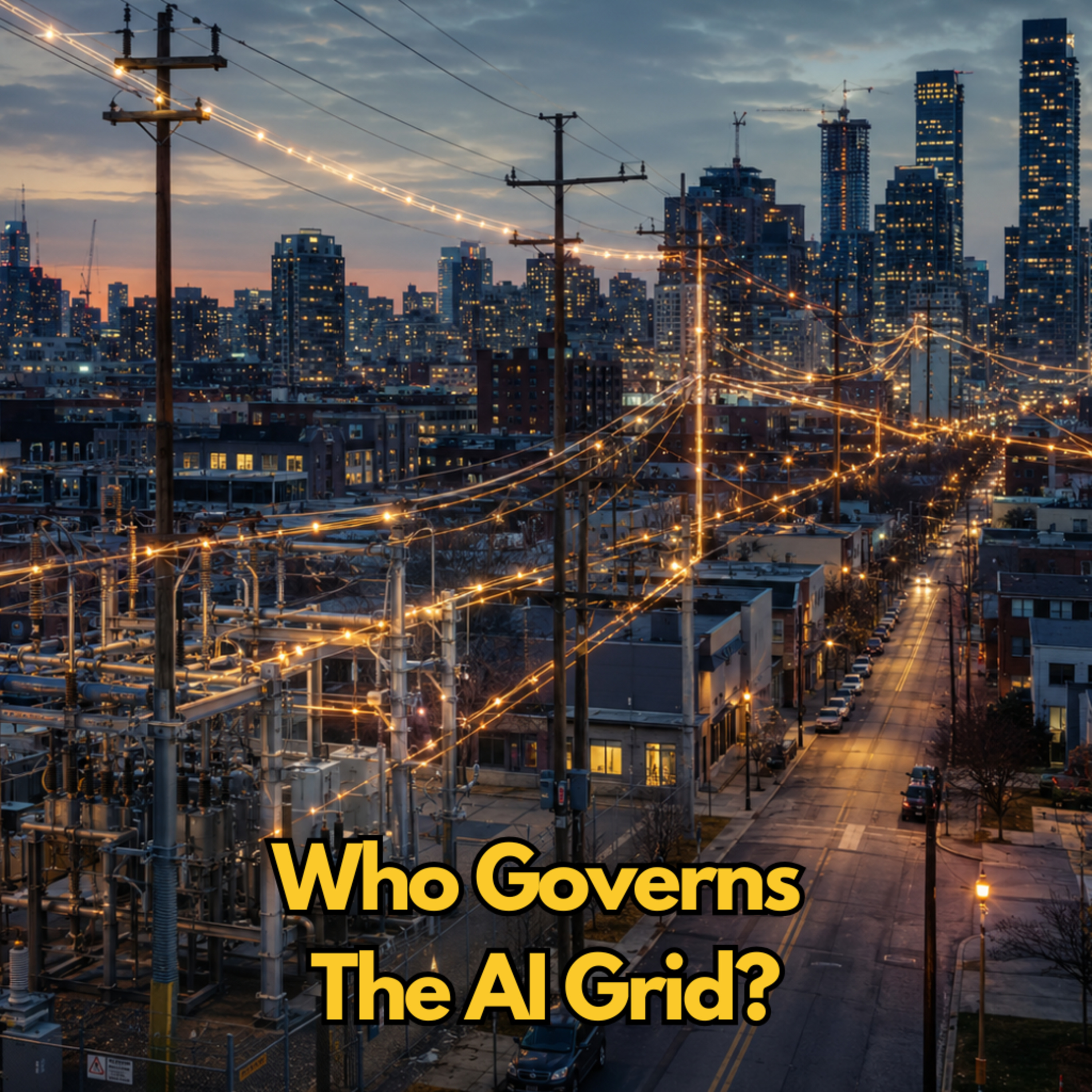
The AI Grid Conundrum
Jun 2000:27:51Tap to summarizeElectricity gives us a useful way to think about AI governance. Power is experienced locally. People care where the plant is built, how much the bill costs, who gets service restored first, and what risks their community absorbs. But electricity also depends on a grid that stretches beyond any one town or state. Local choices matter, yet no community can pretend the system ends at its border.AI is beginning to take on that same shape. A school board may want one set of rules for student chatbots. A hospital network may need another for diagnostic tools. A state may want strict limits on automated hiring or child-facing AI companions. Those decisions are local in the sense that the harms are felt locally. But the systems underneath are rarely local. The same foundation models, cloud providers, data brokers, software vendors, and security standards may sit behind thousands of separate uses.That creates a governance problem that neither side can solve cleanly. If every state or city writes its own AI rules, communities keep the power to respond to what they actually fear. They are not forced to accept a distant standard written for someone else’s politics, industries, or risk tolerance. But a patchwork can also make the system harder to inspect, harder to secure, and harder to trust. An AI tool used across hospitals, schools, banks, and employers may end up governed by dozens of overlapping rulebooks while the technical system underneath remains the same.A single national framework has the opposite appeal. It could make audits clearer, liability easier, security stronger, and compliance less chaotic. But it could also erase the places where disagreement matters. Communities do not all face the same risks from AI, and they do not all define harm the same way. A clean grid can become a quiet transfer of power away from the people who live with the consequences.The Conundrum:As AI becomes more like infrastructure, should governance stay close to the communities that experience its harms, allowing different places to write different rules around schools, hospitals, policing, hiring, energy use, and children?Or should AI be governed more like a national grid, with shared standards strong enough to keep a deeply connected system reliable, auditable, and secure, even when that means local communities lose some control over the systems shaping their lives?When AI is experienced locally but built and operated through shared infrastructure, what deserves more weight: the legitimacy of local rulemaking, or the reliability of one common system?
Transcribe →GPT 5.6 vs Fable 5 Faceoff
Jun 1901:02:42Tap to summarizeThe episode opened by marking Juneteenth and episode 750 of The Daily AI Show. The hosts discussed three major AI updates: GPT 5.6 rumors, Claude Code artifacts, and Perplexity Brain’s agent memory system. They then debated model access, benchmark usefulness, Google’s position, Fable’s expected return, and whether new models are becoming too efficiency-biased for complex agent work. The back half focused on HTML artifacts, Codex record and replay, browser automation for legacy software, and why practical AI deployment often means building simple tools instead of forcing users into agent workflows.Key Points Discussed00:00:18 Juneteenth and Episode 750 Opening00:02:04 GPT 5.6, Claude Artifacts, and Perplexity Brain00:03:42 Claude Code Artifacts and HTML Interfaces00:09:17 Perplexity Brain and Agent Memory00:13:38 Perplexity Model Access and Credit Friction00:19:38 GPT 5.6 Rollout and OpenAI Hiring00:23:20 Google, Fable, and Model Release Timing00:27:04 Benchmarks Versus Real Workflow Results00:33:21 Karl Yeh Joins the Discussion00:39:01 Beth’s HTML Facilitation Board Demo00:45:02 Codex Record and Replay00:48:05 Codex and Chrome for Legacy Software00:54:08 AI Automation for SME Systems00:57:04 Simple Apps Versus Forced Agent Workflows01:02:13 Wrap-Up and Weekend Build PromptThe Daily AI Show Co Hosts: Beth Lyons, Andy Halliday, Karl Yeh
Transcribe →What Are AI Harnesses And Why Do They Matter?
Jun 1801:03:33Tap to summarizeThe episode opened with Midjourney Medical, an ultrasonic scanning concept aimed at making preventative full-body imaging faster, cheaper, and more spa-like than traditional MRI workflows. The hosts then discussed preventative medicine, GLP-1s, OpenAI’s leaked financials, and the pressure that cheaper Chinese models could put on frontier AI business models. The middle of the show focused on model harnesses, Claude Design, Replit integration, and how the software layer around AI models is becoming as important as the model itself. The episode closed with DeepSeek’s state-backed cap table, Codex reset updates, and Brian’s first hands-on review of Sakana Marlin’s strategic research output for AI-native company planning.Key Points Discussed00:00:15 Opening and Community Welcome00:02:33 Midjourney Medical Surprise00:12:36 GLP-1s, Food Noise, and Preventative Health00:19:05 OpenAI Financials Leak00:20:57 Chinese Models Challenge Frontier Pricing00:26:07 Claude Design and Replit Integration00:31:31 Defining AI Harnesses00:44:24 DeepSeek Funding and State Control00:46:14 Codex Reset Bank Update00:47:13 Sakana Marlin Research Test00:57:53 AI-Native Company Roadmap01:02:48 Wrap-Up and Newsletter NotesThe Daily AI Show Co Hosts: Brian Maucere, Beth Lyons, Andy Halliday, Karl Yeh
Transcribe →AI Consciousness, Cursor, and World Models
Jun 1701:11:58Tap to summarizeThe episode opened with Brian Maucere describing internal AI command center work at Scaled, including a “chief of staff” agent for consultants and project managers. The hosts then discussed usability, AI systems architecture, token governance, and how AI work is shifting from prompting to operational design. News topics included Odyssey’s world model funding, XAI and SpaceX’s Cursor acquisition, cheaper Chinese coding models, Adobe creator survey results, AI-generated film trailers, Cursor’s potential GitHub competitor, and BitTorrent’s decentralized inference network. The AI in Science segment focused on consciousness research and the move from judging behavior to evaluating underlying mechanisms in animals and AI systems.Key Points Discussed00:00:18 Opening and AI Science Day00:01:04 Brian’s AI Chief of Staff Agent00:08:32 Usability QA and AI Systems Governance00:13:55 Odyssey Raises For World Models00:16:15 Cursor, XAI, and Coding Agents00:17:38 Chinese Models Challenge Frontier Pricing00:27:46 SpaceX Stock and Valuation Debate00:30:13 Adobe Creator AI Survey00:36:20 Feature-Length AI Film Trailers00:42:17 Cursor’s GitHub Competitor00:45:19 BitTorrent Decentralized AI Inference00:49:36 AI in Science: Consciousness Tests01:04:42 Future Projects and Creative AI Tools01:11:08 Wrap-Up and Community NotesThe Daily AI Show Co Hosts: Jyunmi Hatcher, Andy Halliday, Brian Maucere
Transcribe →