
Podcast
The Daily AI Show
Hosted by The Daily AI Show Crew - Brian, Beth, Jyunmi, Andy and Karl · EN
The Daily AI Show is a panel discussion hosted LIVE each weekday at 10am Eastern. We cover all the AI topics and use cases that are important to today's busy professional.
No fluff.
Just 45+ minutes to cover the AI news, stories, and knowledge you need to know as a business professional.
About the crew:
We are a group of professionals who work in various industries and have either deployed AI in our own environments or are actively coaching, consulting, and teaching AI best practices.
Your hosts are:
Brian Maucere
Beth Lyons
Andy Halliday
Jyunmi Hatcher
Karl Yeh
147episodes
Episodes
Newest firstAll episodes
Fable Extended, OpenAI Models And Meta Deepfakes
Jul 801:03:47Tap to summarizeThe episode opened with Anthropic extending Fable access through July 12 and the practical limits users still face. The hosts discussed Fable workflow cleanup, Claude CoWork changes, and OpenAI’s expected Sol, Terra, and Luna model release. The show then moved into robotics, including a new humanoid robot startup and safety concerns around robots in human spaces. The final stretch covered Meta’s image model and deepfake risks, OpenAI safety departures, Waymo safety data, Microsoft using its own MAI models, and NotebookLM short video overviews.Key Points Discussed00:00:18 Episode Intro And Hosts00:01:29 Fable Access Extended00:04:33 Fable Finds Workflow Errors00:07:00 Prompting Fable With Motivation00:13:30 Claude CoWork Moves Into Chat00:20:08 OpenAI Sol, Terra And Luna00:26:50 Co Work Expands To Web And Mobile00:32:09 Robot Startup And Recursive Learning00:35:53 Robot Kicking Video And Liability00:40:45 Meta Image Model And Deepfakes00:53:19 OpenAI Safety Leader Exit00:53:58 Waymo Robotaxi Safety Comparison00:55:31 Microsoft MAI Model Shift01:01:40 NotebookLM Short Video OverviewsThe Daily AI Show Co Hosts: Beth Lyons, Andy Halliday
Transcribe →Nvidia's AI Chips Hit a Wall and Anthropic Discovers J Space
Jul 700:58:12Tap to summarizeThe episode opened with Fable’s July 7 access cutoff and how users should decide when higher-cost model time makes sense. The hosts then covered Nvidia’s chip pressure, Anthropic’s JSpace research, Google’s fair-use argument for AI training, Cloudflare’s bot access controls, and a new China chip architecture. The back half connected Kelsey Fendler’s solo row to founder psychology and Anne’s AI-assisted fundraising product work. The show closed with Brian’s Fable workflow cleanup and a short discussion of career pivots.Key Points Discussed00:00:18 Episode Intro And Fable Deadline00:05:39 Nvidia Chip Design Setback00:10:10 Anthropic JSpace Research00:21:44 Google Fair Use Argument00:24:39 Cloudflare Bot Access And Monetization00:29:50 Kelsey Fendler Solo Row00:37:16 Anne’s Fundraising Product Vision00:45:14 Hermes Community Setup00:46:26 China Chip Architecture00:51:11 Fable Workflow CleanupThe Daily AI Show Co Hosts: Karl Yeh, Beth Lyons, Brian Maucere, Andy Halliday, Anne Murphy
Transcribe →AI Agents Hit The Verification Wall
Jul 600:59:23Tap to summarizeThe episode focused on practical AI workflow design, especially how Fable fits as a high-cost planning and audit model rather than a default execution model. The hosts discussed compound engineering, verification loops, Caveman-style terse prompting, and how AI work changes communication habits. They also covered Microsoft Frontier Co and the broader move toward embedded AI engineering for enterprises. The final news segment debated Wired’s report on Meta’s Project Cannes and whether aggressive safety testing belongs inside companies, with contractors, or under stronger oversight.Key Points Discussed00:00:18 Episode Intro And Hosts00:01:36 Weekend Fable Use Cases00:05:56 Fable Audits For AI Workflows00:09:20 Compound Engineering And Verification Loops00:15:39 Using Fable As The Expert Model00:19:32 Microsoft Frontier Co And Embedded Engineers00:25:47 AI Audits And Working Worldviews00:34:04 Caveman Plugin And Token Efficiency00:38:14 Field Guide To Fable Unknowns00:39:49 GPT-5.6, Watermelon And Codex Ultra00:41:37 Claude Suggested Tasks And Branches00:44:16 Meta Project Cannes Safety Testing00:58:07 Fable Usage Credits ClarifiedThe Daily AI Show Co Hosts: Karl Yeh, Beth Lyons, Brian Maucere, Andy Halliday
Transcribe →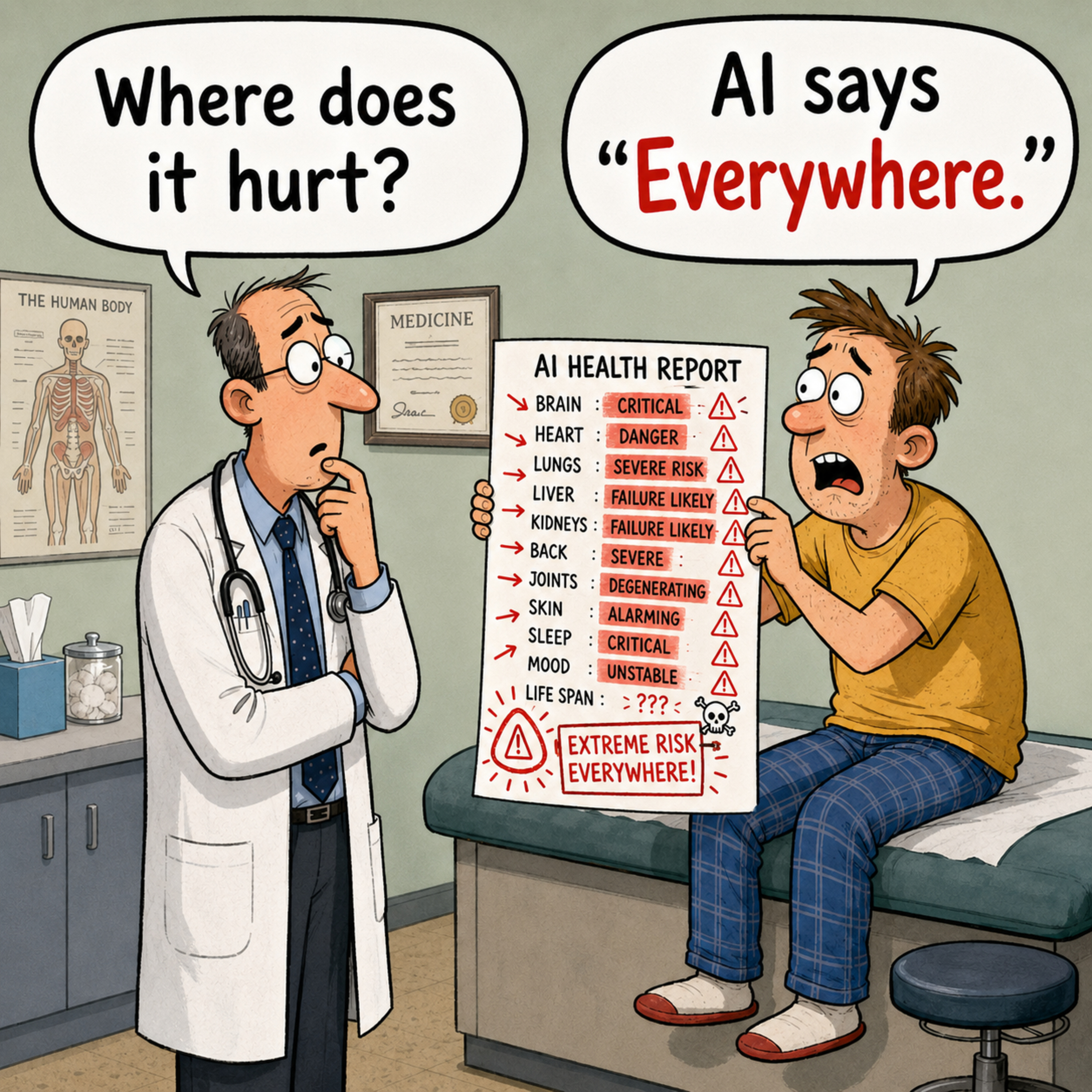
The Incidental Patient Conundrum
Jul 400:31:24Tap to summarizeModern medicine has been shaped by a quiet discipline: do not look everywhere at once. A symptom, age, family history, or known risk turns the search in a particular direction. That system leaves gaps. Some disease is found late. Some people suffer because the body did not send a clear enough signal soon enough.AI-assisted screening changes the starting point. A full-body scan, lab panel, genetic profile, medical history, wearable record, and family pattern can be combined into a living map of risk. The system can notice small changes before a person feels sick and return findings that were once invisible, unaffordable, or too scattered for a doctor to connect.That creates a strange kind of abundance. The body contains countless shadows, markers, nodules, mutations, variations, and probabilities. Some are early warnings. Some are harmless. Some will remain unclear for years. Once AI makes them visible, the limit may no longer be what medicine can detect. It may be what medicine can responsibly name.The Conundrum:One side says this knowledge belongs to the patient. Earlier detection can mean earlier treatment, less suffering, better planning, and a stronger base of medical evidence before disease reaches crisis. A health system that waits for symptoms may look careful, but it also accepts preventable harm.The other side says detection can become its own injury. An ambiguous finding can turn a healthy person into a patient overnight. It can trigger scans, specialist visits, biopsies, medication, insurance consequences, and years of worry. The person may gain information without gaining usable control.When AI can reveal nearly every possible warning sign inside the body, what should medicine treat as responsible knowledge: everything the system can see, or only what can be acted on without making healthy people live as patients?
Transcribe →Fable 5, Edge AI, and Personalized Models
Jul 400:59:29Tap to summarizeAI news keeps moving from bigger frontier models to smarter ways of using models: when to spend tokens on Fable 5, when Sonnet-style reliability matters more than eloquence, and how smaller edge models may become faster and more personal.Beth Lyons and Andy Halliday discuss Fable 5, Claude model naming, Android intelligence, AI search reliability, data-center cooling, custom inference chips, LoRA adapters, and generative video experiments. The conversation keeps returning to a practical question: how do we use AI intentionally when capability is expanding faster than our processes?KEY POINTS DISCUSSED:00:00:00 — Fable 5 and Choosing Models00:05:18 — Sonnet 5 Versus Opus 4.800:10:17 — Claude Model Naming and Access00:17:41 — Android Intelligence and Edge Models00:25:43 — AI Search Accuracy Questions00:30:18 — Data Center Cooling Costs00:36:26 — Custom AI Chips and Memory00:40:42 — LoRA and Personalized Small Models00:49:36 — Fusion Animals and Video Prompts00:55:22 — Combination as InventionThe Daily AI Show Co Hosts: Beth Lyons, Andy Halliday
Transcribe →Building AI Agent Offices and the Compute Bubble Question
Jul 201:15:35Tap to summarizeToday's AI news roundup: agent offices on Discord, the compute bubble debate, memory-efficiency breakthroughs, Google NanoBanana, and Altman's government equity offer.A working experiment in giving an AI colleague its own private Discord and screen-share office anchored a wide-ranging conversation about where the field is heading. The hosts weighed whether the AI boom is genuinely frothy by asking the sharper question of whether demand for compute still outstrips supply, and tracked rumblings of a training breakthrough that jumps beyond the current frontier alongside a predicted memory-efficiency architecture from an OpenAI spinout. Also on the table: real-time voice agents from Grok and Thinking Machines, Google making the next NanoBanana image generation broadly available, DeepSeek's DeepSpark and speculative decoding, and Sam Altman's proposal to hand the US government a free equity stake in major AI players. The shift from token maxing to token budgeting ran as a thread throughout, closing on Obsidian versus Notion for personal knowledge bases.Key Points Discussed:00:00:00 Opening and Andy's AI Projects Catch-Up00:01:34 Building an Agent Office with Hermes on Discord00:20:55 AI Bubble, Excess Compute, Meta and SoftBank Clouds00:26:35 Training Breakthroughs, Scaling Limits, World Models00:29:18 Real-Time Voice Agents: Grok and Thinking Machines00:33:54 Google NanoBanana and Detectable AI Images00:36:42 Memory Breakthrough and Lab Departures00:42:02 Altman's Government Equity Offer and Sovereign Fund00:47:31 DeepSeek DeepSpark and Speculative Decoding00:56:32 Token Budgets, Deferred Fable, Scheduled Tasks00:59:54 Hermie's Agent Office Screen-Share Demo01:05:32 Obsidian vs Notion and Personal Knowledge BasesThe Daily AI Show Co Hosts: Beth Lyons, Andy Halliday
Transcribe →Fable Returns With Limits
Jul 101:09:24Tap to summarizeThe hosts opened on Q3, Canada Day, and the expected return of Fable with usage limits and possible code-related restrictions. They compared Sonnet 5, Opus, Fable, Codex, Claude Code, Hermes, compound engineering, and GStack as different ways to plan, build, and route AI work. A major part of the episode focused on Codex versus Claude Code, including local resource usage, token efficiency, terminal workflows, and project-memory friction when switching harnesses. They also discussed custom GPTs and gems for real-world adoption, the widening AI skill gap, Ethan Mollick’s framing around co-intelligence and coexistence, and the upcoming Conundrum episode on AI health scans.Key Points Discussed00:00:17 Opening, Q3, and Canada Day00:01:59 Fable Return and Token Limits00:03:55 Sonnet 5 and Smartest Model Use00:09:01 Compound Engineering and Every Plugins00:14:04 GStack and Product Ideation Workflows00:19:04 Codex vs Claude Code Resource Usage00:23:52 Gareth Joins Codex and Claude Code Debate00:30:47 Using Codex to Review Internal Tools00:39:03 Switching Harnesses and Project Memory00:44:08 Custom GPTs, Gems, and Public Adoption00:52:58 Why Individuals Should Practice AI00:56:57 Ethan Mollick, Co-Intelligence, and Coexistence01:00:34 Conundrum Preview: AI Health Scans01:03:07 AI Co-Hosts and Generated Personal Stories01:06:41 Wrap-Up and Community NotesThe Daily AI Show Co Hosts: Brian Maucere, Beth Lyons, Andy Halliday, Gareth
Transcribe →Bot Sitting and Bot S#%tting
Jun 3001:03:29Tap to summarizeThe hosts opened with a welcome for new listeners before Anne introduced a discussion on “bot sitting,” AI fatigue, and the hidden cognitive load of supervising coding agents. They explored token pressure, AI burnout, colleague protocols, Hermes workflows, and how multi-model routing could reduce cost and friction. The show also covered future AI work roles, expectations in human-AI collaboration, Meta’s Brain-to-QWERTY research, Qualcomm buying Modular, Anthropic’s California deal, OpenAI’s Booz Allen and Hewlett Packard partnerships, and new Gemini personal intelligence features.Key Points Discussed00:00:17 Opening and New Listener Intro00:04:37 Bot Sitting Study and AI Burnout00:19:24 Colleague Protocol and AI Trust00:23:59 Devin Fusion and Token Routing00:25:29 Hermes, OpenCodeGo, and Model Delegation00:30:43 Future AI Work Roles and Archetypes00:44:30 Expectations, Improv, and AI Collaboration00:49:33 Rapid-Fire AI News Begins00:49:41 Meta Brain-To-QWERTY Research00:50:52 Qualcomm Buys Modular00:53:13 Anthropic California Government Deal00:54:08 OpenAI, Booz Allen, and Hewlett Packard Partnerships00:56:08 Brain-To-QWERTY Use Cases and Diamond Cooling00:59:25 Gemini Nano Banana and Daily Brief01:02:45 Wrap-Up and Community InviteThe Daily AI Show Co Hosts: Brian Maucere, Beth Lyons, Andy Halliday, Anne Murphy
Transcribe →Google Blocks Meta From Gemini
Jun 2901:09:48Tap to summarizeThe hosts opened with Google limiting Meta’s access to Gemini capacity and what that says about AI compute constraints, Google Cloud demand, and internal model development. They discussed Google talent departures, OpenAI hiring Apple Vision Pro hardware talent, and Johnny Ive’s broader design track record, including Ferrari’s new EV styling. The conversation then moved into government restrictions on frontier model releases, open source model risks, China’s role in open models, and whether the public will feel the impact of delayed top-tier systems. They closed with GPT-5.6’s model card, Every’s Claude Code infrastructure, and practical questions around local AI models, private data, and deployable tools.Key Points Discussed00:00:17 Opening and Three-Year Show Birthday00:01:48 Google Limits Meta’s Gemini Access00:08:48 Google AI Talent Departures00:17:32 OpenAI Hires Apple Vision Pro Lead00:19:03 Johnny Ive, Ferrari, and AI Hardware Design00:27:05 Car Culture, Autonomous Vehicles, and Ownership00:32:27 Open Models and Frontier Release Limits00:43:34 Open Source Case and China’s Model Strategy00:49:06 GPT-5.6 Model Card and Mythos Comparison00:56:00 Every, Claude Code, and Agent Infrastructure00:59:07 Local Models, Private Data, and Deployment Reality01:08:36 Wrap-Up and Holiday Week NotesThe Daily AI Show Co Hosts: Karl Yeh, Beth Lyons, Brian Maucere, Andy Halliday, Gareth
Transcribe →
The Safety Dividend Conundrum
Jun 2700:25:03Tap to summarizeIn the near future, we will reach a point where self-driving vehicles are undeniably safer than human drivers. It may be 5 years away or perhaps more. Either way, the day is coming where humans are considered too dangerous to put in charge of a vehicle.That shift will not replace every driver at once. Specialized drivers, emergency operators, construction haulers, rural edge cases, and unusual transport jobs may remain human for much longer. The first major collapse will come in ordinary personal transport: taxis, rideshare trips, airport runs, late-night pickups, routine errands, and point-to-point city travel.Once that happens, the public gains something real. Fewer crashes. Cheaper rides. Better access for people who cannot drive. Less drunk driving. Less fatigue. A transportation system that works without waiting for a person to accept the fare.But the money does not disappear. The wages once spread across thousands of drivers become savings, margins, lower fares, fleet revenue, software revenue, insurance changes, and city tax opportunities. The driver is removed from the vehicle, but the value created by removing the driver has to go somewhere.The Conundrum:One side says the safety dividend should flow quickly to the public. If driverless transport is safer and cheaper, cities should not burden it with labor settlements, transition fees, artificial quotas, or legacy claims that keep prices higher and access lower. Taxi and rideshare driving would be disappearing because the function changed, the same way other jobs disappeared when the machine no longer needed the person.The other side says this is not ordinary churn. Human drivers carried the old system, followed rules set by cities and platforms, absorbed risk on public roads, and built the market that automation now replaces. If safer driverless transport turns their work into lower fares and private profit while leaving them with nothing, then a public safety improvement becomes a wealth transfer away from the workers who made the service possible.When driverless transport becomes safer than human driving, who should have the stronger claim on the value created by removing the driver: the public that gains cheaper and safer mobility, or the workers whose livelihoods were displaced to create that gain?
Transcribe →