← The Daily Beans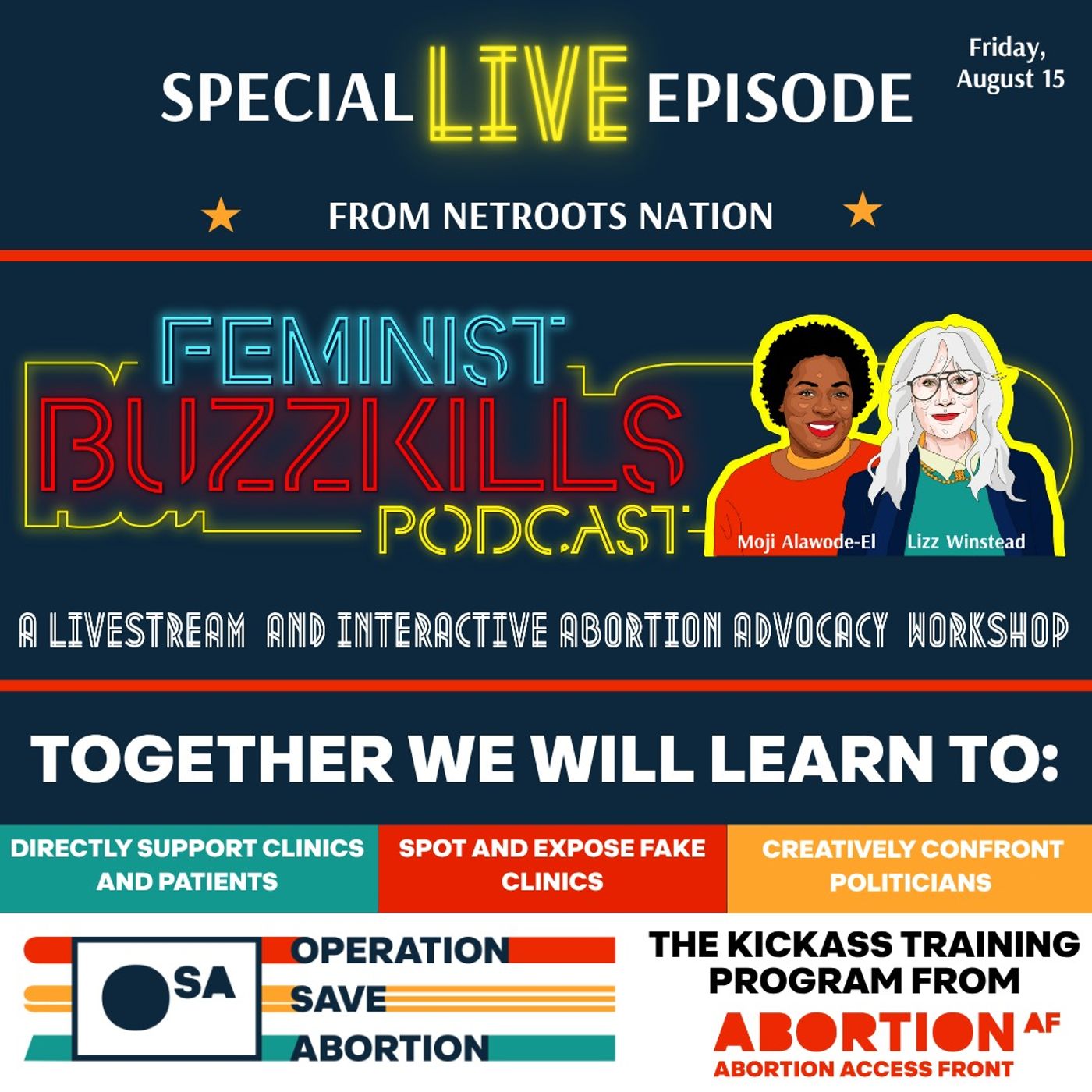
The Daily Beans
Operation Save Abortion at Netroots Nation 2025 With Abortion Access Front
00:27:50
This week FBK brings you Operation Save Abortion! It’s a Podcast! It’s a Workshop! It’s a combination podcast workshop! A Podshop if you will! Your Feminist Buzzkills took some big patriarchy-smashing heat to The Big Easy and recorded a live episode that dropped some knowledge and trains you up to keep fighting against the anti-abortion machine. Lizz and Moji joined forces with AAF’s Head Writer Alyssa Al-Dookhi, Programs Manager Sherill Dingle, and Programs Director Kristin Hady to drop their knowledge. They give you the scoop on abortion doulas, how to hold anti-abobo lawmakers accountable, how to spot fake clinics before they trap you, AND drop your marching orders on exposing anti-abortion lies no matter where you live! Gather your partners in resistance and tune in for the tools, tactics, and firepower you need to fight forced birth fascists at every turn. P.S. You can still join the 10,000+ womb warriors fighting the patriarchy by listening to our PAST Operation Save Aborti...
Loading summary
Transcript102 lines
- [00:00]
A
MSW Media. Hey, everybody. This Feminist Buzzkills episode is a game changer. I know we're navigating a firestorm of fascism, often just sitting with the overwhelming helplessness that it brings. But one of my favorite nonprofits, Abortion Access Front, creates activities and actions you can take that are fun, meaningful, and directly support those most harmed by the laws and executive orders stripping away our humanity. So if you're looking for ways to go beyond marching and donating, listen to listen up. This special episode of Feminist Buzz Kills walks you through amazing opportunities to turn your rage into direct support for abortion providers and the patients they serve. You will feel better knowing you can help. So give it a listen and let's do it together.
- [00:44]
B
Finally, the day is here. It's the episode we've been promoting for months on the pod. Moji and I are live from Metros Nation in New Orleans, turning this broadcast into an Operation Save Abortion session in both audio and video format.
- [00:57]
C
It's time to train you up with members of our AAF programs in comps Team team on some of the most meaningful actions we do with our volunteers.
- [01:04]
B
This show's kind of a two parter. First up, you're gonna learn about the emotional toll these laws and abusive assholes actions take on abortion providers and patients.
- [01:13]
C
Then part two, if you're prepared for the workshop, you can head over to the abortion access front YouTube channel, start the video and get to work.
- [01:20]
B
But if you need some time to prepare for the workshop because you didn't know there was homework, head over to operationsaveabortion.com, download the toolkit, which has everything you'll need to do the training. Once you're prepped, go over to our YouTube channel and get started.
- [01:34]
C
With that said, live from Netroots Nation, it's Feminist Buzzkills presents Operation Save Abortion.
- [01:42]
B
Without further ado, please say hello to our programs director here in the green jacket, Ms. Kristen Haitie.
- [01:47]
D
Hello. Hello.
- [01:50]
C
And also I'm happy to introduce our program's manager, Cherelle Dingle.
- [01:57]
B
And in a few minutes, we'll be joined by our AAF head writer, and we call them Dukes. It is Alyssa El Dukey who's going to talk about direct action. So give Alyssa, Kristin and Sherrelle welcome. Let's get into it.
- [02:11]
C
Sherrell, you've been on the ground working with providers for 10 years. What have you been hearing from the clinics you work with about how these terrible laws are affecting the morale and the burnout for the staff?
- [02:22]
E
Oh, so much. Ten years is a long time.
- [02:25]
B
Yeah, yeah.
- [02:26]
E
But What I've been hearing is a lack of community support. You know, they're supported by their community. They see just a lot of negativity around. They don't feel that that support and love and then obviously lack of funding. The funding is scarce and few and that leads to not enough staff. Right. The funding not to staff these clinics and. And have that support and then also not be able to get basic services just simply like painting and fixing a fence or fixing the door or anywhere from fixing a window just because again, they have to focus on providing abortions or focus on their actual patients. So just little minute things like that.
- [03:10]
B
And I think a lot of times they can't get those services too, because people will have their businesses protested.
- [03:16]
D
Yeah.
- [03:17]
B
If they are the landscaper in front of a clinic, if they are the plumber in front of a clinic. And so they have no way to get just basic, I need my roof fixed. And if a roofer shows up, they're screwed. So we were like, hey, let's find some roofers and help.
- [03:32]
E
Yeah, yeah, yeah. We had a situation like that where we had to, you know, make sure a clinic was looking for a new air conditioning unit. And we had to make sure whoever would replace that, those persons were vetted and safe to come in the actual clinic. And they were pro abortion and things like that because again, you get some random and they come in the clinic and it's not safe.
- [03:54]
B
And I think too, Kristin, I want to talk to you a little bit about the escalation, but I also want to talk a little bit about the profound and repeated assault on abortion care means that the anti abortion movement is defining who they are and what they do.
- [04:11]
D
And.
- [04:12]
B
And that really adds to the isolation. They don't feel safe to come out and correct the record. And they'd love to invite people into their clinics to say, come have a tour, see what we do. But like, trying to be able to do that safely is really hard.
- [04:25]
D
Yes. Every abortion provider we know is incredibly proud of the work that they do and the patients they serve as they should be because they're doing incredible work. But all of these barriers exist on top of everything that's still happening. The worry of a national abortion ban, their care being criminalized. There are providers that genuinely don't feel like they can talk about it anywhere, not just because of societal stigma, but because you might be arrested if you go to another state. They are worried about walking off of the plane in a state that they don't feel safe and not making it back Home. And that really is. It's a paralyzing fear. Yes.
- [05:07]
B
Yeah. So with this administration, it's gotten like five bazillion times worse. But this escalation of violence at clinics has been happening forever. It happened when we had Roe. It happened when we had Roe, when ROE was like, at its, like, most accessible. But now that the January 6th people are basically the same people that are outside those clinics. Kristin, talk a little bit about what the violence looks like outside of the clinic and how it's escalated.
- [05:34]
D
Nearly every abortion patient that walks into a clinic is going to have to walk a gauntlet of anti abortion protesters. These people might have amplification megaphones, giant signs. They will yell at them, approach their cars, harass them to the best of their ability. And that's just normal, everyday violence that patients have to deal with. But we are looking again at clinic invasions and blockades where we really saw the legs cut off of that movement in the early 90s. But we are seeing anti abortion protesters go inside abortion clinics and harass patients. The goal is always to shut things down for the day. They will sit outside and they will block access to clinics, which not only stops anyone from going in, but it also stops anyone from leaving. And that's not even the vandalism in the damage. Just this week, literally this week, we have stories of a clinic invasion and someone going through and smashing out windows in another clinic. This is what happens every day. So I'm from Ohio and I will say we. A few years ago there was a clinic invasion. It's something called Red Rose rescue. And multiple people went inside this clinic and occupied it until the staff realized and police were called. And there was a moment where one of the anti abortion protesters, he stood up and they were in regular garb. They don't want to be identified. He opened his bag and he pulled out a rope. And so the rope itself was just for his outfit. He was a priest of some sort. But the provider that talked to me about that, can you imagine that feeling of these people come in? There's always been violence and murder and harassment in this movement. And they stand up and pull out a rope. It's terrifying. And it got so bad that we saw Chart face charges, which is the freedom to access clinic entrances. 23 people were charged, not and indicted.
- [07:41]
C
They weren't just charged, they were indicted. They were convicted. They were tried by their peers.
- [07:46]
D
Yes. And some.
- [07:47]
C
And were. Some of. Some of them were serving sentences.
- [07:49]
D
Yep. And some of them, some of These charges took 4, 4 years to get if you can imagine from the invasion four years later, Trump pardoned them all. And so that sends the message both to providers that we don't care about you or your safety, but it sends that to the protesters too and basically says do whatever the hell you want.
- [08:10]
B
Yeah, and a provider that we work with a lot. I'll never forget talking to her and she invited us to her house for lunch and big beautiful windows in her home. And I said, you know, it's astounding. You have these beautiful windows and I know you're under attack and you don't have any curtains on your windows. And she said to me matter of factly, it's because if they try to kill me, I want to make sure they get me and not my kids. So that's the kind of day to day life that these folks are living in.
- [08:43]
D
And.
- [08:43]
C
And come on, doesn't this sound overwhelming and really demoralizing? AAF is trying to meet the needs to support staff and patients. And Sherrell, can you tell folks what kind of help providers have asked for?
- [08:55]
E
Anything that we could see their humanity bring relaxation, things that we often take for granted or we do on our own day to day, you know, self care and think about ourselves. They don't really think about that. We say don't take care of work home. They take it home every day, all the time, on the weekend, even when we're not thinking about it on holidays, they're thinking about their patients and the clinic. So, you know, anything. And then also providers deserve more than survival, right? Survival mode. More than just I'm fighting every day, day to day, just to survive.
- [09:32]
C
Yeah, we all deserve to thrive. Not just survive, survive. So we are going to show you some of the stuff that we've done and when you work with us, we can help you recreate in your community. Let's start with you, Kristen.
- [09:43]
D
One of the things that AAF has done because really clinics need a million different things, a million different ways of support. But as Sherrelle mentioned earlier, sometimes they literally can't find people to do the work. So AAF has gone to a clinic and put landscaping in. They dug everything old out, they bought it, they brought it in, like muscling this shit around as you can see behind us.
- [10:09]
B
But I wanted to say too, with that example here, the thing that's cool about it is that we really need to beautify our property. But there was a secondary goal here, and that is so Huntsville passed a law that the clinic couldn't erect a fence to block out the protesters. And so the protesters would just sidewalk to. But what they didn't have a law about was planting really tall bushes. So we waited for the protesters to leave and it was like 9 million degrees, but we planted these massively tall bushes. So when those assholes had to come back the next day, their shit was blocked. It was really great. It was like a really great workaround.
- [10:50]
C
We felt really good about that.
- [10:51]
D
Sneaky.
- [10:51]
E
Sneaky. We love sneaky.
- [10:54]
C
Sherrelle, can you talk about another example of some really great work we've done?
- [10:57]
E
Yeah. So one clinic, actually I'm from Baltimore, Maryland, in Baltimore, Walpeege county adjacent. They, the providers went to like a doctor's conference of some sort. And they were like, yeah, we experienced this wellness with puppies. And it's made to de stress the staff. So that's what we did. We brought puppies to the staff and had a puppy party. We had a puppy party. It went well. We brought like bagels and coffee and everything. But the puppies like cuddled with the staff and they were loving on them. And it was just a moment of again, just to get away their mind from what they are focusing on now.
- [11:38]
B
Animals have no judgment. They are literally just the best as far as like the cuddling. And I just want to say too that sometimes things seem so small, but they mean so much. And I think that's part of our advocacy where whatever your abilities are, whatever your capacities are, whatever your, you know, maybe you don't have a lot of money, you know, we want to make sure that we are engaging with people. And this final thing that's up on the, on the board here is this is in Hartford, Connecticut. There was a. It was like an old timey series of small buildings that was like an office park with. It was like cobblestone. And there was an actual abortion provider. And within two arm's lengths away, right before you got to the actual clinic was one of the fake clinics, which we'll talk about in a little while. And they were like, we are so hosed because they are just before we get to them. The real clinic I think is called like Harvard's Women's center. And the fake clinic was called like Hartford center for Women. You know, just like the whole thing was a mess. And they're like, can you help us figure out a way that our patients aren't fooled because those people are right before us. So what we did was we painted a yellow brick road to the actual clinic. And so when the patients would call, they would go, okay, when you come in just follow, follow the yellow brick road. So whatever bullshit was happening, they could do that. Right. But it's like that's the kind of gumption and ideas that like regular folks like, can help do. And it makes a world of difference for everybody.
- [13:13]
D
Yes.
- [13:14]
B
Yeah.
- [13:14]
D
That might be one of my favorites.
- [13:16]
C
It is absolutely one of my favorites. It is so simple, so impactful.
- [13:20]
B
It's really good. And Sherelle, you play a wonderful role in the life of patients because you are full spectrum doula. And a lot of people might not know that in the scope of full spectrum doula ing, there are abortion doulas. And abortion doula is a training program that many of you can do in your communities. But would you talk a little bit about what an abortion doula provides for a patient and what you've learned from the patients?
- [13:45]
E
Yeah. So we provide non judgmental support, practical support, emotional support, or physical support. And that could look like a portal, but it could be before, during, or after or all three the abortion. And what I have learned through my doula journey so far is kindness goes a long way. Kindness just being that consistent support, consistent face, and showing up for someone, really showing up right consistently and being that pillar of the community that folks are looking for in a time that may be stressful, that may not be, but that they're going through something and you can be that person for them. It goes a long way. And sometimes we are the first moment of compassion that they come in contact with throughout the whole abortion process for them. So, you know, just knowing that you can play that role and you can do that for them, I think that means the most to me and my work so far.
- [14:48]
B
Great. Yeah.
- [14:49]
C
And it's really important to provide this emotional support for patients because there's a lot of emotional tolls that come with traveling and gathering resources and all the things you need to do to access abortion if it's not available in your state or if it's just not in your city. Kristin, can you talk a little bit about these sort of tolls?
- [15:07]
D
Yeah. So in addition to the wonderful work I do with aaf, I'm also on the board of my local abortion fund, the Aggie Fund. Woo. And one of the really difficult things is what patients have to go through to get there. So abortion itself is often out of reach monetarily for patients, and that's why abortion funds exist. But because of the incredible demand, we have 14 states who now do not have legal abortion access, and those patients all have to go somewhere. The providers are seeing increased demand near there, and patients are going, and they're finding that abortion funds don't have the money that they did before. So maybe it's not. I get funding from one abortion fund. I now have to contact this one. That's part of my money, and then this one that's the other part. And when you have minimal resources to begin with, the stress of having to ask so many people for help, I mean, to be honest, it's. It's bullshit. And nobody asks strangers.
- [16:17]
B
You have to ask strangers for help and explain your situation over and over again. And I think that is an unspoken thing that happens so much. And, Sherrelle, I wanted you to weigh in a little bit here on that too, where to talk about, like, where sometimes I think folks who want to help when it comes to helping people travel for their care and they think, I'd love to have somebody stay in my home. It sounds good on its face. But talk a little bit about why providing autonomy for an abortion patient is really the goal that we should be trying to work.
- [16:49]
E
Yeah, absolutely. Because it puts a unspoken pressure of, okay, you want me in your home, but now I have to talk to you. I might have to have dinner with you if you extend. And I don't want to be mean or perceived as mean. And you didn't open up your home to me, and now that this. And now we family and I guess. I don't know, I just had a. I just had all these things happen and I don't know. So it's just that unspoken pressure, that unspoken feeling like, okay, I already don't have control over the funding or I already don't have control over how I'm trying to navigate things because I need support and I need help. I also don't want to again come off or be perceived as mean, even though I know your intentions are. Well, I know your intentions are to be supportive or whatever the case may be, but that's not necessarily the impact. And, you know, just knowing when to still step up but also step back.
- [17:45]
B
Right?
- [17:46]
F
Yeah, yeah.
- [17:47]
C
Or support people in ways that preserve their dignity.
- [17:49]
E
Yes.
- [17:50]
C
And that's really, you know, sometimes offering something your home doesn't allow them the space to have the dignity they need during a trying time. And these are the horrifying results of laws that sort of focus on the fetus and the politicians who don't consider the real world impact when they enact these laws. And at aaf, we do a lot of direct action to hold them accountable. And to get to that, Sherrelle's gonna step off for a bit and she'll be back later.
- [18:17]
B
Don't worry. Because.
- [18:18]
C
Joining us now to talk about AAF's direct action strategy is our head writer and good trouble shitster, Alyssa Al, Duki Dukes.
- [18:27]
B
Thank you, Sherrelle. Some love for Dukes.
- [18:37]
D
The one bossing you around to sit at the front table.
- [18:41]
B
Okay, so the last thing we're going to talk about in our overview before we get to the workshoppy part, Dukes, is how much fun we have doing direct action. Because you know what we love disrupting bullshit. So can you talk about some of our tactics in. In how we do it and when we show up?
- [19:02]
F
Yeah. So a big part of what we do, and you may have noticed this from us, is arresting visuals. We really like to be big and in your face. Because a lot of times discussions of abortion are kind of private, of course, or behind closed doors. So big, giant signs is a big part of the work we do. And you can see up here, we've got the magazine covers that we used in front of the Supreme Court and that did a number of things that was able to give information about who on the Supreme Court is fighting against abortion. But also blocked out the protesters on the other side.
- [19:42]
B
Yeah. Cause they always show up with these massive fetus signs. I'm sure you've seen them. They're huge, they're gross. And for decades, our side would show up with, like, pro choice and they have massive fetus signs. It's like, what are we even doing? So why not? If you know what they're bringing to the battle, bring the weapons that can.
- [20:00]
C
Bring the bigger one.
- [20:01]
B
Bring the bigger one. That's right. And the other thing I do love about these that we use often with the Supreme Court is, you know, if you read anything about any of these justices, they're obsessed with their legacies. And we were like, how do we shit on them? And so we thought magazine signs to take each of them and show how the public views them. Which is nice because then when it's in the New York Times, they have to see it and they have to read it. So that makes it really nice when the media picks it up. Yeah. I don't know if you've seen. Through the course of netroots, both Dukes and Moji have been walking around in our Disneyfied abortion pill costumes. Disarming glittery fascinators, oftentimes gloves. Dukes, I'll start with you. Talk about showing up and why showing up. Educating folks about medication, abortion in a sparkly inflatable costume. Has been wildly successful. Well, first of all, y' all loved.
- [20:57]
F
It, and that was great. But also, you know, when we show up in these giant inflatable costumes sometimes, oftentimes it's the first time people are seeing an abortion pill ever. And so we get to own that conversation then. We are gorgeous, we are friendly, we're sweet. You want to hug us, you want to take a picture with us. And you know what's interesting about this weekend is we got more pictures of men with the pill than we had men visit the table.
- [21:28]
B
Oh, what?
- [21:29]
D
That's an everybody observation.
- [21:31]
B
And we know what the psychology of that is. They didn't want to stop by the.
- [21:35]
F
Table, but when you see somebody in costume, they're like, I want to be.
- [21:37]
B
A part of that. Yeah. And also because you guys had a handout that explained what it was, it's not just dancing around being like, hi, hi, hi, I'm the Ariel of abortion. Or is that a Disney thing? I feel like it is. You have a piece of information for them to learn and dispel the myth.
- [21:51]
F
And we just get to reframe the abortion pill as something that is there for you.
- [21:56]
B
So talk about the couple of places that we've shown up, because we not only have the first regimen, there's five pills in medication abortion. There's the first pill, which is called mifeprism, and then you take four pills called misoprostol, and we have the full complement in giant inflatable costumes. So often we'll show up with all of them. But you see us here talk a little bit about where you were in each of these pictures and the effect that you had. Yeah.
- [22:21]
F
So in that picture where we all have our little cute little feet out where I'm the pill, we went to the dnc and you may be wondering, why would you go to the DNC to call people out about abortion? It's because, well, we as progressives need to be talking more about abortion and we need to hold the people who are letting the anti abortion folks get away with this accountable.
- [22:45]
B
Yeah, that's right. They have been too passive and not pro abortion at all. It has been narrowly dealing with their shit. And also, let me tell you what, people are just dumb about abortion pills. And like, I don't care how progressive you are, people still will say to both of you, I know, are you plan B all the time?
- [23:03]
F
All the time.
- [23:04]
C
Also a really fun thing that is helpful. People will come up and say, what are you?
- [23:09]
E
Right?
- [23:09]
C
There's. Are you plan B But there's what are you? And one of the great things about being in an enormous inflatable costume is that you can tell them, oh, I'm the abortion pill. I'm one of four. All of the details that they need to know. The second picture is actually me as the pill at the New York City Halloween parade. And boy, was that fun. We had stickers, abortion AF stickers that were available at our table, the whole netroots, and we were handing them out as treats. Trick or treat.
- [23:33]
B
Here's a treat.
- [23:34]
C
Here's a little abortion sticker, A little information about how abortion pills work. And it also allows people, when they're just chilling, to be like, oh, I've now learned so much more about abortion bills than I had ever known before.
- [23:44]
B
And it's a volunteer opportunity because we're about to transition, which is nice to actually getting into the workshop part. But as a volunteer opportunity, we're always looking for people to be a pill with us. If you are in a city, we are in. But like those posters you're able to download. And it's really fun to join us at scotus and we have SCOTUS robes and to hold those signs and to be there. So it's like really fun to be in community and educating people as well and then be able to have the tools to be able to download them for yourself, print them up for yourself, and do it. So Dukes and Kristen, if you want to weigh in quickly, talk a little bit. Just about like, with all this work, what is it that is fun and why these are meaningful opportunities for activists and volunteers.
- [24:28]
D
It is fun because people have such an incredible reception to you. They're excited to see you. And at the crux of everything we do, direct action, whatever it is, there should always be education. And that is why these actions are so perfect. A giant inflatable pill starts conversations. We, a lot of people realized the miso pills were not soup.
- [24:51]
B
Yes.
- [24:52]
D
And so many people walked away knowing what the actual protocol to a medication abortion is. And in places we are in Louisiana, where there are places that aren't allowed to actually say that, it's so incredibly important to make sure that people have the information to. That they need to make their own choices.
- [25:16]
F
Yeah. And also, you know, this can get really heavy, this work. And there is plenty of work to be done that, you know, we already talked about clinic defense and clinic support, and it gets really scary. But we also have to let people know that this is normal. You can have fun and you can have joy in this process as well.
- [25:37]
D
So much joy.
- [25:38]
B
That's right. And to that end with the joy, you can look this fall for the release of Miffy and the Miso Tones music video. Yeah, we have taken the song I'm Just a Bill and done it to I'm Just a Pill and we're shooting a Josie and the Pussycats type video where they are going to be the pop band that you are going to want to love and know and have at every event. And so that's really fun.
- [26:03]
D
Delightfully absurd.
- [26:04]
B
Let's get to the workshop and get moving on because that's what we're here for quite frankly. Right?
- [26:10]
D
Woo. Thanks Dukes.
- [26:13]
B
Kristin Sherrill Dukes thanks so much for this eye opening conversation and one that lays out so many things we would never learn if it wasn't for AAF and our intimate work with the providers and activists on the ground.
- [26:26]
C
That's a wrap on Part one of the FBK Operation Save Abortion. We hope our Abortion AF team has given you a greater understanding of just how devastating these laws are to the well being of people who need abortion and who provide the care.
- [26:40]
B
We also hope our conversation about the harm mitigation work we do at AAF inspires you to join our workshop over on YouTube so you can learn to engage in some heart to heart activism.
- [26:50]
C
So again, to prepare for the workshop, first go to operationsaveabortion.com download the toolkit and read up on everything you'll need to gather to have a meaningful training.
- [27:00]
B
Once you have that, then head over to our abortion access front YouTube channel and follow along with our step by step instructions for each activity.
- [27:07]
C
Then you'll be on your way to giving of yourself and helping others who are suffering. Waiting till the next election is not the answer. Helping those who need it now empowers you to be the face of humanity we all need to see right now.
- [27:20]
B
If while watching the workshop you find you have questions, please anytime, reach out to programsafront.org and our team will help.
- [27:28]
C
Thanks so much for joining us. You are the change. Start making it.
- [27:33]
D
Feminist Buzz Kills the podcast from Abortion Access Front. New episodes drop Friday when BS is poppin we pop off and if you want to support our podcast and all the work of Abortion Access Front like subscribe and join our patreon@patreon.com feministbuzzkills.