
Podcast
The Diligent Observer Podcast
Hosted by Andrew Kazlow · EN
Helping angel investors see what most miss.
Want more? Get essential angel intel in 5 min with The Diligent Observer Newsletter: your weekly shortcut to vetted deals and expert takes.
https://www.thediligentobserver.com/
https://feeds.buzzsprout.com/2459970.rss
18episodes
Episodes
Newest firstAll episodes

Episode 69: "Roll Up Your Sleeves or Go Home" | Israel365 Media's Ben Woolf on Israel's Prove It First Investment Culture, Founder Grit, and Why Ideas Alone Don't Get Funded
6d ago00:41:08Tap to summarize🗞️ Get essential angel intel straight to your inbox every week with The Diligent Observer Newsletter. 🗞️Today's episode explores three ideas that caught my attention:① Israel’s startup culture is built around proof: Ben explains why first-time founders in Israel usually do not get funded on an idea alone. They have to build, test, get customers, and prove the thing works.② The ecosystem is direct by design: Ben describes the Israeli concept of tachlis—the instinct to get straight to the point, cut the fluff, and focus on results. That directness can be uncomfortable, but it can also create clearer companies.③ Israeli startups are global from the beginning: Because Israel is a small market, high-growth companies are usually built with export in mind. The country can be a powerful place to test, develop, and refine technology, but the goal is often to sell abroad.Ben has built and worked across startup ecosystems in the UK, the United States, and Israel. In this conversation, he shares what makes Israel’s technology ecosystem different, why military and R&D networks matter so much, how directness shapes founder culture, and why outside investors may be overlooking meaningful opportunities in Israeli innovation.During our conversation, he shares:• Why AI is forcing operators to ask bigger questions.• What makes Israel’s high-tech ecosystem distinct.• Why Israeli business culture values directness and practical proof.• How military, university, corporate, and startup networks overlap.• Why first-time founders often need traction before raising capital.• How Israel’s small domestic market shapes global startup ambition.• What US investors may misunderstand about Israeli founders.• Why stubbornness can be both a challenge and an advantage.• How outside investors can connect with Israeli technology.• Why investing, not just donating, may be a powerful way to participate in Israel’s future.Connect with Ben:LinkedInConnect with Andrew:Newsletter | X | LinkedIn | Book | WebsiteStuff We Reference:Israel365Israel365 MediaKnow someone who would enjoy this episode? Share it with them! Want more? Get essential angel intel straight to your inbox every week with The Diligent Observer Newsletter. Check out the entire show library and follow via Apple Podcasts, Spotify, and YouTube.All opinions are personal and may not reflect the views of The Diligent Observer. Not investment advice.
Transcribe →
Episode 68: "Dual Use Isn’t a Distraction" | 757 Collab President & CEO Paul Nolde on Dual-Use Startups
2w ago00:45:14Tap to summarize🗞️ Get essential angel intel straight to your inbox every week with The Diligent Observer Newsletter. 🗞️Today's episode explores three ideas that caught my attention:① Dual use is becoming harder for early-stage investors to ignore: Paul explains why more commercial technologies are finding credible pathways into defense and government markets, and why that can expand a startup’s opportunity rather than distract from it.② AI may change the operating model for angel networks: Paul shares how AI is already improving first-pass diligence and why the real question is not whether AI can help, but what work should remain human.③ Angel investing is still a people business: Even as AI improves workflows, Paul argues that the life of an angel network comes from the people and the deals. Community, trust, and collaboration still matter.Paul has worked across banking, family office investing, venture capital, accelerators, and ecosystem building. In this conversation, he shares how Hampton Roads’ defense, aerospace, energy, and logistics strengths shape the region’s startup opportunities, how 757 Angels thinks about dual-use companies, and why Virginia’s angel ecosystem is more cooperative than competitive.During our conversation, he shares:• Why dual-use startups are showing up more often in angel deal flow.• How AI can improve the diligence burden for angel network operators.• Why angel networks cannot remove the human element.• What investors should ask when a startup claims to be dual use.• Why government contracting requires different diligence than commercial markets.• How Hampton Roads’ naval and defense assets create startup opportunities.• What makes a good angel investor.• Why investors need to know whether they are return-first, ecosystem-first, or somewhere in between.• How Virginia’s angel groups collaborate across regions.• Why the Series A gap matters for emerging startup ecosystems.Connect with Paul:LinkedInConnect with Andrew:Newsletter | X | LinkedIn | Book | WebsiteStuff We Reference:757 Collab757 Angels757 Defense Technology AcceleratorAngel Capital AssociationKnow someone who would enjoy this episode? Share it with them! Want more? Get essential angel intel straight to your inbox every week with The Diligent Observer Newsletter. Check out the entire show library and follow via Apple Podcasts, Spotify, and YouTube.All opinions are personal and may not reflect the views of The Diligent Observer. Not investment advice.
Transcribe →
Episode 67: Charlotte Angel Fund Administrator Greg Brown On Why a $50M Exit Might Not Be Enough
3w ago00:52:06Tap to summarize🗞️ Get essential angel intel straight to your inbox every week with The Diligent Observer Newsletter. 🗞️Today's episode explores three ideas that caught my attention:① A $50 million exit may not be enough: Greg explains why a company can create real value and still fail to meaningfully improve a pre-seed fund’s returns. Entry valuation, dilution, and portfolio math all matter.② Investors need to price risk when they take it: Greg shares how he talks with founders about valuation caps, SAFEs, and why investors cannot price a deal based on a future version of the company.③ Great founders need to tell a clear story: Greg does not need a perfect spreadsheet. He wants founders who can explain what they are building, why it matters, and why employees, customers, and investors should want to be part of it.Greg brings decades of experience in venture capital, fund operations, and finance leadership. In this conversation, he breaks down why pre-seed valuations have become such a math problem for community-based angel groups, how founders can better understand the investor perspective, and what Charlotte Angel Fund learned from its 20x investment in Elektrofi.During our conversation, he shares:• Why Charlotte Angel Fund has stayed regionally focused while improving deal quality.• How the fund grew from 10 original members to more than 180.• Why fund operations matter as much as investment selection.• Why a $50 million startup exit can still be only a neutral fund outcome.• How to talk with founders about valuation without making it feel adversarial.• Why founders need humility, adaptability, and the ability to pivot.• What makes a startup story memorable to investors.• How to build a visible and approachable angel community.• Why a 20x company outcome does not automatically make a 10x fund.Connect with Greg:LinkedInConnect with Andrew:Newsletter | X | LinkedIn | Book | WebsiteStuff We Reference:Charlotte Angel FundCharlotte Angel Fund’s Letter to CommunityElektrofi / Halozyme acquisitionKnow someone who would enjoy this episode? Share it with them! Want more? Get essential angel intel straight to your inbox every week with The Diligent Observer Newsletter. Check out the entire show library and follow via Apple Podcasts, Spotify, and YouTube.All opinions are personal and may not reflect the views of The Diligent Observer. Not investment advice.
Transcribe →
Replay: Episode 19: "Smart Money Goes Beyond the Checkbook" | Seasoned Angel Investor Mitra Miller on the Importance of Founder "Relentlessness", Innovation in Houston, and "Poker" vs "Roulette"
4w ago00:45:16Tap to summarize🗞️ Get essential angel intel straight to your inbox every week with The Diligent Observer Newsletter. 🗞️Today's episode explores three ideas that caught my attention:① The power of student innovation - The story of Ariana Williams turning a class paper into Prairie View A&M's first innovation center demonstrates how exposure to possibilities can catalyze institutional change.② Angel groups are getting younger - The shift from mostly retirees to 75% working professionals in the Houston Angel Network reflects a broader evolution of early-stage investing. This materially changes the dynamics of engagement.③ Daily optimization >>> big pivots - Her insight about successful founders making micro-adjustments daily rather than dramatic strategy shifts challenges the popular narrative about “pivots.”Mitra Miller brings 25 years of venture development and innovation expertise to her role as Vice President & President-Elect of the Houston Angel Network. As managing member of Mill River Advisors, she works directly with investors and founders to optimize early-stage ventures, bringing deep expertise in strategic planning, due diligence, and commercialization. Beyond her commercial work, Mitra demonstrates her commitment to expanding innovation access through Eagle Investors, her non-profit focused on connecting under-resourced high school students with startup opportunities and business communities.During our conversation, Mitra shares:• Deep insights into building a sustainable innovation ecosystem in Houston through intentional collaboration between investors, entrepreneurs, and community organizations.• A perspective on value creation beyond check size that emphasizes strategic introductions, industry knowledge, and active engagement with portfolio companies.• How the cap table composition tells a story about an entrepreneur’s existing investor base. If it’s all dumb money - that’s a yellow flag. Connect with Mitra:LinkedInConnect with Andrew:Newsletter | X | LinkedIn | Book | WebsiteStuff We Reference:Houston Angel NetworkAngel Capital AssociationEagle InvestorsRice Business Plan CompetitionKnow someone who would enjoy this episode? Share it with them! Want more? Get essential angel intel straight to your inbox every week with The Diligent Observer Newsletter. Check out the entire show library and follow via Apple Podcasts, Spotify, and YouTube.All opinions are personal and may not reflect the views of The Diligent Observer. Not investment advice.
Transcribe →
Episode 66: “Build vs Buy” | Black Prism Capital Partners Founder Steven Miller on Dual-Use Investing, Government Sales, and Deep Tech Diligence
Jun 3000:53:51Tap to summarize🗞️ Get essential angel intel straight to your inbox every week with The Diligent Observer Newsletter. 🗞️Today's episode explores three ideas that caught my attention:① Government demand is not the same as government revenue: Steven explains why “the government needs this” is not enough for an investor. A real dual-use thesis requires evidence of a buyer, a budget, a contracting path, and people inside the government who can execute.② Commercial-first companies need a distinct government strategy: Selling to the federal government is a completely different sales motion. Steven shares why companies should not let a speculative government opportunity distract from their commercial growth, and why the right specialist can help build a separate federal pathway.③ Investor diligence has to go beyond the pitch deck: From SBIR awards to high-profile advisory boards, Steven explains why surface-level signals can mislead investors who do not understand the government market.Steven spent two decades building a government contracting company before launching Black Prism, a venture firm focused on commercial-first deep tech companies with credible dual-use potential. In this conversation, he shares how he thinks about government buying behavior, federal sales, AI security, early-stage diligence, and the signals investors should look for before backing a dual-use company.During our conversation, he shares:• Why the government is increasingly looking to buy commercial technology rather than build it internally.• How to distinguish a real government customer from a vague government-market claim.• Why a Phase I SBIR award does not automatically create lasting revenue.• How Hardshell is approaching data security in the age of AI.• Why stacked advisory boards should be reference-checked, not simply admired.• Why selling to the federal government requires a separate sales motion.• The questions every angel investor should ask before underwriting a dual-use opportunity.Connect with Steven:LinkedInConnect with Andrew:Newsletter | X | LinkedIn | Book | WebsiteStuff We Reference:Black Prism Capital PartnersHardshellCertus CoreAmerica’s Seed Fund, SBIR/STTRDefense Innovation Unit Commercial Solutions OpeningsDFARS Subpart 212.70Know someone who would enjoy this episode? Share it with them! Want more? Get essential angel intel straight to your inbox every week with The Diligent Observer Newsletter. Check out the entire show library and follow via Apple Podcasts, Spotify, and YouTube.All opinions are personal and may not reflect the views of The Diligent Observer. Not investment advice.
Transcribe →
Episode 65: Faith Driven Angel Investing | Will Thomas, Co-Founder of Ambassadors Impact Network
Jun 2300:41:12Tap to summarize🗞️ Get essential angel intel straight to your inbox every week with The Diligent Observer Newsletter. 🗞️Today's episode explores three ideas that caught my attention:① Faith-driven investing is growing: Will shares how the ecosystem has expanded from a small number of early players into a much broader community of investors, funds, founders, and networks thinking seriously about faith and private markets.② Return and impact should be measured separately: Ambassadors Impact Network evaluates companies with two distinct scorecards: one for financial return and one for spiritual integration. Will explains why keeping those categories separate helps serve both founders and members well.③ Christian investing is not charity: Will is clear that Ambassadors wants to bless founders, fund managers, employees, and communities. But the group is still underwriting real investments, reviewing deal terms, and looking for companies that can produce meaningful returns.Will is an Air Force veteran, Harvard MBA, and co-founder of Ambassadors Impact Network, a Dallas-based investor group that has deployed more than $27 million into gospel-advancing companies and funds since 2018.During our conversation, he shares:• Why faith-driven investing has grown so quickly.• How Ambassadors Impact Network got started.• Why the group moved from only funding operating companies to also investing in fund structures.• How Ambassadors evaluates financial returns and spiritual integration separately.• Why the group focuses on post-revenue companies.• What founders should understand before approaching faith-driven investors.• How Christian investors can pursue impact without creating unhealthy workplace dynamics.Connect with Will:LinkedInConnect with Andrew:Newsletter | X | LinkedIn | Book | WebsiteStuff We Reference:Ambassadors Impact NetworkSovereign’s CapitalPraxisFaith Driven InvestorThe Lion’s DenC12 GroupMarketplace ChaplainsAbideStartup GarageRedemptive Real EstateKnow someone who would enjoy this episode? Share it with them! Want more? Get essential angel intel straight to your inbox every week with The Diligent Observer Newsletter. Check out the entire show library and follow via Apple Podcasts, Spotify, and YouTube.All opinions are personal and may not reflect the views of The Diligent Observer. Not investment advice.
Transcribe →
Episode 64: “We Pass on 98.5%” | Bio Angels Yaniv Sneor and Alex Pederson on Life Science Angel Investing, Screening Criteria, and Exit Discipline
Jun 1600:41:29Tap to summarize🗞️ Get essential angel intel straight to your inbox every week with The Diligent Observer Newsletter. 🗞️Today's episode explores three ideas that caught my attention:① Disciplined screening can be tested: Yaniv and Alex explain how Mid Atlantic Bio Angels reviewed more than a decade of life science startup applications to ask whether the group’s screening criteria were helping or causing them to miss the winners.② Life science angel investing has different economics: In therapeutics, medical devices, diagnostics, and digital health, the capital path matters. A company may be promising, but if it needs too much money before reaching an exit, it may be a better fit for venture capital than angel capital.③ Angel-scale life science exits are about being acquired early: Alex explains why time, capital intensity, clinical risk, and later-stage dilution can make “growing big” less attractive for early angel investors than reaching a strategic acquisition sooner.Yaniv is a co-founder of Mid Atlantic Bio Angels and a biotech CEO. Alex is an oncology commercialization professional who helped lead a detailed analysis of BioAngels’ screening criteria, applicant outcomes, missed deals, and exit patterns.During our conversation, he shares:• Why BioAngels invests in fewer than 1.5% of companies that apply.• What they learned by analyzing nearly 1,100 life science startup applications.• Why only a small percentage of passed companies reached an exit.• How life science angels think about dilution, time to exit, and capital requirements.• Why one of their first screening questions is: how much money do you need to reach an exit?• Why some companies are better VC opportunities than angel investment opportunities.Connect with Yaniv:Yaniv's LinkedInConnect with Alex:Alex's LinkedInConnect with Andrew:Newsletter | X | LinkedIn | Book | WebsiteStuff We Reference:Mid Atlantic Bio AngelsBioAngels Investment CriteriaBioAngels Investment ProcessACA Data Insight: “What Do Outcomes Teach Us About Screening Criteria?”ACA Data Insight: “IPOs as Outcomes for Life Science Angels: What Changes, and When?”Angel Capital AssociationPitchBookClinicalTrials.govMedTech StrategistBioSpace Denatured episode with Yaniv Sneor and Alex PedersonKnow someone who would enjoy this episode? Share it with them! Want more? Get essential angel intel straight to your inbox every week with The Diligent Observer Newsletter. Check out the entire show library and follow via Apple Podcasts, Spotify, and YouTube.All opinions are personal and may not reflect the views of The Diligent Observer. Not investment advice.
Transcribe →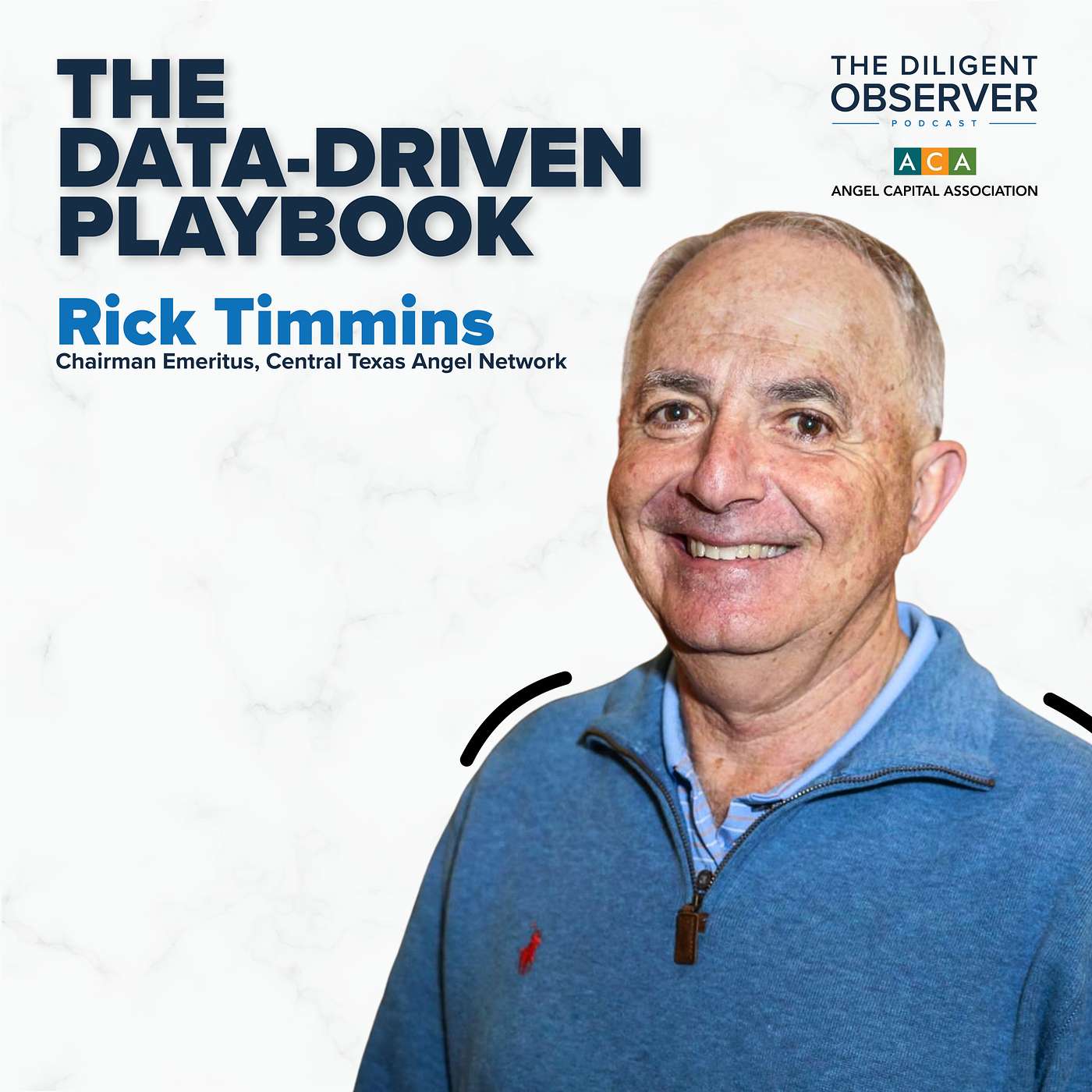
Episode 63: Central Texas Angel Network's Rick Timmins on Data-Driven Angel Investing
Jun 900:37:25Tap to summarize🗞️ Get essential angel intel straight to your inbox every week with The Diligent Observer Newsletter. 🗞️Today's episode explores three ideas that caught my attention:① Angel investing needs better data: Rick explains how his Six Sigma background shaped the way he thinks about angel investing, including why CTAN tracks dozens of metrics across its investment portfolio.② Due diligence changes outcomes: Rick shares how board involvement, written diligence, follow-on investing, and industry diversification have all shown up in CTAN’s data as meaningful drivers of better angel investing outcomes.③Many angel groups are still operating like supper clubs: Rick argues that too many groups gather, hear pitches, write checks, and fail to track what happens next. His challenge is simple: angel investing is an asset class, and it requires process.Rick spent decades in finance leadership at Motorola and Cisco, where he helped apply Six Sigma principles to financial operations. In this conversation, recorded live at the Angel Capital Association Annual Summit, Rick explains how that same data-driven mindset shaped his approach to angel investing, portfolio tracking, member education, due diligence, and post-investment involvement.During our conversation, he shares:• How Cisco moved from a three-week monthly close to a one-day close.• Why CTAN tracks 78 metrics across its angel investment portfolio.• Why Rick believes many angel groups still operate more like supper clubs than professional investor groups.• How board involvement and formal due diligence have affected CTAN’s investment outcomes.• Why successful angel investing often takes five to eight years.• Why Rick is concerned about secondary markets, SaaS liquidity, and the concentration of capital flowing into AI.Connect with Rick:Rick's LinkedInCentral Texas Angel NetworkConnect with Andrew:Newsletter | X | LinkedIn | Book | WebsiteStuff We Reference:CTAN Investment DataCTAN EntrepreneursCTAN MembershipACA Data InsightsACA Data Insight by Rick TimminsACA Angel Funders ReportCisco Investor RelationsSix SigmaTech Coast Angels / TCA Venture GroupAngel Capital Association SummitAustin Technology IncubatorAngel Capital AssociationACA SummitKnow someone who would enjoy this episode? Share it with them! Want more? Get essential angel intel straight to your inbox every week with The Diligent Observer Newsletter. Check out the entire show library and follow via Apple Podcasts, Spotify, and YouTube.All opinions are personal and may not reflect the views of The Diligent Observer. Not investment advice.
Transcribe →
Episode 62: Baylor Angel Network's Steven Diedrich on Training Students to Think Like Angel Investors
Jun 200:36:56Tap to summarize🗞️ Get essential angel intel straight to your inbox every week with The Diligent Observer Newsletter. 🗞️Today's episode explores three ideas that caught my attention:① University angel networks need clear priorities: Steven explains why Baylor Angel Network works because it knows its primary purpose: experiential student education. But the model only succeeds because it also serves investors and founders well.② A two-year analyst model changes the student experience: Baylor’s program is not a short internship. Students move through coursework, shadowing, deal analysis, peer training, and hands-on responsibility over multiple semesters.③ Angel investors need diversification: Steven shares how Baylor’s data showed the network’s overall returns were in line with angel investing benchmarks, but many individual members had not seen returns because they were in too few deals.Steven brings a unique perspective as both a former student analyst in the program and its current executive director. In this conversation, recorded live at the Angel Capital Association Annual Summit, Steven breaks down how Baylor Angel Network built a university-affiliated angel group that serves students, investors, and founders through a structured two-year analyst program.During our conversation, he shares:• How Baylor Angel Network’s two-year student analyst program works.• Why university angel programs need to serve students, investors, and founders at the same time.• How Baylor’s analyst alumni have become investors, founders, fund managers, and members of the network.• Why a fund structure can help angel investors get diversified exposure while still allowing direct investing.• What other universities should consider before trying to build their own angel network.Connect with Steven:Steven's LinkedInBaylor Angel NetworkConnect with Andrew:Newsletter | X | LinkedIn | Book | WebsiteStuff We Reference:Baylor Angel NetworkBaylor Angel Network, Hankamer School of BusinessBaylor Angel Network TeamBaylor Angel Network Student Practicum TeamBaylor Prospective AnalystsBaylor UniversityBaylor EntrepreneurshipAngel Capital AssociationACA SummitWant more? Get essential angel intel straight to your inbox every week with The Diligent Observer Newsletter. Check out the entire show library and follow via Apple Podcasts, Spotify, and YouTube.All opinions are personal and may not reflect the views of The Diligent Observer. Not investment advice.
Transcribe →
Episode 61: “40 to 60% of Angel Investors Gone?” | ACA Board Member Mark Friedman on Startup Policy, QSBS, and the INVEST Act
May 2600:40:22Tap to summarize🗞️ Get essential angel intel straight to your inbox every week with The Diligent Observer Newsletter. 🗞️Today's episode explores three ideas that caught my attention:① Startup policy is capital formation policy: Mark explains why the ACA’s public policy work is not just about helping investors. It is about helping early-stage companies access the capital they need to grow.② Accredited investor rules may need a rethink: If old thresholds were simply indexed to inflation, Mark says it could remove 40 to 60% of current angel investors from the market. His argument is that sophistication and education should matter, not just net worth.③ Regulation should evolve with the market: From QSBS reform to the INVEST Act, Mark shows how small technical changes can have major consequences for founders, funds, pitch competitions, and angel groups.Mark brings a rare perspective from the intersection of angel investing, venture capital, public policy, and startup ecosystem building. In this conversation, recorded live at the Angel Capital Association Annual Summit, he pulls back the curtain on how the ACA supports policy improvements for early-stage investors and founders, including recent QSBS changes and proposed updates to the accredited investor definition.During our conversation, he shares:• Why the ACA’s policy work matters for founders, angel investors, and the broader early-stage ecosystem.• How recent QSBS improvements could lead to more rational exit decisions for startups and their investors.• Why simply indexing accredited investor thresholds could have major unintended consequences for startup capital formation.• How a sophistication test could allow more knowledgeable investors to participate in private markets.• What the INVEST Act could change for angel funds, pitch competitions, accredited investor rules, and early-stage capital access.Connect with Mark:Mark's LinkedInRTP Angel FundDental Innovation AllianceConnect with Andrew:Newsletter | X | LinkedIn | Book | WebsiteStuff We Reference:Angel Capital AssociationACA SummitACA Mission and LeadershipRTP Angel FundDental Innovation AllianceQSBS Reform, ACAQualified Small Business Stock, Section 1202INVEST Act overview, CartaINVEST Act Congressional Research Service summaryAccredited Investor Definition, SECEqual Opportunity for All Investors Act, CBOWant more? Get essential angel intel straight to your inbox every week with The Diligent Observer Newsletter. Check out the entire show library and follow via Apple Podcasts, Spotify, and YouTube.All opinions are personal and may not reflect the views of The Diligent Observer. Not investment advice.
Transcribe →