← DR. GUNDRY PODCAST: GUT HEALTH, WEIGHT LOSS, AND NUTRITION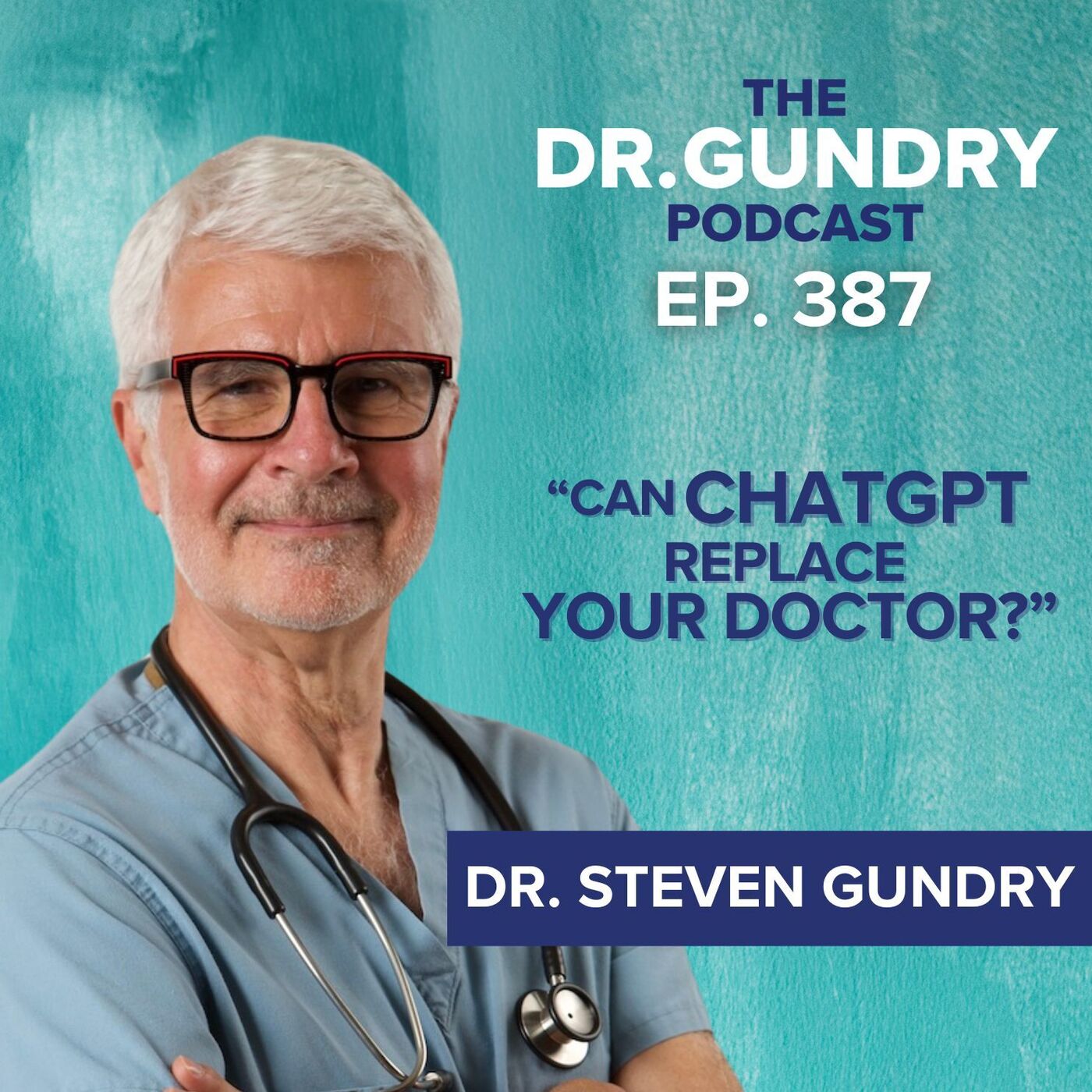
DR. GUNDRY PODCAST: GUT HEALTH, WEIGHT LOSS, AND NUTRITION
Can ChatGPT Replace Your Doctor? The Truth About AI Health Advice | EP 387
00:47:22
Loading summary
Transcript57 lines
- [00:01]
Dr. Steven Gundry
Welcome to the Dr. Gundry podcast, where Dr. Steven Gundry shares his groundbreaking research from over 25 years of treating patients with diet and lifestyle changes alone. Dr. Gundry and other wellness experts offer inspiring stories, the latest scientific advancements, and practical tips to empower you to take control of your health and live a long, happy life.
- [00:23]
Host/Interviewer
If you've ever been in the market for a new home, you know home shopping can be a lot.
- [00:28]
Sponsor/Ad Reader
There's so much you don't know and so much you need to know.
- [00:31]
Dr. Steven Gundry
Well, what are the neighborhoods like? What are the schools like?
- [00:34]
Sponsor/Ad Reader
Who is the agent who knows the listing or neighborhood best? And why can't all this information just be in one place?
- [00:41]
Dr. Steven Gundry
Well, now it is.
- [00:43]
Sponsor/Ad Reader
On homes.com they've got everything you need to know about the listing itself. But even better, they've got comprehensive neighborhood.
- [00:50]
Dr. Steven Gundry
Guides and detailed reports about local schools.
- [00:54]
Sponsor/Ad Reader
And their agent directory helps you see the agent's current listings and sales history. Home homes.com collaboration tools make it easier than ever to share all this information with your family.
- [01:06]
Host/Interviewer
It's a whole cul de sac of.
- [01:07]
Sponsor/Ad Reader
Home shopping information all at your fingertips.
- [01:10]
Dr. Steven Gundry
Homes.com we've done your homework.
- [01:16]
Sponsor/Ad Reader
Today we're tackling a question I get more and more often, Can AI replace your doctor? I enter health questions and then analyze chat GPT responses. We're also going to dig into blood tests. Which ones are actually worth your time and money? And which ones are overhyped, unnecessary, or even misleading if you don't know how to interpret them correctly? If you've asked AI for health advice or wonder whether there are vital blood tests you need but your doctor never suggests, this episode will give you clarity.
- [01:47]
Dr. Steven Gundry
Stay tuned.
- [01:48]
Sponsor/Ad Reader
We'll be right back.
- [01:52]
Host/Interviewer
There's a new Dr. Google in town or webnd in town. So should you use artificial intelligence for health advice like ChatGPT? So I'm going to put some questions in that a lot of people ask and let's have fun. Let's see who agrees, who doesn't agree. So here's an easy one. We ought to completely agree on that. What? What is the healthiest, healthiest diet? That ought to be fun. Oh, I like this. Let's give it a second. There isn't one healthiest diet for everyone. The healthiest diet is balanced, flexible and sustainable. Sustainable is actually a very good point. That said, most health experts agree on these core principles. Lots of fruits and vegetables, different colors, different nutrients. Well, let's start with that one. You may remember in my first book many years ago, I said give fruit the boot. What did I mean by that? We inherited a genetic mutation from great apes that allowed great apes and us to take fructose, the main sugar in fruit, and convert it into fat in the form of triglycerides. Why would that be beneficial long ago? Well, it allowed great apes during climate change to take advantage of fruit that was only available certain times of the year and store it as fat to make it through the hard times. We inherited that gene that allowed us to eat fruit when it was available to store fat for the hard times. Unfortunately, we now live in 265 days of endless summer and there are for most of us absolutely no hard times. We also never had occasion to get fruit 365 days a year. And now of course, we can do that. So what was healthy at certain times of the year when fruit was available now has become a real problem for most people I see. In fact, most people I see are shocked when we do new blood tests looking for fatty liver, that almost everyone, almost everyone has some degree of fatty liver. And many people without knowing it, eating a healthy diet have extreme fatty livers thanks to partially the fruit they eat, but also the fructose in high fructose corn syrups which is in almost everything. So fruit in season, local fruit in season, but otherwise give fruit the boot. Oh, next one, whole grains. Now there's a bad idea. Brown rice, oats, whole wheat bread, quinoa. First of all, Remember everything that ChatGPT mentioned is loaded with lectins. And for those of you who haven't listened, 100% of my patients with leaky gut when they first see me, that's virtually every patient that I see has antibodies to whole wheat, have antibodies to oatmeal, have antibodies to corn. And quinoa unfortunately is also a lectin rich food. So that's the worst advice I can imagine. Okay, how about protein from varied sources? Beans, lentils, eggs, fish, chicken, tofu, nuts, yogurt. Well, beans and lentils have some of the highest lectins of any food group. Now the good news is you can soak them and then pressure cook them or you can buy them from companies already pressure cooked, like Eden brand, like jovial, think happy person and have no problem. How about eggs? That's a touchy subject. A number of my patients actually do react to the components in eggs, whether it's egg white or egg yolk or both. But eggs, if they're pasture raised or omega 3 eggs for most people can be a good source of protein but also an incredibly Good source of healthy fats for their brain. Fish. You probably know in my last book, I introduced the chicken and the sea diet. I'm a huge fan for my patients to eat wild fish and pastured chicken as most of their animal protein. Tofu. Once again, tofu comes from soybeans, and soybeans are loaded with lectins that many people react to. Tofu is not a fermented food, and that's the problem. Fermentation usually destroys the lectins in most products. Nuts. There are some great nuts, but just remember, peanuts and cashews are not nuts, and they're not part of the program. Same way with yogurt. Yogurt, if it comes from sheep, if it comes from goats, if it comes from a two cows, is a great addition to a diet. But if it's got sugar on the bottom, if it's got fruit on the bottom, if it's got a flavoring like vanilla bean, it's loaded with sugar. So buyer beware. It's not a protein source. It's a sugar source. All right, how about healthy fats? Hey, we're in pretty good agreement here. Nuts, seeds. Well, there are certain seeds that aren't healthy for you. Sunflower seeds are not healthy for you. They're pure omega 6 fats. They're also loaded with lectins. Olive oil. Hey, good choice, but buyer beware. You've got to find high polyphenol olive oil. How's the best way to do it? Look for not only extra virgin, but also first cold press. And finally, look for the country of origin and the date of pressing. And we've got complete videos on how to do this. Avocados. Eat them whole. Believe it or not, avocado oil is not a particularly healthy oil. It's oleic acid, which is a monounsaturated fat. But it's the all. It's the avocado that's good for you because it's loaded with fiber. Oh, here's a fun one. Eat enough calories. America is overloaded with calories. We don't have to worry about eating enough calories. Also, the average American eats at least double the amount of protein. That's recommended by the Department of Agriculture, the FDA for needs for protein. And yet you hear every day that we have to add more protein to our diet. Nothing could be more wrong.
- [09:56]
Dr. Steven Gundry
All right, other key habits.
- [09:58]
Host/Interviewer
Drink mostly water. Yeah, I like that. But just remember that most of our water, municipal water, is loaded with antibiotics, chemicals, toxins. Really, you ought to do your homework. And get yourself a reverse osmosis filtered water. They're actually quite reasonable. A lot of countertop ones. And use it that way.
- [10:23]
Dr. Steven Gundry
Oh, here's a great advice.
- [10:25]
Host/Interviewer
Eat regularly. Don't skip meals.
- [10:28]
Dr. Steven Gundry
Huh?
- [10:29]
Host/Interviewer
I guess nobody ever told the hunter gatherers like the Hadzas that they ought to eat regularly. These people don't usually eat their first meal until 10 or 11 o' clock in the morning when they find food. Do you really think our ancestors crawled out of our cave and said, what's for breakfast? There was no breakfast break. Fast means when we stopped eating, started eating in the day and when we stopped eating at night. And back in the old days, we usually stopped eating at night when we had dinner and went to bed because there was nothing else to do. So just remember that a lot of these healthy ideas are the best way to get my patients you into trouble. So that's a really idea. Enjoy treats. Sometimes health includes mental well being too. Yeah, but sometimes doesn't mean all the time. And evidence suggests that if you eat within two to three hours of bedtime, you're really going to destroy your brain's ability to clean out the junk that's in your brain with every sleep cycle. So enjoy treats. Yeah, but make sure those treats are the good ones. We're going to move on from this, but just remember that all of these AI models pull from every website known to mankind. There used to be an expression early on in computers, when we programmed computers, garbage in, garbage out. And I see this all the time, even when ChatGPT or other search engines show you these ideas and even show.
- [12:25]
Dr. Steven Gundry
You where they got that idea.
- [12:29]
Host/Interviewer
A lot of these are actually just from podcasts or websites, from someone who's just stating an opinion, who actually has no experience in talking about what they're talking about. On the other hand, I've been now seeing patients for 30 years, six days a week, and looking at their blood work every three months and asking what happens when you do this? Let's see what happens when we ask you to take something away from your diet. Let's see. So that's totally different.
- [13:10]
Sponsor/Ad Reader
Every new year, I see the same pattern. People make big resolutions and a few weeks later they're exhausted trying to keep up with them. The problem isn't motivation. It's that most resolutions ask too much too fast. That's why I like Bon Charge. It's not about willpower or overhauling your life. It's about simple tools that support your body while you're already living it. One of my favorites is their Red Light face mask. Red Light therapy has been studied in over 4,000 peer reviewed studies and it supports skin health, recovery and healthy aging without adding stress to your routine. I use it for about 10 to 20 minutes a day, usually while winding down at night. What sets Bottom Bon Charge apart is the quality. Their devices remove sleep disrupting blue and green light, have zero EMF and zero flicker and combine both red and near infrared light in one mask. It's lightweight, comfortable and easy to stick with, which is why it works. If you want a resolution that actually fits into real Life, go to boncharge.com and use code GUNDRY to save 15%. That's boncharge.com code GUNDRY not a fan of making resolutions but still want to make this year better? Here's one easy and maybe even fun how about a linen Closet Cleanse? STEP 1 Toss or donate linens like sheets and towels that are either worn out or made of harmful materials like polyester. Step 2 Replace sheets and towels that support your health, not harm. It's like Cozy Earth. Their Baja bedding and luxe bath towels turn your home into a place you actually want to be soft, luxurious, resort level comfort that makes rest feel effortless every night and every shower becomes a little reset, a little upgrade to your day. Plus it's completely risk free. A 100 night sleep trial and a 10 year warranty. Once you feel this level of comfort, you'll want it to last. Make this year the year you finally feel refreshed. Go to cozyearth.com and use my code GUNDRY for up to 20% off. Start improving your life where it matters most.
- [15:23]
At home.
- [15:26]
Host/Interviewer
Let's try another one. This should be fun. What should diabetics eat? It's thinking. Okay, sure, people with diabetes should eat in a way that keeps blood sugar steady. Great idea. Foods that are generally good choices. Carbohydrates still important. Exclamation point. Oh no, here we go again. Whole grains, brown rice, oats, whole wheat bread, quinoa. Gee, where have we seen that before? Need I say more? This is probably one of the worst things that I can see from my diabetic patients. Now remember most of these foods. For instance, let's talk about whole wheat bread. Really? Have you ever seen any whole wheat kernels in whole wheat bread? No, of course you haven't. Because they're ground up and when they grind them up, anytime you grind up a carbohydrate, a starch like wheat mostly is, you expose that to recipe. Rapid digestion and absorption into sugar. So a piece of whole wheat bread makes your blood sugar go up higher and faster than four teaspoons of straight sugar. Really? So how in the world could that possibly be healthy for a diabetic? And the answer is it's not. And I see this all the time in my patients. Oh, I'm having healthy sourdough bread and I'm a diabetic and I'm going, well, what the heck is your A1C going up? Why is your triglycerides going up? And they tell me, I don't eat any sugar. Yes, they do. Every time they're having their healthy whole wheat bread, they're eating sugar. Not anything healthy.
- [17:51]
Dr. Steven Gundry
Fruits.
- [17:52]
Host/Interviewer
Whole fruit is better than juice. Folks, if you are a diabetic, the rule applies. Give fruit the boot. There is nothing healthy in fruit for a diabetic because it is a sugar bomb the way it has been hybridized.
- [18:12]
Dr. Steven Gundry
And that's one of the first things.
- [18:14]
Host/Interviewer
I do for my diabetics is take their fruit away. And they, and I love to watch their blood sugars and their hemoglobin A1Cs and their insulin levels and their insulin resistance plummet. They love to see their triglycerides plummet. They love to see their good cholesterol go up. All because they gave fruit the boot. All right, beans and lentils. So if you're going to eat plant based proteins like beans or lentils, you have to remember that beans in general are mostly starch, which turns into sugar. On the other hand, lentils are the lowest of the starch and highest in the protein of the beans and lentils family. So if you're doing a plant based diet, lentils that are pressure cooked are a much better choice than beans. Here's one we get all the time. Is high cholesterol really dangerous? This ought to be good. Okay. Why it says yes. High cholesterol can be dangerous, but usually causes problems over time, not right away. Well, Let's move on. Why high cholesterol matters. Cholesterol itself isn't bad. Your body needs it. That's right. It's not usually bad. Thank you very much. The issue is too much of the wrong kind. Bad cholesterol, ldl. High levels can build up in blood vessels and form plaque over the years. This can narrow or block arteries, increasing the risk of heart disease, heart attack, stroke, usually later in adulthood. Well, first of all, LDL, bad cholesterol. We'll give you a seminar. But there's seven different kinds of LDL. There are big LDLs which are fluffy beach balls that bounce around your blood vessels and bounce and don't stick. Then there are what are called small dense LDLs. Now, back in the good old days, when I looked at these various fragments, small dense LDLs are typically the one that oxidize. Now, what's oxidation? Oxidation is becoming rusty or rancid. And if you like the cholesterol theory of heart disease, which I don't, but if you like it, you have to have oxidized cholesterol to stick. Most of my patients were able to have them have very high LDL cholesterol levels, but they don't produce many small dense LDLs, and even if they do, they don't oxidize them because of the diet they're on. Secondly, it takes two to tango. Your blood vessels themselves have to be sticky like flypaper to attract cholesterol, and that's from inflammation. That's why I much prefer the inflammatory theory of heart disease and, or the autoimmune theory of heart disease. You have to have both activated cholesterol and blood vessels that are damaged. After all, cholesterol is just a spackling compound that looks for damage to blood vessels, cracks in blood vessels, and, and patches it. That's how it ends up attaching to your blood vessels. The other thing, sadly that I see, I have patients who are on statin drugs, on injectable drugs to lower their LDL cholesterol. And yet they still develop new lesions, have new stents, and no one ever bothered to look at the inflammation on their blood vessels or whether even those lower cholesterol numbers were oxidized. And shockingly, the folks who do get into trouble with these lower levels have oxidized cholesterol and sticky blood vessels. And once we fix that, we no longer have to worry about the levels of cholesterol. Oh, eat plenty of fruits, vegetables and whole grains. Guess what, folks? The more fruit you eat, the higher your triglycerides go. And in general, the higher your LDL cholesterol goes. Guess what, folks, the more whole grains you eat, the higher your triglycerides go, the higher your LDL cholesterol go. So no, that's a horrible advice. Well, you know, this was fun. Let me know what you thought about this in the comments. But just remember what You Feed Chat GPT is what ChatGPT is going to use to answer your questions. And again, it just, it's just, you know, regurgitating what it's able to see. And a lot of times what it's able to see is not the current advice that I would give to you if you saw me, the point of these questions was there is no really generalized answer for almost all of these questions. Each of us needs an individual assessment of what's good for them and what's bad for them.
- [24:22]
Dr. Steven Gundry
Actually, I'll give you a great example.
- [24:26]
Host/Interviewer
I see all the time in my patients who were trying to eliminate lectin, high lectin containing foods in their diet. And there are low lectin containing foods, even grains like sorghum and millet, who don't have any lectins. And so I decided years ago that sorghum popcorn, which smells like popcorn, tastes like popcorn, looks like popcorn, but it's made out of sorghum, might be a really fun food to give my patients because, hey, who doesn't like popcorn? I ate a cup of sorghum popcorn for three weeks as my snack before dinner, and I watched my blood work. Now, triglycerides in general are the first form of fat that we manufacture from sugars and starches. And I run my triglycerides quite low, usually 40 to 50. Imagine my surprise. I shouldn't have been when my triglycerides in three weeks went from 40 to 140 just by adding healthy, no lectin starches to my diet. Now, they're not good for me if I think I should have a low triglyceride, and I believe most people should. So even though it's, quote, healthy, even though it doesn't have any lectins, it's still a starch that's easily absorbed and turned into sugar, which in turn is converted. Converted into triglycerides fat. So that's not the healthiest diet for me.
- [26:21]
Dr. Steven Gundry
From Instagram, TimothyGeorge asks, Can you go over the most important but not so common blood tests that we should be adding to our yearly physicals, like the ones you mentioned in the Energy Paradox, or perhaps are there others as well? Amazing book, by the way. Life changing. I'm lucky to have a general doctor who is very open to your teachings and will order labs that you say, thank you. Okay, so that's a great question, Timothy George. I put a whole list out in the Energy Paradox, but for those of you who have not gotten it yet. So there's certain tests that you really should, should get from your doctor or your healthcare provider that are cheap and easy to obtain, and then we can go into more esoteric ones. First of all, your doctor is almost certainly going to get a fasting blood, sugar, a fasting glucose, quite frankly, that isn't half as important as a fasting insulin level. Now I can tell you training third year family practice residents like I do in my clinics, that most of them haven't even heard of a fasting insulin level. So if your doctor looks at you funny, just say, you know, humor me, Please order it. Fasting insulin level, it'll cost you about $8. Quite frankly, that's number one. If that fasting insulin level is above 10, then you're in trouble. You have insulin resistance. It's useful to get a hemoglobin A1C. You see, I got my A1C down on half the commercials on TV. Hemoglobin A1C looks at how you're handling sugars and proteins for the two months prior to the test. Looking backwards in time. But what's surprising is a hemoglobin A1C should be 5.6 or less. The closer you get to 5.0, the better. But you wouldn't believe the number of people I see with A normal hemoglobin A1C who have elevated insulin levels. The other test that still some doctors can order is a homa ir, capital H, capital O, capital M, capital A, dash, capital I, capital R. The IR stands for insulin resistance. A home IR is another really good way to see whether or not you have metabolic flexibility, which of course is one of the major subjects of the energy paradox. And about 80% of us in this country have no metabolic flexibility. Our mitochondria don't have the ability to switch on a dime to burning sugar for fuel, to burning free fatty acids for fuel. And the longer all of us study the various chronic disorders, diseases including dementia, including diabetes, including heart disease, the more and more we're realizing that this is a mitochondrial dysfunction problem. So all of these will actually help you point to mitochondria dysfunction. Now, there's some good general purpose inflammation markers. The easiest one to get is hsh, crp. The HS stands for either highly sensitive or heart specific. Either one is just fine. It's the same test. It'll give you a generalized marker of inflammation in your body. Another useful one is fibrinogen. If you're a woman, ferritin is actually a use useful marker for inflammation. Now, most doctors associate ferritin with iron levels, but I can tell you it correlates very poorly with iron levels. So if you're a woman and you have an elevated ferritin level, that means we need to look further into inflammation markers. So those are some simple markers to get. We can get more esoteric. One thing that I urge everybody to get is to have their APOE 4 genotype measured. You've heard me talk about this. You've heard Dr. Dale Bredesen, you've heard Dr. Promeiter talk about this. The APOE4 gene determines whether you're going to make a lipoprotein that carries fats around your body. The APOE4 genotype, which about 30% of people carry, is sometimes called the Alzheimer's gene. Now you really want to know whether you carry that because whether you follow me, whether you follow dektapromide, or Whether you follow Dr. Bredesen, this is not sealing your fate that, oh my gosh, I carry the Alzheimer's gene. I don't want to know. I have that.
- [31:51]
Host/Interviewer
I'd rather not know.
- [31:53]
Dr. Steven Gundry
You can actively do something to prevent the development of Alzheimer's if you carry this gene. And it's well worth your money to find out about that. The other one I would get in terms of a genetic test is the MTHFR mutation. And if you say that out loud, we would bleep you from network television. We laughingly call it the mother effer gene for obvious reasons. It determines whether or not you carry a mutation that you can't convert vitamin B12 and folic acid into their active forms, which are methyl B12 and methylfolate. And knowing that actually gives you power to get methyl B12 and methylfolate into you as supplements. So if you have for instance, anxiety, depression, adhd, bipolar, schizophrenia, alcoholism, drug abuse and suicide tendencies, you may in fact carry one or more of these MTHFR mutations. And it's really a good idea to figure out if you have that. Now for the real nerds in the audience, ask to get an insulin like growth factor level IGF1. It's one of the best ways of looking at how slow or fast you're aging. And there's some fun tricks to play with influencing IGF1. Just a word of warning. If your IGF1 is high above about 200 to a 250 and you're over the age of 40 or 50, that increases your risk of developing cancer. On the other hand, if your IGF is very low, it's very unusual to develop cancer. Insulin like growth factor is simply that it is a growth growth factor that stimulates cancer cells to grow. So that's a good start and thanks for asking that question.
- [34:09]
Sponsor/Ad Reader
Feeling like you missed the New Year's resolutions. It's not too late to focus on your health and one of the easiest ways I found to do it is with my Juvent Micro Impact platform. I use mine every day while reading or watching tv. It's jumping gentle low level vibrations that send micro impacts through your bones, joints and muscles, helping your body maintain mobility, balance and even support stem cell activity. It's not a high powered vibration plate that pounds your body. This is safe, low impact mechanotherapy inspired by NASA research and made right here in the USA. In just 10 to 20 minutes a day, you can give yourself your skeletal system the daily vitamin it needs supporting your overall health as you age. Go to juvent.comgundry and use code GUNDRY for $300 off. Start focusing on your health today. It's never too late.
- [35:09]
The Dr. Gundry podcast is brought to you by Progressive Insurance. You choose to hit play on this podcast today. Smart Choice Progressive loves to help people make smart choices too. That's why they offer a tool called Auto Quote Explorer that allows you to compare your Progressive car insurance quote with rates from other companies so you save time on the research and you can enjoy savings when you choose the best rate for you. Give it a try after this episode@progressive.com Progressive Casualty Insurance Company and affiliates not available in all states or situations. Prices vary based on how you buy.
- [35:51]
Dr. Steven Gundry
David Favela from Instagram asks, do I need amino acids if I am a vegetarian? Where can I get them from any specific foods or supplements? Is it true that if I don't eat meat I need to supplement because they are only found in meat? Well, here's the good news. Gorillas and horses don't ask about where they can get their amino acids. And as far as I can tell, gorillas and horses do very well with muscle mass. So amino acids are present in plants and in animals. They are the building blocks of protein. There are essential amino acids that we do not manufacture our cells and so we have to obtain them from our diet. Now so much emphasis in the vegetarian and vegan community is combining foods so that you don't miss out on certain essential amino acids. And so much I think wasted time is devoted to okay, grains are devoid of a couple of essential amino acids and beans are devoid of other essential amino acids. But if you combine grains and beans, you'll cover the base for essential amino acids. Believe me, there are plenty of essential amino acids in a vegan or vegetarian Plant Paradox program. You will get it from the leaves that you eat. You will get it from the roots that you eat. You will get it from the nuts that you eat. There are, for instance, several nuts like sacha, inchi and barucha nuts, baru nuts, that have all the essential amino acids covered and so you don't have to go looking anywhere else. One thing that is very, very interesting about vegans is vegans actually have low levels of creatine, which is a protein. And there are interesting studies that vegans are deficient in creatine. And there are some interesting studies that vegans have smaller brains than non vegans because they're lacking creatine. So if you're a vegan, I do recommend supplementing with a creatine supplement. And they're not animal derived. You can get vegan creatine and just supplement with creatine as part of your diet. Great question though, from Lucas Wasak on Instagram. What's the ideal age to begin fasting? Well, so fasting covers a lot of territory as I talk about in all my books, particularly the energy paradox. So as I've talked about before, if you're a woman of childbearing age and you want to get pregnant or you're planning to get pregnant, then quite frankly, time restricted, eating, water, fasting, juice, fasting is not for you. I've seen so many patients that fasting or intermittent fasting has actually prevented them from getting pregnant. And when we had them stop that practice that started things. Also, if you or a family member have a tendency to focus on controlling your eating habits, then this is not for you. This absolutely is not the direction you want to go in your relationship to food. On the other hand, if you look at hunter gatherer societies, I got news for you. They're not waking their kids up at 8 o' clock in the morning for a bowl of oatmeal to send them.
- [40:03]
Host/Interviewer
Off to hunt, you know, berries.
- [40:05]
Dr. Steven Gundry
The kids don't eat until the adults eat, and many of them do not eat until 10, 11 or 12 noon with their first meal. And in fact, the idea of eating breakfast, as I've talked about before, is a modern nuance that was actually fostered in great part by the kellogg's corn flakes company in 1906, telling you and convincing you with a massive advertising campaign that breakfast is the most important meal. And it simply is not. So if you want to make this a part of normal family activities, of skipping breakfast as an example, or eating an early dinner and not snacking at night, that's a normal, healthy practice. And the more you introduce your kids to this style of eating early on, you're going to set them up for a much healthier lifespan to come. Holly Boyco from Instagram asks what is the best fiber you would suggest to eat weekly, daily? Thank you, Holly from Ohio. Well, so there's so many great sources of fiber, it's hard to start. Certainly the fiber in vegetables, in leaves, in radicchio, in Belgian endive, in Curley endive. I posted on Instagram recently a salad that I had from a chef outside of Missoula, Montana for the Wellness Week that was just every last wonderful chicory family of vegetables that was absolutely delicious. And I've mentioned before, whenever we're visiting southern France and Italy, there are chicory vegetables in every salad, on every plate, with every meal. So we're beginning to see radicchio, which some people call this Italian red lettuce. It's this bright red and white firm ball. It's in many, many, many grocery stores now. Belgian endive is everywhere now. It's in Trader Joe's. Grab yourself a head of those, pick up some Belgian endives and just mix them in your salads. It's an easy way. On the other hand, ground flax seeds is a great source of fiber. It's a great source of a short chain omega 3 fat called alpha linolenic acid. But if you're going to buy ground flaxseed, the minute you open the package, put it in the refrigerator because it goes rancid. Preferably buy whole flaxseeds, grind them in a coffee grinder and then sprinkle them on your salads. Put them in your coconut yogurt, put them in your goat or sheep yogurt. Great way to introduce fiber. Psyllium husk. You can get psyllium ground psyllium husk anywhere. And don't forget that resistant starches, for instance, like a purple sweet potato that you cook, then cool and reheat is another great source of fiber. And not to forget jicama. Get yourself some jicama. Many places now have it pre sliced. Use it as a dipping chip for guacamole. And guacamole has a lot of fiber. Avocados are a great source. Plenty of places to get your fiber. And remember, you're eating the fiber to feed your gut buddies and the more you feed them, the better your health.
- [43:55]
Sponsor/Ad Reader
Now it's time for the review of the week. The review of the week comes from PluggedIntalent over on Instagram. About my post on 2026 New Year's resolutions, she said great philosophy and advice. Small, simple steps and resolutions are what I need.
- [44:12]
Dr. Steven Gundry
As already overwhelmed with so much.
- [44:16]
Sponsor/Ad Reader
Well, thanks so much plugged in talent.
- [44:18]
Host/Interviewer
You're right.
- [44:18]
Sponsor/Ad Reader
It's more and more overwhelming. And the key is baby steps. I've been at this for 30 years watching patients take either big steps or little steps. And like I often say, weight off fast will never last. Weight off slow, you're good to go. And that observation has absolutely stood the test of time. Thanks for writing in. Now it's time for the Question of the Week. The Question of the week comes from odovertrue295 asks Dr. Gundry, I'm trying to quit smoking and drinking. What supplements best support this journey? Forever grateful for your help. I'm scared to quit. I'm looking for all the best advice I can to make this stick for good. Well, if you've read the Gut Brain Paradox, you know that quitting smoking and drinking is difficult because your gut might microbiome in you thinks that nicotine and alcohol are their guilty pleasures as well. And you're going to find that if we can manipulate your gut microbiome into more pleasant folks, you'll have a much easier time. So how do you do that? Well, follow the rules in the Gut Brain Paradox. You've got to get the right probiotics, which I talk about in the book. You've got to feed them what they want to eat, which are prebiotics. And one of the easiest ones to add to your regimen is psyllium fiber and chicory fiber. It's easy to find online and the more you take of those, the easier it's going to be to lose weight. Finally, you got to get fermented foods and the easiest, easiest way to do that is use vinegars, non flavored yogurts. If you like sauerkraut or kimchi, go right ahead. But that's the easiest way to do it. Great question and it'll be worth it, I promise you. But take it slow and easy.
- [46:28]
Pluto TV has thousands of free movies and TV shows.
- [46:33]
This is the mindset free.
- [46:34]
This is the mantra.
- [46:36]
This is.
- [46:40]
With movies like Joe dirt, pixels and 51st days.
- [46:43]
Dr. Steven Gundry
This is awesome.
- [46:44]
Sponsor/Ad Reader
And TV shows like Survivor, SpongeBob SquarePants, the Fairly Odd Parents and Ghosts. Pluto TV is always free.
- [46:52]
Huzzah.
- [46:54]
Pluto TV. Stream now. Pay Never.
- [46:56]
You're welcome.
- [47:00]
Dr. Steven Gundry
I hope you enjoyed this episode of the Dr. Gundry podcast. If you did, please share this with family and friends. You never know how one of these health tips can completely transform someone's life when you take the time to share it with them. There's also the Dr. Gundry Podcast YouTube channel where we have tens of thousands of free health insights that can help you and your loved ones live a long, vital life. Let's do this together.