← The Dylan Gemelli Podcast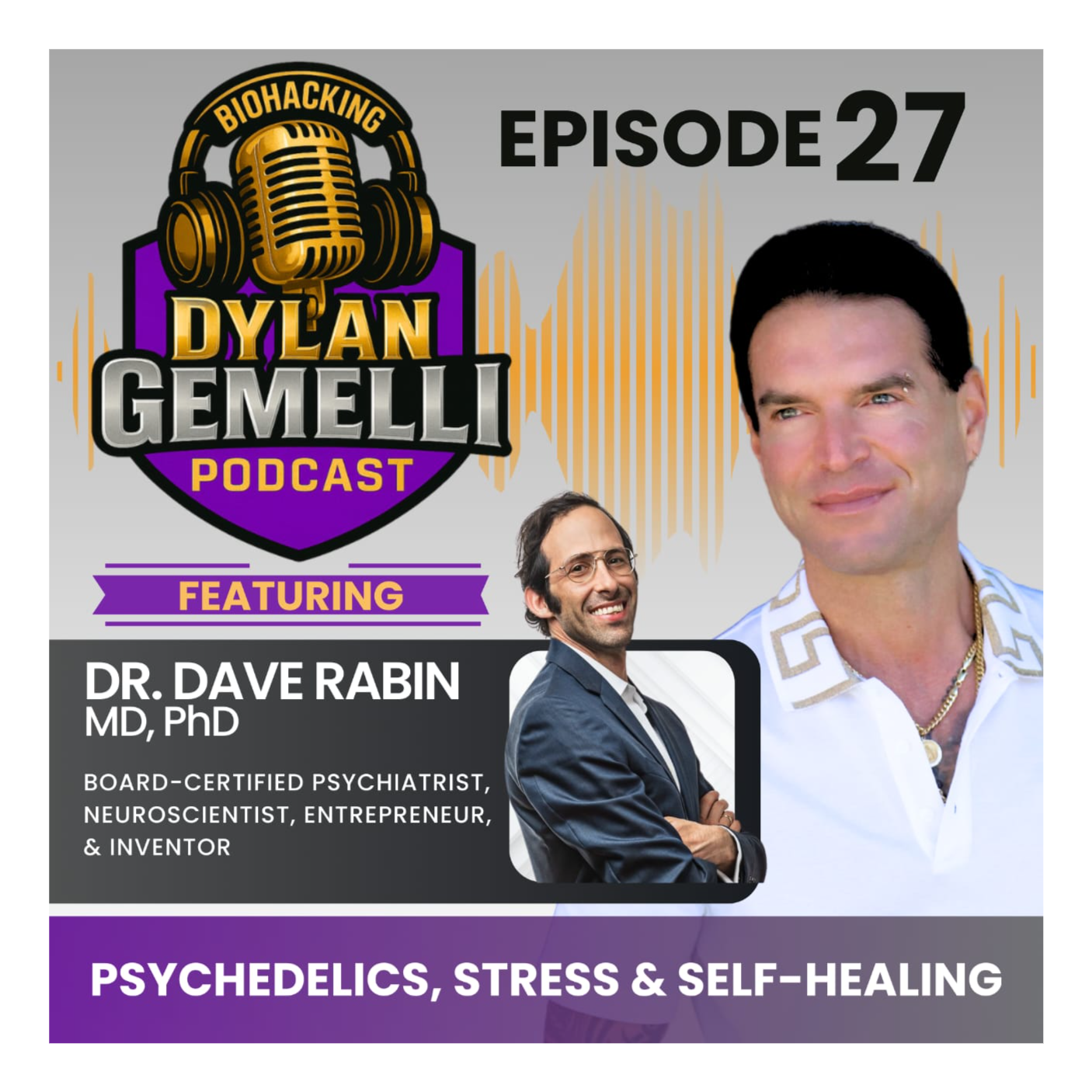
The Dylan Gemelli Podcast
Episode #27 Featuring Dr. Dave Rabin! Psychedelic therapy misconceptions, effectiveness and safety, chronic stress implications, shifting from treatment to CURE, ketamine facts, unlocking self awareness, mental health vs. stress and more!
01:11:29
Loading summary
Transcript45 lines
- [00:00]
A
Foreign.
- [00:12]
B
Everybody. Welcome back to the Dylan Gelli podcast. I am really, really excited about my guest today. We've been kind of having some scheduling, but I'm so glad that he's here today. So my guest today is a board certified psychiatrist, neuroscientist, entrepreneur and inventor. He studied resilience and the impact of chronic stress on our lives for over 20 years. And he's also the co founder of the Apollo Neuro, as you can see that I'm wearing now. And he does so much more than we're going to get into today. So my friends, welcome Dr. Dave Rabin. Thanks, Dave, for being here, man.
- [00:47]
A
Thanks so much for having me, Dylan. It's a pleasure to be here with you.
- [00:51]
B
Awesome. Well, I've been following some of your work now for quite a while. I was really thankful that I stumbled upon you sleep Several months ago. Many of the people that I highly respect I saw interviewed you and so we got a lot to talk about. Obviously I'm wearing the Apollo Neuro. I'm a big believer in that and your work. So first let's kind of just talk about your background a little bit because I'm always curious. Everybody's got a pretty cool backstory on why they kind of take the directions in life where they're going. So what, when was it that it kind of occurred to you or what happened in your life that made you go into the route that you're going to?
- [01:27]
A
Well, I, I actually became interested in consciousness and dreams from a very, very young age. It was probably when I was between maybe four and seven years old. I started to have very vivid dreams that I couldn't really explain, but felt very real to me. And they felt as real as my regular waking life. And I found myself really referencing those dreams when I was interacting with my brothers or friends and they would have no idea what I was talking about. And then I would instantly rec remember that this is something I dreamed about. It wasn't something that happened in our regular lives. And that just started to, you know, make me interested in what these, these dream things we have are. And so I think as I got older and started school, I went to my parents and I said, hey, what? You know, as I started to have more scary dreams, you know, I was like, what are, what are dreams? Like, what's going on when we're sleeping? And you know, they just kind of gave me the answer that all kids get from their parents pretty much, which is, you know, don't worry about dreams. They can't hurt you because you know, our parents want to make sure that we don't become afraid of sleep. And that was fine for the time being. But it didn't really satisfy my curiosity because I kept having vivid, you know, dreams that seemed real. And it started to make me question, you know, what does the word real really mean? And maybe the adults don't know the answer to that question because these dreams feel real and regular waking life feels real. So maybe there's more to it. And then from there I went and started reading. As I got older, into high school and things like that, I started reading science fiction. My vivid dreams kind of faded. I didn't have them as often. And then when I got into medical training, I became very interested through my science fiction days in neuroscience and brain science, how the brain works. And some very great mentors that I had along the way kind of advised me that just studying dreams is very hard and that it's hard to build a career doing that. And so I would be better off to become a doctor and be able to actually treat people and work with people and learn from people, which as doctors, learning from our patients is like one of the best possible ways that you can learn anything. And so our patients are often our best teachers. And so I started working in medical school and doing neuroscience research on the side and starting in college and really became interested in chronic stress. And because stress in particular impacts our dreams, right? Like if you have, if you watch a scary movie that's just as you have before bed, your dreams will take on that content. And if you have a really hard day, your dreams can take on that content. And stress changes the way we make meaning in the world. And meaningfulness in the world during our waking life seems to have some impact on what material pops up during our dreams. So that became interesting. And then as I was treating patients in 2012, timeframe 2013, I started to be treating more people who had severe PTSD and trauma related disorders and being, you know, a learned fear, learned stress disorder, and realized that most of our western standard of care treatments were not working very well. You know, we're taught to use a lot of medications for PTSD and the medications only work really in about 30% of people. There's still 70% of people who get treated with medications for PTSD that never get better. That was really surprising to me. And so I started to look outside the box to other things that could work. Natural techniques, breathing, meditation, mindfulness, yoga, soothing touch, psychedelics. And I found through one of my colleagues who was interested in psychedelic Therapy. She sent me 10 of the top papers that have been published around the world in leading journals, leading medical journals, basically studying psychedelic assisted therapy for PTSD and trauma. And as I started to read these papers, I realized that psychedelic medicines were actually working to help people heal from trauma by inducing a waking dream state with a chemical that you take from outside your body and put it in your body. And I was like, wow, this is really wild. Um, and I. And as soon as I read those papers in 2012, I realized that I could study dreams and do what I always wanted to do as a kid, but do it from the perspective of psychedelic medicine. And. And then down the road, sort of, you know, developed Apollo based on my research into psychedelic medicine. So that's kind of how that all came about.
- [06:06]
B
Okay. All right. I'm smiling because I'm so interested in all of these things that you're talking about. And I. I've read some of the things that you've talked about and discussed, but not into the depth. Like, I want to get with you and understand this. So maybe a little selfishly, I'm, like, even more excited because I'm going to learn so much here, and then I know I can share it with so many. I want to dig into that. First, though, let's go back to what you said about the impact of chronic stress on our lives, because I've. I've actually spent a great deal of time with that as well, seeing, like, the anxiety that's kind of built through my family and then kind of trickled down into my life and worked on fixing that. And it's a struggle. I mean, it's a. I think we all probably struggle with, to a point. Some people obviously far worse than others. So in your studies and your treatment of patients and things of that nature, if you could, maybe. And. And I know this is hard to say, but maybe give a percentage of the amount of people you feel actually struggle with this and some of the techniques that you utilize to treat chronic stress. And also, how serious is that for our general overall health?
- [07:16]
A
I mean, chronic stress is probably now more than ever due to the latest results and findings in neuroscience and population research around the world, especially since the COVID pandemic in 2020. I mean, it's probably one of the leading causes of all illness. And it's hard. It's hard to quantify because we know that when you're physically stressed, we know the mind and the body are connected. Right? So that's kind of like one of the first core neuroscience teachings. That is been found to be true. That was taught that is not the case many, many generations ago, starting with Descartes in like the 1800s, that the mind and this idea of the mind and the body are separate. So, you know, a lot of the work we're doing now in neuroscience is to try to understand better how some of the ideas we had about how the mind and the body work and are connected are actually not the case. And that there's more to it than we thought. So you know, when you're stressed and you have a physical illness, what happens to your symptoms or your pain typically gets worse. Right. And so that most, that's most people who have any kind of like pain disorder, physical illness. If you've ever like hurt yourself in any way and then you get stressed out, it increases inflammation, the area that's suffering the pain. And so that increases pain. If you're. And then if you don't treat that, you can get mental illness as a result of having untreated physical illness. If you have a mental illness like depression, anxiety, PTSD or any other mental illness and you increase the stress in that person's life in whatever way, they will also have worsening mental health symptoms and their mental illness will become harder to treat. And part of what's happening is that the body has two major parts of its nervous system that are involved in the stress response, one of which is, and most people know about these two parts, but the. One of the parts is called the fight or flight or freeze response nervous system, which is called the sympathetic nervous system. That's not actually that sympathetic in the way we typically think about that word, but what it does is it protects us from survival threat. So it's a resource allocation system. So when you're, when you. We only have so much blood to go around in the body to feed all of our organ systems at once. And so when you have something that's supposed to trigger the, a survival threat, that's supposed to trigger the sympathetic fight or flight nervous system. Evolutionarily for hundreds of millions of years, that would include being chased by a predator, running out of food, running out of water, running out of air, being potentially excommunicated by your community, or being deprived of sleep, these are like the six major factors that potentially threaten our survival because we need those things to survive and thrive and reproduce. And so if one of those things is threatened, it's supposed to trigger our fight or flight stress response if we're stressed out. But none of those things are being, none of those boxes Are being checked on the survival six survival key factors, Then it's not supposed to trigger our. Our fight or flight nervous system. And we have another part of our nervous system Called the vagus nerve system, or the parasympathetic rest and recovery system that governs all recovery. So sympathetic nervous system, fight or flight, Takes all of our blood and available resources when we're in an actual survival threat, and then clamps down on the vessels that go to reproduction, Digestion, immunity, rest and recovery, all the things we don't want to be getting our blood and resources when we're running from a bear, right? You don't want to be thinking about reproduction when you're running from a bear. You want to be getting away from the bear. All the blood, simple, the simple concept is all the blood vessels get squeezed to the organ systems and empathy systems and creativity systems to get us to safety. And it sends that blood to our skeletal muscles, Our motor cortex of our brain, Our fear center of our brain, Our heart, our lungs, to literally just get us to safety. When we get back to safety, Then the blood vessels switch, and so the blood vessels clamp down to the skeletal muscles in the heart and lungs and then redirect all the blood as the blood vessels open up to reproduction, Digestion, immunity, sleep, you know, creativity, empathy, all the good stuff. And they're not both. They're not generally both active at the same time most of the time. So it's a resource allocation problem. So if you could imagine, when you're stressed out all the time, when we as humans are stressed out all the time because of everything that's going on in the world, we're literally sending all our blood to our skeletal muscles, Heart, lungs, fear center of our brains, Motor cortex. And we're taking that blood from our recovery nervous system, the nervous system that is responsible for healing our bodies and also delivering nutrients to reproduction, Immunity, digestion, sleep, and for helping us to take waste away from those organ systems. So if you didn't have garbage pickup and you didn't have food for an extended period of time, how long would we last? Not very long. Right? Like, we need garbage pickups, food. You last maybe like a week. But in the body, the body has a ways of negotiating this and figuring it out and extending our ability to sustain organ systems for years with decreased garbage pickup and decreased nutrients, Meaning decreased blood flow to those organ systems. But eventually those organs dysfunction. And so that's why we see people who have chronic stress and, you know, developing all these different illnesses, Physical and mental, emotional, because their organ systems responsible for recovery are just deprived of resources and waste pickup. So you can see this direct connection between, like, where's your blood going? And in any moment and stress and organ system functioning. And that's why in large part, we get sick and our symptoms get worse when we are under chronic stress. And it affects probably almost every single human in the Western world today.
- [13:06]
B
Right. Okay. So I'm very sympathetic when it comes to people that have, like, mental health, anxiety, stress. But at the same time, I'm wondering how you differentiate this, because what I've seen, I analyze people. I'm no psychiatrist, but I mean, with all of the work I've done, done throughout the years, I analyze people, actions, reactions, emotions. That's kind of what I do. From being in sales and then to interviewing people and being around people, you kind of have to have a knack for that. So I guess over time, what I've observed is mental health has obviously been talked about a lot more. And. And I'm also the focus on concussions and things like that in sports. Right. So we see this progression and it's, It's. I guess it's being more accepted to talk about it and to view it. But I do feel like some people revert to calling being stressed or in stressful situations than claiming they have a mental health problem. So I guess my question for you is how do you differentiate if. If I were to come to you and say, Dr. Dave, I've got some mental health issues. How do you differentiate between just stress and true, like, mental health conditions?
- [14:15]
A
Yeah, it's a great question. That's actually one of the first ways that we focus on treating folks is any good clinician will first start to ask you questions about your life. And in the first visit and the intake and the first therapy visits, you know, we ask you questions about, like, what's going on, right? Like, what's been, what's your day like, what are your nights like, what's your work life like? What are the major sources of stress? Where do you feel like things are going well? Where do you feel like things aren't going well? And when did it start? Right. When did things seem to be going, like, when do you last remember things going well? And when did things start to take a turn downhill from your perspective? And then you can start to build a map of somebody's life and figuring out like, well, you know, was, was there? And there usually is a stressful event or a series of massively stressful events that occur at a certain time. Point that start to take us in a direction towards feeling like we have mental illness or mental health challenges. And the difference between somebody who's just stressed and somebody who has actual mental illness is really time and intensity of the symptoms. So typically the definition is that it is described based on you. If you have, if you have like feelings of depression, feelings of anxiety or any other, you can add in whatever other mental health, mental illness symptoms you want for six months or more on a continuous basis, then you may be struggling with a mental illness. And if you have mental health symptoms like anxiety, depression or sadness, focus issues, any of these other symptoms and they last for a very short time and they're only existing when you're really stressed out in your life, then you probably have just too much stress and not a mental illness. And then we need to focus on, let's, let's figure out ways to minimize the stress in your life and not, you know, just think about what, what medications are we recommending for you, but, and what treatment therapy and that kind of thing. But it's, you know, what, how do we get the stress under control? How do we help improve your resilience, your adaptability and give you like, the emotional bodybuilding skills effectively to learn how to bounce back from stress more quickly. And these skills also benefit people who have mental illness, of course. But once you have a mental illness and you fit into that pattern of somebody who's had six months or more of symptoms, it becomes more diff, a little bit more difficult and delicate to treat. So that's why we really try to bring people into treatment earlier before they start developing, you know, six plus months of, of, of struggles.
- [16:56]
B
Okay, I'm going to relate this to something and then I'm going to tell you why I admire your approach and why you're doing it. So for me, I do a lot of hormone optimization. And so I'll get people that'll come to me and say, oh, I'm, you know, and oh, I've got this symptom or that symptom, relating it to low testosterone, right. And they so quickly want to jump on trt. And so I'm going to compare that to, with you. I'm assuming that a lot of people want to jump on a medication. But what I try to do and what I can see that you try to do is we try to find the root cause and fix that first as opposed to just medicating. So for me, you could, you may have low testosterone for sure. I may pull your blood panel and see that it's there, but I will go in and say, oh, you've got high shbg, so that's bounding up your free testosterone. Oh, you have a liver problem. Or, oh, this. And that's causing this. Let's fix this first and then see the result, as opposed to just here's TRT forever. So is that kind of similar to what you do is let's dig in here, find the cause, treat that, see if it fixes the issue, and then if it doesn't, then we progress into something a little bit deeper.
- [18:00]
A
Yeah, exactly. I mean, if you can. If you can identify the root cause, whatever the root cause is, sometimes the root cause of a mental health problem is a thyroid problem. Right. This is a very common issue where, you know, people have thyroid dysregulation. It's very common. And if your thyroid's messed up for whatever reason, that impacts everything about your nervous system functioning and your mood and your metabolism and everything. Your entire body's regulated by your thyroid. So one of the examples that we, you know, that we do in mental health is before we even think about treating you with a mental health, as if you have a mental illness, we run a series of labs and we look at, okay, well, is there anything that could be an obvious physical sign of something wrong with your body? That would be why you're coming to me. Right? And if there's. If you have thyroid issues, that's what we treat first. Because that's like an easy fix. You may never need to see therapist if you can fix your thyroid and get everything straightened out. Right. But then if we do the medical. Full medical workup and we realize, oh, you're actually physically medically healthy, you don't have any issues going on that would result in a mental health problem, then we start to look at, okay, well, what else could be causing the mental health problem? And it's basically like a root cause analysis, you know, so you're, like, really diving into, you know, what is at the core of what's happening medically, then psychologically, then emotionally, and then really starting to. And then with stress as a core theme and trying to figure out, you know, what's. What's at the core, and then how do we address that first? And that helps us kind of steer the direction of treatment planning for people. And that's what all psychiatrists should be doing. Many of them do, but there are some that don't.
- [19:42]
B
Yeah, and see, I'm leading, leading, leading, leading. So where I'm going is I want to stress So I always stress to people, look, I'm not the only one in the world that does this. But find yourself, if you have a testosterone problem, find yourself a, a professional endocrinologist that will go step by step by step and do all of this and figure it out. And so I'm going to revert that to you. Don't just depend on a regular doctor who's just going to throw you on. Chances are, I'm not saying they're all this way, but just going to throw you on medication and move you on your way. Find someone like Dr. Dave that will take you step by step by step and really dig in and find the problem. That way you could actually avoid creating yourself further problem by getting on a medication that you don't need, which we want to prevent, right?
- [20:26]
A
Yeah, exactly. Because all medications have side effects. All surgery, as my, as good as the outcomes might sound, have potential risk. And there's no treatment, medication or surgical based treatment that doesn't come with potential risk. And that risk is often not worth taking. So if you can work with somebody who understands, you know, a diagnostic framework, it doesn't mean you're going to leave with the diagnosis. It means you want somebody who's going to put their detective hat on and rather than going straight to the prescription pad, they're going to talk to you enough and gather enough information from you during the history and physical process to the history and physical exam process to figure out, okay, what is actually going on here before I start handing you treatments. Right. That's, that's really the core of, of medicine that, you know, we're all taught throughout our medical doctor training and that, you know, doctors have. The problem is in modern society, medical, you know, medical treatment has been commoditized as a business. And so doctors don't get paid enough to do what they do. And so many of them and insurance companies are often trying to tell doctors what to do. And so, you know the saying when everything, when you're a hammer, everything looks like a nail, right? It's right. That's not. Just because you have a hammer doesn't mean everything is actually a nail. It means that certain things are nails that you use your hammer on and certain things are not nails and you need another tool. And so doctors have lots of tools. You know, we have like, like the benefit of medical training is that we have all the tools available to us. We just need to know what's going on. And so if we take enough time and clients have enough patience with the, with the Process of us getting to know you to figure out what's going on, which often is on both sides. There's. It's a rush, right. There's not enough time to figure that out, or it seems like there's not enough time to figure that out. If we rush through the diagnostic process, the quickest solution for a doc, from a doctor's perspective, is, well, let me take out my prescription pad. Right. And that's not the best option in most cases. Usually there's, you know, anywhere from like three to ten different things you can do that don't require medication or surgery that can start to make a dentist before we start moving in that direction to riskier options.
- [22:50]
B
Yeah, and that's what I always try to bring that point to light. Look, we need. Every single doctor has a purpose and a reason, but you have to remember that, like, when you go to a general practitioner doctor, they come and talk to you five, 10 minutes and that's it. They can't really get a feel for what's going on or really truly know. And they give you, like a basic blood panel and move on and write you whatever you need to get you out and move on to the next. And so that's why it's so important to, especially as you get more severe or like, based on a certain condition, that you find a real professional that really just focuses on that, that actually, you know, delves deep into the process. So, okay, would you break down or just kind of give like a small little synopsis on what exactly neuroscience is so that people kind of have a grasp and understanding for what it is you study and why it's so important?
- [23:38]
A
Sure. So. So. And before I even get into that, just to wrap up this topic, I think it's important people to know that stress and anxiety, especially chronic stress, impact your hormones in your body. Right. So if you have low testosterone or you have reproductive issues, as a woman, one of the most, if not the most common cause of hormone imbalances and reproductive issues is chronic stress. We know this with infertility. Infertility, like 50% of infertility is caused by anxiety. Right. But if you get sent to an infertility specialist that doesn't do therapy or mental health work, then they're going to say, oh, well, you need to do all of our fertility procedures to get to have a baby or to have any chance of having a baby. And that could include invasive procedures like egg harvesting or hormonal treatments or any of these things. But they're missing the fact that your Body is in a stress state. And when you're in a stress state, guess what? There's no blood flow going to your hormonal systems and your reproductive system. Your reproductive system is literally deprived of resources, starting with blood. So why would it function properly? Right? Like, it's silly for us to even consider, based on the way that neuro, that, that we know now that the body works, that your reproductive system should not be functioning properly when your body mind perceives that you are running from a lion, right? You don't want it to function when you're running from a lion. So your body's doing what it was designed to do. It's just that stress has hijacked it. And the idea of stress being, oh, this is actually dangerous. So that's neuroscience, really. And we know this because of neuroscience. So neuroscience is a field that has been around for quite some time, I guess probably about a hundred years. In the modern neuroscience. And what it is, it's the study of the brain and the body and how the brain and the body are connected and how nerve cells, the brain's core cells, that connect information from one part to another, are able to talk to each other and basically entrain learning and information. And I actually. And neuroscience can be any number of different things. It can be practiced in a lab, which is how I started, and that's how most commonly people think about neuroscience, is a bunch of people in white research lab coats doing experiments on animals or cells. I did that for about eight to 10 years. And then there's neuroscience on the human level, where we're actually studying how people, how people's brains work using brain imaging and biological techniques that act, that help measure the nervous system, eeg, brainwave measurement, things like that, body measurement, heart rate and respiratory rate, and all these functions of the body can be used to help us understand the brain better. So those are all different neuroscience practices. I am actually fairly unique in that I am a translational neuroscientist. So what that means is I don't work at the bench anymore. I'm not in the lab, and I do work in the clinic with my patients. But my focus is on how do we literally translate the great discoveries we've made in the lab and then bring them into the community and bring them into clinical care. And how do we change the way we treat patients? How do we change the way we live from all of the incredible discoveries we've made over the last hundred years, most of which have never actually been fully integrated into the way we live? And the way we practice medicine, which I noticed when I was in the lab, I'm like, why are these things, why are these great discoveries not moving forward into changing the way we work? And they just weren't. There's all these blockers along the way. So one of the main ones is how do we describe the findings and how do we create new tools? Apollo being the first translation that we did from our work from the lab into the clinic and into the real world. But how do we literally translate what we learn from the lab into a language that everybody can understand? And so that's kind of my specialty is on the translation neuroscience side.
- [27:30]
B
Yeah, because that's true. I mean, because that's. It's a little bit more complex of a concept, to say the least. So I'm. I'm sure that you're good at breaking things down and explaining to patients. Do you find that it's hard for them to kind of follow and understand, like, what you find, or do you think that people are kind of receptive and understanding? Do you struggle with that or how does that work for you?
- [27:52]
A
I mean, I think everyone tends to want to know how their brain and body work. Right. Like, have you ever met anybody who really just doesn't want to know? You know? So I think, like, most people want to know. I think the. Yeah, the challenge has always been how, what words do we use to teach them? Right. How do we teach them? Einstein brought this up back when he was live, which was, you know, if he used to say something like, if you can't teach something to a, a five year old or, or a seven year old, I can't remember the age, but it was something under 10. Like, if you can't teach something to a person of a young age, it's not the fault of the person trying to learn. It's not the fault of the learner, it's the fault of the teacher and not being able to explain things adequately. And I thought that was really interesting because he kind of brings up this topic of language as an evolving, active, dynamic thing, that it's up to us as the teachers to come up with better ways to meet our learners where they are and explain things in a language they can understand. And so I really took that to heart because I had people in my training who did that and who taught me things in a language I could understand. I had people who did the complete opposite and just talked about things the way they understood it and made it really complicated. And I am, you know, I am an. I am an MD, PhD. I'm a neuroscience and a psychiatrist. And I still struggle to understand what some of these guys were talking about, guys and gals we're talking about. So it's not unique to, it's not unique to you as a listener that you might have a hard time understanding this? Some of this stuff is really, really freaking hard to understand for me. Yeah, it's almost like a, it's almost like a game to figure out how can we find the words. Right. And develop our personal language skills better and expand our vocabulary to meet an individual, a learner, where they are, wherever they are. They could be a child, young child. It could be somebody who just graduated from high school or is in high school. It could be somebody who is an older adult who grew up, you know, 70 years ago, who has no frame of reference of the kind of things that we face every day in the same way that we do. Point being that we have to meet the learner where they are. And so it's fun to try to figure it out. How do I describe what you want to learn to you in the words that you can understand?
- [30:22]
B
Right. A hundred percent. No, it's really, really broken down. Well, I appreciate the breakdown and I thoroughly agree. And trying to analyze your own self and your own mind could be a very, very difficult and tricky situation. Especially you can drive yourself crazy doing it. If I didn't have prayer in my spirituality, I don't know what I would do with, with, with that. But anyway, I, I. Okay, so I mentioned this at the beginning and this, this is probably one of the things that fascinated me with you so much was when I watched you talk about psychedelic treatment and different aspects of it and the way that you broke it down. Because let me just say that most people, when they hear that, immediately go one route. I know you know what I'm talking about. I want to know your route, the route that you're talking about, the professional route, the route that treats and helps people. I want your perspective on why that you believe in it so much and just kind of how it works and what one can expect when getting that kind of treatment.
- [31:24]
A
Yeah, it's a great question. And I think, you know, speaking of things that have been poorly translated, right, Psychedelics is amazing. Yes. And I think the best way to understand psychedelics, again, if we're going to take a language based approach, is like, let's start with the word, right? Like, what does psychedelic mean? So psychedelic was a term that was, that was coined by Aldous Huxley, author of Brave New World and Humphrey Osmond in the 19, late 40s, early 50s to describe the experiences they were having with LSD and back when LSD was first discovered and before they. And so that term psychedelic means to reveal the mind. Psyche means mind. Delos means to show or to reveal. So this term is not. Does not mean crazy 70s dance party or rave or festival, music festival. Right? That's not what. That's not what it means. Just like, eliminate that from your consciousness for a moment and think about that word for what it actually means, which is mind revealing experience. Following me?
- [32:32]
B
Yep.
- [32:33]
A
Okay. So that's. So that's how it starts. And the reason why that's really important is because the words we use to describe these experiences, before Aldous Huxley and Humphrey Osmond developed, you know, coined the term psychedelics or psychedelic experiences, was psychoto memetic, which means to mimic a psychotic episode. So that was how people looked at psychedelic experiences before we had a new word. So again, just thinking about, we have to develop new language, right? Language has to evolve, right, with our understanding of the world. It's a perfect example, because these are not mimicking psychotic experiences. They are not hallucinations. They are changing the lens with which we look at reality through so that we can learn from reality through a different filter, a different lens, right? That's what's happening. The chemical shifts neurocircuitry, that shifts a filter in our brains that allows us to intake different stimulations, different stimulation and frequencies from the environment that are always there. We're just perceiving them now under the influence of the molecule or the chemical or the meditation experience you had or the great yoga or whatever. Whatever it was that it. The breath work, whatever it was that induced the psychedelic state doesn't have to be drugs, right? So, like, that word psychedelic is also important to understand because it doesn't mean you have to have a drug involved that you take from the outside to get there. It means. It means a state where you're looking under the hood of your awareness. So what Freud and Carl Jung referred to as the subconscious or unconscious material that lives underneath the surface of everything. We're normally paying attention to all that material, like an iceberg, right? That our awareness is just the tip of the iceberg. It's just what you see above the water. Everything underneath that is our subconscious and unconscious material, which is much, much more vast than what's just the tip of the iceberg above the surface. So when you enter into a psychedelic state, whether it's through deep breathing Meditation, yoga, mindfulness, soothing touch, soothing music, or something like ketamine assisted therapy or MDMA therapy. What you're doing is you're changing the neural. The neural network connections and the interactions in the brain to be able to look under the hood and expand your awareness to reveal parts of your mind to yourself that you weren't necessarily aware of before calling me.
- [35:00]
B
Got it? Yeah.
- [35:03]
A
So these are very powerful.
- [35:04]
B
Okay.
- [35:05]
A
Yeah, These are very powerful tools. They're some of the most powerful tools we've ever had in mental health because the entire goal of psychotherapy from the beginning was to look under the hood. It's just really hard if you're scared of what's underneath the surface. Right. So the psychedelic medicines help us to, when used properly in the therapy context, molecularly amplify safety, and the safety cascades in the emotional brain that help us feel safe enough to look under the hood. And then once you look under the hood from a perspective of safety, you're like, oh, wow, that's not that scary. I can. I can figure this out. I can process some of these emotions. I can feel my body. I can reconnect with myself. And then you start to have these, like, profound therapeutic opportunities for healing that we've never really seen before in the mental health space.
- [35:53]
B
And admittedly, before I even saw you talk about this or anything, the only thing that I could ever think of was mushrooms and LSD or, you know, I. People that I know that told me, oh, I had this experience, this ayahuasca experience and how it changed my life. And I'm just like, yeah, okay. You know, like, okay. But then I started to realize, no, maybe I'm wrong here and not listening, and there's a lot more to understand and see on how these things work. Do. And I know that you just gave a great breakdown there. Do you feel like you have a lot of trouble overcoming assumptions that people have towards it? Do you get a lot of negativity towards it or resistance, if you recommend it? And how do you overcome that? Do you just, like, give the breakdown that I gave and find it's a little bit easier to overcome? Because I feel like there's resistance and misunderstanding like we were talking about. But I see and hear the way that you break it down and the passion you have behind it and the obvious experience, so kind of get into that a little bit. I'm just. I'm really curious.
- [36:53]
A
Yeah, I mean, you know, just think about the history, right? We're. We're trying at this point in the 21st century to overcome like several decades of anti psychedelic propaganda, right? And it was amplified by Richard Nixon and amplified by the war on drugs from Reagan. And you know, that's the legacy that we are trying to dispel and of propaganda that has changed the perspective to be anti psychedelic drug and anti altered state throughout all of the medical and scientific community and throughout the government and throughout the general population. Because people think they're going to lose their minds if they take these medicines. And that's certainly not true. It's a rare side effect if people use them incorrectly or abuse them, certainly cause damage, right? But guess what? Like you can kill yourself with Tylenol, right? Tylenol is an over the counter drug that you can buy at any store, as much of it as you want, you can buy it at any drugstore and it can kill you if you misuse or abuse it. Psych. Like actually by destroying your liver. Psychedelic medicines don't destroy your physical body and don't cause physical toxicity in the same way that something like Tylenol or Ibuprofen, which can cause kidney failure if you take too much of it, can do, right? So even just thinking about it from a scientific perspective of the relative safety profile or what we call the toxicity profile of psychedelic medicines versus things that are common in our over the counter space like Tylenol and ibuprofen or aspirin or things like opiates, narcotics, benzodiazepines, other mental health, mental health drugs. These are all riskier and more dangerous to the physical body and our overall health than a proper use of psychedelic medicine. And proper use is very important, right? Like you would. We don't prescribe these medicines to people and say, oh, just use them however you want, however it feels right for you. Like that's not how medicine works, right? The, the dose makes the poison, right? That's the saying that has existed in medicine forever. The dose makes the poison. So if you're using something incorrectly, you best believe you're probably going to have some unwanted side effects from it. So what we really talk about, and I think this is where, you know, it becomes easier to explain to people, is there's a proper way to use these things. This is what they are there. There's nothing scary about it. It's helping relearn and remind you how to access a natural state in your body which you can access on your own with breath work. If you don't want to take a psychedelic drug, you can access it by teaching yourself how to breathe properly too, right? And and you can access it in your dreams. Like every single person who has ever had a dream has had a psychedelic experience. And we think that this is like a drug only experience. It's not true. So as you start to explain this understanding to people who people start, even the biggest skeptics start to say, oh, wait, maybe there's more to this. That's that I should look into, right? And then that's all you need to do is just kind of invigorate that spark of curiosity for people that maybe what they, everything they knew about this topic is not correct. And then they start to figure it out on their own. But I think the next step that we need to teach people, that's really important is that if you look at medical history, right, and you look at going back to, you know, similar times where other illnesses have been treated the way that current mental illness is treated. So current mental illness, you get diagnosed with a mental illness, most people are afraid of that diagnosis. The reason why is because we don't have cures for mental illnesses as doctors in the psychiatry, psychology space. We don't talk about, hey, when you have depression, ptsd, oh, there's a cure, you're gonna get cured. We don't use that terminology. What we say is you're gonna get treated. And treatment can last for a lifetime, right? So there's a difference between cure and treatment. Cure means you take something for a short amount of time and then you have a really good chance of no longer having symptoms for the rest of your life afterwards. And treatment means you are getting treated for a chronic illness that will in all likelihood exist for your entire life and it will always have a high likelihood of coming back. That is the same way that infections were treated in the 90s before the invention of antibiotics. You know, infections were considered a lifelong illness that was chronic, it resulted in early death or it resulted in loss of a limb. And there was no cure known for infections in almost every case until Alexander Fleming, who I believe won the Nobel prize for discovering penicillin. And when Alexander Fleming discovered penicillin all over the course of 20 to 30 years before we had double blind randomized placebo controlled trials, people started one off or few off testing penicillin to treat all these different kinds of infections. And within 20 to 30 year period, we made one of the greatest discoveries in the history of science, which took infections, a terminal and often lifelong illness that shortened human lifespan by 10 to 30 years. And we made it curable to the point where you could take a drug and do proper aftercare of your infected site of your body. It's not just the drug that's doing it, it's the drug helps your body get into a state by weakening the bacterial or the bacteria, the infection. It helps your body get into a state to fight it off itself. So you still have to do the self care as part of the antibiotic treatment. And within one to 12 weeks of taking an antibiotic, you're cured. Right? That changed everything for humanity. Like that is the single biggest longevity and heat quality of life, invention and discovery medicine that we've had in the last hundred years and maybe ever. And so next to hand washing, right next to hand Washington greatest discovery. And so simple. And then you think about where we're at with mental illness, where mental illnesses currently are treated for life. They're basically chronic lifelong illnesses. Most cases they have no cure. And then you look at the MDMA assisted therapy trials and you see which have been very excellently conducted and you look at those trials and 55% of people who have had PTSD for 17 years on average, that would likely be continuing to have it for life. 55% of those people with just three doses of MDMA assisted therapy and 42 hours of therapy over 12 weeks are no longer meeting diagnostic criteria for PTSD. Two months after the treatment's over, then you look at one year out, those same patients, that number goes up from 55% to 67% without additional treatment.
- [43:32]
B
Wow.
- [43:32]
A
So more people are better at one year out than they were at two months out. And then three months, no additional treatment with just three doses of medicine. Three doses, that is an antibiotic level effect. And it invites us into an opportunity to be curious about can we effectively develop the same type of cures for mental illness that we developed for infections and extend have another opportunity in front of us to embrace these new medicines, use them properly, teach people how to use them properly and then, you know, extend human life another 10 to 30 years and expand quality of life to a level we've never known before just by using medicine and therapy in the right way. And that's what I'm, I think, you know, a lot of my work is around inviting people to entertain that possibility. That's really right in front of us that the data from the research is showing that we can potentially cure mental illness in the next five to 10 years, starting with PTSD. And nothing could be more exciting than that. I mean, that's like game changing for the field and game changing for humanity.
- [44:43]
B
Oh yeah, 100%, 100%. And I like when you brought up the misuse and how so many things you can take too much of anything. That's so one of the things that I've sat in a lot of conferences on to learn and then now speak on is like GLP1 use, because obviously it's so prevalent and there's so many misconceptions and bad information given by some people that have abused it and misused it. So. And there's always bad players out there that give it out too much or tell people how to use it wrong and then it causes problems and then it trickles down and before you know it, it's like this big narrative pushed out in the field that's just inaccurate. Right, because of some bad experiences. So clearly that's the same type of thing that you're going through. I was curious because I want to get into the Apollo and how you designed it. But first I do want to ask you what are some of, if you don't mind some of the psychedelic treatments that you use and how effective do you find them for whatever condition that you're using them on?
- [45:45]
A
Well, so the only legal psychedelic treatment that's available right now is ketamine assist ketamine therapy. And so that's what we use in our clinic. Ketamine is extremely safe. It's been around in the Western medical community as a legal psychedelic or a legal drug for probably 70 years and was originally developed to evacuate wounded soldiers from battle and without going into shock and to provide better, safer anesthesia for surgical procedures. And it's still used for both of those purposes. But it was discovered in the late 90s, early 2000s to have powerful antidepressant effects and psychedelic effects at certain doses. And so that was originally, I think, a study that came out of Yale in the late 90s, early 2000s that demonstrated that ketamine is a powerful antidepressant and helps people with certain kinds of mental, mental illnesses. And that's now been studied since that time in a number of studies. And it's the, you know, most effective and only legal psychedelic medicine that licensed physicians can legally prescribe and use. And it works very well when people actually participate in the full treatment protocol of ketamine assisted therapy, not just taking ketamine, but ketamine assisted therapy that we see something like 90% response rates to treatment for depression and PTSD, which is really exciting. So that like similar levels of response over a 12 to 24 week period, as we see with MDMA assisted therapy, when it's done correctly with therapy. And we published a paper on if anybody's interested in like what is proper use mean. We published a paper in 2023 as a collaboration between some of my colleagues at Psychedelic Support, which is a major psychedelic harm reduction service. They're amazing. And my non profit, the board of Medicine and our clinic to describe the evidence based best practice gold standards for what proper use means based on the current evidence we have today for the use of psychedelic assisted therapy and psychedelics in therapy. So that being said, ketamine probably works in depression for about 50% of people with just four doses or six doses without therapy. But the effects tend to not be long lasting. So the effects will fade if you don't do it. With the talk therapy. If you include the talk therapy as a core part of it, we see the, the benefits sustaining for extended periods of time, like months or years later, people are still feeling like themselves and not symptomatic. Whereas when you just deliver the medicine by itself, people tend to relapse and become symptomatic again within usually a year or two or less. So that's kind of how we use ketamine and as a medicine and it being the only legal psychedelic medicine we have access to right now nationwide.
- [48:36]
B
Are there any that are looking, being looked at in terms of legalized or anything else that you know that's on the horizon coming out at all or is it just getting kind of. That's where it's at now with the ketamine and that's it for now?
- [48:50]
A
Well, I mean that's all we have right now. MDMA therapy was, has been on the horizon of legalization for a very long time. It's been researched in quite rigorous trials for the last 30, 40 years. It probably has. The MDMA assisted therapy probably has the most evidence behind it for any mental health indication and, and mostly being studied for ptsd. Extremely effective and safe and promising when used properly. And then there's psilocybin for depression and treatment resistant depression which has very promising trials. Psilocybin is also being used for end of life care. People who have had severe terminal physical illnesses like cancer have had great responses to psilocybin, even just one dose. Then the others are like ibogaine. Iboga which is an African root plant that is being used for opioid addiction studies. Psilocybin is being used for cocaine and other addiction studies. So way this is like if you think about it, it's a way to. What is what, why do people. Addiction is really at the heart of this. I'm an addiction trauma psychiatrist as my focus and psychedelic medicines are really interesting because they help people shift their perspective on why they use substances. People who are using substances addictively use them to, to numb or distract themselves from discomfort in the body, which is usually caused by unprocessed or unresolved trauma and feeling, basically. And that unprocessed, unresolved trauma makes us feel ashamed and therefore afraid to be ourselves and be in our bodies. Makes our bodies feel like an unsafe place. So correct use of psychedelics within the psychotherapy environment amplifies safety learning, again, that helps us to unlearn fear associated with our bodies. It reminds us our bodies are safe places to be and that healing can occur naturally and wants to happen naturally. When we remember that our bodies are safe and that they're allowed to heal themselves and they have the ability to heal themselves, which they do for all humans and most animals, if not all animals. So it's interesting because now we're seeing over the last 30, 40 years, thanks to the work of many great scientists, that you can use a drug treatment in very intention, very intentional ways to help people discontinue addictive behavior which is extremely damaging to their lives. We have very few treatments, if any, that work well for addiction and especially opioids and cocaine, alcohol addiction. So that's really exciting.
- [51:23]
B
Absolutely. Well, I appreciate the breakdown and the insight. I could probably quiz you on this all day, but I want to get to the Apollo side of things. But I appreciate the breakdown and it's exciting and it's encouraging to know that there's going to be hopefully continuous growth towards correcting, you know, these issues. And the medications will hopefully be approved and viewed upon differently as we go. So let's talk about the Apollo. Yeah, I know. So what is the Apollo for everybody watching? And what, what gave you the idea to come up with such a concept?
- [52:00]
A
So Apollo is a, is a software technology that uses, we developed out of my research at the University of Pittsburgh Medical center that delivers like soothing sound wave vibrations that kind of feel like a cat purring or like ocean waves gently washing over you, or like taking a few deep breaths or chanting om, getting a hug. All of these soothing sensations that we get boost vagus nerve activity because they remind us that we're safe in the moment. Like right now, when you have those experiences, you're reminded that you're safe and you can just relax and be present. And so that is, interestingly, a neural pathway that's well understood in the brain and the body, where you feel something soothing, it sends that signal to your emotional cortex, your emotional cortex and it's called the limbic system. And the specifically the insulate cortex of the brain, which is like deep underneath, gets activated in a positive way that says, hey, I'm safe. This feels good, right? This reminds me of something that makes me feel safe and comforted. Then that sends a signal to the amygdala or fear center of the brain that says, hey, fear center, you don't need to be firing off right now. We're good, we're not in a survival threat situation. And then recovery is allowed to turn back on. So that pathway is well understood pathway. And when I started to study MDMA assisted therapy and how MDMA assisted therapy and other psychedelic medicines are in, are facilitating access to these incredibly transformative healing experiences. And by the way, I'm one of the few psychiatrists nationwide that's trained in both ketamine and MDMA assisted therapy. I was really curious, like, how is it doing this? Right? Like, how are we getting these completely stunning results from these treatments with just three doses or six doses? I mean, it's just something we've never seen before, so. Right, right. I mean, it's just amazing. So I started to like, again, an antibiotic level effect for a mental illness. Again, like unparalleled paradigm shifting in mental health. So I'm like, how is this possible? So being like a neuroscientist and a mechanistic guy trying to figure out how things work all the time, I'm like, I'm gonna figure out how this works. And so I got my MDMA training in 2016 from Maps and then started to recognize through the training and the work I was doing and the work that many other great scientists in the psychedelic space had done on humans and animals. Is that the way MDMA works? If you really break it down in the simplest explanation is that when you, you build a, you build a trusting relationship with your therapist and you learn what it feels like to trust again and to trust in your therapist and then to trust in yourself, you just get that as a, that's the foundation of all psychotherapy and all medical treatment is just building a trusting relationship with your doctor or your therapist. That's where it all starts. So we build a trusting relationship with the, with the, with the patient. The patient remembers what it feels like to feel safe enough to trust and they remember that feeling. Then you sprinkle in the MDMA in a six to eight hour therapy session and the MDMA is Like throwing rocket fuel on the cascades, the neural cascades in the brain that are involved in safety learning. And that amplifies or catalyzes these feelings of safety that help you feel, help a patient, even. Even the most severe patients feel safe enough in that moment to go back in time into the past and remake meaning around past traumatic events. So safety is really the key. And that's how regular therapy works. Regular therapy is just about feeling safe enough to remake meaning. And so MDMA just makes that easier. It just makes it easier for us to bring people back there and to. And to accelerate that process. That could take 10 or 20 years for people to do without. MDMA, we can do it in 12 weeks with three doses of MDMA. Right. So that's really how it's working. And so as I started to be doing this research and get my own training in this area, I realized, like, this key word safety keeps popping up. Like, why is this popping up everywhere? And I realized that it's because when we feel safe, our vagus nerve gets activated and our recovery nervous system starts to get resources again. So then I thought, well, maybe because MDMA, this is. Back in 2016, I had this light bulb go off. I thought, well, it's going to be like eight to 10 years before MDMA becomes legal. So what if we had technology that could give us some of the benefits of mdma, the safety from mdma, without having to take mdma. Novel concept, right? Nobody had really thought about that before. So as I mapped out the neural pathways of what MDMA was doing and what soothing touch was doing, and soothing music and the smell of your favorite food your mom makes, and like all these things that make us feel safe, I started to realize they're activating the same vagus nerve pathway. So we went back to the lab at the University of Pittsburgh, and then we were able to design sound waves that are very low frequency, like bass sound waves that come out of your subwoofer that are. You can't even hear, but they're very. You can feel them on your body. I'm wearing it on my chest right now. You're wearing it on your wrist. It doesn't matter where you wear it. And you can also get it through your phone. So anybody who's interested can feel Apollo right now by just downloading the Apollo Neuro app on your iPhone and just feeling the vibrations and what we're talking about. But this is unlike any vibration you've ever felt come out of your phone before, because it's a Slow wave of vibration that's tuned to your body. And all humans are tuned actually the same in that we all breathe at around five to seven breaths per minute, enter a meditative, calm recovery state. Any human basically on the face of the earth, can breathe at five to seven breaths per minute, and within a couple minutes enter recovery in the body and biologically increase activity in the vagus nerve. So we thought, well, maybe if we send the right signal to the body as vibration, the body will recognize it and know how to get into that state. And guess what? It did. Just like hearing your favorite song on a bad day, just like getting a hug from a loved one on a bad day, your body knows how to calm down immediately. And so we thought, well, maybe technology can do this for us in a wearable in your phone. And so we studied that. We put it through multiple rigorous clinical trials at the university. Double blind, randomized placebo controlled all the things. And it kept showing that these specific patterns of sound waves were increasing vagus nerve activity and helping healthy people perform and recover faster and helping people with severe illnesses recover faster. And then we launched it in 2020 to the world as a wearable and now this year as an iPhone experience that anyone can get for free.
- [58:48]
B
Yep. And I pulled this up so I could. That's what I was doing there is so I could show people so on the app there. So when I got Covid, I wrote Dr. Dave and asked him, like, what can I do? Like, what can I do here? And you told me, and I did this, and it helped me a lot, actually, as I went into that recover mode, I. I kind of like the intensity a little higher because I like to feel it. But I went to this recover and set it up, and I think I did mine for 90. Yeah, I did the 60 minutes at a time, but I. I like it up in the 75 range because I like the feeling that it gives. But you can go lower, higher, however, it's, like, comfortable. But, you know, I try to. I don't wear it seven days a week, but I'm doing like five. And it's really helpful, like, at multiple times throughout the day, I. I train really hard. I told you that prior. And. And so it helps in that regard. And I try to keep stress low. But sometimes during the day, this will. If you just turn this on for a little bit. And like, if I'm in one of those states where it's like everything's getting a little overwhelming or there's so much going on, this is almost like you know what I mean? Like that, that deep breath calming effect that you need that sometimes you can't force yourself to do. Sometimes that you'd like if you turn this on. Like, this just started going off right now again. And I feel it and I kind of, okay, everything's going to be fine today because it's like a busy day, you know, and it's like, it's so helpful, the science behind it, like, you got into. It's. It's really detailed and in depth and there's obviously a lot to it, but it's what an invention and what a creation that you guys came up with. It's just a testament to your work. And I really appreciate and I hope more people utilize it and use it and learn about it and take the time to just download the app. You can feel the vibration. I. I cut some videos on it in the past because I was so fond of it and believed in it. So, you know, you've done some amazing work and it's really appreciated the innovation and the care that you actually have. We need more people like yourself. So just a big thank you, I guess, on my end and from everybody.
- [60:49]
A
Oh, yeah, it's my pleasure. And I'm. Nothing makes me happier than to know that this helped you through challenging times and that you're still enjoying it. We've been using it every day, almost every day, for seven, eight years, since our early prototyping days. And we now have 16 clinical trials, two of which have been published. Six more are expected to come out this year that are actually showing that just having this vibration on your body, whether it comes from your phone or from a wearable, one of our wearables, within two minutes helps relax you and calm you down and reduce stress and changes your breathing pattern and your heart rate variability, which is the leading metric of vagal nerve activity and performance and recovery and longevity. So thinking about that, right? Like, two minutes, that's all it takes to get your body into a relaxed state again. But if you use it for three hours or more a day, five days or more a week, we see people within as little as 21 days getting 30 to 60 minutes more sleep a night. And that is wild, right? Like 30 to 60 minutes more sleep a night is six times, six to 10 times the benefit of melatonin. And it's like two to three times the benefit of Ambien and the other leading prescription sleep aids that have a lot of side effects. And we can do that just by calming your body with a little ocean wave. Sound waves before bed and in bed. And you don't need to take a drug to get not as good an effect and risk getting, having side effects. So I think this is for us, you know, one of the most exciting things to work on and where we're gonna see technology going in mental health, because we don't need medicine necessarily as the first line. Medicine's great and it's very helpful for certain things, but there's a heck of a lot we can do before we start taking medicine. And one of those things is learning to calm your body again. And that's really what Apollo is doing. It reminds us how to feel good and to feel safe in our own bodies. And then as you use it, it becomes easier to access that state without Apollo. So it really is a training tool in a lot of ways that you can use anytime you want. It's safe for children, adults, elderly people. And it proves like most metrics of well being, quality of life, socialization ability, your ability to have reliable energy during the day, better sleep, better mood, less pain, all of that is impacted by these kinds of stimulation to your nervous system. And it would happen if it's. The same thing would happen if you were getting more hugs the way you should. Right. We just don't get enough hugs. We don't do enough meditation or breath work. So if we're not going to do it on our own, technology can now be supportive in helping us get there.
- [63:36]
B
And I like how you brought up the cat purring. Like, I. My cat is like my whole world over here. And so when she does that, it's like one of the most calming things. And it's very similar to me, to that feeling, I will say just for me personally, because I know we can. I've tried it on my ankle and different spots, but I find it to be the most soothing. Just this is just my own personal experiences right on my wrist. I feel like I. I feel more stimulation and more calm that way personally. But I know it's different for everybody, so I would just encourage people to try and see what works for you and what area you feel the best with it. One question before we go for the sleep, what do you recommend going into, like the calm before you're about to go to bed? And then what settings do you recommend while you're sleeping? Just for Pete, because sleep's a big problem for a lot of people. And so I'm curious, your method on the best way to go about utilizing it?
- [64:27]
A
Yeah. So sleep is a great question. Sleep is the Single core issue in almost all mental and physical illness across the board. If you're not sleeping well, and we now know this from modern neuroscience, if you're not sleeping well and you're trying to treat somebody and you're trying to get treated or heal from an illness, it's going to be a lot harder if you don't fix the sleep first. So sleep is really the core because all of our major physical and mental emotional recovery happens during sleep more, much more than it happens during the day. So the way Apollo helps with this is twofold. So one of which is if you're using Apollo in the basic kind of like manual mode, we recommend a schedule for you that basically turns Apollo vibrations on automatically during the day and at night to keep you awake and energized and focused and clear during the day, and then to keep you unwound and calm and relaxed at night before bed so that you're ready to fall asleep when you hit the pillow and then helps you fall asleep faster. And the vibes that people use at night are unwind before bed and then sleep when you get into bed. And you can schedule Apollo to just turn on automatically for you, which is one of the best features that people use. And then regarding sleep, we are actually one of the. We are the first fully closed loop AI product. So if you think about what Tonal did for the fitness industry, Tonal was the first closed loop fitness product that changed the way people work out forever by actively training you based on your data and adjusting your workout based on your data. Apollo does that for sleep. So it's closed loop AI and it is the first of its kind that can detect in real time when you're about to wake up in the middle of the night and then turn on automatically to prevent you from waking up or to put you back to sleep faster after you wake up. Just like a snoo for adults. I don't know if you heard of the Snoo, but it's like the most popular baby crib that does that for. Yeah, for children under 6 months old. This Apollo works for everyone over 6 months old. So you can literally now have a tool you can wear anywhere on your body. Ankle or wrist is probably the best for sleep. I personally prefer the ankle, but wrist is totally fine. And wherever works for you is fine. It can be worn anywhere and we can actually intervene in real time. We can detect when you're about to wake up and then turn Apollo on in a very gentle vibration that just kind of like your mom when You're a baby, rocks you back to sleep. And that gets people upwards of 60 more minutes of sleep a night, which is really exciting. I mean, it's like 60 minutes of sleep a night is like seven hours more sleep each week. You think about seven hours sleep each week. I mean, most people can't even imagine how they function with 7 hours more sleep each week, but you notice the difference. And in 21 days, which is how long it takes to restructure circadian rhythm of sleep and wake cycle, you can actually be sleeping significantly better and feel so much better during the day. And so we really encourage people, whether you're going to do this without Apollo, you're going to sleep train without Apollo, or you're going to sleep train yourself with Apollo, is to give it 21 days and really put in the effort of just put this thing on, let the AI do its thing and see the impact for yourself of what, how much better you can sleep and how much more sleep you can get back by calming yourself naturally. And you won't be disappointed. I mean, it's incredible. It's the first thing that actually helped my wife's, my co founder, Katherine, sleep through the night after we started this company, which was really stressful.
- [68:02]
B
No, it's true. And what you said there, I don't think people realize just how much that little bit goes a long way. You're talking 30 minutes to an hour of extra sleep a night. That's incredible. Like it's a, it's a lot. It adds up really fast. And just getting that little extra, it improves all aspects of your life. Your health, your mental stability, your clarity throughout the day, just everything. Your metabolism, the way you burn, fats, carbohydrate. Like it plays a role in absolutely everything. So everything. Love it, man, I really do.
- [68:37]
A
I'm so glad nothing makes me happier.
- [68:39]
B
Oh yeah, it's greatly appreciated. So I really appreciate the time. I literally I, I even went longer than I thought. And I don't care because I could still keep going, honestly. But I, I know we both have a schedule to keep. So tell me what is the best place for and I'll link all this in the description for everybody. But what are the best places for everybody to find and follow you?
- [69:03]
A
So the best places. And I'd love to hear from people. By the way, don't be shy, please reach out. You can find me on socials, rdavidraben on Instagram and X. You can find me on my personal and clinic website, DrDave IO if you want to look up Apollo Neuro and you have an iPhone, go to the app Store, download the app, it's free and you can upgrade your phone to start delivering, you know, Apollo science backed Apollo vibes through your phone and your phone instantly becomes upgraded to be a source of well being for you. So it's a free upgrade on us. There's no reason not to try it out. And you can find that at Apollo Neuro in the app Store. If you have an iPhone, you can also go to thehugvibe.com thehugvibe.com and you can download. That'll take you right in to download the app and then you can share these good vibes with other people who have iPhones. And the Apollo wearable you can find@Apolloneuro.com this is available for both Android and iOS users. The wearable that Dylan, you and I are both wearing. And lastly, if you want to learn about my work in psychedelic space, I recommend checking out our nonprofit, the Board of Medicine and some of the great work we're doing to update the medical field on the latest, greatest evidence based treatments and train clinicians and everyone to understand the power of these new treatments. And I have a show, two shows that describe my work on psychedelics and the news on brain science, consciousness and psychedelic medicine on Spotify and Apple podcasts called the Psychedelic Report, which is the psychedelic news every couple weeks and your brain explained, which is the show about how your brain works and the like. So please reach out. I would love to hear from you and thanks again for having me.
- [70:47]
B
Awesome man. Hey, pleasure was all mine. The audience is going to love it. I loved it. We may even have to do a part two later because there's still a lot of stuff to go over. But I, I appreciate your time and your efforts and everything, so. All right everybody, that wraps up another great one. I hope you enjoyed it and stay tuned for plenty more to come. Dylan Gemelli and Dr. Dave Rabin signing off.
- [71:18]
A
SA.