← The Dylan Gemelli Podcast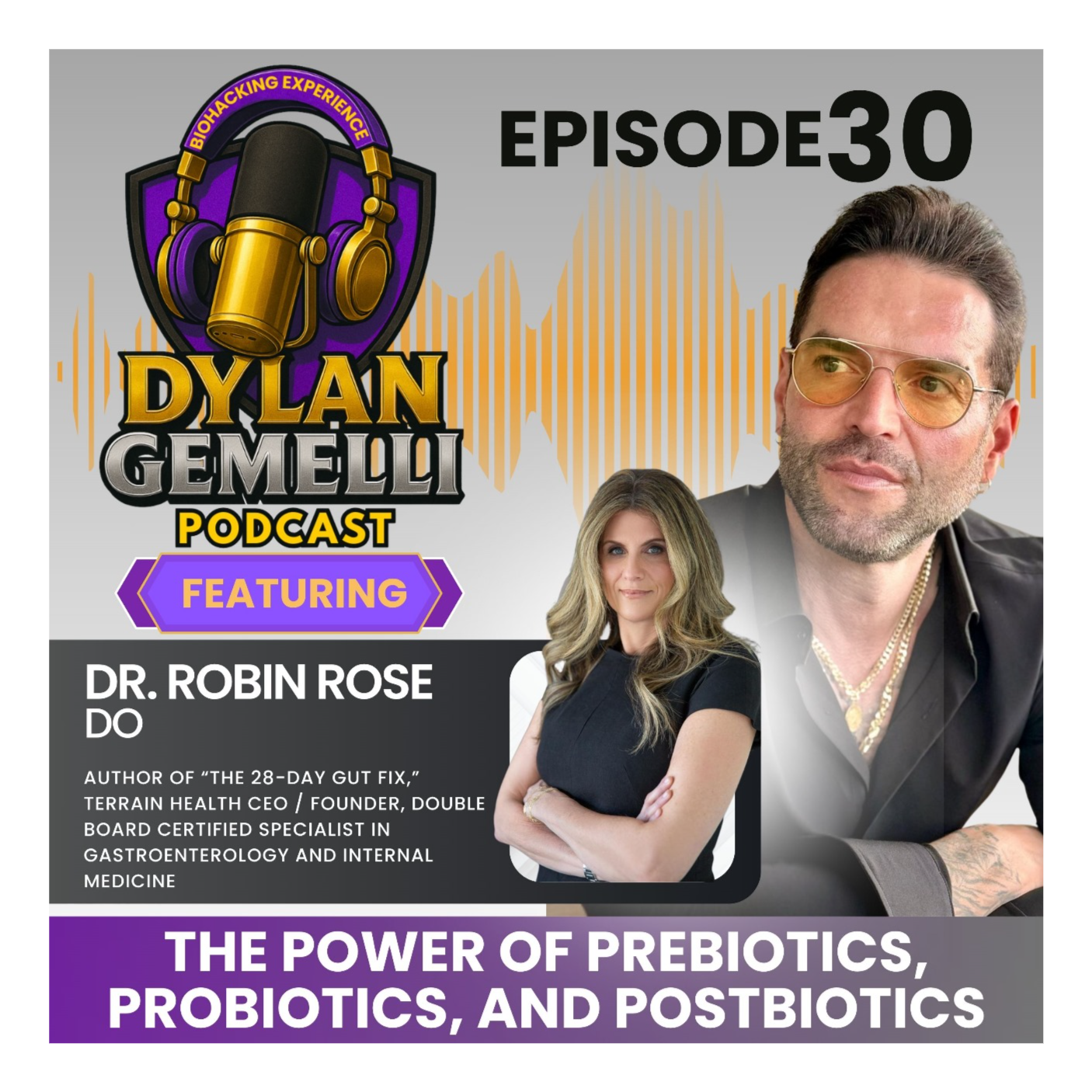
The Dylan Gemelli Podcast
Episode #30 Featuring Dr. Robin Rose! The Gut Microbiome and Covid Expert!! Insight on how the covid virus works, the dangers of spike proteins, long covid concerns, a FULL breakdown of leaky gut, how to treat it, SPORE probiotics and MORE!!
01:40:59
Loading summary
Transcript373 lines
- [00:18]
A
All right, everybody, welcome back to the Dylan Gemelli podcast. So we have a very, very, very exciting time today that I have been waiting and looking forward to. So my guest today, she does quite a bit, and I've already learned a ton from her. I'm sure many of you have heard of her, but just some of her credentials. First, she is a board certified specialist in gastroenterology and internal medicine. She has a bachelor's degree in behavioral neuroscience with honors from Lehigh University and a master's degree in neuropsychology from New York Verna University. She also has a medical degree from the New York College of Osteopathic Medicine. And she is the CEO and founder of Terrain Health. And she did that because she wanted to practice healthcare, not sick care. And she's known for being an expert on the gut microbiome and long Covid. So we got a ton of stuff to get into today. So my friends, welcome Dr. Robin Rose.
- [01:11]
B
Thanks, Dylan, for having me. I really appreciate it. I'm so excited to be with you. Educate your audience on all that we.
- [01:18]
A
Can talk about 100%. Well, everybody, I've had the blessing of knowing Robin now for several months, and she's going to be doing some tests on me as well and help me out with some things I have concerns about. And she is just beyond being highly respected, just a wealth of knowledge. But beyond that, what I would say is just a huge breath of fresh air because of the way that she goes about her teaching, the compassion that she shows, and the knowledge that she has. So we're going to dig into a lot of different topics today that I think some people are either scared to touch on or don't know a lot about, have misconceptions, have, like, hearsay things. So that's why she's here to help and educate. So, Dr. Robin, let's first just kind of start with your background a little bit. Why gastroenterology? Why internal medicine? What turned you on to that? What fascinated you with that?
- [02:10]
B
Yeah, so when I was doing my training in internal medicine, it was funny. I actually thought I was gonna maybe specialize in hematology, oncology. Then I thought I was gonna do cardiology, and I landed on gastro because I just like the system. And I struggled with some irritable bowel syndrome myself. Maybe that's tmi, but I did. And I also liked procedures. Like, I wanted to be a proceduralist. So you do upper endoscopies, colonoscopies, and you get to do really cool things when you're in there with the scope, like stop bleeding ulcers and take out really large masses or polyps that could turn into cancer or that maybe are cancer. And you have a lot of opportunities to like save people from surgery sometimes by being able to utilize the instruments and the, and do the procedure the correct way. So that's why I went into GI and I really, like I said, I do love the system. It's like, you know, the hole in the donut, you know, everything from your mouth down to your anus, and then it's also your liver, your pancreas, your spleen, your gallbladder. So it's a big system to have fun with and diagnose a lot of different conditions and diseases and obviously treat them. So I, that's why I chose it then. It was a perfect segue when I went into the functional integrative world. Right. Or the longevity state to transition. It was very natural for me to transition into being a gut microbiome specialist or really specializing and honing in on that area. And also before I even went in to the functional medicine space, I, you know, always gravitated towards treating the gut microbiome, like for years, like right out, right when I got out of my fellowship and I was in the conventional world, you know, my, my two senior partners who were both males, they were like, what are you doing? Like, they're like, why are you not scoping all these people? They're like, how are you getting them better? And you know, I was using nutrition, I was using probiotics, I was using all these things. And they're like, what? And then they started jumping on the bandwagon and doing so anyway, I always gravitated toward trying to treat people more naturally. Right. And trying to get more to the root cause and not symptomatic management pill for every ill, you know, so that's always been something that I was passionate about anyway, so it was a, it was a pretty natural move for me to go into this space.
- [04:40]
A
Awesome. So, and, and that's. I align so well with people. I'm so blessed to talk to people like you. And that's why I gravitate to people like you that have kind of taken, you know, your knowledge base and went and done something about it on your own and taken control of the situation and help people in the way that they really don't get it from normal healthcare. And so when you start studying gut microbiome, you did that like quite a long time ago, correct?
- [05:04]
B
Well, it's funny. So when I first Got out of my fellowship and I started practicing. I started using probiotics and prebiotics, more probiotics. But I, and I, we don't learn about any of that. Like, I was like, no. And I don't know why, but I literally had a stack of, like, papers like this, this high of every article and any article I could get my hands on to, you know, basically, you know, understand like, why this helps people stay healthy, how it impacts your immune system, why people that take probiotics or have a healthy gut microbiome, like, have less days missed at work or less days of an illness when they get sick, if they're sick. You know, all these different things, right? And so I, So I always, I always had this knowledge to learn that type of medicine. But unfortunately, when I finally was doing both, when I was sort of in my conventional, practicing 30 plus patients a day, I say practicing MC medicine, right? Like a revolving door of patients in and out and only being able to, you know, spend 10 minutes with them or 15 minutes with them and wanting to really heal them. I couldn't do that. And I know was really depressed about it. It was really upsetting. And I really felt like I called myself a charlatan. I remember to some, I felt like I wasn't like, once I finished all my coursework at the IFM and all the certifications, like, I was like, I couldn't even apply it in my conventional practice. There was no way for me. And that's when I felt like I was like a fake. I was like, I can't even, like, really heal people this, you know. And so I just finally, in the middle of COVID literally June 2020 of COVID I gave my notice and I just was like, it's just gonna work out. Like, I just was like, let it work out. Like, I was just like, I. I don't know. And I just started to rain help, you know, and that's how it started.
- [06:57]
A
Well, when your heart's in the right place, it always works out. Eventually. It just does.
- [07:01]
B
I. I don't know. It's. I think it's still working out, I guess, to some degree. Like, you know, it wasn't, you know, it wasn't the best stuff. My husband at the time was not happy about me.
- [07:13]
A
You know, you have to do what makes you happy and what fulfills you, and then that's it. Otherwise you're going to be miserable and resentful forever. So I can tell you right now, there's plenty of people thankful for what you do. Where I was kind of going with the gut microbiome thing is it's, it's, it's gotten so more prevalently talked about and discussed now where people are realizing that that is one of, if not the key issue to almost every problem we have. Essentially it's either a cell problem, and if it's not a problem with your cells, it's your gut. Right? It's one of the two. Everything's origina. When do you think was the turn for that, where that became? Because, like, for me studying this and being around it, I was blessed enough when I met my wife, she was working at like a natural health place. But this man that was in there that everybody thought that was crazy, that owned it, and this was like 2011 was way ahead of the curve and was talking about this and I was like, what are you talking about? When she started telling me. But come to find out, you know, it's gotten so prevalent. When do you feel like it really took hold, that, okay, people are catching on now we understand this is really a significant issue to like the core of all the problems.
- [08:19]
B
I, you know, so here's the thing. Like, I wasn't really heavily vested in the space until like 20, you know, 2019. Right. So. But if you look back at all the people that have influenced this space so much, like Mark Hyman and you know, you know, those, they've been talking about the gut microbiome forever, you know, But I mean, I, I think especially since, you know, the pandemic, it's become very hot topic. You know, it's been published in mainstream media, you know, newspapers talked about, like on television, on, you know, news shows much more often, particularly like probably in the last like five years. But I mean, it was definitely getting hot probably at least five years before that, but still as, as hot as we think it is. And we noticed this, the vast majority of the population still doesn't understand or get it, nor does the conventional medical world either.
- [09:14]
A
No, I know it's wild too, because you would think that more people would be onto this now and understand it, especially with all the studies and the talk and the people behind it. But I guess the best we can do is just keep putting out the info. And I interviewed Dr. Gundry a couple weeks ago. So, you know, we got into that heavy, you know, and it's, yeah, it's, it's really nice to learn and understand the ways to combat this, the things to look for, because a lot of people don't know and they just start to taken Any probiotic under the sun.
- [09:41]
B
Don'T even know what it does, aren't even the. It's all about really healing the intestinal mucosal barrier, right. Like really the leaky gut and getting the good bacteria to grow. Right. You know, probiotics are great, you know, to a certain extent and especially you have to be careful about which one you're using. And they're sort of like tourists, you know, they sort of like, they go, they're like passing by, exerting their effect, you know, and then they're leaving. Right. It's more like the post biotics, which are the metabolites that those good bacteria make. That's what's the most important. That's what is influencing structure, function and influencing different systems in our body. It's really those metabolites or what I call the postbiotics.
- [10:25]
A
Okay, so let's do a rundown here. Let's try to give a good explanation because I can't. You know, there's not too many people that I could think of better than you to explain this and break this down for people. So let's, let's do this. Let's make it as easy as possible, but still get into like the full rundown. One, how do we decipher if we have like a leaky gut issue? What are some, some either blood markers to look for or some, some side effects, trigger points, things like that. And then two, how do we go about addressing that issue?
- [10:55]
B
Okay, so you might laugh from my answer, but first of all, I think the vast majority of the population, especially if you're living in the United States and eat a standard American diet, you have some form of leaky gut or at least a little bit of it. So I say to many of my patients, unless you're a cow and you live in a bubble and you eat grass all day, you probably have a little bit of leaky gut. Because everything from. Right, Dylan, from our exposome, like all the environmental toxins, glyphosate, which is now pervasive, it doesn't matter even if you're like not eating foods with glyphosate in it, because that's being spray in this, it's being sprayed even like on golf field, like on golf courses, you know, and then it travels in the air and then we're inhaling it. Right. So it's like all of those things are going to, you know, destroy the gut. Microbiome, your refined sugar, ultra processed foods, alcohol, non steroidal anti inflammatories. I don't know, the list goes on and on. 1. And forget about the course of the antibiotic. But one antibiotic, one dose of an antibiotic kills off thousands of the good, friendly bacteria. So we're exposed all the time to all of these things, right? So that gut microbiome, which is obviously influenced heavily by our epigenetics, right? How we interact and adapt to the world around us is always. It's like in this dynamic state, right? So we're always trying to keep balance in that microbiome. That's how I. That's how I think of it. So I think we all have to be doing something on some level to keep that intestinal mucosa, the intestinal mucosal, mucosal barrier intact and to keep really good balance in the gut. Right? The good, bad, and the friendly bacteria, like, in check. Okay. And balance. So there's always stuff that you should be doing, even. Even not moving, you know, being sedentary, even smoking kills, you know, the, the tobacco, nicotine, you know, that has a bad impact on the gut microbiome. Even when you have cortisol dysregulation and, you know, your vagal tone is, for all of that, is messing with the health of your gut and your gut, you know, your gut microbiome in that barrier. So you have to be working, unfortunately, because of the, you know, if we were hunter gatherers back in the day, and we were going to sleep when, you know, when the sun went down and we're falling asleep in front of the fire that we lit naturally, and we're just, like, eating off the land and the berries and the plants and. And, you know, hunting when we had to and being in feast or famine and all those things, we'd have really good gut microbiomes, probably, but that's not how we evolved. And so based on how we've evolved, we now have to pivot and work harder at keeping ourselves healthier and keeping that gut microbiome healthier.
- [13:50]
A
Got it. Okay, perfect. Yeah. 100%. You're the expert. You can't ask me, but of course it's okay.
- [13:56]
B
Did that make sense? Like, I was.
- [13:58]
A
Yes. No, I'm just. I'm. Yeah, 100%. Absolutely. So you were talking about prebiotics and postbiotics and all of those different things.
- [14:07]
B
Yeah.
- [14:08]
A
Can we just give, like.
- [14:09]
B
Yeah. You want to talk about that?
- [14:11]
A
I do. Because it's very confusing.
- [14:14]
B
Well, confusing.
- [14:15]
A
So can you just say, okay, first of all, can you just say what the heck is a prebiotic and a postbiotic and two, what. What do we need and what don't we need?
- [14:25]
B
Okay. So prebiotics are the food that the bacteria in your gut are feeding off of.
- [14:33]
A
Okay.
- [14:33]
B
And the interesting thing is, and you can look at this in a lot of different ways, but giving yourself a prebiotic or a specific prebiotic might not be good for one person, but be good for another person because you each have your own unique microbial blueprint. Right. And so based on the bacteria that are there, what prebiotic is right for you? Right. So I always say, you know, really having that beautiful diversified diet of all the colors of the rainbow. Right. And, you know, sticking to either side of the grocery store, like where you're in the produce section or. Right. The meat, the fish and that stuff, like eating anything that man hasn't gotten in the way of and staying away from that standard American diet, you're going to give yourself the prebiotics, like from all the veggies and the fruit, you know, all those things. Right. So, you know, resistant starches, all that stuff is going to be really important in helping diversify and feed that microbiome. Sure, there's different things like inulin and so forth, you know, but again, it's. You don't know what each person's blueprint is, Right. Unless you test every single person and know that, and then you can maybe match that prebiotic to the population that's, you know, living there. And of course, if you took maybe, you know, something that has a bunch of different prebiotics in it, that's always helpful, of course. But eating foods that specifically have these prebiotics in them, them. And, you know, at the end of the, you know, I could give you a list of, like, really good prebiotic, like, foods that give the microbiome that food that they need that like, have more prebiotics in it is really healthy. I mean, the other thing that people talk about too are fermented foods.
- [16:10]
A
Yeah, yeah.
- [16:11]
B
Which are awesome. And they help feed the gut microbiome. Well, like kimchi and sauerkraut and kombucha and all those lovely things, like anything pickled. Right. The problem is, in this day and age and with all the chronic illness we're seeing, a lot of people are very sensitive to that, right? Mast cell activation, mast cell issues, histamine issues are like through the roof right now. So when you give yourself fermented foods, it's going to exacerbate that. So once you get your gut microbiome in balance again, Right. And you've controlled for this mast cell or histamine issue, then it's okay to start bringing in those foods again so that you don't trigger your histamine, you know, that histamine response. So I just want. That was. I digress. Sorry, but I just felt like I should say that, but.
- [16:58]
A
No, please.
- [16:59]
B
They are great. And then. Okay, so those are your pre. Does that. So that's your pre. Right, Your pre situation. Okay. Then you get to your probiotics. So you're pre. And now you're probiotic are the bacteria, right? Those bacteria. So that's why when you take a probiotic there's like so many different ones on the, there's like every single, you know, species of Lactobacillus or every single species of Bifidobacteria, right. And again, it's like you want diversity, you want all those different things. And then there's, you know, some of them have Streptococcus thermophilus in it. And then you have, then you have your other class of, of probiotics which are your spore forming bacteria are fantastic too. And a lot of people lean towards those because the spore former, right, those, those are like the missing organisms. Right? Like you know, spore form, these spore formers, those bacteria, a lot of them have been lost over the decades from urban urbanization, deforestation and industrialization. Right. So giving us back those types of bacteria. Great. And then those help actually the other bacteria to grow. So that's why a lot of people do really well with those probiotics. So like Megaspore Biotic, for example, that's by Microbiome Labs. That's a great megaspore. Yeah. I think Zach Bush has his ion. What is it? I, I forget his product. I use this other product I love called Rhizo Health, which is from unmind soil from South Africa. And it's all of the lost organisms that have been identified in this unmined soil. You can find unmind soil in different parts of the world and it's wonderful. And because of what it's suspended in and because of what it does, once it gets into your body, it actually behaves as a pre pro and postbiotic. So anyway, there's lots of different things on the market like this that are super helpful, you know, and the probiotic, like I said, the spores are nice because they're sort of like getting in there and doing their job and getting those other bacteria to grow where maybe some of the other probiotics aren't seeing sticking as much. But as they pass through, they're exerting their effect and they're getting those post metabolites to grow.
- [19:18]
A
Okay.
- [19:19]
B
I mean to, to be synthesized. I don't know why I said grow, but. And the other thing I will say, I'm sorry, my head, I feel like I have all these things to tell you is when you take a probiotic too, in the probiotic is a prebiotic, usually because the bacteria has to live inside the capsule and stay alive. So a lot of times when you're taking a probiotic, you have some prebiotic mixed in with the probiotic too. Okay, so is that confusing? Tell me.
- [19:44]
A
No, no. Well, okay, so like my mentor several years ago told me to take spore probiotics and I'm looking at this like it's a foreign language. Honest. Just I'm normally like, really?
- [19:56]
B
It's like, yes.
- [19:59]
A
We didn't get into the like, what's the difference and why. So first, first question, if you're taking a spore probiotic, right. Do you need to take a regular probiotic with that or are what you need from that?
- [20:12]
B
You're likely getting what you need from it. But I will tell you this, I sometimes will add like, and this is just because I'm crazy, but so I test, like, I do a lot of tests. I was doing a lot of testing on the gut microbiome, like next generation sequencing, shotgun, you know, like real stuff. Like.
- [20:30]
A
Yeah.
- [20:31]
B
And you know, it seems that in the post pandemic world, after getting Covid or the vaccine, that the bifidobacteria species has been wiped out. Okay. And even the phylum, so the phylum, which is the class, right, that the, all those different species and families of bacteria fall under, which is your actinobacteria phylum, that's wiped out in many people too, which is not good because if you don't have your bifido bifidobacteria species, then your innate immunity, your innate immune response is going to suffer hugely. And also those bifidobacteria also control a lot for the histamine response too. And, and also help produce short chain fatty acids, which is a postbiotic or metabolite that's very important for a bazillion different things. So anyway, what was I saying? Oh my God, now I like lost my train of thought. What were you talking about? Like, oh, the bifido. Yeah. So I'll, so I've been giving people, so I'll have them take, let's say the spore forming like Omegas 4, the Rhizo. And then I'll have them do like true bifido, like a true bifido pro US enzymes make it. And I'll have them do that at night. Now, like I said. Is it sticking? Maybe it's exerting its effect. Effect, Whatever. I. I know US enzymes. They had told me back, you know, a few years ago when I did a lot of work with them that they had tested it and they found that it was sticking, you know, like it was in the. It was present in the. In the gut, but, you know, probably not for long periods of time. But anyway, I want people to sort of build their bifido back up. So I was throwing that in there too. But the spore former should theoretically get the bifido to start to grow as well.
- [22:04]
A
Okay, so. So for somebody starting out to make it simple for them, that really just taking a spore probiot the evening would be sufficient, in your view?
- [22:13]
B
I do. To make life easy. That's my.
- [22:18]
A
Would you take that with. Without food then? Is that. Or with food or how do you do that?
- [22:22]
B
It doesn't matter. I mean. Yeah, I mean, if you're taking antibiotics, you want to take it away from the antibiotic. I forget with megas, I probably better on an empty stomach. That's why it's better to take at bedtime, you know, Ugly. Yeah.
- [22:36]
A
Got it.
- [22:37]
B
Yeah, I think so.
- [22:38]
A
So empty some explore in the evening. That's a good way to get going. And then if that's not. If you're still having issues, then we would take a deeper dive and a deeper look then. Correct?
- [22:48]
B
Right. But then we have to. We didn't. We didn't go to the postbiotics.
- [22:51]
A
Okay, let's talk about that.
- [22:53]
B
Let's talk about the postbiotic. So the postbiotic, that means it's the stuff that the bacteria or the probiotics or the gut bacteria in your microbiome are synthesizing and making. So they synthesize and make thousands of metabolites which. Which significantly impact our health. Okay. And these metabolites, you know, cross the gut barrier and get into our bloodstream and impact other parts and parts of our body and organ systems. Right. And some cross the blood brain barrier. And, you know, some metabolites could be good if they're coming from the right bacteria, but some could be bad. Right, right. And like. So, for example, like lps, Right. Lipopolysac. Like, everyone's heard of lps. It's a marker. We look at lipopolysaccharide and that is bad. That means you have like a lot of bad, you know, gram negative bacteria living in your gut and it's secreting this bad metabol, this bad metabolite.
- [23:53]
A
Right, Right, right.
- [23:54]
B
But then you have amazingly fantastic metabolites like your short chain fatty acids which everyone, many people have heard of.
- [24:02]
A
Right.
- [24:02]
B
So, and those short chatty acids like do a million different things. You know, everything from, you know, the, you know, restoring health and balance to the integrity of the intestinal mucosal barrier, keeping intact, you know, the tight, you know, making sure the tight junctional proteins are functioning properly. Cardiovascular health, metabolic health, like ever, all those things. Right, right. So, so that's what the host. So I, I believe that probably in the future, like products that really show efficacy, good efficacy with these postbiotics or these metabolites is where we're going to go because it's really, that's the end result, right? That's the end game. It's not the fact that those bacteria are living there, it's what are they doing for us and what are they making for us? They're living there on purpose to make these things so that we are healthy.
- [24:55]
A
Right, right.
- [24:56]
B
So it's going to be all much, I think it's going to be more about the postbiotics or these metabolites.
- [25:02]
A
Got it.
- [25:03]
B
So, and there's this wonder, there's this one I'm doing unplugging for people. Not that I don't even know. I have no ties to any of these people, by the way. But so there's a wonderful product that I used for quite some time and I still use it and it's called the antibiotic. Okay. And the antibiotic is a, is, is all of the thousands of these postbiotics or these metabolites that we're talking about. So what they do is, is they get donor stool that's screened, right. And then they take the stool and they autoclave the crap out of it. Right. So that, then what's left? So all, anything, any like protein, rna, like any, any bacteria, it's all dead. Okay. So that's dead. And what's left are these beautiful postbiotics or metabolites and then they encapsulate that so it's like freeze dried poop. And people like I used to tell my patients, they're like ew. But no, I mean, you know, fecal microbial transplants, you know, can reverse and regress like many chronic disease states and conditions. Right. This is being studied all over the world. So this is a way around that because you're giving them from a healthy donor, right? From a really healthy donor who has like a perfect, you know, looking microbiome. You're giving, giving people the metabolites from their microbiome. Does that make sense? And so that's a great product and it works great. You know, people do one great on it.
- [26:33]
A
That's laughing because I pulled this up to look at it and it says right on here, good shit guarantee. And it says, are you our next? Yeah. Are you our next unicorn pooper? And it says they're looking for donors and donors.
- [26:47]
B
Yeah. Okay. Yeah.
- [26:48]
A
Oh my gosh.
- [26:49]
B
So really, really important, you know. And I even believe, like I don't want to get like. I know it's like such a touchy subject, but I, I will say that because of how high they heat it and it's autoclaved and any protein will even die. That if people are worried about the Spike Pro, you know, about, you know, because a lot of people are worried about if that person was vaccinated, if there's Spike protein that would be. Be killed.
- [27:12]
A
Okay.
- [27:13]
B
I believe so. I think it's still a good product.
- [27:16]
A
Okay, so let's do this then. So Spore probiotic and the one that.
- [27:21]
B
You had recommended there was Megaspore microbiomes and I like Rhizo Health. R H R H I Z O Health.
- [27:32]
A
Got it.
- [27:33]
B
Rhizo Health. I think it's rhizohealthus.com their site, Microbiome Labs, everyone. You know, it's microbiomelabs.com but those are two of the ones I love.
- [27:42]
A
Okay.
- [27:43]
B
All the time on my patients.
- [27:44]
A
So we're going to do one of those like a spore and then you recommend also taking a postbiotic along with that.
- [27:50]
B
Listen, if you can afford getting the antibiotic, I think it's wonderful. Especially like, you know, for maintenance. You know, it's not a forever thing either. Like if you're, if you just want to repopulate and get those postbiotics in there, like I think you can take it for three to six months. Right. If you have a chronic condition though, you might want to take it for, for longer, like 6 to 9 at like maybe a little bit of a higher dose and then back down to maintenance for a few months and then just keep it around. If you start to not feel great, you know, that's like not. You don't have to stay on that forever because you're just trying to get those postbiotics like in there doing their thing and exerting their effects.
- [28:26]
A
Again, let's say somebody can't afford that. Is there another alternative they could go with for postbiotic?
- [28:32]
B
I have to look up. I'm not.
- [28:34]
A
Okay, but you're, you are saying though that to take that maybe three to six months and then you don't have to take it for a while.
- [28:40]
B
Yeah. But the rhizo does fulfill all three criteria pre proposed based on what's in it and what it's doing in your body.
- [28:48]
A
Really? Okay, okay. So rhizo health fulfills everything.
- [28:51]
B
Personally? I think so. Yes.
- [28:53]
A
Got it. Okay, cool. All right, so here's another question. This was actually sent in by my wife via text message while I'm talking to you. Yes. She's in the other room listening and she has a question. I think it's a good question.
- [29:07]
B
I love that she. We sort of have like a live studio audience. I can ask. Yeah, we do, we do. I love that.
- [29:13]
A
She said to ask you if we still need probiotics if we're eating fermented foods on a daily basis like kimchi or sauerkraut or things like that.
- [29:21]
B
Yeah. So people would argue. No, you know, that like you probably have a much healthier microbiome and you know, and if you feel good, right. And you're pooping good and you don't have GI symptoms, you don't have any bizarre conditions and your blood work looks. I say no, I think if you're giving yourself all of these things and you're eating, that's a problem. But the problem is most people don't.
- [29:44]
A
Don't.
- [29:44]
B
Right. They're not eating that way. So when you don't have like a super clean diet, you're not eating that way. It's going to be really hard, like I said, not to have some dysbiosis, not to have some leaky gut, so on and so forth.
- [29:57]
A
Well, and also people like for instance, Queenie told my mom to go shop for, for kimchi and you know, sauerkraut and my mom wasn't buying the right one and we had to fix that. A lot of people don't know too. It needs to be like refrigerated ones and you know, like the ones off the shelf are not the ones to buy.
- [30:14]
B
I mean, in some of those, I think the kombucha. Doesn't it have the probiotics in it too?
- [30:18]
A
I believe it does. I'm pretty sure that it does.
- [30:21]
B
Yeah, those things are great. I mean, and if you're, if you don't have a histamine issue and you're healthy and your gut's healthy. Those are awesome. You should totally be drinking those things.
- [30:30]
A
Absolutely. Okay, cool. So we've got that kind of down now and that discussed. So I think that's a big one that a lot of people have confusion on. I know it's tricky and there's so many things marketed and different brands and different bs. So that was a good cover. Now.
- [30:45]
B
Oh, and what, you know, wait, hold on. One other thing that I just thought of.
- [30:48]
A
Yeah.
- [30:49]
B
Another red flag I, I believe is, you know, like when you get micro, when you buy Megaspore, when you buy the, these from these good companies, you really don't technically need to refrigerate it. Right. And there was like this, this fallacy sort of like, oh, it has to be in the refrigerator. No, no, no, no. You know, these probiotics are freeze dried and if they're, they're, if they're made the right way. Right. And they have a prebiotic in them and they're made the right way and the, the, the, and they're freeze dried, they can live at room temperature for like a very, they're very shelf stable for a very long time.
- [31:24]
A
Okay.
- [31:25]
B
So they actually, so to me, when they, when they say it has to be refrigerated, that's like a red flag. The other red flag to me is when you have so many billions, so many billions and billions of organisms, that means to me that that's not a stable product. Right. And that those organisms are dying off pretty quickly, you know. So you want like a shelf stable, freeze dried product for sure. That's the other thing. Now the rhizo, it's shelf stable too. And it's a liquid though, just FYI. Yeah, but it is shelf stable.
- [31:58]
A
It looks like it's sold out every. I'm going to look when we get off the thing but off the podcast. But it looks like it's sold out everywhere. But I will find it.
- [32:05]
B
I have it on my. So my so where I keep all my COVID protocols. I have a bunch of the rhizo because it's part of my pro. I put it in my protocols to help rebuild the gut. It's at Medic M E D I C O R E R X Medicore rx dot com. You could get rhizo there too.
- [32:22]
A
Okay, well I'm sold and it's for the same price. Perfect. Well, I'm going to order that there. Here, go ahead.
- [32:29]
B
No, no, I said anyway.
- [32:31]
A
Well, Here I was looking and I. I'm curious here. So on that microbiome lab site, there's products and. And I want to ask about this.
- [32:39]
B
Yeah.
- [32:40]
A
Things like addressing gut flora, for example. Like is one of the things on here that I see. And so to talk about that first. And then the mucosal support, things like that. Are those necessary or what if somebody.
- [32:53]
B
Yes. We didn't want to get complicated, but we could get a little.
- [32:56]
A
Let's get complicated.
- [32:57]
B
Like, like if you. You want to restore. Right. The integrity to the intestinal mucosal barrier. Yes. Like their product, for example, like that mega mucosa. Right. Which has all these different serum immunoglobulins. I think it's. Yeah. Is it mega. No, it's mega IGG2. So that has all these bovine serum immuno immunoglobulins in them. And that is very helpful to restoring the gut integrity. The. The. The mucosal barrier. For sure.
- [33:27]
A
Got it. Okay.
- [33:29]
B
And giving it the immune support it needs. All and all that jazz. So is the. And then there's also. What else do they have? They have the mega mucosa, I think that has. I forget. What is it? Do you have it up there? What's in it? Can you look at it? I forget.
- [33:42]
A
Yeah, I will look. So I've got mega mucosa here. I got two screens going so I can look side to side. It contains. Let me get the back.
- [33:53]
B
Sorry. Iga. I forgot. What's in that?
- [33:55]
A
So we got L, Proline.
- [33:56]
B
L. Yes.
- [34:00]
A
Yeah. Immunoglobulin, globulin, G, M and A.
- [34:03]
B
Okay. Ig. Yes. Okay. So that has the aminoglobulins in it.
- [34:07]
A
Right.
- [34:07]
B
Okay. So that's very good for restoring the leaky gut, the integrity of that, you know, gut. Okay, and then what was in the. Because I get confused with products. I'm sorry, I don't have. And then what's in the. What is in the Mega IGG 2000.
- [34:24]
A
Let's find that one. Okay.
- [34:26]
B
Mega IGG 2000, I think that has all the bovine serum immunoglobulins that has.
- [34:32]
A
Serum derived immunoglobulin concentrate immunoglobulin G 900 milligrams.
- [34:38]
B
That is better. That's gonna help. So the mega mucosa is more. So I got them. I'm sorry, audience, I messed it. So the mega mucosa is better. Is very good for again, restoring health and balance to that intestinal mucosal barrier. Okay. The serum bovine immunoglobulin is helpful for that. Yes, to some degree, but also to helping get the different bacteria to grow better also and help with the dysbiosis as well.
- [35:05]
A
Okay, so the mega IG is the one for the leak gut.
- [35:08]
B
It's great immune support too.
- [35:10]
A
Okay, so mega ig, leaky gut. Correct. Okay, perfect. All right, well, we got some protocols here, so I want. I'm taking so many notes.
- [35:20]
B
Microbiome lab should. Should. Should sponsor this segment. Okay.
- [35:24]
A
I think. I think I'm gonna. I'm gonna send them a copy of.
- [35:28]
B
This and say, you really should if.
- [35:30]
A
You want this released. You know, we got to get some. Some benefit here. No, you know what? I like to promote the products I believe in, but I like to just talk. Whatever's good. We don't have to always. Yeah.
- [35:42]
B
And all the different companies are so good.
- [35:45]
A
Everything doesn't have to be an affiliate code.
- [35:48]
B
And like, you know, I. It was funny, I was thinking about that the other day. Opens up my. My cabinet where I store. Stash all my vitamins that I haven't opened up yet, you know, because I. I hate running out. And I was like, wow. I was like, I'm really just so good. Like, I. I really support everybody because I have, like, pure encapsulations, microbiome labs, integrative therapeutics, vital nutrients. Like, it's like I have everyone, you know, I have everyone and everything, you know, designs for help. Like, it's just amazing.
- [36:17]
A
Oh, it's important to learn, you know, about all of these and to just be honest about what works and what doesn't. Not just because you. Just because you sell it.
- [36:25]
B
Biotics research. Yeah, like, different companies, you know, they all. They have. I feel like I just gravitate to different companies for different things, you know, it just. I don't know.
- [36:35]
A
Definitely. Okay, well, let's switch gears here. Obviously, you know this. I just. Well, and to be honest with you, I didn't even tell you this, so I told you I tested positive for Covid, but then I took another test that said I was negative, and then I took another one. I had a two, two, two piece test from cvs, both said positive, and then I bought three other different tests that all said negative. So I don't know what the hell I had. Okay. But I do know I didn't feel good at all.
- [36:59]
B
Really crappy.
- [37:00]
A
Yeah, I felt horrible. And so you put me on a very nice protocol that I've never done. And within three days, which is by far the shortest because I've had Covid like six or seven times, literally. And some of them have been wretched, some of them have been pretty bad, but manageable. But I mean, I had a, like two and a half, three week one one time. And it seems like they've been different quite a bit too. This was by far the shortest. I don't want to jinx it because I'm still 100%, but let's talk first about the protocol things.
- [37:33]
B
You're on, all the good things, you're not on everything. You're missing one major product. But I, I, I pivoted and made sure I got like, a bunch of the stuff that was in that product into you, you know.
- [37:43]
A
Perfect.
- [37:44]
B
Yeah. You have to be resourceful.
- [37:46]
A
Let's talk about your protocol here. Because there's, you know, there's so much, excuse me, but bullshit that people talk and, and go over and act like something doesn't work. At least now we can actually talk about it because people are more up to speed and actually grasp the concept of what was not true and what's true. Let's talk about your protocol that I can 100 confirm. Absolutely. Worked like a charm. Because three days ago, you want to.
- [38:13]
B
Squash the viral load fast like you want. You don't want the virus to get, like, to start replicating out of control because every, for every virus, you're producing tons of spike protein. Right, Right. And so. And you want that spike protein, like, gone as soon as possible.
- [38:30]
A
Okay.
- [38:30]
B
Because. Well, should we talk about a few concepts first and then why.
- [38:34]
A
Yes, let's, let's. Okay.
- [38:36]
B
Instead of just giving up, interviewing me, I shouldn't.
- [38:40]
A
Well, instead of giving a protocol, let's explain why. Like, really why not? Just, Just because. Or you better do the science. Well, let's talk about the science.
- [38:50]
B
Right, okay, let's. Okay, so if there's a few. Okay. I'm not gonna get into everything because everyone always yells at me when I do that, and they're like, that was really complicated and I didn't understand that. So I'm gonna try to be as simple as possible, and then you guide me to tell me if I'm being absolutely.
- [39:05]
A
Absolutely.
- [39:06]
B
So there's a few concepts I want everyone to understand. Okay. After five years of research and being like, knee deep in this forever, you have to understand two things. First. Okay. There's two drivers of the disease. Okay. Or the, what I call post Covid conditions or post tax conditions. Okay. Clearly, in the vaccine, it's the spike protein. Right? Because that's all that's in the vaccine. Is the spike protein. There's no other proteins in it. Right. Like the spike protein. And then from the virus, it is the spike protein. But the spike protein and the. The virus itself also causes a lot of issues as well. Okay, so. And. And I'm going to explain why. So the virus is what's called a bacteriophage. Everyone's like, what the hell is that? So a bacteriophage means that the virus invades the bacteria in our bio. So I'm going to stick with the gut microbiome because this has been proven by Dr. Carlo Brogna, Simone Crestoni and their group in Italy, and they published this a few years ago. And the fact that nobody really knows this is very sad. So I want to get this out to your audience. Okay?
- [40:15]
A
Yes.
- [40:15]
B
So the bacteria in the gut microbiome get invaded with the virus. The virus then replicates, takes over the bacteria. Okay. And, you know, you can see in the papers published by Bronya et al, that under the microscope, these bacteria are no longer really bacteria and they're not doing their job anymore because they've been taken over by the virus. Okay?
- [40:40]
A
Right.
- [40:41]
B
They're teeming with SARS COV2 virus. So, like, if you could imagine, like a circle, and then all these little tiny circles inside the circle are the virus replicating inside the bacteria. Does that make sense?
- [40:54]
A
Yeah.
- [40:54]
B
Yeah. And then what happens as a result is the bacteria, right. With all the multiplying virus in it, start to throw off these peptides called toxin like peptides. Now, the group has at this point identified about three to 400 different peptides. It's a signature. Okay. They were. They were able to show this because in their papers, they did have their. The same people that got the virus were their own control, so. Meaning anyone that never had Covid before, when they looked in their stool and in their serum and all that stuff in their urine, they didn't make. There were. These peptides weren't present, but then after getting the virus, these peptides were present.
- [41:39]
A
Okay.
- [41:39]
B
So it's unique to SARS COV2.
- [41:42]
A
Got it.
- [41:42]
B
Does that make sense? Yeah, 100% here, because I get yelled at a lot.
- [41:47]
A
No, no, no, no, no. This is important and people will understand.
- [41:51]
B
Okay. So now in most people, if you test them and we're in the middle of researching all this, okay, they have these toxin like peptides because the bacteria, the bacteriophages, live in our gut for months, if not years. I'm really not trying to free people. I'm just telling you okay. So they're there in a lot of people, even people that don't feel like they have long Covid. And, and I don't. We don't know what is the short and long term damage. Like I, you know, what is somebody's post Covid condition and. And is it resulting from this? I don't know. But these toxin like peptides exert their effects all over the body. And a lot of them are neurotoxins that cross the blood brain barrier. Right. And they are toxic to the gut and the gut lining and to maybe your kidneys and your lid and all differently in your heart, you know. So, so that's problem one. Okay, so.
- [42:44]
A
Okay, one second, one second, I'm gonna stop you there. How do we test for this peptide to know if we have it in our body?
- [42:50]
B
So right now it's in R and D, so I'm able to do it with a lot of my patients. But the idea is to hopefully commercialize it at some point very soon.
- [43:00]
A
Okay. All right. Okay, Keep going. Sorry.
- [43:03]
B
Which. I don't know how that would happen, but whatever. Hopefully maybe some. Maybe someone will hear this and want to help us. I don't know. So, okay, so that's first. Now it gets more complicated. You're like, oh, God. If you. So when you have the virus, remember, like when you identify the virus, like even in the gut, you could have the spike protein just in the cells. Right. Or you could have the virus replicating in the cell. And that's not just in the gut, but anywhere in your body. Right. Now, once the spike protein of the virus is inside any cell, it becomes a senescent cell.
- [43:38]
A
Yes.
- [43:38]
B
So it becomes like a half dead zombie.
- [43:41]
A
Right? 100%.
- [43:41]
B
The virus triggers all these different proteins and compounds that inhibit autophagy. So, and your audience might be like, what's autophagy? So autophagy is the way the cell saves itself. Cell is sort of kind of sick and dying and not. Well, like it can like kick in, you know, to superhero mode and like get itself like, you know, healthy and better again.
- [44:03]
A
Yes.
- [44:03]
B
But if the spike protein or the virus is inside the cell, then that's. It's unlikely that that will happen. Now those senescent cells have to come out of you because while they're living in you, they're like throwing off all of these terrible pro. Inflammatory cytokines and garbage and horribleness.
- [44:22]
A
Yep. Yes.
- [44:24]
B
Now because of, and I always say it wrong, because of sast, which is secret, the secretory phenotype, the senescent senescent associated secretory phenotype. Right. Which sort of sends out signals to, like, adjacent cells or cells that are around in the same area. Right. Those cells can then sort of start falling into a senescent state, too. But you can save those cells because the spike or the virus actually isn't in it. It's just through this, through this sort of, you know, mechanism, this communicative mechanism, like the signaling sort of mechanism that's making them senescent. But those cells that don't have the spike in them or the virus, you could potentially save them with cenomorphics. Right. So the senolytics are gonna get rid of this. These bad, you know, cells. But the centamorphics can help morph those cells back to healthy cells.
- [45:19]
A
So is that like a medication, treatment, therapy?
- [45:22]
B
We're gonna get to it. We're gonna get to why I'm giving you, like, the concepts.
- [45:26]
A
Yeah.
- [45:26]
B
Does that concept make sense like that? It's a hard concept.
- [45:29]
A
Well, it makes sense.
- [45:31]
B
So hard.
- [45:31]
A
It makes sense to me because I'm in class right now studying cellular biology and everything. So I underst. Everything you're talking about, I totally get. I just got done learning about senescent cells and autophagy. Well, I work with timeline nutrition, and so I'm very familiar with creating my tophogy and urolith and a. So this is all my wheelhouse. So I get it. But, you know, I want to make.
- [45:54]
B
I'm sure that people trying to, like, dumb it down, but you can dumb it down more if you.
- [45:58]
A
Yeah, 100% just jump in.
- [46:01]
B
So, okay, and then the last part I'm going to say about this is you have productive cells and depot cells.
- [46:08]
A
Okay.
- [46:09]
B
What the hell is that? So productive cells are cells throughout our body that have the actual virus inside them that are still producing spike protein. Does that make sense?
- [46:21]
A
Yeah, yeah, yeah.
- [46:23]
B
And then another type of productive cell is a cell that has the MRNA in it from the vaccine that's able to still produce spike protein. Does that make sense?
- [46:34]
A
So that's not good.
- [46:36]
B
No, that's not good. But then because of all the free floating spike and all the spike that we produce from the vaccine or virus when we're infected, the spike is a magnet for any cell in your body. Okay. And the spike can actually attach to over two dozen different host cell receptors in our body. So everyone always hears, Ace, Ace. Ace receptor, Ace. No, no, no. That's like one of 20, like six receptors. That's why it's such a Beast. And that's why it impacts so many different organ systems, because it can access almost every cell in our body. Okay, so if you have free floating spike without the MRNA or the virus, right. That spike is a magnet for any healthy cell. It comes into it. It doesn't live in the blood. I just want to make that like it has no purpose. It doesn't. It doesn't want to be there. It will just like, you'll eventually just get rid of it. You'll pee or poop it out, you know, so as soon as it comes in contact with a healthy cell, it accesses that host cell receptor, gets in. And that's a depot cell, so it's not productive because it doesn't have machinery behind it like a virus or an Mr. Or the MRNA to make. Make more. But it's still a spike inside a cell that now made that cell senescent and now overrides autophagy and it needs to be taken out also. Does that make sense? Yeah, you gotta, you gotta get all those cells out and then the other cells, like I told you from the sas, you know, that are, that don't have spike or virus in it, you know, they can be saved. And it's every cell in your body. It's like every immune cell, every endothelial cell, epithelial cells, your astrocytes in your brain, your glios, like, everything, right? And there's thousands of papers from, from major academic, academic institutions all over the globe that show exactly what I'm talking about. So it's not like, like, made up, like electron microscopic pictures of this, right? Like, that show that this is, like, legitimate and really is happening, you know?
- [48:42]
A
Have you given any, like, lectures, written any books, done anything on this at all?
- [48:48]
B
Yeah. Oh, so it's funny. And I'm not. I'm a very, like, humble person. Like, I don't have a big ego at home. But I'll tell you this. So I've been trying to really perfect my speaking because I have all this information in my brain and it's really hard to get out, right? And I. And I'm not a seasoned seeker. I don't. I have it like Betsy and all these other beautiful mentors and friends of mine, they've been speaking for a long time and I love listening to them and I learned so much from them. And like Frank Lippman, like, all these people, Amy Killen's another one, Karan Krishnan, like, well, they're great. And so I get up there and I'm like, I Have all this stuff. I don't know what to do with it. So I was at the ihs, gave my talk, and I was like, yeah, that wasn't great because although, like, so many people, I was there an hour after, like, talking to so many people that the reception was lovely, but I was like, God, I gotta do better. So then I went to go speak at Calm, which is me and me and you know, Betsy and Cynthia, you know, Keller, like, we all spoke. You know, a lot of us spoke there. Abit Hussein, like, like, whatever great group of people. And Betsy's. And I love. Betsy was like, so cute because she's like, bragging, like. Cause, like, I'm like, her, like, really good friend. And. And so she's like, we've never seen this happen before. So what happened was, was I couldn't. So I shortened the talk and I got through a lot of the points, which will finish getting through. And this. The audience was, like, stunned. Right? And I. I was like, oh, my God. Right? And I didn't realize, like, how, like, impactful. But, like, I definitely did a much better job than at ihs, like, getting the points across. Right, right. And so I got through so much more of the talk to really, you know, have people wrap their heads around, like, what is going on, you know, and it was a great audience because many of, you know, it's a lot of doctors, obviously, you know, nutrition, you know, people to, like, in, like, that are in your space as well, but people that get it, you know, so.
- [50:37]
A
Yeah.
- [50:38]
B
And so the MC Karen, who's, like, adorable, so awesome, she comes off to take me off, and they booed her and told. Told them to, like, let me finish and keep going. And I was so flattered and humble, like, I really was. And like. And then like, Betsy and like, Cynthia, they're like, that's never happened at any conference we've ever been at, you know, so this must be really important. You know, it's. Anyway, the point is, I've been at only a few talking, but I'm getting better. So I promise the next time I'll be better.
- [51:11]
A
Well, look, I. I have done public speaking for one of my 43. I started. I mean, I was doing classes and everything. At 14 years old. Some people get amped for it. Like, I. I look forward to it and I get amped for it. I have no. No butterflies anymore, no sweats, no fast heart, Nothing at all. It's like. It's excitement, but you have to. That doesn't come naturally. You have to overcome and get used to it, and you will. More comfort. And then it starts flowing. I mean, you go back and watch some of the videos I made, like, 15 years ago, and you're like, dude, what the. You know, I'm looking at myself like, what I really.
- [51:50]
B
It was a big leap from that one to this one. Like, I definitely was much better and, like, got my point across and a lot more clear, you know, with the message.
- [51:59]
A
Yeah.
- [52:00]
B
No, and I was definitely not nearly as nervous too, which was good, you know? So I feel like what you're saying, the more I do, the better.
- [52:06]
A
Yes. Here's what you. Here's what you have to have in your corner. It's so important. Well, two things. One, you have to have thick ass skin where you can need to be open to all criticism and take it as help and not like, oh, you hurt my feelings.
- [52:21]
B
Right.
- [52:21]
A
And you have to be able to take that and listen to it and then use it as your fuel to go. Go, man. Because I always tell my wife, if I'm being annoying, if I'm talking too much, if I look like, tell me so I can fix it. Right. So you have to be open to constructive criticism.
- [52:36]
B
I'm totally open to it.
- [52:37]
A
So once you're open to that, then you can go back and re. Watch what you did and go, okay, maybe this person's just hating, or maybe this person's really telling me the truth. And you can judge by audience reaction and how you view it. Right.
- [52:50]
B
But you.
- [52:50]
A
You can't live in fantasy land and think that, oh, my gosh, I do everything great. Right. I don't care if you've been doing it.
- [52:55]
B
Not at all.
- [52:56]
A
Yeah, you do it a hundred years, you're still probably doing something wrong.
- [52:59]
B
And yeah. You know, always wanting to get better, always learning more every day. You know, all those things.
- [53:06]
A
Yes. There's no room for sensitivity when you're trying to be successful. There's just not, you know, and. And I'm. I'm big on that. You have to be able to be tough to be successful. So just wanted to throw. I'm sorry. I get really riled up with that because I'm, like, really trained for.
- [53:22]
B
So I didn't mean to digress, but that's what happened. And. Yeah, so I've spoken a few times. So that's.
- [53:27]
A
You're. I think you're wonderful. I think that you get passionate about what you're saying, so you just keep going. And people want to hear it. They do. So.
- [53:36]
B
Right. So those are those first two points. Which are so important.
- [53:39]
A
Yes.
- [53:40]
B
So now you're like, crap, how do we get this? And then I just want to talk about a few other really important points. Okay.
- [53:45]
A
Yes.
- [53:46]
B
Everyone's like, okay, the spike protein, it's in there. It's doing X, Y and Z. What is it doing? Let's just focus in on like three organ systems and. Because, I mean, yeah, you can get into the autoimmune part, you get into the immune deficiency part, like, whatever, but let's talk about the brain, the heart, and the vascular system.
- [54:02]
A
Yes, please.
- [54:03]
B
It's so important. So your brain, it's so sensitive to this. And this is why I believe we're seeing the tsunami of neurodegenerative disease like we've never seen before. Right. Even from 2020 to 2022, there has been an increase of Parkinson's disease by human 50%. I just. 50%. I didn't say 1%. I didn't say 5%. I didn't even say 10%. Just a 50%. Right, right. Um, this is because when the spike. So it's a few. There's a. There's a few reasons why. And I'm gonna. Let's just get into the few simple. A few reasons that people can take away, please. Okay, where should I start first? Okay, so one concept is that we know that the Spike protein from post mortem studies, you know, from pathologists looking at this in people that had Covid or even the vaccine, that the spike protein is found even months and months later after they were exposed to either in the skull. In the skull meninges. Like, meaning the. How the. The skull meninges connection, the meninges itself and in the skull bone marrow. Okay. This has been proven. Now we also know that the Spike protein has a very high affinity for the astrocytes in our brain and the pericytes. So the astrocytes and the astroglia cells are super duper important. Right. And we know that these astrocytes are what line and make up the blood brain barrier. Okay. And then the pericytes are like sort of behind it on the back. And if you like we're thinking like, oh, there's a front row and a back, like behind. And those also are. Are infected. The. The spike protein transfects those cells too. And guesses.
- [55:44]
A
So that's like another lining then.
- [55:46]
B
Yeah.
- [55:46]
A
Okay.
- [55:47]
B
And so now. Okay, so. Okay, so now we have spike inside these cells and that's really bad. And then on the other side of our brain is our glymphatic system. Right. Which Is, which is how we get rid of all the toxins and garbage. Like, sort of like how our lymphatic system works throughout our body. That's our glymphatic system in our brain. Brain. And especially at night when we're sleeping, that's when the glymphatic system is working the most to move all the garbage out of our brain. Right. So we can repair, regenerate, detoxify. So the glymphatic system is lined also by the astrocytes and this and these channels called the Aquaporin 4. Okay. And that is. That's heavily. That those are heavily infested by the Spike protein as well. So now what happens is your brain, we call it like a pressure cooker.
- [56:35]
A
Yeah.
- [56:36]
B
In like my group in Europe. Joachim Gerlach, who's been an amazing mentor, he. He. He coined it because it's true. Because what happens is, is now the blood brain barrier is like wide open, right? It's not intact anymore.
- [56:49]
A
Right.
- [56:49]
B
All this garbage is flying across it. Because, you know, that blood brain barrier is so, so selective about what comes in to your brain. Right?
- [56:57]
A
Right.
- [56:58]
B
And on the other side, you have a destroyed glymphatic or a very compromised lymphatic system that isn't able to get rid of all this garbage now flying across your brain. So that's why people feel the way they feel. They feel like they're underwater, like their head's gonna explode. Right. Don't you talk to all these long COVID patients that they feel like, you know, and that's what drives the chronic fatigue and the post exertional malaise and that head pressure feeling and the neck pressure and all. Like, I know so many people are like, oh my God, that's how I feel that are listening to this or that will be listening to this because that's why. That's one of the reasons. Okay? And then you get microglia activation. And those microglia cells are terrible. You know, when you have microglia activate, that's what, you know when you look at an Alzheimer's brain, right. They have microgliosis, their glee, their microglia activated. That's what causes damage and all. All that stuff. That's what a SARS CoV2 brain looks like too. If you look at studies and put them side by side. Okay? So that's one point. The second point is that when the Spike protein and this. Okay, so I gotta give credit. So there's two researchers per Hammerstrom and Sophie Nystrom. I think they're Swedish. They published what we coined the Hammerstrom fibers. Okay.
- [58:11]
A
Okay.
- [58:11]
B
They looked at the spike protein, and they looked at this enzyme called neutrophil elastase. So when you have SARS COV2, when you have the virus, it activates the neutrophils, which are part. Which is part of your white blood cells. Right. Which fight off infection. They get activated. And then when the neutrophils get activated, they release this enzyme called neutrophil elastase.
- [58:34]
A
Right, right.
- [58:35]
B
When neutrophil elastase. So it's an enzyme. Right. So, you know, enzymes cut things up. So when neutrophil elastase comes into contact with the spike protein, and it cuts the protein at certain parts, you know, of that sequence?
- [58:49]
A
Yeah.
- [58:49]
B
They identified seven different sequences or epitopes that get exposed when the spike protein comes in contact with the neutrophil elastase.
- [59:00]
A
Okay.
- [59:01]
B
Those seven proteins are neurotoxic fibrils. They form neurotoxic fibrils on contact with the spike protein. So. And it's tau proteins. Right. We know what tau. Tau is. Alzheimer's, right?
- [59:15]
A
Yeah, yeah.
- [59:16]
B
Alpha synuclein, which is. Is Parkinson's. CD. Is it CD 147 or. I forget. I think that's. Or C. What's the other one? The one for als. There's. There's beta amyloid. Right. Beta amyloid, which we know is Alzheimer's too.
- [59:33]
A
Right, Right.
- [59:35]
B
And they even identified one of, you know, and I. I can. I can share that, too with you. So you can see the slide, or you want to share the study with the audience. That's priorgic, meaning it could cause prion disease.
- [59:47]
A
Right.
- [59:47]
B
And so people. If people want to understand what that is, it's mad cow's disease, man.
- [59:52]
A
There's a lot here.
- [59:54]
B
Right, right. And so that is why. Because of this, like, sort of soup of different. Like. Or in the soup, I think of it like these different fibers that can form. You're almost seeing these people present or we're seeing in the clinic. And when I talk to my. My beautiful colleagues out there that are really noticing this too, you're seeing, like, not even, like, straightforward ALS or straightforward Parkinson's or straight or. It's like, almost like a mishmash, because you have a mishmash of these fibers being activated post exposure. And so everyone's like, everyone. I know. Everyone's over it. I get it. I don't want you not to be over it. But, you know, even in the last year and a half alone, there's been three or four papers published by Nature's, Nature's Communication just showing like a young person, like a young person with mild. From just one exposure, from a mild case or an asymptomatic case of COVID Has brain changes, has gray matter changes, white matter changes, has decreased cerebral blood flow to their brain just after 1 exposure. Right. So this is why now people are being exposed over and over again. And we already live in a toxic soup. Right, so we already live in a toxic. And now you have this biotoxin on top of everything else that I think so many people are living right here and it just like pushed them over. You know, it was like the, it was like the last drop in the bucket.
- [61:21]
A
So the more exposed you've been to it or more that you've had it then the likely, the more maybe, possibly.
- [61:27]
B
Yeah, you could have. You have all the people from the first time that are still suffering. I, I mean I believe the more spike burden you have. Yeah. Could set you up. Probably not for the best success. And that's why it's so important, you know, for prophylactics I believe, you know, for prevention and for treatment to like really treat the right way and try to move the virus, you know, like squash the virus right away so it doesn't multiply and get rid of these sites, proteins right away so they can't take hold and get, you know, become pervasive in different cells throughout your body.
- [62:01]
A
So why would. Yeah, why would somebody like me have had it so many damn times? Like keep getting it. I don't understand.
- [62:08]
B
So okay, so all right, so we sort of covered the neuro stuff. Let's. Okay, so I guess I'll move to immune deficiencies.
- [62:15]
A
Okay.
- [62:15]
B
Remember when like. Okay, so the spike protein, so I was explaining how it gets inside the cells. So it really has a very high affinity for your CD4 cells, your CD8 cells, so your T lymphocytes, B cells, all of your immune cells. Right. And so, and so when it gets inside these cells and you don't necessarily have to see it on your blood work, that you have a quantitative deficiency, but you have a qualitative deficiency now. So now you have spike inside these cells and that's why people can't fight off infection as well. Well, right, so think about it. Why are middle aged adults getting RSV? Like prior to the pandemic, nobody in their 40s or 50s ever had RSV. I was gonna say town has it. Right.
- [63:03]
A
Yeah.
- [63:04]
B
And what is this triple demic of like people getting the Flu, rsv, and Covid all at one time. Like, what is up with your immune system? Right. And what is up with all these people? Like, people that we're friends with that just like. Like, are getting sick multiple times in the winter. Like, they had the flu, then they had Covid, then they had three colds, and they had bronchitis. Right. Why? And also why it takes so much longer for the average person to get over that virus or kick it when they used to not be able to. Yeah, because our immune cells have been impacted and affected in many people. And so we have to rebuild immune resilience. We have to be resilient and really rebuild and get rid of those bad cells and bring the new cells back, you know, without spiking it so that they can function properly.
- [63:52]
A
What's the best way to build that immune resilience back after exposing.
- [63:57]
B
We're gonna get there.
- [63:58]
A
Okay. All right.
- [63:59]
B
So that's, like, the end. So. So that. That covers the immune. I didn't want you. We had to talk about it. But that. And. And not to mention, Dylan, like, that also encompasses cancer. Like, why are we seeing so many young. So everyone will say, oh, the cancer rate was going up and up. Like, you know, it has nothing to do with COVID But. No, that's B.S. covid accelerated it. Like, if you look at, like, how it jumped since 2020. 2021.
- [64:27]
A
Right.
- [64:27]
B
Compared to what? The trajectory it was on. And why are so many people. I have friends, friends of friends, family that were in complete remission from their cancers. Right. And now they have turbo stage four of that cancer. They were in remission for 10, 15, 20 years. Right. But now, like, I don't know. Like, how many coincidences can you have? I've heard of 25 people in the last six months with pancreatic cancer. The spike protein has a very high affinity, and there's papers written on this, too, of why it can cause pancreatic cancer. The spike protein takes out P53, which is your tumor suppressor gene. Right. That's your main tumor suppressor gene. So. So that's why. I mean, I'm just giving you a little. There's so many other reasons. Like, and what it does to your interferon. Interferon. You know, one also like it. All the things that would fight or suppress cancers or suppress infections and all that stuff are impacted by the spike protein.
- [65:22]
A
Okay.
- [65:23]
B
Does that make sense?
- [65:24]
A
Yeah, it does, 100%.
- [65:26]
B
And then let's quickly just talk about cardio and vascular, because that's why Is the cardi. Why is, why is myocarditis, pericarditis, like, why are all these young people dropping dead of heart attacks or just getting heart attacks? Right?
- [65:42]
A
Yes, please.
- [65:43]
B
Young ages. Like everyone comes out to me all the time, like, oh my God, why? Right. And not to mention, like the amount of athletes, especially in Europe, you know, in the in sock for football or soccer. Football, football, soccer. You know, literally like, like healing, like dropping on the field.
- [66:00]
A
Yeah.
- [66:00]
B
You know, and all these young people, it's like we've normalized young kids to have cardiac arrest, like on the soccer field and the bass. I mean, I don't know. Am I. I know I'm not the only one seeing this. It's, it's. And if you try to think before pre pandemic, like that was like one in a million, you know, that wasn't like story after story.
- [66:20]
A
Right.
- [66:20]
B
And so it's because the spike protein embeds itself in the epithelial, in the endothelium. Right. And the endothelial cells are what is what makes up your vat, your vasculature. Right. And then especially, you know, if you think about your cardiovascular system, I mean, vascular affects everything. Like, that's why there's a lot of issues with kidney disease now. And lit, you know, it's everywhere. The cardiomyocytes are very sensitive to the spike protein. Those are your cells in your heart. Right. And so, so that's why we've seen such an uptick and slew of myocarditis, pericarditis, you know, more in men, but even women. I mean, I had a female patient the other day that's coming to me for long Covid. And it all started after she had the. I can't remember if it was the vaccine or the infection. And she had pericarditis. And then after that it all went to crap for her. And she's never been the same since she was hysterical crying in my office. She's 25 years old, she doesn't have a light. But anyway, that's why. It's because you have this low grade endothelialitis or inflammation of the blood vessel wall that's activating platelets, you know, chemokines, things are coming attract, clots are forming, you know, things that shouldn't be happening normally. And it's perpetuating, you know, an event, you know, and strokes, you know, strokes because of the clotting as well and the. And vascular. So lastly the vasculature. So what's happening? So I. So I Feel like people have heard me talk about these microclots. Do you see these?
- [67:51]
A
Yeah.
- [67:52]
B
Okay, so when. When the. When the. When the clotting cascade gets activated by this, you know, by that. What I was explaining that endothelialitis, that inflammation of the blood vessel wall, right? You have all these. And platelets get activated. You know, the clotting cascade gets activated. And then. And then these clots get formed, and they're sort of like a beta amyloid. That's why. That's why they're green. This is a.
- [68:16]
A
Okay.
- [68:17]
B
And this is under a fluorescent microscope. So when those clots start to form, the normal mechanisms that our body uses to break down clots, it's. These clots are resistant to that. The process is called fibrinolysis. Our body, it's resistant to typical mechanisms of fibrinolysis. It can't break these down. Okay, so prior to the pandemic, Risa Pretorius, I don't want to mess up her name. She's in, you know, major academic institution in South Africa. She protocolized microclots. And microclots in normal people are. I mean, in a healthy person are normal to a very certain extent. You could get this protein misfolding where you have these beta amyloid, this beta. But very minimal. Right. So on a grading scale of one through four, like a healthy person might be a one or two. And then she looked at patients that were very, very ill with like, end stage diabetes, like refractory heart failure, you know, think, you know, very sick ill patients, and they make these. And then they found that patients that didn't get over Covid were making these also. Okay. And so your. This should look black, you see, like, it really should look black like that. And you see all this lighting up.
- [69:33]
A
Yeah.
- [69:34]
B
Right. So that you need a fluorescent microscope, which is a very expensive piece of equipment. And only three people in the US Are trained by Pretoria, by visa. This patient has many, like, everywhere. And so. And she's a grade 3.5 out of 4. Oh, so that's not normal. So the, the other goal is like, we need. We need to, like, everyone's like, oh, give triple anticoagulation. That can help break them up maybe to a certain degree. I'm not saying it can't. Again, they're resistant. They're not regular clots. They're beta amyloid clots. You know, they're not regular. Like when a person, like, presents with a clot, you know, like a pulmonary embolism or dvt, you know, prior to the pandemic Those clots are not made of that. This is a different, you know, these clots are different. So the normal mechanisms of, of how we would treat clots and is sort of like out the door. Although triple anticoagulation band aids it, and it will help, you know, with breaking up the clots, but it's not getting the root cause because you're still gonna make them. Cause you didn't get rid of the spike protein.
- [70:37]
A
Right.
- [70:39]
B
All right, so now we can talk about treatment. I could talk to you for four hours about this, but I just wanted to get a few of those points across, like, so that you can sort of understand how it's such a monster, right. The disease process itself and how the spike protein and the virus behaves, you know, and although the virus is not pathogenic, meaning you're likely not going to wind up in the hospital, God willing, you won't. But with each mutation, it becomes more and more transmissible and more contagious. And the studies have shown that the newer Omicron variants cause more damage to the heart, cause more damage to the brain. And it's happening at a cellular level level. So it's almost like a silent killer because we don't know it's really happening right when it's happening. So that's what's going on.
- [71:28]
A
Unbelievable.
- [71:29]
B
Pretty much.
- [71:30]
A
Okay, well, that's a lot.
- [71:32]
B
Are you okay?
- [71:34]
A
Well, it's just so much going on that no one would ever have any clue about. I'm. Yeah, I'm, I'm, I'm a little disturbed by everything, but I'm glad to know, you know, like. Yeah, it's just, it's very troubling to, to really. Well, here's the two parts that are troubling to me. One is the amount of shit that's going on. But two, it's the lack of, amount of education that we actually have on this that's actually discussed in this detail. I wouldn't have known a fraction of this.
- [72:01]
B
Yeah. And, and, and not having the assays if you could, if people could test. Right. Because that's the other thing too. Like, it's like, why did this woman, after the vaccine or after the virus, all of a sudden develop dementia out of nowhere? Or why did this person develop. Get a heart attack? Or why did this person develop a crazy autoimmune disease or what? Like, if you could test and like, figure out that person's unique blueprint, right? Like, and figure out like, oh, okay, spike protein in this person is living in these cells, right? It's throwing off these types of toxin, like peptides, and have this unique gut immune imprint that blueprint rather that you can discover, then you can back into it with more personalized treatment for those people.
- [72:44]
A
Okay, well then let's talk about. We said we talk about how to build back your immunity and then how to treat.
- [72:49]
B
Yeah. So, okay, nothing's. Nothing's foolproof. Right. And of course. And so I find that people with mild disease or people that feel good take care of themselves. Like someone like you. Me. Right. Like I keep myself on a low level protocol all the time. And then what I do is, is when I get exposed, then I like ramp it up. Right. Or if I know, you know, whatever. Or even if I. Even if I'm not sure, because. Right. Look what you just said, by the way, you're like. Two of my tests were positive and three if there wasn't. Just assume you have it and take it.
- [73:21]
A
Yeah.
- [73:21]
B
Because here's the thing, people are getting infected with it like two, three times a year. Right. And to be quite honest with you, all of these compounds, these natural polyphenol, have great activity against a lot of viruses, RNA viruses, all these different. So, like, just take it. It's not gonna hurt you.
- [73:39]
A
No.
- [73:40]
B
And the vast majority of people that get on these, these, you know, these different compounds and things, they feel better so much faster no matter what they're. What? No matter what they're suffering from, right?
- [73:49]
A
Yeah. 100. Well, what I get what I ran from you worked like a charm. So let's just get in. Let's talk about what you put me.
- [73:57]
B
On prophylactics first, right? Okay, let's talk about it. Like, it's so silly, like, not to.
- [74:03]
A
Okay. What? Wait, wait, wait, wait. What is prophylaxis? Not everybody knows.
- [74:06]
B
Okay, Right. Prevention, right? I told you. Yell at me. I know.
- [74:10]
A
Well, not everybody knows, so I want.
- [74:12]
B
You to yell at me. That's what I told you. So let's talk about prevention. Right? So how could we prevent ourselves from getting sick or, you know. So, okay, first of all, you want to have adequate vitamin D levels, right? You have a vitamin D for everything. Every cell in your body has vitamin D receptors and we know that it helps. It's an antimicrobial, all that stuff. I'm a big believer too. If you're a middle aged adult, you know, you start to lose your melatonin starting at the age of like 18, 19 years old. Right? Melatonin is a hormone and it's. Yes. It helps regulate our circadian rhythms, our circadian clock. But it also is a very, very potent antioxidant, antimicrobial, anti inflammatory. And it, and the, and the studies that we looked at really show that it helps restore health and balance to that blood brain barrier. It helps repair the astronomer exercise and the glymphatic system. So I, I'm a big proponent of melatonin. You know, I, I have no issues sleeping, but I, I take three milligrams at night. Yeah. Why not?
- [75:14]
A
Well, everybody thinks it's only for sleeping, so. And I'm glad you just brought that up, because that's just not the case at all. So.
- [75:21]
B
Yeah, it's like, it's so powerful. It's funny, Dylan. At the beginning of the pandemic, I was obsessed with COVID and I actually thought I had it, and then they didn't let me. So I got sick right at the beginning because I, I, I took a trip to another functional medical medicine practice that I was, whatever, I was talking to them and, you know, you know, they were gracious enough to let me come. And I debated getting on the plane, and I was like, wrapped like 5,000 times around with my scarf. And I, I knew it was coming. It was the very beginning of March, but I had been following it from, like, January in China, because my, my husband at the time, he was also doing a lot of business in China, so he was getting pictures and videos and all the craziness that was going on there. So I was like, oh, my God, like, there's no way it's not coming here, you know?
- [76:09]
A
Right.
- [76:10]
B
Anyway, so I had this horrible, this feeling that right around that my trip, it was like, it was, it was like any day, which it was, because, like, the next week it came. So I was so. I wouldn't even use the bathroom. Nothing. I was like, just like this. But anyway, I got sick. There was this guy coughing, like, insanity, like, three rows in front of me. And I'm like, I'm totally gonna get it. So four days later, I get sick. And at that point, that, at that point, the incubation period was like four to, you know, four to seven days. And I got this horrible upper. I didn't get a cough. I didn't desat. Nothing like that. But I had a hor. I never really get sick. And I was like, such a terrible upper respiratory thing, but, like, awful, you know? And they wouldn't let me come back to work because at that point when I was still sick, they were like, yep, you're not coming back to work. We don't know if you have Covid or not, right? So I was home obsessed with COVID like attending like every, like any like world renowned virologist from Italy, Germany, wherever it was. Like on, on the zoom, you know, on the webinar, like, trying to understand how this freaking virus works. Like, you know, learning about the receptor binding domain, the fur and cleavage, like anything, you know, and like all these words were like, you know, I'm not an immunologist or a virologist, but I became one really fast stuff. So anyway, so I learn all this stuff and then I write this primer, but no one knows who I am. So it's like I put it on my, like on my terrain site and I'm like, oh, maybe my friends and family read it. And it's every like natural compound. Like, and it talks about melatonin, like every single thing that works, you know, because these compounds, like really work synergistically and they work on a multitude of different pathways. Right?
- [77:44]
A
Yeah.
- [77:45]
B
And how they, you know, block the receptor binding domain so that the, the virus can't, you know, get inside the cell. And how it blocks the fear and cleavage so that, so that you can't split into S1 and S2 and the virus, you know, like all those things. Right. And I wrote about it, it's still on my site. But anyway, melatonin is a big part of it. And so there's this amazing graph on melatonin where it looks like this. It's like, it's like slooping like this and slooping like this. And it shows you that how when as you lose melatonin, right. For each decade you lose so much melatonin, how you're. You have such a much more increased risk of dying from COVID or getting Covid or really any virus or deadly virus for that matter, right? And it's because that's why the kids did so well, you know, and were barely sick or asymptomatic because likely because they have such high. Melatonin.
- [78:38]
A
Melatonin. Got it.
- [78:39]
B
There's like a strong correlation, right?
- [78:41]
A
Okay.
- [78:42]
B
Like, yeah, you want melatonin. Okay, so, okay, so I don't even know why.
- [78:46]
A
Okay, we got vitamin D and we got melatonin, right?
- [78:49]
B
So I give, I give a combination zinc cd because for several reasons, all three of them are really important for your gut microbiome. And we know that the gut microbiome, like. Well, I guess it's not fully. Because I didn't go into a whole thing about it, but that's like ground zero, right? Like, the phages, the bacteriophages are there. They're throwing off all these toxin, like peptides. You got really crazy leaky guys. But it's a disaster in there, you know? So you have to kill the bacteriophages also. Oh, wait, no, no. We're talking about prevention. Don't go there yet. Okay, so go back to immune resilience. So prevention. So zinc CD is great because that's gonna help not only with keeping your intestinal mucosal barrier in check, but also it helps grow bifido. The C especially helps with bifidobacteria growth.
- [79:36]
A
Okay, so zinc cd, is that zinc, vitamin C and vitamin D. Is that correct?
- [79:40]
B
Yeah, like, it's. I. There's one that I found that has. Has all three of them in it. So great. So I love that. And then some people would be like, oh, my God, there's no K2 in it. So then I'm like. Because they need D with the K. So I'm like, get a little K2. Like, Life Extension has a K2. It's fine. Okay. That's for prevention, definitely. I think you should just always be on some zincy day. I just do.
- [79:59]
A
Yeah. 100%.
- [80:00]
B
And as long as you're not on too much zinc, because people always worry about, like, copper depletion, like, you should be okay. Like, I don't. Like, not more than 30 milligrams.
- [80:08]
A
Okay.
- [80:09]
B
So. And then I take the rhizo prophylactically also, because it. It has antimicrobial properties as well, because what the four formers do, you know, and they have sort of like, quorum sensing capabilities, these. These specific types of bacteria. So they know sort of where to, like, help fight infection and things like that. And then I also. The Medicinals 9. So the Medicinals 9 was patented and formulated by the guys I've done research with and worked with and have learned so much from. Back in. In January of 2020, they, you know, Joachim Gerlach, he studied all of the different pathways and figured out there was these 250 to 300 different pathways being impacted by SARS COV2. Right. And so what. And then he looked at all the pathways and every single thing that's impacted by the virus and then backed in with the different types of natural compounds or polyphenol compounds that can work synergistically on a multitude of all these pathways right at the same time. So the Medicinals 9 has, you know, and. And. And he formulated in such A way that the bioavailability is much better the way the, like the way it's formulated. So it's absorbed a lot better than like, if you took like a regular cap muscle of that same thing. And so you don't even need as high of a dose and things like that. So it has, you know, quercetin, rutin, you know, glyceri, glycyrrhizin, hesperidin, bacolin, curcumin. I'm not gonna. I always. It's like, am I gonna. Did I say quercetin? Rudin? I can't remember everything. Oh, piperine. I'm forgetting one other one. Anyway, the point is, is that I love this product. I love it to help build immune resilience. I love it for the gut. I love it for general inflammation. You know, people that have gone on it, even that have joint pain and joint inflammation say they. It helps them. It get, you know, it helps reduce the inflammation and the pain because of what those polyphenolic compounds do.
- [82:17]
A
Okay, got it.
- [82:18]
B
And I would say, I just wanted to preface it like this. The Europeans and the Asians do much better with this product because they're used to having this in their diet and eating a certain way. Some of Americans are very sensitive when they start this product. So I would tell you when you start to go low, go slow, you know, okay. People that eat a very clean diet that have really, a really good strong gut microbiome, things like that, they. They tolerate it much better. But very sick people, more sensitive people, people that are used to eating more of the standard American diet. It takes them a while. It takes them a little bit. Just get used to it, you know.
- [82:52]
A
Okay.
- [82:53]
B
So anyway, I take it a few days a week with the rhizo as my preventative. Right. And then if I feel like something's coming on or I'm getting sick, I then start taking it. Like the medicinals, like twice a day every day, and the rhizo once a day, every day. Anyway, so zinc cd, the ri. The rhizo, the medicinals. And then, you know, I take a, you know, you know, other things that you would take for your immune system, you know, like some people like black, you know, black seed. The cute black. What is it? The black seed? Black seed oil. Right, the cute black seed oil. Yeah, yeah, the black. So, you know, I love. I also like omegas. I use a plant based omega. I think that that's really good for so many different things. Cardiovascular inflammation, your gut, all the things too. What else do I take. I take. What do you take daily?
- [83:46]
A
I. What don't I take daily? I. I have a pretty extensive list of things I tried to cut down because I was taking too much. But curcumin's a big one that I take every day. Or turmeric.
- [83:55]
B
Right. Which is great. And that's in the medicinal.
- [83:57]
A
Yeah, I take nattokinase, but that's for more for my heart, you know, with everything that I do. I do a dandelion root daily because I want the natural.
- [84:07]
B
I love that. Yeah.
- [84:08]
A
Just getting rid of excess water in the natural way of natural diuretic wise. So I. I like to get rid of that. Dr. Gundry had me start taking something because I had told him about my LP citrus bergamot. I started.
- [84:22]
B
Yeah, yeah. You know what works great for lipo A is the 1M and A. Betsy talks about that a lot too.
- [84:28]
A
Yes.
- [84:29]
B
You know, it's very hard to get. My lipo a is elevated also. And interestingly, post Covid and I, there's studies written on this. I did a major literature search. The lipo a goes up not just because you have the genetic. It's up because I noticed that way more than 20% of the population, or at least what I'm seeing. And even my regular like longevity patients, like their lipo a is up and the lipo a goes up because of what's happening with this endothelialitis and what I was talking about. And it will. And there's papers now even a year out that show it's still. It's elevated. It still will remain elevated. So the lipo is a problem here too.
- [85:08]
A
I've gotten mine from 330 down to 96 the last time I checked it.
- [85:13]
B
So nice with the bergamot.
- [85:14]
A
No, that is with. I take rapatha and vasa and then you're taking rapatha. Yes. But I've also done it with some natural thing. I have a natural protocol that I've utilized. I did take nice and for a while I stopped because I think that was elevating my liver too much. Much.
- [85:32]
B
Right. And the nice and I've never seen it.
- [85:34]
A
Yeah.
- [85:35]
B
Really great for.
- [85:36]
A
No, I do. I do Pomegranate. Pomegranate juice is one of the things that I do. That's one of my secret sauces. Yeah.
- [85:46]
B
Drink it here too. In my house. Yeah.
- [85:48]
A
Well, when I get that clearly done, that's going to tell me a lot. When I know.
- [85:51]
B
I can't wait for you to get the clearly.
- [85:53]
A
Yes, me too.
- [85:55]
B
It does. It has been. Maybe it did. Maybe the combination with the other things you're doing. But the repatha itself has been shown to reduce the lipo A by 30%.
- [86:02]
A
Yeah, Repath and Vascepa both are 25 to 30%. And I'm just kind of waiting for the. Eli Lilly's got the one in trial that supposedly is doing like a 90 to 95% knockout.
- [86:13]
B
I'm gonna have to go on that.
- [86:14]
A
Yeah.
- [86:15]
B
All right. So anyway, I didn't mean to digress. So. Yeah. And then. Oh, another. Another thing too, is your B vitamins, like a good B complex. Because so many people carry or are either heterozygous or homozygous for the MTHFR mutation. They either have one gene or both gene. And that also, I feel like, sets people up for the problems with, you know, you know, Covid and post Covid conditions because they can't detoxify and move out the cytogene also or the virus. So I think, you know, that is another really important piece of the puzzle as well.
- [86:47]
A
So this is our immunity builder, prevention type of deal.
- [86:51]
B
And then. Oh, wait, I have a few other little pearls. So using povidone iodine, you know, like maybe before you travel or before, you know, another repurposed drug, pentosin, some of the compounding pharmacists make it in a nasal spray. I think that's a great prophylactic because iodine you have to be careful with, especially because if you use too much of the povidone iodine, it will get absorbed. I worry about it in my thyroid patients, especially because it can impact your thyroid. If you're just doing it like every once in a while, it should be fine. You don't want to use it for like, like more than like two weeks in a row or anything like that. But when you're using it so much, even sporadically, I noticed there were some issues with the thyroid function tests on some of my patients when they were using a lot of the, you know, so I like. Pentocin is a very. It's a polysaccharide. It's a very, very strong binder despite protein. Very. And it also acts as a weak anticoagulant. So when I put people on my. That see me, I. I use pentacin, a little bit of a higher dose for those two reasons for the systemic effects on what it does on the spike protein, but as a prophylactic for a nose, a nasal spray. Awesome. Because then it will bind. Will it won't let the, the spike, you know, access the epithelial, the mucosa, because that's, remember, it's here, it's your, no, it's your oropharynx. How the virus, how the virus really or any virus gains access to you and starts replicating. Right. So I, and lastly, I'll say is the, the, my group, the, the guys I work with that have developed a lot of these, you know, products, they have, they worked on a nasal spray and I think it's, it's, they're trying to get it, you know, manufactured in the US and as soon as that's done. Oh my God. I would give that to Everybody. It's a Medicinals 9 nasal spray. It's wonderful.
- [88:38]
A
Okay, so that's kind of our, those are good prophylactic.
- [88:40]
B
Oh, and one more thing. Ivermectin. I'm gonna just talk about ivermectin. I don't know.
- [88:44]
A
Well, that's where I was going next was to the ivermectin.
- [88:49]
B
There's been, you know, they, whatever. It's like so politicized. It's so sad.
- [88:53]
A
But there have been talk, facts and not bullshit.
- [88:56]
B
How about that? So many papers. Yeah, no, yeah. So there have been so many papers and then the excuse that you hear in mainstream media or whatever is that, oh, it wasn't powered enough, this was flawed. Oh, this for all the flaws or whatever you want to have to say about the hundreds of studies that have been published all over the globe showing the efficacy of ivermectin. Right. And I'm not saying that it should be used alone and it's a panacea, okay? I'm not. When you use it, it should be used in combination for treatment. Okay. But it really helps, right? For all of those studies, the studies that were done in England and in the United States that showed it wasn't efficacious, I want to make this clear. Those studies were very flawed because when they studied the ivermectin in the patients, okay, There were so many different things. Everything from the way they dosed it, it was so underdosed. It's a weight based dosing. It was underdosed in the vast majority of all the patients receiving it. Okay. It was given the wrong way. You have to eat it with food, especially like fat. It is much more bioavailable. It was given on an empty stomach, okay. They introduced it too late in many people. Like there's just. So there were so many flaws in these major studies that fine, if you Want to say there were flaws in these studies. You need to also, you know, man up and say there were flaws in these studies. You know, that's not cool, right? But you have so many studies showing good outcomes, like why would you not use it? It's safe. It is so safe. It is such a safe medicine. It won the Nobel peace Prize in 2000. Is it 1517?
- [90:41]
A
Yeah.
- [90:42]
B
And it's not just an anti parasitic by the way. As A gastroenterologist for 15 plus years, I used ivermectin a lot to treat patients that had parasites. And I never ever heard of it being called a horsey wormer. No, they were able to like flip it on the mass populace and say it's a horse team. Like I never even as a doctor heard it was used that way. I didn't even know they used it in horses.
- [91:10]
A
Well, you know, Robin, it is a disruptor to the financial side of, you know, big pharma, whatever the hell you want to call it. I, I don't even like to say that because it sounds so just blah. It's the drug companies. It's a disruptor to the drug companies, which in turn all of the people, they pay then go put out this to try to convince people. And so everybody follows suit like little sheep without doing their research. And then what they tried to do, which they can't do anymore, is block us from talking about it. Now they can't do that anymore. Now everybody knows the secret's out.
- [91:43]
B
So. Okay, so the point is, is that as a, as a treatment, in conjunction with other things, it could be wonderful. That's first of all.
- [91:51]
A
Sure.
- [91:52]
B
But as a prophylactic, I mean, I found the studies to be very compelling. And then there was the one study done in Brazil. Pierre Corey is an author on it. What's his name? You know, there's a bunch of guys that were at the FLCC that are on there too. And they looked at Brazil, Brazilian people, like in the population that were given, and they had two groups, they had a group that was given it as a preventative. Right. And they were dosed, weight based at 0.2mg per kg and they took it twice a week, every other week. Okay. And then they had the control group that didn't take it at all. All right. And even in the patient that were given it, a lot of those patients and they talk about this in the study, weren't even compliant.
- [92:39]
A
Right, right.
- [92:40]
B
But they were taking it to some degree, whether it was one, a month or two. Whatever. Okay. And they found such a marked statistical significance in everything from mortality to having to be in the icu, to localization or hospital length of hospital stay, actually getting the virus or not, or if you got it, how many days you were sick. Every one of those parameters performed. The people performed so much better in the group that got it. And remember where this comes from. The reason why they started using it was because they used some doctors globally, were really smart and were like, wow, nobody in Africa is getting Covid. Why is that? That? Because. Or a lot of people weren't. Right. And then they. They figured out that these men, mostly men that were really not getting, you know, and they were. You know, most men did way worse than women too. Right. In the rest of the world, they weren't getting it because they were getting it for prevention of what's called river blindness. It's this, you know, in the rivers, they pick up, I think, from the fish or in the river itself, a parasite that causes blindness. And so they're dosed a few times a year. Not like nearly as much as. I'm just saying, but a few times a year with this. And that was enough to prevent, like, major outbreaks and disease. So that's how it all came about.
- [94:06]
A
Wow.
- [94:06]
B
You know, you know, guys like Pierre, Corey and all these people that. God, they were freedom fighters, right. And they. And they got such crap. But, like, it's so sad because I will tell you, all of my. The patients that I have had on it, and then the patients that I did treat with some of the other things, they all did great, you know?
- [94:27]
A
Yeah.
- [94:28]
B
So.
- [94:29]
A
Well, what I would like to do, since we're running out of time.
- [94:32]
B
Yeah, I'm sorry.
- [94:33]
A
No, no. But yeah, what I want to do is if you want to. And I'd love to do this, we'll do a part two where we discuss long Covid, the vaccine and more on ivermectin in greater detail. So we can get into that and do a whole episode on that because I think that will be a good follow up to this where we kind of covered all of COVID what it was, how to treat it, all of that. And then we can follow up with the second part and do all of.
- [94:57]
B
That because that'll be a big part of the. Of the. Of the segment. In the beginning was gut stuff. So we. The last part I'll say is, is the treatment, right? Just really fast. So the. Really quick. I can do this in five minutes. So the idea is that you want to. You have to do this safely and you have to have all the things on board sort of simultaneously when you go. We just talked about probably prophylactic. So this is more. We won't get into acute treatment. Acute treatment's different. We'll talk about that next time. But let's talk about if you, you go on to have long Covid or something, right? Or how, how could you maybe start to feel a little bit better or move the needle if you're not really that sick, right? So you want to mobilize Spike protein, okay? Two things. You want to get the bacteria out of your gut, right? So the only studies to date, and I'm going to cringe when I say this, is using antibiotics to kill the bacteriophages because nothing else is going to kill the bacteria. There's pro, some natural products and antimicrobials, but that wasn't studied. So Bronya et al, they studied it and they showed that the Amoxicillin875 twice a day for a week. If you're pen allergic, Zithromax 500 for the first day, 250 for the next six days, plus or minus. You can add xifaxan in or rifaximin for those seven days. I don't tend to do it because if I, I feel like when I'm using the medicinals, I use the medicinals in combination with the antibiotic. And it works really good, you know, like acting more like augmentin than amoxicillin, if that makes sense. So that's how you kill the, that's how you can kill the phages.
- [96:34]
A
Okay.
- [96:35]
B
And then now you want to deal with Spike protein. So, okay, you need to break open these senescent cells, right? With senolytics, you have to have binders on board that are then gonna to quickly bind the Spike protein. Because remember what I told you, Spike protein's a magnet for any cell. So any healthy cell in the area that Spike is going to then try to go find attached to and get into, right? So you have the binders on board, but you also have in the medicinals 9 those compounds, many of them are receptor binding domain blockers. So they'll block healthy cell, the healthy cells in the area, they'll block the receptor so that Spike can't get it. Right. And then you also have a lot of. You don't want S1 to split from S2, the Furan cleavage, right? The, there's furin inhibitors built in also to the medicinals 9. So you basically have the medicinals 9 as your backbone. Then you have the binders, the extra binder which is the sequestral and you have the senolytic. Eight of the nine pro polyphenol compounds in the medicinal design are also natural binders and four of the eight are natural senolytics. But we, we put an extra product which are bind binders on board. Okay. Like I think it might have zeolite fucoid on silica. And then the senolytic has very high dose resveratrol in it and fisetin. Okay. So, so those are, those are all on the medicorerx.com so there's a. So I. So it's those plus the rhizo, plus a melatonin liposomal melatonin because of all. So that's a core basic product that people, I mean package that people can do to start maybe you know, moving the needle and feeling better.
- [98:27]
A
Okay, got it. Perfect.
- [98:29]
B
And that's what you're doing. You're basically mobilizing spike binding spike locking any healthy cells in the area receptors. Right. So that the spike then doesn't. If it's not attached to a binder and it's free floating it does it and then you're moving it out of your body, you're peeing it out.
- [98:44]
A
Got it. Okay, awesome.
- [98:46]
B
That's it.
- [98:46]
A
I got a ton of notes here.
- [98:48]
B
I feel like we digress so much but we can talk more about it in detail. But that's the crux of it. But you know, the sicker patients, eboo, you know we, we just were coming out with a study and we could talk more about that when I see you again that we proved that the EBOO filters out the specific EBOO that we use filters out the spike protein and the toxin like peptides and when you do it the right way and dose them with the senolytics and the binders prior to the ebu, you can mobilize a lot of the spike out of the cells and then filter it out. So anyway, there's so many things to talk about. I'm so sorry that we really digressed a lot but.
- [99:23]
A
No, that's good, it's all good. Yes, excellent. I've got stacks of notes here to go through. I'm going to talk to you about later for sure. Well I, I really appreciate the insight because it's really, really priceless insight and this is things you just don't hear. So it is really, really appreciated your time and your effort, especially in all of this.
- [99:43]
B
So thank you thanks, Dylan, for having me. I really, I really loved being with you. It was super fun. Absolutely.
- [99:50]
A
Well, we'll talk about part two and setting that up, and we'll. We'll work on some other things together, I'm sure. So sure.
- [99:57]
B
Yeah.
- [99:58]
A
Tell everybody. I'll cite this in the notes, but what are the best places to follow your work or find you or contact you?
- [100:05]
B
So my Instagram is @doctor like period or dot. Robynrose R O B I N R O S E. My Facebook is the same without the dot at Dr. Robinrose. I think my Twitter is the same too, like as the Instagram. And then our website is. Is Terrain Health like T E R R A I N health dot. And then we did create this medicore Rx site for these different products to live on, you know, and the zinc CDs there, there's other. The other products are there, too, that we talked about, too. So they all live there so that people can access them and get them if they want to start trying, you know, trying it.
- [100:45]
A
Excellent. Awesome. All right, well, thank you again so much for your time. I'll note everything here to where to find and follow you and just greatly appreciate having you here. So stay tuned for plenty more to come. Dylan Gemelli and Dr. Robin Rowe signing off.