← The Dylan Gemelli Podcast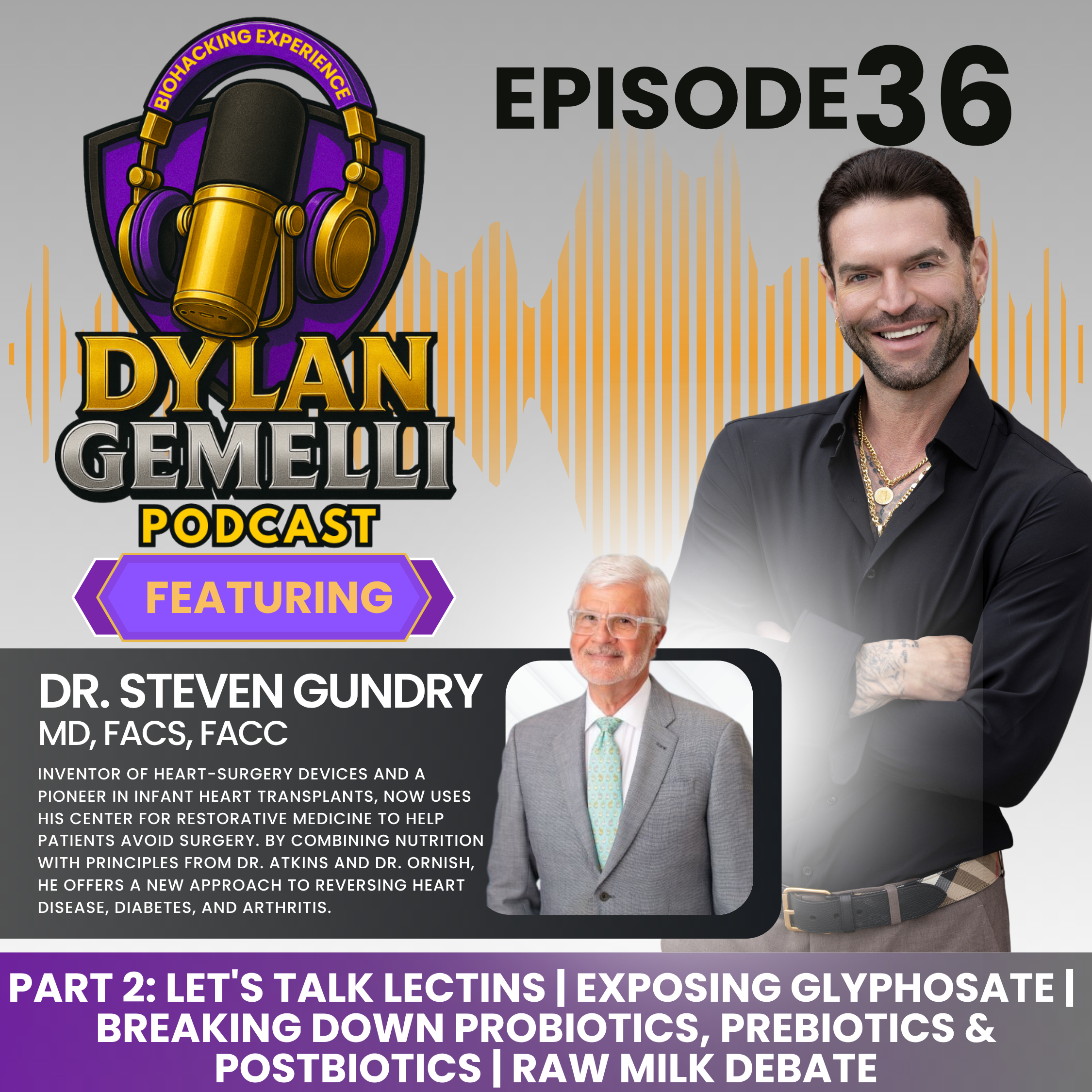
The Dylan Gemelli Podcast
Episode #36 Featuring Dr. Steven Gundry Part 2! Let's Talk Lectins! Exposing Glyphosate, Breaking down Probiotics, Prebiotics and Postbiotics, a Raw Milk Debate, The Vitamin D Paradox and so much more!!
00:55:14
Loading summary
Transcript93 lines
- [00:00]
A
Foreign.
- [00:16]
B
Everybody. Welcome back to the Dylan Gemelli Podcast. And Today is part two of my podcast with Dr. Steven Gundry. We talked about a lot of things last time. We did a lot of focus on the gut microbiome and the role it plays in our overall health. We talked about Dr. Gundry's new book, which we'll kind of get into again, the Gut Brain Paradox, which is a tremendous book. We talked about urolithin a mitochondria. So we got a lot of. A lot of stuff I didn't get to talk to you about last time. I'm intrigued to talk to you about today. All right, welcome back, Dr. Gundry. Thanks for your time, man.
- [00:52]
A
Well, thanks for having me back. Yeah, we had a good time last time and let's have a good time this time.
- [00:57]
B
Absolutely, absolutely. Well, you know, one of the things that I wanted to talk to you about that we didn't get a chance to get into last time was your gundrymd.com website. You got some really cool products there. And I kind of wanted to talk about those because they. Once I kind of took a dive in there, I was intrigued. What do you got going on there?
- [01:16]
A
What.
- [01:17]
B
What are your products focusing on? And let's kind of like get into why you came up with the products you came up with.
- [01:22]
A
Well, so we founded Gundry MD in 19, 20, 15. And so it's. This will be 10 years this year. And what I wanted to do, I did not sell my patient supplements. Believe it or not, I still don't have any of my supplements in my office to sell my patients. I should probably change. For 25 years now, I've been sending patients out to. Before there was an Amazon, health food stores, Trader Joe's, Costco, whatever. And I asked them to get certain supplements and obviously follow some of my dietary recommendations. And then every three months, and we still do, we draw blood, work on them and look at markers of inflammation or looking at markers of blood vessel health, et cetera. And very quickly patterns emerge. And I would start publishing my results at the American Heart association and American College of Cardiology that, oh, look, this stuff makes your blood vessels slippery. And look, if you stop this stuff, they go back to being sticky. And look, if you start this up again, they're slippery again and things like that. So as far as I know, I'm the only practicing physician who still designs all the supplements that we sell@gundrymd.com based on now 25 years of experience of my patients looking at their blood work saying, hey, I Want you to try X. The research looks really cool on it. And if you don't mind, I want to take 30 of you and take this for three months and let me see what happens. So that's where all these ideas come from. And some of them have been really, really remarkable. The first product was Vital Reds, which is a powder. And I designed Vital Reds to get people to get the polyphenols that were present in fruits and vegetables, but without all the sugar. And the other thing I noticed very early on with my patient population is that women in general really do not like to swallow supplements, particularly tablets. They really hate tablets. And so I was frustrated that really I knew they needed to do these things. I could see it on their blood work, but they didn't like it. So Vital Res was a powder form, a lot of polyphenols and all the B vitamins and some probiotics that can make it into the colon. So that's actually where everything started. My by far best selling product was just to give you a history. One of my books in the last few years was called the Energy Paradox. And it was really How Mitochondria make energy and the things that Stop mitochondria from Making energy. And I was one of the first to write about postbiotics. And postbiotics are the product, if you will, of bacterial fermentation. Some people argue that we should also call dead bacteria postbiotics, and in some forms they are included in postbiotics. But I think it's easier to think of postbiotics as the messaging system of how bacteria get us to do their bidding, how they message us. And it's the language that bacteria talk to us and to our mitochondria. We've known for a number of years that there are good gut buddies, probiotics, friendly bacteria, friendly bacteria want to eat prebiotics, which in general are soluble fibers. But you need postbiotics to to kind of supercharge all this happening. And one of the most, I think, important postbiotics that we now recognize is a short chain fatty acid called butyrate. Fun fact, butyrate was named after butter because there's a little bit of butyrate in butter. Don't tell Dave. It's doodly squat worth of butyrate, but that's okay anyhow. So butyrate is really the holy grail of short chain fatty acids. If for nowhere other reason the colon lining cells, 80% of their nourishment has to come from butyrate. It's not from blood. Flow. It's not from sugars, it's not from starches, it's not from proteins. It's this short chain fatty acid called butyrate. And they gotta have it. And if you don't have butyrate, these guys really suffer. Causes leaky gut. There's a lot of experimental evidence that it causes dysplasia and cancer. And butyrate is incredibly important for mitochondri health and uncoupling. So it's a, it's important. The problem with butyrate is that experimentally you could swallow all the butyrate in the world, but it does not get delivered to the colon. It's broken down and that's where it's gotta be. So a few years ago now I said, hey, let's take friendly bacteria, probiotics that survive digestion. Let's take prebiotic fiber that doesn't cause gas. There are some that do, some that don't. And let's nano encapsulate butyrate so that it can pass and finally get dissolved down in the colon. And I called it Bio Complete three. And it kind of instantly became our number one seller. And to this day it's our number one seller. Why? Because it works. And I don't know, we've got so many five star reviews, I can't see straight. It works and it's not a placebo effect. We don't really tell people what to expect, but it works. And now it's kind of cute because all of a sudden the term postbiotic is starting to trend. Triple action biotics, you know, pre and pro and post. So I like to think I've had a little hand in that. So. But that's still our number one selling product.
- [07:37]
B
So that was going to lead right into that first for you. So one of the things that I've noticed, which you just brought up is, and it happens all the time, we get these trendy things like NAD plus, for example, it'll just start trending, trending, trending. And people honestly don't really understand it. They don't know what they're really taking and they'll just take someone's word for it. So let me ask you this because I was looking at this product earlier and, and I figured this would be a great question. How do, how do we get around this where people start throwing these terminologies around, they really don't know what these three, you know, really do. It's necessary to have all three like you brought up. Could you just give a little indication of why you need all three and why it's not just postbiotics or just one or the other. Because the words do get tricky and. And people, you know, they don't have the time or the. Everybody's so busy, they don't have the attention span to really focus and learn on what it is. So I know no one could break it down better than you.
- [08:32]
A
We'll try.
- [08:33]
B
Okay?
- [08:34]
A
So, I mean, I think most people now understand probiotics are friendly bacteria, but there's even a catch to that, and I think it's worth telling bacteria, and I've talked about this in the last couple books, bacteria are sentient beings. Get over it. They don't think like we do. But bacteria have been around for 3 billion years. They are the most successful creature ever. And they talk to each other. They exchange genetic information with each other. They see each other. Now, they don't have eyes, but they literally can read the barcode on the cell membrane of one bacteria and recognize it. We learned this years ago because what was called quorum sensing and was first discovered in cholera. Cholera has to have a critical number of cholera bacteria to begin to cause watery diarrhea and kill you. And if they don't reach this critical mass, they don't bother to do anything. So it was called quorum sensing because bacteria, it's almost like a rave party, literally count how many of their kind are in the neighborhood, and they don't make a move until they've counted that they've got the numbers to pull the trigger and made people really start waking up and go, how? Holy cow, Wait a minute. They know how many of their own kind are around. We know that some of the keystone bacteria know when a bad actor is around and actually start making acid to prevent that bad actor from growing. So they. They literally can read, they can see. And again, get over it. We're not the most great being of all time. Getting back to why that's important. When there's a keystone species that many people have heard about called Akkermansia mucinophila. Cool bug. It took a pendulum life 10 years to actually grow it in the lab, the human strain. And that's a fascinating story in itself, but there's another company that makes dead achromansia, pasteurized Akkermansia. And that Akkermansia actually has virtually the exact same effect. If you swallowed live Akkermansia and you go, what the heck? How's that? Well, it's because we now know that bacteria read the barcode on a cell Wall of bacteria, and it doesn't know if it's live or dead. It goes, whoa, you know, Akkerman C Is in the house. Let's, let's party. And so we now know that even dead bacteria tell tales. It was one of the chapters in Gut check. Dead men tell no tales, but dead bacteria do. So that's just another layer of the confusion. Next layer down is prebiotic fiber. So bacteria really want to ferment fiber. It's what they want to eat. And fiber is simply long chains of sugar molecules, polysaccharides. And the longer these chains are, the more difficult it is for our digestion system to break them apart, and the more available they are to our gut bacteria, which primarily reside in the colon. And, for instance, mushrooms are wonderful things, but they're wonderful things because they're basically long chain polysaccharides that we do not digest well, but just so happen to feed bacteria in our gut. And that's actually their magical, mystical power, for the most part. What was really interesting. And always give a shout out to the husband and wife microbiology team at Stanford, the Sonnebergs, who did a really great experiment with humans. They took humans, they measured their gut microbiome diversity, which is horrible in most of us, and they looked at their markers of inflammation, and then they gave them a bunch of prebiotic fiber. It was in the form of inulin. For those who are curious, inulin is in artichokes. It's present in asparagus, is present in all the chicory family vegetables, like radicchio and Belgian endive. So they gave him a bunch of powdered inulin, and lo and behold, microbiome diversity didn't get any better, and their markers of inflammation didn't get any better. And they go, oh, what the heck? We gave these guys what they wanted to eat. Shoot. So they said, oh, wait a minute. This is a little more complex than most of us realize, and we maybe should be giving postbiotics to these guys. And fermented foods, the products of fermentation. And so they use primarily yogurts and kefirs. And so they repeated the experiment. They gave them yogurts and kefirs and sauerkraut and the inulin, the prebiotic fiber, then and only then did the gut microbiome diversity bloom get more diverse, and the inflammatory markers went down. So, as Hillary Clinton would say, it takes a village. So we're beginning to re. We're beginning to realize that this village and what this village needs is a lot more Complex than most of us would have thought. It gets even more interesting. And I wrote about this in Gut Check, my last book. We now know that bacteria, and actually even plants can pop off little text messages which are exosomes or extracellular vesicles which contain genetic information and even mitochondria. And these membranes, they're phospholipid membranes, they're little bubbles, can pass through the gut wall unperturbed, not recognized as form, can pass through the blood brain barrier unperturbed, can pass through blood vessels and bind to a target, a cell wall target, bind to a nuclear membrane and release that packet of information. And we know plants can do this as well. And so we thought we were pretty smart when we figured out postbiotics and gasomes like nitric oxide and hydrogen sulfide, just to name a couple. But now there's this incredible, even tinier microscopic communication system. And to think that bacteria and even plants are sending instructions to rewire our genetic expression with messenger RNA is really freaky. And again, let's get over it. They've been. They've been here a lot longer than we have.
- [15:23]
B
Right. Okay, so I have a. I don't love theoretical questions. I always like to be very precise. But I'm going to give you one and go against the grain on what I normally do here, so bear with me. Let's say we're just taking an everyday person. We haven't gone through rigorous testing, and we're just going to make it as basic and regular as we can. Because a lot of people do do that. In reality, it's not like you. And I would prefer that they all get all their blood work. So somebody comes to you and says, Dr. Gundry, I don't want to do all that crap. All I want to do is know, give me a good daily protocol that you recommend that I can do to start either healing my gut or, you know, making sure that it stays where it needs to be. What's a good, good, like starting protocol for people to be on to address that or at least maintain gut health?
- [16:09]
A
Well, first of all, the vast majority of people who show up in my clinics have a low vitamin D level. Okay? And so the University of California, San Diego, which has a big vitamin D research unit, thinks that the average American should be taking 10,000 international units of vitamin D3 a day. And I absolutely agree with them. First of all, we should realize that our vitamin D levels of toxicity are woefully outdated. Luckily, labs are catching up. Both Quest and the Cleveland Clinic's lab now say that a vitamin D level of 150 nanograms per milliliter is normal. And yet I have well meaning physicians who tell my patients when their vitamin D level is 90 that they're toxic and it's killing them. Seriously see it all the time. I'll tell you how I was educated about this. And it's a. I think it's a good story. Yeah. Years ago, probably 20 odd years ago, I was seeing a new couple in my Palm Springs office and I have their labs before I see them. And they're in their late 70s, pretty good, and they're sitting across from me and I have their vitamin D levels. And their vitamin D levels are about 276. They were almost identical. His was 276 or his, hers was 270. And I'm, you know, I'm looking at the numbers and they're, you know, bright red on the page. So I said, you guys take a lot of vitamin D, don't you? And they said, yeah, yeah, it's a, it's a longevity hormone. It's not a vitamin. I said, really? And so I'm looking at their calcium levels and their calcium levels are normal. And supposedly if you're vitamin D toxic, your calcium levels will grab. And then looking at their kidney function, because in theory vitamin D could kill your kidneys if it's toxic and their kidney is perfect. And then I go, any kidney stones? Because, well, it could cause kidney stones. No. And then there's a thought that, well, maybe numbness in the fingers and toes can be caused by vitamin D toxicity. So I'm going, hey, you know, numbness, finger and toe. No, no. And they said, why are you asking all these questions? And I said, well, no offense, but from what I've been taught, you should be dead. And they said, you don't know much about vitamin D, do you, Sonny? And I said, and I said, well, you know, just what I've been taught. And they said, well, why don't you read about it? And of course I did. Son of a gun, they were right. Vitamin D is incredibly good for making a much more diverse microbiome. Vitamin D is essential to activate the stem cells that live in the wall of our gut to de. Differentiate and become endothelial lining cells of the gut. And without vitamin D, they just sit there and twiddle their thumbs and they don't activate. Really plus. Yeah, really. And vitamin D is actually what tells the immune system not to get so hyperactive. In fact, there's beautiful papers that white blood cells, lymphocytes of people with rheumatoid arthritis are not suppressed normally by vitamin D. And you actually have to hit them over the head with a sledgehammer of vitamin D to get them to quiet down. So there's just tons of literature. Michael Hollock, the dean of vitamin D research at Boston University, wrote that he'd only seen vitamin D toxicity once in his entire career. And this was in a physician who by accident, because of a mislabeling by a compounding pharmacy, was taking a million international units of vitamin D3 a day for six months. Wow. A million a day.
- [20:01]
B
Damn.
- [20:01]
A
Now, having said that, and I've said this over and over again, if I feel like I'm coming down with something, I'll take 150,000 international units of vitamin D3, three days in a row. So essentially, in three days, I'm taking a half a million international units. And I probably do that several times a year because I travel a lot. I'm not dead yet.
- [20:26]
B
All right, well, we got testing on that. Okay, so vitamin D would be the first thing that we're looking at then. And we want to be about 10,000 IUs a day generally in general.
- [20:37]
A
Yeah.
- [20:38]
B
Okay.
- [20:38]
A
And that, that's a very, that's. I think that's a very good general recommendation. Some of my autoimmune patients, we will literally start them on 40,000 international units a day. There's a very interesting small clinical study of people with eczema and psoriasis who were given 35,000 international units of D3 a day for six months and put on a low calcium diet. None of them got vitamin D toxicity. None of them had high calcium levels. But nearly all of them resolved their eczema psoriasis on ultra high dose vitamin D. Really?
- [21:14]
B
Okay, that's good to know, too. You know, I, I had, I think it was called an oligo scan when I was in Austin there at the convention. And my vitamin D on my vitamin ranking was my worst, and it was only 43%. And it caught me really off guard and it shocked me, really. And then because it was such a world, when I was going, I take a lot of vitamin 3 a day. And not realizing, you know, that vitamin D3. I'm sorry, per day and not really equating what it meant. And so when somebody's on that lower end, it's not the same as just taking a D3 supplement. Correct?
- [21:46]
A
Yeah, that's part of the problem. Early on, before we had leaky gut tests. One of the things I noticed in all my autoimmune patients was that they had very low vitamin Ds and that I had to. I had to use a lot of vitamin D to get their vitamin D ranges where I wanted them, which was a hundred to 150 nanograms per milliliter. Sometimes it was, you know, 30, 40, sometimes 50,000 units. And then as months went on, then we'd start overshooting. And I go, oh, look, you know, now you're 170 on. We'll just use an example. 30,000 a day. Let's drop it down to 20,000. And we come down to a level that I liked. And then a few months later, they'd be heading up again. I said, oh, good, you're. Let's come down to, you know, 15,000. Now, what that was teaching me was what I now know is that most people with leaky gut will take nine months to a year to repair their gut wall. And. And one of the things that I enjoy jostling with Valter Longo from USC is protein requirements. We might morph into that after this. So what I was realizing was that these guys had such profound leaky guts that, among other things, they couldn't absorb vitamin D. Well. And as their le. Leaky gut was repaired, then they could absorb more vitamin D. And that's why we began overshooting. And then once their leaky gut was sealed, we were back to 10,000 a day as the dose. So. And then again, this was before leaky gut tests were available, but I used it as a marker of. This is. This is my stand in for knowing when they're doing well. And we had their autoimmune tests, and corresponding with this, their autoimmune markers went away. Wow.
- [23:39]
B
All right, that. Very enlightening. Before we go further, let's do that protein talk, because I don't want to forget that I talk about this a ton. So I really want to hear what you have to say about it, because I do a lot of. I work with so many fitness guys and bodybuilders, and I get, you know, what I'm running into, you already know. I get these people that want to run these massive amounts that I think are a little too high. And then I also run into people that are scared to eat too much, that I feel eat too low. And I think it's really dependent on your activity level and where you're at and your age. There's a lot of things that factor. But tell me what your Thoughts are there. And do you feel like people are overdoing it, underdoing it, or what? What's your thoughts on the per? 1 gram per pound, 1.5 per. I mean, you hear it all. You know what I'm talking about. So fill me in, please. I'm curious.
- [24:24]
A
Well, remember, you people should really go check out some of Christopher Gardner's YouTube videos on the subject. Christopher Gardner is the head of nutrition at Stanford and he's, he's kind of a vegan vegetarian. Let's not hold that against him or for him, but that's kind of where he sits. And he points out correctly that the USDA protein requirements recommendations are based on 95% of people. If they say, eat.07 grams per pound of protein, you will meet 95% of people's protein requirements. Now, what isn't clear is that 50% of people will be getting twice the amount of protein they need with those recommendations. But because they don't want to miss anybody, they skew the recommendations to basically be double the amount that the normal person would need. That's number one. Number two, and this is where I have a good time with Valter Longo, who I have great deal of respect and I just found out he had some respect for me. He showed me some love on my podcast.
- [25:40]
B
Excellent.
- [25:40]
A
So Valter is kind of an anti protein guy in that there's very good evidence that particularly animal protein has the amino acids, particularly branched chain amino acids that clearly activate MTOR and clearly increase insulin Y growth factor one. And since we use, I use insulin like growth factor one, IGF1 is kind of my stand in for MTOR activation.
- [26:06]
B
Yep.
- [26:07]
A
We can show that you can definitely lower IGF1 by limiting animal protein. And this has been done at St. Louis University and others in humans. So what's cool about protein requirements? He has preached that you really don't want a lot of protein. You don't want a lot of protein, but when you get to be 65, all of a sudden your protein needs skyrocket and you gotta start putting in more protein because we, the last thing we want is sarcopenia, you know, loss of muscle mass. I, I agree. The last thing we want is sarcopenia. So early on in my experiment, most of the people who I used to operate on with heart disease would have low serum albumins. And the liver makes albumin. Albumin is about 80% of the protein in US and they all had low serum albumins. And it was a bad prognostic sign. So when I started People in my program by limiting protein, but more importantly limiting lectins, than I thought would be damaging to the gut wall. Lo and behold, these people on a limited protein diet without lectins, their albumins started going up, their total proteins started going up. And I go, well, that's kind of cool. That's kind of like what I'm seeing with vitamin D is that as their. And then we have leaky gut deaths as their leaky gut is repaired. Look at that, they're absorbing more protein. And look at that, they're making more albumin despite eating less protein. And so what I have been again jostling with Walter for years is. No, no, no. What you're finding is, what I've been saying is that when we're younger, we have a surface area in our intestines that is a, is a tennis court. And through the years, we've turned that surface area into a ping pong table. And no wonder your findings and others show that as we get older, we kind of cross this threshold where we have to have more and more protein. No, we have more and more damage to our intestinal wall. And if you repair the damage to the intestinal wall, now we've got a tennis court and you don't need all that extra protein. And so I think, I won't speak for him, but he said, you know, I've actually learned something from you last time I saw him.
- [28:33]
B
I love it. And I thank you for that explanation because it kind of tough to sift through because there's so many different opinions on that topic. There really is. And you, you would know what the tests you've done.
- [28:43]
A
Yeah, and, and let me add one more thing. I mean, for instance, hemoglobin A1c looks basically at how much protein and how much sugar. Sugar you're handling for the two months before the test. Now, as Christopher Gardner is pleased to point out, we have a storage system for sugar. It's either glycogen in our liver or some in our muscles, but there's not much. But we have an unlimited storage system in fat. So we, we can eat all the sugar we want and whatever is excess will eventually be turned into fat. On the other hand, protein has no storage system except for muscles. And so if you're not building muscle and you're eating excess protein, we convert all that protein into sugar. It's called gluconeogenesis. Why? Because we have a storage system for sugar. It's called fat. And he's right. So protein has to go somewhere and it certainly you can't, you can't just gobble up protein and build muscle. I'm sorry, that's not how it works. Check the physiology textbooks. That's, that's not how it works. Any excess protein will be converted to sugar. It always has been. Now you can burn some of that as sugar, right. But whatever you don't need will be stored as foul.
- [30:10]
B
Yeah, I thought so too. But you know, we get those arguments that I have to go back and forth with people on. So, you know, let me ask you this. We were talking about the vitamin D and I wanted to go back to that. When we're looking at vitamin D supplementation, you gave the amount to take, but are there some good foods that you also recommend for people to kind of eat, to maybe even keep up with more vitamin D and that they should kind of look at eating more regularly?
- [30:33]
A
Waste of time.
- [30:34]
B
Waste of time. All right, got it.
- [30:36]
A
I mean mushroom, mushrooms are a nice source of vitamin D. You're going to suffer. Yeah. In terms of what you want. Yeah. You can go out and get sun exposure. But living in Palm Springs, I learned fairly early on that I'd have these guys particularly come in who were just tanned black.
- [30:55]
B
Right.
- [30:55]
A
And they had minuscule vitamin D levels and they're going, what the heck, you know, I'm out in the sun, I'm a bare shook chested every day for five hours. What do you mean I don't have any vitamin D? Well, their vitamin D conversion was blocked by all the melanin in their pigment and so they weren't absorbing any vitamin D. So that makes sense. Once you get a tan, you're not going to absorb vitamin D. You're not going to.
- [31:21]
B
So when we were going down this list here of we went on to some other things. So we got vitamin D on our list for leaky gut treatment or you know, protection things that we need to address. I was looking at one of your products on here called the GI Advantage. Is that something that we would be looking at to add to and if so, why?
- [31:39]
A
Yeah, so I, you know, I make several compounds that are useful in repairing leaky gut. My first one, and actually my second bestseller is Total Restore.
- [31:49]
B
Total Restore. Got it.
- [31:51]
A
Total Restore. Total Restore is really good at repairing leaky gut. Here's the problem. So we've got vitamin D, we've got Bio Complete three with butyrate and we've got Total Restore. As I tell my patients, look, I can give you like Total Restore or GI Advantage, which also has some really kind of cool probiotics that have been shown to promote a better, diverse microbiome. And if you keep swallowing razor blades, you're going to slice your gut right open, right every day. And I, you know, I'm happy to sell you about a complete three, I'm happy to sell you total restore, but stop swallowing razor blades. In my vernacular, razor blades are these lectin containing foods that I can see it a mile away on people's leaky gut tests. I can see it on their antibodies to various lectin containing foods like gluten. Just, in fact, just in the past two weeks I had, I think you've read the gut brain paradox or at least. So it starts with a 62 year old woman who is a physician who was a marathon runner who has been suffering from Parkinson's disease for five years. She, when I met her, her husband did much of the talking because she had the classic mask of Parkinson's and she had a horrible tremor and really wasn't walking well at all. She had wide open leaky gut. She had antibodies to wheat, rye, barley, corn, oats, another number of other lectin antibodies. And so we put her on the program and my nurse practitioner saw her by phone six months afterwards. And she was getting better. But I saw her for her year follow up and this was actually about a year ago now, and I actually didn't recognize her. She was sitting there with a big smile on her face, didn't have a tremor. Her husband jumps up and gives me this big bear, pushes me back and looks in my eyes and he says, thank you for giving me back my wife. This is the woman I married. I can't, she's back running. I can't catch up with her. Thank you. And we're all crying and misty eyed. She didn't have leaky gut anymore and she didn't have antibodies. Okay, so happy story. It's in the book Parkinson's reverse Yay. So I saw her back a couple months ago now for her two year visit and I had her labs, she had the beginnings of leaky gut again and she had two or three antibodies to different forms of gluten week that were gone before. And I said, so, how's it going? And she said, oh, really good, really good. But she says, you know, I think I'm slipping. And I said, well, how do you know that? And she said, I, I'm telling you, I, I can just kind of feel it coming back. I'm not as good as I was a year ago. And I'm going, ah, tease, you know, I failed. And now this is a person who is incredibly motivated, you know, going from basically not able to move to a wonderful functioning human being. And I'm going, anything change? You know, did you get a viral infection? Did you, have you started going out? Need, you know, are you doing little cheat? She's oh, you couldn't would do that. No, I haven't been sick. I said nothing. Huh. And her husband says, and I showed her the results. He said, our son, our 32 year old son moved back in with us six months ago because he's starting a new job and he's taken some school credits and he's living with us. I said, yeah, okay. I said, does he eat like you? He said, oh no, he's impossible. And then he goes, wait a minute, we have a cutting board in the kitchen. And if him slicing his bread on that cutting board and then using, using that cutting board, would that be enough? Now if you'd asked me 25 years ago, I went to see, I had a couple crumbs, that's plenty for these people. And so she was being inoculated every day by her son and that's where she was getting exposed. Wow.
- [36:05]
B
That easy.
- [36:06]
A
That easy. I'll give you another example. Again, this sounds crazy. I mean, I believe it. Oh, I know. I believe it because I see it. Yeah. I have this wonderful woman, a young lady from South America who has this give too much away. Anyhow, she got a really issue with, with leaky gut and endometriosis and had terrible abdominal pain and they wanted to do a big operation and she didn't want to. And now she's pain free. The endometrial implants are growing again. So we got her leaky gut tests and she was pretty doggone sealed the last time I saw her. And now she's got leaky gut again. And I'm going, what the heck? You know, same question. No, no, why would I do that? Why? I'm pain free. Why would I do that? I'm following the rules and I'm going, well, let's talk about what you eat. So one of the things that she test tested very positive to egg yolks as a sensitivity. And get this, she tested very positive to mustard as the sensitivity.
- [37:06]
B
Really?
- [37:06]
A
It's actually very common, isn't it? Yeah. And so we took away her eggs and we took away her mustard and she starts saying, you know, I eat a lot of chicken salad. And she said, but I get pastured chickens, you know, they roam. I Said, good, good. And I. And then her eyes flash. She says, you never going to guess what I make chicken salad with. And I said, mayonnaise. And she said, yeah, I use a ton of mayonnaise.
- [37:33]
B
I was just gonna say.
- [37:34]
A
And I said, you realize what's in mayonnaise, don't you? And she says, what? I said, egg yolks and mustard.
- [37:42]
B
Exactly.
- [37:43]
A
And I said, oh, my gosh. You know, and you're eating a lot of this. She says, oh, yeah. And I went, there it is. Yeah.
- [37:50]
B
First thing I thought of when you said that was mayonnaise, just immediately it was like, you probably run in that to a lot, though, that people don't even realize what they're eating half the time.
- [37:58]
A
No, you're right. You're right. Now, some people will listen to this and come away with this and say, right, I can't eat anything. No, that's not true. That's not true at all. But. But the good news is, you know, you can. You can find out what you're sensitive to, who the culprits are, and it's. It's really easy to make substitutions. For instance, I said, look, you know, go get some creme fraiche or some sour cream and use that as your. Your mayonnaise because you don't react to dairy. Some people do, but you don't. So brilliant. Okay, bye. I'll see you in six months. I love it.
- [38:32]
B
I have to ask you this. I've been wanting to ask you this, and my wife even brought it up to me yesterday, and I wanted. I told her she got on that raw milk thing because she saw it and you see so many people talking about it. And I told her specifically, I said, I'm. I'm not even going to try to even attempt to answer this with you right now. I'm going to take it right to Dr. Gundry on my podcast. Tell me your thoughts on this whole raw milk thing, because I see people I respect on both ends of the spectrum that will tell you. It's like, will kill you and the other people that'll tell you. It's the only way to go. So you tell me straight what exactly to believe on the raw milk thing?
- [39:07]
A
Well, I'll throw you a bit of a curveball. Number one. One of the only decent things that Pasteur ever did was invent pasteurization that pretty much sterilizes milk. And there are some nasty bacteria that can live in raw milk. Bruce comes to mind. Mine, a friend of one of my patients recently was hospitalized In Italy with brucellosis, spent two weeks in the ICU from drinking raw milk. That's how he got it anyhow. But that. Let's not use that scare tactic. I got a better scare tactic, all right? And I've written about this and I'm going to write more about it because the evidence is getting more and more strong. So you and I and fish and chicken, poultry have a sugar molecule that lines our gut wall, our blood vessels, our joints, our blood brain barrier that's got this cute name called neu5capitalac. And I use the word who knew? That's N E U. Beef, lamb, pork and milk from those animals have a virtually identical sugar molecule called Neu5G C. They differ by one molecule of oxygen, otherwise they're identical. So what, I can have you swallow neu5gc and there's fun ways to have you do that. And you will make aggressive antibodies to neu5 GC. You hate that molecule. I learned about it as a xeno heart transplant surgeon and immunologist. Because pigs, this molecule on the wall of pig blood vessels, we hyper reject. We hate that molecule. And you hear about these genetically engineered pigs. One of the molecules that they've genetically engineered is they've gotten rid of neu5gc and put in neu5ac.
- [41:04]
B
Okay?
- [41:05]
A
That's how important that molecule is. So. So what? When I first wrote the plant paradox, we didn't know as much about neu5gc and ac, but we knew that because neu5ac and neu5gc look virtually identical and that we make antibodies to neu5gc then probably we attack our blood vessels, our joints, our blood vein barrier by mistake. It's called molecular mimicry and that's why it's so bad for you. Fast forward. Now know that because these molecules are so similar, when we eat Neu5GC containing foods, Neu5GC substitutes for Neu5AC in the lining of our gut, in our blood vessels, in our joints, in our blood brain barrier. And because it's now there, our immune system goes, oh my gosh, I hate this molecule. Bam, bam, bam, bam. There's the inflammation that is associated with red meat and with dairy. Here's the good news, okay? So I wouldn't come near pasteurized milk, regular milk, raw milk, because it's an amazing source of GC and why would I want that? Now here's the good news and this is really good news. So I study long lived people and I study the blue zones And I've written about the blue zones are not blue zones. They ought to be called white zones. Four of the five blue zones kind of live on goat and sheep yogurt and goat and sheep cheeses. And they eat tons of sausages that are prepared in a traditional way. That means they're fermented. They're actually inoculated with bacterial cultures.
- [42:49]
B
Right.
- [42:49]
A
Here's the good news. Bacteria love sugar molecules, and Neu5GC is a sugar molecule. And so bacteria in a fermented food like yogurt or cheeses have eaten all the neu5gc and there isn't any. And there is no neu5gc in fermented meats like a sausage. Fun fact. There's no neu 5 GC in traditional prosciutto. Prosciutto di Parma. It's gone. It's been eaten by bacteria. So then you go, no wonder these guys are getting away with murder, because the bacteria have detoxified.
- [43:29]
B
Okay, that makes sense. No one's ever broken that down. I've never heard any of this discussed any of it. That's the first I've ever heard of any of it. Well, thank you for the breakdown. Okay, so here's. Here's a question that we need to know because you touched on this, and I know you touch on it a lot, but maybe we can just give like a top 10 or top five of your, like, the biggest culprits when it comes to lectins that we need to avoid, especially foods that are more like, widely eaten, that we really need to avoid, that are common. Can you kind of give us a breakdown of what we need to be on the lookout for?
- [44:00]
A
Yeah. So part of our problem, and I stress this when the plant paradox came out, but I'm stressing it more and more and more. Almost all of our foods in North America have been contaminated with Roundup glyphosate, and. Right, and glyphosate can produce leaky gut in and of itself. Glyphosate kills bacteria in our gut. But what's interesting is that 100% of my patients with leaky gut have antibodies to wheat, rye, barley, oats, corn. These are troublemakers. Now, remind me to tell you about Europe. I'll finish this thought. A lot of my patients react to the lectins in beans. Now, properly prepared beans are fermented. Believe it or not. That's that foam. If you've ever soaked beans, you know, after, oh, 12 hours, there's this foam on the top of the water, and you scoop it out and you change the water. That foam is actually the fermentation of the lectins in the beans by the bacteria that coat the bean. And I learned this in Tuscany, where they will not cook beans unless they've been soaked for 48 hours, two days, because they say that they're not palatable until they're soaked that long. Well, they're not palatable because the soaking has fermented the lecture. The bacteria did the job, just like the bacteria did the job of eating the sugar molecule and milk so we can get pressure cooked beans. I had pressure cooked beans for dinner last night. I just said it on another podcast. People go, the horror. Dr. Gundry's eating beans. Pressure cooking them or soaking them is fine. And there's a couple of companies that do that. Eden Brand beans and jovial are safe. And I'm not a. They don't sponsor me for anything. Right. So that's a beans and grains. Now, here's the good news. By the time we seal leaky gut, and it can take nine months to a year, honest, people no longer have antibodies. They don't have antibodies to corn, they don't have antibodies to oats. They go over to Europe and they're really happy. Their psoriasis is gone, their rheumatoid arthritis is gone, and, I mean, who can resist? They have croissants in Paris and they have pizza in Italy, and they do not react. Their psoriasis doesn't flare, their joints don't hurt, and they go, oh, Dr. Gudry's cured me. I can have this again. Yay. And so they come back to the United States and they eat our sourdough bread, they eat our pizza, they eat our pasta, and in a couple weeks, they flare. Their psoriasis pops, their rheumatoid, their joint pops. Then they call me up. So what the heck? I thought you cured me. And I said, no, you were no longer exposed to glyphosate. And so you came back here and guess what? You started eating glyphosate and started all over again.
- [46:54]
B
So the glyphosate is really the issue in what's causing it. It's not necessarily the foods themselves.
- [47:01]
A
Yeah, Glyphosate has been. The longer I've been at this now, the more impressed that glyphosate is really the major toxic. And everybody thinks it is. It's. And it's everywhere. Yeah. Yeah.
- [47:14]
B
Is it. Is it true then? Because I have had several people comment to me that even Organic fields or farms can have glyphosate spray that comes over and still contaminates. So even if you're organic, you're not necessarily in the clear.
- [47:28]
A
Yeah. Most of the organic oats tested in this country test positive for glyphosate. Really? That's bad.
- [47:33]
B
Really?
- [47:34]
A
Oh, I know. I've. I've got a winemaker friend, Steve Becker, up in Santa Barbara county, and he, biodynamic farms his grapes, you know, which is one step above organic. And, yeah, I was talking to him. He's got this map of where all his vineyards are certified, and there's this kind of missing piece near the top. I said, what's the deal with that? Why don't you certify that? He says, I can't. I said, why is that? He says, because my neighbor over here sprays with glyphosate and it drifts, and I can't stop him, and I can't certify him. So I sell. Sell those grapes off. Wow.
- [48:09]
B
Oh, my gosh. Okay. It just keeps getting better and better, right? I mean, the things that I hear, it's insane.
- [48:14]
A
Yeah. I had the pleasure of talking to Michael Mondavi a few years ago with Al Gore, and Michael Mondavi said it took them nine years to decontaminate their vineyards from glyphosate. Nine years.
- [48:30]
B
So I. I mean, how much accumulation is that then? Would one even be able to fathom the accumulation over time?
- [48:37]
A
Remember, it was thought to be safe. We were convinced. Yeah, because. Because. Because we don't use the shikimate pathway that plants do to grow. We don't use that pathway. But nobody bothered to tell the FDA that bacteria use the shikimate pathway to grow. And so it got approved because it can't hurt us. We don't have that pathway. Oh, by the way, it kills bacteria.
- [49:04]
B
And see, that's the problem. It's a combination of ignorance and money at the same time. With a lot of these people, I mean, yeah, the money's a factor, but I think a lot of it's just pure lack of understanding, ignorance, stupidity, whatever you want to call it, you know, or blocking of information. Who knows at this point?
- [49:21]
A
Well, right. And until, you know, for instance, the human microbiome project didn't finish until 2017, and we didn't know there were 10,000 different species of bacteria down in our gut.
- [49:32]
B
I mean, who.
- [49:33]
A
Who knew we couldn't grow that. We couldn't grow them. We couldn't count them. We couldn't tell what they did, what they didn't do. And so we, you know, we were flying blind, but now we know.
- [49:43]
B
Oh man, I'm frustrated as, as could be. But I'm thankful that, you know, I have somebody like you to present to people to explain these things because people, honestly, I don't know if it's. They want the blinders on, they just don't want to hear it or they think everything's crazy, but it's not. None of this is. It's all factual and it's all done through testing and real data, which you have more than anybody that I could imagine talking to. I operate strictly on data. I don't care about anything unless I'm seeing it, I'm experiencing it. And I got clients that I'm reading blood panels on and that are feeding me their results. And you know, over time, that's what I was. So one more thing, because I know where the time flew so fast to me. But I, I know you had a couple new products coming out, I believe. A gut brain sink. Is that correct?
- [50:28]
A
Yeah, I got Brain Sync. This was really based on my research for the gut brain paradigm. Yeah. We now know that really the microbiome in our gut controls what's going to happen in our brain and is really going to control neuroinflammation in our brain. And so this is my, one of my newest products to make up for those deficiencies.
- [50:51]
B
So that's more or less like a neuro type of supplement then. And we're looking at inflammation reduction or prevention in the brain.
- [50:57]
A
Yeah. And it's also, if you actually look at super centenarians who are thriving, who have great brains, they actually have a very interesting collection of bacteria that have been identified. And it just so happens we actually have the license to use those bacteria in that product.
- [51:18]
B
Was there one more you had to, was it?
- [51:20]
A
Yeah, well, just came out. Just sold out. But longevity. Yeah. Okay, this, this is. I, I had a NAD type product for a while, but this one really got my attention. There's a cancer researcher in Florida who isolated a compound out of algae, one of the seagrasses in Florida that has incredible ability to recycle NAD and actually activates the NRF2 pathway. And we actually, he couldn't produce enough of it. But we have an algae company in France that we work with. They're just wizards with growing algae. Anyhow, I said, hey, would, would you mind giving me the license to grow this stuff? And you know, can I have the license for this? And he says, yeah, I can't. I Can't make enough of it. And I'm a researcher and I'm not going to form a company but blah blah. So we, so we have it and it's called longevity and cool stuff. So there you go.
- [52:22]
B
Awesome. Well, they gave me a code. Your. Your team gave me a code.
- [52:27]
A
That's right. Yeah.
- [52:29]
B
So if anybody watching podcast20gundrymd.com and that'll get you nice little savings on Dr. Gundry's amazing products that we're talking about today. So take advantage of that because that's. That's a sweet deal.
- [52:43]
A
What's it is indeed.
- [52:44]
B
What. So you have a. Tell me real quick before we go. You have a. Like members can join and they get. What do they get as a member on your site?
- [52:53]
A
Well, we also, yeah, we, we do have people who can join and get discounts and they'll find out. They'll find out when a sale is happening before everybody else.
- [53:03]
B
Cool.
- [53:03]
A
And the other thing I've started which is worth mentioning, I now have my own tell telehealth portal called Gundry Health where we do with a finger prick, we do leaky gut tests and food sensitivity tests and then we guide you with people who I have trained to interpret the results. And some of the trickier ones, I still dive in and go, whoa, this is really interesting. Let me see this one. So yeah, so gundryhealth.com is particularly for people with leaky gut and particularly with autoimmune disease excuses.
- [53:37]
B
I'm gonna check. I might take that little finger, tap it out, see what's going on.
- [53:40]
A
It's really cool. It's really cool. Yeah.
- [53:42]
B
I'm gonna go check that out when we're done and put in for that because I need to test anyway. I have a feeling I need some work myself. So I look, I. Once again, I know your time is valuable. I really appreciate. This was so fun for me today. It was even more fun than last time. So I really appreciate it. Tell everybody good places to follow you again and I'll link everything for you in the comments.
- [54:03]
A
Yeah, we're, you know, we're up to. I think we're almost a million YouTube followers. The Gandry podcast, wherever you get your podcast, Instagram, Facebook, hopefully as you're scrolling through your news feed every morning, I'll pop up and wave at you with blueberries are bad for you or something like that.
- [54:22]
B
We really appreciate all of it because it, it does work the mind, which is good for all of us in general and it gives us a lot to think about.
- [54:30]
A
Yeah. Give you something to think about.
- [54:32]
B
You've said some things before that I thought when I first started watching you. And then I realized it was like not listening to your mom when you were a kid, you know, and then realizing later that, hey, so I really appreciate it, Dr. Gundry, man, it was always a pleasure and an honor to talk to you and have you here. And so thanks again, everybody, for listening and watching, and I hope you enjoyed this. Stay tuned for plenty more to come. Dylan Gemelli and Dr. Gundry signing off.
- [55:03]
A
Sam.