← The Dylan Gemelli Podcast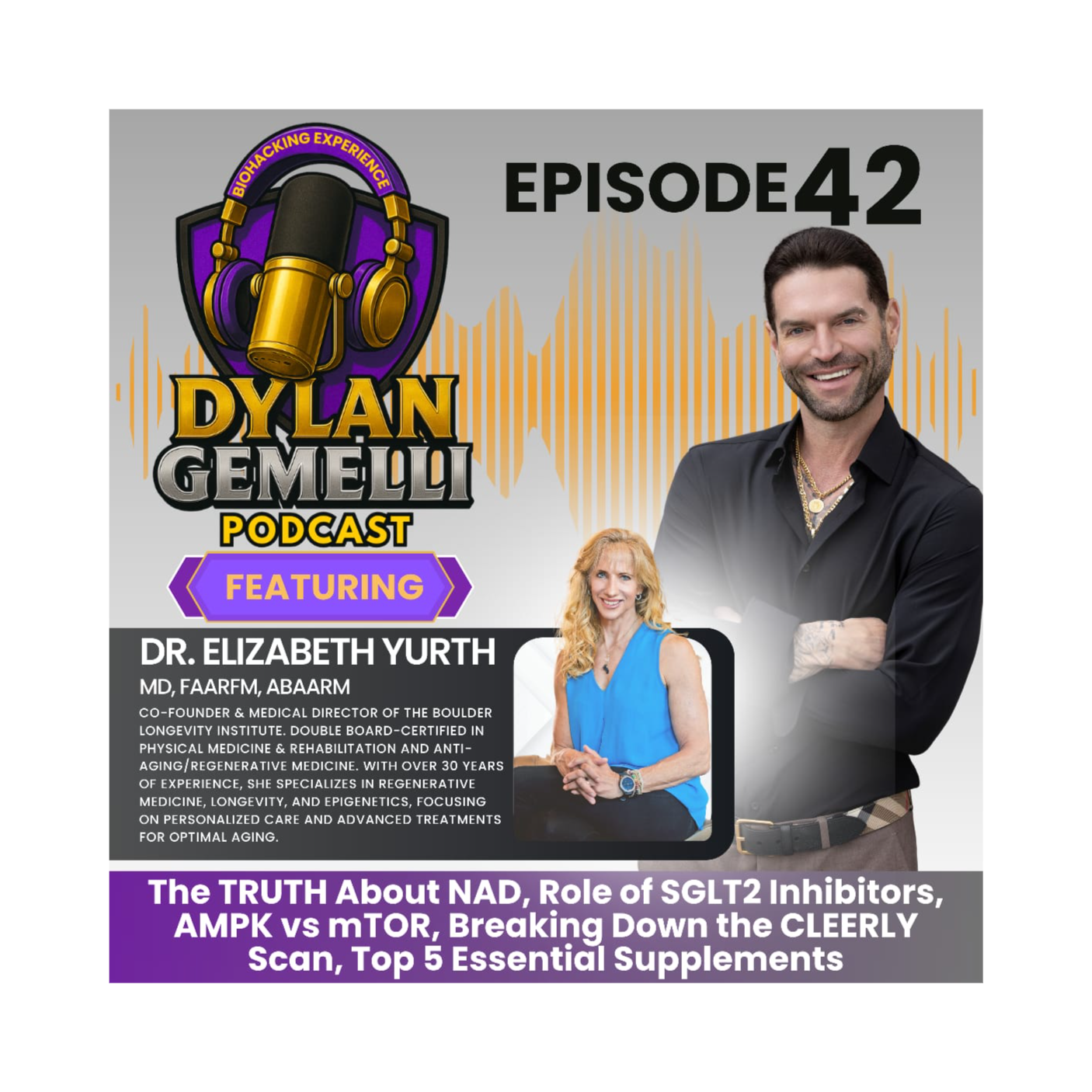
The Dylan Gemelli Podcast
Episode #42 Featuring Dr. Elizabeth Yurth Part 2! The TRUTH about the NAD craze, Jardiance and SGLT2 inhibitors, AMPK vs mTOR, CLEERLY and other heart scans, TOP FIVE essential supplements, Amino Acid supplements and more!!
01:06:46
Loading summary
Transcript138 lines
- [00:00]
Dr. Elizabeth Yearth
Foreign.
- [00:17]
Dylan Gemelli
Welcome back to the Dylan Gemelli podcast, everybody. So my guest today, I gave her a really nice rundown the first time I had her, but I have a little bit different intro that I want to give today. So sometimes teachers will have an ego about them with having the knowledge base that we have. I've been through that many, many years and it took me a while to understand that I am smart because of the people I surround myself with and that's what makes me smarter. And I am very, very, very careful to this day about who I go to for information, who I would even possibly refer to as a mentor to me or somebody that I know I can trust no matter what. And so it's a list that I can count on my hand and really not even all five fingers. And my guest today happens to be one of those people. She is one of my go to resources of information. And I will tell you this right now. She was one of the reasons where I realized maybe I don't know as much as I think that I know in a humble way and a very, very, very appreciative way, so I can give her all the rundown in the world. But I think the at least coming from me, the best thing I could say is that I look up to her and I find her to be one of the most valuable assets in our community. So my friends, without further ado, Dr.
- [01:38]
Dr. Elizabeth Yearth
Elizabeth Y. Dylan, that I such gratitude to you for that and you know, and I'm going to put in a plug for you because guys, I, you know, Dylan and I met, I think we met first at Olympia, right? That was probably the first place we met. And then we subsequently kind of become friends and you know, and done some work together and, and Dylan recently joined. We started sort of a whole new training program where we're actually trying to train people are just passionate about health, how to. How to be more like doctors. So the doctors have these people that they can turn to that can deal with clients when doctors sort of run out of time. And so we're training sort of a force and we actually take these people, we put them through pretty rigorous training. We teach them how to read all the labs. We teach them how to read labs that a lot of doctors don't know how to read. I taught them how to read clearly scans and prodrome scans is tough. And we chose a very small cohort of people who we knew had at least some base knowledge to do the first beta course with. And Dylan's a lot of people we chose because you have to have some background to kind of get there. And so. And you know, honestly, it was an honor to have you there. And, you know, I just want to speak to. There's not a lot of people, I think, who are in your position who take the time to really learn as much as you do. There's a few. And so I just, for all you guys who, you know, are fans of Dylan's, I just really want to put out there that he's a little more even than what you think on the surface. See, on the surface because he is really down there doing the deep dive school stuff that a lot of people aren't doing.
- [03:12]
Dylan Gemelli
That means so much to me because I've always been like a face to an influencer and that's not what I want to be known as or recognized as. And you gave me that opportunity that I can't stress enough how valuable everything I learned from that was. And that's going to be a lot of the inspiration on what we talk about today is because I learned so much that I mean, if I. I actually printed everything out and it, I mean, people that aren't watching on video, it's. It's way bigger than any college textbook, but it's invaluable. And the things that I learned. And so I want to give that back to people at least in some pieces today on what we learned and then.
- [03:46]
Dr. Elizabeth Yearth
Exactly.
- [03:46]
Dylan Gemelli
Just some other things that I've learned that I've talked to you about personally that, that I would like to talk about and bring to light. And that's where I'm going to kind of lead with this because several, several months ago now I sent you a stack of things that I wanted to run. And one of the things in there that was extremely popular still is at the time, that there's a craze on is n he you said to me, you're not going to like my answer on this about nad. And I chuckled because it's like I always come to you because I want that direct answer. And, and I, I showed Queenie and we had a laugh. And I said, I love this. But anyway, to the point, you said in there that NAD may not be the best option. Here's the reasons why. And we never really got into it. And I've. What I found is that people that really know a lot that aren't trying to sell a bunch of crap are going to be honest about this and get into it. So first, can you kind of get into this NAD craze, what it's about and then the misconceptions that are going along with it.
- [04:44]
Dr. Elizabeth Yearth
Yeah, I think that, you know, really, we started learning about NAD not that long ago in the scheme of what we know about medicine, really back in the early 2000s. And we realized that NAD was this critical molecule to life. It absolutely is. Nobody will doubt that. Right. And we absolutely know that levels seem to decline in all organisms as we age. So the belief was sort of, okay, well, obviously NAD is important. It declines while we, when we age, let's give back NAD and life will be better. The problem is that when you give nad. Yes, our cells like nad, your healthy cells like nad, your unhealthy cells love nad, your cancer cells love N A D. And when you actually look at the literature, they really could not support that. The decline in a, in NAD was truly the problem. So if you had a, a, a mouse that was just bred to have low NAD levels, they were not less healthy than a mouse who had normal NAD levels. What happens when we age is we upregulate two bad enzymes and those bad enzymes are draining our nad. So by filling this bucket, we're like, okay, all's good. We're filling this bucket. Well, what's actually happening is on the other end of the bucket is a hole. And these enzymes are just taking this NAD and they're spilling it out. Two big enzymes, one called CD38 and one called NNMT. And those enzymes are actually doing a lot of bad things. They're screwing up methylation, they're feeding cancer cells. All bad cells have higher levels of these enzymes. So when you give nad, they're like, great, I'm going to use this for myself. So it's not the drop in NAD that's the problem, it's the increase in these bad enzymes. So all you're doing when you're giving nad, and this was well shown in a, in a big niacin study that came out the end of last year where they gave high dose niacin and they found out they had an increase in cardiovascular risk. When you give high dose on icing, you do increase nad, but it also increased cardiovascular risk. And it's because of the downstream effects. It's because of this, this NNMT enzyme draining the nad. So what we should be focusing on is not just filling the bucket, but patching the hole. If you patch the hole, then occasionally you might want to fill the bucket. Maybe you had Covid or you ran a marathon or you did something really stressful or a really stressful virus. But at the same time, you better block the hole in the bucket. So periodically using a little bit of NAD if you want, or a precursor like NR or NMN is okay. You don't want to be doing that continuously. And well shown that your bad cells, your senescent cells thrive on that. So people will get this like flushed kind of, kind of good accelerated feeling when they give nad. It's actually not a good thing. It's actually a spill out of a bunch of senescent proteins that are spilled out your blood when you give it AD because of these senescent cells that are fed. And so it's actually that sort of like high that we get is actually not really a good thing. Even though people are like, I love it, I feel all hyped up and all this stuff, that's actually not a positive thing. So I think it's something we're, we're still on the brink of understanding. And people who are doing a whole lot of this, getting their weekly NAD infusions, taking their nmn, NR every day, are probably going to be nice test organisms to see what happens 10 years from now in those people.
- [08:13]
Dylan Gemelli
So when we actually start filling that bucket, the, this CD38 and NMNT kind of thrives on the more NAD that we're bringing in. Correct. And then that's what's causing the problem.
- [08:25]
Dr. Elizabeth Yearth
Right. So these enzymes accelerate as we age. So the older we are, the higher levels of CD38 and NMT we have, if we have cancer, we have very high levels of both of those enzymes. Google nnmt and any disease you want. The bad diseases have high levels of enzyme. Same thing's true of CD38. So all these bad diseases are linked to higher levels of enzyme, including aging. Right? Aging is a bad disease. So basically what's happening is, you know, that all we're doing is we're, we're, you know, so if you're super young, like you're 20 years old, you probably don't need NAD. If you're 20 years old and you don't have really any diseases or bad cells or anything wrong going around with you, maybe giving NAD is not going to be a bad thing periodically. But in me, who's old, giving NAD is going to be spilling right down. It's going to be stealing my methyl groups. I'm going to be creating bad metabolites and it's going to be a bad thing. So that's what really, guys, you have to focus on why these things are happening in our body and then not just Looking, going, oh, this is low, I'm going to put back in. That doesn't make sense. It's not the way our cells work.
- [09:27]
Dylan Gemelli
So two part question then from what you said because it's so interesting when we are talking about you said stopping, patching the draining going on, what are the best options to do that and how do we know if that is occurring? Is there telltale signs, is there a blood test, is there anything like that that we would know where, hey, we got an issue here.
- [09:49]
Dr. Elizabeth Yearth
So it's interesting because the only really thing we know right now to block NNMT is the same way the body does it. So nnmt, when it's accelerated, one of the things it produces besides going on and screwing up methylation, it produces something called 1 methyl nicotinamide. 1 methyl nicotinamide Then when it accelerates goes off and turns off this bad enzyme so we can refill the NAD bucket. So it's our body's attempt to say let's refill the bucket, there's too much bad stuff going on. So we can actually give one methyl nicotinamide exogenously to turn off that enzyme. Now the way to measure that, whether that enzyme's high or low, would be to measure one methyl nicotinamide level. So you, so for instance, like True age does a in their metabolomic testing, does a 1 MNA and what they'll say is if this is high, it's a bad thing. And that's true because if it's high, then I means I've got high levels of this MNMT enzyme. But if it's high because I'm taking exogenously, it's actually a good thing because I'm actually turning off the enzyme. So whether, when my body's making a whole lot of one methyl nicotinamide, that means it's trying to keep up with these high levels of this enzyme that's draining my nad. So my body's trying to keep up. So it's getting more and more one M&A. So basically we can give it exogenously turn off the enzyme and that's gonna have a good effect. So, so we know that if you're, if you're naive to any medications that you're taking, if you measure 1 methyl nicotinamide levels, 1 MNA levels, you know that your NMT levels are high. So there is a way to do that in the True Age testing. It's kind of an expensive way to do it. So I think that in general what I tell people is if you're older. If you've been sick, if you've just been through a traumatic event, if you've just been through a virus, viral illness, probably a good time to be taking more of the one methyl nicotinamide. I. Because I'm in my 60s, take a couple every day. Because obviously everybody, as they get to be over 50, is gonna have higher levels of NMT. So I'm gonna just predomptively block it without doing a whole bunch of testing on it. CD38's a little bit harder to block. The best thing we know right now is apigenin. I did. I was talking to Eric Verdin, who runs Buck Institute recently. Eric's lab is doing a lot of research on CD38. And he said he's not particularly compelled with how effective apigenin is to block CD38, which was news to me. Disappointing news. So I said, well, what is a good way? And he said, well, we're trying to work on that. So I think epigens. There is research to support it. From what Eric said, they're not. They're not finding it to be great in their lab setting at Buck Institute, but I think it's the best we have right now until they come out with. With something better. So they are. They're trying to actually come up with a drug which may be also distorting his input a little bit, but they're trying to come up with a drug with a CD38 inhibitor, which will be a good thing, but not available yet. And for now, apigena is the best thing I have on my list to do that.
- [12:48]
Dylan Gemelli
What about resveratrol? Does that have any benefit there at all?
- [12:51]
Dr. Elizabeth Yearth
It doesn't really work on CD38, so. So resveratrol really has some antioxidant effects. Uh, I'm not a big fan of antioxidants, nor I'm a big fan of resveratrol. Uh, so it's not. It's not one of. You know, resveratrol got its fame from David Sinclair, Right. And then we found out most of that research was not reproducible. Resveratrol probably has some benefits at a very low dose for cell metabol, but at a much lower dose than what most people are taking it.
- [13:19]
Dylan Gemelli
I feel like resveratrol is one of those things where people want a good excuse to drink wine, so they use that as theirs. Okay, so with NAD levels, then aside from aging, which we know you brought up, you mentioned, like, a virus like Covid or a marathon. What do those drop NAD levels?
- [13:37]
Dr. Elizabeth Yearth
Everything that's a stress to our body. Remember, NAD is producing our energy. It's the NAD to nadh and that's what's what's going in. Electron transport change to make ATP. Right, right. So that's that NAD nadh ratio is what matters. So that's, that's really the, it's not really just nad, it's the NAD nadh ratio that's the important thing. When we've just gone through a really energy exhausting event like Covid or which is Covid is really damaging to mitochondrial function. So we get damaged on mitochondria. Or you just ran a marathon, or you just, you know, were up for four days straight. So those are all things that we know were energy drains, meaning my NAD nadh ratio reduced. So that should tell my body to turn up, you know, to turn off this enzyme, start to make more. But the problem is if there's been mitochondrial damage, if I'm older, things like that, then that those events will actually sort of cascade and move, you know, keep, keep going on. And somebody who's super young and healthy, that's where you can probably say, okay, those enzymes went up for a little bit. I'll use something for a brief period of time, I'll give a little NAD with a little NNT inhibitor. And that's probably going to be a fine thing to do. But most people, it's going to be blocking that enzyme and then you can do a little restorative NAD now and then. So I'm not going to ban the NAD is always bad. I think you can use it appropriately, judiciously, like everything just not being used.
- [14:58]
Dylan Gemelli
Okay, well, I appreciate you clearing that up there. I'm not going to get a better explanation than that. And I've had so many different explanations, but a lot of it are from people selling it.
- [15:06]
Dr. Elizabeth Yearth
Yeah, that's a hard thing, right? There's a huge market. I was just, I was lecturing in Portugal recently and I was, I was in between one guy who owns a company that has NAD infusion centers all over the entire, you know, Europe, you know, like 500 NAD centers across here. So I was sandwiched between him and another person who sell, who has a company who sells an, you know, an NR kind of supplement. And I was sandwiched between them and, you know, and fortunately neither more very good speakers. So I was still able to do okay, but it was like, you know, here I am slamming this guy who. And they were actually a big funder of the conference. So it was actually really awkward. I'm like, he's, he's, you know, telling, telling about how great nad was and how ra go get their infusions every day. And I was like, maybe not.
- [15:53]
Dylan Gemelli
Well, I mean, you got to keep your credibility.
- [15:56]
Dr. Elizabeth Yearth
But it is where we have to look at things, guys. You always have to look at science. It's where you have to be careful on who you're learning from. Right. Are you learning from somebody who has a vested interest in something? Because of course, that's where a lot of the literature comes from. You know, so if you read a study, a lot of times you have to go, look, who was this funded by? What were the, what were their goals? You have to look at that.
- [16:14]
Dylan Gemelli
Thank you for that breakdown and for the honest integrity that you bring. It's appreciated. I'm going to shift to something now that I really wasn't planning on talking about before, but you and I got to talking about before and I was telling you about how I had started to take Jardiance and I want to get into this class of drugs, these SGLT2 inhibitors. I've never talked about them, and to be, to be honest with you, I didn't have the understanding about it being used for heart failure as opposed to just being a diabetes medication. And so I guess what I'd like to do is get a breakdown of what these are and how they're multifaceted in use. Why can it be used for diabetes? Why can it be used for heart failure? What are, what are the things that it's prescribed for? And I kind of want to take a deep dive into that. Cause I want to focus on these a little bit more than I have in the past.
- [17:06]
Dr. Elizabeth Yearth
Yeah, these are actually cool drugs. And I think much like the GLP1s, which started out for obesity, and now we've realized they may be just one of the most prominent drugs for longevity in general. You know, the GLP1 inhibitors, now we've, we know improved cardiac function, improved kidney function, improve liver function, improve brain function, and the SGLT inhibitors. And I think these two actually work very nicely in concert with each other, quite frankly. But the, these are sodium glucose like transport inhibitors. And what they actually do is they actually take glucose and instead of being absorbed, the kidney just puts it into the bladder and eliminates it. So really instead of absorbing back. So when you eat a high glucose load meal or high carb meal, instead of that glucose going back into your bloodstream causing a big spike in insulin, it just spills out, right? So Great for diabetes. The one downside is if you have somebody who's a diabetic who has very high glucose levels and is eating a lot of crap, well, what happens if you're always taking a lot of glucose out of the bloodstream and putting it in the bladder is you can see bladder infections. And that's the one risk of this drug. Now people like you and I who are eating healthy and aren't diabetics, that risk is pretty nil. But you have to be careful on people who are eating super high carb meals, things like that, because you will see it increase. You know, if glucose is sitting in the bladder, it's a great night is for bacteria, you'll get bacterial infections in the bladder that can sometimes be severe. So it's just the one caution I have about these drugs. Otherwise they are super safe drugs and have huge advantages beyond their metabolic benefits. And it's really because when you, when you look at anything that really, that's why the GLP1, so when you look at the, at these transport mechanisms, they're not just involved in one thing. So if I can actually modify this little transport of sodium glucose, I can actually start changing cardiac function. So I'll actually increase cardiac output. So they've been now utilized a lot in congestive heart failure. Just by changing that sodium pump, you actually will improve cardiac output in patients. So you can actually improve, you know, in congestive heart failure patients. So people, let's say we've had a heart attack and now their, their ejection fracture, the hot heart just can't pump as much because it's been damaged the muscle. You'll start to increase the pumping ability of the heart. And I've seen ejection fractures improve from like, you know, 25% back up to normal, like 60% in people who, who, who are on these, they're also really good for kidney function. So when you, when you improve metabolic health, kidneys are just naturally improved. But even in people who are relatively healthy, you'll see improvements in kidney function. As we're looking much like the GLPs, they may fall into one of the best drugs that we have for longevity in general. Because whenever you're, if you look at most of the, most of the drugs that are truly are helpful for longevity, most are focusing on really metabolic stringent control.
- [20:01]
Dylan Gemelli
Right?
- [20:01]
Dr. Elizabeth Yearth
And that's one of the things that this works on now because the GLP1 inhibitors or the GLP1 agonists are, are working on very different pathway than the SGLT2 inhibitors, you can actually merge them together and take a low, low dose of each of them. And that's what I do for my longevity is I use Jardians. And I do use Jardians at. Because for me getting my glucose into a really stringent range, I. I really do need a little bit more. So I take Jardi instead of a pretty typical dosing and then just a very low of a GLP1. But you and I were both talking before the show that one of the things you and I are both thin and one of the things you do find is when you're, you know, just sort of spilling out your glucose, it is a little bit harder to keep weight on. So if those are classified as weight loss drugs, you do see weight loss in people. Not so much in people who are obese. You don't see it that much, probably because they're just eating through it. But in people who are eating pretty stringent diets, you do sometimes see a little bit of weight loss.
- [20:57]
Dylan Gemelli
I'm telling you, I've gone from, like, I. I went from 1500 calories to 2, 600 calories now 2, 800 calories. And I'm adding a little more. And I'm, like, looking at Queenie and I'm going, am I dying? Like, is something wrong with me?
- [21:10]
Dr. Elizabeth Yearth
Because I can't.
- [21:11]
Dylan Gemelli
I'm keep, keep losing weight. And I'm like, I've even lessened the cardio load. And I'm like, okay, I was over training. It makes sense. And it's.
- [21:18]
Dr. Elizabeth Yearth
Anyway, go down in the dose. You know, if you just. Yeah, weight on. You know, I kind of found a point now where my weight can stay stable on. On these drugs. But they do, you know, so if it is something where somebody is just a little bit overweight, they can be nice adjuncts there too. The GLP1s are still better from that realm. But I think these drugs, you know, and we could, you know, we should do a whole other podcast just talking about these, because it would be a whole podcast in itself to talk about this universe. My Abid Hussein, who's our cardiologist here in the practice, functional medicine, also cardiology, he uses these drugs a lot for his cardiac patients, people with atrial abnormalities, congestive heart failure patients. Just cardio protection and atherosclerotic protection for people who have atherosclerotic disease. So they're really hugely beneficial drugs, and I really like them a lot. For my people who have sort of declining kidney function.
- [22:06]
Dylan Gemelli
Um, do you think that these pair well then with like a PCSK9 inhibitor too, if you're using that.
- [22:12]
Dr. Elizabeth Yearth
Definitely. And you know, the PCSK9 inhibitors are gonna work primarily on getting that lipids perfect. Right? You're gonna, you're gonna get that perfect lipid balance of the PCSK9 inhibitors. But the SGLTs are working on that whole different pathway to work more on the inflammatory changes in the endothelial wall that lead to plaque. Right. Cause it's not all lipids. So now you're gonna be targeting different approaches for atherosclerotic disease.
- [22:38]
Dylan Gemelli
Okay, so I have a couple part question then. On the jardiant side of things, diet related. If you are having not even necessarily a ketogenic diet, but on the lower carbs. So let's say a hundred grams of carbs or less per day, and you know, you're getting rid of these, you know, at a rapid rate. Is that dangerous in any ways? Do you have to, should you eat more carbs?
- [23:00]
Dr. Elizabeth Yearth
Like, how should you. More ketogenic? Right now there's people who eat no carbs and are fine. I, I need some carbs. Right. So if you're a super low carb, like you're somebody who's eating 20 grams of carbs a day, then you might find, you know, that you feel a little less energy, that you don't have the endurance, you know, that you may have to up that carb intake a little bit more because, you know, I don't have that issue with too many of my patients. But if you're somebody who truly is, you're a carnivore, you're eating really all, you know, like I said, 20, 40 grams of carbs a day. You may run into problems on these where you, you're feeling. I, I've never seen anybody get really frankly hypoglycemic, but I think they feel more fatigued, their energy levels can go down.
- [23:37]
Dylan Gemelli
Okay.
- [23:38]
Dr. Elizabeth Yearth
You know, it's a lot like putting somebody who's not used to ketosis into a ketotic state. You are going to put people into more of a ketotic state here.
- [23:44]
Dylan Gemelli
One of the things that I've noticed is because I do the, the breath checks in the morning to see how I'm metabolizing fatter carbs. And you taught me too, if you're waking up in the morning extra hungry, you're probably in the carb state of burning. And I'm generally at a one or two level of fat burning. And as I've gotten on the jardiance A little bit. It's been like nothing's changed. But I'm at a three or four and I'm wondering if that's due. Due to the fact that I'm running through them so fast.
- [24:07]
Dr. Elizabeth Yearth
Yeah, you're running, you're running that glucose through faster without it being absorbed.
- [24:10]
Dylan Gemelli
Okay.
- [24:11]
Dr. Elizabeth Yearth
So you're not, you know, you're not seeing the insulin changes. Right. So you're going to be more, you know, when, when we're not getting those spikes in insulin, we don't go into as much fat storage mode. Right, Right. That's the nice thing about it is, is insulin levels are going to stay much more stable. So, you know, every time we eat, we see insulin levels spike. You're gonna see insulin levels spike a lot less on the Jardians. Like for me, for instance, like rice is a big Gl. It's a big insulin spike. To me, if I eat rice, my, my insulin or my glucose will go up to 170 and it'll drop down. But I got a big insulin surge. Right. When I'm on Jardians or Empagliflozin. I don't get that. It'll maybe go up to like 120, my glucose levels, you know, so it's still, still bumped up a little bit. Then they'll kind of gradually come down. Much less of this sort of big surge and big jump in insulin.
- [24:56]
Dylan Gemelli
Wow. Okay. Well, one more question on the Jardiance before I move on then, because we were talking about ejection fraction and you said that you've seen it improve it drastically. What would one expect in the amount, like the duration of time it takes to take effect to make that improvement? I guess that would depend upon the.
- [25:13]
Dr. Elizabeth Yearth
Dependent how much the damage is and how long it's been going on. Right. I think it's going to be slow, but I think even at 12 weeks you're going to start to see some changes. Probably six months to see more dramatic changes.
- [25:24]
Dylan Gemelli
Got it.
- [25:24]
Dr. Elizabeth Yearth
Well, for me, kind of changes, it was probably closer to like a nine month period of time. But I had one guy who had a more acute injury, developed acute myocarditis from COVID and he, he dropped his ejection fracture. He's a young guy in his 30s, dropped his ejection fraction dramatically. He came back really fast, you know, within like 12 weeks.
- [25:47]
Dylan Gemelli
Yeah, because I think I've had Covid seven, eight times, something like that. So I'm certain that has had a. To react.
- [25:53]
Dr. Elizabeth Yearth
Covid is a big player, unfortunately. And even if you don't get a myocarditis. We know that the spike protein from COVID and the vaccine unfortunately can really cause dysfunction in all the little blood vessels. Right in the endothelial, the blood vessels. And that's probably the biggest. We're doing a big long Covid summit. I'm not calling a long Covid summit because it's a post viral summit, but in, in October with new bio age. And you know, it's funny because I'm talking immune system and Dr. Hussain's talking about endothelial function and somebody else talking gut and we're in this argument about what's the most important thing here that Covid's affected, you know, and, and you know, the endothelial lining, the glycocalyx lining of our endothelium is probably the one of the big hits. So that's why the cardiac function gets so, so declines this endothelial damage that Covid has created. And that's something you can't measure very easily. We don't have a great measurement of endothelial function. There's a lot of people who say, okay, you can, you know, look with a camera under the tongue. We don't really have anything that measures it well. So that's people like you who where all of a sudden you see these changes in cardiac function, you're like, but there's nothing on my MRI scan, there's nothing on this. It's really the microscopic changes that we don't know how to define yet.
- [27:02]
Dylan Gemelli
Yeah. And that's my. I'm certain that's gotta be what it.
- [27:05]
Dr. Elizabeth Yearth
Is because I and somebody had Covid that many times. Especially people who have had vaccine and Covid seem to be the worst hit.
- [27:11]
Dylan Gemelli
I haven't had that, but about half of that.
- [27:15]
Dr. Elizabeth Yearth
But yeah, the multiple Covid hits. Yeah, not great. I forted out Covid once and that was it. So.
- [27:21]
Dylan Gemelli
Oh man. I, I don't know why I'm so susceptible, but I, I don't know.
- [27:25]
Dr. Elizabeth Yearth
Yeah, I mean there's a lot of genetic factors that play a role in your susceptibility there.
- [27:28]
Dylan Gemelli
Yeah. It seems like every time I go to a big event or something, I, yeah, I'm limiting the events that I go to anymore because it's just you keep getting hit.
- [27:37]
Dr. Elizabeth Yearth
Right. That's a bad thing.
- [27:38]
Dylan Gemelli
No. So, okay, so I have a couple routes I want to go with you and I want to make sure I utilize the time. So the first one that I would like to talk about, we discussed this in class. And another thing that I, I'm going to admit I didn't know a ton about that. You fascinated me so much with the breakdown of understanding AMP and MTOR what they were, because it's especially so important in bodybuilding. But it is in general and I, I never really focused on it enough. Could you do a nice little breakdown of what these two things are and the importance of, and possibly the detriment of being an MTOR too long and why we want to be in, you know, the, the other state and just kind of get into that a little bit.
- [28:21]
Dr. Elizabeth Yearth
This is such an important thing for everybody to understand because this is sort of the, you know, the, you know, the balance between longevity and muscle is this understanding of these two competing pathways. AMPK stands for AMP activated protein kinase. MTOR stands for mechanistic target of rapamycin, right? So when people take rapamycin, so those people who are, you know, big rapamycin fans and they're taking it for longevity, what they're doing is blocking MTOR and we'll talk about, you know, is that good, is that bad? So if you look at, at, you know, what, what that all means. So AMPK activation occurs when our body senses we don't have enough energy, right? So when we don't have enough energy, we're in an energy deprived state. We've fasted or we exercise and we've utilized a lot of our energy stores. Then AMP is, is this kind of catabolic switch. It tells the cells stop making new proteins, instead focus on breaking down damaged and recycling damaged parts, which is really important, right? We know getting rid of the damage is as important as building back up, if not more important, right? So it's not really just energy conservation. So the goal is stop using energy, you don't have enough energy, stop using it. So ampk, you exercise, you fasted, AMPK turns on, it says stop using energy. So it's conserving energy, but it's also playing cellular housekeeping now. It's stimulating. Okay, I need a little bit more of this. I'm going to break down these bad cells, take the good parts away, repromote them. It's going to promote fatty acid oxidation. It's going to shut down the really energy expensive anabolic process, right? That's really important for longevity. All of those things, conserving energy, recycling, breaking down damaged things, those are the big pieces of longevity. So everybody's like, okay, then you just want to be in an AMPK state. But MTOR is the opposite, right? So MTOR is the seesaw so mtor, when nutrients are abundant, like you've just eaten a whole big steak or, you know, or you. So you're really well fed, or you've, you've stressed your body a little bit, but not to the point of extreme stress. Right, Right. So doing some, you know, PR type weightlifting kinds of things, then MTOR could accelerate. You have to be fed to be an MTOR state. So MTOR is not going to be activated when you're fasting. That's why feeding is important, because we do need some mtor. So here's where kind of the fascinating thing is, right? So MTOR is going to drive protein synthesis, lipid synthesis. That's important. It's important for brain, it's important for muscle, right. If we don't have mtor, we're gonna be frail. Our brains aren't gonna work as well. So at the same time it stops. Autophagy says, okay, we don't, we don't need to break anything down. We. You've got plenty here. And it's gonna promote cell growth and proliferation. Right? So if you think cancer is the ultimate MTOR state, lots of growth, lots of proliferation, which is why cancer does better if you are more fasted, less glucose, things like that. But for most of us, unless you have cancer, the. The balance has to be there. So if, basically, I'm always in AMPK activated state, I'm always doing endurance exercise. I'm always fasting, right? So I'm one of those people who loves fasting. I fast every single day for 20 hours, right. I only eat one meal a day for two hours. I'm exercising a lot. I'm taking rapamycin all the time, or metformin. Metformin is also a blocker of mtor. So if I'm always AMPK activated, that might be good for longevity. What it's not good for is being muscular, having great brain function, being robust. Right. Feeling like, you know, like you could take on the world. So the key is that we have to be able to kind of transition back and forth. So we have to be able to go into ampk, turn off MTOR for a while, and then turn on mtor. So that's where it's, it becomes a tricky challenge. And that's why things like maybe periodically doing a fast. Right? Now, if you're people like us who are thinner, that might not even be the best thing for us because we may be a little bit too, you know, too much in that autophagy state all the time, a bit. But, you know, for some people, that's why the 16 sort of 9 eating pattern became sort of the rage. Is that, okay, I'm Gonna, I'm gonna 16 hours at least I'll be more of an AMPK state, but then I'll, I'll refeed. Right. So basically what we want to do, if you think about this more therapeutic target approach, it's selectively activating mtor. So going and doing heavy weight training while you're eating, you know, a good amount of protein, you know, 170 grams of protein a day, doing your heavy weight training and then backing off at periods of time. So you're going to do that and then periods of time backing it off. I'm going to eat less, I'm going to go more into my, my cardio, you know, training phase so I can turn these things on and off. And we've tried to do that with drugs as well. Right. So that's where it's taking. Periodically taking rapamycin. Well, rapamycin is going to be an MTOR inhibitor. Now I think that maybe the problem with rapamycin is we have no idea what the right dose is for that process. So people kind of hang their hat on the 6 milligrams once a week dosing. And that's sort of just been formulated from Matt Kaberland and some of his dog studies and things like that, but we don't really know is that the right dose to be doing anything. Mikhail Blagaslani, who's a Russian who recently died, he had done the most research on, on rapamycin and he really felt like we needed much higher doses. He thought you needed like, you know, two weeks of a 12 milligram daily dose and then off. So we don't know. So I think instead this is where things like the GLP1 agonist may be really beneficial. The GLP1 agonists seem to be able to do is sort of up and down AMPK and mtor. So they seem to really regulate turning on AMPK just enough, but still allowing you to push up to MTOR when we're eating, when we're fed, when we're exercising, when we're doing heavy weight training and things like that. So I think that's where these GLP1 Agnes are going to be really a nice benefit to play the seesaw game. Because if you really want, that's what you got to do is up and down, up and down. So I want big muscles, but I want to live forever. How I'm going to do that. I Have to go into, you know, and that's too. Where maybe protein restriction periodically is a good thing. Right. Where I don't, I, I'm eating, you know, I try and eat 100, I'm. I'm about 128 pounds so I try and eat 120 grams of protein every day, 130 grams of protein every day and you know, but going to periods where now I shift where I drop that down to maybe only 60 grams of protein for four days. Right. So I get myself off of the semtor and during that period of time I'm going to do less hardcore heavier weight training and more of my hated cardio that you love but I hate. So that's. People really need to know because that is going to be the key to longevity is being able to see some of these appropriately so that I have enough ampk to last forever but enough mtor to be muscular and have robust brain function.
- [35:18]
Dylan Gemelli
Right. It's balanced like everything else. It can be hard. And here's a. Then here's a question based upon what you've said that I maybe is just theoretical but see if this hits with you. So when you do a protein restrictive day and let's say that's like a non lifting day, non training day and maybe it's a cardio day and maybe it's a rest day.
- [35:37]
Dr. Elizabeth Yearth
Right.
- [35:38]
Dylan Gemelli
Would you then counteract that with maybe a little bit of a higher carb day or no?
- [35:43]
Dr. Elizabeth Yearth
Probably. I mean the higher carb is, you know, you're at least you're not feeding so much into that mtor with a higher carb diet. But you don't want to be in nutrient excess either, right? Right. Not necessarily. It's probably a day where I just eat little less by lowering my caloric intake a bit.
- [35:58]
Dylan Gemelli
Right.
- [35:58]
Dr. Elizabeth Yearth
I don't do, I mean I fast for. I make sure I'm fasted from, you know, for a good period of time overnight. But I don't do long fasts. I don't tolerate them. Well, I think that depends on person. I think there's people who do really well on longer fasts or fasting, mimicking diets or things like that. I think that's very personal on what works for what person. If you, you know, if you do have some extra weight, things like that, probably being in a fasted state for a longer period of time like up to 24 hours is probably a good thing.
- [36:26]
Dylan Gemelli
Yeah, I didn't, you know, I've always been the way you are because of all the training and Everything with the longer fast. Now I have found during this whole entire moving process that I am able to fast 18 hours if I need to think about.
- [36:37]
Dr. Elizabeth Yearth
Right, you just, you know. Right. You just don't think about it.
- [36:40]
Dylan Gemelli
Yeah, yeah. When forced and there was a little bit of benefit there. And I, I do believe, and I'm wondering your thoughts on this and eating in a, maybe a smaller window. So like a eight hour window. All of your calories in a day.
- [36:53]
Dr. Elizabeth Yearth
The big thing is we should stop eating, you know, a few hours before we go to bed. We don't, you know, so you really, I, that's why I think that it's easy if you're actually sleeping eight hours. Right. And you stop eating two hours before you go to bed. You know, you got 10 hours there. And then maybe, you know, I mean I tend to eat after I work out in the mornings. I work out early, so I probably, and getting at least because I do a protein shake within an hour after I work out. So I'm probably getting, but I'm probably going a good 14 hours without food then.
- [37:18]
Dylan Gemelli
Yeah, I agree with that. I, I, the other day I did a thousand calorie meal and it was like gone like this and I didn't even realize I had eaten because I had, you know, it been 24 hours since I had even eaten anything on everything. And so. Yeah, definitely. Okay, so all right, next question then. You and I and in our class especially, we talked about a clearly exam and I actually talked to Dave Asprey about it last week. He brought it up and he was like, you know what it clearly is? Oh, of course I know what it clearly. Probably more than I should. So can you. Okay, so like when we're looking at standards of, of testing on the heart, looking at things, I'm, I'm going to give you some examples and you tell me where it clearly ranks among these. So we've got your calcium score, your echocardiogram, your ekg, your stress test, your CT angio, and then your cardiac mri. I think those are probably the main, you know, ones. And, and then the catheter, the, the, the other angiogram that they do and it more evasive. So I guess now it's kind of said that the MRI is more of the gold standard of testing as from what I understand, MRI scan is not.
- [38:31]
Dr. Elizabeth Yearth
Going to find atherosclerosis.
- [38:33]
Dylan Gemelli
Right.
- [38:34]
Dr. Elizabeth Yearth
So MRI scan's great for looking for myocardial damage. Myocarditis, you know, inflammatory changes the heart muscle itself, but it can't look at the small blood vessels which are going to be what potentially drops you down on the golf course. So remember, we're looking at different things if we're just doing an ekg. Unless you're having an active heart attack, the EKG is, unless you're either in arrhythmia or I've had an active heart, have had a heart attack or having a heart attack, your EKG is going to be normal. Even if you have horrendous atherosclerotic disease. Right. That, that won't typically reflect in your ekg. Now it might reflect when you're doing a stress test because you'll get chest pain, but a lot of people don't. Right? A lot of people don't have plaque to the point where it's inhibiting flow in the blood vessels. So they're not going to get chest pain. They're completely asymptomatic. So that's the population that's been missed. Because if our standard testing was doing and then you're talking about the coronary calcium score. So we say, okay, I'll do a coronary calcium score. So I've got my ekg, it looks normal. I do my stress test, you know, or you're just a high level athlete and you go, so you're stress testing yourself every day. I don't ever get chest pain. So you think you're fine, you do a calcium score and you're like, oh, my calcium score is zero. I'm golden. Right? And that's what a lot of doctors still believe. Problem is, what a calcium score looks at is calcified plaque. Calcified plaque is low risk plaque. Think about calcified plaque. It is cemented there. It is going nowhere. The plaque that is going to break off, kill you while you're out running. And it goes, oh my God, he had perfect heart problems. I don't know why. He dropped dead running. That's soft plaque. It cannot be seen on a calcium score. So you have a calcium score of zero and have horrible soft plaque and be at a very high likelihood to have a cardiac event, in fact, a much higher likelihood than somebody who has a calcium score of, you know, that's, that's mid range because that calcified plaque is no longer risky to them.
- [40:36]
Dylan Gemelli
Right.
- [40:37]
Dr. Elizabeth Yearth
So, so what a clearly can do and so coronary CT scan where coronary angio ct which you write, they run the basic and you have to do a coronary CT angio when you do it clearly. But basically you run dye through the blood vessels and you do a CT scan of the heart. But what clearly does is it takes that information and it can quantify the type of plaque. So basically it can look and say, is this plaque with a whole lot of fat in it? So it's basically a, a very low density plaque. That's a very high risk plaque. Is it just a, you know, a, a low density plaque, but a soft plaque, that's a little less risky. And how much of that's calcified? My goal if I'm treating somebody is actually to calcify the plaque. I want that plaque to become stable. The other thing that clearly allows us to do is actually looks at what called, what's called a remodeling score. So remodeling score is basically it's how much the vessels expanding outward. Okay, so if I have plaque forming. So and this is why you might not get chest pain, Right? So my plaque is forming inside the artery, but instead of the artery getting narrower, what happens is the artery just expands outward. So it's, there's no restriction in flow. So I never get any chest pain. But that's called positive remodeling. That weakens that blood vessel and it creates a plaque that's much more likely to rupture, break off, go down a small artery, and drop you dead. So basically that's the test. What clearly does is it can quantify the type of plaque and your actual risk factors. Right. Otherwise we don't find people unless you have, you know, unless you have a, you're having chest pain, right. And, and then we know something's wrong. So honestly, the clearly is my only way. I, I think everybody should get clearly, especially if you have any high risk disease in your family. But I think everybody over 50 should be getting a clearly scan because you should know this, right? I have people who I would have thought were the most perfect cardiac people in the world. There's great athletes, they working hard, they're doing all this stuff, and they do it clearly again. You're like, oh my God, this person's at high risk. And once you see that and you know what the risk is. So, you know, do they have this high risk morphology, this positive remodeling of the plaque, unstable plaque, then I actually can work to stabilize it, right? So I can actually use things like colchicine or, you know, PCSK inhibitors, things that will actually help me to turn this plaque into stable plaque. And then once the plaque's stable, you can actually use things with that calcified plaque. You can eliminate. But the goal is first calcify it and then you can eliminate it, make it safe, make this person not vulnerable. But this is the only way we're going to ever catch people. Who are those people? Who, you know, one of my patients just telling me a sister was playing golf. She's like 60 years old, dropped dead, you know, never a problem in her life, actually just sitting there talking, you know, so those are the people we have to catch because those are scary people that just are out running and drop dead of a heart attack. Most of the people are developing chest pain, they get caught and they, you stent them or whatever, you know, and then they get treated. But how do they, you know, people like you or I who are walking along our lives being fine and we're like, oh, I'm good looking, My lipid panel looks good. Everything looks good. You're not going to find them. So honestly, this is to me a really important test that everybody gets. Now the question is, what age should you get? I have people, I'm ordering it in their 20s because they have a bad cardiac history in their family and their lipid levels are crappy. And I really want to know. It also is a great way for those of you guys who have really crappy lipids. Like, you know, your doctor's like, you need to be on a statin drug. Well, let's say you have horrendous looking lipid panel. But you, I get you're clearly, you've got zero plaque, nothing. No soft plaque, no calcified plaque, no, you know, negative remodeling index on everything. Then I'm really not that worried about you. I'm not gonna jump to saying, let's get you on three different drugs, right? We can treat you more conservatively and work with other less aggressive methods. So it does also help you to decide how you're going to treat yourself.
- [44:44]
Dylan Gemelli
So you talked about kind of it's showing like the smaller vessels, right? So what if you have plaque and a smaller vessel that they can't stent? Like, then what is the protocol? Or how do you get around that or fix it or are you kind of screwed?
- [44:58]
Dr. Elizabeth Yearth
So basically this, you know, the small vessels are not going to be typically the ones that, that, that, that need the stent. It's gonna be the larger ones. Cause the smaller vessels aren't so important. What happens with the smaller vessels, however, is that the plaque breaks off and sits in them. So, so they're unstentable vessels. Right? So, but it's not that there's plaque forming the smaller vessels as much the clearly, it's looking at all your vessels, all the cardiac vessels, from top to bottom. So basically you're, you want to catch the people who, to stent who have actually the plaque forming inward to the point where it's creating stenosis, creating narrowing of the blood vessel. And those are the people you could consider stenting on. Really, it's not until you have about 80% loss of flow in the blood vessel that you would even think about stenting. So, so really those people are the small. And again, most of those people get caught way earlier by things. They, they, you know, they have abnormal EKGs, they had heart attacks, things like that. So, but, but yeah, the small blood vessels, that's why we've got to prevent the plaque from breaking off, because you can't stent them. You can't. In fact, that's not where the plaque really forms. It's that breaking off of soft plaque going to the small vessels that, that, that becomes a problem. So that's really what we see is that, you know, and, and the cooling amount of clearly too. As you can see, you get. See pictures of your plaque, which becomes really kind of this dramatic feeling when you see this. Like, oh my God, you know, look at this plaque sitting. It's in my. And you can see where it is in the blood vessel. So it, it's much more impactful when you can see a picture of your heart and you see this stuff, it's much more impactful to you.
- [46:28]
Dylan Gemelli
Right?
- [46:29]
Dr. Elizabeth Yearth
So it's a, it's a super fun and interesting test to do. It's not a fun test to do because when they do an angiogram, it's uncomfortable. You got to put D. You have to lower the heart rate to around 50, 55. So you've got to use beta blockers, things like that, to lower the heart rate. So it's, it can be a little bit of a, a difficult test to go through, but it's so critical. And so most of my patients get clearly scanned.
- [46:52]
Dylan Gemelli
So when you go to sign up for the CLEARLY scan, you have to have a CT angio done there. Is that how it works?
- [46:59]
Dr. Elizabeth Yearth
It has to be a facility that knows the clearly protocol because for a CT angiogram, you don't need to slow the heart rate down to the degree you do for a clearly. So it has to be a center that works with clearly and knows how to do the protocol and that they can send it off to clearly with the AI or with the data that The AI can interpret. So it's really the way that the test is done, the imaging quality and the rate of the heart, pace of the heart, that allows that data to be sent to clearly technology. So clearly it's outside technology, but you need a facility that knows the protocol.
- [47:32]
Dylan Gemelli
Got it. The catheter that I had put in, I mean, I was sitting right there and he just looked at me and said, I don't see any blockage, I don't see any plaque anywhere really. But they can't really see in detail what kind of plaque you have. Right. With the catheter that's in there and there looks.
- [47:46]
Dr. Elizabeth Yearth
If they did an angiogram. Right. So if they did, if they did a CT angiogram on you, you know where they did, they ran dye it and they did CT scan images, they will see plaque and they will. You can to some degree see soft plaque. Not as well, but you can see soft plaque. It's just tends to be underestimated and you can't quantify the type. So but if, if you had a completely normal coronary CT angio. So they did a ccta, a coronary CT angiogram and it was completely clear. Do I think you need a. Clearly, probably not.
- [48:20]
Dylan Gemelli
Yeah. Because I had a ct angio done two years ago and it said 38%. But then when I was in, when I had that episode now recently, I had the full blown catheter up my wrist, the uncomfortable shit, you know, And I mean, he told me I don't see any blockage and I barely see any plaque in there at all is what he told me. Yeah, and that's why I was like.
- [48:39]
Dr. Elizabeth Yearth
So you'd have to follow that, make sure that he's followed it with a ct. Because you can see the blood flow, all that's telling you is flow. Right. So if they're following the dye pattern, you could tell if the blood vessels narrowed or not. Right. But remember that positive remodeling, the blood vessel is not narrowed. So remodeling, if I do an angiogram and I'm just looking at pictures, I can't see it. So that's the problem is the positive remodeling makes the flow fine. And yet that's still vulnerable, dangerous plaque. And that's what you. Things like that.
- [49:06]
Dylan Gemelli
Okay, cool. So, okay, let's. Let's talk about some of your personal preferences or protocols. I want to know because there's so many damn supplements and things that you got to take this, you got to take that, and you know I want to know if you had a breakdown of things that you. Or staples for you that you say you should generally take. Like, for me, creatine is one. All right.
- [49:31]
Dr. Elizabeth Yearth
Everybody's creatine.
- [49:32]
Dylan Gemelli
Yes. If you could give me your top five that are just that you feel are essential, what would they be?
- [49:41]
Dr. Elizabeth Yearth
Yeah, I think that we. We have gotten way overboard in the supplement realm. Right. And. And, you know, and you just keep going, oh, I need this and I need this, and I need this, and I need this. And you end up with, you know, a billion supplements. And I won't say that I'm. I refine my supplements downgrade. I mean, here's my, like, you know, supplements for the day. It's like. But worse. So. Oh. But if I want to say, okay, what does everybody absolutely need? And I will tell you, I get that from a lot of patients. I will take five things. That's it. Right. I get that. A lot of people, my staff says it. I will take five things. That's it. Because, like, these younger people are. They're not going to do this, right? So. So we've kind of had to say, okay, we got to work with people where they're at. And I do think if you're going to say, I'm going to take five things. Number one, D3, K2, that combination of D3 with K2 at a high enough dose. So you really want to make sure that your D3 levels are 80 to 110. You really want that range. You need K2 along with the D3, both for vascular health, but also because D3 and K2 work synergistically to transport the D3 into the cell. So you need a combination of D3 with K2. So I encourage. You can buy that supplement, you know, all over the place. I think everybody needs some magnesium. I think magnesium tends to be deficient in most of us, particularly because our diets. Even if you're eating a really healthy organic food diet, the soil's been depleted magnesium. So almost every we test have. Has. If you get a red blood cell magnesium test, you'll see it's. Most people are low. You really want to get that in the 6.5 range and above. So most people need D3, K2 magnesium. I think that you're. You're right on the creatine. Everyone needs creatine for their brain as they age. I think you need something for detox. So as we. So if you look at the things that really. We're getting killed with glyphosates, Environmental toxins. One of the main ways to get rid of those is having higher glutathione levels. So I think N acetylcysteine becomes a pretty critical player in there. If you look at most of the cancers, the neurodegenerative diseases, a lot of em are, are played by the crap that we're in our environment that we can't get away from. I don't care how pristine you live, I don't care what kind of perfect house you live in. You will get environmental toxins, you will get glyphosates, you know, so you, you're gonna have to protect yourself. And I think NAC is a simple way to do that. Nac, N acetylcysteine is what will raise glutathione levels. You can go get your IV glutathione, but really glutathione gets broken down into cysteine to get into the cells. So taking N acetylcysteine is a simpler way of getting glutathione levels up. So I have everybody, particularly I have people who live in cities, things like that, to be taking N acetylcysteine or you know, or, or if you're drinking, I don't care if you're just the person who's drinking twice a week. If you're drinking, you need more glutathione. So, so N acetylcysteine I think should, should be added to that list. I think if we look at most people need a little more B vitamins, so a good B complex is really useful. And then if we, you know, one of you and I's favorite supplements, if I look at the other thing that declines with longevity, it's going to be mitochondrial function. And so you know what you can do there, coenzyme Q10 or things like urolithin A, one of your favorites is huge there. So, so you know something that's supporting mitochondrial function. Coenzyme Q10 may not be as good as something called geranyl geraniol gg, cause that's higher up in the chain. So Everybody's replacing coenzyme Q10. Those of you guys who are on a statin should really be aware of this because even if you're taking coenzy with your statin, you need geranido geranyl. Just look up gg. It's a little higher in the pathway. It's why you'll get, you'll still get statin problems in people who are taking Coenzyme Q10. Is because you have to hit higher in the chain. So I think something for mitochondrial function use you using a combination of something like urolithin A, which is working in a different mechanism right on that inner mitochondrial membrane. So something into the cell is gonna be really important. So if I have sort of go after my sort of top realm, it's hard because certainly, you know, you need carnitine, you need lots of things, but so much you can still do. If you're eating a really good diet and you're eating meat, you want, you know, you gotta make sure you're eating meat. Cause that's got more of the nutrients in it that you need. You know, you're not gonna, I don't think you can do it with a vegan or a vegetarian diet as you know as much without taking a lot more supplements. But if you're eating a rear pulping diet where you're eating a good complex of vegetables and fruits and meats, more of a Mediterranean type diet, then you're getting a lot of other other nutrients. So, you know, so obviously if you want to be a vegetarian or vegan because you're, you know, you have moral, ethical reasons for that, then you've got to take a lot more supplementation to be doing that. I don't know, what would you add to that list?
- [54:08]
Dylan Gemelli
You know what? I, I really like what you put on there. I was going to ask you about Ubiquinol versus CoQ10.
- [54:15]
Dr. Elizabeth Yearth
So I think if you're taking CoQ10, it should be in the ubiquinol, not ubiquinone form.
- [54:19]
Dylan Gemelli
Okay.
- [54:20]
Dr. Elizabeth Yearth
Or mito Q, which is sort of a, sort of gets into the mitochondria a little bit better. But I think if you, if you use just ubiquinol with something like your, your Uran A, you're going to get pretty good mitochondrial function out there.
- [54:32]
Dylan Gemelli
And, and, and I do think vitamin C is very important for a variety of reasons, but we get it. I don't think that it necessarily.
- [54:38]
Dr. Elizabeth Yearth
Yeah, if it's going to be my top five, then I'm gonna say I'm gonna try and get it with my diet and see. Right. Especially if you have collagen dysfunction, things like that, a lot of orthopedic issues. More vitamin C really helpful. Cancer then more vitamin C. Remember your collagen, your vitamin C are really helpful for bone and joint function. So you know, if you're taking collagen, make sure you're taking vitamin C with it. Those two work synergistically.
- [55:02]
Dylan Gemelli
One of the things I think's important that I want to retouch on, that you covered was the importance of taking K2 with D3. A lot of people try to slam D3, don't take K2, don't understand correlation or the importance. And then one other thing. I don't necessarily think this is a top five, but one thing that I think is so important that people don't get enough is selenium. And you know what?
- [55:21]
Dr. Elizabeth Yearth
I. Yeah. So we test micronutrient levels in people. So we do a full micronutrient palm. I will tell you, selenium is low in a lot of people, and it's not all that available in our diet. So you and I know you and I talked about this. Like, Brazil nuts, you know, are great selenium source. So eating like five Brazil nuts a day. But who does that? But I see selenium low a lot. And remember, selenium is absolutely critical to your thyroid function. It's critical to mitochondrial health. So, you know, these micronutrients are so, so critical. And that is one I see low in a. A lot of people.
- [55:54]
Dylan Gemelli
I overeat fish. I've tried to cut back a little bit, but that's helped my levels. I'm just doing seven days a week.
- [56:00]
Dr. Elizabeth Yearth
I know that's my fish is my staple and not great plumber our mercury levels. But no, no, it is my. You know, salmon's sort of my staple food.
- [56:08]
Dylan Gemelli
I've cut it back now. I was doing seven days a week. I found some good pasture chicken to mix in and take out those days because I have beef every day. I don't care. I mean, like, that's literally a. A thing now. So. Okay, I have to ask you this as the last question, because you made me laugh. I. I think I had the thing on mute that day in class. But you said, I'm gonna tell you why these are. And I know Dylan and. And I can't remember who else it was likes him, but it was the BCAA and EAA. And I laugh because it's. I. I use EAAs to a point, but I don't. I. I honestly know, like what you said. I just like it after I work out anyway. But talk about why you said that or why they're maybe not necessary.
- [56:50]
Dr. Elizabeth Yearth
I mean, there is some detriment to doing them, actually. So. Yeah. Our amino acids are really designed to be in the sort of specific complex.
- [56:59]
Dylan Gemelli
Yeah.
- [56:59]
Dr. Elizabeth Yearth
Of amino acids, really. The perfect complex that comes in like a whey protein or a beef protein, you know, so if you, and so if you're just taking four different amino acids, for instance, and you're pounding a whole bunch of those after you work out, it actually changes the metabolism of some of the other amino acids that you actually need for muscle building. So Bill Campbell did some great work with this where they actually looked at whether people did better, you know, if they just loaded amino acids, like taking a BCAA after workout versus just eating a really good protein load after workout. That's dramatically different for muscle building to actually just eat protein. So to me, it's like, is there, I know it's easy to pop a bunch of BCAs, but they've also shown some dysfunction in neurotransmitter function, probably because, again, this changing the balance, our body doesn't like it. It doesn't like when we throw a whole bunch of one thing in. So, you know, if you look at the way our bodies were designed, it was designed to get this full complex of amino acids in one source, which would have been a, you know, sort of a meat source. And, and so when you're trying to, to screw around with that and take, okay, well, I know these four amino acids are the most important for muscle building. They're not, it's the complex working together that become much more critical. So I, I, I think that there's very little evidence that they support muscle building. The way that people say it, if you start looking at gut health, tryptophan levels, things like that, they start to get skewed in people who are taking a whole bunch of EAs or BCAs. So, yeah, I'm not a fan. I think that they can actually cause some disruption in gut metabolism and brain metabolism. And, you know, when you look at gut microbiome health and people are taking a lot of em, you'll see changes.
- [58:36]
Dylan Gemelli
So you think, then stick with the.
- [58:37]
Dr. Elizabeth Yearth
Protein package, have a nice little protein shake after, you know, you know, I, I don't know. There's Bill Camp also did some research to show that there was no reason to have to have that protein load within two hours after workout, which you and I have all learned, right? I still do it. I, I still, I don't know. I mean, he said it doesn't matter as long as you get your protein in throughout the day. It doesn't really matter if it, you know, but somehow that still seems right to me, is to replenish a little faster. So I still stuck on that robe. I think I was taught it too long for me to change my mind on it. So I just you know I, I get home from the gym, I do a little protein shake, I go get ready you know for work and everything and then you know.
- [59:13]
Dylan Gemelli
Well, anything else for if you're working out and you're working out any sort of hard you're going to be hungry when you're done. Yeah right. And it's better than eating a bunch of garbage or right.
- [59:22]
Dr. Elizabeth Yearth
Just you know. Yeah, I don't like a little protein shake and you know and um, you know, and then I add things like some Meios md if those guys aren't familiar with that. Myos MD is pretty cool. It's got fortitropin in it which is a myostatin inhibitor. So you can add a scoop of that. So basically I wanna turn off myostatin so I can keep building muscle for a while for my workouts. So if I do my turkey shape with a little of this for tropin, this myos md, this fortitropin, it's gonna inhibit myostatin. It's gonna encourage muscle building from this full all the amino acids put together help encourage my muscles growth. So that's I think my perfect realm. If you want there a few ketones in there might be helpful too. Yeah, that's kind of my perfect realm for really you know, maximizing muscle after you work out.
- [60:04]
Dylan Gemelli
So lay off the EAAs, add some protein powder and stop wasting your.
- [60:07]
Dr. Elizabeth Yearth
Yeah and I know that you know, you know I always hear nat nid I'm talking about the BCAs and you know now I go argue with her. But so, so if you love your branch chain amino acids I think maybe just be a little careful what you might be screwing re up.
- [60:21]
Dylan Gemelli
Yeah, I would say cut it down.
- [60:23]
Dr. Elizabeth Yearth
They're just so intricately designed and so when we slam a whole bunch of one thing in, you know, that's why you sort of have to do what kind of makes sense with what our bodies were designed for. And they weren't really designed to do that. Right. Never did did our muscles say oh I just want this amino acid. And we know, we know leucine is really important for muscle building but it without taking with other things is not going to do it.
- [60:45]
Dylan Gemelli
I think on my end it's because I sweat so much and work so hard. I'm just trying to replenish a little bit. But I also know what you're saying is so accurate about don't try to overload and replenish something you're not even losing or you go right you're not.
- [60:56]
Dr. Elizabeth Yearth
Rapidly Losing the amino acids. Right. You know.
- [60:58]
Dylan Gemelli
No. And we tend to always go a little overboard on things, especially when it comes to replenishing. So I think it's good to be cognizant and understand that.
- [61:04]
Dr. Elizabeth Yearth
Yeah. About what? Yeah, just creating these disruptions.
- [61:07]
Dylan Gemelli
Yes. Oh yeah.
- [61:09]
Dr. Elizabeth Yearth
No, I got in the brain that can be most affected by that. Yeah, they really like things in a really delicate balance.
- [61:15]
Dylan Gemelli
Well, I can't believe how fast an hour goes with you. It's ridiculous. It's.
- [61:19]
Dr. Elizabeth Yearth
Yeah. An hour, ten minutes. How'd that happen?
- [61:21]
Dylan Gemelli
No, I know, I, I could go 20 more. I'm gonna hold you to it. I want to do another one.
- [61:25]
Dr. Elizabeth Yearth
Just kind of let's do podcast on the sglts. I think people don't know about them. I think they're a really cool topic to really deep dive down and explain how they're working in all these different realms. Because I think you guys are going to start seeing these just like the GLP1s.
- [61:38]
Dylan Gemelli
Yeah.
- [61:39]
Dr. Elizabeth Yearth
You know, became the huge rage. I think we're gonna start seeing more of these in the longevity biohacker world is coming more the forefront. You know, I think that that's where you people get really gigged out on all the peptides and things like that. But we have some really cool things that are FDA approved and you know, and well established and safe that we can, we can, we can utilize very easily. And I think the SGLT inhibitors are one of those ones that we, we need to learn more about.
- [62:03]
Dylan Gemelli
Yes, we're gonna do that. We didn't even talk about peptides today as much as we've talked about em before because there was so many other great things so. And then, you know, everybody too. Make sure in October now we're both going to be Speaking at the Mr. Olympiad in this year.
- [62:17]
Dr. Elizabeth Yearth
So all of you guys who are into, you know, bodybuilding, weight training, just health in general, honestly I love Olympia for a whole lot of reasons. If nothing else. The exhibit hall is just fascinating. But Olympia University, you know, we've been doing it for a few years now and never gets the turnout it should. I mean we just get these panels together of people just talking about topics. It is, I think one of the most interesting, fun little conferences I go to and people aren't really coming to it as much as they should. So put it on your radar, guys. It's not expensive, you know, it's. In fact you might not. I might be able to do it free with your ticket, I think.
- [62:58]
Dylan Gemelli
Yeah.
- [62:59]
Dr. Elizabeth Yearth
And, and, and calm. It's like you know, there's, you know, Rick Collins, who's a, you know, attorney there. Dylan and I, and Jay Campbell's always there, and we're just talking muscle and, you know, and everything under the sun, and it's really, I think, so valuable and. And we need to get bigger turnouts there, so put it on your radar. It's fun.
- [63:18]
Dylan Gemelli
Yes. I swear, the first time that I went and I wasn't speaking and I said this. Things like this exist, like, I was shocked.
- [63:25]
Dr. Elizabeth Yearth
And no one don't know about it. It just doesn't get marketed enough.
- [63:29]
Dylan Gemelli
No. Well, we're gonna make sure this year, because we have a really tight panel this year, and I think as many things as you and I speak at or that we go to or that we see, I swear, this is the most impactful of all talking.
- [63:42]
Dr. Elizabeth Yearth
Someone. You get a group of people, not all of us agree with each other, but just talking. So to watch a panel that can just sort of converse, there's a lot of time for questions. It just. It's not like somebody's up there just lecturing to you, right?
- [63:53]
Dylan Gemelli
Yeah.
- [63:54]
Dr. Elizabeth Yearth
Their opinion. You're getting all these different, like, six different people talking about a topic. You know, everything from training practices to diet to hormones to, you know, peptides, just across the board. And, you know, in a place where it's. It's, you know, clinically relevant but not, you know, pushing the envelope a little bit more. Right. Which is fun.
- [64:13]
Dylan Gemelli
And nobody's selling anything, and they're all.
- [64:15]
Dr. Elizabeth Yearth
Trying to sell anything, right?
- [64:16]
Dylan Gemelli
No. And no matter what we do or where we're at, it's just a. Just a discussion. And I. I be. I come home learning a ton from it, too.
- [64:24]
Dr. Elizabeth Yearth
I always. I. I always love and I always want to go, why can't. Why are people not coming to this? Plus, the whole event is just a kick, right? It's just.
- [64:31]
Dylan Gemelli
I know we're gonna work on that this year. We got. We're definitely ahead of schedule on that.
- [64:35]
Dr. Elizabeth Yearth
So tell anybody's listening this, tell your friends, and, you know, hopefully this will get out there. Point Olympia.
- [64:41]
Dylan Gemelli
Well, as usual, I value every moment that I have with you, and I appreciate your time. I know you've been all over the place, talking, recording, and doing everything. So anytime you give me and my audience, we really appreciate it.
- [64:52]
Dr. Elizabeth Yearth
I appreciate you, Dylan. I'm so happy you're out there teaching, because, you know, again, this is the guy who's doing it, right, guys? He's learning the science, teaching the science, and that's what you need to be listening to.
- [65:02]
Dylan Gemelli
Yes. I went from 10 years of bro science to actual real life earning. And yeah, I appreciate everything. You have no idea how much I can't express it into words and I know everybody else does. So tell everybody where they can follow you. And of course I'll link everything down here for everybody as well.
- [65:20]
Dr. Elizabeth Yearth
Guys, I'd love the falls on at Dr. Yourth on Instagram. Join my YouTube channel. I'll do a lot of education on that at Boulder. Longevity also has a Instagram. And then, you know, we have a whole training academy, BLI Academy. So you can join that training academy. We have monthly Q&As that people ask amazing questions. We talk a lot about peptides, we talk hormones, we talk everything in the Q&As. It's kind of no holes barred. And so go to BLI Academy for that. Our clinic is borderlongevity.com any of you guys who want consultations, we're licensed in every state so we can see people virtually. So anybody who's interested in consultations patients can contact us there.
- [65:59]
Dylan Gemelli
So everybody, you always hear people say so and so deserves more followers and deserves this and deserves that. There's not one person on the planet that I can find that deserves more following than Dr. Y does. So make sure that you go follow her, please. You don't have any idea what you're missing out on and you're going to gain a world if you do. So go follow her. All right, everybody. Of course. Always. Well, everybody, stay tuned for plenty more to come. Dylan Gemelli and Dr. Elizabeth Yearth signing off.