← The Dylan Gemelli Podcast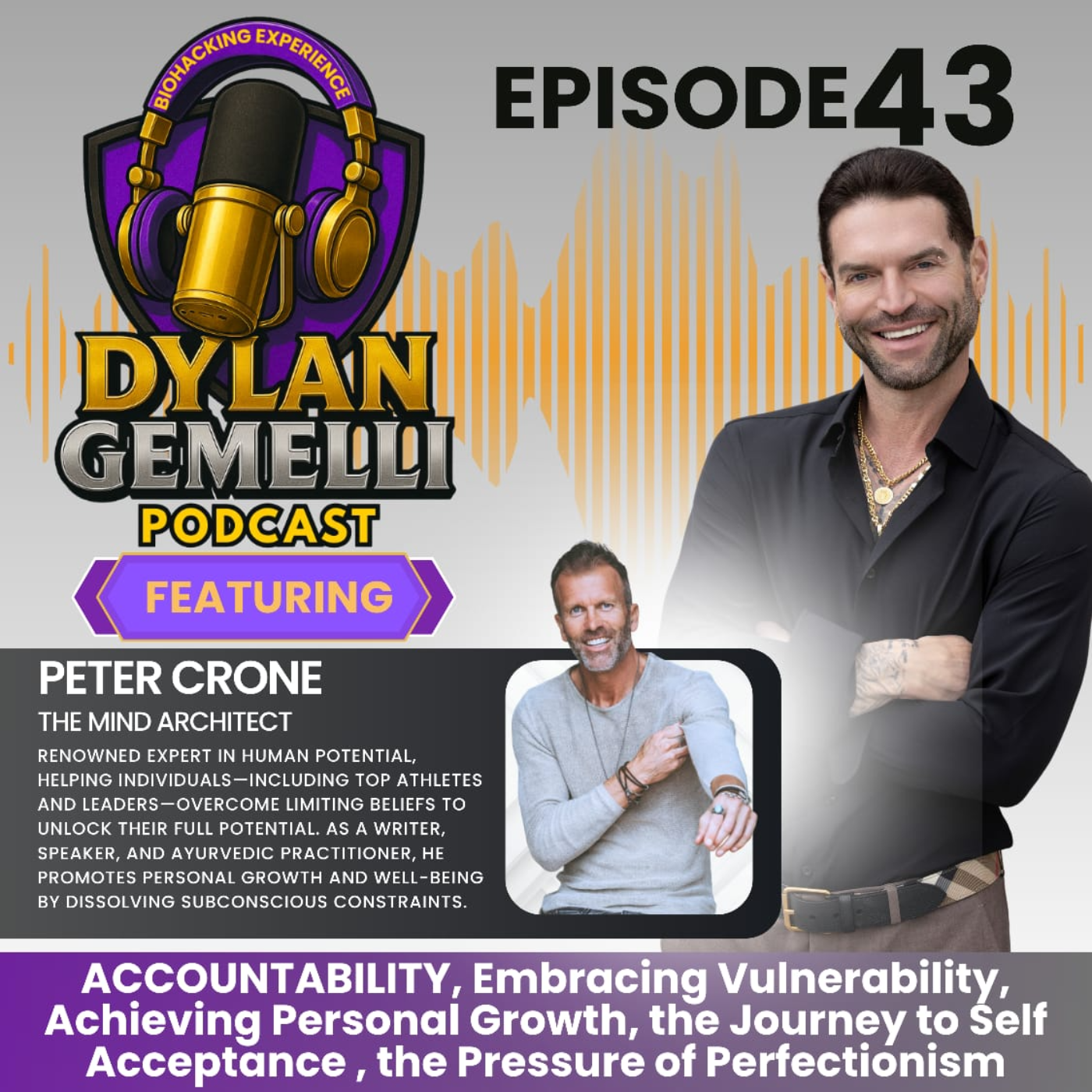
The Dylan Gemelli Podcast
Episode #43 Featuring "The Mind Architect" Peter Crone! The journey to self acceptance, ACCOUNTABILITY, Embracing Vulnerability, Achieving personal growth, the pressure of perfectionism, inside the minds of professional athletes and more!!
01:01:15
Loading summary
Transcript77 lines
- [00:01]
Dylan Gemelli
Welcome to Paradise. The Platinum cart's 5 times membership rewards points on flights got us here. Now let's make our trip Next level Hottest restaurant booked with Rezi Unforgettable experiences Event access Endless vibes Late hotel checkout yes please Platinum card membership for a trip that's nothing less than iconic. Learn more@americanexpress.com Explore Platinum terms and points Cap Apply Foreign Today's episode is sponsored by my good friends at Timeline. Timeline is now offering the world's first ever longevity gummies, powered by Might Appear. You've heard me talk about the importance of cellular health and our mitochondria, which is why I have Timeline as my favorite and most trusted sponsor. These are the only clinically proven Urolithin, a gummies for strength and healthy aging. We may be living longer lifespans, but are we truly living better lives? What if the key is not just adding years to your life, but life to your years? This all starts at the cellular level. As we age, our mitochondrial health starts to decline. And one of the key keys to living longer and healthier is keeping our mitochondria healthy and strong and might appear targets this for us. Take control of your health now and live the life that you not only desire, but you also deserve. As a gift to all my listeners, you can save 20% off today by going to timeline.comdylan to get started. That's timeline.comdylan. i assure you your cells will thank you. All right, everybody, welcome back to the Dylan Gemelli podcast. Now, I. I don't want to sound repetitive, but I am super blessed by the different types of people that I get to interview. And I always say, oh, I'm so excited, I'm so excited. And I am. Every single time my guest today I hit it off with immediately. And we'll get into that during the podcast. I'm sure that many of you already know who he is, but this is going to be one of those episodes you absolutely do not want to miss. I am going to drain him for information today while I have him because he's extremely busy and he's graced us with our time. So he is a renowned thought leader in human awakening and potential, and he works with a really diverse amount of clients ranging from top level athletes, entertainers and leaders to people from all walks of life. Now, his expertise lies in dissolving the constraints of the subconscious mind, freeing people from the limiting beliefs that inhibit behavior, health, relationships and performance. And his work liberates people from the fundamental blocks that hold us all back, which helps us to better understand our common humanity, reduce human suffering, while simultaneously accessing our unlimited potential. And beyond his role as a transformation coach, he's also a writer, a speaker, an ayurvedic practitioner, and he does really everything when it comes to helping overall well being. So my friends welcome Peter Crone.
- [03:29]
Peter Crone
Wow, Dylan, I don't know what your fees are for like MCing or introing, but I might have to splash out. Oh, we'll discuss death, brother. It's all downhill from now. They're like, wow, this guy sounds amazing. I high expectations, but let's make sure we fulfill.
- [03:47]
Dylan Gemelli
Absolutely. So just a quick background. I. I got the chance to meet Peter at the Dave Osprey biohacking convention this year and it was like within a minute, an instant click of different types of ideas and thoughts and us going on and on and, and unfortunately with those events, you have to keep moving. But I did get thankfully some time to spend with you, Peter, and I'm really thankful to have met you and really grateful for your time today, man.
- [04:15]
Peter Crone
No, likewise. I mean, kindred spirits, brothers from other mothers, and I can what a good soul and especially someone who's up to big things and wants to make a difference. And it's always flattering for me to be on a platform like yours where you touch the lives of many people. And I hope that I can amplify that.
- [04:33]
Dylan Gemelli
Absolutely. Well, let's dig in then, man, while I got you here. So first of all, you do a variety of things. Let's get a little bit into your background. First and foremost, you know, what is, what was your passions, what were you looking to do studying in college and what kind of drove you into the path that you're on today.
- [04:52]
Peter Crone
Wow. I mean, I would have, looking back at college days and had no clue that this is what I would quote, unquote, end up doing or what would turn into being my purpose, my passion, my profession. But I know back then I was certainly fascinated with human behavior. Going to college, I didn't really know what to study. Growing up in England, we're a little bit more traditional in terms of you think of a career and kind of reverse engineer it into a course of study. Right. As sort of a direct link. Usually for people in the uk where it's like, okay, well, if you want to go into business and study economics, you know, or in any of the medical world, if you want to become a doctor or nurse, you study that. But I didn't really know what I wanted to do when I grew up, but I knew I was fascinated with humans. And so I just studied human biology and exercise physiology, which was fascinating. And it led to my previous career as a trainer to some of the elites. You know, I was going around the world for five years on private jets and making them look pretty for movies and theater. But ultimately, it was my own life and my own series of trials and tribulations and a certain amount of adversity that I went through, especially from a young age, that led me to what I'm doing now. And being the Mind architect, where I recognize these patterns of the subconscious that every human being has. Has that is the. The gateway to real freedom and tapping into true potential. So it was. It was a. Looking back, it made complete sense how things unfolded and one thing went to the next, but could never have predicted it, definitely.
- [06:21]
Dylan Gemelli
So Mind Architect, and this is what you said, and that's kind of what your moniker is out there. What is that? Like, what, what does that entail? Why did you get that name associated with yourself?
- [06:32]
Peter Crone
I made it up, right. I think when they say that necessity is the mother of invention, you know, any other moniker just didn't resonate or fit. Like, okay, Spiritual Teacher sounds good, but sort of a guy in flowing robes who's burning, you know, sage and incense and probably sleeping with a bunch of young women he shouldn't be. And I was like, well, that doesn't fit the bill. Life coach is, you know, you can become a life coach in a weekend course. And I knew my stuff was infinitely more profound and life altering. I was called a happiness guru. A hitman for the ego. I like that one. But yeah, so it was just. I realized what I'm doing. I just like, okay, well, what am I doing? I'm really redesigning people's inner thinking space, which is a form of architecture or design. And it's focused predominantly in the mind, albeit the mind is just the bridge between body and soul. So it was just. It just made sense, you know, and it's obviously become very catchy and people love it. And I also wanted something that would inspire curiosity. You know, any other title that is commonplace, you know, there's a contamination with it, right. If. If you're a spiritual people, spiritual teacher, everyone already assumes something, but Mind Architect, okay, now I'm the mind architect around the world. So people are becoming more familiar with it. But to begin with, it was like, oh, like you just asked, what, what does that mean? So it also allowed me to engage in conversation with people as opposed to be in this world of presumption which I'm not a fan of.
- [07:56]
Dylan Gemelli
It's a damn cool name. I was like, in my head, I'm. I'm going back to Talladega Nights when Ricky Bobby's and, and he says, oh, I'm the Magic Band. And he says, yeah, that's a really cool man. You know, like, that's all I could think of. It's, it's, it's a very cool name, but I think more so it's what goes along with the title and what you do that is the actual cool part and the thing that resonates with me the most and how you have come to be who you are and what you do. Can you kind of talk about when you work with somebody? What are we looking at? Like, what are the things that you look for? What do people come to you to really help do?
- [08:38]
Peter Crone
Yeah, great question. Well, as you said in the intro, it started because of a little bit of my background with a lot of people in the entertainment industry, in film and music. And there the conversations were predominantly about burnout, stress, pressure, expectations. You know, obviously ego is becoming incredibly inflated that a human being couldn't keep up or mimic in real life. And so there was this delta between who they're being perceived as by millions of fans and how am I just as a regular old human. So helping there to be profound acceptance. Then I got my first athlete in 2007. He was a pro golfer on the PGA Tour, and we tripled his winnings in two years. So that opened the floodgates of other golfers. You know, you're a business and you go from, he was making just under a million as an average and went to three, six in two years. You know, that gets people's attention. So what I'm doing to answer your question is I'm really delineating and revealing what is holding someone back in life. And as my work has matured over the years, as I've grown, as I've become, you know, hopefully more wise with my work, I realized what I call these 10 primal prisons that everyone has in their subconscious. These limitations, constraints. That's what I'm writing in my first book. I've never revealed them yet. And people who do, my three month mastermind, get most of them because I work with people during that. But I will help them delineate. Okay, what is, what is the default way that you are being defined because of things that you went through in your childhood that has become a constraint. So in the case of an athlete, you can imagine they could have all the talent in the world. But if they're living in a subconscious prison that is like I'm not good enough or, or I, I'm a failure, then no matter how much talent they have, it's going to be curtailed. Right. It's going to be inhibited. So once that's removed, it's like taking the governor off a golf cart. It's just, you know, you go a lot faster with a lot more ease. So. And now it's obviously grown to where I reach millions of people around the world who deal with everyday human issues of anxiety, depression, relationship woes, health problems, financial struggles. Whatever a human deals with, to me always, always is the genesis of it is one of these primal constraints of our subconscious that we're not good enough, we're not safe, we're not loved. Something like that. And then when you parlay that and connect it to the events of your childhood. Let's take not safe. If a child was brought up in an environment where the parents argued a lot, or dad maybe had a few too many cocktails sometimes and got angry, or God forbid, a child was abused emotionally, or even worse physically, that child's nervous system creates a relationship to life where they don't fundamentally feel safe. So then as an adult, what that might manifest as is somebody who is constantly not trusting in a relationship or is constantly dealing with stomach issues because actually their nervous system is in fight or flight all the time. So I'm undoing all of that. And hence my catchphrase is I don't solve problems, I dissolve them. So remove the constraint and then whatever the superficial problem was in real life, that just vanishes, which, last I checked, people love.
- [11:45]
Dylan Gemelli
Yeah. So let me ask you, I'll relate this to myself and I've talked about this with myself, and it's just an example to kind of get a deeper explanation into what you do. So, for instance, I battled an eating disorder issue since I was very young, like 11 years old. And it's like a continuous issue. Never really talked to somebody about it, never expounded on it deeply, aside from a little bit with my wife and in prayer and as. So if somebody like with that problem, or maybe somebody struggling with addiction or you know, somebody that is having just the way that they view themselves or look at themselves, are those the types of things that people can come to you that you can address and help and help people to overcome?
- [12:26]
Peter Crone
100% absolutely. Happens every day. Certainly, as I said during the course of my mastermind, I probably work with. I don't know 50 plus people. And the beauty of that is, okay, there could be hundreds of people from all around the world, but they don't necessarily need to talk to me directly because their issue gets dealt with vicariously because of somebody else's story, Right? Take yourself, which is, I appreciate the vulnerability, eating disorder, that's symptomatic of something beneath, right? So even when you say I help people with addictions, I do, but I'm not interested in the addiction itself, that is a symptom of something deeper. So whether it's a substance, whether it's alcohol, whether it's weed, whether it's sex, whether whatever it is, it's just the byproduct of how somebody relates to. To themselves, right? So when I write in quotes, my first book is a series of quotes, and then I expand on them. But I say that there's no greater addiction than a person's idea of themselves. That's the ultimate addiction. So deep down for Dylan, there'll be some story that you have about yourself in the arena of eating disorders. It's usually, as you said, something to do with your appearance. So I'm not good enough? You may have heard, you know, people who have eating disorders, maybe a parent said something about being overweight. A lot of people maybe have experienced childhood obesity or being heavier and they were mocked. Or somebody like you as a man, what I feel is sometimes a kid feels they're bad and it's a form of self punishment as well. So you gotta track what is it that that kid made up at a young age. And then I. My sort of gift, I guess, is to slowly take someone to be able to see it, then investigate the validity of it is what I call, like, so is it true that you're not good enough just because your sister was the better academic or your brother a better athlete? And then when people see it's not a truth, that opens up the floodgates of freedom, which is my main product.
- [14:14]
Dylan Gemelli
Excellent, man, that's amazing. So, yeah, one of the things that we connected with right away was when we started talking about sports. I mean, and I told you I like live and breathe sports, and I was an athlete and. And I. I mentioned to you I was moving to the Phoenix area, which I just did. So then you in turn discussed your time with the Diamondbacks and that brought the fascination. And you just mentioned briefly about helping golfers. So one of the things that I'd like to ask you is how challenging is it when you have a professional athlete in front of you needing help and, you know, their whole career depends on it. And you're talking about somebody depending upon the athlete, obviously, that's making millions upon millions of dollars and has these expectations and these pressures and, you know, from the outside looking in, a lot of us look at them as like, well, you should just. You should just do it. I mean, you're getting these millions of dollars. You're not human, you know, and I. I humanize people. And I realize, you know, we're all humans, but that's not easy for everybody to do. So can you just talk about. You don't need to talk about anybody specific.
- [15:17]
Peter Crone
That's not what I'm asking.
- [15:18]
Dylan Gemelli
Just some of the. Maybe the different types of challenges you have with somebody that's doing that kind of work and in that kind of. Under that kind of pressure, for sure.
- [15:27]
Peter Crone
And I think the way that you delineated it is very accurate. But that adds to the significance and the importance, right? Which is one of the big bugaboos for athletes is that there this unwritten, sometimes, you know, blatant expectation on performance, right? You're paid millions of dollars. You've been doing this since you're probably three or four years old, and you shouldn't fuck up, right? That then becomes actually the biggest obstacle. So I am happy to share a story because we actually did a documentary, which I. I think is coming out this year. But, you know, one of my dearest friends and favorite clients, he's a MLB guy. He's now on the Yankees team, but he was with the Diamondbacks when I met him, and about four seasons ago, he won the MVP for the National League, which is no small undertaking. He won. He was with the Cardinals. And then Aaron Judd Judge, who's the stud for the Yankees, he won for the American League. Right now they're playing together on the same team, which is kind of cool. But at the beginning of the season, he, like any, you know, in the sport of baseball, which is all about failure, he was having a few games where he was scuffling and he was going over meaning he, you know, struck out, right? He wasn't getting any hits, as is to be expected. He was getting frustrated. So we had a call, and it was one of the most powerful that we still talk about because I like to use a lot of humor, and I can sometimes be a real prick, you know, because I care about my clients. And, you know, so I jokingly said to him, okay, well, you know, you've maybe gone, I think, four games without a hit. You know, which is not ideal. He just, I think, signed a deal for 150 million for six years or something, you know, pretty significant. And I said, so you the only guy striking out in the league? And he's like, well, no. And I was like, no. I mean, the best in the world striking out seven out of 10 times, right? Hall of Famers are still failing 70%. They're batting.300. And I said, so you're getting upset about something that is an intrinsic part of the game. It's unavoidable. So the problem isn't that you're striking out. The problem is that you're not okay with it, which is where the resistance is sitting within his system, which is an athlete is kryptonite, right? Because, like with my golfers, I remember one of my LPGA girls. She was the girl that everyone would watch on the range because she flashed it, but then she wasn't getting the same results inside of the ropes. And I'm like, well, you're two different people on the range. You're having fun. You're joking around with me, the caddy. You're relaxed. And then when you go inside of the ropes, you're tensed and you're focused. I'm like, I might as well give you a set of clubs to somebody else, right? You're physiologically, emotionally, psychologically being a different person. So with my athlete, you know, helping him to see that it's unavoidable, failure is part of the game, but he's got this extra expectation because he's one of the best as well, that that shouldn't be happening for him. So the. The way that I phrased it to him, I said, you have the capacity to suck. And for a pro athlete, that's like, yeah, but I don't want to. I'm like, oh, yeah, but that's not the problem. You have the capacity because you're human. And especially in the sport of baseball. And it was such a pivotal turning point for him because literally, the next, you know, few games, he started to crash because he was okay with not being excellent, Right? Which seems counterintuitive for an athlete, but it's actually the access to freedom because you're embracing your humanity. I always use the quote by Jack Nicklaus, who's the greatest golfer of all time. I know people think it's Tiger, but, you know, Jack's actually got more accolades, especially in terms of majors.
- [18:45]
Dylan Gemelli
That's right.
- [18:46]
Peter Crone
His quote was one of the most important parts of winning, is being okay, losing. He didn't say I want to lose. He didn't say, I like losing. But you've got to be okay with it. What that does psychologically to the brain is you're, you're allowing for all outcomes such that you don't have any more attention on it. The people who are worried about missing the cut on the PGA Tour, invariably the ones that do, because that's what they're focused on, you see. So with him, what happened is he realized, oh yeah, I have the capacity to suck. I have the capacity to strike out. That is a part of who I am. And he was denying it, and the denial of it, he's now in a state of conflict with himself. And so it becomes a self fulfilling prophecy. So that was just one of those, One of my favorite stories. The same was, you know, again, I don't care. It was, you know, with one of the worst free throw shooters in the league. He was with the Clippers at the time. It wasn't shaq, it was DeAndre. But yeah, yeah, I went to his house and I'd never met the guy before and he at the time was really struggling and it was impacting his life as any athlete would happen. And I just happened to have mutual friends who had a wealthy businessman that I helped who had floor seats and knew, knew him and said, hey, just talk to my, my guy. He's changed my life. And in one conversation, I sat there and I said, so when you step up the free throw line, what are you worried about? He said, well, you know, missing it, fucking it is embarrassing. The cloud of booing, you know, I go home and the win or loss on the newspapers the next day is usually because of me. If I only shoot three out of 10 from the three throw lines, you know, as opposed to a league average of seven or eight, those five points is the difference in the game. I lost the game, you know, so you can feel the pressure, right? And I said, okay, well, that means that every time you step up to the line, you're trying to fix your, your, your history. You can't do it. So your brain, which again, one of my quotes is a past hurt informs future fear. So whenever we've done something that hurt or was a failure, the brain designed to predict and protect is trying to avoid it. Makes sense, but it's also perpetuating it. So I just again gave him one line. I said, well, what if I told you that for the rest of the season you shoot league average, which was about 70%. Yeah. And he was 37. He's like fucking, hey, that would be amazing. He bit up. He was like smiling like a kid who probably just picked up a basketball for the first time. And he said, yeah, that'd be a fucking amazing. I said, how would you feel at the line? He said, I'd be so at peace, I'd be so at ease. You know, like the golfer who's on the range who was just flushing it. I said, well, what I just portrayed for you is as real as the future you're worried about. We're still both fucking sitting in your kitchen, right? So then I start, then I slowly introduce people to the idea that you're being informed by whatever you're envisaging, right. If you about worst case scenarios, then you're going to be in a state of fear, which for an athlete puts you in a state attention, which means you can't perform at the way that you do naturally. So he went out that night, they were playing the Celtics. And I think that week he shot 68%. You know, just because of a shift in the way that he viewed things. He accepted his history. Couldn't. You know, one of my more popular quotes is what happened happened, couldn't have happened any other way because it didn't. Which is a way that we fully accept our history and we can move on. So they're two real case studies. And that's what I do with athletes. It does seem hard, but not for me because I'm talking to a human. They, they effortlessly perform. So I know that my job is not to help them be a better athlete. My job is to help them to be a more forgiving and accepting human.
- [22:05]
Dylan Gemelli
You know, from like fifth grade through, I don't know how long I would win every free throw competition. I would in, I. I would go to these shooting competitions and win them all. And my senior year of high school, I would shoot 90 to 95% at practice because we kept track of free throws and percentages. And you'd have to run and I did not want to run extra. And I'm telling you, man, I got into the games and I was like 40, 45% and I couldn't get out of my own way.
- [22:29]
Peter Crone
Yeah.
- [22:30]
Dylan Gemelli
And it and every. I'd sit at practice and stay and, and I would go through and I would literally. It was always 9 out of 10, 8 out of 10, 9 out of. And we'd do hundreds a night and I just couldn't get out of my own way and. And I really needed you.
- [22:45]
Peter Crone
Yeah.
- [22:45]
Dylan Gemelli
I'm wondering. Okay, so how do we decipher and how do we get through an athlete who would come to you and say well I, I just expect to be this good and, and they have that confidence and yeah, you want them to have the confidence to think that they're good. But how do you get over that hurdle of, you know, you were just talking about accepting that you could strike out and everything. But what do you, when you have the athlete who's so high paid and just has that belief in their self to a fault and that can, can that cause them the problem then that you have to work through and how do we fix that? Because that can be an issue, right? A block.
- [23:21]
Peter Crone
It's a major issue. And without sounding too harsh, that's not the kind of athletes that's going to come to me, right? Because they're there in the world of knowing, right? Meaning the knowing mind is stuck, right? We, if we know how things should be, there's no room for curiosity, for mystery, for magical, magical miracles to show up in life. So when people know and people do this, oh, I knew that that was too good to be true or I knew I'd fuck up, right? This is a self fulfilling prophecy again. So that kind of athlete is stuck in their own arrogance, which is a form of compensation for inadequacy, right? So they, they, it's a demand that they're putting on themselves, which is an oppressive force. So they might get there. You know, force is a, it's a powerful medium that people can use, but there's always destruction with force, right? When we force something, there's collateral damage, usually to ourselves, certainly to relationships. What I introduced athletes to and anybody is the difference between force and power. When you're powerful, you're able to be with anything. When you're for, you can't. You need to manipulate, control, dominate and be attached to outcome. So I'm much more interested in people who are interested in being powerful as opposed to being forceful. So the kind of athlete you're describing, by default, you know, they've learned to survive by being forceful. They were probably a bully at school. They had to be the best. They would probably cheat at times. They'll do whatever it takes because there's too much at stake for them to, to be revealed as somehow inadequate or flawed. However, that's not a powerful human being. A powerful human being is someone who can actually embrace their inadequacies and their vulnerabilities. Which is to me the last part of becoming a superhero. Right. Clark Kent is the floor of Superman and so he has to be okay with that. If he, if he can't embrace that part of him, then he loses his power as Superman as well. So for me, this is, this is true for every walk of life, every listener right now that anybody, regardless of whether you're a pro athlete getting paid millions of dollars or a stay at home parent, or somebody who works at the local dentist or whatever you do, your capacity to perform at the highest level is directly correlated to your ability to embrace your humanity. If you don't, then you're literally trying to hold the pendulum up to one side and something's going to give, usually your sickness, you know, you'll fail physiologically. Relationships, finances, that's when things fall apart.
- [25:45]
Dylan Gemelli
Assuming you would say, but he got a little deeper. And I appreciate that because I, I, there's so many different walks of life and so many different people that think that theirs is so different than the next person. And I'm sure it's quite challenging.
- [25:58]
Peter Crone
Yeah.
- [25:58]
Dylan Gemelli
What are some of the issues that you deal with or just an example of one that you find to be more problematic that you see? Maybe something that's kind of consistent amongst a lot of people. Like for instance, I used to be this really negative. Something goes good. Well, I'm just waiting for something to go bad type of thing. Once I stopped doing that, the consistent level of goodness sure increased for me and so did my, my health and just everything. Right. So, you know, like that's, that's probably a common problem. Is there something like that or something that you see consistently with a lot of people?
- [26:35]
Peter Crone
For sure. I mean, you know, because you're kind enough to talk about yourself, obviously the 90%, 95 when you're just shooting around and practicing versus 40% in games, you know, the eating disorder that you kindly shared, you know, all of that fills in, you know, falls into the bucket of perfectionism. Right?
- [26:52]
Dylan Gemelli
Yeah.
- [26:53]
Peter Crone
So what I hear for someone like yourself, and probably everybody listening, is perfectionism is a survival strategy for a deeper sense of inadequacy. Right. So it's a behavioral adaptation where we're worried that who we are somehow is insufficient. And so that's the pressure. So then that pressure for you, like I said, what I feel in your system, again, without knowing your whole story, is that you might have thought that you were bad. Right. And there may be incidents where you were disciplined or you got kicked out of school for a day. I don't know the story. Or maybe your dad was a little harder on you than a lot of dads. And so you, Dylan, created the story that who you are is somehow bad. Now why that's important is because there's the shadow side of what I call a negation, right? So a lot of people are not good enough. And so their survival strategy is perfectionism, people pleasing, working harder. When someone's bad, they might have some of the coping strategies, but they tend to, like you just shared, lean more towards the negative and self destructive behaviors. Because if you look at the language, right, if I'm not something, so if I'm not loved, right, a lot of women can struggle with that, then what they're trying to do is adapt themselves, manipulate themselves, even sometimes their bodies, right, with surgery, clothing, makeup, to try and be what? Loved? Because that makes sense, right? If I'm not loved, I'm going to do everything I can to be loved, right? If someone's not good enough, what they're going to do is they're going to try and focus on what they have not to enhance it. Does that make sense?
- [28:23]
Dylan Gemelli
Yes.
- [28:24]
Peter Crone
Now the way the brain works, which is interesting, is if I'm not something, then I'll work towards that. But if I am something negative, so in your case I'm making this up, but for anyone who feels that they are bad, they tend to actually fulfill on that so you don't compensate. So again, if I'm not something positive like loved, good enough, safe, then I'm going to try and do everything I can to get that. But if I am something negative like I'm bad or I'm trash or I'm a failure, then the way that the system orients is to consistently fulfill on that. So the people who struggle the most with, like you said earlier, addictions, eating disorders, even to the point of sometimes, you know, homelessness or real losing relationships and businesses, typically the orientation of their subconscious narratives are I am something negative or derogatory. So they're some of the ways to delineate what someone's dealing with. Most people are dealing with something that they're not and they compensate. But the compensation is exhausting, right? Trying to be a people pleaser, trying to be a perfectionist, which is it's subjective, it's completely unattainable, is nonetheless draining them like in physiological, emotional terms. So they become resentful of a partner, they get Hashimoto's, their adrenals are shot. You know, this is how these things manifest physiologically. So there's some of the basic everyday examples. I would think the I'm not enough is probably the most common because everyone can relate to that. I'm not wealthy enough, I'm not skinny enough, I'm not young enough, I'm not old enough, I'm not good looking enough. I'm not, whatever, right. Smart enough. Like everyone's got their version. And for people to be able to find that in their system, look at the effect of it, because it's really, it's draining. Right. And it's also sad. People feel isolated, they feel defeated and it's self fulfilling. So we always seek evidence to reinforce our own perspective. That's the crazy nature of the ego. It always wants to be right, even though what it's being right about is very unfulfilling.
- [30:27]
Dylan Gemelli
Yeah, yeah. So I'll tell you a couple things and then tell me what you think. So I think that this is one of those things that you can, when you have this problem which you're talking about, which I think is probably very symptomatic for a lot of people. And some will admit it and some don't want to. I think once you do and you start to, to almost embrace it and work at overcoming it, it may be a lifelong thing, but it becomes a lot easier. I, once I figured out to start living for God and stop living for everybody else, that's just me personally, that's not for everybody. But that's when I started to figure it out. I, I, you know, I went to prison because I was a people pleaser. I can say whatever I want and look back on it. But when I made those mistakes and was living the life I was, I was so worried about having things and showing off things and doing things to accentuate what I was doing to get, I don't know what, some sort of glory and respect that got me nowhere and in the end meant nothing. And even after going to prison and fixing things and rebuilding myself, still having that with, well, why, I asked my wife why, why do I feel the need to spend money on all of these designer clothes and have all this collection of shoes and all this so somebody can tell me, oh, that's nice that you have it. And I, when I wake up in the morning, what does that matter? What does that do for me? How does that help me? How does that make me successful? And I think part of it is accepting that you have that weakness and addressing it. And then like I said, for me it's God. For somebody else it might be something else. But living for what you're supposed to live for, do you find that people still, once you help them or help them to overcome. They may still struggle, but they have a better way of dealing with it or, you know, embrace it better and handle it better. And do you find that it's a lifelong struggle?
- [32:10]
Peter Crone
Well, first things first. I really appreciate your vulnerability in sharing that. It speaks volumes about you as a man and obviously the work you've done and why you have the audience you have, because you're willing to show your humanity. So I just want to acknowledge that first.
- [32:21]
Dylan Gemelli
Thank you.
- [32:22]
Peter Crone
But no, it varies. For the most part, when people do committed work, you know, I do some one on one now, I don't do so much because I love to reach more people with my membership. Freedom that you know about, or the mastermind that I do for three months. People are in a container for a while so they get sufficient inspiration and teaching to be able to circumnavigate and dissolve these constraints. So typically, it's instantaneous. And then. So that's the awareness of the pattern that we bring to the surface. Carl Jung had a great quote. He said that until you make the unconscious conscious, it will drive your life and you'll call it fate. So I'm bringing the unconscious conscious shine a light on it, as I said earlier. Then see, is it a truth that you're not good enough? No, of course it's not. How. And then my question is, who could you be in the absence of that and people like fog, I. I feel so light, I feel so good, I could do whatever the fuck I want. And yeah, so typically in the containers that I work with, it becomes instantaneous. And then a bit of practice is the second bucket. But for you to help both you and your listener, because I'm sure many people can really relate to you wanting to buy the designer clothing or have the collection of shoes, you know, that's one of the primordial imperatives of a human being is love and acceptance. Right. It's very subtle, but it's not that you wanted to have the clothing and the shoes to be seen and appreciated. It was what's driving that, which was the deeper belief that you're not. Do you see? That's the compensation. So when people do whatever they have to do in the arena of performance, it could be an athlete or you're performing with clothing for a woman. I mean, there's millions of girls who are performing on Instagram, right? Like with the bikini shots. And you know, it's still somebody fundamentally, there's a being there at the deepest level that to me warrants compassion and kindness, who is just Asking at the deepest level to be loved and accepted for who they are. And then we have the myriad of ways that we dress that up as a form of manipulation to try and look good to the other humans on the planet so that they will love and accept us. But the thing that people miss is you're asking somebody to do something that you're not willing to do for yourself. And that's why it's an addiction. And that's why I say an addiction is where you can never get something enough of something that almost works. Yeah, you really feel that. So there would have been times where, you know, for you, your body was just right. You just had a good, you know, shower, you work out, you're feeling pumped, you got the right outfit on, the lighting's good, and Dylan feels like the man, you know? And then the next day you wake up and you don't know why. You feel like shit because you're being driven by this deeper mechanism, which is the part of you that can never get enough for something that almost works. So that's the addiction. And that can be substance. It could be few clothing for a woman. It could be sexuality or the need to perform whatever it is. So I'm undoing it at the root. So once you pull that out and realize that by virtue of being human, we all have a part of us that fundamentally doesn't feel loved and accepted. It might feel not loved, it might feel not good enough, it might feel like it's not valued, it's not special. It's a part of us that got triggered in childhood. It's not incumbent upon other people to compensate for that. That's called co dependency in relationships. Why relationships don't work, you know, because as long as your partner's placating that part of you and numbing that part, you like them. But if they trigger it, it's like, fuck you. Talk to my attorney. So. So the real opportunity for a human being is to stop putting pressure and demands on other people to take care of the part of us that is our own responsibility. To take care of that, to me, is the human opportunity.
- [35:58]
Dylan Gemelli
You know, I. I fell like a slave to all of this. It would be idolatry and religious term, but, you know, just a slave to all of this desire and want to please everybody and to be this and to be that instead of just being who I was. And I still, you know, it's. It's few and far between now, but it still happens. And when I do, I tend to catch myself, but it Brings me to what I would like to talk to you about now, because I talk about this a lot. I didn't have this forever. Forever. And I think this is lacking in a lot of people. And this is one of those things that also helped me now to kind of get over hurdles in my life that, you know, I was just never able to do. And that is a very simple word and term that I think so many people are lacking. And the term is accountability. All right. Yep. And I guess for me, once I started being accountable with my wife, when I'd argue and say, you know what? I fought dirty, I'm sorry, I screwed up, admitting to myself, instead of making excuses why I didn't get this contract or in the past, it was always why I didn't work out of the job or why I didn't make it and what I was going for. But that word. I feel like we are almost programmed as a society anymore to have built in excuses and to. To have crutches to lean on as opposed to dealing with things internally and mentally and saying to yourself, you know what? I fucked this up. It's my fault. I screwed up. Is that something that you run into and do you teach that or help that or what's your feelings on accountability? And maybe tell me if I'm wrong, but do you feel like there's a lack thereof? And that's a big key component to a lot of the problems that we.
- [37:38]
Peter Crone
Have interpersonally, 100%, and why we clicked, when we clicked. It's one of the main pillars of my work. Again, you know, I've shared it. I speak in quotes. I say, you're either 100% responsible for your life or you're a victim. It's an on, off switch. There's no gradient. Right. So you use the word accountability. I use the word responsibility. Same energy. Right. Which is really that I am the author of my own experience. Otherwise, victimhood is the game of, you know, blame, shame. And that's how most people live their lives. It's McDonald's fault that the coffee was too hot and I'm going to sue them because I was on a phone and not paying attention and I spill. You know, people don't want to be responsible for their action. And I get it, because that would mean that they have to recognize how powerful they are and they would have to deal with the circumstances that a lot of people don't want to deal with. So really, most people are looking through the eyes of a child who's dependent on other people. Doing things for them. Which is why most, even adults are still being driven by the emotions of a scared, hurt, five, six, seven year old, which I have compassion for. But it's no powerful way to live. So absolutely. Singing from the same hymn, sheep, we just use a different word. You know, you're, you're 100% responsible or you're not. And if you're not, then you're always going to look for excuses, reasons, justifications, rationalizations as to why your, your life isn't working. And that's okay too. I can have compassion, but I just don't. I, I'm not interested in living that life myself. It's, it, it's a powerless way to live and it's a frustrating way to live because you're saying that my experience of life is dependent on the behaviors of others. And if you just think about that, that's exhausting. And this is why people have what they call control issues, right? Because it makes sense that if you think that you feel the way you feel because of. Fill in the blank. Your boss, your wife, your kids, your parents, your coworkers, your government, your sports team, you know, whatever it is, then your brain is going to try and control those people to elicit the behavior you want so that you feel okay. It's all self preservation, which an ugly way of looking at it is actually, that's manipulation. You're trying to manipulate people, which is a subtle demand on how they're supposed to behave for you to be okay. And that's the big lie that most people are stuck in.
- [40:00]
Dylan Gemelli
Love it, man. Thank you for that breakdown. Amazing, amazing, amazing. Okay, so I want to get into some of the things that you're doing right now. I know that you were discussing the, the book that you're writing and we're going to get to that. But I want to talk about some things that you are kind of working on right now that you and I discussed, and that was with your mastermind. Let's kind of get into. Because you know what, first of all, if you would, because I've heard the term mastermind so many times from a variety of different people. Some people I highly respect and some people I think are just scamming the shit out of people. Okay. So can you, first and foremost, just in simple layman's terms, describe what exactly is for you and what you do? The mastermind program?
- [40:46]
Peter Crone
Sure. And I appreciate the simplicity and the genuine interest. We just called it the Mastermind because it felt appropriate. I know it's a generalized term, but this has become the one of the most sought after programs by anybody who's interested in, you know, getting out of their own way, as you said earlier about your free throw shooting. So I. It's broken into eight modules over three and a half months long days. Ish. The morning is dedicated to theory. So I wanted to teach people. It's almost like a certification which is not yet at the level of giving a certification. But I teach people the theory of what I do, how it works well, how does the ego get created? Why do people self sabotage? Why do certain people get sick? What are the fundamental pillars of why people get in their own way? And so there's the theory. Then in the afternoon I do a couple of hours, usually three hours of coaching with people and I explain what I'm doing. So I mean, you need only go to my Instagram because especially right now we're launching another Mastermind. So we've got a lot of clips from Masterminds. The difference you see in a human being from who they were before I spoke to them to afterwards to me is still mind blowing. So that's what happens is you both get the theory understanding of my work and then simultaneously seeing the impact and the effects of it. Like a woman who had stage four endometriosis who after the mastermind no longer had it. A woman who was in a state of constant anxiety and had, you know, cancer in the bladder, who no longer has it because she shifted her internal terrain where she's not in a constant state of fight or flight. So that's my mastermind. And then in between we do. So there's over 30 hours that I lead myself and then there's over 30 hours of integration calls with a few of my coaches that help people to better understand the information. Because I download pretty heavy and I want to make sure people get a lot of, you know, content.
- [42:39]
Dylan Gemelli
So I've got it pulled up here on the screen so I can go along with you. So it looks like you do a hour and a half lesson and then you do a break and then a two hour discussion then after the lesson. So is that discussion based upon the lesson that you gave? And then does it, do you get into one on one things with people or how does that.
- [42:57]
Peter Crone
Yeah, that's all coaching. And I normally go way over. I normally do about three hours because there's, you know, there can be over a hundred virtual hands up of people who want to be coached because that's what I'm sort of known for, right, is to break free from the constraints that people are struggling with. So that what's listed as discussion is. Yes, there'll be. I'll make reference to the theory. So people. Because a lot of people want to be better parents, better coaches, better leaders, better yoga teachers, better managers or CEOs, so they want to be able to see. Oh, that makes sense. The person he's helping right now who's been dealing with social anxiety or an eating disorder. That makes sense with what he just taught this this morning. So, yeah, that's the format. It's all one on one. It's all on Zoom Live. But in any given afternoon, I might work with minimum, about four people, maximum about eight. So during the course of the whole Mastermind, you know, it gets to 40, 50 plus people. So there's a lot of real life case studies that are just super fun. We just did our first retreat last weekend for Mastermind is to come and meet in person. We went to California, Malibu, and it was just incredible to see people who've been doing this work because some of them have done a few masterminds and we've done them now for the last three years. So people have known each other for a while, but never met. And I, I've never been in a room where there was so much joy, so much freedom, so much love. It's almost like speaking a new language. You know, the language of full responsibility, the language of freedom, the language of power, the language of, you know, true self worth. So that's. That's another byproduct of going through the Mastermind. You can come to a live retreat at some point.
- [44:34]
Dylan Gemelli
How many of these have you done?
- [44:36]
Peter Crone
The Masterminds, Evan, this is number eight coming up.
- [44:39]
Dylan Gemelli
Wow. Okay, so then is that over how many years? Period time?
- [44:44]
Peter Crone
About three and a half.
- [44:45]
Dylan Gemelli
Okay, so you do a couple a year then?
- [44:48]
Peter Crone
Yeah, yeah, exactly. You do two a year.
- [44:50]
Dylan Gemelli
Okay, cool.
- [44:50]
Peter Crone
So. So this is the last one this year.
- [44:53]
Dylan Gemelli
Yeah, got it. Okay, so you do some other things too. Here you have Freedom membership. Correct.
- [44:59]
Peter Crone
On your site, that's like an archive of all my content from courses about anxiety, depression, how to establish financial freedom. What is real health. Not a, you know, not the healthcare system we have. But how do we generate true vitality? How do you be powerful in relationships? So that's like, I jokingly say that's like my version of a conscious Netflix. Right? Somebody who's really committed to the work. That's all just recorded, it's archived. You can go through it at your own pace. I think now there's about 110 hours of content. I also do live events around the world and they all get recorded and put in there. I do a weekly Q and A where I answer someone's question. So there's new content also being put in. But I, I created that because, you know, the Mastermind's a real commitment in terms of time and financials, but the Mastermind, the Freedom platform, it's. It's 29 bucks a month. I mean, I don't know anyone who can't afford that. If they're interested in breaking free and loving life.
- [45:55]
Dylan Gemelli
Absolutely. So do you still do one on.
- [45:57]
Peter Crone
Ones then at all or. I do. It's as my schedule as, you know, with your own life. You know, it's become more and more popular, in demand. I mean, I'm flying to London, I've got two requests to go to Dubai, I'm speaking in, in San Francisco, I'm going to Abu Dhabi. All in just like the next five months. Right. So it's, it becomes harder and harder to show the level of commitment I do have to one on one. But I still have a couple of clients who are high performers, you know, in business and sports that really just for them, it's, you know, irreplaceable. I mean, my guy who's with the Yankees, we're not working this season, but we worked together 15 years, you know, because for him it's, you know, he kindly said there's no one else he ever wants to work with, so. But now it's more about scale and reaching more people, which is really fun because now wherever I go, you know, there's typically somebody that I've touched the life of, which is really humbling and flattering. And so the more people I can reach, the better planet we have. I mean, my commitment is to helping a billion people find freedom. Yeah, that's the goal.
- [46:57]
Dylan Gemelli
It's just a testament to you and what you're doing and the way that you want to help so many multitudes of people. Let's talk about your book then. When did you start writing it? What, what was your main motivating force behind and when. When can we expect this masterpiece?
- [47:13]
Peter Crone
That's the ultimate question for anyone who's familiar with me. I don't think there's a day goes by where we don't get a comment or a dm. It's like, when the fuck is the book coming up? Because I have been talking about it for a while, so that's on me. But I also believe in divine timing. So what Inspired it is. I just recognize that I have a joy of writing. And as much as I'm an orator and I've paid good money to travel around the world and speak, and I love to coach and do live things, I really love the process of writing and also understanding what that's like for somebody who's reading. You know, if you're somebody enjoying a book, you're taking someone on a journey. So that was part of the reason, recognizing that I had a gift to write, but I also had a lot to write about, you know, so I can come on a show like yours for an hour and a bit, and I'll share whatever I can. And hopefully it's touched some people listening. But there's a wealth of hundreds of hours more content that we just can't cover in this conversation. Right. That's just physics. Whereas in a book, I have the capacity to share a lot more in a container that is easily accessible, it's affordable, it's something people can carry around with them. So that's one of the reasons. And also that I've been approached by God knows how many publishers who've seen my work who are like, we'll pay you X to write a book. Not that that was the driving motivator. I've turned most of them down. But, yeah, I just. I don't know, it feels like it's the commensurate next step for somebody like myself who's got something to say that seems to really be changing people's lives.
- [48:41]
Dylan Gemelli
Well, we definitely need your work and what you've got to. To share and think and. And all of that. Are you. Do you do any. Do you have any other, like, speaking plans? Are you going to do a lot of things speaking live and. And things of that nature? And then also when it comes to podcasts, do you, like, tell people. Do you have your own. Are you going to be on more shows? Like, what's your plan?
- [49:03]
Peter Crone
You got all the right questions, my friend. And this wasn't rehearsed for anyone listening. But. So, first of all, the last part of your previous question I didn't address, and I like to pay attention and listen. When can we expect the book? I'm in talks right now negotiating with a publisher, so even that process with editing and publishing takes a while. So I would hope by maybe summer of next year as a. As a rough guide. But then to your last question, we actually just last week launched a podcast. Like, literally the second episode came out today. And why it's so cool and it's already gone gangbusters in terms of a first, you know, go at it is because whilst you're an incredible host and you have incredible questions, I consider myself to be, you know, infinitely curious. Curious. So I do have a lot of questions, but I'm used to coming onto a beautiful show like yours and answering questions. So I, I resisted doing a show because I'm like, well, yeah, I could have people on and I'm fascinated to meet amazing people, but I genuinely, you know, enjoy sharing more. So the format of the podcast, which I think is why people are loving it, is I coach someone in a session, so you witnesses before and after and if anyone wants to go and go onto my Instagram page, you know, the last couple of posts of where I work with someone and even your. Their face, you can see it's different. You know, it's like, holy. So that's the, the format of the podcast. So that is. That is now out there, which is fun. We're not going to do too many episodes. My athlete from the Yankees has kindly said he'd come on. You know, this guy's a stud and he's going to talk about mental performance in the highest level of sports. But for the most part, I'm coaching people. And then with regards to lives, I do try and do one a month of late, we've been going to LA to do it. So there is one coming up at the end of August. Unfortunately, fortunately, depending how you look at it, I sell out usually within about 24 hours, which is really flattering. But I'm going to be going to London and I'm going to do a live there and probably the first, second week of September. So if people want to keep an eye out, if they're in Europe, I might even do one in Ibiza because I'm going to be speaking over there. Then I'm probably going to do another one. It may be even in Australia. I'm trying to go around the world now because more people are asking me to do that, but all the information will be on Instagram and on my website, so they're really fun. I really love that format. It's, it's. I become a little bit more the entertainer, my team says, you know, I become more the comic on stage, which is fun. It brings out a different side of me doing the live events. And it's always just super nice for me to meet people in real life. And I typically get inundated with hugs and selfies and love at the end, which is always pretty Special. That's awesome.
- [51:34]
Dylan Gemelli
Well, if you ever need anybody completely and utterly screwed up that's willing to talk about it, you can. I. I'll let you treat me on air all day long, man.
- [51:42]
Peter Crone
You seem to be doing pretty well, and I think hopefully I dropped a couple of nuggets for you with your kind vulnerability, but, I mean, it seems like you've done a great job. But I. I'm always here for you, my friend. Whatever I can do to help.
- [51:52]
Dylan Gemelli
I really appreciate that, man. I really want people to make sure they watch you because I think to be able to see how you work and to see different types of vulnerabilities and different types of different kind of issues. I think beyond seeing how you work and the way that you can help people, I think it. I think part of it, and a big part of it is just people accepting they have the problems and then being willing to go get the help that they need. And the more people talk about it, and that's why I'm always willing to talk about it, is because I don't really give a shit anymore, clearly, about what anybody thinks. I would have never talked about any of this stuff for. I. It's only been the past, like, year or two that I've been willing to do this. I just. I don't like to come across like, oh, I think I'm. Look, I'm admitting that I'm doing this to give people the understanding and the realization, like, it doesn't matter who you are. We're all screwed up some. Like, every single person that's ever lived, aside from Jesus, has had some sort of thing. Right? And so, yeah, I just think it's important, man, to talk about it and be open about it and. And let people see it and then to see how you work. I think it's really sweet and. And it's an amazing thing you're doing.
- [53:00]
Peter Crone
No, I appreciate it. And I really, again, acknowledge you as a man who could, arguably, with your success and, you know, your intelligence, play the facade of, like, you got it all together right? But again, it's one of my quotes. I always. They just come to mind as I speak. I say, you know, please never become perfect. You'll have no one to relate to. That's right. And yet the human disposition is funny, isn't it, that we, based on our inadequacies, are trying to become who we think we should become in order to be loved and accepted, which is the obstacle to the affinity and intimacy that we crave. It's. It's just bonkers. And to me, that's why we're here as humans on this dimension. Planet Earth is that God sent us here knowing that we had our own fears and constraints. And they're like, we got the right fucking place for you. Go to planet Earth. That place is fucked up. You will have all of your triggers brought to the surface so you can liberate yourself from the constraints with which you arrived and recognize the divine being that you always were.
- [53:55]
Dylan Gemelli
Were. That's right. I love it. Well, and I ask, how would you know success without failure? How would you know love without maybe hate or. I mean, how would you know any of these things? It would be very difficult. And I think when you can use failures, struggles, issues and use them to your advantage and make them a strength, you know, that's how you really achieve, and that's how you never get down. Once you're down, you never stay out. And you. I've had a lot of people ask me, well, how do you. How have you done that? Or how did you figure this out? Or how did you do that? And that's there. There's really no answer. I just didn't take no for an answer. And I just didn't give up or quit. I just, you know, I don't think there's this magic antidote or answer. I think it's just like what you do, turning that switch on and realizing, you know, how many times I, I would go back and go, man, if I didn't sell drugs and didn't do this, I wouldn't have went to prison and I wouldn't, why did I do this? And then I thought, man, had I not done that, I wouldn't have met my wife. I wouldn't be here talking to you. I wouldn't have been forced to use every talent and ability I have in the way that I have. And actually it brought out. And I'm not recommending anybody go to prison, by the way. Okay. So don't check that. But I'm saying that's what it, unfortunately, it took for me to bring out where I'm at now.
- [55:13]
Peter Crone
Yeah.
- [55:13]
Dylan Gemelli
And I use that as a fuel. I don't think about it and whine and, and moan like I used to and hold that in my heart of how I got wronged. And I. It's like, man, I made those decisions. I did all that. And that's what's helped me now to be fueled. And I'm. I'm wondering, do you do that with people? Do you help them to take Some of those struggles turn them into strengths and, and teach people how to do that.
- [55:36]
Peter Crone
100. That's why the quote that I said earlier, for most people, I mean, I have, I think now we're up to 20 people. There may be more who've shared that they've quoted or tattooed some of my quotes on their body.
- [55:49]
Dylan Gemelli
I love it.
- [55:50]
Peter Crone
And the one that's the most moving to me, and you can find it out there, is a guy called Andrew Streeter who had tried to commit suicide multiple times, you know, which is a real issue, especially amongst men, which is why I love that you as a man, as a leader, are willing to be vulnerable because that's what men lack, right, Is a safe space to speak into where they can address some of their vulnerabilities or their fears. Right. And so it becomes bottled up and then sadly, you know, men of the two genders, despite whatever world of madness we've been living in for the last few years, pretend to be the higher suicidal rate. He overheard me on a podcast, one of the big YouTubers out there, Logan Paul, I was helping him to understand some of his stuff about fighting. And this is when he was, you know, going into fight, the Mayweathers of the world. And so anyway, I shared one of my quotes which speaks to what you said about accepting, you know, your history. Like, I love that you recognize through your own realization that your life couldn't have been any different. And that's why you met your wife and you're doing the show and meeting me. And, you know, so there's a profound acceptance that comes with that. And so the quote that I shared was what I said earlier, what happened, happened and couldn't have happened any other way because it didn't. And it's a kind of a catch all for your history. Right? It doesn't mean you liked it, it doesn't mean it was easy, but it's what happened.
- [57:09]
Dylan Gemelli
That's right.
- [57:09]
Peter Crone
And so he, it's really moving on his forearm. You know, if people are watching this, I'm just showing my forearm, but he's got a multitude of 15 to 20 scars where he had tried to, you know, slit his wrist. And the last time he was sadly close, I mean, he got, he was woken up in hospital because he had to be rushed to hospital. But now across all of those scars which represent what his history, he has that quote of what happened, happened and couldn't have happened any other way because it didn't tattooed across all of those scars. And he actually is featured in a documentary that I got the pleasure of being part of because this family found me, their son, sadly, 18, was a very famous rapper who'd taken his life. And so they, as a family who are proactive about helping young men particularly, have created this beautiful documentary that will be coming out, I think, in a couple of months. And they actually interviewed Andrew because, you know, he obviously found light on the other side. And one of the distinctions I teach people about suicide, now that we're on the topic, nobody wants to die. And they heard me because on that same interview with Logan Paul, I was talking about that the being that you are doesn't want to die. It's the part of your psychology that's suffocating you that is asking to be let go. That's the death that is wanting to happen. And the parents of the, you know, they heard this. They're like, oh, my gosh, we wish we'd met you. Because our son was in anguish. Our son was with some sort of mental disorders and pain and suffering. He didn't want to die. But it's the part of us, the narrative that no longer serves us that is asking to die. And so that's where I hope this documentary will help a lot of humans out there who. They don't want to die, but there is part of them that's ready to be let go.
- [58:52]
Dylan Gemelli
Well said, man. Dude, I could talk to you all day long, I swear. I love her so much. I really appreciate all of this. It's priceless information. And, you know, your time is so valuable. And I want to thank you again for taking that time and providing what you just did for my audience. For myself personally, it's. It's super impactful. I know when I go watch this back, it's gonna resonate even deeper with me. And so thank you so much for taking the time here, but all of your efforts and all of the things that you've done over all these years and that you're going to continue to do.
- [59:27]
Peter Crone
Thank you. Dylan means the world to me. I've often said I feel like the luckiest man alive, because what I get to do every day is to remove people's suffering and introduce them to a new world of freedom. And life doesn't get much better than that. So thank you for inviting me on your show and offering me the opportunity to share, hopefully, some words and insights that have touched your audience. And thank you for who you be in the world as a role model for men who maybe have also had a bit of a checkered past and Might not be so proud of it, but they can look up to you and go, you know what? It doesn't matter what I've been through. It's about who I'm choosing to be right now.
- [59:58]
Dylan Gemelli
I appreciate it, man. Thank you so much. I will link every single place to find you in the description below. But what are some of the best ways that you recommend people to follow you and get signed up with you?
- [60:12]
Peter Crone
The easiest is the old Graham. You know, it's PeterKrohn. That's where I got hours and hours of free content. I don't put pictures of me eating salads or in front of fancy sports cars. It's normally powerful clips like this from podcasts like yours that I try and make it inspirational, informational, you know, but then also, if people do want to sign up for freedom or do the mastermind, if they're really committed to entering this new world of freedom and understanding why humans do what they do, then that's all on my website, PeterKrohn.com awesome, man.
- [60:45]
Dylan Gemelli
Well, I, like I said, all the gratitude in the world. I'm. Hopefully we can do this again, and I just really, really appreciate everything. So I will link everything in the description. I would highly, highly recommend people to listen to your podcast, to go take your classes, or at the minimum, sign up on your website and get going and learning and reading and see where it takes you. So, yeah, thanks again, Peter, man. I really appreciate it. It's. It's been a pleasure and I. I can't thank you enough.
- [61:16]
Peter Crone
Thank you, brother. Much love to you and everyone listening. Awesome.
- [61:19]
Dylan Gemelli
All right, everybody. Well, that wraps up another one. Stay tuned. Plenty more coming from the Dylan Gemelli podcast. Dylan Gemelli and Peter Crone signing off. Sa.