← The Dylan Gemelli Podcast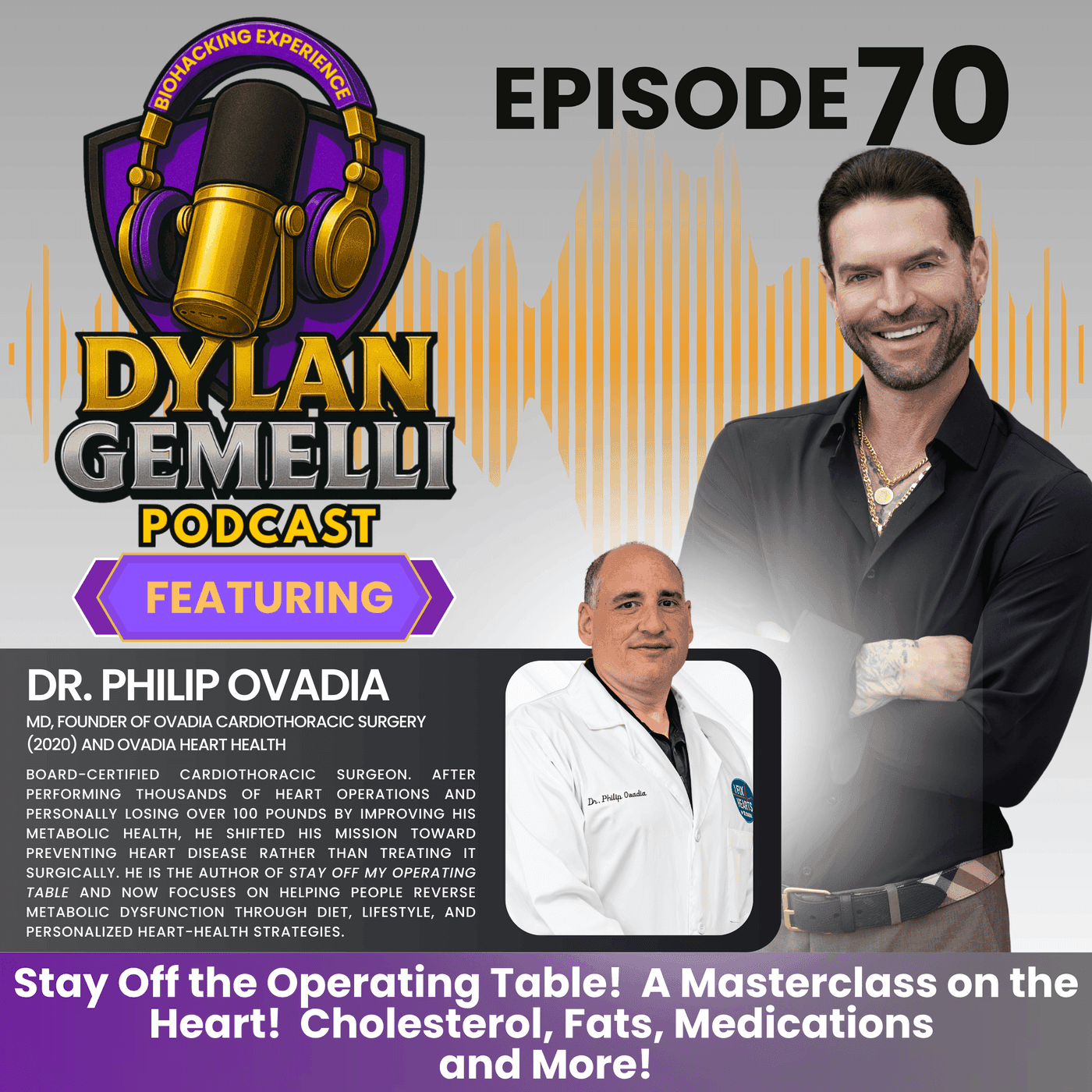
The Dylan Gemelli Podcast
Episode #70 Featuring Dr. Philip Ovadia! STAY OFF THE OPERATING TABLE! A masterclass on heart health! Overcoming Myths on Cholesterol and Fats, Hearth Healthy Diet, Heart Meds and more!
01:05:14
Loading summary
Transcript157 lines
- [00:00]
A
Foreign.
- [00:17]
B
Hey everyone. Dylan Gemelli here today with an extremely exciting announcement. I am now on the Minect app as an expert. That is Patrick Bet, David Zapp. So you can hire me today. You can ask me questions about hormones, peptides, neuroscience, science, cardiology, cellular health, finances, faith, religion, whatever it may be. I am there. You can book me for your podcast and you can also apply to be on mine. But go over, download the Manect app, find Ylanjamieli. I will answer either by audio, by text, you can get video responses, you can even book a phone call with me. I'm extremely excited to be available to work with all of you and I thank you all for your support. So check me out on my nect today. Today's episode is sponsored by my good friends at Timeline. Timeline is now offering the world's first ever longevity gummies, powered by Might Appear. You've heard me talk about the importance of cellular health and our mitochondria, which is why I have Timeline as my favorite and most trusted sponsor. These are the only clinically proven Urolithin a gummies for strength and healthy aging. We may be living longer lifespans, but are we truly living better lives? What if the key is not just adding years to your life, but life to your years? This all starts at the cellular level. As we age, our mitochondrial health starts to decline. And one of the keys to living longer and healthier is keeping our mitochondria healthy and strong and might appear targets this for us. Take control of your health now and live the life that you not only desire, but you also deserve. As a gift to all my listeners, you can save 20% off today by going to timeline.combackslash Dylan to get started. That's timeline.combackslash Dylan. I assure you your cells will thank you. All right, everybody, welcome back to the Dylan Jelli podcast. We are on set, which is how I like to do it. So it's a nice personal conversation and my guest flew in to see me today, which I am very honored because he is extremely popular, extremely knowledgeable, and not only that, but he is a good friend to me and I'm going to explain to you why in a second. But first let me give him the intro that I feel he deserves. So he's a board certified cardiac surgeon, he's the founder of Ovadia Heart Health, and you'll see Ifix Hearts as part of that. And his mission, which I am 100% behind, is to optimize the public's metabolic health and to help people stay off his operating table, which goes hand in hand with his book. It is called Stay Off My Operating Table, and it's a heart surgeon's metabolic health guide to lose weight, prevent disease, and fill your best every day. He also has a podcast, stay Off My Operating Table. I'm sure you can see where we're going here. And I just. I love his message. I love how he delivers it. I love what he stands for. I just love the guy in general. So without further ado, Dr. Philip Oadia. Welcome to the show, man.
- [03:16]
A
Thank you, Dylan. It is great to be out here with you. I agree with you. Doing these podcasts in person always leads to a great conversation. And I know sometimes the logistics make it difficult, but was happy to come out here and join you.
- [03:32]
B
I appreciate it. I know you're busy, and I know that you're requested everywhere and with good reason, which is why I wanted to have you here. And I think, you know, pretty much by now, unless there's new listeners that are following me, they know how personal, like, art discussions and issues are to me. And before we get started, I just want to. To make it known the kind of guy that you are to everybody, aside from the obvious, with your wealth of knowledge and the great work that you do. You know, I've had issues, like, I've discussed before, and. And Dr. Ovadi and I are both in this large, like, group of different types of influencers, doctors, people in the. The health space. And I had never even talked to you, and there was a message in there that I had an incident and I was in the hospital and a few people reached out to me. And as busy as you are, you not only reached out to me, but you kept checking on me. You gave me tons of free information and didn't know me from the next. And that told me all I needed to know about you. And so I just want everybody to know that a lot of people, you see us do these things, you see us talk, but you don't know what kind of people they are until you hear these kind of stories. I want everybody to know just, you know, what kind of person you are and how much I appreciate you. And like I told you before off camera, I will not ever forget it.
- [04:51]
A
Well, thank you. I. I definitely appreciate it. You know, always kind of humbling. And, you know, I've always tried to remember, right, that we do these things right, and we get on platforms and, you know, we can reach millions of people, which is amazing, but it's always about the person that's in front of you. Right. This is all about one on one relationships. And I just, you know, I'm on a big mission, but that's always composed of lots of little missions. Yeah, right. And I also believe in the ripple effect. Right. I help you, you can talk to your audience. It starts to spread and that's how we're ultimately going to change the course of that we're on, you know, take back control of health that I always talk about. And it all. It's going to be more and more individuals that are waking up to these realizations about how broken our healthcare system is. And I'm sure we're going to get deep into that conversation. But again, this starts with us as individuals.
- [06:04]
B
Absolutely. And that's why I wanted you to come here because I know you have dedicated your life to this. I have spent the last several years now digging into this and I almost feel, I don't feel regretful, but so many years of discussing steroids and, and training bodybuilders and knowing the effects on the heart and it took something to happen to me to really dig in like I should because, you know, my knowledge base was limited and understanding now all of these different aspects and how they work and then how broken the recommendations are and the things that we go through and misconceptions on cholesterol and all the things we're going to get into in diet related stuff. That's why this is important. And you are one of the key experts out there on this subject matter. So it is you and I's mission now to convey this together. And I am happy just to be a part of that. And so let's dig right into it first. Just kind of, you have a nice journey to talk about on why you do what you do and what you've gone through. And, and I'd like to just get a little bit of backstory before we start nailing these detail. So.
- [07:16]
A
Yeah, definitely. So. And you know, the, the challenges that we all go through. Right. That I think is our best education and my background, you know, fairly typical to start with. Right. I go to medical school, I decide to become a heart surgeon, I go through the training process for that and I go to work. Right. And what I do as a heart surgeon, right. Is people come to me and they have advanced heart disease, they've had heart attacks and they need help. And you know, surgery is one way to do that. But along the way I was becoming more and more unhealthy and I reached a point where I was morbidly Obese, I was pre diabetic. And I realized that I was going to end up on my own operating table, so to speak. I was following a journey that I, so many of my patients had followed and like them, I didn't know what to do about it. I realized that the advice that I had been taught to give, the advice that I would give to my patients, right, Eat less, move more, eat a low fat diet, you know, lower your cholesterol, right? It wasn't working for me. It wasn't working for then. And that led me to start asking some different questions. Thankfully, I started to get exposed to some different information, you know, than the sort of bubble that you get into in medicine and in cardiology. And ultimately I was first able to overcome my health challenges. I was able to lose a hundred pounds, reverse my pre diabetes. And then as I, you know, started talking to friends, family, patient about it, saw their success and then I started asking, why, right? Why didn't I know this before? Why didn't I learn this in school? Why didn't my, you know, why didn't I learn this from my colleagues? And that's when I really, you know, came to the realization, right, that this is the best way that I could be helping patients. And this is the mission I needed to go on. And so that's what I've been doing, you know, and we'll talk about all the different ways maybe that I've been doing that. But ultimately I realized that no matter how good a surgeon I might be, no matter how good all the heart surgeons out there are, you're never as good after you had the heart surgery as you would have been if you didn't need the surgery in the first place.
- [09:51]
B
Well said. You know, what I find to be important is these conversations is not.
- [10:00]
Calling when we're calling out bad information. It's not getting angry, it's not dwelling on it. It's not any of that. Far too many people waste too much time doing that as opposed to going, this is where we were wrong, this is how we fix it. Just get over it, right? And that's one of the things about learning from mistakes. You don't dwell on it, you're thankful for it because then you learn from it and you can overcome it. So, and I've, I've never heard you go on this bash fest or anything. I, I can't do that with people. I just can't do it. I want the time that we have to focus on, this is what's wrong. This is how we Fix it, right? And so I appreciate that, that you go about it that way and appreciate your journey and sharing that. You know, I want to get into the low fat diet first. I've made it no secret that I did that for 20 some odd years. And I feel like that's probably part of the reason why I have the heart problems that I do. Complete lack of understanding and not really eating any fat. And once I switch, my whole life has changed. It's been about, oh, a little over a year or something like that where I did that and I went from like 20 grams of fat a day to 130 some. I'm like, you know, 40, 40, 40, 20 protein, fats, carbs. And for me it's working. But let me ask you this. Why has fat been demonized for so long, in your view? And just how important is it to us to have us a major part of our diet?
- [11:28]
A
Yeah, so fats are essential, right? And especially animal fats, which have been the most demonized, but are actually the most important component of our diet. It's literally the food that we allowed us to evolve into human beings. Our ability to eat, absorb and, you know, utilize fat is what made us different, right? What allowed us to evolve as humans and become what we are as a species. You know, why did it get demonized? You know, and that's a story that many people will have heard, right? You go Back to the 1950s, heart disease is exploding in this country, right? And rightfully, people were panicked. And, you know, the scientists of the time, the physicians of the time were trying to figure out why, what's causing this? And there were two competing theories, right? One school of thought was it was sugar primarily that was causing it. And the other school of thought was it was fat that was causing it. And, you know, the fat theory won out. And, you know, maybe there are reasons that people can look back and say, you know, they were kind of nefarious, right? And it wasn't completely scientific based. But again, I don't worry too much about that. And I can understand, you know, there was a crisis, we had to kind of make a guess and act upon it, right? And so, you know, the prevailing theory became that the dietary fat, especially saturated fat that we were eating, is what was driving heart disease. And therefore, to correct this, right, we first had to remove dietary fat and we had to lower our blood cholesterol levels, right? And this really came to a head. Then in the late 1970s, early 1980s, the US Dietary Guidelines in their first version, get released, promoting you know, less saturated fat, especially in the diet, and then the pharmaceuticals come along to help lower blood cholesterol levels. Right. And again, okay, let's give it a try. Right. It seemed to make sense as a hypothesis, but the evidence was always there. And then it continued to accumulate that this wasn't working. Heart disease remained the number one killer. We started to see a little bit of improvement in heart disease starting in the mid-1980s, continuing through the 1990s. Right. And the mistake that was made there is it was assumed that that was because of low fat diet and lowering cholesterol. In reality, it was because people stopped smoking. And that was a major contributor to heart disease as well. But then you look and, you know, after it kind of plateaus in the mid-1990s, heart disease starts going up again. And the reaction was, okay, now we have to double down on all of this stuff, right. And we have to get cholesterol levels even lower and we have to get more fat out of the diet. Right. And you and I are about the same age, right? We remember the, you know, all the low fat, the snack wells, the, you know, everything that came, I used to eat. Yeah, I know. And, you know, we all ditched our butter and had our margarine and. But our health has just continued to worsen. So what I can't excuse is here we are 70 years later, this low fat experiment has clearly failed, and we can't change our ways. You know, the mainstream approach to this is just, well, we're just not doing it hard enough. People aren't listening to the advice, but they are. Our consumption of animal products has dropped dramatically in this country. Our consumption of fat overall and especially saturated fat is down 40% at least some, some stats show even more than that. And yet heart disease is getting worse and worse. So it's time for us to step back, re examine. You know, the, the classic saying by Einstein, right, that the definition of insanity is doing the same thing over again and expecting a different result.
- [15:58]
B
Right.
- [15:58]
A
And that's essentially what we're doing.
- [16:00]
B
So frustrating. You know, it, it's wild too, because like you said, we keep seeing evidence, we keep seeing evidence, but they keep pounding it into our heads that it's something different than it actually is. I mean, I've been doing a lot of studies on like, cells and cellular biology and seeing the importance of fats for the cell membrane and that. I mean, that's how we live. I don't. And that's part of the problem is people don't understand or study Cells and how they actually function and work and what they need, you know, nutrient wise, to, to, to be efficient. And I think if they did that, they'd understand the importance. And, and that's not just that. I mean, as you know, but my whole world's opened up since I made those changes. I mean that low fat and, and like the yogurt for example, when I stopped eating low fat yogurt, when I realized they strip everything out of it. So not only does it taste like and you have to be miserable that way, but you're losing every nutrient too. And the same thing with all the egg whites over and over again. And I was doing and not eating yolks. Yep. You know how angry I was telling my wife, you know how just flat out angry I am that I haven't been cooking in grass fed butter for so long. I mean, aside from not sticking to.
- [17:11]
A
Pans, the flavor, it's amazing. You can look at it at so many levels, right. You can get down to that biochemical cellular level and you can see the importance of these things and just at the, you know, macro level. Right. And, and you know, I see it every day now how much better patients feel when they eat this way.
- [17:31]
B
Yeah.
- [17:31]
A
Right. And the concept that, you know, patients can feel better and most. Right. The, the way the standard medical system looks at it. Right. Is most of their numbers get better. Right. But because one number might get what perceived as worse, this medical system has decided, right. That this is a dangerous approach and it's really just nonsensical. I, like you said, I don't like to spend my time arguing with people. Right. About, you know, these bad ideas that they have. But you just, you know, it never ceases to amaze me because it literally is almost a daily occurrence when I'm dealing with patients. And they'll go to their regular doctor, right. And they'll lost weight and their blood pressure is better and they're off medications and you know, their triglycerides are lower and their HDL is higher. And the doctor then looks at their cholesterol level or doesn't even look at the cholesterol level, just says, wait, you mean you're eating all this red meat, all the saturated fat.
- [18:39]
B
Right.
- [18:39]
A
That's going to kill you. You have to stop.
- [18:41]
B
Right, right.
- [18:42]
A
It's just crazy.
- [18:44]
B
Well, they're, they're brainwashed with that in school now. I mean, that's what they're told. Yep. So you can't even really fault them. I, I mean, to an extent. Right. Because that's just I learned that from talking to so many people that I'm thankful that I'm able to know. Like, you know, and they tell me that's just kind of what we're taught and that's the way it is. When I was in the hospital and I don't think I sent this to you, they gave me this fart healthy menu.
- [19:09]
A
Yeah.
- [19:09]
B
It had. It literally said dinner, rolls, margarine, Me and my wife were dying. She said, does that say chicken parmesan and tortellini?
- [19:19]
A
I said, what?
- [19:21]
B
This is heart healthy.
- [19:22]
A
Yeah.
- [19:23]
B
I mean, you should have seen what was on there. All these cereals, like sugary cereal.
- [19:26]
A
Oh, yeah.
- [19:28]
B
So you tell me this then. If we're looking at macros and foods and stuff, what are the real dangers to causing heart disease in our diets? What are the things that we really need to be watching out for? And I'm assuming there, there are bad saturated fats and bad fats. Like there's bad proteins and bad carbs. Just what is the main problem areas that people should avoid?
- [19:50]
A
Yeah. You know, before we really talk about the foods, I think it's important to get down to that sort of cellular level. Right. And when we look at what are the drivers of heart disease consistently, what you see when you really look at the studies is it is insulin resistance and it is inflammation.
- [20:09]
B
Yep.
- [20:10]
A
Right. So that leads us to say, okay, well, what do we eat that causes insulin resistance and inflammation? And you know, you look at carbohydrates, especially the highly processed, highly refined carbohydrates. You look at things like vegetable and seed oils, right. That drive the inflammation, and that really shows you what you should and shouldn't eat. You know, the bottom line for me, the way that I came about this, right, and the way that I talk about it in the book is any diet that's going to lower insulin resistance and lower inflammation and make you more metabolically healthy, right? That's the diet that you should be eating now that can have some different varieties. Right. But I think some important concepts to understand are animal proteins and animal fat are essential to our health. You know, again, the concept that these might be harmful to our health is just crazy. Right? Bad science combined with maybe some politics, maybe some religion that gets in there. But again, animal proteins, animal fats, they are essential to health. They are the foods that we evolved on as human beings. You want to throw in some, you know, non processed carbohydrates, you want to throw in some vegetables, fine. It's not essential. You can Live on just the animal fats and the animal proteins alone. Right. And many people do carnivore diets and they do great with it. It's actually what I personally do because it works well for me. But I don't think it's the only approach that can work.
- [21:49]
B
Right.
- [21:50]
A
But you know, the real kind of first principles that I stick to are avoid the foods that are causing insulin resistance and inflammation. And those are gonna be the processed foods to refined carbohydrates. Get your essential animal proteins and animal fats and then fill in the rest with some non harmful stuff if you want it.
- [22:11]
B
So if you could make a list of your top five essential foods or the few that you think that everybody should be incorporating, I'll give you mine. I'm curious how they stack up with yours. Cause I think it'll be cool to see. Because you know what's crazy is like some of these are stuff that I haven't touched my whole life until just recently. Avocados would be one, eggs, whole eggs especially would be probably number two. I would say probably either grass fed beef or like grass fed pork, something like that. And I would probably say salmon. And then I, I mean honestly I would say like the grass fed butter or something along that line or maybe like an olive oil, an extra olive oil or something like that. Because I would just categorize that into my, my food. So that's kind of where I feel like those are stuff that I don't ever want to be without and that are essential to my fat burning, my health and everything that I've changed. And the funny thing is, never would I touch salmon, never would I go near avocados. I mean I always loved eggs. But a lot of this stuff I just started doing and I'm seeing drastic differences and I think what's the correlation? Well, most of them are like healthy fats.
- [23:22]
A
Yeah, that's exactly it. Right. And you know, the only, you know, I, I would probably include those same five foods. I might put them in a little different order for me, you know, again, I do a primarily carnivore diet. So it's going to be, you know, meat of all kinds, but primarily beef, certainly seafood and salmon and tuna are my go to's as well. I love eggs, I eat plenty of eggs. I include dairy, you know, butter and cheeses and maybe you know, yogurt. Yeah. And yeah, of the non animal stuff that I eat, avocados are probably at the top of the list for me as well, you know. But you look at it again. And it's literally the exact opposite of what I was taught in school. What, you know, I believed and what everyone around me believed, you know, for the majority of my career until I made this change.
- [24:19]
B
Change.
- [24:20]
A
But it's just undeniable. Again, you know, I. I've now seen the results in so many people. Yeah, right. In my patients, in the, you know, community that you can't, you know, you can't deny the evidence that's right in front of you.
- [24:35]
B
No.
- [24:35]
A
Right. And they can talk about their studies and, you know, when we can discuss why those studies might, you know, have led us astray, why they're lousy science. But ultimately, again, coming back to how we started this discussion, you know, dealing with individuals and seeing the results that individuals are getting, that's the evidence that really becomes overwhelming.
- [25:00]
B
Right. So everybody remember inflammation. And I knew you were going to go there because it is like just the end all. Be all of all the problems we have. I mean. Yeah. Is inflammation and insulin resistance. So I want to talk to you about blood panels. And one of the issues that I have that I actually had to figure out on my own was, you know, learning the actual panels that we need to be looking at that are really going to tell us what we need to know that we need to have the focus on. I mean, I'm not saying ldl, hdl, triglycerides are not important because we need to know that. But for me, and then you tell me, as the professional, this is what I've gathered and learned over the time, is one, you need to get that intricate, you know, panel, that full cholesterol panel where you're looking at, at apob, lp, particle sizes, things like that. I find to get the. Personally, that's where I've learned the most data for you. What are the things of importance that you look at and what are we missing when we just go to general doctors and GPs and things like that that they're not looking at, that they should be.
- [26:05]
A
Yeah. So, you know, the advanced lipid panel is, I say, essential because it's showing you the quality of your cholesterol. And that's what is important when it comes to, you know, LDL cholesterol. It's not about how much LDL you have, it's what is the quality of that ldl. Because if it's good quality ldl, which it should be if you're healthy. And again, this means having the larger particles. Right. And these particles are not harmful. And again, this is something that unfortunately, the vast majority of doctors don't know, they don't get discussed. Right. They've been told, just look at the ldl and if it's high, you have a problem. But the reality is, is that if you have a lot of large LDL particles, those are not atherogenic, they are not flak forming and in fact they play so many vital roles in our bodies. Right. They're part of our immune system. They get converted into hormones like testosterone and estrogen and progesterone. They get converted into vitamin D, which is essential to us. Right. So we need good cholesterol. The problem is most doctors don't understand what good cholesterol actually is right now. You know, I then kind of step back a level and say, well, what causes larger particles and what causes the smaller particles that we are trying to avoid? And it goes back to what we mentioned earlier, insulin resistance and inflammation. So if I'm assessing a patient, if I'm getting a blood panel, I want to know about insulin resistance and inflammation. Measure your insulin level, measure your glucose and you know, hemoglobin A1C is a better number of that, you know, better measure of that because it gives you a average. Right. Over about a three month period as opposed to just a spot glucose, which can be affected by lots of different things and then inflammation. Right. And my high level measure here is what's called C reactive protein. Crp. Yeah. And that's a good general measure to look at. And you know, if you just stop there, you're going to get a pretty good picture of where you stand on your metabolic health and specifically for your heart health. There are some other things that, you know, I do go deeper with my patients on, but when I'm talking to people about how to just start, you can do that panel many ways to get that done inexpensively. You know, you can go on many websites. One that I like in particular that I don't have any affiliation with is called ownyourlabs.com and you put that all those things together, it's going to cost you a hundred dollars somewhere in that range. You know, it's a good investment in your health. If you can get your doctor to do it and get your insurance to cover it, I guess that's even better. But sometimes you're fighting an uphill battle there. That's just not worth it. Right.
- [29:11]
B
I have mine on auto every three months. Yeah, I mean I have to, but I just do it anyway and it's, it gives me a nice idea of where I'm at and like you said, since I made that change to the higher fat diet, I, I just had a panel done and I haven't had this good of a liver and kidney value and I have a higher kidney because of the way I work out and train your, you know, you know that. But all of those other levels, including like triglycerides and all that, the only thing that went up was LDL and APOB and total. My total is like 205 or something like that. And that's scary to the doctor, you know, and it's crazy to me and I want to get into that in a second, but I just want to touch real quickly back on the particle sizes, if you would. So what kind of foods would you. Is it the same kind of foods we're talking about? That'll increase the size of the particles and then that will make the smaller ones is the processed foods and the, the ones that are causing inflammation and everything. So why are the small particles so dangerous?
- [30:18]
A
Yeah, so the small particles are really a damaged form of ldl. Those are the ones that are tend to be oxidized or most easily oxidized, and those are ones that they get stuck in the blood vessel wall and they set off an inflammatory reaction within the blood vessel wall, and that's what leads to the plaque formation. The large LDL particles, the large fluffy particles, you'll hear them call. Right. They don't cause that problem.
- [30:48]
B
Yeah.
- [30:48]
A
So, you know, again, this is to take a step back, right. How was the system designed? Right. The system was designed that, you know, blood vessel walls are going to get damaged. Right. There are lots of things that cause damage to them. And, you know, some of them we can avoid, and some of them, you know, are unavoidable. Right. LDL cholester, a repair mechanism. Right. It comes, it, it, it gets attracted to the blood vessel wall. When the blood vessel wall is damaged, if you have good, functioning, normal, functioning LDL cholesterol, it's going to go and it's going to repair that blood vessel wall and then it's basically going to kind of melt away. Right. It's going to get reabsorbed is kind of the technical term for it. And you know, you're going to be left, there's going to be nothing damaging left behind. But the problem is if your LDL is these small particles, these oxidized particles, it goes there to repair the damage. It goes into the blood vessel wall. And because it's oxidized, because it's damaged, the body then reacts to it as A problem. And it sets off this inflammatory reaction within the blood vessel wall, and that is then what causes plaque to start forming.
- [32:06]
B
Okay.
- [32:06]
A
And you do this over and over again, right? Because let's say your blood sugar level is always high. Let's say you're diabetic, right. And you just keep repeating this process over and over again. And now you have all this plaque buildup in your arteries, and that's what ultimately is going to lead to atherosclerotic heart disease and having a heart attack.
- [32:26]
B
Right. So then let's get into that a little bit. Now, I have learned through getting a calcium score first and then going through the process of the CT angios and every test known to man, because when I went for the calcium score, I got 120 score back. And I was like, what it.
- [32:45]
A
What?
- [32:46]
B
I mean, I was shocked to. On all end. And, you know, then going a little bit deeper, I find that I have a really high LP, like 330. Yeah. So I. Then I begin to dig in to understand what that is and what that means. And I'll let you talk about that. From my studies, from. Obviously, I've spent a lot of time and talked to a lot of people. It's one of those things that's inherited, like an inherited gene, and it's not really controllable through diet and working out. I still would never advise to. I would still say, you know, keep those things in check for the other aspects apart. But. So I got that going for me, which is obviously sweet, you know, and then I'm. I'm looking at the CT angio comes back, and it's like a 38% blockage in the worst spot where everybody always has it, it seems, but thankfully caught early enough to where, you know, I mean, it's not end of the world. It's not obviously, it's not ideal. But so I got that and looking at that, and then I start to understand and learn, okay, hard plaque versus soft plaque statins make your LP go up. They're. They're, you know, I mean, all of this backwards things that I was being told. And mind you, we went to Mayo Clinic, which is supposed to be end all, be all. And I'm on the way home, and I never argue with my mom and my wife, ever. This was one of the few times that we got into the argument, well, you need to listen to them about, you know, because I went in there and I said, you know, statins are not going to help me. And they. First they told me there was not enough information about LP to even get into it. It would be bad practice to put me on a PCSK9 inhibitor or anything else. It's statin only. And so I got into a big argument with them. I said, I'm not taking the stat.
- [34:29]
A
Yeah.
- [34:30]
B
And. And I know. And anyway, now they'll tell you they were wrong. But I guess I want to go into all of this with you. What's the difference between soft and hard plaque? What do we need to be looking for? Why is a statin going to make the LP worse? And what even is lp?
- [34:46]
A
Yeah. So let's start with what is lp? So LP is ldl. These are LDL particles, but they have this extra protein on them. That's what the lp. Little A. Lipoprotein A is this extra protein that's attached to the ldl. And the reason that LP is problematic and the reason that LP is increases your risk of heart disease really has nothing to do with the cholesterol that's in that LDL particle. It's that LP protein causes that particle to interact with the blood clotting system. And so the risk from lp, again, has nothing to do with cholesterol. It has to do with blood clotting. And this, again, is something that just doctors don't understand. And so, you know, you look at that and you say, okay, well, then if I have high lp, it makes sense to do something to prevent blood clotting. And that's what I recommend to my patients. If you have elevated lp, take a baby aspirin, take a supplement, nattokinase. I mean, she's gonna say that, take some nattokinase, and that's going to help protect against the effects of the lp. Okay, does it lower the lp? No, but it's going to help protect against the damaging effects from it. The other important thing that people need to know about LP is it is particularly problematic in the setting of inflammation. So the studies have shown that patients that have elevated LP combined with an elevated CRP level, those are the ones that have a lot of, you know, high risk of heart disease. And so do everything you can to avoid the inflammation. Right. And that leads back to all the diet and stuff that we were discussing right now, Again, statins don't lower lp. And what's really interesting about statins is when you're looking at particle sizes, they preferentially lower the large particles and they leave the small particles behind. So, again, I see this all the time because I check these things on my patients, but most doctors don't Right. You go to your doctor, they put you on the statin, your LDL level goes down, and they are happy. Right. But when you check particle sizes, what you see is, yes, your LDL cholesterol level might be 70, but 70, 80, 90% of those LDL particles are small particles. And that's why people are still at risk. That's why I see it routinely as a heart surgeon, that the patients that are on my table have been on statins for decades, and they still got the heart disease and still ended up on my operating table. Wow. So that's one issue I have with statins. There are some other ones, but that's one of the big issues that I have with it. You mentioned about the foods. Right. And it turns out that saturated fats in animal, you know, fats in animal proteins, they promote larger particles. The polyunsaturated fats, the vegetable and seed oils that have the sticker on them that say they're heart healthy. They promote smaller particles. Yes. They might lower your ldl. Right. And that's the reason that everyone believes they're heart healthy.
- [38:14]
B
Yeah.
- [38:15]
A
But again, similar to the statins, they're lowering the wrong type of ldl and they're causing more of these damaged, oxidized small particles that are leading to more problems. So, you know, this is how when you're looking at the wrong measure. Right. When you're just looking at this LDL measure, you get led down the wrong path. But when you start looking at the particles, you start looking at the quality of the cholesterol. That's how we really start to lower.
- [38:48]
B
The risk of heart disease, man. See, I didn't know that about the statins with the particle sizes at all. That's really makes a lot of sense. And, and I understand. It's, it's just, just this illusion they like to create on one number without explaining all of the other negatives and the problems that it causes just to simply sell. And I'm. I'll leave that alone. But it just, it makes. It frustrates me. So let's talk about the soft versus hard plaque soap. When you get a calcium score that's only testing for hardened plaque.
- [39:15]
A
Right?
- [39:16]
B
Right.
- [39:16]
A
You're only seeing the calcified plaque.
- [39:18]
B
Right. So somebody that has a zero calcium score does not necessarily mean that they're free of any problems. Right.
- [39:24]
A
It, you know, the, the incidence of having a significant amount of soft plaque such that you're at risk of a heart attack with a zero calcium score is actually pretty low.
- [39:35]
B
Okay.
- [39:37]
A
So I don't worry too much about that. Right. I view the calcium score, the CAC test as a great screening test. Gives you a great kind of indication of where you stand relatively in terms of your risk. And then if you follow the CAC score over time, the progression of the CAC score is very predictive as well. The CAC score in and of itself, it does give you some indication of relative risk. But I've seen patients with scores, a CAC score as low as 2 or 300 that end up having significant disease. I've also have patients that have scores in the multiple thousands that don't have anything, any blockages that we've had to intervene on. They haven't needed a stent, they haven't needed bypass surgery. So, you know, the absolute score by itself, you can't completely rely on. Okay. And the reason is, you know, kind of what you alluded to. You're not seeing the soft plaque, the non calcified plaque. And you also, the score doesn't tell you anything about the distribution of that calcium.
- [40:46]
B
Yeah, right.
- [40:46]
A
You can imagine that you can have 200 worth of calcium all in one spot in one blood vessel and that might be a problem, but you can have a couple of thousand of calcium spread throughout the blood vessels. And no one spot might be, you know, problematic.
- [41:03]
B
Right.
- [41:04]
A
So that's why, you know, I love the calcium test. It's a great screening test. I recommend it. You know, men at 40 years old should get one, women at 50 should get one. If you have family history, if you know you're insulin resistant, if you have, you know, any reason to be concerned, get it earlier than that. Yeah. Because you know, again, what I can tell you as a heart surgeon is I'm now seeing 30 year olds end up on my operating table. Though it can certainly start earlier in life. And I really, at this point don't think it's ever too early to get one. You just have to understand if you're 20 years old and you have a zero score, it doesn't really mean all that much. You have to kind of follow that and make sure it stays zero. But if you're 20 year old, you get a CAC score and your score isn't zero, that's a major red flag. And that should alert you that you got to start making some changes so that it doesn't progress over time.
- [42:02]
B
Yeah, I think that that's like gold standard number one. You better do that first. That's like your entry point to you. You're okay now. I need to really take it serious, obviously, blood panels, but I think testing wise, that's like, okay, start there and go from there.
- [42:16]
A
Yeah. You know, if we're worried about heart disease, let's measure heart disease. Yeah. We can argue all day long about what blood, you know, metrics are meaningful and not meaningful. But ultimately, let's look at whether or not you have heart disease.
- [42:29]
B
Right, of course. No, I. I'm with you. 100. So I've got several million questions when we're looking at why is soft black the dangerous? I mean, they're obviously, you can say they're both dangerous, but why is soft black the higher risk? Explain that if you would.
- [42:45]
A
Yeah, so they're dangerous in different ways is how I explained to bridal. Right. The concern with the soft plaque is that it's less stable. It could be break off. Right. And what we call a plaque rupture. And that causes usually a blood clot to then form in that area and block off a blood vessel quickly.
- [43:06]
B
Okay.
- [43:07]
A
So there's risk from that. Whereas with calcified plaque, the risk is over time, as that calcified plaque, you know, builds up more and more, you basically narrow that blood vessel to the point that you can't get enough blood throw.
- [43:20]
B
Okay.
- [43:21]
A
And that can lead to a heart attack. So they're both concerning. And, you know, the CT angiograms and especially the advanced CT angiograms that we now have that can show us exactly how much of each type of plaque they are. Yeah, there are. Are great. You know, they have some drawbacks in the amount of radiation that's involved, the cost involved, that you have to, you know, give intravenous dye to do those studies. But, you know, that is allowing us to learn a lot more about this process.
- [43:52]
B
Right.
- [43:52]
A
You commonly hear the explanation that, you know, the. The plaque process starts with soft plaque, and over time that soft plaque can become calcified plaque. And the reality is, is that we don't know that that's actually how things occur. Right. And. And the more that we're now able to do these advanced CT angiograms and, you know, when we can start to do them more frequently. Right. We'll learn more about is it really a progression like that or are there different factors that predict. Some people get more calcified plaque, some people get more soft plaque, and you know, what really is the most dangerous?
- [44:33]
It's. It's really still an open question. The explanation. Right. That it is this progression can sometimes again lead us to make conclusions that may not be correct. Because, again, one of the other sort of inconvenient facts around statins is that patients on statins see their calcification progress quicker. Yeah. Right. And so the. The explanation was put, you know, is put out there that the reason that is happening is because soft plaque was being converted to calcified plaques, and therefore it was being stabilized.
- [45:18]
B
Right.
- [45:19]
A
And it leads you to a. And you'll hear cardiologists say this, right, except they don't really think about it when they say it, that what they're saying is if you have a higher calcium score and you're not on statins, that means that you're at high risk of a heart attack. But if you have a high calcium score and you're on statins and you're not, it's okay. And you're not. And it just. It doesn't make sense. The science doesn't support it. But I. I hear that repeated over and over again.
- [45:47]
B
No, that's. That's this. That's the story. I was going to say, isn't that the story? And of course you know that. So here's one for you. So I was told you can't ever reverse plaque. And I was also told my LP little A score was kind of like, well, you're, you know, you're kind of. You maybe get it down a little bit or whatever. Well, miraculously, I've gotten mine. I haven't tested it in a while, but I went from 330 down to 94. Yep. Now, tell me about the reversal of plaque. Is that possible?
- [46:15]
A
Yeah, it's definitely possible. And I see it in my patients. I always tell them, right, you're not going to go from a thousand to zero. Of course, you know, we see people go down 10, 15, maybe 20%. My primary goal with my patients is we want to stop plaque from getting worse. Right. Before it can get better, you have to stop it from getting worse. So that's what I really focus on with people, you know, and whatever level of plaque that you have, certainly if you haven't gotten to a point where, you know, you've needed a stent or you've needed bypass surgery and you're not having symptoms related to it, if we just stop it from getting worse, you're going to be fine. Even if you have had a stent or you have had bypass surgery. Right. It's still the same goal. We just want to stop it from getting worse.
- [47:01]
B
Right.
- [47:01]
A
Listen, we can't. We can't undo, you know, what was done, can't change the past. But if you just stop it from getting worse, you're going to be better off in the long run. And then, you know, I believe, as I know you do. Right. The body has an amazing capacity to heal.
- [47:19]
B
Yep.
- [47:20]
A
And if you just stop doing the damage and then you let the body do its thing, you'll see some healing. And that can manifest as decreased levels of plaque. And again, I'm seeing it routinely in my patients.
- [47:33]
B
Dude, God created a magnificent body. Just like at the beginning of time, we were given animals to eat just to go back on the animal. I mean, that's what we were given to eat. Right. So it just. Anyway, let's talk about a couple other tests and what they mean. So, I mean, I've had everything under the sun now at this point, I. And I think the. Clearly is the only thing I haven't had done yet. But when I was in the hospital, they did the catheter up my arm and all of that. And I'm. I'm telling you, and I'm curious how evasive this is in terms of seeing plaque build up, because when the doctor looked at me because I had told him, you know, I've had plaque in the past, and my. I tell them that I told him everything because I was awake and the whole time, and. And I explained it to him. He looked right at me. He's like, I don't. I don't see anything in there at all. And I'm like, well, you know, how much are they actually seeing on that kind of test? And that's like a catheter angio. Is that what that is? Yeah. So how much are they actually able to see on that? Is it just. They can only see if there's, like, a major blockage and they can't see anything else, or do they get a clear picture?
- [48:33]
A
Yeah, you get a pretty clear picture. But you're. What you're really looking at there. Right. Is the narrowing of the blood vessel. Some of this plaque does not cause narrowing. Right. When you. You know, now that we have these advanced CT angiograms. Right. We can really see the detail. Right. That some of this plaque ends up sort of outside the blood vessel. Right. Or it's in the blood vessel wall, so it's not narrowing that flow channel, what we call the lumen. And when you do a catheterization in that situation, you may not see much. Doesn't mean that there's no plaque there, but it means that you don't have any significant blockage. So, you know, you don't need to be concerned about that. Okay. Because the catheterization is an invasive test. Right. And it does involve actually even more radiation than the CT angiogram does. I typically prefer the CT angiogram first.
- [49:30]
B
Yeah.
- [49:31]
A
Now, the only situation, Right. Where that might change is if someone's coming in with a heart attack. Right, Right. The advantage of the catheterization is if you see a blockage that needs to be treated, you can treat it. Right? Right. You can put the stent in. You can, you know, do the angioplasty, what we call the balloon, the, you know, open that blood vessel up. And so that is the advantage. And if you have someone in front of you that you think needs that, go to the cath lab, get the catheterization done. But for most other patients, I much prefer a CT angiogram first.
- [50:05]
B
My order has been calcium score, CT angiogram and then the echocardiogram and then that catheter and then the cardiac mri.
- [50:19]
A
So, I mean, you, you. You run the gamut. Yeah, yeah. We haven't gotten you a stress test yet, but nor do you need one.
- [50:28]
B
But I was going to say I'm learning to handle stress a lot better through prayer. And I don't need any other stress tests of any kind.
- [50:35]
A
Exactly.
- [50:36]
B
Well, let's. Let's shift here towards the end then, to more like the heart failure side, the ejection fraction, the echocardiogram, the functions of the heart. I think we covered the basis pretty well on blockages and things of that nature. So what's the importance of the echocardiogram? What does that show you?
- [50:53]
A
Yeah. So the echocardiogram is showing a different aspect of the heart. Right. We've been talking about the blood vessels that provide the nutrients, the oxygen. Right. That the muscle of the heart needs to function. Right. The echocardiogram is really showing you the function of the heart itself. How well is that muscle working? It shows you the heart valves within the heart. Right. That are controlling sort of the direction that the blood is flowing in. And you can look at those valves and you can make sure that they're not leaking or they're not stiffened and too tight, what we call stenosis. So the echocardiogram gives you different information and, you know, it can be related. So heart failure is when the heart is no longer pumping as strongly as it should. That can be due to blockages in the artery.
- [51:47]
B
Right.
- [51:47]
A
But it can also occur for different reasons. So these tests end up being complimentary. We don't have one test that shows us everything we need to know about the heart. Right. There's no, like, perfect test. So, you know, depending on the situation, you're going to draw upon these different testing options to kind of put the story together about what's going on with that patient's heart.
- [52:12]
B
Then in terms of heart failure, once again, obviously there's different stages. Yep. Now, is it correct in me saying ejection fraction should be about 55 to 70? Is that pretty standard?
- [52:23]
A
Yes.
- [52:23]
B
Where do you prefer to see it?
- [52:24]
A
So, so first of all, let's just explain a little more. So we're talking about the left ventricular ejection fracture. All right? So the left ventricle is the main chamber in the heart that then ejects the blood out into the system.
- [52:40]
B
Okay.
- [52:41]
A
And so we're looking at each time the left ventricle is contracting, is squeezing, how much of the blood is getting pushed out. And a normal value there is going to be, like you said, 55 upwards to about 70, 75%.
- [52:56]
B
Okay.
- [52:56]
A
Heart failure generally is going to be when that ejection fraction is reduced. And most people would say less than 40%, some less than 45. Although you can actually have heart failure without a reduced ejection fraction. The ejection fraction is measuring how well the heart squeezes. But we also have to. The heart has to relax.
- [53:19]
B
Right.
- [53:19]
A
You know, between the squeezes.
- [53:21]
B
Right.
- [53:21]
A
And if it's not relaxing, well, that's a different type of heart failure. The ejection fraction may look okay, but you still can have heart failure.
- [53:30]
B
Got it. Okay. So what would cause, aside from blockages, what else could cause like prior drug use, steroid use? What else could cause fat injection?
- [53:43]
A
Yeah. So there are many medications, many drugs, you know, illicit drugs.
- [53:48]
B
Yeah.
- [53:48]
A
And prescription medication, really. Things like chemotherapy, for instance, can, but can damage the heart muscle and lead to heart failure. Viruses, Right. Covid, flu.
- [54:02]
Other, you know, other viruses can lead to heart failure. Those are probably, I would put, you know, blockages, what we call ischemic heart failure. Viral heart failures and either drug or medication induced heart failures are probably the majority of them. There are some less common things that cause heart failure as well.
- [54:25]
B
So how would you know if say like Covid caused it or like there was. If that would.
- [54:31]
A
That.
- [54:31]
B
What would that show on or how would you know?
- [54:33]
A
Yeah, it, it. Actually there's no definitive test that would show that. Right. You just got to put the clinical picture together. Right. If you have someone who showed up with heart failure, you know, shortly after they had a Bout of COVID And they don't have anything of any of the other explanation. Right. They don't have blockages in their arteries. They haven't, you know, taken drugs or. Or been on any of those medications. Then we'll usually, you know, say it's a viral or, you know, Covid specifically, or more broadly, there can be other viral causes. You know, sometimes it's difficult to figure out exactly what caused it, but most of the time, we are able to identify a cause for the heart failure, and then what caused it may change how you treat it for us.
- [55:22]
B
One of the words that I. I don't like to use the word hate, but I hate this word is idiopathic. I hate hearing that word. I don't want to hear that. You know what I mean? Because what does that mean? So everybody else knows.
- [55:32]
A
So the technical definition is, you know, that there's no explanation. We don't know what caused it.
- [55:38]
B
It's a tricky way of saying I don't know.
- [55:40]
A
Yeah, yeah. And, you know, I'll sometimes joke that idiopathic means that the doctor's an idiot and hasn't been able to figure it out. Right. And that's the reality. Oftentimes it just means that we haven't looked hard enough. Yeah. Because again, there should. There is always a reason. It's just a matter of, are we looking at things? Right. And you start to get into some more unusual things that maybe the medical system doesn't necessarily even recognize as causes. Right. But other toxicities. Yeah. You know, heavy metals, mold, chronic Lyme disease. Right. These are all things that I uncovered in some of my patients that the medical system just. It's not in their standard algorithm. You know, they check sort of the common things, and then they stop. And that's when we call it idiopathic. But in reality, it just means we haven't looked hard enough.
- [56:37]
B
So it's perfectly plausible that somebody that has, like, I'm just gonna make something up here, but like, either high exposure to certain toxins or heavy metals that's built up over time, some sort of nasty parasites, or, you know, these things that never get tested for. It's plausible that if they're having some sort of issues with their heart, it could have. That could be a contributing factor.
- [57:00]
A
Yeah.
- [57:01]
B
Okay.
- [57:01]
A
Yeah.
- [57:01]
B
All right. So that's what I thought. So I know we're getting close to the end. I do have another question, another term that I want you to. To discuss really quickly. What is cardiomyopathy?
- [57:10]
A
Yeah. So cardiomyopathy just Means that the heart muscle isn't working well, isn't, you know, squeezing well enough. It's kind of just another way of describing, you know, heart failure is sort of really the, the end clinical manifestation. Right. The symptoms that occur. You get short of breath, you have fluid retention. You know, that's what heart failure is. Cardiomyopathy is describing why you have heart failure. Because the heart muscle isn't working well.
- [57:42]
B
You can improve ejection fraction and come out of, like, heart failure. Is that possible?
- [57:49]
A
Yeah, definitely. So. Right. And, you know, some of that may be because you identified a cause and you treated it.
- [57:56]
B
Right.
- [57:56]
A
If you had a blockage in your artery and it was causing, you know, the heart function to decrease, and you treat that blockage with a stent or with bypass surgery, we'll see the heart function improve. Right. If you have a virus that resolves and you treat it, the heart function can improve. It's certainly possible, unfortunately. Right. The medical system oftentimes, again, you know, we stop looking for the cause. We don't find the cause. We focus now on treating the heart failure itself. Right. Trying to relieve the symptoms using medications primarily. And we see the heart function get worse. Yeah. And many doctors, again, just think this is sort of a natural history that's unavoidable. And the reality is, is if we can identify a root cause and we can correct that, we should expect that the heart function will improve.
- [58:53]
B
That's what I, I, I, I find. I hate when I hear this, oh, you can't fix this, or it's not fixable. And, and they, and they, they do that, and they tell people that, and one, and you know this, then that loses an array of hope, which also can be a contributing factor to making it worse.
- [59:09]
A
Yeah.
- [59:09]
B
Adding stress, which will add inflammation, which will turn into oxidative stress, and before you know it, you're just exacerbating the problem.
- [59:17]
A
Yeah.
- [59:17]
B
With falsehoods.
- [59:18]
A
Yeah. Right. Yep.
- [59:19]
B
I mean, I think, and I was talking about this before, I don't think people understand the correlation of your mind and your body together and how that affects everything. And when you go through added stress and everything else, like, they'll tell me when I go in there, don't get stressed anymore. And I'm like, I'm like a type one personality. I'm always amped up.
- [59:36]
A
Yeah.
- [59:36]
B
What I mean, like, I'm trying, but how dangerous is that, that added stress or having problems with your mind on the heart? How serious is that?
- [59:44]
A
I think it's a huge problem. And I think the Disempowerment that we do, you know, that we kind of enforce on patients. Right. When you tell someone the only thing you can do is take a medication. And, you know, and we know that over time it's going to get worse and you're going to need more medication.
- [60:04]
B
Right.
- [60:05]
A
Right. The patient gives up. Right. But instead, if you can say to them, listen, you know, if you change the way you eat, Right. You change some things about your lifestyle, you can improve yourself.
- [60:17]
B
Right.
- [60:17]
A
You don't need the medications to do this. You have the power. Right. It's much more empowering. And patients react well to that. Yeah. And I've seen it over and over again. I've seen the patients who, you know, they're hopeless. They feel like they're in a hopeless situation. And when we have a conversation and say, no, you can do these things, they do it and they get better. And, you know. Yeah. Some of it is the physical things that they've done, but a lot of it, I agree, is the mental aspect of that.
- [60:53]
B
So I've had Covid, like, seven times, probably that I know of. I don't know why I'm so susceptible to it. Would you imagine that would have some contributing factors to some of the problems I've having or have had?
- [61:06]
A
Yeah, I think it certainly can. Right. And again, this gets controversial. Right. And people start freaking out when you start talking about this. But it's just scientific facts. I don't. The COVID virus, the COVID vaccine, they both contain the spike protein that is damaging to the heart.
- [61:24]
B
And I never took it.
- [61:25]
A
Yeah. And, you know, and again, it's not about, you know, blaming people for their choices, you know, one way or the other. And I know both sides, you know, will. Will blame the choices that people make. It's just scientific fact. Right. And if we can't talk about that scientific fact that maybe Covid contributed to your heart disease, you know, again, what hope do we have? Right. It's just crazy to me that, you know. And you know, what's really kind of galling to me is it's not like we didn't know that viruses cause heart problems. Right, Right. We have so many examples of it. We see it all the time before COVID Yeah. And came along. And it's another virus. And yes, it has probably a greater affinity for the heart than maybe some other viruses. But all of a sudden it became taboo to say, maybe this patient that's, you know, showing up with a heart attack that had no evidence of heart disease in the past, maybe Covid contributed to it. And all of a sudden, it's like, you know, some super controversial thing, and you're getting banned on, you know, social media for just saying things like that.
- [62:36]
B
That, you know, once I really got a really good, deep understanding of spike proteins and it was explained to me properly, and then I start piecing everything together and putting it together. I have no horse in the race. You have no horse in the race. When we're talking about this, the only thing that we're trying to do is just say, hey, you know, especially if you've got previous heart problems or maybe family history, you might want to be a little careful with this, what you're putting into your body, right? That type of thing. And it's like, man, you know, you came out here, you gave me your time. I know how in demand you are. I know how obviously enlightened you are on all of this. So taking your time. Doing this with me means the world to me. Giving it to the people means so much to the audience. So a big thank you and appreciation for me on every level possible, definitely.
- [63:25]
A
So. And I do want to give something to your audience. We got a great gift for them. Just go to iFixhearts.com Dylan and free copy of the book. Stay off my operating table. You'll be able to download it right away. I want people to have this information in their hands, you know, I want them to be empowered to take back control of their health.
- [63:46]
B
That's generous, man. I gotta get. I'm gonna go download that, too. I don't have a copy of that yet. We got. We gotta get me one of those. I would strongly suggest that you go read that book. And after you've listened to this, just, if anything, as a refresher, to have it always as a database to a point to go back to, because you can't ever learn enough about this. Like, if there's anything that I can stress to you, and this is from personal experience, you want to know everything you can about your heart. Your heart is literally everything, I would say, heart and brain. You want to know everything about it, right? And so, Dr. Ovadia, man, you're the man. I can't thank you enough. You know, I hope we can actually do this again, because I got like 700 million more questions for you.
- [64:30]
A
Sounds good.
- [64:31]
B
We're gonna have to do it again. I appreciate you. The audience appreciates you. IFixhearts.com check them out on Instagram, too. I'll link everything in the description. Ifixhearts.com backslash Dylan for the book. So that being said, man, I appreciate it, everybody. I hope that you take, take as much as you can from this. Take it serious. Start to learn about your heart, educate others. Stay tuned for plenty more to come. Dylan Gemelli and Dr. Ovadia signing off.