← The Everyday Millionaire and Mindset Matters Podcast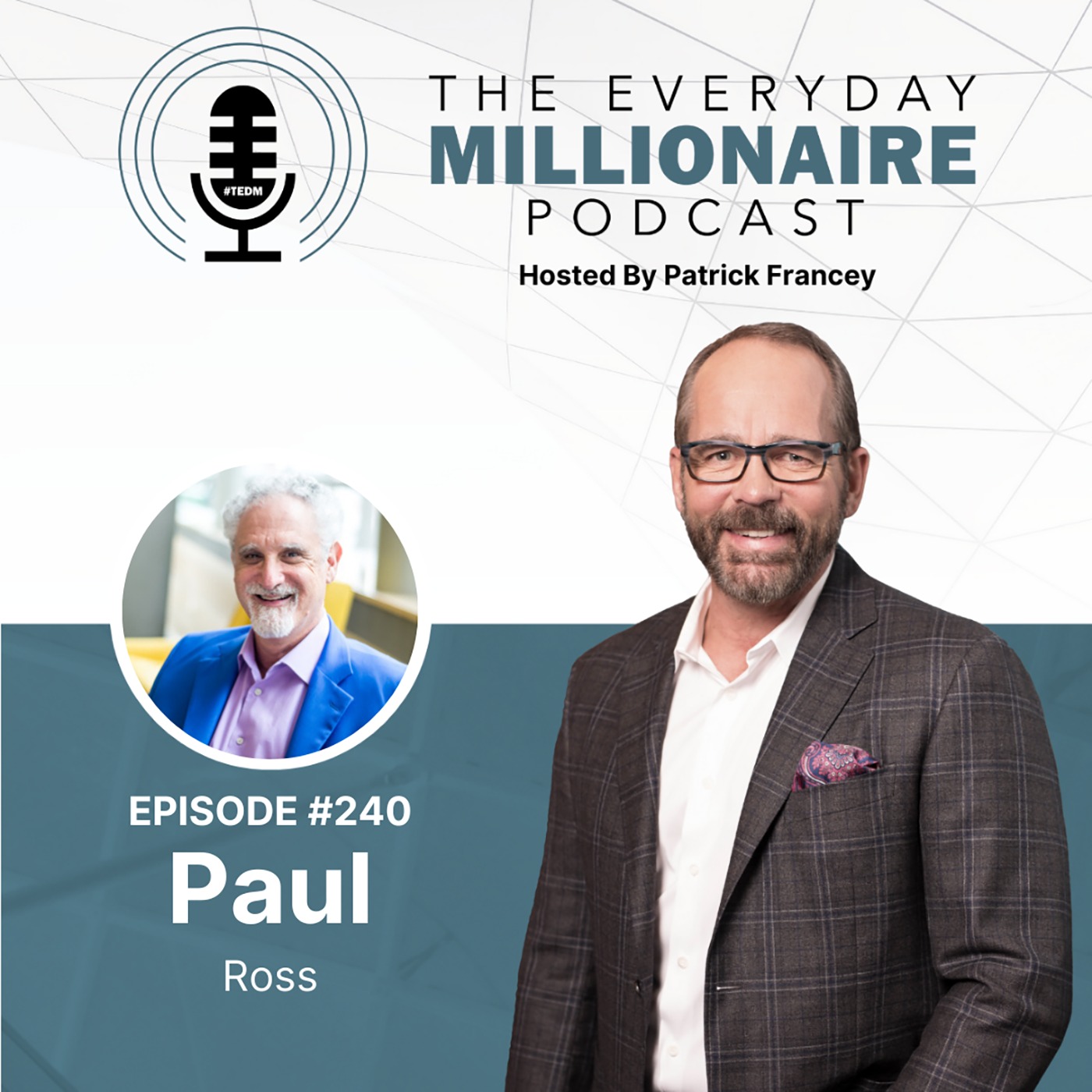
The Everyday Millionaire and Mindset Matters Podcast
Episode #240 - Language That Sells: Paul Ross on Focus, Trust, and Decision Making
01:03:50
Loading summary
Transcript113 lines
- [00:00]
A
Foreign. Welcome to the Everyday Millionaire podcast. My name is Patrick Francie and I am your host. And I want to begin by saying thank you for listening. On this show, I am having conversations with seemingly ordinary individuals who have achieved some amazing and extraordinary results in both their life and business. My intention is to inspire and help you learn and grow by having my guests share their journey of how they face and overcome their challenges, but also how they celebrate their their many wins. And now let's get on with this show and have a conversation with today's guest. If more effort solved sales performance, most teams would already be winning. But they're not, because buying decisions aren't logical, they're psychological. My guest today, Paul Ross, is a sales and psychology strategist and subconscious influence expert. Now, most sales teams work harder every quarter for smaller gains. They refine their scripts, they add technology, they use push activities. But buying decisions don't happen in the logical mind. They happen in the subconscious. For more than 30 years, Paul Ross has studied and applied the psychology of influence, where resistance is immediate and rejection is constant. His early work, Mastering Real Time Persuasion, became so well known, it inspired a character portrayal in Magnolia. Now, when business leaders began adapting his methods to sales environments, the results became obvious. The biggest performance breakthroughs weren't coming from better product knowledge. They were coming from better psychological positioning. Paul translated those principles into a repeatable framework for sales teams, and he wrote a book called the Subconscious Sales Advantage. So instead of pushing harder, teams learn how to lower buyer resistance quickly, shift conversations from logic battles to emotional alignment, and create internal buying states rather than external pressures. His clients, from individual producers to enterprise sales organizations, have reported measurable lifts in close rates, revenue per conversation, and deal velocity within a single quarter. His work sits at the intersection of sales performance, applied linguistics, and behavioral psychology. His mission is simple. Give serious sales leaders tools. Tools are grounded in human psychology, not motivational hype. So performance becomes predictable instead of exhausting. At any level. We are all sales people. So as much as this might be selling a product or service, this conversation is meaningful for us. Just in selling ourselves day to day, family, friends, peers, business, without any delays, let's get this show started. Paul Ross, welcome to the Everyday Millionaire podcast. Thanks for joining me.
- [03:08]
B
Thank you, Patrick. It is an honor to be sharing this journey down the rabbit hole of subconscious influence and how you can use it to increase your sales by 30% or more in 90 days. But before we dive in, I just want to ask the audience to do a favor. Patrick produces such wonderful content. If you could jump on your favorite platform and leave him a star 5 star review. I'm going to do that as soon as we're off the air. And let's all say thank you to you for doing such wonderful work. I appreciate you.
- [03:39]
A
Oh, I appreciate the ask. Thanks, Paul. You know, I, I open generally with my podcast because of course, you know, your team sends a bio to my team and then I look through the bio and, and I use it as our intro. But ultimately I keep have discovered many times over the years that the bios never do justice to a fundamental question. Right. So you know, they're not updated and all the things that go on because we're busy entrepreneurs, individuals. So I open with always the question, if somebody runs into you today and meeting you for the first time and says, Paul, what do you do? What's your answer to that question? And oh, by the way, I want to just preface a little bit and say and is there a way that we should be introducing ourselves when somebody asks us what we do? Is there some psychology behind that as well? You'd expand on that if you like.
- [04:28]
B
That's two questions. So let me answer the first one. So my name is Paul Ross. I am trained in clinical hypnosis. I'm a former pickup artist, believe it or not. And I help already successful sales team salespeople, highly productive businesses to overcome that wall, that ceiling they've hit because their old techniques no longer work the way they used to. They're pushing harder and burning out, barely moving the needle and they want to make exponential leaps, their cells by 30% or more in 90 days. Using the power of subconscious communication to create states of suggestibility, compliance, trust, very, very quickly.
- [05:10]
A
Let's hold part two, that second question and let's, let's start to unpack this a little bit more. And because I wonder, I'm thinking to myself right now is that there's maybe some individuals who are listening to this podcast and go, oh, is this that NLP thing? Is this like some. It is. Are you manipulating. So are you asking me to manipulate people? That's, I know, bit of a narrative. So anyways, how do you respond to that? Because it's held in.
- [05:41]
B
Let's draw a distinction. There's two kinds of manipulation. When most people talk about manipulation, they mean three things. Number one, lying about facts. You tell people you're a brain surgeon, you're actually an unemployed bum living in your parents basement. Number two, omitting pertinent acts. Number three, pushing down on people's pain points, their shame, their Guilt, their fear of loss, et cetera. I'm not talking about that. For me, manipulation means engineering consciousness. It simply means to move with deliberateness and skill to create a state of consciousness that includes possibilities that your prospect never saw was possible for themselves before. Let me give you a metaphor. A scalpel can be used by a surgeon to save a life, or it can be used by someone to commit a crime. So there's that manipulation. Then there's manipulation, influence. It's really designed to expand and engineer states of consciousness, like focus, believing in themselves, trusting you, getting past their own limiting beliefs about what they deserve, what's possible for them in the world, et cetera, et cetera. Does that make some sense?
- [06:59]
A
Yeah, it totally does. And by the way, I have a context for that, and you kind of articulated it way better than I would have. But I think it really does say to those individuals that. And I think there's a. There's a. There's something that we. I would like to shine a light on. Goes back a little bit to the question I asked you earlier. Is that when we're introducing ourselves, you know, although you work with sales teams and, you know, somebody out there is going, well, I don't sell. And I'm, you know. And of course I'm going, we all sell. We're always selling. I don't care what you do. We're selling ourselves somewhere along the line. So back to the question of, you know, in an introduction, when somebody walks up and says, what do you do? It's often, although it's a kind of a door opener, I guess, a conversation opener, it's common. Is there a specific or is there a kind of a cool way to articulate what we do when we're asked that question based on your, I guess, your skills in terms of communication?
- [07:59]
B
My experience is you have to take what you do that benefits the other person. What you do that you're passionate about, you're an expert about, and package it in a way where people can get it like that. Maybe in the space of 15 seconds. There can't be any confusion whatsoever. Now, there's a time and place, believe it or not, and a good persuasion. We get that later down the road where you should confuse people. But here in the opening, when you're getting their focus, you've got to be crystal clear. That's what I would say. I don't know if that's full enough answer for you.
- [08:36]
A
For now. It's perfect. Take me back a little bit. I mean, you've been on the planet a while. You've got a lot of experience. What started this journey for you? Like where did you get into it? Where you're actually saying hey, you know, language is important, which we know we can use it in a, in a cool way. You're using words like consciousness, you're using words like hypnosis, you're, you know. So let's unpack a little bit how that journey began for you.
- [09:03]
B
So about 35, 40 years ago, believe it or not, I was terribly shy around women. I could not get a date in a woman's prison with a fistful of pardons. I was super shy. I communicated by facts, data, figures, and I just got nowhere. So she took a deep dive into hypnosis and neuro linguistic programming which is basically how language structures consciousness, shapes decisions and drives behavior. So I began to have success with the ladies and I figured I'm going to teach other guys. So I was the creator, the whole worldwide manosphere pick up women thing. Hey ladies, I'm telling the truth. So there you go. And what happened is about 20 years ago I started getting email from students who said thank you very much. I met my wife and started a business using your stuff. And oh by the way, I've tripled my sales applying what you apply in. I'm just going to say the word pickup and seduction into my selling process. And I got enough of these where I thought let me call these people and interview them and find out what they're doing. And I thought okay, idiot, you should have seen this all along. Go and figure it out. It took me about a year to map it over. I mapped it over and then I just started training anybody I could get my hands on so I could learn this stuff. And I perfected it, wrote a book in 2019 called Subtle Words that sell how to get your prospects to convince themselves to buy. And ever since then I've been going great guns, coaching, training all sorts of sales teams across multiple industries. I don't work with just one industry.
- [10:50]
A
Well, I guess, I mean the techniques or the sales training that you provide, it's sales training, it doesn't really matter. It shouldn't matter too much what the industry is. I mean there's going to be the nuances that affect any given sector, any given industry. But ultimately sales are sales. This is something that you've tapped into. You know, NLP has been around a long time. My wife is Stephanie, who's, she's a, an Olympic and world class mental performance coach. And she was actually trained as a I don't know if the term they use, to be honest with clinician or something. A trainer in lp nlp.
- [11:27]
B
A master trainer.
- [11:29]
A
Yeah. So she never carried that on as a career. But you know, she certainly took her training as an NLP coach very seriously and, you know, has gone on to do great things with many, many athletes. She's just on her way back from Italy, as a matter of fact, from Winter Olympics. So it's an effective tool. Would we call it a tool or is it a way of thinking? How would you describe it?
- [11:49]
B
It's. Well, first of all, it's a way of modeling hubit excellence, extracting the structure of that excellence and talent and then training people to take on that excellence and talent. Now obviously there's a learning curve. I can teach someone to be a very, very powerful Hypnotic influencer in 90 days. I obviously can't make someone into an Olympic skier. Some people will never be an Olympic skier. But if you're relatively bright, I can teach you to be an incredibly powerful NLP hypnotic engineering consciousness salesperson. Let me unpack what I mean by that.
- [12:32]
A
Yeah, please.
- [12:32]
B
The way I keep sales, it's not just about getting your ideas into your prospect's subconscious mind. It's about expanding their mind to include your ideas, your possibilities that they never knew could be there before. And engineering states of consciousness like trust in you, trust themselves. Focus. You've got to get your prospect of focus very, very quickly. Nowadays people's attention span is about that of,
- [13:07]
A
I'm told of a goldfish. Our attention span is now that I don't know how to measure. Apparently it's three seconds. Okay, so I, yeah, I didn't want
- [13:16]
B
to be rude about it, but yeah, that's true. And remember, focus is the currency of any kind of influence. If you can't get your prospects to focus, all the report techniques that used to take five minutes, you don't got that five minutes anymore, folks. Sorry to tell you, you've got maybe 90 seconds. So I teach building that trust within 90 seconds and getting your prospect to trust themselves. Your prospects no longer trust themselves if you don't have focus. How can you make a good decision? If you've got too many options, how do you make a good decision? You can't. So it takes something beyond the ordinary, off the shelf stuff. That's why I say to my potential clientele, look, I'm glad you're doing great. And I only work with people who are in the top 10 to 20% of their field. And I say up until now you've been doing really good. Now you're hardly moving the needle. You're pushing harder, you're grinding. It's not your fault the market has changed your prospects. Consciousness has changed. You have to keep up with the shifts in their consciousness.
- [14:26]
A
Can you. You know, consciousness is a, to me, is a. It's a big topic. It's a big word. In the context that you're using consciousness, how would you describe it? Or. Yeah, how would you tap into that. That word and that thought process?
- [14:41]
B
Sure. So let's talk about focus. As you're listening to me, ladies and gentlemen, at home, I can't tell all the ways you might pause and feel a growing focus on what it is you're learning, something powerful. That's. That continues to happen. As you listen to me, I sure feel absolutely wonderful that a great learning is taking place. Now. I don't know if you felt your consciousness slightly altering there. What I did was to slow my tempo, lower my voice a little bit. I was very vague. I didn't say when you'll focus or how you'll find that growing focus when you're vague with your language. The unconscious mind has to. Or the subconscious mind, they're the same thing. Has to fill in the meaning for itself. So the person on the receiving end gets the perception, the illusion that you're speaking directly to them, that you understand exactly what their needs, desires, hopes are, even though you don't know that at all in the very beginning. Later you get specific and do your evocative questions and find that out. But if you're specific in the beginning, they just turn off.
- [15:56]
A
So can you give a. Do you have an example of something that people, you know, something that people can relate to?
- [16:03]
B
So let us say you're giving a presentation to a group of people or you're doing on a zoom call or whatever it is, and you want your prospects to trust you very quickly. So I teach six words. I call them implied relationship words that get the subconscious mind to interpret the communication as one of deep trust between a profound relationship and those words are we our together, Explore, share. Let me give you an example. Before we begin our exploration together today, may I just request that you please share the questions that naturally arise when a great decision is being made? So let's unpack that. Instead of saying before I present to you, which is about something I'm doing to you, I say before we, which already builds a relationship. It's us on the same kind, same side of the table. Before we begin our. Not what I'm going to do to you our. Again, that's a relationship. Before we begin our exploration. Exploration is a deeply hypnotic word. I'll explain why. For every exploration, there must be a leader, and for every leader, there must be starts with the letter F. A follower. So when you use that word, it's implying on the subconscious level that they are your followers. Not just your clients, but your followers. So again, that's relationship. May I ask that you please share the questions, not ask the questions. What's the distinction between asking and sharing?
- [17:56]
A
Well, sharing, it's together. This whole sentence that you put together is very inclusive. We're in this sentence together.
- [18:04]
B
So if you do that at the beginning of a presentation, you're going to create a sense of togetherness, a sense of trust. You're going to do all that in a matter of about 90 seconds without having to do the traditional rapport techniques that just don't work anymore because your prospects have seen them a million times before. All that mirroring and matching, your competition's been throwing it their way forever. And if you do what your competition does, it becomes a foot race to get to the prospect first. And foot races can become exhausting.
- [18:39]
A
So when you're, you know, as you work through this kind of conversation, it's, you know, we arrive at as inclusive. You know, there's a fundamental. When you're speaking that, you know, like, I, whenever I hear this, you guys, you know, some speakers use that term. You guys, you guys, you guys. Like, they're talking to this group. Where is a button for me which is like, you guys. No, there's not you guys, there's you. And so is that, Is that psychology or that I, I want to call that method is when you're speaking to one person, regardless of how many you're speaking to. Is that along the lines of what you're suggesting? So it's, it's.
- [19:18]
B
No, no, no, no, no, no. You guys. Implies a separation between the speaker and the guys. I'm not saying you guys. I'm saying we our together share.
- [19:33]
A
And I guess I'm only expanding on it. Is that in when we're using. If we're being mindful of the language we're using when we're speaking to somebody or to a group of people. More importantly, in this particular illustration that I'm giving or this example is that you're using the word you when you're speaking as opposed to you guys in your conversation, you know, the word you is important as the. As is the word we in in an inclusive. So if I'm speaking to you as an individual as opposed to a whole group, you hear the word you. So it could be 50 people, but it sounds like I'm speaking to you directly. That thought process.
- [20:08]
B
Exactly, exactly. Even though I don't say I never start with you, I start with we. I don't care if it's one person or 50 people or 500 people. Start with we because we implies a relationship immediately. You're building trust immediately, not in five to 10 minutes, which you no longer have. Because people cannot focus. They just can't.
- [20:36]
A
So this goes back a little bit to what I said earlier. I think that, you know, this conversation, this style of communication is applicable in as much as it's powerful in a sales scenario. We're always, at some level, we're always selling ourselves. We're always trying to get buy in of something, you know, as parents want to get buy in with their children. There is still the use of language in a way that has that group or that person, you know, follow along your thought process, go with the direction that you would like them to go or what you would like to take them. Is that a relevant, relatively fair statement in this context?
- [21:15]
B
Yes, absolutely. And that's why I started out in the context of using this. I'm just going to say it's going to offend some people, but I only work with people or unconventional thinkers. If you're not an unconventional thinker who thinks outside the box, wants to, likes to disconnect the dots and color outside the lines. Sorry, not a match. Yeah, I've started using this for pickup and for seduction. And it works across. Look, language is the structure of consciousness and focus and decision making which is part of the human experience across all contexts. There's not a context where it doesn't apply.
- [21:57]
A
Is this also, you know, as you take it into a sales team or into corporations that you work with, it sounds also where this actually becomes very cultural in the way of thinking and in the way of approaching clients, even in the brand and who you, what you stand for in your brand. This all becomes an important part of how you treat clients and, and how you represent your business when you're outside of the office kind of thing or within your branding and marketing.
- [22:25]
B
Yes, yes. And let me make it very clear. I don't monkey with people's sales process or their brand. What I do is take what they're already doing that's working and splice in, or rather teach them how to splice in this subconscious hypnotic language. Sprinkle it into their already successful process to make it super successful, Go beyond moving the needle into getting exponential increases in what they're doing, and to do it with a lot less effort, with a lot less pushing or seemingly pitching. We don't want to do any of that.
- [23:00]
A
You know, the journey that you've been on is obviously over many years. So go back a little bit when you're first realizing I look old.
- [23:11]
B
I just did my face cream and got a facial for this show.
- [23:18]
A
Dude, I'm 60. I'm. I'm 67. Soon to be 68. Here we go. I'm right. I'm right on your page. So I understand. So the long term, you know, like when you think about the journey of any entrepreneur and any individual who is gone, the direction you've gone, you spent years doing it. But you were talking about earlier where you weren't the guy, you weren't the cool cat, you weren't getting the deals done, you weren't getting the girls, all of that. So what was that kind of the fork in the road that took you on this particular path if you go back that far?
- [23:52]
B
I ran into my kooky but absolute genius mentor, Richard Bandler, who's the co creator of nlp. I went to a seminar thinking this is. Can I curse on your show?
- [24:05]
A
Of course.
- [24:07]
B
I thought this was absolute, utter bullshit until he got me on stage, hypnotized me, told me my fear of women would go away. And then he brought some very attractive female volunteers on stage. And I found I wasn't shaking. I found my voice dropped an octave, that I was given nice, hard eye contact, that I was speaking confidently. And I thought, holy f. This stuff is magic. And that's what got me started. And I thought, I got to figure this out and really expand upon it to teach other guys. And that's how I got started.
- [24:48]
A
That fork in the road moment was then. And then you go, you start your journey. So you, you start applying it, you're using it. Are you at that point, are you working a job or are you single?
- [24:58]
B
I was working. I was working as a litigation paralegal. That's what I was doing. That's right. And as I said, about 20 years into that career teaching men, I had former clients email me and say, I have a family. Sometimes they detach pictures or the kids using your stuff. And my sales career or my business has taken off by applying this stuff in sales. And I called them up and interviewed. How are you doing that? And then I went into my Mad scientist language lab for a year, figured it out and then I started teaching it to anyone who would listen. And at first I didn't take a lot of money, but then as I got really good at it, then I became known as the sort of wild man, the mad scientist of influence, persuasion and sales. Because again, this is totally not off the shelf. If you're doing off the shelf stuff and you want to stick with it, can't help you.
- [26:04]
A
Well, you're, you know, it's interesting. I don't know if I'm just really odd, but you know, like you, you, I think you said unconventional, but I listen to these conversations like I'm having thinking about this conversation right now. There's nothing odd about this conversation to me other than my lack of understanding of it and wanting to dig a little deeper into knowing the, you know, the moving parts a little bit in the psychology behind it or the mechanics behind it. So it would be, you know, so when you say that I'm thinking and because I'm not in the world that you're in, but I, I'm thinking that in large corporations particularly, which kind of have a reputation generally for being a little bit more tick tock, that may land for some of the large corporations as being a little out there. That's my thought process.
- [26:49]
B
That's why I don't, that's why I do not work for large corporations. I won't do it. They want to pay me a 5 million, I won't do it. Because they tend to be very stiff, very rigid. They have a strict corporate culture, they have a strict training process and then you have to bump it up. The sales decision making process takes a year. I don't work with big corporations. I won't. That's not how I do it. Usually work for people have anywhere from 25 to 50 salespeople and they're open to something that's different and unconventional. I won't work with big corporations, won't do it, don't want to do it, never done it, and, and never will. Unless, hey, if you're out there, you want to slap 5 million and give me carte blanche, you're on.
- [27:36]
A
You're in.
- [27:37]
B
Nah, maybe, I don't know. I got stuff to do, you know.
- [27:41]
A
Sure. In a, you know, there's a phrase that I'm sure you're familiar with, which is a confused mind says no. And when we are, you know, selling something, whatever that might be, a product or a service, there's the inevitable no. When I hear a no On a sales side of things, I go back to a good friend of mine who was a top performing sales guy, like out of the park top performing. But his, as soon as he received a no, his mind went, oh, they just don't understand. Because he believed so much in what he was doing and he was so, you know, in his world integrous in terms of you need this. Like you don't understand how bad you need this product and or service. So when you hear to know you go, oh, you just don't understand. Let me say it another way. So is there when you talk about what you're doing, is there. You're already going into the conversation going, okay, I want to be really clear. I know a confused mind says no. I want to make sure that they understand and are listening to actually hear what I have to sell. So you're opening with whatever conversation you're opening with, which is inclusive and then going down the path so that there is no confusion, obvious or I'm thinking that at some point you're stopping talking and hearing what they're hearing or listening
- [28:58]
B
for what they're hearing. However, there is a, there is a point where being artfully confusing, this is counter. Anything you'll hear is actually really powerful, particularly answering objections. I'll give you an example. One of the biggest examples we get for an objection is I need more time to think it over. Correct?
- [29:20]
A
Yeah, we hear it all, all the time. I gotta talk to my wife or I need to. Or my significant other or I need.
- [29:26]
B
Okay, yeah. What I do is I teach my clients to use a pattern interrupt and let me back up and tell you what that means and why it's important. People are pattern making machines. We see patterns in everything even when they're not there. When you're a little kid, ladies and gentlemen, and you were laying back on the grass looking up at the clouds and seeing shapes, maybe seeing animals, whatever. Your brain was making a pattern. If you break their pattern, they become very suggestible. So when someone says to me, I need more time to think it over, I want to break that pattern of what they expect me to say. And I want to create objection amnesia by being deliberately confusing and shocking. What I'll say is, I understand. May I ask, have you ever taken a long time to make a decision and it still turned out to be a terrible choice? Maybe it's not about time, but about the clarity you need to recognize it's safe to move forward. So thinking about it like that, as we continue to share, what is it that we really need to get out on the table. Heart to heart, human to human. You won't hurt my feelings. I've been rejected before. It doesn't matter. Just speak what's on your heart. Now I totally erase the objection. I've gone from being afraid to creating a sense of trust. And when I say, speak from the heart and I place my hand here and I'm creating utter trust and sincerity, then they're far more willing to share what's going on. And maybe they're confused and maybe they don't trust themselves, whatever it is, then it's far more likely to come out on the table.
- [31:15]
A
The application of all of this, I mean, you, you know, at a high level, you, even what you've shared right now is, you know, I'm going, okay, I can see where this would apply. I could see where this would apply. Like, I'm already placing where I could use this kind of languaging. And this thought process is when you, when you're training sales teams, is it a. Does it take you days, weeks? Is it an ongoing thing? Is it hours? Like, how do you work?
- [31:40]
B
It takes, it takes about 90 days. The structure I talk about when I do the initial consultation call, but it takes about 90 days. First I have to teach them the concepts. Then I teach them the structure of how to embed suggestions. Then I teach them how to create a process where the prospect convinces themselves to buy. Then I teach erasing objections, not overcoming objections. So it's about a 90 day process and we track progress as they go along. They have a little bit of a homework assignment. It really doesn't take that much time. It takes about two to three hours a week of investing their time and being guided by me.
- [32:31]
A
That's so interesting. I'm curious though, is over the evolution of your career and what you've been training, when we consider, you know, we talked about our distractions, our attention spans, but now we, you know, fold into that. AI fold into that, you know, just an onslaught of content coming at people. How do you, you know, suggest that anybody in the sales world these days, knowing that they're bumping up against or they're competing with so much coming at their potential clients, does it shift how you've, how you're training people? Does it shift what you're doing these days?
- [33:08]
B
Absolutely. Absolutely. Well, absolutely. I teach my clients to use hypnotic language to create states of focus. This is going to sound like gobbledygoop at first, ladies and gentlemen, but as you find yourself continuing to listen multiple times to this episode, you'll understand more and more clearly how you'll begin to apply it in your own unique field. So it works like this. I can't say directly. In a moment, you're going to focus on every word I say. Everything will fade into the background, and you only listen to the 1, 2, 3. I can't say that. I can say, before we begin this exploration together today of what it is we're going to be learning, I don't know all the places you might stop and feel a growing focus. Now that's a command. Feel a growing focus. Notice I didn't say feel focused. I said feel a growing focus. That word growing implies that the focus is going to build and build and build and intensify the more you speak. Usually what happens is, as you continue to speak, focus drops exponentially. That suggestion get your prospects to focus even more the longer the conversation goes. It's extraordinarily powerful if you take away nothing. But this, ladies and gentlemen, take away this. Focus is the currency of any sale, any influence, any persuasion. If you don't have the currency, all your old techniques are bankrupt. That specific language that I gave you is. Is what I teach my clientele to use to create the focus. Now, I also teach them the delivery and the concepts behind it. And the pacing. You have to be able to pace it. Right. It takes some time. It's like learning. It's not easy. It is powerful. It's like learning a second language. You're not going to walk out this training session with me and be an expert at. It takes time. It takes work. Yeah, you have to be extra smart. This is not for the average thinker. You have to be extra smart and you have to genuinely look at something that's unconventional and contrarian and outside the box and go, damn, this excites me. I'd like something outside the box. I don't want to be taught what I already know with just some tweaks. So there's only a certain psychographic that wants to work with me. A lot of people think I'm batshit crazy. I kind of am.
- [35:49]
A
Well, aren't we all? It's interesting though, is that. So when you shift that. So there's the one on one sales calls that people make, and then there's one on many, perhaps into a group. I'm thinking more along the lines of, you know, over the years, because of what I've done for what I. What the. One of the businesses that I own within the real estate investment network, I want to Unpack a little bit. Number one, there's stage sales, those individuals who are good at doing stage sales. And I'm sure this applies in that regard as well. Applies I think probably in every instance. But I'm also thinking too is that you know how important it is that you know from a value point of view. I have a lot of real estate investors who follow this podcast just because of the nature of what I do. But part of their challenges within the real estate investment world is raising capital. And raising capital is a very important part of what they need for growth. What they need in terms of joint venture partnerships or private equity or private capital, whatever they need. So I only use that as an example, is that this really becomes for do it yourself investors who are kind of starting on their journey. Maybe they're a full time, I don't know, fireman or full time nurse or they have a career and they have a profession that isn't related to sales directly, yet they find themselves having to raise capital. All to say this, is this the kind of thought process and training that would apply to somebody like that? Somebody who doesn't necessarily have sales training, but finds themselves in a position where in this case they're building a real estate portfolio, they want to raise capital. Now I'm just giving a scenario specifically because that's kind of part of what this audience yet doing.
- [37:33]
B
Yes, it, yes, it does and not. But investors are a little bit more cautious. They're going to do more due diligence. And so you have to pace that. You have to make sure when you phrase it, you have to say as we're moving along together in this process, it's really important. I understand, I get it. That you have to do your due diligence in a way where you can recognize you want to move forward. So as you continue to do that, just make sure I invite you to please reach out and share any questions that naturally arise when a great decision is being made. So again, you can still put it in the context of you recognize the challenge and you still marry it, tie it to united with that language that creates trust. So the more they do the diligence, the more they unconsciously trust you. It would be like if I hypnotically dropped that investor into a trance and said, as you continue to do your diligence, your unconscious mind will interpret it as meaning, the more you look into me, the more you trust me. I know that sounds nuts and unconventional, but there's the factual part of any influence sale persuasion, then there's the unconscious suggestive state of consciousness part, you have to be able to get both in balance and when it comes to investing, there's a lot more numbers, there's a lot more due diligence and the process can take longer. But fundamentally, ultimately you tie those two together on the unconscious or subconscious level means the same word.
- [39:14]
A
So you know, the one point that I guess, you know, if you're raising capital or anything to do with dollars and cents or investment, I mean, it's really important that you gain those individuals trust and to your point is how do you. And how do you get into that conversation so that you can open that door sooner than later? Because as soon as you start talking perhaps about raising capital and depending on how you approach it, they're going to have, you know, the individual you're speaking with is going to have their guard up at some level. They're going to be. So, yeah, slow down here a little bit. So is there, is there a, you know, is there a languaging or a thought process that you would share that somebody getting in?
- [39:58]
B
Here's the concept. I always teach and train at the conceptual level. Before I give the tool, I give the understanding. The understanding is there's two pieces. Whether it's in raising capital or any kind of which is a form of selling or anything like that, there's two pieces. You're addressing the conscious mind, facts, data, figures, numbers, and the unconscious mind that states of consciousness, trust, doubt, fear, et cetera, et cetera. So you've got to tie those two processes together and you've got to show that you understand on both levels. So for example, if you're in that discussion with someone and you're looking to raise capital, you want to very early on say, as we continue to share this process together of making our decision, it's really important to me that you allow yourself to naturally do that due diligence. Because this is a big step for you, it's a big deal for you. I just invite you to please share any and all questions that allow a person to recognize they're making a good decision. So please feel free at any point to reach out for any data, numbers, facts, figures, whatever statements you need, I'll make them readily available for you. Is that fair? So you're doing both. You're facing the fact of what they're looking for, but you're also tying in that subconscious unconscious language. It's building trust. So the more they go through the due diligence process, the more on the unconscious level they trust you. You still have to have your, the numbers still have to add up. I'm not saying this is going to work if the numbers don't work out. The numbers still have to work. But even if the numbers work, there's still going to be some doubt and they're going to look and scratch their heads and say, I don't know, et cetera, et cetera.
- [41:59]
A
Well, your language, even in that, I mean, it's certainly inclusive. It's progressive. In other words, it's not like this is it, this is your last chance to get out. It's. No, we're in this together. We're actually on this journey into the discovery of what this is all about together. And I mean, that's.
- [42:16]
B
Yeah, it's a journey, not a forensic look up your ass.
- [42:20]
A
Yeah, yeah, yeah, exactly. So I want to just change the direction a little bit here because, you know, in the early on, you use, you know, your, you hypnosis. So we talk about nlp, we talk about hypnosis. Hypnosis, you know, throws people off a little bit and they're afraid of it. And, or, or they're really rejected or others are more open to the conversation around hypnosis. So in, in all of what you're talking now, is the hypnosis part of what you do? Is that off to the side? Is it part, you know, is that a kind of a, in parallel to or at all inclusive? How does that come together in this conversation? Or does.
- [42:57]
B
Okay, let's define what I mean by hypnosis. If by hypnosis. If by hypnosis, your viewership, your audience thinks that it means I'm going to give you commands, I'm going to snap my fingers, you will go to sleep and believe every word I say. That's not what I'm talking about. About. What I'm talking about is communication, which simply means that I'm going to use language that creates rapport with the unconscious or subconscious mind, means the same thing, begins to build states of trust and focus. It's not about sleep, it's about suggestibility and suggestibility. This is really important distinction. Suggestibility is not the same as gullibility. Gullibility means you believe fact figures. If I tell you, I have a submarine, let's go for a cruise, you say, okay. Suggestibility just measures how quickly your unconscious mind can take an idea, make it real, play with it, make it vivid, see the results of it, et cetera, et cetera. Now, you cannot not be hypnotic in any communication where you're moving the other person and you're evoking strong feelings. It is, in a sense, hypnotic. And we experience hypnotic states all the time. Anyway, I know you've had the example. Do you ever just find yourself falling
- [44:29]
A
in love with a person or with. Yeah, I fall in love with animals. I fall in love with people. Sure.
- [44:37]
B
It doesn't matter.
- [44:38]
A
Okay.
- [44:38]
B
Is that, is that really a conscious choice? Did you really go, oh, I think I'm going to fall in love with this person or did it sort of just happen and then you came up with reasons why later?
- [44:52]
A
Sure.
- [44:54]
B
And I like, I actually teach a two word phrase that has a hypnotic effect. It's the phrase find yourself again. Did you ever just find yourself falling in love? Did you ever just find yourself driving in your car and suddenly 30 minutes went by and you find yourself going, where did that time go?
- [45:14]
A
How did I get here?
- [45:16]
B
How'd I get here? Find yourself implies a hypnotic state where you're not paying attention in the normal way. Some people have an eating problem, they just suddenly find themselves at the refrigerator, looking in and they forgot even what it was they were looking for. So a lot of our common behaviors are driven by the unconscious mind, which means they're hypnotic anyway. I do not mean doing anything against a person's will, by the way. Most people don't have a will. If by will you mean a focused, strong intent aligned with your vision and your values, it's unwavering. Most people don't have that. They have conflicting wishes and desires, the slit in and out of their brain like butterflies. So that's just. That question often comes up. Can you make someone do something against their will? No, but I can expand the range of what it is they want. I can expand, I can take that rigid frame of I only want to do this and blah, blah, blah, and expand that to include new possibilities.
- [46:28]
A
Well, that, that in itself would be a gift for many because as a coach, myself, in terms of, you know, self mastery, personal development, the things that we've done over the years is a lot of people just don't know what they want, period. So even if you can open up the door to having people arrive at that conclusion of getting clear on what they want, I mean, that, you know, that I, I don't know where I'm going with that, but it just kind of landed for me when you were talking about having people do something that they don't want to do, having people arrive at something that they do want to do, having them say it out loud or admit it to themselves or get to whatever is in Their way of just knowing what it is that that would be a gift that, that hypnosis could possibly bring to somebody as well, right?
- [47:14]
B
Absolutely correct. I can't even add to that. That is brilliantly put. Chef's kiss. You nailed it.
- [47:23]
A
So I want to go way back. You know, part of, within the context of the show, I often, you know, I use the phrase that seemingly ordinary individuals who have achieved extraordinary results. Now you would say, well, I'm not seemingly ordinary. There's nothing ordinary about me.
- [47:38]
B
No, I am ordinary.
- [47:40]
A
No, yeah, the, the. But the point of it is I want to go back. So you go on this journey now, you're entrepreneurial in spirit. I mean, I don't know, you know, you haven't indicated whether you had a. Jobs along the way or this was what.
- [47:53]
B
I had many jobs.
- [47:54]
A
Okay.
- [47:54]
B
I had many jobs.
- [47:56]
A
Yeah. So. But you've been on this entrepreneurial journey. Did you come by that honestly? Did you come out of the shoot as an entrepreneur? Your parents, what did they do? Like, how did you become the business guy that you are?
- [48:09]
B
My parents were not entrepreneurs, but they're entrepreneurs in my family. My niece actually is extremely famous and very successful entrepreneur speaker. She's one of the world best selling author multiple times. So it runs in the family. Another niece got a deal on Shark Tank and she's got a product that's doing millions and millions of dollars.
- [48:32]
A
So. So.
- [48:33]
B
And my sister's an entrepreneur. It runs in part of the family. Part of the family just doesn't have it. They're just doctors and lawyers.
- [48:41]
A
Doctors and lawyers are pretty entrepreneurial in, in really as well, to some degree. So. But it sounds like there's, you know, a genetic predisposition to being entrepreneurial in spirit. At some level anyways.
- [48:54]
B
At some level with some of the family. Other, you know, others. Don't get me wrong, but I have a niece who's an orthopedic surgeon. And this is all crazy stuff. None of them are slouches. We all have a good work ethic. But I think that comes from being Jewish and having grandparents who immigrants came from Russia, spoke no English, had no money in their pocket, had to hustle just to feed themselves and their kids and lived in tenements and in Brooklyn, running around in New York City during the Depression. It was a tough life. And my parents went through the Depression. My father fought World War II. He was a combat medic fighting the Nazis. I have all his medals back at home.
- [49:41]
A
Wow.
- [49:41]
B
Decorated veteran. Whenever I think of my challenges and the things that make Me afraid or knock me down. I think of my father on the front lines and thinking, I'm a piss sack. I'll never be the man my father was.
- [49:53]
A
Yeah, yeah, so, so true. The thing, I guess when I look at what's going on in the world today, you know, the, the consideration that, you know, when I bring and have a guest like you join me, there's a part of it where the world is changing in such a dynamic and profound way. I mean, the technology, the world is, is literally shrinking to, you know, it's a nanosecond to have a communication with anybody. I mean, look at us talking today, you know, all of the things that are happening. But we start to look and consider what AI is potentially doing. There's lots of fear around it of jobs elimination. And when you listen to some of the pundits out there, they're literally warning people that you better figure out what you're going to do if you're not doing your job. Because if you're sitting in front of a computer today, you and you have, if part of what you're doing is digital, it's going to go away and a lot of jobs are going to disappear in the administrative roles and all the things that they're talking about. The point is this is if that comes to fruition, you know, there are young people out there that think they've got this secure job and all of a sudden it's going to go away. That's the fear, that's the story that's being shared by many. And I look at it and I go, man, you better be good at something. Like, you better be able to take some of your skills and apply it from an entrepreneurial perspective. And, and as I'm speaking with you and you're, you know what you're, the language that you're sharing with us to include. I mean, that becomes almost something you have to learn to do, potentially. That's going to be. Or you're going to find yourself, I don't know, living on the street kind of thing. It could. That's a dark direction to go. But these are skills that I think anybody would need going forward, given what's going on in the world. So a little bit long winded. But what's your thoughts on that, Paul?
- [51:47]
B
I think it's very true. And I think a big chunk of that is things are changing at such a rapid pace. But one thing that will never change are the fundamental rules of human communication. The way the unconscious mind humans will always dream at night. People, humans will always daydream. It's just the way consciousness will always work.
- [52:13]
A
So there's a question that I occasionally ask experts, and it goes along the lines of, you are the expert in what you do, the best in the world at what you do. Now, I've had this conversation with you, we're having this conversation and as we start to wind down slowly, I'm not in a rush, but as we do start to wind down, what is the one question or what is one question that I'm not asking you, that I should be asking you?
- [52:42]
B
That's a really good question. This is the question that you should be asking me. And here's my answer. Yes, I love, Yes, I love seeing my clients make these huge leaps, pushing our blah, blah, blah. It's important. But ultimately, my secret ulterior motive is, is to make everyone who I train, who learns from me, even if you just listen to this, we never have contact again. To fall in love with language. I am madly in love with language. I was a kid in grammar school who stayed after and didn't go to recess. I want to diagram more sentences. I want you all to fall in love with language. Its power to move people to change their values, to shatter, limiting, make good decision. Fall in love with language. That's my secret ulterior motive behind all of this.
- [53:33]
A
You know, it's so important, and I love that you shine a light on the importance of language and the choice of words and not just from how you show up for other people, but just how it affects yourself. You know, the words that you choose and, and then also the level of communication and communication in how people, you know, respond or how they embrace what, the conversation that you're having with them, whether you're selling something or not. You know, the use and the shift of words and the use of our words not only impacts the person that are hearing us, but it really does impact us and it discloses a lot. I'm sure you know, this. What I found over the years is that as I've done a lot of work with individuals, small business owners and just individuals, one on one. You, you see, it's, it's, you know, the, it's the, their choice of words discloses so much. It actually tells you where they're at, where they're not at. You know, there's, there's the, you know, when I do over the years, if I'm interviewing somebody for a job, it's not so much the questions that they may ask, it's actually the questions they don't ask, tells me exactly where they are. The comments that they make shows me exactly where their experience is or where they're. Gives us so much information, doesn't it? You know, often because I have some expertise as a business owner and in the world of real estate, you know, for many, many years, I'll have somebody approach me and just in the conversation I know exactly where they're at in their own learning and in their own experience. It discloses it all. Now those individuals who are well read, who are very good theorists, they can sometimes pull it off and get, you know, they kind of fool you. But ultimately when somebody's expressing themselves, they're so language is so powerful. I guess that's the, that's the big takeaway from there. So I agree with you 100%. So important. Like you, you start to realize just how important language is and then be responsible for the words that you're choosing and the words that you're using because it is a reflection of who you are and what you're thinking and, and it's important to understand that so that you take responsibility for the language and improving and upping your game. So that's, for me, that's the kind of takeaway that you're just confirming what I already kind of believe. So thank you for that.
- [55:52]
B
You're welcome. Again, language structures, consciousness, shapes decisions, drives behavior, which is why it's so important in today's sales world, no matter what you're doing, because you've got to create that focus. You can't use the old off the shelf stuff if you want to do more than barely move the needle. And if you want to make some exponential gains, you need to do something radically different.
- [56:18]
A
So Paul, as we start to wind down the show, I like to go through what I call rapid fire questions that are rarely rapid fire, but we just get warmed up a little bit. Let's start with Android or Apple.
- [56:32]
B
Apple. I'm an Apple guy. Apple guy, iPhone, MacBook Air.
- [56:38]
A
There you go. All interconnected, beautiful. Favorite movie or. Yeah, favorite movie or movies. Anything that stands out for you?
- [56:48]
B
Magnolia? Because Tom Cruise played a character based on me, Frank D.J. mackie. No, no kidding at all. Tom Cruise. Cruz played a character I created called Ross Jeffries, who is my seduction guru, foul mouth, somewhat misogynistic character. Now Tom did know he was playing a character that I created. He thought he was playing a real person. He wasn't.
- [57:13]
A
Oh, interesting.
- [57:14]
B
I never met him, never saw a penny from it. But I did get a date with my Intellectual property attorney.
- [57:21]
A
There you go. Beautiful. Favorite, favorite band? Favorite song? Do you have one of those?
- [57:30]
B
Queen We Are the Champions. And then quite frankly, I like to listen to superhero theme songs. Theme tracks. Soundtracks.
- [57:39]
A
Yeah, fun. Favorite swear word.
- [57:44]
B
You actually want me to do it?
- [57:46]
A
Go. Go for it. We've heard it all.
- [57:48]
B
Favorite swear word is butt plug. Stupid. That means you're so stupid you pulled out the plug your brains would run out your ass and down your leg.
- [57:59]
A
It's quite the expression. That's great. Was there a book that you know stands out for you that was really impactful? I'm sure you've read many, but is there one or two that stand out or that you share a lot?
- [58:10]
B
Yes, absolutely. One has nothing to do with sales. It's called beyond the Brain by a Czech psychiatrist, Stan gra Groff. Excuse me. Who did treatment of patients who were very traumatized. First he used LSD and it caused them to have birth memories. What went on inside the womb. Womb traumas. And then he, when LSD was banned, he created a holotropic breath work that convinced me that we're not just meat. That our consciousness exists beyond the brain. Outside of it, their identity is not just the flesh and blood. Because I used to be very materialistic, hardcore atheist. I'm not anymore. That book convinced me. And the second book launched me in my NLP career. Frogs and the Princes by Bandler and Grinder. That book had a profound impact on my thinking. I remember so dog eared. I remember writing top secret. This book should be banned. And I took copious notes all over it. And that's what like blew my mind. I. I couldn't believe it.
- [59:18]
A
Perfect segue into my next question, which is if there is a God, what do you want to hear him or her say when you get to the gates?
- [59:28]
B
I don't like to tackle religion. I would like to hear, hey, you screwed up a lot, but you did the best you could and you left the world a better place than when you found it. So get in. But you're on probation. Watch your ass.
- [59:45]
A
Beautiful. And what are you grateful for?
- [59:50]
B
First and foremost, I'm grateful for my parents. And my parents were a different kind of people. They were the most generous, kind hearted people. I keep them alive in my heart every day. I lost my mom from liver cancer in the end of 2006. And my father just from old age. And losing my mom broke his heart. But after mourning them for a long period of time, they're alive in my heart every day. Every time I do an act of generosity. I'm kind to people even if I don't particularly enjoy it. I share my warmth, anything that I can. I feel them alive in my heart every day. So my parents, no question about it.
- [60:34]
A
Beautiful. I am always grateful for the guests that I get the opportunity to meet and have conversations like this one with. And like you, I am grateful for my parents. I'm also very, very grateful for my wife and the life that we have created for ourselves along with daughter and grandchildren. So Paul, thank you so much for your time and your insights that you shared today. Appreciate it.
- [60:57]
B
Thank you. Now, I do have something your audience is giving me, something of profound value, their focus and attention. So I've created something just for your podcasts for them. If I can share it, please. What I have is something from my subconscious selling system I call the subconscious selling domination system. If you're ready to dominate, your market again, breaks through that ceiling. You're done with incremental gains. And you know that frustration of what have I been doing? What's wrong? Why am I pushing so hard? So it's two components. First is the instant trust Quick start training. It's about a seven minute video training and it teaches those seven, six, seven words that will create that instant trust. Your prospects lean in, listen and look at you as a trusted authority. Most people see results in four or five days. Second component, I call it my subconscious selling conversion vault. I only give this something my $25,000 private clients. You won't find it anywhere. I don't sell it. This is a private collection of subconscious selling phrases that create that instant trust that overcome objections and trigger your prospects to convince themselves to buy. Here's how you get it. It's only for people who are audience members watching this episode or listening to it. Go to www.sellwithsuggestion. everyday millionaire. I want to thank your audience for giving me something so valuable, their time, attention and focus. And thank you, Patrick, for this opportunity to share what I love, which is language. That's my ulterior motive. Fall in love with language and its power to heal, to change lives, to sell, to make stumbling blocks to the stepping stones and improve your business like crazy.
- [62:59]
A
Beautiful. Well, we'll be sure to share that link in the description. And Paul, thank you so much for this offer and thanks for your time and energy. Beautiful. Loved it.
- [63:08]
B
It's been my honor and pleasure, Patrick. Thank you ladies and gentlemen.
- [63:13]
A
Thank you for listening. If you found value in the podcast, please take the time to rate and review and share with others share with your friends as it is my goal to always improve and to provide the highest value for you, the listener. If you have any comments, suggestions or questions you'd like answered, please email me at ceor@raincanada.com. that's C E O at R E I N Canada. Com. I look forward to hearing from you. And until next time. Patrick oh.