← The Everyday Millionaire and Mindset Matters Podcast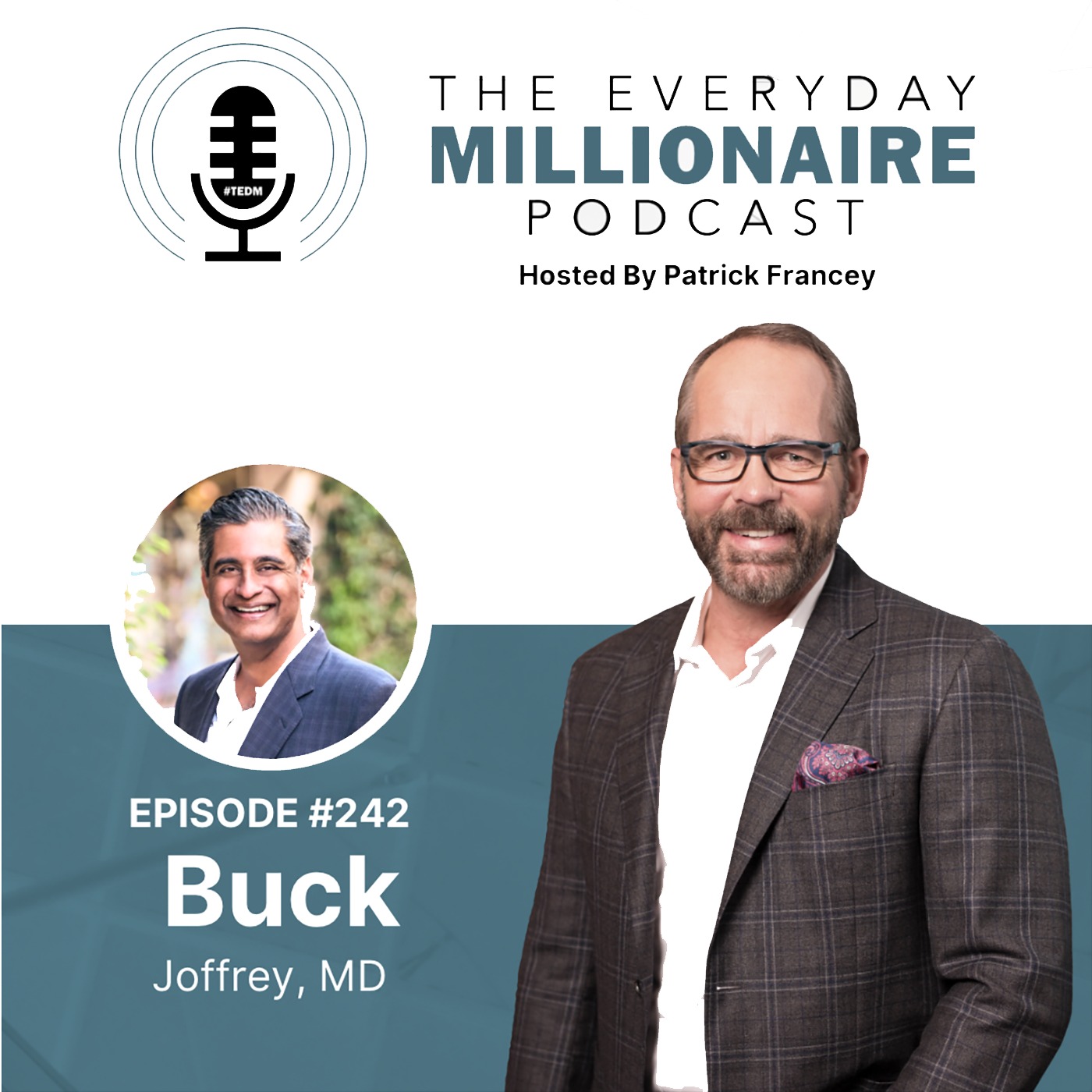
The Everyday Millionaire and Mindset Matters Podcast
Episode #242 – Why High Income Doesn’t Equal Wealth with Dr. Buck Joffrey
01:19:13
Loading summary
Transcript132 lines
- [00:00]
A
Foreign.
- [00:05]
B
Welcome to the Everyday Millionaire Podcast. My name is Patrick Francie and I am your host. And I want to begin by saying thank you for listening. On this show, I am having conversations with seemingly ordinary individuals who have achieved some amazing and extraordinary results in both their life and business. My intention is to inspire and help you learn and grow by having my guests share their journey of how they face and overcome their challenges, but also how they celebrate their, their many wins. And now let's get on with this show and have a conversation with today's guest. Most people climb the ladder and never question where it's leaning. My guest today, Dr. Buck Joffrey, climbed it all the way up. Surgeon, trained at ucsf, respected high income professional. Then he had a realization that changes everything. Income is not wealth, and security is often an illusion. That moment forced a shift from professional to entrepreneur, from certainty to risk, from structure to ownership. Since then, he's been involved in over 2 billion in real estate transactions, built multiple businesses and educated thousands through the Wealth Formula podcast and his book, seven Secrets of Eternal Wealth. But on this show, we care less about the transactions and more about the transformation. Who do you have to become to walk away from a safe identity and build something bigger? Listen in. Let's get this show started. Buck Droffrey, welcome to the Everyday Millionaire podcast. Thank you for joining me.
- [01:46]
A
Yeah, thanks for having me.
- [01:48]
B
My traditional opening, Buck, with my podcast is, you know, we understand bios. You know, you've got a very impressive bio. And what I found over the years in interviewing many is that bios don't really keep up with high performers, especially in the entrepreneurial and business world. And so the question I like to open up with just to get things rolling is if somebody bumps into you today and asks you, so, Buck, what do you do? Do you have a answer for that question? I know it gets deep.
- [02:21]
A
It's, yeah, it gets, I usually say it's complicated.
- [02:25]
B
It is.
- [02:27]
A
But, you know, I, it's funny because I always end up defaulting to. Well, I am a physician, which is true. It's just that, you know, I haven't practiced in a number of years. But, you know, sometimes those kinds of things, at least you know, they, they, they, they give you a quick answer. And so that's what I start with. But, and then I usually say, you know, I'm a surgeon, haven't practiced in a while, and, and had, have been an entrepreneur for the last several years and, you know, multiple business models and, and yeah, that, that's pretty much what I say. And Hope and hope. Hope we don't ask anymore. Yeah, I hope you don't ask anymore.
- [03:10]
B
Okay, well, let's, let's unpack it a little bit because, you know, you're, like I say, your bio is very impressive. You've accomplished a lot, You've done a lot. I mean, the fact that you left the world as a doctor, a surgeon, were you specialized in something? Were you a general practitioner specialty in some kind of surgery? What was that background?
- [03:30]
A
Even that gets complicated. So I started out in neurosurgery as I used to be, you know, brain surgeon, and then left the brain outside and did. Had a neck surgery and then after that ended up in plastics. So, you know, I have a, you know, I have multiple specializations. I spent a lot of time in school and in residency and all that kind of thing. So. So yeah, I mean, I even. That gets complicated. But yeah, I mean, maybe, maybe part of the issue with a lot of entrepreneurs like me is that we have a little bit of add. And, and that's certainly the case with me, I think controlled.
- [04:07]
B
But yeah, you know, it's interesting, you know, as an entrepreneur myself, you know, 42 years as a business owner slash entrepreneur, I agree we do get complicated. And not intentionally. It is maybe a little bit of add, but it always is reaching for what's next, what's lighting us up, what's exciting, what can we do to make a difference in this world and generate revenue? Of course, and inspire others generally, I think we, at some level, all business owners and entrepreneurs that have any degree of real success are built to be leaders. So buck your doctor surgeon, as complicated as that might be, you go on this big long journey to be that and then you gave that up. Did you just rip off the band aid? Was it a. What was the kind of progress to get to that place in your life where you're going high paying job, you know, high profile, probably, you know, elevated just by the nature of what you do. And you go, nope, this isn't for me anymore, I'm out. How do you get to that conclusion?
- [05:13]
A
I mean, I think the realization for me right after residency, it sounds a little silly, but it was reading one of these Kiyosaki books, right? I mean, I read the Cash flow quadrant and I just felt like even as simplistic as those concepts are, they were new to me. And the idea of being an entrepreneur just, you know, it was like electric and it was almost like it just kind of let the genie out of the bottle, you know, it was just a Huge moment for me. And so right away, you know, I didn't work. I, I, I started, started for practice and I started another medical business. And so I started moving in that entrepreneurial direction pretty quickly. And then, you know, one of the side effects of being a successful entrepreneur is you make some money. And, and I did. And in my case, didn't, you know, initially, my impulse wasn't immediately to hand it over to a wealth manager. You know, I, I actually was looking, okay, so what do I do with this money now? I can't. You know, I'm a son of immigrants, and my dad was, was still alive, but he's, you know, he's a, he's a professional as well. He was an engineer. And he came to this country and within a couple of years became an entrepreneur himself. So I think there's something about the hereditary nature of this as well. And he ended up going into real estate and started buying, you know, small apartment buildings or, you know, little four plexes, three plexes, whatever. And he became a very successful guy as an immigrant coming from a, you know, country very poor. So, so my impulse then was, okay, well, I guess I'll buy some real estate. So I bought some real estate. I learned a lot about real estate before I bought it, you know, and I did that by listening to podcasts and reading books and, and talking to my dad a little bit. Although for some reason, that never really seemed to be something I thought was the smartest thing to do, but it probably was. And so I had success with that. I had success with real estate. And then I got this bug just to learn more and more, and I started listening to podcasts. The podcasts out there a lot of times were not geared towards me, somebody who was already making a decent amount of money just trying to figure out what to do with it and how to be smart. They were mostly dealing with people who were trying to get to that financial position in their life. So at one point I was like, maybe I should just start a podcast. So I started a podcast, and that became Wealth Formula Podcast. And that was, I think, what, 2014. It's been a long time. And then I used the podcast as a way to learn. So I reach out to people and learn about things. I would learn about, you know, a tax strategy. I would learn about asset protection. I would learn about, you know, investing, the way people think about investing. So that turned into an audience for me because all of a sudden there was a niche of people that were similar to me who were high paid Professionals, physicians, whatever, that were kind of looking for the same thing. So it kind of ended up almost happening by accident that set up the next stage.
- [08:39]
B
It's interesting. Buck, I want to go back a little bit. I often have discussions with my guests. You know, is entrepreneur having that entrepreneurial spirit? Is it nature or is it nurture? You know, that's always a kind of a question. I think you kind of hit on it is that, you know, in your case, you kind of see it as a maybe a genetic predisposition to be entrepreneurial, which is, you know, again, I see these, you know, this many years into my podcast and many hundreds of guests, there is definitely a thread to pull on in those cases. But often we see the immigrants that are. They come in entrepreneurial, and there's so many success stories with immigrants. And this is kind of a way to get to this point or question, I guess, is that in as much as you're watching podcasts or listening to podcasts, you're reading a lot of different books, you're learning the how to's of whatever things that you're doing. But I want to just touch on what is the. You know, there's a lot of mental fortitude that goes into doing what you've done in terms of being very entrepreneurial, taking on doing different things. I mean, it's no small feat to become a surgeon, as a brain surgeon. So I'm wondering a little bit for you, is that that kind of spirit of entrepreneurial, the mindset, what we'll call it, that I prefer to speak when in the context of self mastery, you know, which is internal, not external. You know, mindset to me is always about what we can do to view the external world. Self mastery is about the internal world. That's kind of how I'm defining it these days. When you look at and consider how you showed up, like, how much. How many podcasts were you listening to or how many books were you reading about mindset and. Or that. That attitude, that spirit of. Of growing personally and professionally, leadership. Was that something you also studied, or did it come quite naturally to you?
- [10:45]
A
I think mostly it came naturally. I think mindset, you know, sure, I read like, think and Grow Rich. And I was like, yeah, I get it. You know, but, yeah, I think it's interesting because you talked about how difficult it is to become a surgeon and all that other stuff that you mentioned, but there's a path to that, right? And it requires a different kind of intelligence. And in fact, I would say that having that kind of Intelligence is a real disadvantage to being an entrepreneur because it sort of creates this positive feedback loop. And you don't get a lot of failure and you don't have to navigate out of it. You just follow this path and you, you know, you get success and you get rewarded and. And you get that Pavlovian response of, you know, continuing to do what you do. It's another thing altogether to go into the world of entrepreneurship, because entrepreneurship is about having no curriculum. It's about creating the curriculum. And for me, it was definitely an innate. There's no doubt about it. I had an intensity about it. I spoke very confidently about what I'm going to do and how I believed I was going to be able to do it. Some of those things I was able to do, some things I was not, but I always believed it. And I think the most powerful thing was an incredible energy force pushing me towards doing what I wanted to do. I think that's very difficult to. I think at some point you're going to have that or you're not going to have that. Right? You also have to have a little bit of, in my opinion, a little bit of daredevil in you. Right? You have to do the things that people think are a little bit unsafe. You know, you go back to the whole idea of the immigrant thing, right? One of the reasons in my theory and why immigrant, a lot of immigrants do as well as they do, is that they actually don't have a lot of expectations when they get here. There's a certain kind of personality it takes to actually leave your own country and go somewhere brand new. These are people who are already ready to take a risk. And so it doesn't surprise me that those are also the people a lot of times who end up very successful because they're out there, they're moving, they're physically moving in the world, they're creating energy in the world. And. And I think that breeds success.
- [13:15]
B
You know, you're. We talked just very briefly before we got on the podcast here, Buck. And, you know, as an educator myself, you know, I've worked with, you know, thousands of real estate investors, small business owners over the years, stood on stages. You know, we teach systems, we teach house. You know, the. The question, you know, that I often ask is that, you know, I look at, you know, rooms full of people who come to get the education, we teach them how. And in the model within the real estate investment network is one of the businesses that I own. We were literally teaching thousands of real estate investors over 32 years of the business, how to invest in real estate the right way, do it yourself kind of stuff. But beyond that even. My question, or my point was, is that I'm sure you're experiencing it. You teach people how, you teach them how, you teach them how. And. But why is it that such a small percentage of those individuals who spend countless hours learning, learning, learning, but they never pull the trigger? And do you have a kind of a. Do you have a take on that? Do you have a theory on why that is? To me, that always comes down to the mental game, whatever that mental game means to somebody who's listening. But ultimately, what gets in the way? You're being taught the same thing as the other 500 people in the room. What's the difference between, you know, you and the, you know, and those that take action?
- [14:43]
A
Well, I mean, I think it. Again, it goes back to, you know, I mean, look at traditional curriculum does not. When you're in school, like, and you're taught things, it's not particularly interactive, you know, I mean, and anybody who's good at anything knows that the educational, like somebody teaching them something only went so far. Right. In order to get some good at something, you actually have to do it. And you. And when you initially do something, you're often not very good at it. Yeah, I think that's. I think there's. That's a lot of fear of failure. It's a constant fear of failure. I mean, fear of failure is the. The biggest, biggest hurdle.
- [15:29]
B
Can I share my insight into that? Over the years of coaching and working with people, I would like to get your view of this. I often say to people that fear failure is bullshit. I don't think it's fear of failure. You and I fail probably every day at some level. We're trying things. We're directing the team to do this on this initiative. We're trying different things in terms of marketing. We're constantly failing at something. It is part of just being in business. Not everything you try works. I think fear of failure is a story that people are telling themselves, an excuse that they're making. I think the real fear is the judgment of others should they not achieve that goal, the judgment of their peers, of their family, of their friends, that they will be judged harshly, laughed at, shamed, embarrassed. I think that's the true underlying fear of failure. Because complete catastrophic failure is rare. Not that it doesn't happen, but failing on an initiative, I think that's just often part of the process. But what's your thoughts on That I
- [16:39]
A
don't know if I completely agree. I mean, let's take the example of people listening to me oftentime, right. They're already successful. They're already making, you know, they might be a physician making, you know, hundreds of thousands of dollars a year. It takes a lot and to, if somebody actually doesn't enjoy that, to say, I'm going to do something completely different. And that. That. Yeah, I mean, there is that whole ridicule thing. There's no doubt about that. If you try to do that, that doesn't work. You're going to look like a fool. However, if you're already pretty comfortable and, you know, you've got kids and, and you've got a family and you got a mortgage and. Sure, that's genuine fear, right? Like, why giving something up for the unknown. I think that's. I think that's real. Like, you. You have to. And unfortunately, the way it happens my too, is like, you see, successful entrepreneurs, and I'm probably guilty of this too, but the more success you have over the years, the more skittish you get sometimes too.
- [17:43]
B
Sure.
- [17:43]
A
Because. Because it's sort of like, okay, well, when I started my first business, I, you know, I was renting a place with, you know, my wife at the time, and we had a baby who was like six months old. What did I. I mean, I didn't have any risk. I had zero risk. Like, I could. And I was, you know, in my early 30s. I could just do whatever I wanted at this point. And I figured, well, if I screwed it up, then I'll just get a job and I'll just be a surgeon. That's what I'll do.
- [18:19]
B
So when you read, it's interesting. I've often asked my guests the question of what's a book that was instrumental or impactful in their life? Maybe even a fork in the road moment for you. Is Kiyosaki, what is it called, Four quadrants or something? Yeah, yeah. And. And Rich Dad, Poor Dad. Those are, you know, really common books. But something you said that, you know, as you went into that world, you are pretty confident. And I often use and. And courageous. You know, those are two Cs, you know, confident and courageous or two important Cs. So I often will use the phrase is that confidence is rarely owned. It's most often borrowed. Now you sound like you kind of came out of the chute with that level of confidence. Which would, you know, where do you get your confidence from? Is that how you were raised, do you think? What's the impact your parents had on your confidence as an individual.
- [19:18]
A
I think I was raised, you know, just. Just my dad, probably just by example. I mean, he was. Is again, he was just sort of a little bit of a renegade, you know, But I still think. I mean, Patrick, it's. It's not. I still think a lot of it is genetic. I think of a lot of it was being born with it, you know, like you. Like my. My brother is in, you know, very successful guy, you know, manages a sovereign wealth fund and does, you know, pretty incredible things, but he's not an entrepreneur at all. 00. And he grew up with the same, you know, darn background. He's, you know, he's a very conservative guy that way. For me, it was just, you know. Right. I've always kind of been, you know, someone who wanted to strive to do things. It just was a matter of time before I figured out this whole world of entrepreneurship just completely opened the entire world up to me to do anything. And when I found that, it was like a kid in a candy store at the beginning, it was too much because I had too many ideas and was trying to shoot in too many directions. Right. And then, you know, you just. After a while, you realize you can't really do that, you know, and then
- [20:42]
B
you want to in your energy.
- [20:44]
A
Right, right, right. You want to, but you can't. So. Yeah, no, I don't. For me, again, I think a lot of it is, is what you're born with. I mean, and that's. That's not fun to hear if you're not born with that and that's what you want to do. I do think you can. I do think that you can train your mind to be a certain way. I think you can train yourself to be a certain way and to strive for more. I mean, you know, all the work that guys like Tony Robbins do with people and all that, I think it is to try to arrive at places where some people are just born with a different mentality and you're just trying to transform yourself, and I think you can do that.
- [21:24]
B
Yeah. You know, I agree that, you know what? I've. This many years later, I agree that not everybody is cut out to be an entrepreneur, that's for sure. And many try and develop that skill or go down that path. You have to be built a certain way to achieve that. And so. Or to actually take that on and be successful at it. And you got to really commit to it. It's, of course, it's many hours and sleepless Nights and early mornings and late nights and all the things that we do to, to build a business, build a team and. But I go back a little bit, which is, I'm finding really interesting for you, is that, you know, as a doctor, and I think many people probably don't even think about it, but when you consider a doctor is well paid as they are, they are selling their time, and it doesn't matter how you do it, they're for the most part selling their time. They. They need to be there. They need to have contact with those patients. They need to do that. So as much as there's an entrepreneurial component to it, you know, it really is kind of locked in in terms of them working long, hard out.
- [22:30]
A
To me, it's not really entrepreneurial at all. So.
- [22:32]
B
Yeah, so. So for you to leave that comfort zone, that space of being well paid, like I say, being probably held in a. Generally a higher esteem just because of the nature of the work you do, what was, was there, you know, you read the book, but was there a bigger dream or. I mean, gosh, you spent years learning to do what you do. Obviously there's a high degree of intelligence and then skills, you know, even eye hand coordination, if you will. But what was behind the book? In other words, you read this book, you have this kind of epiphany or whatever that might look like. But what was the driver behind it? Did you just, Were you just tired of being the surgeon or did you just go, this is not big enough for me? Like, what was the, what was your mental or thought process behind the change? What drove it?
- [23:22]
A
So, you know, I think just, just in general, that what that book did for me was just open my eyes to a world that I didn't even realize existed. Which is stupid because my dad was entrepreneur. Right. But growing up, you know, not having to worry about money myself, I was going to prep schools and I was going, you know, I was, I was being, you know, groomed in the way of professionals. Right, Right. So I kind of lost track of that. I never really let myself get exposed to that. But that book, for some reason just really opened up this entire world that I didn't know that existed. Now when I started to. So one of the things I think is the entrepreneurs out there will. I, I think this will resonate with some people. But, you know, a good friend of mine who's one of the most interesting entrepreneurs I ever met, he, he said entrepreneurs, you know, they're, they're, they're not, they're not in it for the money. Right. They're in it for the game, but they keep score with the money.
- [24:24]
B
Yeah.
- [24:25]
A
Right.
- [24:25]
B
Well said.
- [24:26]
A
Yep. And. And I think that's very true. I think especially, you know, 10, 20 years ago when I was getting started, it was just fun. Just fun. You know, it was like solving a puzzle. You know, this will be a strange analogy, but I used to tutor organic chemistry when I was in college, and organic chemistry was always about solving problems. It was about figuring out how to take this thing here and take this thing here and create something else. And to me, entrepreneurship felt like that. It felt like, what can I do? Where's the problem? Where's the solution? How can I create a business? You know, and. And then executing on that was really fun to see it happen. You have something that came out of your own head that turned into something real. And that is an extraordinary thing. I'm not an artist, but I think that is a certain type of creativity. And when people have a talent for some kind of creative activity, they tend to be passionate about it. And I think that's true for a
- [25:36]
B
lot of entrepreneurs in some of what you said, Buck. And this isn't to minimize anything at all. So I want to be cautious about how I ask the question, because I'm realizing in my head that could come out sideways. But, I mean, ultimately, we think about environment. So you, to your point, you lived in a. You know, as a young man growing up, you lived a fairly privileged life by many standards. If you're going to a prep school of some sort, there's a common phrase or a quote that I'm sure you're familiar with, which is, you know, it's not about the goal. It's about who you need to become to achieve the goal. When you consider the environment, how you were brought up, universities, colleges, the education that you got, you are already in an environment and in a space where you're already upping your game, you're already hanging out with people, you're meeting people, and. Or you're in an environment of other very bright, driven people. Do you think that has had an impact in terms of how you evolved in your own development, in terms of the confidence that you gained as well? I mean, you had benchmarks. I mean, you were. I often use the analogy that if anybody's a golfer, we all know that if we're just hackers and we go out and golf with three other hackers, our game is, you know, bad. You know, we'll go out with three really great golfers and our Game will still be bad, but we'll knock five strokes off the game just because we're in the hanging out with the right people. We're picking up on the subtle things that we see them do when they're chipping or driving or whatever it is. Does any of that ring true for you?
- [27:14]
A
I mean, maybe. Maybe some. Only to the, the extent that I had success in things that I was doing, I think it made me feel confident in myself in general. But it's interesting you bring up the analogy of, you know, golfing or tennis and, and trying to get better at something and try to be there with people who are better than you and, you know, upping your game. In fact, I would say to the contrary. If you want to be an entrepreneur, you don't. You don't want to be around the most. The smartest kids in the class. You know, I don't. I don't know if you know. So, Rob, Robert Kiyosaki, I've gotten to know, Got to know him a little bit. He's been on the show a bunch of time. But, you know, he says that comment he has in his books about, you know, A students work for C students and B students work for the government. Yeah. And one time I said to him, I said, robert, you know why that is? It's because the, the C students had nothing to lose.
- [28:09]
B
It's a good point.
- [28:11]
A
You know, that's why. That's. That's why A students had everything to lose. They had everything to lose, and so they didn't take any chances.
- [28:21]
B
I love that. That's, you know, something. In all my interviews, I've not had that perspective. I think that's a great perspective, by the way. You know, it's as subtle as it is. It's a meaningful perspective, you know, and I couldn't agree more. That's really interesting when you talk about you had some early successes. You know, our biggest lessons are often learned in our failures. I've had more than a couple. Is there any big failures or failures for you that really hurt and stung, that you learned a lot from no regrets kind of thing? Anything that you would share insights into?
- [28:56]
A
Yeah, I mean, listen, I've. I've had a ton of failures, I think, you know, whether it's, you know, leaving, you know, one surgical specialty for another and wasting a year there, wasting a couple years there and, and trying to be okay with new identities. You know, I've also had, you know, I've also had investments that I was really confident in that, you know, Got beat up because something happened, like interest rates going up extremely fast in the United States that didn't turn out well. And that. That is a real. That is very. That's hard because I think, you know, as an entrepreneur, you.
- [29:41]
B
You.
- [29:42]
A
You start especially early on when you have a lot of successes. You do feel probably often like you can't. Like you're on top of the world and. And there's nowhere but up. But when something like that happens, it really starts to make you question everything, like, in terms of your own abilities, your own, you know, Should I be doing this?
- [30:05]
B
Yeah.
- [30:06]
A
Am I wrong? Like, what. What did I. You know, so. So, yeah, I think. I think. Listen, failures happen, like, constantly. Right. It's just a matter of. I think, you know, I've been telling myself this, and I. I've talked to other people about this, too. Is like, you know, part of recovery, though, is you just got to keep showing up. Right? You just got to keep showing up. You got to keep plugging away. Gotta not sit there and focus on the negative and know that if you've done it once, you can do it again. Yeah, I mean, it's. It's. Yeah, I. I think, you know, it's pretty rare when I run into somebody really successful. Like, I, you know, here in Santa Barbara, I mean, see, none of my neighbors work. They're all business. You know, they own businesses, they own real estate, whatever. And everybody has that story, you know, everybody has a story of just getting killed at some point and feeling terrible about themselves
- [31:09]
B
and.
- [31:09]
A
And then. And then, you know, coming back as a hero, you know.
- [31:15]
B
Well, you know, and I asked the question, and I unpacked it a little. I was. I think you brought up some really great points. And, you know, part of the podcast is seemingly ordinary individuals who achieve extraordinary results. That's, you know, that was part of the theme of the podcast all these years. And the reason I shine a light on the failures is those young entrepreneurs or want to be entrepreneurs or just business and entrepreneurs in general. I think it's helpful to remember, you know, that when you look around and you really see what it takes, you're going to hear, you know, even from the most successful individuals, many stories of failures or, you know, one step forward and three steps back and get up, dust yourself off, and go again. So as much as we worry about that proverbial or that failure, potential failure, there's a lot of learning in that failure. Sometimes it's the failure that propels us forward because we've learned so much from it. That we come back at it from a different approach, much smarter. And so the failure is sometimes just part of the education process. And so I think it's an important message to really highlight, which is if you're on the entrepreneurial journey, you know, don't beat yourself up too bad for those, what you would call mistakes or those failures. Often those failures are, can be a launching pad to what's next. When you look at, back at your time as a surgeon, Buck, and then you'd mentioned it a moment ago about various identities, you know, you again are a surgeon. There's the identity of being a surgeon. Two questions. Was it. Was it tough to kind of let that identity go? Or, or does that even enter your mind per se? And, and was there. What kind of skills did you bring forward as a surgeon into being an entrepreneur?
- [33:06]
A
Yeah, for me, the identity part wasn't a big deal. I mean, I, I think it is for. It probably is for a lot of physicians, but it didn't skill wise. I think. I still think like, maybe not my background is a, as a surgeon as much as a background in science and a background in, you know, biochemistry and organic chemistry. And I think that those thinking patterns that I had were very translatable. Again, they're problem solving skills. And so to me, like the ideas and the creativity of being an entrepreneur actually was cultivated by that background. I don't think I've ever heard anybody else say that, but there's no doubt in my mind for me, that that was a big.
- [33:59]
B
It's interesting. So I'm 67 and I've really been kind of observing my own aging process, the phases of life that we go through and what we learn and the wisdom that just age gives us. But also I've been observing my own as I kind of wind and transition into other things and what I want to do next. And I do notice there's this niggly around identity, right? There is a niggly around. There is that who are you if you're not that? And it's kind of an interesting process. I've got no jag around it other than I'm just observing it. And I'm really enjoying the observation of my own aging process, if you will, both mentally, physically, emotionally, all aspects of life, if you will. And so that's why I asked the question is, is that the identity part of it is an interesting one because it's just really, I don't know, it's a, it's a coat we wear. I guess maybe that's how to put it. So it's just very interesting.
- [35:00]
A
A little bit of a disadvantage too, though, like, if you start creating a certain identity, for sure. Sometimes you, you know, if you want to change the identity and, you know, it's, it's almost more. The problem is you've already been identified as somebody. You know, it's like the poor guy Rob Reiner, who got, who got killed by his son. But, you know, like, he had this show when I was a little kid. I remember my parents watching called where he was a character was Archie and it was a family something or another. Do you, do you remember that show I'm talking about?
- [35:34]
B
Was it called Family Affair? I don't.
- [35:37]
A
And it was something like that. All in the family. That's what it was. Rob Reiner played this, you know, hippie kid who was married to this guy's wife, and he was, he was Meathead. That was his nickname. And Rob Reiner became a famous director in part because he could never shake off the actor. Meathead. Right.
- [36:00]
B
So.
- [36:01]
A
So I think, I think it cuts two ways. I mean, I think some people have difficulty leaving identities and some, once they have an identity, especially like, hey, guys like me who are all over the Internet as a podcaster, you know, a guy who's involved with real estate, who used to be a physician. If I want to do something different, it's really difficult to create a different identity and serve yourself up, you know, so it sort of cuts both ways, though.
- [36:29]
B
For me, that's what understanding, you know, or self mastery is about, understanding yourself. You know, know thyself, be true to thyself, but it's understanding and, and learning who you are and, and evolving and developing. I'm going to take it off a little bit of track, kind of a different path, if you will, in the conversation, you know, your, your podcast wealth formula. Yeah. You're obviously talking business and you're talking about money. And, and this is, as we go in on entrepreneurial journeys, business, etc. I mean, there's, at the, at the heart of it is, you know, creating wealth.
- [37:05]
A
Yeah.
- [37:06]
B
Do you have, you know, do you see. When it comes to money, do you see. I don't know, do we call it. Yeah, we'll call it belief system. A belief, you know, belief systems around money that you see that you can kind of spot, oh, this is going to get in somebody's way. Or we've. You've got to shift your, your view of the world of money. Is there, is there anything that you kind of touch on within your wealth? Formula that kind of hits on the money conversation.
- [37:33]
A
I mean, we, we talk a little bit about mindset. A lot of times it's mostly about like, macroeconomics and, and strategies for personal finance. But I mean, to your point, I personally do believe very much in what I, I, I would call a wealth thermostat. Right. Where I think that everybody kind of pegs themselves or gets pegged at a certain income level, a certain wealth level.
- [37:59]
B
Sure.
- [37:59]
A
And you go up, you go down, but somehow you always end up at that same number. And that I do believe you can change, you can change that. And I do think that that goes back to a lot of what you were talking about with, you know, who are you hanging out with? Right. When I lived in Chicago, I lived in a, you know, a sort of affluent neighborhood there as when I was a surgeon. But that was a different level of wealth than when I'm here in Santa Barbara and I'm in Montecito, which is one of the most expensive area codes in the world, and in zip codes in the world. And here, I mean, I meet people. Literally the guy behind me is a billionaire, you know, and I, I've got nowhere near that money just aside, but I'm not. But the guy over there is that my best, you know, my best friend in town, you know, sold his hotel for 40, $50 million, you know, and, and he's still got a couple more, and he has, he's one. I've heard all sorts of crazy stories of like, losing everything and all that kind of stuff. When you're around these people, it really sets the bar, right? And you, you don't start seeing yourself as a guy, you know, who's a six figure guy anymore. You, you really set your bar much higher, much higher. And, and the next thing, you know, like everything you do ends up being in that world. You, you kind of project yourself into these different, you know, settings on the thermostat. And it's, it's just like who you are. Oh, yeah, I'm, you know, I'm a seven figure guy. I'm not a six figure guy. You know, some of my friends, they're eight, eight or nine or ten figure guys, you know, like, they're in that. I do believe you change, you can change that actively.
- [39:57]
B
So, you know, when you talk about money and wealth, you know, just kind of off on a little bit of a tangent. When is enough enough? You know, you talk about billionaires, multi billionaires. Is it really the game? Is it just the scorecard, you know, and who's looking at the scorecard? You know, like, who are you competing with? So when is enough enough? You know, six figures, seven figures? Like, I mean, what is it for you? Like, how do you. If I give you that question, when is enough enough? Do you have an answer to that question or what drives you? I mean, you've got enough. You've got enough. You live a wonderful life. I mean, sustainable, I'm sure.
- [40:33]
A
I think that that's, you know, again, for me, like, I don't think I ever thought about is enough enough. I mean, in fact, I will say that I do so more now than I did, you know, 10 years ago, because, you know, there, if I'd known then what I know now, I would have put the brakes on faster. You know what I mean? Because you go through these super highs and super, you know, lows, and you. Then you're in this area too. It's sometimes, like when you're, when you're riding really high, it's not a bad idea just to be like, hey, this is pretty good. How can I just set this up and go on cruise control now and then, you know, so how much is enough? That, that's up to it, you know, sure. Each individual. But, you know, I think, I think for me, it's, you know, a lot of understanding right now is that I just, you know, getting the point where I just. A lot of entrepreneurship is. Is a lot of aggravations, too, right? And as you go through life, like, you want less of aggravations, right? So. So to me, it's like, I wish in those, some of those super highs that I had, that I had just kind of said, okay, there may come a time when you're not going to want to do this, so let's maybe not go head first into the next thing with all this money, you know what I mean? So I would just put that warning out there. By the way, one of the things that I think is that one of the things that I think is really important for entrepreneurs to do is to diversify their wealth. This kind of goes back to what I was just saying. Like, a lot of the guys I know who've been really, really successful, they dumped all of their money into their own business and maybe it paid off, but for some of them, it ended up being catastrophic, right? Where the next thing you know, they were. There's a single point failure. They had nothing else.
- [42:36]
B
Sure.
- [42:36]
A
So that's something. As an older guy now than I was before, I am very cognizant of and whenever I see people do that, I'm like, maybe, maybe you ought to, like, do something. You know, maybe you should put some of that money somewhere else in case this doesn't work. Right?
- [42:55]
B
So.
- [42:55]
A
So I don't know. I don't know that I'm answering your question, but I think what I would say is that enough is enough, is that you can stop, live without aggravations, feel like everybody's happy, everybody's, you know, all the kids are taken care of and, you know, have to work, you
- [43:18]
B
know, you know, the, you know, to kind of, you know, to expand on that just a little bit, you know. Now, as an aging boomer and multiple business owner, you know, the one thing I would encourage many and lots of boomers are learning this lesson, is to plan your exit strategy early. And I say exit strategy doesn't mean getting all out or anything like that. But to your point, we started the conversation with, it's complicated because as you are an entrepreneur, as you grow businesses, as you grow relationships, as you do different things take on different commitments. I mean, a lot of the commitments to make are long term. So then it's like, okay, well, you know, I'm at this point where I need to slow things down. I need to simplify things. And I tell you what, I started that process a few years ago, and it literally takes, in my case, it will, you know, I'll wind things to the direction I want to go. But that takes thought, too, and it. And I wish in some regards, I would have had that heads up, you know, in a meaningful way, much earlier. You know, somebody could have said it to me. Patrick, you know, you need to always be considering an exit strategy. How are you going to go? What are you going to do? Is it a sale? What. You know, and then actually execute against that plan. And, and as much as we'll get through it all and we'll get things unwound, it is complicated and it takes time to do. That's, you know, that's the only insight, additional insight I give anybody at this point.
- [44:37]
A
Right, yeah, sure. Green.
- [44:39]
B
When you, when you consider you talking on your podcast, on your wealth formula podcast, you were Talking about strategies, etc. To what degree are you connected to seeing what's going on? Because I talk to different people. And it depends. It really depends on who I'm talking to. You know, how aware are you of what's going on on the global macro? You know, the past five years, to me, you know, 2020, March 2020, was a line of demarcation I think the change. The world changed forever. I think that it is never going back to. If anybody's hanging on to some story that will go back to what once was, they're hanging on to the wrong story. But when we look at what the global macro and all of the kind of crazy things that are happening in the world, on top of AI, on top of robotics, on top of all of the stories that we're hearing of China, Ukraine, Middle East, Iran, Russia, I mean, gosh almighty, how are you dealing with it? Or are you just going. Doesn't matter. I'm just going to stay focused on what I'm doing. How do you see the world in that regard, Buck?
- [45:44]
A
Oh, I mean, honestly, that's a lot of what I do is, is try to think about the macro. Because I think, I think not looking at the macro is a tremendous mistake. I mean, yes, and I mean one of the things that you just, you just sort of talked about AI. I mean, I think that, I think AI, I truly believe that it is probably the, probably one of the greatest disruptors of mankind. And I think that the most people have no clue that that's happening. And it's interesting because in the US We've had this period of significant inflation that followed the pandemic and we're seeing those inflation numbers come down and then Trump puts his tariffs on everybody. Most economists thought that that was going to bring inflation up. Well, inflation keeps ticking down a little bit every month here or every, you know, every report. And to me, like the, it's, it's kind of a no brainer where it's coming from. I mean, it's a no brainer is coming from, you know, automation and AI. And I think that, you know, if you think about what could happen in the years to come, I mean, deflationary forces are a much bigger problem in the United States than inflation by a mile because AI is going to substantially increase productivity and that brings down costs. Now the issue then becomes like with the workforce, I think there's going to be a tremendous change in workforce. AI Right now where it's hitting the hardest is anything that requires technical work, brain power, lawyers. You know, a lot of law firms are barely hiring new lawyers anymore because they used to have the associates do all that initial draft work. Well now they just use AI for it. They don't need as much. I think that's gonna, that's happening in medicine to a certain extent. Like, you know, with radiologists, for example. I mean, you're still going to need them to sign on the line, but you're going to need very many of them. Yeah, right. But this whole thing is going to. The next. The next phase in this, if you look at what Elon's doing with Optimus, is robots.
- [48:18]
B
Yeah.
- [48:19]
A
Intelligence in these robots. And guess what happens to all those factory jobs? They go away. Guess what happens to all those Uber drivers? They go away. I mean, Tesla's gonna destroy that entire market. Right. We're looking at a world that, as an entrepreneur, that is incredibly important to understand what's happening. Right. Because otherwise you're. You're gonna walk right into a landmine. You know, you're gonna be. It's funny because I remember when I was a kid that at one point my dad was. He owned a bunch of phone booths. Back in the. It was in the 80s, he owned some phone.
- [49:00]
B
It's hilarious.
- [49:01]
A
Yeah, yeah, yeah. But fortunately, he, you know, sold that. Sold those long before the cell phone phenomena. But, you know, we're looking at the same kind of thing across the board. There's gonna be so many. So many areas that just aren't going to exist anymore.
- [49:19]
B
So, yeah, I think most are not. You know, it's interesting is that, you know, as I'm speaking, you know, fairly often to live audiences, a couple of questions that I like to ask. One of them being, you know, how many of you are using AI, some kind of an AI, as a tool to support. I'm surprised that relative, if I'm speaking to a room of 100 or a couple hundred, I mean, it's improved. But even as little as three or four months ago at a particular event I was at, I expected to see 80% of the room put up their hand, and it was probably more like 30% of the room put up their hand, which I was. I found quite surprising. You know, I'm encouraging everybody. You get on chat, GPT, get on the free account, start to understand exactly what is going on within your businesses. You're using it as a tool. Are you using it in any way to monetize, or are you just improving productivity and maybe the quality of work that you're putting up?
- [50:18]
A
I'm. I'm definitely just. I'm using as a productivity tool. I mean, the amount of time it takes, you know, for me to prepare for a podcast compared to what it used to be, it's like a fraction of the time. Right. I mean, you know, I. I know everything about this. You know, I used to have to, you know, Google people and figure out what they were doing. Maybe read some of their, you know, their. The most important stuff that they written and what. What they're saying it in public. Well, I can, I can get all that information within, like, seconds, you know, with artificial intelligence. And then I know what you know, I typically have a certain type of question I like to ask. And Chat GPT now recognizes the types of questions I like to ask.
- [51:04]
B
Sure.
- [51:05]
A
So I let it do the first draft of questions that I want to ask, and then I go back and I tweak it and I'll. And I say, is there anything else? Is there anything provocative this person is saying right now? Is there all this? So. And it's all done. I can prepare for an entire podcast probably with 10, 15 minutes. You know, it's incredible.
- [51:26]
B
I'm finding. Yeah, I'm the same way. I've been using it. I've been on the paid version of Chat GPT probably, I think three years. I was an early adopter in it and thought it was really cool when it first come out. But even when it first came out, but even now with whatever it is, 5.0 and 5.2, whatever the numbers are that they've assigned it, I'm watching the response time. It went from a couple seconds to split seconds. I mean, it's coming back at me almost as fast as I push send. It is really remarkable. But to your point, I do a lot of research just on the economics, global macroeconomics, and of course, Canadian economics. And the quality of the research and the depth of the research that it can come back at me with in literally seconds or maybe, maybe 120 at the most. Like, if it thinks for two minutes, I know I've given it a good task. Yeah, but the quality and the speed of which it moves, I mean, you can't. I can't even account for the hours, the hundreds of hours of time that I get to produce better quality, that it takes me that much less time to produce better quality and more of it and more accurate. And so it is an interesting phenomena. And then you look to your point to Optimus and you look at the robotics and just what's transpired over the past 12 months of where they were 12 months ago and where they are today. And Tesla's not the only show in town. Optimus is certainly a leader in the space. But what I'm seeing, some of the stuff I'm seeing coming out of China, not AI proven it's real, actually. It's remarkable. And it is both exciting and a little frightening, given that we've never been here before. We've never had this opportunity to have this much technology run our world. And we don't know if it's good or bad or what it's going to be. We do know that there's going to be an impact. Everybody's guessing. I mean, there certainly are some assumptions being made that are probably pretty safe considering the source of those assumptions. Like some of the brightest minds and you start to say, how do we front run this? And as an entrepreneur, I want to front run it. I want to be ahead of it. I don't want to just keep up with it and I certainly don't want to chase it. So my brain is constantly firing, how do we stay ahead of this? How do we, as a capitalist, how do I monetize it? What is the next phase of this? Do you have any thoughts around that? What's your own thought process?
- [53:57]
A
Yeah, I thought about it, but a lot of times I've just, you know, I don't really do this anymore. But you know, when I was, when I was coming out of the gate goes back when I finished training and I got the entrepreneurial bug, I was doing all sorts of stuff, you know, on Internet marketing and unrelated to medicine. You know, I was just doing Internet marketing and affiliate marketing. I was doing, I was writing, getting, getting people from, you know, fiverr to write cookbooks and putting them on Amazon and selling them. I was doing, I was doing all sorts of stuff like that didn't make a ton of money. But again, remember I was telling you I was like all over in these different directions because I thought it was fun to do and makes, make a little bit of money here and there. I think there's their opportunity in AI is there right now? The problem is that, like, I feel like I'm not quite smart enough to figure it out right now because AI is a lot more complicated than the Internet was and everything. And so for one of the things I thought is like, man, if I was, you know, if I was just starting out and entrepreneurial stuff, I would just learn everything about AI I could. And then I would create courses or I would go to businesses and I'd say, let me help you implement AI into your business. You know, consulting type stuff. I still think you could do that. Somebody out there could do that.
- [55:22]
B
You know, lots of, lots of old, lots of old guys like us. And I put you in the category of old guy. Is that the guys who you really own AI are like, you know, 25.
- [55:31]
A
Yeah. Yeah, I'm definitely one of the old guys here. Because, I mean, I think, like, I think I, I use it and probably understand it better than most. Yeah, right. But, but I don't, I don't, I don't. You know, it would take a lot of energy to go out there and, and turn that into a business. You'd be. But it is extremely viable right now. There's no doubt. I mean, like, think about all these businesses. You could literally call them up and just be like, how are you using AI? You know, you do realize you're going to have to use AI or, or you're, you know, going to lose. How can we help you?
- [56:10]
B
You know, it. Is it. Like I say, you know, I find it all very fascinating. It's exciting and it's sometimes overwhelming and you're trying to figure out where this is going and how to get a handle on it and do something really with it other than use it as a tool. I mean, we were, you know, I look back at the years and you know, I was an early adopter of the Internet. You know, like, so when we, like literally when I, when the Internet, I'm old enough that when the Internet came around, I was still being impressed by fax machines, you know, and you know, what's an email? How does this work? So I became an early adopter as a user, but I never really monetized it. Yes, we went through websites and all that kind of stuff, but I never really tapped into what the Internet was able to do back then as an early kind of startup in that world. And I'm looking at AI and I'm going, I don't want to miss this boat. If there's a boat to miss. I want to make sure I don't miss it, you know. And so there's some part of me that, that entrepreneurial spirit that I have as I'm going, how do I tap into this really, you know, and make it work along your journey, you know, is there, have you considered, you know, you get to that place in your life where you've created the wealth you've created? Have you, do you or have you considered being a VC of some sort? A venture capitalist with other businesses? Do you invest in other businesses? Do you take on that kind of stuff?
- [57:33]
A
I haven't done that. I mean, I'm, you know, I have my own investor group, accredited investor group, and through my, and, and we, we tend to focus on, you know, cash flowing, value add, real estate. Once in a while we'll, we'll bring in, you know, like One time, a couple years ago, there was a very well known gamer who actually people probably know a guy by the name of Samson Ma, if you're interested in bitcoin, he's a big name in bitcoin. Got to know Samson and he, he was putting together a, A, a new video game and you know, it was just a friends and family thing and turned that over to the group. We invest a little bit of money in there. It's still a work in progress, so things like that. But I would definitely, I mean, would I consider it? Absolutely. It's just not really part of my world. I'm not really exposed that much to like, you know, young people starting businesses so much.
- [58:31]
B
So in your real estate world, are, is there. You talk about cash flowing real estate, Are you residential, commercial, multifamily? You know, do you, is there a specific specialty that you kind of walk down?
- [58:44]
A
Multifamily? Real estate is, is what we really been doing, like apartment buildings, large apartment buildings in, you know, area, in, in growing areas in the United States, you know, like Texas and Arizona and you know, the Carolinas, Atlanta, all over the place, Phoenix. So, so that's, that's been the, that's been sort of the, probably the major thing that my group does. Although we've done some interesting things like in aviation and you know, renting jets out to, you know, jet, jet engines out to Delta airlines, things like that, which are kind of interesting too. But yeah, I mean, I think my group tends to be people who've already are making money and they're looking for alternative assets to invest. And you know, a lot of it is tax mitigation plays too.
- [59:42]
B
So. Yeah, for sure. When you look at your own strategy for wealth creation, real estate being a big part of it, your business is another part of it. Do you go outside into other assets? You know, when we look at what's happening, the great divide gets wider in terms of the haves, the have nots, you know, the, you know, I don't know what the phrase is or what is happening. I follow US Economy quite closely, certainly more than the average Canadian does, for sure, because we're at the effect of what goes on in the U.S. but when you, aside from real estate, do you look outside of that in terms of do you own bitcoin, do you own gold and silver? You know, equities, like what's your kind of focus? Is it all real estate all the time or do you reach outside?
- [60:27]
A
Yeah, I mean, I think I'm mostly real estate. Some equities. I Own bitcoin? Not as much as I, you know, used to. Unfortunately, I was fairly early in bitcoin. Not early early, but, you know, I was in. I was in there like 2000, 16, 17, and, you know, and then there was this big, you know, you call it, you know, crypto winter. Yeah. And. And I needed. I needed money for. I needed money for some other business stuff, and I just. For some reason, I lost faith and so sold what would have ended up being an enormous amount of.
- [61:10]
B
Yeah.
- [61:13]
A
For a couple hundred grand.
- [61:15]
B
Yeah. You know, I've made mistakes. I've made a lot of money in bitcoin and I've lost a lot of money in bitcoin. I have no idea. I'm. I've. I've. I've been up and down so many times, I'm not sure if I'm ahead or behind anymore, but.
- [61:32]
A
So now I own some. And I will say this is. I won't sell because I'm convinced, you know, I'm convinced. It's just. Yeah, we're going to a million dollars. I think that. Yeah, that.
- [61:45]
B
I don't.
- [61:46]
A
Five years or six years. I don't know, but maybe longer. But I. I think this thing only ultimately, you know, you look at adoption across the United. You know, in the United States, it's just insane. The banks, you know, blackrock. I mean, all this stuff, you know, none of this existed in 2122. I mean, they started talking about the ETFs then. I mean, look at what's happening. And now the Trump administration, the Trump kids have World Liberty Financial. I mean, it's crazy not to think that this is, you know, there's people out there that are declaring bitcoin dead again. You know, that it's, you know, like the Mark Twain thing about the, you know, the reports of my death have been grossly exaggerated.
- [62:32]
B
Yeah. Probably the same individuals. Maybe not. I'm just saying it goes back to the people that said, you know, gold's just a rock, you know, and of course, when we look at historically what's been going on with gold and silver the past year, past couple of years, you know, you really start to understand that, you know, everything has its time and, you know, it is a patience game often and understanding what drives certain things. You know, there is an interesting. It was a comment that I saw from somebody who's in the bitcoin world. I don't know who it was exactly, but I don't remember. But he made a really interesting point, which was. It's interesting that Satoshi created bitcoin apparently to work outside the system, to not be part of the system. But here we are being totally owned by the system. We went from avoid Wall street and the bankers at all costs to being fully integrated and now at the risk of being controlled by Wall street and the bankers. And so it's, it is an interesting, it is an interesting kind of shift of.
- [63:37]
A
Well, it's, it's the ultimate irony of bitcoin because it was the whole cypherpunk thing and you know, money outside the system. But the irony is that what now gives it is as much value as it has is the fact that it has been adopted and that adoption continues. And that, you know, now you're talking about potentially, you know, I mean, US has a reserve. They only that from confiscating right now. But I mean, here's an interesting thing to think about for people who, you know, who are, who doubt bitcoin still. So if the US seizes assets from somebody, they'll sell their home, they'll sell their boat, but they'll keep the bitcoin.
- [64:21]
B
Well,
- [64:25]
A
that's our policy. That is national policy right now. So take that and process it how you will.
- [64:34]
B
Yeah, I don't know if you, I'm sure you've listened or have come across Ray Dalio and certainly in the past few months he's talked quite extensively about the coming collapse of the monetary system at some level, whether US loses reserve currency or not. That's I guess, still one of those things that is easily debated. But when you look at the debt, the deficits, the money printing, the devaluation of dollars, the decoupling, do you have a view of what's going on in that world at all? Buck, do you look at that.
- [65:10]
A
I mean, I mean, Ray Dalio is obviously a really smart guy, but you just, you know, one thing just to remind people of is Ray Dalio has been saying the same thing for 30 years. I mean, it's not, you know what I mean, it's, it's. He's kind of a, you know, doom guy and a lot of his business is predicated on that. And I don't, you know, you know, so, so I'm not. Again, he's way smarter than me. So I'm. But, but, but, you know, it's just, just to think about like, because there's, you know, plenty of this kind. What I do think is, is there's no doubt about is the devaluation of the dollar. Right? And so to me, that is that kind of is really important when you're thinking about investing in macroeconomics. Right. I think what you're looking at and, and kind of what you alluded to is that ultimately we're going to have two classes. You're going to have the investor class and the non investor class. That's it. Because what's going to happen is when you devalue the dollar, you, the value of assets goes up. So if you're one of those guys who's, you know, working and you don't, you don't have enough money to invest in anything, you don't own anything, you're just going to get more and more poor.
- [66:29]
B
Yeah.
- [66:29]
A
Because everything, everyone around you who has assets, they are just growing, not only because they're productive, but also because the value is devaluing against them.
- [66:41]
B
So, you know, you make a 100% concur. You know, there's that, what we call is a K shaped economy or a K shaped division. And it's the, you know, the K, the upper leg is those who own assets and that downward leg is those who don't. And you know, to your point, there's many individuals, nine to fivers or people with young families or young people just trying to make ends meet given some of the costs of things, the cost of housing, rent, food, et cetera, who are just, you know, they're, they're living paycheck to paycheck and some are, many are using credit cards to get through it. And that is the sad reality of what it is. And you know, for, I know, for guys like you and myself is how do we, you know, can we get that message out there that owning some store value hard asset outside of a bank account where you've got fiat currency, you know, you've got to wrap your mind around it. I've struggled, Buck, and maybe you can, maybe you have a view of this. It's challenging, I find, to try and explain to people the devaluation of dollars. The, you know, you can, you can say, you know, I use an analogy like a silver dollar. You literally, I'm old enough that I remember shoveling snow for my dad and he gave me like, he reached into his pocket and flipped me a silver dollar. And that was like kind of the, you know, he happened to have one. I just remember it was a dollar, it was a silver dollar. I probably took it to the bank and deposited as a dollar. I don't recall. But that, that silver dollar is now worth, you know, 80 bucks or 100 bucks depending on any given day. Of what Silver's doing. I mean, that's one, I think indicator or one way. But how do you explain to somebody that doesn't really understand, do you have a story or an explanation of how do you emphasize to people that, you know, if you get 100 grand in the bank today of investable dollars and you just decided that you're too fearful or you're just going to hang on to that hundred grand that, you know, in a year from now, your buying power is probably going to be 85,000. You know, I think that's conservative. But how do you explain that to somebody where they can actually get it? Do you, do you have a, do you have a methodology? Because I'm lacking.
- [68:57]
A
I always just think about cash, you know, cash in the bank, which people think is, this is safe. But the problem is that cash in the bank is actually guaranteed to lose buying power. Guaranteed.
- [69:12]
B
Guaranteed.
- [69:13]
A
Because if you're, you know, maybe you're getting 1% or whatever inflation has ticked down, but it's still sitting there at like, you know, 2.6, 2.7% right off the bat, you know, you're losing, you're losing a percent or two per year. It's guaranteed, it's not safe. It's basically the opposite of safe. It's a guaranteed loss. Right? It's a guaranteed loss. And so the other way to think about inflation is simple. Like when you look at, you know, I don't know, this is different in every market, but over a period of time, you look at, you know, my parents bought, I think their home back in the 80s. I think they maybe paid 2, 2 or $300,000. And that was a lot of money. And you know, they, they don't even live in a very super fancy neighborhood. But now you can't get a house under, you know, a million bucks there. You can't, you know, you can't do it. And these are not fancy. And that's not because the area changed, it's just because the dollar changed. You need more of the way to think about why that happens though. Might help to understand, might help explain as well. Now we have a huge national debt. Right. And so you have to pay that debt. There's two ways that you can pay that debt. You can either be more productive. Right. Or you can inflate. Because what happens when you inflate? It reduces the value of the debt. Yeah. In other words, you borrowed $100,000 20 years ago. Well, that hundred thousand dollars is worth a lot less now than it was 20 years ago. Right. So that's the game that the government plays. That's why we have to have inflation. And in fact, I think you're going to see this reaction. I think you're going to see this reaction sooner rather than later where the, the AI pressures are going to start to bring inflation down. And I think the Federal Reserve is going to panic because they're going to realize what's happening because deflation is absolutely the worst thing that can happen. But it. Because it increases the national debt in real dollars.
- [71:41]
B
So when you think about, when you're talking about deflation, Buck, are you. Can you define it a little bit like deflation of services, deflation of the cost of food. When you talk about deflation, we know technology, it's always been deflationary. Think about television that you paid five grand for 10 years ago, you're picking up for 600 bucks on any given day, or somebody's giving it away. So that's just an example of technology deflationary. Do you see deflation in, in other areas that are going to be impactful that you would kind of shine a light on?
- [72:18]
A
I think so. So first of all, we don't, you know, we've never really had deflation. We've had reduced inflation, right? We've had for. We still have some inflation. Even when people think inflation's not bad, you know, the target is 2%. If it goes below that, the Fed's going to freak out. If it goes above it, they're not going to be happy either. But you'd rather have inflation than deflation for the national debt. Right. But every service out there will become easier to produce, cheaper to produce, and so prices have to come down. That's where I think deflation is real. I mean, you hit it on the nose with the computer stuff, right? I mean, computers were really, really expensive. Now they're not. Just because they're really a lot easier to make. It's a lot efficient to do that. Now magnify that a hundred times and put that across every sector. Other, you know, that's not just electronics. Everything becomes cheaper. Everything becomes cheaper. So that's where I think overall deflationary forces are, you know, the prevailing danger to the economy.
- [73:30]
B
Well, you know, you think about, you know, even the thought process of robotics. You know, if you've got robotics starting to take over, but you're that human that wants that job, you're competing against the cost and trying to justify your cost over the cost of a robot doing your job, literally. And, you know, you're going to have to come in pretty light in order to be able to get that job, if you even get it, just because of efficiency. So.
- [73:59]
A
Well, I mean, even think of construction work, right? I mean right now. Yeah. I mean people try to get, you know, cheap construction workers and whatever. What if you just had a. What if you had a one time buy a bunch of robots that can work 24 hours a day, 24, seven.
- [74:17]
B
Yep.
- [74:19]
A
It's a completely different game. Like the, the, the extent to which this is going to be our new reality. I don't think most people have any
- [74:29]
B
sense of that if you're not. And to the degree we know, I mean, only because we're paying attention and we're actually looking into it a little bit more. It was interesting. Back to your construction conversation. You know, there was a friend of mine who's kind of a journeyman, jack of all trades, but he spends a lot of time in the construction and he's talking about drywallers and electricians and all the things that were happening. And then sure enough, a few days later I'm seeing some of the robotics of drywallers and of painters. And I went, are you kidding me?
- [75:02]
A
Me?
- [75:02]
B
And with, I watched, literally watched the robotics going through this whole process of drywalling a room, a framed room. And I'm just going, holy cow, there
- [75:14]
A
is no cleaning services. All these things. I mean, that's the next frontier, right? Right now it's all affecting white collar stuff, but it's going blue collar. And then we have. Then we're going to have a big problem with employment.
- [75:27]
B
Yeah, it's an interesting time, my friend. It's kind of cool.
- [75:32]
A
Yeah.
- [75:32]
B
So I would like to go through some what we call rapid fire questions that are never quite. Okay, okay, okay.
- [75:40]
A
Let's do it.
- [75:41]
B
Very easy, Very easy. Okay. We'll start with an easy one just as a warm up. Android or Apple? Apple. Yeah, of course you are. Do you have a favorite band, a favorite song, genre of music that you like to listen to?
- [75:57]
A
I'm old school. Let's say Led Zeppelin.
- [75:59]
B
Ah, nice. Favorite movie?
- [76:04]
A
That's a tough one. Your Godfather.
- [76:07]
B
Godfather, that's an oldie too. Favorite swear word?
- [76:12]
A
Oh, fuck, I don't know.
- [76:17]
B
That's a hard question. If, if there is a God, what do you want to hear God say when you get to the gates?
- [76:27]
A
Jokes on you.
- [76:35]
B
Now you've already stated it, but is there a, is there a favorite? I mean, obviously Kiyosaki Books was a kind of a fork in the road for you. It created that. Was there, is there another book that really stands out for you?
- [76:48]
A
Yeah, I would say think and Grow Rich was really impactful and I think that's something everybody should read. And what's interesting about that book is that it's like if you read that book, you realize that every self help book after it basically kind of copied it.
- [77:03]
B
It's true. I think in that particular space, I don't think there's a lot of new stuff. It's just said differently and we hear it and sometimes we're ready to hear it and it has an impact. Other times that doesn't, you know, I think it is really where we're at in our life and the filters that we've got going through that aspect of it. What are you grateful for, Buck?
- [77:26]
A
Oh, I'm just, you know, at the end of the day just grateful that, you know, I, my kids are healthy and happy and you know, that regardless of, you know, the stresses in life, I mean they're, they're doing just fine. And then, you know, that they don't, you know, that, that any sort of stressors and stuff that are in my life don't have to penetrate to them.
- [77:49]
B
Beautiful. And I am always grateful for the guests that I get to meet and have conversations with. The comment I was going to make, which was around the book I had. I've had a couple guests, but one stands out in my mind when I asked the favorite book they shared with me, that they have read one book a week for the past 10 years and rarely have missed the week. So I go, holy cow, that's a commitment. But good for you. Anyways, I am grateful for you, Buck. I am grateful to have had the opportunity to hear some of the insights that you've shared today. And I appreciate you and I am always, always grateful for my amazing wife and family. And so thanks for joining me on the show today.
- [78:31]
A
Thank you, Patrick.
- [78:34]
B
Ladies and gentlemen, thank you for listening. If you found value in the podcast, please take the time to rate and review and share with others. Share with your friends as it is my goal to always improve and to provide the highest value for you, the listener. If you have any comments, suggestions or questions you'd like answered, please email me@ceoraincanada.com and that's CEO.com I look forward to hearing from you. And until next time, Patrick goes.