← The Everyday Millionaire and Mindset Matters Podcast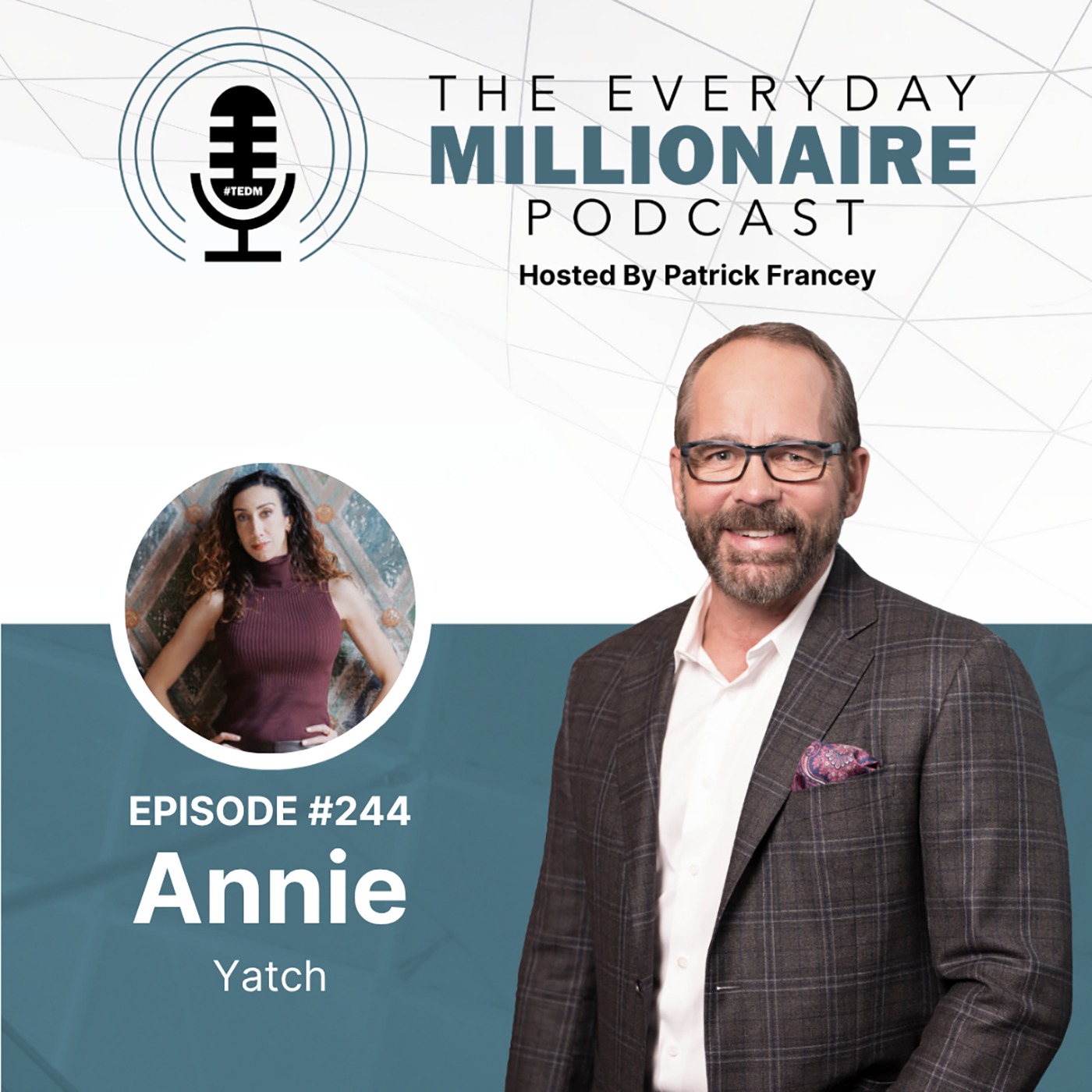
The Everyday Millionaire and Mindset Matters Podcast
Episode #244 – Annie Yatch Explains the Truth About High Performance Burnout
01:01:43
Loading summary
Transcript105 lines
- [00:00]
A
Foreign. Welcome to the Everyday Millionaire podcast. My name is Patrick Francie and I am your host. And I want to begin by saying thank you for listening. On this show, I am having conversations with seemingly ordinary individuals who have achieved some amazing and extraordinary results in both their life and business. My intention is to inspire and help you learn and grow by having my guests share their journey of how they face and overcome their challenges, but also how they celebrate their their many wins. And now let's get on with this show and have a conversation with today's guest. There's a moment that doesn't get talked about nearly enough. It's when what made you successful stops working. And it's not because you failed, but because you've actually outgrown it. Today's guest works in that exact moment. Annie Yach is a reinvention, strategist and leadership advisor who helps high capacity individuals redesign how they they live, how they lead, and how they operate when the old model no longer delivers. She works behind the scenes with CEOs, with founders and ultra high performers. You know, people who on paper have it all dialed in, but internally they know something is off. The effort is still there, but the ease of the effort is gone. The success is real, but the freedom isn't. What makes Annie different is she doesn't deal in surface level strategy strategy. She blends behavioral science, leadership, performance and trauma aware change to help people break patterns they can't out think. And she helps them rebuild a way of leading that's actually sustainable. This is not about doing more. It's about becoming someone who no longer has to become more. So if you've ever felt like you've outgrown your own success, this conversation is going to hit. Let's get this show started. And yet. Welcome to the Everyday Millionaire podcast. Thanks so much for joining me.
- [02:15]
B
Thanks for having me. I'm so happy to be here.
- [02:18]
A
Now, to the degree that we listen to bios, I like to open because bios never seem to do justice to my guests. You know, they're often not up to date and most of my guests are always a, you know, doing something. They got things going on and things change a lot. So I prefer to open with a really fundamental question. And that is if somebody walks up to Annie and says, so Annie, nice to meet you. What do you do? How do you answer that question these days?
- [02:48]
B
So what I usually say is, I'm the Chief Transformation Officer for businesses. It's the missing C suite. So for businesses and entrepreneurs that want to transform their, their minds, their their physical life and also their intimate relationships. I'm typically the one that they hire, and I end up typically working with the family, as well as sometimes even the kids, the ex wives, the current wives. Usually when a family or a team member works with me, it's a whole family experience. So it's been really exciting to help more people that way.
- [03:18]
A
I love that. And, you know, I don't want to go off on a tangent just yet. I mean, this is a space that I play in myself and have for many years. So I hear what you're saying, and I'm going to unpack that a little bit in just a minute. But share with me how you got on this part of your journey. How did you go to develop this particular business model that you have where you're working with those individuals? What was the kind of path to get you there, if you will?
- [03:46]
B
Well, it was a very interesting path. I started in counterterrorism after graduating from Georgetown University School of Foreign Service. And I thought that I would go down that path. But I realized very quickly, I cannot lie to save my life. Everything shows on my face, and I care too much about people's hearts. And so I diverted out of the intelligence realm after working for the Defense Intelligence Agency. And I started down this entrepreneurial path because at the time, I met and fell in love with a Navy seal. And when I met him, I was. He was very horribly injured. And he was like, I don't know what I'm going to do with my life. I don't know what my purpose is. And I was like, well, isn't there a need in this world for us to backwards engineer and better figure out what the most elite teams in the world, that elite. What if we could bring that and bottle that into corporations and teach companies and teams how to lead like the seals lead? I'm like, what if we could do that? And so from that moment on, we were sort of in this exciting entrepreneurial endeavor together that ended up being three different businesses where we were bringing the elite models of mindset systems and structures from the SEAL teams into companies that made between. Usually it was like 1 to 60 million. We had a couple of billionaire clients, but we worked with a lot of different companies to try to make their teams even higher performing. And then once we discovered, well, once I sort of saw that you can bring a lot of great leadership training to companies, but if the entrepreneur who's leading the charge, the owner of the company, tries to just keep jumping back into micromanage, you're really not going to have the robust team that you would want. So I started instead then working with the entrepreneur, the CEO first, to say, hey, listen, we can't have you jumping back into, destroy or cause chaos for the team that's in a very high level of performance. What do we need to work on here that's between, you know, these six inches in our heads that's causing you to jump back in when all you want to do is scale and grow your company.
- [05:35]
A
Yeah. So that's always interesting, isn't it? There's the entrepreneurs who become business owners where they can step back and start to realize that they have the vision and they need to lead that vision and lead the team to kind of work backwards to achieve that vision. And then there are the operators who built their businesses and letting go that operational aspect of it is probably quite difficult. But having said that, you can't scale the business without actually surrounding yourself with a team of people. I think that sounds like where you enter the space going, let me support you in achieving that goal where you're an actual business owner, not just a technician or an operator. Is that a fair statement? Annie?
- [06:20]
B
That's a fair statement because I think a lot of entrepreneurs think that they are the business owner when they're in actuality an operator, action taker.
- [06:28]
A
So when you enter those conversations and then what I heard you say earlier on is that, you know, all of a sudden it becomes quite holistic where you know, you've got family involved and you're kind of looking at, okay, I operate from a place. And then this would be maybe an interesting conversation with you. And given your expertise is I always look at an owner, operator. It doesn't actually matter whether it's a CEO or an all star mom or dad, you are the center of your universe and it's up to you to look after yourself so that you can look after those around you. But having said that, they have to be engaged in the same kind of thought process, if you will. So I'm just touching on a little bit of where I think and I want to give you a point of entry. Am I being accurate in that thought process that you have as well? And is that you need to look after you, which means that you need to and look at your life and what's going on in it relationally with friends, family, whatever that might be. So I know I'm still very high level and kind of vague in that thought process, but is that along the lines of how you're thinking? Annie?
- [07:37]
B
Well, I think Typically what you said is very accurate, right? If you don't have the same language as the people around you, then it's very hard to coordinate action with people that you care about. So I think one of the main things I always work on is I'm like, well, if you're doing this transformative work, it might be helpful for your spouse or your significant other. And typically when the spouse sees the person changing or the kids see their father or mother changing, they're like, well, what are they doing? What are they doing differently? So that's when I end up working with the families. But it's almost always to make sure the whole family has the right language around the work that they're doing.
- [08:08]
A
So where does the, you know, you said something when you talked about you came out of a counter terrorism world to the degree that you played in that space, but you obviously had some degree of training in that space. You're hanging out with a Navy SEAL or a group or whatever that might be. How did that play into what you're doing today?
- [08:31]
B
So I think what I started to realize as I was observing, because I worked at the time with like probably 30 to 40 Navy SEALs, we were working at the time with Jerry Bruckheimer and Disney to try to end the piracy of or the theft of big blockbuster films. And so working with like 20 to 30 to 40 Navy SEALs at one time, you start to see some of the similarities in how they think. And I found it so fascinating, like the way their brains would plan for missions. I was like, gosh, I wish in the corporate world we had the ability to learn this skill set. So it really became my fascinating, my fascination with how their brains function, how their brains worked, and how to see if we could backwards engineer that which makes them really great as leaders and could we bring that to companies all across the U.S. so really, because I was in counterterrorism, I liked observing people's behavior, I liked watching behavior. And then I started learning more about the neuroscience of behavior and it became this sort of very clear path towards, well, if we want to change people's behavior to make them higher performers or more elite performers, and if we can weave in some of these skill sets, these mindsets of these super elite performers, there might be something here that we could take with us and run with. And ironically, it ended up being we were coaching fifth graders on leadership from all these lessons that we had learned. And as we were coaching a fifth graders group on leadership with a curriculum we put together the head of 3M called us and said, this is the best curriculum I've ever seen for teams in general. Can you come in and teach my leadership team what you're teaching to the fifth graders? And it was sort of this mind blowing moment when I said, of course, we'd love to do that. And then that's how the executive leadership, the high performance coaching took off.
- [10:08]
A
When you look at, you know, the clients that you've worked with, you know, especially for those who are still a little bit owner, operator in terms of how they frame and what they're doing in their business, having troubles, letting go, whatever that might be, have you found that given that mindset or that thought process that you observed with Navy seals? My thought process or my experience around these kinds of things is that not every owner, operator, technician is cut out to be a CEO. They're not designed for that. Do you ever find yourself in that scenario where you're dealing with somebody where you have to kind of point out to them that they're not equipped to be a CEO? They're not designed that way, their operating system isn't, and it's not the best use of their talents? In other words, you may need to be the president and hire a CEO. You may need just to be the owner and hire a CEO. You come across those scenarios because when you think about what it takes to be an accomplished and grow a business in that position called CEO, not everybody has that skill set or is designed to do that. But what's your experience in that regard?
- [11:20]
B
Well, I think that while not everybody is designed to play that role or to do that role well, I think that what I get hyper focused on when I work with entrepreneurs that are in that role at the moment is how can we streamline this role to better fit your genius zone? And what I found from working with so many entrepreneurs is that what an entrepreneur thinks is common sense and everybody on his team should know it's actually his genius that he hasn't documented. And so that's. I worked with a lot of entrepreneurs. I'm like, listen, you may or may not be the CEO, and you may or may not play that role well, but we need to figure out what is your genius zone, what are you incredible at? And then how do we streamline the company so that we use that role? But you may not have the same title. You know, it just depends. As people get smarter and smarter about what they want to do for their business and what their purpose is with their business, I think they're more willing to change that role title.
- [12:09]
A
Now you're working with Navy seals and your, you know, your observation of is how they plan, how they work through the thought process of a mission. You know, are there qualities that you would say that really stand out for you in those individuals? I mean, aside from their, you know, whatever degree of physical toughness and mental stamina. But are there qualities of those individuals that you know that when you're meeting with a CEO based on your experience, you're hearing it in their language, you're observing it? Are there two or three qualities that you see that you immediately have to see or that you immediately have to kind of guide them to get? I don't know if I'm asking that question the right way, but I'll try it on you for size anyways, if you understand my question.
- [12:55]
B
Well, I think I understood it, and please interrupt me if I haven't. But usually when I work with a CEO, I can find out pretty quickly where their fuel is coming from. And so for a lot of the CEOs, especially in the work that I do, they have something that I call the negative fuel. So they've built a business based off of something in their childhood where they had to prove themselves, typically to a father figure or to an overly critical parent. And so when you have a CEO that has had to prove himself, he's typically still in the operator position, even though he's. I mean, the cap of the money that people make is very different. Right? So you can have a CEO who's making millions of dollars, but he's still doing far too much on the action taking and not enough on the management side. So it's just really fascinating to watch. But what I learned from the SEAL teams really is that if we're going to do any planning with a CEO, we really can't start with the strategy or the tactics. We have to start with the emotional feeling that that CEO is going to create with the outcome that they most want. The seals, when they plan for these impossible missions, they actually go in and they talk about what's the emotional feeling that we want to feel when we're successful at the end of this mission? And they drive everything from the emotional feeling of success, and they tie every strategy, every tactic to that emotional feeling. Now when I started bringing that into companies, they were like, why would we want to use the emotional feeling? But once you do research in neuroscience, you figure out really quickly that the emotion of something is what drives people forward. It's what sustains momentum, it's what sustains motivation. If you don't start with motivation and this emotional feeling. Then people fall off pretty quickly because they're. Then they're just doing their jobs for a certain paycheck. So very interesting awareness from the SEAL teams that I ended up weaving back in to the work that I do with CEOs.
- [14:38]
A
Now when you're working, you know, you're working with the CEOs, are you working as well with their teams? I mean, the team is a reflection of their leader. Yes, at various levels. And as part of that, are you also saying, okay, you're working with this particular CEO, you're helping him get out or her get out of their own way, but you're also saying, okay, how does this translate into the team and the work that you're doing with the team? I always think about, I've been in business 43, 44 years, still a business owner, still doing what I love to do, or trying to. I guess the question there is that I always have been really focused on culture and environment. So when I think about the thought process of the culture of a Navy SEAL team, to the degree that I watched or heard about it, et cetera, there's culture and there's environment that they create for themselves. So are you also doing that and working with the CEO to do that with their teams as well?
- [15:43]
B
So I do. I think that with Most of the CEOs I've worked with, once you do enough work on them so that they realize what they've been doing and who, excuse me, who they've attracted and magnetized to them in their team members. We start to realize as the CEO up levels, a lot of the team members that were from that old pattern of how he used to lead will drop off or be fired or be let go because it no longer fits the culture. Right. So that's been something very fascinating. So usually when a CEO hires me, I'll do the work with that individual first. But over time, it's almost inevitable that he'll be like. Or she will be like, Annie. There are these three people on my team. I'm not sure what's going on here. Can you jump in and figure out what's going on with them mentally to see if we can, you know, help them be higher performing, create more for their families? And so that's sort of how that evolves sometimes. But what I notice is that the team, as the CEO up levels will shift and the dynamic will change, and the leadership culture will actually change as the CEO does that work. So I prefer go in and work with The CEO first rather than start with the team just because the CEO is going to be staying, he's not going to be leaving, she's not going to be leaving. And the up leveling of the CEO will dictate the culture and how the culture shifts.
- [16:52]
A
Do you find yourself going in and specifically working with the team to say, okay, we define the culture that we're in, we collectively are on, you know, on that page, it's up to us, do you go in and do that kind of work with a team? As an example, I'm just trying to get a handle on how you, your operational, your M.O. if you will.
- [17:10]
B
Sure. So if I, if I work with the CEO and then the CEO says to me, I need you to up level my team. What I typically do there is I use the book that my ex husband and I wrote together, which is called How Leadership Actually Works. And there are six pillars in that book. And from that book I will work with the executive team and we'll work on each one of the pillars to define the culture of the company based off of these six pillars of performance. And so it's really about training the executive team then on those pillars of performance and figuring out where there are the gaps. So that's typically what I'll do if I come in. And then also the CEO might say, Annie, you know, I want this team to be higher performing. What can you do individually with each member? And so then I'll put a program into place for the individual members.
- [17:53]
A
You know, in my years of experience and working with literally thousands of real estate investors, small business owners, you know, what I've come to understand and realize is that the how tos of business are pretty, I don't want to call them straightforward, but they're pretty straightforward. I mean, there's a way to operate a business and all of the things that you need to do, from sales to marketing, to creating team, blah blah, blah, all the rest of the stuff. So the hows of operating a business are out there. I mean, you can get how to invest in real estate, how to own a business, how to be an entrepreneur, but the one component that seems to be missing, that you're hitting on for many is, and I don't like to use the term so much anymore, but I still use it, which is mindset. How much of that, you know, where you're actually having CEOs who are so strong technically in their operational skills, but don't have the mental fortitude, if you will, the, the ability to self reflect or to you know, observe their thought processes, if you will. How much time do you spend with them? Or is that kind of where you actually enter the convers?
- [19:02]
B
That's almost always where I enter the conversation. Because if I can't show a CEO something he's missing, something that's in his blind spot, he won't hire me. So from my perspective, the first place I start is, and I don't even call it mindset anymore, I tend to call it subconscious infrastructure. Because really, the subconscious infrastructure, those 11 million data points that run you on autopilot that are causing the most problem in your business. And a lot of people just can't see what those sabotage patterns are. So I'll typically come in and within half an hour to an hour, I can identify, here's the pattern that's been running you that you may or may not be aware of. And the person will typically be like, well, this has probably been running me my whole life. I'm like, well, do you want to keep running you? Because you're making decisions based off of a pattern that you didn't consciously choose. So that's going to get you where you want to go in business.
- [19:52]
A
So interesting that you bring that up. I've shared this story countless times. It's, you know, it's, you know, my, my wife, who's a world and Olympic class mental performance coach, working with athletes and business owners for many, many years now. But when we first met almost 40 years ago, she, you know, we, we were getting to know each other, going through this process, dating, all the things that we do. And I had a way of being. And I would, you know, back early on in our relationship, she referred to me as her favorite Neanderthal. And it was just how I developed. And she was, you know, I definitely married up. But the point is, is that there was ways I would react to certain situations and the way it would be. And she would say, why do you do that? And I would say to her, it's just the way I am.
- [20:40]
B
Oh, wow, okay.
- [20:41]
A
And one day she, Whatever I did and however I reacted to a scenario, she says to me, I. She said, why do you do that? And I said, I don't know. It's just the way I am. And she looked at me and she says, you know, it's a choice, right? I went, what? And in that moment, it was like, holy cow. I never occurred. It never occurred to me. And so that was really the journey that I began that many years ago in my own personal. We'll call use the Term personal development. And you know, personal professional development back in there. And it was a game changer for me. That was definitely, definitely a huge fork in the road moment. And so anyways, I, I changed enough.
- [21:29]
B
I love that story and I feel like your wife and I would get along very well.
- [21:33]
A
I'm sure you would. And so, no, I don't want to surround her with people that agree with her too much. That's, that's dangerous to me. I joke. So, you know, there is, there is that space where, you know, it is a conscious choice, but first you have to realize that, you know, it is an external thing that's in our way. I'm going to just plant a seed with you. You called it subconscious. Use the term again.
- [21:58]
B
Subconscious infrastructure.
- [22:00]
A
Subconscious infrastructure. That's the first I've heard that term. That's a cool term because like many I've used operating system before. And I use that as a kind of a point of what is your operating system. And that really is part of what you're using in the phrase, all phraseology that you're using. So the point is, is that we all look at it and we say, how are we getting in our own, our own way? And those are belief systems and all the things that we go through. Are you partnering with the, you, you mentioned the Navy SEAL that you were working with. Are you still working with a Navy. Former Navy seal.
- [22:40]
B
He was my ex husband now, but we worked together for about 15 years and did a lot of this work together. He was sort of the, the keynote speaker for the company and then I ran the three companies that we had.
- [22:51]
A
So do you find that CEOs are open? I mean, there's so many individuals that when I have met and just through the nature of being in business as long as I have, I've met many, many CEOs and I'm always surprised that the degree, or I'll just use that term, the degree. So some CEOs are very much into their own development as leaders, you know, even we'll call it personal development. Professional development is more palatable for many, especially in the men's world. Do you find that you're often dealing with clients that are not as open to that kind of look in the mirror and see where you're in your way? Or is that part of your own filter system and who you take on as a client?
- [23:36]
B
That's usually part of my filter system. Right? Because I have quite a few referral partners that will pass me, people who have, you know, who I've worked with personally who have then said, you know, you need to work with this person. But what I've found is that if you have too big of an ego, if you're not willing to look at yourself, if you haven't done any professional or personal development in the past, it's going to be more difficult when I throw ideas at someone to see if they're open to them, right? So in the interview process or discovery call process, I will very quickly see is this someone who can take coaching on or not? And if they can't, I'm like, no, thank you. Let's, you know, here are five other resources you can, you can work with. But you have to be really ready to do this work. This is not superficial work, right? As you know, it's extremely deep into the subconscious mind, into the conscious mind, and trying to bring the subconscious, the conscious together as much as possible for decisions you make in your relationship and decisions you make in your business.
- [24:29]
A
It's an interesting journey, isn't it? And I would like to hear your own experience in terms of your observations is that, you know, many people start on this, you know, they think about mindset and then it becomes this thing about mindset and they go on this journey of personal development and they read a book and they start on that journey and their work around some professional development. I found over the years is that where I've got to in understanding mindset and that kind of mental work that we have all done at some or most have done is that mindset is about external things in a lot of ways. How do I deal with what's happening outside of me? I've now gone into a world and I share this with you to, with the value that you see with it. And that is we then get to a place where it's about self mastery, understanding that it's all internal, it isn't external. And understanding, to your point, around those hidden beliefs that we operate on top of or the blind spots that we have, or the subconscious or whatever operating system you have that, that there's so much language around it. But I find that for me, and I would like your view of it, it really is about self mastery in the world. So that it translates into how you lead, how you see the world, how you deal with people, including those closest to you. What's your thought process on that, if you will, Annie, if you have one?
- [26:01]
B
I would say self mastery is the most important part of growing a business because if you do not have the awareness of self and how you move how you think, how you act, how you behave and why you do those things. You're going to create a business that might make you a fair amount of money, but it will never make you feel fulfilled. And so one of the things I'm most passionate about for entrepreneurs is I'm like, how do we get you to feel more fulfilled more quickly with the business that you choose? By better understanding the internal operating system. And once you understand that, then you can craft and create businesses from that internally aligned place, which makes life so much easier on all levels. So that's, that's what I would agree with 100% with you.
- [26:41]
A
So is there a place any, like, if you're somebody listening to this and they're either a CEO or an entrepreneur that wants to go into whatever next level, are there things that, you know, you would say are indicators that you need some outside? I mean, to me, and I'm sure with you, is that coaching? I mean, I've been, I've coached for many, many years now. But my, I still hire coaches, I still have specific people I reach out to. But if somebody is, you know, questioning do I need a coach or what should I do? Or do you have any indicators if somebody's listening to this? Would there be something that you would say that based on your experience that if you're feeling this, saying this to yourself, having these conversations, whatever the case is, that you should be considering having somebody work with you?
- [27:33]
B
There are definitely a couple of areas. So the first thing I would look at is the revenue that their company is generating. And I would say, have you been stuck at a specific revenue level for more than a year? Because if you stuck in revenue and it doesn't matter what the level is, it could be 8 million, could be 10 million, could be 1 million. But if you've been stuck there for longer than a year, it means there's something going on in your subconscious that you have not solved yet. That's a really big one. The other thing that I ask people to do is I say look at your life and look for any area where you are suffering. If you are suffering in an area, it means there is a lie in your subconscious that you have not revealed to yourself yet. If you cannot reveal that lie, you cannot improve and get out of suffering. So those are the two things I'm always asking you to look at in order to figure out, do I need a coach or do I not?
- [28:18]
A
I love that thought process. Can you give an example? Is there something that you can pull out of your memory? That might kind of illustrate that so people can really sink their teeth into it.
- [28:28]
B
Well, I'll give you an example of the first one. I had a gentleman come to me who had only ever been at just underneath 2 million. Every time he'd get close to $2 million, he would end up in the hospital, horribly sick, like, almost on the verge of death. Wow. He was going after a really big IPO with this company, and he was like, I can't get sick. I can't have any of this happen. And he had heard about me from a friend of ours. So he reached out. He's like, annie, there's something going on in my mind. Every time I go to hit through this $2 million barrier and I get horribly sick, I almost die. Can you help me figure out what's going on? So we dove into his background. What we identified after a little bit of work was, oh, my goodness. When he was 15, his dad died. At the time of his dad's death, his dad had only ever made $2 million. And his dad talked about this a lot. And so he created a story in his subconscious that if made more than $2 million, he would die, which is why he kept showing up at the hospital and almost on the verge of death every time he got close. So he worked to rewire the story so that he wouldn't have the cap, his revenue anymore. And he blew through that gap, took his company and IPO status, made millions. So I bring this up because that's an example of you're stuck in something you've tried to figure out on your own. You can't figure it out, but it's a revenue cap that's affecting your business, your team, your ability to grow and scale. And you don't know what it is anymore. You're like, it's probably got to be me, because I'm the common denominator. That's one example.
- [29:53]
A
And that's such a great example. And, I mean, we hear these. You know, some have used the illustration of. It's like a thermostat, right? It hits a certain point, and then boof. It kicks off. But something else that you said, and I think that I would encourage people to really look at one of the indicators is. Is that our mental state? And you know, this. I mean, it's. We think it's common knowledge. Probably not, but the. Our mental state often manifest. Manifests itself physically in forms of illness. And I've had people go, yeah, no, I'm not buying that. I can tell you I had A staff, this was years ago, a guy staff that he was great. And we would get into some really. But when he screwed up, I was really hard on him. And I remember I would pull him into the office occasionally. It seemed to be an every quarter kind of thing, but anyways. And I would kind of get into it with him and kind of call him out on his stuff in a really respectful way. But he felt that pressure and I would literally watch him get sick, cold in front of my eyes. He would literally, physically, the next thing I know, he's all stuffed up, his nose is running and he was just a, a mess. And that would all happen within a 60 minute conversation. And so, you know, that to me was always such proof that we manifest stuff physically. And then one a friend once pointed out to me and he goes, well, you know, what are ulcers caused from stress? Well, he goes, there, perfect. That's a perfect example of physical manifestation of what we've got going on mentally. So I always point that out, you know, for people in self assessment. I don't know if you've had any more experience with that or your thought process on that, Annie, but does this showed up for you in the past?
- [31:39]
B
It's definitely showed up for me. And sometimes I'll even see that people have. And I know this doesn't sound super kind to say, but they'll have like what I call a trauma reaction in their face. So, like, you will have a certain way of breathing because of some trauma patterning from their subconscious. Some people will have a certain way of blinking. And so what's interesting is they'll blink or they'll do this one facial thing whenever they talk about something from their past that's still impacting their current environment. So, you know, from my background in counterterrorism intelligence work, I like watching people, watching their body, their responses, their reactions to things. So I would say you are completely accurate that you can have it. See it as a manifestation in the physical form. What I find for a lot of the entrepreneurs that are hitting that barrier, if they don't recognize that it's a revenue barrier, it's usually because they go to sit down to think about something and their brain's running too fast. They can't meditate and they don't know why they can't do some of these things. They'll try, but their brain won't shut, won't turn off for them, or they won't be able to sleep well at night. And usually for me, that's an indicator of a hijacked nervous system. And the hijacked nervous system is also where we run into trouble as an entrepreneur, because if our nervous system is hijacked, we're not making decisions from a calm and neutral place. We're making it from a place of urgency that is almost always tied to subconscious infrastructure. That's not helping you succeed.
- [33:01]
A
Wow. Now, I think you have a process. Do you have an assessment process that you share with your clients before taking them on, or once you take them on, you go through an assessment. Is that a written assessment? Is it. How do you kind of assess where people are at? What's your. What's your. How do you get a benchmark for where they're at? Is it just through conversation, or do you have actually a system or a process?
- [33:23]
B
It actually depends on how they hear about me. So if they hear about me from, say, a podcast, they'll probably get linked up to my energy leakage quiz, and they'll figure out, like, where's my energy leaking? And how is that causing me not to step into my authority and my business or my leadership in a certain way? So there is an assessment that people can do that I'm happy to share with you and the people that are listening. But more often than not, that's sort of the superficial level, because we're trying to just figure out, why is your energy not where it should be? Because the energy, the amount of energy, passion, excitement for life, that's always an indicator of how in alignment you are. Right? So if your energy's way off, just like a manifest manifestation on the illness side, it's an indicator, okay, something is off in your leadership. How do we figure that out? Now, normally I have a, you know, like a discovery call or call with somebody, and I'll be able to assess them personally. But I think really good resource for people that may never work with me but are trying to figure out, like, what is the gap here? What am I missing?
- [34:17]
A
Earlier, you. A little while ago, you mentioned meditation. What does meditation in your world look like? How do you guide clients in meditation? Or do you.
- [34:30]
B
So for me, in my world, when I ask someone to do a meditation, it's usually a meditation on a theme, right? Because I'm trying to rewire the subconscious, and I'm trying to help the subconscious think very differently in those 11 million data points. So a lot of what I do for meditations are very customized to the client. What I tell people is if they're not working with me, the easiest way to start meditating is to use a word like peace and to say that over and over again because it helps you remove some thoughts that are not supportive. And if, you know, if they can't use the word peace. I like to use the concept of basically saying, be, be still, be still and know. Be still and know. Am, be still and be still, be. Just to have like a little bit of a repetition there that the brain can get into a good rhythm around. Because meditation can be very hard for high level performers simply just because our brains are running millions of miles a minute, our nervous systems are hijacked because we've been in the same patterning for 10, 15 years. It's very hard to get out of that through just meditation alone.
- [35:31]
A
I think there's a thing about meditation and I've trained in TM, transcendental meditation, gosh, 25 or 30 years ago. So I go back to meditation. I'm not, you know, it's interesting about meditation comes in and out of my life and it seems to be when I'm trying to solve problems or I'm feeling stressed or I'm feeling out of whack that I go to meditation rather than just have it as a daily practice. Over the years, I've had it as daily practice for extended periods of times, like years at a time. I've noticed recently that I've got out of meditation, which is so interesting because I know better. And the common pushback from people who are into meditation is they go, oh, I can't stop the thoughts from going. And I go, well, no, you're not trying to stop thoughts from happening. You're letting them come, you're letting them go. That's the key. Let them go, let them go, let them go. Is that a kind of a common thought? I'm sure it's gotta be. The most common pushback you get is I can't stop my mind. And the whole goal. Well, we're not trying to stop your mind. We're just trying, trying to not hang on to thoughts and you have to let them go. What's your thoughts on that?
- [36:41]
B
Well, I think that you hear that quite a bit from people who are high level performers in the space. And I honestly, like I used. I started with meditation very early on, right in my journey. But I found that sometimes it just wasn't as helpful for me. So instead I turned to some of the ancient Hawaiian practices and I use ho' oponopono all the time, which is more about, you know, forgiveness practices. So I'll do a forgiveness practice in the morning, I'll do a forgiveness practice. At night, I'll cut the cords with the people that have been attached to me throughout the day or even people from the past. I find that. That for me, because it's an activity that you're doing to clear your mind, it's more powerful than just a random meditation here or there. I did like transcendental meditation. That was helpful. But I do feel for many of us, there's so much that we're trying to process from the past that we haven't spent any time working through. So that's why I like to use forgiveness instead.
- [37:32]
A
Yeah, I mean, there's so many modalities around doing these bodies of work. I'm a big fan of journaling because I've come to understand over the years that, you know, one of the things that I've learned. And maybe you can confirm this or say no, but my own thought process or my own training coaching has always been that our brains are very unique in a. In a way that when you journal, when you write things down, your brain literally gives itself permission, if you will, to not hang on to that. So I often refer to, you know, in the old days, we used to defrag a hard drive. You know, it was like, get cluttered, get full. And our brains, I look at that and say, well, it's like a hard drive you need to defrag, you need to declutter the brain. And the way to do that is if in a journaling practice, as you write, your brain is letting go of that, knowing that it doesn't have to remember it. So you're actually freeing up space for better ideas, more creativity to come in. So that's high level. What's your thoughts and impact of journaling and do you recommend it as a tool?
- [38:44]
B
So I think journaling is a fantastic tool. I use it with almost all my clients. Only differentiating thing that I do that's a little bit different is I found a company about seven years ago that calms the nervous system at the. At the same time through some of their technology. And so what I do is I pair the journaling with the specific technology it was based on. I don't know if you remember the movie Limitless.
- [39:03]
A
Oh, yeah, yeah.
- [39:04]
B
So that technology actually does exist. It just doesn't give anybody any negative side effects. Right. But it does exist. Expands the brain, it calms the nervous system. And if you pair that technology with journaling, the brain can build new neural pathways in a record amount of time. And so if a client of Mine is working on journaling. I'm making sure that they're taking their capsule or their sprays at the same time because it allows the brain to expand so dramatically. So that's where I found that journaling is fantastic as a resource. I just like to take it to the next level with calming their nervous system at the same time so that the neuroplasticity increases.
- [39:38]
A
Is that a specific product that you recommend?
- [39:41]
B
It's from a company that I found about seven years ago. I don't represent the company, but I do. I have had a lot of clients want to hear about it. So the. The company is called Biome Tech, and it is not very well known, but what they've created in technology is just incredible.
- [39:58]
A
Wow. Okay. I'm going to have to do a little bit of investigation on that, and so thanks for sharing that. So I want to go to veer off this conversation a little bit, and I want to know a little bit about Annie. I mean, I can't step over counterterrorism, because that's kind of sounds cool.
- [40:15]
B
It does sound very cool.
- [40:17]
A
Yeah. How the heck did you get on a journey of counterterrorism? I mean, how did you get there? I mean, forget the fact or aside from the fact that you've now moved on from that, but how did you get there?
- [40:28]
B
I was a very patriotic young lady for most of my childhood growing up. Like, I stayed away from a lot of bad, quote unquote, bad things in life because I was like, well, someday the CIA is going to hire me and I'm going to save the world. And when I got to Georgetown, I went through their school foreign service. I met this incredible female lawyer who was, I believe, at the time, the CIA's first female attorney for international law. And she sort of took me under her wing. And she. She was one of my professors. She did incredible work with me. She's like, you know, you would be amazing at this. Would you ever be interested in pursuing a legal career as at the same time as working for CIA or one of the other agencies? And so I started getting involved in that concept and working, going through some of that process. And I realized after being interviewed by a couple of different CIA people that they're like, you know what? You are one of the kindest people we've ever met. We think this might crush your heart a little bit. So if there's anything else you would ever consider doing, you should probably look into it. And I took that to heart because I think when you're young and you're very excited about a career in a certain area, but then you get to sit down and talk to people that have been in the field doing these things over and over again, and you see how their energy is so different than your energy. It really helped me to better understand, like, maybe this isn't the right fit for me. And to be honest with you, it would just. It would have destroyed my soul, my heart to have to leave people in country and not be able to get them out or not be able to keep my promise to them, to support them or help them. So I think for me, it was the right pivot at the right time. And, you know, it's not as though I didn't enjoy learning everything that I learned. It was just, well, I think God had a different plan for me.
- [42:01]
A
Sure. What was. Do you recall? You know, so your mentor at that time had suggested that, hey, you'd be really good at this. What were the qualities that you had that she spotted that said, you know something, she'd be really good at that.
- [42:18]
B
I don't know everything that she believed about that at the time, but she did share with me. She's like, you're a natural people person. She's like, everybody around you always feels more connected, happier, like you really see them. She's like, that's just an incredible gift. And then she said, you know, you're very well spoken. She's like, you know, when you have a concept that you have to explain to someone, you break it down, make it easy for them to understand. So she said, your communication skills are very high. And I think, you know, woman to woman, as you're in that experience with each other, you know, I think she just saw that I had a desire to really change and help the world. And I think, you know, you can change and help the world in so many different ways. But I think, you know, my gift, hopefully, to humanity, was helping people transform the way their subconscious brain works. So even though I didn't do that in the counterterrorism side, a lot of those skill sets, I think did contribute to me being a very good listener and a very good assessor of patterns and risk. It's just assessing the risk in your brain.
- [43:15]
A
Sure, that's cool. So you hear today you're a coach, you're an entrepreneur, business person. I often investigate the question, is it nature or is it nurture? And so I think about part of the show over the years has always been about seemingly ordinary individuals who've achieved some extraordinary results. But my area of Interest is always, how did we get there? And as you know, I've had the pleasure of now interviewing hundreds of guests who have hugely accomplished or not, but have done some really cool things. How did you get on your journey? Were your parents entrepreneurial? You know, was your dad a business guy or your mom or how did you then say, you know something, I'm just going to go on this entrepreneurial journey because that's what you're doing.
- [44:05]
B
So my journey was very unique. My, my father was not an entrepreneur. He worked in a business. That was not what he wanted to do. My mom was a stay at home mom at the time. And I think what really happened for me was I had this big dream about going into the CIA or the DIA to help keep the country safe. But what I realized very quickly in that journey was I'm not sure that this is me. And so when that came up, I remember at the time I had been, gosh, I'd been starting launching a restaurant. I'd been working with a celebrity chef. I had met this Navy Seal and I was just like, the way his brain works is just fascinating to me. I'm like, I wonder if there's something I can learn here. So I was always such a big learner. I never even realized I was an entrepreneur until literally three businesses later. And it was a bunch of my clients sat me down and they're like, you are the entrepreneur. They're like, you've built three businesses from scratch. You built all these teams. They're like, you're constantly trying to solve and make the world a better place. They're like, you want to create impact everywhere you go. They're like, this is not normal. This is not like just some random thing. And so I think for me, I never realized I was the entrepreneur and I never really wanted it. It was always, how do I solve this problem? How do I bring more benefit to the people around me? And I think it just naturally created from there because I always knew there had to be a better system, there had to be a better way of doing things, there had to be a quicker way to get people to more happiness, more fulfillment, especially in that entrepreneur space, because it seems like so many of us are running, you know, hustling, grinding, driving forward. But not everybody is very fulfilled. And I really want to change that game for entrepreneurs because they create so much wonderful worth in the world for the families and the people that they hire.
- [45:48]
A
So when you're doing the work, and so that's, you know, I've often said you know, I certainly didn't know I was going to be an entrepreneur. I've only had one job in my life, and that was many, many years ago when I was 18 years old and I had a job. And then, you know, the downturn in the economy, there was no jobs to be had. And the next thing you know, I had several entrepreneurial accidents over the year years. And, you know, that's how I became business owner slash entrepreneur.
- [46:16]
B
And.
- [46:17]
A
And I've had several, like I say, what I call entrepreneurial accidents. You were. Sounds like you were very intentional about what you were doing. Mine was like, more opportunistic in that, oh, this is a cool concept, cool idea. I think I could take this to a next level. And the next thing you know, I own the business. And that's kind of how that unfolded for me. You're a little bit more or a lot more intentional than I was about it, by the sounds of it. In all the work that you're doing, you know, you said something that is around fulfillment. Do you have your own philosophy in life in terms of what a business has got to do for you? You own your business. You're the entrepreneur that you are. What are some of the driving factors for you that you've learned about yourself? That I need this. I mean, there's the fundamentals we all need, you know, we all need significance. We all need to matter at some level. We, you know, ultimately, as long as we're being a contribution, I'm sure that's the way you are. You need to be that contribution in order to have that sense of fulfillment that you're looking for. But what is it for you? I don't want to put words in your mouth. How do you operate in terms of when you're looking at what you're doing and how you're doing it, what lights you up? What is a kind of this has got to work this way for me or it doesn't work?
- [47:33]
B
Well, I think it's changed over the years a fair amount. But I remember if you'd asked me this probably two years ago, I had tried to redefine success in my life because I felt that the way we define success in our culture didn't really fit for me. So when I redefined success, I thought of success as an optimized daily environment that I can sustain over time. So I really looked at how do I create an optimized daily environment, an environment that I love every day, that I can sustain over time consistently. And that forced me to really look at the schedule and what my ideal day would look and feel like and then build a business around that. And what I noticed is this. So many times in the first three businesses I built, the businesses were built to solve a problem. They were not built off of what I would like to experience in my life or the day to day experience with my children that I would like to have. And as I've gotten older and I've made more mistakes and I've learned from those mistakes. Now, you know, the business that I run where I privately coach and I run these group programs, it has to be, I have to be passionate about the people that I'm helping. I have to be able to help more people than I've ever helped. And I also feel like it has to fit my day to day sustainable lifestyle. So for me, you know, it's, it's all about I get to wake up in the morning, I get to snuggle with my kids, I get to have a great breakfast, have a great workout, and then I make sure that I can dive in and provide huge value to people because I'm in such a happy place myself. And I never would have thought this back when I started businesses 10, 15 years ago. I would have, nope, gotta solve the problem.
- [49:01]
A
Can you? You know, it's interesting that over the years I've quit asking the question of how do you define success of my guests. I rarely ask it because it often as I'm going to, at the time, it was most often it caught people off guard. Surprisingly many people can't define what their definition of success is. So I'm going to ask you to repeat how you define it because I think it's really good. And then I'll share a little bit of an insight with you on something else.
- [49:36]
B
So the way I define success is an optimized daily experience that you sustain over time. An optimized daily experience that you sustain over time.
- [49:46]
A
I love that.
- [49:47]
B
Thank you.
- [49:48]
A
So I'll share with you that I rarely ask the question, but a guest, and this was several years ago, but it just stuck with me. I said, how do you define success? And I don't know why I asked the question, but because I had not been. And he really came back at me just really easy, says, you know, when I wake up in the morning, I literally before I get out of bed, I get really grounded in my thought process. But one of the questions I ask myself is am I living the life that my, am I living the vision that I've defined for myself or am I Living into the vision that I've defined myself for myself. And if the answer is yes, then I'm being as successful as I see myself needing or wanting to be. I went, there's a really cool definition too. It wasn't about dollars and cents. It wasn't about growing a business to X and having this or that or overcoming this. It wasn't a moment in time. It was how they live their life, which is exactly what you just defined. It was more about how you define and live your life. That's how you have looked at it. And I think that is something that many can take away. You know, you can have a success where I've got a goal called maybe it's revenue or scale or whatever it might be. But what I like about this is that it encompasses all of life. You know, there's business, but there's life. We got life. It's just life. And that's what you've defined there from my perspective. So I appreciate it.
- [51:23]
B
Oh, thank you for that. It's been one of the biggest, I think, pivot points in my life was looking at success very differently because I think we get too wrapped up in the money of everything or the, you know, the KPIs are the metrics of everything. And I'm like, I'm sure I could make a lot more money if I had a different life I wanted to live. But the life that I'm living is so wonderful that I'm like, this is a really great combination of everything.
- [51:46]
A
It doesn't need to be more than that. It doesn't need to be more. That's so interesting. And some people are wired differently. And we were just back from, literally last week, back from Europe, and we had gone to Prague, we'd gone to Spain, and it was the observation, and we met some people down there and it really is, you know, lifestyles. Where we were there was a lot of lifestyles of the rich and famous. And it was really interesting to see how people operate and how they do their thing. And as I'm sure you've seen is money does not dictate life quality, if you will, relationship quality. And there's a point where you go, eh, do I really need that? And I'm looking at it through a different set of eyes, Andy, because what I've come to understand as what I'll call an old guy now, at 68 years old, a lot of things have changed for me. And in reflection, so I happened to go to a friend's birthday party and he had turned 50 and there was five guys, we all got together for lunch and they're friends and I hadn't seen, they live in Toronto by the way. And so I'm sitting, we're having lunch and I'm the old guy at the table and, and one of my buddies goes, okay, so PF, you know, you're 68 years old, we're all 50ish, what's your wisdom about 50? And I go, quit focusing on buying more stuff. And as was my. Because I realized that you get to a point where I'm just to a point where I spent all that time and energy wanting more stuff. And I'm going now, in reflection I'm going, did it really move the needle in the quality of my life? I would argue it did not. And to this day, like as I sit here today, I go, if I gotta insure it, wash it, park it, worry about somebody, like I, I don't want more stuff. As a matter of fact,
- [53:45]
B
I'd rather have the experience. I totally understand. Like, I'm like, let's go on the travel, let's do the experience experience things because those memories are priceless. But I think I've gotten to a point where the stuff side just doesn't matter as much. I'm like, what is buying this additional thing going to give me? Not much. But what is helping one more person going to give me a lot of excitement for their life? My life. The small little moment we had with each other to redirect and make that 1% change, that becomes the massive trajectory change for their experience.
- [54:11]
A
Given what's going on in the world these days as we're recording this, I mean there's wars but breaking out all over the place and the economy is questionable and you know, presidencies and prime ministers, I mean it seems quite this weird world. And I'm going to say that for me the line of demarcation was, you know, March 2020, when we had all the lockdowns. The world changed in that moment. You know, that for me was the line of demarcation. Are you seeing a shift in your clients attitude of life in general or, or not? I'll just leave it at that. Like leave the question there.
- [54:48]
B
Well, I think what I'm noticing, the big shift being is that people are now getting much more specific about what they choose to input into their subconscious or into their conscious thought. So for example, in the past, probably five years ago, nobody really cared if they had too many notifications on their phone or if they watched the news. Too much or if they were reading too many books or listening to too many podcasts. What I'm noticing now is everyone's like, tell me what I should cut out to make sure my subconscious is. Is pristine, moving. You know, a lot of my clients don't watch the news anymore. A lot of my clients don't listen to podcasts as much as they used to, a lot. Because the input was so overwhelming for their system that it would hijack the nervous system and cause them to make decisions based on urgency or fear instead of. Instead of decisions based on being very calm and very neutral. So I'm noticing a lot of the entrepreneurs removing inputs now and going after beautiful experiences that they can protect more so than anything else. And there is an uptick in people wanting to work on this, what's happening between these two quadrants of the brain, because that is the only competitive advantage most people have.
- [55:54]
A
I love it. Okay, well, our time is almost up here. I know that you don't have a hard stop, but we do have to be conscious of our time as we start to wind this conversation down. Annie. I like to do what we call rapid fire questions that are often not so rapid. But we're gonna.
- [56:13]
B
I'm ready. I'm ready. Bring it on.
- [56:14]
A
Ready. We just warm up. We always start out a little bit easy. And, you know, these are kind of reoccurring questions that my listeners always come back to me. Go. It's so funny. I'm always waiting for your questions anyways, the answers that your guests give. So this is always an easy one. We're just getting warmed up. So, Apple or Android?
- [56:32]
B
Apple.
- [56:32]
A
You're an Apple person. That's mostly. Not always, but I find my corporate guys are often Android, not Apple for some reason. I guess PC works better in that world. Not sure. Is there a book that was transformational in your life that you or. And. Or that you would recommend or that you gift something that was kind of pivotal that you read?
- [56:54]
B
So there are two books I can mention. The first book is the Way of the Superior man by David Data. So that's what all of my male clients that I work with receive from me. It just blew my mind. Better understanding the masculine feminine in relationship and how essential that dynamic is. And then the other book, it's a children's parable book called the Little Soul in the Sun. And it actually, I think, really beautifully explains why we have the experience of life that we have, where there's suffering and there's truth and there's ease and there's growth. It was the most beautiful book I've read about that experience as a soul on earth. That was helpful.
- [57:28]
A
Love it. Thanks. There's a. Only because you brought up Navy seal, there's a book that I recommend, I'm often recommending. I read it a few years ago and because it was Navy SEAL was Jocko Wilnick and it was called Extreme Ownership. That book is. I mean it was so impactful for so many people. Some like the way he wrote in his style and I don't remember who he co wrote it with or who was partner on that. I don't remember the name but Leif Bavin.
- [57:54]
B
I could be wrong.
- [57:55]
A
Yeah. Yeah. Great book. Okay, how about music? Our favorite band? Favorite song, Favorite genre of music?
- [58:03]
B
Gosh, I love need to Breathe. I don't know if anyone's ever heard of it, but it's like Mumford and Sons. Oh yeah. So those are the two I love the most.
- [58:13]
A
Okay. Movie, favorite movie.
- [58:16]
B
Oh my goodness. I really loved the movie the Rock. When I was a kid it was like my favorite movie with the Sean Connery and Nicholas Cage.
- [58:24]
A
Yeah.
- [58:25]
B
These days, gosh. Favorite movie I think all time favorite is probably the Princess Bride.
- [58:32]
A
There you go. Favorite swear word.
- [58:36]
B
Fuck yeah.
- [58:38]
A
F bombing is just, I think it just fills so many gaps, doesn't it?
- [58:43]
B
It does, it really does.
- [58:47]
A
If there is a God, what do you want God to say? Hear God say when you get to the gates.
- [58:53]
B
I want God to say welcome home.
- [58:57]
A
Ah, beautiful. And Annie, what are you grateful for today?
- [59:03]
B
I am incredibly grateful that I have the two little boys that I have. They are the most precious and also sometimes the most thought provoking little men in my life. They're 9 and 11 and I, I constantly look at them and I look and I see the, the best sides of myself, the best sides of my ex husband. And I'm so thankful for them because they really, I would say teach me about gratitude and about myself every single day.
- [59:28]
A
We have two grandchildren that. Are they just changing? I think they're eight and no, nine and 10. And you know, it's such a, such an interesting age and so fun to watch them and to see the difference in personalities and characteristics. It really is quite amazing to watch their journey as they go along.
- [59:50]
B
But I also had a additional thing that I'm super grateful for because for anyone listening, I think when you are in your 40s and you find love in a really beautiful way with another person, I think that is something we all should be so grateful for. Because in the end all there is is love. Anyway, so that's something else I just wanted to add in on that.
- [60:08]
A
Yeah, beautiful. I love that. And I am incredibly grateful always for my guests. I'm grateful for the opportunity to have had this conversation with you, Annie. I am grateful for my family and my two Bernie's back mountain dogs and my amazing wife. So like you, I have lots to be grateful for. And thanks again for sharing your insights. We will put a link in the description to your. What do you. What do you call it? Your.
- [60:38]
B
The energy Quiz, just because it'll help you identify where your leadership is leaking.
- [60:43]
A
Oh, the energy leaks. Oh, we could have done a whole segment on just energy leaks. Oh, crazy.
- [60:51]
B
Maybe our next session.
- [60:52]
A
Well, that gives me a perfect reason to have you back on the show again. So thanks again, Annie. I appreciate your time and the wisdom that you shared today.
- [61:00]
B
Thank you for everything. I'm so thrilled to be here.
- [61:04]
A
Ladies and gentlemen. Thank you for listening. If you found value in the podcast, please take the time to rate and review and share with others. Share with your friends as it is my goal to always improve and to provide the highest value for you, the listener. If you have any comments, suggestions or questions you'd like answered, please email me@ceoaincanada.com that's ceor.com I look forward to hearing from you. And until next time, Patrick, go.