← The Everyday Millionaire and Mindset Matters Podcast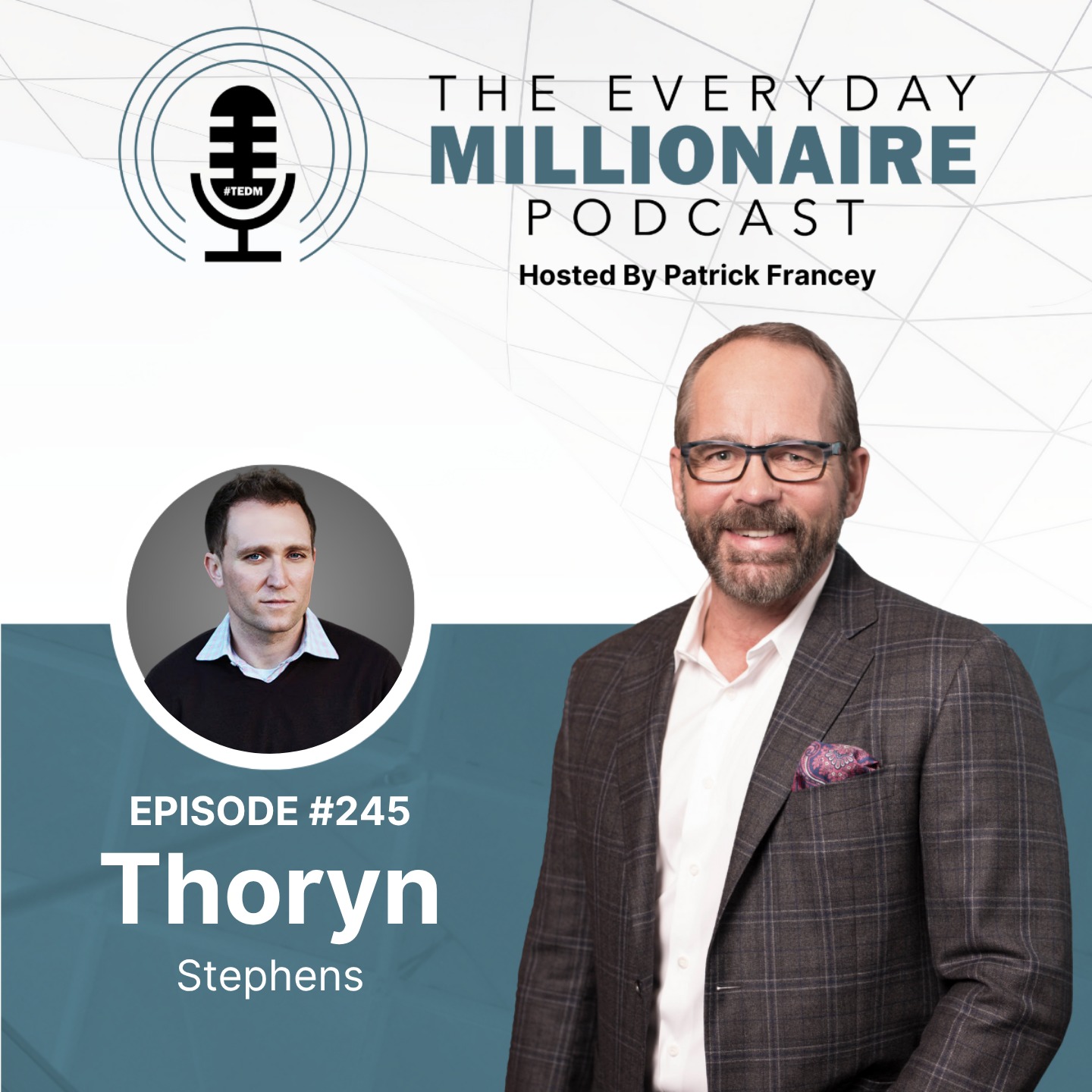
The Everyday Millionaire and Mindset Matters Podcast
Episode #245 – Biohacking Your Brain and Body with Thoryn Stephens
01:02:28
Loading summary
Transcript77 lines
- [00:00]
A
Foreign. Welcome to the Everyday Millionaire Podcast. My name is Patrick Francie and I am your host and I want to begin by saying thank you for listening. On this show I am having conversations with seemingly ordinary individuals who have achieved some amazing and extraordinary results in both their life and business. My intention is to inspire and help you learn and grow by having my guests share their journey of how they face and overcome their challenges, but also how they celebrate their their many wins. And now let's get on with this show and have a conversation with today's guest. My guest today, Thorin Stephens, is working at the edge of where science, AI, human behavior and biology all collide. He is the founder and CEO of Brain Dot one, an AI powered platform built to turn research into real world health protocols that help people think sharper, age slower, and perform at the highest level. With a background as a molecular biologist and data scientist, Thorne has spent the better part of two decades in digital transformation, predictive analytics and applied science, working with organizations tied to names like GlaxoSmith, Klin and Unilever and Fox Networks. What makes his work especially relevant right now is that he's not looking at health as a symptom to manage. He's looking at it as a system to understand, to measure and optimize. His focus sits at the intersection of neuroscience, behavior design and adaptive AI, with the goal of building a more prevention first measurable and scalable model for human performance and well being. He has spoken on stages including the Wharton School, Wired London, Khan's Lions and Click Z, Hong Kong, and he brings both scientific depth and practical application to a conversation that matters to anyone who wants to perform better, think clearer, and live with more intention. He's based in Aspen, Colorado, and Thorne also lives what he teaches as an ironman, triathlete, backcountry snowboarder, and lifelong student of consciousness. Without any further delays, let's get this show started. Thor Stevens, welcome to the show. Thanks for joining me.
- [02:39]
B
So great to be here.
- [02:40]
A
So when I look at bios, I like to open the show because bios are often not current. Most of the individuals I'm interviewing have a lot of things going on. So I really like to open the show with a fundamental question to my guests, which is if somebody walks up to Thorne today and says, what do you do? What's your answer to that question?
- [03:02]
B
Sure, great question. So my background's in molecular biology and biotechnology and my current focus is building a health technology platform that builds health protocols for users looking to solve a specific problem ranging from brain to Women's health to peptide support.
- [03:26]
A
Where did you get on that journey? So that's very high level. So what got you to a point where you're solving those kinds of problems? What was the journey or some of the journey that led up to where you are today?
- [03:39]
B
Sure, yeah. So began my career as a molecular biologist, again working in biotech. And what I found is in my 20s, I could genetically modify nearly any model organism. And then I transitioned from biotech into data science and I began to build systems focused in user measurement and optimization and did that at scale for a number of large brands. And the through line throughout my career has really been measurement at the end of the day, you know, measuring, you know, enzymatic activity on a molecular level, or measuring human activity and behavior. And then, and then optimization, fundamentally. And a couple things that occurred. One is, in my 20s, I've always been pretty athletic, a big skier, live in Colorado, skier, snowboarder. And I began trail running and doing marathons. And then marathons led to triathlons and triathlons led to ironman distance. And it was through that experience that I began to optimize my own biology. And so I use the term know, tuning my biology and using big wearables like this Garmin that I have. And what I was able to, to see in the data is that, you know, I could optimize my biology by using the data and improve my performance ultimately. So I could attenuate my lactic threshold so I could go stronger, faster, longer on the bike or on the run. And, and that was a pretty eye opening, I would say, part of my life. And that was in my 20s. And then fast forward in my 30s and 40s, continue to do triathlons. And then my career, I went again out of biotech and then I was in technology. And then I went into private equity. And about two and a half years ago now, I had this moment where I realized that I wanted to come back to my purpose of science. And that's ultimately where I started our current company, which is called adaptive AI health.1 and brain.1 is one of our properties focused in neurological optimization. And it's the idea that humans are more efficient and productive and potentially happier when they have a structured framework to follow. And so that went back to my days in triathlon. But now we've been building essentially health protocols to help people do things like prevent dementia. And so we'll take a scientific paper, we'll summarize it, and then give them a structured framework to follow, really based on Behavior and helping them reach their health goals through that type of structured framework.
- [06:15]
A
So there's a lot of range between, you know, with all the, what you just shared there, it was great. There's a lot of range between, let's say, just being healthy day to day, how do we live a healthy life to, you know, higher performance? Like you were trying to achieve bigger goals than your triathlons or whatever competitive thing you were doing at the time. So are you focused on kind of day to day individuals who just want to have a healthier life or you focus on higher performing in terms of athletes or all of that in between, what is the kind of the main focus of who's really interested in the body of work that you're doing?
- [06:54]
B
Yeah, it's a great question. So I live in Colorado and many of my friends and family are considered peak performance humans where we're just optimizing our biology, we're just compromising our health. You know, my mother's done more Ironmans than me, so it runs in the blood. But. And so from that perspective, I think initially we were looking at the peak performance, you know, essentially cohort of humans. But of course we want these protocols to be accessible for anyone, basically. And as an example, you know, we have a dementia prevention protocol which all of our grandparents and our parents should be reading and following, you know, right now, basically. And, and arguably, you know, our people in their 20s and 30s should know these basic principles to help again stave off and prevent a disease like dementia.
- [07:44]
A
So when you, in all your research and I, and I'm certainly know I have a little bit of experience with dementia, I've got a father in law who's at 98 years old and dementia, you know, but has been on that for the past couple of years. We've really seen it. Digress. Is there a cause of dementia that you've identified that, you know, people can say, okay, oh, if I want to avoid that outcome, you know, there's some things I need to do because we know that by doing X, Y, Z, we lead to. Can lead to dementia.
- [08:17]
B
Yes, certainly. So, you know, taking a step back, you have neurodegeneration, you have diseases like Alzheimer's where you have a genetic predisposition. And in that case, you know, there's really not a lot you can do to prevent the disease. However, there are things that you can do to again prevent the onset of the disease or the symptoms, basically. And so similarly with dementia, you know, there are causes. Tau proteins, amyloid plaques, buildup in the brain. And again, you know, you can't necessarily like, stop the onset of the disease, but again, you can help support the progression. And so we're big believers in lifestyle and microhabits and that concept, you know, we are an artifact of the decisions that we make, you know, throughout, you know, in the morning, throughout the day. And behavior really plays a large part in your gene expression. And I would go that far. And again, you know, my background as a molecular biologist, we were the generation that sequenced the human genome. So this is in the late 90s, early 2000s. Craig Bentner Human Genome Project. You know, we sequenced the human genome and at the time I was working in biotech doing drug development and we were very optimistic we could start unlocking, you know, the secrets of human health and drug discovery. And, and unfortunately, you know, that wasn't entirely the case because while over here you have, you know, your DNA blueprint, over here you have what's called the proteome, and that is expression of your DNA through RNA to proteins, but it's really what's happening in between. And you have things like the metabolome, you have the transcriptome, and of course you have what's called the epigenome or epigenetics, which is how you modify your DNA and ultimately the expression of your DNA. And so there's quite a bit you can do between here and here, though, that is still in your control, where again, you might have a genetic predisposition, but there are lifestyle changes, there's small microhabits, you know, things that you can do on a daily basis to help improve your health. And so that's where I really lead with a, you know, an era of optimism because again, you know, you, we have a ability to control a good amount of our gene expression.
- [10:34]
A
So I mean, that's a relatively, I think, I don't want to call it a new concept, but it's certainly a relatively new thought process that's getting out into the world, you know, into public, you know, thought processes where we can kind of alter these things in our life, different protocols. I'm pretty focused on health. I have been for many, many years. You know, from training and, and to how I supplement or not supplement what I've learned over the years about my own body and what I do. Pretty healthy guy, you know, at 68 years old, I can, you know, still crank out three sets of 12 pull ups and push ups and do all the things. I have noticed, however, that, you know, the little more aches and pains that go along with it, you know, some inflammation that I'm. That's a little bit annoying. As we age, these things seem to creep up. But I'm still convinced that inflammation is something that we can manage through, you know, diet or supplementation. I don't know if that's the case or not. So what you're talking about when you talk about microhabits, that's really key to, you know, these little habits of what, you know, pay off down the road, many years down the road. Are you, is this a program that somebody comes in and gets tested and they use you look and you kind of assess where they're at, what they've got going on, and then make recommendations from there?
- [11:48]
B
Yeah, that's exactly it. So generally we look at a multimodal approach. So we're looking at things like biometrics, and that could be coming from wearables. If you don't have a wearable, no problem. We also have the ability to do a face scan or even a voice biometric. And so from a voice biometric we can get about 10 biomarkers. And what we've seen are high and medium correlations to heart rate variability, which you can get out of, you know, again, any major wearable. But it's coming through the voice. And, you know, it's pretty interesting because of course, you know, you can hear it in someone's voice when they're stressed. And so it's really good indicator of your stress level. It's actually through your voice. And similarly, with facial scans, we get about 30 biomarkers from your face, essentially with again, a very high correlation to heart rate variability, but also to blood pressure and a number of other biomarkers. And then we also look at blood biomarkers as well. We also look at different qualitative tests relative to the human. And again, stress, anxiety, things like that. And we build that baseline and that usually takes about a week. And then from there we craft a personalized protocol, or we could use one off the shelf and then personalize it to the person depending on, and then give them roughly a 90 day essentially period where they can work to optimize their health and make these small incremental changes that are measurable. And I think that's one of the most interesting pieces is that oftentimes in health you do a thing and you don't really know if it's working. So that's one of the problems that we're trying to solve.
- [13:25]
A
Well, I'm curious. It's interesting. Over the years, we work with a lot of world and Olympic class athletes. And so you look at that kind of cohort, if you will, and then you look at somebody who's, you know, 20, 30 pounds overweight or even obese, you know, so do you have. So when you look at, if I walk in your clinic and you know, I'm 68 years old, you look at me and you go based on benchmarks, Based on benchmarks of, you know, kind of traditional or normal 6 or, I don't know, average 68 year olds, whatever you might want to say. Male, 68. Here's some benchmarks we're going to. Are you measuring against that or are you looking at me as a 68 year old individually and saying, okay, this is low, this is high, you know, this. We're not getting a measurement like how, how does, how are you measuring that?
- [14:15]
B
Yeah, great question. It's, it's both, it's based on the individual, but we also look at benchmarks. So an example is we have again different modes of measurement. If someone is looking to understand their baseline around their neurological activity, we could use a EEG brain cap essentially and see the electrical current, but framework of their brain and if there's any areas that we can then work on a protocol to help them reactivate. So as an example, we have a case study. A guy lives in Minnesota. He slipped on ice, hit his head, and what he found was that a large part of the rear of his brain was no longer neurologically active. And so with him he went on a protocol of hyperbaric and glutathione and nad. And through the protocol of a period of roughly six months, he was able to see a reactivation of that portion of his brain. And so in that analysis, initially we would compare that to individuals of his age, gender, and that ultimately helps us better inform the baseline and thereby the protocol that would be available to him.
- [15:25]
A
So can you give me an example of a protocol that you might put just an average person, male, female, whatever, an example of what a protocol might look like. Again, we can use me as an example because I'm really, if you want, I mean, let's just talk about an average or a common protocol that you might recommend 100%.
- [15:43]
B
Well, so let's define protocol, right? And so when I was in the lab sequencing DNA, I would follow a protocol to, you know, ultimately sequence the DNA, which is just following again a series of steps, a structured framework. In the case of health protocols, it's again a structure generally day parted, so you have your, your morning, your afternoon, your evening, And a microhabit is just a small thing that you do. And so an example could be you get up in the morning, what is your daily routine? You know, and I'd love to hear, you know, when you get up in the morning, what are the five things that you do regularly? Is there anything you'd want to share?
- [16:21]
A
Sure. I mean, you know, for me, I'm very conscious of so what I try and do, and I'm pretty consistent with it, you know, when I wake up, when I find myself waking up, I never wake up to an alarm clock or rarely if I, if I'm worried that I might sleep in, you know, because I've got a flight, I'll set an alarm. Other than that, I'm, you know, in the position in my life where I just wake up when I need to wake up. So my body, six and a half, seven hours sleep doesn't matter. And occasionally I'll sleep for eight hours. I do wear an apple watch, so I'm paying very close attention. I watch my sleep, I watch my steps, I watch my heart rate, you know, those kinds of things. So. But in the morning I wake up and mentally I always kind of get prepared and, you know, decide how I'm going to take on my day. You know, I don't get into too much more than that other than a kind of a positive self talk of some way. I then get up, I'll. I've got to walk out to my office. I try and get some fresh air along the way. I'll do a little bit of trampoline in the morning. Or rebounder, you know, I'll try and get 5, 5, 10 minutes of rebounder in. I'll always make some notes, do some journaling before I start getting into any kind of my day. So. And two or three days a week I'm going to, you know, my trainer comes in and I do a physical workout. We live on five acres of land, so for me, I'm always active. It is very functional training I look at because I really get into it. So, yeah, that's kind of my, my morning routine. Water, Celtic salt, and then I'll do some supplements throughout the day.
- [17:55]
B
Okay. Yeah, we should sit down and we'll map out your health protocol and you can put it online and share with your audience. That's, that's very fascinating. Right. And it sounds like you have a pretty defined, you know, protocol routine. Same thing that you do in the mornings. So I live in Colorado. Mine generally includes waking up and having water. I usually do Some level of intermittent fasting. So you know, no food till, you know, roughly 8:00am as much direct sunlight as possible. I live in the mountains so we don't even get direct sunlight until about 9am but direct sunlight and then, you know, begin my day, maybe some prayer, meditation. I do hot Pilates roughly three to four days a week. And the reason I do hot Pilates is because I get my stretching in, I use heavy weights, I get some cardio and then I get the catharsis of the sweat and generally have about two liters of water in a one hour class. And that's an example of my health protocol. And that's all that we're really looking to do, is help humans establish what is the routine, put it on paper and then begin to optimize against it by adding additional microhabits that could be helpful for, you know, whatever they're trying to achieve. You know, fundamentally nutrition, exercise, sleep, stress connection and some level of metabolic support. You know, those are kind of like the six pillars that we really talk about. You know, we've analyzed, I mean, thousands of longevity protocols and everyone's looking for the secret hack. You know, what's the next peptide or da da da. And it's pretty simple. It's nutrition, exercise, sleep, stress connection, and again metabolic support. And even if you just start with one of those sleep awesome. And to your point, you're using an apple watch. That's great. And as soon as you can start to understand those patterns in the data, then you can begin to optimize them. And an example could be, well, maybe I shouldn't have that glass of white wine right before bed because it's going to spike my sugar and then I'm just not going to sleep as well. You know, anytime that I have a glass of wine, it absolutely impacts my heart rate variability. You know, tends to go down 20%. And, and that's where you can really start to modify, you know, your lifestyle and live a healthier lifestyle, whatever that means to you.
- [20:14]
A
I think it's, it's such an interesting, for me, an interesting conversation because I've always been very focused health wise. Although I didn't do triathlons or Ironman, I did half marathons when I was running. I did all those kinds of things. But I've always been very, very aware, health wise. My question for you is that my observation at this phase, in this phase of my life is that what does it take to really be healthy? So you as an Ironman, you're kind of in that peak of what you're trying to achieve physically, you're pushing yourself, which then has that mentally and that mental impact, and it's cathartic and it's all the things that it is. But I'll give you an example. So my mom passed away last June, and she was 90, almost 98 years old. Well, my mom was never an athlete, but what my mom did was pretty much every day she walked, and that was her thing. She do a lot of walking. So my point is, around all of the soren is that, you know, for listeners who are like us, who are really focused and want to push ourselves physically, microhabits is so, so important. You know, it's like, are you picking up the phone in the first thing in the morning and scrolling, or are you actually getting grounded in doing what you do, going outside, doing the things that we like to do? So where's the balance for what you're doing? So if somebody's walking in, and here's the thing about it, and you know this, I know this, and that is, is that when you start to get into a regular exercise routine, I don't give a shit if it's just walking, but if you start to get into a routine, your general energy lifts and then all of a sudden you want more of that and you can get into the routine. But for those who have not worked out recently or over any period of time, they're carrying extra 20, 30 pounds around. Is this the kind of protocol, Is this the kind of testing, if you will, is this the kind of work that would. Would support them in moving forward? To me, it is. But microhabits is about mindset. It's like you have to have the discipline. We talk about habits. I say, well, habits come from discipline, but. And that's a debatable thing, but from your perspective, does what you're doing, does it really matter to the kind of average person who's just trying to lose 20 pounds and. Or be healthier?
- [22:33]
B
Oh, 100%. I mean, you know, you're the example of your mother is awesome. I mean, she lived to 98, so she did something right, you know, at the end of the day. And I would also agree. I think the microhabit of walking, you know, and it doesn't need to be fast, it doesn't necessarily need to be long. I do agree it probably should be consistent, but, you know, that's a really beautiful example. And, and again, I think these are like the longevity hacks that people are looking for. You know, they think it's going to Be a pill or, you know, an injection or whatever it might be. And these are honestly quite simple. I think the consistency, the discipline, as you mentioned, is really, really important. But, you know, the, the walking is a really, really good example. And, and you know, and, and so we talk about walking as a microhabit. Why is it so pronounced? Well, again, if you're walking after you eat, it's going to help with digestion, you're going to potentially get fresh air. So you're going to be in nature, which is a whole nother microhabit that were really big advocates for your time in nature. It also could be social because maybe you're running into people if you live in a city, maybe not in the country, but so that type of microhabit, again, you're going to be checking off a number of boxes. So I think that's a really, really good example. And these apply to everyone, every single human. And we'll give your listeners this free dementia prevention protocol as an example. You know, and these are all small incremental changes that people can make to again. And so the statistics around this for dementia prevention as an example, there's 55 million global cases and by changing your lifestyle, they say, you know, roughly maybe half of those global cases could be prevented again based on these small consistent changes to your behavior. So it's really quite pronounced. And going back to the prior point around the gene expression model, you know, these are things even though, you know, we have a DNA blueprint, these are things that we can change by our behavior. And so it's actually empowering.
- [24:32]
A
Do you find, Thorin, that people in general are looking for that, you know, that magic switch? You know, these things take time and, you know, is there's a lot of impatience. They want the result tomorrow. They want, you know, the outcome and there is a part of it. And I don't know who said it, but they, I'm going to paraphrase it and kind of make it not say it as well as they did. But ultimately we have a tendency to focus on the outcome and it shuts us down if we don't get to that outcome sooner. We need to focus on the process and enjoy the process there and then ultimately get the outcome. But we're so focused on this idealistic outcome that we maybe have in the vision of our mind and that we. And the process is work. The process is shifting and changing and doing things differently than when we've always done that change. You know, people, what's the phrase? Right. I want my life to be different. I want to change. I want my physicalness to be different. I want the change. But people don't want to change, they just want the result. So as you're working with clients, are you in fact having those kinds of conversations? Are you helping them shift through the mental kind of barriers that people can put up in, in the process?
- [25:52]
B
Yeah, 100%. I mean, that's just human nature. You know, people want to do a pill and they want to see a change, which is why we're seeing such an explosion of GLP1 use in the North American population. I don't know if you.
- [26:07]
A
What is what GLP?
- [26:08]
B
Yeah, so GLP1, it's a peptide. And an example would be, of course Ozempic or you know, retrograde, any of these GLPs that people are doing for weight loss. And so you do an injection and you lose weight and it's actually pretty pronounced. And I mean the mechanism is you're just not eating, you know, you, you do the injection and you just aren't hungry. So, you know, and so I think there's actually some positives with GLPs. The challenge is that you have other side effects. So things like muscle loss can be serious. It can be, it can be serious. And so my personal take on it is, you know, microdosing glps is probably a better mechanism. It's just my two cents, not a doctor. Yeah, I mean, people are really looking for, you know, that, that magic bullet. I would say in that example though, if you're doing a GLP and if it's, you know, successful, you know, for you, great. You should think about how do you titrate down, you know, essentially come off of these drugs so you're not on them forever. And then I think the secret sauce is the behavior change. What are you doing to change your behavior? And that's the hardest part. I built massive analytical and technological systems for massive brands. And the technology is not the hardest part. It's the human behavior that's really the piece. And so as we look at again, glps as an example, no problem. But think about what does it look like to actually come off them and then further, what is the lifestyle behind it that you're really trying to reinforce to get you to your goal. So ideally, you don't need anything outside of yourself and your body to reach that goal.
- [27:46]
A
It's such an interesting kind of world that we live in, given the abundance of food we have, but the abundance of poor quality food as an example, the degradation of the Quality of the food that's being produced even from, from the, from agriculturally, you know, where we're nutritionally, the, the, you know, our food is getting watered down, if you will, if that's the right term. So supplementation and, but something that's showing up for me is this whole thing around peptides. Somebody, you know, buddy of mine said, oh listen, I put on a bunch of weight and da, da, da. I tried, I don't know, B147 peptide. It was, it was a game changer for me. And I'm going, what the hell's a peptide?
- [28:26]
B
Tight.
- [28:27]
A
Like, why does this all of a sudden come out? I don't know if you've ever heard of. I think it's whiskey.
- [28:32]
B
BPC157.
- [28:34]
A
Yeah, what is it again?
- [28:36]
B
BPC157.
- [28:38]
A
Yeah, yeah. Well, so tell me, let's use that as an example because it seems to be a pretty common peptide, whatever that might be.
- [28:46]
B
Oh, it's probably the most, it's actually the most well researched. So again, to be clear, GLP1S is a peptide. So you mentioned BPC157. There's also TB500 and when you take the two of them together, it's called the Wolverine stack. And what does. So first off, what is a peptide? It's a short chain amino acid that basically helps support cell signaling in pathways. You can think of it that way. And so BPC157 is an example we've been using, I've been using like in the triathlon space for like a decade, you know, for many, many years before people even knew, you know, what peptides were. Because I came out of that world, we were also doing things like red light therapy. You know, I remember one, I mean, this is actually well over 10 years ago now, but we were doing a triathlon training camp in California and we look over and we're like, dean, what are you doing? And he has this, you know, panel on his leg and he's like, it's red light therapy, you know. And again, this is like over 10 years ago and now it's on Tony Robbins homepage. So a lot of these things that we've been doing were a bit more fringe, are now mainstream, which I think generally is positive if you have the right regulatory control. And actually just yesterday, RFK in the United States basically decategorized or classified, essentially a list of about 10 different peptides which now can be available through your doctor. And they were in this gray market area. People were ordering them online From China, unfortunately, now you can actually get these, you know, just similar to GLP1s through your doctor. So you have better safety and you have better control. And so, yeah, and then full circle, you know, BPC is an example. So that is really helpful for inflammation and recovery. And so when I have been training, you know, for a race and we're talking, you know, whatever, you know, 100 miles on the bike, you know, 20 miles running per week and you know, a couple miles swimming, that's when I would cycle in like a BPC and a TV 500 as part of my health protocol essentially to improve my recovery. And then I could measure that recovery through, you know, my wearables and seeing how am I sleeping and what does my HRV look like. And so I think that's another really important part of this is the feedback loop. You know, like you said, you're sleeping with an apple watch like awesome. You know, that's really helpful in understanding your sleep patterns. And so that's, you know, as a, as a scientist, but also as a peak performance athlete, you know, those are kind of the, the foundations, you know, that we really try to, you know, make accessible to humans, you know, without becoming obsessive about the measurement. But you really want to have a feedback loop. So, you know, if the things are working. And that's actually what's so crazy about most peptides is you just don't know. I mean, you have your qualitative, like, I feel better. But then you also have the quantitative, oh, my biomarkers are improving. And so we try to look at kind of the middle of the road for all these things. So you're seeing both improvements in how you feel, but also what you can measure.
- [31:47]
A
But I think it's important, my own experience with it all is that if I'm measuring it, it actually helps keep me focused. And it's a little bit of aspirational stuff that goes involved. If you've got any kind of competitive nature at all, there's a little aspirational things that you get into. You know, years ago I remember having this conversation and, and we're with a friend and he made some comment is that, you know, you know, you're so focused on your health and all the things that you're doing. He thought I was maybe being a little bit extreme. And in his world I probably was, but I wasn't. You know, in your world you'd go pick it up. You know, in his, what are you doing? What are you going to do? You going to live Longer I go, I don't know if I'm going to live longer. I just know that the quality of life that I'm going to have as I'm living is going to be great, and that's what I'm shooting for. And if I happen to live to 100, awesome, you know, but my. I want to have a really great quality of life as I'm going. And so that's how I view it. That's how I'm paying attention to it. And again, I've noticed that as I go through these phases of age, you know, from my 30s now to, you know, well over 60, the way I look at my body and training and what do I want to achieve is just shifting. It's changing. So when you start to consider, you know, we talk about a peptide, but what about just kind of normal supplementation within your protocols, within what you're testing for? So, for example, it's taken me years, but I really feel like I've got my supplementation dialed in real, nothing crazy. Zinc, vitamin D, potassium, magnesium, those kinds of things. But do you actually sit down and go, you know, this is where you may need to focus potentially?
- [33:29]
B
Yeah, it depends. You know, supplements. So generally we also, to be clear, you know, our primary model is B2B. So we would work with a clinician, a team, and then recommend them, and then the clinicians actually make the recommendations. You know, we're not a medical device or we don't give medical advice, you know, just to be clear. But we work with awesome doctors, longevity concierge clinics and so forth that do. So, you know, just to. Just to be clear on that point, you know, one of the biggest challenges with supplements is just, again, it's the same point. It's like, are they working? And. And that's actually a problem we're, you know, working to solve. You know, it's a little bit complex to say the least, because most humans are doing so many different things at once. You know, it's a multivariate equation. You're doing, you know, a couple of peptides, you're doing some supplements. You know, you've got some nutrition things going on and so forth. So, you know, again, it's really hard to pinpoint it to just one thing, but I think with the right measurement, at least you're getting a better understanding. So I think that's important. And then one other point that you made, which I completely agree with, is quality of life. You know, there's a. There's a man named Brian Johnson, you May have heard of. He's one of the most measured humans on the planet. He is out of Venice, California. You know, he's measuring everything, everything you can possibly imagine. And you look at the guy and you're like, well, you know, how is his quality of life? You know, and maybe it's good, but for most humans it would be too aggressive. You know, he doesn't really get any direct sunlight. You know, he stops eating. And I think about like one in the afternoon for the entire day and, you know, so forth. So I think a really important, you know, question around these protocols are, you know, are you living your best life? Do you have the highest quality of life that you can? And, you know, part of that too is a little bit cautionary around the wearable data. You know, when you wake up in the morning, you start using a sleep tracker. You know, do you look at it and then does that, you know, data influence your day? You're like, oh, my H.R. b. Is down. Oh, my resting heart rate's up. And my sleep score is only a 55, you know, as opposed to just sitting with yourself and seeing like, hey, how do you feel today? And then, you know, and then looking at the data. So I think again, as a data scientist and also peak performance, don't get me wrong, the data is important, but, you know, it's always measured. And you want to be careful that that doesn't help, you know, jurisdict your quality of life because you got a sleep score that was low. And then just one other point on that too is like, I also think it's important to live life, you know, and to have a glass of wine with friends and family or to do some things that might impact, you know, your day to day, as long as you're living the best life that you can. So for me it's, you know, I always look at these things as a spectrum and I try to find, you know, balance somewhere in the middle.
- [36:17]
A
Yeah, it's interesting, isn't it? Is. You know, this goes back to what I was trying to articulate a little bit earlier, which is you have to enjoy the process. And when you start measuring things, it's just, it's just part of the process and it gives you information and you make adjustments and, you know, intermittent fasting. I've been intermittent fasting for, I don't know, a number of years now. I quit drinking a couple of years ago. Short of, you know, champagne at special occasions.
- [36:42]
B
Sure, that's great.
- [36:43]
A
And, and I, you know, I didn't quit drinking because I had a problem. I just quit drinking because I'm going, why am I drinking? I know it's toxic. Why do I continue to drink? And I went, I'm out. And. And, you know, my wife's happy to drink all the wine. You know, she's good with it, and our friends are good with it. I just find that. But having said that, interesting about quitting drinking. And if somebody said to me, what difference did it make? I would have to say, I don't know. I know that I like to eat, so I'd rather get my calories from food than wine. That's. That's what works for me. But I couldn't put my finger on it and go, you know, my life has changed in any way because of it. But that goes back to even the supplementation, I think, and is that you don't know until maybe you quit taking the supplements. But all of these things take time. That's the, that's the key there is, you know, Zempic is like, get a shot, boom. Everything kind of shuts down. Your body goes, oh, I don't want food, I don't want this. I don't want that. That's the magic pill. And I think that's why it's so popular in spite of the pretty significant risks of Ozempic. But again, that's. People are making those choices because you get a result much quicker. And what I'm, you know, what we're talking about and what I'm hearing from you is even with the protocols that you're putting out, it's a process. You know, it doesn't get fixed overnight. And there is a mental part of it that you have to get into those microhabits, incremental steps to get to the result. So don't know where, quite where I'm going with that, other than the comment on it. Maybe your thoughts on that.
- [38:17]
B
Yeah, again, small incremental changes, you know, just start small. And ultimately, you know, they have compounded interest over time, you know, even the smallest thing. I mean, like, you're again, you know, your mother going on her daily walks. I mean, I have to believe that helped influence her physiology, her mental, you know, health and wellness and all those pieces. So it's never too late to start.
- [38:41]
A
Do you think there's a gap of what people? So it's interesting for me is that I look at it and I go, okay. You know, I've always kind of paid attention to resting heart rate, for example. And when I was, I, you know, when I train over for many years when I trained, didn't matter what I was doing. I always had a heart. Heart rate monitor on. And, you know, so I look at. For me, resting heart rate is a real benchmark of what's going on for me. And 100%. And. And so I look at it and I go, okay, so my resting heart rate is 53, 56 is kind of really high, but it's in that range consistently.
- [39:21]
B
Yeah.
- [39:21]
A
And I go, you know, something for me, at this point in my life, I'm not a runner. I don't do a lot of cardio. I, you know, anymore. I just feel like it beats my body up too much. But, you know, something as simple as rebounding and going for walks seems that right in that level. So. But I'm. I'm also looking at and going, what are the benchmarks? Normal. Like people can. Can, you know, I say, okay, well, for me, I know a benchmark for me is anything under 60 is a pretty good resting heart rate in my age range if I'm not an athlete, et cetera. So do you think there's a real gap or people are getting. There's no point in comparing to you. Okay. Given what you do. So you're kind of in a benchmark and an extreme. Then there's something in between all that, right?
- [40:10]
B
Oh, 100%. Yeah. I mean, again, and that's your prior question. You know, you should be looking at benchmarks relative to age, gender, geolocation, and all that data is online. You can find that, you know, and see how do you compare. Or again, and we can, you know, help take the person through the process and see, you know, how do they compare to those national averages and so forth. So, yeah, and it also, at the same time, is very individualized. You know, my. My hrv, you know, I tend to be quite high. I mean, it can be anywhere from 80 to 100, you know, which for a normal human, I mean, I. And I talked to an amazing athlete. I was on the podcast a couple of months ago, and, you know, this guy is, like, yoked out. I mean, he's, you know, buffed, but doesn't really sleep. His HRV was like 20, you know, which is. Is quite low. I mean, I think the, you know, the average might be 30 to 40, again, just depending. So. So it's all relative. And at the end of the day, the numbers don't really matter, you know, I mean, they're important. But you're, you know, as I do these things, I'm always like, I'M competing against myself. You know, I'm just, I'm looking at the baseline and seeing relatively, you know, am I trending upwards for things like hrv? Am I trending downwards for metrics like resting heart rate? And then how does that compare to my average? And then, you know, looking at it holistically relative to stress, you know, and other things going on in your life, you know, family, work, you know, all of the things that can impact you. And then you can start to build a bit of a toolkit. You know, if you see that your, you know, HRV is declining, you know, what can you do to help yourself, your parasympathetic nervous system better recover? It could be things like breath work, it could be cold plunging and, you know, finding those microhabits that are good for you. And that's really, you know, the most important part, you know, finding these things that really help support you in your journey. And it, I mean, no one else really matters, you know, at the end of the day.
- [42:05]
A
So, so take me a little bit. Let's, you know, I want to kind of veer off this particular conversation. Tell me a little bit about your own background. I mean, this is a very, it sounds to me very complex. You know, certainly when you get into biology and chemistry and, you know, all the things that I'm no good at, this seems very complex. But how did you get on that journey and then ultimately end up owning or being an entrepreneur, being a business owner? You know, one of the things I love to investigate on the show is, is it nature or is it nurture? You know, did you come out of the shoot that way? Was your parents entrepreneurial? How did you get on the journey?
- [42:44]
B
Yeah, great question. So, you know, a couple thoughts there. Again, you know, my journey, beginning as a scientist, I was always interested in science. And so when I went to college, I knew I wanted to study initially biochemistry, and then I just went into molecular biology. And, you know, that kind of galvanized my worldview and, you know, the way I think about the world relative to structure and, you know, frameworks and protocols and things of that nature. And then as I, you know, in my 20s, I began, you know, again doing these long distance endurance sports like marathons and triathlons and, and that kind of galvanized it further, you know, with the layer of like understanding my own biology in between and, you know, and then full circle. It was again a couple years ago that I just, I came back to my root in science and there was a interesting quick anecdote. So I. I live in. I live in Colorado, and I'm a very aggressive skier and snowboarder. And in the winters, you know, I try to ski every day, if possible. You know, we're about a mile from the gondola, and I broke my clavicle. So I was doing a backside 5 40, which is a spin. It's one and a half rotations. And it was on a run I do every day. And I just. It was kind of a crazy period, some other things going on. I had a death, you know, friend that passed away, and I was just off, and so I landed and I broke my clavicle. And long story short, I go to the number one orthopedic in the country. They're called the Steadman Institute. And I walked in, and they did the X ray. And the doctor's like, you've been skiing on this for two weeks. You're crazy. And I was like, well, yes, doctor. And she's like, okay, well, here you go. And, you know, she said, I'll see you in six weeks. And she threw me a sling. And I was like, oh, that's my recovery protocol. And it was immobilization, you know, ultimately. And I just, you know, I was a little bit shocked, to be clear. And so I went back to my network, and I was just starting Brain One, and, you know, we have an amazing group of. Of scientists and nutritionists. And I was like, guys, I broke my clavicle. What do you think? And the team was like, oh, you know, focus on your nutrition collagen, you know, bone broths, like, doing big. And I was making big bison stews. And then I did a somewhat experimental therapy. It's called pemf, P, E, M, F. Are you familiar with that?
- [45:03]
A
No, I'm not.
- [45:04]
B
It's a pulse, electrical, magnetic frequency. They have grounding mats. It's just awesome. And what it helps really do is, you know, stabilize, I would say, you know, your nervous system, but also just your, you know, your general frame. And. And so we did localized pimp. And essentially, it's an electrical current. You know, you don't really feel it, but it goes through the bone. And then the belief is it helps stimulate bone regrowth. And I was traveling, and so she said, come back in six weeks. And I went back and forth. And the doctor does the X ray, and she, you know, she. She looks at the results, and she's like, oh, my gosh, your bone is completely healed. We've never seen anyone heal so quickly. She's like, what have you been doing? And I was like. I was like, doctor, I. I focused on my nutrition. And the doctor turns to me and she's like, well, we never would have thought of that. And it was one of those moments. And that literally galvanized what ultimately became Brain One and Adaptive AI Health One. And it's the idea that nutrition is the foundation, you know, and so that was like one of those pivotal moments where I was like, we have to do better. You know, we have to do better for our parents, our grandparents, our children, and, you know, nutrition. And I'm a big believer, like, food is medicine. You know, we're just as much as. We're a reflection of, you know, the microhabits, the things that we do. We are just as much what we put in our body. And so that was really one of those galvanizing moments where I was like, okay, I need to do something. And that's where I really came up with this framework for Brain1 and the company. So that was the concept again, of nutrition being one of those foundational pillars.
- [46:39]
A
Yeah. My own observation over the years and where I've come to in my own understanding of things is so Brain One is exactly kind of. You're talking about lifestyle, microhabits, protocols about health. That is truly health care. You know, what our traditional system of health care to me is, you know, your doctor didn't think of nutrition because that's not even in their. Their world.
- [47:07]
B
Exactly.
- [47:08]
A
You know.
- [47:08]
B
Yeah.
- [47:09]
A
And so I don't know why we call it healthcare. I think we should call it disease care, because primarily we are dealing with something that's happened. We're already sick. That's why you're going to the doctor. As opposed to health care, which is, you know, the kind of things and the kind of work that you're doing, which is to say, well, how do we prevent all this? How do we look after ourselves to prevent all of this? That, to me, is healthcare, as opposed to disease care, which is after the fact. That's kind of how I view it. And nutrition is just not. Not part of our healthcare system. Our doctors are not trained in that. Which is just really odd to me. Always has been. From your perspective, like what. You know, for those listeners that are out there, what would you want them to know about Brain dot one? What is it? You know, what do you want them to know? I mean, you're doing the research, you've got the data, you're working with clinicians. Come. But what's your kind of. Is there a mission or a primary Message that you want to get to the general public?
- [48:07]
B
Yeah, sure, yeah. The mission is to reach a billion humans and help them optimize their brains and their biology. You know, so we're not aiming, not aiming low. And again, the vision is to do it through this idea of a hyper personalized health protocol and providing a structured framework for people to do that. So one of our initiatives for this summer, we are going to be, we've been focused on B2B, but we're going to be opening it up to the general public as soon as June. We have a new native app. We will be dropping and we will be giving away a million dementia prevention protocols. And again, just that concept of humans having a structured framework that they could follow to help optimize their biology. And it's very simple. We use the term protocol. It's just a routine and it's honestly just a task list. Start there, put on paper. What are the 10 things you do every day? What are the five things you do in the morning, the five things you do in the evening? And ultimately what is your goal? You know, what are you trying to achieve? Is it better? You know, and what we hear nearly from everyone, sleep, you know, stress in microbiome, you know, gut. Basically like those are the three things nearly every single human, and I guarantee the majority of your listeners are dealing with and then building a structured plan around that and, you know, doing it, it doesn't have to be expensive. You know, it gets more expensive when you start looking at the, you know, different diagnostics. But, you know, you can start right now and you can really start with these small incremental changes that have such impacting, you know, lifelong, you know, impacts in your life. So I think it's again, empowering.
- [49:45]
A
I love the fact that you fold, you know, sleep and stress into the conversation, you know, in my own experience, and I believe it is that our kind of mental state, our stress levels, our physical is often a manifestation of what's going on for us mentally. You know, there's a phrase I like to use that it's not the weight we carry that breaks us down, it's the way we carry the weight. And you know, it is. How do you manage your stress? How do you look at what is happening in the challenges that everyone faces in life? And how do you, how do you manage that? And I'll use an example that really occurred to me many years ago. I was on a project as a president of company, as a many, as a startup, many millions and dollars at risk and investors and all the rest of it. And, and I felt a lot of pressure. And one day I was at a coffee in Canada. Tim Hortons was very busy, was a boom, booming economy. You know, coffee shops were lined up out the, out the, out the doors and staff. You couldn't get enough people. And I was observing, I stopped in for a coffee and I'm observing this lady in behind the counter. She was a supervisory, obviously in her position, not enough staff. She is just like losing her mind. You can see the stress. She was just wearing it and carrying it in behind the counter as she was trying to serve this massive crowd of people that were lining up. And I thought in that moment, I realized at the time, she's probably making 10 bucks an hour. And her stress at, you know, in the role that she was playing, she's making 10 bucks an hour was probably 3x the stress that I felt dealing with a multimillion dollar startup business. And, and I think to myself, you know, how it is not about the weight, it's how we carry it. And that is so important. And we sometimes lose and our sleep is affected by the stress that we carry. So stress management has got to be like top of the list of what you have to do to look after yourself. Would you, would you agree with that or what's your thoughts on that?
- [51:57]
B
Yeah, I mean again, stress is the killer, you know, at the end of the day, I mean, I believe so. That's where again, we try to empower humans to help deal with their stress. And you know, that's a really good analogy. You know, this woman making 10 bucks an hour, you know, and her stress load. The question is, what do you, you know, what do you do with it? How do you manage it? You know, what are the tools that you have? You know, for me, again, I do things like hot Pilates or I do a, you know, 60 mile bike ride. And obviously I'm a bit of a maniac. But you don't need to do a 60 mile bike ride. You can just go for a walk in the, you know, in the forest or you could just go for a walk around the neighborhood, connect yourself. You know, I mean, that's another microhabit we talk a lot about is connection and purpose. You know, people who generally have connection and purpose live, you know, 10 to 12 years longer than people that don't. And so it's these small tools, you know, that we can have to help manage stress to get us through the day to day and you know, help support your parasympathetic. Nervous system and ultimately live a better life. You know, the challenge is we're not really taught these things. You know, like you go through your, you know, younger education and you know, maybe college graduate, you know, depending. But you know, you're not taught these very fundamental tools. You're not taught about nutrition, you know, let alone our doctors, by the way, I mean, which is absolutely insane in my mind. Let alone, you know, how do you manage and regulate your nervous system? And so the good news is that there's a lot of tools that are out there that are free. You know, if you can't afford to do, you know, go to a cold plunge and do a sauna, you can take a cold shower. You know, when I'm in Colorado, I go in the river, you know, for 90 seconds and when the snow's melting, you know, that's about, you know, 2 to 3 degrees Celsius, so it's quite cold. But you can do these things that are also free. You know, that's something we really try to focus on is the accessibility as well. And you know, the good news is you don't need a ton of money. You don't need to do these super robust protocols. You know, these are things that you can do in your day to day, but you need to do them. You know, you need to show up, you have to have, you know, some level of goals and then some sort of a structure. But yeah, that's the very positive. But that's a really great analogy that you shared.
- [54:10]
A
Yeah, it is interesting that I just find it all. It's kind of one of my quirky little side things that I like to pay attention to and follow along. So is why I was excited to have this conversation with you is because I knew it was kind of next level stuff. And you start to understand though that there is the basics to your point. It doesn't have to be expensive. First off is those microhabits, those discipline, making the commitment. Something you said earlier is, you know, like food to me, when I start to understand that food really is a drug. And it does have a huge impact on how you think and what you do. It's, you know, the classic example of that is try and get off sugar. You know, try and just cut sugar out. Try that sometime and go through those withdrawals and then find out what happens. And then you have one bite of a chocolate bar and boof, away you go. You know, the next thing you know, it's like seven chocolate bars. I'm not speaking about me, by the way. But I heard that in the past. But it really is the impact of food in your physiology and how you think and your mood, it's pretty dramatic, I find. I'm sure it's not that way for everybody. But as you get really clean in your eating, I sometimes joke is that I'm pretty, I eat pretty clean generally. And if I go out for a night where I just kind of go off the rails for whatever reason eating, I literally wake up the next day with what I call a food hangover. And it's not because I overate, it's just what I ate. And it really, really impacts me. So when you're kind of set a benchmark for yourself where you are eating relatively clean, I'm not drinking, I'm not eating a ton of sugar. I'm really paying attention to my proteins and my vegetables and all those things. When you go off the rails, man, oh man, for me, I really feel it. I think that's probably relatively common. I'm sure you have experienced the same thing.
- [56:00]
B
Oh yeah, 100%. And I again, I think you should allow yourself to do that. You know, personally, I mean, as regimented as I am, you know, Ironmans and so forth, you know, it's all about quality of life and you know, it's. So it's okay to have that occasional glass of wine, it's okay to have that occasional occasional ice cream, you know, and you don't need to feel anxiety or, you know, negative about it, like you should be able to live your life. And so that's where again, I look at all these things as a, as a spectrum. It's important in my opinion, to be a bit moderate and also forgive yourself and, you know, having ice cream every once in a while. I mean, I try to live a zero sugar lifestyle myself, but you know, sometimes it just doesn't happen. And that's okay, you know, unless you're really training for something where it really matters, which most of us are not, then, you know, give yourself that flexibility and that's kind of even to the prior point around the data, you know, like, I think it's okay to just accept where things are at and, you know, approach them from that mindset so you're not adding additional stress and anxiety because then, you know, you're defeating the purpose further.
- [57:05]
A
I mean, you make a great point, right, which is, you know, it's about moderation. But I also believe that, you know, if you set, you know, set the target high, set the benchmark high, and then if you miss it you're not. Even if you're missing it by a lot, it's not the worst. Right. So start up high and go from there. So as we start to wind down, I realize we just ate up a bunch of. I love these conversations, by the way, Thorne, so thank you for that.
- [57:29]
B
Thank you, Patrick.
- [57:30]
A
I like to get into some, what we call rapid fire questions that aren't so rapid.
- [57:36]
B
Sure.
- [57:36]
A
And they're just meant to be fun and get to know you a little bit better. So we started with just a little warm up, you know, Are you Apple or Android? Apple. Apple. I'm surprised by that because it seems PC would be more in that medical side of things is more traditional but higher efficiency.
- [57:55]
B
Everything's interconnected. Apple, Apple Watch to unan.
- [58:00]
A
So Apple ecosystem design. Yeah, Apple's ecosystem is awesome. Favorite. Are you a music guy? Do you. Favorite band? Favorite song? Favorite anything in the music world?
- [58:13]
B
Oh, yeah, I've been playing drums since I was about 6 years old, so another passion. Yep. Actually have a song that I'm going to be releasing in the next month or so with my chief scientist and yeah, pretty excited about that one. Favorite guy. That's a tough one. I mean, I have so many favorites musically. I would say maybe Radiohead would be higher on the list.
- [58:38]
A
There you go. Favorite movie?
- [58:40]
B
Movie? You know, that is a great question. I don't watch too many movies nowadays. Maybe related to music, but Pink Floyd, the Wall.
- [58:57]
A
Ah, there you go. Is there a book that really stands out for you that may have been a. A fork in the road or a book that really impacted you that you even like to gift or recommend?
- [59:11]
B
Yeah, I would say the. Oh, that's a tough one. I'd say there's probably three, but maybe the Teachings of Don Juan by Carlos Castaneda, which talks about. Published in 1967, talks about his foray into working with a native medicine man and his foray into plant medicines.
- [59:33]
A
You mentioned earlier that, you know, like, I'm thinking about what you do and science and all the things. It's very intellectual. You did mention, you know, that you do some meditation. Do you find yourself being very intellectual? Do. Is there a. You know, I don't want to. I'll use the term spiritual side to you. Is there some aspect that takes you out of your intellect aside from meditation? Is there a philosophy that you have around that?
- [59:59]
B
Yeah, I, I grew up with more Eastern religions, so, you know, ranging from Hindu and the Bhagavad Gita to Siddhartha and Buddhism. So deeply spiritual. I would Say that I am the most spiritual when I am in nature. That's truly my church.
- [60:17]
A
I'd agree with that. I'm built that way as well. If there is a God, what would you like to hear God say when you get to the gates?
- [60:27]
B
That I've lived the best, most active life possible.
- [60:31]
A
Beautiful. And what are you grateful for? Thrun.
- [60:35]
B
You know, I wake up every morning grateful for the life that I live. I was recently married, so very grateful for my wife and our. Yeah, our lifestyle in Colorado and the mountains and clean air and clean water and nutritious food.
- [60:52]
A
Beautiful. I'm always grateful for my wife, who without her I would not be where I am today. Whatever that you take that for what it is. But I'm grateful for family. I'm grateful for my wife. I'm always so grateful to have the opportunity in this podcast and this platform to meet such a range of people and have amazing conversations. I often joke, you know, that if nobody was listening to my podcast, which that isn't the case, but if nobody was, I'd still do it because I love these conversations and I love the opportunity to hear different perspectives and learn a lot along the way. So, Thorin, I'd like to say thank you for your time and the insights and wisdom you shared today. And I appreciate it.
- [61:36]
B
Thank you, Patrick. Yeah, it was a great conversation. Appreciate the time and appreciate your listeners. And just remember, it's never too late and we control our some percentage of our biology and we can make positive changes.
- [61:50]
A
Ladies and gentlemen, thank you for listening. If you found value in the podcast, please take the time to rate and review and share with others. Share with your friends as it is my goal to always improve and to provide the highest value for you, the listener. If you have any comments, suggestions or questions you'd like answered, please email me@ceoaincanada.com that's C E O R E I N Canada.com I look forward to hearing from you. And until next time, Patrick, go.