← The Everyday Millionaire and Mindset Matters Podcast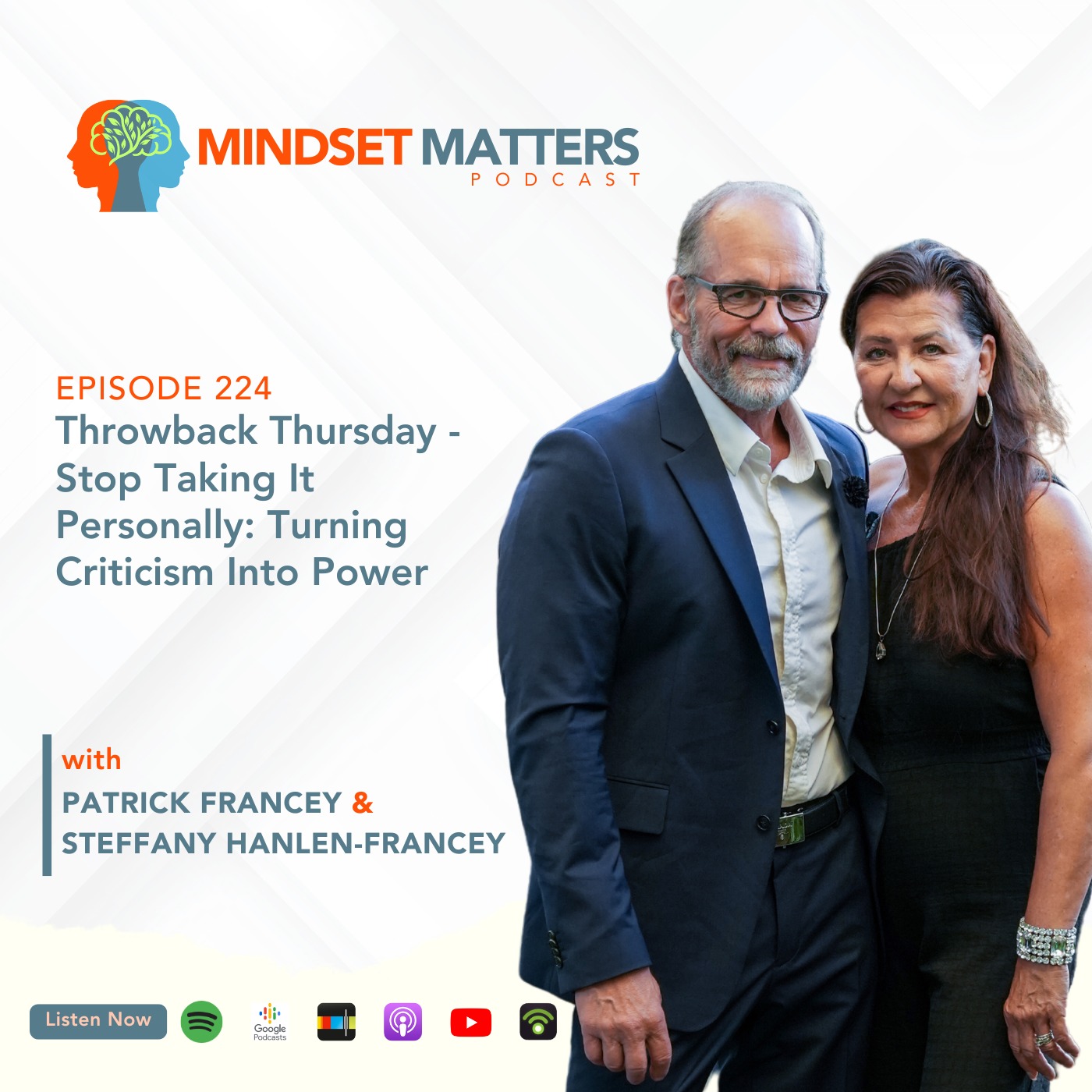
The Everyday Millionaire and Mindset Matters Podcast
Mindset Matters - Episode #224 - Throwback Thursday - Stop Taking It Personally: Turning Criticism Into Power
00:23:26
Loading summary
Transcript1 lines
- [00:00]
A
Foreign. Hi there and welcome to this episode of the Everyday Millionaire Mindset Matters podcast, where I'm joined by my wife, Stephanie Hanlon. Francie. In these episodes, Stephanie and I will unpack the different aspects of what we refer to as Mindset Matters. We believe that today, more than any time before, we're living through the most impactful events in history. Changes in the world that are leading to rising confusion, uncertainty, and and ultimately fear for those who are awake. Your view of your world is the filter for how you will experience the evolution and changing dynamics of it. Whether it's the growing social and political divisiveness, the need to pivot in business or career, or shifting family dynamics, very few know how to deal with or manage what is unfolding before them. Whatever you're experiencing in your world, Stephanie and I have deeper conversations about mental, emotional, and and spiritual health that provide a context for living that we hope inspires you to ask different questions and has you check in to ask yourself the hard questions, like, is the path you're on the best path for your journey? Are you still clear on your intended destination, or has it changed? Our vision is to provide you ideas and tools that you can apply in your life, that you can use to take steps in your evolution of being your greatest self and living your best life. Life. Listen, then enjoy. Hi there and welcome to the Everyday Millionaire Mindset Matters podcast. Thanks for joining me. Thanks for listening in. And I'm flying solo on this particular episode as Stephanie has been away. She was in Italy this past week at a competition with her athletes and the other coaches. I hear they had a great week. She's on her way back, but not in time to do this recording. So here I am on my own, and you know how much I like being on my own. I really love to have somebody else to talk to. Anyways, I've shared in the past that, you know, with Stephanie that we don't necessarily always know what the topic's going to be. We're always working backwards from what do we think is going to serve you in helping you move forward and giving you some tools and what you might find interesting. And ultimately, we're always just trying to, you know, figure life out and we reflect on what we've been through this past or the past week or some of the experiences we have, and we think about, you know, what did we learn and what are the tools that we use to kind of get through it, because we're dealing with all of the things that life has to handle, you know, our businesses and our non businesses and you know, this past week, week plus, you know, we had an injured dog and our dogs are important to us and all of these things. So the point is this, is that sometimes we show up with these podcasts and we just have to sit back and meditate on a little bit and come to a topic. And this particular topic around criticism, criticism and judgment, came out of a couple of different instances. And I'm going to share those with you just to give it context. I think there's some lessons to be learned or some insights to be gained by me sharing where I got to this topic and why. So the past weekend, JG Francour, who's the Chief Growth Officer of the Real Estate Investment Network, he and I did what we call a 15 step intensive. Now we do these about once a month, I think, where we get a group of individuals, we do a live event, they attend the live event. And it's six hours of working with JG and I to learn how to invest in real estate. And it is really to teach the system, to teach the process, to understand what drives real estate. And people are there because they want to learn, they want to take control to the degree they can. They want to be responsible for creating and growing their financial future, you know, having that financial certainty and freedom and security that people want. And real estate is part of what they're going to do to get there. Now it is six hours, it is live, it is intense and there's a lot to learn. But this past weekend was slightly different, marginally different in that it was a smaller group. You know, it's December and of course real estate is out of flavor right now. And the group was still very good, but smaller. So we said, let's change it up. You know, we're always looking at how we can coach better, how we can deliver better, how we can be better. Anyways, this group was smaller, so we changed up and it got very interactive, more than usual. We're always very interactive with the audience and with the group. But this took it to the next level. So long story short, there's a part of the process that we share, which is around what we call the real estate success cycle. I've shared it on the podcast before, but ultimately it's really the life success cycle. It's not really about real estate. It can be about anything. The point is, is that we're in our comfort zone and we're hanging out there and we get tired of it. We then say we gotta do something different. And in this case it's real estate. And so you say, okay, I'm gonna go take on real estate. I'm gonna learn. I'm gonna take responsibility for my financial future. I'm gonn and you say, okay, I'm going to move forward. And then you hit the fear zone. So the success cycle is about these zones, and you got the comfort zone. You got the fear zone. Then to get through the fear zone, what many do, myself included, is we say, okay, I just need more information. I need to learn some things. So you get in the fear zone, and then you go to the learning zone. And ultimately what you want to do is take that learning and move it into the growth zone. So you go through that cycle, and then you get comfortable again, and the cycle starts all over again. Now, here's where we spend a little bit of time, which is on the fear zone. And in this particular case, we really try and break down what is your fear? What is the story you're telling yourself? What is your bs, Your belief system? What is the bs? What is the story you're telling yourself? And there's all sorts of excuses. And we set the context for the weekend when we say, okay, we want you to hear us through a thing called anything is possible and it doesn't matter. And it is what we call the excuses. And it is, I don't have enough money. It is, I don't have enough time. I'm not smart enough. The economy's wrong. Real estate is too dangerous. So all of the excuses that show up now, we use that and we talk about it and we get into a discussion with the attendees. And ultimately somebody will say, what I'm really afraid of is failure. That's my biggest fear. And I know, having been a coach and having been coached a lot, that it really isn't fear of failure that we operate on top of. We actually are afraid of the fear of the judgment. And here it is the criticism of people who say, I told you so, because there's a risk that you don't achieve the goal. And real estate's a big thing. It's not something you generally can keep secret. Sometimes you may want to, but ultimately, people know that you're investing in real estate. And you can have friends, you can have family, you can have peers that are going, you're crazy. Don't you read the headlines? Don't you know that real estate's crashing? The world's coming to an end, Interest rates are gonna go to 17%. You're nuts. And so what happens is that the fear that we have called all of the excuses and the fear of failure is really the fear of the judgment and the criticism that comes with that judgment, or how we hear it as criticism. So we don't take action because of that. Now, I give that context. It's very common, by the way. And I've been at the effect of that myself many times over the years. I'll share that in just a second. Now, the other thing I do on weekends, occasionally or most of the time, I guess, is I sit back on an early morning, Saturday or Sunday morning, and I have a coffee and I listen to a podcast called the All In Podcast. And the All In Podcast is for what they refer to themselves as besties. And it's four really rich guys, and they call it the All In Podcast because for many years they've been good friends and they've been playing poker. And of course, being all in is a phrase and a term that's used in poker. And these guys are like a couple of billionaires. Shamath Polya Patel, I don't never really remember how to say his last name. And Jake Calacanis and Dave Sachs and Dave Freeberg. And these guys get together and they're all good friends. Now they do this podcast, and like I say, they're a couple billionaires, a couple of hundred millionaires. And the reason I share the story is because in this particular podcast, they were talking about Twitter and the shadow banning and what Elon has done with Twitter. And they're very in it. You know, Chamath, if you don't know him, was a big part of what got Facebook launched. And, you know, they've just got this big history of being in that tech world, is what I'm trying to say. And they know Elon well to the degree that a couple of them went in and they just volunteered to help him as he was setting up the office and kind of working through what he was working through on the deal, all sorts of stories behind it. Now, this is to say this, four successful guys, good buddies. And on this particular podcast, they were just all over each other. Like, it was really surprising in terms of how they showed up. Now they're just pissing in each other's cornflakes. They're interrupting. They were disagreeing, which is not normally what they do, but they were very passionate about their topic around Twitter. And then there was Google and shadow banning and all these things that were happening. The point is, the topic is not so much what I'm here to kind of share it was how they interacted together. Four very good friends, and they were just trash talking each other. Now, I share that because I know that after that podcast, they'll walk away and they'll buy, you know, they'll bitch and complain like good friends do, and they will shrug it off and walk away like they don't take any of the criticism personally. Okay, so this topic is really about criticism and how we receive it. Let me share one more story with you, and that is, is that several years ago, I was, you know, I. We brought the executive team out to my place out of the acreage, and we had a coach out here. And part of the processes that we went through in the course of the weekend was developing as a team. And in that development, we did an exercise that was called what is your superpower and what is your kryptonite? I think if you've been listening to us, you know, over a period of time, we've done a bit of an exercise around super power and kryptonite. Now, the superpower part of it's really cool because, you know, you sit down and you say, well, what are your superpowers? You ask yourself that question, but then ultimately you go around. In our case, we went around the table and each of us said, what is this person's superpower? And each of us shared what we saw as their superpower. And that's kind of cool. And it's a perspective. And, you know, sometimes we don't recognize the gifts we have or we don't see our own superpowers. We don't recognize them. And that's kind of good. It's very positive. And it's kind of, you know, you make. You actually feel pretty good about it, right? So. But there's the other side of that equation, which is, what is this person's kryptonite? Now, both the superpower and the kryptonite are often blind spots, and particularly the kryptonite. So what are the weaknesses? That was Superman's thing, right, is kryptonite. So what is the kryptonite? And it came to being my turn, and the team went around. And what my kryptonite turned out to be was how I received feedback. And I was told that I'm very hard to give feedback to because not that I get angry or pissed off, but I get defensive. And so they're trying to deliver feedback, and I'm defending it rather than just taking it. And it was interesting that in this particular exercise, we weren't allowed to talk about it like, we weren't allowed to have a discussion about how people thought our superpower or our kryptonite was. We just had to listen, take it, own it, and process it. Well, there's six other people, seven other people at the table. Everybody goes around and tells me my kryptonite. And it was pretty much the same from everybody that how they saw it. Now, it wasn't by vote. It wasn't by consensus. It wasn't like everybody talked about it and they said, okay, well, that's his kryptonite. No, this was everybody around the table going, patrick, you got so many gifts and you do so many great things and blah, blah, blah, but when we try and give you feedback to make you better, you get defensive. Holy shit. And I had to sit and listen to it. So imagine that. I don't know if you can. But anyways, it was a big deal for me, but it was very cool in that I learned that that was, in fact, one of my blind spots. And I got a history and I know where it came from and all the rest of it. So now, many years later, I don't hear it as criticism. I don't hear it as having to defend it. And although occasionally it shows up for me, depending on who's giving me that feedback, I have to actually not take it on. I have to listen and say what is in there for me. Now, I say this because in the past, if I'm busy defending it as an example, then I'm not hearing it for what it is being delivered for my team. And the coach in that particular session pointed out something that was really, really powerful, which is think about where it's coming from. You've got this team of people that love you and want you to win. They want to win. You're the CEO or you're the owner of the business, and you're the pointy end of the spear. They just want you to be the most amazing you can be. So they're not being critical from a you're an idiot point of view. They're being critical from a holy cow, you're amazing. Just imagine if you could get past this. I share that with you because in the all in podcast, and these guys are pushing each other hard, right? And they're really being critical of each other, if you hear it that way. But I realized in that I'm going, no, these guys are high, high rollers. Like, they're very, very successful. And they have reputations. They're very public figures, and their reputations are really, really good and strong. And so they then walk away from this and they've all just upped their game. Now back to the weekend that JG and I share. We see people at a different place trying to grow and build and have and take control of their lives and their financial futures. And sometimes they're operating on top of this story called Fear of Failure. And so I invite you to consider this. This is a long winded way, I guess, which I can be of getting to. How do you take criticism when you're talking, for example, with your spouse and he or she says to you, or significant other and he or she says to you something that it pushes your button because you hear it as a criticism, like, who are you to say that? And that wasn't what I meant to do and blah, blah, blah, and you get into an argument about it. So I share that with you only in that consider how you hear criticism and what might be getting in your way of doing what you really want to do. There is that quote or that meme that I shared in the past, which is, we live the life we like and sacrifice the life we would love. Something along that line. The point is we stay stuck in what we like and for fear of stepping into the life we love, we actually give up the potential of the life we would love. And that comes from what does it mean to move from that level to the next and what is getting in our way of moving to the next level? And part of that is that fear of criticism or the judgment that we may feel. So when we look at the, I guess we'll call it the definition. No, that is what it is, the definition of criticism. If you look it up, it's defined as the disapproval of expressed by pointing out faults or shortcomings. I mean, gosh, I mean, that even feels a little harsh, doesn't it? Does to me. Anyways, it's the serious examination or judgment of something. It's critique. So think about it. You know, it could be a written evaluation, by the way. Imagine, you know, you go for your job review or your position review if you've got a job and you know somebody sitting across the desk at you trying the best, by the way, to deliver a review, what you did and what you were great at and where you fell short and it shows up as criticism. But do you take it on as criticism or you just take it on as feedback and go, wow, thank you for that. And sometimes it's hard to do, isn't it? Especially depending on how the person is Delivering it. And that is where we run into the problem. And if we don't create a really strong context for it in terms of how we receive it, then of course there's going to be that tendency often to take it personally. So when you think about, let's say a movie critic or a book critic, you know, we look at and we read that criticism, or we kind of examine and we say, oh, okay, well, I got that feedback about that movie or about that book. It may adjust whether you read it or not. Imagine if you're the author of that book, or imagine if you're the producer, director, or the actor and you're taking on that criticism. You have to be able to take that criticism and not take it personally. Although sometimes, of course, it's going to be delivered and intended to be taken personally. Somebody wants to actually throw a dart at you, and they want it to hurt, they want it to sting, but that's never about you. It's always about them. And that's the key here. When you're taking criticism, can you filter and hear it from. From. Oh, this criticism isn't about me, really. They're expressing it as criticism about me, but it's really about them. That's a real line in the sand that you have to be able to define. But can you take criticism and really take it as feedback as opposed to a negative judgment or negative criticism? Hard to do. I'm the first to really put up my hand and say, that's really fricking hard to do. So. But having said that, it is freeing when you can get past that. Here's my other observation. Few people that I know that are uber successful, I mean, it seems like, number one, they're not only successfully financially, but in their businesses. And my observation of them is, you know, I could say that they're narcissistic. I could say that they're not. You know, they're. They're arrogant. I can have all those judgments of them, by the way. But if I was to criticize them and their friends, if I was to criticize them, they wouldn't even hear it as criticism. Like, it's. Like it does not exist for them, literally. They don't hear criticism. They only hear feedback. And it's an interesting dynamic that I've observed in a few people that I see. And I acknowledge them for what they've accomplished and how they live their life and all the rest of it, because they just don't give a shit what people say to them in terms of they don't have an attachment to it. Feedback, feedback, feedback. That's all it is. And it doesn't offend them. They don't have an ego around it. And if it is delivered as a personal attack, they can just kind of laugh it off, shake it off, go. That's not about me. That's all about you. So in this particular context, I share all of this with you in that I invite you to consider how you receive what would be referred to as criticism. And when I look at that definition, you know, a serious examination or judgment of something, it's a critique. Oh, my gosh, you know, like, how do you take it? So when we look at that kind of from through that lens of how do we take it? Is it feedback? Then we start to consider, how do we give feedback? And as a coach and having had many conversations with people, one on one, one on many, I sometimes have to set the table or set the context for people should hear me, because as a coach, I'm not going to, you know, I can't just spend all this time trying to dance around how somebody feels. So I just set a really strong context. I am going to give you feedback, and if it lands for you as criticism, please don't hear it that way. It's just feedback. I only want the best for you. I see parts of you. I see what you don't see. And so I'm going to share with you my observations of where you may be getting in your way of some shortsightedness that you might have. And if that sounds like criticism, it's not. Don't take it personally. I'm just not going to kind of dance around and try not to hurt your feelings. Your feelings are your feelings. But just know I'm only coming from a place of support, a place, Place of love. I only want you to succeed. And so I'm going to be direct and I'll deliver it as gently as I possibly can. And I'm not necessarily very good at that sometimes, but the intention behind it is only to support you. So think about how you receive from your significant other. You know, Stephanie and I, over the years have had to actually realize that I hear her sometimes as being very critical of me when she's looking at me like, going, what are you talking about? I'm not being critical of you. I'm shining a light on something that I think you can do better because I know you and I know you can do better, and it's really hard to take. So as you listen to this, think about where you might be operating on top of how you hear criticism, how it feels like a shot to your ego, how it feels like a shot to you personally, how somebody might be delivering it. And if anything, be curious if you get criticism, you know, say, tell me more. Thanks for that feedback. But what is your point? Like, what are you trying to point out to me and be critical as opposed to defensive now? It's taken, as I said, a lot of years for me to get past that and get beyond it. And I still have it, by the way. And that's why I'm sharing it this weekend. I know, or in this podcast, because I know that over the the weekend when we did that, I saw it show up for many people in this particular event that we hosted. And so I share that with you. And that's all I got today, folks. And hopefully you enjoyed this, there was something in it for you to take away and we'll catch up to you on the next podcast. Thanks for listening, ladies and gentlemen. Thank you for listening. If you found value in the podcast, please take the time to rate and review and share with others. Share with your friends as it is my goal to always improve and to provide the highest value for you, the listener. If you have any comments, suggestions or questions you'd like answered, please email me@ceoraincanada.com that's CEO E I N Canada.com I look forward to hearing from you. And until next time. Patrick O.