← The Everyday Millionaire and Mindset Matters Podcast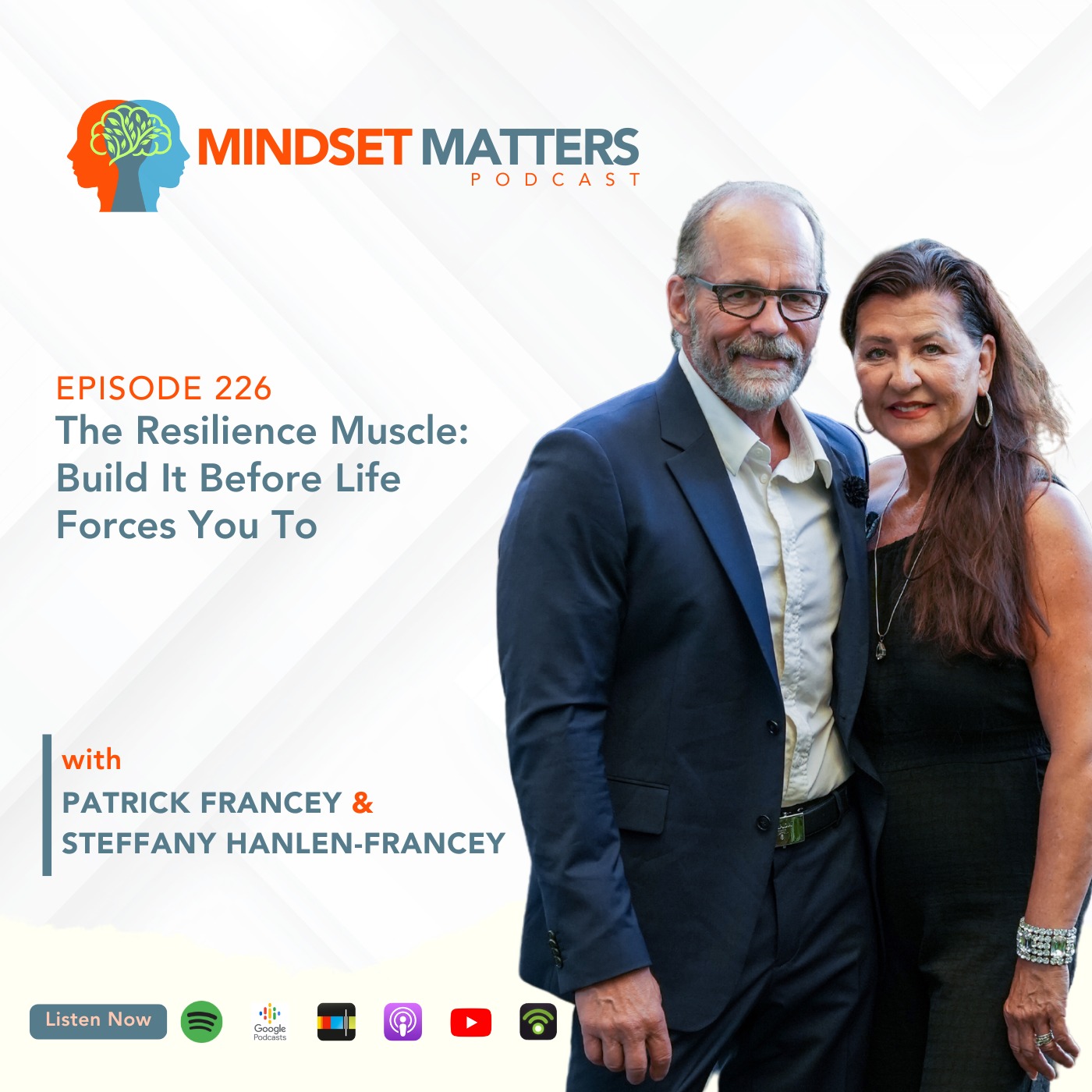
The Everyday Millionaire and Mindset Matters Podcast
Mindset Matters - Episode #226 - The Resilience Muscle: Build It Before Life Forces You To
00:44:23
Loading summary
Transcript50 lines
- [00:00]
A
Foreign. Welcome to this episode of the Everyday Millionaire Mindset Matters podcast, where I'm joined by my wife, Olympic mental performance coach Stephanie Hanlon. Francie. In these episodes, Stephanie and I have a conversation about the different aspects of what we refer to as Mindset Matters because we believe that for those who are awake, we are living in and through the most impactful time in history. Your view of the world is the filter for how you will experience the evolution and changing dynamics of it. Our intention is to provide you with ideas, nutritious food for thought, and some tools that you can use to help you in being your greatest self and living your best life. Listen in. Enjoy. We all love comfort, don't we? It's human nature, and left alone, we always tend to drift towards it. It's the easy decision, the familiar routine, the path of least resistance, as they say. You know, it feels pretty natural, safe, efficient. But then something happens. We feel a pull. And it's that kind of quiet tensions that says this isn't enough. There's more. There's more in us. There's more in me. There's more to build, more to become. And then there's the moment that you answer that pull, you start to collide with the truth that most people spend their lives trying to avoid. And that is that if you want more, you must tolerate more. More pressure, more uncertainty, more exposure, more discomfort. Because growth doesn't feel like growth when you're in it. It feels like friction. It feels like doubt. It feels like stretching beyond the edge of who you currently are. It challenges your identity. Actually, it exposes your weakness. It forces you to confront the gap between who you are and who you say you want to become. Here's the irony. We willingly sign up for years of discomfort so that one day we can live comfortably. But that's the wrong target. Because resilience, and that's what we're talking about, isn't built when everything is working. It's not built on stable ground. It's not built when conditions are ideal. It's actually forged under pressure. And most people don't lack talent. They lack tolerance. You don't lack potential. You lack the willingness to stay in the stretch long enough for it to change you. So the real lesson isn't about arriving at comfort. If you want your best life, however you define it, you must learn to get comfortable being uncomfortable. And that's where resilience is built. That's where identities shift. That's where the future you're chasing actually gets created. And today I want to Unpack that with the amazing Stephanie. Stephanie, welcome.
- [02:57]
B
Hi, hon.
- [02:58]
A
Okay, we got a lot. I want to go way deeper. So everyone goes through tough times in their life when they feel stuck, and I think that's a given. But we want more, we want to do more, we want to achieve more. So anyways, what do you think of that opening kind of thought process?
- [03:14]
B
I love that. I love when you have those kind of brain waves and. And you go on a rant and it makes a lot of sense. And I realize, you know, what I've been through for the last three, four months, just preparing for the Olympic Games and trying to figure out, you know, who am I going to be as I go through that and knowing that something always blows up on the way to the Olympic Games. Something always happens. Is that, where does my resilience muscle live? How have I been building it? How have I been training it over the last, you know, four years or. Or eight years or ten years, for example? And I think it's a really important conversation that we dig into because comfort isn't a goal. You know, being comfortable is, to me, scary as shit. Like, I. If I'm not uncomfortable, I know I'm not growing.
- [04:03]
A
Yeah. You know, something? I remember when we first. I don't know if it was when we first got married or before when we first met or something. Somewhere along the line when we said, this relationship's going to go for a while, and we wanted to be in a relationship, we had said, you know, let's promise ourselves that we're not going to get comfortable. Now, there's been times in our life where I've said, why the hell did we ever make that commitment? I was dumb, you know, anyways. But here's the thing about it, and I want your thought on this, because last time we talked about your athletes and going the Olympics and what it takes to prepare and resilience from an Olympic athlete point of view. But I think there's a part of this that there's two kind of subjects here that I want to hit on. Number one is we often find ourselves stuck, or we hear from clients or people in conversation, they're just feeling stuck. And the funny thing about stuck, and this is just me kind of riffing off a thought process around it, is most of the time when I'm feeling stuck is also where I've been comfortable. Then get uncomfortable or. No, been comfortable knowing that I want to do more, but feeling stuck. So how do I get unstuck? So it's in. There's A part of me, and this is just for me, that I think when I start feeling really comfortable is when I start feeling stuck. There's no. Because there's no challenge in that. There's like. It doesn't feel productive. That's my addiction. I need to feel like I'm getting shit done. So what's your thoughts on. Because. So here's where it plays to this. On the resilience side of it, if we're comfortable, we're not gaining or training for resilience to be resilient. You know, you talk about that with your athletes, you talk about that with some of your business clients about resilience. To get unstuck, you have to get uncomfortable, which also builds the resilience. You see, I'm trying to bring these two together, and maybe I'm working at it too hard. But you follow that train of thought.
- [06:11]
B
Yeah, I totally do. And I think that it doesn't occur to people early on in an athletic career or in business that you're actually. Every time you take a step or supposedly fall or do a misstep, you're building resilience is because it's how you react to it. It's how you dig deep. It's how you figure out, you know, what it is that truly matters to you, that allows you to move forward, regardless if anybody understands, regardless if you feel like crap or you feel guilty or you've got a bunch of shame because you made a mistake. It's about how do you pull yourself up and take that next step forward and move into your. What's next. Believing that those missteps or that downfall is actually happening for a reason and nothing's happening to you, for example. But there's a lot of gold in the times that we do make mistakes or things do happen or shit does hit the fan. And I think what happens is we forget that those. That is truly where resilience is built.
- [07:12]
A
But it's interesting about the word resilience, right? So I think, you know, we. We, you know, how do we define resilience? And then do you think that I don't. I know all these years later, I don't know how many times I've had a conversation about. Specifically about resilience and being resilient. It's always kind of there in the background, but it's not often a conversation. And yet resilience and gaining resilience, if you're becoming resilient, it means that you are challenging yourself. You're going through the discomfort, the uncomfortable Things that we need to do to get stronger, to get better, to get smarter, all of that stuff that's actually resilience or what's your thoughts on it? I don't know if you've got a definition for it.
- [07:57]
B
I think, you know, for me, what I've discovered is that everybody has a different definition. And because resilience isn't something we consciously train for. And I think going forward into, you know, the next, whatever iteration of our life is that, you know, it is something that we're training for is, is not just survival, but how do we thrive as we go through, you know, when shit hits the fan or when things go down or the banking system crashes or one thing happens after another, how do we rise to the occasion? And that's, to me, what resilience is. And if we don't consciously take a look at when things don't go well and see where the gift is, where the lessons are, and how do we pull those forward, then we're not actually training resilience. And if we do it consciously and go, and that's what I do with the athletes is I go, okay, well, you know, I just got off a call with one team and they didn't make the. They didn't qualify for the free dance. They had a fall and something happened. And I just spend an hour talking to them about the gifts in that and how they're going to build a resilience for the next four years of the quadrennial so that they are on the podium at the next Olympics, for example. And how do you pull forward the lessons and the gifts of when things don't go your way? To me, that's resilience.
- [09:11]
A
Okay, so for this conversation, let's give resilience a definition for listeners, right? So in my world, if we put a definition on it, I would say that resilience is the trained capacity. Trained is the key word. Trained capacity to stay aligned to your standard under sustained pressure. So stay aligned with whatever your standard is under pressure without the erosion of our identities, our decision quality or our integrity.
- [09:45]
B
That's good. Say that again, cowboy.
- [09:47]
A
It's pretty deep, isn't it? Resilience is the trained capacity to stay aligned to. To your standards under sustained pressure without erosion of identity, of decision quality or integrity. Now that's a really good definition.
- [10:06]
B
That's really good. And that is not something I don't think is trained in. Like, even in university. I don't even think that's a definition that would land. It's like People get into survival, and they just think, well, you know, the strong survive and the weak, you know, fail.
- [10:24]
A
Well, it's a. You know, we have to train. Let's call it the resilience muscle, okay? Because. So think about that. Even in this definition, you know, trained to stay aligned to your standards under sustained pressure. So in other words, you know, if we call it a muscle and we're working that muscle out, and every day or every second day, we go in and we lift, you know, we'll use the gym metaphor analogy again, where you're lifting weights if you don't consistently. So you're lifting that weight, and you can. Let's say you can lift a hundred pounds and you can normally lift it under. You know, you can lift it 10 times. But maybe you go into the gym one day and there's something different about the weights or there's something. There's a bunch of noise and distractions in the gym. But, you know, a hundred pounds at ten reps is. You can. You got this. But can you do that with all those distractions? Cause you feel the pressure of that. Or maybe you go in and there's somebody, a peer that's judging you or a group appears that, you know, okay, let's see. Let's see you pull this off, buddy. You know, and then you got all this pressure on you, and you have to be able to do that under pressure. Can you do it? That's resilience, and that's trained because you've trained for it, or maybe you haven't. Maybe it's really easy when, you know, conditions are ideal. What happens when conditions change? So put that in a business capacity, you know, you've got it all handled, and then all of a sudden some curveballs get thrown, and can you actually sustain that level or that standard that you have? And that's resilience, the ability to do that under pressure. Or do you lose your shit? Do you lose your mind? I can't do this.
- [12:10]
B
It's so true. And when you're saying that, I realize that even under the next level of competition, like the Olympic Games, for example, everybody goes. We go to the, you know, the Grand Prix, they go to the Nationals, but all of a sudden, the Olympics, it's such a big deal, right? And they. It's like all these external pressures and distractions happen, and can they still perform under that level of scrutiny, under that level of pressure? And I call that the eye of the needle. Like, can you take the macro version of how you've trained and Then put all of those pressures, distractions, judgments, elevated exposure, and still go through the eye of the needle and come out with yourself intact, with your performance intact. And I think, to me, that that's a trained muscle. That's really something that, you know, with the athletes that I work with and even my. In the business people or the CEOs I work with, is that I sometimes will have to manufacture adversity to see if I can actually get them to test their ability to be resilient. Resilient, sorry, is that if things are going too well, too long and the comfort kicks in, that, to me, is a downward spiral.
- [13:18]
A
Well, it's risky, right? Because as soon as the environment changes or something changes, can you take it on? So think about what we're, you know, let's use. Continue using the. Your athletes as an example. They train their whole lives in terms of, you know, technically and then through their programs and their technique, and they train their whole lives for that. And they go through a lot of pressure because right from a young age, they start to learn to compete. And that's with any sport, right? We go through the various levels and ages and all the things, and we, you know, spend our life putting ourselves in environments of competition where every level we go to is assuming that we're growing within that sport is another level of pressure, and that then creates the resilience. And by the time you get to Olympics, it really has been tested many times. But this is the, you know, the epitome, if you will, of resilience and being able to perform under pressure. You've worked your whole life for this, and then every four years you get, you know, you really, in some regards, your resilience is being tested, of course, your technique and all your ability to compete. But, you know, that's how that lands for me. But you actually, with. Throughout the years that you're working with athletes and through that quadrinity, I think you refer to it as you're actually putting your athletes or setting them up in giving them circumstances, or you're using life lessons that they're going through. Because we've talked about it many times. People see the podium, they see the gold medals or whatever they might see. They don't really see what's going on in behind the scenes. And what's going on in behind the scenes is that in amongst their hours and days and months and years of training is life. You know, relationships and parents and money issues and job issues and all the shit that goes on. They got all that on top of it. So they're already probably got a higher degree of resilience than the average person anyways, I would think, you know, like what would you compare it to? I guess you could compare it to a high performing executive, maybe corporate executive,
- [15:23]
B
business executive, people that have responsibility that, that other people's livelihoods are dependent, for example, on their results. When you think about that level of team or that level of leadership, we really have to, you know, dig into how prepared are we. You know, we don't know, for example, what's going to happen in the next, you know, cycle of the real estate cycle, for example, or what's going to happen in the banking world and what's going to happen in sports world. We don't know what's going to happen, you know, in the climate. Like we don't know. But what are we training for? Like, are we being naive to think that, you know, we're just wanting things to be comfortable? We're just wanting to get to. If I just get through this hard part, then things are going to go well. But it's getting through the hard part is what builds your resilience to prepare yourself for the next level of competition or the next level of challenge or the next level of exposure. Because that to me is really what is going to be the defining factor going forward, not just in sport but in business as well, is who do we have to become and how can we build the ability to, to move through the stresses that are going to happen to us. And a lot of those stresses are unknown. The same thing happens with athletes. They don't know what's going to happen. They don't know if there's going to be an earthquake or they don't know if there's going to be a ruts in the ice. Because there was, you know, the short track speed skaters happened before the figure skaters. They don't know what's going to happen. But do they have the tools and the ability to ground themselves and slow down and take a, take a pause and a breath to make sure that they are folding in all of those things that are happening before they step out onto the stage, onto the ice or into the boardroom?
- [17:03]
A
So would you, when you think about resilience, you know, in the definition of the trained capacity to stay aligned to your standards under sustained pressure. Now when we talk about sustained pressure, you know, I don't know what, you know, I'm thinking about that definition a little bit. But is resilience our ability to deal with adversity? I think that there's a part of that would. Would be there, right, Is, you know, the understanding. So I think about, you know, when I look at, you know, as a business owner and what I've been doing for as many years as I have, and when I look at, let's say, our team in Edmonton, our general manager, been there a long time, and what I realize, you know, as I'm kind of even in this podcast, thinking in real time, I'm going to, you know, he's got pretty good resilience, but I know that his level of resilience isn't to my level of resilience. You know, what can melt him down and what can kind of cause grief in his life. I'm looking at it going, okay, dude, you know, settle down a little bit. Just take a breath. You know, it's not that big a deal. So is that just because of my age and what I've been through in life, like, you follow what I'm saying is that it is an interesting kind of dynamic of developing resilience. So how would I, how do you think I would help maybe him be more resilient? Do I challenge him more? Do I force him to come up with answers as which I do often. But, you know, rather than give him an answer, I say, what? Well, what do you want to do? How would you handle this? How are you going to handle this? You know, like, I do that kind of stuff. So do you have any kind of insights in how do you do it with your athletes?
- [18:50]
B
That's a great question. And I think about what you go through, what we go through with our teams in different areas of business, etc. There's certain things that we can't teach them. They have to go through it themselves. And I think from a building resilience standpoint is can we create environments and structure? So they learn to trust themselves. They learn to trust their decision making and they become more solid in their values and who they are so that they can draw on those things as they go through tough times. I mean, I've been through things with athletes that are just brand new, like their first Olympics. And then, you know, one of the teams that I work with, of course, is their fourth or fifth Olympics. And their adversity was they, they won the silver medal instead of the gold medal. And that's as big a stress as the ones who didn't qualify for the, for the free skate. Do you know what I mean? Like, it's. Everything is as big as it is because of where we've come from and who we've had to become. So one is not bigger than the other. So, for example, what you're talking about with your general manager, what's going on in his life is, is real for him. It's a big deal. And just because it's maybe not as big as the, you know, somebody else's, you know, deal, it's still big for him. And I think what we do and what I do is try to make sure that they know that A, they're going to be supported, B, they're not a failure, and C, what is the benefit of the result that they got? So, for example, with Maddie and Evan's case, they won the silver medal. They're not happy. They thought they wanted to win gold, but it doesn't change who they are. It doesn't change their identity and the identity that they get to build and the resilience they've had to build to even get that silver medal and then move forward in their life knowing they didn't achieve their goal of winning gold. But what about the people who are just day to day trying to survive, trying to pay their bills, trying to get their mortgage looked after, trying to heal a relationship? It's all the same. And I think for. Back to your question is how do we help people build that resilience? Is that we have to also create environments for them where they feel supported and they feel unconditionally supported and loved and, you know, trust that they can trust themselves. Like confidence, for example, the word confidence, you break it down and the, the root of the word is fid, you know, it's fidelity. Can you be faithful to yourself? Can you be faithful to your training? Do you trust yourself? So when you circle back to resilience, it's grounded in the level of confidence that we can build or we can help people build in themselves. And that comes from making decisions, take a hit and moving forward. Decision, move forward, decision, move forward, decide, move forward. And that creates that level of confidence in your ability to make decisions, which I believe is the foundation of resilience,
- [21:43]
A
our ability to make decisions. So there's something that, you know, this goes back to, you know, what I wanted to, what I feel like we need to fold into this conversation is to how do you build resilience? So let's talk about, you know, as I said earlier when we kicked, kicked off is there's a part of, you know, when we feel stuck, okay, where we're, we're not building, you know, how do we get through that stuck that's, that's getting through that stuckness, if you will. That's part of building resilience. That's what I would say, you know, when we challenge ourselves.
- [22:17]
B
But it means we need to have a bigger goal, hun. And that's what happens is that we don't need to build resilience if we don't have a bigger goal, if we don't want something more for ourselves, if we don't want to have a different or better life. You don't need resilience if you just want to be mediocre.
- [22:35]
A
Well, again, but that's not what we're. That's why we don't. Mindset matters isn't about nobody listening to this show doesn't have bigger aspirations. They all do. That's the whole point of the resilience conversation, is that in order, we feel that pull, that's actually what we want to do. But then we realize that in order to achieve those bigger things, those greater things, we have to go through the discomfort of being uncomfortable. Like we gotta bust through our comfort levels or our world of comfort into the discomfort. And that's also. But I go back to what I said earlier, is that when we're feeling stuck, it's the desire to get out of the comfort zone that I think we're in. I think some might say, no, I feel stuck because I've got a problem I can't resolve. That's a little different of, that's a little different. But even that we have to break things down. So let me work through this a little bit. So when I think about being stuck and to me, I can bring that together and make it make sense in the conversation of resilience. So we've talked about it before. We have people and we ourselves have had conversations. How do we get unstuck when we're feeling stuck? That's also what builds resilience. So here's where resilience, I think gets to be built. So there's five kind of things that I've come to over the years that we've talked about before is how do we get unstuck? And so the first thing, and this is all about resilience. What am I avoiding? We need to ask that question, what am I avoiding? So if I'm feeling stuck, what am I avoiding? And we have to ask that question and be really brutally honest with ourselves. So it could be what I'm avoiding is the discomfort, the courageous conversation, the financial stress stretch, the work that needs to be done. I don't want to work that hard. So that's part of it. So we ask ourselves that question of what are we trying to avoid? And then we need to lean into that question. And then we also, as importantly, need to lean into the answer of that question. Right. So think about. I'm going to go back to your athletes. I mean, you must see that when you're working with your athletes about where they're feeling stuck is there's something that they're trying to avoid. Tough conversation with their partner, training dollars and cents. What's your thoughts on that?
- [25:01]
B
Yeah, or a lack of ability. Maybe I'm not good enough. You know, the. The doubt, all of those things kind of roll into that. And feeling stuck, you know, sadly, I think that's become a little bit of the norm and it's been reframed as, you know, survival in many ways. Just, you know, get. Put one foot in front of the other, and let's just keep going. And until you want to actually have something or do something more, you don't realize how stuck you've actually been. So when you identify that you're stuck and you realize, you know, what am I avoiding? What am I stepping over? What am I not telling the truth about? Those are difficult conversations, and sometimes they have to be facilitated. And, you know, it takes, I don't know, trust and a coach or somebody that you.
- [25:47]
A
An outside voice, somebody that can step back from it. Somebody step back and look. Right?
- [25:52]
B
Yeah.
- [25:52]
A
So I'm thinking about, you know, about getting stuck. And then, you know, what. What am I trying to avoid? So, I mean, these are. That's such a good question. You know, when we're. When we're trying to figure this stuff out. Right. The other question that often is, where do I start? So if you're feeling stuck, it might be because you're feeling overwhelmed. So where do we start? And the answer to that question is, how do you eat an elephant?
- [26:23]
B
One bite at a time.
- [26:24]
A
Right. So doesn't it kind of. Doesn't that kind of.
- [26:28]
B
And it seems so obvious, but why is it so difficult, you know, think about it is that, you know, where do I start? You know, start with what's right in front of you. One step. I always think, you know, setting goals. I always say, oh, dream big. But the truth is you have to act small. You have to take one step in the direction that you want to go. And if that means it's you cleaning up an incompletion or you're, you know, having a conversation that. That needs to Move you forward or something that's stuck in your body that you need to move, or, you know, it just takes that one thing and sometimes things just open up.
- [27:05]
A
You know what, as you were talking and as I was thinking about this, you know, I go back to your French team, your team from France, Team France, who won gold at the Olympics, and they'd only been together 10 months, but think about how much they'd trained, the resilience. So think about that. They hadn't skated together. They, you know, Guillaume was coming off from a different partner, hadn't he? Had. He'd been off the ice for what, a year or something in terms of competition, right? Almost two. Yeah. Lawrence had been skating with another partner. And so they come together and they go, okay, let's do this. And then, then, then a program has to be developed and costumes and training and oh, my gosh. So think about that. You know, there's resilience. I think that actually is the epitome of resilience. Think about the training that they had done over the years and their ability to face adversity, because they have both faced so much adversity in the past couple of years, right? So think about how much resilience they had built so that when they showed up 10 months before the Olympics, they leaned into it, right? And so, I don't know, that just kind of showed up for me. I think that's pretty remarkable, actually.
- [28:27]
B
It is. But they drew on that adversity, you know, both of them, and I think, you know, good, you know, you know, kudos to the good coach. But ultimately is that we also. I also didn't let them avoid the lessons of the adversity. Okay, where am I responsible? How am I accountable? What is it that I need to bring forward out of this shitty situation that's happening? And how do I not become a victim to it? Because to me, those are the pieces of developing resilience. That, sure, you could be a victim to any of it. You could, you know, just surrender and just go, I'm just going to sit on the couch now. Because of course, now with social media, everybody's, you know, a victim, and everybody is an expert. So, you know, how do you navigate and kind of move through the eye of the needle in that regard? And I think there, to me is a. An absolute brilliant case of how do you take all the. That's going on in your life and reframe it in a way and say, okay, well, I'm going to climb on top of this. I'm going to move forward because I. The goal hasn't changed. You know, in Laurence's case, she still wanted to be Olympic champion. Guillaume was already Olympic champion. He wanted her to be Olympic champion. It didn't minimize how hard the U.S. team, Maddie and Evan worked. They weren't doing it to beat anybody. They were just going to live their journey and to heal themselves and to bring forth the strength of character that the things that they had to learn because really, they had nothing to lose. Both of them have had so much taken away from them that they're like, ah, screw it, we had nothing to lose.
- [30:01]
A
Yeah. Yeah. Okay, step three. And the reason this is a little bit of getting unstuck, but I'm realizing it is a bit of rebuilding, resilience a little bit at a time, and then that's how we get unstuck. So the next number three is how do we win a day? How do we win the day? Okay, and we also, we. We want to answer that question just from the aspect of, okay, what can I do today that I can take on and get done today? And that would be a win. You know, sometimes when I'm writing, for example, like, I literally will go, I'm going to get a thousand words in the can today. A thousand good quality words done. You know, a thousand words doesn't sound like a lot, but I can tell you it's huge. That makes sense. That actually flow, right? And then the other side of that, you know, when we're talking about that, is the also, especially when you've got big challenges, you have to take and look and say, well, what. What was my win today? You know, and acknowledge the wins that we had. We often share that story. You know, that as overachievers, we focus on, you know, if we want 100 and we hit 80, we focus on the 20 we missed the 80 we gained. Like, that's just so crazy. But it's. It's actually what, number one keeps us stuck and it doesn't build resistance. It. Or I said it again, resilience. So I'm resisting this conversation maybe.
- [31:31]
B
And what's funny is, you know, you think about it sometimes. I always used to say in the seminars with the hockey players and different athletes and stuff, it's like, sometimes my win is getting to the rink on time. Like, stuff is happening, shit's blowing up all around me, getting cut off in traffic, things aren't. Aren't flowing. And sometimes you have to go in and, okay, what's. What is the win? And I went, oh, I got to the. I got to the rink on time, or I got to the office on time. Oh, breathe into that one thing and start again. And that's the other thing about resilience, is that you get a chance to start again is that you're not going to judge yourself and go and just destroy everything that you've created. I mean, from that ego standpoint, it's like, oh, all of a sudden I suck because I screwed up and I, you know, didn't close the deal or didn't make the whatever. And then everything you've done to that point gets minimized. But the minute you can find the one thing, the win, the what's important now, like when you find that one win and you can just breathe into it and go, okay, let me just start again. That's also resilience.
- [32:36]
A
Number four. What are the habits or systems or lack of either of those that are interfering with the result that you want to achieve? Now, this goes back to. Resilience is trained, but resilience is built on top of good habits and good systems. So, you know, we fall to the level of our systems and our habits.
- [33:05]
B
We don't. We don't rise. A lot of times. A lot of times, what I've seen in the. The athletes or the business people that don't achieve their goals, it's because their systems weren't solid. There was things that, there was energy leaks, There were things that weren't fully fleshed out or really defined. Yeah, that's a big one.
- [33:27]
A
Yeah, it is, isn't it? And then there's the final one, which you and I go to all the time, which is we have to reflect and ask ourselves, where does who I'm being get in the way of where I am going?
- [33:43]
B
That one pisses me off.
- [33:46]
A
I know, right?
- [33:50]
B
We're doing everything right. We're working, we're taking the courses, reading the books, and things still aren't happening our way. And we're like, okay, where do I still need to take responsibility with who I'm being? Something's not right. How am I being perceived? What is going on for me? And that sometimes, you know, we talk about blind spots. Sometimes we need someone that cares about us to point out our blind spots if we're not getting the results that we want.
- [34:18]
A
It's so interesting, isn't it? And resilience is something that's built over time. I mean, I think about, you know, and my general manager is awesome, by the way, so I use him as an example. But you realize that the resilience that I've built over the years or that you've built over the years is over years. It is dealing with the grind every day. It's going through it and actually being okay with the grind, loving the grind, because, you know, that's what it is. And being uncomfortable and sometimes realizing that, holy cow, this is really sucks. I don't know if I can do this. And you do it anyways. And that's how you build the resilience muscle as well. And so who do you have to become to do that? That's always. Geez, you know, I don't know. It just keeps going back to that, doesn't it?
- [35:09]
B
Yeah, it does. And I think about, you know, think about the last five years and what happened in 2020 and how people had to pivot and the decision fatigue that happened for people. It's like, we've never done this before. I have to make a decision. I have to. I'm responding at the speed of information. Like, information was downloaded on people and then had to do this, and they had to pivot and do that, and they had to do so. Like, the decision fatigue that affected people really showed the level of resilience. And that's. In my world, that's how we measure it. It's like, how can we really continue to make quality decisions based on our values, based on what we know at the time, and be okay to be wrong sometimes? Because that's where we. Right. What the recovery discipline comes in is that. Okay. So that was not the right decision. Decide, move on. Okay, got it. Get the feedback. Move into another, you know, area of. Of of decision making and results is that we can only be like. We get. We judge ourselves by our intentions, but other people judge us by our results. Right. My mom always said that you can have the best decision intentions in the world, but, you know, the road to hell is paved with good intentions. Yeah.
- [36:20]
A
Yeah. We're being judged by our actions and our results as well. But it's something in the definition that we got to go back to, which is resilience is the trained capacity to stay aligned to your standards. Okay. And this is where resilience really lives. And I'm just trying to sum this up and really kind of put it into a phrase. But resilience is built under pressure, and the more resilient you are, the more capacity you have to stay aligned with your standards, to stay aligned with your values. Because the minute that you compromise your values, your resilience just ticked down. The minute that you emotionally break down, whether that's anger or break down in tears or whatever because you're feeling the pressure of a, of a board meeting or something. You know what I'm saying? It's like resilience is our ability to handle the pressure, stay aligned with our standards, stay aligned with who we are, and actually make decisions in those moments. So let's go to an extreme. So we talk about Olympic athletes. Let's go to the next stream. Imagine the resilience of somebody like, I don't know, Elon Musk. Imagine, you know, for all his weirdness, I mean, he's, he's sending rockets into outer space. Like, just imagine the decisions and the pressure and the, you know, and his ability to not fold like a cheap tent under pressure. That's resilience or am I, am I out of whack?
- [38:03]
B
Oh, no, absolutely it is. I can't imagine. I mean, we don't know if any of it's true, but ultimately, when you think about that, what has to happen and the level and the capacity and the speed of decision making, that has to happen? I think that's, I mean, when you go back, when we circle back to the building of resilience, that is, that is one of the pillars is capacity, right? Like, how do you sustain decisions under load? Like think about a CEO or think about, you know, anybody that has a lot of pressure. And I think people that listen to us are living this kind of, they're not kind of living in a world of mediocrity or, or just average. So how do you sustain decision quality? And then we talked about, you know, decision fatigue that happens when things are coming at you all the time. But to still climb on top of it, raise into the quality of the decisions under an increasing amount of stress that is coming onto them, whether it's the Olympic Games or a CEO that's running a billion dollar company. Right?
- [39:07]
A
Yeah. So folks, as you listen to this, ask yourself, where are you testing yourself to be resilience? Where are you maybe folding like a cheap tent? I think that's really it. You know, like we have to work on our resilience muscle. And it always, like all things, starts with your awareness of your ability to actually go, holy cow, this is me being. My resilience is being tested. You know, we talk about adversity quotient, we talk about emotional quotient, we talk about all the AQs, EQs and whatever other cues are out there, the quotients. There should be a resilience quotient. I guess it's all made up of our.
- [39:51]
B
The rq. We just invented it.
- [39:53]
A
We just invented it. The rq, our resilience quotient. Now we got to do is figure out how to test it. Anyways, I think we covered a lot of ground. Hopefully there's enough in here for listeners to kind of think about in their own ability to be resilient, in how they operate in business, in careers, with their teams, with the challenges that we face in our life, with our families. Yeah, exactly. I think there's one other thing I want to hit on, just one other thing before we shut this down today, because we've already run on a long time, and that is that when we look at the world and we've talked about it many times, you know, 2020, the world changed. And that was really what was the launch of this podcast. The world is changing. It's shifting. It's not what it once was. And we're hearing more and more about people's lack of resilience and without any judgment around it. It's just that that is what's happening. You know, we think about. We've heard, we just. I just read a stat recently about young people, like, as in under 30, the percentage increase in suicides is, like, shocking. It's like 135% for girls and 160% for boys or something. Like, I don't remember those numbers, but it's like it's in the nosebleed section of how high it is. And that is. I think that has to do with resilience. And I know it's a mental game. And I don't want to minimize any of that, by the way. I don't. But it's just like we need to face a changing world. And for those who are aware of that changing world, who are actually paying attention to it, realizing that the government isn't going to fix our problems, we have to be resilient. As we go into the future, so many things are changing, and just on the technology side of things alone, let alone monetary policies and economies and potential wars that keep continuing to fricking escalate over the past three years. So that's going to take resilience. As our environment starts to change, as even culturally we seem to be shifting as a country, that's going to take resilience and we need to adapt and adopt some kind of standard of performance that we can hold that resilience muscle and test it. Anyways, I'll leave it at that. That's all I got.
- [42:19]
B
Stephanie well, I really appreciate this conversation, hun, because you know, over the last few months and few years, just going through what we've been through together and with our clients and with the athletes and our businesses, is that what I really appreciate and admire about you is you. You don't change. Like your standards and your values don't change. You are who you say you are in every situation, under pressure, under load, under situations. And I think that's something that we both carry through and if we can even leave something in this conversation is that if we can separate our self worth from our outcomes and we can still honor and own who we are as humans and can stick true to our values and not have to, you know, compromise what we believe in, I think that will be the foundation when we're getting challenged, when we're being minimized, when we're being inundated with all the bullshit and social conditioning what's going on in the world, right? If we can just separate our identity and our self worth from our outcome, then I think what happens is that we will continue to grow as a society and get stronger and support and attract people of like mind that we can continue to grow with. So that's all I got.
- [43:37]
A
Well said. Thanks. And that's a wrap, ladies and gentlemen. Thanks for listening. Stephanie. Thank you.
- [43:42]
B
Thank you. That was fun.
- [43:45]
A
Ladies and gentlemen, thank you. Thank you for listening. If you found value in the podcast, please take the time to rate and review and share with others. Share with your friends as it is my goal to always improve and to provide the highest value for you, the listener. If you have any comments, suggestions or questions you'd like answered, please email me@ceoraincanada.com that's CEO E I N. I look forward to hearing from you and until next time. Patrick.
- [44:18]
B
Oh.