← The Everyday Millionaire and Mindset Matters Podcast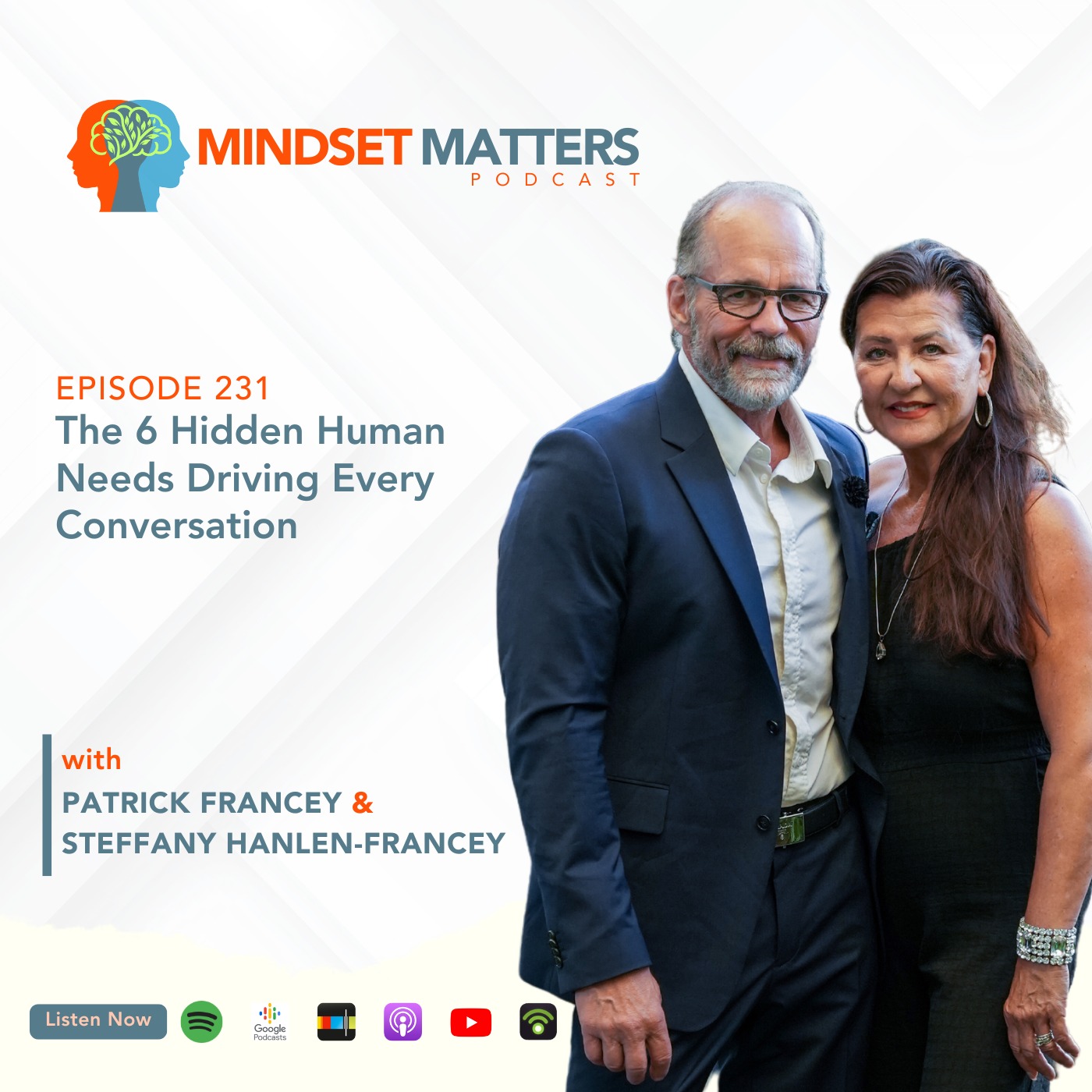
The Everyday Millionaire and Mindset Matters Podcast
Mindset Matters - Episode #231 - The 6 Hidden Human Needs Driving Every Conversation
00:29:05
Loading summary
Transcript199 lines
- [00:00]
Patrick O
Foreign.
- [00:05]
Welcome to this episode of the Everyday Millionaire Mindset Matters podcast, where I'm joined by my wife, Olympic mental performance coach Stephanie Hanlon.
- [00:14]
Francie.
- [00:14]
In these episodes, Stephanie and I have a conversation about the different aspects of what we refer to as Mindset Matters because we believe that for those who are awake, we are living in and through the most impactful time in history. Your view of the world is the filter for how you will experience the evolution and changing dynamics of it. Our intention is to provide you with ideas, nutritious food for thought, and some tools that you can use to help you in being your greatest self and living your best life. Listen in. Enjoy.
- [00:51]
Stephanie, welcome.
- [00:53]
Stephanie Hanlon
Hey, hon.
- [00:55]
Patrick O
So one of the things that, you know, human needs are we need validation. People in general need validation. That's kind of one of the things. Right? But there's actually six ways that people seek validation in a conversation. Now, this is interesting when you're talking to somebody. So this was research based on what Chase Hughes talks about. And I found it intriguing and I thought, you know, let's have a little bit of a conversation because you and I have done this body of work. Of course, Hugh Chase is whatever he was.
- [01:32]
Stephanie Hanlon
Chase Hughes.
- [01:33]
Patrick O
Chase Hughes, I should say. He's, you know, he's a CIA operative for years. And he did. He, he, his, his. All of his training, he says straight up, was about brainwashing.
- [01:45]
Stephanie Hanlon
Yep.
- [01:46]
Patrick O
And I thought he's pretty cool guy. He's so interesting. Anyways, he talks about validation and how do we. I identify what it is that somebody needs in terms of their validation. So I'm going to go through the six things and then I want to just break it down one at a time and kind of talk a little bit about it. This is. We've actually talked about this on the show over the past. Whatever. It's been three, four, five years that we've been doing the show. Anyways, the point is, is that we've had these conversations before. Chase Hughes put it in a really cool contest. So you ready?
- [02:21]
Stephanie Hanlon
Hit me.
- [02:21]
Patrick O
You know, these ones. Okay, so first off, you need significance, right. You need acceptance. You need approval, intelligence. This one will get you pity.
- [02:35]
Stephanie Hanlon
What?
- [02:36]
Patrick O
Yeah, I know. And strength and power.
- [02:40]
Stephanie Hanlon
The pity one kind of threw me off.
- [02:42]
Patrick O
I know. But there is a place where I read that one in the way I interpreted and kind of picked up on it was pity isn't about being a victim, but it is about having somebody that has enough empathy that they can say, yo, God, that had to be hard. Wow. See how that would be Tough, right?
- [03:04]
Stephanie Hanlon
Yeah.
- [03:05]
Patrick O
And so this is about when you're having conversations or you see somebody that you've not met before that you got to have a conversation with. There's just different things and there little subtle signs around it. So with a couple of these, I created parables, you know, or examples, did a little bit of research. So significance, you know, a man builds a taller and taller tower in a village, not to see further, but so everyone else has to look up. So the truth of that is a significance isn't about impact. It's about often. Or it's often about having an identity or protecting your identity. And then in the way it shows up, you'll see it with this person because you're trying to assess this person, perhaps needing to be right in conversations. Status signaling, as in titles to real estate, you know, cars, how many deals you've done.
- [04:03]
Stephanie Hanlon
Okay, well, pin in that. Think about the story of. We were having. We had people over for a summer. I think it was your birthday party. And we were talking about somebody that wanted to buy a helicopter or a big excavator or something like that. And the question you asked was, so if nobody knew you had the excavator or the helicopter, would you still buy it?
- [04:24]
Patrick O
Yeah, totally.
- [04:25]
Stephanie Hanlon
He went like, what?
- [04:28]
Patrick O
Yeah, I was like.
- [04:29]
Stephanie Hanlon
Never even occurred to him. Because he realized he was doing it because all the neighbors had one.
- [04:33]
Patrick O
Yeah, that kind of thing. Exactly. Okay, so the significance, you know, those individuals will turn a small win into a big long narrative. Like they just, you know, cured cancer.
- [04:45]
Stephanie Hanlon
Yeah. And being personality around it.
- [04:48]
Patrick O
Yeah. And then being defensive when challenged. So these are signals, you know, about somebody who needs significance or needs to feel. I think everybody, you know, I. I know that part of our human nature is to have significance at some level, make a difference in other people's lives is how I frame it. But in this case, it positioned as well, is if you're assessing somebody, do they need to be elevated?
- [05:18]
Stephanie Hanlon
Yeah. There you go.
- [05:19]
Patrick O
Right. Any other comments on that significance thing?
- [05:24]
Stephanie Hanlon
No, I think that's a big one. It's one of our number one human needs is being seen and being significant. That's why I think about the athletes and on the journey to be Olympic champion. You know, if I am the. I am the gold medal, I am the Olympic champion, then it gives them that level of significance. And the work that I do, I. That I try to do underneath that is that you are not that.
- [05:45]
Patrick O
Yeah.
- [05:45]
Stephanie Hanlon
You know, you're more. You are so more than that. But if that's what gives you significance in that moment, then fold it in, but don't attach your identity to it.
- [05:54]
Patrick O
Well, I think that, you know, it's interesting about it. So I continue to research this, like literally research beyond AI, by the way. And I went, okay, so how do we read this stuff? So one of the. One of three articles that I read about it is. And then I was thinking about it. Yeah. You know, you start to identify these things. So watch this. So how do you look at. For somebody who's looking for significance? So if you're in a discussion with somebody you don't know, maybe you're in a. Negotiating a negotiation, you know, ultimately you. If you're in a negotiation with somebody, you know, the way to win in a negotiation is tap into what that person really needs. Right. So how somebody who needs significance, how do you. How do you identify that? Right. So you see, how do you read it in somebody? One is watch for over talking, watch for interrupting or one upping. Some would say that I do that with you on the podcast. I know that's what you're thinking, but that's never my intention. I just wanted to call myself out before somebody else did. Listen for I. My what I did.
- [07:01]
Stephanie Hanlon
Me, me, me.
- [07:02]
Patrick O
You know, fragile ego.
- [07:05]
Stephanie Hanlon
Yeah.
- [07:05]
Patrick O
You know, underconfidence. So what do you do? Give them recognition. That's what they want.
- [07:14]
Stephanie Hanlon
Attaboy. Add a girl.
- [07:16]
Patrick O
Yeah.
- [07:17]
Stephanie Hanlon
Good job.
- [07:19]
Patrick O
So.
- [07:19]
Stephanie Hanlon
Yeah, well done on that. As long as it's sincere, right?
- [07:23]
Patrick O
Yeah, of course, of course. But again, that same person be taking a big thing and make or a small thing and making it big. So, you know, really all you're doing is playing to them. Okay. So give them recognition and they'll actually open up. Here's the thing. And you know this. Challenge them publicly and they'll probably shut down.
- [07:46]
Stephanie Hanlon
They'll shut right down.
- [07:47]
Patrick O
Yeah. Right. Okay, so that's significance. You got that one. Now, do you think you can spot somebody who needs significance and know what to do?
- [07:54]
Stephanie Hanlon
Always.
- [07:55]
Patrick O
Okay. Acceptance and approval. Okay, parable for that. A chameleon survives not by strength, but by becoming whatever the environment wants of them. Oh, wow. So in this particular case, approval. Right. If you're wanting acceptance and approval. Approval is about safety. Rejection feels like a dangerous situation.
- [08:23]
Stephanie Hanlon
Well, it is. Back in the day, if you were rejected out of the tribe or out of the pack, you would die.
- [08:28]
Patrick O
Right. So how do you spot that in somebody? You know, maybe they're saying yes when they actually mean no. And we can pick up on that kind of stuff, I think often, you know, Avoiding conflict, adapting opinions to whatever the temperature of the room is. You know, what's everybody else saying over explaining decisions. So an example might be an employee who agrees on everything in meetings. But then when you go to. When they go to execute. No, they resist the execution. How many times have we seen that?
- [09:06]
Stephanie Hanlon
A lot.
- [09:07]
Patrick O
You know, so how do we read it? So we. Number one, that would be one way to read it. Watch for hesitation before they're speaking. They use language like I just think
- [09:17]
Stephanie Hanlon
or maybe or the trying too hard guy.
- [09:21]
Patrick O
Yeah. Energy shifts depending on who's present.
- [09:23]
Stephanie Hanlon
Let me buy you a beer. I can buy you a drink. Let me do this for you. Let me do that for you. Yeah. Trying to our guy approval.
- [09:30]
Patrick O
And then energy shifts depending on who's present. So, you know, how do we use it? First off, we have to create safety for them. That way they will, in fact, open up and they will tell the truth. And then when you put them on the spot or challenge them a bit, they're going to default to pleasing. Yep.
- [09:52]
Stephanie Hanlon
Trying too hard guy. Oh, so many athletes.
- [09:56]
Patrick O
So think.
- [09:57]
Stephanie Hanlon
So many.
- [09:59]
Patrick O
So get into a little bit of a. You know, I. I've seen this in business meetings where. Push back a little bit, you know, if you're the more a type personality and the other person just kind of backs down and they just default. Oh, yeah, no, actually that's a pretty good idea. Yeah.
- [10:16]
Stephanie Hanlon
And then they back down.
- [10:17]
Patrick O
And then they back down. They don't.
- [10:20]
Stephanie Hanlon
What they believe. Yeah.
- [10:21]
Patrick O
Yeah. So I thought that was quite interesting. Third is intelligence. So a scholar memorizes every map but never leaves the room. Right. We see this and we talk about it all the time in. In our industry or in many of these. You know, are you a theorist or are you an operator? Right. Nothing wrong with either of them. Right. But if a. Again, a scholar who memorizes every map but never leaves the room will show up and everybody. They'll sound very intelligent because they know all the stuff.
- [11:06]
Stephanie Hanlon
Yeah. But it's like an athlete that can know all the things they have to do. Watch the YouTube and, you know, read all the books and take all the courses, but never actually do it. It's like I remember one time, you know, when we were doing what.
- [11:21]
Patrick O
Just let me just hold that thought. Don't lose that thought. Okay, but so think about that. So. Because I'm gonna. You just said what I was gonna say, which is intelligence can be used to understand or to avoid action.
- [11:35]
Stephanie Hanlon
Of course.
- [11:36]
Patrick O
Yeah. Which is what you just said. So anyways, I know I'm so smart recapping it. You're so smart, you're so intelligent.
- [11:44]
Stephanie Hanlon
No, but you don't ever give me a heads up on what we're talking about. So then I have a thought and then you interrupt me and then it doesn't like it. Just like you gotta.
- [11:52]
Patrick O
Because I need significance. Didn't you just. Didn't we just discuss that?
- [11:55]
Stephanie Hanlon
I think we did. Anyway, I lost my train of thought. What was I saying?
- [11:58]
Patrick O
Something about athletes, real estate.
- [12:02]
Stephanie Hanlon
Oh, yeah, I remember back in the day, you know, we were quietly investing in real estate and one thing led to another and at one point we had over like 150 doors and blah, blah, blah. And people are like, well, how come you don't ever talk about it? How come you don't ever, you know, you know, make it a big deal? And like, why, why would we do that? That's not really why we're doing this. And then I remember you when you bought Rain, it's like, well, how is that you have the significance or you have the credibility. And we're like, well, because we've been quietly chugging away.
- [12:37]
Patrick O
Doing it. Doing it.
- [12:39]
Stephanie Hanlon
Yes, we're doing it. We're not. We're not like shouting it out to the world on social media and making sure everybody knows what we're doing.
- [12:47]
Patrick O
Okay. Okay. So how it shows up. Yeah, this is intelligence. Right? How it shows up over analysis, always researching. Gosh, that would be me, not you needing more data. Data before moving and then arguing nuance over results.
- [13:03]
Stephanie Hanlon
So that's not me.
- [13:06]
Patrick O
No example would be an investor waiting for the perfect market or for the perfect market conditions and then misses three cycles. Right, Right. And then, you know, how could we read it? You know, somebody. And we, we probably see this in a few people. Right? Very complex language for just simple problems. Yep. Ask great questions, but don't take any action. That one drives me freaking crazy. Yeah.
- [13:35]
Stephanie Hanlon
Oh, well, that's the trap, right? Think about coaching. How many times have you and I both said to somebody, you know what? I don't think I'm the right coach for you. You just keep wanting me to have the answers for you. And you keep asking questions. The whole motion versus action thing, like, I'm, that's not me. I. I'm not.
- [13:52]
Patrick O
But people like that. So knowing this, the point is, is that and. Or their value being right over being effective. So the point of it, all of this, is that this is about intelligence. So if you're talking to somebody, you've never met them before. Let's keep Going back to where. What we're talking about here, how can we use it? And this is a really great, great question, I think. And this is, you know, the quality of your life is a reflection of the quality of questions that you ask yourself or somebody asks you. What would you do if you had to decide today? That's a push to action.
- [14:28]
Stephanie Hanlon
Yeah, it is. And that's really uncomfortable for most people because again, the whole. When you. Motion versus action, it feels like you're, you're actually doing things. When you're in your head and you're analyzing and your analysis, paralysis, it feels like you're actually doing something and you're just sitting on your chair.
- [14:47]
Patrick O
Right.
- [14:47]
Stephanie Hanlon
Your head.
- [14:49]
Patrick O
So you. But you just said it, right? It's like you're, you're, you, you're pushing the action to the kind of the edge or the threshold of what they can do without the certainty.
- [15:01]
Stephanie Hanlon
Right.
- [15:02]
Patrick O
You know? Yeah, you said that. Well, thanks. I could articulate it better anyways, but. But that's really what it was. That's really what it is. You know, it's. What would you do if you had to decide today? Okay.
- [15:16]
Stephanie Hanlon
And some people would do nothing.
- [15:18]
Patrick O
Okay. Yes.
- [15:19]
Stephanie Hanlon
Anyway, move on. Next.
- [15:20]
Patrick O
Pity.
- [15:22]
Stephanie Hanlon
Yeah, this one. Tell me about, Break this down.
- [15:25]
Patrick O
Okay, well, so think about pity.
- [15:27]
Stephanie Hanlon
I mean, don't, don't go to empathy first. Like you use the word pity.
- [15:31]
Patrick O
Okay, so here's a parable. A man carries his chair, his chains everywhere. Not because he can't remove them, but because people treat him gently when he wears them.
- [15:41]
Stephanie Hanlon
Gotcha.
- [15:42]
Patrick O
Right.
- [15:43]
Stephanie Hanlon
It's like an injury. Oh, using a cane or. Oh, wow.
- [15:47]
Patrick O
It could be ending. It could be a divorce. You know, it could be.
- [15:51]
Stephanie Hanlon
That's huge.
- [15:52]
Patrick O
Any number of things.
- [15:54]
Stephanie Hanlon
So this goes back, whatever it is that you are looking for to get pity, but you're also getting significance from
- [16:01]
Patrick O
it, a hundred percent. So it's the aq, EQ kind of thing, Right? Pity. So we stay stuck in an old story, even though it's past, it's done. What? It could have been bad, by the way. It could have been something really sad or really great.
- [16:18]
Stephanie Hanlon
Maybe.
- [16:19]
Patrick O
Yeah. But if it becomes. Or. Well, no, you're not like, no, you wouldn't be great. But if you're looking for pity, what
- [16:26]
Stephanie Hanlon
if you were like a gold medalist in 1994 and then nothing happened since and people pity you?
- [16:34]
Patrick O
No, it could be. Right. But the point of it is, is, you know, pity is different. But so how do we, you know, it can become a strategy for, for connecting and also for avoiding responsibility.
- [16:51]
Stephanie Hanlon
Totally. I never even thought of that.
- [16:54]
Patrick O
I know.
- [16:56]
Stephanie Hanlon
That's a big. And now that you're saying it, I see it everywhere. Like, all of a sudden, bing, bing, bing, bing, bing. My brain is, like, seeing all this stuff where I've actually entered conversations and felt sorry for people, but they have wrapped their whole identity around what happened to me back in the day.
- [17:12]
Patrick O
Yeah, yeah, yeah.
- [17:14]
Stephanie Hanlon
Wow.
- [17:15]
Patrick O
Okay. And that's how it shows up, right? Repeating the same problem. Then your external blame, you know, whether it be economy or partners or timing, you know, it. It ultimately the underlying weather. Yeah. The underlying message always is a little bit of poor me. You know, it's good that your sympathy and they want sympathy, not solutions. So Ben, don't fix the problem maybe is also right.
- [17:44]
Stephanie Hanlon
Oh, my God. I know that one. I avoid so hard when I feel people just want me to join their pity party.
- [17:52]
Patrick O
Yeah, yeah. Oh, oh, I got another. I'm gonna go later. I'm gonna. I'm gonna end this segment, but I'll ask you a question about gossip. Don't let me forget. Okay, so the example of pity is like, the example would be an investor who always has a reason why it didn't work, but never changes the strategy or never takes action. Right. So how can we read it Is that if you're running into somebody or you happen to know this is probably the fourth time that they've told you the story and they don't even know it. You know, the story that hasn't even evolved. It hasn't evolved. Like, I got over it. It hasn't evolved. You remember how you know, and there's patterns that are repeating, and then, you know, oh, gosh, I. I can't. I even. I think there has been times in my life where I've been this guy, Right? And then the energy drops when somebody gives you a solution to the problem. Hold it, hold it. That means I can't be this guy anymore, right?
- [18:58]
Stephanie Hanlon
I can't be the victim anymore.
- [19:00]
Patrick O
I. I think we've all probably had that. But anyways, so here's how to read it and handle it. Don't feed the story. So in other words, shut up. Stop talking. Stop talking. So when somebody gives you that story that you've heard for the fifth time, move on. Don't even acknowledge it or put the question in. When they show the story. Oh, that's interesting. What's your next move?
- [19:27]
Stephanie Hanlon
Yeah, for me, my strategy is I stare at them blankly.
- [19:32]
Patrick O
Well, I know, but if you ask them what their next move is, that Puts the. That puts them as responsible, not you. Rescuing.
- [19:42]
Stephanie Hanlon
Yes.
- [19:43]
Patrick O
Put the responsibility back on them, and they'll quit telling you the story.
- [19:49]
Stephanie Hanlon
Yeah. And then you may lose them as a friend, though. But if you just stare at them blankly and let them feel,
- [19:56]
Patrick O
they'll think he did drugs. I don't know. I don't. I don't know about the staring blankly
- [20:00]
Stephanie Hanlon
one, but I do that all the time. It's. It works so well.
- [20:05]
Patrick O
You do with me. It just pisses me off. So.
- [20:07]
Stephanie Hanlon
Yeah, that's you, though.
- [20:09]
Patrick O
Okay. Okay. Number five. Strength. Okay. Control, certainty, dominance. So a general fortifies his castle so well, he never realizes the war has moved elsewhere.
- [20:26]
Stephanie Hanlon
Right. And he's still behind the wall.
- [20:29]
Patrick O
Yeah. Here's the reality. Strength often masks fear of losing control, and it shows up in people who need to control all the decisions or being really direct or forceful in communications. Gosh, is this me? Hold on. Let's go back here. What are we talking about again?
- [20:53]
Stephanie Hanlon
Totally.
- [20:55]
Patrick O
Am I. Okay, that's strength, control, dominance. I don't know. I don't. Maybe sometimes forceful communication. I. To me, I'm just. Curtain. Abrupt. I don't know. I'm pretty direct, I think. I've. Yeah, I. I've got.
- [21:08]
Stephanie Hanlon
That's why you don't have any friends.
- [21:10]
Patrick O
I know. It's like nobody likes me. So. Low tolerance for ambiguity.
- [21:14]
Stephanie Hanlon
Yeah.
- [21:15]
Patrick O
And I. But I don't struggle to delegate.
- [21:18]
Stephanie Hanlon
No, you kind of do. You like to do everything yourself because, you know, you. You're the better. You could do everything better than everybody else.
- [21:26]
Patrick O
No, no, no, no, no.
- [21:27]
Stephanie Hanlon
Yeah, you do.
- [21:28]
Patrick O
In. Okay, quit it. In some areas of my life, but I'm. I pay a lot of. I pay people. I pay a lot of people to do shit. So quit it.
- [21:37]
Stephanie Hanlon
Right. Okay.
- [21:39]
Patrick O
There are certain things that I like to do myself. Okay, here's one. Right? Here's an example of that. You know, the business owner who bottlenecks growth because no one can do it like me. Oh, funny you were just saying that. That's not me, by the way. I've been an absentee business owner for 20 years.
- [21:59]
Stephanie Hanlon
Yeah. I'm thinking more about, you know, around the property. Like, we have. Want us to do stuff, but I
- [22:06]
Patrick O
do that because I like outdoor activities and I like to have motion and keep strong.
- [22:11]
Stephanie Hanlon
Say that not just like, no, I can do this myself. I want to do this myself. That's different.
- [22:18]
Patrick O
Well, I do want to do it myself. How many times have I said that out loud? Many times.
- [22:24]
Stephanie Hanlon
Yeah, but then it's stuff that you could actually get supported on that. Doesn't have to be as perfect as you do it.
- [22:31]
Patrick O
Okay, quit it. We. We're moving on on this. This is a podcast, but sometimes people
- [22:37]
Stephanie Hanlon
want to hear us argue.
- [22:39]
Patrick O
Counseling. Quit it. Okay, how are we reading it? We've lost the plot.
- [22:43]
Stephanie Hanlon
That's.
- [22:43]
Patrick O
Okay, so how do we read that in somebody else.
- [22:45]
Stephanie Hanlon
Okay, yeah, exactly.
- [22:47]
Patrick O
How to read it? Short, decisive, language, impatient with the process. That's me all over the place. Focus on outcomes, not feelings. Oh, my gosh. This is describing me.
- [22:57]
Stephanie Hanlon
What? Why did you even bring this up?
- [23:00]
Patrick O
Dude, I know, but here's the truth. How do you use it? Okay, if you're talking to me, here's how you got to use it. Be direct, not emotional. Show confidence, because that'll earn respect. Otherwise, you're just wasting my time and you're going to lose me. That just described me pretty much right to a T. That's pretty funny.
- [23:19]
Stephanie Hanlon
I'll never lose you.
- [23:21]
Patrick O
Okay, well, that was good. Okay, look at that. There was one there. That was there. Okay, so if you're talking to me, that's. That's it.
- [23:30]
Stephanie Hanlon
That's actually so true. Can you repeat that one? That. That is so true, I think for so many entrepreneurs and businesses.
- [23:37]
Patrick O
Oh, 100. 100. Okay. So this is it. This is about number five was strength. Okay. And the words around that, Control, certainty, dominance. Okay. The parable was a general fortifies his castle so well, he never realizes the war has moved elsewhere. So, you know, we, we've done that a lot in our life and in our businesses, by the way. But the strength is often masks fear of losing control. And there is a degree of that. I don't, it's not that I don't. I need to know it's handled. So I don't, I don't fear losing control once I know it's handled. Okay. So depending if it's a kind of dominant thing or a negative thing, it, you know, it would sometimes how it shows up needs control of decisions. I don't think I need that. I want to know what the decisions are and how they got there. But I can be direct. I don't know that I'm being direct.
- [24:38]
Stephanie Hanlon
Sometimes they call it curtain abrupt.
- [24:42]
Patrick O
Well, I. But sometimes I'm just direct, I think. And I don't know I'm being direct, and I'm not even that bad. Like, I, I, I'm. I was thinking of Bonnie, but, you know, like, she's direct, you know, sometimes forceful.
- [24:54]
Stephanie Hanlon
You also know her values, and she's never going to cut corners. And she's always going to speak to your highest value. Her highest values. And when that's an agreed upon conversation. I love that.
- [25:06]
Patrick O
Yes. Sometimes forceful communication. That's it. Okay. Low tolerance for ambiguity. That one kind of. Yeah, that. That's a button for me. I hate ambiguity in certain situations. Yeah. But I don't know that I struggle to delegate. Maybe I do. I don't think so, but maybe in some areas. So this is it. The business owner who bottlenecks growth because no one could do it like me. I definitely not that guy.
- [25:34]
Stephanie Hanlon
You're not that guy. You used to be that guy. Sure.
- [25:36]
Patrick O
I think every entrepreneur goes through that. Or most of them. Yeah. So how do you read that? You know, at the end of the day, be short, decisive. Language. Impatience with a process. So in other words, if I know there's a process, I have more patience. And then focus on outcomes, not feelings. That's. That's kind of how I am.
- [26:00]
Stephanie Hanlon
Yeah. Sometimes I wish you would focus more on feelings.
- [26:03]
Patrick O
So I know. Okay, I get it.
- [26:06]
Stephanie Hanlon
That's me.
- [26:07]
Patrick O
How to use it. Be direct. That's why I married you. You're. You're kind of, you know, you complete me. Be direct, not emotional. Show competence. Yes. That's what earns respect. And if you're wasting time, I'm just shutting down.
- [26:24]
Stephanie Hanlon
That's true.
- [26:25]
Patrick O
Okay, so if we bring this all together. Six people walk into a room. One wants to matter. One wants to belong. One wants to understand. One wants to be cared for. One wants control. And they all think they're arguing about facts.
- [26:45]
Stephanie Hanlon
Right.
- [26:45]
Patrick O
They're not. They're protecting their needs.
- [26:49]
Stephanie Hanlon
Oh, my gosh. Oh, my gosh. That's genius. Say that again.
- [26:54]
Patrick O
Okay, okay.
- [26:56]
Stephanie Hanlon
Like you just brought it all home.
- [26:58]
Patrick O
Yeah. So that was the whole point that we're. Because we're coming to a close here, sweetheart.
- [27:02]
Stephanie Hanlon
Not step it. Like, this is so good.
- [27:05]
Patrick O
Six people walk into a room.
- [27:06]
Stephanie Hanlon
Yeah.
- [27:07]
Patrick O
One wants to matter. One wants to belong.
- [27:12]
Stephanie Hanlon
Inclusion.
- [27:13]
Patrick O
One wants to understand. Intelligence.
- [27:16]
Stephanie Hanlon
Intelligence.
- [27:17]
Patrick O
One wants to be cared for. Pity.
- [27:20]
Stephanie Hanlon
Pity.
- [27:21]
Patrick O
One wants control. Strength.
- [27:24]
Stephanie Hanlon
Strength.
- [27:25]
Patrick O
There's two that I brought together, and I'll come back to that. And they all think they're arguing about facts. They're not. They're just protecting their needs. Wow, that's. So if you don't understand the need, you actually are misreading the behavior. Yeah. If you misread the behavior, you misplay the relationship. And in business and in real estate. Investing and investing in general and in life, that gets costly.
- [27:53]
Stephanie Hanlon
Wow, this was so good. This is one of my best, most favorite podcasts ever. Thank you for this.
- [28:02]
Patrick O
It's good. You're smart, you're intelligent.
- [28:04]
Stephanie Hanlon
Thank you.
- [28:05]
Patrick O
But you're not just a theorist.
- [28:07]
Stephanie Hanlon
I know, right?
- [28:08]
Patrick O
You. You're way ahead of me.
- [28:11]
Stephanie Hanlon
You are.
- [28:12]
Patrick O
Okay. And that's a wrap. Thanks, Steffi. You're. You're smart, you're intelligent and pretty. And you got. You're really strong, too.
- [28:21]
Stephanie Hanlon
And pretty.
- [28:22]
Patrick O
And you're Brittany, too.
- [28:24]
Stephanie Hanlon
That was fun.
- [28:26]
Patrick O
Ladies and gentlemen, thank you for listening. If you found value in the podcast, please take the time to rate and review and share with others. Share with your friends as it is my goal to always improve and to provide the highest value for you, the listener. If you have any comments, suggestions or questions you'd like answered, please email email me at CEO@raincanada.com. that's CEO@reincanada.com. i look forward to hearing from you. And until next time, Patrick O.