← The Everyday Millionaire and Mindset Matters Podcast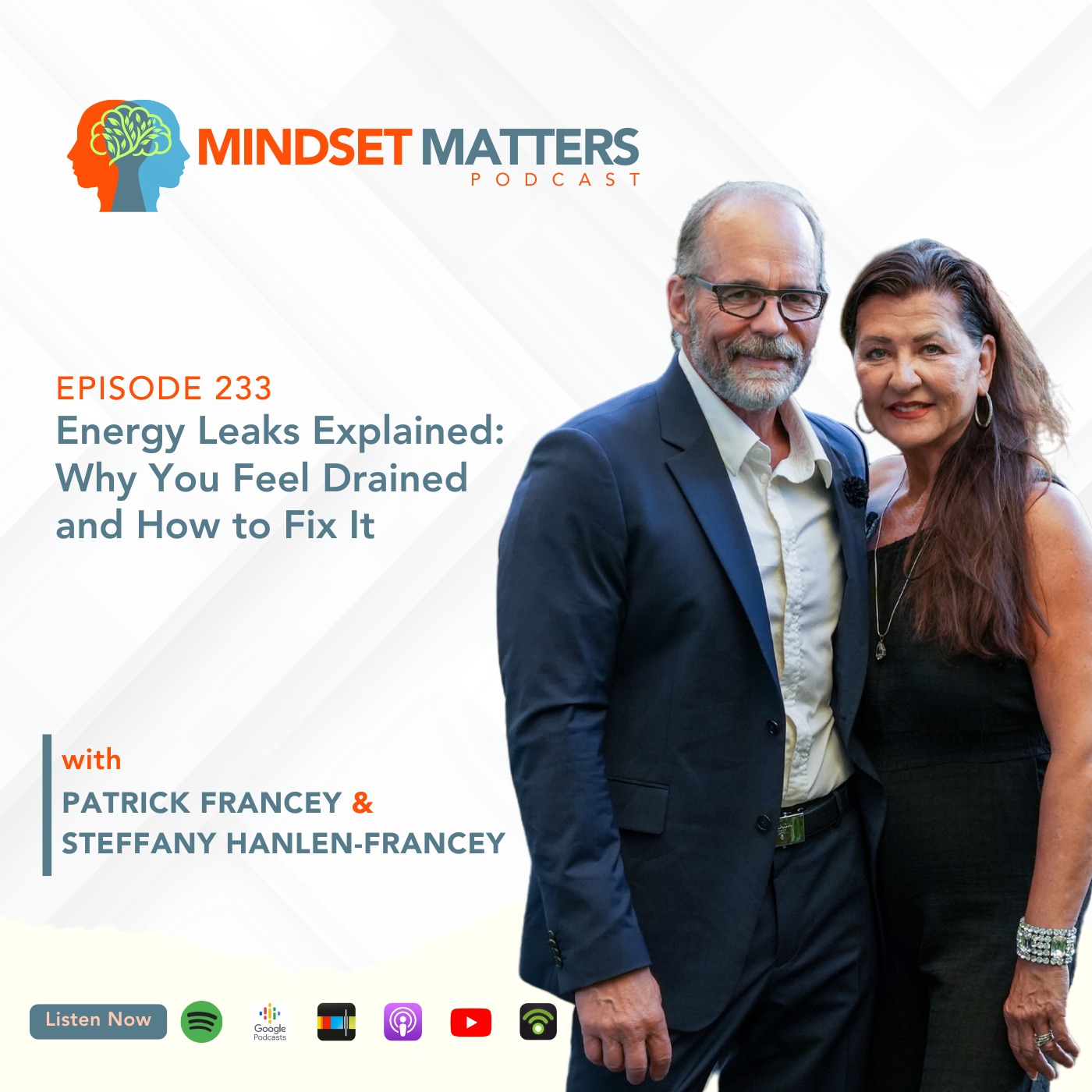
The Everyday Millionaire and Mindset Matters Podcast
Mindset Matters - Episode #233 - Energy Leaks Explained: Why You Feel Drained and How to Fix It
00:31:18
Loading summary
Transcript63 lines
- [00:00]
A
Foreign. Welcome to this episode of the Everyday Millionaire Mindset Matters podcast where I'm joined by my wife, Olympic mental performance coach Stephanie Hanlon. Francie. In these episodes, Stephanie and I have a conversation about the different aspects of what we refer to as Mindset Matters because we believe that for those who are awake, we are living in and through the most impactful time in history. Your view of the world is the filter for how you will experience the evolution and changing dynamics of it. Our intention is to provide you with ideas, nutritious food for thought, and some tools that you can use to help you in being your greatest self and living your best life. Listen in. Enjoy. Stephanie, welcome.
- [00:53]
B
Hi, Han.
- [00:54]
A
Okay, here we go. Have you ever noticed your phone battery sometimes drains faster than it should and is surprising because you're not even using that much, but the power keeps dropping way quicker. Yeah, you've seen that, right? So what we've come to understand is you realize it's not the phone, it's really the apps that are running in the background. You know, things you didn't close, updates that you're getting that you're not even aware of, processes you didn't know were there. And that is the topic of the podcast. And it's about energy leaks. It's not about your phone, it's about energy leaks. And that's, I love that.
- [01:27]
B
That's one of my favorite things to work through with clients.
- [01:31]
A
So, yeah, I mean, at the end of the day, it's, you know, energy leaks aren't about what you're doing. It's what's running in the background that you haven't shut down. And we're going to really unpack energy leaks. Now, this is an interesting topic because I had a guest on the podcast that I interviewed a while ago, Annie Yach, who actually has a questionnaire. So she is a coach with really high performing business people, CEOs, et cetera. And. And she has actually a questionnaire, a test, if you will, of energy leaks. And it really, when she said that, I went, ah, we often talk about energy leaks. We are aware of energy leaks. And so I said we should have a little discussion about energy leaks. That's where I'm starting.
- [02:14]
B
Yeah. Did you do the questionnaire?
- [02:16]
A
I didn't do it. I know you did.
- [02:18]
B
I did it. And so, yeah, Cheryl did it too, I think.
- [02:20]
A
Yeah. And how'd you do?
- [02:22]
B
I'm like second from the top. Like, I'm not fully 100% clear and up to date on everything. And I, I'm the One layer down.
- [02:30]
A
Yep.
- [02:30]
B
Um, but I, but she did say in the questionnaire is like, be really honest, take three to four minutes, just sit quiet and tell the truth about what's going on today. And that's, I really liked how she framed that. It's like not what you want it to be, not what you think it, what you, what you were when you were super high performance. Like, where are you at today? And I think that's what was a nice filter for me to do the questionnaire in that context.
- [02:54]
A
Well, here's the thing about that. You are aware of energy leaks. So when Annie actually brought up the topic of energy leaks, I knew exactly what she was talking about. And for this particular show, I think we need to get a little bit detailed about what we're referring to around energy leaks. So what are energy leaks? If you were going to define it, I don't want to put you on the spot, but energy. If you had some example or definition of an energy leak, what would it be for you?
- [03:24]
B
Oh, man, put me on the spot.
- [03:27]
A
Well, we know what they are.
- [03:28]
B
We know what they are. So in my world, in the world of athletes and high performing business people, et cetera, it's incompletions. It's things that are undone, unfocused, and that are taking your energy away from what it is that you want to focus on as your purpose. So what I've done is I've created an, basically a conversation with clients that says, okay, here's what your goal is, here's what your outcome here, here's your purpose. What are the things that are going on in your life, physically, mentally, emotionally, spiritually, even in seven areas of life that are drawing your energy away from your purpose?
- [04:07]
A
Okay, so that's a really great start. Now let's give some real specific examples, an easy one. Mindless scrolling. Okay, so do recipes count? Well, you apply some of the recipes that you find, but the point is this is that mindless scrolling is really just an energy leak. It does not generally move you any closer to your goal. It's a distraction. And I had this conversation with you just the other day. You were telling me something about what you watched. And I went, okay, what does that mean? Like, what difference did it make in your life? Do you even remember what you watched? And that was a bit of a conversation that. And this is the challenge. So you can't. And I don't mean you, I mean people in general. I'm guilty of it. I think many are guilty of it. You get into this Mindless scrolling and you're not even aware you're doing it. That's an energy leak. It does not move you one inch closer to intended outcomes. And so it really is a lack of focus. It would be one energy leak. But let's talk. Let's just keep going deeper. We're in the process of perhaps moving, selling and moving. We don't know. We haven't completed, but we're acting as if we're going to sell the property and move on. So we're doing some purging. So let's talk about a big closet. You know, a closet that has accumulated over time. You walk into the closet, and every time you walk in, there you go, oh, shit, I really got a purge. I really got stuff hanging there that I haven't worn for 10 years or whatever the story is. Right. The point is, as soon as you have that thought, realizing and that could be considered an incompletion, but ultimately it's an energy leak. It's a kind of a side distraction that takes you out of the thought process that you're in. That would maybe move you forward. That would be another example. Relationships that don't really serve you, but you stay in that or you entertain the relationship, even though it's not what you want to do. It's not something that you see moving you forward. But it's easier than blowing it off. You know what I'm saying? That would be considered an energy leak. Let's see if we can give some other examples. Incompletions are the most common one. That job that you know that needs to be done, that you're not doing that every time you walk in, you see it and you don't do it. That's an energy leak.
- [06:23]
B
Yeah. And think about physical energy leaks. So you look at an athlete, and the way that I frame it a lot of times is that we move from our core. So whether we're skating or running or whatever, we move from our core. So if anything is out of alignment in our body, it's also considered an energy leak because it's affecting your output, your. Your performance. And as we know, high performance is a. Is a result of low tolerance. So when I think about that, and I apply it to an athlete's body, body, an athlete's mindset or whatever, it's like, what is in the way of you moving efficiently? That in itself is an energy leak. So center of gravity and physics, you know, works the same on all bodies. So how do we align and remove those inconsistencies? Or misalignments, so that the energy can flow.
- [07:13]
A
Right.
- [07:13]
B
Our energy also. The word that I like is chi. Like chi, our energy is centered through our center of gravity and our chi. So whatever we've got in the way of that, whether it's a thought, physical misalignment, something that is in the way of clear and pure movement, is an energy leak.
- [07:33]
A
A hundred percent. And just on that same note, you know, I think about from an athlete point of view, or non athlete. So when you think about inflammation, you know, sore knees, sore joints, sore body because you've been training a lot or whatever that might be, that is a physical energy leak. That inflammation, that pain that drains you because it's constantly there. Yeah, right. So there's another, there's another side of the story. Am I interrupting you?
- [08:01]
B
Yeah, yeah, yeah you are.
- [08:03]
A
Okay, go.
- [08:04]
B
Okay, now I forget what I was going to say. Okay, okay, carry on.
- [08:09]
A
Okay, so as you think about what it was and where you were going to go with that, you were talking about athletes and chi and energy that way, which then led me to a conversation around inflammation would be like an energy leak. And it's not. I mean, you're in pain, but that is distracting. That's taking you away. There's another form of energy leak, and I think about this over the years, what we call negotiation fatigue. So if you get a really smart negotiator, they drag things out and then you struggle with what we would call negotiation fatigue, decision fatigue. Those are all energy leaks, that fatigue. So it could come from the ongoing. It's like, okay, let's just get this done. But it just keeps gnawing away at you and it's an incompletion that you can't complete because you're out of control. It drains your energy, which then leads to poor decisions. That's the point of negotiation in that context. Keep dragging it out, keep throwing curveballs, Those become energy leaks that impact the decisions that you make. So that's on a business side of it. So energy leaks can be. Not getting enough sleep. Drains your energy.
- [09:25]
B
True.
- [09:26]
A
Impacts it. So did you come back to what you remembered that I interrupted?
- [09:30]
B
You're talking about inflammation and, or pain or dealing with injury, etc, And a lot what I've experienced is that many times it's the incompletion or the energy leak that actually creates the injury or the inflammation. So you're either not taking care, you're not hydrated, there's things in our, our mindset that can create avoidance tactics that create energy leaks. So what are you avoiding in the moment? What are you not taking care of? What have you pushed aside? Or what are you pretending not to know? Which is again, a huge energy leak when it comes to that. So, so in our work, I think about clarity equals velocity. I mean, even I struggle with this a lot sometimes if I'm fuzzy or I'm not feeling clear or I've got brain fog or I'm tired or jet lagged, I know that I have to slow down and actually physically put in a recovery or a reset type of plan so I can get myself back into a place where I'm not dealing with a mountain of energy leaks or the energy leaks that are coming at me. Because all of the incompletions will always seem to show up on vacation or they show up when you're on the airplane coming back and you can't control anything. So it is about creating the space and the opportunity and the commitment to notice or identify what your energy leaks are or what your incompletions are so that you can plan for it backwards and not enter, you know, post vacation or post something with a mountain of energy leaks coming at you.
- [11:08]
A
So, you know, when I often speak to audiences and I, one of the segments that I do is around ethos, defining what your ethos is. And I use ethos as an acronym and the E and ethos. So ethos, a statement of character of an individual or an organization, high level definition. And one of the things I talk about is ethos is around energy. Do you bring energy into the room or do you suck energy out of the room? So we have all been in those circumstances where the person that walks in the room is, you know, just sucks energy out of the room. They're bummed out, they're doomed, they're gloom, they're drama queens, there's something wrong, they're making excuses. And maybe we've had those individuals that we've worked with, those are energy leaks. Those are individuals that actually suck energy out of the room because of how they show up in a particular room, maybe in a meeting. They don't align, they can't get along, they want to be heard. And it's just this constant. Okay, let's move forward. So I would define energy leaks at some level as that which is a distraction or that that takes away from you moving towards or yeah, towards your intended outcome, whatever that outcome is. I don't mean it has to be a big, hairy, audacious goal. It could just be in your day to day operation that these are the distractions that take you away from being in flow with your day, back to your comment around the physical qi. But just think about the energy of your day, the flow that you have. You've got a process that you're going to do and you get these distractions, these energy leaks that take you off path. How's that?
- [12:48]
B
Oh my gosh. Yeah. That is so clear. And I think about it as I'm listening to you, how many times I've heard people talk about all the things they've got going on in their life, their to do list, the things that they have incomplete or whatever. And I realized is that sometimes that becomes the addiction and the energy leaks and the procrastinations or however you want to frame that become the reason why they don't achieve their goals. And I think when I introduce to a client, you know, the fact that they. This is an energy leak, for example, whether it's physical, emotional, intellectual. The closet. I mean, I just spent what, four hours yesterday on my shoe closet just
- [13:26]
A
purging because that barely made a dent in. It totally did.
- [13:32]
B
And it was really interesting because by focusing on the energy leak, what it did was it allowed me to be present to it. And you know, one of our coaches, JB lady, JB Owen, you know, she really coached me a lot around, you know, letting go of things. You know, over the past five years, my wardrobe's changed. Well, our life has changed. I'm not speaking as much, I'm not on stage as much. I'm not doing as much, you know, presenting. So I don't need so much corporate or business type attire. But a lot of my identity was connected to the clothing and the shoes. So what she coached me around was to really take the time to be present to what that piece of clothing or that pair of shoes meant to me. And it didn't have to be an energy leak. It could be something that I was grieving. It could be something that I was willing to let go. But I had this block because I couldn't move myself forward into who I'm going to be if I'm not that person that I've been for the last however many years. And that became, that itself became the energy leak why I couldn't purge the shoe closet. And I think for us and in our coaching is that when we circle around and really bring that attention and that moment of to what it is and what it meant for me to have my very first pair of $500 shoes or my very first Armani suit that I Bought at an outlet, you know, what. What that meant and who I define myself as because of it. But I didn't realize at the time what a huge energy leak it was because I had all these stories going on around what that meant.
- [15:10]
A
That's a good one. I think there's a fundamental, you know, when we're really focused on something, and this is. We see this in high performers, where if you're really focused, nothing takes you off track. Anything that doesn't move you further forward or move you closer to whatever that outcome is that you have for a bigger goal or for the day or for even for the next couple hours is then a distraction, which is then just an energy leak. It goes back to. And I always remember, you know, when I used to do. When I used to run and, you know, and I was training for half marathons and the things that I did, you get into a groove and you're kind of into this meditative state when, for me, when I was running, and then if I had to look over my shoulder because I was crossing a street or if I had to look behind me, it throws my stride off. And that, of course, consumes energy. And so that's an example of anything that distracts. This is what offends some people who don't understand high performers, because high performers, we use the phrase clarity equals velocity. And when you have clarity and when you have momentum and when you have velocity, anything that takes you out of that stride, out of that focus is. Is considered an energy leak. No, this is not what's important to me now. I stay focused. I go, now, if you're that individual who's trying to interrupt that person, it's going to land as well. Arrogant or curtain abrupt or whatever it might be. But actually you're just not in stride with the person's focus. So the lack of clarity, on the other hand, of course, creates friction that becomes an energy leak. So I think I just want to kind of hit this from all different places so people can really, who are listening can look at what they've got going on in their own life. Because we don't know. Sometimes we're just not aware that our energy is being sapped until you really think about, well, why am I doing this? Why is this important? Why haven't I got this done? And that then opens up the possibility of having better ideas, more creativity, and. And being more effective in the decisions that you're making. So you want to just.
- [17:24]
B
Yeah, think about environment. Think about the environment that you're creating around you, you know, one of my long term favorite clients ever, Angie, we spent the first couple of years in our work together completing incompletions. And this woman is so powerful. And when she was able to really reframe what those incompletions were and completing incompletions, she was able to create on a massive level. And what I learned from her is that the commitment and the willingness to be humble and to move through the incompletions and the, and the energy leaks that it took for her then to be able to focus on family and building an abundance and supporting her husband in a whole different way. And is that it allowed me as a coach to go, oh, okay. So as we move through cleaning up energy leaks and cleaning or closing energy leaks, cleaning up incompletions, what it does is it actually creates a level of velocity into moving forward. And the interesting thing about that too is that it can be really scary. It can be scary because a lot of these things became comfortable excuses and comfortable distractions. So you didn't actually have to get your goals right. And I think the gift that Angie gave me was that, you know, she was willing to do the work to get through so that her goals and what she was taking a stand for was really going to affect, you know, the long term health of her family. And I think that really, when I think about the athletes across, oh my gosh, would we figure out 17 worlds?
- [19:04]
A
I just completed world championships. Yeah.
- [19:07]
B
Oh my gosh. And five Olympics.
- [19:08]
A
You know, something's interesting. You, you mentioned those 17 world championships on social media. And somebody mentioned, think of all the places you've been, because not all, all those world championships were really around the world. So you, you went to a lot of places. You probably never went to 17 countries, but you went to probably at least 13.
- [19:28]
B
Yeah. And the first. And the cool thing is, is that when we identified that, I realized that neither of us had been to Prague. And I thought, okay, well, why not close that energy leak and say, okay, we want to do a trip to Europe together. Okay, let's use the vehicle of figure skating to get us to Prague. So that's the other benefit of understanding your incompletions is that being able to have the conversation with your partner and your spouse, you know, business people, your family, is that, what are the incompletions, what are the energy leaks that are happening in your life right now and how are they getting in the way of you moving your life forward? And I know, and I get it. Right now the whole world is, you know, Suppressing energy and suppressing travel and suppressing food chains and all that kind of stuff. But we don't have to buy into that. If we just soften and get into the what it is for us as a family, what it is for you, then what's ever happening outside of you doesn't have to be an energy leak, it doesn't have to be an incompletion.
- [20:32]
A
Great point. And you know, to that there's a phrase that we often use is what's the difference between signals and noise? And what we run into is that we see signals which are meaningful. Noise is just that. It's just noise. We don't need to pay attention to it. So as we were kind of going through the stuff, I made some points I don't want to call them. You know, there's some downsides of our energy leaks. So I made a little bit of a list. So one is, and this really plays into noise versus signals. Signals we want we can act on. Signals we can make a decision on. Noise is just that, it's just noise. But those are where the energy leaks live. So if we're paying attention to a lot of noise and not signals, we run into decision fatigue. So we're constantly looking at all this noise, but it's really the signals that we need, but we're distracted. That's the. Perhaps the mindless scrolling as an example. So we get decision fatigue. And then when we get decision fatigue, we have reduced clarity, which means that we're in the friction of a lack of clarity. So are you following along in what? I'm totally, yeah. So then when you've got that energy leak and you don't have that clarity and you're not great at making decisions because of the energy leaks and the distractions, your execution quality goes down. You do the work. It's just that you're just getting through it. It's a little bit sloppy, perhaps. You're not paying necessarily attention to the details. You're not empowering your team. You're just getting shit done and you're not being your best self with it. That's another downside. The other, another downside that I noted was just around again. Clarity equals velocity. You have less velocity. And that in itself, just the slowing down, knowing that it could be faster if is also an energy leak. There's also a side of it which I've seen. I'm guilty of this. When I have a lot of energy leaks, those are things that are. I'm feeling like I'm having to Deal with that. They aren't moving me forward, they're just distractions. And, and I get really bitchy, you know, I get a much shorter fuse. I'm not as patient, I'm a little bit more reactive.
- [22:56]
B
That's not as nice to me.
- [22:58]
A
I'm not as nice to my wife. That's true. So those are a few, you know, things that happen around energy leaks. And then often it's inconsistent, you know, inconsistent performance if you will, you know, good days, bad days. But can you be reliable? And you get momentum going, then you get this distraction, you lose momentum. These are kind of the results of energy leak. So for those who are self assessing in this, think about in terms of what is it that distracts you, that annoys you, that you know that if you just handled it it would be better. The most common, I don't want to say the most common. I don't know that to be true. The messy closet is an example. You, every time you open the closet and you go, I need to get this closet straightened out and you don't do it, that is in fact an energy leak. You can feel it in your body. And it could be your office, you know, a messy office. It could be, it could be any number of things. But think of it in those terms, those reoccurring things that every time you open that door, every time you go to do that thing, it's an incompletion somewhere, something that should have been done, could have been done, you could have paid somebody else to do it, but you still haven't done it. Those are energy leaks and out of that comes distractions, lack of creativity, irritability, loss of momentum.
- [24:23]
B
Oh man. I know, it's funny when I think about it from a physical standpoint, an alignment or a full on injury situation. I've dealt with athletes who have not taken care of energy of injuries, for example, or they haven't understood what it takes to, you know, do some self care because they think you're being lazy. Or we have to also pay attention to the stories that we're telling ourselves around those kinds of things. For the longest time I didn't see my shoe closet as an energy leak until I did. Right. So we have to look at and give ourselves a little bit of grace as to when it shows up for us and when we see it sucking our energy out of what it is that we want to do. For me, with athletes or the H and W clients that I work with, it's most important to identify those energy leaks really early on because things happen and success happens in very short windows. If you don't work and train and do the things that you need to do to win Olympics, then you're not going to win Olympics. So same thing with a big deal with a. In the C suite. If you've got some, you know, massive gossip, somebody is gossiping on your. In your C suite. And something's. That, for example, is an energy leak. It's. It's sucking the energy out of what it is that you're trying to do. So without judgment, how do you then take the conversation forward and say, okay, how do we identify what an energy leak is? What is it that we need to align on, and how do we move forward based on common values? And I think it kind of. This conversation kind of wraps up all of the work we do that helps all of our clients and ourselves personally in our relationship as much as we, you know, battle and, you know, fight it out when it comes to certain things is that we're committed to the same thing, and anything that pulls us out of that can be considered an energy leak.
- [26:29]
A
Yeah. And as you're speaking, one thing that came up for me, and I think we'd remiss to be remiss to step over it, and that is environment. So, you know, you like to be surrounded by stuff. I'm more of a minimalist. So, for example, we've all gotten into somebody's vehicle at some point that for them, keeping a clean vehicle is just not a priority. You know, and so you get in that vehicle and it's McDonald's bag, dirty and McDonald's bags and spits on the floor and, you know, sunflower seeds, all those things. We've. We've all probably had that experience for me that like, get me out of here. I can't be in that environment. That's, for me, a huge energy leak. For others, they don't care. It doesn't matter. For me, it's a button. And so if I walk into a really cluttered, disorganized environment, it stresses me out. It's just like, get me out of here. I don't think my brain processes that way. I'm too, you know, I'm too, you know, squares and boxes and, you know, it's got to make sense in my brain. And a messy, what I would consider a messy environment that's not organized. It just. It's an energy leak because it creates stress in my body, and not everybody's wired that way. So I just wanted to bring it up because I think that's another situation where sometimes people don't want to be that way, but they're too lazy to clean up their mess.
- [27:53]
B
That's you judging.
- [27:54]
A
Like, no, like, I'm not judging. I don't care.
- [27:58]
B
Yeah, you are a cowboy. Slow down. Whoa, whoa, whoa.
- [28:02]
A
Don't piss me off. You're misunderstanding what I'm saying. If you think that's a judgment. That's not a judgment. What I'm suggesting is, is that some people don't realize what the energy leak is.
- [28:13]
B
Maybe it isn't to them.
- [28:15]
A
I just said that. What I'm saying is that some people don't realize that they've created an environment that's an energy leak, and that if they actually took the time to straighten out their environment, it would improve. They just look at it go, I don't want to clean up.
- [28:32]
B
Maybe they're comfortable. Maybe they're comfortable in that. With the spits and the. And the thing. And sometimes I walk into, you know, I go into our car, the Rover, and I. There's like, chocolate bar wrappers and napkins and stuff that I didn't put there. I don't judge you for that, Stephanie.
- [28:48]
A
You're misunderstanding what I'm saying.
- [28:50]
B
Repeat what I'm saying, because if I
- [28:52]
A
am, then somebody else is first to understand. I'm saying. I'm not suggesting. For I have no judgment over. I'm telling you, for me, when I walk into a room that's disorganized, displaced, it stresses me out. It doesn't land well for me. For some people, they like that environment. You like to be surrounded by a lot of things I don't. That's just an example. It's not a judgment of you and how you like your environment. It doesn't work as well for me. That's all I'm saying. So for somebody who doesn't mind their car that way, they don't mind their car that way. For me to get in that car, it's an energy leak.
- [29:31]
B
It's like their junk. It's their.
- [29:34]
A
Yeah, it's their stuff and their stuff. Yeah, I don't. Yeah, right. So I'm saying is, is that there's others who live in that environment. They don't like that environment, but they don't see a way to straighten it out.
- [29:48]
B
Okay, got it.
- [29:50]
A
Your hard work. Some days.
- [29:51]
B
Oh, my gosh. Well, sometimes you just come across so judgmental, I don't know how to.
- [29:55]
A
So this was process. You today were an energy leak. And I'm going to leave the podcast on that. Oh my gosh.
- [30:05]
B
Oh, I know you love me anyway.
- [30:07]
A
Okay, folks, manage your energy leaks, be it. Pay attention to where you're giving away your energy. We do have a limited and give away your power. That is giving away your power. We have a limited amount of energy. We need to manage and protect our energy. See where your leaks are that you're not addressing. Or maybe you weren't even thinking about them as energy leaks. You've normalized it. So that's some food for thought for today and I'll call that a wrap. Stephanie, thank you very much.
- [30:37]
B
Thanks, Ann. That was fun.
- [30:40]
A
Ladies and gentlemen, thank you for listening. If you found value in the podcast, please take the time to rate and review and share with others. Share with your friends as it is more my goal to always improve and to provide the highest value for you, the listener. If you have any comments, suggestions or questions you'd like answered, please email me@ceoraincanada.com that's ceor.com I look forward to hearing from you. And until next time, Patrick out.