← The Everyday Millionaire and Mindset Matters Podcast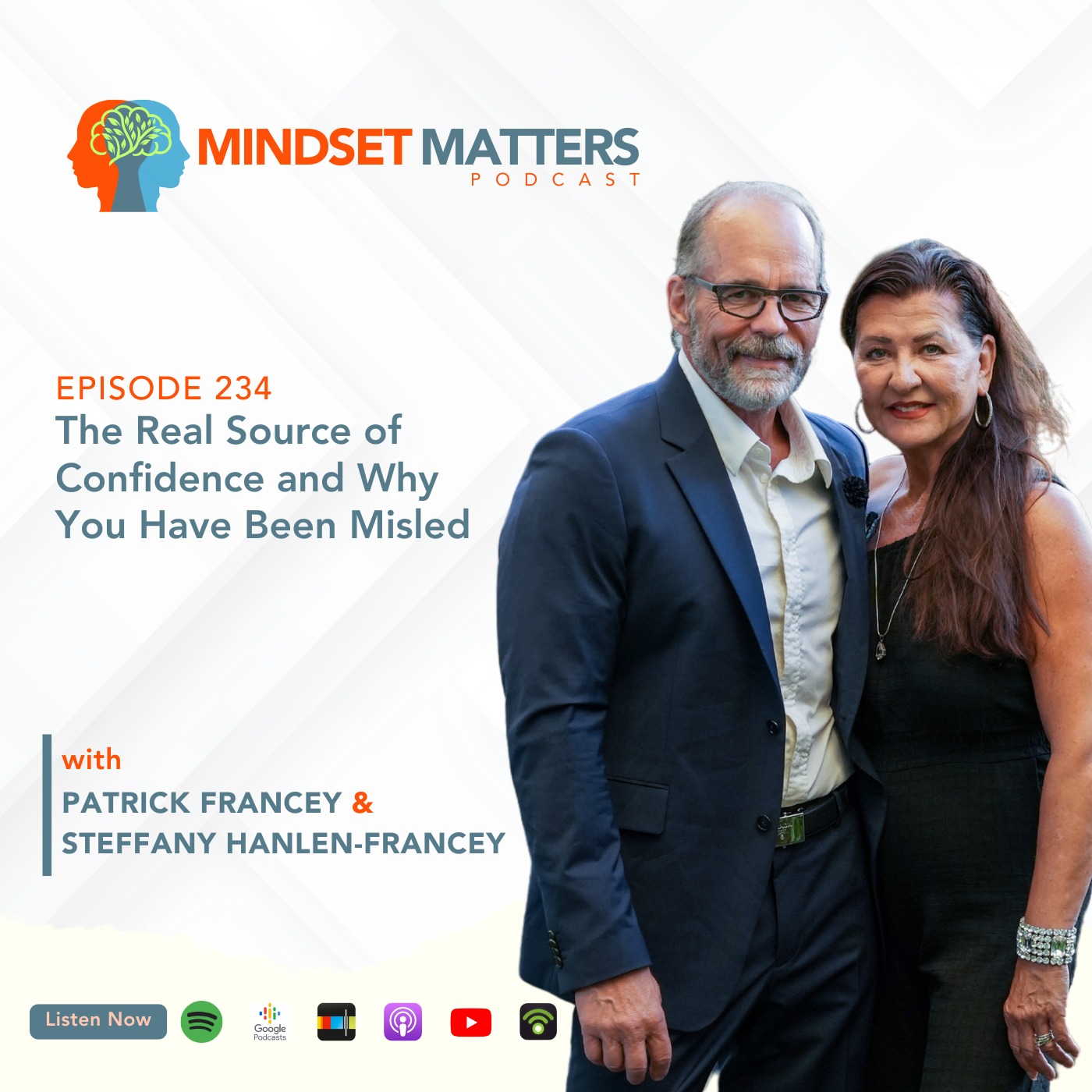
The Everyday Millionaire and Mindset Matters Podcast
Mindset Matters - Episode #234 - The Real Source of Confidence and Why You Have Been Misled
00:33:30
Loading summary
Transcript69 lines
- [00:00]
Patrick
Foreign.
- [00:05]
Podcast Host
Welcome to this episode of the Everyday Millionaire Mindset Matters podcast, where I'm joined by my wife, Olympic mental performance coach Stephanie Hanlon.
- [00:14]
Patrick
Francie.
- [00:14]
Podcast Host
In these episodes, Stephanie and I have a conversation about the different aspects of what we refer to as Mindset Matters because we believe that for those who are awake, we are living in and through the most impactful time in history. Your view of the world is the filter for how you will experience the evolution and changing dynamics of it. Our intention is to provide you with ideas, nutritious food for thought, and some tools that you can use to help you in being your greatest self and living your best life. Listen in.
- [00:47]
Patrick
Enjoy. Stephanie, welcome.
- [00:53]
Stephanie Hanlon
Hey, hon.
- [00:54]
Patrick
Okay, so the topic is confidence, and there's a bit of a metaphor slash parable. No, more of a metaphor, I guess, to give it context. Now, I often when we talk about confidence, there's a quote that I use and I've used many times, which is confidence is rarely owned. It's almost always borrowed. And I want to unpack that a little bit. But let's just create an overarching context for confidence and how important it is and where does it come from and how do we have it, how do, where does it go, all of those
- [01:27]
Stephanie Hanlon
kinds of things and what is it
- [01:29]
Patrick
and what is it? So let's get into it. I'm going to lay out this metaphor to create a really strong context for listeners, and then we can kind of unpack it a little bit more. You ready?
- [01:39]
Stephanie Hanlon
Hit me.
- [01:40]
Patrick
Okay. So confidence is not a spotlight, it's a foundation. Now, most people treat confidence like weather. If things are going well, they feel strong. If life punches them in the mouth, confidence disappears. But that was never confidence. That was comfort. Real confidence is more like building a house. And if the house is built on sand, it looks fine on a sunny day. But the moment the wind picks up and you get some rain, the flaws get exposed rather quickly. The walls shake, they start to melt down, the windows rattle, and then panic starts to set in. But when the foundation is deep, if level and built on rock, the storm still hits, but the house holds. And that is how most people live their lives. They build their self belief on praise, performance, approval, or momentum. But when results dip, when criticism comes, when things get hard, they start questioning everything. Now, questioning everything is okay, but they question everything and they stall. Lasting confidence is built differently. It's built through preparation, through keeping promises to yourself, through doing hard things repeatedly, through evidence, through process, through learning that you can wobble without collapsing. So maybe the real question is how do I feel more confident? It isn't that question. Maybe the better question is what am I building my confidence on? Because if your confidence is built on outcomes, it will always be fragile. If it's built on foundation, it becomes durable. And that is where the work begins. Not with hype, not with affirmations, with architecture. So today the conversation is what is your confidence actually built on? Because a lot of people are not lacking potential, they are standing on a weak foundation that breaks confidence down. So what's your thoughts?
- [03:44]
Stephanie Hanlon
Oh my gosh, this is such a big topic, hun is that so many people, families, parents, kids, they think confidence is a feeling. If I just can be confident, I could just go out there, I could write the exam. Be confident, you'll do great. You know, go out and compete, play hockey, do your thing, just be confident. And it sounds like such a easy thing to do or to be. It's not a feeling. Confidence is a journey. Confidence is an action. And it doesn't come from anything other than taking a risk and self belief. But self belief comes from taking a risk and then recovering. Taking a risk, screwing up and then recovering, taking a risk, screwing up and then recovering. It's a journey. It's such an ongoing thing. I know the only reason I'm confident in going out into the life is because I up and I've screwed up a lot and I, you know, you know, stood back up and, and tried again and got a different result. And I think what happens is that so too, too early, whether it's parents or, or coaches or teachers, just think confidence is something that can be bestowed on somebody. And that's just not true.
- [04:59]
Patrick
I think the thing that you're, what I'm hearing you saying as well is that you can fail but still have confidence in carrying forward. Right? That I think, but that's the fundamental breakdown. So when you say, and of course when we're talking to people that are trying new things or they're stepping into someplace they have never been, they lack confidence. But that confidence, they lack the confidence that they're going to succeed. And that isn't necessarily what confidence is all about. Confidence is the ability to do something and whether you're successful or not, you're still confident. You believe in yourself to say, oh okay, that didn't work this time. Next time it will work. That's where the self belief comes in. And I think that there's a fundamental, I'm just kind of thinking about over the years how much my, how much confidence I've gained And it's not from being necessarily successful in all the things that we've done, because that certainly isn't the case. But there is a. I am pretty unshakable when I have. I have confidence in my own ability to figure out and to get through it and to know that even if I fail, I'm still standing, still alive, I'm still around. You know what I'm saying? I think. I don't know if I'm articulating it well.
- [06:22]
Stephanie Hanlon
No, you are. And I think that's what, you know. If I could give a context for confidence is that when you look at the word confidence and people are thinking, well, just feel confident. Just believe in yourself. And I just know I can do it. Well, we can't do that unless we have proof if we don't have a source of reality that says, you know, what I did made a difference. So when I work with somebody and I said, okay, if you're not confident in a performance or a deal or an activity or something, I said, let's work backwards. And look at the word confidence. And you break it down and you look at the center of the word. The Latin root of the word confidence is fid, F, I, D. And fid is the root of the word fidelity.
- [07:08]
Patrick
Got it?
- [07:09]
Stephanie Hanlon
And confidence comes from your ability to be faithful to yourself, to your training to. To the. The willingness to fuck up and, and fall down and get back up again. Because think about sport. I mean, I go back to ice sports, of course, over hockey, figure skating, speed skating, whatever is that you're going to fall down a lot in order. In order to win, in order to finish the race, you got to keep going. You got to get up and keep going. And it's in the keep goingness. That confidence is. Build that. That's a source of confidence. And when you can do that on an ongoing basis, then you stop judging yourself. You stop wondering if you can be successful or you can finish the race. And I think that's where people get confused, is they think that they can just bestow a red ribbon or a medal or when I win something, I will be confident. It's the opposite.
- [08:02]
Patrick
Well, it's interesting, isn't it? Because I think that to your point, well, when you win the medal, when you get the ribbon, when you have done something enough times and you've had some degree of success, however you're measuring it, you would say, okay, well, I've got a lot of confidence in my ability to do this, Been there, done that. And, and so you Gain confidence because you've been there, done that. I think for me, the real confidence is in those situations where, and I know for myself if I'm doing something I've never been, never done before, or I'm being asked to do something that I've never done before, there's two parts to it. Number one, I'm telling myself I've never done this before. So I'm not confident that I'll be able to pull it off or to have the success that maybe the expectation. But here's where I do go and I, I am confident in my ability to figure stuff out. So in other words, if I'm not doing something or if I'm working on a project, I've never done this before. There is a place where confidence, there's a side of confidence that says you have to believe in yourself enough to have confidence in your ability to figure it out. Because it may not be in a skill. You may not have the skill up front. You may go, I don't know, I've never done this before, but I'll figure shit out, right? So there's that part of it, then there's competence part of it. Do you have the competence to do it? But if you don't have the confidence, the self belief, then you're in trouble. I think that's my thought.
- [09:37]
Stephanie Hanlon
Yeah, I think there's a progression that happens and you know, as we're kids growing up and, and we're allowed to fall down and get back up again and our, our parents don't freak out and you know, you know, say your failure or whatever. If we're allowed to fail, I think that's what builds initial confidence is that we're allowed to fall down and get back up again. We're allowed to, you know, be in an environment of challenge. And I think that's what's really scary right now in, in the culture is that everybody gets to participate but nobody is allowed to compete. And that to me, whether you're competing against yourself, which is really the only thing we can compete against, or you're in a competition environment, whether it's sport hockey, figure skating, soccer, you know, I don't know, I just did a 4H competition. I judged a local 4H competition where 9 to 12 year olds were competing in a speech conversation. And I got to judge them. And it's in the judging and the feedback and their willingness to receive the feedback is where their competence increased. And I think that's what is missing in a lot of society and a lot of situations right now is we're not just challenging our youth to compete and to be and to find their competence through failure. And I think that's where a lot of confidence lives.
- [11:02]
Patrick
So think about this for a second though. You know, when you. Let's talk about athletes, for example. So you're working with whatever, let's say you're working with skaters. And then somebody asks them to compete in, I don't know, tennis. Now they're not competitive tennis players, but they are athletes. They've not maybe played tennis to an extent, but they've competed a lot. They understand what it takes to compete, they know the focus it takes. So then it's going to be a fun tennis match, but it's being taken seriously. Maybe they're playing for their charity. Here's the fundamental that I think so here's the rules of the new game. You've never played tennis competitively. You've maybe hit a ball round, you've got two weeks to learn enough about tennis that you can go out and do a charity and in a fundraise. Now what does that athlete think? Well, I've never played tennis. But where they gain confidence is in their ability to compete, their ability to train, their ability to learn. So they have a foundation for confidence. In other words, they may not go in thinking I'm going to win, but they're confident in their ability to step up because of their experience. So they're taking their experience as a competitor, as an athlete, they're putting it into a new space called tennis as an example where they have some time to prepare and they can prepare as thoroughly as they can prepare over a two week period. But their confidence in being able to do that comes from the confidence they gained as competitive athletes. So you're linking the. Again we go back to believing in yourself, believing in your ability to do something. To connect those dots, even though you don't necessarily have a skill set does that. Am I making any sense? I'm trying.
- [12:59]
Stephanie Hanlon
You are think about business. You think about business and decision making and doing deals. All the deals are not the same. But do you have the competence and confidence and the resilient self belief that you can adapt? So let's say you're a hockey player. I'll make a story, I'll tell a story about the hockey players that I work with over the years. The Oilers, they would get invited to golf tournaments and a lot of hockey players are good golfers, but they're not successful, they're not pro level, semi pro level. Golfers, but the transference of skills, of competence in the ability to believe in themselves and to step out there and be judged and to, you know, set themselves up on a te and, you know, backswing and hit the golf ball, it really transfers. And when you have that resilient self belief in your skill system, your skill, I don't know if it's a system or whatever it is, is that the earlier you understand that you're transferring those skills from kindergarten to school to middle school, to pre competitive to competitive to post to world championships, is that that lineage of competency comes with you. And I think that's what people don't really understand, is that the earlier that we introduce competition to kids, whether it's, I don't know, kickball, T ball, you know, mini half ice hockey, whatever it is, they get to fall down, they get to screw up and mom and dad get to cheer anyway, is that they build that resilience within them. And as they grow, you know, forward into whatever's next in life, whether it's business or, I don't know, being an entrepreneur, they're willing to take risks. And the more you're willing to take risks and up and fall down and screw up and survive and raise above it, the more you're building your confidence. Because it's, it's your fidelity, your faithfulness to keep going is what builds confidence. It's not about a result. It's not about people clapping, you know, or getting a medal around your neck. I just had a meeting tonight with one of my teams and both of them said. Or two of my teams and both said it wasn't about winning. It was about the journey that it took to get us to the metal. I didn't care if it was bronze, silver or gold. They didn't give a. Yeah, they were. Just the fact that they were there and they survived the journey that was the giant, you know, check mark.
- [15:40]
Patrick
So let's keep thinking about and you know, let's unpack a little bit more about what is confidence built on. There has to be a foundation for it. And I, you know, I think there's, you know, what they would call, or I think you called the confidence architecture, which is building, you know, self belief. So what comes first? Self belief or resilience or confidence? Like, how do we, how do we build that architecture?
- [16:11]
Stephanie Hanlon
There's a preparation cycle that happens. I mean, it starts when we're really, really young. It starts in, you know, when you fall down as a kid, do your parents pick you up and go oh my God, you know, whatever. How, how do your parents react when you fall down? So kind of reverse the, the visual of what it is when you're kind of growing. Are you allowed to experience failure? Are you allowed to then put in the correction yourself? So when you start the cycle, what happens? It requires the people around you to allow the failure. And when you think about parents, whether they're hockey parents or figure skating parents in sport or whatever, it's very difficult for them because there's something called transference. And they don't really know how to allow the failure of their child in hockey, in sport, in, in school, or whatever. So what happens is that they don't know how to maintain the momentum. So they think that failure in that moment, in that competition is the end. But it's not true. It's not true. It's a moment. And how the parents and how the coaches deal with that moment is truly what creates the foundation as a human being for confidence. And then what happens is that when you maintain that momentum and you're allowed to fall and you're allowed to fail you, and you find it in yourself to climb on top of it and realize that, oh my gosh, that doesn't define me. That's not who I am. I just screwed up. I just fall down. I just fucked up for a minute, but that's not who I am. So there's an identity separation between that result and who I am. And then they go into an environment where they get to break the negative cycle. So if it's a negative cycle, that happens when they keep falling or they keep fucking up, or they keep missing the shot, or they keep letting the goal in, but they have a place in a space where they get to work through it. Because again, our coaches, our parents, the people are our mentors, if it's about them, then it's very difficult to let an athlete screw up. And that's where that identity separation has to live.
- [18:28]
Patrick
So self belief has to come from. There's a couple aspects of it, right, Is that I have a lot of self belief and confident in my abilities to figure stuff out. But that comes with a lot of years of just experience, lots of different scenarios, you know, and then being tested. But one thing I do know for sure is my confidence, my self belief comes from preparation.
- [18:57]
Stephanie Hanlon
Yes.
- [18:58]
Patrick
So the foundation for a lot of these things is just in the preparation for whatever it is you're doing. You know, I always remember years ago when we were working on the thermal blade project and I, you know, when we met with Gary Bettman, so he's governor of NHL. It's a big deal. We're in New York. I'm with a group of men where just for that half hour meeting, there was six of us in that, going to go to that meeting. We each had a role to play in that meeting, and we literally discussed and practiced. At least we were there at least four or five hours.
- [19:41]
Stephanie Hanlon
Exactly.
- [19:43]
Patrick
Doing your role, doing our role, practicing it. Without doing that, I wouldn't have had the confidence to walk into Gary Bettman's office and have a, you know, a conversation about an opportunity that would impact the whole NHL. So I go back to that as a scenario. I was confident enough that give me this time to prepare and I'll be good. But I don't know that. I think there's a part of it where people lack the confidence, even in the preparation, and that has to do with the environment that they're in and how they set themselves up. The point of confidence is that to your original point is as much as it's a feeling, that feeling has got to be built on a belief in yourself. And that belief in yourself comes from going through the building, having a foundation to, we'll call it practice, if you will, running through scenarios, that's also where that comes. And then your confidence, you gain confidence because you've practiced it, you've tried it. You may not know how you exactly, you're going to pull it off when the time comes, but you also have the confidence to say, I'm ready to compete because I have a foundation I built and prepared. A lot of confidence comes from that.
- [21:07]
Stephanie Hanlon
So think about it. I just came off, what, my fifth Olympics.
- [21:12]
Patrick
Yeah.
- [21:13]
Stephanie Hanlon
So you think of an Olympic cycle, it's four years or three and a half years long. I've done, what, five of them. There's nothing that happens for the three to four years prior that actually affects the result of the Olympic Games, which we see every year. There's always a random, there's always an anomaly, there's always something that shows up. Ilia Malin should have won with his quads. He's a quad God and he was 13th. Like, nothing based on the journey of the training, actually can show up as a. As a. As an equal result. So what's interesting about confidence and the preparation cycle is that there's no correlation between preparation and result, unless you take the lessons from screwing up and ultimately putting the correction in from screwing up. This young guy, he didn't screw up for four years. You know, this Guy, he, his, his marketing team created the Quad God scenario, whatever. There was no place for him to fuck up. He couldn't fail in four years. So he didn't have the resilience, he didn't have the resilience muscle for him to pull from. And what's interesting about that, whether you're a golfer or a business owner or an entrepreneur or a real estate investor pitching to the bank, is that you, if you haven't screwed up, if you don't have that initial investment in going, okay, I'm going to do this and I'm going to fuck up on some level somewhere and then be able to continue to build momentum off the screw up, there's no win. And that's what I think what, what people forget or parents forget when they're trying to help their kids be confident.
- [23:13]
Patrick
So this goes back to what I said though. You know, what I'm trying to, I think, get on, which is, is preparation. Confidence comes from preparation. There's what we refer to as performance based, where you gain it through performance, okay. Or it's a process base. So when I know that when I'm preparing to even present in terms of what's going on economically, I have a process that I go through to gather the data, to gather the information, then I have a process to say, okay, here's how it's going to flow through that presentation style. And I have the confidence in what I'm saying because I also have a process for research. So I know the research, I know what I'm looking for, I know where it's coming from, I know the sources. And so I have a lot of confidence. There's another part of it, you know, your confidence, my confidence in the content that I'm delivering the data, the confidence in my ability to present it in a way that it means something to the audience. But that comes from preparation. So those three aspects of practice, preparation, performance and process all come in, and I think this many years into it is understanding that, you know, you've done five Olympics, you know, we've both been in business a long time. I've been in business over 40 years. So I think about even when I'm working with particular clients in terms of their, they have a call and they're going through what they're going through. It's like I realize how many times I've done what a 35 year old is doing for the first time or a 50 year old is doing for the second time, right? So to me, I have all the confidence in the world. Now they can borrow that confidence from me because I know them and I understand their process and I can guide them through it and they can gain that confidence in a conversation. At least they believe it, but it goes back to believing in yourself.
- [25:12]
Stephanie Hanlon
Yeah, but think about it hon. Like think about the 30 or 35 year old. They don't have the evidence.
- [25:18]
Patrick
No, you're right.
- [25:19]
Stephanie Hanlon
Like we, they don't have the documentation, they don't have the evidence. They don't like in their world, they don't have the evidence that it's going to work. And that's what when you talk about borrowed confidence, like for us as coaches and for me, you know, five Olympics and all that stuff and you 100 years in business is that you have that. And when you look at somebody and you see their gifts and you see, and you're able to say to them, you know, I see who you are, I see the gifts that you have, but they don't see it. Right, like how do you control that? Like that exposure to help them shift out of their belief systems into what you see and who you see them as.
- [26:03]
Patrick
So as we wind this down, so what's kind of the secret to little secret but what's some of the process to gaining and having confidence? So we have to, number one, look at a couple things. I think about where I didn't, where I lacked confidence over the years and the realization that even when you screw up, you're not having a near death experience. You know, whether it be a project or you're speaking or you're doing something, you know, you could lose a lot of confidence. I mean I've, I've got hit on more than one occasion. You know, in decisions that were costly financially, you gain, you lose a lot of confidence. Then you go back and it always comes back to okay, where didn't I prepare, where didn't I stay true to what I was? What your values? What my values? You know, so the confidence still always goes back to your self belief. And what do you need to have to create the belief in yourself? Sometimes it's just having others believe in you that that's one way to get through it until you believe in yourself. You know how many times I think about, I've said to groups of people or individuals, I believe in you more than you believe in you. And you have to. And I, and I say that with all sincerity because I see it, you know, I see what they're capable of. I have all, I have all the confidence in the world for Them, they just need to step and lean into it and do it. That makes, I don't know, sometimes I wonder if I'm making any sense today.
- [27:43]
Stephanie Hanlon
No, honey, you are. That is the thing. And that is the thing about coaching. The thing is with parents sometimes is that the kids don't have, or the parents don't have the credibility with their children. And they have great credibility as parents. You know, they take care of them and they, they pay the bills and they cook dinners and stuff. But sometimes parents will step into coach position or they'll step into, you know, business advisor. And that's really where they lose credibility. And I'm seeing that more and more when I'm working with young athletes who have very successful parents, whether they were pro athletes or, you know, multimillionaire H and W clients and. But their kids are like, yeah, I don't really want to listen to my parents anymore. And the problem is, is that, that credibility or the. Yes, they have the evidence and yes, they had a great life, but the truth is every generation is different. Every generation is going through their own and their own issues and. Right. So until they can actually connect with somebody that can help them link or leverage where they're at, they can't build that level of confidence in the, in themselves like the parents are. Yes, look at me, I'm successful and I've got a multi million dollar real estate investment company or I'm this person or whatever. But those kids, those children, they want to do it on their own. And what's happening is that they don't actually get to share the confidence of their parents. And I think, sadly, I mean, we don't have a culture where there's multi generational leverage. So I think coaches become more important, advisor become more important, family advisor become more important. Or the sad part is that their peers become more important, which sucks the, the six up, the success out of it. But ultimately, I think when we talk about confidence, is that are we building it early enough? Where it's a core, it's a root skill, no different than.
- [29:53]
Patrick
Yeah. And I think I would. The only, the only thing, what you just said, are we building our confidence early enough? I think it goes back to are we building the process, the foundation for how we gain confidence in ourselves. So back to what you said. I don't know if I get where it's not a feeling. I think you have to feel confident.
- [30:15]
Stephanie Hanlon
No, no, no, trust me, it's not a feeling. I'm working with Olympic.
- [30:21]
Patrick
I get it. So then.
- [30:22]
Stephanie Hanlon
And it's not a feeling. It's a commitment. It's being faithful to their training and the fact that, like, FID the word FID means fidelity. If it can turn into a feeling where they can actually believe in themselves, awesome. But that is something external. It still seems to be connected to validation and things outside of them.
- [30:51]
Patrick
Okay, well, maybe we're splitting hairs, but when I'm thinking about confidence, confidence is a knowing that you're going to be okay. To me.
- [31:04]
Stephanie Hanlon
Okay, this. Full stop. Whoa, whoa, Slow down, cowboy. Say that again.
- [31:09]
Patrick
Confidence is a knowing that you're going to be okay.
- [31:14]
Stephanie Hanlon
Period. Full stop.
- [31:15]
Patrick
Period. That's it.
- [31:18]
Stephanie Hanlon
It's not about you winning. It's not about you going to be having the greatest performance of your life.
- [31:23]
Patrick
Okay, can I point something out?
- [31:25]
Stephanie Hanlon
Yes.
- [31:25]
Patrick
You've f bombed in this episode about 20 times. What the hell's going on?
- [31:30]
Stephanie Hanlon
I. I think. Because I'm not sure. I'm just done with being nice.
- [31:35]
Patrick
I'm gonna. I think we're gonna have to ask Jason to beep you out a few times because you're getting carried away.
- [31:41]
Stephanie Hanlon
You could.
- [31:43]
Patrick
Okay. I think we beat this one up. I'm not confident that our listeners are going to get what we hope.
- [31:51]
Stephanie Hanlon
You know what's really interesting? I'm going to tell you about swearing. Yeah, I'm just going to finish it up.
- [31:56]
Patrick
You can tell me about swearing. Okay, thank you. Tell me more.
- [31:59]
Stephanie Hanlon
It shifts the energy.
- [32:02]
Patrick
It's a pattern disruptor.
- [32:03]
Stephanie Hanlon
It's a pattern disruptor and I rarely swear, but.
- [32:08]
Patrick
You rarely swear. Oh, my gosh. Okay.
- [32:12]
Stephanie Hanlon
Oh, my God.
- [32:13]
Patrick
Any final words as we come to an end of this particular episode?
- [32:18]
Stephanie Hanlon
Well, I think for me, when I work with athletes and they're seeking confidence, I always bring them back to their preparation and their cycles and the things that they do to be consistent and to trust themselves and then to soften into that instead of seeking a feeling.
- [32:40]
Patrick
Beautiful. Thank you for sharing your wisdom and dropping your f bombs. And thanks, everybody, for listening.
- [32:49]
Stephanie Hanlon
That was fun.
- [32:52]
Podcast Host
Ladies and gentlemen, thank you for listening. If you found value in the podcast, please take the time to write, rate and review and share with others. Share with your friends as it is my goal to always improve and to provide the highest value for you, the listener. If you have any comments, suggestions, or questions you'd like answered, please email me@ceoaincanada.com
- [33:16]
Patrick
that's C E O R E I
- [33:19]
Podcast Host
N Canada.com I look forward to hearing from you.
- [33:23]
Patrick
And until.
- [33:23]
Podcast Host
Until next time, Patrick goes.