← The Everyday Millionaire and Mindset Matters Podcast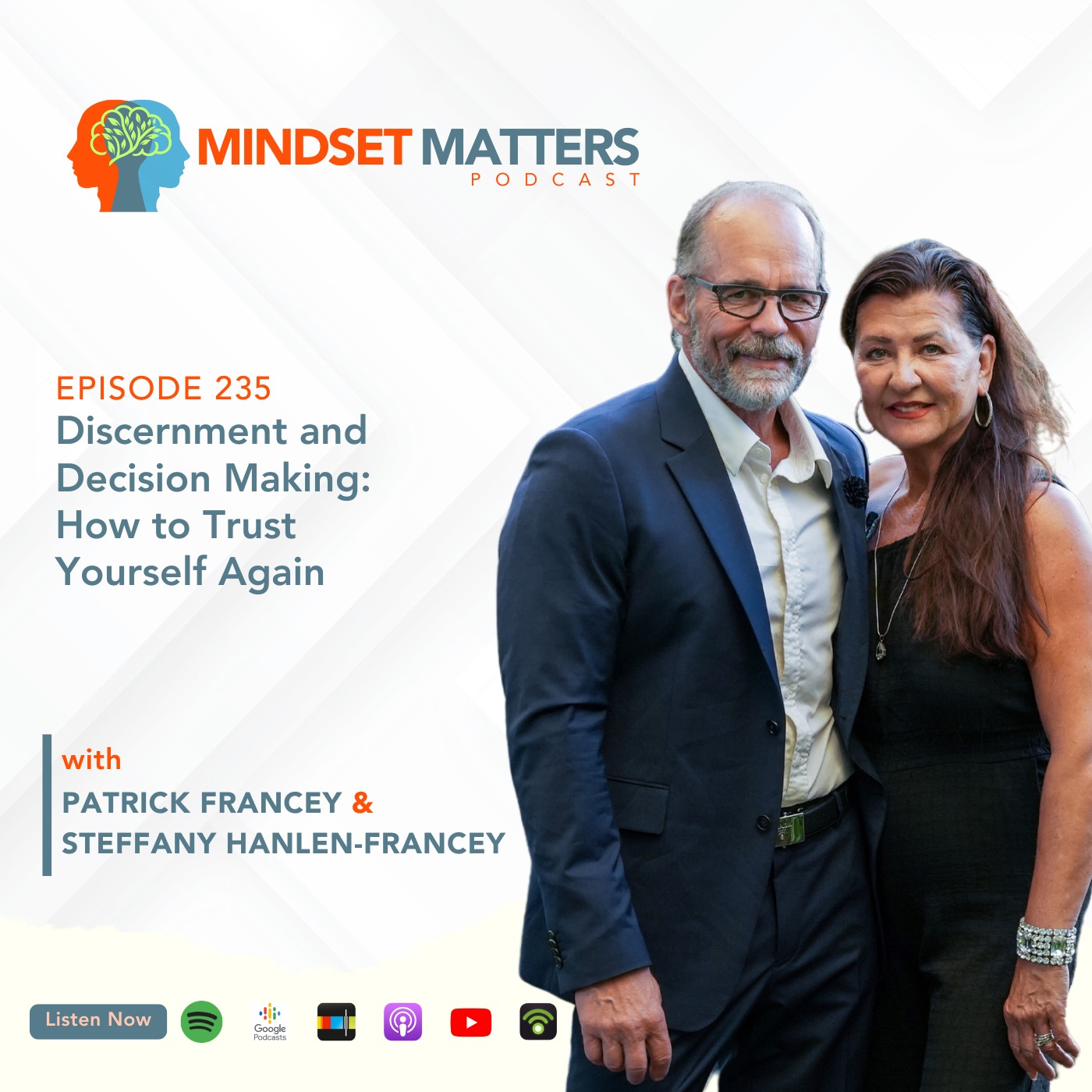
The Everyday Millionaire and Mindset Matters Podcast
Mindset Matters - Episode #235 - Discernment and Decision Making: How to Trust Yourself Again
00:35:11
Loading summary
Transcript78 lines
- [00:00]
A
Foreign. Welcome to this episode of the Everyday Millionaire Mindset Matters podcast, where I'm joined by my wife, Olympic mental performance coach Stephanie Hanlon. Francie. In these episodes, Stephanie and I have a conversation about the different aspects of what we refer to as Mindset matters because we believe that for those who are awake, we are living in and through the most impactful time in history. Your view of the world is the filter for how you will experience the evolution and changing dynamics of it. Our intention is to provide you with ideas, nutritious food for thought, and some tools that you can use to help you in being your greatest self and living your best life. Listen in. Enjoy. Well, hello, Stephanie. Hi, hon. Okay, so here we are. Mindset Matters. I don't even know what episode we're on anymore. But aside from all of that, I've got a word, but I'm going to have you kind of guess it. But I'll give you some really good hints. You ready? Yeah.
- [01:10]
B
You got a parable, too?
- [01:13]
A
Probably.
- [01:13]
B
Maybe. Okay. All right. Hit me.
- [01:15]
A
Okay. I'm not going to give you all the information. Okay. So there are things you usually know before you admit you know. For example, you know when something is off. You know when the opportunity feels a little too polished. You know when the relationship conversation is overdue. You know when your body is warning you. Oh, yes, you do. You know when the numbers don't quite make sense. You know when your emotions are driving the bus and your wisdom is sitting quietly in the backseat. And here's the real uncomfortable truth. Most of the damage in our lives doesn't come from not knowing. Comes from knowing and choosing not to listen. And that's where poor decisions get made. That's where resentment builds up. That's where health gets compromised. That's where money gets lost. That's where purpose gets diluted. That's where confidence erodes. And it's not all at once. It's gradual. One ignored signal at a time. And that just pretty much covers all areas of life, by the way. So in behind all of that, there's a word. I'll give you a couple of guesses.
- [02:27]
B
What am I pretending not to know?
- [02:30]
A
Well, that's a statement. Oh, that's a good question. Though we often ask that. What are you pretending not to know?
- [02:37]
B
And, well, what am I pretending not to know Means that I've seen something, I can assess it, and I'm about to. Discernment.
- [02:47]
A
Discernment. It's a gut feel. That's the word. Discernment. I don't know that it's a gut feel, but sometimes I think it's the gut feel is the trigger. I think in my mind anyways, you know, sometimes I think I can be very discerning. Sometimes not so much. Sometimes the emotion gets in the way. So, anyways, what's your read on discernment?
- [03:09]
B
Well, I think it's a really important trait because it can be trained. It's not something that we all have access to it. I think what happens is when we're in stressful situations and to your point, emotion will lead a reaction. Sometimes we can't separate what we think and what's true because my mom always said, don't believe everything you think. Right. So our thoughts are not always true. They're not always correct. Sometimes feelings and beliefs can be familiar, but again, they can still be wrong. So the discerning quality of being able to step back and go, okay, let's look at this situation. Is it. Is this true? Is this. Let's do a, you know, a case study. Is it true? Is it correct? Is it. Is it logical? Is it fair? What is going on? And am I being activated emotionally? Is my ego kicking in? But it takes a lot of discernment and emotional regulation in order to. To get to that before you react.
- [04:12]
A
Yeah. I want to add on one thing you said, which is don't always believe what you think, but also don't believe what you feel. Like your feelings are often bullshitting you. And. And that is really what happens on the emotional side of it. So for me, when you think about that whole process, it's actually some really great wisdom that was passed on, which is when something triggers you before you say anything, do anything, react in any kind of way. Sit on it for 24 hours. Yeah, same thing.
- [04:43]
B
We write an email to somebody that's written in anger.
- [04:46]
A
Yeah. Sit on it. Because the emotion takes away or waters down the discernment, if you will. And there's also another part of it around discernment that I think, which is around integrity. So if we're not taking the time to step back from things, we can find ourselves in situations that a decision was driven by emotion, a shiny thing, a big promise where we get caught in the emotion of it. We think that emotion is real. We think that what is being presented is real. And if we don't step back and go, okay, we need a little discernment to actually make that decision, to think about it and sometimes sit on it for 24 hours, I think that's an important aspect of it. But it's so interesting that we can, we know the word discernment, but we don't really necessarily have a definition for it. And maybe I should do a definition here.
- [05:47]
B
Yeah, do it. I think it's a really important word and I think as we're going through this next stage, especially economically and in our society, this is going to be a skill, a high level executive functioning skill that I believe we need to really develop.
- [06:04]
A
Well, I think too that, you know, to your point is in this is, in business, for example, in the things that we make, you know, when we're even in our relationships, there is a level of discernment that we have to bring our attention to. Practice, if you will bring it to top of mind, maybe that's the right way to say that. And okay, so let me, let me get to a definition of discernment here. Let me. Okay, so I, I just pulled it up here. So. Discernment is the ability to judge cleanly and wisely, to separate what is true from what is false, what is useful from what is noise, and what is aligned from what is merely attractive said. In other words, discernment is the discipline of seeing things as they are, not merely as you want them to be. So that's going to include clarity, judgment, so weighing facts, motives, risks and consequences, clarity, understanding what is actually happening, wisdom, knowing what matters most, restraint, not reacting too quickly goes back to, you know, wait 24 hours, alignment, choosing based on our values, not our impulse. And of course that then goes back to the conversation of integrity, which is based on values. Right? So if we frame it kind of in how we look at it from a mind shui perspective, discernment is mental filtration or the ability to recognize what deserves your attention, what deserves your trust, and what deserves your action. So ultimately it's the difference between being informed and being influenced. And I think that.
- [07:56]
B
Slow down, cowboy. Say that last one.
- [07:59]
A
It's the difference between being informed and being influenced.
- [08:03]
B
Oh, wow, that's huge right now.
- [08:06]
A
That's, that's all mine. By the way. That, what, that last little bit there was me thinking mind shui and decluttering our mind. So that's kind of how I like to kind of think through these things these days. And you know, decluttering our mind, this is all part of it. And discernment is a, is an important aspect of that. So when you think about what you deal with, or I don't want to say what you deal with, but when, as a coach, when you're talking, especially with your Athletes or your business clients, you know, think about discernment. Does that ever fold into a conversation that you have with them?
- [08:42]
B
100%. Some. With some. I don't actually use the word discernment, but I, I sprinkle it in, or I, I give them the context for what it is, especially when they're bumping into a decision or something's happened, quote, unquote to them to be able to help them step back, disassociate, and say, okay, did this happen for you? Did it happen to you or did it just happen? You know, can you discern what the, what the situation was? Without emotion, can you gain clarity? Is this really, is it really something that you need to own? And if it's not, if it's just mental clutter, what if it's just like, if it's not clarity, maybe it's just like mental clutter wearing a suit, you know, or an outfit, or winning a trophy. Like, we don't, sometimes we collapse a lot of different things onto one, a series of emotions when things happen to us. And with athletes, I find that when they have to choose. For example, like, remember the word decide means to cut away. It means once you've decided and you've committed to one particular journey, you go on that path as long as you can, as long as it works and you're getting the feedback and the results that you want. If you're not, you have permission to undecide. And I think that is where discernment is. It's not second guessing a decision like, oh, no, I shouldn't have done that, like in 24 hours. Because there's always something called buyer's remorse or decision remorse or decision fatigue. And what happens is we get so overwhelmed sometimes that we can't actually separate those things out. So when you're training or you've got a big goal, just count on there being big pushback, big challenges. And the discernment factor, if you're anchored into your values and what it is that you want, there really is a moment where you have to not be concerned about other people's opinions. You know, mom always said, you know, other people's opinions are none of your business, right? So if you're operating on a level of taking action based on external approve approval, external validation, external reward, then discernment isn't going to be your best friend. It's, it's going to actually sound like a buzzkill. Instead of really embracing the opportunity to take a look at things, step back. Especially if you're in A huge adrenalized arousal state. It's very difficult to actually access discernment unless you've trained it well.
- [11:08]
A
I think there, that was the question, you know, and that's the thought process. So I think discernment has to be a habit that you form a way of operating. Right? Because I'm thinking about when you get into. Back to your point, you know, you're in a meeting and everybody's kicking around ideas and solutions, and this is what we're going to do, and this is how we can do it, and this is how we're going to go forward and going to be kind of in the emotion of it, perhaps that one individual is going to be a little more discerning. They're not going to look at the emotional side of it. They're going to break it down a little better. And if you bring that kind of view of the world to the team, it may sound like a bit of a buzz kill. So, you know, discernment, I think, is one of those things that it. You're. It doesn't always jump out at you. I think it can be pretty subtle. It doesn't give you a map of where it goes. But it. And it certainly doesn't remove uncertainty. That's the whole point of being discerning is to kind of help remove the uncertainty, the pressure, the fear, whatever you've got going on. And it's to really, to pause, to look closer. And, you know, you ask, I guess, the fundamental questions. You know, is it true? Am I being wise in my choices? Is this aligned with my values? You know, is this a real deal? Or is it an attractive opportunity? Or is it just being driven by emotion and shiny things? That's part of the. Okay, let's just step back. Am I choosing the path of least resistance because it seems easy rather than I'm being discerning and choosing the right path as opposed to the path of least resistance, as an example.
- [12:54]
B
Yeah, totally. And, you know, I don't want to go on a rabbit, you know, down a rabbit hole, but there's, you know, we go back to the M way is that when we talk about hidden beliefs, you think about in those emotional arousal situations, when you're about to choose a path, a fork in the road, are you choosing it from your higher self, aligned with your values and being okay to be uncomfortable, be okay to be misunderstood, etc. Or are you coming from, oh, I got to protect myself, you know, I got to prove myself. I got to, you know, I gotta. I gotta Fight through this. I gotta be the strong warrior. And I think about all the times over the last 30 or 40 years in business and sport where the decisions that I've made from my ego or from survival or from being overgenerous or from, you know, whatever, maybe. Maybe I was tired. You know, that's not the best place to make decisions from or to send emails from, you know, but at the same time.
- [13:57]
A
Or build relationships from.
- [13:59]
B
Yeah, exactly, Build relationships. Because that's where things get torn down, is that, you know, you show up in certain scenarios where you seem clear and grounded and regulated, and then the next thing you know, something fires you or, like. And I'm always speaking for myself, something fires me up or triggers me or I get activated in a way where I have to feel, or I do feel defensive. And being defensive to me has become a level of awareness. The minute I'm defensive or the minute I'm feeling like I know what I'm doing, that's where I activate my discernment.
- [14:33]
A
Well, I think there's a part where, you know, discernment is how you operate. It's not necessarily. It's not just something that you have. I think it's something that you use. You know, there's a phrase which is, you know, because you know better or choose. Knowing better and choosing better are not the same thing. And when we are got a lot of things coming at us, we have to be able to stop and say, how can we be discerning? And I don't know, I think about, you know, it's not a word that comes up in my vocabulary, but I think there's a part of it where it needs to become more forefront, especially with what's going on in the world today, where we're having to make different decisions and we're seeing what's happening in a geopolitical level. You know, we've got wars happening all over the place. We're looking at the impact that that is going to have on our country. You know, we are going through a process of saying, okay, are we going to continue to have a primary residence in British Columbia or are we going to sell this property and move back to Alberta because of all of the things that we're seeing, and that's not an easy decision, but we're having to be discerning in that so we're not caught up in the emotion of it or thinking that it's greener on the other side. We have to really kind of go through the process. I think that's Being discerning because we've been like literally weeks in the process and ultimately to come to a decision, and I think that's really defining discernment. Getting out of the emotion of living and leaving, I should say, a home that we truly love. And, you know, thinking about, okay, we have to look into the future and say, where is this going? Where do we see it going based on. And it's not an easy path. That's the other side of it. Because it would be far easier to stay here.
- [16:26]
B
Right. But, you know, from a discernment standpoint, and I think I just picked up on your languaging, we wouldn't be moving back to Alberta. We would be if, if we, if, if things, you know, if hits a fan or whatever. And with all these indigenous land claims that are going on in B.C. etc, you know, we're not in a situation where we have to move. But if we're going to move to Alberta, it's because we want to move forward in our relationship with the kids, with our relationship with Aaron and Alyssa and Monty and our business partners and my brother and my dad, you know, and your sister and the gr. You know, the nieces and nephews. You know, we're going to move forward in that because of family. And we're at that age where that makes total sense. But I think when we point, you make.
- [17:11]
A
I just want to say, so it's not a moving back. It is a return to roots in some regard, but it's a return to proximity of family. Yeah, that's really what it is. Exactly.
- [17:23]
B
Because we'll never go back. Like, there's no such thing as going back. It's like people crack me. Cracks me up when people go, we're going back to school. No, you're not. You're going to a new grade, you're going to a new school, you're going to a new level. Right?
- [17:35]
A
Yeah. Yeah, that's a good point. Oh, you're so smart.
- [17:37]
B
I know that's why you love me.
- [17:39]
A
That's why I love you. Okay, well, there's other reasons, but you being smart is just bonus. Because you're smarter than me.
- [17:46]
B
But, you know, there's. Before we get off, do you have a parable or should we just keep breaking down? Because I know there's. I think I've got a parable.
- [17:54]
A
I do have a parable. I, I'll, I'll, I'll, I'll lay out the parable. And I don't know that we'll see if it, you know, We'll. We'll decide. Maybe the editor will want not to use it, but here's the parable, okay? Okay. It's an old story about a man walking home through a dense mountain fog. And it's the name of the parable is called the Lantern and the Fog, as a matter of fact. So there's an old story about a man walking home through a dense mountain of fog. He had made the walk many times before. He knew the trail. He knew the turns. He knew where the path narrowed, where the rocks loosened, and where the edge dropped sharply into the valley below. But on this particular night, the fog was thick, very thick. It was heavy, the kind that makes familiar ground feel foreign, get easily turned around. But in his hand, he carried a lantern. Now, obviously, the lantern didn't remove the fog. It didn't light the whole mountain. It didn't show him the entire path from beginning to end. It only gave him enough light to see the next few steps clearly. Now, at one point, he came to a fork in the trail. One path looked wider. It looked easier. It looked more traveled. He could hear voices in the distance coming from that direction. So naturally, he felt pulled toward it. It felt safer. But when he lifted the lantern and looked closer, he noticed a few things. The footprints on the path were sliding. He could see where it was uncertain footing. The mud was loose, the stones were wet. And just beyond the first bend, the trail dropped away. The other path, however, was narrower, quieter, but the ground was firm. So he chose the narrow path not because it felt better, not because the crowd was going the other way. And it's not because it promised certainty. He chose it because he could see enough to know the difference. That is discernment.
- [20:04]
B
So it wasn't a feeling, it was an actual. There were many things that were activated. The visual, the physical, the sensation of sliding, seeing the. The footprints and then choosing which is the. Just like filtering all those things in and then deciding maybe the narrower path was. Was more sturdy, even though it was less accessible. So that's almost like the less traveled from Robert Frost, right?
- [20:33]
A
Yeah, a little bit of that. Yeah. Yeah. Rubber frost. Yeah. And the crowd have obviously had not used the narrow trail. So he had to make the decision. Am I going to follow the crowd? Am I going to follow the masses down this trail? That looks a little precarious. And as a matter of fact, evidence shows that it's precarious with the slipping and sliding in the mud. That was obvious there. Now, maybe he didn't hear anybody screaming as they fell off the cliff. But.
- [20:58]
B
But was the light, the moment of discernment? Like, explain that to me. Was the what, the light, the lantern?
- [21:05]
A
Well, all he could do is he didn't have all of the information. All he could see was the few steps in front of him. And he had to make a decision based on what he could see in those few steps that he could take at a time. Now, he could have chose a path that maybe got him on the wider, more used path that was. Looked a little more treacherous and the crowd had gone down. He could have maybe traveled it a little ways, but he made a decision. He made a choice based on what he could see, and he chose. And this is the discernment. Didn't say he was right. Got was discerning. He saw this path and he saw this path. He looked at them both. He got information and he made a choice. But he used discernment to make the choice, not the emotion of, oh, everybody's going that direction. Oh, look at this path. It's much wider. He didn't look at that. He didn't come from an emotional. He could see what he could see. He had to make a decision based on that. And he chose the path, I guess, in this case, less traveled.
- [22:11]
B
Think about it just for a second, is that it's also being able to make decisions without all the information. Like, how many times do people get shut down and stop moving forward because of analysis paralysis? They just don't have enough information. I don't have enough data. And think about RAIN members over the years is that they just want more information, more data, more this, more proof. And, and. And then all of a sudden, all these opportunities just pass by them because they're stuck in needing to know more or having more data. You know, it's like going to, you know, it's the personal growth junkies, you know, like, it's like you get to the end of a workshop or something on the Sunday night, and you're on the caffeine high, and you think you're going to make all these changes and decisions in your life. And then Monday morning, of course, after the high, there's always a low. And then it's wa, wa, wa. You know, once the caffeine high is gone, then you're just back to your normal habits. And it's like, when are the moments of discernment where you actually can shift the trajectory of your life in the direction that you want to go? And, you know, one of the things I said back in the day, always when I was speaking and people always wanted to talk about goals and big goals and set, you know, big, hairy, audacious goals and vision. I'm like, yeah, but you gotta act small. So if you're not willing to act small and you know, eat an elephant one bite at a time, then it doesn't matter how big your goals are. And I think that analysis paralysis can be conflated into discernment and it's not. It's a chicken shit way of trying, of not moving forward. That's what that is.
- [23:49]
A
So there's some questions that, you know, we have to ask ourselves. That's discerning, right? So first off, we ask, you know, is this scenario true or is this story true or is any of this all true? You know, is this wise? Is this is the best? Am I being wise in my decision making process? Is this aligned with my values? I think for you and I, we often talk about values because it's such an important part. Is this aligned and is it aligned with my values or is it just
- [24:18]
B
a shiny thing and is it justifiable? Like that's where I've been caught recently and I'm caught hard and expensive lessons is that I would justify, like I would find reasons why it would work even though it wasn't aligned with my values. And that to me that's such a big lesson. And when you get to my age, there's way less Runway to recover from those kinds of mistakes or those kinds of results. Right?
- [24:44]
A
Well, exactly. You know, and of course you always make the best decision you can make at the time with the information you have. But we do, people in general, you and I included, we've both done it where to your point, we've justified because it seems like the easier path to
- [25:03]
B
try, or we're helping someone or we're helping, which is one of my patterns, which is so when am I going to get over that one.
- [25:10]
A
Yeah. So at the end of the day, I think most people don't get into trouble because they didn't have the proverbial or the metaphorical lantern. And they get into trouble because they don't use the lantern. And even if they have one, you
- [25:27]
B
could probably have a whole bunch of lanterns and flashlights and lighters.
- [25:31]
A
Maybe we should get a lantern. Call it discernment. This is a reminder, you know, because at the end of the day, what happens, okay, back to even the scenario that you just shared, you know, something's off, you know, the warning, you see the pattern, you sense the misalignment but ignored it because the easier path was louder. Maybe it was faster, more comfortable.
- [25:58]
B
Or it hit my values of, of supporting someone, helping people.
- [26:02]
A
Totally.
- [26:04]
B
You know, and I. That's where I have to reevaluate.
- [26:07]
A
Yeah, 100%. And so this becomes discerning in the decision making process, which is to say, slow down, look through a lens, list, lift the lantern called discernment. So you're actually looking at what is real as opposed to what and what you're stepping over.
- [26:27]
B
Yeah, right.
- [26:28]
A
You know, so I think there's a part of that conversation around discernment when you reflect, when you self reflect on.
- [26:35]
B
And what am I pretending not to know?
- [26:37]
A
And what are you pretending not to know? We asked that question, by the way, you know, somebody who's listening, you know, you. We've often used it when there's somebody in, you know, in a relationship and there's an affair, this is probably an easier one to shine a light on. So many people. And I'm not, listen, I'm not an expert on this, but I do know over the years where you see people come up and go, oh, he had affair or she had an affair. I didn't see it, I didn't see it coming. And like, it's just out of the blue. And we have, we've heard those stories many times and I'm sure our listeners have heard some version of those stories. But at the end of the day when you sit back, you saw signs, there were signals.
- [27:21]
B
Yep.
- [27:21]
A
But what were you pretending not to know? That's what we get into these conversations. And I use that as an example in relationship. But it could be in partnerships, it could be anything that you pretend that you didn't know or there's that niggle
- [27:39]
B
in the back of your head or the gut feel like our gut is our second brain. Right. Like if, if something is making sense logically but your gut is saying no, there's a contradiction and there's a path to choose in that. And okay, I can get more information, I can intellectualize this, but there's something off in my gut. And I think there's an emotional regulation or a maturity that comes from learning how to trust your gut and not just think it's, you know, oh, it's just ridiculous or it's just whatever, it's my, my patterns or it's my historical trauma, you know, but no, there's something. When you're in tune with slowing down and creating a little bit of space and distance between the situation and what's going on, there's something about what we have intuition. Like I've really activated my intuition those last couple of years. It's been crazy coming back. I shut it down for a long time. Cause I didn't trust it or the people around me weren't trusting my intuition. But I've always known that there's something about my pattern recognition gifts that sees things in order. And I don't know if it's a dyslexia thing or whatever, but doesn't matter. It doesn't need a label. But there's a pattern recognition skill that I think a lot of people have that's been minimized or pushed down because we're seeing so much negativity in the mainstream media. We're seeing so much, you're wrong, you're crazy, that can't be right. And the gaslighting and everything. So we start to not trust our gut and that's. Or the instincts or our experience and go, oh well, you know, it makes sense intellectually. So there's seven layers of. Sorry, seven areas of life that this can show up in is what kind of showed up for me.
- [29:23]
A
Yes, but I think what you just said is interesting too, is that I think it's a little dangerous to go with a gut feel unless you are really, really tapped into that, which few people are. And I think the gut feel, the intuition that you speak of, may be the lantern that you need to lift.
- [29:45]
B
Good one.
- [29:45]
A
So in other words, it doesn't mean you need to make a decision on gut feel. Sometimes you may, but that's risky too, unless you were really tapped into it. And we both made decisions on gut feel. And we've been right often, but we've been wrong often too. So the point is, if we just take again the metaphor of the lantern, the gut feel is maybe the lantern, it lifts and brings and asks you to say, I need to shine a little more light on this. Let's pay attention, let's be a little more discerning in this decision, in the choices that we're making as opposed to just going with gut feel.
- [30:25]
B
And again, interesting about that. Sorry to interrupt, Hun, but there's also something that's so interesting because two things can be right at the same time that are completely opposite.
- [30:34]
A
Give me an example. What do you mean?
- [30:36]
B
Like a paradox, like, you know, you can love to win and hate to lose. You can know something, the opposite, something to be true. And I think that's what breaks people's brains a lot of times, is that you can see something that's happening in the world and. And actually visually see it, but then know that it's not true. So there's paradoxes all over the place. And I think what the. Where people's brains get so overwhelmed is in the cognitive dissonance. I mean, we did a whole podcast on cognitive dissonance. I think it was in our first year.
- [31:12]
A
It's like episode Bring it Back. I think we got to do more. We got to do another one on cognitive.
- [31:16]
B
We do, because I think that's what I'm seeing just day to day. And of course, we're not experts in all of that stuff, but when you see two things that are completely opposite that can be true at the same time, it's an absolute mind bender. And how do you use your discernment when they're both true?
- [31:35]
A
Well, and I think we, you know, we expand on that whole conversation is the reality of what we're faced with these days, which is the algorithms that feed our feeds.
- [31:44]
B
Right?
- [31:45]
A
You know, the algorithms that, you know, you say you know too many words out loud, and the next thing you know, your feed's full of it. And so if you're having a discussion, whatever it might be, political or otherwise, then the next thing you know, all these things are in your feed that are there to support your argument. So in other words, are you going to buy into that or are you going to be discerning? And that's a little bit of true, you know, is. Is we have to be discerning. And I think about the importance of the word and just how timely we should probably have this conversation a while ago. It's a great reminder, I think, for many that we have to use that discernment as the, you know, the proverbial lantern that shines a light on the direction that we're thinking about going before we make the choice of actually going.
- [32:41]
B
That's so good. And it gives us permission, I think, just as. As humans, as. As business owners, as families, to slow down. You know, I know people joke and they always want, like, I remember when we had the. The shift program out here and. And we had, I think, six or eight couples out here, and we were checking and we were sitting at the front of the room and you were talking, and I went, whoa, whoa, whoa, slow down, cowboy. And they burst out laughing because they hear me say that on the podcast, but didn't realize it's actually how we are. Like, we're the exact same on the podcast as we are, you know, doing a. Facilitating a workshop or doing mind shui or doing shift or whatever. And I realized in that moment is that that is also a moment of discernment when I'm also not processing something clearly of what's being said. And I want to be able to hear what you're saying or hear what somebody's saying and make a choice based on having as much information we can have in the moment. And if I have to ask you to slow down or somebody to slow down or just can you repeat that? There's a moment where it creates a pause. And I think that level of pause creates a level of respect, and that level of respect creates the feedback that we need to make better choices.
- [33:56]
A
Yeah. Okay.
- [33:58]
B
I thought that was good.
- [33:59]
A
It is very good. I think this has been a discerning podcast.
- [34:03]
B
It really has been. Yeah.
- [34:05]
A
Very thoughtful. Very thoughtful. And I'm going to call that a wrap. I'm going to bring discernment into more of my conscious thinking and see how that works out. I'll circle back, let you know how it is.
- [34:21]
B
Yeah. Moi o si. Okay, that's French for me, too.
- [34:25]
A
Yeah, I get it. Okay, we'll call that a wrap.
- [34:29]
B
Thanks, then. That was fun.
- [34:32]
A
Ladies and gentlemen, thank you for listening. If you found value in the podcast, please take the time to rate and review and share with others. Share with your friends, as it is my goal to always improve and to provide the highest value for you, the listener. If you have any comments, suggestions, or questions you'd like answered, please email me@ceoaincanada.com that's ceorincanada.com I look forward to hearing from you. And until next time. Patrick.
- [35:05]
B
Oh,