← The Everyday Millionaire and Mindset Matters Podcast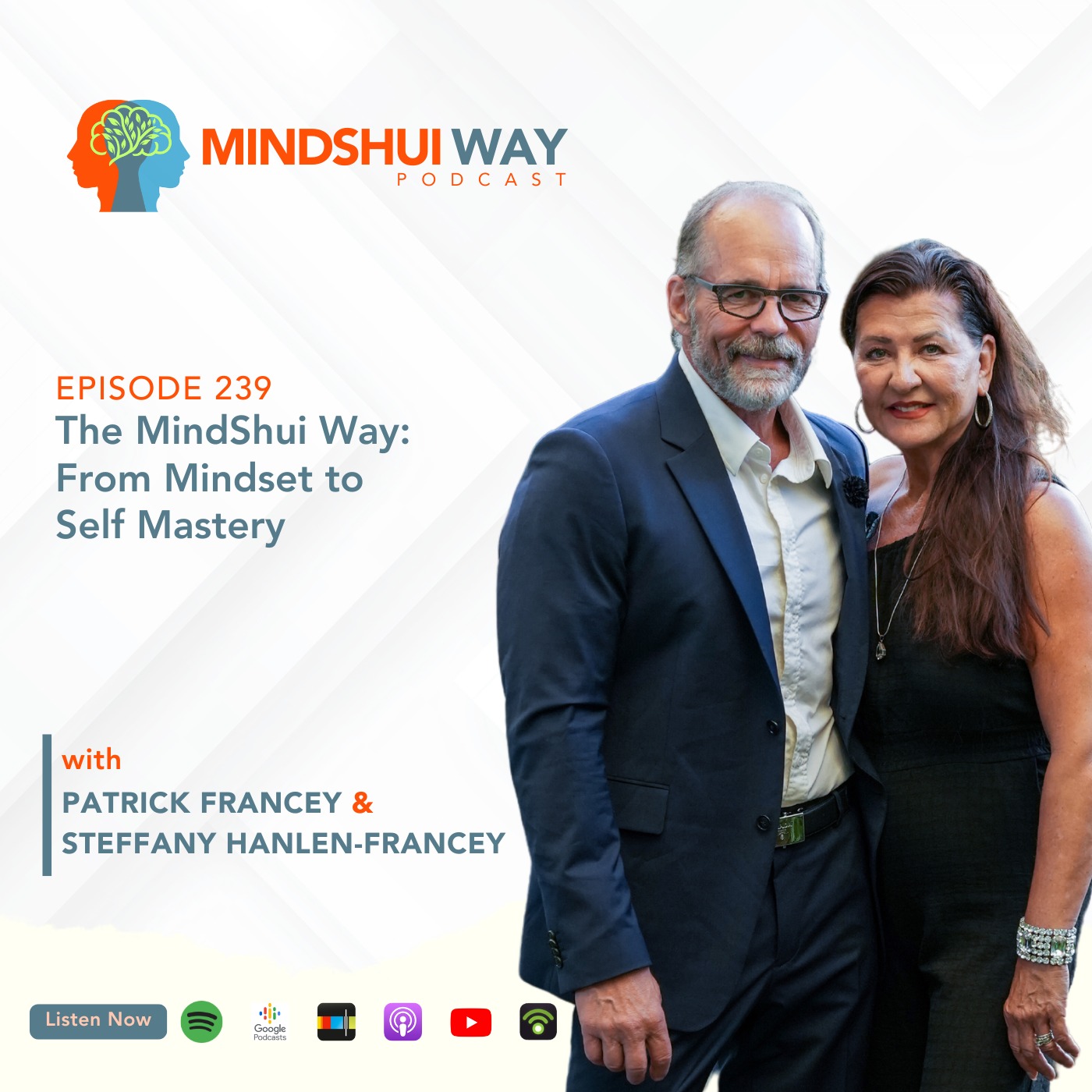
The Everyday Millionaire and Mindset Matters Podcast
MindShui Way- Episode #239 - The MindShui Way: From Mindset to Self Mastery
00:32:16
Loading summary
Transcript39 lines
- [00:00]
A
Foreign. Welcome to this episode of the Everyday Millionaire Mindset Matters podcast, where I'm joined by my wife, Olympic mental performance coach Stephanie Hanlon. Francie. In these episodes, Stephanie and I have a conversation about the different aspects of what we refer to as mindset matters because we believe that for those who are awake, we are living in and through the most impactful time in history. Your view of the world is the filter for how you will experience the evolution and changing dynamics of it. Our intention is to provide you with ideas, nutritious food for thought, and some tools that you can use to help you in being your greatest self and living your best life. Listen in. Enjoy. Hey there, and welcome to Mind Shui podcast. Feng Shui for the mind, formerly Mindset Matters. Stephanie, welcome.
- [00:59]
B
Hey, hon. This is exciting.
- [01:01]
A
Well, the official shift from mindset matters to Mind Shui is I'm doing it. I'm just moving forward with it because of a lot of reasons. But as we roll out the rest of our programs, it was a necessary change. And mindset is too. What's the word I'm looking for?
- [01:23]
B
It's not too broad of us.
- [01:26]
A
Too broad. Too broad, too overused, has too many different meanings for many people. And the podcast has been great. And so we love the podcast. We're going to continue doing the podcast. We're just rebranding. It will be mine. Shui and the Mind Shui way and feng shui for the mind. Clearing the clutter of the mind. And that's how we're going to roll with this.
- [01:47]
B
I love it. I think it's great. I think the timing is perfect. Love the rebrand. I've just seen you work so hard on this particular process and the program, and it's, you know, it's funny, it's clarifying, and it gelled like, it looked like it was fast for me, but I know it was really intense for you, so I'm really proud of you.
- [02:06]
A
Well, just a lot of things to work through, but that's also the fun part of it, right? Is the creative and then coming out the other side of it. Well, hopefully with something that people enjoy and people get. And based on the feedback we do get, we're on the right path and we will continue to improve and up our game and do all the things that we do. Okay, so I want to talk about in that same kind of context, if you will, and we talk about Mindset. That was the name of the podcast. And for me, we start to understand that it's progressive. Most don't understand that or wouldn't see it that way. As a coach, I see it that way and I know that you do as well. But think about where we start. These journeys of what we normally call personal development, self discovery, all of those words that are quite common in this space. Really what it is, is about how can I be the better version or the best version of myself? How do I get out of my own way? These are all kind of normal sound bites that we hear when we go on this journey of what? Personal development, then professional development. And we attend courses, we read the books, we have epiphanies, we have realizations where we can actually see that we're getting in the way of ourselves. And there's some mental and emotional clutter that has to be cleaned up. That's where part of the story is where we get to mine shui, you know, feng shui for the mind. So feng shui being, clearing the space. Let energy flow, let things flow. In general, this is about flow for the mind. Now when we go on that journey, we don't have a roadmap necessarily. It's not like we're putting it in a gps. So we, so we go on the journey and it is about self discovery. But at some point, you know, this many years later, mindset to me started to get so, I guess watered down, overused if you will. And that's why mine shui showed up. And in the context of mine shui, I then got to a place where I'm going. This is not a destination. But really what this is about, self mastery. So for me, mindset was always, how do we handle those things that are happening to us? Self mastery is having an understanding of how we're showing up as those things are happening to us. Who are we being? Mindset is about what are we doing? Self mastery is about who we are being. So I just wanted to. I don't know if that gave us a strong enough context or not.
- [04:29]
B
Yeah, I like the distinction, the difference, because you're right, it's become the flavor of the month mindset. You know, everybody's a, an Internet or an Instagram psychologist these days. My feed is full of it when I'm scrolling my recipes all of a sudden. Of course, because of my interest, I'm sure I'm finding all these 25 to 35 year old psychologists on there or people with no real kind of maybe life experience and no disrespect, but ultimately, if that's really just the external process of, you know, focus and resilience and all those kinds of things that are important. That's great. But to me, the way that we've evolved over the last little while, especially in this podcast, is that we have up our own game and upped our own level, even in our communication to the world of mastery. And I think that's what is going to be our next journey for sure.
- [05:19]
A
And so as we go through this process, you know, I want to relate it to what, I guess what we called the four stages of competence, if you remember. It's a good way to kind of give us this whole thought process that I've got going on. So, first off, stage one is the unconscious incompetence. So in other words, you don't know what you don't know. You may think you're really calm, clear, or a good communicator, but your behavior may be telling a different story. So that is unconscious incompetence. Then there is conscious incompetence, which is now you see your pattern or the pattern. And for example, I know that I shut down when I'm criticized. I interrupt when I feel the need to prove myself. I avoid difficult conversations. And this is where mindset often begins. You start to realize that, oh, there's places where I am getting in my own way and I can now see them. Stage three is conscious competence. So now you can choose differently, but it takes effort. You pause instead of reacting, you listen instead of defending, you stay present instead of avoiding. And this is the practice. Okay, so that is conscious competence. So you're really working at it. You're clear. Somebody says something, you don't react, but you're consciously being that way. And this is where ultimately we want to get to in the world of self mastery, I believe is unconscious competence. So the new behavior becomes fully integrated, is becomes who you are. And I think this is where self mastery starts to fold into this conversation is because it just becomes who you are. I share the story quickly. Back in the day when we did the Hoffman process, for those of you who are ever interested in doing some really cool, deep work, you can look up Hoffman Institute. Anyways, we did Hoffman, and after we went through that process, I came out the other side and there was a realization that things were happening and I had to reflect on it a bit. And I actually said, I think that used to piss me off.
- [07:20]
B
Mostly about me.
- [07:23]
A
Mostly about you? No, not mostly about you. But yeah, certainly there was all those buttons that you pushed in others that used to piss me off. And then all of a sudden they just went away because I collapsed that charge, that trigger through doing that work, that process, and it just became the new me and the new me didn't react to it. And what was interesting about after I did that particular process and over the years of doing all the work that we've done, a lot of people who knew me said, wow, have you ever changed? I didn't see it, by the way. I didn't really see how much I changed. People around me were making note of it and commenting on it. And that's what I noticed over the years. Those were in the early days when I was coming out of your favorite Neanderthal mode.
- [08:14]
B
You're still my favorite Neanderthal.
- [08:17]
A
Thank you for that. So. But you get what I'm saying, right? So this is where self mastery becomes so mindset.
- [08:24]
B
Don't skip over the last part of the story, cowboy. The last part of the story was when, for example, we knew each other's triggers. We, you know, we were a little bit unconsciously incompetent at times. And we would maybe start an argument or I would push your button or whatever and you used to push mine and it, you know, etc, and then every once in a while you would fire me off a barb or something like that. And I would, you would always know how I'd react. And I would always, you know, one liner or sarcasm or I'd be pissed off or whatever. And then after Hoffman, you'd fire off these barbs at me and you compared it to like a golf ball. Do you remember that story?
- [09:04]
A
Yeah. A golf ball hitting. Throwing a golf ball up against a wall, a cement wall. It comes back real hot, reactive. Bang. And after that, it was like throwing a golf ball up against a mattress.
- [09:16]
B
It just, that's what it was.
- [09:20]
A
So. But what's interesting about that was that I wasn't consciously putting, like throwing darts. It wasn't conscious. But my realization was in our communication, I'll say my general communication. And then I started noticing that I had that communication and it was just something was different. And then as I thought through it, that's when it became. It came into my awareness, is the way I was communicating. Used to push certain buttons and it wasn't that way anymore. Now it was at a very subconscious level and it gets a little heady. But the point is that as we went through this, when we think about self mastery, and that's really the conversation for me is that mindset is only one part of the conversation. We have the mindset to achieve the goals, to get through the challenges. To face the. I don't know, the adversity that we have to face, to become resilient. Now, do you become resilient and you're resilient consciously, or do you get to a point where. Where that's just who you are. And I believe that you get to a point where resilience is just who you are. It is your identity. It is part of just how you're wired. But it is an upgrade to your software, if you will. Your operating system in how you see the world, how you view the world, where it's not conscious anymore, it's just now how you operate. But you got there through the awareness, through the shift of mindset to staying open, to where am I getting in my own way? Oh, I make excuses. Oh, I blame other people. Oh, you know, I. I'm looking at the world through. Or at my world through a lens that gives me a really twisted perspective or a twisted perception, which. No, the perspective shifts my perception. Right. So we start to learn through the work of mindset that you're looking through different lenses gives you a different perspective of your world, which then can shift your perception. And if you're not willing to look at your world through a different lens, you're always going to have the same view of your world, the same perception. And until. And if you want to shift that perception, you have to shift your perspective, your view of your world, look through a different lens. That's the mindset part of it. Then I think you elevate. You go to a place where you just upgrade your operating system. It's no longer. It's just how you operate. And I think that's the shift. That's the self mastery part. But you have to get to that realization before it becomes about self mastery, which is an inside job. Mindset is an outside job. That's kind of how I'm trying to define it. Is any of this making sense?
- [12:07]
B
Of course. Yeah. It's good. And I think it's a good context for our shift from mindset matters to mind shui in the mind shui way. In the way that, you know, if you're on this journey with us, you'll start to see that Patrick and I are also continually evolving and trying to figure out our blind spots and trying to figure out what's not working and where am I, you know, where am I being, you know, a victim on some level. But I do remember back early in the mindset matter days, in the first couple years, we did talk about it. I kind of sprinkled in is that, you know, mindset is one aspect of it. But I remember asking, you know, whether it was a client or on the podcast, like, yeah, but what is your heart set on? Like, what's your heart set? What's your soul set? What is, what is your mind set on? What is your heart set on? So we started to play a lot with those words, which I think kind of started to unpack the, the depth and the gravity of if we stay stuck just from our, you know, neck up. I think my mom always used to say the longest distance in the world is from your head to your heart. Right. So when I would say that, we'd have a few chuckles about that. Yes, it's mindset. Yes, it's thought process. Yes, it's having, you know, the mind of a steel, you know, the, of a steel trap or whatever the saying is. But then as you start to understand mastery and you get down from your head into your heart and into the soul set about something that is moving you or trying to maybe signal an intuition or something that we have to then embrace the other seven and six areas of our life that allow us. So what is our, you know, our mastery around our physical wellness and what's the mastery around our. Our health and maybe our social relationships, our financial life? So it's really about what we set our mind to, and I think that's how we shifted it and we're able to kind of navigate into the awareness when you came up beautifully with the term mind shui.
- [14:05]
A
Yeah. So I want to give some examples and work through this kind of thought process to support listeners in thinking about, where are you a master? Where have you, you know, to give some clarity around the term self mastery, I want to give you a really cool example. I haven't even shared this with you, but it was something that has been sitting with me and this was, gosh, this happened at least a month ago when I was traveling and I was. Had a carry on and, you know, the whole thing around carry on, you know, they sometimes out of the blue, they say, does your bag fit in there? And both of you. Both of us are quite. Both of you. I don't know where that came from. Both of us are, I mean, we're well traveled, we travel a lot and we do a lot of carry on and we have our carry on bags. We know what fits, we know how to pack them, all of it. So we're pretty dialed in systematically in that whole thing. So I pull up to a WestJet, you know, and of course, they've got all the bells and whistles of tears and things that you can do. And. And I pull up, and as I'm. And she looks at my bag, and she goes, put it in the bag checker. And it pushed my button, right? And I didn't say anything, but I was a little bit aggressive in how I handled my bag. I probably rolled my eyes or something, right? And she called me on it, and she said to me. She goes, don't give me attitude. That's what she said to me. Wow. Yeah. Don't give me attitude. And I felt like saying, okay, talk about who gave who attitude, right? I just said, you know something? I travel thousands of miles with WestJet, and this is the bag I use every single trip. And so what happened was that. That happened to be a Tumi bag. And as you know, it zips and you can kind of expand it. And for whatever reason, maybe I pulled the wrong zipper. It had expanded, so when she saw it, it looked a lot thicker. So of course I had to zip it up to put it in the machine or in the box. Okay. That's a whole long story. But it's important because I realized from a mindset perspective, I knew that there was no point in me being annoyed. Irritated, making her job more difficult, or kind of cussing her cornflakes. Because up until then, I was watching, I was observing. She seemed quite nice. And then it got to me, and she'd go and check that bag. So it pissed me off. But here's the thing about that. I know that all she's doing is it's all about bureaucracy. It's check the boxes, Checklist, checklist. They're dealing with millions of people over the course of a year, hundreds of thousands, whatever. They have to have that system in place or they lose control. I get it. Let's put it this way. Intellectually and from a business point of view, I totally get it. Get it. But it pissed me off. Now, here's the difference. I didn't. I reacted, but I didn't say anything, which was very conscious. That's a very conscious thing. It's not who I am. You follow what I'm saying?
- [17:03]
B
So before, maybe you would have.
- [17:07]
A
Oh, 100%. I would have. I probably would have got kicked off the plane or let. They wouldn't have let me board. No, but the point. Because that stuff, really. It still pushes my button. Nothing pushes my buttons more than bureaucracy. And, like, it's just such. It's so inefficient, such a Waste of time anyways, without going on. See, look at that. Look at. I get fired up about going on a rant, so I have no mastery in that department. But I have a very conscious and clear thought process leading up to that. But I haven't evolved to the place where it just is, you know, don't sweat the small stuff. It's all small stuff. And can I get to a point where that kind of thing doesn't push my buttons? Now it's way better than it's ever been, but it's still very conscious.
- [17:53]
B
That's conscious competence. What you're saying is you want to get unconscious competence. You want to get to the point where it just, you know, you're just like, what is it? You just like water and just water off a duck's back.
- [18:04]
A
Water off a duck's back, as they say. So that's, that's the mastery component of it, where you kind of get a little bit Zen, like, about that shit, and I'm just not there. I'm Zen, like, in a lot of situations, in a lot of, you know, times when drama and chaos is freaking people out, I just don't have that same reaction. So it's like, yeah, okay, whatever, you know, it's not that important. But comment on my bag, getting on a plane, telling me, are you fucking crazy? Like, what are you doing? So, and I'm a complainer. I'm a complainer too. Like, I don't have a problem with security. I, I, if I go through security and they annoy me because they check my bag, I will complain to supervisor. I'm not beyond that because I think that initiates change, and it does.
- [18:49]
B
Especially if you're going through with all your status tags on your bag, that obviously triggers, or you're going through the NEXUS line or the business class line, and it obviously, they know that you are an experienced traveler, so they're taking a big chance. I think where it gets me in terms of my mastery is what pushes my buttons is policy over people. If you put a policy or a procedure over the person standing in front of you and you're only filtering through that and doing your job and checking your boxes, that's when the shift happens for me is I go. That's where we're our society and our corporations and our bureaucracy and our bullshit government is really starting to, I believe, you know, separate, segregate and damage the people. Like, people don't want to fly. They don't want to be treated like that. They don't want to have to unpack their bag and repack their bag, and they're making it very difficult. I mean, this is one example. But to your point, for me, the mastery piece is the unconscious competence of being able to stand there, let it go through me, and realize that I have some compassion for this person. Because they are now having to put policy in front of people. And I saw this when my mom was in the hospital when she was dying, is that those nurses and doctors put all the policies ahead of the person that was sitting there. And that's when it really hit me, is that this has got to shift. This has got to change. And this is probably one of the stakes I'm going to put my. My. My big stick into.
- [20:18]
A
Yeah. And I don't think it's. And let's. To be clear, self mastery isn't about ignoring those situations. That's not what it is. It is being able to eloquently deal with the situation without being triggered or in the charge or whatever language you want to wrap around it. I think that's part of mastery. So that's just an example, by the way. So the point of it is, is that as we go through this, defining ourselves, what's in our way, doing all the work to be the best versions of ourselves, to achieve those what seem to be unachievable goals, or to become the person that you need to become to achieve those goals, all of that language is really important. And we know that we are all getting in our way at some point. So when we start to understand that the Journey of Personal Development, it's where you might read the first book. You know, for me, it was a Wealthy barber and then Rich Dad, Poor Dad. Those were a couple of books that started my. And then Wayne Dyer. You actually introduced me to Wayne Dyer, Dr. Wayne Dyer. And I go, who the hell's that? Right. So I read some of his books and then I started on that journey. And that was really in the personal development, you know, who Stole My Cheese? You know. Right. It's interesting is that, you know, when I ask my everyday millionaire guests the question of what was a book that was the most influential in your life? It's not uncommon to get Rich Dad, Poor Dad. It was really, you know, But I'm always surprised at how many people read who Stole My Cheese? And it was, like, profound for them, but it was one of the most basic books yet. It was really profound for them. And so we start to understand that that's that entry point that we go on this journey of hold it, you know, this isn't just the way I am. I get to choose how I'm going to be. And then we evolve into different levels of that personal professional development, and we start talking about mindset and adopting and adopting the right mindset. But for me, the place that we need to come to is self mastery, which is the inside job, is really being reflective and understanding how you're showing up, who you're being in the context of what it is that you're trying to achieve, who you're trying to be.
- [22:29]
B
Yeah. And that, I think, brings us to the identity operating system. And I know I want to do a whole podcast on this, because what I've learned over the years, 100 years that I've been coaching and empowering and leading, you know, to the best of my ability, is that identity defense. Identity stability is one of the biggest things that people will defend to the death. This is who I am. And once an identity has gotten locked on, it's very difficult to help people shift and look at things through a different lens and through a different set of. To your point, to your different perspective or their perception is a certain way. And if it locks into their identity, it is, I would say, almost impossible to help people shift that if, especially because they don't want to, when the need to be right is so, so ingrained.
- [23:23]
A
But the question then becomes to those individuals, right, which is, are you happy with where you are in your life? Are you happy with your life in general, your relationships, your financial situation, those seven areas of life that we talk about? Are you okay with it? Because if your identity is. Is, you know, etched in stone, if this is who you define yourselves as, then that is going to be also the limitation that you live in. Because generally, if that identity, and if you. If you've got this identity, if you're hooked on who you are and you're stuck on that, you're overweight, you're not making the money you want to make, you're not in your dream job, or you're hating your career. Okay, well then hang on there. How's that working for you? So that becomes the question. I think that when I look at even myself as we evolve, and, you know, I've shared this probably too often, and I'm really watching my own aging process at this point. You know, at this point in my life, at this age, you know, Mr. Grandpa, I'm starting to notice this whole. These aging qualities, but I'm also starting to. Or aging things physically, mentally, all the stuff that goes on but the point of it is that I'm starting to see my identity shift. Who I thought I was known as or who I know, who I, who I saw myself as is now shifting. That's. And that's kind of, that's messing me up a little bit. Like it's not in a bad way, but I'm kind of looking at it. It's different. Right, that makes sense. Am I making any sense today?
- [24:56]
B
Yeah, of course. But I just decided not to look at that. I'm, I'm timeless. I'm not going to buy into that. You know, your line with Clint Eastwood was don't let the old man in. And that's how I see you. I don't see you as any older or different than the man that I married 30 years ago. Coming up.
- [25:11]
A
Oh, thanks sweetie. So, but I'm not, I'm not making it wrong, I'm just observing it. And what I'm observing around it is my own view of the world of it. I'm feeling about it. Just an observation. It's not even judging it, it's just the observation of it. As a matter of fact, there's lots of it that I'm really starting to enjoy and appreciate about getting older. And so it's just the observation. And when it comes to self mastery and to trying and working at or holding the space for you to be the best version of yourself, I think we have to step back to observe how we show up, who we're being, how are we thinking, what are we feeling? I think we have to step back to understand ourselves if we're going to be better leaders, if we're going to take this journey and support others on their journey. I mean, let's face it, we come. At this point in my life, I come with a lot of wisdom and experience just through age and through focus over many, many years of business and life. You with your experience as a five time Olympic coach, working with hundreds of athletes, etc. So we come to a place where we have to observe ourselves so that we can be the masters that we are in the space.
- [26:28]
B
Yeah, that's a really good point. And you know, back in the day, you know, when I was building the Power skating company, I was what's called the master course facilitator and master coach for Skate. Canada's Can Power Skate. Now that wasn't a title that was kind of endowed upon me. The master word is what really I felt at that time. It was such an honor because I'd earned the role. I'D gone up the ranks, and I became a master course facilitator. And what that means is I trained others. So when I started to understand what that term master meant, it gave me a definition for myself. And I was young enough to go, okay, well, what do I have to do and who do I have to become to hold this title of master? And then in like 2012 or 2013 or something, I became Canada's only master skating instructor for Hockey Canada. And I went, oh, there's a link between the mastery piece. So there's an evolution through the process that you can become masterful and hold a space of mastery where you then become. For me, I held it as a responsibility and a real commitment that I still had to keep learning. I had to be a teacher, A teacher, but I also had to be a student. And in order for me to hold the space of master, I really flipped being an expert on its ear and said, mastery is a journey. It's an evolution. It's the entry point, the starting point that I was taking. And I was a master coach for Skate Canada for over a decade, and I'm still technically the master coach for Hockey Canada, even though I don't really even teach skating anymore. But the state of mastery is. I think what I'm excited about in the. In the feng shui for the mind is really in the mind shui way is holding the space and the energy of. What do you hold as the definition of mastery? Of being a master?
- [28:24]
A
Yes, but we can answer that question a little bit. Not for everybody, but when we look at the mei shui way is the process of clearing the mental and emotional clutter so that self mastery actually becomes a way of being. It's a way of being. It's not a destination.
- [28:41]
B
Yeah. It's a space that you can hold, but also giving yourself the opportunity to define what that means. Because seriously, when I started removing the clutter from my mind, I started seeing clutter everywhere else. Like, now I'm in. In purge mode of shoes and socks and things that aren't serving us anymore. So the clearing, the clutter of the mind creates this level of clarity. And of course, as we know, clarity equals velocity, and things start speeding up. And in order for you to handle the velocity, I think there has to be space. There has to be at least an awareness that you want to hold the space of being masterful, being excellent, you know, holding. I would say to the skaters, you know, because they want to talk about perfect. Everything's got to be perfect, perfect, perfect. I says, well, you know, you know, shoot for perfection, but maybe land on excellence. And then mastery, I believe, is the having the awareness of the standard you're going to hold yourself. And to your point, you know, going to the WestJet counter and having that woman, you know, make you get your bag. The mastery that it took in you, not to respond to that and not to, you know, come up with your opinion really was a choice. And I think in some ways, mastery is definitely a choice.
- [29:55]
A
Okay, yes. Mastery is a choice and it is an awareness. It's a way of being. So made a note here in terms of a definition that mindset stretches how we think, see and perceive our world. I said that earlier. Right. Because of perspective and perception. So mindset stress how we think, see and perceive our world. Self mastery is when that expanded awareness becomes integrated into how we live, lead, choose, respond, and operate.
- [30:23]
B
There you go.
- [30:24]
A
So good one, that is. Yeah. So I had to make those notes to kind of get some, because I think pragmatically and I think for listeners, especially on the audio side of it, is that it's helpful to be that pragmatic. That's what I'm trying to achieve. So hopefully that lands for everybody.
- [30:44]
B
I want to be the creative kind of wing nut that is your foil so that I can bring stories in real life. Kind of take me down rabbit holes. Absolutely.
- [30:56]
A
Yeah. Okay. Well, I think that is it for today. So what do we recap? You know, first off, mindset and self mastery. Self mastery is a way of being. Mindset is more doing. Self mastery is just a way of being. Mind shui. It is the Mind Shui podcast versus the Mindset Matters podcast. We're dropping Mindset Matters. It'll take some time to get rid of that. You guys will keep hearing these repeated because we get new listeners and they don't know what the hell we're talking about. So for the avid listeners, thank you for listening. We love this community. We love when you reach out, by the way. And that's all I got. Stephanie, thank you.
- [31:35]
B
You're welcome. That was fun.
- [31:38]
A
Ladies and gentlemen, thank you for listening. If you found value in the podcast, please take the time to rate and review and share with others. Share with your friends as it is my goal to always improve and to provide the highest value for you, the listener. If you have any comments, suggestions, or questions you'd like answered, please email me@ceoaincanada.com that's CEO E I N Canada.com I look forward to hearing from you. And until next time, Patrick goes.