← The Everyday Millionaire and Mindset Matters Podcast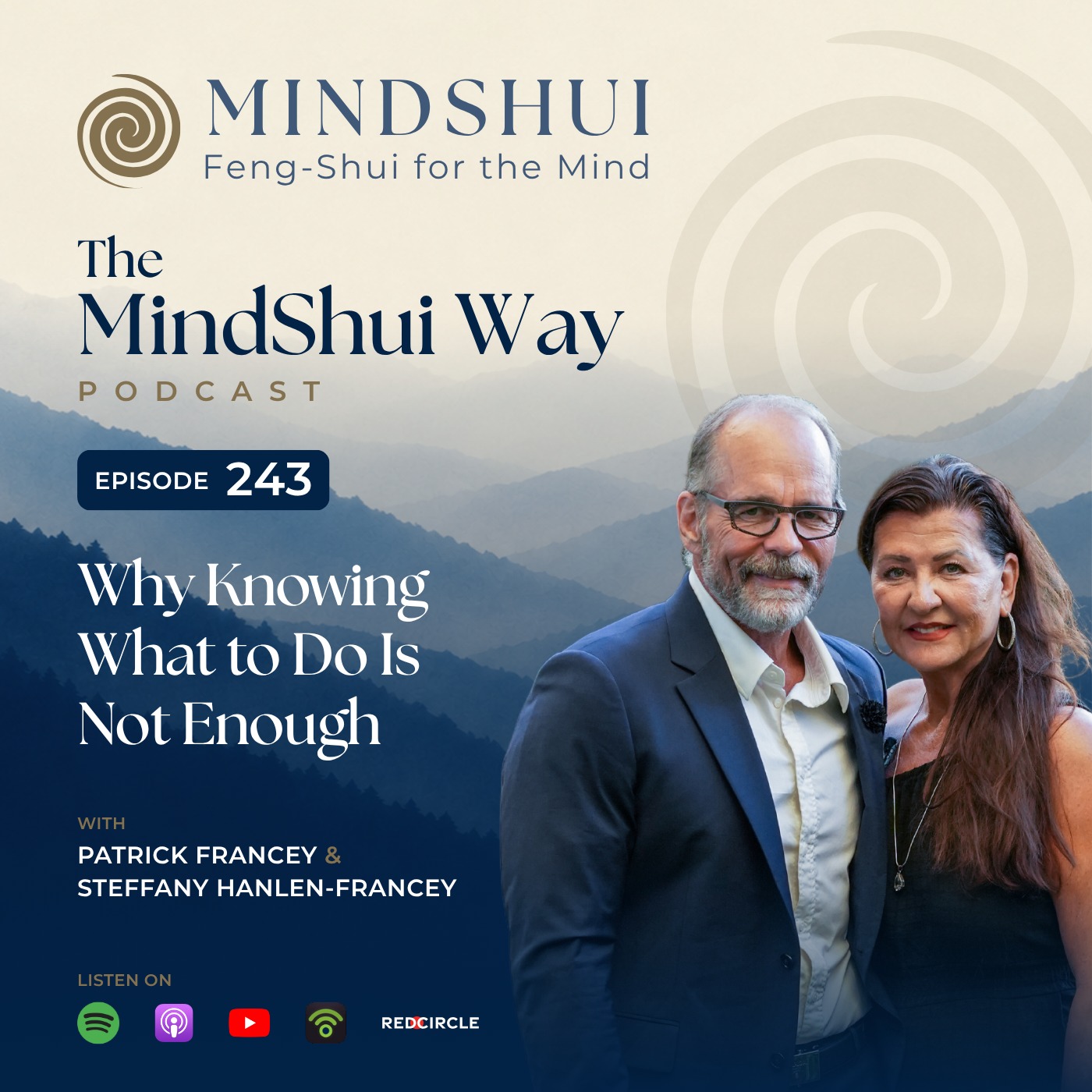
The Everyday Millionaire and Mindset Matters Podcast
MindShui Way- Episode #243 - Why You Know What to Do But Still Don't Do It
00:41:24
Loading summary
Transcript52 lines
- [00:00]
A
Foreign. Most people try to change their life by doing more. More discipline, more planning, strategy, more effort. Often the real issue is not that you're not trying hard enough or even that you feel like you're broken and need to be fixed. Mostly it is the mental and emotional clutter that keeps getting in the way, leaving you wanting change in your life, but not knowing how, or even avoiding the changes you need to make. So welcome to the Mine Shui Wei podcast, formerly Mindset Matters. I'm your host, Patrick Franci, alongside Stephanie Hanlon. Franci, my wife, Olympic mental performance coach. We call this mind shui, like feng shui for the mind. And just as feng shui creates order, flow, and alignment in your physical space, Min shui is about creating order, flow and alignment in your inner world. Because your mindset is not just positive thinking. It is the operating system behind your experience. Experience in life. This is the Mine Shui Way. Listen in. Enjoy. So the question of the day. Why do I know what to do but still don't do it? That's what I want us to unpack today. Because this is a question that hits almost everyone, including myself, because most of us know. We know we should move our body, deal with money, make the call, set the boundary, stop the habit, start the thing. And still we don't. So what the hell is actually going on? Welcome to the Mine Shui Way podcast. Stephanie.
- [01:37]
B
Hi, Han.
- [01:39]
A
Okay, so this is an interesting question, right? And often this is where we turn on ourselves. You know, I'm lazy, I lack discipline. I'm a loser, I'm inconsistent. I always do this. But I don't think that's the whole story. You know, maybe part of Kazoo night. Bless you.
- [01:59]
B
Sorry. Thanks.
- [02:00]
A
Part of you wants the results, but another part of you is attached to whatever pattern you've got that you may be even not aware of. So I think until we understand that conflict, we're going to try to solve that problem, doing more of the same, putting pressure on ourselves, perhaps, you know. Yeah. So. And that always is costly, and it's costly in a lot of different ways, because every time we know what to do and don't do it, we're actually breaking down trust with ourselves. And I think for this, what I want to do is kind of unpack. Well, why? What is the answer to that question? What's your thoughts on answer to that question? Just kind of off the top of your head. What is it that's creating the resistance to doing what we know we need to do?
- [02:52]
B
Well, there's the. The Whole motion versus action thing, right? Like we know what we need to do. We need to move things around, we need to do things. But where we get stuck in the, whether it's entropy or in inertia is that in order to make things change, we actually have to take action. We have, we have to move, we have to get up off the couch, we have to take the step to the gym, we have to, you know, set the clothes out the night before. We have to, you know, get on the bike. So there's action that's taking. So what happens is our intellect takes over and our intellect. I already know this. It's like, I don't read that book. I already, I'm halfway through And I know 17 people that I need to send that book to, right? So there's all these things that our intellect will get in the way. And our intellect can also be known as our ego. And our ego doesn't want to be wrong, right? So think about, if we already know all this stuff, then we don't actually have to do it. What is the line you used to say? This was easy. Everybody would have, you know, a multimillion dollar portfolio and a six pack.
- [03:55]
A
No, I said more information was the answer. We'd all be billionaires with six packs. So, okay, so we know what to do often, but we don't do it. We have to ask ourselves, well, what gets in the way of doing that? And so I'm going to give you an example. And we've talked endlessly about values and understanding your values and what drives you. I'm going to give you a quick example. So sometimes we don't do what we know we need to do. We. I've heard people refer to it as procrastination. We're just procrastinating, you know, and there's that little catchphrase that I sometimes use. You know, do it today, procrastinate tomorrow. Right. You know, we have some fun with that. But I'm going to give you an example. So, and this is just really recent, young man, young client is talking about some of his challenges with procrastination. And you know, one of the things that he procrastinates on is cleaning up after himself, picking up after himself. And so we talked about a little bit about that. And, you know, just why is that and what gets that. And today, you know, you're saying, well, it, you know, I actually, when we had that conversation, I started picking up after myself and I actually feel better about myself doing that. And then we started talking about values. And one of his higher values is the relationship that he has with his significant other. And so I said to him, within the conversation I mentioned to him, I said, so your procrastination, you have stopped the procrastination, but it's really intentional. Like you have to think about it. It's a very mindful thing that you're doing. But I said, if you connect it to one of your higher values being your relationship with your significant other, I said, tell me, if you're leaving your stuff laying around, is she okay with that or is it kind of a button that it pushes with her? He goes, oh, no, it definitely pushes a button. And I said, isn't that interesting? I said, what if you framed it that given that one of your highest values is the relationship that you have with her, that in order to honor that high value, cleaning up and picking up after yourself is better for that relationship? How does that shift for you anyway? Wow, that's a really good point. So I said, if you're doing it for you, yeah, who cares? You know, it's not really one of those. It doesn't matter to you. You're a guy, you don't care. Really know that's just how you're wired. So I'm not making that wrong. Some of us, some men are wired that way. Some people are wired that way. Men, women, doesn't matter. The point of it is, is that as soon as I kind of shone a light on how it honors his value of looking after his relationship with his significant other, his partner, he went, wow, that, that would definitely. You're right, that would really make a difference. So the question then becomes, why don't we do the things that we know are good for ourselves, good for us? Why don't we do it? And we procrastinate or we just ignore, or we pretend we got busy, or we make all these excuses and we know we need to do it, but we still don't do it. Why? I'm going to go back to number. There's a couple reasons, but number one, I'm going to go back to our values. You say that you need to do it and that you should do it and. But until you frame it so that it is part of one of your higher values, you're just not going to do it. So I'll leave it at that just for you to comment on.
- [07:26]
B
Oh, yeah. And I don't want to go deep super fast, but there is a place of self worth that is in. In. That's underneath that and we sabotage ourselves. So on so many levels, when we say we are a certain way and then we don't follow up with action. And I think there's a, a really deep sense of lack of self worth when it comes to that. And I see, I see it all the time. I see with athletes, I see it with my H and W clients. I see where they just rip themselves off in terms of who they say they are and what they say they want. But then they just pause and they procrastinate or they just don't do it because then they get to beat themselves up or they get to just play small. And to me, that is something that doesn't get talked about enough in terms of self sabotage around who we say we are and what we say we want. Because they say it all day long. It's like people bullshit. They, I'm this guy, hey, you know, and then, you know, they wake up in the morning and, you know, they can't get their act together. And I think that's really, truly becoming more and more prevalent, I think is the better word as we go into this world of, you know, everybody's equal, all that kind of stuff. So you don't want to stand up, you don't want to be the tall poppy, all those kinds of things. So there's just a place where we play small or we don't honor ourselves or really, truly believe that we want to live our best life. And you know what, it's really funny. You know, the last couple of years we've been doing the podcast, you know, living your best self, all that kind of stuff, and I've realized that so many people just don't want to.
- [09:04]
A
Well, they're not. Okay, but let's got it. So living your best life, being the best version of yourself, Right? So if we look at it from a self mastery frame.
- [09:13]
B
So yeah, but what if it's super hard work?
- [09:16]
A
No, but, but okay, but let me go with this. So knowing what to do, we know we know what to do. So intellectually we know what to do, but that's not the same as being internally aligned to do it. So the question of why do we know what to do but still don't do it? It's not really a discipline question, although that takes discipline. I think it's an alignment question. It's an alignment with our values and even understanding what our values are and can we shift those values too. So like my young client, you know, procrastination, cleaning up after himself as soon as I aligned it with one of his values, which was his relationship, and the fact that it didn't work for her, and he really honored that relationship. It then became something that he wanted to do because it would improve his relationship. So there's that part of it. So it's a values alignment, but it's also an identity alignment.
- [10:17]
B
Right.
- [10:17]
A
So for you, you know, let's. I'll use me as an example. Anybody who listens to the podcast or anybody who knows me would know me as being somebody who's really focused on health and fitness, and I do a pretty good job of that. And I'm certainly not fanatical about it by any stretch of the imagination, but I do a pretty good job of it. And ultimately it's because, number one, it's one of my higher values in terms of my own health, and I've got family history that kind of is part of that inspiration. So I have the internal alignment, knowing that, no, this is really important, and I've got pretty good examples of that. But secondly, it's part of my identity. I know that, and so I'm okay with that. You know, it's like my identity is to, you know, part of my identity is being a really fit old guy, being in the upper percentile of fitness and, and physique and. And weight management and health, or an old guy. That's part of who I am.
- [11:19]
B
So I don't think it's super hot.
- [11:23]
A
Thanks, hon. But you understand my, my. What I'm saying is that if it is. If it. If it's your identity, if it's who you are, you will do it. And if you lose that identity, and that's where a lot of people go through identity crisis or not being able to do even though they know it, it's because it's not who they are. And so then you have to unpack it and go, yeah, but it's really important. So then how do you shift it so that it either becomes a part of your identity, you look at it and say, how does it support my other values? And then if you really want to get into it a little bit deeper and it's still not working, then you unpack and go, well, what is the pattern? What is the belief system I have? What is the hidden belief that I. That I'm not recognizing? Because at the end of the day, the individuals who are taking action are actually doing what they know needs to be done. You know, they're doing what they need to do. It's also aligned with their values and who they are as people.
- [12:29]
B
Right.
- [12:29]
A
And understanding, like the narrative. I have this conversation with one of the teams today, one of our teams today, which is, you know, it's David, Grogan, Hooverman, all those guys. Not Grogan, Goggin. I got Rogan. I got Rogan and Goggin mixed up. Rogan. Okay. Well, they're both, you know, new guy. They're pretty intense. So the point of it is, is that they. They talk about doing hard things. Yeah. We as humans, if we know the nature of who we are as humans, is to seek comfort. Yeah, right. We all do. I do. You do. We all do. We want comfort, but we want to achieve great things. At least I do. I want to make a difference in this world. That's part of my identity. It's part of your identity. It's part of our purpose. It's what kind of gets us going sometimes that's really hard. And it's only in doing the hard things that we grow. So let's keep coming back to the questions. Why do I know what to do but still don't do it? Because you're either bullshitting yourself and you're saying it's one of your highest values and who it's. Is who you are, and it's not, so you're just telling yourself a lie, or even though it's in your face. I know I need to get this done, and I'm still not doing it. Then you. But you see where you're in your own way, then you have to unpack. Okay. I've got a hidden belief. I've got a pattern. I've got to shift something, and that takes a little bit of self reflection, and that's the self mastery part of it. So I went on for a long time there. I'll just leave it over to you.
- [14:07]
B
No, it's okay. I don't know if you remember, but back in the day, early 2000s, 2006, after my first Olympics, I wrote a book. I never published it, but there was a chapter that really resonated with the publisher and the literary agent that I presented it to. And it was a chapter on a client of mine, mine that I'd had, who was a woman. She really wanted to lose weight. She was, I want to say, in her, like she was just under 300 pounds. Beautiful woman.
- [14:41]
A
I do remember. Yeah.
- [14:42]
B
Do you remember that? Anyway, so one thing led to another and she kept saying, I want to lose weight. I want to lose weight. I want to lose weight. And so we would do a fitness program or we'd go work out or we do things and she just, yeah, no, I'm good, I'm good. And she's like. And she'd get comfortable back into her, into her weight. And I never judged, I don't care how big you are, what the number is on the scale. And then one day she went to her doctor, she did a physical and the doctor said, you know, you, you have a BMI of this and you need to do this and you, you really need to lose some weight. She's like, yeah, yeah, yeah, I'll lose some weight, lose some weight. And she'd go home and she wouldn't lose weight. And then she came to a meeting one day and she'd had a shock. She had gone to the doctor again and the doctor had given her a diagnosis and said, if you don't decrease your bmi, you don't lose some weight, you're going to die. And she's like, what? She's like, I'm good, I, I eat vegetables, I do this. She goes, and the doctor, it was a female doctor, says, tell me about your daughter. And she had a 12 year old daughter and she's like, well, my daughter, she's this, and she does sports and she's going to grow up. And she goes, and the doctor goes, what if you don't ever see her grow up because you're gonna die. You have taken your body and your, and your physicality to a place where your heart can't handle it. Your body's not going to be able to surv stress. And her name was Sarah. And she goes, sarah, you're, you're not going to see your daughter graduate. And that was the value, that is what motivated her. She didn't lose weight because she wanted to, because she wanted to be fit or her ego or she wanted to be look slick in an outfit. She realized that if she didn't change her lifestyle, she wasn't going to see her daughter graduate. And I just remember that time and then I got to work with her through that process and that was her highest value. It wasn't about her looking good or being connected to anything physical. It was about, I needed to be there for my daughter. And she was. She lost probably within 16 to 24 months. She lost probably 60 or 80 pounds. And she was able to walk with her daughter, she was able to do things. And she saw her daughter graduate and she's still alive at this point. But it was only when her MD said, sarah, you're not going to see your Daughter graduate is when it shifted for her. So when we say yes, we know what to do, but we don't. Why we? Because it hadn't linked. She had done it for years. She'd gone on all the diet, she did the cabbage soup, she had done keto, she'd done everything. But until the doctor connected it to her not being able to see her daughter grow up, it didn't change.
- [17:52]
A
So we have these patterns. And then what you just described was a consequence.
- [17:58]
B
Yes.
- [17:59]
A
Okay, so what drove her was the consequence. So one of her highest values was her daughter, her family. Than realizing that there was a consequence for her family and she would never want to put that her family through that, nor did she want to miss it. So she could get the consequence.
- [18:16]
B
Exactly.
- [18:17]
A
So there's all sorts of things that we know what to do and we don't do and there's lots of reasons for it. But for example, you know what to do. Like so showing up for time on work, maybe that's the thing, you're always coming in to work late. But you know that in order to get on the good side of whatever, to get the raise, to get the promotion, what you have to do is show up on time, maybe even a little bit earlier. The point of it is, is that you either have to make that part of your identity and you go, no. Who I am is, I'm the on time guy. You know me, I am frickin almost never late. I joke that I can reverse time.
- [19:02]
B
Yeah, you can leave 10 minutes late and show up 15 minutes early for something.
- [19:06]
A
I don't know what that is. That's just kind of how it works. But for me it's important. It's important. That and the team that I've worked with in the past is like we're. Logistics was always a thing and we were going to events and we were sharing, you know, we were getting in a car or a cab. We'd be hotels, there'd be seven people all coming down and saying, okay, we meet in the lobby at 5 o'. Clock. Okay, every single person showed up before 5 o' clock and or were coming out of the elevator exactly on time and getting in the cab like because that was the consequences are we're leaving without you, you're on your own. Right. So that was a bit of a joke and we certainly had, you know, incidents where things happen, but somebody's texting going, hey guys, you know my blow dryer broke down, I'm going to be a little behind. Right. Whatever the story is but the point of it is, is that there's a commitment that we make to ourselves that we're getting in our way. And if we don't either attach a value, an identity, a consequence to it, we're not going to get it done. And so these are the challenges that we face. And there's the personal things. Let's go back to losing weight, or how about cleaning out your wardrobe? Right? It's one of those things, you know, it needs to get done, but you don't get it done. So why. Why is that? And you start to realize that nobody sees your wardrobe but you in terms of your closet. There's no consequence other than it's inconvenient and it's cluttered and it's frustrating and. But really, what's the consequence? So what is it? So until you get into a value of. My environment needs to be organized for me to do my best work, then probably it's just always going to be a very full wardrobe. I'm only using. I'm using. An example is kind of real life. What I think might be real life examples, you know, I don't purge enough of my clothes. One, like, two cares, you know, it doesn't really matter. It's me, but it seems cluttered to me. And I like my environment less cluttered than you like your environment, for example. And so I have to be conscious. Conscious of the environment that I create for myself. And I think that's an important part of setting yourself up so that you are consistently doing what needs to get done. That makes sense.
- [21:39]
B
Yeah, it does. Because I think what we bump into a lot is the things that we put in our way so that we don't have to actually have clarity, we don't have to actually experience velocity, for example, is because if we just don't. If we have a cluttered closet, you know, and we don't want to lose weight, then we just have our fat clothes, our skinny clothes, our normal clothes. Everything is just there. And we have an excuse, you know, to not create space. I've experienced that in the last year, is that, you know, the last 12 to 18 months, I've committed to wear every single piece of clothing in my closet to the point where you say, is that new?
- [22:23]
A
This old thing?
- [22:24]
B
And I'm like, you know what this old thing is? That it's probably 10 years old, and if it feels good, if I'll keep it. If it's not, I'm going to let it go. But I had to actually have an agreement with Myself, because I'm like that person, person that hangs on to who I was when I bought that, who I was when I wore that outfit and who I had to be when I was at Worlds or when I was on stage speaking to a thousand people and I wore those boots. And one of the things that our coach J.B. owen said, Peter Giesen, they said to us last year in Sedona is like, yeah, but you're not that person anymore, so go into the closet, grab those boots or whatever and. And say, oh, my gosh, thank you to who I had to become and who I was when I wore those boots. And you know how easy it was to put it in the box when I did that, Because I let go of the story of who I was or who I thought I was when I was wearing that outfit or wearing those boots or whatever, and all of a sudden this attachment that I had to all this stuff and clothing and shoes and boots and all started to release because it wasn't my identity anymore. Who I am today is not that. Right.
- [23:41]
A
Exactly. Because as. And also, by the way, as you ship as. Our identity changes because we're growing and becoming different people and doing all. We're the same people, different. We have different values. We're starting to understand values. As we shift and change and grow and go through different phases of life. Values change. Identity changes. It shifts. How we identify. That's an inside job, by the way. Identity. It's not like we're changing our driver's license picture and the name on our driver's license. The identity is an internal job. Right. It's an inside job. And that's the key part of it. And that's what JD pointed out to you. But, you know, so. And then think about the environment part of it. I'm going to go on a little bit of a rant. Can I do this a little bit?
- [24:22]
B
Of course.
- [24:24]
A
So think about in British Columbia. So one of the things about British Columbia we spent, I don't know, past three or four years, I think it is, with what they call the SAFE Drug program. Free drugs. So safe supply, you know, safe supply. We're going to give you safe supply now going into it. So think about that. People know. Okay, here, here goes back to the question. Why is it that we know what we need to do and we still don't do it? Okay, now, if you look at addiction and you look at drug addiction, it's, well, okay, well, because I'm physically addicted to the drug. There's a part of that, and then of course, there's a mental. And all of the things that go along with addiction. But think about how important environment is. You get a bunch of fucking bureaucrats that sit in a room and go, oh, what we need to do is safe drugs so they don't overdose. Well, did our overdoses go down? No, literally, East Hastings has got more support, more volunteers than you can imagine. Many recovering addicts who have been on who, who are on the street or off the street. Now they're back on the street, but they're there to help people. And they're literally telling these bureaucrats, no, stop it. Why would you, why would you think that giving them more drugs is going to fix the problem? How about if we look at changing the environment? That's the number one. So they didn't do any of that. And, and ultimately now 20, 26, they look at and they go, oh, well, guess that didn't work. Oh, well, you know, how many hundreds of people, Hundreds of people died. Overdoses. Because they had access to safe drugs, which they then sold off, traded for stronger street drugs. And the guys who traded for the safe drugs were organized crime who went on to sell it like it was just a cluster screw. It just fire.
- [26:17]
B
Because you got bureaucrats making decisions that don't have a clue about what.
- [26:22]
A
So I get pretty fired up about that one. But the point of it is, really is we. They have the opportunity to sit back and say, how can we change the environment Now? I don't have an answer to that. But certainly, you know, providing them more drugs. Tell it like the guys on the street are going, I'm an alcoholic. You know, there's a, there's. Or I'm a drug addict. There's a phrase as an alcoholic that people have shared with me, which is, you know, one is too many and 100 isn't enough.
- [26:51]
B
Not enough.
- [26:52]
A
Okay. So to the degree that you might get that, the point of it is that the environment that they were in, you don't create an environment where they have access to it. No, you create an environment so out of sight, out of mind. You create an environment that is clean and more sterile and you don't have
- [27:09]
B
access and replace it with, with things that nurture or, or.
- [27:15]
A
And help people redefine who they are. You know, you once did. A friend of ours had a heart attack, and he referred to it as my heart attack. When I had my heart attack. And you said to him, you go, it's not your heart attack. Why are you owning it? You know, it's like a heart attack. It's a heart attack. I had a heart attack. It's not my heart attack when I had my heart attack. Don't own it, you know, so those are little subtle shifts that we play with in our languaging. But at the end of the day, I use that as an example, is that we as individuals, whatever it is, and it doesn't have to be an extreme addiction to something. That's just an example and gives me a chance to rant about bureaucracy and people that don't know what the hell they're doing. The point is, how do we create an environment for ourselves that is going to support doing what we know needs to get done? That's the other part of it. So if we break this down in a in, and we go on a long time for this, we have to look at the values that are driving us. How can we create and wrap it around other values so that it has meaning? How do we create consequences? Should we not do it? How do we make it a part of our identity so that our ego says, hold on here just a minute, that's not who you are. Okay? It's like, me, I could like to eat and I'll start to creep up and put my weight on again. And my ego goes, hey, dude, that's not who you are. You're not an old fat guy, okay? You're an old fit guy. So quit it. You know, snap the hell out of it. Get back on track. And so these are all little signals, if you will, that support you in doing what you say or what you know needs to be done and not procrastinating on it or ignoring it. So I just wanted to go there and, you know, as we start to wind down. Any thoughts on any further thoughts on this conversation?
- [29:12]
B
Yeah, I'm glad you brought that up, because there's also an internal shift like, I think about when I'm working with athletes. For example, in figure skating, they're 5 foot 1, 92 pounds. I'm 5 foot 8. I'm over like 150 pounds at my heaviest. Like, I'm double their weight, right? So when I show up on tv, I look like a giant. There's nothing I can do because they're technically half my size. Would I want to look thinner and skinnier and younger and all those things? Yeah, for sure. But that's not who I am. Who I am needs to be the best. Stephanie Hanlon. Francie. That I can be at this age, at this height in the world, that I'm in without judgment and without trying to compare myself. And I think that's where we get stuck in this conversation, is that, yeah, yeah, I know what I need to do. Why don't I do it? Well, I can't, because I'm 6ft tall or I'm this, or I, I, I put an external judgment on, and then I go, well, you know, I can't, I can't eat right or I can't do this or I can't do that because I've got this limitation. But when I think about what you said about your ego kicking in or my ego kicking in, going, that's a healthy ego response to aligning yourself to your values. And at the same time, if I compared myself to my skaters or the clients or my colleagues who are all like, you know, 110 pounds soaking wet, then I would really judge myself and I would really be hard on myself. And I think that's one of the reasons why, is that there's a tipping point where people go, well, I can't do it anyway, so I'm just gonna fucking eat the chips, I'm gonna drink the beer, and, you know, go the other way. But there's a place around what I'm getting to is self worth and alignment with who you say you are and your values and knowing that you can't compare yourself to the people around you. But if you know what you, what you want and who you are, and if you can at least have the grace to have that conversation with yourself, then you can get to your conversation around, you know, I'm not an old fat guy. I'm an old fit guy. And I can go, you know, I'm not 100, you know, five pounds and five foot one. This is who I am. And if I keep myself fit and in shape and I, I can still feel good in that environment and I'm taking care of myself physically, emotionally, mentally, spiritually, vocationally, then I can still enjoy the life that I say that I want. And the great thing about that, when you get older, is that when I get older, I can only speak for myself, is that I can still align and fit in with that group, but not try to be them. And my, you know, colleague Mary, France and Patrice, they always say, you know, you're not old. You're timeless. And because I'm taking care of myself and you're taking care of yourself, yes, you have a gray beard, and yes, I've got little gray in my widow's peaks and all that stuff, but because we are staying current and not trying to be something or somebody that we're not. We can choose to do the things. I can, you know, jump on my E bike and I can jump on the rebounder and lift my little 8 and 12 pound weights, because that's what I can do.
- [32:41]
A
Now there is that other side of it where we know what we need to do and we don't do it. There's a internal dialogue that happens every time you see that job or you see that thing that you should be doing, and inconsistently you're not doing it, or you're consistently not doing it. The internal dialogue that we beat ourselves, right? I'm lazy, I don't have the discipline. I always do this. I don't know why. So we get into this negative jag in this negative kind of downward spiral, the other side of it, and the consequence of that is that negative self talk that brings us down, we justify, we quantify, we qualify all the reasons. We don't and don't get it done. There's always an excuse. But I think most can relate to the fact that when you finally do it, you go, oh, that feels better, right? That feels better. And you feel better about yourself. So to reverse a downward spiral in terms of the pattern of not doing it, even though you know it needs to be done, that negative downward spiral has to be reversed. And the way the consequence of reversing it is feeling better about yourself. There's another side of the identity part of it that, you know, that's who you want to be. You want to be that person that feels good, that you trust yourself, that you feel good about doing it. Like, for me, it's one of my drivers, you know, how many things there are to do around this acreage. And there's always something for me to do and there's always a job for me, maintenance to do or an improvement to do. I love doing that stuff because I always feel better. I always look back and I go, oh, I love that. This is cool. I feel like I accomplished something and
- [34:26]
B
I think it's what.
- [34:28]
A
Thank you, honey. There's a narrative that we have with ourselves that can be very. It actually makes the problem worse because it is such a negative self talk story that we have. And so that's the other consequence. So again, we go back to identity, values, consequences, environment. These are things that we have to attach as we look at those things that we know we have to do and we don't do it. And there is a little bit of, you know, Reflection on it. You have to ask yourself why? And I'll give you a quick example. And then we got to sign off because I think it's an important conversation and I like to use myself because I'm as good as anybody at not doing what I know needs to be done. So for me, with too many corporations, we end up doing a lot of year ends. Nothing shuts me down quicker than accounting. You know, give me, give me the financial statements, give me the Gls. Give me that stuff. But don't ask me to give you paperwork and give me this and give me receipts. Like, don't. I. I just. I will not do it. If I didn't have. You realize we've got two, three bookkeepers and an accountant now. We used to have two accountants. If I had to do any of that, I would shut it down. I would go sell seashells on the seashore because there's not a chance in hell that I'm going to do any of that accounting anymore. That's kind of where that's at. You follow what I'm saying? So I create the environment. I put the team around me that does that stuff. That's the other side of the equation. Is it really your job to do some of these things or are you just procrastinating in hiring somebody to do it? Right. So anyways, I'm just. I don't know where I'm totally going with that. But these are all things that we reflect on and ask ourselves a question. Why don't we do the things we know need to be done sometimes?
- [36:33]
B
Right? Okay, so don't. Yeah, don't step over that, cowboy. Is that the fact that, you know, that's a limitation for yourself and for me? We, we're not good with minutia. We're not good with paperwork. So we build people around. So it's not that we don't do it. We know what we need to do. But what I find, I'm finding actually right now with a lot of clients is that they think they still need to do it. So it shuts them down and they procrastinate around bookkeeping or taxes or filing or whatever. And I'm like, okay, well what if you paid $20 an hour to somebody to do it in six hours instead of having this stress living in your body, right? Just layers upon the procrastination. Layers and layers and layers. And then you just beat yourself up even more and then you're in trouble with the bank or the CRA or whatever. Instead of just Softening. And that's the thing is like when you soften and go, I'm not good at this. I'm just not good at this. And I know that I'm not good at this. So why don't I just build something into my routine or somebody into my routine that can take care of that and what it feels like in your body. It's like me cleaning up my shoe closet. What that felt like in my body is the same thing when I know that Carol Ann or Laura or Kelly can take care of something in our world. And I've given that to myself or we've given that to ourselves. And it doesn't diminish or take anything away from our finances or from our whatever, but it does remove some of the angst and the anxiety and go back to the question, why do I know what to do? But I still don't do it is because sometimes my ego says that I have to do the bookkeeping.
- [38:19]
A
I have to do my lectures, so
- [38:21]
B
good I have to do it.
- [38:23]
A
Yeah. It's interesting is that, you know, on stage, when I'm doing some of my talks that I do, one of them I talk about is, you know, we do. We talk this thing about time management. We, you know, talk with the audience about time management. You can't manage time. There's no time management. You can't manage time. All you can manage is focus. But beyond that, we start to then identify this is place to this, you know, why don't we do the thing we need that we know we need to do? When you start to shift it and go, what is the return on investment of your time? That's another way to look at it. And as soon as you shift it. So back to your point, you walk past whatever pile of things that you know you need to do, but you're not doing it because you're in a story that you have to do it yourself. And you're way better at it than me. You just go hire somebody. Let's just hire somebody to do it. I'm more frugal and I also maybe don't put as much value on my time. But my point is, is that we know that one thing is, is back to your point, is that there is a place where the best use of your time is not doing that job, but to get the job done. You hire somebody to do it who's good at it.
- [39:34]
B
And it's in their values.
- [39:36]
A
And it's in their values. I always remember JG talking about this. He shared this story. Every entrepreneur is like, you go for dinner and the server says, would you like a copy of your receipt? I always go, no, but my bookkeeper does, right? I don't care, but my bookkeeper cares for me. And JG Goes, I hate fricking receipts. He hires Nancy, and the day he hired her, he said, listen, I do a lot of receipts. I don't like doing it. And she looks at him, she goes, oh, jg I love doing bookkeeping and receipts. I love sorting through receipts. And he went, who is mind who loves doing that, right? So this goes back to, why don't we do it? Because it's not in our highest values, you know, if we don't value, if it's not one of our higher values or it doesn't support one of our higher values, we're going to procrastinate. We're not going to do it. So hire somebody to do it. And that's all I got. Any parting words?
- [40:42]
B
I love this conversation, but you know what? That was fun.
- [40:46]
A
Ladies and gentlemen, thank you for listening. If you found value in the podcast, please take the time to rate and review and share with others. Share with your friends as it is my goal to always improve and to provide the highest value for you, the listener. If you have any comments, suggestions, or questions you'd like answered, please email me@ceoaincanada.com that's ceor e I n canada.com I look forward to hearing from you. And until next time. Patrick.
- [41:19]
B
Oh,