← The Everyday Millionaire and Mindset Matters Podcast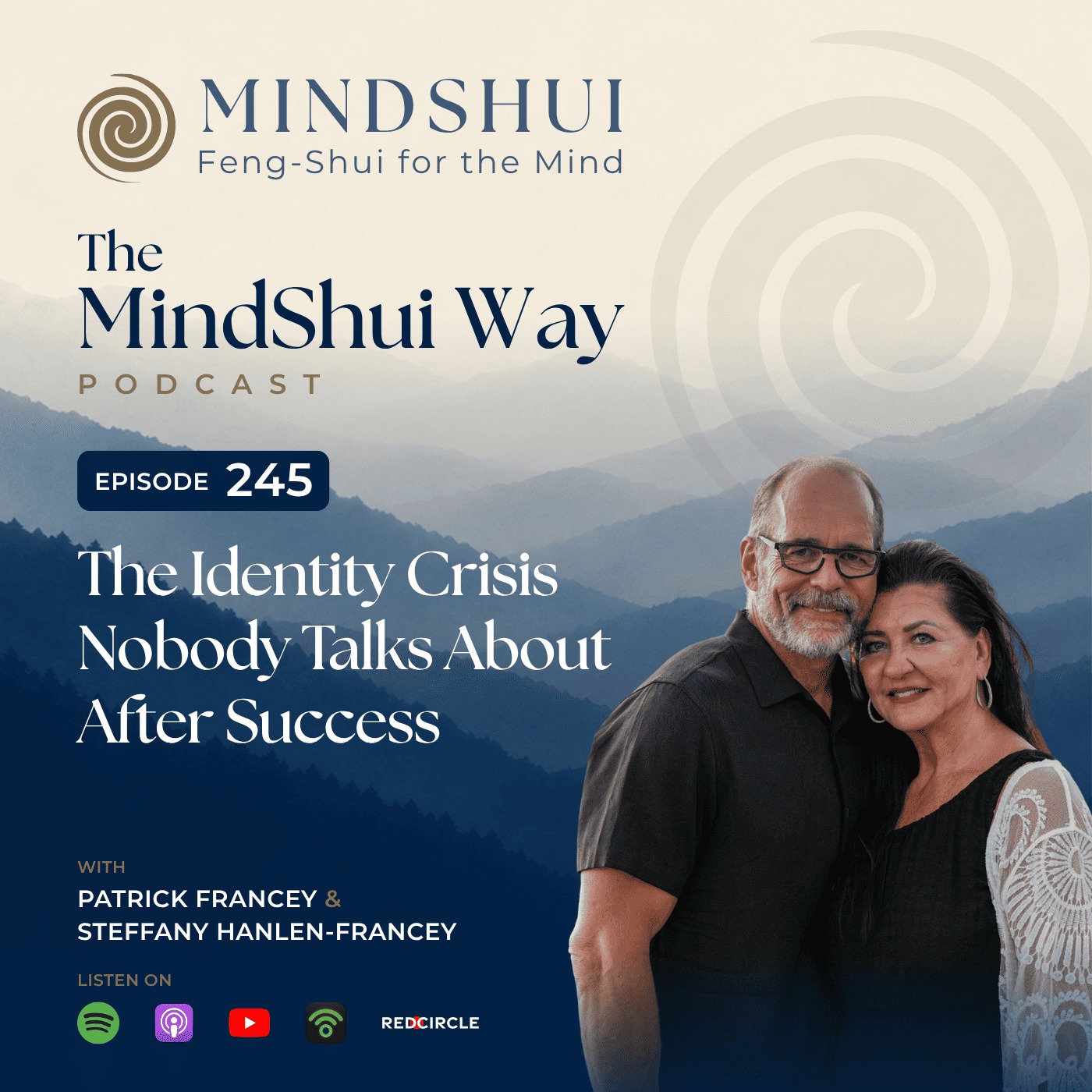
The Everyday Millionaire and Mindset Matters Podcast
MindShui Way- Episode #245 - The Identity Crisis Nobody Talks About After Success
00:36:50
Loading summary
Transcript53 lines
- [00:00]
Patrick Franci
Foreign.
- [00:04]
Patrick Franci (Host Closing)
Most people try to change their life by doing more. More discipline, more planning, strategy, more effort. Often the real issue is not that
- [00:12]
Patrick Franci
you're not trying hard enough or even that you feel like you're broken and need to be fixed.
- [00:17]
Patrick Franci (Host Closing)
Mostly it is the mental and emotional clutter that keeps getting in the way, leaving you wanting change in your life, but not knowing how, or even avoiding the changes you need to make. So welcome to the Mine Shui Wei podcast, formerly Mindset Matters. I'm your host, Patrick Franci, alongside Stephanie Hanlon Franci, my wife, Olympic mental performance coach. We call this mind shui. Like feng shui for the mind. And just as feng shui creates order, flow and alignment in your physical space, Min shui is about creating order, flow and alignment in your inner world. Because your mindset is not just positive thinking. It is the operating system behind your experience. Experience in life. This is the Mine Shui Wei. Listen in. Enjoy.
- [01:08]
Patrick Franci
Nobody tells champions that winning has its own grief or that success doesn't end the war. It just changes the way you're fighting. Or that the thing that gets you to the podium may be the thing you have to outgrow to survive standing on it. Welcome to the Mine Shui Wei podcast. A little feng shui for your mind. Stephanie, welcome.
- [01:31]
Stephanie Hanlon Franci
Hi, hon.
- [01:32]
Patrick Franci
Now, those were your opening quotes.
- [01:34]
Stephanie Hanlon Franci
Yes.
- [01:35]
Patrick Franci
Now tell me, that is all part of the Champions journey and the Champions Paradox. So tell us about what is the Champions Paradox?
- [01:45]
Stephanie Hanlon Franci
The Champions Paradox is something I coined back in 2006 when I started the Journey in the world of ice dance. I always wanted to start at the top. So I worked my way all the way up to the Olympic Games in 2006. And what I realized is that in order to have the mindset of a champion, people needed to be able to hold opposing thoughts. Very similar to cognitive dissonance. But paradoxically, how can you move your life forward when you're actually bumping into things along the way? So I thought instead of avoiding all these paradoxes and all these things that were considered negative, I would fold them in and start to talk about them. And I created the context called the Champions Paradox.
- [02:24]
Patrick Franci
Okay, so I want to add to this, like, I like to do a bit of a metaphor. So imagine building a race car for only one purpose. Speed. Every part of it stripped down, tuned, sharpened, and optimized to win. No comfort, no extra weight, no room for anything that doesn't serve performance. And then the race is over. The car has won. But now it has to drive on regular roads. It has to Stop at all the light. It has to have signal lights. It has to carry passengers. It has to function in a world it was really not designed for or built for. That's what happens to a lot of champions, entrepreneurs and high performers. The identity that got them there was engineered for the chase. It was engineered for pressure, for sacrifice, for discipline, and ultimately for winning. And that ultimately being the result. But it was not engineered for a rival. And that's the paradox, that the thing that gets you to the podium is often the very thing you have to outgrow to survive standing on it. Now, there was another phrase which is, I think, really appropriate here, is another phrase you coined was the other side of the medal. Now you've got a couple of athletes, you're actually going through this all with gold medalists, silver medalists, podium. They are on the podium, bronze, all of it. They get there. They've trained years to go there. That's their identity. That's who they are.
- [03:56]
Stephanie Hanlon Franci
It's a struggle.
- [03:57]
Patrick Franci
Then what?
- [03:58]
Stephanie Hanlon Franci
It's a struggle.
- [03:58]
Patrick Franci
The other side of the metal. Now what?
- [04:01]
Stephanie Hanlon Franci
Okay, well, that's the chapter of my book, right, called the Power of Now what?
- [04:05]
Patrick Franci (Host Closing)
Now what?
- [04:06]
Stephanie Hanlon Franci
Well, it happened because I was sitting on the bus on my way to the Olympic Games arena, the venue in 2006, and I was sitting next to an Olympic champion from the 19. Gosh, must have been the early 90s. And I was so excited, I kind of fangirled on him. And I asked, oh, my gosh, that's amazing. It must have been amazing to win and to be on the top of the podium, be Olympic gold medalist. And he looked at me kind of, you know, gently and kind of, okay, that's really sweet, but. And he told me the truth, and he said, that was the saddest, the loneliest moment of my life. And I think what I discovered in that time is that if that's true, and I'm sitting there talking to an Olympic champion, and it was the saddest, loneliest moment of his life, then I need to fold that into the journey that I'm supporting champions to go on, because I don't want them to be standing on the top of the podium and then seeing the lights go up and the flag come down and all the fans start leaving the building, and they're standing there going, who am I now What? So right in that moment, I decided that the champion's journey was going to involve the other side of the medal. Who. Who do they have to become? But it starts. And this is really what gets Messed up with some athletes is that conversation starts the minute I start working with them. And many of them are superstitious. Some of them don't like talking about, you know, talking about the end of a career or what's going to happen after. The way that I fold it in is through these metaphors, through these paradoxes and the stories and the discovery about what the journey is and who they have to become.
- [05:33]
Patrick Franci
So years of being a certain way, you're designed, you're built every day. There's training and intensity around diet and all the things that you do. Choreography, going to the ice, you're in a rhythm. It's what your life is. It's for one moment in time. That's your identity, it's what you know, it's all that you're focused on doing. And of course, life's happening and all the things that happen in life, but then you're done, it's over. It's over. And maybe you go into a career where you're being a keynote speaker, maybe depending on how well equipped you are and how eloquent you are and your ability to speak, etc. But what's on the other side? So what is the paradox like? How do we define a paradox in the context of a champion's paradox? I'm still not quite clear there.
- [06:23]
Stephanie Hanlon Franci
Well, you need to be looking at both sides of the metal. You, you strive and you. It takes a minimum of 12 years of an athlete's life to actually get to their first Olympics. Sometimes it's shorter, but rarely is it less than four year quads or three. Right. 12 to 16 years they're training, so that is their identity. It becomes their social structure, their friends, their family, sometimes their husband slash wife, partners, their business. And their goal maybe is to be a coach or to be a choreographer. So there is kind of a path that's laid out for them. But what happens over time is that they start to get to know themselves and they realize maybe that's not what it is that I want. Maybe I want to discover and stretch into something new. Well, think about working out, for example. You can't get a stronger muscle. You can't grow a muscle without tearing it down. So that's one paradox. In order to win, for example, you have to be a really good loser. That's another paradox. But what happens is we only want to talk about the positives. It's like when I discuss fear and excitement. So, for example, I'm nervous, I'm afraid, I don't want to compete at this games or at this competition? Because I'm terrified. So we'll go. Okay, well, let's talk about the physiology. In the nervous system, fear and excitement are exact same thing. They're the exact same physiological response in your body, but it's a paradox. We like excitement, but we don't like fear. So I'll bring up an example. For example, it could be a roller coaster. Some people love roller coasters. They think it's super exciting. Some people are terrified of. It's the same thing. So how do we frame it? And how do I take each athlete on their own individual journey to discover what matters to them, what excites them, what are they afraid of, and how not to make that wrong and to fold in the paradoxes, fold in the dissonance, just fold in everything that maybe doesn't make sense to us normal people.
- [08:12]
Patrick Franci
So, but what's the paradox? So when we think about. Okay, I want to go back to this quote that you had. The thing that gets you to the podium may be the thing you have to outgrow to survive standing on it. Can you give that a definition?
- [08:28]
Stephanie Hanlon Franci
I can. It's not even to survive standing on it. It's also to survive stepping off the podium. Do you know who you are? The drive to get to the podium has to be singular. It's a very focused journey. But the paradox is that we have to fold in who we have to become next. We have to be holding both sides of the metal at the same time, looking at our lives holographically so that that person becomes more whole, more hol. As they go through it. The paradoxes are. Maybe it's the wrong word, but it's just the word that I use to create the container. It means the ability to hold two completely opposing thoughts or situations that even are in conflict of each other and at the same time. And I believe that champions have the ability to do that. And as they slow themselves down and slow the thought processes down, and they can say, ah, okay, in order for me to get faster. And this is what I do in quantum speed all the time with hockey players. In order for me to skate faster, I have to train slower. So that's another paradox. People think that in order to skate faster, you just got to skate faster. Well, actually, it's the opposite. So one of my favorite lines is, you know, do the opposite, not the obvious, which is another champion's paradox.
- [09:46]
Patrick Franci
So this is a little bit when you think about what you're describing. So that paradox. So let's just Take it back a little bit, because in that, you know, I hear identity crisis, but in the world of sport, we'll use that for an example right now, or really anything when you're training for something. So in other. So the paradox would be, in order to get good at something, to be great at something, you have to be prepared to fail a lot. Okay, A lot. And that can be the case in sport, it can be the case in business, it can be a case in relationship, you know, to get good at something. Is that. Is that, I guess, would be one way to look at the paradox.
- [10:23]
Stephanie Hanlon Franci
Absolutely, yeah.
- [10:24]
Patrick Franci
So it's what we have to be prepared to do on the other side. So there's another phrase that you use that something always happens on the way to the Olympics. But, you know, in a previous quick discussion earlier, you said something that was really interesting. When you say something always happens on the way to the Olympics, the connotation to me is that something you have to be prepared for the shit that hits the fan. And while that's true, a lot of good things can be happening on the way to the Olympics or whatever your journey is. I mean, we use sport because you, of course, are an Olympic coach. So that's the paradox in anything, right, Is that we have to be prepared to the other side, the falling, to actually to succeed, the failing to succeed, to get good at something, the tearing down of a muscle, to actually rebuild it to get stronger. So that is, in fact, the paradox. Okay, so.
- [11:20]
Stephanie Hanlon Franci
Well, just put a pin out in that cowboy. One sec. Don't step over the fact that something always happens, because when you heard it this morning or when we were chatting about it, that's exactly how the athletes hear it the first time, because I think our brains are trained to go to the negative. And what we were able to get to over the last, for sure, 20 years with this conversation was it's always something, but it's not always negative. Something was always going to happen, but it's not happening to you. What if it's happening for you, with you in conjunction? What if it is? What if it's a birth of a child or a marriage or a beautiful celebration of something's always going to happen. So it's in the stories that we tell ourselves about positive or negative things that are happening that get us into the conversation where paradox can exist and we can actually draw the power from them.
- [12:13]
Patrick Franci
When you think about the champions, paradox, if we think in terms of take the champion's paradox, take the word champion out of that, and take the high performer use the thought of high performance as a result of low tolerances. We talk about that. So it's the high performer's paradox. And some notes that I made here. You know, for instance, a tennis player who dominates with an intensity and a really aggressive style of play, they win perhaps championships because they take risks, they push hard, they train really hard. However, that same aggressive style or that big drive can lead to burnout, you know, injury. So I'm thinking about that for me is that, you know, years ago when I was doing a lot more training and running and all those things that I was doing, I was always injuring myself. So there's a little bit of that paradox in all of that. And then how do you morph out of that and how do you carry those qualities into your life? You can't necessarily, you can't take, you know, when you think about how athletes have to train, the intensity that goes behind the commitment, the discipline. So how does that fold? Like is that the paradox when it comes into life? When it comes into their life, do you think? I think so is the way to describe it.
- [13:38]
Stephanie Hanlon Franci
That's a good analogy because when I think about the qualities that you need to be an exceptional business owner, entrepreneur, high net worth, individual C suite, there is a certain level of intensity that at times you can't come home with that. You can't bring that home to your 4 year old or bring that home at night to, to your partner or whatever because it just doesn't land that person's not in your day to day. That's why you see a lot of figure skaters, hockey players, they end up being together because they understand each other's drive and they understand that commitment. But what happens is that in the champion's journey and the Mind Shui way, part of what we teach and what I teach is how to reset, how to recover, how to savor a moment, how to celebrate so that you're shifting the energy around who you have to become. If you are on that, if you're redlining, for example, training for the games, so many people think we're just redlining all the way up to the games. That's not true. Part of the secret of the Champions journey success is that I dial it down. I dial it down. There's times where we're doing four day weekends where I will say this weekend you are not an athlete, you are not a champion. You're just a dude walking to the market, going for coffee, finding some things to do, going to the theater. You're not Thinking like an athlete. And it has to be consciously framed that way during the entire training cycle. Because if it's not, then they don't know who they are outside of that, of the superhero cape or the champion definition or the identity fusion that they have with that picture they have on the top of the podium. So that those moments after a celebration or after a win or after an Olympic gold medal, really important to do what's called a hard close. The athletes that don't do that end up dragging on, sometimes the regrets or sometimes the leftover feelings, and they can't quite get grounded. And that's what the depression can kick in. And I've seen athletes over the years, five, six, ten years later, still defining themselves as to who they were back in the day, you know, and there's so many stories in sport that drag forward, but in the moment, if we can teach people, our clients, athletes, business people, moms, dads, like, think about empty nesters, think about people that are graduating and now they're stepping into what's next, there is a moment you have to slow down, you have to savor. You have to look around and look at the environment and see what you've created and let it in. And many athletes don't give themselves that luxury.
- [16:20]
Patrick Franci
I think that's, again, kind of. We talk about athletes because, you know, that's kind of always a good metaphor for us. But when you think about just in life in general, you know, when we think about the other side of the medal. I remember so many years ago, we were kicking back, doing a meditation. One Sunday morning, sitting up in bed, doing a meditation. And I realized in that meditation, I thought to myself, I've arrived. I don't know if you remember that. The conversation I had thought about, I realized that, well, first off, I said, I've arrived. And then I went, wow. I think too small, right? Because I was making the income that I dreamed of making. I had the girl I dreamed of having. We were living in the home that we dreamed of owning. And I'm going to, oh, gosh, you know, I'm 40, I've arrived. And then I'm going, oh, shit, now what?
- [17:15]
Stephanie Hanlon Franci
Right, yeah, right, totally.
- [17:17]
Patrick Franci
And then how do you take the qualities that you develop in those early years and then apply them? I don't know. Again, I don't want to get, I guess, too stuck on the word paradox. But ultimately, that all plays into all of it, right? Is the. Can we tie the irony, is there irony into that paradox?
- [17:37]
Stephanie Hanlon Franci
And humor. Yeah, irony, humor. Looking at Things completely upside down and differently. I have an exercise which is a complete paradox, and I'm working with Olympic champions, for example, and we're on the way to a competition. They're having a bad day, maybe an argument with their partner, or something's happening off the ice, there's an injury or something, and I'll. They just get to the point where they hit the wall and they go, you know, I'm done. So I created an exercise called Permission to Quit. And they're like, what? I don't want to quit. I go, you don't have to quit, but I want you to go through this exercise and give yourself full permission to feel what it would be like not to be in this environment, not to be with this partner, not to be coached like this, not to be on a journey that inspires you to get out of bed every morning. Like, think about how. What that would be like. And sometimes I'll have them sit on a bench in a park, or I'll just have them at home doing the meditation, or just in a. In that moment where I go, okay, you have full permission to quit. Who are you now? What does your life feel like now? What does it look like now? Who's in your life? Do you still have all these amazing people, these support team, these coaches, this. The fans, for example? What does your life feel like? And then when they can get to the end of that exercise and they go, damn, I don't want to quit. This is amazing. But sometimes we're just so full of stress, anxiety, and discomfort that just having that space to go, I'm out. I'm done, creates more space.
- [19:08]
Patrick Franci
You know, you and I, we've seen it many times with professional athletes that we've known or worked with and just know because of what we do. But they retire, and then it's like, now what? So what you're talking about really is, you know, in terms of the mind shui way is also about preparation. It's also knowing in advance what you will be facing at some point. Right? It's the identity crisis that goes along with it. You know, you make the money, you get the accolades, you do all the things, okay, great. That really, you know, you're doing 100, and you all of a sudden slow down to 40, and it feels like you're crawling. That's an adjustment. So if you're not mentally prepared for that and emotionally, and then also your environment that you've created for yourself, because that environment's going to totally change, you're going from One environment to another. And so these are all adjustments that is really about on your own journey. And if anybody listening is, if you're coming to a point like even right now, I don't want to say I struggle, but I'm noticing myself is that as we get into this phase of our life where we're really slowing things down, keeping things simple, I'm having to adjust from always being really busy, being addicted to the busyness and the doingness and the, you know, the front facing things that I've done over the years and then having to adjust. That's a bit of a paradox too, I think, you know, is like what comes with all of the busyness and all the things is, you know, there's always a bit of an adrenaline rush or what, you know, whatever that might be, some stress, some pressure, but then all of a sudden that goes away. And it is really a kind of a now what scenario. And I think I'm well equipped to at least observe it and go through it. But I am noticing that I'm going through it.
- [20:55]
Stephanie Hanlon Franci
Yeah, I think, well, that's part of the awareness of the mindset of a champion. So the reason why I call it the champions paradox or the, you know, the CEO paradox or whatever you want a high performers paradox is because it takes the ability of the mindset and the heart set and the soul set of understanding that, that these things can have to occur. You know, to think that the, the medal or the podium is the end of the road is really short sighted. And I've seen that on so many levels. And it's not like I'm criticizing, but if I'm working with an athlete and they go, listen, I don't want to talk about life after sport, I go, okay, then I'm probably not the coach for you. Because in order for you to develop as a human being, as a person that's going to take the step from the podium. Because if you're at the top of the podium, there's really no place up to go unless you've already maybe got some irons in the fire or start looking outside and building things. Not everybody wants to be a coach. Not everybody wants to be a choreographer. You know, I was trying to get out of coaching. I was trying to get out of sport for the longest time thinking I was going to rock the world as a world class speaker. I think I may be ready to do that now. But back then I wasn't because I didn't have the ability to see things holographically or Almost like I look at it now, like you remember those disco balls back in the day where you know, you throw the disco and you put the light on and you see all the fractals and all the fractions of life and light and everything that's possible. And that's what I try to present with our coaching, with Mind Shui way and with the champions journey is that we get to become the next version of ourselves. One of my favorite lines is from Chase Hughes. I love it when he says be your, be the butler of your future self. Like take care of yourself so that you can step into your life as if you had a butler. So I look at myself now and I go, okay, what do I need to do tomorrow? What do I need to do to set up for this podcast? What do I need to do to food prep? What do I, what do I need to do so that tomorrow myself is. It's an easier way. So there's something that I'm looking forward to. So I always want to look forward as also looking backwards from what it is that we want. And that's a paradox into itself.
- [23:10]
Patrick Franci
I don't know where to go. Let me ask you this question. So when you're working with athletes, are there signals, are there signs, is there some languaging that they're using? Where are you picking up on that? You see that so much of their identity is going to be attached to that achievement or that you need to start working in to the conversation with them around the champions paradox.
- [23:34]
Stephanie Hanlon Franci
Well, they have to be ready mentally, physically, emotionally. And at many times it's funny, you know, the athletes that find me are usually near the end of their career or somebody that's just about to win a medal. So it's not like, you know, I've had the luxury of starting, you know, with athletes that are quite young. I mean I have in business and skating and with quantum speed. But the truth is there's certain things that a person has to go through. They've maybe had to go through some adversity. I mean the resilience that it takes to be a champion athlete or a corporate success, superstar real estate investor. The resilience emotionally, the co regulation, the self regulation that goes through sometimes needs to be in place already. So what I'm listening for are things like how they speak about themselves, how they speak about their past. Do they live in the past? That's a big one for me. That's a huge red flag is they just are telling me about all the things that they used to do and who they used to be. And I'm like, okay, I. I don't live in the past. Right. So it's hard for me to even follow that conversation. So that's a clue right there, is that that's they're not going to be open to looking at their life as a journey forward because truthfully, the future is unwritten, it's uncertain. So it's much. It's much easier for people to live in the past. You know, there's this whole conflict that, you know, living in the present moment, all that kind of stuff. Well, the truth is we're never really living in the present moment. We're in a memory of what. What has happened before with setting the intention about what we're moving forward. And that's where I try to pull the paradoxes into that conversation. And the minute someone shuts down or they get the glaze over the eye or whatever, I know that I'm not the right coach for them, and they're not ready. And you know what? They can be super successful. There's tons of athletes that are out there being champions that don't really give a about any kind of journey or who they're going to be after. That's amazing. And they'll probably be successful anyway. So the people that find us and find us work for me want to be intentional around creating, want to be intentional about bringing the lessons that they've learned, bringing that forward and actually sometimes going, hey, I was really wrong in that I want to change direction and being okay with that.
- [25:39]
Patrick Franci
Yeah. And there's also some. Aside from identity, like, how do you connect purpose to a gold medal? Because most of these athletes, I mean, they're not making really any money. I mean, they make some money along the way and they raise funds to be able to pay for it, but they're not making big money. You know, we used to joke all the time because we used to see it often where, because of our background, working with NHL and all the things that we did in those years, I think about the days where somebody's complaining about a new draft, you know, and all of a sudden they got drafted, you know, top five overall kind of thing, and then they play and then they just come off the rails, you know, and then you hear all the complaints about what they're not doing and all of the things. The point there is that they sign the contract, they get their signing bonus, they get the car, they get the girl, they get the nice house. Now what? Now they have to be there to Play the game. So in terms of an athlete going for a gold medal, beyond the gold medal, is there purpose in behind that? Like why? What inspires some of these athletes?
- [26:47]
Stephanie Hanlon Franci
Some of it's just the metal. Growing up and having this moment when you're five years old, seeing an Olympic games on television and just dancing in front of the tv, you don't know where it comes from. A lot of clients that I work with, I'll try to get them to that moment. What was the moment you knew that you wanted to be on this journey? What was, what is going on? What did it smell like? What were you thinking at the time? Do you remember what you were wearing? What were your parents doing? I try to get them to that moment so that they can go, I do remember. I just remember the feeling in my body. I remember this or that. If I can't get them to that, then sometimes what I'll do is get them to a point where the, the languaging that I use is I go, well, we need to find a purpose. So the champion's journey, the tagline was and is still from purpose to podium. Because when you have a purpose and you know your why and that really from the gosh, from the. When I was with the Empton oilers in the 90s, I always had to connect to the players to why they were playing the game, why they were doing a stupid drill, why they were taking power skating lessons, why they would put themselves in a certain situation and how it affected to game situations. So I do the same thing on the champions journey is I connect them to their why. If you don't know what's driving you or what, your why is the what and the how. Yeah, okay, whatever. Anybody, you can go on the Internet and you know scroll down now or go on chat GPT and find out the what's in the hows of everything. But individually, ChatGPT or Cloud or whatever these guys grok, they're not going to tell you your why. And the same thing with athletes is that a coach or somebody, your parents, they're not going to connect you to your why. At six in the morning when you got to get out of bed and it's 40 below in Montreal, they're that that's not their job. If you don't know your why, if you don't have that purpose and, and tell, trust me, it goes away. Like they forget a lot and it's my job to help them circle back. And sometimes the why evolves and sometimes the why gets completely thrown out the
- [28:43]
Patrick Franci
Window on the identity part of it. And I mean, this is all. There's so much paradoxical kind of things that we weave through all of this, but ultimately, an athlete, business owners, entrepreneurs, whatever that might be, individuals high performing, they have something to prove somewhere along the line. So what happens when you've got nothing left to prove? Like, if you're an athlete, you hit the top of the podium, or you podiumed, whatever that might be for you. What's left when you've got nothing else to prove? Freedom, maybe.
- [29:16]
Stephanie Hanlon Franci
Freedom. Well, I saw it at the Games in Milano, Cortino, with the figure skating. The woman who won, the young woman who won the gold medal from the US had nothing to lose. She went out and competed strictly for herself. It was completely free. The joy, the moment that she let go of all the expectations, all of the what? Like she had nothing left to prove. She had nothing left to lose. She just went out there and did it for herself. And it changed the trajectory of so many athletes. And I can use that as an example now, because so many people saw it. So there's that on the other side. If you've got nothing left to prove, then maybe you've come to a place internally where you're okay with yourself. You know, one of my favorite books is the Way of the Peaceful Warrior by Dan Millman. And to me, that is. And Rashard Monette, a friend of mine, sports psychologist, wrote a book called the Gift, and it's a similar journey, but it's his journey. And when you are looking at the journey, for example, it's based on the hero's journey. And when the hero has no place else to go or no grail left to fight for or to look for, then there's really only. The only place to go then is inside. So you think of the Stoics, you think of the people who have still. Or, gosh, we walked. We watched Invictus the other night. You know, think about what happened in South Africa and Nelson Mandela and how he had to go inside because he couldn't do anything for 27 years he was in jail.
- [30:43]
Patrick Franci
Yeah.
- [30:44]
Stephanie Hanlon Franci
So I don't know if that answers your question, but I think that is, to me, the most important part of the champion's journey and the champion's paradox, and is that the sooner we can have those conversations with young people, athletes, and say, okay, you're going to have the car, you're going to have the. The. The hot wife or the hot husband or whatever, you're going to have everything that it is you're going to put it all in place now. Who are you going to be when you come home? You know, and I can say it now because I, I'm old now and I'm older and I've had a little bit of success in those games. I'll say, what are you going to have a road wife? Who are you going to be? Are you going to, you know, where are you going to get your yourself fired up? Where are you going to have a midlife crisis? You can all of a sudden buy a red Corvette? Like, what is it that's going to give you another charge in your body that's going to get you going? Is it going to be something outside of you? And I think the earlier within the champions paradox that we can go, it's not going to be anything outside of you. And it's been proven. I mean, the ice academy in Montreal, we've had the last three games. We've had the gold medalists first and second, first and third, first and fourth, second, fourth, like top.
- [31:48]
Patrick Franci
But you guys kind of, it's not really fair because you guys have like 18 teams from around the world. So who else is going to be on the podium?
- [31:55]
Stephanie Hanlon Franci
Well, it's true, but there's lots of room. There's three spots. You know, it's who they have to become. I mean, I get it, but the point is that's not going to be like that forever. Just like, you know, within our businesses, hun, is that it's not going to be like that forever. We have to be mindful of who we are working and how we're going to change and grow. If we think this is going to go on forever, then we're delusional. And I've said that to my partners in Montreal. I go, guys, skaters are going to come and go. They're going to win their medals, they're going to move on, they're going to do the things. They're going to get married and have kids and who's coming up behind them? Like, do you really believe if we don't stay ahead of the game and we don't pay attention because right now the big targets are on our back in Montreal. Big target on the Carolina Hurricanes, for example. They're the Stanley cup champions right now. Everyone's coming after them. So if you're not staying ahead of the curve, you're going to die. That's called entropy. And honestly, I'm not prepared to do that. I think that's why, you know, we're kind of timeless. We're kind of timeless in our mentality and how we look at life. Because I think we're always looking to be the best selves, to be our best selves so that we can show up for other people.
- [33:01]
Patrick Franci
So when does somebody know when you think, like, if we're going to leave our audience with something to take away, you know, for example, how does somebody know when it's time to either evolve their identity, perhaps instead of just getting back on or setting a bigger goal or repeating what they've already done, when's the time to kind of move on? Is that a good question?
- [33:28]
Stephanie Hanlon Franci
Oh, boy, that is probably the question, because you really don't know. And I think what I've discovered over the years is that there's some really sad moments. And I've got some athletes who have left the ice dance world as gold medalists, as champions, as, you know, like the best in the world, and within six, seven months they're completely depressed. And what happens is if you don't have a strong identity, kind of a separation in that moment and see yourself, then what I've seen is they become victims and they turn around and can blame the environment, the exact environment that helped them become gold medalists or champions or Stanley cup champions or whatever it is, or, you know, huge billionaires even, and they go around and make the environment wrong. And I think there's a moment in time that if we don't actually create that identity separation about who I am versus what I do, I don't work with athletes. I work with people who are on a journey of sport that is a vehicle to get them what they want in their life, period. Now, I am also been at the effect of some, several athletes who have turned around and become very vicious because they make me wrong or they make the environment wrong because they're so scared and they don't want to look at what their life is going to look like or feel like without sport. So there are really moments in time where anyone, I believe if you're going to stop doing what you're doing, then there's gotta be a line of demarcation where you go, okay, this got me here. And if I'm going to turn around and make that wrong or become a victim and trying to, you know, create a different identity outside of sport, I have to be very responsible for that. It's extremely, extremely important. And mental health is a huge issue when it comes to the transitioning out of one lifestyle into another.
- [35:22]
Patrick Franci
Okay, on that note, we're going to wrap it up that is the mind Shui way. This is a journey of self mastery, self awareness, self discipline, discovery. You know, it's one thing to say that, you know, you want to be the best version of yourself, but that is a ongoing self awareness thinking about what you're thinking about. And it really is an inside job. That's the paradox. The inside illustrates the outside, right? Your life is.
- [35:49]
Stephanie Hanlon Franci
Life is an inside job.
- [35:51]
Patrick Franci
Life is an insider job. It's a reflection of the things that you think about, the things, things that you do or don't do, the decisions that you make or not make. And it is a reflection of your awareness of how you're showing up clear the clutter of your mind. That's what it's about. It's hard work.
- [36:07]
Stephanie Hanlon Franci
It is hard work.
- [36:08]
Patrick Franci
Okay, thanks.
- [36:09]
Stephanie Hanlon Franci
Thanks. That was fun.
- [36:12]
Patrick Franci (Host Closing)
Ladies and gentlemen, thank you for listening. If you found value in the podcast, please take the time to rate and review and share with others. Share with your friends as it is my goal to always improve and to provide the highest value for you, the listener. If you have any comments, suggestions or questions you'd like answered, please email me@ceoraincanada.com that's ceorincanada.com I look forward to hearing from you. And until next time, Patrick O.