← The Everyday Millionaire and Mindset Matters Podcast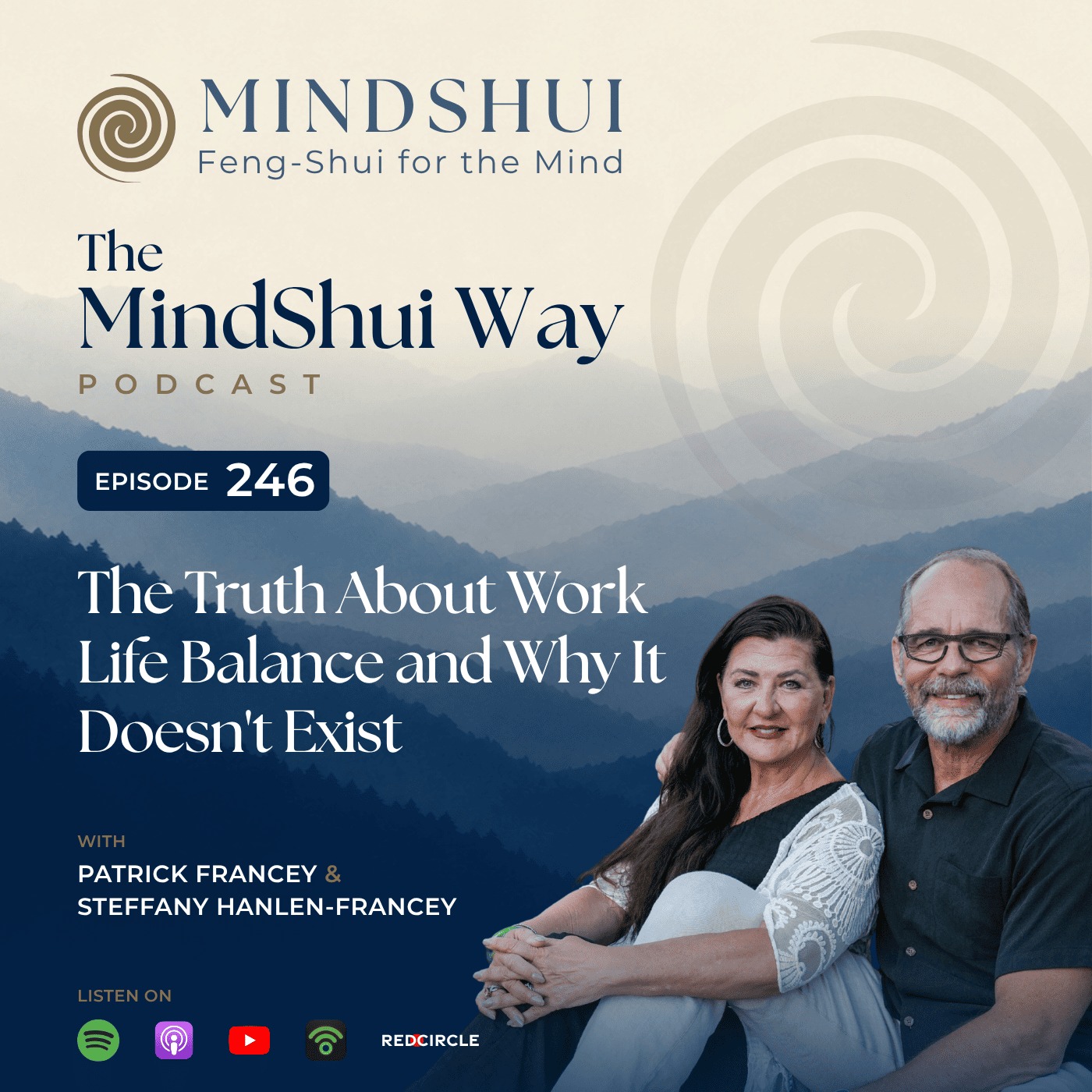
The Everyday Millionaire and Mindset Matters Podcast
MindShui Way – Episode #246 – The Truth About Work Life Balance and Why It Doesn't Exist
00:39:50
Loading summary
Transcript84 lines
- [00:00]
A
Foreign. Most people try to change their life by doing more. More discipline, more planning, strategy, more effort. Often the real issue is not that you're not trying hard enough or even that you feel like you're broken and need to be fixed. Mostly, it is the mental and emotional clutter that keeps getting in the way, leaving you wanting change in your life but not knowing how, or even avoiding the changes you need to make. So welcome to the Mine Shui Wei podcast, formerly Mindset Matters. I'm your host, Patrick Franci, alongside Stephanie Hanlon Franci, my wife, Olympic mental performance coach. We call this mind shui. Like feng shui for the mind. And just as feng shui creates order, flow and alignment in your physical space, min shui is about creating order, flow and alignment in your inner world. Because your mindset is not just positive thinking. It is the operating system behind your experience. Experience in life. This is the mine shui way. Listen in. Enjoy. So you wake up in the morning, you're already feeling overwhelmed before your feet even hit the floor. Your mind is racing. The kids need something. Your spouse is frustrated. Your job is wearing you down. The cost of everything keeps going up, but your income is not keeping space. So if you own a business, it's hard. People are cautious. They're not spending the way they used to. There's texts, there's emails. You haven't answered any of them. You're making decisions and not making decisions. You're actually making decisions to not make a decision. And somewhere in the middle of all of it, you think to yourself, how the heck did I get here? Welcome to the Min Shui Wei podcast, where we're going to share a little feng shui for your mind. Again this week, Stephanie, we're talking about overwhelm and stress. What's your thoughts?
- [01:53]
B
It's such a big and important topic right now. We're getting so many people reaching out and saying, how do you guys handle what's going on in the world? I mean, you think about your life, right? Everything looks great on the outside. I mean, you got a family, you have a home, a business, maybe the kids, maybe, you know, all the things you thought you ever wanted. You're living it, you're living it, right? And then you feel like you're like one decision away from it all blowing up.
- [02:15]
A
Yeah, yeah, yeah. Right? Yeah. So true. So when we break it down, I mean, we often talk about mindset, but let's mind shui it. Let's really kind of work through what is the process when we think about feng shui for the mind is clearing the clutter. But within that clutter, within the framework of mind shui and all that clutter are old beliefs, old patterns, stories that you're telling yourself, misinformation that you've wrapped around a story. So there's a lot of that that's causing the overwhelm and the stress. So let's kind of break it down a little bit further. So first we have to understand what causes overwhelm.
- [02:53]
B
Well, you think about all the different things that could cause overwhelm. Is it outside of you? Is it external, is it environment, Is it internal, Is it thought processes like you said? Is it what's going on in the economy? Is it politics? Is it your opinion? One of the things that I find that really causes stress and overwhelm for people is expectations. Think about expectations. You know, you wake up in the morning and you think you're gonna have a great day. And next thing you know, you know, you burn the eggs and someone cuts you off in traffic and. But it's in the expectation that things were gonna go easy that day, you know, maybe it just will.
- [03:26]
A
So there's a good point, right, which is it's in the expectation. The disconnect is between what's happening and what your expectation of it should be, what you think should be happening. It's like stress is created from the life we think we should be living and the life that we believe we're living. So it's like the old story of change. Your perspective and your perception changes. So let's break this down a little bit further. Let's get kind of a clear handle on it. So overwhelm story I'll share. So a long time ago when I did Hoffman process, that was 25 years ago, that's a body of work that we've both done. Many people have done it and it's called the Hoffman Process. Through the Institute, I was working with a couple coaches at the time. I was in the middle of it. It's a week long program and I'm just melting down. And I look at the coaches and they're looking at me and they go, what's up? I go, I got all this shit going on, da da, da da. And they just calmly looked at me and they go, okay, but Patrick, what is happening right now? And I go, I just told you what's happening right now. And they go, well, no, what's happening right now? And I don't know, they probably said it a few times. But before I finally answered the question, which was, well, nothing's happening right now. But it's all that other stuff. And they go, well, I know, but all you've got is right now. So first off, you know, when we look about overwhelm, it's always future thinking. Often. It's always future thinking. I shouldn't say that. I gotta be careful about that. Don't like to use the word always. It's most often future thinking. So the analogy we've used many times is you look at the top of the mountain that you're climbing. It's Mount Everest. And if you're looking at the top, it can be like, holy shit, what am I doing? But if you just look at the next step, okay, I can handle that. And then you just do one step after another, and eventually you're at the top of the mountain. So that's one of the kind of step back. And what are you looking at? What is the overwhelm for you, really? What have you got going on right now? Can you break it down? So the overwhelm is what creates the stress? Or is it the stress that creates the overwhelm? I don't know. They're two kind of words that they kind of go together.
- [05:33]
B
Yeah. But I think the stress is more the physiological response. And there is a body reaction that we get when we're under stress, whether it's adrenaline or whether it's this. And some people actually get a dopamine hit from it. So there's an addiction. I mean, I'm not an, you know, an expert.
- [05:48]
A
It's true. People love drama. Think about the people who love drama, right? They live in the world of stress. They create drama. There's always a problem.
- [05:57]
B
And if there isn't, they don't know what to do. They don't know how to define themselves. Right. If there's no drama. If there's no stress. So the physiological response also has to be identified. Which is one of the really magical things about the My Shui way is that we actually focus on some of the physical aspects of what happens when we're under stress. Now think about the term, are we under stress or are we put under stress? I think that the overwhelm that we're talking about today is about the imposed stress. And that's where I think overwhelm comes from. So overwhelm comes from an overabundance of things on your a to do list or things that you've placed on yourself, or maybe you. You've imposed other people's expectations and values on you. Maybe you're trying to please people. You don't want to let people down in a situation or a. Maybe it's a collaboration that you have going on so that you don't look at things, you know, in sections anymore or in containers. You've got everything piled up on one big thing. And what I find that really causes a lot of overwhelm in the world that I'm in is incompletions. So I think there's a dynamic when it comes to overwhelm and stress that, yes, they're connected, but one is the activator and one is the reactivator, which overwhelm, I think, is what activates it and stress is what is the result.
- [07:10]
A
So I think about overwhelm and I think about my own. I can get overwhelmed. I mean, we've got three or four businesses, we got team, we've got deadlines, we've got things that we're trying to do and wanting to do. And so it can be overwhelmed. And so the first part of that conversation, though, is we're pretty blessed in that we've set our lives up, that we're doing what we love to do. But that doesn't mean that we're not going to get overwhelmed, because just the sheer volume of things that I have to do, sometimes it's like, holy shit. And everything feels like a priority. I get really bitchy because I'm overwhelmed, but I do have the tools to step back from it. And so some of the, you know, some of my own kind of assessment of my overwhelm is that I have to step back. I have to then look at what really matters. You know, I'm not curing cancer, you know, nobody's about to die. So then it's like, don't sweat the small stuff. And it's all small stuff. It really is. Then a little bit of Marcus Aurelius comes in there. What can we control? And then all I can control is my response to all of it. And then ultimately sometimes I just have to go, I'm the fucking boss. I'll decide. Like, why am I being stressed out about this? Because ultimately, that's the pressure I'm putting on myself. But also I want to accommodate my team. So often a pressure I'm putting on myself in the terms of the volume of stuff that I'm doing. And I'm saying, and I want to get to this part. What do we say? Yes to versus no? That's a bit of a tool as well. But then I have to step back from it and go, okay. I just want to accommodate the team. I want to get the results. I don't want to be the sticky spot in any of the initiatives that I'm putting in. It's one thing, you know, you launch initiatives, which we both do. I don't want to be the sticky spot for that. You know, I want the team to be able to deliver on what they say they want to deliver on or what I asking them to do. I don't want to be the problem. So how does this break down into overwhelm and stress? It always comes back to being able to step back from it, recognize the volume of things, the top of the mountain, and say, okay, what can I do next? Marcus Aurelius. What can I control? What can't I can control? Number one, I know all I can control is my response to it. So my response ability. So I shift my response and my ability to respond differently. And then that kind of takes the edge off of things. And then I look at it and go, a lot of the pressure I'm putting on is on myself. That's for me now, somebody listening go, yeah, but you don't have a boss that's chirping at you and putting pressure on you or clients that are pissed off at you because you're missing the boat. That can create overwhelm. So let's think about that. So what do we do?
- [09:48]
B
Well, the first thing I suggest people do is to take a look and saying, what is it that's really happening? Can you self assessment? Can you assess the situation and step back and go, okay, what is my responsibility? What am. What am I actually responsible for? What am I taking on? Am I taking on too much? Am I taking on a task that I'm not qualified for? I. It's not on my job list. I mean, as the boss, as a CEO, you know, is it really your job to be, you know, checking emails and doing accounting? No. You have people for that?
- [10:17]
A
I do.
- [10:17]
B
Right. So if you don't delegate or if you don't give the people the responsibility, then that asset, that actually adds a lot of stress to you. And, you know, it's interesting, it adds stress to them because they feel they're not doing their job or they're not good enough to do the job for you. So, you know, we've talked about it before. You know, back in the day when you were still working at pro skate, you actually had to sit somebody down and say, listen, I didn't hire you to sharpen skates at that time. That was an $8 an hour. Well, a long time ago, an $8 an hour job. But now he was a manager making whatever he was making. And he was pushing guys out of the way that were making $8 an hour to sharpen skates because he didn't know how to take the next step. And I think that's where stress and overwhelm can live, too, is in where we're feeling inadequate, where I'm not feeling that a. And it's not just about not trusting your team or not trusting the person that you hired to do that job. It's about, do I know? Do I know what I need to do next to lead the team? And I think there's a piece there that really stresses people out. The second thing that I really pay attention to when I'm working with people that are feeling overwhelmed or have brought stress to the party right at the beginning of a meeting is, okay, is this happening or is this happening to you? And the mindset of this is happening to me creates way more stress than, hmm, yeah, this is the situation. This is happening. So there's a, to me kind of a thing. And then there's a shift that happens, okay, well, where can you take the tool or where can you take something out of that, what's happening, and really take an action step around it? And I find the best thing that moves people through stress is the smallest possible action step in the direction they say they want to go.
- [11:57]
A
So I think we have to break this down a little bit more in terms of overwhelm and stress. It is certainly always a conversation that I have with clients that you've had. It always shows up somewhere. We experience it ourselves. So the question is, is that there's a couple things around this, which is, first off, how do you deal with it when you find yourself in it, what created it? And there's a part of it where what I said earlier is, what are you saying yes to? And interesting. Tim Ferriss wrote a book called Tools of Titan that I read years ago where he interviewed a couple hundred CEOs, and what the CEOs, every single one of them, I think, or let's say 85% of them, in their narrative of what they did to be successful and all the things that the chances they took and how do they kind of do what they do, every one of them said that they learned to say no, and they say no way more than they say yes. A couple of examples of guys that said, if I say yes to something, I've already said no to a hundred other things. So it's our ability to say no. So that's the first part. So we have to assess and say, well, how did we get ourselves into this situation? There's self assessment which goes back to those individuals who like drama. And we know, we've met, we know people like that. It's like you go there, you have conversation with them, you meet with them, you have a coffee with them, they come over for dinner, whatever, and they're going to tell you what drama they've got going on and the people they're fighting with and the judgment they have of this and so that. So you have to self assessment. Are the dramas that you're working with, are they real, are they real dramas or are they self inflicted? And you're just in the charge all the time that comes from often being in judgment. So there's a part of it. So we have to self assess one other part of it which is the expectation that we have of what our life should be doesn't align with what's happening. This goes back to the myth of life work balance. So we've had this conversation many times. We don't believe there is such a thing as life work balance. There's just life and there's balance and
- [14:10]
B
there's balance, but there's no such thing as work life balance. Like those 50, 50 thing. I'm going to 50% with my family or doing the things I love to do in my bliss, you know, being an artist or whatever, and then 50% doing something else. That is an absolute myth. And I know we're going to piss some people off by saying that, but it's true.
- [14:28]
A
And the reality of it is it's just life. And so, you know, many years ago you and I heard the quote, you know, if your vocation is like a vacation, you'll never work another day in your life. Which is to say, do you love what you're doing? And if you don't, then there's decisions that have to be made. And some people have all sorts of things, you know, I can't, I have to feed my family. I get all of that. That's not to say that you go quit your job tomorrow. But we're talking about self assessment, we're talking about the mind shui way, which is to actually self assess, to declutter what's really going on for you so that you can compartmentalize, so that you can actually look at what's happening in life and then make decisions so that are you being overwhelmed. So we look at the seven areas of life. Vocational, familial, physical, mental, emotional, spiritual, financial. Okay, so I just ripped off seven. I don't know if I hit them all or not. But the point is this, is that are you really feeling stressed and overwhelmed in all areas of life, or is it just business, or is it just finance, or is it just physically because you're feeling like crap, because you don't have time to work out your body, you're overweight, none of your clothes fit anymore. You're going through this whole period of time. That can be overwhelming, that can be stressful. But what about the other areas of your life? So when we start to compartmentalize, I think we can break what we feel is the overwhelm and say, what is it really? And what steps can we take? Overwhelm is volume. Generally. Overwhelmed could also be, I don't know what the hell I'm doing. So then you're going through this learning curve of overwhelm. But when you can break it down and identify what the overwhelm is, and I don't know if people do that
- [16:10]
B
in general, I think that's a really, really important thing to get underneath. Because if you don't know what's going on and you don't have that level of aware, then I think what we jump outside of our bodies and start comparing and start thinking, well, this person does this and this person does that, and I should be able to do that, and I'm trained to do that, but I'm not doing it, or my life just feels like it's a shit show and I don't know what's going on. So the comparison piece, I think, is what kind of draws that kind of like a circle around what you were just talking about.
- [16:41]
A
Comparison is huge. That is then an expectation that you're placing on yourself that you didn't have before until you compared yourself to somebody else who seems to have it easier
- [16:51]
B
or more, has more than you, has more. And next thing you know, you're chasing them more, and you're like, what? And I. I say to my clients, there is no more. Just, let's just stop here and let's, you know, take an assessment, self assessment, take inventory of what it is that you do have, what's going on, and let's bring it back, slow it down, cowboy, and start into. Get into a space where we're not comparing. We're actually grateful. And I know that work's been around for a long time, is being grateful for what's going on. I believe that, and I know this to be true, is that gratitude and stress and overwhelm can't live in the same spectrum. It's impossible. So if you just take a few moments to just check in with what's really going on. Back to your Hoffman story is it's true. You can't. What's going on right now? Nothing. What are you upset about right now? Nothing. What do you. What, are you in pain? Are you in pain right now? No. Right.
- [17:45]
A
Somebody got a gun to your head? No.
- [17:48]
B
Right. So let's really talk about what's going on.
- [17:50]
A
Future thinking.
- [17:51]
B
Future thinking. Back circling back to future thinking.
- [17:54]
A
Future thinking. So there's a part of it, I think that we can all be aware of our overwhelm. So first question is, are you aware of it? Is it normal for you? Are you. Are you able to step back from it and going, okay, right now I'm overwhelmed because I'm going through a huge learning curve. I'm having to put in too many hours to keep up with it. I've got too big a to do list that I have to go through. So what you're doing is you're breaking it down and saying, okay, but I see a light at the end of the tunnel. Okay, that can take the edge off. I know that. I'm just. Sheer volume of stuff. I'm going to feel that sense of overwhelm. How do you react to the overwhelm? I get bitchy when I get overwhelmed. You don't notice that, but.
- [18:35]
B
No, no.
- [18:36]
A
So. But I can usually breathe through it. I can go for a walk. I can step back from it. So overwhelm's a pretty normal thing. Stress is a pretty normal thing. It's our. In our ability, I think, to deal with it. And what are the tools? So first off, you have to identify what is the overwhelm, really, and not this. I just overwhelmed. I got all this shit going on. Okay, well, let's talk about that. What exactly have you got going on? If you can break it into smaller pieces and then you can start to differentiate and say, okay, well, let's break it down this way. Okay, well, that. Oh, oh, I'm way ahead of myself. Deadline on that. So not for another week. Okay, well, what's important right now and well, what's important right now is what I got to do for tomorrow. Okay, well, let's just focus on that.
- [19:21]
B
It sounds so simple, doesn't it? But the truth is when we're. When we've stacked all of the things that we're overwhelmed by and it really starts to blow up in our faces. I think that's. There's also something that goes on inside. It's like, oh my God, I'm not good enough. What have I done? How have I screwed this up? So we go into this really, this harsh judgment. I'm really, I've come through that one that I was really hard on myself. That's one of the things that I'm just not good at at all. But what I am good at is simplifying is going, you know what? It's too much right now. I'm going to simplify. I'm going to take this off my plate. If I don't have to do laundry right now, I'm not going to do laundry. If I don't have to, you know, reply to emails, I'm not going to. I'm not just going to. My mom always used to say, why do you, why do you paint a busy picture? I'm like, what? And she goes, you're painting such a busy picture. And that visual gave me a real understanding of what I was doing to myself about that. And she goes, you're not that busy. Why are you acting like you have all this stuff to do? Running around like a chicken with your head cut off.
- [20:23]
A
There's people's default answer. How you doing? Oh, good. Busy.
- [20:26]
B
Great.
- [20:26]
A
Busy, busy, busy, busy, busy, busy, busy.
- [20:30]
B
I know I'll never say that if someone asks me how I am, I'm doing. Oh, you're so. I would reach out to you, but you're so busy. I go, I'm not busy. Yeah, I'm complicated. I'm complicated, but I'm not busy.
- [20:40]
A
Well, yeah, yeah, lots of going on, but we're not busy. So it is an interesting part, but I think we have to kind of look at it so we start to identify, you know, number one is future thinking. Quit it. You know, if you're going to future think. Got it. That's the top of the mountain. Bring it back to what's important now, when what's important now. Okay? Then, you know, get out of this illusion that there's this thing called life, work, balance. There's just life and work as part of it. So is family, so so is your health and your mental emotional well being. So it's all part of life, right? So we have to break it down. What are you saying yes to more than you're saying no to or what
- [21:19]
B
are you saying yes to that you don't want to Say yes to. But you feel like you. Yeah. Obligation.
- [21:25]
A
The story you're telling yourself is you have to do that, but you have to identify again what the Overwhelm is. And then what are you doing to either create it so that you're always in that mode, or you're feeling like you're always in that mode, or is it just a shift of your perspective? And what's interesting is that, you know, I just had this conversation recently with a guy that I'm coaching and working with, and it was really interesting because his sense of overwhelm was really in the learning curve. But the other is he didn't know what to do. Like, he didn't know what actions to take, what to not do. So he was in this whole like, I'm stuck. And he was overwhelmed by not volume of things to do, but he was overwhelmed by not knowing what to do. Which is a totally different approach. Right. Again, it's like a mental state that we put ourselves in. We have to self assess and we have to look at it and go, what is the story we're telling ourselves around all of the things that we've got? Have we actually broke it down in a way that we can compartmentalize, put a schedule around it? And there is one thing that I shared. You know, we share all the time with people, which is if you are trying to remember shit, okay, I've got 100 things to do. But you're going to commit that to memory.
- [22:47]
B
Yeah, good luck with that.
- [22:49]
A
Well, you're already, you're in this world called overwhelm. So then it becomes more of a situation of if you write it down, you free up the capacity because your brain's going, oh, I don't have to remember this. It's already written down. So it frees up space. And that's what we have in Overwhelm. That's what we're looking for is capacity. If we only had more capacity. Overwhelm is the lack, this feeling of a lack of capacity to do what you got to do.
- [23:17]
B
Yeah. I do a whole exercise called how to increase how to increase capacity. And one of the first things is to take a look at your to do list and break it down in chunks into what, what's, what's possible. So instead of a to do list, it's a I will list. So I will today do this, this, and this. And then you put what's future state in another column. And if you can't do that, then what happens is that then you compartmentalize things In a way that you can see things as a process working backwards from. We always talk about, you know, looking at a pro, a project, for example. We're not the, the top of the mountain is the outcome, it's the goal, it's the, it's the medal, it's the trophy, it's the whatever. The outcome, the deal, that's great. But what do we have to do to work backwards from that? And I think where capacity lives is the ability to go, okay, well this is where I am today. In order for me to get there, I need to be able to do this first. And that takes a lot of, of work. And that's why I think with this young man that you're working with, why it's so important that he has a coach and he's working through this with, with somebody that has like an old gray haired guy that has experience, you know, that, that can give you that. And I think where capacity can. What we've lost, I think is, is community and maybe mentorship and coaching's really lost its shine over the last little while. I mean I'm really grateful for us and the reputation and the fact that we're in industries that it's normal to have a coach. But I'm working with people now that have, are under so much stress and have so much overwhelm, but didn't even occur to them they could talk it out with someone that they could actually work it out because they feel that they have to do it all themselves. And I think that's another issue and another stressor when it comes to overwhelm is that I have to do this all myself. I got this, you know, and that's a big one. I, you know, I've heard people say, you just tell, you know, tell them they got this, they got this and you know what, what if they don't got this? That's another stressor. And again, that doesn't help increase capacity. I think it shrinks capacity.
- [25:11]
A
Well, I think you hit on something that really we have to consider, which is delegation. So the belief that we have to do it all ourselves. Now when we think about, you know, putting it in real terms, you know, we immediately are thinking business or career or whatever, but think about a mom or a dad. You know, we'll use moms because that historically they're kind of the hub of the operations of a house. Not that men aren't involved, but women take on, seem to take on a lot more tasks, duties. Right. Generally speaking in a family situation. So. And that's where we often hear and see moms feeling way overwhelmed. And some of it is they feel this obligation that as a wife, I need to do this. They don't know how to ask their kids for help or give the kids chores. Many don't know how to do that. And they take it all on like they're the center of the universe and they haven't learned to ask for help, or they don't think they're worthy, or they get into the story of I wouldn't be enough. So when we break down and say, okay, well, how do we get to this place of even managing overwhelm as much as we relate it often to business and careers and all the things that we relate it to, but it just in day to day life, people can feel overwhelmed. Like, when I look at our property, we're on five acres, we got two buildings, we got dogs and cats and grass and trees. And, you know, we bring, you know, we hire people to help, but there's still a lot of it that I want to do myself. But that also can add up in terms of overwhelm. It's our ability to break it down and not let it overwhelm us. So what's your thoughts on that?
- [26:54]
B
Well, there's a philosophy out there, and I'm not sure whose it is, but I think it's the 4Ds. It's like you have choices when it comes to overwhelm. You can dump, delegate, discard, or like there's this 4Ds. I don't know exactly what they are. Maybe we can put it in the show notes, but there is theories out there and there's practical ways of looking at it. For me, I'm a big fan of dumplings. You know, I have learned that as a, as a, you know, a very proud hoarder, you know, that if I
- [27:23]
A
don't, that overwhelms me.
- [27:25]
B
It overwhelms you, right? You know, because clutter, clutter drives me crazy. External clutter, or to me, some. It can give me comfort. And I think that's what's different, is our judgment on that. But there are tools out there. There's great books out there, there's great tools. There's. But what it is is can you have the conversation with somebody to really get grounded in what's happening? Because the ability to delegate is also a place where you have to think yourself worthy and feel yourself worthy, that you can bring somebody in, because there's a vulnerability in that. And I learned that Firsthand when I've asked somebody to come in and help me with my closet, for example. And then I start trying things on and I start justifying why I'm keeping this. And she's going, well, no, it actually doesn't look good. Yeah, but I'm going to lose another five pounds and it's going to look amazing. Or this piece has a great memory to it or something. Right. And. And then all of a sudden the person that I've hired is completely useless and they, they walk away going, well, that. Thanks for the hundred bucks or whatever, but I got nothing done. So there's a way where we have to also believe in ourselves enough to get ourselves supported. And that takes a lot of. Of it doesn't take a lot of. I say it takes a belief and a. And a love of yourself and a love of your self enough not to want to be overwhelmed and living and addicted to this level of stress and this chicken with a head cut off. And I think that leads us to. I think one of the other things I find is boundaries or lack of boundaries or not knowing how to form boundaries or even what a boundary is.
- [28:55]
A
Well, that's a little bit of. What do you say no to, versus yes. So somebody asks you to do a favor. I mean, we've had this conversation over the years with some of your athletes. So your athletes are in training. They've got a lot of things going on. They're not even in, let's say, an Olympic year, but they're training. They have big commitments. Right. And somebody will ask them to do a favor that throws off their day, you know, and they want to do the favor, but they're committed to their training. Then they don't say no, and then they're trying to catch up. So it's. It's like the boundaries that you're talking about is our ability to say no.
- [29:34]
B
Right. Because if we say no and then someone rejects us or they get pissed off or they move on and they go, that's an. Why didn't you. You're obviously not a good friend. So we're afraid more of the reaction of the other person.
- [29:44]
A
Yeah.
- [29:45]
B
Or the other situation that rather than just going, ah, you know, driving you to the airport right now at 9am and I have ice time at 10, actually doesn't work because I won't be able to get back to warm up. You know, let's. Can I help you find somebody else? Or can I, you know, help you find an Uber or something? So helping the solutions. But when we think that that person is asking us because we're the only person that has the solution. We're the only person that can drive them to the airport. Then that is also, you know, a lot of pressure that we put on ourselves, which is really ego based.
- [30:15]
A
I think there's some things here that as we kind of work through this and you know, try and have the conversation and break down overwhelm. Number one is we let it. It's a choice. It really is overwhelming, I think is a choice if we really think about it and we let overwhelm. So then we say, okay, well that's minimizing it.
- [30:34]
B
It's an operating system.
- [30:35]
A
It's an operating system. It is our operating system. And what makes up our operating system, you know, beliefs is one of the big ones. But you know, our kind of our, our beliefs around our belief systems, around those hidden beliefs that we don't recognize, our perspective and our perception of certain circumstances. There's a lot of things that go into what drives our operating system. So, you know, if we want to update it, etc. This is part of that conversation. But I think overwhelm goes to something that's very interesting, which is capacity. We didn't mention capacity.
- [31:07]
B
We just did. We spent the whole 10 minutes on capacity.
- [31:10]
A
No.
- [31:11]
B
Yeah, we did hun. Increase capacity. I said I have a whole program on increasing capacity.
- [31:17]
A
Okay, well that was a long time ago. I want to go back. That was so long ago.
- [31:22]
B
That was like 10 minutes ago.
- [31:23]
A
That was like so 15 minutes ago. So.
- [31:25]
B
No, that's good.
- [31:27]
A
Maybe I'm phrasing it wrong. The point is that we have to unpack capacity more. So capacity. When you go through the learning curve, when you gain competence, when you start to understand what it is you're doing, when you learn how to delegate, when you start to say no, all of that is about increasing capacity. There is the mental capacity, there's the emotional capacity. So for example, when we are talking to people that is just. Their whole life revolves around whatever drama they're going to next, right? Their capacity to get out of that mode, their ability. I don't know where I'm going with that. I lost my thought process.
- [32:06]
B
Can I just put a pin in that? Because I think I do know where you're going. Because the drama or the overwhelm actually decreases, shrinks capacity. So then you go to ask them to do something or they, they can't even hear a conversation about a solution because they're so in love and addicted and their capacity has shrunk so much because of the overwhelm. I actually totally see where you're going.
- [32:29]
A
Yeah. And. And they can't see it other. Any other way that that goes back to the perspective right. Then drives the perception of their scenario, and that's what's happening. So as we wind down, we have to recap. Let's get out of the narrative about life, work, balance. Let's learn to say no more than we say yes. Let's be able to step back and assess what is the actual overwhelm. What are the challenges that we're facing? And can we stretch it out? Can we recontextualize what it is we're looking at? Quit looking at the top of the mountain. Look at what is the next step that you can do. Don't sweat the small stuff. It's all. These are all kind of cliches around it. All right?
- [33:14]
B
Yeah. But I don't. Don't slow down, cowboy. I don't really think they're just cliches, because I think what it does is if we slow down enough and realize that what's important now is just that we have no problems right now, is we can maybe shift into, okay, what does mean something to me? What. Where am I out of alignment with my values? Possibly. Where am I not taking responsibility for how I'm reacting to things? And do I want to be known as that person that spins around and just is so in my drama? And so, you know, painting a big busy picture and making it look like I'm so important that everyone gets pushed
- [33:56]
A
away anyway, how much of it runs into. And I know I was trying to wind this down a little bit, but I'm thinking about, you know, a real application to those situations where people have a board of directors or a boss or, you know, a group of people that are. They're feeling the overwhelm of all the things that they feel responsible for. That goes back to the ability, again, in terms of overwhelm, the ability to have a courageous conversation. A courageous conversation for you that pushes back and says no. You know, that's also part of it. You know, our ability to say no comes with the ability to have a courageous conversation.
- [34:41]
B
Sometimes the potential of massive conflict.
- [34:44]
A
Yeah. And conflict. Right. That's what comes with it. And. And so, you know, there's. This is always about the self assessment side of things. You know, we have to be able to reflect and go, what can I control? Where am I responsible for this? What have I created? Or what am I letting overwhelm me? You Know, like really, is this really
- [35:05]
B
that important right now?
- [35:06]
A
You know, am I writing things down? Am I looking at the entirety, you know, of everything? Or can I just step back and break it into small bite sized pieces? And then I got this. No problem. You know, that's what it is. There's a. You know, when we worked with Dr. Paul Stoltz so many years ago, I always remember something that, you know, you open your garage door and like shit's coming out of it. You know, he just is all packed, right?
- [35:32]
B
Like my closet.
- [35:33]
A
Yeah, like your closet. Sometimes like your office. So, so what does he, you know, like he walks through. So what do you do? You go, you, you can't work in that. You're overwhelmed with just the sheer volume of stuff that you got to get handled in that garage. What do you do? You step back from it. You got the big door open and you go, okay, let's pull all this shit out. Let's look at it. The only thing going back in the garage is what matters. And then you put it in, it's organized, it's on shelves. Everything else you throw away. All of a sudden, the overwhelms gone.
- [36:07]
B
Except the emotional overwhelm, possibly from the attachment. Because that's where I think overwhelm lives in that attachment, hon, you can't step over that. You make it look so easy because you're so organized and you got. You want to put your things in all in little boxes. And it's not always true. I walk in your office and it's all over the place sometimes too. But it's in the, in the understanding that, yes, the part of the overwhelm is the emotional reaction to some of the things that we're trying to organize.
- [36:36]
A
That's a good point, you know, that
- [36:38]
B
we're trying to let go of. I mean, think about shifting your mindset. When we spent all this years, for me, on mindset. As we move from mindset into understanding what mind shui actually is and the operating systems and what's really driving us, what we haven't really focused on a lot is the emotional attachment, the emotional regulation, emotional dysregulation that happens when we're trying to change who we are and who our life. Because we could be operating and I could be, I. I could say, hey, come and help me organize the garage. And you, you know, come and help me organize the garage. And with three weeks, it's exactly the same as it was before.
- [37:15]
A
That happens.
- [37:16]
B
It happened not just to me. I'm sure it's Happening to people that are listening to us. Because in that emotion, until I change my operating system and the root cause of that, I don't have to be all psychological or all, you know, get super deep about it, but there is a shift that I have to remove some of the attachment to the emotional
- [37:38]
A
side of things that itself mastery it is. And that was what we come back to in terms of the mind shui way. This is not a mindset matters program. This is a mind shui way which is about self mastery. And to me, that's really the next level of where we go on these journeys of self discovery, of being able to deal with things like overwhelm and stress and to manage it and to be able to break it down, walk away from it. Go. Yeah, no problem.
- [38:09]
B
So, yeah, problem, no problem. Or I get to reassess what my values are and maybe who I am today. The values from yesterday or 10 years ago, they're not serving me anymore. They're not supporting me anymore. Maybe I've changed.
- [38:22]
A
Yeah.
- [38:22]
B
And be okay with that.
- [38:24]
A
Yeah, problem, no problem. Where did we used to use that?
- [38:27]
B
I can't remember.
- [38:28]
A
Can somebody go, I got a problem?
- [38:31]
B
No problem.
- [38:32]
A
No problem. No problem. Problem, no problem. Anyways, we're going to wrap it up for today. Another episode of the Mine Shui Way in studio. For those of you who are listening audio. This will eventually end up on YouTube. And if you're watching this on YouTube, make sure that you comment. Let us know if there's value in this. What would you like us to talk about and like subscribe? Do all the things you do on the YouTube. For those of you who are listening to this on audio. Yeah, make a comment. Make sure you share it. That's always about make a comment question.
- [39:04]
B
And even if you don't like it, we want to know that too.
- [39:06]
A
Yeah, we want to know that too. Thanks, Stephanie.
- [39:08]
B
Thanks. Fun. That was fun.
- [39:11]
A
Ladies and gentlemen, thank you for listening. If you found value in the podcast, please take the time to rate and review and share with others. Share with your friends as it is my goal to always improve and to provide the highest value for you, the listener. If you have any comments, suggestions or questions you'd like answered, please email me@ceoaincanada.com that's CEO E I N Canada.com I look forward to hearing from you. And until next time, Patrick.
- [39:45]
B
Oh,