← The Everyday Millionaire and Mindset Matters Podcast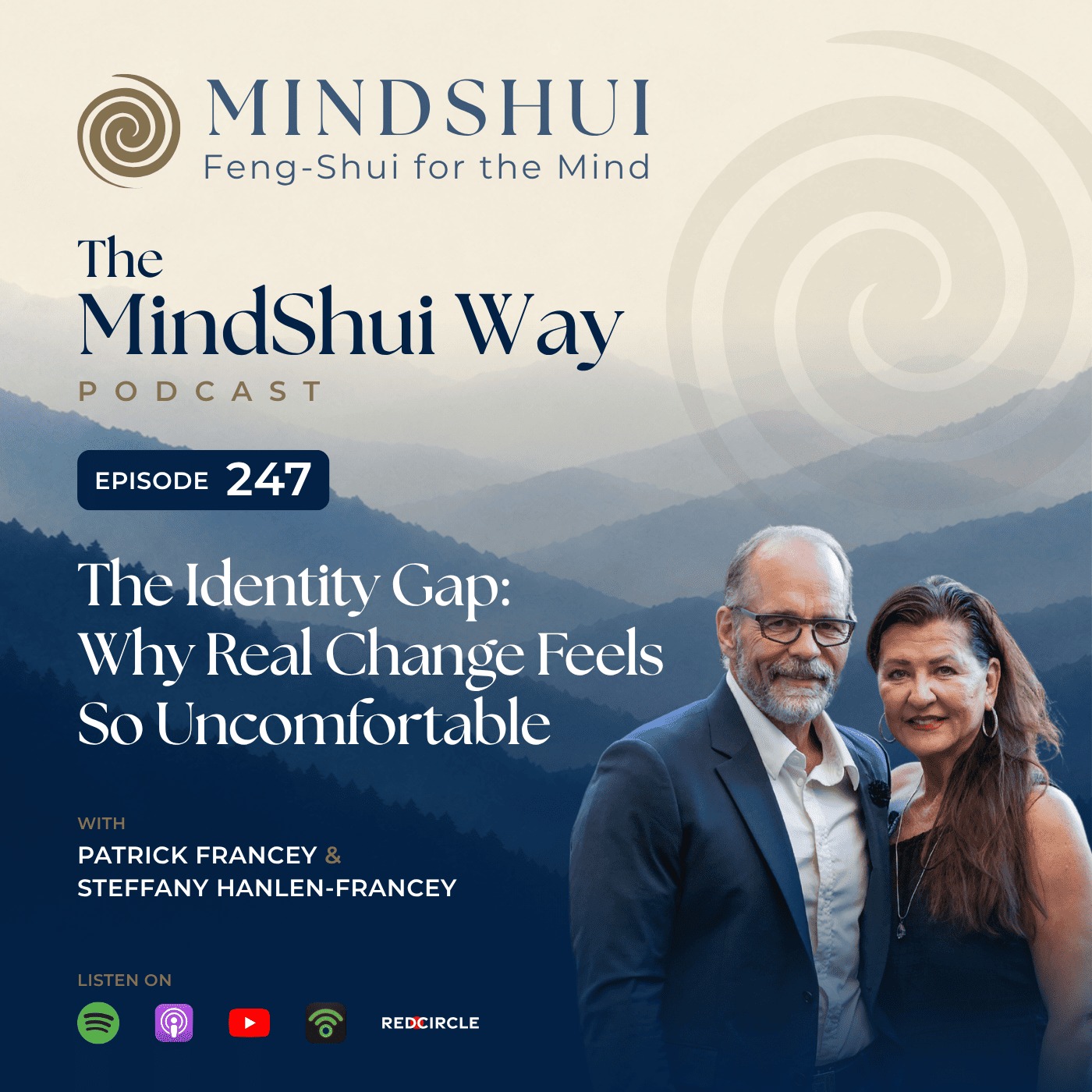
The Everyday Millionaire and Mindset Matters Podcast
MindShui Way – Episode #247 - The Identity Gap: Why Real Change Feels So Uncomfortable
00:49:21
Loading summary
Transcript64 lines
- [00:04]
A
Most people try to change their life by doing more. More discipline, more planning, strategy, more effort. Often the real issue is not that you're not trying hard enough or even that you feel like you're broken and need to be fixed. Mostly it is the mental and emotional clutter that keeps getting in the way, leaving you wanting change in your life, but not knowing how, or even avoiding the changes you need to make. So welcome to the Mine Shui Wei podcast, formerly Mindset Matters. I'm your host, Patrick Franci alongside Stephanie Hanlon Franci, my wife, Olympic mental performance coach. We call this mind shui, like feng shui for the mind. And just as feng shui creates order, flow and alignment in your physical space, mine shui is about creating order, flow and alignment in your inner world. Because your mindset is not just positive thinking. It is the operating system behind your experience in life. This is the min shui way. Listen in. Enjoy. There's an overlooked truth about self improvement, and that is that not changing has a cost. And it's one of the reasons so many people who say they want their life to change never actually change. But there's always a price to be paid for that. And it's usually showing up as a regret or, or some degree of suffering. And I don't mean it as always, dramatic suffering. Mostly it's simply that underlying belief that something's wrong with your life, that you're living a life that is somehow less than it could be, or that you think it should be. And if at some level you know that having the life you dream of living requires you to change, but you don't, you'll eventually have to live with the consequences of that choice. So welcome to the Mind Shui Wei podcast, where Stephanie and I hope to provide a little feng shui for your mind. Stephanie, here we are, and today we are talking about the challenges of change and of course, the uncomfortable space that sometimes referred to, or we refer to as the identity gap. So what's your thoughts?
- [02:13]
B
Well, I think this is a really important topic because change for change sake, change, you know, that's kind of a useless concept, but when you think about change, conscious change, moving your life forward in the direction that you want to go really does take time. It takes effort, it takes a shift of habits. But what happens in that gap, or that identity gap is where we can quit or where things get really confusing.
- [02:36]
A
Well, it's interesting too, is that we as coaches and we say this often, which is people want change. They want their life to be different, but they don't want to change. They just want the result. So it goes back to the old phrase of what is the definition of insanity? Expecting things to change, but not changing.
- [02:57]
B
Somewhere along that line, something about getting a different result.
- [02:59]
A
And getting a different result. Exactly. We want a different result, but we want to change. So I came across a piece that I want to share with you. I want to read it, and then I want to unpack it. Okay. So you ready to do that?
- [03:11]
B
I am.
- [03:12]
A
Okay. So if you want to go from where you are to where you want to be, you're going to have to do something that makes you feel different, feel weirder, more easy to be mocked and criticized. That's what you think anyways. But the hardest part isn't waking up early and going to the gym or staying disciplined. It's surviving what we'll call the identity gap, which is that period where you've outgrown your old life and your old self, if you will, but haven't yet built your new one. You become so different that you can't even resonate with your old set of friends anymore. But you've not yet developed to the degree that you've created or attracted a new set of friends. You know, most people mistake that feeling for failure, and they go back to the habits of the people and the routines that they already know. And it's not because they're happier there. They're not. But it's because familiarity feels safer than the uncertainty. There's a temptation to go back to the old ways of thinking, to the road that you already know how it's going to end. You know, books, movies, YouTube experts are all making personal growth look like one. Just inspiring montage. It really is, however, taking years of showing up without knowing if any. Any of what you're doing is going to pay off. You're surrounded by uncertainty, questioning whether you're wasting your time while everyone else seems really happy just staying the same. And that is why so few people truly change. The loneliness isn't a detour, it's part of the journey. And if you can survive that crossing that gap, that chasm, without turning back, you're already further ahead than most people ever get. There's a lot in that.
- [05:01]
B
Yeah, there really is. And I think it's an important conversation because people change and they grow in stages and in cycles, similar to seasons. Right. We can't. We can't expect ourselves to be the same all the time, and we can't expect the people around us to be the same. And I think that's where we really get stuck is if we're demanding ourselves to not be different, but we want a different result in our life, or we want us to grow or evolve or elevate our thinking, you know, why do we go to secondary education? Why do we travel? It's so that we get different experiences. And when we come home, can we still be the same person? Or do we actually have to enter that identity gap to grow and change and attract what it is that we say we want next?
- [05:43]
A
Well, I think it doesn't matter what you do. I mean, we go through. I've gone through it a ton over the years, and that's why I think I can speak to it pretty clearly, aside from all the work we've done. But as even right now. So we think about the development of this program, you know, Mind Shui. The Mind Shui way. Going through all of the things that we're doing, delivering this podcast, that takes change. That takes us putting it out there and getting comfortable with sharing our space, sharing our thoughts and our processes. It takes a different individual than we were a year ago or five years ago when we started the podcast. As we go through the journey of growth. So, for example, you and I, as business owners, it could be anybody with a career that's trying to achieve more. It goes back to that fundamental equation of who do you have to become to achieve the goal? And so when we look and say, okay, well, we've set this goal, we want to achieve that goal. And the person that we're being today isn't the same person. It's the same body, but it's not the same identity. That is what's going to deliver the results that you want for the changes in your life. And that's the uncomfortable part of it. And I always go back to my own experience over the years of even early on in my journey of my personal growth, we joke often about you referring to me as your favorite Neanderthal. And you still are, and I still am some days. But the point is that we evolve and we change. And we know that in order to. If we have a vision for our life, if we have a vision of what we're doing and who we want to be in that context, we go through these changes, then we set ourselves up for what we think is judgment of other people. And I think that's one of the biggest gaps that stop or it's the gap, because as you're going through that, people are judging you, and for real, they are. And if it's family and peers, they may be directly saying, what the hell are you doing? You know, I joke that when I went through that period of my life, you know, my family thought I was part of a cult.
- [07:49]
B
I remember, who are you?
- [07:51]
A
What are you doing? How come you're being that way? You know, this goes back so we go through these changes, but we have to be very conscious and then we have to be prepared to feel that judgment, to maybe even experience that judgment. But if we really are committed to the person that we need to become to achieve that goal, we have to get past it. And so let's talk about maybe some ways to do that.
- [08:14]
B
Well, I think the first thing we need to understand is that in order to grow and change, we need to know ourselves. We have to have a certain level of self awareness as to where we're at and a certain level of acceptance and gratitude for where we've come because we're continuing to change or want to change, but we're not actually going from a place of full acceptance or understanding of how we got here. Then change becomes just change for change sake. And that's not good either because then you lose a little bit of yourself or lose a little bit of your, your North Star, so to speak, or if you're just changing, you know, with the wind because you changed, because you met a new person or you, you know, your new boyfriend drives motorbikes and now you want to drive a motorbike and you know, your new girlfriend does this and hangs out with these people and now you want to do that. Well, we can get pulled into that gap and that identity gap if we don't have a higher level of self awareness. I didn't remember a time where I said, I don't want to change. This is perfect. I'm exactly, you know, who I want to be and this is good enough. And you put your stake in the ground and off you go. I remember when we first got married, I said I want to be in a marriage that is about growth and challenge and personal development and, and personal uncovery and the things. And I chose you as a partner because you said you wanted the same things. So for me, I'm really grateful. We're not the same people that we were 35 years ago when we met. You know, I'm glad that we've been able to take a look, pause, be dis in the discomfort of the identity gap each time we've changed and then be in there to, to catch each other when we, when we fall.
- [09:47]
A
Well, you know, I remember so many years ago and I can't put a specific time on it, but I remember early on, probably before we even got married, where we both said, let's get comfortable being uncomfortable. And sometimes I think I might just regret that. That's kind of my own thought around it. But I think when we look at that, we think about sitting and we're going, ah, our life just is not what we want it to be. And that's fair. And that's what happens. That's how you actually inspire yourself to grow and to do things you've never done before. But for those who are kind of going through that process and then starting to make those changes, because they've gained that awareness, maybe they've had some coaching, they've read the book that resonated with them, they listened to the podcast, they go, oh, that's a really good point. So we start to put those changes in place. And for those who haven't been through it or are just starting to go through that process, you start to second guess yourself. You go, have I picked the right journey? I mean, it'll keep you up at night. You'll go, oh, why did I say that? Why am I doing that? Why am I taking these new stands? Why did I push back? Why did I change that relationship? Why did I say, no, I'm not going to hang out with these people anymore? So then we get into that phase of where we second guessing, we're questioning if this is the right move. But then that's the discomfort, that's the gap between who you are and who you're trying to become. And these are incremental changes. It gets tested. You take one step back, two steps forward, three steps back, four steps forward. And it's kind of this thing where it isn't a switch that you just flip, it's the evolution. And as you go through that process, hopefully you gain some confidence. It's interesting with a client that I'm just working with is he tried some things that he'd never tried before and showed up differently, was very aware of how he was showing up and he started to get some results. Like he forced his way. And I wanna say forced, he was intentional about not going back to his old pattern of how he was doing things. And now all of a sudden he's starting to gain some confidence around that. And so that's a really interesting journey to be on. Now he's really just starting on his journey with. Whereas another client I have is going, and he's having the Conversation with me is going, I'm doing this, I want to go there. There's no question about I'm going to change and shift how I'm looking at the world. But what specifically do I got to really consider? Two different, you know, where you are in your journey is really what it's about, isn't it? I mean, at this point, this many years later, we're always looking at how are we showing up, what are we doing, how can we improve? And then we just embrace it and move and we know we're going to go through the discomfort. It's like again, it's like being front facing on a podcast is just one example. Putting ourselves out there and saying, this is our journey, this is where we're going, come with us, hang out with us. We are learning like you.
- [12:52]
B
Wow, there's a lot there. I think the biggest one that really resonated with me is that we are all at different stages of our journey and there's no pressure to change. If you don't want to change, don't change. But eventually there's going to be enough external forces on you in order to, to grow or elevate or you want to make more money or you want a different lifestyle. There are some things that have to physically change. And that gap that gets changed or that gap gets created when you want to change is the where the fear lives. So the fear can also be where the excitement lives, but it also is where you're going to get tested and where you're going to be criticized the most. And you used a really good term in the opening. You, you know, potentially mocked. And I know what it's like to do that. I mean, I have had people that knew me when, you know, when we were just a couple of north side kids in Edmonton. And now I'm a five time Olympic coach and Mind Shui co host and all these things and people are just going, what the hell? Who does she think she is? Right? And I remember thinking, okay, well if I just played a little bit smaller then maybe they wouldn't judge me. But you know what? The truth is, nobody really gives a shit. So everybody is on their own journey. So when I really slowed down long enough for you and I to say, okay, what is it that we want our life to look like? Who do we have to become and who do I have to become inside that partnership that I had to be willing to take those hits and have people leave and have people criticize me and the haters online. And I mean, it's all there for us to, to experience. But, you know, I'm more committed to what it is that I want than my fears or the buts or whatever. So when I think, when we can help people really identify that the gap is okay, it's okay to be in that. It's okay to. I don't know. Remember we used to talk about it's okay to be in the space of. I don't know. Sometimes that's the uncertainty of being in the identity gap.
- [14:48]
A
Well, I think that the cool thing about the identity gap is first knowing that there is one. You're gonna be in that gap. And aside from the judgment that you might feel from others, friends, peers, workmates, whatever that may be, there's your own judgment of yourself and your own second guessing of yourself. And then let's keep in mind that for years you've had that predictable day, that routine, those habits that have become comfortable. You're starting to feel uncomfortable or you're starting to feel like you're capable of more, so you're questioning yourself. But part of why we go back too, is that, oh, that's so comfortable, you know, as much as, you know, it's like being on the diet. We all know what has us put on weight and we make that commitment to be on that diet and not do that. And, you know, sure enough, we start to question, go, ah, we don't really need to diet. I'm not that fat. I can live with this, you know. So then you start making excuses and going back to what's comfortable, and you start second guessing and then even quantifying, qualifying, justifying you staying stuck or staying where you were. And then one day you wake up and go, why did I do that? And then you start again. And that's kind of what it is as we start to shift our own identity and who we want to be and how we want to show up. And it's going to keep. There's going to be that pull, I think back until you gain that confidence. So you start seeing the result and then all of a sudden people show up in your life that you resonate with. I think I want to share that story about the Friday night guy. Yeah.
- [16:29]
B
Okay. I love the story, you know. Yeah.
- [16:32]
A
So there's, there's some identity attached to this, but this isn't really about me. This goes back many, many years. But where I came to that story, the realization that, you know, every Friday night, I'm talking to men right now, but it could be women, some version of their story. But every Friday night you go to the bar and eventually you go to some Peter bar and you hang out.
- [16:56]
B
A what? A Peter bar.
- [16:57]
A
Peeler.
- [16:57]
B
Peeler bar. Oh, the strippers, the ballet, the shoe show.
- [17:02]
A
The shoe show, whatever you want to call it. Anyways, you go. And every Friday night you've been doing that, you've been hanging out with the same guys. Every Friday night after work you go. Then one day you meet a girl and very early in the relationship, and you go to the stripper bar and she knows you're going. And then one day, as things start to evolve and you're dating her more and one day she says to you, she goes, I don't really like you going to that stripper bar, you know, hanging out with those guys at the bar. And you look at it and go, okay, if I want to keep the girl, she's just told me what she would prefer I don't do. So you go to your friends and one day you go, guys, this is the last time I'm coming to the bar. You know, my girlfriend is suggesting that she doesn't like me looking at other girls and so I won't be coming out on Friday night. Now what does that group of guys say?
- [17:55]
B
Pussy whipped.
- [17:56]
A
Yeah. Airbag control. What the hell does she know? She's gonna dump you anyways, right? All of the things that you know. And why do they do that?
- [18:05]
B
Because it's a mirror. Possibly.
- [18:08]
A
Well, it serves them. Yeah, right.
- [18:09]
B
Yeah.
- [18:10]
A
Okay, Friday nights we're all getting together. It serves them. They're going to have fun. They know the routine, they know what's going to.
- [18:16]
B
Oh, man, you're changing the dance step.
- [18:17]
A
You know, you're changing the dance step. You're going to drink and you're going to have funny and you're going to throw loonies and toonies at the girls or whatever you do. Well, that no longer serves you. You now are growing into a relationship. And how do you have to show up in that relationship, in this case, to keep the girl? Well, that's all fine, but you're going to get that pull. You're going to. People are gonna pull you back, you're gonna get judged. In this case, you get mocked, ridiculed, teased, and you're making a decision which is the person I wanna become and the person I need to be. To be in this relationship means I have to change. And so that's part of what goes on in the development. And there was a catalyst for it called a girl. So we think about those kinds of things. And how many times in that scenario that I've witnessed over the years, not so much anymore, of course, but back in those days where guys went, nope, you're out. They dumped the girl. They'd rather hang out with the boys because that's what's comfortable for them. The pull isn't strong enough to actually make that change. So that's just an example of what we go through as we start to fill that gap. Now, the identity gap in that case is that now all of a sudden, you're showing up in a relationship and you've just made another level of commitment to that relationship because you're not going to go hang out with the boys on the Friday night at the bar anymore. Well, in that space, you're filling it with the girl, which. Okay, there's a nice reward to that. Well, you've gaining confidence that, holy cow, if I show up a little bit different, I have this great relationship. Often that's the spark for many men to start to say, oh, okay, what else can I do? So I think about how much I changed because of all the pressure you put on me.
- [20:04]
B
Well, I just saw you as a giant hunk of coal just to keep the girl.
- [20:08]
A
Well, yeah, so, yeah, the chunk of coal. So the diamond. So I, you know, that was the. I think I was the first time I heard the phrase or somewhere I learned it, which is, you know, a coal or a diamond is just a chunk of coal put under a lot of pressure. And you put me under a lot of pressure.
- [20:24]
B
So I did back then. But you were worth it all.
- [20:27]
A
Good, good. And I did a great job. Okay, I'm pretty shiny diamond, but that's pretty cool.
- [20:31]
B
And don't step over cowboy. The fact that there was a willingness and sometimes when there's no. There's a willingness and there's possibilities, but when there's no willingness, first of all, there's no awareness that maybe the Peeler Bar isn't, you know, the most evolved place you can be on a Friday night. And maybe sometimes it is. Nobody said you couldn't. The guy couldn't go back there every once in a while and, you know, and once he evolved or the relationship evolved or they broke up or whatever. But you go back and are the same guys there? You know, you're two years, three years later, and do you still fit in with that group of people anyway? And there's that willingness to change and to grow that creates this whole kind of ability to see possibilities and to look at life differently. And I Don't think it's always about an external motivation. Sometimes we get this burning inside, right, where I just know. I don't know what it is, but I just know I need to do something or I need to shift or I need to change or. Have you ever had that feeling where you just know you need to do something or move or go? I just remember, you know, back in my early 20s, I just wanted to move to Vancouver desperately. And I didn't know why. I hadn't really been there a lot or hear a lot, but I just had this burning desire and it was like I had to do things in order to get myself to be prepared to move, to be the person I wanted to be living in Vancouver. So I think there's also the external, you know, meeting somebody and wanting to change, but there's also that awareness inside. If we can start to help people identify what that is inside, about growing and about changing and about embracing potentially a new identity and building off or stacking the knowledge and the experience and then jumping off the cliff and figuring out who you're going to be without all of those constraints.
- [22:14]
A
I think too, there's a place where, you know, if you start a trip and you don't know where you're going, of course any road will get you there. But if you don't know the outcome from the efforts you're putting in, or if you're not confident in them, that's where you start to second guess and you start to back up a little bit. So let's go back to the story of the young man who was going to the bar Friday nights with the boys. At some point, that guy can make a couple of different decisions. He can say, this is no longer who I am. I'm not the guy that goes and drinks too much on a Friday night with the boys and goes to the bar. I'm not that guy anymore. Or he can be the guy that goes, ee, that's a big commitment. You know, I don't want to, I want to hang out with the boys. Now, I don't make any of that wrong. I mean, of course men want to hang out with men, women want to hang out with women, and there's just periods of time where we want to do that. I mean, that's fine. But what he was saying in that space and that change was within being in integrity, was his commitment to his significant other, his girlfriend, in this case, that said, no, I'm not going to go look at other naked women with a bunch of guys and Drink too much and throw money at girls. That was his commitment. Lots of guys are going to go through that identity gap and going, no, I can't take that and make that kind of a commitment. So what do they do? They may either give up the girl or they sneak out on a Friday night and they still go to the Peter Bar. They're just not telling the girls about it. So that's the gap. That is the gap. And hopefully, and often what happens eventually is they make the change or they don't or they lose the girl. And that's how that goes. But that's the consequence of not being able to go through that identity gap. They're not able to really fully own who they're standing for in terms of who they are. And that's again, that's the uncomfortable part. And some of that discomfort is created by peer pressure, significant other pressure, whatever that might be, family, friends, girlfriends, wives, et cetera, husbands. Or you just hedge and you go, no, I can't make it all the way. I think eventually, hopefully, that kind of light goes on, that bulb goes on and you make the change. You start to see that, no, the benefits of that change far outweigh the discomfort of making the change. And that really takes us back to where we started the conversation. Are you willing to go through that discomfort? Because those are some of the things that are going to show up.
- [24:47]
B
You know, it's fascinating to me when we're talking about this because when I'm working with a client, for example, a world class athlete that wants to go from being a national champion, for example, to becoming world champion, from world champion to be an Olympic champion, there are things that people have to do that we're not aware of when we don't set those big goals. When you set a big goal, there's going to be a new identity that needs to be created. And there's a lot of pushback, not just from the people around you, but also from an industry or from people that have expectations around. So if you're going to have the courage, first of all to set a goal that is going to force you to change who you're being at that time and what you're doing and how you're treating yourself, where you're living, how you're showing up, that takes a lot of courage. And not having the ability to sit there like you, like you're talking about this young man who was at the bar, he was able to sit there and go, okay, I'm making this decision. Yes, the catalyst is this person I want to get to know and maybe learn more about commitment. But I'm doing it for myself because if you don't do it for yourself and eventually let's say that relationship didn't work out, then it's the relationship or that's a woman's fault or that's that guy's fault because you made the decision for them. I did this for you. I changed. You know, and I think about the athletes that I work with or the high net worth business owners who just are so committed to and they are so convicted in what it is that they're doing is sometimes they just don't give a shit or they can't care. It's not that they don't care, they're good people. It's just they can't care about other people's opinions right now in this particular. Because that identity gap can be shortened by a level of self awareness and who you're being in that and whether or not you're doing it for the right reasons. Are you linked to your purpose? You know, one of our programs we call Values to Vision and and out of that came the champions journey from purpose to podium. And now if we can link values and purpose into our why we want to change, I think it's a lot easier than just saying I'm going to change for change sake or I just want to move cities or you know, you think about change people, there's people that are addicted to change because of the dopamine hit that you get. Oh sure, you know, it's like swiping right or whatever. There's a lot there. So I guess I don't want to step over. The fact that we need to take a look in that part of the identity gap is who am I making the change for?
- [27:07]
A
There's another part that we shouldn't step over and that is what is the environment we're creating for ourselves that sets us up for success? You know, back, you know, even when we, I'll, I'll just, you know, go back to a diet. I mean if it's the old case of and, and I know this one really well, if being on a diet or managing your diet means not having snacks around the house to create the environment means don't have snacks around the house. Otherwise you're just setting yourself up for all the temptations. So this is, you know, what is the environment that you're working in? What is the environment that you're hanging out in? Again, if you're hanging out with a Bunch of friends that their whole goal is to get to the bar on Friday night and do all the things that you do on a Friday night at a bar. If you keep yourself in that environment, you're going to be pulled. You're setting yourself up for just a lot more challenges, way more discipline. It's going to take that mental fortitude. So can you create an environment that sets you up for success Now? I joke about it, but it's very serious. I mean, back in those days, when I was going through the changes of who Patrick was becoming, and to the point that I don't, I used to be known as Pat. That was, of course, Patrick. It's the automatic nickname. Nobody calls me Pat anymore. If you call me Pat because you knew me in the past, you haven't seen me for 35 years. You know, that's the reality of that situation. So even going through that change, I felt pressure, number one. But we joke and say, well, my family thought I was part of a cult. Well, there was a part where I just couldn't hang out with my family on a regular basis anymore. I couldn't do what I used to do with them because they didn't know how to be around me. And quite frankly, I didn't wanna be around them. We just didn't align. And it's not that I didn't love my family, it's just that I just had nothing that I related to anymore. I couldn't get into the kind of conversations that we had now. That evolved over the years, and I became really close with my sisters and my younger sister. We're still very tight to this day, but there was the evolution of that. So I had to have my conviction of the changes I was making. I think my family had to see that, okay, this is the journey he's on. And they started to actually, I think, appreciate who I was becoming and why I was heading that direction. And, you know, many years later, it's all water under the bridge. And it wasn't like there was big fights and there was none of that. It was just a disconnect that happened along the way. And as much as I say they thought I was part of a cult, I think it was. That's more of a comment that got made. It wasn't. Again, it wasn't a fight, but it was still very uncomfortable. And in many scenarios, and I think about even now, if I reflect none of. I have none of the old friends that I had, that's not quite true. I have a couple that were on the journey with me, they were part of my journey. And guess what? We evolved and we grow and to this day we still have conversation.
- [30:08]
B
The willingness to be misunderstood. You know, I remember that time with your family and a little bit during the changes that we were growing in order to, to hang out and be a couple and, and, and still maintain our autonomy. And I was very big and bold personality. You, you had a lot of success and you were already on, you know, your journey. And we brought our energies together. It just created something new and new meaning we didn't have any idea what we were going to be and who we were going to be as a couple or. And that was so interesting to build an identity around that and to see it as a team, to see us as partners was really important to me. And that became a big part of my identity as we were growing. And my parents and my brother were always very supportive. I could, you know, they were my biggest fans growing up. I'm very, very grateful for that. And when that. Pat, remember that Pat?
- [31:01]
A
Yeah, yeah.
- [31:01]
B
My dad used to say, is that Pat coming over for dinner? I mean, it took him years to call you Patrick.
- [31:06]
A
He's probably the only guy that'll occasionally call me Pat. But that's okay.
- [31:10]
B
He's allowed.
- [31:11]
A
He's allowed.
- [31:12]
B
He's 97. So. But I think what happens is that even when I hear my old name or I, or people call me Steph, it kind of throws a little, you know, I don't know, weird feeling up my spine because that's not who the identity that I see myself as. My clients, my skaters call me Steph. It's an a term of endearment. But identity is also who you, what your name is, who you show up as, where you live. And I see with parents, especially with, with sports in hockey and figure skating and a bunch of different sports, is this really important for a lot of parents to make sure their kids are in a positive environment that they can learn how to compete, they learn how to cooperate, they use the environment to pull the skills that, you know, we need to help a child grow. It takes a village. And when you talk about environment, it's not just the identity within the environment, it's what is the identity of the environment. And I look at Ice Academy Montreal, or I look at the things that we're trying to build with mine Shui in our community is that that like mindedness not only holds people to account and to a high standard, but also gives us that accountability and credibility and support that aligns with Our vision. And I think it's really important that we don't step over environment.
- [32:25]
A
So I guess there's a fundamental, that there's the identity gap that can leave you feeling pretty lonely because you don't resonate with old friends. And maybe you can hang out with them, but it's just you don't align. Right. You're not having meaningful conversations that you want to have. You're not really interested in the topics that they want to talk about anymore. You've outgrown it. And so you go through that period of time where it can be very lonely and you take a stand and maybe it's, you know, well, guess what? Friday night I'm at home alone, I'm reading a book, I'm doing my work and I'm not going and being distracted in an environment or a space that doesn't serve me, that doesn't support my growth. And there is a part of us that has to trust that the fundamental of like attracts like. But we got to give that time and we have to be able to, I guess, energetically let go of that past to go through that gap to get to where we want to be next. And whether that be environment or the people that we're being surrounded with, maybe the career choice that we make or the business choices that we make. How do we define ourselves in whatever we're taking on next? You know, somebody who gets promoted, and I've seen this many times over the years in business and I've personally experienced it, is that. Let's talk about a career. You know, you're taking somebody from who's just been a guy in the shop and you're going to promote them to a supervisory position, a manager position. Well, they can feel empowered and they can be excited about it, but they can't show up the way they did in the past. Who they were has to shift. And well, if you are friends with all your buddies and the next thing you know, now you're holding them accountable in the shop or in the office or whatever you're doing that can be very, very uncomfortable. And how do you want to handle that? Do you want to be the boss? That four lettered word, four letter word. Or do you want to be that individual that guides and supports and empowers those staff around you? Well, that's a whole different shift from where you were if you were just working the shop in the past. You follow?
- [34:44]
B
Oh yeah. It's like your buddies. It's like on a team, right. All of a sudden the team you know, you become the assistant captain or the captain, and all of a sudden you've got a different responsibility in a role and you have to show up and you're accountable to different people or the boss or the owner, and these guys are looking at you like, why are you being such an asshole? Like, we used to be, you know, we used to get away with all this kind of stuff when, you know, we were on the tools together or whatever. But now, if that is the case, how do you manage those. Those gaps in between the identity of you evolving into being someone that is now going to have to be accountable to somebody else. The owner, the manager, or someone above you senior position, and then still have that relationship and maintain the respect of the guys that you have been with this whole time. So that piece of identity is really important because we tend to then look for evidence, okay, is there evidence that I can do this? Is there a book? Is there, is there. Do I need to wear a new T shirt and suit and tie? Or what's the image that I want to portray? And I think a lot of that, in that curiosity about who do I have to become and can I maintain those relationships? And maybe you can, but maybe you, to the point of the guy going to the Peeler Bar on Friday night, maybe you just can't do that anymore. There's just certain things, maybe you don't go for lunch anymore with the guys, maybe you, you know, sit in your office and do your bookings or whatever, but can you maintain that duality? And I think that's really important, and find evidence that the guys or the people that you were working with before are also going to be supportive of you moving next to the next level and that all that's not always the case.
- [36:13]
A
Well, it's absolutely not always the case. Those friends that you worked with, now you're the boss, they can't go beyond that. They're going to hold you in a different light. And now all of a sudden they can't talk to you the same way. They can't have the same relationship. So guess what, you've just lost those relationships. But hopefully whoever has promoted you into that position is supporting you. But that's not always the case. Sometimes you're kind of thrown out there and left to figure it out. So then the question becomes, where do you get support? And this is where we take responsibility for going through that change. Where do we get our guidance? Who do we have conversations with? Have we actually. And are we actually setting ourselves up to win by not Just necessarily going it alone. Are we having a mentor? Are we bringing in a coach to support us through the changes that we're facing? I mean, when I look at the clients that you're working with or that I've worked with over the years, is that really is the space that we often hold? Yes, we're providing guidance, and we're doing the things that we do, but we're also supporting them as they go through that shift of identity to growing into and actually pushing them to become the person that they need to become to achieve that goal.
- [37:26]
B
And.
- [37:26]
A
And hopefully they're gaining some confidence in doing that. And I know that is what happens, you know, when we start to get results because we've made some decisions. As uncomfortable as that decision was, we start to get the result, and then you say, oh, okay, I can do that. I've got this. I link it back often to one of the most difficult challenges I faced was as a public speaker. That was so painful for me to go through that, you know, and I. You know, people have made comments over the years, and, you know, certainly I. I've acquired some acumen as a speaker, and I've had people come along and say, gosh, you're really good. You know, you're just like a natural speaker. And I go, are you kidding me? Like, that was the most painful thing I had to go through. That identity gap is who I am. I'm not a speaker. I don't know anything. I'm scared shitless on the stage. I'm nervous. I don't know what the hell I'm talking about half the time. That was a big gap for me to fill. And then you just have to go through that discomfort if the outcome is big enough for you to want it. And I did. And I had a lot of support, and I had a lot of pressure from peers. And people around me. They're just, like, throwing me on stage sometimes. They wanted to hook me off the stage. But we go through all of that, right? So the point of all of this is that, first off, you have to look and say, I don't like where I'm at. You know, this is. I'm beyond that. I know I'm a cape. I'm capable of more. And whether that's in a business initiative or just in who you're hanging out with, the people you want to meet and get to know, you have to change. You have to step up. You have to be bigger, bolder, be prepared to get judged.
- [39:12]
B
And it's within that judgment that I think a lot of people stop. I think that's what they say that, you know, we're not really afraid of failure. We're afraid of what people are going to say about us failing.
- [39:21]
A
Yeah.
- [39:21]
B
You know, even though many people make decisions based on what other people think. Right. And when you can get to a place of your life where that doesn't matter anymore, where you just are so clear and so committed and so uncertain about what's next, but, you know, what was behind you doesn't serve you anymore. That's that moment, that pain point that we push through that and then the gap can show up. And but what's interesting too about the gap is that to notice what shows up in the gap with you. Is it other friends? Is it mentors? Is it somebody that you've inspired to maybe go, you know, I, I, I, I like that idea. Maybe I, I could change too. And then on the other hand will be the people that will hold you down. And the Tall Poppy syndrome is a real thing. And if you, if people are seeing you as better than or you're just who do you think you are and what's going on? They're gonna wanna come and top your head for sure. And that's human nature. And that's where the awareness comes in and the willingness to be misunderstood and to handle the judgment. I think about a judge sport like figure skating and ice dance is that we're already putting ourselves out there on so many levels to be judged that to even have that self judgment and to look at each other or look at ourselves in the mirror and go, you know, you got this. You know, maybe people don' right now and I don't maybe even understand where I'm going right now, but I know that I can do more and I know I can make a difference and I know whatever those things are. But I think understanding the purpose or the why you want to change, even though not right at the start, just that you got to change. You don't need to know why. But once again, to honor that gap, honor that space that gets created and not step over it or go, I need to get to the new identity right now. Well, that's actually not sustainable.
- [41:08]
A
Well, and you can't do it. There has to be the evolution of your learning. You know, it's not like you all of a sudden flip a switch. I mean, to some degree you do, but ultimately there's the learning process. You're feeling things. What's natural, what's authentic. I mean, sometimes it's like you say, well, fake it till you make it. And there's some truth in that statement often. But ultimately, you have to get a feel for it. You have to. Is this working? You know, you've never done it before. So it takes time. It takes energy. I mean, I think about 10 years of the Everyday Millionaire podcast, five years of this podcast that we've now evolved to the mine shui way, and the term mine shui, and people going, what the hell? Is that a stupid word?
- [41:46]
B
Oh, actually, don't step over that, cowboy. Let's remember that. It was. You were in a conversation with JB and Peter. We were at a. We were doing a couples course in Sedona, and we were talking about mindset matters and da, da, da, da, da. And then all of a sudden, we were talking about feng shui and da, da, da, da. And you were answering a question to. To one of them, and you said, I don't know. It's just kind of like mind shui. I mean, mindset. And I went, whoa, wait, what? That's hon. I think you just invented something.
- [42:14]
A
That's right. That's how you get to. It was an accident. It was on about. I'm going. I actually explained it's kind of like feng shui. And I actually said, yeah, and said, mine shui. Thought it was a great word. Anyways, so we go on. The discomfort of all of this, you know, and my commitment. And we've been. By the nature of who we are, we've both been driven to always be supporting people in their own journey, in their success. And that, for us, has always been a purpose and a mission of where can we be a contribution? How can we help? How can we bring huge value to the people that we work with and the audiences that we speak to and doing all the things that we do. But there's nothing comfortable about that. I get excited about it, and by the same time, I get nervous about it. And then there is always that, you know, there's somebody out there judging you, especially when you're on a podcast and you're on YouTube and you're saying shit that people don't agree with or they're saying is bullshit, and all the rest of it. You've got all that judgment. So anyways, I don't know where I'm going with that other than it is uncomfortable. But this is who we are, and this is how we show up, and this is our commitment to supporting people on their journey and for us to bring value to others.
- [43:28]
B
Well, think about the word you know, comfortable being uncomfortable. Being comfortable being uncomfortable. I think about getting in a rut. It's like your wheels are spinning in the same spot over and over and over again, doing the same thing, expecting a different result, etc. Etc. And then that wheel gets deeper, the hole gets deeper, the rut gets deeper, and then it's just even harder to get out of that rut. And I remember doing a whole workshop on the rut. What is the rut? What is the rut that you've created, and how on earth are you going to get out of that rut? Well, the first thing you do is you need to stop. You need to stop spinning your wheels, right? And that's what I love about our work is even in. In Mind Shui and Shift, the programs that we've done over the years is we get people to slow down long enough to go, okay, what if we're not spinning our wheels right now? What if we're just being present and taking stock of what is? And I think about, you know, clearing the clutter of the mind. You have to quiet your mind to start to do that. And I think that's the other thing about the identity is, is that, you know, have you already locked in? I'm a big personality, I'm a comedian, I'm funny, I'm sarcastic. This is the way I am. You know, are you really locked into the personality? And your personality becomes your personal reality. Right. So how do we unwind that and create this distinction between personality and identity? And I think that'd be fun to unpack.
- [44:48]
A
Again, we're gonna have to do that. But I mean, at the end of the day, the whole idea around feng shui for the mind means that you have to actually look at the clutter of your mind. You have to be reflective. You have to think about what you're thinking about. And how does that look? You know, it's interesting about the comfort, discomfort thing, and that is that if I'm feeling really comfortable, I'm a little bit nervous. I always have to have a little discomfort because to me, that's a message that there's some growing going on, because that's always what growth is about. There's always some discomfort that goes with it. You're questioning it. Can you do it? What are people gonna say about you? And all the stuff that goes along with it. But I also know that growth is in the discomfort. It's the only place it can be. So when I get up in the morning and I look around, I go, oh, I love my life. I love our home. And it's a sunny day and it's like, oh, this is so comfortable. I love it, love it. Then, of course, as the day unfolds, I go, oh, okay, there's a discomfort. I got shit to do anyways. Okay, so I think we've covered it all. Any recap on what we need to hit on?
- [45:58]
B
Well, I think the number one thing is to be aware that there is a gap when you are self aware enough to go, I want to go from one identity to another, but not stepping over what can live inside the gap, which is maybe some silence, maybe some really choosing thoughts. I mean, how many times have I said this? This thought doesn't even serve me. Why am I even thinking this anymore? This is ridiculous. And it, you know, that's what creates that rut, right? So I think that. And then the third thing to me is really creating opportunities and environments for you to test it out and find evidence that the new identity or the identity that you're stacking and building on who you used to be and who you want to become is supported. And I think that's the biggest thing.
- [46:42]
A
You know, there's a body work that I do with clients called who they're being. It's like, who are you in the context of your life? So it's really writing the context of your life, defining in writing who you are and what does the future look like. And it's not goal setting. It's actually. It's kind of a description of the person you are and what those results look like in your future Thinking you're speaking in the present moment. I am. I have. I've accomplished. This is what this feels like. This is what this looks like. It's a way to get it out of your head, out in front of you, to be able to really own it all, see it all. Paint that picture for yourself, I guess, writing and paint that picture and then lean into it.
- [47:27]
B
I remember the first time I did it, it was so uncomfortable because I wrote it as if I was working backwards. And this is what I want my life to feel like. And then I felt like such a fraud because that's not who I was. And I was like, oh, my God, who am I bullshitting that I could be this amazing person and I could be an Olympian and I could be this. And it was so uncomfortable. But somewhere deep inside, I had this fire and this certainty that I know I could go through it. I could go through it with you. I could go through it with the support of my friends and family, and I could be okay with not knowing and okay with not having a certainty. So I was in uncertainty and discomfort. Those are the two things that I want to invite people into checking out. Are you uncertain and do you have some discomfort? And then, boom, you're ready to grow?
- [48:16]
A
Well, I think within uncertainty, there's always discomfort. That's always part of it. And then there's the identity gap, folks. So one of the phrases we use are you clear on who you want to be in the context of your life? The more important question that follows that are you willing to be misunderstood in the context of your life? Stephanie, thank you.
- [48:40]
B
That was fun.
- [48:43]
A
Ladies and gentlemen, thank you for listening. If you found value in the podcast, please take the time to rate and review and share with others. Share with your friends, as it is my goal to always improve and to provide the highest value for you, the listener. If you have any comments, suggestions or questions you'd like answered, please email me@ceoaincanada.com that's CEO E I N Canada.com I look forward to hearing from you. And until next time. Patrick.
- [49:16]
B
Oh,