
Podcast
The Free Talk Show (MP3 Feed)
Hosted by Abhas Abhinav · EN
A talk show with people who care about software freedom.
6episodes
Episodes
Newest firstAll episodes

Episode 6: Frederick Noronha
Nov 26, 201800:32:05Tap to summarizeGetting involved with Free Software is not just for technical people and programmers. For more than 20 years now, Fred, a journalist based in Goa, has been writing about Free Software, about people involved with free software and enabling people to discover and connect with each other. His writing, support and encouragement has helped many community members and helped get a spotlight on their work and contributions. In this episode, Frederick Noronha walks us through the history of the free software community in India, his perspectives on sharing knowledge, how he got involved, why he cares and what we can all do to help. Frederick Noronha is an independent journalist based in Saligão in the Bardez taluka of Goa. He is active in cyberspace and involved with e-ventures involving Goa, developmental concerns and free software. He writes mostly on free software / open source software issues, technology, and computing issues in India. [00:00] [Abhas] Hi Fred, so we doing a recording for the Free Talk Show – a talk show that talks to people who care about software freedom. And to start with I wanted to ask you – how did you get involved with free software and what does software freedom mean to you? [00:31] [Fred] You know, Abhas, when… this is like late, mid-90s — see I have been a journalist all my life and I understand how crucial information is and how crucial the flow of information is. And how dastardly blocks on information can be. So this idea of free software was something that caught my mind in the early to mid-nineties. I am not a techie; even today, I can not install a single [GNU/] Linux distro. But the moment I saw it, I said “wow, what a great idea of making software sharable!”. I think knowledge should be sharable; software should be sharable; seeds should be sharable; books should be sharable – even as a journalist, our work should be sharable. We all need to live – so, maybe, I have to sell it the first time. But then I should negotiate with the publishers (or whoever) to put out there, and it is possible to do it. I have been sharing all my work and it has helped me so much, by sharing. Although, it may seem ironical. I say that what I have given into sharing is 1/100th of what I have received! So for me sharing is terribly important. I understood the implications of sharing software immediately but I was not in a position to implement it even by way of setting up my own computer at home — which my friends did for me and I am happy to say that since 1999 or 2000 I have been GNU/Linux – one brand or the other – without loosing a single byte of data. [I am] very happy about using it; hopefully contributing back to the community, doing what I enjoy, writing about nice people, writing about positive stories… how young Indians (mostly young) and mostly guys, unfortunately not enough women, are contributing to this world of software. [02:25] [Abhas] You started by saying that you like that information is free and that is one of the things that brought you close to the free software movement. But not everyone thinks about it. People don’t [always] put in so much thought. So how do you think people can discover this value of free sharing of information (software is information in that sense) — how do people realise or arrive at this sort of clarity on their own — if they are not used to thinking about it or caring about it so much? [02:54] [Fred] You know, Abhas, I think we are brain-washed by the corporate and mainstream models of copyright, of wanting to protect, of wanting to cash in on our “intellectual products” that we “own”. That’s a big myth. All our knowledge is based on the backs of others. Nothing is original in that sense. If I can say something, I can speak in a language its because someone else has taught me to do it. And I have learnt from someone else. And the facts have collated from all over the place. And so I “grabbing it” and this whole myth of the “sole inventor”, the “sole genius” – that is not really something I believe in. And the other argument, is that when you share its not that you are giving away something – your blood or your wealth or something which you are going to be deprived of. As the saying goes – two boys have a toy, they exchange their toys – each boy still has one toy each. Two boys have an idea, they exchange their ideas – each boy goes home with two ideas. So the wealth is growing, the knowledge is growing, the pool is growing. By sharing – you are not loosing anything – especially these “intellectual products”. See when it comes to hardware, when it comes to scarce resources – then maybe a different paradigm applies. When it comes to knowledge, software – all these kind of things – there is no scarcity really. And I think free software is quite a miracle — if I can use religious terms, I’m not religious, but — its quite a miracle that people like Stallman and people who followed him have managed to work it out and built something that is better than the “real thing”. Incidentally, I have a small joke. In the Bible, the first free software miracle is there. When Christ goes and converts two bread and five fish (or whatever it is, I don’t know the exact number) into enough food to feel the multitude – there is a free software explanation for that – a simple, logical, rational explanation. There were these guys who were hoarding their food. And then they saw some of them taking it out of their pocket. So when someone starts sharing, then everyone starts sharing. And this is not an intellectual, ideological, intangible product – it is something very tangible. So everyone starts sharing and they end up with basket loads of extra food! In those days its explained as a miracle. But there is a free software rational explanation to what could have happened. That apart, can we repeat these ways of doing things in a country like ours’ which needs it so badly and many parts of the world still need – there is scarcity all around, people don’t have enough – so can we be more liberal in sharing and everyone gains. [05:51] [Abhas] So there is this ideological perspective to free software and there is a technological perspective. In my perspective, ideology drives what technology you use. But some people also come at it the other way. They start with technology and then they discover the ideology. So you started from the ideological perspective — am I right? [06:12] [Fred] To be very honest, in the seventies, there was a lot of student ferment. So we are a part of that. In our younger days, even now, we look at the politics of every situation. I would be naturally be more convinced by something political, by something ideological – though the fact is – I am not a techie. Most Indian techies are not very political and they don’t like discuss politics. Except now its seems to be changing. There are many people in the Aadhaar campaign protesting about this 12-digit identification number and the privacy issues around it. Many of them are free software or open source guys. So they are getting political. But – in India – the thing is not to see the politics of technology. Whereas, the full free software movement – Stallman and the famous printer getting stuck and all – it tell you that people there are really thinking about what is the politics of technology. And I don’t think we can ignore the politics of it at all because it is getting so more powerful – even the people we vote for and how elections are manipulated by way of facebook and cambridge analytica — it shows you that technology is not neutral. You may think it is neutral but it can not be – it has a very political role – so you’d better understand that role before it subsumes and overtakes you. [07:26] [Abhas] There is this classic quote attributed to Stallman saying that “Value your freedom or you will loose it teaches history. Don’t bother us with politics say those who don’t want to learn”. Okay – so lets reflect back to the early stages of the free software movement in India. You were actively trying to connect people and share information; support people to keep doing what they were doing. Give us an idea of what it was like at that time? What was your perspective of what drove people to do the things they were doing? 1999 to 2003/4 – that time. [08:07] [Fred] I got involved around 98/99 – it took me 1 or 2 years to actually start getting to use [GNU/] Linux and all the me...
Transcribe →
Episode 5: Raghu Kamath
Oct 11, 201800:23:25Tap to summarize Have you ever wondered about the viability of using Free Software tools for your graphic design, illustration and art needs? Have you tried out Gimp or Krita and given up because they looked very daunting? Are you searching for a reason to stop using proprietary software for your design needs? In this episode, Raghu Kamath walks us helps us understand why he chooses to use Free Software and GNU/Linux for all his design work, how it helps him, how he got started and how you can make a similar choice as well. He offer compelling arguments about why freedom is important and how the sense of belonging to the community inspires and supports him. Raghu Kamath is an illustrator & designer living in a suburb of Mumbai, India. He uses Free Software for all his illustration and design and advocates the use of such tools to other designers as well. You can get a glimpse of his work on his website: https://raghukamath.com/ Transcript [00:00:01] [Abhas] Welcome, Raghu. [Raghu] Yeah. Thank you. [00:00:04] [Abhas] I actually loved your talk yesterday. It was the first time I was listening to someone talk about art entirely with free software using a wealth of the tools that we have, and someone doing it on a commercial scale, not as a hobby. So tell us about your work first? What do you do or what is your work about? [Raghu] Thank you for having me here. I do graphic design and illustration. When you say graphic design and illustration, these involve illustration for the advertisement, the advertisement that you see on the newspapers, be it the illustration for the packages, all those products you buy in shop, those have some illustrations. There are some mascots like a company, brand identity. All those stuff I do it for ad agencies and other enterprises like, for example, I did a calendar for Axis Bank. So, all these stuff, like these are included in my work. I also do like I am a fan of comics. So I work with the Amar Chitra Katha to color comics, and do some comical stuff. So yeah, this is the general range of work. [00:01:24] [Abhas] So did the art come first or the technology? [Raghu] I guess, it is art, because like for me or for? [00:01:33] Abhas For you. [Raghu] Yeah. For me it is art because when I joined an art college, in our curriculum, there is no computer used. So we actually got to use computers in the fourth year that too in the last semester of the thing. So I am fortunate that it was that way because you get to know the theory, and you get to know the basic principles of art without getting spoiled with the convenience– [00:02:06] [Abhas] Convenience. [Raghu] Yeah, that you have. So that helped me because I always see everything as a tool to create an art. There is no convenience. If there is a way I like to do it, be it like it can be hard, like you can create art with carving out wood, and making imprints, and then you can make prints. So it is really a time-consuming process, but the satisfaction it gives, so that’s what matter. So computer came at a later stage. It is just a tool to get the art done in a faster way. That’s what I think about it. So I don’t think computer rules art or computer come first from art. [00:02:55] [Abhas] But today it is sometimes very common to find people who define their art by the computer or the tool they use, not by the thought behind that art, right? Like you said, the thought comes first, and then the computer is just a tool to implement it. [Raghu] Yeah. [00:03:10] [Abhas] But many people today, they rely on the tool as an end in itself, right? So what is your take on it? [Raghu] I guess, they shouldn’t do it because ultimately, you are conveying some message be like maybe it’s a movie, maybe it’s a poster or anything. Even, even if it is a writing on some wall down the street, it is an art. It should convey something. And if that message is conveyed properly to the person that is supposed to be conveyed, then that art is successful. Limiting yourself to a tool is like limiting your scope of improvement. You are just with the tool, and when that tool goes out of fashion, you yourself go out of fashion. So you always — maybe there will be something bigger than computers in later stage. There can be art created with VR. You can do all the crazy stuff with wearing the headset. So it can be anything. You should really find art in everything, because if you are a comic fan, when you walk down the road or when you do some daily stuff, you should see frames of comic everywhere, like everything is composed, and you should just observe. And limiting yourself to a tool, that makes your point of view very limited. You find yourself creative only when you sit in front of the computer or only when you do Google research or stuff like that. So I think they shouldn’t do it that way. They should really open themselves up to the world, and think of it is in a larger perspective. Yeah. [00:05:06] [Abhas] Yesterday, in your talk, you mentioned that when it comes to art, the customer is not really bothered about how you did something. It’s the end result which matters to them. [Raghu] Yeah. Yeah. [00:05:14] [Abhas] But for you, who is a creator, the tool can be an enabler in a way, right? So if you contrast your work when you might have been using proprietary software and now that you use all these free software tools, how has software freedom enabled you? What are the different ways in which it has enabled you? I’m not talking about it just from the technical perspective, but from the way you work, your work flows, or your ability to do better work for customers, better according to your standards? [Raghu] Mostly, thanks to the handwork that I did in the college. Mostly, it is the same, and I don’t feel that my work has become faster or slower from the earlier days when I used proprietary software, but the sense of community and collaboration is more in this. And earlier when I did like when I used proprietary softwares, everybody is using proprietary software, and you don’t feel unique. Okay. And now when I do this stuff with a free software and the thought of free software that I like learn more and more daily, there is a sense of community in my thought process. When I do something, I share it with others. I get feedback. And the important thing that I learned from using free software is, which I earlier didn’t know, is earlier I did something. I kept it to myself. It was like art done for myself, but I feel — now I feel that art is useless unless it is observed and enjoyed by others. And by keeping it to yourself, not sharing it, you are limiting your audience. So now I share my artwork more like liberally, and I try to get feedback from all, like from every person that I can get feedback from. So it helps me shape myself. It helps me think from their perspective, how they perceive, how they think that this could have been done. And in return, I get to improve myself. Earlier it was that only I or the client will evaluate the art that I have done, and that’s it. But now I broaden my scope of audience and get more feedback, and I get more chance to improve. [00:07:58] Abhas So, why is a sense of community and collaboration important to you personally? [Raghu] Because like I said, I get more feedback, and there might be a way, which I couldn’t think of like suppose there is one message, which I should draw, which I should convey by drawing, I might think of one way. When I share it with others, the person can come up with some other idea, and so he may improve the way, improve the execution, or improve it in any way that I couldn’t have thought earlier. So this leads to development of both persons. So this matters. This really matters today. It really speeds up your improvement. It’s not just you practicing single handedly, like to practice in a sport, you have to be with the team, right? You can’t practice cricket at home. Yeah. So that is the difference here. [00:09:01] [Abhas] So, you know, what I see is that you have this hunger to keep growing. [Raghu] Yeah. [00:09:05] [Abhas] And in a way, you can’t grow as much if you use proprietary software. So if you have learnt or grown as much as you could with proprietary software, you are not finding any room to grow, and maybe crossing the [indiscernible 00:09:18] to the world of free software is a way or limitless growth. Do you think that way? And is that the reason why a lot of artists don’t adopt free software because theyR...
Transcribe →
Episode 4: Ashwin Whitchurch
Oct 11, 201800:29:06Tap to summarize Curious about how and why somoene would build hardware and share the designs and source code of that hardware? Want to get started with designing your own hardware? Wondering about how hardware developers and companies that build and share their hardware designs remain viable? In this episode, Ashwin shares details of how he got started with embedded device development and how he built and released multiple devices as Free/Open Source Hardware. Ashwin Whitchurch specialises in embedded system design and development with a specific focus on embedded medical devices. He is the founder of ProtoCentral where they build and provide embedded products, devices and components to developers and users. Ashwin is also the developer of the HealthyPi and HeartyPatch boards which are available for order on Crowd Supply. Transcript [00:00:00] [Abhas] Welcome, Ashwin. So we are trying to do a series of audio recordings with some of the delegates here at the conference to learn about their work, and their motivation, why they chose to do the things they do, and how software freedom is a part of their work. [Ashwin] Okay. Okay. [00:00:16] [Abhas] So, to start with, I would like you to define what you do as a person? What’s your work? How do you define your work? [Ashwin] Okay. So our work right now I would say it is developing open source medical devices. By open source medical devices, I mean the hardware. We make open source hardware, and for that, of course, we use open source software as the firmware, as the GUI and so a lot of other applications. Unfortunately, we have not been using KiCAD yet, but we are going to start. We have just started using KiCAD and we are just learning about that. So, it’s not just that. I mean, we have been using open source hardware for a lot of different projects. So some projects are possible only because of open source hardware. Otherwise, we don’t get access to all these high end tools being a small company. And so open source hardware and open source software together has allowed us to reach into especially the world of medical devices. It’s a very closed community. [00:01:40] [Abhas] So to again personalize the question a little bit more, how did you get involved in this line? So you were talking about what you do as a company. Personally, what has been your journey like? [Ashwin] Yeah. So, interestingly, I was just talking to Christopher I think about the same thing, and the first project that really got me into open source hardware is a project called OpenEEG. This was in 2002 when I was a student and I did not have access to, I mean, we wanted to do some research with the EEG, but we did not have access to any kind of tools. And I mean, even our Internet access was limited. So we started with OpenEEG and that’s the first board that I made, first PCB that I etched by myself and that really opened up everything that I do today, like I used to be a — my basic degree is in software engineering, but I left that long time back. I am fully into hardware now, and I think OpenEEG was the main part of starting that. So during that OpenEEG I used [was designed by] Christopher, and it’s nice to meet him in the same conference here. [00:03:24] [Abhas] So why do you do what you do? I mean, you work with open medical devices. You work with medical devices fundamentally. [Ashwin] Yeah. [00:03:32] [Abhas] Openness is a facet. Ashwin Yeah. Yeah. [00:03:34] [Abhas] So why do you do this? [Ashwin] So I work on medical devices for several reasons. One is that medical devices and the physiological measurements are a very interesting thing. My first introduction to the medical devices or physiological measurements was with EEG. When in college I was really fascinated with EEG maybe because it was because of my own personal thing. I have epilepsy myself. So for that I have gone for EEG ratings and stuff. And at that point, I wanted to know what epilepsy was. I mean, because most people don’t know. They just think it’s something, and then I went into details, found out. Then I started researching on epilepsy, and my first research project was on a topic called Absence Epilepsy, and that got published. It was a published work, and that was after — that is why I started using OpenEEG. And so from there onwards, my entire thing changed. I am not a software engineer. I still write code, but I went on to do a degree in microelectronics. I do not pursue this thing, but a degree in microelectronics with a concentration on biomedical instruments. So that was quite a transition for me, but it’s been the best. I think, that’s the best thing that happened. [00:05:28] [Abhas] So has the education helped you or are you largely self-taught? [Ashwin] Mostly, I would say self-taught, because my education, basic education here in India was on software engineering, and if I’m being honest and you can edit it out later, I don’t think it helped it all because it was mostly theory and if you ask me any software engineering practices or methodologies, I don’t know. [00:05:58] [Abhas] No, but you mentioned something, your degree in microelectronics. [Ashwin] My basic — yeah, yeah. No, my basic bachelor’s degree was in software engineering. But I do not remember anything that I learnt in the software engineering because that was just not my game I guess. Algorithms are interesting, but the way in which it was taught was not interesting. So I really didn’t catch on. I would say that I learnt algorithms from the basic algorithms after college by myself, which was the best way to learn. And that’s the final two years of college was when I got interested in JEE and stuff, and then I just [indiscernible 00:06:40]. [00:06:41] [Abhas] So you’ve been designing medical devices for a very long time. I remember you told me that you’ve done it for some of the defence organizations in Bangalore. [Ashwin] Yeah. Yeah. [00:06:49] [Abhas ] So tell us something about that journey? So you built it for these companies, and then you started to build these as open source hardware. [Ashwin] Yeah. Actually, one more point if I may mention when you ask me about why have you stepped in to medical devices, now when I was in college, I knew I wanted to work with EEG with epilepsy, but if I go to a doctor, doctor may think I’m crazy because they say you are a software engineer. I mean, how will you even do this kind of thing? And then when I approached the biology department, they thought I was even more crazy, and they didn’t allow access to any of the equipment out there. So I thought the best thing to do would be build my own. So that is what made me choose OpenEEG project. So as for your next– [00:07:45] [Abhas] I was talking — so, how did you start building these devices? [Ashwin] So we started, I mean, my basic research in graduate school during my MS was in medical system, patient monitoring systems. We tried it with the animal models and human models, and the part of it was in nanotechnology, which is actually quite boring, the exams. So, immediately after finishing my MS, I came back to Bangalore, and I didn’t wanted to work anywhere I guess. So I started this company, and our first customer was the defense for the DRDO, and we started out by developing a soldier health monitoring systems for the DRDO using a, I mean, at that time it was new body area networks and all that was new, and VLE was new at that time. So we made some devices for that. And then we made a lot of other projects, and right now we have completed at least like 7 to 8 projects in different areas. So during the course of this project, we had to do a lot of research to get these devices to work. And we spent a lot of time figuring out how to get these used to work, and medical devices as they are, they are not properly documented or anything, because of the very nature of highly IP, the dependence on IP. So we learnt these things like how to measure in EEG, and what is the best way to do low-noise amplifiers and all that, and these are — this is common knowledge. I mean, this is not proprietary to the projects that we’ve worked out. So that’s when we decided okay, let’s take these parts whatever we made, and whatever we can open source, we will open source, and see what somebody else brings with them. And as an experiment, we just started with one or two boards for that. I remember the first board...
Transcribe →
Episode 3: Prof Satish Annigeri
Oct 11, 201800:19:32Tap to summarizeProf Satish Annigeri is currently the Registrar (Evaluation) at the Visvesvaraya Technological Univeristy (VTU), Belgaum. He has taught Civil Engineering at BVB College of Engineering (now KLE Technological University), Hubli for more than 25 years. Prof Satish has been one of the earliest users and supporters of Free Software usage in education and for IT infrastructure implementation. He is also an avid endurance cyclist and has completed 100+ km rides multiple times. In this episode, we learn from Prof Satish about why Free Software matters in education and how teachers and students can imbibe the values of the free software movement into their learning. Transcript [00:00:00] Sir, this is going to be a conversation about software freedom, and how it impacts our life, and my attempt to understand your take on software freedom, and your awareness. So to start with, how would you like to define what you do as a person? I’m an educator. I teach engineering students. I believe that the ability to do things is very important, and free software is one way students can do and build things. And from this perspective, free and open source software and the freedom movement is very important. [00:00:48] So how you get started? How did free software became a part of your life? I didn’t know what free software was when I started working with software. Being a civil engineer, I started with the numerical computations. The first experience with free software was when I started using Linux. I remember it was Red Hat 5. I believe it was Red Hat 5. It was the first time I realized that you could do things the way you want with free software even though at that point of time I didn’t know what free software was. For me the prime thing was the ability to do things. I remember the first experience where me along with my PhD adviser, we built a small network for the civil engineering department at the University of Roorkee. We were able to give Internet access when the industry didn’t have Internet access and that too on a dialup modem. This ability to do things I think is what made me understand the power. It was only later that I understood about licenses, and the freedom, and [Richard] Stallman and other things. But as I believe it gives the chance for somebody to do things which possibly you could not have done otherwise. [00:02:22] And why do you think having this chance is important? Human endeavour, I think, requires solving problems: academic, societal, whatever, and in today’s world, many solutions involve using software whether it is simulations or building devices. It is impossible to solve problems nowadays without using software in one or the other way. And therefore, having the ability to choose and build things with free software is important because it gives you the freedom which possibly non-free software would never give. [00:03:16] And so why do you think this is not a very common place understanding? Why is it that not every person in education, every student or every teacher doesn’t desire the same element of freedom or the same level of freedom? Okay. I really can’t — I have not cracked this problem yet. I myself have worked with many of my colleagues, and faculty from other colleges trying to get this movement going for quite some time, but okay, the understanding and the realization amongst educators today is much better, but it, I mean, I fail to understand why everybody doesn’t simply pick it up. Is it the curriculum that is responsible? Is it the lack of awareness? It’s very difficult to say, but I see the scene changing. I can — people do not really understand the true meaning of freedom. They do not appreciate the different types of licenses, but I begin to see what value free software has in building things, and that is changing. But still understanding the true essence, I still don’t see it. And I frankly, I don’t know the reason. I fail to understand why it would not be pervasive. I don’t know. I can’t explain. [00:05:01] Yeah. So, have you been able to translate this technological freedom into other aspects of the life or has it played any — what sort of role has it played in other areas? None of it directly, but my appreciation of what the free software community has changed the way I look at things. For somebody to give complete access to something that they have created without the slightest hesitation, I think not many people really appreciate. Many of us use free and open source software, but perhaps I’m not aware what motivated those developers. This has really helped me, and that is one reason why I make all effort to advocate and use free software in my teaching or research. I take every opportunity to spread the use of free and open source software. I think that is one way it has affected. [00:06:17] So tell us something about your most challenging experiments in trying to apply the concepts of software freedom in your academic life? What was your experience in these experiments? I have tried several times to get thinking of the faculty or the board of studies changed where okay, simple replacement of tools. Let’s not talk about free software and the freedom movement, nothing. Just let us simply try to replace an existing proprietary tool with something that is you can say a free and open source software. That is when I saw that many people believe that something that is free cannot be of quality. Everybody raises questions about its ability to meet the expectations, or documentation, or support when, in fact, they use the minimal features of the proprietary software that they are actually using. So this has been a great challenge. If you are having such a simple task to replace many of the tools with free and open source… many people think that our attempt in doing this is to save money and save cost. I try to tell them that this is a way to get students to play with things. I try to tell them that this is a way student gets an opportunity to test himself against others. Nowadays you have so many open source software challenges and things like that. But the understanding of this even today after trying for quite some years, it’s still very low. I think it is a tough thing. I have not been able to convince people about this. [00:08:36] What are the biggest bottlenecks that you see in free software adoption or usage in the larger level of education, I mean, apart from what you have already outlined about it? A clear policy from the top regarding the appropriateness of free and open source software and inculcating them into curriculum, getting faculty trained in those, and propagating not just the saving in cost, but also the major benefits that the students would get through the ability to play with things, the ability to create things on their own… this should be done top down. It is very difficult to do this bottom up… individual faculty trying to advocate is important. It is necessary, but if it comes top down, I think it will be much faster, much quicker. [00:09:39] So what advice would you have for enterprising students who doesn’t want to let the college interfere with their education? I think today students have this great resource – the Internet, and the motivated student I am sure will be able to learn and create things on their own. It is just that they need to be pointed in the right direction. They need to be shown the usefulness of the things that they could do. While many academic institutions focus exclusively on the examination system, I am sure there are several students who are also interested in doing things outside the exam system, and the number of resources today, the MOOCs, and the tutorials, or the StackExchange or whatever, I think there is a great opportunity. There is today, you know, much easier. It is much easier today to develop an additional ability or skill compared to let us say 10 years ago. [00:11:03] So how does one cultivate this correct learning attitude? And how early can we start building this learning attitude and curiosity? I think it is great that a student develops through personal experience or a personal motivation. I don’t know if it can be taught en masse. I don’t know if curiosity can be taught. I think the environment in which the student is put is more critical in helping a student to identify a problem for himself. It is, in fact, the moment a problem is set by an outside person, it becomes a task. When a person sets a task for himself or herself, I think that person is on a self-driven path. I think many times this happens because a student is motivated by a benchmark. It could be non-academic. I know somebody who would want to become Sachin Tendulkar, for example. Somebody else would like to become Zuckerberg, for example. So what triggers this, I find it very difficult. But a teacher I think has a major role in showing, you can say, higher levels that the student could reach. May not be that all students would aspire to reach that level, but I think some students would. [00:12:51] Recently, in the free software community, we’ve had a lot of discussion about diversity, ethnic diversity, gender diversity so that we can have multiple perspectives to problem solving. What is your view on that in our context here? I think in the engineering field, the engineering academic field today at least the gend...
Transcribe →
Episode 2: Pirate Praveen
Oct 11, 201800:18:06Tap to summarizePirate Praveen is one of the oldest members of the Indian free software community. He is a Debian developer, a grassroots activist, a free software advocate and a pirate. In this episode, we talk to Pirate Praveen about the roots of his free software activism and why he believes so strongly in these principles. Transcript [00:00:01] Hi Praveen! We know each other for a very long time since the FSUG in Bangalore, but I guess we have been out of touch. So this recording which we are doing today is trying to understand what motivates people to do what they are doing, and how software freeware is a part of that life, and how they keep going with whatever principles and values they believe in. … To start with, how would you define your work? What is it — what is your work about? So I work on like creating packages for Debian that is like to make installation of a software easy. If you want to like compare probably, most people are familiar with using Android or iPhone. For Android, they have the Google Play Store. For iPhone, they have the Apple Store where in you just search for your application, and then just say click install, and then it becomes installed. So in the same way for free software distribution Debian, I take the software available in the source code format and I make the Debian packages and put it in the Debian repositories. So for users, they can just search for the software, and click ‘Install’ and it gets installed. So I make an installation and management of software easy for users. [00:01:25] Why do you do this? What is the motivation behind doing what you do? So I always like the, you know, doing things together like collaboration and community. And so free software is the natural thing and actually like the only thing, like in proprietary software, you have no choice. You can just use whatever they give. You cannot build something on top of that or you can make — you cannot make any changes. So, basically, it’s about the community spirit, building something together for yourself and for your community. [00:02:06] So give us some background of your activist like what sort of movements are you involved with? And what is it that is common to all of those movements that you relate to which is why you work in this? Yeah. So, initially, like I was more or less, you can say, I was shy and not much into, you know, different issues or like activism or anything. But in college, like I was doing engineering, I was introduced to free software in the lab, we had the free software. So I started using them, and then, you know, in that time itself, I somehow liked it and then with my classmates itself, we used to have debates. So that time I had to defend why free software is better, but in those days, free software did not have so much features or even, you know, it was like the first one we had was just the terminal, the monochrome display wherein you log in to a remote machine and just use it. That time I didn’t even know that there is a graphical interface and, you know, even then I used to support this thing, but later when I saw okay, there is graphics also, I was so happy. But then it continued, and in those interactions with free software community, like some of them were also involved in other social issues like, especially, Honeywell Aravind. So he used to share about other issues, other activists, other struggles. And then slowly, I started also interested in these issues. And then while I was in Pune, I got in touch with an activist group called Lokayat. So they also used to be involved in many of these social issues. So I also used to go to their meetings and their campaigns and all. And nowadays I am mostly active with Indian Pirates. It’s we are trying to use, trying to take the values that we learn from the free software community, especially, transparency, and collaboration over the Internet using tools of the Internet and use that for creating a political platform to propagate the values like social justice, human rights, all those issues, but the difference is the structure, even though many of the organization, they share the goal or the values with us, the main difference is our structure. We are transparent, and we are more like a direct democratic thing. All the members are on the equal level, because all these things were like enabled by technology, but free software, it showed us, okay, this can be done in more areas. So the values of like direct collaboration and open communication, this encouraged us to take those values, like we saw okay, Debian out in the free software community. We understand you can collaborate over the Internet and do things together without somebody having the leader, you know, they tell you what to do, just blindly following someone. You could all discuss and decide what is best and then do that. So all of these, but I did not see that in other organizations or other fields of societies. I wanted to take these values and apply them to the other areas of society. So Indian Pirates is one of the like one of like my — yeah, mostly active. And also in free software, I mostly focus on adding more web-based software to Debian like Diaspora and GitLab. [00:06:08] So are you able to make a living out of these activities? Does focusing on a variety of these things enable you to earn a living or do you have to — is there a conflict in earning a living and being an activist and a developer? So initial days I did some of the crowdfunding campaigns wherein I would promise I will work for one or two full months on this particular project. Basically, most of it was packaging Diaspora, GitLab. And then GitLab itself there is a company that develops GitLab. So they started sponsoring my work, and even now they sponsor my packaging work. So it’s like it’s a flexible work. I just, for example, I will ask them okay, I am going to work for next one month as in like this many hours, but that hours I could work it in like one actual month, two months, three months whatever, whenever I feel like. So that supports my living, and other times I — so it’s like if I have some event or some activity, I go there. When I don’t have any events, I start working on packaging and I get paid for that. [00:07:27] That’s very interesting. I mean, that’s a very interesting approach. It minimizes the compromises that you have to make, right? So do you find any challenges in sharing these value systems with people around you, your friends and family, because everyone might not believe in the same things? Yeah. So how do you handle that? Friends and family, I think they don’t have much problem as such. They keep trying to bring me to the mainstream line of work, you know, work in a company, that kind of thing, but to some level, it’s fine. They just say, but when they realize I am not going to change, they just leave it at that. But when I talk to people, new people, I think one of the biggest challenge I see is the most people are, you know, they are not willing to take even small discomfort or go beyond their convenience. If you look at the early days of free software, when we started to get it install on your thing itself was not very easy. The technical challenges were so much, but now technically, it’s not very challenging because like Diaspora or something you have to just visit a website, say sign up, just give your username and then start posting or for Matrix, you just select one app from Play Store. Anyone could do it. But that even those small like an inconvenience may be compared with WhatsApp or Facebook. People are not willing to go through. Even those people who are convinced by free software, those who already use free software in their desktop, or they understand the philosophy, even among the communities they don’t do, but that to some extent okay, you want to interact with your friends or other society. You might have to use those mediums, but among ourselves, if you are not even trying to do that, that makes me very sad. Okay. I can understand someone in your family, your — someone outside okay, you might have to post something on Facebook, but with your own group, internal discussion group, you’re still using WhatsApp or Telegram, it’s like okay. That makes me very sad. [00:09:58] We’ve had very vibrant communities in the past. We had a vibrant user group in Bangalore. There were so many small user, I mean, small in the sense there were so many user groups in Kerala also. But maybe these groups have all died out. Why do you think that’s happened over the years? I think, in those days, I think getting support for installation, for troubleshooting, these groups served that purpose, but now that purpose is solved as in like you can get these things online. So I think maybe we have to re-engage or find a different set of goals or different purpose for this user groups and meetings. These are important for community building and so we need to reinvent ourselves probably, reorganize or– [00:10:56] You also work with many students. Yeah. [00:10:59] You know, something about your work with students, what do you do with them? Yeah. So, mostly, I try to mentor them into contributing to free software. So we try like if it’s a new institute, we try start with a Linux installation phase wherein we tell them how to install, help them. [00:11:20] Who is we...
Transcribe →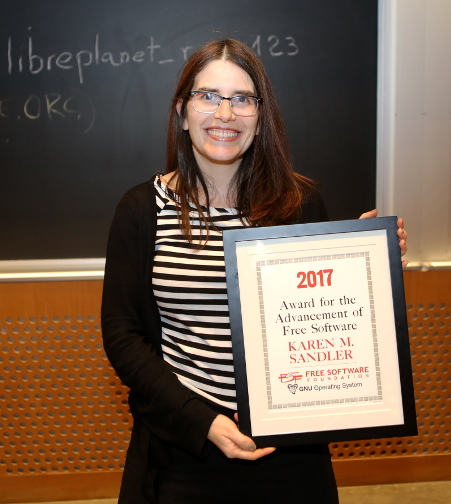
Episode 1: Karen Sandler
Oct 11, 201800:18:41Tap to summarizeKaren M. Sandler is the executive director of Conservancy. Karen is known as a cyborg lawyer for her advocacy for free software, particularly in relation to the software on medical devices. Prior to joining Conservancy, she was executive director of the GNOME Foundation. Before that, she was general counsel of the Software Freedom Law Center. Karen co-organizes Outreachy, the award-winning outreach program for women globally and for people of color who are underrepresented in US tech. She is also pro bono counsel to the FSF and GNOME. Karen is a recipient of the O’Reilly Open Source Award and cohost of the oggcast Free as in Freedom. In this inaugural episode, we have a conversation with Karen Sandler about why software freedom matters, how to build a Free Software life and how to keep going. Transcript [Abhas] Hi Karen. So we’re trying to do a small series of recording to understand how and why people work with software freedom, what keeps them going and how freedom in general affects their work or their ability to do any work, for that matter. Hopefully, this will inspire a lot more people to choose working with software freedom and freedom-related issues in general. So the first thing I wanted to do was to ask you to define what your work is about, in your own words. [Karen] That’s funny. I have never really thought of defining my work as a whole. I think my work as a whole is to work on everything that helps promote ethical technology through software freedom We are working in an era where we are building a lot of infrastructure and we are using a lot of technology in new and unexpected ways. And we are networking all of the old ways that we used technology into these new ways and we’re doing so on a lot of proprietary software as a society. It means that we are opening ourselves upto a lot of vulnerabilities and we are ceding control of a lot of our basic functionality to companies, rather than to ourselves. The things that we agree to in the electronic space are things we would never agree to in the analog space (in the real world). Most of my work is focussed around bringing awareness to these issues and doing all of the nitty-gritty stuff that we need to do to be able to conquer the world with free software and really make a change. [01:33] [Abhas] You’ve been doing this for many years. Did the context arise after you’d gone down the road for a few years? Or did you start with this context of what you want to do? Oh! Its been an evolution for me. The first time I got involved with Free Software was when I was at university and I worked at a computer lab. And I saw Linux labs and I thought – “wow! this free software thing is a cool idea; its too bad that it won’t go anywhere!”. And I guess I was really wrong. Then I went to law school and I didn’t think about software anymore. And I wound up working in this space again working at SFLC (Software Freedom Law Center) and I thought that open source was pretty cool. Then I met up with a lot of my clients and I was struck by their passion for what they were doing. Slowly over time, I started to realise that there was a lot more going on than I had previously thought. And as I went down that road, at some point, a few years in, I wound up being diagnosed with a heart condition and needed to implant a pacemaker / defliberator. And all of a sudden I was asking questions about the technology that was going to be inside my own body. And the company that I was asking that information from, and the doctors that were giving me advice, had no information to give me! It was such stark realisation and such a stark experience, that all of sudden I went from someone who thought that open source was pretty cool and definitely useful, to someone who thought that software freedom is essential. I had that really big transformation as I did that research about the ethics and the safety, just the basic safety, of the whole device that was going be sown in to my own body and screwed into my heart and it really, just, changed my life and made me realise that these are issues that you must be passionate about. And as I have experienced over the years since then, my heart device is just a metaphor for all the software that I run. So while your phone might not be literally implanted in your body or connected to a major organ, it is still something you rely on for so many basic things. And so we just can’t just think about our technology as something as a product that we buy from a company – we have to think about its impact on society and our lives. [04:02] [Abhas] So my question was going to be “why do you do this”, but I understand that from your answer. What I would like to ask you is, had it not been for your medical condition what role do you think you would’ve had? What I’m trying to say is that unless we personalise software freedom or technology freedom in general, how do we relate to it; for someone who has not faced these sort of challenges and can’t personalise it. I want to say that I have the answer for this. But if I have to be totally honest with you and anyone listening to this, I didn’t have a plan for my career particularly. I kind of went wherever it seemed reasonable for me to go. [Karen] After law school, I was a securities lawyer doing work on stocks and bonds. And I never really thought about issues in the public interest much at all. And I am so embarassed when I think about the person I was then and the issues that I think about and work for now. So I understand what its like to [inaudible]. Even going into an organisation and was working on issues around Free and Open Source Software, it wasn’t until it was presented to me as a personal issue [that I was able to examine these issues personally]. I was struck by the clients that I work for, but it was only when it became a personal issue, that I was able to internalise it and realise that this was so important. So I find that talking about my own personal experience and issues, helps people understand the relevance of the issue to them. But I think that it is actually something a little bigger. Which is that – early on, and even largely now, a lot of people who are advocating for software freedom are similar people. No similar to [inaudible] When I first heard about these issues [related to Free Software], it was older men telling me about these issues… older white men. [They were] doing great work, I might add, but I didn’t necessarily think that it was that relevant to me because these people weren’t like me and they didn’t lead the life I lead. They didn’t use the technology I use. And I think this is a critical lesson for how to expand the work of software freedom. If you’re listening to this right now, its because you already know about software freedom and you think that its valuable. And you may think that your experience is not that important, but, in fact, it is most important. So somebody who is in your situation talks about software freedom, it is going to make the biggest impact to people who are also similar to you. And I find that when I talk, especially women really respond to my story. And I think its because they are hearing it in a way they didn’t hear before. And so diversity is critical to software freedom. There is a need to have as many voices from as many walks of life talking about software freedom, it will be a much easier situation. For example, one of things that I talk about when I advocate for software freedom is the experience I had while pregnant and having a defliberator. It hadn’t even occurred to me my experience of being pregnant with a defliberator would be different when I was not pregnant. No one else except a woman with a defliberator could possibly have that experience. But it is something that I can talk about and something that people can relate to. (Abhas: I can reckon with that.) As we use our software in ways that the original authors of the software didn’t necessarily anticipate… that goes for community software but also especially for corporate-driven software and products as we deploy them in different countries and different use cases, we are going to find situations like my defliberator, where our use cases are not what the small group of people who worked on them [envisaged]. In Free Software, we can change the software to do something about it. We can customise it for ourselves. And we can educate people about it. And without that we can’t. [We should be] making sure that we have as many people talking about free software. If you are listening to this, it is because somebody has informed you about software freedom. And so its never a bad time to talk about software freedom. I talk about my doctor’s appointments at the grocery store all the time. [Abhas] But you would face challenges from people who don’t seem to care. When you talk to them in all these places, they might not care at all or they might not care enough. Because they have have not been in a similar situation. Or maybe, they might remember something you’ve told them today and they might be able to relate to it a few months or years down the line. What I’m trying to ask you is how do you inspire people to care; personally, from your experience? [Karen] Its very hard. Honestly, the way that I do it is not necessarily transferrable to other people. What I do is I talk about my own experience and I talk about the fa...
Transcribe →