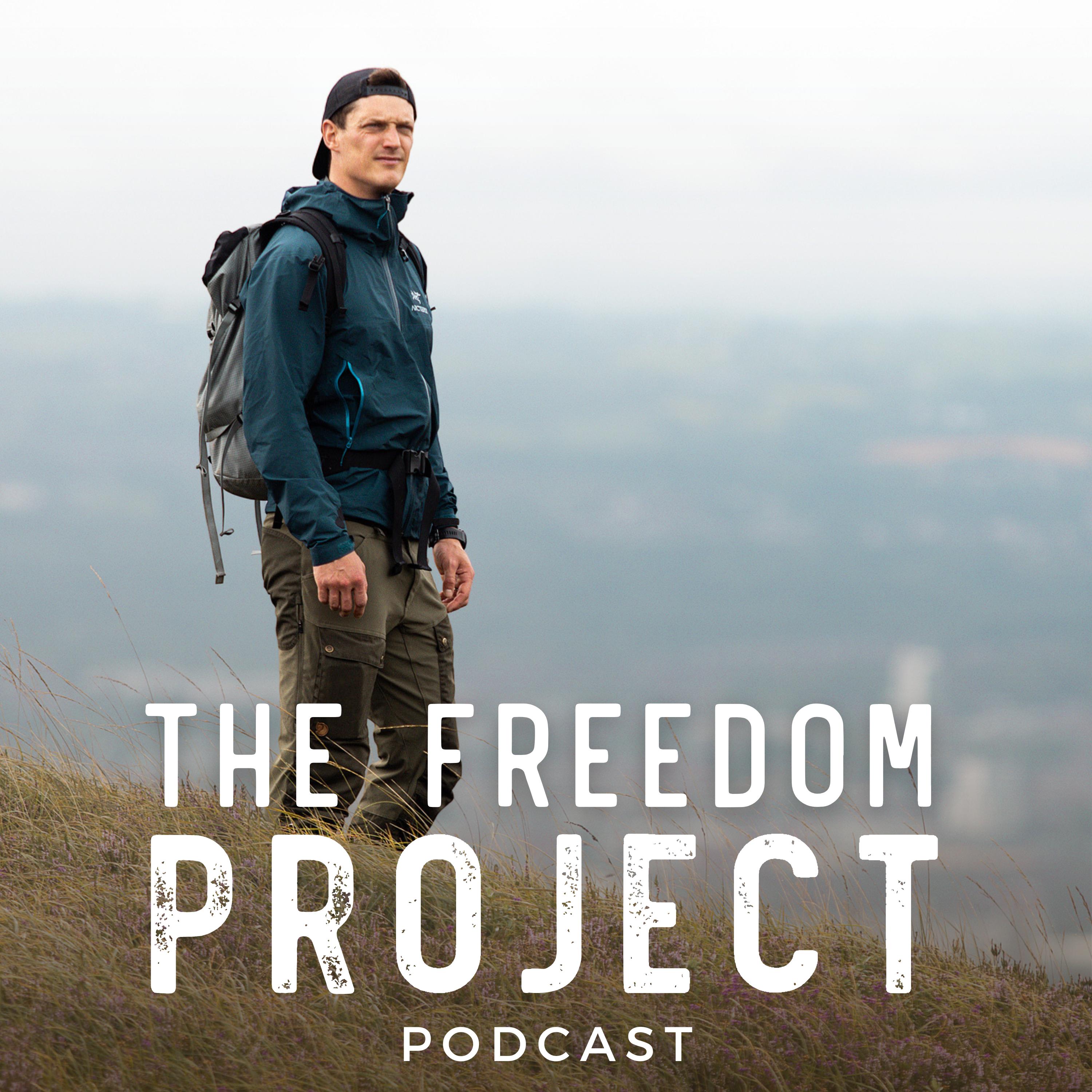
Podcast
The Freedom Project
Hosted by Tom Foxley, Mental Fitness Coach for Business Owners · EN
Do you crave freedom & want to hit peak mental fitness?
The Freedom Project is here fore those of you who live for adventure and freedom.
Your host, Tom Foxley, is a mental fitness coach, former Royal Marines Commando, a freedom seeker, skier, mountaineer, and climber who lives for adventure. Tom has been coaching elite performers for more than a decade.
In The Freedom Project, Tom aims to uncover what it takes to hit peak mental fitness for freedom seekers.
Once per week, Tom will also get highly tactical and teach you strategies you can deploy into your own life.
If you want to learn peak mental fitness, and love creating freedom, this is the podcast for you.
www.instagram.com/tomfoxley
14episodes
Episodes
Newest firstAll episodes
You'll Call It Fate
1w ago00:29:02Tap to summarizeFor twenty years I picked the hardest thing in the room and made sure people could see me do it. I called it ambition. It was an eight year old who didn't feel like he mattered, running every decision I made, and I never once heard it. There's a line usually put on Jung. Until you make the unconscious conscious, it will determine your life, and you'll call it fate. This one is about the thing driving you that you can't see. Where it comes from, why self-awareness doesn't catch it, and what it quietly does to a business once it's built one. Then the part that made me want to record it. Every amplifier a business owner has ever held reflects his inner world back at him. Headcount used to. Now AI does, faster, with no sanity check left in the loop. If your thinking is unclear, AI won't fix it. It multiplies it. Inside: the three ways something ends up in your blind spot, how a financial planner worked out he was creating chaos just so he could solve it, and the one thing I'd train before handing your thinking to a machine. Take the assessment I run with every client at tomfoxley.me.
Transcribe →Junk Volume: Why 16 Hour Days Produce 8 Hours of Work
2w ago00:07:17Tap to summarizeA client of mine works sixteen hour days. Up at four, in the office by seven, laptop still open at eleven at night. I asked him to rate the quality of that work out of a hundred. He said fifty. Maybe sixty. So we did the arithmetic together. Fifty percent of sixteen hours is eight hours. He's producing one working day and paying for two. Every endurance athlete already understands this pattern. You run every session at the same middling pace, too slow to build the aerobic base and too fast to build speed, and after eight weeks you're tired and no quicker. Coaches call it junk volume. Business owners do junk volume at the desk, and fatigue makes it feel like something happened. In this episode I break down why sixteen hours at full quality was never available to you, what the research on deliberate practice says about the real ceiling, and what changed for Dean McMahon when he stopped working more and started working on far less of the right stuff. Two sets and reps at the end. Find your three hours, and write your not-to-do list. If you recognised your own week in this, book a Mental Performance Blueprint Call at tomfoxley.me. Thirty minutes, no pitch, and if it isn't a fit I'll be the first to say so.
Transcribe →The Business Owner Who Couldn't Stop Doing Everyone Else's Job
3w ago00:05:33Tap to summarizeA client showed up early to do a job that wasn't his anymore. Nobody asked him to. He couldn't stop himself. In this episode I break down what was running underneath that habit: busyness as identity, the quiet competitiveness that creeps in between a leader and their own team, and the four-word framework I now use for saying a hard thing without softening it into nothing. If you've ever done someone else's job before they had the chance, stayed visibly busy so nobody would question whether you were working, or softened feedback because you needed to stay the good guy in the room, this one's for you. In this episode: Why busyness becomes an identity, not just a schedule The quiet competitiveness that shows up between a leader and their own team A four-word framework for saying a hard thing without softening it into nothing Book a Mental Performance Blueprint Call at tomfoxley.me.
Transcribe →The GP's Mouthwash — Why Business Owners Keep Treating the Wrong Problem
May 1100:08:11Tap to summarizeFor about a month, Tom Foxley's tongue felt like it was housing a small mammal. He knew from the start he should go to the dentist. But she's expensive and her waiting room has a specific combination of clinical smell and Radio 2 that he finds miserable. So he went to his GP instead — easier, more accessible, felt like doing something. The GP prescribed medication and a mouthwash. His tongue didn't improve. His teeth started staining. He'd created a new problem by treating the original one incorrectly. When he finally booked the dentist, she physically recoiled at what he'd been prescribed. Thirty minutes later: teeth back to white, actual solution in hand. Salt water with a pinch of bicarb. Free. Thirty seconds. Perfect for the problem. All of it avoidable if he'd just gone to the right person at the start. In this episode, Tom maps that experience onto the pattern he sees most consistently in business owners — something that's been off for a year or longer, that they know is there, but instead of addressing directly they reach for the accessible option. Podcasts, books, breathwork, meditation apps. All decent things in the right context. But for the specific problem of having outgrown the operating system running the business, they treat the surface. They don't touch the thing underneath. Topics covered: - The tongue story — and why it maps perfectly onto how intelligent business owners avoid their real problem - What it actually means to outgrow your operating system - Why the drive, focus and ability to push through become less reliable over time — and what that signals - Why reading about this problem won't move anything — and what does - What a proper diagnostic conversation looks like — and what it isn't
Transcribe →2am, a Wet Giraffe and What It Clarified About Resilience
May 800:06:51Tap to summarize2am on a Tuesday. Daughter sick. Bathroom dark. Boxers. Wet stuffed giraffe. 18-month-old supervising from the doorway with the expression of a senior consultant reviewing a deliverable. In the middle of it, Tom had a very clear view of his month. Product launch. Upcoming heart surgery. Ultra marathon training. The business. Being present at home. None of it relevant. This was the job. In this episode he talks about the version of himself that would have handled that night very differently — not in the bathroom, but in the days that followed. The familiar pattern of pushing through on nothing, white-knuckling the day after, patience thinning, quality of thinking dropping, recovery taking longer than it should. That's resilience. Absorb the hit and keep going. And it sounds like toughness — until you notice that absorbing hits repeatedly without anything actually adapting just means accumulating damage you haven't fully accounted for yet. Tom learned resilience in the military. In that context, it's exactly right. But running a business while training, while being a husband and a father and refusing to let any of those things become just words — that's not the military. And grizzing it out every time something goes sideways doesn't build anything. It just costs you slowly until one day the engine is less reliable than it was. This episode is about what he's been building instead. Topics covered: - Why resilience is armour — and why armour has a weight limit - The difference between absorbing pressure and being built by it - What it looks like when decisions get cleaner under load rather than murkier - Why the hard week ends and you're not carrying the residue into the next one - Why understanding this concept changes nothing — and what does - The question worth sitting with about what happens to your performance after pressure lands
Transcribe →Emotions Are Data — What the Most Successful Operator Tom Knows Does Differently
May 600:07:19Tap to summarizeLast weekend Tom Foxley had dinner with the most successful man he knows. Not just commercially — though the numbers are serious. What made him different was the combination: the external success and a genuine internal ease. Good health. A marriage that works. In his 60s and moving through life in a way that's rare enough that you notice it immediately when you're in the room. After dinner he gave a speech about his wife and the people around him. Mid-speech, in front of twenty people, he let a few tears fall. Didn't push through them. Didn't apologise. Just let them be there. The next morning, walking in the Yorkshire Dales, Tom brought it up. Started to say he thought more business owners should be able to do that, because — The man stopped him. "Because they'd make better decisions, wouldn't they?" This episode is built around that line. Because the path to building something real tends to reward suppression — push it down, stay logical, don't let it get personal. And for a while, that works. But somewhere it becomes the ceiling. Not the strategy, not the market, not the team. The fact that the operator has been overriding their own signal for so long they've lost the ability to read it. Emotions aren't the thing getting in the way of good decisions. They're part of the data set. Topics covered: - The dinner, the speech and what it means to have nothing to prove - Why suppression doesn't produce better decisions — it produces incomplete ones - What anger, fear, shame and frustration are carrying that logic alone cannot generate - Why the hire that doesn't sit right usually isn't right — and what happens when you stop overriding it - What shifts when operators learn to read rather than suppress - The first rep to start building this as a skill this week
Transcribe →I'll Be Present When Things Settle Down — The Most Expensive Lie in Business
May 400:05:47Tap to summarizeThis morning Tom Foxley sat in the garden watching his daughter look at something in the grass. Just there. Fully. Nothing lost. That sounds unremarkable. For a long time, it would have been impossible — because Tom is by default a distracted person. Anxious head, always moving, obsessive about progress in a way that doesn't switch off when he leaves the desk. For years he told himself it was just how he was wired. The price of being driven. The honest version looked like: phone out mid-conversation. Wife talking, part of his brain somewhere else. And the quiet, persistent belief that he'd be present when things settled down. When the business was more stable. When this particular pressure lifted. Things don't settle down. You just keep deferring the version of yourself you actually want to be. In this episode Tom traces what changed — the moment he saw clearly what kind of father he'd become if nothing shifted, the training that followed, giving up twice, and what it eventually built. Not just at home. In the business too. Because the weeks where his mind was most scattered tracked directly with his worst decision-making, his most deferred conversations, his most avoided work. Presence isn't a personality type. It's a capacity you build. And you can start the first rep today. Topics covered: - Why driven, ambitious people are often the worst at being present — and why they mistake it for a feature - The pattern connecting mental scatter to poor business performance - Why "I'll be present when things settle" is the most expensive lie in business - What the training actually looked like — including failing and starting again - What it means to build something you can actually inhabit - Where your attention is right now — and who gets the remainder
Transcribe →Two Kinds of Operator — And the Training That Separates Them
May 200:07:45Tap to summarizeA few years ago, lying in a tent in the Hindu Kush with destroyed legs and altitude-split lips, Tom Foxley found himself in a conversation about Everest. Why it pulls at people. And why, despite that pull, he realised he didn't want to climb it — not the way most people climb it. Fixed ropes from base to summit. Guided queues. Infrastructure rebuilt every season so that people reach the top regardless of whether they were truly ready. His climbing partner said something Tom has been turning over ever since: everyone gets to the top, but everyone who knows the mountain knows how they got there. That's style. In this episode, Tom maps that principle onto the two kinds of operator he sees every week in business. The one who moves constantly but struggles to name what they actually built today. And the one running what looks like a similar business — similar revenue, similar team, similar pressure — but where decisions don't come back, problems stay solved, and calm is a trained state rather than a lucky one. The gap between those two operators isn't information, discipline or a smarter model. It's training. And almost nobody does it — not because they don't want to, but because nobody told them it was available. Topics covered: - The Hindu Kush, Everest and what mountaineering style reveals about business operators - The two kinds of operator — what actually separates them - Why masterminds, accountability and systems are the fixed rope version of building a business - The difference between engineering around your gaps and closing them - What it looks like when the internal architecture does the work the external structures used to do - The question worth sitting with this week
Transcribe →You Can't See It From Inside It — The Hidden Operating System of Every Business Owner
Apr 3000:05:41Tap to summarizeLast weekend Tom paid a Michelin Star bill without flinching. That sounds completely unremarkable. For a long time, it wouldn't have been — because he knew exactly what his body would do when the bill arrived. Stomach tightening before he'd seen the number. Low-grade dread that followed him home and bled into the next morning. He'd told himself that was just being sensible. Knowing where he'd come from. It wasn't. It was a belief about money running quietly underneath every decision he thought he was making rationally. In this episode Tom unpacks that pattern — and three versions of it he sees constantly in the business owners he works with. The operator whose need to be liked means the standard never quite gets held. The one running from an old version of themselves, so every financial and hiring decision has fear underneath it instead of ambition. And the one who privately suspects they're not quite what everyone around them thinks — so they stay in the weeds, overwork to cover it, and never quite let the business reach the level it could. None of it is weakness. It's a pattern that formed somewhere, for a reason, and never got examined. And patterns respond to training. The problem: you can't see it from inside it. Until someone helps you find it, it's making calls on your behalf. Topics covered: - The quiet money belief that ran Tom's financial decisions for years — and the moment it shifted - The three hidden patterns most common in high-performing operators - Why the need to be liked, fear of going back and imposter syndrome all produce the same result - Why delegating feels like exposure — and why some operators unconsciously keep the business smaller than it could be - Why familiar decisions aren't always rational ones - What changes when the pattern gets found
Transcribe →Why Your Business Mentor Might Be Killing Your Business
Apr 2600:05:18Tap to summarizeYou hired a business mentor to shortcut your path to growth. Now you've got a generic to-do list, a sales system that makes you feel fake, content bringing in the wrong leads, and advice that doesn't account for the complexity of your life, your model, your clients, or your strengths. In this episode, Tom Foxley makes the case that most business coaching doesn't work — not because the strategies are wrong, but because they belong to someone else. Coaches teach what built their business. That is almost never what will build yours. What you're really buying from most business mentors is an illusion of certainty. The social proof, the testimonials, the case studies — those are the people who naturally aligned with that coach's model. For everyone else, following the blueprint produces an imitation. A Russian doll of someone else's business. The real competitive advantage isn't a better system. It's deeper self-knowledge. Knowing yourself thoroughly enough to build something that only you could build — and that fits you so well it stops feeling like work. Topics covered: - Why generic business advice produces generic businesses - The illusion of certainty that most coaching is actually selling - Why copying a business model makes you an imitation of your mentor - Naval Ravikant — do what feels like play to you but looks like work to others - Two real client examples of business owners who scrapped the standard model and built their own - Why self-knowledge is where real business growth starts
Transcribe →