Podcast
The Uncertainty E.D.G.E.
Hosted by Sam Sivarajan · EN
The Uncertainty E.D.G.E. Podcast reveals what judgment looks like when certainty doesn't exist—and waiting isn't an option.
Hosted by Sam Sivarajan—former investment banker ($40B+ in M&A), three-time wealth firm leader ($80B+ AUM), and behavioral scientist—each episode explores how people navigate decisions when outcomes aren't clear, tradeoffs feel unavoidable, and responsibility can't easily be delegated—the kind of uncertainty leaders face in the real world.
These aren't polished success stories. They're honest explorations of how people make high-stakes decisions when:
- The data is incomplete
- Stakeholders demand clarity
- Delay carries its own cost
- And acting feels just as risky as waiting
Through conversations with executives, investors, and experts who've made and lived with consequential decisions, the podcast surfaces:
- What couldn't be known at the time
- What pressures shaped the decision
- What tradeoffs were actually on the table
- How judgment was exercised without guarantees
This is decision-making as it actually happens—not as it's modeled in hindsight.
The Uncertainty E.D.G.E. Podcast is for people accountable for decisions that matter: senior leaders, business unit heads, investors, and operators who must act with clarity when certainty is impossible.
No best practices. No leadership slogans. No predictions.
Just the reality of deciding when the stakes are real.
Want practical tools for navigating uncertainty? Subscribe to The Uncertainty E.D.G.E. newsletter at www.theuncertaintyedge.com for frameworks you can use immediately.
31episodes
Episodes
Newest firstAll episodes
Why Mother Nature Doesn't Care About Politics—and Neither Should Your Business with Steven Rothstein
Mar 1700:46:51Tap to summarizeEpisode OverviewIn this episode of The Uncertainty Edge, host Sam Sivarajan speaks with Steven Rothstein, Chief Program Officer at Ceres, about navigating climate uncertainty and transforming it into strategic advantage. They explore the evolving landscape of climate risks and opportunities, the critical role of climate disclosure in decision-making, and how companies are making long-term sustainability investments despite political polarization. Rothstein addresses greenwashing concerns, the insurance industry's climate challenges, and the importance of integrating climate considerations across all business functions while highlighting emerging innovations and practical tools for managing uncertainty.Key Quote"Mother Nature doesn't care about politics." — Steven RothsteinKey TakeawaysClimate change is a present reality — No longer a future issue, requiring immediate action and long-term thinking.Climate disclosure drives transparency — "You can't manage what you can't measure" applies to climate risk management.Opportunities amid risks — Climate challenges create innovation and competitive advantages for forward-thinking companies.Sound Bites"Mother Nature doesn't care about politics.""We need to build in the price of carbon.""You can't manage what you can't measure.""Climate risks are increasing, but so are opportunities for innovation."Topics Discussed00:00 — Climate Uncertainty and Strategic Advantage03:03 — Evolution of Climate Risks and Opportunities10:53 — Climate Disclosure in Decision-Making18:16 — Addressing Greenwashing and Building Trust29:43 — Economic Impact of Climate Events31:48 — Insurance Challenges in a Changing ClimateResources MentionedLearn more about Steven Rothstein:CeresStay Connected with The Uncertainty EDGESubscribe on your favorite podcast platform.Join the conversation on LinkedIn.Explore Sam's website.
Transcribe →Progress Over Perfection: Philip Setter's Digital Transformation
Mar 300:54:53Tap to summarizeEpisode OverviewIn this episode of The Uncertainty Edge, host Sam Sivarajan sits down with Philip Sutter, founder of PolicyStream and Affinity Life, to explore how he transformed his insurance practice into a thriving six-figure digital business built entirely through content marketing. Philip shares his journey from creating terrible webcam videos to building a specialized practice serving rock climbers and extreme sports enthusiasts.Key Quote"Progress over perfection isn't motivational fluff—it's the framework that allows you to navigate every major pivot in your career." — Sam SivarajanKey TakeawaysProgress over perfection — Start badly and improve daily rather than waiting for the perfect moment.Niche down to scale up — Being a big fish in a small pond makes you referable beyond that pond.Intent drives authenticity — Shift from "I need leads" to "Who am I genuinely trying to help?"Sound Bites"You don't learn by researching—you learn by doing.""Your niche isn't a cage. It's a spotlight.""When you focus on serving rather than selling, people feel it.""The leaders who thrive aren't the ones with all the answers—they're the ones willing to start before they're ready."Topics Discussed00:00 — Building a Six-Figure Digital Business Through Content00:35 — Progress Over Perfection: Starting Badly and Improving Daily01:09 — Niche Down, Scale Up: The Power of Specialization01:50 — Intent Drives Authenticity in Content and Client Relationships02:26 — Thriving in Uncertainty with ConvictionResources MentionedPolicyStreamAffinity LifeStay Connected with The Uncertainty EDGESubscribe on your favorite podcast platform.Join the conversation on LinkedIn.Explore more insights on Sam's website.Free ResourcesThe Uncertainty E.D.G.E. newsletter — Strategies for navigating financial uncertainty.The Good Human Practice newsletter — Insights on leadership and meaningful client relationships.
Transcribe →From Warrior to Elder: How Redefining Success Transforms Life’s Disorientation with Nick Shelton
Feb 1700:51:02Tap to summarizeEpisode OverviewIn this episode of The Uncertainty Edge, host Sam Sivarajan sits down with Nick Shelton, author of An Introvert's Guide to World Domination, to explore navigating life's challenging transitions—from military service to early retirement at 49. Nick shares the existential crisis he faced and the frameworks he developed to rebuild purpose beyond achievement.Key Quote"Readiness isn't just about money. It's about auditing your sense of purpose and what will fill those hours when the familiar scorecard disappears." — Sam SivarajanKey TakeawaysThe currency that no longer spends — Retirement requires auditing purpose and daily structure.Warrior to elder mindset — Success shifts from targets to mentoring and impact.Design your reset — Audit, rebuild, and reintroduce yourself intentionally.Sound Bites"The guilt of 'I won, so why am I unhappy?' is more common than people admit.""You don't wait for purpose to find you. You architect it.""The best transitions aren't accidental. They're designed."Topics Discussed00:00 — Military Service to Early Retirement00:35 — The Currency That No Longer Spends01:09 — Warrior to Elder: Redefining Success01:50 — Design Your Reset02:13 — Architecting Purpose with AccountabilityResources MentionedReset the ManNick Shelton on LinkedInNick's TEDx TalkAn Introvert's Guide to World DominationStay Connected with The Uncertainty EDGESubscribe on your favorite podcast platform.Join the conversation on LinkedIn.Explore Sam's website.Free ResourcesThe Uncertainty E.D.G.E. newsletter — Strategies for navigating financial uncertainty.The Good Human Practice newsletter — Insights on leadership, resilience, and client relationships.
Transcribe →Navigating Succession Planning for Financial Advisors with Andrew Mirolli
Feb 300:48:45Tap to summarizeSummaryIn this episode of The Uncertainty E.D.G.E. podcast, Sam Sivarajan interviews Andrew Mirolli, co-founder of BuyAUM, about the unique challenges and solutions in succession planning for smaller advisory practices. Andrew shares insights on the current landscape of financial advisory succession, the importance of understanding market demand, and the innovative vision casting process that BuyAUM employs to help advisors transition their practices smoothly. The conversation also touches on the potential conflicts of interest in the advisory business model and offers actionable advice for advisors preparing for a successful transition.TakeawaysThere is a significant gap in succession planning for smaller advisory practices.Many advisors lack viable succession options, leading to potential business disruption.The vision casting process involves understanding the seller's true value and legacy.BuyAUM focuses on a relationship-first approach to match buyers and sellers.Sellers often regret their decision to sell due to lack of planning for life after selling.The market for smaller practices is growing, but many advisors are unaware of their value.Advisors should normalize their fees to industry standards to improve practice valuation.Building relationships with the next generation of clients is crucial for retention.The discovery process is key to understanding what sellers truly want in a transition.Authentic service and transparency are vital in navigating potential conflicts of interest.Sound bites"There's a better way to do this.""70% of sellers regret selling.""It's all about a perfect match."Chapters00:00 Introduction to Succession Planning for Advisors03:54 The Landscape of Financial Advisory Succession09:59 Understanding Market Dynamics for Smaller Practices13:48 The Vision Casting Process Explained19:43 Navigating Trade-offs in Succession Planning25:43 The Art of Tailored Introductions29:02 Navigating Buyer-Seller Dynamics32:12 Maintaining Balance in Relationships33:21 Conflict of Interest and Authentic Service38:54 Preparing for a Successful Transition43:53 Lessons in Entrepreneurship and LifeKeywordssuccession planning, financial advisors, advisory practices, market demand, vision casting, transition planning, exit strategy, buyer-seller relationship, advisory business model, retirement planning
Transcribe →Bridging the Gap: Insights from Jim Effner
Jan 2000:50:39Tap to summarizeSummaryIn this episode, Sam Sivarajan interviews Jim Effner, President and CEO of P2P Group, who shares his journey from a rookie financial advisor to a successful leader in the industry. Jim discusses the importance of mindset, the gap between potential and performance, and the evolving nature of sales training in financial services. He emphasizes the need for continuous growth, the significance of having a purpose, and the timeless principles of building trust and relationships with clients. Jim also provides actionable insights on prospecting and the importance of embracing discomfort to tap into one's potential.TakeawaysThe importance of evolving goals as one gains experience.Impact is a key focus for Jim in his current role.Mindset and environment are crucial for success.Competence, confidence, and courage are interconnected.Sales training has diminished in the industry.Prospecting requires a shift in mindset.Building trust is timeless in financial services.Continuous learning is essential for growth.Embracing discomfort leads to personal development.Sound bites"The world was my oyster.""Impact is my one word.""Sales is life."Chapters00:00 Introduction to Jim Effner and His Journey01:37 Early Success and Competitive Drive06:25 Evolving Goals and the Importance of Purpose11:02 Understanding the Gap Between Potential and Performance17:32 Mindset and Environment: Keys to Success22:45 The Role of Competence, Confidence, and Courage27:04 The Shift in Sales Training and Its Impact36:44 Prospecting Challenges and Mindset Shifts43:50 Timeless Principles in Financial ServicesKeywordsfinancial services, sales training, mindset, performance, leadership, coaching, financial advisors, personal development, success, professional growth
Transcribe →Navigating Uncertainty: Lessons from Everest
Jan 600:12:08Tap to summarizeSummaryThe Uncertainty Edge Podcast explores the complexities of decision-making in uncertain environments, using the Everest disaster as a case study to highlight the challenges leaders face when certainty is absent. The podcast introduces the E.D.G.E. Framework, which aims to improve judgment under pressure and emphasizes the importance of understanding VUCA (Volatility, Uncertainty, Complexity, Ambiguity) in decision-making processes.TakeawaysThe podcast has evolved to focus on decision-making under uncertainty.The Everest disaster serves as a powerful case study for decision dynamics.VUCA describes the environment but doesn't guide decision-making within it.Judgment often fails when certainty is lacking, leading to poor decisions.The E.D.G.E. Framework helps establish a rhythm for decision-making under pressure.Most organizational failures stem from drifting decisions and implicit trade-offs.Deliberate judgment is crucial for shaping outcomes in uncertain conditions.The podcast will explore real decision moments and the trade-offs involved.Understanding when to act and when to wait is essential for leaders.Clarity is practiced under pressure, not found in calm.Sound bites"Waiting feels risky when certainty is absent.""Uncertainty isn't the problem to eliminate.""Clarity isn't found in calm."Chapters00:00 Introduction to the Uncertainty Edge Podcast01:29 The Everest Disaster: A Case Study in Decision Making04:17 Understanding VUCA: The Environment of Uncertainty07:01 The Edge Framework: A New Approach to Decision Making09:10 The Focus of the Podcast: Decisions Under PressureKeywordsdecision making, uncertainty, VUCA, Everest disaster, leadership, judgment, pressure, commitment, frameworks, organizational failures
Transcribe →
Marketing Like Red Bull: Winning the Attention Economy with Charlie Grinnell
Dec 2601:03:07Tap to summarizeHow do financial brands win in a world where attention—not capital—is the scarcest resource?In this episode, Sam Sivarajan is joined by Charlie Grinnell, co-founder and CEO of Right Metric and former global head of social at Red Bull, for a sharp, practical conversation on modern marketing in financial services. Charlie breaks down what disruptors like Chime and Wealthsimple understand about the attention economy that traditional institutions often miss—and why long-term thinking is the real competitive edge.They explore how to reach Gen Z and millennial clients authentically, why attribution is often misleading, and how advisors and firms can start acting like media companies without losing trust.If you want marketing that actually moves behavior, this episode is a must-listen.
Transcribe →
Turning Policies Into Purpose: A Guide to Charitable Life Insurance Strategies with Joseph Galli
Dec 900:45:24Tap to summarizeEpisode SummaryIn this episode of The Future Ready Advisor, Sam Sivarajan speaks with Joseph Galli, entrepreneur and founder of a medical foundation that’s reshaping how life insurance can fund philanthropy.Joseph shares his personal journey into charitable work, how he created a foundation to fund medical research, and how he’s built innovative life insurance donation programs that combine financial planning, philanthropy, and tax efficiency. He also dives deep into the compliance aspects of these programs, the 310 rule, and how advisors can ethically and strategically guide clients in transforming unwanted policies into charitable legacies.This episode is a must-listen for advisors seeking to expand their value proposition and help clients make a lasting impact.Key Takeaways· Joseph’s philanthropic journey began with personal family health challenges.· His foundation funds medical research through non-traditional methods, avoiding gala-based fundraising.· Life insurance donations can unlock major tax benefits while supporting meaningful causes.· The 310 rule enables donation of term policies not originally intended for charity.· Compliance is critical—ethical advisory practices are key to execution.· Advisors can help clients monetize unwanted policies, converting them into charitable receipts.· Philanthropy should be a core strategy in financial and estate planning.· Life insurance gives clients a unique path to leave a legacy and support medical innovation.Episode Chapters00:00 – Introduction to Innovative Philanthropy03:06 – Joseph Galli's Personal Journey and Foundation05:48 – The Need for a Holistic Approach in Medical and Financial Services08:56 – Building Sustainable Funding Models for Medical Research11:45 – Understanding Life Insurance Donations and Tax Benefits15:00 – Real-Life Examples of Life Insurance Donations17:54 – Navigating Compliance in Philanthropic Endeavors24:17 – Navigating Financial Dignity in End-of-Life Planning26:55 – Compliance and Family Dynamics in Policy Donations28:37 – Identifying Ideal Candidates for Charitable Donations30:34 – The Role of Advisors in Policy Donations34:11 – Philanthropy as a Cornerstone of Financial Planning36:35 – The Future of Life Insurance Donations in Financial StrategiesSound Bites"We only do one in five policies.""We have an IRR that we have to meet.""This is a problem — this is an opportunity."Featured Quote"This is a problem — this is an opportunity."— Joseph Galli, on recognizing how life insurance can be repurposed for philanthropyKeywordsphilanthropy, life insurance, charitable donations, tax benefits, medical research, compliance, financial planning, estate planning, Joseph Galli, Future Ready Advisor
Transcribe →
When Genius Fails: The Day the Models Broke
Nov 2500:20:07Tap to summarizeEpisode Description: In September 2008, Lehman Brothers—who survived the Civil War, two World Wars, and the Great Depression—collapsed in one of the largest bankruptcies in American history. They had Nobel laureates on staff, sophisticated models, and decades of market data. Yet they missed the critical difference between managing risk and navigating uncertainty. In this solo episode three days before the book The Uncertainty E.D.G.E. Lead with Clarity, Adapt with Confidence, Win with Conviction launches, Sam Sivarajan reveals why smart leaders repeatedly make this mistake and introduces the framework that helps you avoid it.Key Takeaways:Why sophisticated risk management can blind you to true uncertaintyThe critical difference between risk (calculable) and uncertainty (unpredictable)How Lehman Brothers' 25-sigma events revealed the limits of modelingThe four-phase EDGE framework: Establish, Diagnose, Go, EvolveWhy the next two years require uncertainty navigation over risk managementPre-Order The Uncertainty Edge: 🔥 Black Friday Special (ends Dec. 1): [Pre-order here] Regular launch price begins Dec. 2ndConnect with Sam:LinkedIn: https://www.linkedin.com/in/samsivarajan/Website: https://www.samsivarajan.com/Mentioned in This Episode:November 18 newsletter: "Why Smart Leaders Miss the Real Danger"Lehman Brothers collapse (2008)Richard Fuld and the 25-sigma eventsThe 2008 financial crisis lessonsJPMorgan's adaptive response under Jamie Dimon
Transcribe →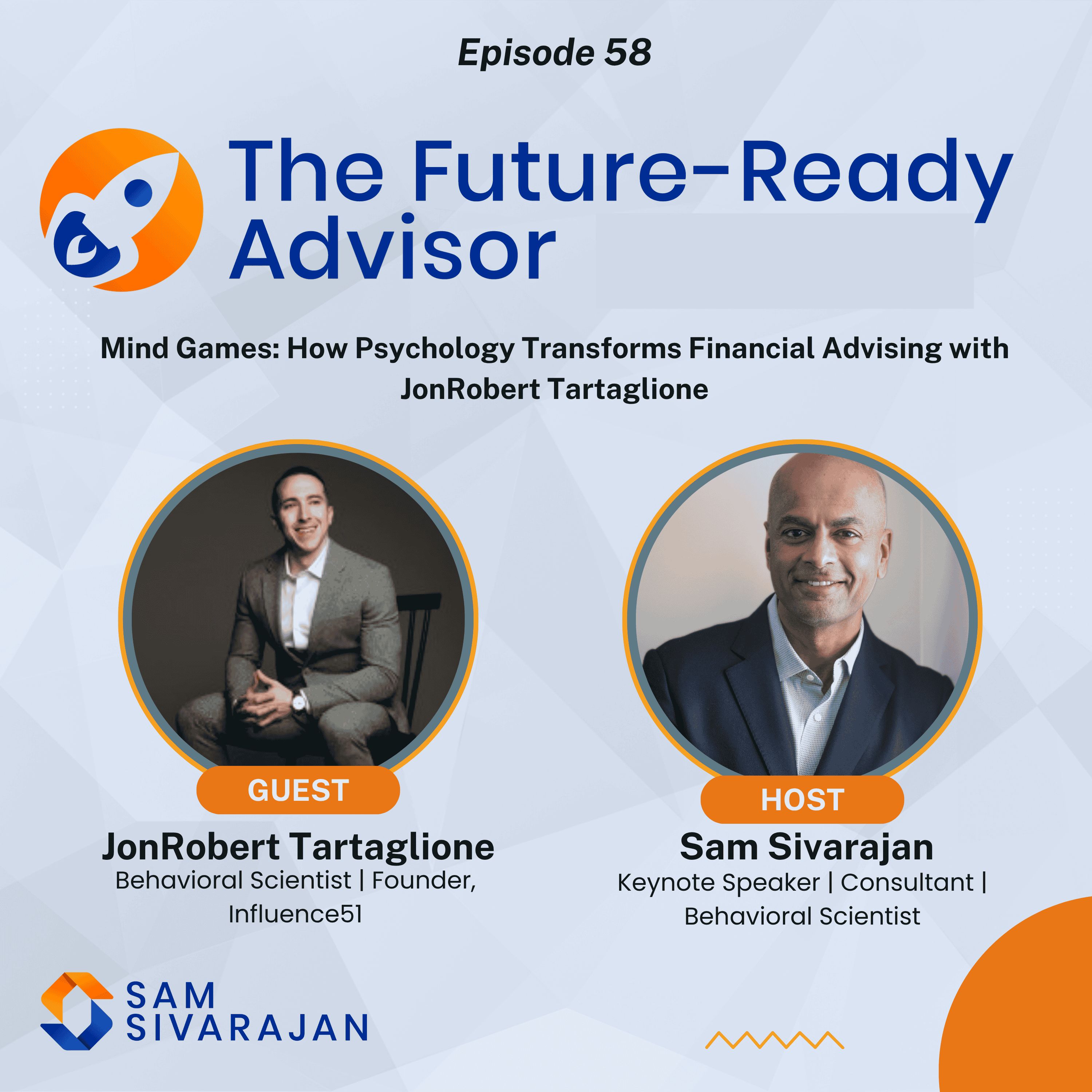
Mind Games: How Psychology Transforms Financial Advising with JonRobert Tartaglione
Nov 1100:59:07Tap to summarizeEpisode OverviewIn this episode of The Future-Ready Advisor, host Sam Sivarajan sits down with JonRobert 'Tat' Tartaglione, a behavioral scientist and founder of Influence 51, to explore the fascinating intersection of psychology and financial advising. With a doctorate in psychology from Cambridge, Tat specializes in translating complex behavioral science insights into practical tools that financial professionals can implement immediately.They discuss how small changes in language and framing can dramatically influence client decisions, why choice architecture matters more than we realize, and how metaphors shape our perception of financial concepts. Tat shares practical examples of behavioral science principles in action, from commitment devices to loss aversion, all tailored specifically for financial advisors seeking to improve client outcomes.Whether you're looking to enhance client communication, drive behavioral change, or simply understand the psychological forces behind financial decisions, this conversation offers actionable strategies that bridge the gap between academic research and real-world application.Key Quote'Language matters so, so much. There is a difference between saying \'80% fat free\' and \'20% fat\'. Even seemingly insignificant tweaks matter.' — JonRobert TartaglioneKey TakeawaysChoice architecture dramatically influences decisions - how options are presented matters more than the options themselves.Metaphors shape financial conversations - the language we use guides how clients conceptualize financial concepts.Commitment devices drive action - creating accountability structures helps clients follow through on financial plans.Loss aversion is a powerful motivator - framing choices to highlight what clients might lose creates stronger incentives.Subtle language changes yield big results - even minor wording adjustments can significantly impact client decisions and behaviors.Sound Bites'When it comes to choice architecture, the way you present options affects how people choose, even when the options themselves don't change.''Money doesn't influence decisions—the psychology around money influences decisions.''People will work harder to avoid losing $5 than they will to gain $5, even though mathematically it's the same amount.''Budgeting as 'paying your future self' reframes the experience from loss to investment.''Metaphors aren't just flowery language—they guide how people conceptualize problems and solutions.'Topics Discussed00:00 - Introduction to JonRobert Tartaglione and Influence 5101:39 - The Gap Between Behavioral Science Research and Practical Application06:37 - Understanding Choice Architecture in Financial Advising15:06 - Loss Aversion and How to Frame Financial Decisions22:04 - The Power of Commitment Devices to Change Client Behavior31:24 - Metaphors and Language: How Words Shape Financial Perceptions46:43 - Making Behavioral Science Concrete for Different Industries48:15 - The Critical Importance of Language in Client CommunicationsResources MentionedLearn more about JonRobert Tartaglione and his work: https://www.influence51.comStay Connected with The Future-Ready AdvisorSubscribe on your favorite podcast platform to never miss an episode.Join the conversation on LinkedIn—
Transcribe →