
Podcast
The Geneva Learning Foundation
Hosted by The Geneva Learning Foundation · EN
The Geneva Learning Foundation is a Swiss non-profit with the mission to develop, trial, and scale up new ways to lead change to tackle the challenges that threaten our societies.
The Foundation’s unique approach to education as a philosophy for change fosters the emergence of self-motivated learners who become leaders for change. The podcast is a crossroads for a new kind of dialogue – and an opportunity to listen in.
A broad range of topics are covered, ranging from immunization to women's health, noncommunicable diseases (NCDs), neglected tropical diseases (NTD), humanitarian response, digital communication, and leadership for learning.
The common thread is the Foundation’s mission to support practitioners to find better ways to learn and lead to face the threats to our societies.
Our podcast includes the best of our live-streamed content in a convenient, low-bandwidth audio format that you can listen to anywhere, any time.
25episodes
Episodes
Newest firstAll episodes

Equity matters: Identifying and eliminating biases in health systems
Apr 11, 202501:24:28Tap to summarizeLearn more & request your invitation: https://www.learning.foundation/bias # Equity Matters: Identifying and eliminating biases in health systems Every day, unfair treatment determines who benefits from health systems. When certain groups are excluded from research, we miss crucial knowledge about how diseases and treatments affect them. When policies ignore some communities, people face greater health risks and suffer unnecessarily. ## Why this matters Bias in health systems has real consequences: - Lives are lost when care is not equitable - Limited resources are wasted on ineffective programs - Communities lose trust in health services - Research misses critical insights when it excludes certain populations The BIAS FREE Framework offers a practical approach to identify and address these inequities—looking beyond single factors like gender to examine how multiple forms of exclusion intersect and compound. ## What you will experience This interactive session brings together health professionals, community members, researchers, policy makers, and humanitarian responders across 137 countries to share real experiences with bias and discover practical solutions. During the live event, participants will explore seven key questions covering various aspects of the BIAS FREE Framework. You will: - Learn to quickly spot the three main types of bias in any health work - Discover simple questions to check if your work treats all people fairly - Gain practical tools to address problems once identified - Develop strategies to discuss bias with colleagues who may not recognize it - Explore measurement approaches to track your progress - Build connections with others committed to equity in health ## Guidance from experts Two distinguished "Guides on the Side" will provide context and feedback: - **Mary Anne Burke**, co-author of the BIAS FREE Framework - **Brigid Burke**, sociologist specializing in equity, diversity, and accessibility Rather than lecturing, these experts will respond to participant experiences, helping connect patterns and offering insights to deepen our collective understanding. ## Who should attend This event is valuable for anyone working in health systems: - **Community members and frontline workers**: Your lived experience is essential to understanding how health systems truly function - **Health professionals**: Discover tools to address hidden biases preventing quality care - **Humanitarian responders**: Learn rapid assessment techniques for inclusive emergency response - **Program managers**: Uncover adjustments that can dramatically increase your reach - **Researchers**: Transform methodologies to eliminate biases that compromise validity - **Policy makers**: Gain frameworks to analyze policies for hidden inequities ## Why learn together across differences? Our approach brings diverse perspectives together because: - No single viewpoint can see the entire system - Breaking traditional knowledge hierarchies creates more effective solutions - Collective intelligence emerges when different experiences connect This special event launches the Certificate Peer Learning Programme for Equity in Research and Practice. Your participation helps determine if The Geneva Learning Foundation will develop a comprehensive learning opportunity on identifying and removing bias in health systems. Register now to receive the BIAS FREE Framework and join a global community committed to health equity for all.
Transcribe →
Decolonizing global health: From colonial structures to transformative action
Apr 2, 202500:14:35Tap to summarize# Decolonizing global health: From colonial structures to transformative action In this thought-provoking podcast, our hosts analyze nine cutting-edge papers on decolonizing global health, featured in a peer knowledge course developed by The Geneva Learning Foundation and led by Dr. Luchuo E. Bain. Through accessible conversation, they unpack complex theoretical concepts and practical implications for transforming global health. ## What you will discover: - The distinction between historical colonialism and ongoing coloniality in global health, drawing on Naidu's (2024) analysis of epistemic disobedience and Krugman's (2023) exploration of colonial power structures - Eye-opening survey data from Finkel et al. (2022) revealing significant disparities in research partnerships—with 60% of researchers from low and middle-income countries reporting they are not viewed as equal partners - How funding mechanisms, authorship practices, and language barriers perpetuate colonial dynamics, as detailed in Pai et al. (2024) and Forsberg & Sundewall (2023) - Kwete et al.'s (2022) application of Nkrumah's concept of neocolonialism to global health research, explaining how resources and control continue to flow northward - Practical recommendations from McCoy et al. (2024) and Hussain et al. (2023) for dismantling colonial structures in research partnerships - The Nature Reviews Bioengineering editorial's (2024) argument that engineers and technologists must prioritize equitable relationships alongside technical innovation The hosts skillfully connect theoretical frameworks with real-world implications, from "epistemic violence" that devalues local knowledge to "epistemic disobedience" as a path toward transformation. They explore how seemingly collaborative partnerships often mask persistent power imbalances in resource allocation, decision-making authority, and knowledge production. The conversation moves beyond critique to constructive pathways forward, including direct funding to Global South institutions, diversifying editorial boards, changing promotion criteria, and embracing diverse research methodologies and outputs. Whether you are a researcher, practitioner, funder, or student, this podcast offers crucial insights for anyone committed to creating a more equitable global health landscape. You will come away with both a deeper understanding of colonial structures in global health and practical strategies for contributing to meaningful transformation. Learn more about The Geneva Learning Foundation's peer knowledge course led by Dr. Luchuo E. Bain and join the critical conversation about what it truly means to decolonize global health.
Transcribe →
How to earn certification in a peer knowledge module
Mar 29, 202500:09:55Tap to summarize# How to earn module certification: A step-by-step guide Learn more and request your invitation to join this course: https://www.learning.foundation/women This guide outlines the process for earning certification in any module of the peer learning course. Follow these steps carefully to complete the certification process successfully. ## Prerequisites Before beginning the certification process, ensure you have: - Completed all mandatory units in the module - Familiarized yourself with the module content ## Step 1: Invite a colleague 1. Navigate to the certification section of your module 2. Click on "Invite a Colleague" 3. Personalize the invitation message rather than using the default text 4. Speak directly with your colleague to explain the course 5. After confirming their participation, click "Mark as Completed" 6. Click "Next" to proceed to Step 2 ## Step 2: Answer reflective questions 1. Click "Start Submission" to begin 2. Read both reflective questions carefully 3. Compose thoughtful, personal responses based on your own experiences and learning from the module 4. Review your answers thoroughly before submitting 5. Click "Submit Responses" (Note: You cannot edit your responses after submission) 6. Click "Next" to proceed to Step 3 ## Step 3: Review and provide feedback 1. Read another participant's responses carefully 2. Rate the overall quality of their responses using the provided scale: - No answer - Insufficient - Developing - Strong - Exceptional 3. Provide constructive feedback (minimum 25 words) that: - Acknowledges specific strengths in their reflection - Offers at least one specific suggestion for improvement - Shares relevant insight from your own experience (if applicable) 4. Review your feedback carefully 5. Click "Confirm" to submit your feedback 6. Click "Next" to proceed to Step 4 ## Step 4: Access and reflect on feedback 1. Wait to receive feedback from another participant (you may need to check back later) 2. Once feedback is available, click "Reflect Now" 3. Read your original responses 4. Review the feedback you received 5. Take time to consider the feedback thoughtfully 6. Click "Mark as Completed" 7. Click "Next" to proceed to Step 5 ## Step 5: Answer value creation questions 1. Rate how your participation impacted various aspects of your professional life on a scale of 1-6 (1 = strongly disagree, 6 = strongly agree): - Professional identity - Social connections - Practical application - Professional influence - Perspective changes 2. Provide optional explanatory comments where you feel moved to elaborate 3. Review your responses 4. Click "Confirm" to submit 5. Click "Next" to proceed to the final step ## Step 6: Generate and download your certificate 1. Click "Generate Certificate" 2. Download your certificate as a PDF (certificates are only available for one week) 3. Optional: Share your achievement on social media platforms using the provided links 4. Optional: Share the certificate page with others ## Important notes - You cannot edit or undo your submissions at any stage - You do not need to complete all modules in order—you may skip around - You may complete modules at your own pace - The peer learning process relies on participation, so inviting colleagues is essential Congratulations on completing your module certification.
Transcribe →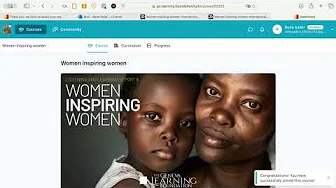
How to access the Women inspiring women book and enroll in the course
Mar 28, 202500:03:13Tap to summarize# How to access "Women inspiring women" book and enroll in the course This step-by-step guide will help you download the "Women Inspiring Women" book and enroll in the free online course, even if you are not comfortable with computers or the internet. ## Finding the landing page 1. Search for "Women Inspiring Women" on Google. 2. You can also find it on social media platforms like TikTok. 3. Click on the "Learn More" button when you find the landing page. ## Requesting the book 1. Enter your full name (not the example shown). 2. Enter your email address (use your own, not the one in the example). 3. Click on "Send" or "Share your details". 4. If this is your first time requesting information from the Geneva Learning Foundation, check your email inbox for a secure message. 5. Click on the verification link in this email to confirm your request. ## Downloading the book 1. Check your email inbox for a message about "Women Inspiring Women". 2. In the email, find "Step 1: Get the book" and click on "View download page". 3. If you see a "popup windows blocked" message in your browser, look for an option to allow the popup. 4. Click on "Open" or similar button to proceed. 5. On the download page, scroll down to the bottom of the page. 6. Click on the "Download" button. 7. The book will now download to your device. ## Enrolling in the course 1. Return to the email and find "Step 2: Enroll in the course". 2. Click on the enrollment link. 3. On the new page, click on the "Enroll" button. 4. Enter your first name. 5. Enter your last name. 6. Enter your email address. 7. Create a password (must contain at least 8 characters including a number, lowercase letter, uppercase letter, and special symbol like ! or ?). 8. Select your biological sex (man or woman). 9. Choose your country of residence. 10. Check the box to agree to the terms and conditions. 11. Click "Sign up". ## Accessing the course 1. After signing up, click on the "Join Course" button. 2. Click on "Start Course" when prompted. 3. Wait a few seconds for the course to load. ## Unlocking the course modules 1. Complete the "Tell us about yourself" section by clicking on "Start here". 2. Answer the questions about your work level and sector. 3. Review your responses carefully (they cannot be changed later). 4. Click "Confirm". 5. Invite a colleague by clicking on the WhatsApp sharing option (or other available options). 6. Send the invitation to at least one colleague. 7. Return to the course and click "Mark as completed". 8. Confirm you have downloaded the book by clicking "Mark as completed" for this section. 9. After completing all required steps, refresh the page if necessary. 10. Module 1 should now be unlocked. ## Using the course 1. Click on Module 1 to access the content. 2. Read through the stories from women around the world. 3. Go at your own pace. 4. After completing each section, click "Mark as completed". 5. Continue to progress through the modules as they unlock. Remember to mark each section as completed to unlock further modules in the certification course.
Transcribe →
Five years on: What we learned from the COVID-19 Peer Hub could help prepare for the next pandemic
Mar 12, 202500:15:16Tap to summarize# Five years on: What we learned from the COVID-19 Peer Hub could help prepare for the next pandemic This podcast explores the remarkable story of the COVID-19 Peer Hub, an innovative digital network created by the Geneva Learning Foundation during the early days of the pandemic. As we mark five years since WHO declared COVID-19 a global pandemic on March 11, 2020, we examine how this unique approach helped maintain essential health services when they were most at risk. When the pandemic hit, routine immunization services were severely disrupted, placing over 80 million children at risk of missing vaccines for preventable diseases like measles and polio. Traditional training models couldn't adapt quickly enough to this unprecedented crisis. There were no existing guidelines for the challenges health workers faced on the ground. The Geneva Learning Foundation responded by creating the COVID-19 Peer Hub, connecting 6,000+ frontline health workers across Africa, Asia, and Latin America. This peer-to-peer learning network, supported by the Bill & Melinda Gates Foundation, enabled health workers to share practical solutions in real-time without waiting for top-down instructions. ## Key achievements of the COVID-19 Peer Hub: - Generated 1,200+ ideas and practices within just 10 days - Developed 700 peer-reviewed action plans for maintaining essential health services - Created 734 case studies addressing vaccine hesitancy - Achieved implementation rates 7x higher than conventional approaches - Demonstrated that participants who actively collaborated had 30% higher success rates The podcast discusses how this approach challenged traditional hierarchical models in global health by recognizing frontline workers as experts in their own contexts. Instead of being passive recipients of information, health workers became creators and sharers of knowledge across borders and health system levels. Analysis showed remarkable "cross-pollination" of ideas, with about two-thirds of solutions cited in action plans coming from people working at different levels of the health system than the plan's author. This demonstrates how valuable diverse perspectives can be during a crisis. By January 2021, over a third of Peer Hub members had successfully implemented their immunization service recovery projects, far faster than colleagues facing the same challenges without network support. Beyond the initial pandemic response, the network continued to prove valuable. In countries like Ghana, Burkina Faso, and the Democratic Republic of Congo, the alumni networks became trusted resources for national health authorities, helping with various health challenges beyond COVID-19. The podcast also explores the mathematical advantages of peer learning networks. Research showed that properly structured peer learning achieves significantly higher efficacy scores (3.2 out of 4) compared to traditional cascade training (1.4) or expert coaching (2.2). When calculating efficiency multiplied by reach, the differences become even more stark. Five years after the WHO declaration, this experience offers valuable lessons for pandemic preparedness. Connected transnational digital networks of local actors represent a powerful approach that complements traditional systems, especially when facing complex, rapidly changing health challenges. The COVID-19 Peer Hub demonstrates that pandemic preparedness isn't just about stockpiling supplies or creating emergency plans – it's about building resilient human knowledge networks that can quickly adapt, share information, and implement solutions when the next crisis arrives. This podcast was generated by AI to explore articles about the topic. While the conversation is AI-generated, everything is based on published articles about the Geneva Learning Foundation's COVID-19 Peer Hub.
Transcribe →
AI podcast: Artificial intelligence, accountability, and authenticity in global health
Mar 11, 202500:13:59Tap to summarize# Global Health Podcast Examines AI's Impact on Power Dynamics and Knowledge Production Read Reda Sadki’s article: Artificial intelligence, accountability, and authenticity: knowledge production and power in global health crisis https://redasadki.me/2025/03/09/artificial-intelligence-accountability-and-authenticity-knowledge-production-and-power-in-global-health-crisis/ Get the framework here: https://redasadki.me/2025/01/24/a-global-health-framework-for-artificial-intelligence-as-co-worker-to-support-networked-learning-and-local-action/ A recent podcast delivers a thought-provoking discussion on artificial intelligence's evolving role in global health, examining researcher Reda Sadki's new article on AI, authenticity, and power dynamics in knowledge production. The conversational deep dive, featuring two health experts discussing Sadki's work, explores how AI tools could either exacerbate existing inequalities or potentially democratize knowledge in global health settings. ## Case study grounds theoretical concerns The podcast hosts begin by discussing how Sadki's article uses a specific case study to illustrate broader concerns about AI in global health. "What's really interesting about Reda Sadki's piece here is how he uses this really specific case study to ground all of these ideas," explains one host, describing how Sadki introduces Joseph, a Kenyan health leader known for thoughtful contributions to a global health learning program called Teach to Reach. The hosts explain that according to Sadki's article, Joseph began using AI to respond to questions designed to elicit personal narratives. One speaker notes, "And that obviously caused a lot of confusion. People were so used to these really insightful personal stories from Joseph and then all of a sudden they're getting these like really generic AI generated responses." ## Accountability pressures in global health The podcast delves into how Sadki connects Joseph's experience to broader accountability structures in global health, highlighting the pressures practitioners face from international donors. "Health workers are under a ton of pressure from international donors. Their funding is tied to these performance evaluations, and there's this constant fear of getting penalized if they step outside the box or take any risks," says one of the hosts, summarizing a key point from Sadki's analysis. This creates what the hosts describe as the "transparency paradox" discussed in Sadki's article – practitioners must choose between acknowledging AI use and potentially having their work devalued, or concealing it and risking accusations of dishonesty. "If Joseph had just said, 'Hey, I'm using AI,' people might have just dismissed his work as not authentic, even if it was good," explains one of the speakers, adding, "But if he kept it a secret, he'd risk being accused of being dishonest and maybe even losing his funding." ## Economic considerations and emerging inequalities The discussion turns to the economic dimensions of AI in global health, with the hosts referencing Sadki's mention of OpenAI's announcement of specialized AI agents. "Sadki says a high level AI agent might cost $20,000 a month," notes one speaker, highlighting the financial aspects that might make AI attractive to organizations facing budget constraints. The hosts examine how these developments intersect with existing labor inequalities in global health. "Sadki highlights how historically there's been this labor stratification in global health where people in the global north have often been paid way more than their colleagues in the global south," explains a speaker. This raises concerns about potential new divides: "Will these AI agents just make those inequalities worse? Will it lead to a situation where the people who can afford these fancy tools have even more control over knowledge and decision making?" ## Framework for responsible AI integration The podcast outlines what the hosts describe as Sadki's framework for integrating AI responsibly in global health contexts. "Sadki has put forward this framework that sees AI as a coworker supporting network learning and local action," explains one host. "It's not about replacing human expertise, it's about making it stronger." This approach emphasizes local context and community empowerment, with one speaker noting, "You can't just take some tool that was developed in Silicon Valley and expect it to work perfectly in a rural village in Kenya." The hosts connect Sadki's ideas to other researchers' work, mentioning "what Newton Lewis and her colleagues have written about performance management in complex adaptive systems," highlighting the importance of flexible, participatory approaches that value local knowledge. 🤖 This podcast was generated by AI to explore the article. While the conversation is AI-generated, everything is based on the article.
Transcribe →
AI podcast: Deep Dive into the Women Inspiring Women book and peer learning course #IWD
Mar 11, 202500:17:42Tap to summarize# AI podcast: Deep Dive into "Women Inspiring Women" Project Get the book “Women inspiring women” and enroll in the free peer learning course: https://www.learning.foundation/women ## Episode Summary This podcast explores "Women Inspiring Women," a project from The Geneva Learning Foundation (TGLF) that combines a book published in 2024 and a peer learning course launching March 23, 2025. The hosts discuss how the initiative features contributions from 177 women across Africa, Asia, and Latin America who work in various settings including cities, villages, refugee camps, and conflict zones. ## Key Highlights - The book includes personal stories and advice written as letters from women health workers to their daughters - The peer learning course launches on March 23, 2025, and will be available in both English and French - TGLF has a network of over 60,000 health workers contributing to this global initiative - The course follows a four-step learning methodology: immersion in stories, personal reflection, peer exchange, and developing action plans ## Featured Stories and Quotes - Dr. Eugenia Norah Chigamane (Malawi): "Pursuing a career in health work is not for the faint hearted" - Hellen Osowo (Nurse, Kenya): "As a health worker, I can confirm to you that so many things give satisfaction in life. But none gives so much gratification, like being there for people at their worst" - Obaji Kelechi Victoria (Nurse, Nigeria): "I loved to wipe tears off people's eyes and take away their pain. That was why I wanted to be a nurse/midwife. I enjoy it because I can serve humanity" - Dr. Faiza Rabbani (Public health specialist, Pakistan): Shares how she involved her daughter Anam in her work from a young age, following her grandmother's saying "empowered women, empower women" - Kinda Ida Louise (Midwife, Burkina Faso): "Never give up in the face of obstacles and difficulties, because there is always a positive point in every situation we go through and we must know how to exploit it to move forward" ## Episode Structure - Part 1: Introduction to the project and its unique features - Part 2: Deep dive into the peer learning course and its methodology - Part 3: Call to action for listeners to get involved and support women in healthcare ## Themes Discussed - Challenges faced by women in healthcare (low pay, long hours, limited resources, emotional toll) - Importance of mentorship and role models across generations - Self-care as essential, not selfish, for healthcare workers - Need for systemic changes to support women in healthcare fields - Visual elements of the book that capture practitioners' experiences - Ways listeners can contribute to the movement for change ## Notable Mentions - The podcast highlights how the book includes powerful photographs of women working in the field - The hosts discuss the importance of community and support networks for women in demanding healthcare roles - The episode emphasizes how women make up two-thirds of the health workforce worldwide yet remain underrepresented at senior levels - The book was published for International Women's Day 2024, while the peer learning course represents the next phase of the initiative launching in 2025 ## The Four-Step Learning Methodology 1. Immersion: Deep dive into diverse stories from the book 2. Reflection: Connect these experiences to your own life and aspirations 3. Exchange: Share feedback and ideas with a global network of peers 4. Action: Develop a personalized plan to apply the learning in your context 🤖 This podcast was generated by AI to explore the book and peer learning course. While the conversation is AI-generated, everything is based on the resources themselves.
Transcribe →
Peer learning for Psychological First Aid: New ways to strengthen support for Ukrainian children
Mar 11, 202500:15:54Tap to summarize# Peer Learning Offers Practitioners Crucial Insights for Supporting Children in Crisis This is Reda Sadki’s presentation at the ChildHub “Webinar on Psychological First Aid for Children; Supporting the Most Vulnerable” on 6 March 2025. Learn more about the Certificate peer learning programme on Psychological First Aid (PFA) in support of children affected by the humanitarian crisis in Ukraine https://www.learning.foundation/ukraine Get insights from professionals who support Ukrainian children https://www.learning.foundation/ukraine-insights "I understood that if we want to cry, we can cry," reflected a practitioner in the Certificate peer learning programme on Psychological First Aid (PFA) in support of children affected by the humanitarian crisis in Ukraine - illustrating the kind of personal transformation that complements technical training. During the ChildHub “Webinar on Psychological First Aid for Children; Supporting the Most Vulnerable”, the Geneva Learning Foundation’s Reda Sadki explained how peer learning provides value that traditional training alone cannot deliver. The EU-funded program on Psychological First Aid (PFA) for children demonstrates that practitioners gain five specific benefits: First, peer learning reveals contextual wisdom missing from standardized guidance. While technical training provides general principles, practitioners encounter varied situations requiring adaptation. When Serhii Federov helped a frightened girl during rocket strikes by focusing on her teddy bear, he discovered an approach not found in manuals: "This exercise helped the girl switch her focus from the situation around her to caring for the bear." Second, practitioners document pattern recognition across diverse cases. Sadki shared how analysis of practitioner experiences revealed that "PFA extends beyond emergency situations into everyday environments" and "children often invent their own therapeutic activities when given space." These insights help practitioners recognize which approaches work in specific contexts. Third, peer learning validates experiential knowledge. One practitioner described how simple acknowledgment of feelings often produced visible relief in children, while another found that basic physical comforts had significant psychological impact. These observations, when shared and confirmed across multiple practitioners, build confidence in approaches that might otherwise seem too simple. Fourth, the network provides real-time problem-solving for urgent challenges. During fortnightly PFA Connect sessions, practitioners discuss immediate issues like "supporting children under three years" or "recognizing severe reactions requiring referrals." As Sadki explained, these sessions produce concise "key learning points" summarizing practical solutions practitioners can immediately apply. Finally, peer learning builds professional identity and resilience. "There's a lot of trust in our network," Sadki quoted from a participant, demonstrating how sharing experiences reduces isolation and builds a supportive community where practitioners can acknowledge their own emotions and challenges. The webinar highlighted how this approach creates measurable impact, with practitioners developing case studies that transform tacit knowledge into documented evidence and structured feedback that helps discover blind spots in their practice. For practitioners interested in joining, Sadki outlined multiple entry points from microlearning modules completed in under an hour to more intensive peer learning exercises, all designed to strengthen support to children while building practitioners' own professional capabilities. This project is funded by the European Union. Its contents are the sole responsibility of TGLF and IFRC, and do not necessarily reflect the views of the European Union.
Transcribe →
Global climate-health survey extended as #TeachToReach Leaders share scary stories (5 March 2025)
Mar 11, 202500:41:00Tap to summarize# Global Climate and Health Survey Extended as Frontline Workers Share Impact Stories Request your invitation https://www.learning.foundation/teachtoreach (You will automatically receive information about the survey when you received your invitation.) The Geneva Learning Foundation has extended its Global Climate and Health Survey until March 11, 2025, giving health workers worldwide additional time to document how climate change affects community health. "Climate change is doing more harm than good, and we need to develop adaptation strategies," said Kingsley, a community health worker from Ghana during a recent Reach Network update session. "In Ghana this year, 15 farmers who took loans for crop cultivation committed suicide because there was no rainfall, their crops could not yield, and they had no way to repay their loans." ## Survey aims to influence global health funding Launched on January 15 in partnership with Grand Challenges Canada, the survey has already gathered 3,702 responses from health workers in over 100 countries. The initiative seeks to create evidence that global health funders and governments cannot ignore when making climate health funding decisions. "When many health workers from our country fill out this survey, our experiences become proof that leaders cannot ignore," explained Reda Sadki, Executive Director of the Geneva Learning Foundation during the March 5 update meeting. "Funders and governments can then use this proof to bring support." Nigeria currently leads with the highest response rate, followed by Democratic Republic of Congo, Ghana, Kenya, and Brazil. However, most countries still lack sufficient responses to achieve statistical significance, which the organizers estimate would require approximately 400 responses per country. ## Frontline workers document diverse health impacts Health workers participating in the session described varied climate-related health challenges in their communities. "In Nigeria we have three basic issues related to climate change," shared Umar Pella Abdulrahman, a public health specialist. "During hot season, the temperature is around 40 to 42 degrees centigrade, causing heat stroke especially among elderly people. During rainy season, we experience flood disasters associated with cholera and waterborne diseases. During dry season, we experience drought, which may translate to food scarcity and malnutrition." Laura Omari, a public health officer from Kenya, highlighted additional concerns: "Climate change brings vector-borne diseases like malaria, food insecurity, malnutrition, and respiratory diseases. In Turkana, climate disasters have made drought something big, bringing waterborne diseases like cholera and typhoid." ## Challenges in survey dissemination Participants noted several barriers to wider survey participation, including connectivity issues, data costs, and mistrust of government-led initiatives. "Some people have joined in, others have not because of different constraints," explained Lillian Mutua, who heads the health promotion unit in Nairobi City County, Kenya. "First, connectivity issues. Second, they feel they need data bundles to connect to the network, which is a cost. Also, most feel like these surveys are being taken so people can get grants from donors, and there's currently a lot of mistrust from health workers toward the government." The survey is part of the Teach to Reach initiative, with the current cohort of health leaders forming the Reach Network (Relate, Engage, Act, Connect, and Help). The initiative is supported by Grand Challenges Canada with funding from the global technology company Arm and the government of Canada. Results from the survey will be published in an academic journal, with findings intended to guide innovation and funding for climate-related health challenges in the most affected communities. Health workers interested in participating can access the survey through the Geneva Learning Foundation's social media channels or contact survey partners in their countries before the March 11 deadline.
Transcribe →
PFA Focal Points across Europe strengthen support for Ukrainian children (4 March 2025)
Mar 11, 202500:24:58Tap to summarize# Psychological First Aid #EU4Health initiative expands to reach crisis-affected children in 2025 Learn more: https://www.learning.foundation/ukraine The Geneva Learning Foundation, in partnership with the International Federation of Red Cross and Red Crescent Societies (IFRC), significantly expanded its Psychological First Aid (PFA) for Children initiative, growing from 34 to 75 focal points in Ukraine and across Europe who will help disseminate critical mental health support practices to frontline workers. These Focal Points, together with others leaders and partners, met today for the ninth Partners & Leaders learning session. ## New tools developed from practitioner experience The latest developments were shared during a virtual meeting on March 4, 2025, where program leaders announced several new learning opportunities created directly from practitioner experiences. These include a new comprehensive insights report based on 24 case studies developed by participants in 2024. Get the insights: https://www.learning.foundation/ukraine-insights “This is the first report where we are actually analyzing what participants shared in their case studies around PFA for children,” explained one of the program coordinators. The 162-page document contains detailed accounts of children’s responses to crisis situations. Several community members, including Andras Elena, Anna Rovek, Natalia Savelieva, Olena Arutjavan, Olena Filipova, Victoria Mehova, and Yulia Melnichenko, were acknowledged for their contributions as community reviewers of the insights report. The insights gathered are not meant to replace existing technical guidance but rather to complement it with real-world experiences from practitioners working directly with children in crisis contexts. ## Community-driven knowledge The program’s approach emphasizes learning from peers to complement technical expertise. Key learning points from previous sessions have been compiled into concise documents that acknowledge contributor input and make this collective intelligence available to everyone, including those who might not have been able to attend live sessions. This collaborative approach reflects the program’s commitment to centering the experiences of practitioners working directly with children in crisis situations, while providing them with flexible, accessible opportunities to further develop their skills and knowledge. ## Flexible learning options for busy practitioners Recognizing the time constraints faced by humanitarian and development professionals, the initiative has expanded its learning offerings beyond the original peer learning exercise that required intensive participation and case study development. New options include: - A self-guided course that allows practitioners to learn at their own pace - An e-learning module that takes approximately one hour to complete - Micro-learning courses where participants can earn certificates for individual modules The new offerings are designed for “people who are too busy, cannot really take the peer learning exercise, but would still like to learn from their colleagues.” ## Measuring impact on children’s wellbeing Looking ahead, the initiative plans to focus on how to measure the impact of PFA interventions on children’s wellbeing. On March 18, 2025, the program will introduce PFA Measure to this forum of leaders, described as “a simple tool that practitioners, in particular those at the local levels or those in fragile contexts, can use to actually determine if and how the wellbeing of children is improving due to the PFA intervention.” This development aligns with the Inter-Agency Standing Committee recommendations to provide simple measurement tools for practitioners in crisis settings. ## Expanding access and participation The program continues to democratize access to learning opportunities. The newly created courses will be available in both English and Ukrainian, with the English version launching on March 6, 2025, and the Ukrainian version following shortly after. For the upcoming peer learning exercise, which runs from March 31 to April 15 for English speakers, the program is actively seeking facilitators and mentors from among program alumni. The initiative, funded by the European Union’s EU4Health programme, has already reached more than 2,000 practitioners from Ukraine and 27 European countries. It is extending the reach of an initiative led by the Ukrainian Red Cross and 27 other European Red Cross Societies, with the support from the International Federation of Red Cross and Red Crescent Societies (IFRC) and the Red Cross Red Crescent Movement MHPSS Hub. This peer learning event was produced with the financial support of the European Union. Its contents are the sole responsibility of The Geneva Learning Foundation (TGLF) and do not necessarily reflect the views of the European Union.
Transcribe →