← The High Performance Podcast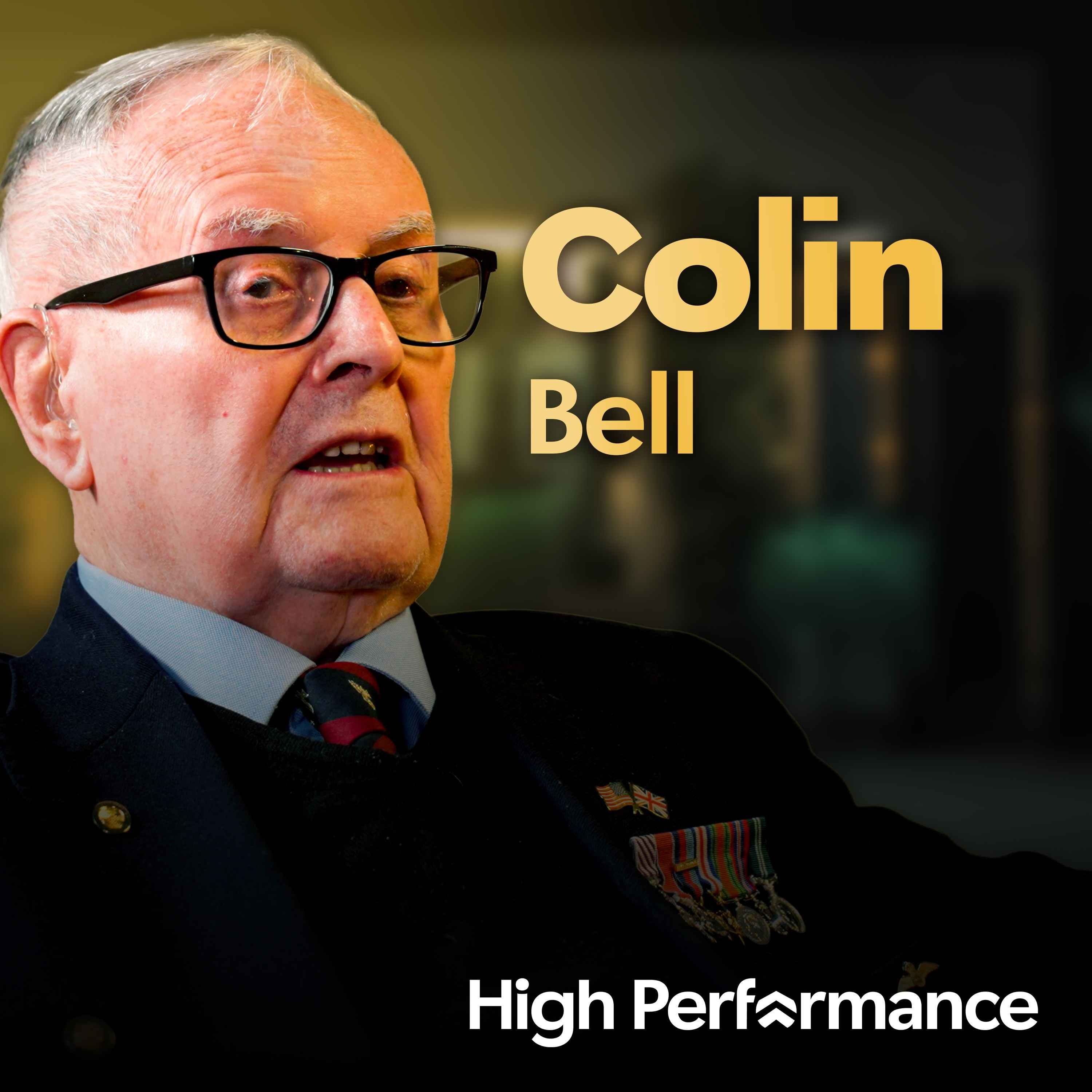
The High Performance Podcast
105-Year-Old WW2 Bomber Pilot Shares a Century of Wisdom | Colin Bell (E405)
00:57:32
Loading summary
Transcript184 lines
- [00:03]
Interviewer
Well, Colin, you're three days away.
- [00:05]
Colin Bell
Yeah.
- [00:06]
Interviewer
From turning 105.
- [00:07]
Colin Bell
Correct.
- [00:08]
Interviewer
You truly are one of the last men standing from those Mosquito pilots in World War II. Probably over 50 missions over Germany, 13 of them over Berlin itself. And we want to find out from you today what it takes to fly into hell, and most importantly, what it takes to come home again.
- [00:27]
Colin Bell
I'd simply say that it was a job to be done. We had to defeat the Germans because they had some very nasty plans of what they were going to do over here. If they ever subjugated us, you just had to get on and do it. It didn't help to have too much imagination. I always remember that sailor Milan, who was a Battle of Britain pilot, a very experienced Battle of Britain pilot. He said that in his experience, survivors were those possessed of not too much imagination. Fear kills. And so it's not in my nature to be fearful. I'm not boasting, it's just stating a fact. I don't find easy. And I just got on with it. And I had the very good, great fortune to have with me a superb Canadian navigator, the name of Doug Redmond. He started out life as a lumberjack and then he became a navigation instructor. I was an instructor of American cadets out in America when I finished my training. So we were both instructors, we were both very experienced. I was an experienced pilot, he was an experienced navigator, and we were a good team. And again, Doug didn't get frightened, except on one occasion when a shell exploded under the aircraft and it lifted us up and we lost power on both engines. And he said to me, what do we do now? Which I thought was a bloody stupid question. And I said, well, we wait, don't we? So we waited, and hallelujah. After a brief period, the power came back on again and we edged our way from. Away from Berlin. And at that point I leaned across to him and I said, you weren't frightened, were you, Doug? And he said, no, I wasn't frightened. He said, I was bloody terrified. And that was dark.
- [02:52]
Interviewer
Why were you not bloody scared when the shell exploded under your aircraft?
- [02:56]
Colin Bell
I think probably I was. I know my knees knocked. I got a job to do. I got the aircraft in the air, I got to keep it in the air. And when you've got a job to do, it tends to cut out in fear. At least in my experience it does. There we are. People react differently.
- [03:26]
Interviewer
Take us into the cockpit of a Mosquito, because this is an experience, particularly in wartime, that no one on planet Earth will ever have again. What's it like inside the confines of a Mosquito?
- [03:42]
Colin Bell
Well, it's a bit cramped.
- [03:43]
Interviewer
Yeah. Is it uncomfortable?
- [03:47]
Colin Bell
No, I wouldn't say it's uncomfortable. Compared with flying in Halifax or Lancaster, it much more comfortable because you didn't have to wear heated suits. You could wear what I wore in the mess, a battle dress. I flew in a battle dress because it was beautifully warm, heated cockpit and it might be 30 below outside, but in the cockpit it was as warm as it is in your studio here today.
- [04:28]
Interviewer
And where would the navigator sit?
- [04:29]
Colin Bell
He'd sit to the right of me, a bit lower down and I always felt that his position was a lot less comfortable than mine, but, well, that was his bad luck being a navigator, wasn't it?
- [04:46]
Interviewer
And were you in constant communication?
- [04:49]
Colin Bell
Yeah, excepting we didn't talk about last night's film. We were purely professional. He would tell me the courses to fly and then complain if I didn't do it properly.
- [05:05]
Interviewer
I think it's important as well to explain to people.
- [05:08]
Colin Bell
Yeah.
- [05:09]
Interviewer
The Mosquito was partly made of wood.
- [05:12]
Colin Bell
Yeah.
- [05:12]
Interviewer
Had two.
- [05:14]
Colin Bell
Well, entirely made of wood.
- [05:16]
Interviewer
Entirely made of wood. Two huge engines.
- [05:19]
Colin Bell
Two Packard, in my case, Packard Merlin engines. Some of the Mosquitoes, the ones that are built over here, of course, have got Rolls Royce Marlins.
- [05:34]
Interviewer
No guns.
- [05:35]
Colin Bell
Huh?
- [05:36]
Interviewer
No guns.
- [05:36]
Colin Bell
Ah, well, it depends which type of aircraft you're flying. A bomber Mosquito had no guns because the object of the bomber Mosquito was go in, bomb and get out.
- [05:49]
Interviewer
So with no guns in a plane made of wood, flying towards Germany.
- [05:54]
Colin Bell
Yeah.
- [05:56]
Interviewer
Was there not a fear that as soon as a German fighter with guns saw you, there was trouble?
- [06:02]
Colin Bell
Well, you must understand the majority of. In fact, I go as far as, say, all the propeller driven night fighters, German night fighters couldn't go as fast as we could. We used to fly at 25,000 and they did get some Focke Wulf 190s up at 30,000 cruising around. They call them wild Boar squadrons and these chaps used to sometimes dive down on you with added speed of being coming down in a dive. But you could generally see them coming and if it was dark on a night where they couldn't see you, you couldn't see them, so it wasn't a problem. But if it was a clear night and you could see them coming, it wasn't difficult to avoid them. And once they'd passed you, they'd never be able to turn around and catch up with you again. So night fighters, propeller driven night fighters, weren't really a problem. The real problem was a German anti aircraft Fire, which was intense and lethal. Accurate. And that was. Well, that's just something you had to contend with.
- [07:27]
Interviewer
We'll be right back after a quick word from our partners.
- [07:32]
Co-Interviewer
Close your eyes. Listen to Monday.com. feel the sensation of an AI work platform. So flexible and intuitive, it feels like it was built just for you. Now open your eyes. Go to Monday.com, start for free, and finally, breathe.
- [07:48]
Commercial Voice 1
Okay, caller one wins courtside seats to tonight's game. What? I won floor seats. You. I've been calling for 13 months. Wait. Chris. Yes. I finally did it. What are you gonna wear? Men's Wearhouse. They've got today's looks for any occasion. And I need to look like a celebrity. Don't want to stick out. Exactly. They've got Chill Flex by Kenneth Cole, Joseph Abboud, and a tailor at every store for the perfect fit. Congrats. You can stop calling now. Not a chance. Hit any look for every occasion at Men's Wearhouse. Love the way you look.
- [08:18]
Commercial Voice 2
Hey, sweetie. Your mother showed me this Carvana thing for selling the car. I'm gonna give it a try. Wish me luck. Me again. I put in the license plate. It gave me an offer. Unbelievable. Okay, I accepted the offer. They're picking it up Tuesday from the driveway. I haven't even left my chair. It's done. The car is gone. I'm holding a check anyway. Carvana, give it a whirl. Love ya.
- [08:41]
Commercial Voice 1
So good you'll want to leave a voicemail about it.
- [08:43]
Colin Bell
Sell your car today on Carvana. Pick up.
- [08:46]
Commercial Voice 1
Fees may apply.
- [08:50]
Co-Interviewer
Well, tell us then, about that night in September 1944 over Emden.
- [08:56]
Colin Bell
Well, that was our first trip. And it's the one time that my wonderful navigator was rather cocked up and he took me back over Emden. And I always remember that as we approached Emden, we. We saw some gunfire ahead. And he said to me, I wonder what they are firing at? And of course, the next few moments we knew, because German naval gunners are very good, very competent, and they were banging shells around us all over the place. And this is when I talk about fear. At that stage, I did feel fearful. And I put the aircraft into a dive, and we were 25,000ft, and I went into a very steep dive to get away. And of course, I did get away. But we built up an enormous speed far in excess of what the Mosquito was designed to do. And when I tried to get out of. Wouldn't respond. And although I hauled back on the stick, the stick wouldn't come back. And that was Very bothsome. But I had a device known as a tail trim which was operated by a wheel on my left arm. And I wound this back and that forced the elevator at the back upwards. And with the aid of that, I'm still pulling back on the stick. We finally levelled out, but we were going at a hell of a speed. And if I hadn't succeeded in doing that, well, that would have been the end of Colin Bell and Doug Redman.
- [10:56]
Interviewer
So you were being shot at from the ground.
- [10:58]
Colin Bell
Yeah.
- [10:58]
Interviewer
But you dove down towards the ground.
- [11:01]
Colin Bell
The guns weren't traveling along underneath me, I was traveling away from them.
- [11:08]
Interviewer
Right. So you just wanted to get as much speed as quickly as possible.
- [11:13]
Colin Bell
I wanted to get away from the anti aircraft fire and by increasing my speed and changing height I achieved that.
- [11:26]
Interviewer
And had you been coned at this
- [11:27]
Colin Bell
point you were regularly coned. If you went over a target and where Berlin was concerned, the search sites would pick you up on the way in. They would cone you on the way in. You would be coned all the way over the target, coned out of the target. And not only that, but all the time that you were coned they were firing shells at you. I mean they were intent on destroying you.
- [11:56]
Interviewer
For people that aren't aware, being coned is the cone shaped light that finds the aircraft. What did it feel like inside the Mosquito when suddenly it was almost like daylight, you were just lit up from below?
- [12:08]
Colin Bell
Well, of course you lose the horizon.
- [12:10]
Interviewer
Yeah.
- [12:11]
Colin Bell
You can't see. You have to fly on instruments. You can't relate yourself to anything because
- [12:17]
Interviewer
you're blinded by the light because of
- [12:18]
Colin Bell
the blinding light inside. In fact, sometimes it's difficult to read the instruments. But at that time you have to fly what was known by the seat of your pants.
- [12:31]
Interviewer
When you've been coned over a heavily fortified city like Emden, with anti aircraft fire coming at you, even in that moment, did your imagination not start to think maybe this is it, maybe my time is up?
- [12:49]
Colin Bell
No. Wow. No, not at all. Yeah, you might, you're trying to make certain that your time is not up.
- [12:59]
Interviewer
Can I ask you about anti aircraft fire?
- [13:02]
Colin Bell
Yeah.
- [13:03]
Interviewer
What is the experience of facing that? Because I've always assumed unless it hits you, you don't really know where. You don't really know where it is. Like what's happening around you outside the aircraft. In those really difficult combative moments, there
- [13:19]
Colin Bell
is a time lapse from the time that the shell is fired to the time that it reaches you. Okay. That's why anti aircraft fire is known as predicted. Gunfire. The Germans on the ground are predicting where you are going to be when the shell arrives. And if you've got any sense, you make bloody sure that you're not there and you're somewhere else. And that is the secret of staying alive. Introspective anti aircraft fire. You don't stay in any one place for very long. You shift your position, you shift your height, you change your direction. Excepting, of course, in the last stages, when you are actually on your bombing run. At that time, you have to fly a steady course and at a set height to enable your bomb aimer to do his job. And that's when you're most vulnerable.
- [14:31]
Interviewer
And the Germans would know as you came in towards your target that you won't be changing course, you won't be changing height because you're about to release your bombs. So in that moment, is it just a case of hoping that their aim is out?
- [14:45]
Colin Bell
Well, that's when you need religion.
- [14:50]
Interviewer
Tell us about that. Tell me more.
- [14:53]
Colin Bell
Well, I've said it in one word, that's when you need to pray.
- [15:00]
Interviewer
And would you pray?
- [15:01]
Colin Bell
No.
- [15:04]
Interviewer
I want to talk a bit more about flying the Mosquito.
- [15:06]
Colin Bell
Oh, yeah.
- [15:08]
Interviewer
So you're given a parachute. Would you be wearing the parachute all the time in the aircraft?
- [15:13]
Colin Bell
The parachute formed part of your seat.
- [15:16]
Co-Host
Right.
- [15:17]
Colin Bell
And after that incident where we were blown up in the morning, we came down and we looked at the aircraft and the rear half had got full of holes. And my fitter came up to me and he said, would you like to have a memento of last night's raid? And I said, what memento? And he produced two shell fragments about that long. And I said, oh, where did you find them? And he said, they were in the parachute that you were sitting on. And I said to my son, later on, you never realize how you might never have come into existence. I said for two reasons. One, the sliver might have gone through me and then the other, I might have been left with a high pitched voice.
- [16:13]
Interviewer
Well, it sounds like it was close.
- [16:16]
Co-Interviewer
Colin, would you tell us about the revolver that you took with you on your flight?
- [16:20]
Colin Bell
Ah, yes. Well, one day Scotty, our wing commander, said, we have it on good authority that Goebbels and Hitler are encouraging the local populace to lynch you if you parachute out and they come across you. So they had lynch mobs out for. And in fact, they did lynch a lot of Americans, some of our chops. So Scotty said, it's up to you what you want to do about it. But he said, if Only you feel like drawing a Smith and Wesson.38 from the armament store and 20 rounds of ammunition. You might find that a comfort if you come down. I thought, well, that's for me. So when people said to me, you know, did you have a mascot on your trips over Germany? I say, yes, it was a Smithson missile. 38 and 20 rounds of ammunition.
- [17:32]
Interviewer
What would have been the process of parachuting out of a Mosquito? Was it a case of climbing from the aircraft?
- [17:38]
Colin Bell
Well, you climbed into the aircraft through a hatch in the nose. You had a ladder, so if you wanted to parachute out, you would jettison the hatch, and then you would you just climb out and let yourself drop out. You had, in fact, an escape hatch above you. But the difficulty with that is that if you climbed out there, you would get caught by the winds, by the slipstream, and that take you back, and you probably find yourself cut in half by the tail fin. So it wasn't a very good idea to climb out while you were actually flying.
- [18:31]
Co-Interviewer
And when you think back to the 50 missions that you did, which one stands out in your memory?
- [18:39]
Colin Bell
Oh, being chased by a jet fighter, that was very dangerous. He could go 100 miles an hour faster than we could. This chap came up behind us, and when he switched, he wanted to get a visual on us, because once he got a visual on you, you were dead. Because his firepower was immense. And I knew he was coming up behind because when he turned on his air to air radar to locate us, to close in and get a visual, a white light appeared on my instrument panel because I got a device at the back of the aircraft that picked up his radar signals, okay? And as soon as the white light appeared, I dropped down 10,000ft to get away from him. At which point my navigator said, what the hell are you doing? Because of course, it upset all his instruments, you see. And I said, well, you saw the white light, didn't you? He said, but I've heard that ghosting doesn't necessarily mean that it's jet fighter coming out behind you. And I said, you want me to hang around and find out? Which quietened him down a bit. But I had a lot of trouble avoiding this guy. But I knew one thing that he only liked. His endurance was 45 minutes to the time of takeoff to return to base, his base. So I took him all over the sky in the dark, and then I also took him down low because I knew that if you go down low, jets consume proportionally a lot higher amount of fuel. Low, down than up high. And all the time, of course, I got my navigator belly aching because he would never accept that it was truly a jet fighter. I never was able to convince him. But I spoke some, many, many years later, I spoke to that wonderful aviator, Captain Winkle Brown, and when I described the circumstances to him, he said, you were bloody lucky to be alive. You did absolutely the right thing. I wish that Doug, my navigator, would be still alive so that I could have quoted this to him. But by that time he, sadly, he'd died. There was another instance too when I was interviewed by a reporter from the Times and I described the circumstances to him. And when I read his write up of our conversations, he said a number of aircraft mosquitoes were shot down over Berlin by jet fighters. And I phoned him up and I said, hey, hey, hey. I never said that. He said, I don't and. But he said, I got it independently from the Ministry of Defence.
- [21:58]
Interviewer
Wow. So it did happen.
- [21:59]
Colin Bell
Yeah, it did happen.
- [22:01]
Co-Interviewer
There is a term of becoming overcome by events that many pilots can sometimes become distracted by what's going on around them. So how would you teach the cadets about staying calm and doing your job?
- [22:16]
Colin Bell
I think really what you're coming round to is, is the emotional reaction. There's no place for emotion in wartime. You've just got to get on with the job. If you start becoming emotional, well, then you're not fit for the job, but
- [22:38]
Co-Interviewer
the emotion is still very real. How do you learn to override the emotion with logic? Can you share for our listeners?
- [22:47]
Colin Bell
I think this is a present day attitude. I think if I go back to when I was a young man, people didn't get emotional. It seemed to me, I don't know, something has happened to people today, apart from overeating and getting too fat and not fit for work. Then there's all this emphasis on emotion and breastfeeding. In my day people weren't like that.
- [23:32]
Co-Interviewer
You don't think it's a good thing?
- [23:34]
Colin Bell
No, I think, well, it may have a place in domestic life, but it has no place in wartime.
- [23:44]
Interviewer
In the dead of night when you've had to evade a German fighter plane and it's cloudy and there's flak and there's no light from the moon. How on earth does Doug work out where you are and how to get you home?
- [23:59]
Colin Bell
Well, that was his job.
- [24:01]
Interviewer
What tools did he have? What tools did he have at his disposal to work out where you were?
- [24:06]
Colin Bell
Oh, he had radar, he had what was known as G. And a little later on he had An American device, I think, called Loran. But these were merely tools to assist him. And he was just. He was just. He was just brilliant. And I always remember how on one occasion we were in the mess, an American, some American generals came in. They always had nurses with them, lieutenant nurses, I wonder why. And anyway, they all came in, shuffled into the mess about 3 o' clock in the morning. Look, I was finishing my ham and eggs when I saw this contingent come in and I got the story. Eventually they were on a. I don't think it was a Globemaster, but something like that. They'd flown straight out of America across the Atlantic and they'd missed their navigator, missed the UK completely. And they went out over occupied France and the first thing they knew was that shells were coming up all around them. So. So they practiced 180 degree turn and they headed back across the Atlantic when the navigator went into the cabin and said, I don't know if you guys have got any religion, but if you have, you better start praying because we're lost. That's a certain way of building up Barao. And anyway, they sent out a Mayday call and Matt Chap at Downer Market picked it up and he gave them some courses to fly and eventually they landed at Downer Market with about enough fuel in their Globemaster to fill a cigarette lighter. Yeah, and they came shuffling in looking incredibly shaken.
- [26:20]
Co-Interviewer
Would you and Doug ever spend any time together outside of the cockpit?
- [26:25]
Colin Bell
No, he wasn't a very sociable man. We'd go up in Kingsland and have a few beers together or we'd go down more often to the Crown Inn, Downer Market and have a few beers there. My wife would come along, pushing my baby daughter in a pram and we all used to convene together at the Crown in Downham Market. And where I still go.
- [26:57]
Co-Interviewer
How would you describe 20 year old Colin to us?
- [27:01]
Colin Bell
I was very conscious that I'd got a lot of. You grow up very fast when you were in the raf and I regarded it as a privileged to be selected for aircrew. I regarded it as a privilege to be in the RAF and I certainly regarded it as a privilege to fly the best aircraft in World War II, which in my judgment was the Mosquito.
- [27:32]
Interviewer
And what was your relationship like with authority as a young man?
- [27:37]
Colin Bell
I think by nature I tend to be a bit of a rebel and sometimes you have to curb that tendency. When I was on 608 Squadron, I had a boss, which was a chap called Scotty and he was an Australian wing commander. And I'd got a lot of respect for Scotty. He was a man's man, he was. When he moved on, we had a navigator who recently trained as a pilot and I didn't like him and he didn't like me. I thought he was an old woman. And so I think a lot depends when you say how do you get on with authority? I think a lot depends on who is your commanding officer.
- [28:36]
Co-Interviewer
Can we talk about some of the statistics that you've already told us about? So one in four didn't make it, didn't survive. How did you handle that? Uncertainty.
- [28:46]
Colin Bell
You. In war, people get killed and you just have to accept that and you have to accept the possibility. Possibility, not the probability, the possibility that you'll be one of them. We had Rolls Royce Packard Merlin engines and some of those, not many had got weak conrods. Do you know what a conrod is? No, I thought you wouldn't. It's the thing that connects the piston to the crankshaft. And if you're taking off at night in a aircraft, a Mosquito has bombed up, it's got full of tanks full of petrol, including wing tanks. It's got the flaps down, it's got the undercarriage down and you carry. You start off at night with full bore, with the throttle wide open and your engine fails, there's nothing you can do, you can't continue climbing, you've just got to land. But you've got fields and trees in front of you. Scotty was asked, what do you do in such circumstances? And he said, well, you go in ahead and die like an officer and a gentleman.
- [30:12]
Interviewer
And when someone said that, like, how were you not petrified to get in the aircraft the next day, fire up the engine?
- [30:21]
Colin Bell
It's just a risk. You just have to accept that it's a risk. And there's a risk when you drive on the road, isn't there? You just had to accept. I mean, the suggestion came from one of our number that the aircraft should all be grounded until the engines could be inspected and the weak conrods identified and replaced. And Scottish said, no way. He said, this is a war, we're getting on with it. You've just got to take your chance. And of course, he was quite right. You can't stop operating just because one or two aircraft will takeoff. Just one of the. You know, you just have to live with these risks, don't you? It's rather like flying up in the air and being shot at. You can't say, I'm not Going to go out on this tour because I might get shot down.
- [31:30]
Interviewer
And as one of the lieutenants, as someone who was training cadets and encouraging cadets to believe in themselves and be confident and go to war, what would you find was helpful to say to men younger than you and less experienced than you to calm them down?
- [31:48]
Colin Bell
Well, my advice to youngsters these days is to be bold but not reckless. In point of fact, I appeared, they displaced the Coca Cola advertisement and Piccadilly Circus for a short while and they put me up there saying, my advice is be bold, but don't be reckless.
- [32:12]
Interviewer
And was that the same advice that you gave to your young cadets you were training in the war?
- [32:18]
Colin Bell
I wasn't considered with their morale. I just expected them to do as they were told and get on with it.
- [32:27]
Co-Interviewer
Would you explain the difference between being bold and being reckless?
- [32:32]
Colin Bell
Being bold is analyzing a problem and taking the course that you think is the most prudent and sensible, but still doing it. That's being bold. Being reckless. Oh, gosh, what the hell, I'll just get on with it anyway. For example, you might have a situation where there are three alternatives. Being bold is choosing what is the best one of the three. Being reckless is just ignoring and getting on with it and paying no attention to. It's a different approach.
- [33:13]
Interviewer
And what were you like with pilots under your command who you were training, who were reckless?
- [33:20]
Colin Bell
My American cadets were very good bunch. They're very powerful chaps. They all look to come off the football field. And I was only 5 foot 6, weighing about 8 stone. 8 stone and about 130 pounds odd. They were big muscular blokes, probably weighing 220 pounds. So it was a strange, you might think it's a strange relationship, but in the American Army Air Corps, the instructor is God and the cadets are rubbish. So as I was an instructor, believe it or not, I was God.
- [34:14]
Co-Interviewer
And in your book, Colin, you talk about a promise that you made to these recruits. You talk about, you said to them, I may be half your size, but I have the guts of a British lion.
- [34:26]
Colin Bell
I have the guts of a lion and a British lion at that.
- [34:29]
Co-Interviewer
Yeah. And what was the promise that you made to them?
- [34:32]
Colin Bell
You see, under the American system of training, if you put a foot wrong, you were liable to be washed out, which means taken off the course, eliminated, which was terrible. I mean, all these chaps were sort of busting their guts to become commissioned officers in the United States Army Air Corps pilots. But under their system, they had hanging over them the threat of almost instant Dismissal at any stage in their career. So when I had my six American cadets, I said, my system is different. I said, it's different. I'm not criticizing your own system, but my system is different. I said, unless you do something diabolical, I can guarantee every one of you will graduate. And I could almost see them sort of relax like that. And I think my system was better. I think people learn more and when they're not under emotional pressure. And all my chaps, in fact, did graduate, excepting one, but that wasn't my fault. He failed on ground school.
- [36:07]
Interviewer
And how would you deal with the death of one of your cadets in wartime?
- [36:13]
Colin Bell
I gave my cadets the best advice I could to become competent pilots and to avoid getting killed. I couldn't do any more than that. That was the limit of my ability and responsibility. If, unfortunately, they got killed, well, that was something you just had to shrug off.
- [36:40]
Interviewer
How would you get the balance, though, between allowing your cadets to make a mistake, to learn but not punish them for making a mistake?
- [36:51]
Colin Bell
I never thought in terms of punishment if they made a mistake. My job was to see that they didn't make the same mistake again.
- [37:02]
Interviewer
We'll be right back after a quick word from our partner. What if the real question isn't where you're going, but the adventures you experience along the way? It's time to set your sights higher on peaks still to be climbed, rivers still to be crossed, and greater dreams to pursue you. It's time to embrace the impossible with Defender, A family of vehicles built around capability, durability tested on some of the most difficult terrain. Defender defines tough luxury, and I should know. I've driven one for the past three years. I have the Defender 130. But from the compact confidence of the Defender 90 to the versatility of the 110 through to mind the Defender 130, with seating for up to eight. There's endless potential. You feel it in the details as well. The rugged body design, the robust materials, all working together so you can head out with confidence. And inside. Clear technology helps you see the world around you in a new way. While the PV Pro keeps your navigation routes and playlists flowing seamlessly as you go. And with up to 89 cubic feet of cargo space, there's room for everything you need on your journey. Explore the full Defender lineup@land roverusa.com if something's been a bit off in the bedroom, you're definitely not alone. And a lot of guys put off doing anything about it for longer than they need to. With hims, it's easy to take action. Everything's fully handled online. No awkward appointments, no pharmacy queues. You fill out a quick online intake and a licensed healthcare provider will see if treatment is right for you if prescribed your treatments delivered in a discreet package. This includes Sildenafil generic for Viagra, available through Hims up to 95 less than the brand name. And if that's not the right fit, there are other options available so you can find what works best for you. To get simple online access to personalized affordable care for ed, hair loss, weight loss and more, visit hims.comperformance that's hims.comperformance for your free online visit hims.comperformance Prescription required. See website for details and important safety information. Sildenafil is the generic version of Viagra. Viagra is a registered trademark of Viatris Specialty llc. HIMS is not affiliated with or endorsed by Viatris. I don't know about you, but I really love keeping my money where I can actually see it. Unfortunately, traditional big wireless companies seem to like hanging onto my money for me. For years I was overpaying for wireless simply because it's what I used to do. I didn't really question the high monthly bill, the extra fees, or those free perks that somehow end up costing me. Eventually I realized it didn't make sense, so I switched to Mint Mobile. Most people just accept overpaying for their phone bill, but you don't have to. Thanks to Mint Mobile. With premium wireless plans Starting at just 15 bucks a month, you still get high speed data and limited talk and text, all on the nation's largest 5G network. Honestly, the wireless service is just as good as the traditional big carriers. It's easy to switch too. Keep your phone, your number and get set up in minutes with esim. No contracts, no hassle. If you like your money, Mint Mobile is for you. Shop plans@mintmobile.com HPP that's mintmobile.com HPP upfront payment of $45 for 3 months 5 gigabyte plan required equivalent to $15 a month new customer offer for first 3 months only, then full price plan options available, taxes and fees extra. C Mint Mobile for details I'm interested
- [40:00]
Co-Interviewer
in your relationship with your partner, your wife Kath, who was your wife for 74 years. How did you handle going off on these raids in terms of your relationship with her?
- [40:15]
Colin Bell
First of all, she was a very gutsy woman. She had to be. If anybody deserved a decoration, it was her, not me. So we start off with that.
- [40:28]
Co-Interviewer
How did you Meet.
- [40:30]
Colin Bell
Oh, it was simple. I was working in a charter surveyor's office. We had a middle aged secretary and the middle aged secretary moved on. I was 19 at the time and this drop dead gorgeous 17 Pitman trained girl came to replace her. So we were in the same office together. I suppose I brainwashed myself into the certainty that I'd always come back. I mean, I believed it. I just convinced that I would, you know, complete the tour. You call it brainwashing, call it what you will, but I was convinced I would. And I, in turn, I brainwashed Kat. I mean, the first two or three times that went out and I came back, she was a bit emotional. And then I said to her, look, darling, I can assure you without any doubt that I shall always come back. After I'd done 10 or 15 more operations, I came back on each case and I said, well, there, I told you. And so I brainwashed her. Yeah.
- [41:49]
Interviewer
Was it hard for you knowing that she was waving you off, watching you leave, waiting for you to return? Did you feel the pressure of that? Did Kath have a baby during wartime?
- [41:58]
Colin Bell
Yes, she did. She had a six week old baby.
- [42:01]
Interviewer
How did that change things for you?
- [42:03]
Colin Bell
Well, of course you're onto this emotional tack all the time and I'm not an emotional person. I just got on with it. People in this day and age spend far too much. Best breezing and wondering what ifs or whatever. What they really need to do is get out there and get stuck in and bring in the money for the wife and the family. That's what matters, not best beating.
- [42:32]
Interviewer
What do you think is the secret to a happy and successful marriage?
- [42:36]
Colin Bell
Secret of a happy marriage or tolerance? Tolerance without doubt. Being willing to overlook the things that people do that they shouldn't do in a marriage. You need tolerance. I mean, I'm much more tolerant now than I was as a young man, but in one word, yes. Tolerance. That's the secret of a happy marriage.
- [43:06]
Interviewer
What's the biggest lesson you learned from KATH in your 74 years together?
- [43:11]
Colin Bell
Kindness. Kindness and tolerance.
- [43:15]
Co-Interviewer
Can you give us an example of that?
- [43:17]
Colin Bell
If I was driving a car and I was, perhaps there was danger of coming up ahead. Kath was much faster in recognizing this than I was. Or if she thought I was driving a bit recklessly, she wouldn't say anything. She just put her hand on my arm and I knew exactly what she was saying. You know, cool it, take it gently. So she was a very restraining effect, had a very restraining effect on my behavior without being bossy. She was this very clever woman, she could see much, much further ahead than I could, and not only on the road.
- [44:11]
Interviewer
For a man who doesn't talk an awful lot about emotion, how have you coped with her passing, with her death?
- [44:19]
Colin Bell
It was very hard, very hard indeed. But as time goes on. They say time is a great healer. I found the first jail. But I decided, and we had discussed what might happen to one or other of us if we died. And naturally, I expected I'd go first. It didn't happen. We agreed that whatever life was left to us, we'd make the best of it and not grieve too much. Well, it's easy to say that, but it's rather difficult in practice. My real savior was the Royal Air Force Club, which I regard as my second home. I was left in a very nice flat in Tunbridge Wells, where my wife died. I was left alone in it. So therefore I used to go up as often as I could, like every day, to the World Air Force Club. And I developed many friends up there. I'd been using it quite a lot beforehand because I worked for the government until I was 60 as a chartered surveyor. And at 60, I took my pension and my lump sum, and I'd been playing the role of gamekeeper for the government. And then I suddenly switched to being a poacher on my own account because I set up my own practice and I worked until nearly five years ago. But when I was private practice on my own account, my clients almost used to queue up to go to the RAF club because it's such a lovely place. And so I developed in that time that after I lost our lovely Cath, I developed lots and lots of friends up at the RAF Club.
- [46:40]
Co-Interviewer
Can I ask you. You've already mentioned Scotty. Yeah, but there were other leaders, such as Hamish Mahadi and Bennett.
- [46:49]
Colin Bell
Bennett, of course, was a brilliant man. He, too, was an Australian. He could fly better than anybody else. He could navigate better than anybody else. And damn me, when he came down to our station at Downermarket, he was more accurate on the firing bats than any of our. And now, as I say, you don't want to feel inferior, even if you are, but there's one story about Bennett that I rather like, and that is that when he was on his honeymoon, he took some time off to write a chapter on the book that he was preparing, which is called Air Navigation. Now, I don't know about you chaps, but if I were on my honeymoon, I think I'd find better things to do than take time off for write a chapter on air navigation?
- [47:51]
Interviewer
I think so. I think we could think of better things. But I also think that you lived through and operated in a time where people had a real sense of their duty and maybe that's what he was feeling. What do you think of this modern world where we talk far more about our rights than we talk about our duties?
- [48:10]
Colin Bell
Well, I've already told you that I've got a great admiration for the young people of today. Inevitably there are some that don't measure up, but I suppose really there were some that didn't measure up in the period running up to World War II. I always remember that there was a motion put to Oxford Union which said we will not fight for King and country. And it was carried with acclamation. That was in the late 30s. It probably encouraged Hitler to attack us because he thought we were decadent lot. But of course, those self same young men who voted in favor of the motion, we will not fight for King and country. When war broke out, they queued up to join the armed forces. Yeah.
- [49:14]
Interviewer
What are the parallels you see between the 1930s and today?
- [49:19]
Colin Bell
In the 30s, my father and mother were all appeases to a man and most of their friends the same. They would have seen the awful slaughter in World War I. They'd have done anything to avoid and a repeat. And they thought appeasement was the answer. Well, we now know, of course, it isn't the answer. Appeasement really encourages despots like Putin and Hitler to attack you, particularly if you are weak. The first requirement of any government and people is to put defense at the top of your list. Without defense, you have nothing. And it saddens me to see that in a recent poll, the population put defence as number eight, after pensions, NHS and everything else. But you see, unless you've got a good defence, if you're subjugated, you don't have a pension, you don't have nhs. Defence is absolutely the number one priority. I cannot overemphasise it.
- [50:45]
Interviewer
And do you fear that Britain in its current state is vulnerable?
- [50:50]
Colin Bell
Yes, I'm sorry to have to say so. We were of course vulnerable in 1939, but thanks to the dedication and skill of fighter command, we held the Germans at bay. I like to think that even now, if we were attacked, we would still be able to hold the line, but we're very vulnerable. And incidentally, the point is, of course, and I can't again overemphasize it, that there was a Roman general 2000 years ago who said if you want peace, prepare for war. What he meant was that if you arm yourself up by preparing for war, you'll have peace because people won't attack you.
- [51:45]
Interviewer
What would you say to Sir Keir Starmer today if he asked you what his approach should be?
- [51:51]
Colin Bell
My answer to him is beg, borrow and steal to build up the defences of this country as quickly as you can and put that as your number one priority. And he'd say to me, but if I do that, I shall be voted out of power. And I'd say, well, bad luck. That's what leaders have to accept. Churchill was advising what should be done in the 30s. And I remember clearly because I was a teenager, I could hear all this, my father and mother talking about these things and they said, we don't want that man Churchill in power. He'll have us into a war the day after tomorrow. Well, of course, we now know that Churchill was right and we now know the appeases were wrong. Churchill once described as appeasement being like feeding a crocodile in the hope that you'll be the last to be eaten.
- [52:59]
Co-Interviewer
What would you like this generation to understand about what you chose to fight for?
- [53:05]
Colin Bell
Well, I just hope they'll listen to what I say and accept it as being correct.
- [53:12]
Interviewer
And you've got a lovely Latin phrase that you live by. Would you share your Latin phrase with us?
- [53:18]
Colin Bell
It's right at the end of my book and I seem to remember it is neo lisi bastardia carborundum. And for those that don't have an understanding of Latin, the translation is don't let the bastards grind you down.
- [53:42]
Interviewer
How do we do that? How do we stop the bastards from grinding us down? What's the secret?
- [53:48]
Colin Bell
Be strong.
- [53:49]
Co-Interviewer
Some of our questions on emotion, I know that, I know that you weren't welcoming them, but I think some of it is because of our modern day understanding of post traumatic stress disorders that so many people that served have suffered from. How do you view that these days?
- [54:12]
Colin Bell
Well, I think it is a fact of life that people who are in war situations do suffer from traumatic stress and I think they're deserving of treatment. That doesn't mean that you need to spend too much time wondering if you're going to develop it.
- [54:38]
Co-Interviewer
But can I ask a question around that then? Because so many people talk about the debrief after a mission being important, the ability to share the experiences and process it. What was the debrief like for you and Doug when you would come back?
- [54:56]
Colin Bell
Well, in point of fact, I always let Doug do The debriefing because I used to be pretty sleepy. I can sleep almost drop of a hat. And I used to let Doug deal with all the questions. He enjoyed doing it anyway, so I let him get on with it.
- [55:18]
Interviewer
Love that. Can I ask you what you think about luck? Because two days after you stopped flying your Mosquito, after your final mission, your Mosquito was shot down.
- [55:31]
Colin Bell
That is the element of luck, isn't it? In our case it was luck that we won. Shot down. Never underestimate the power of luck. Machiavelli once said, half of your life is luck and the other half depends on yourself. You can't underestimate that element of luck. Or as our Australian wing commander said, live every day as if it were your last. And one day it will be time
- [56:14]
Interviewer
for some quick fire questions. What do you believe are the three non negotiable behaviours for life? The three most important behaviours for life?
- [56:24]
Colin Bell
Keep healthy, be true to yourself, be honest.
- [56:28]
Co-Interviewer
What's the greatest piece of advice you've ever received?
- [56:32]
Colin Bell
Advice? Those horses and fast women.
- [56:38]
Co-Interviewer
You're.
- [56:39]
Interviewer
You're almost 105. You worked until you were 100. You still drive.
- [56:45]
Colin Bell
Yeah.
- [56:46]
Interviewer
You still go out. What is the secret to a. A long happy life. What's your longevity trick?
- [56:53]
Colin Bell
Well, the secret it calls is exercise, alcohol and the love of good women with the odd bad ones honed in.
- [57:06]
Co-Interviewer
What advice would you give to young Colin?
- [57:10]
Colin Bell
Already given that I'd be bold but not reckless.
- [57:13]
Interviewer
Colin, what a fascinating conversation.
- [57:17]
Colin Bell
Well, I hope you enjoyed it. I did.
- [57:19]
Interviewer
Absolutely. Truly remarkable. And thank you for the time. Damian, Jake, the oldest guest we've ever had on high performance and he corrected me, not 105 yet. 105 in three days time. But a man who I think we can learn so much from. We don't even have to agree with all of the things that he says to still learn from the things that he believes.
- [57:44]
Co-Host
Oh, what he's experienced, what he's seen, what he's learned. And what a privilege for us to be able to sit in his company for a couple of hours and pick his brains.
- [57:53]
Interviewer
What I thought was interesting was that there was going to be more conversation about psychology, right, where you would be talking to him about overwhelming the cockpit, about the importance of having an emotional connection to the guy that was his navigator, how he compartmentalized the pain of losing fellow pilots during combat, how he processed emotionally. The end of the war and becoming a civilian. There was none of that. I mean there was no conversation about emotion. So for someone who's got the experience you have. Was Colin born without very much emotion, or was Colin a man who was taught in a really intense period in his life that in the things he had to do to stay alive, there was no value in emotion?
- [58:37]
Co-Host
I think it's a brilliant question. I think the answer is probably a bit of both. I think certainly the conditioning of that generation, you know, like, you're a fan of the stoics, Jake, and that idea of sometimes you just get on with the job, do the task, don't think too deeply about it. That very much was that pragmatic generation that had to do it. And I really welcome. The challenge that Colin gave us is don't talk too much about this stuff. Don't dwell too much on it, because that gives us a perspective from what life was like, from his point of view, from being a young man and the conditioning that. I don't think it is a bad thing to be able to do it, but I think that was the way that he survived.
- [59:16]
Interviewer
I think also there is an argument that we do internalize things too much. We do think too often about how does this impact me. We are too concerned with our own emotions and our own issues and our own thoughts and feelings. And actually, the more time we spend internalizing, the more anxiety, the more stress, the more pain it causes us. Colin is the master of just externalizing everything. It's not about what's happening inside, it's what's happening outside. And there is. There is a value in that.
- [59:42]
Co-Host
Yeah, absolutely. You know, I think that. And again, it's a different time. So, like, diagnosis is very different. But I think, like, cases of depression, unhappiness, anxiety is a lot higher today, and partly is because we're more aware of it than maybe that generation was. But I do think there is something we can learn from that generation of sometimes being stoic in the face of challenges and difficulties. And he was a brilliant example of that.
- [60:08]
Interviewer
And also, every time I open up any of my social media apps, I see people on there kind of congratulating themselves for being heroes. And there was a man who risked everything for us. And when I dared to say, do you feel like a hero? I mean, he was basically offended by me telling him he was a hero, wasn't he?
- [60:24]
Colin Bell
Yeah. Yeah.
- [60:24]
Co-Host
But do you remember when we were lucky enough to sit down with Dame Stephanie Shirley, when she came with us? She was our previous oldest guest at 93. She had a very similar outlook to life, didn't she? Of like, how do I make today a life worth saving was the question that she asked that she would ask herself. Collins was just, how do I get the most out of today? You know, regardless of what he's asking for? It wasn't the best of everything or the best opportunities. It was just, how do I get the best out of the plane that I'm flying? How do I get the best out of the relationships with Doug in the cockpit? You know, that's a man that is. Has got lessons to teach so many of us.
- [61:04]
Interviewer
Absolutely. And don't let the bastards grind you down.
- [61:07]
Co-Host
I know that was from Norman Stanley Fletcher in Porridge, wasn't it? That was his philosophy. So I was delighted that Colin shares the same philosophy.
- [61:14]
Interviewer
Absolutely. Thank you, mate.
- [61:15]
Co-Host
Thank you, mate.
- [61:16]
Interviewer
I really hope you enjoyed this conversation. If you want to, you can check out the back catalog of high performance content wherever you're enjoying this episode. And I hope that there was something in there that just made you think a bit more about your life, about the way that you're living. And maybe there's someone you know who needs to hear this conversation. If there is, make sure you send it on to them. And also hit subscribe wherever you're enjoying this episode and we'll see you again soon for another high performance.