← The High Performance Podcast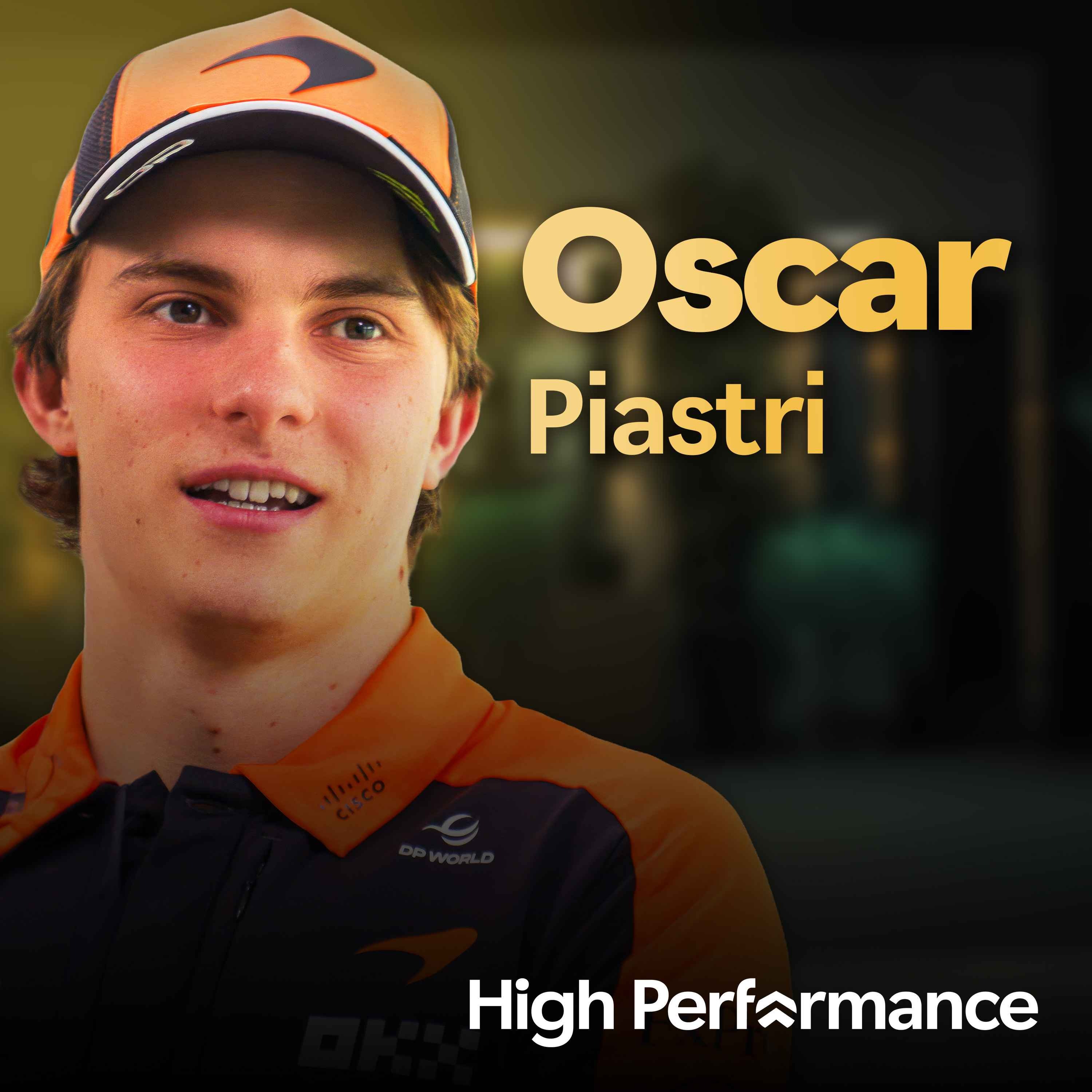
The High Performance Podcast
Oscar Piastri Exclusive: The Mindset Secrets of F1's Calmest Driver (E406)
00:50:15
Loading summary
Transcript86 lines
- [00:04]
Oscar Piastri
Right.
- [00:04]
Rob Smedley
If I asked you at 14, do you believe you'll be a Formula 1 driver or an F1 world champion, what would you have said?
- [00:10]
Oscar Piastri
Honestly, probably no. I just wanted to race cars for a living. I try and look at it from a very realistic point of view. I knew that as long as I got close to my potential, that I could win races. Having respect for one another and being friends with one another are two very different things. Realistically, I probably only had to beat Lando. Obviously, Max was back in the picture later in the year. 24 times a year, you've got to go on track and prove that you're better than.
- [00:39]
Rob Smedley
Do you believe you will one day be a Formula one world Champion? Oscar, welcome to High Performance.
- [00:45]
Oscar Piastri
Thank you.
- [00:46]
Rob Smedley
Well, here we are. Another season of F1 is underway. I'm always interested when I've watched someone like you come through from the junior formula, and now here you are, and this is the first time you and I have had a chance to sit down and chat. Like, how is this life compared to the dream you had for it when you were an 11 year old sitting in a go kart?
- [01:05]
Oscar Piastri
There's a lot of elements that are just as cool as you would think. Like, you know, when you generally take a step back and think about what I'm doing, it's pretty cool. I'm driving the fastest cars in the world. I think what is different, like, there's a lot of behind the scenes work. There's obviously the hard work that goes in on kind of an engineering and performance side of things. There's obviously all the kind of marketing and media and sponsorship side of stuff as well. Which, you know, when you're an 11 year old kid, you basically just jump in your go kart, do laps, and go home again. And that's kind of it. So that part is certainly different to what you, I guess, dream of as a kid. But it's all part of it. I think the other biggest difference is, like, when you're actually in the situation, you have to consciously take a step back to appreciate what you're doing. Like, when you're in the moment now I go, okay, I'm driving my car. Like, I kind of ignore the fact that it's an F1 car and the fastest car in the world. And I just go, this is my job. I'm trying to do the best job that I can. Like the feeling of sitting in the car and what I'm trying to achieve is the same as when I was 10 years old. But, you know, 10 year old me would be looking at that going, this is the best thing ever. So that, that's probably the biggest difference is you have to consciously take that step back because once you're in F1, obviously you aim for race wins and championships, but they're, they're not so far off in the distance, they're kind of within touching distance.
- [02:42]
Rob Smedley
And have you consciously done that step back moment? Because the life you're living doesn't come for free.
- [02:47]
Oscar Piastri
Right?
- [02:48]
Rob Smedley
I remember talking here actually to your teammate Lando and I said, how's life? And you know what, he just went lonely. Fernando Lance has been on the podcast. At the end of the conversation the question was, you know, what's the cost of doing this? And he said, well, personal relationships at the time, he said, I don't have kids, for example. He, obviously he does now. So have you taken those moments to step back and realize that this doesn't come for free, therefore you have to find the joy in those things that the 10 year old, 11 year old you would not have believed you were doing for a living?
- [03:17]
Oscar Piastri
Definitely, yes, I think, yeah. For me, you know, I take a lot of kind of joy and happiness from, you know, being able to drive race cars for a living and, you know, fortunate enough to be in a competitive team, you know, fighting for wins, podiums, championships. And that's the kind of stuff that, you know, you've always dreamed of as a, as a racing driver. But like you said, it doesn't come for free, you know, especially if you're not from Europe. You've got that added step of moving to Europe at some point. And you know, for me that came at the age of 14, so it was pretty early to be making that decision. And I think that was a good thing in some ways because I was young, naive of kind of, you know, as far as I knew I was going overseas to go and race the best guys in the world. And that was, you know, that sounded awesome to me. But then, yeah, once you kind of look back on it, yeah, it's a pretty tough decision to make. You know, not being able to see your family very regularly. You know, even now go back home for a couple weeks a year over Christmas. So, you know, it's in the, in those. How long have it been now? 10 years. I've probably spent in total 7 or 8 months seeing my family away from a racetrack. You know, I've seen them at the racetrack, but it's a bit different when you're, you're at a racetrack versus just relaxing at home. So this definitely decisions you have to make along the way. But at the end of the day, I decided that I wanted to be an F1 driver and that I was willing to give up certain things to make that happen. And I'm certainly glad that I was able to accomplish that. But, yeah, I'm pretty happy driving race cars.
- [05:21]
Rob Smedley
I'm sure you are. And, you know, people obsess over the decisions you make now, the teams to join, the decisions you make behind a wheel. I think this decision at 14, to leave Australia, travel to the other side of the world without your family to pursue your dream is a really fascinating moment. And I think people don't think about the fact that if you're. If you're a Spaniard or you're a Brit or you're a Frenchman or you're Italian, well, you're still in the same continent. You can whip home at a weekend. That option's not available for you as soon as we finish this conversation or you're pretty much about to fly off to Miami. So people will be listening to this. Ahead of that race, they've announced a few regulation changes. You had an issue in Melbourne with, you know, the car delivering a lot of power. Oliver Berman had the same thing in Japan. From what you've seen and the changes they've made, is it enough?
- [06:12]
Oscar Piastri
It's hard to say now. I think there's definitely some rule changes that are definitely a step in the right direction. I think some of the stuff around the. The kind of power you get from the boost button, I'll be honest with you, there's a lot of rules I still need to actually look through and see what specifically that changes. So it's still complex. And, you know, with the engines we've got, there's always going to be a compromise somewhere. And I think it's been. I think for me, the biggest thing has been the kind of coordination and collaboration between the drivers, teams, F1 and the FIA. It's been actually quite refreshing, I think, for especially some of the older guys to see the collaboration. But time will tell. I think there probably will need to be some further tweaks. How easy they are to implement this year, we don't know, but I'm sure there'll be some changes probably next year or in the future, but it's definitely going in the right direction. So hopefully. Hopefully we see that on show in Miami.
- [07:21]
Rob Smedley
We'll be right back after a quick word from our partners.
- [07:26]
Monday.com Ad Voice
This is a Monday.com ad, the same Monday.com designed for every team. The same Monday.com with built in AI scaling your work from day one. The same Monday.comwith an easy and intuitive setup. Go to Monday.com and try it for free.
- [07:42]
Verizon Mom Voice
Hey honey, it's mom. Did you know if we switch to Verizon we can get four phones for $0 plus four lines for 25 doll online. Call me back. Me again. That's just a hundred dollars a month for four lines on unlimited welcome plus four phones. No trade in needed. Call me. It's mom. America's best network Verizon. That's the one we're talking about. I'll send you text.
- [08:03]
Carvana Ad Voice
America's best Network based on RootMetric's best overall mobile network performance US 2nd half 20254 new lines and a limited welcome and auto pay. See verizon.com for details. Hey sweetie. Your mother showed me this Carvana thing for selling the car. I'm gonna give it a try. Wish me luck. Me again. I put in the license plate. It gave me an offer. Unbelievable. Okay, I accepted the offer. They're picking it up Tuesday from the driveway. I haven't even left my chair. It's done. The car is gone. I'm holding a check anyway. Carvana, give it a whirl. Love ya.
- [08:35]
Monday.com Ad Voice
So good you'll want to leave a voicemail about it. Sell your car today on Carvana. Pickup fees may apply.
- [08:45]
Rob Smedley
So go back to that 14 year old. What was the decision making process you can remember going through at that point?
- [08:52]
Oscar Piastri
Well, it was kind of a, let's say joint ish decision between me and my parents, especially my dad. You know, he took me to all my karting races, he was my mechanic when I was racing in Australia. You know, my mum was very supportive in kind of allowing me to chase my dreams, but, you know, not particularly interested in motorsport. She was interested in my racing, obviously, but also very supportive in that I've got three younger sisters and you know, it would have been quite easy for her to turn around and say, I can't, you know, I can't look after the girls and kind of not see, you know, my dad or me so often. It would have been quite easy for her to turn around and say that. But she didn't. She let me do it and kind of did her best to make it work. So I think that side of things was one thing. But I did a race the year before in 2014, which was kind of the litmus test for basically whether my dad was going to, you know, put in the time and the Money to try and give me a crack at racing in Europe. And that race went well. I finished third. And then I did a few more races the following in 2015, which also went reasonably well. But we could kind of see that compared to the guys that were, you know, I did the European Championships and I think one other race and, you know, all the other guys, all the other kids were racing every second weekend, basically. And you, you could kind of tell that we were doing a good job for the amount of kind of effort and time we were putting in. But to do it properly or, you know, to get ultimate success, we needed to do it properly. And the only way to do it properly is to commit to it and move to Europe. So for me, at the time, you know, there was kind of the, the weighing up of, you know, I'm going to be leaving Australia, I'm going to be leaving my friends behind, you know, not being able to see my, my sisters in particular, not seeing my mum that much. My dad was there for the first six months pretty much full time, and then I went to boarding school after that. So the idea of going to live at school wasn't the most appealing at 14 years old. But I knew that, you know, I had to weigh up. Do I want to continue on this path? Firstly, racing against the best guys in the world, which I'm really enjoying. And, you know, at this fork in the road, either I keep doing this and kind of keep making those sacrifices, or I go back to Australia and probably try and race V8 supercars. That probably would have been the plan, but I had the, I guess the passion my family was supportive in. They were supporting me both with time, you know, effort with my sisters and making it work and financially as well. So I kind of thought, well, if they're willing to help me with this and I really want to do it, then why not? There's plenty of opportunities here if I do a good enough job, so I better make sure I do a good job.
- [12:10]
Rob Smedley
And what about the self belief? I mean, there's something magic about naivety when you're 14, right? If I asked you at 14, do you believe you'll be a Formula 1 driver or an F1 world champion? What would you have said?
- [12:23]
Oscar Piastri
Honestly? Probably no.
- [12:25]
Rob Smedley
Really?
- [12:25]
Oscar Piastri
Yeah. I was realistic. And I think until I got to F2, my goal, I always kind of split into my dream. And my goal, my dream was always to be an F1 driver, but my goal goal was always to just be a professional racing driver. I just wanted to race cars for A living. I didn't really mind if it was an F1 car, a supercar in Australia, GT cars, IndyCar even. Although with age, I'm not so sure I'd go race IndyCar now. But I wanted to be a professional racing driver. And I was very realistic that, you know, my chances of getting to F1 are incredibly small. So I'd kind of accepted that from a young age. But I also thought, you know, even if I don't make it to F1, I'm just going to get as far as I can up the junior ladder and, you know, if I don't make it, then hopefully there's an opportunity that comes from racing in F3 or F2. And I didn't really let myself kind of dare to, you know, turn that dream into a goal until I got to F2 and started to fight for the championship there. That I went, okay, the next. And even then, it was kind of more a logical step of going, okay, well, the next thing you know, if this goes well, say if I win this year, the only step left is F1, rather than going like, I'm in F2 now. Okay, now I really want to get to F1. It was kind of okay. Well, things are still going well in the junior ranks, so the next step is F1, and that's a pretty cool place to land. So I was very realistic early on that the chances of making it happen were going to be small. But, you know, I guess the saying of, well, somebody's got to do it is very much true. And I think when you're a kid, it seems very far away. And that kind of feeling of, you know, someone does have to fill those seats on the grid feels incredibly distant and hard to achieve. But as you get a little bit closer, you go, okay, I can actually be one of the people to do this.
- [14:35]
Rob Smedley
I also think that self belief is such an important tool in someone's, you know, armor. We've had over 400 conversations on this show, and so often the people that we sit and speak to tell us that they believed it before it happened because otherwise it would never have happened. So now you've been this close to making it happen. Do you believe you will one day be a Formula one world Champion?
- [14:56]
Oscar Piastri
I think so, yes.
- [14:57]
Rob Smedley
Yeah.
- [14:59]
Oscar Piastri
Again, I. I guess I may be a little bit different in that I. I don't spend that much time thinking about the kind of. Or I try not to anyway, about the hypotheticals or, you know, of course I want to become a Formula one world Champion, but I Try and look at it from a very realistic point of view. And, you know, that's a combination of, you know, I need to do my job. But in this sport, for good or bad, if you don't have the car to achieve it, then you can kind of believe you're going to be F1 world champion all you want. But if you don't have the best car or one of the best cars, then again, you can believe that it's going to happen all you want, but probably not going to happen. So I think for me, that's more. Where I come from is just that sense of realism. And I'm a big believer in just trying to do the most with what you've got. And, you know, take Suzuka this year, for example. You know, you look at it in the history books in 10 years and say, okay, I finished second, and at this point, I've won nine F1 races. But honestly, I would probably put that second place higher in my list of personal achievements than probably 50% of those wins that I've had so far. Just because I know that I didn't leave anything on the table in that weekend. I got the absolute most out of myself in practice, I got very close to the absolute most in qualifying. I got the absolute most out of the race. And we were quick enough to finish second, me and the car and the team. That was all we had. And again, the history books will say I got beaten by 15 seconds. But, you know, that's where our sport is a little bit funny and where you have to be very disciplined in kind of focusing on the right things. Because again, I left that weekend happier than I probably left half the races I've won in my career. And that's a really big, important factor for me, is making sure you leave every weekend knowing that you've done absolutely everything that you can, regardless of whether you've won the race, whether you've finished 10th, whether you've finished 15th, even as long as you can leave the weekend knowing that I did absolutely everything I could in my control, that's good enough for me.
- [17:31]
Rob Smedley
So when we talk about belief, right, do you remember the moment that you went from turning up on a Thursday thinking, hope things go my way and I get a decent result, to turning up on a Thursday thinking, if I do my job, I know I win this race?
- [17:46]
Oscar Piastri
Probably after Melbourne last year, right, again, in the history books, I finished ninth. And it wasn't a race filled with great memories, but I left that weekend knowing that I'd taken a big step forward from the year before. I knew that I still had some steps and improvements to make, but I knew that I was really close to just being able to kind of maximize my potential. I think through my first two years of F1, there was always a bit of a lingering feeling of a little bit of hope, a little bit of, you know, I need to do something a little bit extra or I need to do something a bit special. But after Melbourne in 2025, I knew within myself, and especially after China, when I won, I knew that as long as I got close to my potential that I could win races. And obviously a big part of that comes from the car that you're in. And especially the first half of the season, I knew that if I got close to my potential, then realistically I probably only had to beat Lando and that was it. Which is not an easy task, but it's a little bit easier when you've only got to worry about one or two people. Obviously, Max was back in the picture later in the year, but 2025 was the first time in F1, at least where I went. You know, if I get close to my potential here, I'm going to win.
- [19:16]
Rob Smedley
And when you go back to those first few races of last season, you're winning them, you're leading the championship. Like it looks easy from the outside. I'm really interested from behind the visor, how different does the job and the sport feel when that's the, the way that it's looking and the way that it's falling? Do you know what I mean?
- [19:37]
Oscar Piastri
Yes, I do. It's. It's a double edged sword, right? I would say there's obviously the, the confidence you get from that and just the enjoyment. You know, at the end of the day, we're all here on the grid because we're trying to win races and eventually championships. So there's a lot of enjoyment that comes with that. I guess there's also kind of the expectation or, you know, the building expectation of trying to keep that going. And, you know, at certain points last year, finishing second was almost kind of the worst place I could finish because I got beaten by my teammate probably. And our car was a lot better than everyone else's on certain weekends. And, you know, I didn't do a good enough job basically. So, you know, when finishing second feels like a bad weekend, it's. It's tough to. Or, you know, it's tough and important to kind of look at it in a more holistic way and go, okay, yeah, it wasn't a good weekend or whatever in the grand scheme of things. But I still just finished second in an F1 race, thinking I probably didn't do as good of a job as I should have or I could have. So, yeah, it's a double edged sword and it's, you know, you've got to be careful to not get carried away either.
- [20:59]
Rob Smedley
And what's the secret to that? Because I remember watching, thinking, I wonder whether even after four or five races, whether you were thinking, oh, I think I might win the world title this year and how dangerous it is for your brain to go there, which is the most natural human thing in the world, isn't it?
- [21:13]
Oscar Piastri
I think there was definitely thoughts of. I don't think there was ever really the thoughts of, I'm going to win the World Championship or if there was. If there were, I was very quick to go. Calm yourself down because there's a long way to go. But I, again, like, after Melbourne, I, I knew within myself that I, it was within my power to win the World Championship. I didn't necessarily think or, you know, I wasn't certain it was going to happen, but I knew that if, and it's a big if, if you did a good enough job and if certain things go the right way, then it can happen. So I think that was more the belief. And again, there's a good quote from Niki Lauder that I saw this morning, actually from the Laureus Awards, where he dedicated his award to the losers and saying that he always learned so much more in losing than in winning, which I think is true. And it's very, very hard to find. You know, when you lose a race because of a mistake or because of something you did badly, it stares at you in the face pretty obviously. But if you've won a race and there was things that didn't go that well, you've got to look a bit harder to go. Okay, this still wasn't great. This wasn't great. You know, Miami for me last year was a perfect example where I won the race, but I started fourth. I went into the race going, there's no way I'm gonna win this thing. Starting from fourth, a few things went my way. Our car was incredibly quick in Miami and I knew that I'd done a good job of kind of the, the circumstances I got dealt with in the race and was able to win. But I knew that if I like, I could do that once or twice or three times in the year out of 24 races and maybe get away with It. But I could not win a championship based on weekends like that.
- [23:20]
Rob Smedley
In what respect?
- [23:22]
Oscar Piastri
I didn't do a good enough job before that. I think in the race, I did a good job, but.
- [23:27]
Rob Smedley
But people would look at that and go, well, you won the race. What do you mean you didn't do a good enough job? Like, what does winning a race and not doing a good enough job actually look like to you?
- [23:35]
Oscar Piastri
I think in that one specifically, mainly qualifying. You know, qualifying is such a big part of Formula One that in 95% of the races, I would say starting fourth, you're not going to win the race, especially when you've got a competitive teammate alongside you. And, you know, Lando was starting ahead of me. You know, there was races last year where I think we both pretty much knew that whoever was leading at the end of the first lap, out of us two, it was more than likely gonna stay that way. So that's a really important part. And I knew that I hadn't done a good job in qualifying and that if I was qualifying fourth every weekend again, I could do that once or twice and have a bit of action, go on and take advantage of it. But I couldn't rely on that, basically. And, you know, the next weekend I tried to improve my qualifying, and the rest of the year tried to do the same. And that sets up your race and, yeah, just trying to make life as easy as possible for yourself, that was the biggest thing.
- [24:37]
Rob Smedley
We'll be right back after a quick word from our partners. What if the real question isn't where you're going, but the adventures you experience along the way? It's time to set your sights higher, on peaks still to be climbed, rivers still to be crossed, and greater dreams to pursue. It's time to embrace the impossible with Defender. A family of vehicles built around capability, durability tested on some of the most difficult terrain. Defender defines tough luxury. And I should know. I've driven one for the past three years. I have the Defender 130. But from the compact confidence of the Defender 90 to the versatility of the 110 through to mine, the Defender 130, with seating for up to eight, there's endless potential. You feel it in the details as well. The rugged body design, the robust materials, all working together so you can head out with confidence. And inside, Clearsight technology helps you see the world around you in a new way. While the PV Pro keeps your navigation routes and playlists flowing seamlessly as you go. And with up to 89 cubic feet of cargo space, there's room for everything you need on your journey. Explore the full Defender lineup@land roverusa.com if something's been a bit off in the bedroom, you're definitely not alone, and a lot of guys put off doing anything about it for longer than they need to. With hims, it's easy to take action. Everything's fully handled online. No awkward appointments, no pharmacy cues. You fill out a quick online intake and a licensed healthcare provider will see if treatment is right for you if prescribed your treatments delivered in a discreet package. This includes Sildenafil generic for Viagra, available through HIMS up to 95% less than the brand name. And if that's not the right fit, there are other options available so you can find what works best for you. To get simple online access to personalized affordable care for ed, hair loss, weight loss and more, visit hims.comperformance that's hims.comperformance for your free online visit hims.comperformance Prescription required. See website for details and important safety information. Sildenafil is the generic version of Viagra. Viagra is a registered trademark of Beatrice Specialty, llc. HIMS is not affiliated with or endorsed by Beatrice. I don't know about you, but I really love keeping my money where I can actually see it. Unfortunately, traditional big wireless companies seem to like hanging onto my money for me. For years I was overpaying for wireless simply because it's what I used to do. I didn't really question the high monthly bill, the extra fees, or those free perks that somehow end up costing me. Eventually I realized it didn't make sense, so I switched to Mint Mobile. Most people just accept overpaying for their phone bill, but you don't have to. Thanks to Mint Mobile. With premium wireless plans Starting at just 15 bucks a month, you still get high speed, unlimited talk and text, all on the nation's largest 5G network. Honestly, the wireless service is just as good as the traditional big carriers. It's easy to switch too. Keep your phone, your number and get set up in minutes with esim. No contracts, no hassle. If you like your money, Mint Mobile is for you. Shop plans@mintmobile.com HPP that's mintmobile.com HPP upfront payment of $45 for three months five gigabyte plan required, equivalent to $15 a month new customer offer for first three months only, then full price plan options available, taxes and fees extra. See Mint Mobile for details. Inside the Saracens rugby jersey and we had their captain Maruwatoji on the show recently they have the letters tstns. The shit that nobody sees is the acronym that that stands for. What is the shit that nobody sees in your world that think you think makes you a better driver?
- [27:56]
Oscar Piastri
Oh, that makes me a better driver. I think it's probably, I mean, it covers so many things, but I think it's the hard work and the data we go through, the kind of preparation we do, which obviously no one sees because we never share it because it's sensitive information. Right. So I don't know if any, if people will ever really be able to appreciate that. But it's a bit different in that, you know, racing is very different to a lot of sports. Like, you know, tennis, for example. If you want to go get better at tennis, your number one thing you're going to do is go on a court and hit some balls. Can't do that with racing. The closest thing we've got is a simulator. It gets close. But when you talk about the really detailed minute things you're trying to change, I'm not sure simulators will ever quite get to that point. So it's the kind of discussions you have with your engineers, it's the squiggly lines we look through the data traces, whether it be the mental work we do, the physical training. I think the physical training people probably understand because people can relate to that a lot more. But you know, sitting in a simulator for five hours testing different roll bars or downforce levels and stuff, it's very hard for people that haven't driven a race car to relate to that and, or, you know, trying this driving style change or whatever. So I think it's just the amount of, kind of, in some ways the mental effort that goes into preparing the limited physical time you have in a race car. Yeah, because, you know, even on a race weekend, especially a sprint race weekend, for example, and especially with this new regulations of cars, you know, if you go into the session going, okay, let's see what happens and we'll go from there, you're gonna be absolutely nowhere. And you need to do that time in the simulator. You need to discuss through different setup ideas, you need to discuss through different driving ideas so that when you're on that track for an hour, and I guess what people also maybe sometimes don't see is we have a one hour practice session, but we've got two sets of tyres per practice session. Essentially. One of them is generally a soft tyre, which is good for one lap or two laps, so maybe two. So you've got all that preparation Time to prepare. Qualifying is going into effectively, let's say, three minutes on the track. And you've got to be so prepared and put so much effort into being able to do that in real time alongside trying to drive a race car at however many hundreds of kilometers an hour. So I think that's probably the shit that no one sees.
- [31:13]
Rob Smedley
Yeah. And are you the kind of guy that will share everything with a teammate and want them to know everything, or are you more protective of your.
- [31:22]
Oscar Piastri
Generally, yes. And, you know, I think it's the way of just modern teams Anyway, especially at McLaren, you know, that's the way it's going to be, whether I want it to be or not. And, you know, I think it is a very good way of going about things because, you know, it goes. It goes in a circle. Right. Of course, if you find something special that you think that no one else has found, you're going to want to try and keep that to yourself. But we've got hundreds of people working in our team. Other teams got the same. Got on boards gps, like, there's no secrets you can't hide. And again, it goes the opposite way as well. You know, if you're in that position where someone else has done something and you go, oh, I need to work out how to do that. You want as many tools at your disposal as you can get. So, yeah, I think everyone probably has their little moments where they go, okay, I want to keep that one to myself. But at the end of the day, if you start going down that route, eventually it'll bite you when you probably least want it.
- [32:32]
Rob Smedley
The teammate dynamic is so interesting. You and Lando, you know, went toe to toe for the title last year. How different does that relationship become when you both know, okay, one of us is now going to win the world title?
- [32:50]
Oscar Piastri
In all honesty, I don't think it really changed, really.
- [32:55]
Rob Smedley
Which I just thought.
- [32:56]
Oscar Piastri
I don't think anyone really believes or struggles to believe. I think it's very much down to how we are as people. I think we're both quite good at, you know, separating kind of the people and what happens on the racetrack versus off the racetrack. You know, our marketing days that we had to do together, for example, were exactly the same. Probably, if anything, you know, like, we get asked about our relationship as teammates quite a lot, and I think probably it was actually better, you know, at the back end of last year than it was, you know, say, the first six months that we were getting to know each other just because we know each other more. And you Know, we spend so much time around one another every year, so it really didn't change much because I think, you know, we both knew the situation we were in of trying to beat each other, and one of us. Only one of us could win. We knew all of that, but it never got nasty. And I think that's a really important thing because I think it would have been very easy for last year to have got nasty. And, well, there would have been probably the, you know, if it really got bad, the question of whether one of us was even sat here doing this interview wearing orange. But I think, you know, just the team dynamics is so important to protect going forwards. And, you know, obviously, we've not quite started this year the way we want, but it would have been so easy for the battle of last year to make it look 10 times worse and 10 times worse for a long time. So I think we both knew that as well.
- [34:52]
Rob Smedley
And you should be proud, actually, of the fact that you both went through that pressure cooker.
- [34:57]
Oscar Piastri
Yeah.
- [34:57]
Rob Smedley
And. Yeah, and you're both here and you're okay with each other. I think that's. It's not easy for that to.
- [35:02]
Oscar Piastri
Yeah. And I think, again, I think we, you know, we obviously had a couple times where we came together, but there was never, you know, I think in kind of title battles, especially between teammates that have kind of turned sour, there's normally been some element of games or trying to hide stuff or something like that. And I think for both of us, we're just not really like that. But also, we know, like, you know, we've seen that play out as well. And, you know, I think it doesn't take much to get into that sequence of, you know, I'm gonna do this. And then the teammate goes, oh, well, okay, I know you did that, so I'm gonna do this. And then it's just escalates. And I think, you know, for both of us, even if we did have problems, I think they were never intentional. And, you know, even if we felt like we'd crossed the line either we were, you know, good. We never had to confront each other, but we. I think we both kind of knew if we'd crossed the line ourselves and went, my bad. And the team held us accountable for that as well. So, yeah, I think we had a good system to keep things friendly.
- [36:24]
Rob Smedley
What was the biggest lesson from the toughest moment last season?
- [36:31]
Oscar Piastri
I mean, there's a few tough moments, I think, I guess the pressure, in some ways, of. From different angles, you know, when you're ahead in the championship, you know you're doing something right. That's why you have the lead. But you're also the one being hunted if you're behind and you know you're trying to maintain that advantage, so you always. You can only look behind in some ways, so it's difficult to not do that. But then when you're behind, of course, you've got the. The mentality of being the hunter, but you've also got the gap to close. You've got to close it. And I think just the kind of dynamics of that a little bit maybe, was a bit of an eye opener. It's obviously a very long season.
- [37:19]
Rob Smedley
So which is more natural for you to be the hunter or the hunted?
- [37:22]
Oscar Piastri
I. I think the hunted. I've. I've always enjoyed being that position because, again, I've said it a few times, generally that means you're doing something right or something better than the people you're racing against. And I guess there's that confidence of, you know, genuinely, you're probably in that position because you've won races or, you know, been on the podium a lot or things like that. You know, if it's chopping and changing every single race, then, yeah, if you're the hunted by two points, then it's a bit different if it's by 30. But for me, that's always been a nice position because you've got a little bit of buffer and you've got the races and the results to back up that position normally. So I think that was probably the biggest thing. And then, yeah, there was a few technical things, a few tracks at the end of the year where I had to drive the car very differently that I probably didn't get on top of as quickly as I should have. Probably some things as a team we'd do again in a slightly different way as well. So, you know, there's little bits everywhere. There wasn't one glaringly the obvious thing, but you put enough of those things together and sometimes it doesn't quite happen.
- [38:52]
Rob Smedley
No, indeed. And how are you recovering from these moments?
- [38:59]
Oscar Piastri
I think generally pretty good. You know, definitely the few days after Abu Dhabi weren't the most enjoyable in my life, but I think in some ways having such a big reset this year was a good thing because, you know, I think for me, I kind of reflected on last year and, you know, firstly, obviously, again, going back to the. Looking at things when you're winning versus losing, you obviously look at the things that were painful and the mistakes and then reflected on the things that were good and the things I want to try and maintain for this year. And then once you do that, then the challenge of the regulations this year was so massive going into it that for good or bad, you almost didn't have time to dwell on last season that much, which was. Was perfect for me because I didn't, you know, I had the kind of two weeks in Australia to see my family, see my friends, reflect on 2025, and then get stuck into the challenge of this year. And, you know, obviously the first two races this year didn't go well in that I didn't start them, but I think Japan was in some ways a more just reflection of where I feel like I'm at this season and the hard work we put in in the off season, the way I kind of, you know, switched my focus from last year into this new challenge this year, I think that was a really helpful thing for me to be able to just focus all my energy on. So, yeah, I've enjoyed in some ways having the new challenge. In some ways, it's been a bit of a headache. But, yeah, for me, I felt like I used my time efficiently to reflect on last year, but then channeled that energy or any motivation I had from last year, let's say, into. Into attacking the new challenge.
- [41:06]
Rob Smedley
Do you remember when you made that switch? Because we've spoken to some people on this show who are like, I give myself 48 hours and I can be the grumpiest, most horrible person on the planet for that amount of time. Other people, they just kind of let it be there until they feel better. I don't know what your approach is to dealing with those really difficult moments.
- [41:25]
Oscar Piastri
I would say it's more just letting it be there. I think it's. It's very hard to force things in general. Yeah. And, you know, you could perfectly say to yourself that, you know, okay, I'm gonna give myself, you know, until midnight on Sunday night. And when it gets to 12:01 on Monday morning, I'm gonna reset myself. But you could have a thought at 1205 going, Damn, I wish I didn't do that in this race or this race. And, like, you know, we're human. We don't work by just switching off. And, you know, I think you kind of have to deal with your emotions and your feelings when they happen. And that's, I guess, part of being human is you don't always know when that's going to happen. So for me, it was kind of just feel it out and, you know, even now, there's still the odd thought of doesn't even necessarily need to be last year, could be racist or, you know, we all have moments, embarrassing moments in our life where, you know, you have an interaction with someone, you go, oh, I wish I had have said this instead of this, or, you know, those random thoughts, they happen about everything. So, yeah, for me it's just dealing with them when they come up rather than trying to force a time period because, yeah, you never know when they're going to come up, but it's, you know, it's always how you deal with those things rather than trying to shut them out and pretend they're not there.
- [42:59]
Rob Smedley
And do you work with a therapist or a mental coach or anyone like that?
- [43:04]
Oscar Piastri
Mental coach? Yes, her name's Emma Murray. I've worked with her for, for quite a while now. And yeah, she's done work with different AFL clubs in Australia and, and various other athletes. So we've known each other for, for a while. And yeah, I think for me, I've always felt like my natural mental strength has been pretty strong. I maybe didn't always necessarily know that, and I maybe needed some tough situations or people like Emma to tell me sometimes. But I think there's. There's been elements of that that come naturally and elements of that that are definitely kind of practiced and worked on as well.
- [43:57]
Rob Smedley
And what's the best either piece of advice she's given you for some work that you can do mentally to keep yourself in a good place, or maybe. I know most of this stuff should rightly stay private, like maybe something that she said where it's just made such sense to you that you think it might be helpful for people listening to this to hear.
- [44:15]
Oscar Piastri
I mean, there's lots of great pieces of advice I could give, but I think, you know, maybe some people think of kind of mental performance, or even mental health, for that matter, as trying to be positive all the time or, you know, just look at things through a very positive lens. But I think, again, going back to the kind of giving yourself a set time or trying to force things, like, I guess to put it bluntly, if something's shit, there's no point trying to say it's not shit. Yeah, you know, it's not fooling anyone. You know, you're not fooling yourself if you do that. So to put it more politely, you know, if you're in a tough situation or something bad's happened, there's no point trying to tell yourself that it's good or, you know, that it's not bad necessarily. You know, there might be a silver lining to things that you. You'll always find, and it's always important to try and find those. But to, you know, if you crash out of a race, like, if you try and say, oh, well, it wasn't that bad, or it was. It was good actually. Clearly it wasn't like, like. And I think there's always, yeah, just being honest and real is probably the biggest thing. Just letting your emotions out but then being able to do something about it. And, you know, that's kind of how I always was anyway, or how I am is, you know, I think emotions are. I phrased this in a way before that I want. I've changed a bit now, and I think I phrased it that emotions are rarely helpful. And I still kind of believe that to a sense, but I think they are helpful as long as you know how to control them, how to deal with them and channel them in the right way. I think that's a really important part of it. And I think for me, again, it's about what you can control and what you can't control. If I've got a problem and I can do something about it and I can fix it, then I'll fix it. If I can't fix it, then, okay, depending on the size of the problem, sometimes you go, I really wish I could fix that, but at a certain point you have to go, I can't fix it. I'm gonna focus on something else that I can fix. And, you know, that applies in racing and applies in life, and I think generally it makes me feel a bit more comfortable sometimes.
- [46:58]
Rob Smedley
I mean, I think it's so interesting and you certainly sound wise beyond your years. I remember talking to Johanna Conte, the former British number one tennis player. She spoke similar to this. She said that if your resistance to life is a 10, even if life is giving you the challenge of a 2, if your resistance is a 10, it's 20. So if life is giving you a challenge of a 10 and your resistance is a 10, that's a big issue. Whereas if your resistance to life is zero, right. Then the challenge can be 10. 10 times zero remains zero. So in your career, your reaction to anything, whether it is what happened in Monza or Baku or happened at the end of the season or what happened in Japan, whether it's good or bad, negative or positive, more than. What matters more than any of those things is your own personal reaction to those things.
- [47:42]
Oscar Piastri
Yeah, I agree. And I think again, it's kind of along everything, you know, I've kind of said, I always try to take the results out of it and think of, have I done a good job of the things I can control. You know, if you had a penalty from the stewards, you can complain about it, cry about it all you want, but is that actually going to help you? Like, you know, if you get a penalty on lap one of a 50 lap race, you know, you've kind of, you've got two options. Can you. Especially with a stewardship penalty, you know they're never going to change it. So either you can complain about it for the next 50 laps and say how unfair it was, or you can go, okay, I've got this penalty, let me try. And there's a fine line. You probably shouldn't say, try and drive even faster because you're trying to drive as fast as you can. But I've got this penalty. It is what it is. Let me try and do my job and if I do a good enough job, maybe I'll be able to overcome that penalty, maybe I won't. You're not gonna know. But all I can do now is try and do the best job that I can.
- [48:54]
Rob Smedley
I tell you, when you make me laugh, I know when you're getting news in the cockpit that's pissed you off. Cause there's no response, isn't it? I'm like, when's he gonna say something? There's always like five seconds of silence where you like processing. What information are you giving me here?
- [49:08]
Oscar Piastri
Yes, it depends, you know, if I think I can have some element of influence or control in the situation, then yes, I will say something. But if I know that there's not, there's. If I know that I could talk for the next half an hour and it's not going to change a single thing. Like, I'm not going to waste the energy. I'm just going to focus my energy on something I can do that might help me get over that situation.
- [49:42]
Rob Smedley
And when things are tense and difficult, who in the world of F1 can you lean on?
- [49:48]
Oscar Piastri
Mark, definitely, I think.
- [49:50]
Rob Smedley
Oh, actually I have a question about Mark. Do you mind if I play? This is from. I don't know whether you know, Rob or not, but we do an F1 podcast called High Performance Racing and he had a question for you which relates to this.
- [49:59]
Oscar Piastri
So, yeah.
- [50:00]
Rob Smedley
Hey, Oscar, it's Rob Smedley. So the question I wanted to ask you was, what is it like getting
- [50:07]
Oscar Piastri
managed off my old mate Mark Weber? Is he a taskmaster? And how has your relationship changed with
- [50:15]
Rob Smedley
him since you came in as a rookie?
- [50:22]
Oscar Piastri
The relationship's good.
- [50:24]
Carvana Ad Voice
Very
- [50:26]
Oscar Piastri
thorough. Is Mark, I think. How's it changed? I think, you know, when I first got into F1, I think Mark was, you know, coming up with questions and ideas that literally hadn't even entered my brain. And like, I would hear him say it and go, like, how the hell did he think of that? Or like, how am I ever going to think of that? And I think just with experience, I'm, you know, I'm still, you know, we're always learning every day. But I think, you know, now starting my fourth year, I have either the answers to a lot of those kind of questions that I wouldn't have had in the first couple of years, or I know the questions to keep asking, which just comes with experience. And I think, you know, there's naturally less and less for Mark to do on a racing side of things, the more experienced I become. But I think, especially in the first couple of years, just the kind of, you know, there's some lessons you have to learn the hard way, and there's no other way of doing it. But I'm sure there could have been plenty of other slightly annoying or tough lessons to learn that, you know, I was probably spared because of Mark's experience and Mark's guidance. So, yeah, there's probably always going to be, you know, situations or things that have gone smoothly that. Or almost problems that weren't, problems that I'm never going to know about because Mark managed them for me. So, yeah, I think that's probably how it's changed in the last few years.
- [52:12]
Rob Smedley
But you don't rely on any other fellow drivers for any advice or support.
- [52:18]
Oscar Piastri
No, not really. I mean, I think, you know, I think, you know, going back to kind of relationships, you know, with different people on the grid, I think there's always. I think especially now in F1, there's a massive level of respect between all the drivers. But having respect for one another and being friends with one another are two very different things. And I think, you know, for me, it's. It's always hard to be genuine friends with somebody that 24 times a year, you've got to go on track and prove that you're better than them, basically, or compete against them. And I think that's why probably a lot of, you know, some of the closest friendships in racing are between racing drivers that are in two different series or that have been teammates. You know, whether it be in the junior ranks or ex teammates in F1 that are now no longer either in the same team racing as each other or kind of at different ends of the grid because there's not that the same competitive tension between the two of them. So I get on with a lot of the drivers and there's definitely some I'm, you know, more friendly with than others. But you know, again, some ex teammates that, that I've had in the junior ranks because, you know, we're not racing against each other anymore. We can relate to each other a lot because, you know, we're both racing drivers, both doing the same job, you know, in different series. So there's a lot to talk about and now there's not that awkwardness of going, oh, well, I really want to talk to you about this, but if I talk to you about it, is it going to give you ideas on how you can beat me next time and all of those kind of things. So it's a tricky old business.
- [54:13]
Rob Smedley
Yeah. Well, look for someone that doesn't like sitting down and talking too much, I thought that was really interesting, mate. So thank you so much for giving me so much of your time.
- [54:20]
Oscar Piastri
Really enjoyed it.
- [54:21]
Rob Smedley
Nice to finally meet you.
- [54:22]
Oscar Piastri
Yes, nice to meet you too.
- [54:23]
Rob Smedley
Thanks, mate.
- [54:33]
Verizon Mom Voice
Hey honey, it's mom. Did you know if we switch to Verizon, we can get four phones for $0 plus four lines for $25 a line? Call me back. Me again. That's just $100 a month for four lines on unlimited welcome plus four phones. No trade in needed. Call me. It's mom. America's best network. Verizon. That's the one we're talking about. I'll send you text.
- [54:54]
Carvana Ad Voice
America's best network based on rootmetrics Best overall mobile network performance us second half 2025 four new lines and unlimited welcome and autopay. See verizon.com for details.
- [55:03]
Monday.com Ad Voice
Could AI help you do more of what you love? Workday is the AI platform for HR and finance that actually knows your business. We help you the have to DOS so you can focus on the can't wait to dos. It's a new work day.