← The High Performance Podcast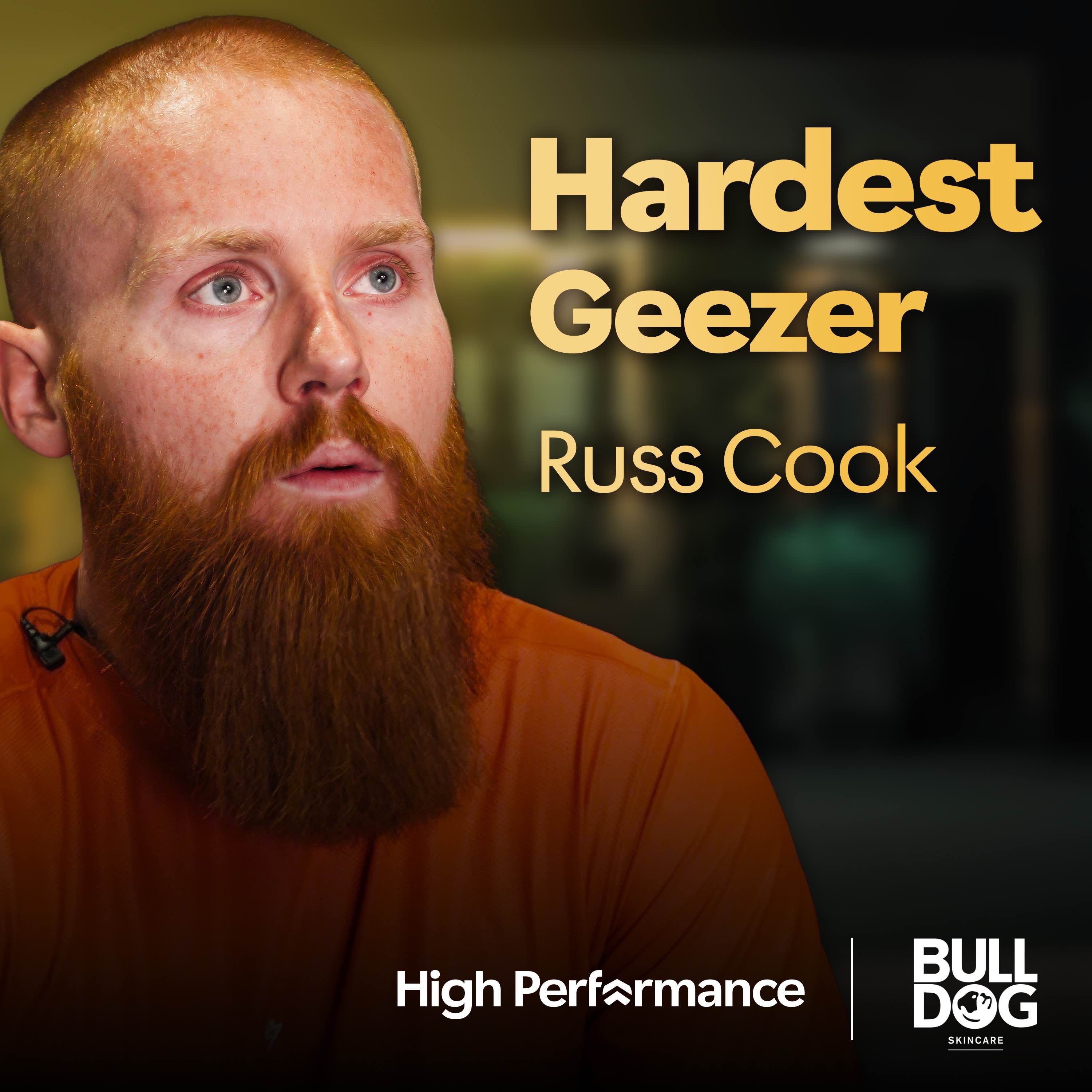
The High Performance Podcast
The 'Hardest Geezer' On Finding Direction When You're Lost | Russ Cook (E418)
00:43:22
Loading summary
Transcript201 lines
- [00:03]
A
This episode of High Performance is brought to you by Bulldog Skincare. In their mission to support everyday skin endurance, Bulldog Skincare are proud to be the official men's skincare partner of Ironman Europe. And our guest today here on High Performance is a true high performer, Russ Cook, or maybe hardest geezer as you might know him. Russ, of course, shot to public fame after completing a number of incredibly impressive feats of endurance, most notably his run across Africa in 2024, which saw him become the first person to run the length of Africa over 352 days. Russ covered more than 10,000 miles along the way, inspiring so many people as he documented his journey and raised close to a million pounds for charity. However, he didn't stop there. He's gone on to complete a number of other serious challenges. And as he sits down and talks to me, he's currently training for the Leeds Ironman Triathlon.
- [00:55]
B
Yeah, baby.
- [00:56]
A
Now look, I haven't competed in an Ironman, but Bulldog Skincare have challenged our guest today to do exactly that and I'm excited for him. However, in this episode, what I really want to dive into is the mindset around what it actually takes to prepare for something like an Ironman. What is driving Russ and can he pull it off? How's the training going?
- [01:17]
B
Well, I had a baby four weeks ago, so getting a good amount of sleep deprivation training in. But now, mate, I'm really looking forward to the Ironman league. It's gonna be a bit of a different test for me. Obviously I've done the running, but the swimming and the cycling is a whole new kettle of fish.
- [01:30]
A
Okay, sum up parenthood after four weeks for me.
- [01:33]
B
Do you know what, mate? I think if I was talking really honestly when she was born, I've never been struck by like, it literally felt like a lightning rod of emotion. I don't know how it was with your kids. It sounds quite soppy, but I've never felt so much love in my heart. Like I. Some of my favorite things at the moment are watching em, my missus and Poppy, our little girl just asleep in the mornings or in the evenings, they're just like cuddled up there asleep. Or I'll dance around with her in the kitchen, send her off to stick Coldplay on the speakers and I'll have a little sing and a dance of her and oh, mate, there's, yeah, a real deep sense of like, fulfillment from the last four weeks, which has been really nice actually.
- [02:13]
A
And this is interesting in the conversation we're having, I think for you because motivation is so important to do the things that you do. And I wonder whether having a baby is this whole new layer of motivation, a whole nother reason for what you do.
- [02:27]
B
I would definitely think. I mean, I am only four weeks in, but I would definitely think so. I think it gives a new sort of responsibility as well. You know, it's not. I think even when I look back at some of the challenges that I've done before, like, there's definitely an element of I'm doing it for a higher purpose, of doing it for other people. But I think now that I've got my little girl in the world, like, I'm. There's a. There's like this sense of, you know, I'm her father, I want to protect her, I want to guide her in all the right ways. And I know that a lot of that is down to how well, you know, what can I do in my own life? You know?
- [02:58]
A
Listen, I think a lot of people talk to you about what happened in Africa. And before this conversation, I obviously listened to you on lots of other podcasts and read lots of articles, and so much focus was about what you learned in Africa, how Africa tested you, where the growth was. And I would like to rewind quite a lot.
- [03:15]
B
Sounds great.
- [03:16]
A
To. When you're 21, you're in Worthing, you've been up since 4 o' clock in the morning working as a cleaner, you come home, you open a cupboard, and in that cupboard is a single tin of little new potatoes.
- [03:29]
B
Oh, what a time to be alive that was.
- [03:31]
A
Yeah, Take me into that room.
- [03:33]
B
I was a bit younger than 21 then, actually. I would say when I look back on it now, I'd say that was like, such a pivotal moment for me
- [03:40]
A
as a specific moment in time.
- [03:42]
B
Yeah, I don't think I necessarily realized it at the time, but it's. It encapsulates a time in my life where I felt kind of directionless. I had a lot. I had a lot of energy and I had a lot of motivation to do something with my life, but I really didn't know where to apply that. So I think I was. I was really struggling with that. And in that kind of moment, you know, you open the cupboard and you got tin and new potatoes for dinner, and that's all I had. No. No money to get anything else. It was showing me my, like, almost uselessness. And it just gave me this feeling of, like, I know that I'm kind of like. I feel like, helpless and useless and don't know where I'm going, but I know I'm at the start of trying to figure that out. So I mean it wasn't for a few years until I've really started making any significant changes but that was definitely a point where I went like one day this feels rubbish now but one day this is going to be worth it and this is going to have meaning, this moment.
- [04:33]
A
So how had you ended up working as a cleaner with no money, with only a tin of new potatoes to eat for dinner? Like what was going on? Because you are like a driven, interesting, dynamic, hard working, ambitious guy and we write people off in this world too often.
- [04:49]
B
Yeah, yeah.
- [04:50]
A
Whereas often the circumstance is just not right for them.
- [04:52]
B
So I was about 17, 18 during the, during that time and I think being now, I look back now and go being a 17, 18 year old bloke, I mean I'm sure girl as well is hard in that moment. It's like I didn't have any skills, didn't have much life experience so I was kind of struggling with the fact that I was like, had all this ambition and motivation but skill set wise I hadn't really, I haven't really figured out my place yet and I was kind of bottom of the food chain as it were. So you know, what jobs can I get at 17, 18 or the only jobs I could get was cleaning jobs, it was minimum wage, scrubbing, Waitrose toilet, four in the morning.
- [05:27]
A
But interestingly you talk about I was super ambitious, I knew I wanted to do something.
- [05:30]
B
Yeah.
- [05:31]
A
Like what did the ambition look like at that point?
- [05:34]
B
You know actually how it manifested was in a lot of ways like an arrogance. I didn't want to listen to people that if I looked at someone's life and I would look at, you know, I would say this like with a bit of shame now, but I look like my parents or maybe some other adults around me, some of my teachers at school and I'd go, well I don't really want your life so I ain't listening to you.
- [05:54]
A
Yeah.
- [05:55]
B
And I kind of just applied that logic to sort of a lot of people that I would encounter that were older. So that kind of ends up leading me down quite an isolated path because I'm no longer really trying to take direction off people that I don't deem valuable enough or living a life that I want to live. So I'm not kind of, I'm kind of not going to listen to you. And that kind of was a blessing and a curse. It led me down quite a lonely path to Start with. But then once I was, you know, I was born in that sort of age where podcasts were coming through at that time and I was listening to the Joe Rogans and these type and I was thinking, oh, you are living the life that I've got, so I am going to listen to this. And that kind of was a really important start of, you know, kickstarting my, me and my thinking in that way.
- [06:33]
A
I think we've got a bit of an issue where, particularly for young guys, they are a little bit unsure about what their place looks like in society now. And I think it's a huge problem.
- [06:43]
B
Yeah.
- [06:44]
A
And I get the sense that you were kind of in that place.
- [06:46]
B
Massively. Yeah, massively. I think, you know, it wasn't necessarily an information problem, like we have access to an amazing amount of information now. It was a bit more of a direction problem. I didn't know what direction do I want to head in? And that's. It's a bit of a rite of passage for a young man, I think, is finding that direction.
- [07:05]
A
So here's my question then. If you could rewind the clock and leave school, know the direction and immediately begin, which is what all parents want for their children. Oh, leave school. Have an idea of what you want to do. What do we say to 13 year olds? What do you want to be when you're older? Oh my goodness. Like, it's the worst question I think you can ask a young person because they should be available to explore. If I could remove that period of your life and take you straight from school to a sense of fulfillment and a purpose and a career, would you take that opportunity?
- [07:34]
B
No.
- [07:35]
A
Why not?
- [07:36]
B
Because I think that it's really valuable to come to that conclusion through the mistakes. They kind of, they keep you in line when you like. I know now that gambling is a bad thing for me to do because I've been there. I've spunked all my wages month after month on, on roulette and, and ackers at the weekend. That's deeply entrenched. But I know that's silly. Whereas if I never had done that, then I wouldn't notice. So I've done that in so many different verticals. I've done that with the party and with the drinking, with the sitting down on a, on a Saturday, on a Sunday morning after a hangover with the Domino's and the pizza and the ice cream in bed forever and just wishing. I wish this was my life. And now I know it's like, no, no, you can have Your comfort moments. But it's not good for you, and it's not what you want either. I wouldn't change it. Looking back at all now, I just
- [08:27]
A
wish that I'd been told when I was 17, embarrassment is the price of entry.
- [08:32]
B
Yeah. Yeah.
- [08:33]
A
Failure is the price of ambition.
- [08:36]
B
Yeah.
- [08:36]
A
Be embarrassed and fail.
- [08:38]
B
Yeah. But we go again, don't we?
- [08:40]
A
Exactly.
- [08:41]
B
Well, you did.
- [08:42]
A
So let's talk about the moment that you went again.
- [08:45]
B
Yeah. Oh, I guess there was a lot of going again, to be fair. I think that's quite an interesting part of the journey because people see, like, the run in the Africa thing or whatever, and they think, oh, wow, that was, you know, did that. But I'm like, mate, I literally. And even since then, I'm constantly failing at things I'm trying to do. So, Yeah, I mean, the. The going again from the. From the Tina. New potatoes.
- [09:09]
A
Yeah, let's go from that moment. Yeah, just a few of them.
- [09:12]
B
So from. I think I didn't even have the bravery or courage at that point to really start looking at the places that were gonna be successful. I was going for all the easy ones first. So I would do the partying, the drinking, going out, the doing the things that I shouldn't be doing. Those were all of those kind of, like, quick. I'm searching for, like, little dopamine hits.
- [09:32]
A
Yeah.
- [09:32]
B
Like, oh, is that gonna make me feel better? Is that gonna make me feel better? I remember I ran back from a nightclub in Brighton, and then that was 11 miles after a night out. And my mate text me after that saying, come and run Brighton half marathon, and then come to do the full marathon after. And it was actually the process of just training for one marathon that really showed me a different path. It was like, okay, you know, you've got the challenge, you've got a test. You've got to train for it. You've got to be disciplined to accomplish it. You've got to be motivated. You need to believe in yourself. You need to push through hard things. That was like, the real start for me of unlocking, like, a new perspective on it. And then I kind of, you know, I ran with that, really.
- [10:12]
A
But I do feel that there was a real value in those hard times. And I think sometimes people look at those hard times, I think, well, that was there to give him the energy to go and do what he did in Africa and all the other things you've done. But I actually think you would have learned a huge amount about yourself in that difficult time. What. What were the big Things that you learned about Russ or about the hardest geezer in those difficult days.
- [10:34]
B
God, that's really. You know what? I'm not sure I've actually thought about this too much, so it's a really interesting one to try and unpack. So you're talking about, like, the gambling, the cult. Like, if I, you know, I really go back. These are, like, quite dark days, to go back, to be fair. But I remember. I remember one day after I'd been on a gambling. Bit of a. Bit of a gambling spiral, and spent. I think I spent about two grand, which was like, my whole. Everything I had, and it was like, you know, my whole monthly wages, and I couldn't afford to pay the rent, and I was living with my girlfriend at the time in a house, and I had to lie to her to borrow rent money.
- [11:13]
A
It's a shame.
- [11:14]
B
Yeah. Yeah. And that. That deep sense of shame, I think. I mean, what that moment showed me, really, is that, like, I had a responsibility in that time to someone that I really cared about, and my actions alone had really let them down. And then I, like, tried to cover it up by lying, which is something that I knew was. Knew was wrong, but I did it anyway because of the shame that I was feeling. I think that even in that moment, that showed me how important, like, responsibility is, especially to people that you care about. That person's around me, and I've let them down. And it kind of. That was such a pain that it did. It pained me enough to know that I need to change this, you know? So I think, like, if I try and pick, that would be a big one that I would pinpoint and go, like, that was a tough one. That.
- [12:04]
A
Yeah. And I can see even now it gets you. Right.
- [12:06]
B
Yeah. Yeah. Like, wow. I can't believe that I would let myself get to that kind of position. But, you know, say, Lavi, that's the journey of life, and. And hopefully I'm a better person now for it.
- [12:18]
A
There's one thing that I think is really interesting in your story at this point, which is that you've been through the tough times. You've. You've run home from the nightclub. That feels like a seminal moment.
- [12:26]
B
Yeah.
- [12:26]
A
Your mate said, do the Brighton Half Marathon.
- [12:28]
B
Yeah.
- [12:30]
A
There's a big difference between doing the Brighton Half Marathon and running across Africa.
- [12:33]
B
Yeah. Yeah.
- [12:34]
A
So I'm interested in that.
- [12:35]
B
There's not, though. Really. Well, I would say, like, it's the same fundamental skills, just on a. On a bigger scale, you know.
- [12:45]
A
What gave you the belief that you were the guy that can do that on a really big scale because most people wouldn't even consider that.
- [12:51]
B
So I did, did the Brighton four marathon. And then from then I was training a lot, pretty much every day. And I'd kind of gone on this run of building self esteem, building belief in myself just more than anything. Just by going out and doing the work, I was building my evidence that I am who I say I am. You know, like it was naturally building in me and it got to a point where I was like, right, I, you know, I'm sick of the cleaning jobs that aren't giving my life any meaning and I'm sick of just living in the routine that also feels meaningless. So I'm gonna, I need inspiration. I'm gonna go out, I'm gonna quit everything, saved up a couple grand and I just one way flights just around the world, just hoping to be inspired really more than anything. And then it was that journey that I went to Kenya, started running with all these big dog Kenyans that were absolutely rapid, and then met this Italian man who'd been cycling around the world. And it was just a conversation with him that was way out of the zone of conversations I'd had or role models that I'd had in my life before. And you know, he had a bike and a pannier bag and he had all his possessions in, in his bag and he just camp around and it sounded mental to me at the time. And it often sounds mental to people that, you know, don't live in that world when I tell them the story. These guys, six years, just six years, long time, you know, and he just gave me a new perspective on life that I took and just thought, right, I'm going to apply that to, I could, I could do something like that. I would love that. I would love the adventure. I, I'd love to see what I'm made of. I'd love the challenge of it. And it was then I decided, right, I'm going to run home from Asia. And I just packed a camelback for hammock and phone charger and a bar of soap and a toothbrush. And I thought, can I do it? I think I've got the resilience to it. I think I've got the grittiness for it. But we are going to find out, that's the adventure. We are going to see what I'm made of in this moment. I'm going to find out who I really am. And I was just pulled towards that and I got, got through it. It was 71 marathons and 66 days that time. But I was fully by myself. 11 different countries, camping in the woods every night. A bunch of different challenges there. And then, you know, I finished that with this kind of like, rock steady sense of if I apply myself, I believe I can do anything, like, on this scale. And that's when I thought of Africa.
- [15:07]
A
And that's the great thing about doing hard things.
- [15:09]
B
Yeah. Yeah.
- [15:11]
A
You're just building up a body of evidence that you can do hard things.
- [15:15]
B
Yeah.
- [15:16]
A
And I love this idea where you said. You said something there. You said people who are not in his world think it's mad when you're talking about the guy that cycled across the world.
- [15:24]
B
Yeah.
- [15:24]
A
Pannier. And this is where I think it's all about perception. The way that we're all brought up. Like, we're told, oh, you want to live a good life? Okay, great. Get a job.
- [15:33]
B
Yeah.
- [15:33]
A
Do that job for life. Pay your taxes, buy a house. When you buy a house, you can have kids. When you've bought a house and had kids, you can buy a nice car and then you can eventually retire.
- [15:41]
B
Yeah.
- [15:41]
A
And then you look at people like this guy who you'd say, like, lives on the edge of society in so many ways, but who's the person who's got it right? That guy who's exploring and is content and is challenging himself. And he's like, we, we look at the. Oh, he's a bit weird because he does something different. Like, it's the most. It's the least weird thing for a human being because we used to be explorers, Right. And we just stopped exploring.
- [16:04]
B
Yeah, no, I would, I would agree. I mean, just like everything, there's a balance of nuance to it all. Because that's probably a thought that I really doubled down on super hard. And then obviously I've come up with this idea, right? I'm going to do Africa. And it's going to be the most difficult, demanding, challenging thing I've ever done. And, you know, it's dangerous and there's all these things that might happen. I think what I did find is that challenge and tests. And a test is a really important part of being a human, I think, and maturing as a person. But there is, you know, I've poked around at the limits of those kind of things, and you can kind of delve into the realm of, like, traumatizing yourself or put, you know, if you push too hard, then actually it can be damaging, you know, so it's like finding that Right balance that you like. You want the adequate challenge. You don't want to nearly die or, you know, these kind of things. So I think for me, that's just like, the nuance I put on. It's like, challenge is super important. I'm a huge promoter of challenging yourself. But there's limits. Just like everything, there's limits to all of this kind of stuff where it starts becoming a damage, where it starts becoming a problem.
- [17:12]
A
Did you get to that point? Because I'm sure I remember seeing an interview with you where you said, well, if I die, I die.
- [17:16]
B
Like, yeah, yeah. Oh, mate. That was 100. The belief, like, when I started project, it was run Africa or die trying. I really did mean that. But I also think that living that mindset taught me why that's not actually a great mindset to have. It's amazing if. If you're looking to get things done quickly, you're optimizing for achievement, which I probably was at that time in my life. Like, having that achievement would. Would really meant something to me. But I think I'm in a slightly different season of life now, and it's like, okay, I have a responsibility to other people around me. Also, like, a community is much more important. Part family, these things are more important to me. And. And going. And just sort of throwing my life, risking my life, like, it doesn't mean anything is actually foolish. It's not a wise thing to do. Like, I've been blessed with the opportunity of life and it feels somewhat noble to go, I will die for this game. But to say that would be to say that my life isn't. Hasn't got the inherent value that I think a life does. Achievement's not everything, you know.
- [18:23]
A
You are totally correct.
- [18:24]
B
Yeah.
- [18:24]
A
But again, a bit like that young guy who was staring at that tin of potatoes.
- [18:29]
B
Yeah.
- [18:30]
A
Trying to work out the way forward.
- [18:31]
B
Yeah, yeah.
- [18:32]
A
And the only way forward was to explore. You've had to explore it to reach this point.
- [18:36]
B
100%. Yeah. Yeah.
- [18:38]
A
And that's. I think one of the biggest takeaways so far from this conversation is the power of exploration. Asking questions of yourself and as well as other people.
- [18:47]
B
Yeah, well, I think it's different. It's just different seasons. It's like that season I had this ferociousness and tenacity, which I think is really powerful for young people in general. Is like, the facts are, you're kind of a bit stupid. You don't have the wisdom yet to know which direction to go in, but you kind of replace it with this just like, like ferociousness for life, which is valuable, which is super valuable. And I would never want to put that fire out in someone. But I think just part of the arc is then realizing that that ferociousness needs to be tamed and guided in certain ways. Because if it is left to just manifest in whatever way you want it to, then it will, I'm literally a walking example of this. It will take you down some paths that maybe you don't want to go down, you know, or maybe you're not wise to go down. So I think when that ferociousness matures, it's like you just start having the wisdom to go, maybe I'm not trying to die in the Congo rainforest today. You know, maybe I do want to have kids in a family and grow old. Blah, blah, blah.
- [19:47]
A
Okay, let's talk training now. Because preparation obviously is key. Bulldog get that. Which is why their products are all about helping men sharp looking and feeling their best every day, whether that's the original moisturizer for daily hydration or the original face wash to feel fresh before and after your serious workout. So let's talk then about training. Before you get your body right, how do you make sure you've got the right mindset to approach training? I mean, it sounds like it was an all or nothing mindset.
- [20:13]
B
It was very much an all or nothing mindset. Like I said there, it was a run Africa or die trying kind of situation for me at the time. So I was giving it everything I had. But I also think that this is something maybe people don't understand so much about the project itself is that running was, was just one tiny part of getting that project underway. So, yes, I was running a lot. I was running 2, 200, 250k miles a week, kilometers a week even. But I was also like high focused on life, right? I've got no money and I need to basically build a business alongside this to fund the whole thing. And I also need to recruit a team that are going to help me with this. And I need to grow an audience online that can help the business, that can help this whole thing function. So I was like, I was spread across a few different areas, you know, but running was the bread and butter. I had to get the running done, otherwise this whole thing was never going anywhere to start with. So 250k a week was sort of my baseline mileage I would be doing.
- [21:09]
A
And that's interesting because people have focused on the running like the incredible, insane, ridiculous distances that you were covering, but they haven't really thought very much or spoken very much. I don't think you have either about the additional challenge of creating the content, building the brand, finding businesses to partner with. So I'm interested where even the idea to do that came from. Does that go back again to the podcast you were listening to, like the conversation with Joe Rogan that you might have heard about what it takes to build a brand?
- [21:38]
B
A little bit. I mean I was, I was probably, probably on that sort of self development arc as, as a young, as a young guy trying to find my, I'm trying to look for that direction. So I was pulling, pulling bits and pieces in from that area. I think one person I met that was actually pretty important in just opening up that sort of way of looking things was a guy called Zach. Also, if you've heard of him, YouTuber, really successful guy, makes great videos. And I met him and he started talking to me a lot because I didn't know how media worked at all. I didn't really have a scoobies about any of this whole stuff. And he was a YouTuber and he was like, right, you know, if you build, if you make content, you build an audience and these brands, look how much money these brands will give you to do this. And I was like, that's, that's how I fund it. I don't go and work a job, a cleaning job for minimum ways and just save as much as I can and then go and do it. I build a business around this. But it was my first sort of like time really thinking about it. So I'm going through the motions with it all. But I think the one thing that was the most important to me at the time, and that was one of the biggest reasons that it was successful, is that I really believed in the vision and I sold the vision to people that could come and help. And that was like, if there was nothing else I could do, that was like my job was like to tell people, right? I'm going to be the first person to run the name for Africa. We're going to raise a million pound charity and we're going to make content that's going to inspire a bunch of people to go and get after their own life, take on the adventure of their lives. In the meantime, I need you, the videographer, you, the editor, you, you guys are, you guys are fundamental. I need you. And together we're going to be a part of something that's like amazing. So yeah, I mean it was really selling that vision to. But I mean the boy, the boys Came in at the start. They were just like, they're starting off in their own careers, you know, So I was pitching to the right people. I wasn't trying to get after your crew. That had been, you know, cushy jobs in London, Happy days. They don't need it. I need Christy jobs.
- [23:29]
A
Guys, would you say your job's a good chef? You don't know what we're doing.
- [23:34]
B
I needed people that were like me, that want. That needed the opportunity. They wanted to make something of their lives. So that's, you know, selling that vision to the team was like. That was huge. And then once we had. Once we started getting the help in, it was like, right, now we're really starting to build some momentum now, you
- [23:52]
A
know, but there's that energy once again.
- [23:54]
B
Yeah, yeah.
- [23:54]
A
And your energy was suddenly directed in the right place.
- [23:57]
B
Yeah.
- [23:57]
A
It wasn't. You needed more energy than you needed when you were 17 or 18.
- [24:01]
B
No.
- [24:01]
A
You had the then, but you were putting it into gambling wiser.
- [24:04]
B
That's. You know, that's.
- [24:05]
A
It takes time.
- [24:06]
B
It takes time. Yeah, that's it. You can't. You just have to.
- [24:09]
A
You.
- [24:10]
B
You know, it's like you said, you pay for the experience with failure. So you just fail, fail, fail, fail, fail. And it's like, oh, next time I failed a little bit less. Get in. You know? But, yeah, that is just that tenacity, Tenacity, ferociousness. Go, go, go, go, go.
- [24:22]
A
Why do you think people cotton onto your story? Because doing endurance events is not rare anymore. Doing an endurance event that genuinely does what you said, you know, the raising of the money for charity.
- [24:34]
B
Yeah.
- [24:35]
A
Doing something that no one has ever done before, but also raising awareness of what you're doing. Because the income from the brands doesn't happen if no one knows you're doing it.
- [24:44]
B
Yeah.
- [24:45]
A
The millions of pounds for charity doesn't happen if no one's doing it. I guess you still do the run, but I wonder whether even that would have felt a bit empty if you'd have got home and gone, all right, no one realizes what I've achieved here.
- [24:54]
B
That's what it would have done to a certain extent. Yeah.
- [24:57]
A
I mean, so why you? Why did people latch onto the hardest geezer? Was it because you were the hardest geezer?
- [25:05]
B
Maybe it was like, Brandon was probably a certain element of it. You know, hardest geezer is quite like big ginger beard, white boy running in Africa. And, you know, it's quite funny. There's. I mean, there's so many things that go into. I do think Even from a timing point of view, I think we're particularly sort of entering an era of culture where people are looking for that direction a bit. I think like the rising of like the things like the manosphere, people listening to podcasts, more people, like people want, you can feel, people want to be guided, they want that direction, they want the inspiration. So I think maybe that it was a good era of like, people wanted to be inspired. So I was that, you know, here's a story that you can be inspired by sort of thing that probably helped, I think a lot of times on these endurance big expeditions before, you'd have the category of someone funded by big TV doing it and it was all. And you know, and they would be super successful missions and people would love watching it. But on the like, social side of it, you would, you'd have. People have maybe clawed a bit of funding together themselves, but they've just got enough funding to do it. They haven't really thought about telling the story outside of that, of their own little world. So I think I thought about it, right, we're going to tell the story. We're going to try and put together a good story. And it was still ragtag. As you know, I had three boys living in a van. But we really, we were really focused on how do we document this and put it out into the world that people, in a way that people are going to want to at least try and half engage with. So we did think about it a lot and I think that was probably unique at the time because not many people would have done the running and then gone, right, what video should we make on this?
- [26:41]
A
So who inspired you to, to do that part properly? Because I can imagine a lot of people go, look, I'm just going to do the running. Yeah, you film it and that will be enough. But you knew there was more to it than this. You, like the thing you said numerous times, tell the. The story was not that you ran across Africa. Yeah, it was so much deeper than that.
- [26:57]
B
Yeah. I would look at this as a, as a blessing for the position that I was in because I was, you know, I'm a work class lad that didn't have the money to do it anyway. I wouldn't have been able to do it. So I think that was actually ended up being a really important component is that it's not that like, oh, I was doing it and I could decide whether I was documenting it or not. It was like, if you want to do it, you must document it to give yourself a chance of funding it. So I didn't have a choice. But the fact that I didn't have a choice meant that I did document it. And then the fact that I documented it meant that we had the, you know, we had the money to make it happen.
- [27:29]
A
So, yeah, I think that also documenting it did something else very important that I'm sure you've thought about, which is that suddenly you had a contract with the public. I remember seeing you and thinking, oh, I look forward to seeing whether this guy completes this challenge or not. Yeah, there's nowhere to hide when you tell the world what you're doing.
- [27:48]
B
Yeah.
- [27:49]
A
How important was that for your mindset?
- [27:50]
B
Huge. Accountability is massive. Like I always say, it's one of my. The first pieces of advice I give to people is if they want to do something really hard, I'm like, tell as many as. As many people as possible about what you're trying to do because it'll just box you in and just burn the boats. There is no. If you have in the back of your mind this little get out clause, this little back door, I could just, you know, things are hard now. I'm an Angola, I've been running for two months. I'm injured a little bit. If there is a back door, you best fucking believe that I'm going through the back door. I'm doing it right, because I am not God and I am, you know, I. I feel pain just as everyone else feels pain. And if you press down hard enough on that pain and there's. There's an exit door, I'm out of the exit door. So I think understanding that, like, as a human we are, that is going to happen. Just, that is how it is. It's just my mindset going in was like, right, remove as many exit doors as possible. The more exit doors there is, the more chance I'm going to take when I do not want that. So accountability is massive. One you've got social contracts with people, you know, now we're uploading content. If I just stopped uploading content, said, I'm quitting. I've got, you know, at that point now, hundreds of thousands of people that would be like, what are you doing that? I've also got charities I'm donate that we're raising money for, which is a purpose. It's more than ego, it's more than the status of the achievement itself. It's actually with this project is now going to. Going to help people more like in a way that's bigger than me. So I think, you know, Those two things got family back home. I've got boys that I've sold a dream to, sold this big vision to that I need to deliver on for. Mate, I'm penned in. Yeah. I'm penned in so much to the point where the amount that I can tolerate, the amount of suffering I'll tolerate, is now exponentially higher than it ever would have been if it was back to me in a hammock in the middle of Bulgaria on my ones that no one knew about. So, yeah. Oh, mate, I can't talk enough about accountability. It's so important. So, so important.
- [29:42]
A
You're also a guy that had experienced your fair share of shame.
- [29:45]
B
Yes.
- [29:45]
A
And I imagine the last thing that you needed was more shame.
- [29:48]
B
No, exactly that. And that's even that. That's like a. You know, I wanted to prove myself right, but it's almost like a redemption story for all of the times in my life where I didn't deliver on the thing that I said I wanted to do. I wasn't behaving like the person I wanted to be. I had in that moment there a opportunity to be the man that I wanted to be and also have a bunch of people see it, which is quite motivating, powerful for Sahay.
- [30:16]
A
And I think there are some things that you did as well, which I'd love to explore.
- [30:19]
B
Yeah.
- [30:20]
A
In terms of a very different side of motivation, like, that is almost like what you've just spoken about there is almost like a painful motivation. It's like an angry persistence. It's always there. It's like. Whereas I know that you broke the rundown into small chunks. I'd love to talk about how you knew that was the right thing to do and what that did for you. But also this idea of a Zen garden that you created, because no one can live with that amount of pressure constantly. So you had to find an escape, and the escape was in your own head.
- [30:49]
B
That is what running has eventually become for me is like my little meditation time. And for me as well. Like, I'm a believer in God, and it's that running will often be sort of my time with God, which has turned out to be, like, quite a beautiful experience too. So, Yeah, I mean, you hold both things right. Like, it's the carrot and the stick. You're. You're the stickies. The horrible, gritty stuff, the proving the people wrong and blah, blah, blah. And then you have this carrot of. I want to not only just run away from things, I want to run into something good. I want to you know, progress and be better. And I would have both of those forces operating on me and breaking it
- [31:30]
A
down into small chunks.
- [31:32]
B
That was big. I mean when you start to look at something like Africa, 10, 000 miles and I knew I was going to be on the road for, you know, best part of the year, it's like any challenge in life, it feels daunting. You know I get if you went back to sort of 16 year old you and said, you know, look at this challenge ahead of you, you're going to build a big company, media company, you're going to go into podcast, going to do the tv, like wow, it's exciting. But you go like hell. That's like, it's a lot to take on. So I think for me that scale on that it can be really exciting. But because it's daunting I like to just, right focus on it can get a bit messy if you look at it all at once. Right. You don't know what's the first step I'm going to take. So for me it was all right, just this is a big task but we are just going to break it down into the, you know, 20k before breakfast, 20k before lunch, 20k before dinner. I know I can do that. So it feels way more comfortable now which go. Execute, execute, execute, execute, execute.
- [32:28]
A
So I want to talk about the sort of continued motivation that you have particularly when it comes to competing. And again Bulldog have got products which can help you and help everyone feel their best when these big moments of competition arrive. Such as the Bulldog Anytime Daily UV Moisturizer SPF 50 which gives you all day hydration and sweat resistant protection. When the starting pistol goes. I want to talk to you a bit about the feeling that you get particularly as someone who in the eyes of so many people has achieved the ultimate. Like what you did in Africa almost feels like it can never be bettered or never be beaten. But you've kind of, you've found a way to continue competing, continue pushing yourself.
- [33:07]
B
Yeah, well I, I think that for me challenges is not something that you do tick and then you move on to other areas of life. It's a constant part of life and it's, it's a necessary component to, for me to continue to find out who I am as I develop in different seasons of my life. So running Africa was obviously like an achievement or a challenge that sort of caught more attention than others and people will frame that in their own mind that it was like the hardest thing that I've that I'LL never be able to top it and blah, blah, blah. But for me, there's always. I am so flawed. There's unlimited things I can challenge myself with. Right. So like with the Ironman, for example, I can't, I can barely swim. I did three lengths of a pool the other day. I nearly passed out. So, like, I am up against it.
- [33:50]
A
How long have you got to the Leeds Triathlon? Your Leeds?
- [33:53]
B
Not long enough. I think it's like two months now
- [33:56]
A
or something if you've only got three lengths in your.
- [33:59]
B
Yeah, yeah, exactly. So, but this is, this is the beautiful part about a challenge for me is that like, in order for me to go from someone that is doing three lengths and is about to pass out to like however many lengths an ironman is, I think it's four and a half K of swimming. It's a long, long old way.
- [34:13]
A
I can manage in a tricks, people, you know, when you. Because how many, how far do you run and cycle on the.
- [34:19]
B
Oh, well, you know, I've run hundreds of Ks and cycling's easy enough. Well, once you've got the technique and
- [34:24]
A
then when you say, oh, I've got a 4K swim, people go, oh, that doesn't sound like very far.
- [34:27]
B
Yeah, yeah, you try swimming four and a half. Well, far. So I think what, you know, the beautiful part about that is that for me to get from someone that can only do three lengths to a 4 1/2 K swim, I'm gonna have to put myself in a difficult and challenging environment weekly in training sessions and figure out a way to overcome each time. And that's gonna give me a sense of purpose, give me a resolve. So there's so much to be gained from it all still.
- [34:52]
A
And I think that you have got so much from creating this Persona with the hardest geezer and the things that you've done. But it also comes now with an expectation. So, like when you're on the start line at the Leeds Ironman triathlon, people will be looking at you going, oh, well, if this is easy for you.
- [35:08]
B
Yeah, yeah. Which is blessed at curse because he's not.
- [35:12]
A
It's not.
- [35:13]
B
But yeah, people will say 100. Ah, walking apart. Yes.
- [35:18]
A
So do you get nervous like when you're on the start line of that race? How. How will you be feeling?
- [35:22]
B
Sure, I don't think I'll be nervous. I, I acknowledge that there's. There comes a little bit more added pressure when you're a bit more known than people expect certain things of you and they maybe don't understand the context of, you know, I actually can't swim, so Iron Man's definitely going to be really difficult for me. But, you know, that that is kind of pressure that exists externally for me. I'll always have the standard that I want to give myself. I want to give the best performance that I can. I want to try my hardest, like you try my hardest with where I am and what I've got. Right. So that's. That's an internal pressure that other humans can't. That's gonna be. That's gonna be higher than what other people can put on me, really. So I'll try my absolute best, and I know that. And on race day, it will happen, and there's not really an awful lot to be nervous about. What will. What. What you'll see is my best, and that could be a complete failure. And that's okay because we'll get up and we'll go again next time.
- [36:13]
A
You do the best you can where
- [36:14]
B
you are with what you've got.
- [36:15]
A
Right. I think before we. Our quick fire questions, one thing I think is very interesting, and you've. You've already spoken about the risks of the manosphere and the dangers of people constantly searching for answers. I think a lot of young people, particularly, are lording content creators who are just dealing with unresolved childhood trauma in some way. You know, I see a lot of these people that get lauded as running away from something.
- [36:37]
B
Yeah. Yeah.
- [36:38]
A
The pain they haven't yet managed to solve is the thing that drives them on this need to kind of punish themselves all the time. Do you feel like you are running towards something great or away from something bad?
- [36:51]
B
At this moment in my life, I would like to think that I'm running towards something great. That's definitely not always been the case for me, though. I think I'd be honest to say that. And also probably have to be honest to say I'm not 100. Sure. I think I am.
- [37:06]
A
What would you be running away from?
- [37:09]
B
There's so many things that I think it's hard to really fully understand yourself to that level where you fully can say, sit here and go, I am 100, not running away from anything, because the subconscious runs deep, and it's like traumas run deep, and they could be affecting me in ways that I'm not actually quite sure of. So, yeah, I mean, I'd like to think not.
- [37:29]
A
Yeah, because I think, like, we look at someone that a really good example is my fellow podcaster, Spencer Matthews on Untapped, another show that we Produce here at High Performance. Like people lord what he does now, but he used to have an alcohol addiction. There's an argument that he's still addicted to something, but the addiction is achievement.
- [37:49]
B
Yeah.
- [37:49]
A
And sport. Therefore we lord it rather than criticize it. And I think it's just remembering that it's okay to be a human being, not a human doing.
- [37:58]
B
Yeah.
- [37:58]
A
Like, you are enough as a person.
- [38:00]
B
Yeah.
- [38:00]
A
You don't have to do a good
- [38:01]
B
Christian message, but you are, like, you
- [38:03]
A
don't have to do amazing things to be an amazing person.
- [38:05]
B
No, it's true. Yeah. Just you are loved as you are. Yeah, I know. 100. And I think you can. You can replace alcoholism with achievement. You know, that is a real thing. And you make achievement. You're sort of. But you get praise for that. So it doesn't feel as negative necessarily. But. Yeah.
- [38:25]
A
So interesting. Isn't it just.
- [38:26]
B
Yeah. You could just chop it up for hours and hours and hours, unpick these things. Yeah, yeah. There's just such a. It feels like an infinite, complex nuance to all of them.
- [38:34]
A
Yeah. But it never. It also never ends, which I think is interesting. Listen, before we get to the quick fires, what do you think that young lad looking at that tin of potatoes would be thinking of the man in front of me now?
- [38:46]
B
Grateful for the journey that I've been on. And I think the young version of me would probably be, like, mostly pretty proud of how I've handled those situations. I'm always more cautious to stay proud, more grateful. I'm grateful for the journey rather than proud.
- [39:03]
A
And we're having this conversation thanks to Bulldog.
- [39:05]
B
Yes.
- [39:06]
A
And they talk about. Bulldog understands men. I think this is exactly the kind of conversation that men need to be having to understand other men.
- [39:13]
B
Yeah. Yeah.
- [39:13]
A
And if people have listened to this, try and have this kind of a conversation with your mates and just see where it takes you. Don't you think?
- [39:18]
B
Yeah. Yeah. I have hope that we're getting better at this as men. I think that, like, be a bit vulnerable, lads. It's great to have friendships that, for me, that have evolved from like, sort of pub mates, drinking, having fun to a bit more of, like, what I would call, like a brotherhood, like, where you actually have deep connections and you'll do life together and you'll talk about all the real stuff. So, yeah, I'm big on promoting that for the boys.
- [39:42]
A
Love this. Ready for some quick fire questions?
- [39:44]
B
Let's do it.
- [39:45]
A
The three non negotiables to live a great daily routine.
- [39:49]
B
It's gotta Be that SPF daily moisturizer, innit? Come on. Yeah, get that skin nice and protected. What other non negotiables do I have at the moment? Four weeks post, baby, it's a bit of caffeine in the morning.
- [40:01]
A
Very good.
- [40:02]
B
Get me fired up.
- [40:02]
A
Very good.
- [40:03]
B
Yeah. I've tried to quit that a while ago, but it's come back in, it's snuck back in there at the minute, which is a tough one. And then for me, I always try less successfully of recent, but I always try and get my fitness done, my running done, first part of the day. Hardest thing of my day. Get it done and then we're free.
- [40:19]
A
Freedom. Greatest piece of advice you've ever received.
- [40:23]
B
One that I would say recently that I've. That's really resonated with me more is that I think sometimes we can be really focused on being the most interesting person in the room. But it's way more beneficial and valuable to be the most interested person in the room. Asking the questions, finding out what other people are, what's going on in their life, what they're doing, how can you help? Blah, blah, blah. Be interested, not interesting.
- [40:47]
A
What's your biggest strength?
- [40:49]
B
I'd probably say that, like, there seems to be this like burning ferociousness and tenacity in me that seems to be more than average. So I'd say that's probably my biggest strength.
- [41:00]
A
And your biggest weakness could probably be the same thing. What is the hardest thing about being the hardest geezer?
- [41:08]
B
Hardest thing about being the hardest geezer? Life's pretty blessed right now. I'm trying to. Wow, that's actually great that I can't think of anything. Isn't it unbelievable? Oh, do you know what I would say is maybe like, as is anything in life, responsibility can feel like a lot of pressure. I'm aware that it's actually a massive blessing. I wouldn't have it any other way, but it can sometimes feel. I'm sure you feel this sometimes too, but the responsibility of providing for other people, having other people rely on you, can feel that's just something that's difficult. But I. But I do, on the whole, love it.
- [41:38]
A
Yeah. Well, it boxed you in in Africa and I think it can box you in in life. Yeah. If you. If you don't keep an eye on it. What does high performance mean to you?
- [41:47]
B
The ability to get what you want out of life.
- [41:52]
A
Amazing. I've loved this conversation.
- [41:54]
B
Me too, man.
- [41:55]
A
Really, really interesting. And good luck in Leeds, the Iron Man.
- [41:58]
B
Thanks for having as well.
- [41:59]
A
Yeah, I'll be thinking of you that you can only currently swim. 3. Thanks for.
- [42:02]
B
The good news is if I make it out of that lake, then I've then I've got a good. I've got half a chance there.
- [42:08]
A
Is that what you feel? As soon as the swim's over, you're good.
- [42:10]
B
I'm glad that it's first get the most difficult one done first and then we're away.
- [42:15]
A
Love that. Russ, thank you so much.
- [42:16]
B
No worries.
- [42:17]
A
And thank you as well for listening to this special episode of High Performance brought to you by our friends at Bulldog Skincare. Look, as you just heard right, it can be exciting to talk about big achievements, whether that's winning a race or competing in an ironman. But I think what we've actually touched on in this conversation is that it's easy to overlook the everyday hard work, both physically and mentally, that goes into making great things happen. And actually the same goes for all of us in our personal lives. We all want that buzz, right, of reaching for the big target. But the risk is we overlook the strain it can put on our lives. That's why self care is so important. And that is what Bulldog are all about supporting with their quality products. Purpose built for men. You can find Bulldog Skincare in major retailers and online. Bulldog understands men.