← The How To Podcast Series - Podcast Co-Hosts, Practical Podcast Tips, and Podcast Community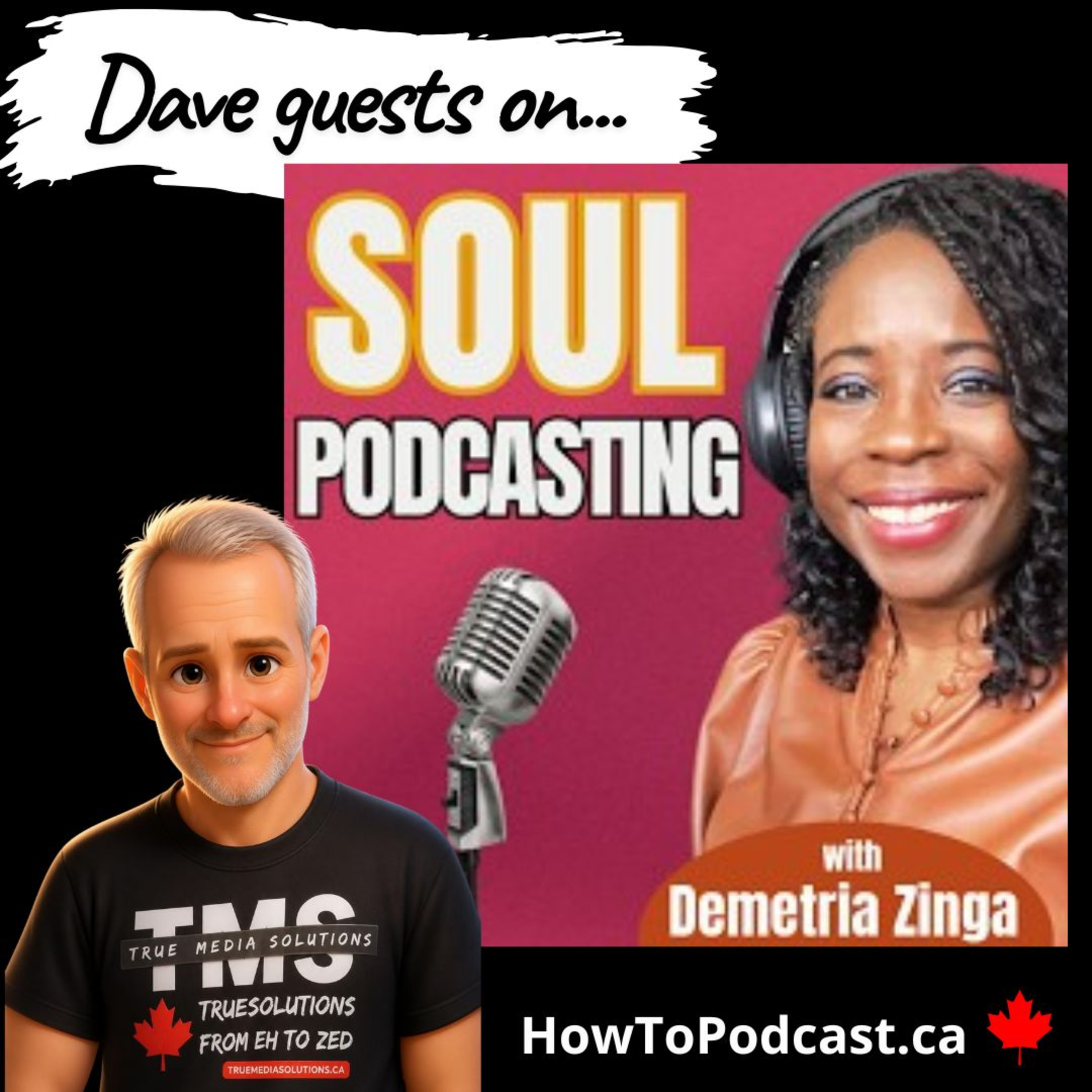
The How To Podcast Series - Podcast Co-Hosts, Practical Podcast Tips, and Podcast Community
E692 - Shared Mic Sessions - Dave Guesting on Soul Podcasting with Demetria Zinga
00:54:08
Loading summary
Transcript238 lines
- [00:00]
A
Hey, welcome back to the how to Podcast series.
- [00:02]
B
It's Dave with you a little different.
- [00:04]
A
We're doing the shared mic sessions. What is this?
- [00:08]
B
Okay, well, I get to go on podcast as a guest, and it's so much fun that I want to share these episodes with you, because some of
- [00:16]
A
these have been a while ago, and
- [00:18]
B
you probably have never heard me as a guest. You hear me as a host here all the time. You're like, well, what if Dave was a guest? What would that sound like? Well, this is me on a podcast, and I. I wanted to share with you as part of our daily episodes in 2026. It's a chance to hear me on another show.
- [00:38]
A
I hope you're ready for this. Are you?
- [00:41]
B
Okay, so I get to go on a podcast, and I love every opportunity. This one's super special for me. Demetri A soul Podcasting. Why do I love this show? Oh, let me count you the ways. Demetria is such an amazing person. She's been in podcasting way longer than I have. She has got so much tenure in podcasting. She's like the guru of gurus. But what I love about her, humble, gentle, caring, loving. She's just the nicest human being ever. We both have music in common, which is awesome. And Demetria is just one of those people that you are lucky to meet. And I was not only lucky to meet her, but also lucky enough to have time with her on her podcast, Soul Podcasting. And Demetria mixes in music with her show. It's very soulful. And Demetria is just one of the nicest people.
- [01:43]
A
I gotta keep saying it.
- [01:44]
B
Nicest people you're ever gonna meet.
- [01:47]
A
So we were. I was on her show, she invited
- [01:50]
B
me on a while back, and I thought, you know what? There's a good chance you might not have heard this episode with me as a guest in the passenger seat on Demetria's podcast. And she's amazing. So if you are looking for a podcast about podcasting, like this show, but hosted by an amazingly powerful woman in podcasting, then go and check out Soul Podcasting. I hope I don't lose you to her show, but if I do, it's a graduation, because she's just that good. So I'd love for you to go check it out. I have links for her in the show. Notes, as always, in a link to this specific episode. Please go out and support Demetria, please, and tell people about her show. And if you're looking to start a podcast and the how to podcast series is great, but you're looking for that little bit different extra then Dimitri Zynga is. You are a perfect person to talk to. Here's my episode with Demetria on Soul Podcasting, and it was the most soulful podcast interview I've ever had, because it is soul podcasting. Demetria, can you take it from here, please? And I'm just gonna sit back and enjoy.
- [02:58]
A
Here we go.
- [03:10]
C
Hi, everyone. Welcome to Soul Podcasting. I have with me a special guest today. Name is Dave. He is awesome. I can't wait to chat with him and to share what he does. He is. He's the host of so many podcasts. We're going to get into that in a moment. He is someone that has created content, community, and stories, and we're about storytelling here. He's also a musician, which is something we have in common, and he is handling podcast editing, growth, and promotion@True Mediasolutions.ca. and so welcome to the show.
- [03:42]
A
Dave, as a member of your community who loves what you do. Demetria, I just love everything about your show. You serve us well, and the idea that I can have time with you on your show is an honor for me. So thank you.
- [03:57]
C
Thank you so much for that. Thank you. And I appreciate you being here. I love getting into the heads of podcasters because that's just. That's what this show is about. We're talking about podcasting, all about podcasting for podcasters or soon to be podcasters. And so we want to explore, like, the whole gamut of what it means to be in this. In this space, in this sphere. So I'm wondering, first off, tell us how many shows you host right now.
- [04:26]
A
Okay. I need to put a warning out there for everyone. Please do not try this at home. I do have nine different podcasts that I host, and I do about 10 to 12 episodes a week across the nine different shows.
- [04:39]
C
Oh, my goodness. That. That's a lot of shows. That's a lot of shows. So, okay, now what got you into podcasting? How did you get started and, like, what sparked your interest to get into this podcast?
- [04:52]
A
Music was my gateway into editing for other people. Wow. I would record and do stuff in my home for band practice and then send copies to the band for them to rehearse after. So editing and all that in software. I've been doing that forever.
- [05:06]
C
Yeah.
- [05:07]
A
So I started editing some podcasts, and as I edit, I'm like, you know what? I could do this myself.
- [05:11]
C
Oh.
- [05:12]
A
All I need is an idea. So about Six years ago, I guess I started, and from there, one. One podcast became nine over a period of time.
- [05:21]
C
So one became nine.
- [05:22]
A
One became nine. Yeah.
- [05:24]
C
Wow, that's awesome. That is that. I just love that. And that's for. So for you, it was organic. It was a natural progression from music editing to podcasting.
- [05:33]
A
Yeah. Yeah. That whole skill set transfers really well into this format.
- [05:37]
C
It does. It does. Okay, so when you look back on your first couple of episodes, I'm pretty sure you're thinking, okay, I've come a long way. There's been so many changes. So, like, how has your show evolved since the beginning?
- [05:51]
A
I think the biggest thing is my confidence on the microphone, how I treat my guests. I've learned a lot about myself as a human being in the process of being a podcaster, and all of that has had a trickle effect into my relationship with my wife and my kids and how I show up at work. All of these things are a benefit to being on the mic and creating content as a podcaster. It just has this great effect across the room. So a good example would be when I have a guest on my show early on as an interviewer, I would. I would ask a question of my guest, and then I would ask them a supplemental question before they even finished answering the first question. And now we're on a different topic and a different path. And my audience reached out and said, dave, could you let your guest answer the first question before you ask the second question? I'm like, that's great advice. Because for them, as a listener, they're like, where are we going in this conversation? Because there's all these tangents. Right.
- [06:47]
C
Yeah.
- [06:48]
A
I learned to slow down, give my guests some space. You're a great example of it right now, but give your guests some space so they can finish their thought.
- [06:57]
C
Right. See, I love that. It's actually helping with our communication skills, not just being a better speaker, but being a better communicator. And I think this is probably one of the best ways to practice communication is through podcasting.
- [07:15]
A
It has an impact if you're a speaker on stage.
- [07:17]
C
Yeah.
- [07:18]
A
If you present in front of a group, if you leave a team meeting in your office, all of those things require confidence. And the best way to do it is just practice. Practice getting on the mic. Right.
- [07:27]
C
Exactly. Exactly, exactly. So anybody listening right now that's thinking, I don't know if I. If I can start a podcast, I don't know what to do, how to get started. You have to practice first. You have to just start and Then with time, it gets better and better and easier. So I love that you gave an example of how you, you've improved. And so you didn't start with perfection. You started with where you were with what skills you had and what you knew to do. And then you progressed from there and it got better.
- [07:53]
A
So the only way you can become a bungee jumper is to jump.
- [07:57]
C
Jump.
- [07:58]
A
You can go read a book, you can take a course, you can watch a YouTube video, but you're not a bungee jumper until you jump off that platform.
- [08:05]
C
That's true.
- [08:05]
A
So the best way to podcast is the podcast.
- [08:08]
C
There you go. I, I love that. Okay, so now let's kind of jump into peeking behind the curtain of what you do. So when you are planning your show, do you script every single word? Do you use outlines? Or do you just hit record and just start talking? How do you plan your process?
- [08:27]
A
Now I want to make sure that people listening who are new don't feel overwhelmed by this answer because again, I've been doing about 2,000 episodes in the last three or four years. So you get to get, you figure out your style and your the way you show up on the mic. So keep that in mind. If you have four episodes or you haven't even started yet, this might not work for you from the beginning, just so you know. So some of my shows are interview based, some are co hosts, some are solo episodes. I do every different type of podcast with across my nine different shows. So they're not all the same. So on my interview based show would be like Living the Next Chapter. It's an author podcast that has 590 episodes in three years. And I do three episodes a week and every November I do 30 episodes in a row.
- [09:12]
C
Oh wow.
- [09:13]
A
So for the last three years. So that's. And those are 45 minute conversations every episode. So in that one I have a pre interview with my guest. I always chat with them, kind of plan out where we're going to go. It builds a bridge between me and my guest. And when we record, I don't know the next question in the conversation, I have no idea where I'm going next. Because sometimes my guest might say something that sparks my response to go, I want to chase that. I want to know more about that. And it came because I listened to a show, Demetria and the host asked the guest a question. The guest answered and at the end of the answer the guest is something like. And that was the day my car crashed and I almost died. And the host without picking up on that at all, Went right to the next question and ignored that whole statement. And as a listener, I'm like, wait
- [10:05]
B
a minute, I want to know about.
- [10:06]
C
I want to know about that. What happened right back, right?
- [10:09]
A
And I'm like yelling at my speaker, like, come on, please, please go back. But they just left it. And I'm like, I want to follow the, the conversation. And the most interesting feedback I've had from a listener was, Dave, the moment I had a question for your guest, you asked the question, how did you know that? How did you know how to do that?
- [10:28]
B
And.
- [10:28]
A
Well, I don't, but I'm just following my curiosity. Right?
- [10:32]
C
Yeah.
- [10:33]
A
So I love having a structure, especially when you're starting. You got to know beginning, middle, and end. So that's a great starting point. But over time, you're going to develop your own style as you do this on a regular basis where you can, you can step away from it, but always have them there as a source, as a resource to go back to.
- [10:50]
C
It's a great idea, right? Oh, that's so good. I love how you're giving so much freedom to people right now, like, who want to do this but don't even. They could care less about having an outline or a structure and would just like to get on the mic and talk to people that you're saying this is, this is the thing. You can actually do that. You can just have conversations and let that follow what it. Whatever happens right on the show. And there's no set structure. You can have a show that's very structured. You can have a show that's. That's very fluid. So I love that you are doing, doing it all and have different formats, shows with different formats, interviews, solo shows. And so that, that's. That just gives a lot of freedom and leeway to podcasters getting started or wanting to think about how they can do this. So, all right, let's kind of nerd out a little bit with your tech stack and see what you're using. I'm always curious, what mic are you using, what editing tools are you using, and what are some of your favor gadgets that you're into lately?
- [11:54]
A
Okay. So I'm going to. I'm going to throw the whole podcasting world in a tizzy right now. I have. One of my websites is Podcast for free dot com.
- [12:03]
C
Okay.
- [12:04]
A
And the idea behind Podcast for free dot com are all the tools that I use or have used that are free tools for anybody to get started. Because the idea of having 15 different subscriptions every month you have to pay for. And hundreds and thousands of dollars of worth of equipment.
- [12:20]
C
Right.
- [12:20]
A
Is a barrier to entry to many people who want to get started. So you could start here and then develop into what you want to use later. But here's a starting point to get you through the door and get you into podcasting. So for me, microphone wise, I have all of my gear for my band stuff, which is thousands of dollars of equipment that we take out live. And that stuff is, like, bulletproof, and it's made for what it's designed for. I don't use that for podcasting because it's a lot to set up, and it requires extra equipment to process and get everything. Exactly. For a computer, I have a $50 USB mic from Amazon, and I've been using this for 2,000 episodes. Never an issue, never a problem, and it suits my voice. The one thing I would say to anybody trying to determine your tech for your podcast is to listen to a show where the host sounds like you. You have a really deep, bassy voice, you're hot, your voice is a little higher, and try to find somebody who sounds like you that you think is kind of in your range, and listen to their setup and then reach out to them because they're doing what you want to do, and they kind of sound like you. A rich, deep, bassy voice might not work with some of the microphones that are extremely bassy. You might sound really hard to understand and not so clear because it doesn't match with your voice. So that's one of the suggestions I'd have for people, is listen to other shows and figure out what you like before you make a determination on what equipment you want to buy. But I'm sure you have great links that you share with us as listeners on things that we can use. And you're a great resource, Demetri, as well. As a listener of your show, I, I, I resonate so much with how you approach technology for your, for your audience. And I, I just second what you do on your show. So if you want any advice on tech, listen to every episode of Demetrius podcast and you get all the information you need.
- [14:17]
C
I love that. Thank you for the freedom. Once again, you're just like, giving us the space to just do what's best for us. And I love that you brought up the fact that our voice may work better with certain equipment. So find someone who has a similar voice and tone and see what they're using, and maybe that is a good option for us as well. That's a good idea. Really, really good idea. So, yeah, I love that. Thank you. I also wanted to know your process. So we talked about your tech stack and the different things that you're using. Some things that will work for us. Like you said, you got your $50 device and you're using that. And then there are also some ways that you can podcast for free, and I think you said you have resources for that as well. So then how about your product process? At certain point, do you hand off your editing and your show notes, or are you doing that in house? Or are there any things that you are outsourcing and if so, why?
- [15:17]
A
I do everything in house at this point, because again, I have nine podcasts. Again, if I had one, I might have a different answer for you. But with nine different shows, the cost of doing things times nine would be extravagant.
- [15:31]
C
Right.
- [15:31]
A
And my wife would not be a happy fan of that. So I do everything in house, and I also do it for people as well. I help people like you do as well. So I have some clients and stuff in the US And I love working with them, taking their. Their. All their efforts when they don't have the time or the technology to do so, and helping them share their voice. That's really rewarding to be the editor and helping them. Yeah. But, yeah, like, for me, I just. I try to find the easiest tools possible that I work for me. So again, like you mentioned in your show, I started with Audacity as a music editor. I continue with Audacity because it's. I've used it for over 20 years.
- [16:09]
C
Wow.
- [16:10]
A
Like, it's like trying to grow a new arm for me to learn a new software. It's gonna go with what I know.
- [16:16]
C
Yeah.
- [16:16]
A
Right? Yeah. Everything's really natural to me on that. But just finding those tools. Right. That work for me really helps to.
- [16:26]
B
To.
- [16:27]
A
To do the way that I like to do it. And for me, again, I like to do it the most simple way possible. So when somebody comes out and reaches out to me, they don't have a huge learning gap right out the gate to do what they want to do. I can help them right from the beginning and then, like I said, graduate them to something that serves them better.
- [16:44]
C
Exactly.
- [16:44]
A
As they work into this. Right?
- [16:46]
C
Yeah. Yeah. Again, you're. You're making it easy. You're making it easy for people to. To get into this, and they're, they're thinking, I want to start a podcast. How do I get started? What about all the, the barriers to entry? What about the things that make it, you know, seems so difficult. The. The equipment, the learning curve. And you're saying that, no, there doesn't have to be a huge barrier to entry. Here's. There's free resources available. There are ways to learn how to use this material. And once you get used to using the equipment, once you're used to just like you said, it becomes kind of like your. Your second arm leg or whatever. And Easy. It's easy. So it's an extension of you. Okay, so as far as growth, we're going to talk about, like, how you've grown. Your shows. I mean, you've been doing. You've hosted nine shows over the course of how many years?
- [17:37]
A
Well, two of them are on hiatus right now, as of.
- [17:40]
B
As of.
- [17:40]
A
As of, like, last week or so, but all of them are active as well. They're not. They're not, like, archived.
- [17:46]
C
Right, right.
- [17:47]
A
So they're all. Yeah.
- [17:48]
C
So you're hosting an eye. Yeah, yeah.
- [17:49]
A
I'm doing all the time. All the time. So, yeah, there's. There's a lot going on. Like I said, I'm doing about 10 to 12 episodes a week for the podcast. Two of my shows release three times a week. Monday, Wednesday, Friday. Some are twice a month, some are every week, and they're all different. I even have a children's podcast as well. Oh, yeah, A kids podcast in Christmas time. And it's 25 episodes in a row. That Countdown to Christmas. And encourage children to be good humans leading up to Christmas because Santa's watching. So help your parents, find your neighbor, clean up your room. Right. And even if you don't believe in Santa or Christmas, there's great lessons for kids in there. And what's exciting about that show is it's. If you can imagine this, Demetria, there's like, some. Some of the episodes had, like, 20 to 30 tracks that were all in one recording. So I'd have sound effects music.
- [18:46]
C
That's a lot. A lot of editing.
- [18:48]
A
And I created my own character, and his name is Selfie. And Selfie is Santa Media's. Santa's social media elf. And Selfie. Right.
- [18:58]
C
Oh, that's cute. I like it.
- [18:59]
A
And he's an elf. It's in the word, too. And so Selfie, all he does is cause mayhem in every recording, spilling things on the. On the studio recording equipment and making. He's part of the bloopers at the end of every episode. And so it's really fun, right, to do this kind of stuff. And like I said, the thing about podcasting is you could be as creative as you want to be.
- [19:19]
C
Yeah.
- [19:19]
A
You can. You don't have to just do an interview. You don't have to just do solo. You can just be creative and put it out there to the world.
- [19:26]
C
Wow.
- [19:27]
A
So exciting. Right?
- [19:28]
C
That is so cool.
- [19:29]
A
The freedom of all this as well. What I really love.
- [19:32]
C
Exactly. Storytelling. Freedom to talk with whomever you want in whichever way you want. Like you. Like you said the children's podcast. That's a whole different story dynamic. It's a different part of your brain that you have to kind of turn on and get into your. Your childhood. Like, it didn't. To bring that. That child out of you and connect with children. I'm gonna have to show what you're doing on my homeschool podcast and share the children's podcast there. But what are your other name? Some of your podcasts? You have a couple more.
- [20:02]
A
Yeah. So I have the how to Podcast series, Living the Next Chapter. I have a podcast for dads called dad Space, and that one's a lot of fun.
- [20:09]
B
Okay.
- [20:10]
A
That one's interesting because I created it. It's a podcast. We talk about our niche or niche. I wanted to focus on dads, not men in general. Right. And not parenting in general terms. I wanted to focus just on dads.
- [20:23]
C
Yeah.
- [20:24]
A
So I'm eliminating men who don't have children as fathers. I'm eliminating in my conversation the women that. Because it's not focused on women.
- [20:33]
C
Right.
- [20:33]
A
But here's the interesting part. 67% of my audience are female for the dad Space podcast. That's interesting, which I love. I think that is the coolest thing ever, that they're finding value in the conversation.
- [20:47]
C
What's the name of that podcast again?
- [20:49]
A
That's Dad's Space.
- [20:50]
C
Dad Space. And women are listening to dad Space. That is interesting.
- [20:56]
A
Isn't that neat? So when people say, I don't want to make my audience too narrow because I want everybody to listen, nobody's stopping anyone from listening to your show.
- [21:05]
C
Right.
- [21:05]
A
Really? Right. So just put it out there and be focused on an audience and serve them well.
- [21:11]
C
Right.
- [21:11]
A
So that's dad Space. I have a podcast called the Podcast Editing and Support show, where I help podcast editors find podcasters and podcasters to find editors because it's very hard to find these people. So that's another really kind of niche audience. Right. Thanks. Yeah. And then I have Living My side Hustle. I have a podcast about recycling and repurposing called the Upcycle Canada Podcast. And then it goes on and on from there. It's just a lot of fun.
- [21:38]
C
That. That's so cool. That's so cool. And I love that you're having fun with your shows. This is not something that you feel like you're obligated to do. You're not doing this for another company or just to, like, just. Just to make money or just like, you're doing it because you love it, and. And thankfully, it's. It's lucrative, too. But you're doing it because you enjoy it. It's a passion. Passion. And I can see that your creativity is. Is just kind of like, showing itself through each and every one of your shows. They're all like their own character, so to speak. Like, every podcast has its own characteristics, and I love that you're able to explore all the different sides of podcasting.
- [22:15]
A
It's a lot of fun.
- [22:16]
C
Yeah. Yeah. So how have you. What are some strategies that you've used to grow those shows over the years?
- [22:21]
A
So there's three things I think every podcaster should consider when they start their show. First of all, is to have a way for your audience to reach out to you. So some way to get feedback.
- [22:32]
C
Yeah.
- [22:32]
A
So I love Speak Pipe is really great, where people can leave a voice message for the show. I can bring that message into the podcast. I can also respond with my voice to any Speak Pipe message, and we can have an actual conversation with our voices instead of email. That's really fun. So have some way for people to reach out to you. Your DMs, a speak pipe, an email, whatever, that works for you. But cultivate that. Get that going. Right? And then when somebody speaks to you, have a way for you as the podcaster, to speak back to them. You need a dialogue, right? So you need some way of somebody lifting their hand and go, demetri, I listen to your show. Great. Now I need a conversation between me and Demetria. I really need that to start happening. So now it's me to one to one with my audience and start building that. You can start that on episode one. You get one listen that's pretty easy to track down. One person, then a thousand is really hard to do. So focus on that small audience and cultivate it from day one. But yeah, so have a way from them, put it up their hands and say, I listen to your show. Have a conversation. But the third part, which I think a lot of podcasters miss, is have a way for your listeners to meet each other. Like, how do they communicate without you? You're not even There. Right. So some of the ways I do that on my Living the Next Chapter podcast, I have my podcast linked up to YouTube. So every time an episode goes live as audio, it goes to YouTube, and I just treat it as a backup storage drive that the world has access to. I really don't have a YouTube strategy. Just so.
- [23:59]
C
Okay, okay.
- [23:59]
A
But in the comments, I tell my guest, when you come on my show, your episode will go live and people are going to be listening to you on my show.
- [24:08]
C
Right.
- [24:08]
A
And they will be in the comments for. So the best thing you can do as a guest on my show is to jump in the comments with the listeners.
- [24:16]
C
Very cool.
- [24:16]
A
Don't even need me to facilitate conversation. They can talk to you directly through the comments.
- [24:22]
C
Yeah, yeah.
- [24:23]
A
And I also say to them, create your own playlist as a guest so that you can take all of your episodes and put them into one playlist. Yeah, that one link. When you were on 10 different podcasts, instead of asking your audience to go find you, give them one location where everything gets put into one playlist and then share it. You could technically even turn that playlist into your own podcast as a guest within the confines of YouTube. And technically, technically, you have a YouTube podcast simply by being a guest.
- [24:53]
C
That. I never thought of that.
- [24:57]
A
Right.
- [24:58]
C
The ideas that keep coming when you. You share, like, more about how this works and different ways to look at it. Like, there's so many different ways to look at this and how as a guest, they can use their own RSS. They can create their own RSS feed on YouTube. That's amazing. I hadn't even thought of that. But that is. That's definitely doable. And also, the idea of creating community does not have to be a standard kind of. I need to go out and purchase, you know, some software to make a community or a membership site. The community can be found on YouTube. You can create that with just simply by having people comment under your. Your YouTube, your video.
- [25:41]
A
Right.
- [25:41]
C
Yeah. Simple.
- [25:43]
A
So one of the other things I created, too, is I do have a meetup group that I meet twice a week with my audience. These are people who listen to my show, who have found my show and be through my podcast, come to my meetup. And every Tuesday and Saturday, we get together on just on Zoom. And we have people from France, us, Canada, all around the world. We get together and we just talk podcasting. Some people have been doing it forever. I had a gentleman on Yesterday who was one of the first 50 podcasts uploaded to itunes when Apple podcasting started.
- [26:11]
C
That's amazing.
- [26:12]
A
Okay, now there's 4 million podcasts or something. He was one of the first 50. He jumped into our Zoom room and we were able to ask him questions and talk to this gentleman who's been doing it from day one. And I'm like, isn't that so cool
- [26:25]
C
to have that type of community where you have that access to so many years of experience in podcasting and you're doing this on Zoom.
- [26:32]
A
And what's really rewarding, Dimitri, is I get to sit back in the audience and watch my community be community in front of me without. Without any prodding, without any coaching them to talk to each other. The conversation just goes off and I just get to be there. And there's times where people ask a question and people will look at me on the screen and Dave's going to jump in, he's got an answer for this, and I'll go, you know what? I think Demetria would really answer this question really well. And I just sit back in the
- [27:00]
C
audience and let them be the community.
- [27:03]
A
There's wisdom in the council of many.
- [27:06]
C
Wow.
- [27:06]
A
Right?
- [27:07]
C
It's true.
- [27:07]
A
And when we get get together in community, it's not one single voice trying to carry the conversation.
- [27:13]
C
Right.
- [27:13]
A
So have a way for people to connect with you, put up their hand. I listen to your show, have a way for you to have conversation with that one person that reached out and said, demetri, I love your podcast. And then have a way for your community to talk to each other. Those three things are really going to help you build your community.
- [27:29]
C
We're going to make sure that those three things are bulleted in the show notes so we can go back and refer to that. So thank you for that. Just reminding us those are things that we need to keep in mind that community is important and there's a way to allow our audience to engage. That's not just this top down model is just us speaking to them, but creating that collaboration amongst us all. So very, very cool stuff. Okay, so now I want to ask you about, like, how you see yourself. Are you? Because I'm fascinated by self identity, especially when our roles kind of like melt into each other. And what you're doing, you're doing a lot of things wearing a lot of different hats. So do you see yourself as more of a host, an educator, or an entrepreneur? All three or something completely different?
- [28:14]
A
I like this. I would say it's a combination because there's times where I'm going to lean into one more than the other.
- [28:20]
C
Yeah.
- [28:21]
A
When I Create a new show. I'm really putting my entrepreneur hat on. I'm creating something from nothing. I see myself in a coaching role. I see myself as an educator. There's times where I'm going to be playing into all of those things. That's true, right?
- [28:35]
C
Yeah. Yeah.
- [28:37]
A
But I think the biggest thing is just being a fan of podcasting. I think as a podcaster, we need to not only encourage the audience that are listening, but people who don't even know what a podcast is.
- [28:48]
C
True.
- [28:49]
A
So you're sitting at the lunch table at work, and you look at your friend that you work with every day, and you go, do you listen to podcasts? No. Give me your phone. Give me your phone. What do you like? What do you like? Well, I like music from the 70s.
- [29:00]
C
Great.
- [29:01]
A
Here you go. Here's a podcast about music from the 70s. And just hand them their phone back. Now you know what a podcast is, right? We need to bring more listeners into the. Into the podcasting as well. I think it's kind of our responsibility to not only just deal with the audience we have, but go out and try to compel people to come to
- [29:20]
C
podcasting, spread the word, share with others, and just show people, like, what's out there. Because there's so many voices and people that have something to say that they wouldn't. They don't have any other platform but their podcast, and their voice needs to be heard because they have such a. Just awesome opinions and. And advice and stories, and we wouldn't be able to hear them in any other way. So just to be introduced to those shows could actually, like, change someone's life.
- [29:50]
A
And as a member of. As a member of your community, Demetria, I want to honor you right now. You have been in podcasting for so long, and you have continued to serve your audience and show up for us in such a unique and genuine way. I. When I listen to your show, Demetria, I hear your heart. I don't just hear your words. I hear you showing up. And there's something special about your show. You and I have very similar conversations on your podcast. I have talked about something. I've come over to listen to your show, and you've said almost like verbatim, word for word, what I talked about. And I'm just wanting. You know, I'm not stealing your content, but you and I are just kind of on the same wavelength we have, right?
- [30:35]
C
Yes.
- [30:36]
A
And I just want to. I want to honor you for all of the years that you have poured into people and Helping them to create content and being a great example, especially for the women in podcasting. Yeah, I have a big heart for women in podcasting, and I want to see so many more women come and share their stories. There are people at. I can't reach, Demetria. I would love to, but they just aren't going to identify with me and my message and how I am in the world. But they're going to recommend they're going to listen to someone else, and those. Those people who don't show up are probably not going to reach the people we need to reach. So, yeah, again, I just love what you do and how you show up, and I just wanted to see. I want to take an opportunity before we close. I just wanted to say thank you for all that you do for us as listeners in your community, Dave.
- [31:22]
C
Thank you so much for that. You. You don't realize how much that means to me, because as podcasters and you know, you know this, that it's not very often that we hear. Thank you. It's not very often that we hear, hey, I loved your show because sometimes there are crickets and we don't hear that feedback. So I appreciate you for taking time to tell me that. And, yeah, I. I'm just overwhelmed. But thank you so much for sharing that with me and for just the words. The. The words of thanks means everything, and I appreciate that. And that said, as far as reaching people, you just said that, you know, sometimes we. Our audiences are different, and sometimes I might reach someone that you might not reach, or you might reach those that I can't reach. And so that said, what. What's some advice that you would give to content creators who are struggling with imposter syndrome who are saying that, I don't know that I actually have what it takes to do this. I don't know that I actually have a voice or. Or something of worth to bring to the table yet. They do have an itch to start a show, and they do want to bring something, but they're afraid that who. Like, it's like, who cares? They. They're afraid that maybe, just maybe it doesn't matter. What would you say to that?
- [32:35]
A
So I have a quote, and I have a practical example for you to do. If you're feeling like you're not enough as a creator, podcast whatever it is. The quote, Theodore Roosevelt, do what you can with what you have where you are. Do what you can with what you have where you are. You have everything you need to start and get this going. You're not lacking in anything. The only thing you need is practice. That's it. Do what you can with what you have where you are. You need all three of those things, and it won't work if you don't leverage all three.
- [33:10]
C
Yeah.
- [33:10]
A
And then a practical example of this, when you feel like you don't have a voice, you don't feel like you have the skill set, you don't have the technical ability, is I want you to make a list of, say, 10 things that you didn't know how to do at one point in your life and now you don't even think about it. It just. You can do it without even thinking. Okay?
- [33:31]
C
Right.
- [33:32]
A
That's proof to me that you learned something new and it became a habit and a skill and one of your tools. So an example. I drive a manual standard transmission car, okay? So I have three pedals and two feet. The math doesn't work. There's no way you should be able to drive a car with three pedals and two feet. But. And then you go on a hill and your car rolls backwards and it's all weird and you're changing gears, you're doing all this stuff, Right? It's very difficult.
- [33:58]
B
Yeah.
- [33:58]
A
And when I first started, I was horrible at driving standard. My car was jerky and bouncing all around, and I was doing all this stuff. But over time, I can get in my car without thinking, Demetria. I can just drive home. And I didn't even think once about how I was driving. It's just natural to me, it becomes something that's easy. So create a list of all of the things that you have done as proof that you can do new things. And the moment that feeling comes into your brain or into your heart that says, I can't do it. Demetria does. Like, I don't have what she has. Well, she was doing this forever. And here I am thinking I can start a show this week. Look at the list and reference a list of facts. These are facts. I couldn't do it. I can do it. I couldn't do it. I can do it. And every time you feel like you're inadequate, just remind yourself that you have done hard things in the past you
- [34:50]
B
have done, and use that.
- [34:51]
A
Use that as your point of reference.
- [34:53]
C
Yeah.
- [34:53]
A
Because the thought and feeling that I can't do it is just that.
- [34:57]
B
It's a thought.
- [34:58]
A
It's not a fact.
- [34:59]
C
That's right.
- [34:59]
A
It's not a fact. The list is a fact. So put that list next to where you are most often A mirror in your bathroom, beside your monitor, by your computer, near your microphone, and every time you're like, oh, my gosh, I don't think I can do this. Look at the list and go, okay, I can do it, because I know I've done it before.
- [35:19]
C
Yeah.
- [35:20]
A
Just one more thing to add to the list. And eventually podcasting will be on that list.
- [35:25]
C
That's right.
- [35:25]
A
With everything else that you thought you couldn't do at one time.
- [35:28]
C
That's right. That's so encouraging. Thank you, Dave. That's like. Yes. Just think about what you've already done and remember that podcasting is just one more thing. If you want to do it, you can. And it's. And just takes practice. It's just. Just, just do it. Right. Just start with where you are. And I love that quote. So I'll have to go back and listen to the quote you gave, but that's awesome. So now, what about doors? Because sometimes when we can think of. All right, once I get past this hurdle, this mindset hurdle, and I'm actually on the other side, then when we start to see that there are some good results from podcasting, for example, maybe some business opportunities that opened up for us, then we can look back and be very grateful that we started this journey. So what are some opportunities that have opened up to you as a result of your shows?
- [36:22]
A
Well, one thing I'm excited about, I'm going to be actually reconnected through podmatch, but I'm going to be one of the speakers on an upcoming Pod Match in July, which is going to be really exciting. So if you're available, listening or available, I would love the support of having some people in the room that are friends.
- [36:38]
C
Absolutely.
- [36:39]
A
That'd be great, because they're going to play my video and then we get to talk after. That's a great opportunity from Alex and our friends at Pod Match. If you're not connected with Pod Match, you should check them out. It's really great. Insert plug here and Demetrium in the show notes, of course, but that's one example. I've also just the opportunity to meet great people. I have had time with people in my calendar, Demetria, that I should never have time with, and they make time for me because of a podcast. So if you want to grow as a person, as a human, you watch your. Your. Your connections and community to grow, collaborations to grow, and for people to know about you. Simply getting behind the mic has opened up so many amazing doors.
- [37:20]
C
Yes.
- [37:21]
A
So my encouragement for you listening is Listen, you have everything you need, Right. Do what you can with what you have, where you are. You have everything you need to start building a community of listeners and a community of people who will look to you as an expert in your space because you come up with choke with passion.
- [37:39]
B
Yeah.
- [37:39]
A
And people connect with you. Right. So go ahead, take it. Take a shot at this. You'll. You'll stumble a little bit at the beginning.
- [37:46]
B
Yeah, but that's.
- [37:47]
A
That's to be expected. That's not. That's not rare. Everybody stumbles a little bit. But it's. As you develop and grow by repetition, you'll find your voice and you'll find your audience, and you'll have more people coming to you through your podcast than you'd ever.
- [38:02]
C
That's right. It's part of the process. But. Well, you're. You're so right that it's all worth it in the end. And even during the process and even in the beginning, it's worth it because it's just this idea of being able to share your heart with someone and share your side of things, and people want to hear that. It helps them in their life. And so what are some things? I just have two more questions for you, and one of them is about burnout, because although we're inviting people, encouraging them to get into podcasting, we realize that there is that there it could happen, that they get burned out within and that they're tired of it. So what would you recommend that we do to avoid the burnout, if that is possible? And we don't want to, like, you know, run ourselves into the ground. So what keeps you showing up and inspired with passion week after week?
- [38:56]
A
Well, the first thing I would say is don't start nine podcasts. That's the first thing I would tell you to do. Don't do that at all. That's one thing you take away from this conversation. Do not do that. There's this. There's this kind of this misnomer that when you start a podcast, you're going to talk about that thing forever. And how am I going to talk about this thing for the rest of my natural life? You don't have to. A podcast can have a beginning, middle, and end. Could be 10 episodes, and then you move to the next new podcast idea and pursue that. There's a lot of opportunities for you to be creative without feeling like you have to be. Surrender yourself to this content for a long, long period of time. I think when people get that in their mind, that they. There's no escape from this topic in the show that they feel scared if you're going to run out of ideas. Right? So just so you know, every book has a beginning, middle, and end, so you can naturally just end a podcast, celebrate, and then move on. What you're going to find is listeners are going to come to you and find you originally because of your show and your content. But as a listener of your show, Demetria, you connect with the host and you. You know that. Well, Demetri is a singer. Demetria did homeschooling with her kids. Demetria has a strong faith, and you learn all these things about your host over time to the point where you know them. So if they go create another show, you're naturally just going to come with them, even if it's not really the topic you would search for. You just love the host, right? And I'm finding that people who listen to one of my shows then start coming and listen to another show completely unrelated. So there's this beautiful thing that happens. Burnout is a real thing. I love when people schedule breaks. The biggest thing in podcasting is to remember there's no rules. So you don't have to do things in a certain style or because a guru told you to.
- [40:46]
C
Right?
- [40:46]
A
Do whatever you want, however you want, and you're not gonna. You're not gonna break any rules because there is no rules. So if you wanted. If you want a podcast without seasons and you want to take a break, the only thing I would say to you, tell your audience, because they're going to worry about you. Demetria was here every week for the last X number of years, and all of a sudden, she's not here. I hope she's okay. Right? You're not letting them down. They're worried about you, right? Because they love you.
- [41:13]
B
Right?
- [41:14]
A
You're part of their week. You're. You're their person. So just let them know. I'm just taking a break for a month. It's summer. I'm going to spend time with the kids. I'll see you in September. Great. So, yeah, that. That just alleviates that idea that you create content every single week. You don't have to.
- [41:31]
C
You don't have to because there's no rules, because you do what you need to do to bring value to your audience. And when you need a break, take a break.
- [41:39]
B
But let them know, drop your shoulders
- [41:42]
A
and go, wait a minute. I don't have to do this topic for the rest of my life. I don't have to do five episodes a week. I don't have to have nine podcasts like that Dave guy. No, you don't. There's no rules.
- [41:53]
C
Right.
- [41:53]
A
You do whatever you want.
- [41:54]
C
I love it. And if you want 10 podcasts, you can have 10.
- [41:57]
A
Oh, are you giving me permission right now?
- [41:59]
C
There you go. Do whatever you need to do. I love it. So, okay, you gave me three. I believe you said there were three things that you wanted us to remember, and we're going to get those in the bullets. But I'm going to ask you, if you had to sum up your podcasting philosophy in a mantra or just, like, one sentence, what would it be? Something that you can remind yourself of, like when you're behind the mic or when you're about to edit or when you are sharing with the world your thoughts, your ideas, and your heart. What would that mantra or philosophy be?
- [42:37]
A
Okay. It's going to be based on something musical. Okay. And I know you'd appreciate this.
- [42:41]
C
Oh, yeah.
- [42:41]
A
So there's. There's. And there's no hate here. I love both shows. American Idol. Okay, American Idol, you have what?
- [42:48]
B
What.
- [42:48]
A
What are the people behind the desks? They're judges, right?
- [42:51]
C
Yeah.
- [42:51]
A
And people come up on stage and they sing for the judges, and they get judged whether or not they can move forward. We have the Voice. What are they called behind in those red, big rotating chairs? They're called coaches.
- [43:04]
C
Right.
- [43:04]
A
On purpose. And in true audio format, on the Voice, you hear the Voice before you see the voice, you don't even get to see the person. So there's no prejudging what this person is going to be like, because all you have is their voice. That's the point of reference. And on American Idol, you're judged. And some people are treated pretty poorly. You got to admit, some people are not treated well. On the Voice, you're treated with grace and love and encouragement. And even if you're not selected, all of the judges. And that's one of the coaches turn their chair and they give you coachable advice and invite you back. They want to make you better. So everyone leaves. Better than worse on Voice. And in podcasting, we need more people who make people feel better than worse.
- [43:51]
C
That's good.
- [43:51]
A
Okay, so again, if you love American Idol, great. But I just want to get away from the judgment side of this. Again, there's. There's rules, there's this. And if you don't have the right mic, if you don't do this way, all of those things are things that keep people away from Podcasting, it's like going to your favorite amusement park. You must be this high tall to ride this ride. There's people putting up these signs and podcasting all over the place. My job is to go and take those signs down because I want as many people podcasting as possible. So that's my full time job, is to rip down signs and encourage people to get into podcasting. Okay. So my mantra around podcasting is podcasting is for everyone.
- [44:31]
B
Wow.
- [44:33]
C
That, that, that just tops it all. I love that. Podcasting is for everyone and you're taking down those barriers. Thank you for doing that. Thank you for that work because you
- [44:46]
A
do it as well. Demetria, on your show, I listen. You are exactly. You're doing the exact same thing in your content, which is why I love it so much and why I resonate with you as the host so much, because that's your message and I just, I'm cheering you on at work while I'm doing things.
- [45:03]
C
Oh, man.
- [45:04]
A
Rewind that, rewind that. Like, like, like, right.
- [45:06]
C
I love it. Thank you, thank you, thank you, Dave. I, I'm just like, I'm really honored to, to speak with you. I feel encouraged after this interview, so I'm just like, I'm going to stay on this buzz all day. Thank you so much. You have been a blessing to our audience listening. You have really encouraged those of us who are start starting a podcast. Those of us who are currently running a few shows and need to stay on the track and not be burned out. You've freed us to be able to do podcasting our way. And I'm just really appreciative of you being here today. So thank you for sharing what you do, Tell us what you do in your editing and all the services that you offer and where we can reach you.
- [45:49]
A
All right, so before I do that, my. I'm going to talk to the listener for a second, Demetrius, so I'm going to excuse you for a second.
- [45:55]
C
Okay.
- [45:56]
A
As you listen to this podcast, everyone, I know you're here and I know you love what Demetria does and how she shows up for us as listeners. As a fellow community member who also loves this show, I have one ask of you to go and leave her a rating and review and a comment so that she knows that you're here. So if you're on Spotify, I'm a Spotify person. I'm an Android person. I'm sorry, I'm leaving. I'm leaving those five stars. I'm leaving comments within the episodes. I want Demetria to hear from us as she shows up for us. She gives her heart to us every episode. The least we can do is show our appreciation to Demetria. So please, if you're on Apple, you're going to leave a review, you're going to leave your comments and all of your thoughts about why this show is so great. And you're going to share the show with somebody else who's thinking about starting a podcast. Because when they come here as a new listener, they're going to be loved and nurtured and cared for deeply, because that's who Demetria is. So as a listener, that's my request of you to show love to Demetria and this amazing show. Okay? So that aside, true MediaSolutions CA is all my stuff. I'd love for you to come visit. If you're a podcaster and you want to see what the meetup looks like. It's completely free. There's. We don't have any ads, no sailing, no nothing. That stuff. It's all family there and it's people loving each other, which is the coolest thing ever. Podcasting should be done in community. Don't try to do this alone. Don't go swimming alone, and don't podcast alone. Find somebody that you can podcast with. You need a buddy in this. You have it with Demetria. Her community is great. She's great. And if I can serve you in any way, in addition to what Demetria does for you, so well, I'd love to be there for you. So true. MediaSolutions.
- [47:34]
C
Cat, I love it. Thank you, Dave. Everyone listening? Be sure to check out what Dave is doing, Join his community, follow his work, listen to his shows. He has a lot of shows for you, so you get to pick which one resonates with you and whichever ones they are. And I will list them all in the show notes. And again, thank you for being here today.
- [47:55]
B
So there you go on Demetrius show. I really appreciate the opportunity to talk, podcasting, connect with people. And again, she's got a wonderful show. Please go support this amazing podcaster. Tell others about Demetria as well share links to her show.
- [48:11]
A
Go, follow, go do all those things,
- [48:13]
B
right, because that's what we do here and how to Podcast series. We support each other and we are grateful for every opportunity that we could do that. And if you're looking for a guest for your show, I'd love to be a guest. So reach out to me through my pod match. Or you can reach out to me through my, my website, howtopodcast ca and my calendar links right there. Let's get together, chat about your show. Then we can set up a future recording date. Let's jump in and do this. I love, love to be on your show. We can talk podcasting, we can talk a dad stuff. I can talk about music. I can talk about a whole bunch of different stuff. And if I can be of service to you, especially even if you've never had a guest, you're like, I just want to practice.
- [48:52]
A
See, I'm getting excited here.
- [48:53]
B
But I just even, I just want to practice. I don't even know if I'm going to release it, but I want to practice and see how I am as a host. Then I will be your podcast guest dummy. I will come on and help you with your show and give you some advice. As far as interviewing, I have over a thousand interviews baked already for my podcast, so I'm sure I can help you. I know I can help you and I'd love to be a part of that. So if you looking for any of that information, please reach out howtopodcast ca. Thank you for being here.
- [49:23]
A
I'll see you tomorrow.
- [49:24]
B
And we're going to keep bringing some of these episodes here and there back so that you can hear Dave as a guest. And again, if you're looking for a guest, I'm looking for you. Howtopodcast ca. See you tomorrow. You're still here.
- [49:40]
A
Amazing.
- [49:41]
B
Okay, Well, I had a question from a podcaster. They said, I've been hearing this stuff about thing called podcasting 2.0, and they're like, what? What the heck is podcasting 2.0? I have no idea what this is. Is this a scam? Is this. What is this? Well, it's basically a bunch of bored nerds in podcasting that have gotten together, and we love our nerds. They've gotten together and said, how can we make podcasting better? And I love that they do want to make podcasting better. So they, they're playing with the mechanics behind the scenes of podcasting. All the stuff we don't see and don't touch. They're trying to play with it and make it better, which I love. And there's a bunch of different things that they're trying to do. You're trying to expand what podcasting is and trying to get apps like Apple and Spotify and Audible and all these other places to adopt kind of some standards around podcasting. And they're doing great work, but they're Have. They're up against some, some walls right now. They were originally going down the path of bitcoin and thing called Satoshi, which is like a fraction of a bitcoin. I have no idea about this stuff because I don't do pretend money on the Internet. That's not my thing. But anyways, they're. They're doing this whole thing based on bitcoin and at the time when they
- [51:04]
A
first set it up here in Canada,
- [51:06]
B
it was not really receptive to that up here and there was no way to join in.
- [51:11]
A
I did try to.
- [51:11]
B
I did try to get set up, but I was blocked. So basically there's a lot of different pieces to all of this.
- [51:18]
A
And what they're trying to do is
- [51:19]
B
basically just make podcasting better. So if you're interested in this, there's a lot of podcasting 2.0 podcasts out there and they get really technical. Very, very technical. If you want to hear like a cleaned up version of the technical side of podcasting 2.0, you can go on the new media show, you can go on YouTube and search them up, go on the new media show and then go into their videos and then just search podcasting 2.0 and you'll hear them talking about it at length, just ad nauseam, just over and over. Podcasting 2.0, this and that. They have a bunch of terminology that I have no idea what they're saying, but apparently it's really important that what's one or POD News. POD News Weekly Review is every weekend and they kind of do the week's news recap and they touch on the tech side of podcasting 2.0.
- [52:14]
A
That's.
- [52:16]
B
It still gets really techy, but a little bit easier to understand.
- [52:20]
A
They try their best.
- [52:21]
B
So it's really basically a complicated way of making podcasting better. I'm sure that there's going to be elements that make their way into the common podcasting space, but right now it's kind of on the outside looking in and not everyone's adopted it as a user, not every app has adopted it as a player. So there's some hurdles to cross, but they're moving forward with it and they're getting attention over time. So taken a long time, but they're moving forward with this. So I applaud all of the podcast nerds out there because all they want to do is make podcasting better. So I would say go do your research on that. If you're not super techy, don't get caught up in the weeds for now. It's not ready yet. It's not ready for prime time. Again, a lot of feathers. Not much chicken for this at this point, but I see it, it being a great addition to podcasting as it matures, as it gets better adoption, and as they put this into place for all our benefit. So cheer them on from a distance if you don't understand what they're saying, because they will. They'll spend hours explaining the super techy side of podcasting, and my eyes kind of glaze over, but I know their hearts are in the right place and they want to make podcasting better for
- [53:40]
A
you and for me.
- [53:41]
B
That's podcasting 2.0. If you have any questions, I'll give you my limited knowledge, but there's a lot of smarter people out there than me on this. But again, I think they, they deserve our support and our attention. So do your research. Podcasting 2.0. There's a lot of great stuff out there and lots of good stuff coming. Podcasting is growing up and you want to. You want to learn as much as you can.
- [54:05]
A
So stick around here.
- [54:05]
B
We'll keep you up to date on all the new stuff. Take care.