← The How To Podcast Series - Podcast Co-Hosts, Practical Podcast Tips, and Podcast Community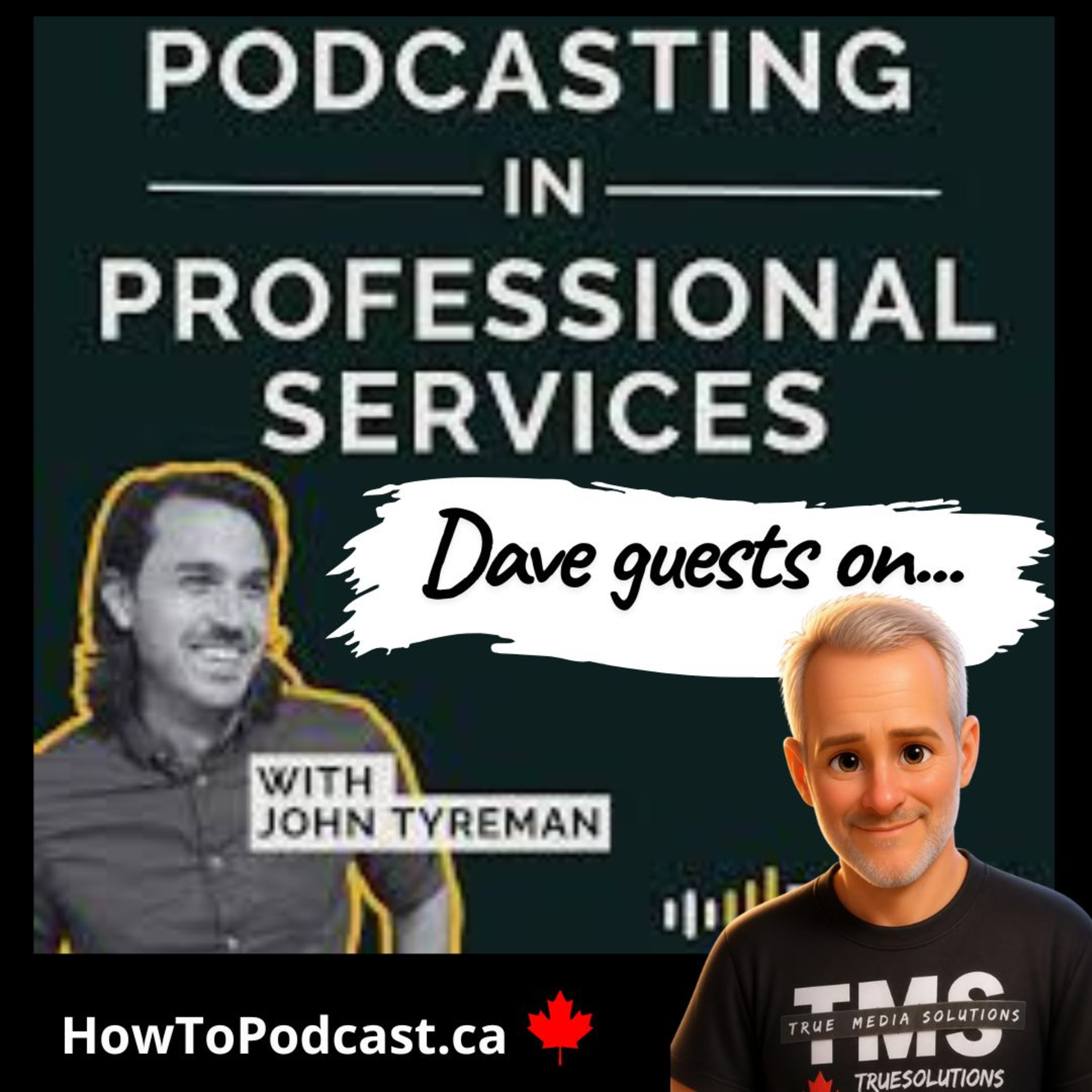
The How To Podcast Series - Podcast Co-Hosts, Practical Podcast Tips, and Podcast Community
E694 - Shared Mic Sessions - Dave Guesting on Podcasting in Professional Services with John Tyreman
00:46:05
Loading summary
Transcript97 lines
- [00:00]
Dave Campbell
Hey, welcome back to the how to Podcast series.
- [00:02]
It's Dave with you a little different. We're doing the shared mic sessions.
- [00:07]
What is this?
- [00:08]
Okay, well, I get to go on podcast as a guest, and it's so
- [00:12]
much fun that I want to share
- [00:14]
these episodes with you because some of
- [00:16]
these have been a while ago and
- [00:18]
you probably have never heard me as a guest. You hear me as a host here all the time. You're like, well, what if Dave was a guest? What would that sound like? Well, this is me on a podcast, and I wanted to share it with you as part of our daily episodes in 2026. It's a chance to hear me on another show. I hope you're ready for this.
- [00:40]
Are you?
- [00:42]
So I met John through podcasting and we connected and what a great guy. He has a great service that he offers to podcasters, and he's out there creating great content as well. Had a chance to go on podcasting and professional services, John's podcast. And we talked about my business around my true media solutions and what I do for podcasters. We talked about my favorite quote that I use all the time, do what you can with what you have, where you are. John really liked that a lot. And we kind of went through and. And chatted through a lot of the different parts and elements around my podcast journey, what I'm doing as a podcaster, how I help podcasters in podcasting. And it was a great conversation.
- [01:31]
And like, I.
- [01:32]
The reason, like, I'm bringing these episodes to you is you normally hear me in the driver's seat. You don't really hear me in the passenger seat responding to questions, and you get a different side of the conversation. And we talk about stuff together on John show that I don't talk about on the show. It doesn't come to me in the moment that I should ever talk about these things, but when I'm asked about it and. And these things are brought up, I. I think it's creates an opportunity for you to maybe get a different picture of me as the host of the show, and maybe this deepens our relationship between myself and you as a listener and again, me promoting John show at the same time. So there's a lot of wins here. So I'd love for you to check out John's information. It's all in the show notes and just take a look at some of the things that he's up to. He's doing a lot of great stuff in this world. So in this episode, you're going to hear us talk about my True Media Solutions, why we should start a podcast. Podcast influencers, how to also then build community around your show as well. So lots of good stuff here for John's podcast. Yeah, this is Podcasting and Professional Services with John Tyerman. And yeah, here we go. I hope you enjoy it and I'd love for you to go reach out to to John and follow him as well, but here's the episode.
- [02:58]
John Tyerman
Hello, business podcasters, and welcome to another episode of Podcasting and Professional Services. Today I'm joined by Dave Campbell, who is a podcast manager at True Media Solutions. Dave is a fellow podcaster and a podcast about podcasting. He's also the host of, I think, like, eight different shows. So his perspective, I thought would be really valuable because he's seen podcasting from across many, many different genres. I think it'll be really relevant to all you business podcasters out there to hear some external perspective. Dave also runs a weekly meetup for podcasters. So if you're looking for some community, check out what Dave has going on over there. In this conversation, Dave and I talked about some of the challenges facing podcasters. We talked about some of his biggest takeaways from helping his clients and from hosting those eight different shows. Dave shares some stories about how, you know, podcasters just need to get scrappy, right? Do what you can with what you have, where you are. Dave's a big proponent of no rules in podcasting. There's so many different ways to do it. Everyone's got different experiences. So I love the. The paradigm for which Dave looks at podcasting. Before we get to my conversation with Dave, let's launch a podcast for your business. Imagine that there is a way for you to generate visibility for your business, to accelerate your network growth, to create endless content, to build trust with buyers. Well, it's all possible with a business podcast and folks that are listening to this episode. I am offering a complimentary podcast consultation. Check out RedCedarMarketing.com or connect with me on LinkedIn and reach out there to learn more. All right, and now for my conversation with Dave Campbell. All right, today my guest is Dave Campbell, podcast manager at True Media Solutions, where he is a podcast creator, host, and manager for eight active podcast productions. Do I have that right, Dave? Wow. Okay. You're a braver man than I, including the how to Podcast series, where Dave offers a variety of episode types and formats packed with great tips on podcasting. Listen to his podcast on Apple, Spotify, YouTube, or wherever you get your podcast. Also, if you're a podcaster, check out howtopodcast ca to attend one of Dave's weekly podcaster Zoom meetups. Dave, it's January. You're in Canada, but it's all smiles from you. How are you, my friend?
- [05:33]
Dave Campbell
We're good, we're good. It's not too snowy, which is great. I'm happy with that. The less snow I have to shovel is a good day. But, yeah, we're just enjoying life, enjoying the new year. Lots of good stuff ahead. It's a perfect time to start a podcast. So if you're listening for your business, hey, you're in the right spot here on John Show.
- [05:50]
John Tyerman
Yeah, I found that too. Is like, December, everyone's thinking about other people, and then January folks start to think about themselves and their own business. And what can I do to. To market my business? A podcast is definitely like a January thing.
- [06:04]
Dave Campbell
Yeah.
- [06:04]
John Tyerman
And speaking of, you know, if you want to get. Get into podcasting, Dave and I were actually, you and I were connected on Pod Match, and I was a guest on your show recently, and now the tables have turned. So, Dave, are you ready for another conversation around podcasting?
- [06:20]
Dave Campbell
I love it. I love being in the passenger seat.
- [06:22]
This is fun.
- [06:23]
John Tyerman
Yeah, yeah, yeah. Exactly. Cool. So let's set this. Let's set the stage for our listeners here. Can you give us a quick overview of who you are and how do you help them?
- [06:34]
Dave Campbell
Yeah. So I've been podcasting for just over five years now. I've been doing editing for other people, helping them with their shows, people who don't have the skills, technology, or time to do their own edits. So I do that for them, which is fun. I really enjoy that. And I host eight different podcasts of my own. And like you mentioned, I also do the meetups when I were doing them twice a week now, Tuesdays and Saturdays. And we have people from around the world coming together and podcasting community. I know there's a lot of different places you can build community, but I found the meetup platform as a. As a contributor on other meetups, and I'm like, I could do this for my own group. And now I have people who write this into their calendar. Every week, we get together with some of the smartest people in the world. And the beautiful thing, it's not one voice teaching anything to do with podcasting. It's the group. We help each other. And there's times where I don't even talk, John. I'm just kind of in the background and facilitating and letting the group do its Thing. It's the coolest thing ever to see people who now consider this to be their. Their home, their tribe, their community, and to see them helping each other, which is, like, amazing. So anytime you can see your listener in person, even if it's on screen, it's a cool thing. So, again, I'm a listener of your show, so you are in my head and now you're on my screen. It's really kind of cool to have that interaction with a podcaster that you love.
- [07:52]
John Tyerman
Yeah. Yeah, that is really cool. And it's cool that you're able to bring people from all over the world to share their knowledge of and their experience of how they've run their shows and what they've learned and what, you know, you know, what questions they have. I like to say there are no rules in podcasting. And so you've got shows that have different formats, different types. You know, the hosts all bring a different personality to the mix. So there's really just like endless combinations of different podcast podcasts out there. So that's really cool that you're doing that, Dave. So, like, I guess what I'd like to do is kind of start at the beginning. How did you get into podcasting? What was the first podcast that you launched?
- [08:34]
Dave Campbell
My first one was a podcast around my small business that my wife and I have called Upcycle Canada, where we don't just recycle, we upcycle. We take something like a piano and turn it into a shelf or a cabinet. Like, we totally turn into something new, keep it out of the landfill. And we had just opened a brand new store, brick and mortar store, grand opening. The mayor came, the babies kissed, Babies were kissed. Everything was great. And then about four weeks after we opened, that global thing happened, and we had to close our store for six months straight. We opened again for about three months and then closed again for another six months. So we were paying for the rent for a storefront that we couldn't even open. So in that moment, thinking, not knowing how long this global event was going to be, we thought, well, I'll start a podcast, because I love listening to podcasts. And we'll talk to our audience because we have clients and customers around the world who would support us and buy our stuff. So we started a podcast to talk to them. And from there, it just kind of became a very slippery slope where now I'm stuck in this pit of podcasting, which I love. I can't get out, John. I really tried. I can't get out. And I just love the connections that I've had through podcasting, I've had time in the calendar of people that I would never have otherwise. Yesterday, for example, I talked to the gentleman who wrote the original script, which Rowan Atkinson used to become famous as Mr. Bean. He wrote the script, and if it wasn't for his script, there might not be a Mr. Bean. And I'm like, oh, my gosh. Like, and he knows Rowan personally and he gave me great stories about Rowan. And next time he comes back, he's a good friend with Jack Black. So we're going to talk about that relationship. Like, how would I ever meet these people? There's no way. And for me, as a podcaster with many different shows, I get to interact with some of the greatest people in the world. So it's.
- [10:27]
It's a joy, really.
- [10:29]
John Tyerman
Yeah. Podcasting unlocks conversations you wouldn't normally be able to have, which is one of the really truly magical things about this medium. You mentioned, David, that you got into podcasting because you were a listener of podcasts to start. What were some of the shows that you listened to before you got into podcasting?
- [10:52]
Dave Campbell
Oh, wow, there's so many. Well, at the beginning, I was listening to a lot of podcasts about podcasting, so that's why I created my own. Because listening to these other shows, they're great. There's some really amazing, smart, talented people who are doing this a lot longer than me. But I found a gap in the, in the process where I didn't hear a lot of community based conversation around podcasting. I heard one single voice talking about podcasting and some of the things I agreed with, some of the things didn't work for me. As a new podcaster, I'm like, well, instead of one single voice, I'd like to have co hosted episodes where I bring people on who approach podcasting differently than I do so that I can learn as well, so that we all learn a community again, going back to the meetups where it's not just a single person kind of leading the ship, we're all working together. There's a quote that I found a long time ago that there's a. There's wisdom in the council of many. So I love the idea that we can work together in podcasting and hear different voices and learn from each other, you know, so that's, that's the joy for me. So I listen to a lot of podcasts about podcasting. Most recently, I am a huge fanboy of Mel Robbins. I love everything that Mel does, and I love how she podcasts. So if you're listening as a business and you want to know how to talk to your audience, what doesn't matter what the topic is of a Mel Robbins show, go listen to how she talks to the people that listen to her show. A great ways for you to adapt your own podcast as a business podcast. To realize that there's a listener on the other end of this conversation and to bring them in as much as possible. I think that's a huge lesson. So go check it out.
- [12:26]
John Tyerman
Yeah, and I think I know exactly who the single voice is about podcasting that you got into a long time ago. And I love how, you know, today there are so many new shows and there are so many untapped niches out there that folks can start a show. The ocean has never been bluer for a podcast. Maybe it was a few years ago and folks are starting to catch on a little bit right now. But specifically for business, I think, you know, there's. It's. Right now is a really great time to start. Currently, like, you host eight different podcasts, Dave. So I want to, like, explore that a little bit and some of the challenges that come with that and, you know, maybe the decision to do it. So Living My side Hustle Upcycle Canada, which you talked about briefly. Dad Space is another podcast, and of course, the how to Podcast series. Why so many shows? How did you end up with so many different shows on your plate, John?
- [13:24]
Dave Campbell
I feel like I'm talking to my wife right now. Why are you doing this? Well, the first thing is they're all different and they're all different communities, they're all different topics. And I'm. Somebody called me a multi potential light and I'm like, wait, what does that mean? Are you calling me something bad? They're like, no. It's the fact that you see all this different potential in different ways and you're always not. It's not like you're distracted. I'm super focused on all of these shows, but there's just so many things that I want to talk about beyond just podcasting or beyond upcycling. So, like, I have a music podcast and I have a children's podcast, and I have all the ones that you've mentioned. It's just I see gaps and I guess I have this innate sense of being able to see around a corner and go, there's. There's something missing here. And because it's missing and I can't find it for myself, then maybe it's my turn to create It. And sometimes these ideas, John, come to me and I have no idea where they came from. Living the next chapter. My author podcast came to me. The website, the name of the show, the concept, everything came to me when I woke up ready to go to work one day. And the whole thing was I had to get a paper and pen, write it out quick because it was just like, everything's here. And I went and checked and the domains available. There was nobody that had that show. And I'm like, I can't believe this. Like, it's like, just go do it.
- [14:42]
Right.
- [14:42]
So I think we get these taps on the shoulder. Whether it's creating a new business idea, creating a podcast, writing a book, we get this tap on the shoulder. And I think we need to be. We need to realize that it's happening in the moment and capture that moment. Don't, don't think you'll get back to it later because you'll probably forget and it might move on to somebody else if you don't respond. So I just feel like I'm responding to the opportunities in front of me. And it takes a lot of work to do eight shows. Yeah, I wouldn't recommend it to anybody, but I find there's so much joy in the context of creating great content and shining a light on other people. That's what lights me up.
- [15:20]
John Tyerman
That's. That's really cool. Yeah. And if folks do want to take on eight different shows, maybe they can work with you to outsource some, some of their production.
- [15:28]
Dave Campbell
Yeah, sure.
- [15:30]
John Tyerman
No, that's. You bring up a really good point about, you know, if you really love talking about, you know, something you're passionate about, a podcast is a great medium. It's a great outlet. I found that simply talking in a podcast format helps me connect dots that I, you know, probably wouldn't connect otherwise. And so it's not just about the relationships and, you know, forging deeper connections with people that you wouldn't normally be able to have a conversation with, but it's also self serving in the sense that you're able to sharpen your own perspective on certain topics and learn and grow. So that's, that's one thing that I've. I've really come to appreciate about the art of podcasting. You have an episode of your how to podcast series, and part of the title is a quote from Theodore Roosevelt that I just want to read out real quick. So do what you can with what you have, where you are. You and I talked about this a little bit when I was on your show, but I think it's worth reprising for my audience again here. Can you explain what you mean by that quote and how that applies to podcasting?
- [16:38]
Dave Campbell
It's kind of like three legs to a stool, and all of these are important, and none of them are irrelevant. You need all three, so do what you can. So we're always in this. I talk to people. John, who spends so much time and money learning about podcasting, but they never do it. Yeah. So they're. They're experts. They've got PhDs in podcasting, but they've never hit record. So do what you can. And the next part is with what you have. So you don't need to go spend thousands and thousands of dollars. You got an amazing setup, John. You got. You're. You're. I know that you're on the right path, and you found your spot, which is great, but you don't have to start there. Right. You know, nobody starts at a finish line. We all start at a starting line. So if you look at somebody like your setup and go, oh, I got to be like John, then obviously you're going to help them do it for
- [17:25]
John Tyerman
five years, you know?
- [17:27]
Dave Campbell
Right.
- [17:27]
John Tyerman
Yeah.
- [17:27]
Dave Campbell
It takes time to get to where you are.
- [17:29]
Right.
- [17:30]
So don't compare yourself to somebody who's way further down the road. Compare yourself to Mr. Bean's first 10 videos on YouTube for your first 10 videos, not his current library.
- [17:42]
Right.
- [17:42]
You got to compare properly. So do what you can with what you have. So if your phone is all you have, there's no shame in that. Let's start. Let's get going. Can always get better from there. So do what you can with what you have where you are. Like, where you are now, right now is enough. You don't need anything else. There's so much knowledge and wisdom and people who want to help you with your show too, John. Like connecting a business to a podcast. You would be the first person I would send somebody to, as they're starting a business out of a business and they want a podcast to go with it. I'd be like, go, listen to John show. Because you're covering this from that lens and that perspective, just completely different than the lens that I'm doing. And so there's so much room in the space of podcasting. You're not too late, so do what you can with what you have where you are. I think it just. It helps you to drop your shoulders and go, okay, I'm not too late, and I have everything I need. I don't need anything else. I just need to start. The only way to become a podcaster is to become a podcaster. And the only way to get to episode 10 is to do nine episodes before. So just get started.
- [18:46]
John Tyerman
Amen. You're preaching to the choir here. I was recording an episode a few weeks ago with a guest, and he got into his car and he started it up and he was like, all right, I'm ready. Ready to record. I'm like, all right, we're doing this. He's just. He's like, you know, I. I. Time is valuable to me, and I'm just driving home and we can have a podcast convers. And there wasn't a video component to it, but it was a good conversation nonetheless. Right. And that's what's really most important for listeners, is they want to have. They want to hear a good conversation. It doesn't matter if the audio quality is superb or if every like or ah is removed from the transcript. What matters is the context and the conversation. Some of my favorite sports podcasts, like, they'll get on their phones and they'll just record right there. And it's the immediacy of it from that perspective. So I think you're absolutely right with, you know, if you're limited by technology, we have these supercomputers in our pockets, right. That we can use. And I just think it's. There's. The bar has never been lower to start a podcast.
- [19:54]
Dave Campbell
Yeah, there's going to be a lot of people are going to want your money and they're going to offer you a course or whatever for you to start podcasting. But really, I just go back to the idea of doing podcasting in community. Just find yourself a good group of people who support you and keep you accountable to starting and will support you in all those hard times when you're like, I don't feel motivated, I run out of ideas. I don't feel like I have what it takes to be a podcaster, to have a group of people around you who cheer you on. I think that's the best thing for you as you start your show.
- [20:26]
John Tyerman
Yeah, yeah, I agree. And, you know, the technology aspect of it is diminished even more if you think about it from a business podcast lens where the positioning of the show is so much more important because. Because the total addressable audience is smaller. Right. Because you're a niche business. You're focused on a specific industry, a specific role within an organization, and so the positioning of it is much, much more important than the technology you use, the mic you use, whether it's on video or audio or not. And so I guess that's like, from a business point of view, that's one of the big challenges. Looking at your podcast, the how to Podcast series, some of the topics that you deal about are like, the inner challenges of the host, like dealing with imposter syndrome and silencing their inner critic, or setting goals for your podcast, hiring a team. You talk about discoverability, navigating paid sponsorships, even you. You get even as tactical as, like, talking about episode titles and then using AI for descriptions. And these are all, you know, great, great pieces of the puzzle. I'm curious, Dave, from, like, from your perspective, what are some of the topics or episodes that you've put out that have resonated the most with your audience?
- [21:46]
Dave Campbell
I did a little miniseries. Well, I'll back up a little bit. The idea of the show is not just that I'm going to talk about podcasting, I want to demonstrate podcasting as well. So within my show, I have co hosted episodes. So it's me and another voice talking together. I have my own solo episodes that I do. I have what I call daily Daves, which are just short little things that happen in podcasting. Right. So that's another episode. And then what I do is like miniseries, where I'll do a group of episodes together around a topic. I want to show people that you can play in podcasting, even in within your own show, you don't have to, like, commit to one type of podcast episode, and that's all you're going to do. You can do all kinds of different things. So that's kind of what I do. So I had a little mini series around a quote that I love, and it's all to do with an apple. And the quote simply is that you can count the number of seeds in an apple, but you can't count the number of apples in a seed. One seed has unlimited potential for future apples. Right?
- [22:47]
John Tyerman
Right.
- [22:47]
Dave Campbell
So there's unlimited potential in that one single seed. So I'm finding in podcasting, we count or we count our analytics or listens or stats or followers as seeds in an apple. And then we try to get more seeds than everybody else. If we get more seeds, then we're more successful, and if we're more successful, then good things are going to happen. I'm trying to give you a totally different approach. What if you just single out one of those seeds from that apple and realize that that represents one person who's come across your content. Now, if that one person who comes across your content, listens to your episode and then goes home and treats their partner better, treats their children better, changes the course of their future because they are, they've learned something through your show and that your show has had an impact on them. What if that seed represents unlimited potential to touch more lives beyond that single
- [23:43]
listen to that episode?
- [23:45]
So when I get people coming on my show or reaching out to me, John, and they're like, I only have five listens, I guess I'm not very successful. Like, there's unlimited potential in those five people that they've chosen you over everything else in the world. They come back to you time after time. So there's a relationship there. So work on that relationship. Identify those listeners, the best of your ability and have a conversation with them, you will grow, your show will grow, and people will talk about you when you're not even in the room because of how you treat them. So there's unlimited potential in that scene.
- [24:20]
John Tyerman
I love this analogy. And I want to apply this to a business point of view. And so like word of mouth is the biggest driver of new podcast discoverability. And that's been, you know, that that's something that a number of different I found from a number of different sources, including the infinite dial as well as I think the podcast host did some research on this, among other sources. And so to your point, if you're able to get solicit feedback from, I call them like the Mount Rushmore of listeners. They're like the folks that are like right there with every episode. You know, they're die hards. If you can find out who they are and if you can have a regular feedback mechanism, whether that's a survey or you just reach out to them every couple months and be like, hey, what'd you think of the last few episodes? We'd love to get your feedback. That's a great way to learn and grow. Because those listeners, if they represent your ideal listener, then the potential for them to recommend your show to appear or a colleague or someone else in the industry, you know, that's a probably more of a longer term growth strategy. You're not going to grow overnight, but it is a sustainable growth strategy.
- [25:36]
Dave Campbell
If you ever go to Amazon to buy a product or service or something on Amazon, you're going to scroll down to the bottom and usually look at the reviews.
- [25:42]
Yeah, right.
- [25:43]
You're going to say, this was a great product. This wasn't a great product. It's part of our buying Decisions now. So that word of mouth is really important to us.
- [25:50]
John Tyerman
I. I'm working with a client and we got a negative review on the podcast and it was a one star review. And it's okay though, because the review was some from someone that was outside of our ideal listener. So this show is about business owners in the chauffeur transportation industry. This was a chauffeur who left a rating and review. And so it was great to hear that feedback. And our team internally was aligned around, hey, no, this is good because getting negative feedback is just showing us that we're heading in the right direction. We understand that it's not from our ideal listeners, so that's why it's okay. What we need to do is go out and we need to solicit more ratings and reviews so that we can balance that out and show that, yeah, this podcast isn't for everybody, but it is for owners and operators of chauffeured transportation businesses.
- [26:43]
Dave Campbell
That's interesting. Yeah, my dad Space podcast is a podcast for. For dads. So it's not specifically just for all men, it's for dads. And so I've kind of narrowed it down to that focus. But even though I'm talking to dads, we talk about men's mental health, we talk about men's physical health, we talk about all those things in relation to, also to parenting. But 67% of my audience are female for that podcast.
- [27:08]
So interesting.
- [27:09]
I'm focused on dads, I'm focused on the dad story. But when I look at my stats, yeah, 67% are female. So what I love about focusing in on a target audience for your podcast and what you're talking about, everyone's welcome to listen. There's nobody standing at the door saying, nope, you don't fit the ideal listener. You can't come in, anyone can listen.
- [27:30]
Which is great.
- [27:31]
But the fact that you focus on a target and you focus in on a topic and other people still find value in that, I find that to be very encouraging.
- [27:39]
John Tyerman
Yeah.
- [27:40]
Dave Campbell
So I love that.
- [27:41]
John Tyerman
So, Dave, thinking I just want to steer the conversation back to your how to Podcast series. Are there things that you've learned on your show, maybe they're from guests, or maybe they're just from, you know, connecting dots on your own and speaking through some of these topics that you've taken and then in turn have applied to one or more of your own shows?
- [28:07]
Dave Campbell
Yeah, right now, like, historically, we've been talking about stats and analytics and how many people listen to your show, and that's the key metric that we focus on. I'm really focused on most recently on the retention rates for how long people listen to an episode. And there's one big reason behind it that I don't think people talk about enough. When Apple suggests your show, John, to people and says, you should listen to this show about podcasting and business, and somebody comes to your show, and 10 seconds after they press play, they leave. It's like, well, Apple wanted them to come to your show, but they never. They didn't stay. Now imagine if Apple sends or Spotify or Audible sends people to your show, and everybody they recommend your show to hits play and listens all the way to where we are right now and to the end of the show. That's a good result. And what is. What do these apps want? What does YouTube want? They want you to come and stay. Don't come and leave. That's a bad result. Come and stay is a great result. So I think over this year, what I'm challenging podcasters to do is to focus in on the retention rates and watch how far people listen to your show and use that as a way to get feedback. So often, John, people say to me, I don't get feedback on my show. Nobody sends me any messages. Nobody sends me an email or I have no idea what's going on. But really, your audience is telling you a ton of things as you look at your stats.
- [29:32]
John Tyerman
Yep.
- [29:33]
Dave Campbell
They're telling you how interesting your show is. They're telling you how long your show should be. They're giving you tons and tons of feedback. 67% of my audience are female for dad space. There's so much information coming to you if you just spend the time looking at it. And I know as you help podcasters, you can then unpack that for people if they don't have time to do that deep dive. But I just think that your audience is giving you a ton of great information about your show if you'll pay attention to it. So I always encourage everybody to. To acknowledge the listeners who listen to the end of the show and thank them for listening to the end. I think it really, it kind of battles with the whole ratings and reviews for growing your show. I think listening to the end of the podcast is almost equal to or competitive to a rating and review in that every time somebody presses play, they listen to the entire episode. So I'm always encouraging people to thank their listeners at the end of the show for listening to the entire podcast because it is a signal to all these apps that Every time we send them here, we stay. So I always encourage that. So that's one thing I would love for your audience to consider is how they can reward listeners who stay to the very end.
- [30:47]
John Tyerman
Oh, that's a fantastic point about consumption rates and then how that impacts each platform in their willingness to serve up your show to other listeners. Because there's, you know, there's the charts, right? You know, on Apple you got the charts on, on YouTube, I believe it's like suggested for you. And I think folks that are listening to this, they may not know where to go to find that data. And it's, it's right now the best place that I've had to, I've been able to go. And Dave, you might be, you might know something different is I've had to go directly into like creators.Spotify.com and then podcasters.apple.com and it's kind of buried a little bit those consumption rates and how far folks get. YouTube does a good job showing it a little bit, you know, like higher up in the analytics like flow. Like you don't have to dig as far to get there. And yeah, what I found is I'm, I'm averaging probably around like 70 to 80% consumption rates and that's for like 30 plus minutes worth of content. So I, I see that as a good sign. And then there are some episodes to your point where you know, I'll see like 36% and I'm like, okay, that's a signal that that topic did not resonate with our audience. Let's do less like that and more like the ones where we're getting 80% consumption.
- [32:10]
Dave Campbell
Right.
- [32:10]
I even to the point where I've talked to people and they have a one hour show and they struggle to do an hour every week and Everybody listens for 30 minutes and they seem to drop off. I'm like, well what if you tried to 30 minute episodes, break it in half and then look at your retention rates. Do they stay to the end now because it's half an hour? Maybe that's the answer. I don't know. You're gonna have to play with it
- [32:30]
John Tyerman
a little bit in your audience. Some folks like the long form content and then some that suits some hosts better. Like you said, like this host was struggling to hit an hour mark. You know, maybe a shorter episode would be better suited for their personality. So I mean they're all like different like factors and like little knobs that you gotta like tune and dial in as you're growing your to get it to what works not just for your audience, but for yourself as well.
- [32:57]
Dave Campbell
So as you're listening to this and you're like, oh, I have no idea what these two guys are talking about, then you have to reach out to John, and John's going to show you. You pull up a zoom screen or shared screen. He can show you as you pull up your stats and walk you through it so you can see what he's talking about. So reach out to John. I'm sure he'd love to help you.
- [33:14]
John Tyerman
You know, I'll go as far as to put like the creators.Spotify.com links like in the show notes. So if you want, like just a link to click to to go and stats listeners, it's all in the show notes. So I'm just going to make a quick note to put that in there. Dave, this is. This is a great conversation. I've got one last question for you before we hop off. We've talked about community a lot, and you've talked about your Zoom meetups as a place to foster that community. What are some ways that other podcasters can help each other out?
- [33:48]
Dave Campbell
I love the idea. Well, we do this in our Zoom room. We'll take in our meetups. We will highlight one of the people from our community, and everyone will go listen to their show and then come back the following week with feedback. What they loved, what they could do better, what they didn't understand, what they thought was super. We talk about their artwork, their website, everything. And it's just a chance to kind of. We don't call it a hot seat because we don't want to make people feel uncomfortable. We just make it to be like a, a group session where we all get together and we share our thoughts to encourage each other, knowing that we will eventually be the person that people will be listening to our show about. So we all come together and we help each other. That's the idea. And it builds an appreciation for other podcasts. I think the whole idea about word of mouth, again, going back to that we talked about earlier, to have a bunch of people who want to come and support you and listen to your show. A, you're going to get more listens, B, more people are going to know about you. And somebody who comes and listens to your show out of the meetup group might then start recommending your show to others. And now I'm seeing meetup group members helping each other, being on each other's shows and supporting them that way, way outside of what we do in the meetup group. So that's the idea of community, is to be able to create this safe place where we're not selling you anything. There's no program, there's no book, there's no course, there's no nothing. It's just us getting together and being podcasters in real time. It's the idea that you have a safe place to get together with people. And that's the feedback I'm getting from members of the, of the meetup group is they just feel so safe there. And I have people on the meetups that don't even have a podcast yet. John. I've had people who have had podcasts for years. So it's a great mix of people at all different stages. Nobody ever feels talked down to. Nobody ever feels like they don't have enough way to talk or give input. Everyone's encouraged to talk, everyone's encouraged to share, and everyone feels safe. And that's the whole idea for the meetup.
- [35:47]
John Tyerman
Yeah, that's really cool. And if again, folks that are listening, check out how to podcast ca to attend one of Dave's twice weekly podcast or zoom meetups. Dave, is there anything that we didn't talk about today that you'd like to share with our audience of business podcasters?
- [36:06]
Dave Campbell
There's a quick story. I. I took. I used to take my kids, three kids, my wife and I, the five of us would go dirt bike riding. So we'd have classes in the morning on these bikes, brand new bikes, and then we would ride around with instructors for the day. And I took my kids when they were little and my wife, the five of us went. And they teach you in the morning, you got to go over a log, how to stop and all that stuff. And halfway through the day, they take you for a ride through the forest. So we're riding along, having a great time. Kids are little. We have an instructor in front and instructor in back. And we get to this little area where there's like little hills, like little bunny hills, like a little. A nice little track. And my kids are sipping around. They're having a great time. You get dirt everywhere. They're having a great time. My wife's riding, she's having fun. And the instructor rides up beside me. And this guy rides all the time. And he's a teacher. Okay, he's an instructor. I ride like twice a year. Okay, just for context, he pulls up beside me and he's like, okay, Dave, you look bored. And I'm like, excuse me, what now? He's like, yeah, let's go. I'm going to show you a trail, one of my favorite trails. Follow me. And I'm like, wait, wait just a second. Okay. I. I don't do this as much as you do. I've. I'm. I'm not really good at this. And this is a big bike. I'm not used to this bike. He's like, you'll be fine. I watch you. You're good. Let's go. And he. He's like, just stay with me. And he tears off into the forest. I can't even hear him anymore. My wife looks at me. She's like, where are you going? I'm like, I don't know. I have no idea where I'm going. So I put it in gear, and I start going on this adult, tough trail. And he would ride ahead of me and stop and wait for me to catch up. And we kept on doing these things. He took me through the hardest things I've ever seen on a bike. And the interesting thing was he brought me back after we did about 30, 40 minutes together, just the two of us, brought me back to my family. And I'm out of breath, I'm exhausted. I'm all stressed out because I just did something huge that I thought I could never do. And he said, you did great. You did really good. I knew you could do this. And he wrote off. And in that moment, I thought, wouldn't it be great, John, if somebody rode up beside you and went, I see greatness in you. You look bored. You look like you could do something more. Follow me and I'll show you some great fun stuff to try. Let's get away from the easy stuff. Let's go do something that's going to be more fun for you, more rewarding and in podcasting kind of feel, that's my rule, is to ride up beside somebody who has a message in this world, A business, a story, something that's going to change people's lives. An Appleseed, right? And if I could ride up beside you and say, john, I see so much greatness for you. If you'll trust me, if you'll follow, I'm going to show you some things that you could do that I think you probably thought you could never do. So jump on, click it in gear, let's go. Because there's great stuff ahead of you. Let's get beyond where you are. Let's go to where you could be. And I would love to see you surpass me and do something even better than I can do. So that's the goal. So that that instructor taught me that day to not be safe. Don't think yourself small. Put yourself out there and allow, allow somebody ahead of you to give you the confidence to do the thing that you think you can't do.
- [39:10]
John Tyerman
Yep. Step outside of your comfort zone, step into that fear zone and then you work hard enough and you'll get to, to that growth and learning zone. And that's that. I love that Dave. And folks that are listening to this, check out Dave's weekly podcaster meetups. Check out his how to podcast series on Apple, Spotify, YouTube, wherever you get your podcasts. Dave, this has been a fantastic conversation. Thank you so much for for your time. Thank you so much for your wisdom and thank you so much for all the stories that you shared. This has been great.
- [39:43]
Dave Campbell
And for the people listening. Thank you for listening to the end of the podcast. Thanks for being here.
- [39:48]
John Tyerman
All right, listeners, thank you so much for listening to my conversation with Dave Campbell. If you made it this far, please leave a rating and a review on Apple Podcasts. It really helps grow the show. Subscribe to the show on YouTube, Spotify, Apple, wherever you listen to podcasts and check out RedCedarMarketing.com if you're interested in launching a podcast for your business. Happy podcasting.
- [40:13]
Dave Campbell
So there we go. That's my episode with John on his podcast.
- [40:17]
Really great.
- [40:18]
RedCedarMarketing.com is where you can find all things John and he's a great guy, super nice guy. I love his approach to podcasting and how he's building community around his business as well. It was an honor to have time with him on his show. So I'd love for you to go check out John and see all the other great guests he said on the podcast and I was thrilled to be included in that great batch of great people. It was a complete honor. Thank you, John, so much for allowing me to come on your show. Everyone go check him out and give him a follow over@redcedarmarketing.com and I'm sure you're gonna love him. He's a great guy. If you're looking for a guest for your show, I'm always looking to be a guest. You can reach out to me at HowToPodcast CA. You can also find my calendar link. It's a special link that I only use when I go on podcast as a guest. So you can find that link is giftfromdave.com it's a special link and I again, I use it sparingly because I want to watch that link and see who uses it. That's design. That link just takes you to my calendar and it brings people there so that I can see that you're coming because of a result of me being on a podcast. It's a great way to track who's setting up time with me just from that link. It's really interesting. So that's a little side tip for you as you go out and be a guest on shows is have something that you can offer to the audience as a free gift. For me, it's gift from Dave.com. i went and bought the website and again it's just a link to my calendar, special place in my calendar that's only for that website link. So it's easy to track and it's easy to monitor and it's great way to open it up. And my gift to everyone is just my time. It's the one thing that I can give that limited supply. But I think that my time with you could be really beneficial to help you with your show. HowToPodcast CA is where you can find everything to do with Dave with me. True Media Solutions CA is my parent company, I guess over all of my different shows and everything that I do for podcasters. So if I can be of service to you.
- [42:29]
Happy to do that.
- [42:29]
Thanks for being here. See you tomorrow. You're still here. Awesome working with a podcaster. One thing I like to do with every new podcaster, set them up with a Speak Pipe link so they can
- [42:41]
get right from the beginning they can
- [42:43]
get voice messages from their audience. It's excellent way to keep you encouraged and motivated to keep showing up. So we do that first. That's free to set up and you get a free the free plan. You get a limited amount of time per message. You can move up if you pay. I just asked my audience to pay for mine and they did and it's awesome. They cover the cost of my Speak pipe. I can have five minute recordings from my from anybody using my link at my howtopodcast CA website. So please go try it. It's really great. You should have one for your show as well. Make it super easy. Post it everywhere, make it simple to find. So I get them set up with Speak Pipe and they also get them set up with Buy me a coffee. And the reason why I do that, even if you don't want to make money with your show, that's not your intent. You're a charity, you're you have a coaching program. You're a doctor, and making money with your show is you. You're funding it.
- [43:36]
Fine.
- [43:37]
You don't even need money for your show. That's not why you're podcaster. And when I get that kind of pushback, like, I don't even want to make money with my show, My response to, to those people that say that to me is, what if people just want to be nice? What if your audience just wants to be kind and they want to say thank you? And if you don't, give them a way to connect with you through Speak Pipe or support your show through Buy Me a Coffee, it's frustrating for a listener, somebody who finds great value in your show and what you do to not give them the opportunity to do that. So if you don't want to make money with your show, I would still tell you to set up a Buy me a Coffee and then take the money that comes in that you don't need and give it to somebody who needs it. Why not pick somebody in your. In your community, a local charity somewhere where you can donate the money that comes to your show and then don't, don't hide that from the world. Tell people. This year we've raised $7,000 through Buy Me a Coffee through all of the kind donations, the sponsorships, the. The money that you give to the show.
- [44:52]
Thank you.
- [44:53]
Thank you.
- [44:53]
Thank you. Thank you.
- [44:54]
Because of your kindness, I was able to do this with the money.
- [44:58]
I was able to help a young family.
- [45:00]
I was able to help a single mom and kids. I was able to. To donate it to our local food bank. I was able to do something special with the money that you gave me. So thank you. You don't have to spend the money. It doesn't have to be for you personally, but don't rob your audience from the opportunity of being thankful and showing their gratitude to you for all the great things you do in podcasting. So set up your Speak pipe, set up your Buy Me a Coffee, and
- [45:30]
if you need help with either one
- [45:31]
of those, let me know, but do that. It's a form of engagement. All of us as podcasters, we want engagement. To prove my point, I want your engagement. I'd love to hear from you on my Speak Pipe. I love to see your support for the show through Buy Me a Coffee. Be sure to mention it. Mention it often. Remind people that it's there, because sometimes people forget. And I'd love for you to go in and try those buttons and see how they work.
- [45:58]
I'd love for you to do that. Thanks for being here.
- [46:00]
Thanks for being part of the show. Thanks for being part of this community. We'll see you tomorrow. Take care.