← The Human Upgrade: Biohacking for Longevity & Performance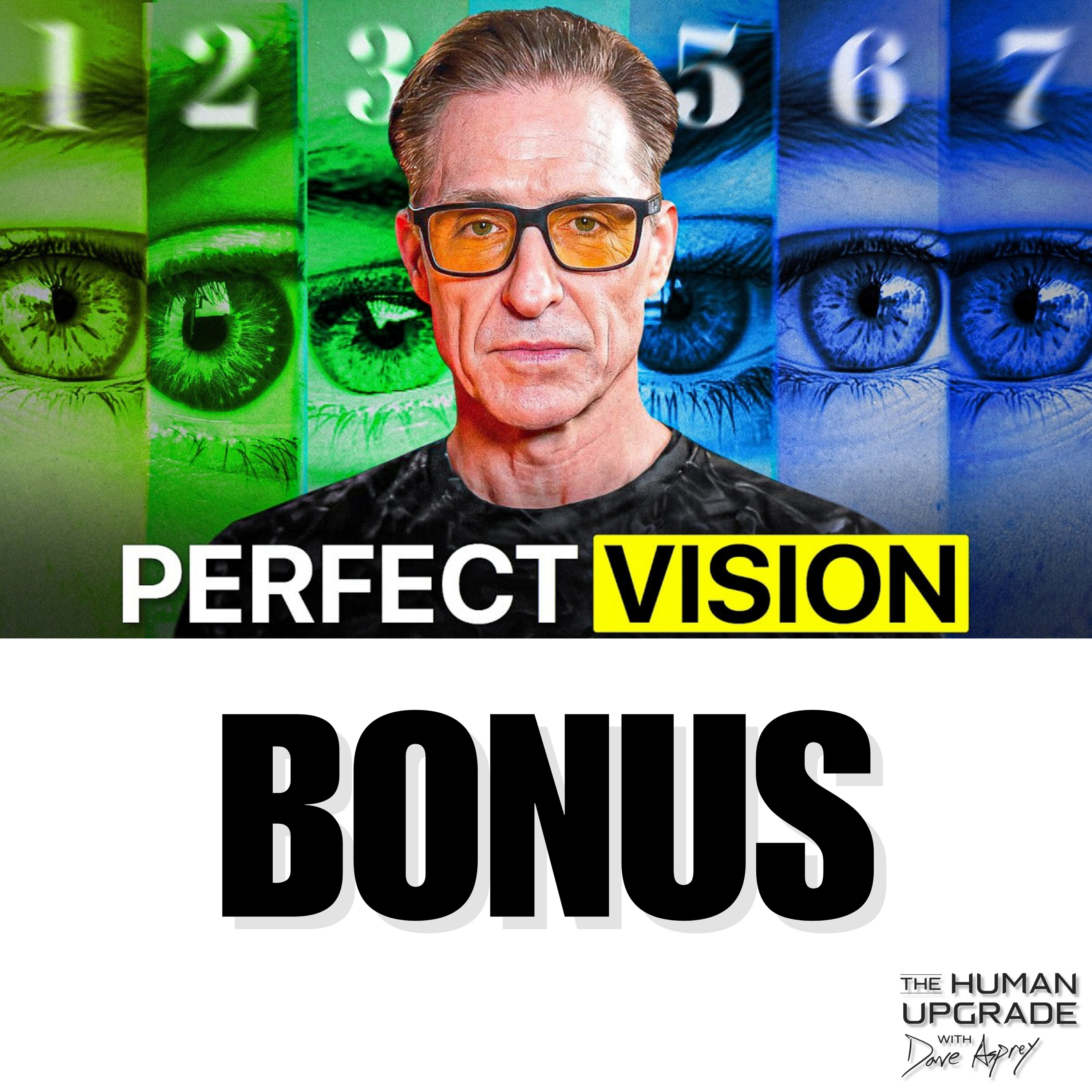
The Human Upgrade: Biohacking for Longevity & Performance
Give Me 21 Minutes And I'll Give You Perfect Vision Naturally : 1436
00:21:08
Loading summary
Transcript2 lines
- [00:00]
A
Your eyes have a self healing switch, and almost no one knows it exists. I used to have 2080 vision, which means that if you had healthy eyes, you could see something from 80ft away, but I had to be 20ft away to see it clearly. That meant everything was blurry. I have somewhere between 2015 and 2020 vision, depending on the day. And that's better than what's required to qualify even as a fighter pilot. And I didn't get there through surgery or through luck. I got there by turning on that self healing switch. But before you try to flip it yourself, you need to understand what's been blocking that process for years. It's your retina's repair cycle. Vision declines, feel final. And that belief alone causes people to just give up far too early. And once reading glasses appear or your night vision gets bad, most people just accept that that's the new normal. And the phrase once eyesight goes, it's gone feels like a biological law. And ophthalmology reinforces that mindset by focusing on correcting with lenses. Stronger glasses, stronger contact lenses, laser procedures, none of them are focused on restoring the health of your eye itself. And that approach quietly trains people to manage decline and even to make it worse instead of just preventing it. And no one ever supports the system that keeps the retina young in the first place. Vision care becomes about compensating for lost vision, not about stopping the loss in the first place. And the reality is, your eyes aren't passive cameras that slowly wear down over time. They are living tissue, and it's metabolically intense tissue. And it follows a daily cycle of damage and renewal. And every single night, your visual system can reset itself. Your eyes aren't just resting at night, they're running a repair program. And if that program weakens, your vision starts slipping in ways that feel familiar, but you don't have a reason for it. Nighttime driving turns, stressful, halos start to happen, and you find yourself turning up lights just to read comfortably. You lose contrast, colors are flatter, and it takes longer and longer before your eyes adjust in a dark room. And most people think, oh, my eyes are wearing out, I'm just getting old. But what's actually happening is far more specific. Most of that vision decline isn't permanent damage. You can reverse it by turning on your eyes natural repair switch and training them. Your retina is one of the most energy hungry tissues in the entire human body. Gram for gram, it rivals your brain in metabolic demand. And these light sensing photoreceptors are constantly converting light into electrical signals and that generates a lot of oxidative stress. So during the day, damage accumulates and light exposure breaks down your photoreceptors outer segments and it depletes visual pigments and then oxidative byproducts build up inside your retinal cells and it's normal. What matters most is what happens next. At night, there's a precise renewal sequence. Damaged outer segments of your eye actually get shed. The retinal pigment epithelium is a single layer of pigmented cells that's at the very back of your eye and it clears away toxic waste before it can poison the other cells nearby. And melatonin, your sleep hormone, rises and it acts as a powerful antioxidant inside your retina. It's not just for sleep that melatonin protects your photoreceptors when the mitochondria shift into repair mode. And then visual pigments like rhodopsin regenerate and restore sensitivity to low light conditions if your body can make them. But modern life systematically interrupts every step of that process. We get late night LED lights and screen exposure that suppress melatonin and that strips the retina, one of its strongest antioxidant defenses. Then we get high blood sugar spikes that increase oxidative stress and it causes something called glycation inside that light sensitive tissue. Glycation is when sugar and protein come together and form permanent bonds that make the proteins dysfunctional. So high blood sugar can hurt your vision. And then sleep deprivation shortens the detox and cleanup window before your eyes can complete the repair cycle. We also get low blinking rates from staring at social. We get dry indoor air and those destabilize your tear film, which creates surface inflammation and that causes more eye strain. And then rise, don't recover. And then we get chronic inflammation which stresses the mitochondria inside your retina. And that means you get less ATP right when your eyes need energy the most. So if you wanted to reverse vision decline, you'd start by reactivating your eyes natural healing switch. And that's the nightly biological cycle that repairs your retina. And this content is educational, it's not medical advice. But I did fix my vision and I've helped lots of other people do it too. If you've diagnosed retinal disease or serious eye conditions, go to your eye doctor and you can apply any of these strategies. Just tell them what you're doing. Here are the seven things I do to activate my eyes Natural self healing switch Every single day. Habit number one Is a specific frequency of red light. And how quickly your eyes repair Depends on how much cellular energy your eyes have available. The photoreceptors in your eyes contain one of the highest mitochondrial densities in the human body. Because converting light into vision is incredibly expensive from an energy standpoint, when your mitochondrial output drops, your cleanup slows and repair doesn't complete. There are many studies showing that red light in the 630 to 680 nanometer range, especially right at 670 nanometers, can penetrate your retinal tissue. That means it directly supports mitochondrial function. And that 670 nanometer wavelength enhances activity of cytochrome C oxidase, which is a key enzyme for your body to make ATP itself. When you can make ATP more available, say, using light, your photoreceptors gain the energy that they need to clear waste, and they can rebuild their outer segments and regenerate visual pigments more efficiently. So red light strengthens your repair switch at its root mitochondria. And to use it safely and effectively, you want controlled exposure. And if you're using a light therapy device, it's brief. It's measured in minutes, not prolonged time. And consistency is important, too. So you choose a daily window earlier in the day or at the same time each day. You don't want to stare directly into high intensity sources. There should be no heat sensation, no discomfort, no eye strain. And if you get headaches or something like that, or your eyes are just stressed, stop and reduce your dose of red light. If you do this correctly, the effects can show up subtly. Your night driving feels easier, your contrast sharpens, you improve your dark adaptation, and you just feel less eye strain over time. There are even studies showing that reading using red light, specifically 670 nanometers, can improve your eye health over time and even cause you to need less vision correction. It's that powerful. Now, habit number two is blueberries, because energy alone isn't enough if your retina can't rebuild the pigments that it needs. Your vision in low light depends almost entirely on how well the rods rebuild this one specific molecule. If that molecule is weak, your night vision is the first thing that goes. You start hesitating while driving after dark. You get tired after driving after dark, and dim rooms feel uncomfortable. It takes longer for your eyes to adjust, and you're like, ah, I'm just getting old. But that's not actually what it's about. What most people never realize is that the rods don't fail because they're old. They fail because Rhodopsin, which is their light absorbing pigment, doesn't get regenerated. Your body is constantly breaking rhodopsin down during daytime light exposure, and it has to rebuild in darkness during the exact same nightly window when the retina is repairing itself. And if that regeneration slows, rods become sluggish, you lose contrast, and your night vision goes. And people try to eat healthy, but they don't get enough of the right antioxidants. Specifically, anthocyanins, those deep blue and purple compounds in blueberries, are uniquely suited to making rhodopsin. They act as powerful antioxidants inside your retinal tissue, and they can improve microcirculation, which your eyes need. But most importantly, those anthocyanins from the delicious blueberries accelerate rhodopsin. And that means you can regenerate it better and you can improve how adapted you are to dark. When you have those antioxidants in your diet, rods rebuild faster and function better. So add blueberries to your diet. That'll help support pigment regeneration. When your rods rebuild, and to make it work, I suggest organic, whole or frozen blueberries without adding sugar. You don't need to eat a ton of them, just a modest amount is fine if you're sensitive to blood sugar swings, have some amount of protein or healthy fat to blunt the sugar that's in the blueberries. Even if you have better fuel and stronger visual pigments, your repair cycle in your eyes will stall if you're not getting blood flow into your eyes. And the retina itself doesn't have a direct blood supply, so that means it depends entirely on surrounding circulation. And if that works, they get oxygen and nutrients that can carry waste away. And if your blood flow is not flexible and responsive, you have a problem, and it'll show up in your eyes. Modern life, unfortunately, doesn't support healthy blood flow. We get hours of screen use, so there's sustained tension around your eyes and face. We're living indoors, we're in the same posture all the time, and we have chronic stress that reduces the ability of blood vessels to adjust. And they're adjusting their diameter, and they get a signal from the environment and from your body that says adjust blood flow. But they don't expand and contrast the way they're supposed to. So most of us are walking around with insufficient blood flow in our eyes, but we don't feel it directly. And we might feel at the end of the day as eye strain, dull pressure or headaches. And you can improve that blood flow through something as simple as cold exposure. Some people are going to hear cold exposure, and then they're gonna overdo it. Ice water can shock your delicate eye nerves and trigger productive reflexes and create more stress than benefit. The reality is your eyes don't need extreme cold. They need a gentle cold that resets your vascular tone. This is not sitting in an ice bath with your eyes. If you do this right, it'll improve nutrient delivery and accelerate your eyes clearance of extra waste. And then you get more oxygenation and you get more responsiveness in the tissues around the retina. And the improved circulation means your retinal pigment can rebuild. That's why a gentle cold rinse can strengthen your eyes, because it's strengthening the support system of the retina because of blood flow. And the key here is restraint. Use cool water, not ice water, just cold tap water is fine. Temperature should be refreshing, but not painful. And we're talking about seconds up to 1 minute. Once a day. You can literally splash your face or use a cool, clean cloth over your eyes when they're closed. You don't need to apply pressure at all. When you do this consistently, you might notice reduced eye strain and fewer tension headaches. Just a gentle cooling to stimulate some warmth to come back in, and you'll have a fresher feeling around your eyes that carries all the way to the evening. But just improving circulation isn't going to improve your vision. If oxidative stress keeps causing problems, you need to be able to recover from oxidative stress faster than it happens. And your retina of any part of the body Is living right on the edge of oxidative stress. Every photon of light that hits your eyes generates free radicals inside those photoreceptors. And that's normal biology. What's not normal is how much extra oxidative pressure modern life is stacking on top of what's supposed to happen. This constant artificial light, these big spikes in blood sugar, chronic low grade inflammation, and even psychological stress all add to that oxidative burden that you're under. When that burden gets high. Your retina's nightly repair cycle can't keep up with the damage. And most people ignore baseline oxidative environment because their body's in it all day long. And who would have ever thought it was tied to your eyes? This is an unusual thing, but I do do it. It's called grounding or earthing. And it works at this foundational level. You place your body in direct contact with the earth, which allows electrons to transfer from your body, which Strangely neutralizes excess free radicals. And I've even had the guy who created this and did all the science behind it on the show a little while ago. And what's going on is you don't have to go outside, although it's helpful, take your shoes off and be on the ground. You can actually get devices that allow your body to shed those extra electrons. And what that does is it reduces oxidative pressure throughout your system and grounding lowers inflammation markers and it shifts your nervous system into a calmer state. And that means your mitochondrial efficiency improves. Your melatonin becomes more effective. And how do you do it? 10 minutes barefoot, on natural ground like soil, grass or sand. And I recommend doing it on a surface that is relatively clean. Watch out for the doggy park. And late afternoon or early evening works best because it helps your nervous system downshift before nightfall. But honestly, anytime you can be outside, take your shoes off, you're going to be better off. And if not, get a device that supports earthing. You can pair grounding with slow nasal breathing or just a walk to amplify your body's relaxation. So now you can lower oxidative load, but still sabotage your eyes with one other mistake you're making. Our modern eye spends most of its waking hours locked into near focus. We're looking at screens, we're looking at books, looking at dashboards, looking and indoor tasks. And they all demand constant close up vision. That means the ciliary muscles that are responsible for changing the shape of your lens, they stay contracted for hours at a time. Your eyes are meant to take breaks. And that chronic contraction creates tension that restricts oxygen delivery and blood flow into the tissues in your eyes. So your vision system stays stuck in this low grade strain mode even when you think you're resting over time, think fatigue, headaches, progressive difficulty with distance vision. And here's the other problem. A system that never fully relaxes during the day is not prepared to relax at night. And how do you flip this? Well, distance viewing, when you look far away, the ciliary muscles release and tension drains out of the visual system. You get more oxygen, blood flow comes back, your eye shifts from work mode back into a neutral, rested state. And the mechanical reset doesn't just feel good, it prepares your retina for better nighttime repair because it's removing one of the biggest sources of strain during the day, which is just constantly being tense. The best way to do this is something called eye fasting. And it prepares your eyes for deeper nighttime repair by restoring a mechanical rest mode. So how do you do it? You spend about 10 minutes a day looking at true distance, far enough out that your eyes no longer need to accommodate. You might look out through a window. You could be outdoors. But the key is to see depth, not just staring across a room. Look out the window, and you can do this one to three times per day, ideally 10 minutes in total. But even pausing, setting your phone down, looking away for two or three minutes. And good news, if you still drive yourself, that counts. Over time, you'll notice less end of day strain, clearer distance vision, and fewer headaches caused by tension. But even if you get your muscles to relax, your vision can still degrade if your cornea is dry all day long. Because your eyes were never meant to stare without blinking. Yet screens are overriding one of the most important repair behaviors that your eyes rely on. Under normal conditions, you should be blinking 15 to 20 times per minute. But when you're in front of a screen, that number drops to four or five. So you're doing 25% of the blinking you're supposed to. And most people have no idea it's happening because blinking is pretty much automatic. Blinking is how your eye maintains its protective surface. So every blink spreads that tear film across your cornea, and it also helps to flush away debris. If you don't blink enough, the tear film destabilizes. You get dry spots, you get micro damage, and inflammation rises at the surface of the eye, and that irritation bleeds inward via inflammatory cytokines, and that can cause blurred vision. A damaged tear film, well, it's going to make your eyes hurt during the day, but it also sabotages how they repair at night. Because your cornea relies on a stable, hydrated surface to heal micro injuries overnight. But if your tear layer has been broken all day long, the surface never gets to fully recover, and you get low grade inflammation that destabilizes your entire visual system. So blinking restores order in your repair process, and each deliberate blink redistributes your tear film evenly. The good news is that if you want to train your blinking back to normal, just being aware of this problem could be enough. So several times a day, just pause and perform a really simple drill. Blink deliberately 20 times in a row, followed by five slow complete blinks where your eyelids fully closed and gently squeeze. So it's literally quick blinks like this. Watch out if your neighbor thinks you're batting your eyes at them. And then it's five where you kind of close your eyes more intensely. That's all you have to do. It's easy. That redistributes your tears and it rehydrates your cornea. And you could make sure that your environment isn't too dry. You also don't want it too moist. Around 50% is good. You want to reduce airflow from fans or vents blowing right at your face. You want to position your screen as far away from you as is comfortable and at or slightly below eye level. The other thing you can do is position your screen so that there's something with depth behind it. So you might look at your phone and then look up and look out at the horizon and look back at your phone. Switching back and forth is going to provide a lot of relaxation for your eyes. But none of those are going to work at their full power if your circadian signal gets broken. Because your retina needs one cue to turn on its repair. And most of us transition into night under bright white and blue indoor light, not under the light your biology expects. Overhead LEDs and phone screens are the biggest source of light in the evening. And to your brain and eyes, that signals daytime. So your melatonin production doesn't turn on. And when it does turn on much later, it's very weak and short lived. And melatonin isn't just for sleep inside your retina. It's the most powerful antioxidant that you use. It's the thing that protects your photoreceptors from oxidative damage. And if you're staring at bright screens and you have bright LED lights in your home at night, you're breaking that system. And when your body delays or blunts melatonin release, your eye repair also starts late and ends early. And stack this up over years and that shortened window of repair, well, it's going to have a cost and it's accelerated decline of your vision. So what's the signal that tells your eyes to kick over into evening mode? It's sunset. That red orange wavelength that's present at dusk is a biological signal that tells your circadian system that daytime is ending. And then that cue synchronizes the master clock in your brain called the scn. Your eyes receive that signal, then melatonin release begins earlier and it's stronger. And that means you get retinal repair enzymes when you wouldn't have had them before. And your photoreceptors start cleaning themselves off sooner, you get more rhodopsin. And if you want to use that signal correctly, you could spend five to 10 minutes outdoors at sunset, let your eyes face the horizon and don't stare directly at the sun. And then after sunset, protect the signal you just set. Indoor lighting should be dim, shifted to warm tones, and minimize scrap so you can have melatonin. But let's face it, how many of us actually have access to a sunset? If you live in a city, you probably don't. So what do you do? You mimic the sunset with the first trick you learned. Red light. That's the key ingredient in sunset. So when it's dusk outside, turn on some red lights in your home and your body will get the same signal. And in the morning, reinforce the rhythm with brief outdoor life exposure. Exposure. So wake up, go outside, take off your sunglasses, and get 10 minutes of morning sunshine. That'll anchor your entire circadian cycle, and it'll improve your vision over time. And when it's working, you get clearer vision because your eyes finally had the time they needed to repair themselves. So it's about having a recipe to support your eyes. Your eyes don't decline because they're old. They're declining because your lifestyle stops them from repairing themselves and they don't have the raw ingredients they need. Once you flip that switch, your retina behaves like it was designed to. It cleans up the damage, rebuilds the internal structures, and then your vision stays sharper longer than most people think is possible.
- [21:10]
B
A Human Upgrade Formerly Bulletproof Radio was created and is hosted by Dave Asprey. The information contained in this podcast is provided for informational purposes only and is not intended for the purposes of diagnosing, treating, curing, or preventing any disease. Before using any products referenced on the podcast, consult with your healthcare provider carefully, read all labels and heed all directions and cautions that accompany the products. Information found or received through the podcast should not be used in place of a consultation or advice from a healthcare provider. If you suspect you have a medical problem or should you have any healthcare questions, please promptly call or see your healthcare provider. This podcast, including Dave Asprey and the producers, disclaim responsibility for any possible adverse effects from the use of information contained herein. Opinions of guests are their own and this podcast does not endorse or accept responsibility for statements made by guests. This podcast does not make any representations or warranties about guest qualifications or credibility. This podcast may contain paid endorsements and advertisements for products or services. Individuals on this podcast may have a direct or indirect financial interest in products or services referred to herein. This podcast is owned by Bulletproof Media.