← Duologue with Leslie Heaney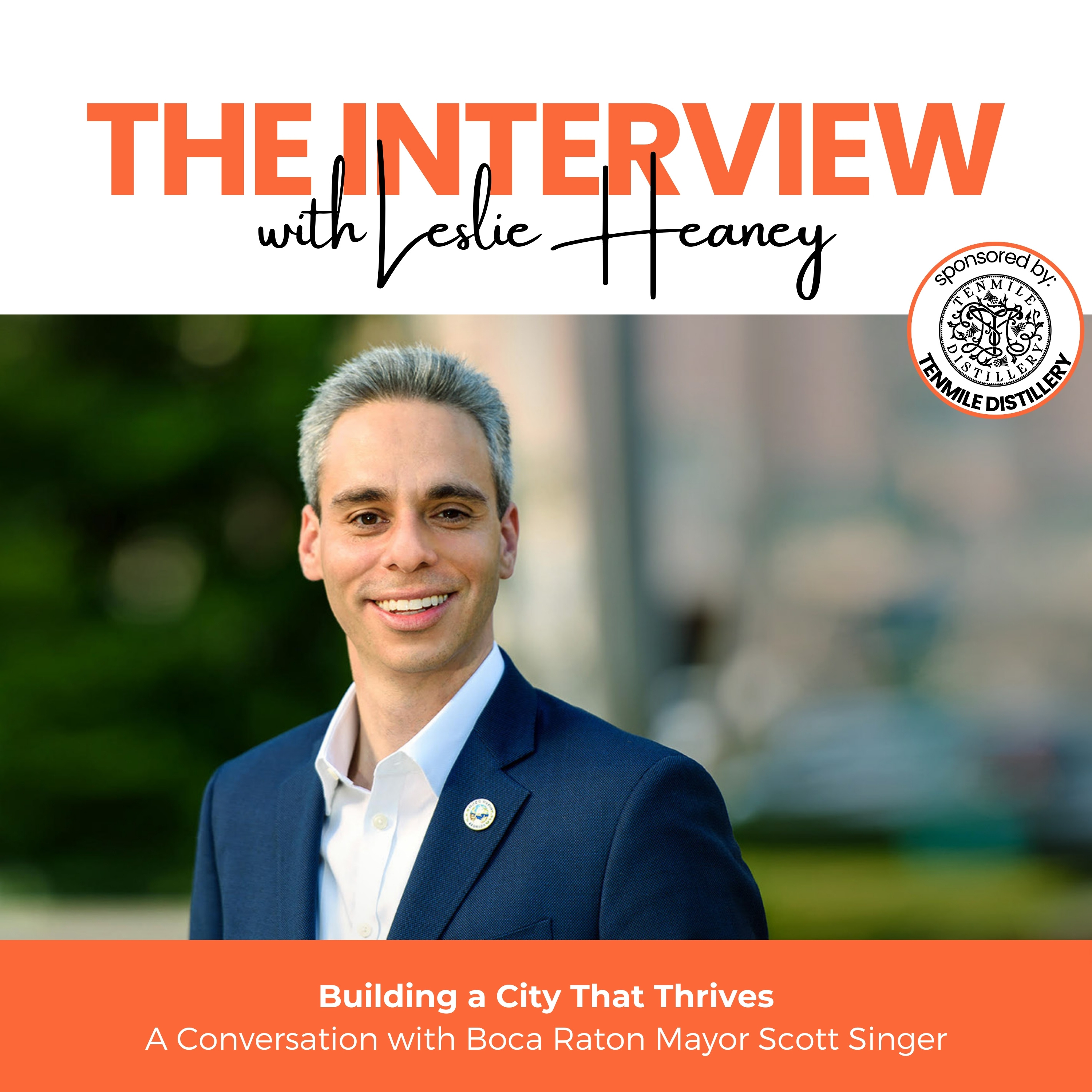
Duologue with Leslie Heaney
Building a City That Thrives: A Conversation with Boca Raton Mayor Scott Singer
00:50:20
Loading summary
Transcript55 lines
- [00:05]
A
Hey, everybody, this is Leslie, and you're listening to the interview with Leslie Heaney. Today we're heading to South Florida, where leadership, vision and growth are reshaping one city, the city of Boca Raton, in remarkable ways. I'm joined by Mayor Scott Singer of Boca Raton. Scott is an old friend and our former lawyer who moved from New York to his home state of Florida years ago and dove into public service, first as a city council member and then as the mayor of Boca Raton. He was elected in 2018. He was reelected in 2020 with 89% of the vote, and he ran unopposed in 2023. He's a wildly popular mayor, and I think after listening to this episode, you'll understand why. Scott's also been a leader in a variety of different national mayoral groups and committees. He's really a leader among mayors in the United States. You may recognize Scott's name as he got quite a bit of press this past summer after New York City mayoral candidate Zoran Mandani won the New York City mayoral primary, the Democratic primary. Scott took an ad out in Times Square urging New York City businesses to relocate to Boca Raton. It was a move that got quite a lot of media attention, but it also got the attention of businesses in New York City. And he's been contacted by many of them since that primary. And we'll talk a bit about how, in his opinion, Mandani's policies will drive businesses and residents out of New York City. We talk a bit about how, in his opinion, Mandani's policies will drive businesses and residents out of New York City. But mostly what Scott and I talk about are what policies strengthen public safety, create strong and thriving hubs for innovation and opportunity, and why local leadership matters. We talk a lot about his successes in Boca Raton. So this is a conversation that really is not about politics, but it is about how vision, public service, and the right leadership and the right policies can really have an incredibly powerful and positive impact on an entire community. I'm so excited about this week's sponsor, the 10 Mile Distillery. 10 Mile is an American single malt distillery based in the Hudson Valley about 90 miles north of New York. And it is the maker of the award winning Little Rest Whiskey, made through a slow distillation process with all New York State grains by master distiller Shane Fraser from Scotland. And when I say award winning, I mean it's earned a 95 out at the whiskey competition in San Francisco and a 96 at the New York International Spirits Competition. This is delicious. If you do not believe me about how delicious this is, the good news for you is that if you're in the New York area, you can go visit this incredible and beautiful distillery yourself. It's set among the most beautiful apple orchard with beautiful views of the mountains behind. Stop by for a leisurely tour or tasting or even enjoy an expertly crafted cocktail. They also have gin and vodka available. They also have this incredibly delicious Thai restaurant that is in residence there from Thursday through Sunday. To learn more about the distillery, you can visit them@tenmile distillery.com theinterview. All orders will receive 10% off if you put in promo code the interview at checkout. So go to www.tenmiledistillery.com theinterview to get that discount, that 10% off, I promise you, you will not be disappointed. So with that, here's my interview with Mayor Scott Singer. Scott, I'm so happy to see you for listeners. Scott is an old friend and was my husband's lawyer, our corporate lawyer for many years before he left us in New York and moved down to the great state of Florida. What year was that, Scott? Remind me of that.
- [03:48]
B
Well, it was 2011, but I'm glad to say we've had an ongoing relationship. Even though I've been in beautiful Boca.
- [03:53]
A
Raton, I know that is true. It's very difficult for the Heaneys to live without you, I must say that. But so you get down there, it's 2011 and then you decide to run for city council in 2014 or around there.
- [04:08]
B
Yes.
- [04:09]
A
What prompted you? What crazy thing led you to having been a recovering town councilwoman, myself and Andrew having run for for office too, as I know you know. What was the impetus for your decision to run?
- [04:24]
B
Well, sure. And Leslie, and to the many viewers and listeners, it is a thrill to be here because I've known Leslie now for nearly 20 years and seeing how you've grown this podcast, podcast to the interview named T H E capital letters there is tremendous. I'm honored to be here. I don't do long form formats like this, but when you asked, I jumped at the chance. I grew up in South Florida, South Florida native, was away for college and law school in the start of my career in New York, met my wife Bella up there and in 2011 we were looking to move outside of the city, looked a lot of places, did not choose the suburbs like some people I know and thought, you know, the suburbs around New York and thought why not move back to Florida for me and Convince Bella to move here. I still had family still here, great place to live. The timing was good. We were just expecting our first child then. So we moved to Beauforton and it's been the best move of my life. I started building my law practice up here. And like many people who grew up in South Florida in the 90s, we did not want to stay here. We didn't feel the job opportunities were here. I saw a lot of people were my peers, my year in school or years around me coming back and starting their careers and really, you know, flourishing. So one day I looked at my one year old son. This is in 2012. I said, I'm starting my law practice here. I'm trying to build my business connections and get more involved in the community real estate law. What's he going to do when he grows up? Is he going to have the same feeling I had in high school, which is he has to go elsewhere to find job opportunities? I thought I better see what we're doing in the city of Boca Raton to attract jobs. So I went to city council meeting and I went to the second one. I saw the mayor then talking about some ways to try to attract younger people here. That's what led her to run. She get older kids then. And I went to a third one. Kind of being a government nerd. I studied government. I was hooked and thought maybe I ought to be doing this and started doing a lot of due diligence, Talked to hundreds of people, had a lot of coffee meetings about how we can make the city better. But it was really about focused on bringing young people here and make this a thriving community for people of all ages. What people don't realize is Boca Raton's pretty young city actually. Young for South Florida standards. And there's the jokes on TV that aren't accurate. Our schools are brimming. We've added 1200 student seats. Our median age is in the mid-40s and dropping. And we are a young, vibrant community. So it's really just about doing that. I wanted more opportunities for my children. Now I have two. My daughter is 12, my son's turning 14. And making sure that they are still achieving all they can. And we've had great success. But I want even more, as I'm sure we'll talk about.
- [06:54]
A
I was just realized, it dawned on me, I didn't think to ask you this for listeners that are not as familiar with Florida. You know, you mentioned that, you know, sort of, you made a comment just then about Boca Raton maybe being Considered a little sleepier or not as vibrant. Where is Boca Raton located and how large is the city? And give us a sort of a 30,000ft on it before we. We dive into all the amazing things that you've been doing there.
- [07:18]
B
Absolutely. Boca Raton is in southeast Florida, the Miami metro area. Miami is the seventh largest metro area in all of the United States. It goes from Miami Dade county, where Miami Miami is further north along the eastern Atlantic coast, to Broward county, where Fort Lauderdale is, to West Palm beach county, where West Palm, Palm beach and Boca Raton are, and then further north a little into Martin county just above us. More than 7 million people in the metro area. Boca Raton is a city right at the southern southeastern edge of Palm beach county, but really kind of dead center of that metro area. 100,000 people in our city limits, 29 square miles. We have more than 14,000 businesses and more than 40 publicly traded corporate headquarters. We punch above our weight when it comes to business. And I don't think there's a city in America with our size that has that sort of corporate representation. We're not the county seat of Palm Beach County, West Palm Beaches. We have more office space, more than half the headquarters of the county, and more available office space. Palm beach county is home to President Donald Trump, who lives in Mar a Lago on Palm Beach Island. That's across the way from West Palm Beach. We're all part of the same metro area. Aside from our business strength, we've got three universities here, including Florida, Florida Atlantic University, a Research one tier one Research University, State University, Lynn University and Everglades University, along with Palm Beach State College, a rated school system and a lot of vibrant neighborhoods. Also. There's one other point, but we'll come back to it. I'm sure we've gotten a lot of attention recently, too, because people have just been flocking to South Florida last few years. And we have a great business strength that people want to come and see more. Great success in finance, in tech. IBM invented the personal computer here in 1981. It's R&D labs here. We're for 30 years. And even though they move, we saw a lot of tech here. So we're leaders in healthcare tech, medtech, fintech.
- [09:06]
A
So, you know, it's so interesting when you're talking about, you know, it being a leader in business and attracting all these different businesses there. Obviously, you started City Council, now you're a mayor. What kind of policies or initiatives did you start along with your colleagues in the council when you first started to attract more businesses and opportunities there.
- [09:26]
B
Well, we created an office of economic development. We had a budget, but we had no one really going out and recruiting. And we're still doing that. And I'd like to do more. We work now with the county officials and state officials, but we had. That office was cut from old cloth. We created an office of communications because we actually didn't have any of a city of our size. And that was very important to me. When I first joined the council, there was a lot of. There was some more dissension in the city. The temperature was a little high. I helped lower that. And I think constant communications from the city about the wonderful things we have. I mean, we have first world problems in our city. We're a relatively affluent community with a strong business base. We've got the lowest property tax rate of any full service city in Florida. Let me read that. The lowest.
- [10:07]
A
You say that again. You're saying that so quickly. I'm just taking notes. By the way, I should say that in preparing for this, you know, reading about all the wonderful things you've been doing to prepare for this conversation, I said to Andrew, maybe we should move to Boca Raton. I mean, it's just like it's.
- [10:21]
B
Well, you know, I'm sorry you didn't. But it's a great place to raise a family. We have the lowest property tax rate of any full service city in Florida. We are a full service city in that we provide water, sewer, police, fire, libraries, parks, recreation, maintain our roads, traffic signals, use air technology for that. A lot of cities, sanitation. A lot of cities don't do all those things. We do. And yet we have the lowest property tax rate because we have the highest valuation. We've got a strong business presence. We've got a lot of homes here. Our valuation on our property taxes is over $40 billion collectively. So we're a big economic engine. But a lot of the things we've done are just trying to streamline government, too. We've had 20 streamlining initiatives in the last six years. We've invested heavily in public safety. We've got, I'd say, the finest police and fire rescue departments anywhere. And our stats bear that out. We are a Class 1 rated fire rescue agency. Less than 1/2 of 1% of all fire departments in the country have that premier rating. We do. We've got the highest starting salary for police officers in the Southeast, if not the United states, and the mid 80,000 for a starting officer. So we're able to attract and retain the best talent. And as a result our crime levels which were at 40 or lows are even lower. They've dropped significantly over the last seven years. So we're trying to do all these things when we focus on creating the right environment for people to live, work, work, play and learn and paying dividends.
- [11:45]
A
So do you think like in terms of the actual you mentioned the center for Economic Development or the or is that what we the office. Yes, the Office of Economic Development. Which is really fascinating because I you know my husband who you know opened up a distribution headquarters in Connecticut for in outside of Bridgeport and it's interesting to see the impact when a city government is actually trying to work with businesses to attract them there and talk about different state initiatives that they could tax benefits that they can enjoy by moving their businesses there. So part of that were you then going out and talking proactively or was that office I guess going out and trying to recruit different businesses and talking about the different tax benefits or tell me sort of how it having that office kind of played out or how it you know, what about going to bring more business in?
- [12:38]
B
Well, yes to all of it opponent of this. But I, I am probably, I am relentless and probably annoying to many people out of how hard I'm targeting their businesses, even friends including your husband.
- [12:49]
A
We're going to get to that in a minute, Scott. We start talking about New York. But go ahead.
- [12:52]
B
Right. Who I you know pitched and know all about the you know why when certain places still try to convince to come down to vote Roton. So I'm not giving up. But aside from our having the lowest property tax rate of any full service city in Florida we have zero income tax, zero state income tax. And when you're looking at people moving from Connecticut or New York City already you're at the 15% marginal level that you can give up and you've got passive investments or other real estate investments, you get your domicile in Florida that goes away off the top. Yeah, that's attracted a lot of people. But Covid showed us a lot of things. It showed us that people didn't want to be in high regulation, high crime cities. They wanted to be in warmer climates where you didn't have those problems could enjoy life 12 months out of the year. You could you had an outdoor spaces. You didn't have your kids cooped up. But also people realized you don't have to work only face to face in the office and you had either work from home hybrid models part time. You and I would not have been doing this 10 years ago. The technology would not be there. The acceptance of it wouldn't have been there. And now it's commonplace. And where people can choose to either move their C suites or different levels of their businesses or just sales executives or tech executives here, they're coming to Boca Raton, they're coming to other cities here. And that's the wave and that's a permanent change. Other cities are shrinking their office footprint. We are adding up to half a million square feet of new class A office in our downtown because of demand. But I think that office goes back to what just what we've been doing. I'm constantly recruiting. We'll talk more about what's been going on in the last month. Certainly we're trying. The moment I want job opportunities, my son, as I said, is turning 14. That means I only have six more years to keep him before he graduates high school and thinks permanently about where he's going to go. So. Or I want to do that. I want every opportunity to be here because we're seeing this. But I want people to know this is a round, round the clock, full gamut city.
- [14:50]
A
So do you think also, I mean I would think you mentioned you're, you're expanding sort of the office space and building new offices and all that stuff. So you're able to accommodate these new businesses coming in. But you also have made some infrastructure improvements or you were able to get Boca Raton to be part of the. The tram, whose name escapes me, which is a station.
- [15:10]
B
Yes. Train called Brightline.
- [15:12]
A
Yes, the Brightline. Right. Which. That's a huge infrastructure project for Florida.
- [15:17]
B
Well, certainly. So for those of you who don't know, Brightline is the nation's first privately funded high speed rail. If you're familiar with the seller in the northeast corner, this is frankly far superior. About the same train speeds. They can go up around 100 miles an hour when they start getting up in central Florida, probably in the 80s and 70s down here in south Florida. But that's about comparable to a seller speed. But it's a premium offering. It's much nicer than a cellar. They've got premium and even the regular level. The regular level, like cars are new. Everything is new. It's more spacious, more accommodating and now invested by Fortress. But private investors came in on the rail line that had been there for 100 plus years and created a Miami to West Palm beach link. Then opened up, look to open up to Orlando. The trains are coming right through our town and I convinced the executives in 2019 after they've been running trains for a few years. You're missing an entire market here. We are the bigger office market than West Palm and Fort Lauderdale with an affluent populace who can take advantage of this premium offering? You ought to have a station in Boca Raton. We had land set aside, so I tore them around and was relentless on pitching them, and they opened up a station here, and that's been great. Bright Line showed their highest writership in the last two years, just last month. They are now connected to Orlando, but it's a game changer for our city for two reasons. One, for we residents who have to commute elsewhere. I want to go down to Miami. The rush hour could be an hour and a half hours. I'm there in 50 minutes. If I need to go to Orlando for a business meeting, I'm there in under two and a half hours. And that's, you know, not much less than driving, but you're productive that entire time. You've got certainty. You've got, you know, full WI fi, full capabilities in a quiet car that's zooming along it. And, you know, commuting patterns are changing. Younger people are not wanting to drive. So this will be the bellwether for what we see as more commuter service within South Florida and then connecting to Orlando and then Tampa. It's connecting these markets in a very important way. And I thought it was essential that Boca be there here. Histories written by the cities that were part of major transportation networks, whether they were on ports or on rivers, part of trading routes, and those that became ghost towns because they got passed over. Well, Boca Raton is right in the mix. So it was a real accomplishment to get that done, especially during COVID because we approved it in 20. We approved it in 2019, and then Covid hit and yet still got it open by 2022.
- [17:32]
A
See, that's so brilliant. That also shows, though, you know, I love that you're out there pitching and bringing the people in and showing them how it would be beneficial for them to have a stop there. But that's where you how government can be so impactful when you have the right people in office who are really working hard to attract and bring businesses to your community. The other thing I would say is that we, as you know, moved to Nashville last year, and there's so much talk in Nashville and different legislation that's being proposed about how to alleviate traffic congestion. I mean, to us, there isn't much traffic there, but to natives and people who've lived there for a while. The growth that they're experiencing, the growth that Austin, Texas is experiencing, they don't have the infrastructure to support that growth. Meaning it's difficult to even expand the highways where they are. And they're trying to figure out how they can bring in some sort of train or rail line to alleviate some of the congestion. So the fact that Florida, south Florida is already on top of that kind of almost in anticipation of the growth is really forward thinking. So well done. Other Florida, South Florida.
- [18:37]
B
Well, thank you. I think there are a lot of things we are doing well and always something better. Going back to where you started. Yeah. I think I've seen successful mayors across this country and successful governors too. I think we recognize a common theme. Government by and large does not create jobs. Government is there to facilitate the private sector responding well, to create the right low tax, low regulation environment to encourage businesses to come in. And when you do that, the private sector thrives. That's who creates the innovation. That's why the free market system has been so transformative, more transformative than any other system in the history of mankind. Humanity to create wealth for the greatest number of people because it creates innovation. It rises the level of standard, you know, the standard of living from everyone. Think of where we were two, 300 years ago in our different system. Like what we have today is tremendous. So I'm, you know, happy to be facilitating that. In terms of transportation, we recognize this. I mean we had urban scroll in South Florida. There are things that our cities doing, cities are doing like new land planning like we have instead of being just a suburbs and everyone commuting in on i95 down to the centers of commerce and going back out. You're trying to introduce a new mix of uses. We're doing this in our downtown. I'm sure we'll talk about that. But we try to introduce mixes of uses nearby. In our city we have not only the high speed rail of Brightline, but we also have Tri Rail, which is the state's funded Tri county commuter rail. And eventually I hope that line will move over to the eastern tracks from city center to city center, where Brightline is now. That's a possibility. But we're using new technology like artificial intelligence technology on our traffic signals to deal with sprawl. And yet we can't control it all. I mentioned that book. 100,000 residents. We have nearly 120,000 more residents who live outside of the city in the unincorporated land. That means they're not in city government. They're just governed by Palm beach county, but they use a mailing address of Boca Raton. And so those people consider themselves residents, even though they're technically not in the city. You know, a lot of your viewers have been out to West Boca. They're not in the city limits. The county government, though, has allowed a lot more housing out there without planning for more roads. No Internet talking about, and no centers of commerce. So that is creating a challenge we have to deal with. It's a little frustrating for me at times. We have people who think they live in the city. They don't pay us taxes, we don't get impact fees, and yet they're on our roads. So it's about managing that growth. We have no sway over that. The county's doing that. And I think you're seeing other jurisdictions still struggle with this, too.
- [21:05]
A
You know, you brought up, you talked about sort of failing cities and your view of government really just playing a role, not in creating jobs necessarily, but into attracting the private sector there to do that. And last weekend we were driving up to Newport from here, and we had to stop in Hartford to charge our car, our electric car. And Hartford was such a thriving, beautiful city, and it is in dire straits. And there are so many cities like that, smaller cities like that around the country. And we had a conversation in the car for the rest of the ride about sort of what went wrong there and what could ever be done to. To bring a city like that back? I mean, in your experience. I don't want to talk about your role as being. You're a past president of the Florida League of Mayors. You're the current America First Policy president. I guess it's America First Policy Institute, Mayor's Council. You're the president of that currently. I mean, what do you do you think for cities like that? And I know you're obviously in those roles talking to mayors everywhere. What can city leadership do with cities like that, small cities like that, to help bring them back?
- [22:17]
B
I try to think of it as a pyramid with three levels. The base of the pyramid is always public safety. You have to invest in public safety and make sure your community is safe, because otherwise people don't want to be there. They don't want to live, don't want to work there, they don't want to invest there, they don't want to visit there. Then second, you need a strong business base because without jobs, you don't have any work for people to work. You don't have jobs that support those jobs, because every job created can Touch three or four other jobs in a community. You don't have that community investment, that philanthropy, that reason for people to be there, that reason to attract people there. So you need that with those two things set. Then you have the quality of life where you've got great parks, great schools, great libraries, great places to be, great commerce, great tourism attractors. So the cities that have struggled have let public safety go. Their tax base eroded, and it's not through their fault of their own. I'm thinking of a lot of Northeastern or Midwestern cities that were company factory towns. It wouldn't be left. They didn't backfill. Our city faced that same struggle in 1995 when IBM took its R&D lab and about 20,000 jobs in our city, which only had about 80,000 residents at the time, to the Research Triangle. We had a pivot and we had a lot of companies that stayed and others that came in, but we could have just folded up shop and said, well, we're going to be a tourist city now. No, we needed to keep that business base, that strong economic base, and that credit to my predecessors in these roles as mayor and council member who did all that. You need to constantly be thinking this way and trying to attract more opportunities, more jobs. I'd say to the cities that have done better lately, you know, when you have jobs that, you know, certain type sectors of the economy go, you have to come back, but you have to constantly invest in public safety. And where I'm seeing more success in among other cities for these different talking mayors, you see studies that have been more adversarial to public safety, have the different attitudes and those quality of life issues, and it scares me. I love New York. I lived there for 10 years. But public safety is not what it used to be. And if some proposals get enacted after a mayor's election in November, talking about, you know, the leading candidate there is talking about and many public statements about defunding public safety over time, you do that, you create more hardship.
- [24:21]
A
You have been in the news quite a bit, Scott, lately, being kind of outspoken about your view of Zoran Mondami winning the primary in New York and the kind of the fallout of that. Or I mean, I guess there are people who support his candidacy because he won the primary, but for those that don't, their concern is based on some of these policies that you just outlined, Right. Sort of his perspective about the police, his perspective on how he wants to approach socializing. Some different types of businesses, for example, supermarkets and things in New York, you Heard about this. We all heard about this. He won the primary. I think it was surprising to some, maybe not to others. As someone who lived in New York for a decade and have a love and affinity and friends that are there, what are your concerns about his candidacy and I guess from your perspective more as a mayor about some of the policies that he's advocating for.
- [25:23]
B
Well, so we were in the news a lot and it's lucky I wanna give credit to my chief of staff, Marissa Herman, because Newsmax happens to be headquartered in Boca Raton. We'd been pitching them on a story for a while about why businesses booming in Boca Raton, this sort of governance. We've talked about lower regulation, encouraging business and letting the private sector flourish. That interview was a two parter and it happened to do the in segment, in studio segment the Thursday after the primary. So naturally we were talking about the contrast to New York as a little more stark. We've always been contrasted from a high crime, high tax, high regulation, jurisdiction. And that caught fire. And we were on the COVID I did a New York Post interview that ended up on the COVID and that spurred a whole spate of media interviews. This being the latest. But in the first period, whether it was Fox Business, Fox News, Newsmax, Newsmax again, the Hill with News Nation, New York Post, Orlando Media, Miami media. We had more than $3 million worth of value that we'd have to. That would be the equivalent of paying for $3 million of paid media advertising on why Boca Raton is such a great place to live, work, learn and play. And so that real highlight. And we got a lot of calls from different states. We launched our own campaign, NY to Boca. We've got a billboard operating Times Square that had.
- [26:36]
A
Sorry, Scott, what is it called?
- [26:37]
B
I could NY to Boca and why to go. Our traffic is up fourfold on our economic development site. We've had thousands of views and I encourage you to see and you and your viewers see why you should move here. But getting back to your bigger picture. Yeah, I could talk for hours about this. We'll cut it off. It is alarming to me. Socialism has failed. Communism has failed. Everywhere it's been implemented. And the free market system works so well because it works well. It is not the market. Capital flows to where markets belong. People make their free choices and they've got that opportunity to exercise their own free will. And you can only get so far by taxing, taxing, taxing before people flee jurisdictions more they're going to New York. If this comes in November, if They're going to raise the tax on the highest earners to 17% on top of the federal taxes. And then the high cost of living and commuter taxes and congestion pricing and the threatening of taking away other proposals that had been advanced or taking privatizing public private housing for public benefit, putting a cap on rents and new construction is the worst way to encourage a decrease in housing prices because you get no new investment. There's these ideas are going to fail and people are going to be wanting to get out. So I expect a lot more calls to continue. And if this election happens in November, as people predict more to come in, I'm proud to be part of mayors groups, bipartisan groups, Florida League of Mayors, US Conference of Mayors, where I think people get it. And I love to borrow ideas from other mayors. You know, they say good mayors borrow from others, and great mayors feel outright. I've been happy to steal from some other mayors. And the more we steal from each other to get good policies in, I think helps us all. So I think some other New York may be in for some rude awakenings. And so as someone who loves New York, I'm torn to see crime potentially increase, to see more bad ideas take root. As mayor of Boca Raton, we're there to pick up the pieces and show people a more successful way of life.
- [28:37]
A
What do you think, though, Scott, as someone who you're so smart, you're so astute, as you said when you first went to that first city council meeting, you sort of bought in. You wanted to learn more about how the government was working. What do you think this is a sort of. This sort of more socialist ideology has been taking root, is getting some traction, I think, particularly among the younger generation. And do you think that that is because they don't feel like the American dream is accessible to them or that they see a place for themselves within a capitalist society? That's at least that's my perspective, is that I think that that's where it's coming from. And, you know, do we need to be making sure we're providing more opportunities in education, other things? So they don't. They see a path forward because the default, I think, is that. And it's really frightening.
- [29:31]
B
You know, I did not realize the extent of certain views being advocated at all levels of education until recently. And I'm hearing it from different parents. I think about it with my own kids, it's not just universities which tended a little more liberal. They've tended a lot liberal. And you're seeing this, whether it's political giving being 99% of the Democrats or the teachers union, largest teacher union, 99% plus other contributions go to Democratic candidates. It is definitely one sided and I think you're seeing a tie between liberal schools of thought and ideology and how that's transforming everything. And that divisiveness is not good. It's not good on either side of the aisle. But when you start to view everything through a certain lens, it creates problems. My role is nonpartisan. I don't run as an R or D on the ballot and a lot of people don't. Party leanings, you know, if you pay attention. We govern in an efficient city, but that crosses all boundaries and our cities have to do that. We've got to get the trash picked up, we've got to maintain the roads. Time for different debates and we're not trying to get sucked into them. But I do see younger people being imbued over decades of just certain teachings and I think it is causing people to lose hope. There are some challenges. The free market's not perfect. It is the best system, but it's not perfect. But I think there's no reason for people to lose hope about opportunity in America because if you work hard, you can achieve here. And this is the first country in the world where you can always say that we didn't have royalty, we didn't have nobility, we didn't have certain classes where you couldn't advance, anyone could advance. My father was the embodiment of that American dream. I could go into that. But so many people can tell that story where you've got first generation Americans achieving so much and that's what makes this country great. I think it's wrong for people to lose sight of what that American dream can be. Yeah, we have some inequities and some challenges, but we can overcome them. But going to a socialist system where the government controls what happens if the government wants that. You're relying on the government for control one day and then the thing that you depend on them for, they change their mind and you've got no recourse. That's how it is. Societies that's not American. And we need to make sure that people understand that we achieve so much as a nation because we were able to bring prosperity to more people choice. That's really where the American dream is.
- [31:49]
A
So with, with your leadership, with these different mayor groups getting together, what, what are the common concerns among mayors? What are they talking about? And what, what sort of were your best kind of cheats or takeaways or things that you borrowed from some of these other mayors that you think are doing a good job?
- [32:07]
B
Absolutely. I think all mayors across the spectrum are concerned with how they make their cities better. Because when you know you are a mayor, you are seen as the face of the city. You got all the wall. Some are strong executive mayors where the CEO of the city. Most mayors in America, like me, three quarters of us roughly are have a council manager form of government. So I'm not the CEO. I'm not running, supervising day to day the water treatment plant operator or the park ranger or the police officer on the be. I'm the chairman of the board of directors, the city council. We set the policy. It's up to the city manager to execute it. We're like the uber passenger or in the old days, the taxi passenger. We tell the past, we tell where them where we want to go. Their job is to get us there. But I think we all share the same vision. We want a city to be thriving. You have to focus on public safety, you have to focus on infrastructure, you have to focus on jobs, you have to focus on quality of life. Some of us have different ways to do this. In terms of the ideas, I've stolen or borrowed tons of them. Whether it's on how you approach communications, because we're really in the communications business, right? Helping people through crises. I give credit to the mayor of Sioux Falls, South Dakota, Paul Ted Haken, who at the start of COVID launched a launched a website for people to exchange services and need, you know, people who are in help. We launched our own website the next day. I bought the domain. I asked someone to go set up a website, bocacares.com it's still out there and it's still a clearinghouse for people who need referral to different services. And Covid, my goodness, that was a challenging time for all of us. But everyone is looking at mayors to lead. I got so many more questions. People angry, concerned about everything and things that were federal, state issues that we had no control over. But we're trying to get people help. Whether it was providing access to vaccines or job economic help. We had to take on all those new roles. So. And I had emergency powers for a long time. So a lot of that concern for the health, safety and welfare rested on my shoulders with a lot of weight. But mayors do this every single day. But you have to be there to rally your community forward in times of struggle and also in times of triumph.
- [34:10]
A
So you took out this ad. New York Taboca is that what it says New York to Boca, Times Square.
- [34:17]
B
It's a billboard right now, 30 second visuals in Times Square, 1440 Broadway.
- [34:23]
A
So, two questions to that. One, you said that the traffic on your economic development office's site has gone up four times and you're getting calls from a lot of companies in New York. Is that fair to say?
- [34:39]
B
Not just New York. I think we're up to 10 states now who've made inquiries. They've seen our. Whether it's our segments on Fox or on the other networks, local media, print media, I told you the value. But I think we had in those first three weeks, 86 million eyeballs talking about our book stories. That's great. And it's a real culmination of what we've been working for and trying to keep it going. The billboard came about because we had someone reach out to us and said, we like what you're doing. We can offer you a discounted rate and if you get your ad up, that will give you free time included. So we hastily put together an ad for Independence Day and said, declare your independence from higher taxes, congestion, winter weather. And we had, yes, thousands of people seeing that. And, you know, our traffic increased fourfold. We're getting inquiries in. I can't announce companies yet, but people. I have more people looking to move here. They're coming down now. And we'd love to create these jobs because we see a moment here and we've seen the success all throughout South Florida. So we should be par for the course and then some.
- [35:39]
A
I mean, are any of your friends who are still living in New York giving you any flack for, for businesses going businesses?
- [35:48]
B
I'm calling the friends I have in New York and other cities come down like us. Nat. Bill Wright, Come move here. It is a better way of life. And I love New York. I never thought I would leave Manhattan. I love New York to my core. But when I realized I didn't, you know, the hard place to raise a family, and this is in 2010, you know, now it's probably even harder when you're looking at moving outside. This is so much better than the idea of my commuting in an hour and a half, an hour, 45 minutes each way. You know, my wife and I were looking at homes that far out and I thought, well, you take the local Westchester bus to the Metro north to the subway to walk to office. And that sounded terrible to me and it's been so much better.
- [36:30]
A
So remind me how much time you have left in your, your term as.
- [36:34]
B
Mayor and So I've got eight months and two days as of today, July 29. I've termed out in March 30, March 31 of 2026, but we are running through that finish line. I alluded to it before, but I'll talk about it now. We're working on a billion dollar plus public private partnership for 30 acres of land that we have downtown. It's our City hall campus where I'm sitting right now, and our city hall that was built in 1964, community center built that same year. City one tenth of our size, surrounded by some recreational facilities and some other stuff that's really not utilized as well as it could be. Recreation is important. So we're said we're increasing the recreational space, moving it different parts in our existing parks, creating a much more green space downtown, but adding a new community center. City hall and why? Partnering with a private partner to add office, residential, retail and hotel, all near the Bright Line station. Create what is a mixed use community. Our successful part of our downtown is called Mizner Park. It was the first mixed use community of its type 35 years ago. We're looking to recreate that and then some. And I really like to get that done this fall and get that going because it'll be transformative. It will create opportunity and amenities for residents now, job opportunities for current and future residents, and also send a signal to the world that we are hoping for business. You don't have a lot of cities working this quickly on a P3 of that style.
- [38:01]
A
Yeah. How does that sort of tell me? Because again, I keep going back to my experience as a town councilwoman in a small town of 4,500. Once you sort of direct the policy, you need to have people that are actually executing on it. How have is it just sort of the cult of personality and your leadership? How do you get sort of that trickle down to affect the change that you want? Because sometimes you'll have people who've been working in city government for 20 years, 30 years, and they might not be as, you know, motivated to do all this great work that you're setting out to do.
- [38:38]
B
Well, I think it starts with the vision. It's not trickled down, it's collaborative. First, I work with four other colleagues in my city council. We're all generally born in the same vision. We understand this is better than just building a new city hall where it is and not touching the rest of the infrastructure here and creating a destination where people want to be. Outside my office are softball fields which aren't that well used, and they're important. That's why we're adding more, but in a better location. But, you know, Friday, 5 o', clock. There's no reason for anyone to be here. And when you've got such land right in the core of your city, in the downtown, you want vibrant. You want more eyeballs on the street to create more public safety, too. So I think we're all bought in the vision. Credit to our city manager, who is managing the team and inspiring people with what a vision this could be, even for people who just live here and will visit. We want more fun places to go. We want to see beautiful green spaces that far surpass what we have right now. We want vibrancy, and we have a chance to make it happen. So I think it's that call to arms and realizing this is kind of a moonshot moment. It will take a lot of effort. Staff's been putting a lot of effort. We have great consultants working with us to analyze the land, planning the deal, the infrastructure to augment our city staff. But I'd really like to see this be transformative because, again, other cities are doing this well. We're trying to borrow those ideas, but to make this really something special for Boca Raton.
- [39:56]
A
All right, so what's next for Scott Singer? I mean, I hope it's the. I hope it's Pennsylvania Avenue. I mean, I've never. You know, you're such an effective leader, and you. You're just led by such a, you know, just dedication to your community and to the resident and to wanting to do the right thing. Have you thought about. I mean, it would be terrific to bring your skillset, your intelligence, your dedication, your vision to. To the greater Florida. To the greater Florida area.
- [40:25]
B
Well, thank you, Leslie. Well, you started me off in Pennsylvania Avenue. That would take a lot. I know.
- [40:28]
A
I'm trying. Yeah, exactly. Well, you know, we. We need that kind of leadership. We really do.
- [40:34]
B
So I'm term limited for this term as mayor. I could run for a city council seat again. I could run for mayor again in a future term, if you count it Grover Cleveland style. I happen to be the 45th mayor of Boca Rao. Mayor to hold this person, to hold the spot. But, you know, I could do a 45, 47 potentially. I haven't ruled that out. I haven't ruled out anything. The only thing now is I have no immediate plans to run for president. I did emphasize immediate. I wouldn't rule it out. I don't think that's the next Step, if any. I'm not sure I will take on another elected role. No matter what, I want to stay very involved in the community I live in and love. I think this a great place for me, for my family and for future families and everyone here. So I am considering a number of different roles in public service, whether elected, appointed again. I'm very excited about the mayor's council at AFPI being its inaugural chair because we have a chance to really bring home and reach new constituencies who aren't as engaged. We had more people voting in this election than ever before, and maybe not, but you know, the voting. Voting is much higher in presidential elections, city elections, sometimes 15, 20% turnout, because that's really what governs the level of government that touches us the most. So if we can get people understanding why it's important to vote in off cycle elections like a March election in Boca Raton, why those national issues, even if they're not partisan, still core values about your view of governance matter and get people more involved in government like you were. Like Andrew tried to be a very important. And I see roles to do this even if I'm not an elected role, but I've ruled out anything. I just love public service. It's really brought me so much fulfillment and candidly, I think I'm good at it. It was, you know, something that had been in the back of my mind when I studied government and practiced law, even though I was always in the private sector. I think I have a good understanding of all the different issues and I love collaborating and communicating with others. And that, I think, is what an effective leader needs.
- [42:35]
A
Well, I think the collaboration part is so key and it takes a certain type of person to be able to do that effectively, to bring people together around common issues and to be someone who's interested again in collaborating and trying to solve problems and not be divisive or too political. And I actually found it was funny. And I ran as an independent for my town board seat and I wasn't affiliated with either party. And watching them react to my candidacy was almost tribal. And it really. And I sort of kept going back to the same thing. It's really about the issues that are facing our town. And in your case, the issues that are facing and the opportunities that are being presented to Boca Raton and how your government can make the most of.
- [43:22]
B
Those and going back to tribalism there, it is a real problem. You know, I'm sorry to say I've lost some friendships not on my doing, but because people disagreed with my stance on a particular issue. When you vote for a candidate, you're not saying that you adopt everything that candidate has ever said. You're choosing someone on a limited list of menu of choices in a particular race. And believe me, I disagree with myself. I don't agree with myself 100% of the time. I'm sure every person has changed their own mind. You know, if we're going to hold everyone to that standard, well, you voted for this candidate, so I can't even talk to you. That's the worst thing our democracy, that's the worst thing for our neighborhoods. If we can't have civil conversations about public policy, then where are we going? And I think there's just been a visceral reaction. Some of them may be stirred up by media forces that, you know, unlike this podcast, you don't get more clicks for being more controversial. You're just an earnest, fair broker. We didn't have media 40 years ago was catering to one side or the other. Now the more it gets us on our dopamine fix, on our Facebook or our TikTok or whatever, people make money from that. Foreign forces are using that to address us. And that's, you know, and to maybe inspire a little dissension of the ranks, we have to realize we're all humans and we're all Americans and we can agree to disagree on certain issues. That's how you get good policy. Unfortunately, a lot of forces bring us apart. That's not good. And mayors don't have that privilege of being so partisan or ignoring that. We have to cash picked up and we have to deal with things. So that's why I find it very rewarding. I love this level of service. If I go to another level of government, it will be partisan. And I don't mind being a partisan, but it's just a one luxury I will lack, I think, in not having as many things deemed as partisan. So I encourage everyone, read multiple news sources every day, understand why that other people think differently, know that you probably don't have 100% of the facts on your side. And there is some give and take. We're going to need some of that if we're going to move forward as a country and as a world. And it bothers me to see even basic things politicized. And even my comments, you know, I try not to. I have a different view, say, for example, about socialist ideas in New York. I can understand, as you were pointing out, Leslie, why some people might feel that way. I don't agree, but I'M not going to call someone. I'm not going to refuse to talk to them. I'm not going to assume the worst about everyone who happens to disagree with me in politics. And I don't think anyone else should.
- [45:44]
A
Yeah, well, I agree with you there. Hear, hear. Hear, hear. I mean, Scott Singer for president. That's all I can say. I'm really just. The people of Boca Raton are so, so lucky to have you, Scott, representing their interests and working on their behalf. And I hope for the people of Florida or wherever, whether it's you being appointed to something, are you continuing to run higher office or even running again for mayor whenever you're legally allowed to do that, you really belong in public service. You are a true public servant. And it's really just been such a delight to watch all the wonderful things that you've been doing in Boca Raton from afar because Andrew's constantly sending me all this stuff that you've been up to. So I really appreciate you taking the time to give us a much more in depth look and have a much more in depth conversation about all the great stuff that's happening in Boca Raton and just broader conversation of the importance of our mayors and our city government and the impact that they make on people's lives.
- [46:46]
B
Well, thank you. Let me just close with this first. Thank you. It's been very rewarding for me to see you from afar, how you just created something of whole cloth and it's taking off tremendously. That's why I'm honored to be here. I'm humbled by your words. Thank you. I think I'm lucky to serve the people of Boca Raton. I feel lucky every day that I get a chance to not only live in this community that I admired from 20 miles away and wanted to live in one day and now get to but the fact I have a chance to help shape some policy and hopefully bring more opportunities for residents and for my own children and others children. I'm the lucky one here. And it's a labor of love. It must be. And I feel lucky to work with others and learn from others, too. We have a chance to make this country even greater. We have a chance to make our world even greater. And it starts with our community. So I encourage anyone watching this. Find out you don't know who your mayor and city council members are, city commissioners. Find out if you see an issue that you don't know what's going on, call up the mayor, call up the city council member, ask what's going on see how you can get involved. Almost every city has lots of resident advisory boards where you can participate and you don't even have to do it in elected office. There are clubs, there are church groups or religious groups. There are school organizations. Get involved. That's where it makes a difference. But you can really make an impact in your city. I didn't have experience. There's no school for mayors yet. It doesn't work this way. And I think we see more success. I think when you have people coming from the private sector for a limited amount of time, coming in, bringing their different expertises and going out. That's what the founders envisioned. And I think that representative government is why America succeeds. You don't have that electoral class who have to come from nobility. There's no House of Lords in the United States. It's just a house of equals. And you can be part of that. And I feel honored to do so and work with great people who want to share that same vision.
- [48:30]
A
Oh, thank you, Scott. I agree with you totally. You and I, it's like talking to each other. We are 100% in agreement of the.
- [48:38]
B
I thought that's what people are watching.
- [48:41]
A
No, there's just the importance of also just getting involved in learning about who's in office. And I actually think for people, you know, it wasn't until we had that issue here in our town over a development that I really got to know who was on our town council and what their perspectives were. So a lot of us, I think, who live in smaller towns or smaller cities don't know who their representatives are in government. And it's important to know that and know what the issues are that are facing your local community because everything sort of starts locally. Scott, thank you so much. It was such a pleasure. I really appreciate you taking the time.
- [49:19]
B
Well, thank you, Leslie. Honor is mine. Great to see you and look forward to seeing you in person soon.
- [49:26]
A
That brings us to the end of this episode of the interview. A huge thank you to Scott Singer. I enjoyed our conversation so much and I hope that you all did too. And as always, a big shout out to our summer sponsor, 10 Mile Distillery. Their vodka was just recently featured in Food and Wine magazine and as I've mentioned, little Rest Whiskey. Their whiskey is award winning and absolutely delicious. So don't miss this opportunity to check out their website at www.tamalisillary.com and the promo code, the interview with using that promo code, you get 10% off at checkout. And as always, thank you all so much for listening I can't believe it's the last week of August and Labor Day weekend is upon us. But I really appreciate all your support of the podcast this summer. And we'll be releasing a new episode episode next week, so hope you'll tune in. And as always, thanks so much for joining.