← Duologue with Leslie Heaney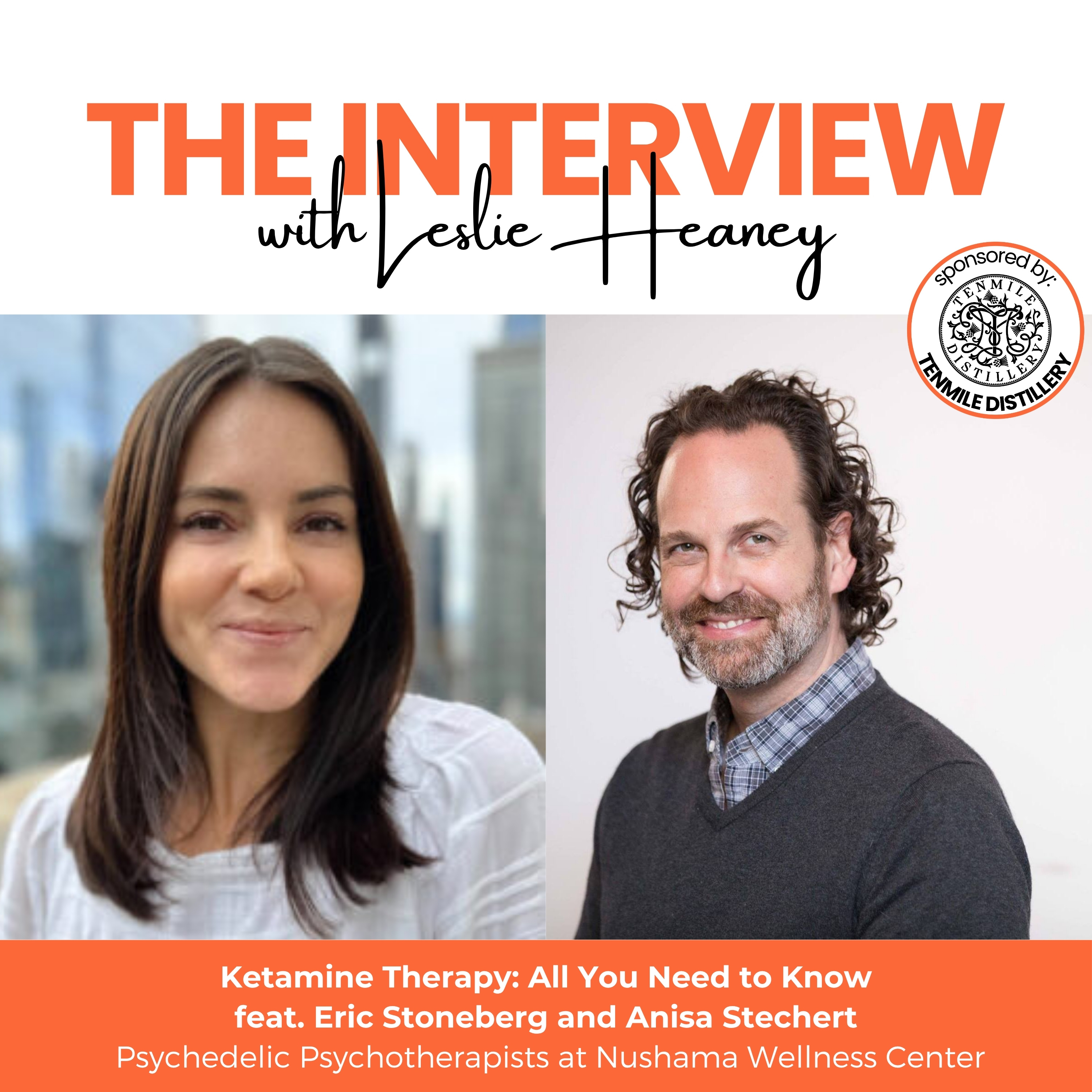
Duologue with Leslie Heaney
Ketamine Therapy: All You Need to Know - feat. Eric Stoneberg and Anisa Stechert
00:55:31
Loading summary
Transcript311 lines
- [00:00]
Leslie Heaney
Foreign. It's Leslie. And you're listening to the interview with Leslie Heaney. Today. I'm taking a little break from our summer travel series. We'll be back next week with more. But to talk about a subject that's interested me for some time, which is ketamine and ketamine therapy. I have some friends who have been treated with ketamine in New York, and they have struggled with mental health issues like anxiety and depression and in one case, alcohol use disorder. And ketamine treatment has really benefited them greatly. When they told me that they had done this, my first reaction was, is that legal? Where would you go for something like that? How does it work? I had all these questions and I did some research and discovered Nushama, which is a licensed ketamine therapy clinic in midtown Manhattan. And I was fortunate enough to get to sit down with two seasoned psychedelic psychotherapists, Eric Stoneberg and Anissa Steckert. Between the two of them, they have treated thousands of patients with conditions ranging from post traumatic stress disorder like 911 first responders. They've worked with veterans to individuals suffering from anxiety or depression or alcohol use disorder. So in the episode, we talk about everything from what is ketamine? What conditions does it treat? How does it work? How does it actually rewire trauma in the brain? Who would be a good candidate for this type of therapy? And what a typical experience looks like when you go to a ketamine treatment center. So whether you're curious about this, like me, or you're skeptical about it, or anywhere in between, this conversation really sheds some light on a promising new tool in the mental health treatment toolbox. It sort of transforms, at least for me, the way I've thought about mental health treatment and healing. Eric and Anissa are so informed and compassionate and also hilarious. It was a great conversation. I learned a ton and it's really worth a listen. I'm so excited about this week's sponsor, the 10 Mile Distillery. 10 Mile is an American single malt distillery based in the Hudson Valley, about 90 miles north of New York. And it is the maker of the award winning Little Rest Whiskey, made through a slow distillation process with all New York State grains by master distiller Shane Fraser from Scotland. And when I say award winning, I mean it's earned a 95 out at the whiskey competition in San Francisco and a 96 at the New York International Spirits Competition. This is delicious. If you do not believe me about how delicious this is, the good news for you is that if you're in the New York area, you can go visit this incredible and beautiful distillery yourself. It's set among the most beautiful apple orchard with beautiful views of the mountains behind. Stop by for a leisurely tour or tasting or even enjoy an expertly crafted cocktail. They also have gin and vodka available. They also have this incredibly delicious Thai restaurant that is in residence there from Thursday through Sunday. To learn more about the distillery, you can Visit them at 10mile distillery.com theinterview. All orders will receive 10% off if you put a promo code the interview at checkout. So go to www.tenmile distillery.com the interview to get that discount that 10% off. I promise you you will not be disappointed. And with that, here's my conversation with Eric Stoneberg and Anissa Ste. So thrilled Eric and Misa to have you both here today. I have had several friends who have done ketamine therapy to great benefits. I'm very curious about it. I know a lot of my listeners will be curious about it too or want to learn more about it. So I thought maybe we'd start like 30,000ft for those that don't know anything about it, kind of what is psychedelic therapy? And ketamine is part of that.
- [04:11]
Eric Stoneberg
Psychedelic experiences bring us into non ordinary states of consciousness and deep within ourselves and rely on our kind of inner healing intelligence. There's some part of all of us that knows exactly what we need to kind of move the needle forward in our lives to heal, to evolve, to grow, to prosper. And we're often just in the way of that. The old programming is in the way. So psychedelics are, there's a lot of different kinds and there's a, you know, we have been working in a ketamine clinic, legal above ground psychedelic therapy for a few years and have seen the hundreds, thousands of patients now we've seen it all. So we're tapping into this, this part of us that knows what's, what's up, that knows what you need to kind of move forward.
- [05:06]
Anissa Steckert
We're working in altered consciousness states, non ordinary consciousness. And the part of us, like Eric said, that gets in the way, we call it the ego. Which is why we get a lot of patients who have been doing traditional psychotherapy for forever and aren't really experiencing much life change. And it's like all the intellectualizing where it's like, why do I know what I need to do but I just can't do it. I still feel disconnected. When we quiet the ego through psychedelics, when we enter these altered states of consciousness. When you quiet that ego, you get to tap into that inner healing intelligence of like, oh, my perspective of myself and the world is radically different. And when you do six psychedelic sessions in close succession, it's like a hard reset.
- [06:02]
Leslie Heaney
You know, I'm not a ketamine therapist. I just play one on tv, as you know. But I was doing some research in anticipation of this conversation. And I think part of the drug, also, the science of it, is that it does do some unblocking and rewiring. Right? That's, I guess, that we talk about the six sessions in sort of close succession. Yes, succession. The benefit of it is you are unlocking that. And part of that, I think. And you alluded to it, Eric, a little bit. And we talked about this a little before we started recording that. You know, there's blocks or trauma or things that we all have from our life experiences. And it kind of allows you to go back and examine that a little bit.
- [06:41]
Eric Stoneberg
It can do that. It can also help you mobilize change. A lot of people know exactly what they need to be doing to change, right? And changing our behaviors is one of the hardest things that humans do. And so if you have this window of time where, like, you're more pliable and you're like, yeah, I do need to go back to that meditation practice. That was good for me. I do need to get back into standing up and getting out of my home office every day, because that is so much better for my mental health. But people don't like making change. That's a hard thing for us to do, Whether it's dropping an old habit like alcohol or some other substance or an old habit of the mind. Right? So there's something about psychedelics that can really help mobilize change.
- [07:31]
Leslie Heaney
So it allows you to kind of go back and have your own aha moment of sort of what that block is or what that thing that you need to do to help you help you move forward. Like you were mentioning, whether the home office example or. Or all different kinds of things that we do that we know we need to do but aren't really maybe giving ourselves the ability to gain that perspective. This is kind of giving us perspective.
- [07:56]
Eric Stoneberg
We get stuck in our old behaviors.
- [07:57]
Leslie Heaney
But I also thought it was really interesting to kind of learn more about when I was, again, reading up for this conversation about the history of this kind of practice. You know, healers, shamans have been using psychedelics for centuries.
- [08:13]
Eric Stoneberg
From time immemorial, right? Psychedelic therapy, psychedelic substances have been used from time immemorial and one of the things that I think is really interesting about, like, the languages, like the Shipibo people of South America that use ayahuasca, for example, other traditions from Africa, from other North American traditions in the language. In a lot of indigenous languages, the word for learning and the word for healing are the exact same word.
- [08:44]
Leslie Heaney
Wow.
- [08:45]
Eric Stoneberg
So when you're doing a journey, you're there to learn. Like, healing is an ongoing process your whole life, but you learn something more about who you are, how you got to be the way you are. I mean, everyone's journeys can be really different. The material of the journeys can be wildly different, but there's something about, like, tapping into this core sensibility of yourself and knowing that you can create new pathways, you can create a new story, you can mobilize change in your life.
- [09:17]
Leslie Heaney
You know, for me, hearing about psychedelic therapy, I, you know, heard of ketamine. I've also heard of psilocybin. You know, I saw a whole 60 minutes a few years ago about how psychedelic therapy has helped veterans to process their ptsd.
- [09:35]
Eric Stoneberg
A lot of veterans.
- [09:36]
Leslie Heaney
I would. I mean, I would think so. And then there's microdosing. Can you. Which might be totally irrelevant to this, but can you kind of break down, for people that are listening, the different. What other kind of psychedelic therapies are there out there that people may have heard of? Or what. What does that landscape look like when.
- [09:51]
Anissa Steckert
It comes to psilocybin? Mdma. Ayahuasca.
- [09:56]
Leslie Heaney
Mdma? Yes. Which is what, like, what the club kids use. Right. Isn't that. Doesn't Miley Cyrus sing about that? Is. Is it Molly? Is MDMA Molly? It is. Okay, okay, Okay. I love that song too. Partying today. I just want to add that as a sidebar. But that's what I mean, there's so many of these terms and names. I just think it'd be helpful for people listening and kind of get educated on.
- [10:18]
Anissa Steckert
Yes.
- [10:18]
Leslie Heaney
These different medicines or drugs. Yeah.
- [10:20]
Anissa Steckert
And. And like every psychedelic is its own tool in its own right and can be used for different things. Mdma, there is ever emerging research on how effective that is for treating severe trauma because it does allow, like, separation between. Because of everything that is being dumped chemical wise, like the serotonin, the dopamine, like the oxytocin. You're able to reprocess trauma speaking with a trained therapist. That's not legal yet. I think actually it was recently totally shut down. The idea of MDMA being able to be given legally. So psilocybin Also not legal. A beautiful tool. Ketamine really is the only legal psychedelic.
- [11:06]
Leslie Heaney
And it is the only legal one from what I understand. Again, I'm looking to you both to tell us all about this. But because it's been used in anesthesia and is legal for, for that and doctors are able to prescribe it off label.
- [11:22]
Anissa Steckert
Correct.
- [11:22]
Leslie Heaney
Will you explain a little bit about that or did I just explain it? You just went into the real.
- [11:27]
Eric Stoneberg
Ketamine at a high dose is one of the safest anesthetic agents that we know of. It's like shelf stable. It's really safe. If a little baby needs anesthesia, they are using ketamine.
- [11:40]
Leslie Heaney
Interesting, right?
- [11:41]
Eric Stoneberg
It is, it is one of the safest tools and that's why there's so much efficacy in the mental health space. Because some of these other substances like you don't want to be on an ssri, you don't want to be on daily anti anxiety medication and taking some of these plant based things. Whereas ketamine works safely with the other wide variety of other, other psychedelics, there.
- [12:10]
Anissa Steckert
Is increased likelihood of contraindications with ketamine. Very few things can actually like totally exclude you from candidacy.
- [12:19]
Leslie Heaney
Sorry, when you mean contraindications do you mean because of other physical health?
- [12:23]
Anissa Steckert
So conditions you may have with mdma, it drastically increases your heart rate.
- [12:28]
Leslie Heaney
I see.
- [12:29]
Anissa Steckert
So if you are hypertensive or if you have a history of cardiac issues, like it just is more, more dangerous.
- [12:37]
Leslie Heaney
Okay.
- [12:37]
Anissa Steckert
There is like a other risks associated with it. Ketamine is. There's just very few things that can interact like contraindications. Like if you are on certain medications or you have certain health issues that would bar you from being able to do ketamine because it is so safe.
- [12:55]
Leslie Heaney
Interesting. So do you think they. When I get. I've gotten two colonoscopies and I right when I'm about to doze off and when I wake up, I like gosh, that was terrific. I don't know what you think that's what maybe they're giving me.
- [13:09]
Anissa Steckert
But you know what's crazy is there is a research study that talked about like people before ketamine was even viewed like as something that could be used therapeutically. People after procedures were like why does my depression and anxiety feel.
- [13:23]
Leslie Heaney
I feel great. They give me warm blankets and cookies. I have no problem going through that process. So that, so that be the same thing for babies though. It's because it doesn't have these other sort of physical effects. I mean it doesn't affect your Breathing or it's not as risky for you for you to be on it. Very interesting. Okay, so I want to talk about all of the different possible conditions that. Or all the different conditions that ketamine can treat and what you. All the work that you all do at Neushama. So we talked about. Well, you mentioned anxiety and depression, but.
- [14:02]
Eric Stoneberg
Anxiety and depression are garden writing typical. Like most common. You know, we're seeing people coming in for pmdd.
- [14:13]
Leslie Heaney
Premenstrual disorder. Yes.
- [14:15]
Eric Stoneberg
Right, interesting. They are coming in regularly in alignment with their cycle and it's helping tremendously.
- [14:22]
Anissa Steckert
Life changing.
- [14:23]
Eric Stoneberg
Life changing.
- [14:24]
Leslie Heaney
So we talked earlier, before we started recording that they're closed on Neshama is closed on Tuesdays. And I am after. I was discussing the amount of I've had this summer and the cheese that I've been eating that maybe, you know, because alcohol use disorder is something else that we got to. But I never knew about pmdd. I might have to spend three days at your clinic with you all. I mean, I, you know, this is very exciting. So that's really interesting. And people are finding great benefit from the ketamine therapy for pmdd.
- [14:52]
Eric Stoneberg
Yes.
- [14:53]
Anissa Steckert
I will say this. What is really wild to me is, as with most things that pertain to women, there are so many women I have worked with who have had no idea about having PMDD and living their whole lives with.
- [15:12]
Leslie Heaney
Yeah, yeah.
- [15:13]
Anissa Steckert
And for those who don't know, PMDD is like PMS on. On steroids.
- [15:19]
Leslie Heaney
Yeah.
- [15:19]
Anissa Steckert
Where it's like, you know, even passive suicidal ideation, hopelessness, bouts of rage.
- [15:26]
Leslie Heaney
Yep.
- [15:26]
Anissa Steckert
Blowing your whole life up. It often looks like borderline personality disorder. So it's even misdiagnosed. And these poor girls into women who are like, oh, I just have a terrible period.
- [15:39]
Leslie Heaney
Yeah.
- [15:39]
Anissa Steckert
And it's like, oh, no. And so actually something that ketamine does is it can boost estrogen. So when women are coming in right at the onset of their PMD symptoms, it like radically alleviates the symptoms because.
- [15:56]
Leslie Heaney
Sounds like this could be something for this 51 year old on my. My perimenopausal journey. I mean, that is just fascinating.
- [16:05]
Anissa Steckert
Yes.
- [16:06]
Leslie Heaney
We talked about the six, you know, successive sort of sessions are closely, you know, close together. How often do you. For people that have kind of more chronic conditions.
- [16:16]
Anissa Steckert
And that is tough because, I mean, not mincing words, this treatment, it can be costly. And so it's not really like very feasible for most people to be coming in once a month for a ketamine infusion. Ketamine, we want it to be A tool. It is not a cure all. It's not a silver bullet. It's not something to be doing consistently for your whole life.
- [16:40]
Leslie Heaney
Right.
- [16:40]
Anissa Steckert
It's a beautiful reset. It's a, it's a crutch when you really need it, just like most therapeutic tools. And really our end goal is like, how do we get you to a place where this state of being is accessible to you?
- [16:53]
Leslie Heaney
Right.
- [16:53]
Anissa Steckert
At all times?
- [16:54]
Eric Stoneberg
I think that one of the things that we see with all of these diagnoses is like, there's a. There's a school of thought emerging that's like, what if the core of all of it is trauma?
- [17:07]
Leslie Heaney
Right?
- [17:08]
Anissa Steckert
Yes.
- [17:08]
Eric Stoneberg
And how do you excavate trauma? You don't excavate and understand and reprocess trauma by talking and talking and talking about it. For many people, that long term talk therapy is exacerbating some of their problems. Rumination, or you have people like, I always think of this one patient that I have who. She's hilarious.
- [17:29]
Leslie Heaney
Right.
- [17:30]
Eric Stoneberg
Brooklyn accent. Eric. I've been working on responding and not reacting to my ex husband for 15 years in therapy. Every week my homework is respond, don't react. And she's like, I'm doing this treatment and suddenly I'm responding and not reacting. It's like when you have a lot of understanding. You've been in therapy for a while and you've kind of hit a wall and you don't. You're like, I'm not progressing. Like, I get it all, but you don't get it. Like, the knowledge drops into your body in a different way.
- [18:07]
Leslie Heaney
Mm.
- [18:08]
Eric Stoneberg
So tell me the cognitive stuff lands in your bones.
- [18:12]
Anissa Steckert
Yes.
- [18:13]
Eric Stoneberg
And it really, like, it's an experiential.
- [18:16]
Leslie Heaney
Treatment that's for people like this woman who I. I'd love to have a. A glass of rose with. I mean, she's hilarious and I love her. You know, Respond, not react. That's a great. But let's talk about other sort of examples of patients that you've had that. Because I know eating disorders is another one that ketamine therapy that you all will treat people with, that alcohol use disorder has been. Ketamine therapy has been very effective. Do you want to talk through some of those a little bit or maybe.
- [18:47]
Eric Stoneberg
Yeah. Like with alcohol use disorder. Right. There's several schools of thought about how you treat that. The old school approach is the abstinence model. It's the model we're all very familiar with aa. You stop if you have a slip up, you start from scratch again.
- [19:05]
Leslie Heaney
Right.
- [19:05]
Eric Stoneberg
You Start at the beginning again. This has been the dominant model of treatment for alcohol for a long time. Really a long time. And what's emerged in the past, I don't know, decade or so is. And more and more so, like, even, even more. Like five years ago, alcohol treatment centers in New York City used the. That model.
- [19:26]
Leslie Heaney
Right.
- [19:27]
Eric Stoneberg
And what was emerging is like this harm reduction model, which is like really tailored to the person. It requires a little bit more flexibility. It sees alcohol use as a process and it's not about necessarily abstinence. It's like, I want to be able to have a glass of in moderation. I just don't know how to like, get control of it. I don't know how to sit with myself when I'm uncomfortable. I don't know how to kind of deal with these deep emotions that come up. They're usually really old patterns in the body. And alcohol is a reliable help to deal with that stuff.
- [20:09]
Leslie Heaney
Well, you're talking about the trauma piece isn't alcohol. I think for many of us we're like, oh, I've had a terrible day, right. Or, or I've had a great day. I mean, you can come up with anything. Yes, to have a glass of. But, but there's an underlying trauma or there's an underlying issue. Right. That might be contributing to that. Is that part of how the ketamine therapy helps those that have alcohol use disorder? Kind of unpack it a little bit.
- [20:37]
Eric Stoneberg
You can unpack it a little bit. I mean, people's journeys are wildly different. Psychedelics are often called a non specific amplifier. So they're going to amplify something about you. And we don't know exactly what it is. It's not specific. But we do know that it's going to like bring something to the surface that's important for you. And we're relying on other people on your inner healing intelligence. So some people do experience a reprocessing of their trauma. Like, like literally, they see it like it's a movie. I had a woman who, victim of sexual violence, terrible story of like abuse at night by a relative who would come into her room all the time. And in her journey, she literally like turned the light on in the dark and saw what was really going on from her adult perspective of looking at this little girl. And she was like, this guy is a loser. This guy isn't a threat. This guy is a lame little dick. Like, this is not the story that I've been telling myself, right. Of being afraid of the dark for my whole Life. So her journey was very much like she went back to the trauma. She turned the light on in her childhood bedroom and saw it from a totally different perspective. And it changed everything for her.
- [22:03]
Leslie Heaney
Oh, that's amazing.
- [22:04]
Eric Stoneberg
Not everyone has that kind of experience. Some people's journeys are like, well, shapes and colors.
- [22:09]
Anissa Steckert
And, you know, I think that with those who do have pretty severe PTSD or cptsd, their journey.
- [22:17]
Leslie Heaney
What is cpts?
- [22:19]
Anissa Steckert
Complex post traumatic stress disorders. So usually, like from childhood, Eric and I have both been able to work with a lot of vets. And then I've had a recent cohort of first responders from 9 11.
- [22:33]
Leslie Heaney
Oh, wow.
- [22:34]
Anissa Steckert
And their journeys. When it comes to CPTSD, PTSD, I feel like it is a matter of like really going back into those traumatizing scenes. And it's like what happens in the journey space is like, it is like extraction, like the release of trauma residue. What they have been reliving in the present moment. Their nervous system is quite literally stuck in that moment of severe trauma. And it's like that doesn't just go away after that.
- [23:07]
Eric Stoneberg
You can't talk that away.
- [23:08]
Anissa Steckert
You can't. Your nervous system is stuck in overdrive. Feeling like I'm there. And it's like a matter of like, let's catch it up.
- [23:17]
Leslie Heaney
Well, that's what I was sort of trying to understand the science of it a little bit. But you're talking about sort of that piece of.
- [23:22]
Anissa Steckert
Yes.
- [23:23]
Leslie Heaney
Unlocking up or the block or however the nervous system reacted to that sort of still being.
- [23:28]
Anissa Steckert
So it is what we were talking about. I feel like maybe the beginning of our conversation. What ketamine does is it disrupts your default mode network, the way you see yourself.
- [23:39]
Eric Stoneberg
Say that again.
- [23:41]
Anissa Steckert
It disrupts your default mode network.
- [23:44]
Leslie Heaney
Okay.
- [23:45]
Anissa Steckert
Self referential way of thinking, like perception. It disrupts it when the ego quiets. It's like it allows for like you to really go inside.
- [23:59]
Eric Stoneberg
Another good metaphor. Anissa's a little young for this. You and I are the sage, right? Back in the day when I was working in corporate America, people would just be like, I don't know what's going on my computer. It's just like freezing. You just unplug the computer, Right. You only did it for 90 seconds. It needs to be three minutes. Right. Like, and then you plug it back in and it suddenly starts working again, right?
- [24:24]
Anissa Steckert
Yes.
- [24:24]
Eric Stoneberg
Sometimes my modem of my cable works that way now. But it's like we need to do that to ourselves every once in a while.
- [24:33]
Leslie Heaney
Right.
- [24:33]
Eric Stoneberg
Unplug the usual Program, something else comes online. Then something else comes to the surface. You know, some people call that the self with a capital S, right? Some people call it that your inner healing intelligence. Some people call that your soul. It comes online in a way that you can access something more.
- [24:56]
Leslie Heaney
So when you're doing six sessions, like we. You talked about that. The first responders, for example, and then going back there, what kind of. What are you seeing over the course of the six sessions?
- [25:08]
Eric Stoneberg
Do you.
- [25:09]
Leslie Heaney
Do you see what I mean? Yeah.
- [25:11]
Eric Stoneberg
So episode one.
- [25:13]
Anissa Steckert
I know.
- [25:13]
Eric Stoneberg
I mean, it is a little like that. I love to frame it.
- [25:17]
Anissa Steckert
The pilot. The pilot episode, we're like, okay, yes. Because I mean. And I know Eric and I keep harping on this. Every single person who comes to us with no previous psychedelic experience, which is the vast majority, I would say, they're like, am I doing this right? Like, am I my journeying? Right? Am I like, I don't know. I don't. And it's like, pilot episode is like, we're just getting in there. We're just practicing presence. We're literally nothing. I tell patients all the time, when you're in there, it's like, VR. Like you're a curious observer of your inner world. You don't have to understand everything that's going on around you. You don't have to remember it. You just got to be in it. Just be immersed. Don't fight it. Lean in. It's 45 minutes of you with you. This is a cheat code to the deepest possible meditative state. Just go in. Let's see what comes up. So that's the pilot episode. Usually people are like, what the fuck?
- [26:14]
Leslie Heaney
That?
- [26:15]
Anissa Steckert
Like, I was in another dimension.
- [26:18]
Leslie Heaney
Like, I saw my third grade teacher. She was, you know, riding a, you know, horse on a bag of.
- [26:24]
Anissa Steckert
And then she turned into a bear. And I'm like. I'm like, what does that mean?
- [26:29]
Leslie Heaney
Right?
- [26:30]
Anissa Steckert
Like, let's get into that. Because we believe that this. Because when the ego. Which gets a bad rap, the ego is trying to protect you, right? It just gets stuck. So it's like the fight flight free spawn when our ego gets stuck, stuck. And it becomes rigid and vocal, and it is shaped by trauma, defense, soul longing. So we want to just quiet it, have it take a backseat.
- [26:54]
Eric Stoneberg
Rigidity and flexibility is a key piece of what we're doing. People come in and they're so identified with. I'm depressed, as if that's my identity. I'm anxious, and that's like, who I am. And everyone, everything in the world is Telling me that that's true too. And then there's something about the psychedelic experience that leverages that piece of you that thinks you're one thing and opens you up to say, like, oh, wow, maybe there's something more here. Maybe I'm not just that diagnosis.
- [27:33]
Leslie Heaney
I was mentioned to you about that. I looked on your website and saw some, some stats around the effectiveness of ketamine therapy versus other more traditional modes of sort of medicine support. For example, with the alcohol use disorder, it said 86% of those with alcohol use disorder don't relapse after six months with ketamine versus 25% of those with traditional methods. It's really powerful.
- [28:00]
Eric Stoneberg
Yeah. I mean, I've worked with a number of people in the alcohol use disorder category who've been in rehab, really expensive rehab.
- [28:11]
Leslie Heaney
Yeah.
- [28:12]
Eric Stoneberg
Dozens of times. Can you be sober in a place where you're outside of your usual stressors?
- [28:18]
Leslie Heaney
Right.
- [28:19]
Eric Stoneberg
That's one thing. That's also part of that. But there is something about this disruption.
- [28:25]
Leslie Heaney
Right.
- [28:26]
Eric Stoneberg
Of the story. It's a significant disruption. Like if you're going to do a six session protocol over three weeks, you're intentionally disrupting your life.
- [28:36]
Anissa Steckert
Yes.
- [28:37]
Eric Stoneberg
And you're still living your life as you do it. Right. So you're learning. I mean, what's so interesting about the six session cadence getting back into that is like, there's the pilot episode.
- [28:46]
Anissa Steckert
Yes.
- [28:46]
Eric Stoneberg
So much of what unfolds for people has nothing to do with being in the chair.
- [28:52]
Leslie Heaney
It's like, so they, so there's a reveal for them that might not be what they think is the reason why.
- [28:58]
Eric Stoneberg
They came in space. In between.
- [29:00]
Anissa Steckert
The real trip happens after the real.
- [29:02]
Eric Stoneberg
Trip and the real journey is like it every day in between those treatments.
- [29:07]
Leslie Heaney
Correct.
- [29:07]
Eric Stoneberg
Because you're going to be triggered if you're an anxious person by certain things and they're going to come up, they're definitely going to come up during your treatment. If you're a mom who's anxious, like, and this is what you're struggling with with your kid, you're gonna have that come up in between your treatments. And what people find is over a few treatments, like, I'm not reacting automatically the way I used to. I'm like, there's space here. I can choose how I want to respond to this kid. Or there's, there's, there's, there's flexibility, there's, there's psychological flexibility that emerges for people.
- [29:51]
Leslie Heaney
For people who are listening who, you know, may be curious about this type of therapy treatment. One of My questions I wanted to ask you both was who is a good candidate for this type of therapy? You sort of answered the question a little bit. People who have had some prior, you know, therapeutic or I should say experience with therapy or CBT and are look and have maybe either hit a wall that you mentioned a wall or are just looking to enhance their level up. Yeah.
- [30:20]
Anissa Steckert
You know, I think, and I would love to also hear what Eric thinks about this. I feel like the most important thing thing regarding candidacy.
- [30:28]
Leslie Heaney
Yeah.
- [30:29]
Anissa Steckert
Or like who would be a best fit. You need to have inner resourcing and external support. Like when we have people who, because.
- [30:40]
Leslie Heaney
We talked about how this inner resourcing.
- [30:43]
Anissa Steckert
You have the ability just even a modicum of it to emotionally regulate.
- [30:47]
Leslie Heaney
I see.
- [30:48]
Anissa Steckert
You know how to self soothe.
- [30:50]
Leslie Heaney
Okay.
- [30:50]
Anissa Steckert
We have patients who have come in who have no inner resourcing skills. They cannot emotionally regulate. They don't know how to self soothe. That's not their fault. Like for whatever reason, because we talked about how this is a disruptor. It's a destabilizer, which is what we want. We want to disrupt the loops, the thought patterns, the way you've been seeing and doing things. And it's a disruptor. And so if you have no inner resourcing capabilities, you don't have any sort of external support system. This can just really throw people into quite the tizzy.
- [31:27]
Leslie Heaney
I see.
- [31:27]
Anissa Steckert
And so you want to have some sort of basic foundational, self soothing, emotional regulation skills before you do something that can be so disruptive, to have people that you can lean on. Like whether it is here in New York or like just people in your corner. Because when people come in who feel like they don't have anyone or anything, it just can be very, very difficult for them to find some sense of orientation throughout the protocol.
- [31:59]
Eric Stoneberg
A lot of times we work very, it's called like bottom up processing, which means we're not going to talk about this cognitively and figure out like why you are the way you are. But like what does that anxiety feel like when that comes on? Where does that live in your body? And people will often say it's like a tightness in my chest, but you hear all kinds of different things. Like my hands get really gripped. People have very distinctive features in their body related to their depression, their eating disorder, their anxiety, their trauma, their, their ptsd. Like when it comes up, it's like I get, they, they describe what's happening in their mind, like in their vision. Like they, they, they get cloudy or they just can't they can't focus or they're scattered all over the place. So sometimes and often I will kind of poke people into that place a little bit to see how they're doing. Like, can they pendulate from there to a more grounded space?
- [33:05]
Leslie Heaney
I see.
- [33:05]
Eric Stoneberg
And if I see that people can kind of make that pendulation, I will poke them and kind of bring up this stuff in the body. Because then you're going into non ordinary states of consciousness and your inner healing intelligence is like, what do we need to work on right now? Oh my gosh. There's that thing that's caught in her throat since she was 12 years old when her mom kept telling her, no, no, no, you, you know, whatever. And then it like starts to unwind something for people and they have the experience of like, it goes away or they let it go. They let go of that tension or whatever. The, the somatic experience is the lack of safety oftentimes. And they go into a place where like, wow, I actually felt safe. Even though there was this crazy stuff happening, right. I knew that I was okay. When you tell yourself that story, like, I'm okay in this kind of turbulent, crazy experience I'm having in a chair on East 53rd street on the 25th floor, you're rewiring your brain, right? I mean, a lot of times people have the experience of like, they start talking to themselves in a different way than they usually do. They get like an inner mantra or they get like, I kept hearing this voice, voice saying, you're safe, you're totally safe now. Or they get a visitation from their dead grandmother, right? Who's like, baby, you're okay.
- [34:33]
Leslie Heaney
Right?
- [34:33]
Eric Stoneberg
Like, it's like the, it's like core stuff that is. Seems really simple, but if you get a deep sense of knowing, like, I'm safe and I'm okay, an embodied understanding of that that can change your life forever.
- [34:48]
Leslie Heaney
You go out into the world with that.
- [34:49]
Eric Stoneberg
You go out into the world with a little bit of a new vision and then you got to practice it.
- [34:56]
Leslie Heaney
So for people. We talked about the six sessions and then do you. Is it common for people to then come back for. You know, it's almost like if someone goes to a spa and they loot, you know, you come back for. Yeah, exactly.
- [35:12]
Anissa Steckert
Yes.
- [35:13]
Leslie Heaney
Okay.
- [35:13]
Anissa Steckert
We do have quite a few. And I always tell patients, it's so funny, like, sixth session. It's very bittersweet. Especially when you're able to do someone's whole protocol. Like, this is such a, a different space than traditional psychotherapy like, we get so. Because, like, think about it, like we're in people's raw, unedited.
- [35:35]
Eric Stoneberg
I'm literally living in people's non ordinary reality every day.
- [35:39]
Anissa Steckert
Yeah.
- [35:40]
Eric Stoneberg
And I think the reason why I wanted to do this work in the first place is I was a yoga and meditation teacher. I was teaching people how to like, go inside, Go inside, Go inside. The world does not want you to go within yourself to figure out anything. They want to give you an algorithm to buy something to make yourself feel better.
- [35:57]
Leslie Heaney
Right, Right.
- [35:57]
Eric Stoneberg
Like that's what the world wants for you. The world wants you to like, externalize everything. And there's a problem with me until I get that thing outside of myself.
- [36:08]
Leslie Heaney
But this meditation is a. Yeah, the gateway.
- [36:11]
Eric Stoneberg
You gotta go in.
- [36:12]
Leslie Heaney
Yeah.
- [36:14]
Eric Stoneberg
The deeper you go in, the more expansive the world outwardly is.
- [36:18]
Leslie Heaney
And you've probably seen the development or change or progression or however you want to define it of the patients that you see over the course of those six oh, yeah. Treatments.
- [36:31]
Anissa Steckert
It really, it is like, it's so bittersweet. Like they're like, oh, like I'm not. You're not a part of my weekly routine anymore. And it feels like a lot of times you've been with these people for like three years instead of three weeks. You get so close and it moves quickly.
- [36:51]
Leslie Heaney
Yeah.
- [36:51]
Eric Stoneberg
Like the depth of connection that happens. So I think people who are doing this kind of treatment look for places where you feel safe.
- [36:59]
Anissa Steckert
But then when patients like, ask about, like, should I do boosters? Like, I always tell, like on their sixth journey. It is so your prerogative at this point after the completion of the protocol. And you have developed a much different sense of self and an intuitiveness about what you need. So, like, if you're feeling in six months, like, ooh, I need a little reset. I need a little like, I'm feeling like easily triggered. Like, I have run the gamut for my typical, like, tools and like, I need something a little bit more heavy duty.
- [37:31]
Leslie Heaney
Yeah.
- [37:31]
Anissa Steckert
Like I need a power tool. I need that reset. And we'll have patients come in three months after the protocol. A year, two years. And sometimes circumstances are such that necessitate coming in with a little bit more frequency.
- [37:46]
Leslie Heaney
Right.
- [37:47]
Anissa Steckert
For that short stint of time. So it's just so dependent on the patient.
- [37:51]
Leslie Heaney
So what happens next?
- [37:53]
Eric Stoneberg
It starts with a medical intake. So you're getting a robust assessment of like, where you are, what you need, what your diagnoses have been given to you. Or maybe you need a diagnosis. And then people come for their first treatment, which looks like.
- [38:14]
Anissa Steckert
So when you come for your first treatment, you walk in. Hopefully you don't have to sit and wait and drink an herbal tea, because you're supposed to be NPO for four hours, which is no food or water, because ketamine as a disassociative anesthetic can cause dizziness and nausea, which. I'll get to that. So NPO for four hours, you'll get taken to your room. And it's your own room. We tried to make it as not medical, clinical, sterile as possible. And so you have your own space. It is really beautiful. You're given an eye mask, a journal, like a little tote. And you'll be seen first by the material who will get your IV in. So we do IV and im. Ketamine at Neushama.
- [39:04]
Leslie Heaney
What is. I am sorry.
- [39:06]
Anissa Steckert
I am. Is intramuscular.
- [39:08]
Leslie Heaney
Okay.
- [39:08]
Anissa Steckert
So the vast majority of our patients do iv. So in ma, a medical assistant will come in, we'll check all of your vitals, blood pressure, temperature. Like the basics. We'll put the IV in and breathalyzer.
- [39:22]
Eric Stoneberg
For people who need that.
- [39:23]
Anissa Steckert
It is true.
- [39:24]
Leslie Heaney
So I didn't mean to laugh.
- [39:25]
Anissa Steckert
No. But what is so important about that is, like, patients think we're just trying to, like, curb their good time. It's like, no, you could die if you have alcohol in your system. That's why it's imperative that you tell the truth. We're not trying to take your fun away from you.
- [39:40]
Leslie Heaney
Right.
- [39:41]
Anissa Steckert
It is a matter of if you have a certain percentage of alcohol in your system. Because ketamine alone cannot suppress respiratory rates. It can't. It is so safe. And if you have alcohol, a certain amount in your body, and you take ketamine, it will suppress your respiratory rate.
- [39:59]
Leslie Heaney
Wow.
- [39:59]
Anissa Steckert
So that is the significance of the breathalyzer for our patients who are coming in and have struggles with alcohol use disorder. It's like, this isn't because we don't believe you. This is because we want to make.
- [40:11]
Leslie Heaney
Sure that this is safe.
- [40:12]
Anissa Steckert
Yes.
- [40:13]
Leslie Heaney
Okay.
- [40:13]
Anissa Steckert
Because it is on its own.
- [40:15]
Leslie Heaney
Right.
- [40:16]
Anissa Steckert
So that is the importance of being honest with the medical team. And so the rn, the registered nurse will come in after the medical assistant will ask you, have you taken your typical medications? Because you'll have told the doctor during your intake, everything that you take, your medical history. And so the RN just kind of confirms with the patient, like, I know you're prescribed this stimulant. Did you take it this morning? No. Great. Did you drink last night? No. Great. Any. Any other substances, 48 hours. No. Great. So then they'll go get the doctor who will come in and discuss with you your dosing. Figure out, like, the amount that you're gonna get for that session. At Nushama, we start patients at 0.8, typically, and there will be, like, we.
- [40:59]
Eric Stoneberg
Start people a little higher than other places.
- [41:01]
Leslie Heaney
Okay.
- [41:01]
Anissa Steckert
Yeah. Actually, like.
- [41:03]
Leslie Heaney
But do you. You were mentioning to me that about how your body metabolizes ketamine, and so, yes, the IV is a way that you're able to control the dosage, turn it off. And if someone is.
- [41:17]
Eric Stoneberg
Someone is having an unhinged, bad response, you can turn off the drip and within seven minutes.
- [41:24]
Anissa Steckert
But that has happened. That doesn't happen. That never happened. We have taken, like. There have been people who get so spangled that it necessitates.
- [41:33]
Eric Stoneberg
Spangled is a technical term that your listeners shouldn't.
- [41:35]
Leslie Heaney
I was using clinical, like, you know, gosh, my pantyhose got spangled on the. I don't. I don't know what that means. But I. I learned that from my.
- [41:45]
Eric Stoneberg
I learned that from my British supervisor. And when you take too much Molly, you get spangled. You get spangled.
- [41:52]
Leslie Heaney
Is that the same as spangled?
- [41:55]
Anissa Steckert
You know what so many patients are like, was what I just ate. Okay. And I'm like, I think so.
- [42:03]
Leslie Heaney
I love using that. I use that term all the. And I have. No.
- [42:06]
Anissa Steckert
I.
- [42:06]
Leslie Heaney
You know, I don't. Anyway, it's this. But spangled is going to be one spangled.
- [42:10]
Eric Stoneberg
Let it. Let it be part. It can. It has a lot of. It has a lot of uses. So much fun. But when you, like, take too many psychedelics and you're like, for the Italians.
- [42:17]
Leslie Heaney
Yeah.
- [42:18]
Anissa Steckert
But that never happened.
- [42:19]
Eric Stoneberg
That doesn't happen.
- [42:20]
Anissa Steckert
That we've had. I think I've seen that, like, literally twice in the two years that I've worked there. People don't freak out like that. But it helps.
- [42:29]
Leslie Heaney
We pray.
- [42:29]
Eric Stoneberg
We prepare people.
- [42:30]
Anissa Steckert
Yes. It makes people feel. Even though this. Everything is about surrender.
- [42:35]
Leslie Heaney
Right?
- [42:35]
Anissa Steckert
Like, not. There is a lot of control on our end as far as, like, administration. We can slow the drip rate down. We can speed it up to get people in faster and then bring it back down. Like, there is just a lot more control about the rate in which the ketamine is being administered when it's IV and people like that.
- [42:55]
Leslie Heaney
And then how long, typically, is someone. How long is a journey typically?
- [42:59]
Anissa Steckert
It is an hour.
- [43:00]
Eric Stoneberg
It's an hour. That's the other thing that's so wonderful about ketamine. These Plant substances, some of those.
- [43:07]
Anissa Steckert
12 hours.
- [43:08]
Eric Stoneberg
6 hours. 12 hours.
- [43:11]
Leslie Heaney
Psilocybin, a plant substance.
- [43:12]
Anissa Steckert
Mushrooms.
- [43:13]
Eric Stoneberg
Yeah.
- [43:14]
Anissa Steckert
Psilocybin is psilocybin and ayahuasca.
- [43:18]
Leslie Heaney
Is that right?
- [43:19]
Anissa Steckert
Yes. Apparently, like, psilocybin and LSD are so close molecularly. Not that any of this matters, but, yeah, it does.
- [43:26]
Leslie Heaney
It.
- [43:26]
Anissa Steckert
It lasts for like, six hours. Ayahuasca, what? Eight. Six.
- [43:32]
Eric Stoneberg
Six.
- [43:32]
Leslie Heaney
So if you are, you know, your third grade teacher's face is morphing, something terrible is happening that would be. It's not a great thing if you're in six hours of that. Right? So this is a different.
- [43:47]
Eric Stoneberg
This is a different rhythm, a different cadence. A lot of times with these plant medicines. Like, they're wonderful. Love them. You need a week away, right? You need a. You need a weekend. Do you need. You know, one of the things that's true about ketamine is like, there's something. And people who do have done a lot of psychedelics are often shocked by how, quote, psychedelic their ketamine experience is.
- [44:11]
Leslie Heaney
Interesting.
- [44:12]
Eric Stoneberg
And there's something about it that synthesizes and it's quick and direct and fast. We're in New York here, so.
- [44:22]
Anissa Steckert
So it is the New York version of, well, I mean, what's really interesting. And then I do want to go back to, like, what people do experience after speaking to the provider. But like, all other psychedelics, expand your perception, like all the ones we've been talking about, and ketamine dissolves your egoic perception. So, like, it is very different from other psychedelics in that way. Like, it's not necessarily an expander. It's a dissolver of your egoic structures or the ways that you have learn to see yourself in the world that have gotten you by enough. And so when we dissolve those, we're able to go in. And so provider comes in, speaks to you about dosing, and then Eric and I are up, we get to go in. And something that is so interesting to me about our jobs is, like, we'll read the intakes that patients have done with the provider. But, like, patients don't pick us. Sometimes they'll have, like, gone on to New Shaman's website and been like, oh, I read about you, and, like, now I get to meet you in real life. But we just go in there. Like, people do not get to pick really who they're meeting with, especially when it's their first time. And, like, we just get into the guts of their story, like, right off the. Right off the rip, because it's like, we have 20 minutes max with these.
- [45:46]
Leslie Heaney
People before they go on their journey. I see.
- [45:50]
Anissa Steckert
Yeah. Because we'll see five, six patients a day sometimes. So it's like, hey, we got 20 minutes to like get in there, like, figure out what we want to like, release, look at, like, how are you?
- [46:05]
Leslie Heaney
But is that happening after or before?
- [46:07]
Anissa Steckert
Both. So there's pre integration and then post integration.
- [46:11]
Leslie Heaney
Because I think they probably, you know, if you're just coming in cold, you just met them. Not sort of say, you know, the example of your, you know, the terrible story of the woman who was sexually abused or things like, they might, you know, the journey might help kind of unpack that for them a bit. And then they're able to share more at the end than they are at the beginning.
- [46:35]
Anissa Steckert
Yes, 100%. Like, beginning is like, you are safe. This is the best place to do this. Like, go in. What do you want to bring back? What do you want to leave there? Like, let's talk about like, you being so safe to do this inner exploration and at times excavation depending on the journey type. Like. But above all, you are safe. Just be present in it. That's its own practice of surrender of like, hey, I can't control this medicine. If I try to, it's going to kind of be a hell of a time when I'm resisting.
- [47:11]
Leslie Heaney
Spangled or spangled.
- [47:14]
Eric Stoneberg
Because it's a non specific amplifier in the people's early journeys. It's often like taking a magnifying glass and going like, hey, you want to know how your mind works, right? It's like this and it's like so like magnified that people are like, wow, why do I do that? That's like a little bit. Because we're not aware of it most of the time. The unconscious programming that's running the show. So when you see it and you experience it at the like, highest volume, it gives you a chance to go like, okay, maybe there's another way.
- [47:47]
Leslie Heaney
Right.
- [47:47]
Eric Stoneberg
Maybe I can let that go a little bit. Maybe I don't have to control this. Regardless of the material of the journey, regardless of what comes up, when you're in your experience.
- [47:56]
Anissa Steckert
Yes.
- [47:57]
Eric Stoneberg
You're gaining this incredible neuroplasticity.
- [48:00]
Anissa Steckert
Yes.
- [48:00]
Eric Stoneberg
Which we have in great abundance from around age 11 to about 24, which is why things land so deeply. You could have learned four languages when you were 15 years old.
- [48:13]
Leslie Heaney
I see.
- [48:15]
Eric Stoneberg
We're more spongy, we have more pliability, we have more of that elasticity. And when you tap into that neuroplasticity and you want to make a behavioral change or a mental change, you have a capacity to do so in a way that you don't in your just day to day life.
- [48:34]
Leslie Heaney
So you brought that up, that, that plasticity. Which reminded me of something I wanted to ask you. Is there any age that. Do you have to be over 18 or through puberty to do this type of therapy?
- [48:46]
Anissa Steckert
We. And again, exceptions.
- [48:48]
Leslie Heaney
Right.
- [48:49]
Anissa Steckert
We have.
- [48:50]
Eric Stoneberg
Eric, I've worked with some 16 and 17 and 17 year olds and they're. They have a very high rate of success with this. They've done incredible.
- [49:03]
Leslie Heaney
I was just thinking.
- [49:04]
Eric Stoneberg
But it's very, you know, like, it's.
- [49:06]
Leslie Heaney
Not like things like that, that, you.
- [49:07]
Eric Stoneberg
Know, for younger, for teenage, you need parental buy in.
- [49:10]
Leslie Heaney
Yeah.
- [49:10]
Eric Stoneberg
At a, at a big level. Usually the parent has a lot of their own experience with either psychedelics or ketamine.
- [49:18]
Leslie Heaney
So ketamine as we mentioned is legal in New York. And ketamine therapy, just anecdotally as I mentioned because I've had friends who've done it and have benefited greatly from it that. Do we see this becoming. And obviously Nushan is here in New York and you all are very busy and have really thriving practice. Is. Do you see it as becoming sort of the future of. For sure.
- [49:43]
Eric Stoneberg
For sure.
- [49:44]
Leslie Heaney
And are there other states where it's legal or is it legal in all.
- [49:47]
Anissa Steckert
It's legal federally. Yeah, it is.
- [49:49]
Eric Stoneberg
It's legal everywhere. It's a matter of like, I think that in terms of clinics that are.
- [49:54]
Anissa Steckert
Delivering it, obviously you have to have licensing. Like the narcotics division is very involved and has dropped the DEA because there are certain criteria that you have to have in place. But it is totally legal. You just have to meet the requirements in order to actually administer it. And it is taking off there.
- [50:15]
Eric Stoneberg
There is a very common refrain that I hear from people which is at some point in the process, most people say, oh my gosh, everyone should be able to do this.
- [50:26]
Anissa Steckert
Yes.
- [50:27]
Leslie Heaney
Right.
- [50:27]
Anissa Steckert
Literally. Yeah.
- [50:28]
Eric Stoneberg
Actually, I wish everyone I knew could do this at some point. You hear that time and time again, which is just like I'm. This is one of the most meaningful experiences of my life. Everyone should have access to this.
- [50:44]
Leslie Heaney
Well, I, you know, you were talking about working with first responders or vets and I'm mindful of the time, so I want to. But I, you know, the, the barrier to entry or the cost of it. Right. And the fact that insurance doesn't cover it is disappointing. But hopefully, maybe, perhaps that that will change.
- [51:01]
Eric Stoneberg
We're trained social workers here.
- [51:02]
Leslie Heaney
Right.
- [51:03]
Eric Stoneberg
We would love more Access to this.
- [51:05]
Anissa Steckert
Yeah.
- [51:06]
Eric Stoneberg
And I think that our veterans are probably one of the greatest resources for ketamine kind of policy making. That's one of the few things that is agreed across the aisle.
- [51:21]
Leslie Heaney
Right.
- [51:21]
Eric Stoneberg
Of like, we need to help our veterans. And they're telling us that this is a handy intervention.
- [51:27]
Leslie Heaney
Or first responders.
- [51:28]
Eric Stoneberg
First responders.
- [51:29]
Anissa Steckert
I mean, we do offer. At Neushama. We do have discounts for.
- [51:34]
Eric Stoneberg
We do.
- [51:34]
Anissa Steckert
Responders. Teachers. Like, it's like the hero discount. Anyone in the medical.
- [51:38]
Eric Stoneberg
It's summer, so we're seeing a lot of teachers.
- [51:39]
Leslie Heaney
Okay.
- [51:40]
Anissa Steckert
Oh, we get a lot of teachers. Being a former teacher myself, I'm like, babe, you're gonna need more than six sessions. But, I mean, the cost is definitely a major barrier. And something else that Eric and I talk about a lot is, you know, psychedelics are being destigmatized, but they aren't being demystified, which is why it's so exciting for us to be able to come on here and talk about this, because people are like, horse tranquilizer.
- [52:11]
Leslie Heaney
Like, what are you doing?
- [52:12]
Anissa Steckert
And so being able to talk about what the point of this really is, like, what experiences are like, is so important because drugs are being more destigmatized. They don't hold the same level of the. The grip of, like, drugs isn't as present now. And also, people are like, I still don't understand what it is.
- [52:31]
Leslie Heaney
Well, that's why I wanted to have you both on, because I've anecdotally had friends who had their lives transformed through this treatment. And I. And I. My first question was like, is that legal? Isn't that. What's. Isn't that a K hole? I mean, and then I, you know, and I found out all these wonderful things about it.
- [52:47]
Eric Stoneberg
It's in the popular imagination right now. There are a lot of sort of negative stories. We have a tragic death of a famous.
- [52:55]
Leslie Heaney
Right.
- [52:56]
Eric Stoneberg
Actor. Don't do ketamine in a hot tub with no medical supervision. With the. With the end. With alcohol and a heart condition.
- [53:05]
Leslie Heaney
Right.
- [53:05]
Eric Stoneberg
Like, that's not a good idea.
- [53:07]
Leslie Heaney
Right. And I think it was quite a lot of it. Yeah.
- [53:10]
Eric Stoneberg
And then we have other public figures who talk a lot about their psychedelic experiences that were kind of. People are like, I wouldn't want to do that. That guy's unhinged.
- [53:19]
Leslie Heaney
Right.
- [53:20]
Eric Stoneberg
But we're seeing. I mean, Anisa and I have seen hundreds and hundred thousands of people now, and does everyone have a radical transformation? No. But does everyone kind of at least move the needle forward?
- [53:36]
Anissa Steckert
Yes.
- [53:36]
Eric Stoneberg
In their life a little bit. Yeah, for sure.
- [53:39]
Leslie Heaney
Yeah.
- [53:41]
Anissa Steckert
People are rewriting their inner narrative and we're getting to like, see it. You know, it is really, really. Even if it is just 1% of moving the needle to where it's like you always have a choice. You're never stuck and people realize that.
- [53:55]
Leslie Heaney
Or you feel safe. Which I thought that was such an important. Well, thank you both so much. I enjoyed this conversation. I mean, I thought we were all.
- [54:02]
Eric Stoneberg
Over the place and we know.
- [54:04]
Leslie Heaney
My God, no. Are you kidding? And I'm gonna, I'm gonna, you know, have to go online and book my. I got a lot to unpack. I mean, I'm really grateful to both of you. Thank you so much for being on.
- [54:15]
Anissa Steckert
Thank you.
- [54:17]
Leslie Heaney
That brings us to the end of this episode of the interview. A big thank you to Eric and Anissa for joining. I learned so much about ketamine and ketamine treatment and all of the potential wonderful benefits that it offers to people suffering from some of these mental health disorder. So really enjoy that conversation. Thanks again to both of them for coming on. And a big thank you too to our sponsor, 10 Mile Distillery. Don't forget to visit their website, www.tenmiledistillery.com so you can order their delicious, award winning whiskey or any of their other incredible spirits. And don't forget to use the promo code the interview at checkout so you get 10% off. And as always, thank you all for listening. I hope you're having a terrific summer. And if you're enjoying our summer travel series, we have two different guests coming up next week to talk about the Hamptons, sort of different parts of the Hamptons. And then we have a guest coming on to talk about Jackson and Aspen. So we have a lot of other fun episodes in the travel series coming up and some other great episodes that are not travel related coming up too. So thank you all so much again for listening. And until next week, this is Leslie. And thanks for joining the interview.