Loading summary
Transcript146 lines
- [00:03]
A
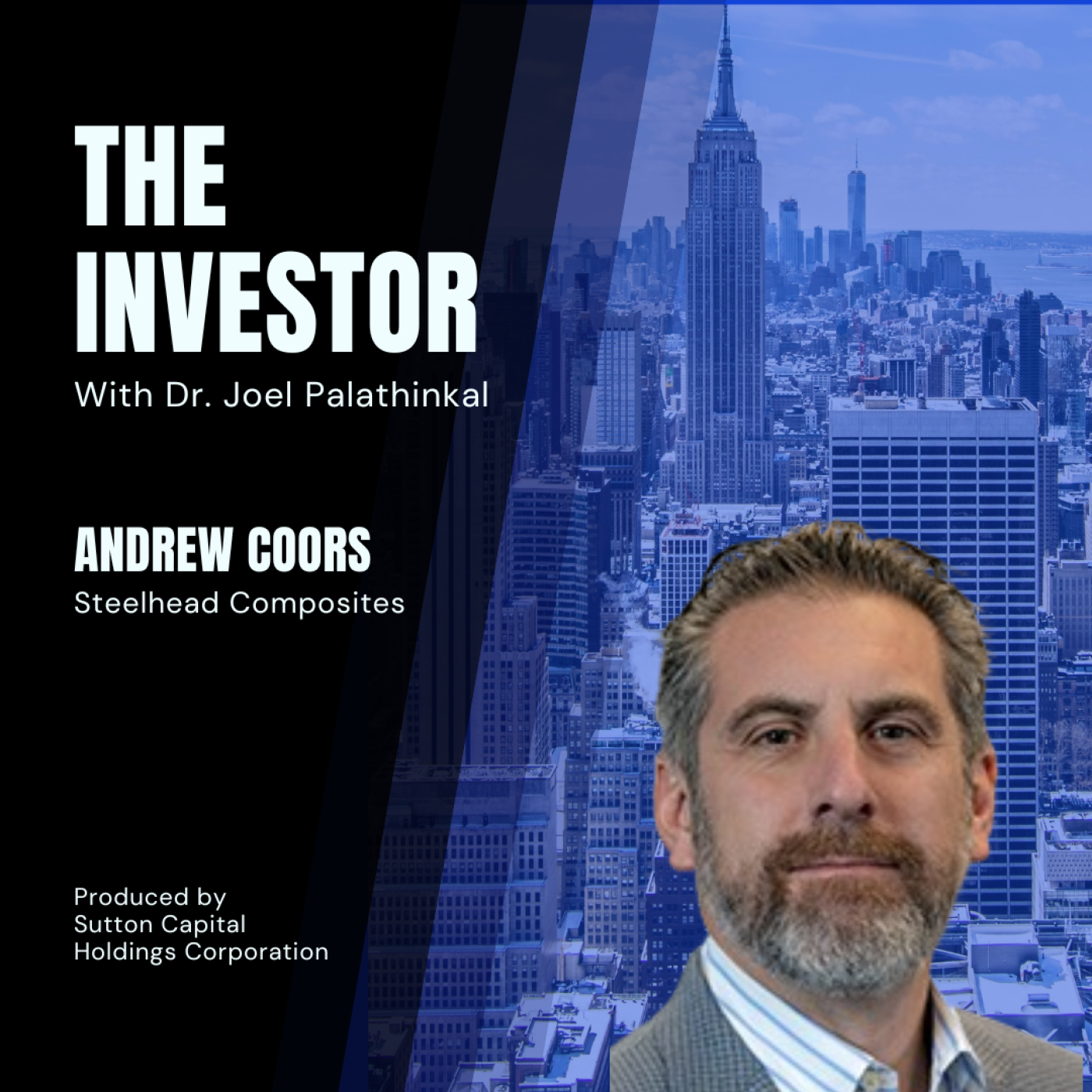
Welcome to the Investor, a podcast where I, Joel Palo Thinkle, your host, dives deep into the minds of the world's most influential institutional investors. In each episode, we sit down with an investor to hear about their journeys and how global markets are driving capital allocation. So join us on this journey as we explore these insights. All right, super excited for my guest today. He's been a long friend for multiple years. Excited to get him on the pod. Today we've got Andrew Coors. Coors. You know, obviously many of you have been familiar with that brand for, for decades, Andrew has been, you know, part of that family. But most importantly, he's a founder and CEO of Steelhead Composites. Previously, he was a principal at ninth Street Capital, venture capital and private equity fund. Previously spent six years as a corporate economist and investment strategist at Qualcomm incorporated, a Fortune 500 company. Prior to joining Qualcomm for five years, he served as a director of research at Laffer Associates, which was a money management and institutional economic research and consulting firm. He serves on various boards and has received numerous awards in the industry, including being named one of the treasury and risk magazines. 40 under 40, upwardly mobile finance executives in 2007. Mr. Kors is a CFA charter holder, has a master's degree in economics from the University of California, San Diego and a bachelor's degree from Colorado State University. So, Andrew, welcome to the show. Thanks for coming on.
- [01:44]
B
Thanks so much, Joel. Yeah, well, I need to update that bio. Having a things back in 20 2007, that's a. Time flies.
- [01:56]
A
I mean, when I hear 40 under 40, you know, I'm like, man, it's, I've crossed that river. And, you know, I think it's, it's exciting to kind of look back, you know. So thanks for, thanks for coming on and phenomenal bio. Really amazing background. I love that you have kind of the, the finance chops and now kind of the institutional, you know, infrastructure chops as well. I think when you marry those two together, there's massive opportunity. But why don't we take a step back and go a little deeper into the, the story, the background, maybe talk a little more about your family, maybe, you know, whatever you're allowed to share about the Coors family and would love to kind of backtrack that and back that into kind of the origin story of Steelhead, and then I'll probably pop in with some comments as well.
- [02:45]
B
As you deal with a lot of family offices, you know that the family is complicated and when successful, it turns into a Multi generational enterprise that has its own, you know, pros and cons. The cool thing about our family, Coors family, is that I'm now part of the fifth generation and there is now a seventh generation has been, been born in the family. It's very cool. But it also means there's been a lot of dilution in terms of opportunities and a lot of family members out there. So I get the benefit of being part of the family, but not the, I'm not one of the few that are on the inside. There aren't very many that are working at the brewery to begin with. It's just a couple. So the rest of us have to go out and find a way to pay the bills and find a living. But it's been an interesting story, you know, that being part of that family, part of that, having that pros and the cons of having a last name that people recognize and being in an area where, you know, I think I'd get a little less, less comment if I wasn't in the, in the Colorado ecosystem. That's where the family's from. There's now, I mean, there's, there's hundreds of us right now. So it's, it's an interesting perspective on multi generational family. And I'm happy to talk about, because I know you've got a lot of family offices that you talk to and. Yeah. How do you manage when you're. A lot of the discussions I'm sure you have are that second, third generation, when you're fifth, now, seventh generation, how does that look? Yeah, interesting. Philosophical.
- [04:57]
A
I mean, one thing that I observed, I was very fortunate to go to this really high profile, really small, intimate, you know, family office dinner this week and met somebody that just became very, very successful in the healthcare space and was super down to earth, you know, really nice guy. But one thing that he told me, because I'm probably, probably 30 years younger than him, and he was just like, hey man, I love what, I love the platform that you're building. You know, can you talk to like some of my kids? Because they don't listen to me. So I feel like a big thing, maybe just broadly more as a parent. People don't, people's, I guess people's kids sometimes prefer to hear from an outsider because it could be biased if it's coming from your parents. So I think having maybe, maybe that cascades into having external advisors that come in and maybe advise the, you know, the fifth and sixth generations in terms of how they should do things because Sometimes there's some, maybe there's some difference of opinion and there's just that bias of maybe somebody telling you something because they're your parent or your grandparent. So just having a third party definitely helps. What would you say are some of the observations to keep in mind? You know, once you get beyond the first, second, third. I mean you're talking about the seventh generation so maybe talk through kind of just generally with all the families that you know as well just things you observe as kind of new generations come in.
- [06:32]
B
Your comment about kids not listening to their parents, there's nothing new there. My kids, I've got a pretty robust investment background and my kids do not trust me on when I tell them, you know, what they should do or what they can do on their, on their investment accounts. Yeah, they prefer to listen to their friends than listen to their dad. I think that's just a common, common thing.
- [06:58]
A
Yeah.
- [06:59]
B
It's also the dovetails into just the complexity of family. Everybody out there, every family is complicated. And then when you add a business to the family, it adds a home, another layer of complexity and then you sprinkle some money on top and then you got the three layers of just how to make things a very potentially explosive environment plus money plus business. Three areas that have a lot of stress, a lot of potential for, for conflict. And the one thing that I've noticed in, in my family and talking to a lot of other family offices is there's not a, there's not a magic answer but every family office out there is looking for it. They want to know how to do the multi generational. They want to know how to get to generation five, six, seven or whatever. And there's besides a little bit of lust and having it structured for whatever nuances exist in your family, there's not a, there's not a solution to it. We've been very fortunate that we're, we're as many generations down the line as we are not many, many families get family businesses get that get to be around for 150 years.
- [08:27]
A
Sure.
- [08:29]
B
I think it's as much combination of luck and a little bit of foresight on behalf of the Gen1 and Gen2 that has kept everything going. That's not saying it's not complicated.
- [08:47]
A
What do you think are the biggest and again, you know, every family office is different but what pieces of governance, that's a big thing when it comes to families that you have to think about and put in place. But you know, as you kind of evolve and obviously as the Family expands and you want to kind of maintain the integrity of the family business. What are some things that you want to think about when it comes to governance with the, the following generations?
- [09:13]
B
Good governance is crucial, but it again, depends a lot on who your population is and how do you, how do you have cohesiveness but also have discipline?
- [09:29]
A
Sure.
- [09:31]
B
Everybody's family out there. There's always all kinds of kinds that are, that are in our family. And how do you, how do you protect the company while still, you know, keeping its cohesiveness with some people that have different, different goals and different ambitions?
- [09:53]
A
Yeah,
- [09:56]
B
you want to, you want to ensure that you got a good work ethic in your family. At the same time, you don't want to, to exclude those. It's all hard. And that's not just, you know, the, the Coors family office. I'm not there. There really isn't a traditional family office for the Coors family. But I think about it in terms of my kids. It's hard to get them to want to work. And that's not because they have tons of money. It's just, you know, a work ethic is something that has to be be learned and, you know, they're becoming more successful at that. You know, when you look across, you know, the, the generation of kids that are coming up right now, the work ethics are a hard thing to find. I'm sure every generation pass has said that about, you know, the generations that are coming behind them, but you know, with a combination of AI and you know, there's been a lot of comfort that has been been given to kids these days and hard work is hard. So. Yeah, I, I'm not a, I'm not a parenting expert or an expert on that. All I know is that every family office I see has the exact same issues. And when you start getting to the point where you've got hundreds of people in the family, you're going to have a whole distribution of whether it's attitudes or educations, work ethics. And that goes back to that governance thing that you're saying is governing for, you know, a second generation with three family members is very different than governing, you know, five, six, four, five, six, seven generations that have hundreds of members.
- [11:55]
A
Yeah.
- [11:57]
B
So I, my solution to it was be a combination of both where I can be a part gen 5, you know, the tours, but also started my own company. So I can hopefully be a Gen one too for some, some enterprise that may outlast me.
- [12:18]
A
Sure, absolutely. Well, tell me a little more about your career journey. So I, it looks like you've had a lot of institutional investment experience, right? So what was kind of walk me through kind of that career trajectory and, and that path and you know, what made you decide to, you know, build, build hydrogen energy technology and just walk me through the origin story of Steelhead.
- [12:48]
B
So I did all of my education, got my CFA and was doing, you know, was rather successful financially in money management. Institution. Money management. It's a corporate m. A corporate venture. I enjoyed that. But after doing it for roughly 15 years, I, I just didn't feel like there was any, anything that had any staying power in that I was judged on, on a quarter by quarter basis. The Great Recession, I was a villain coming out of it. I was a hero and just there was no permanence to what I was, what I was doing. And I had a, had a day I was sitting in traffic in San Diego and said, you know what, I just want to build something so that at least I can touch it, I can feel it and it's more, more permanent, less ethereal than you have in dollars per share. So I spent a, spent a bit of time looking for opportunities of getting into something where we could make something on the board of a company that needed a lightweight hydraulic component. And they were getting to the point where they could not have a viable business model. Retrospect, they didn't have a viable business model, but at the time they couldn't have a viable business model because of a missing a component. So over some beers I worked with their investors and some investors I knew and we said, okay, let's, let's start this company up to fill out the supply chain for the benefit of this, this company. And we wrote a business plan. We were looking to hire a, a CEO to run it. And I had some things happen in my personal life. Plus, you know, I'm like, all right, why don't I go ahead and I'll try this. How hard can it be? Turns out manufacturing sucks. Well, really, really, bonds, it's very, very hard. And that was 13 years ago. And we've had a pretty interesting story and migration into different markets and lots of learning. But yeah, I got into hard tech on a, I guess a relatively short sighted idea. Now I've got the bug and I don't, I don't know if I would do anything else other than making things. It's really, is fulfilling. Yeah, not financially fulfilling, but emotionally personally fulfilling. Joel, you were asking about the background noise saying is there a buzz with your computer? Yeah, there is. That's That's a product actually going through the shop floor. So it's people making things that will go to solve problems in various industries that I'm sure we'll talk about. But it's a, it feels good to have things that I can touch and feel and have a little more permanence than a quarterly financial review.
- [16:20]
A
Yeah, walk us through. I guess the, the business model and how you guys create these hydrogen vessels. I guess what's the process? Is it. And you know, I joke around sometimes. I'm like, sometimes the, the hydrogen vessel almost kind of looks like a beer can, you know. So some of that technology, the, the canister technology, you know, stuff that, that you could repurpose. Or is it just kind of unique machinery? But how do you create a, a steel vessel? I know one thing we talked about earlier is just, you know, with, with certain applications you got to maintain the, the pressure. Right.
- [17:01]
B
I'll talk a little bit about what we do. And I guess we got our start making lightweight hydraulics. And to get a lightweight hydraulic, we, we had to replace a heavy, you know, thick walled steel cylinder. And the way we did that was with the technology that was originated out of JPL for original space shuttle in the 1960s is a class of vessels called composite overwrap pressure vessels where we take a thin membrane, whether it's aluminum or plastic, and then we use a stronger material to reinforce it. You can think of it like a paper mache, right. Where you take a balloon and you put newspaper and paste on it to make it strong. We're doing the same type of thing. We're using mostly now carbon fiber. You've seen carbon fiber having its solution set and sporting goods in an aircraft. With the Dreamliner having the, the composite fuselage, we're doing the same thing. We're reinforcing a, let's say a thin aluminum metal wall with a carbon fiber. So we have a good combination of strength and weight characteristics, actually great combination of strength and weight characteristics. And that technology, we started it with the company for a regenerative braking system. And then we ended up making products that were in some of the robots that you saw the jumping, that the running robots needed to have some stabilization. So they were using our lightweight hydraulics for that. And we got into some mobile machinery applications and offshore oil and gas drilling. Because of the weights, it's savings, all trying to, trying to get this hydraulics business off the ground. Then about nine years ago, we had a different opportunity with the same technology, but not in the hydraulic side. And that was to work with SpaceX on some of their initial problems for opportunities for both launch and for satellite propulsion. So nine years ago we got into that business as well as working with the Navy for lightweighting some of their oxygen tanks. So we migrated into a place where we started getting heritage in space and defense. And now we've got products that have been in space for six years and on various launch vehicles and we're in more and more breathing air for aviators and buoyancy devices for maritime. Hydrogen was a, was a good opportunity for us. We did the largest green hydrogen storage system in the United States. But when that money never materialized at the beginning of last year that some of the big players were expecting, we've had to really double down on aerospace, space and defense. And it's turned to be an interesting, interesting bet for us. Now we're, we really are starting to look and feel like a, like a space company rather than clean energy company.
- [20:44]
A
Can we break down the different pillars when you talk about space? Obviously, you know, I've been in the space industry for some time and I also have invested in the space industry and then I worked in the aerospace industry. So can you just lay out the land for us in terms of defense, kind of where the applications are and maybe the different pillars of those applications?
- [21:12]
B
It's an interesting question. It's one of the things that is hard for people to understand about us because we really are. How can you do lightweight hydraulics and do space and do. At the end of the day, we're just making lightweight high pressure vessels that have a wide range of material compatibilities. And if you think of that as the platform, then it's okay. What applications does that actually pretty much any industry out there that cares about weight, that cares about compatibility, that cares about corrosion, and compares best in safety and has to store a fluid or a gas at high pressure. For space in particular, where you get a pretty hefty financial penalty for every kilogram that you're putting on your vessel, weight is critical. So as more and more satellite companies need to have a pressurized gas on their, on their satellite, and that's for propulsion as well as for the necessity of having way to re enter the atmosphere and then demise at the end of the life of that satellite, how do you find a lightweight, rather inexpensive container that can store whatever gas you're using to propel your satellite around? Whether it's electric, electric propulsion, or cold gas propulsion? Most of them need to have a gas tank that has a pressurized gas that is qualified for space and that they can get relatively easily. And when you look at where you'd find one of those, you can't find it on Amazon or in Grantry catalog. We're one of a few companies in the world and really one of the only in the US that would respond to a request from a small satellite company that needs to have a qualified propulsion tank for a, for a satellite platform. And it's all.
- [23:21]
A
So you're saying that the, the unique kind of market that you're tackling I would say is kind of the customization to those specs. And then I would say with everything, probably speed is important too. Right. To kind of is that would you say that? And why do you think that that's difficult for other people? Is it just the supply chain and just kind of having the composites to be able to do that properly?
- [23:47]
B
It's a few different things. You mentioned customization. We try to avoid customization because customization is what drives timelines out of control. Holding high pressure gases is a highly regulated market and for good reason. When we're talking about thousands or many thousands of psi operating pressure, you can't have a tank that has any problems with it. Now especially like let's look at the perspective of let's say a SpaceX rideshare and we have a bunch of product that has been on SpaceX rideshare because we have that demonstrated safety.
- [24:33]
A
What's SpaceX rideshare? Is that piggybacking some aircrafts
- [24:40]
B
the way that you'd get a satellite to space right now? Because most of these small side companies, small satellite companies don't have a way they're on launch so they piggyback on a SpaceX launch.
- [24:50]
A
Got it.
- [24:51]
B
And you schedule it. And for those of your listeners that are interested in it on the SpaceX website, you can look at the, the rideshare payload guide, which is really interesting that has a set of the criteria to be qualified to be, you know, to get your product up in space. They really have democratized space access, which is, which is, you know, interesting from a bunch of perspectives.
- [25:18]
A
Sure.
- [25:18]
B
But they're not going to allow one of their customers that's renting a space on their, on their launch vehicle, jeopardize the rest of the vehicle or ground crews or anything. They can't have their customers create risk for the entire operation. Right. So that their qualification process is pretty stringent and rightfully so. But if you're, if you have a need for a compressed gas cylinder and you're going to be on one of their, their rideshare platforms. You don't want to, you know, try to reinvent the wheel. You want to go with something that's already been, been flown. And then the word in the industry is heritage. So and heritage is kind of like I've got, I've got kids are trying to get jobs right now. We talked about that a little bit earlier and you can't get a job without experience. You can't get experience without jobs.
- [26:28]
A
Yeah.
- [26:29]
B
In space it's the same thing. No one's going to trust you if you don't have heritage. But you can't get heritage unless you've been in space.
- [26:37]
A
Yeah.
- [26:38]
B
So a startup company may have a, you know, something that they think is lighter, bester, better, stronger, whatever. But who's going to risk their entire platform on a new technology when there's a company like us that has a suite of products that are already in space. They're available, you know, in weeks or you know, months at the most. They've, they're light, they're inexpensive and they've already been qualified. So that's be a real challenge for a new company, a new startup company to, to get that type of credibility that we have. And it was real challenge for us to get. It's, you know, we've had to spend a lot of money on certification, on testing both internal and external to get that. Catalog of test results that gives customers the certainty that our products are safe and they're reliable. And as of now, we've, we've sold over 15,000 composite pressure vessels. We've had no windfield failures. We've got over 300 customers and 26 countries all using our products with, you know, thousands of psi day in and day out. And that was, you know, the ante we had to, we have to, have to be in these markets.
- [28:26]
A
Sure.
- [28:27]
B
And now that's dovetailing to a pretty good seat at the table for a lot of the defense work, whether it's going home, rearmament necessary for interceptors. We are, we're tried and true, we're a low risk, low cost solution for space, aerospace and defense.
- [28:55]
A
So where, you know, the, I'm trying to understand where the vessels sit. So when, when I think of launch, right. There's a bunch of boosters that, that launch the rocket into space, right. And then the boosters fall off. So where do the hydrogen vessels go? It looks like you have a bunch of standard sizes. So do. Those are those vessels inside of the booster.
- [29:17]
B
So those, those big tanks that you're thinking about. They're also made out of composites, but those are generally cryogenic. So liquid oxygen and liquid hydrogen. We don't make those tanks we have. Okay. That's not really our, our business model. Those are, those are specialized. They're, they're a lot bigger than we generally handle.
- [29:42]
A
Yeah.
- [29:42]
B
Have a liner. They don't. They have a different set of characteristics because you're dealing with a liquid gas. Most of our products use compressed gases and it's not just hydrogen. So for let's say a satellite that has. You would have a tank that the average size is about 20 liters or about 5 gallons of, of internal volume. And that would be on your satellite platform and it would hold usually in inert gas. Some are nitrogen, a lot of them are xenon, argon or krypton. And those are used through whatever the propellant technology satellite needs. We don't care which gas it is. We've gone out of our way to get qualified with, with all those gases. We have to ensure compatibility and the right pressure. And then the customer then plumbs that to their engine. Whatever they're using for propulsion.
- [30:51]
A
Yeah. And then that just shoots. So what it does essentially is when a satellite's in air a lot of times, I mean in video games especially right when you're moving the side, there's a little bit of gas that shoots out behind it. Is that what that essentially is like when it kind of. It moves the, it helps just move the satellite in air through pushing the gas out. Right.
- [31:08]
B
That's one way to do it. But yeah, that's, that's a good visual representation is, you know, you know, moves it.
- [31:15]
A
Exactly.
- [31:16]
B
Moving through space is a different, is a different, different challenge because you can't burn a hydrocarbon like you, you know, it doesn't have that same type of oxygen free environment.
- [31:30]
A
Sure.
- [31:30]
B
And you're not, you're not going to bring your oxygen with you in general. So the, there's a whole set of technologies, dozens of technologies for space propulsion, for, for satellites. And many of them require a, a compressed gas on board for that propulsion.
- [31:54]
A
Got it.
- [31:54]
B
And you can take a propulsion. Question is, you know, let's say you've got a satellite and you need to have it in a different orbit or reposition somewhere around. Most of these are low Earth or LEO or below that you need to move it around, you need to have propulsion. You can't just have it sitting there. It doesn't have value for many of these technologies. So how do you get it into the Right orbit into the right location that requires that. Some type of propulsion.
- [32:26]
A
So with propulsion, something needs to burn, I guess, to be able to.
- [32:31]
B
Burning in general, not burning because you don't have oxygen. Yeah, burning. Burning is a, Is a what you would do like a combustion engine where that's. Then you have a fuel plus oxygen plus fire. Your, your, your, your power.
- [32:53]
A
Yeah.
- [32:53]
B
In space you don't have that.
- [32:55]
A
Got it.
- [32:57]
B
You need a different, a different, A different way to move around. The benefit, though is that you don't need a ton of thrust in space.
- [33:09]
A
Yeah.
- [33:10]
B
But you can't use traditional combustion unless you have oxygen.
- [33:16]
A
Sure, that makes sense. And then I guess what you offer too, when it comes to the composite, when you refer to composite, is that essentially the material that it's made of,
- [33:28]
B
it's the, the carbon fiber or. I don't know if your viewers will look at the video. There's a, There's a kind of yellow tank, right. That's a, That's a Kevlar tank. And that Kevlar one is an Aramid reinforcement. The cool thing about that tank is that it was fully certified and fully tested for phenomenon called demisability. And demisability means does it fully burn up upon reentry into the atmosphere? As the, as space junk is a growing concern, the, the FCC changed the rules in 2022, mandating that satellites have the, that at their end of life that they will either re. Enter the orbit or, or, or burn up so that we don't have an increasing amount of old satellites that are no longer in use sitting in orbit that cause a bigger space junk problem. So that tank there, that would be, that has been demonstrated that if you were to bring that upon reentry, there would be no chance of having a, any part of that tank ending up in some farmer's field somewhere.
- [35:07]
A
Sure. I'm gonna go ahead and share my screen here. I was gonna pull up your website. There's a couple, you know, key industries that you focus on. So one thing that was kind of interesting to me was the autumn. Can you guys. Can you see my screen, Andrew?
- [35:22]
B
I do see it.
- [35:23]
A
Okay, cool. Yeah. So when it comes to the, the automotive and transit fleets, you know, I guess this is kind of one of the products that you would offer. Right. And then I guess they fill this in. They would fill the gas in using this top device here.
- [35:45]
B
It's, it is a product that we do offer. It's. I would say it's not one of our more interesting or exciting products, but we do we do sell a few hundred a month that go into primarily compressed natural gas.
- [36:02]
A
Yeah,
- [36:05]
B
yeah, yeah. So there you can see how it would be. Not really one of our customers, but I'm sure when you, when you see the mostly municipal waste trucks, they'll say, you know, powered by cng.
- [36:21]
A
Yeah.
- [36:21]
B
CNG is compressed natural gas. So we are in that case, we're holding a compressed methane rather than compressed hydrogen or compressed other gases for different applications. Again, the composite reinforcement gives us a lightweight, safe tank that we can use for a whole variety of gases. Pretty agnostic to it. It's about finding the right markets. CNG is a market that's already relatively saturated. It's a pretty easy tank to do comparatively to our other.
- [37:00]
A
Yeah. You know, it's interesting, when I went to India, almost every Uber has one of these tanks and it sucks because it takes up the whole trunk space, you know, And I'm like, I'm like, look, we got a stroller. How do we put the stroller in here? Because this thing's got. This tank is taking up the whole tank. So I feel like that's. I haven't seen it as much in the US I don't know if it's bigger in the Midwest. I mean, in New York City, I don't see CNG tanks anywhere. But I mean, definitely, you know, in India I've seen. And I think it's because the government gives the drivers some type of payout or some type of subsidy or maybe when they fill up the tank, maybe the way that they fill it is cheaper or something like that. I'm not sure what are kind of the benefits to using C. CNG or the incentives for people to use. To use it.
- [37:43]
B
So in New York, you will see them look at school buses, look at refuse trucks.
- [37:50]
A
Okay.
- [37:51]
B
Many of those are cng.
- [37:52]
A
Yeah.
- [37:53]
B
And it's a, it's a cost and it's mostly cost side of things. The trade off is you lose a lot of your real estate on your. Your vehicle.
- [38:07]
A
Yeah.
- [38:08]
B
The benefit is that it's quite a bit less expensive to use natural gas. It's also cleaner. So if you. Natural gas was thought of as a technology that would be the next generation above diesel or gasoline for environmental purposes.
- [38:30]
A
Sure.
- [38:31]
B
It didn't. It hasn't taken off. It's a great solution for countries like India because it is cleaner. Sure, it's more available, it's less expensive, but the US it's not really necessary.
- [38:49]
A
Got it. And how do they fill up the gas? Do they just go to the Regular gas station or they have to replace the. These cylinders every month or so or a couple months.
- [39:01]
B
They're not as common, but there, there are, there are. Every town or every bigger, bigger town will have, you know, some infrastructure before refilling it. It's a. You refill the gas. It's not a fluid, so it's. You attach a.
- [39:21]
A
Like a hose or something.
- [39:23]
B
Yeah, we get gas dispenser to the tank and. Yeah, and you replenish the gas and then you're off. Off and running.
- [39:31]
A
Yeah. So you told me that this wasn't, you know, your number one sexy area to, to look at.
- [39:39]
B
Not at all.
- [39:42]
A
Yeah. I mean, sporting goods seems pretty interesting, I guess. What, what are you most excited about? I mean, obviously we got the aerospace and defense applications, but any, any of these to kind of double click on. I was curious with the sports industry. What, what, what are the main applications in that space?
- [40:01]
B
So we've got an interesting. There's a tank that we developed and we got it.
- [40:07]
A
Is it this one here?
- [40:08]
B
It's that one, yeah. We'll make probably 3,000 of those tanks this year. Oh, wow. It's a 8 liter or 10 liter, 4300 psi operating pressure. It's certified around the world. And one of its applications is. It's. Right now it's in space. It's, it's. We've got a few customers that are using it for a satellite propulsion. We have people using it for breathing air. We've got some companies using it for.
- [40:49]
A
For the scuba industry, right?
- [40:52]
B
Yeah. Then we have a partnership with a company called Avelo Labs that has put a bladder on the inside of it. Going back to our. The lightweight accumulator side of things. Things that we started talking about. Lightweight hydraulics, accumulators of hydraulic. They turn it into a hydraulic type unit where not only is it lighter, but it's a safer and easier dive because all buoyancy is managed inside the tank rather than an external air bladder. And Avelos had quite a bit of success with that there. They've got dozens of locations. They're. They're basically swimming with a, a satellite tank that, that I had the opportunity of diving with it. It was really a phenomenal, you know, dive experience.
- [41:54]
A
Well, you talk about robotics. I mean, tell me where you see the future of that is. I mean, I feel like a lot of the humanoid robotics, like the joints are pro, probably regulated by some type of hydraulics or some type of shock. Right. Are there systems within robotics and especially humanoid robotics where I think Kind of. Some of those like smaller vessels may make sense for kind of more fine motor skills.
- [42:17]
B
Yeah, maybe we're not doing a ton with robotics right now. We have in the past we've. The size of our, of our tanks is, is better suited towards. Larger applications.
- [42:34]
A
Yeah.
- [42:35]
B
So you can think of our smaller tanks being the size of a 2 liters or the size of, let's say, you know, a football.
- [42:44]
A
Sure.
- [42:46]
B
That's about as small as we. As we get.
- [42:49]
A
Yeah.
- [42:50]
B
And our bigger ones are 10ft long and 2 1/2ft in diameter. But that's, that's really what we have in terms of installed capabilities for manufacturing.
- [43:04]
A
Yeah, yeah. I threw up as. This is one of the smaller ones here.
- [43:09]
B
That's that gold one you see, that's a fully demisable one. That's the one that burns up upon reentry. And that's a, that one is a 12 to 24 liters. So kind of mid size.
- [43:25]
A
Yeah.
- [43:27]
B
Long and narrow.
- [43:29]
A
Yeah. And then the bigger one, I was just going to pull up some of the bigger ones here. So these are the larger pressure vessels. How big are these?
- [43:37]
B
Those are probably 270 liters.
- [43:41]
A
Okay.
- [43:44]
B
I can't see how long they are in that picture.
- [43:45]
A
Yeah, yeah. And I guess, yeah, the big thing is kind of the weight reduction that you're offering for just the aerospace applications as well, I'm assuming. It's just, it seems like you were able to drop them down by 30% in the weight.
- [43:59]
B
Yeah, yeah. We have got. We're very light, very strong, fully certified. That's really our value proposition. And then it's, I guess it's up to us to find who the, who the customers are that they're looking for. That lightweight, low cost, certified safe.
- [44:22]
A
Yeah, that's great. While I got this site up, any other things that would be helpful to share with the audience?
- [44:31]
B
No, no, I think that's pretty interesting. But if people are interested in the how a composite tank can solve things in the scoop industry, for example.
- [44:45]
A
Sure.
- [44:45]
B
I'd recommend you go to the Availo website. That's dive. Availo-a v e l o.com d a
- [44:52]
A
I v e l o.
- [44:55]
B
No dive d I v e. Huh. Availo a v e l o.com.
- [45:01]
A
okay, cool, great. I'll ping that in the chat here. Great. So some of your vessels are with those guys.
- [45:11]
B
They only use our vessels.
- [45:13]
A
Oh, great, cool. Yeah, just ping this in the chat. So that'll be pretty interesting to take a look at. And I would say same thing with this. I Mean the weight. It looks like buoyancy control is another big thing too, but like, it seems like the weight is a huge thing with this too. Right. I mean, controlling kind of the, you know, how you're managing that well.
- [45:32]
B
And from a, I mean the, the buoyancy helps with the, the safety side because in scuba diving, traditional scuba diving, when things go wrong, there's two. You either end up corking to the surface, which is bad, or dropping to the bottom, which is also bad.
- [45:50]
A
Yeah.
- [45:50]
B
With our system, we're, we're already neutrally buoyant, so you, you don't have that, that failure mode that would end up in a loss of life or catastrophic situation.
- [46:02]
A
Yeah.
- [46:02]
B
The other, the weight side being less than half the weight of a traditional system has been really seen a lot of positive feedback of people of smaller stature, kids and elderly as well, that want to scuba dive. But the bulky has been an impediment.
- [46:26]
A
Yeah.
- [46:26]
B
Having something that is a lot lighter weight and a lot easier has, has really opened up the accessibility of that market for people that otherwise, you know, would have been dissuaded of diving.
- [46:39]
A
Yeah. That's amazing. Well, hey, Andrew, this was great. Really learned a lot and you know, glad I was able to kind of share some of your products and kind of the, the industry overview with the, with the community. I usually end with one question that I think is important, but I have, I also have a fun question too. So I'll start with a fun question. Do you think octopuses are aliens?
- [47:09]
B
Sure. There are some creatures out there that are just so bizarre. Yeah, my, I'm not going to answer the octopuses aliens, but my sister took my mother to a, a kangaroo sanctuary for Mother's Day and she was explaining to me kangaroos and how they birth their young and take care of their young. It's just bizarre. It is so unlike anything that, you know, we experience in our human condition. There's a lot of interesting weird creatures out there, including octopi. But look at how kangaroos take care of their young. If you want to really scratch your head about how evolution has created very different paths.
- [48:06]
A
Yeah. I mean, what, what's unique about the way I thought they just carry them around in their, in their, in their pocket and, and they grow up and they bounce around and find things to eat. What, what makes it unique about how they raise their, their kids?
- [48:23]
B
I'll leave it to you and your audience to do some research. Just. Yeah, I, I, I, I only heard what she said. I was pretty shocked by that.
- [48:37]
A
Okay, that's what I'm doing right after this call and then. Final question, final question. Andrew, one piece of advice that you want to leave with us, it could be about anything. Could be from a past manager, could be from one of your teammates, could be from a family member. But just one piece of advice you want us to take away with us.
- [49:01]
B
I would say the piece of advice I would have and this would be for, I would more look more about like my customers, the customers out there, and we're seeing this as a trend throughout the US Is don't underestimate supply chain. Don't assume that you can find the hardware that you need at the price that you're looking to pay last minute. The number of companies, especially satellite companies that come to us say, oh yeah, we've got a launch date in six months. We need this exact custom tank to do this. No, it doesn't work that way. Hardware is hard and that's also what makes it fun.
- [49:48]
A
Have you heard the triangle analogy? It's a fast, cheap and good quality. You can only have two of them at a time.
- [49:58]
B
Right?
- [49:58]
A
So if you want something fast, it's, it's not going to be cheap. Right. It, you know, may, it may not be good quality either. Right. But you could probably get something fast and cheap. That's bad quality essentially. Right.
- [50:12]
B
If you want a custom, it's not going to be, you probably will end up with none of the above.
- [50:19]
A
Yeah, absolutely.
- [50:21]
B
So, so underestimating the hardware side of things, especially for space and aerospace defenses, I see that something that for people that are actually making things, don't, don't.
- [50:38]
A
I mean, once the design is finalized and you're, you know, you know, sending it to manufacturing, it's the point of no return. Right. I mean it's already printed and fabricated and you can't really, can't really go back and you know, send a patch up in the cloud. Right. It's essentially, it's a physical product. So I think a lot of physical capital intensive businesses, I think the supply chain is a big thing. I think another good and bad problem to have is if you got a lot of demand but you just don't have the infrastructure to actually fulfill the demand. That's a huge issue too. But it's, it's good to have the demand. Right. It's better than not. It's, it's worse to not even have the demand right to fulfill on it. But that's kind of a chicken and egg I'm assuming is huge in manufacturing, right? Just kind of dealing with the supply and demand and fulfilling on the demand at scale especially well.
- [51:27]
B
And nothing's easy.
- [51:28]
A
Yeah.
- [51:28]
B
Scaling up is not easy. Scaling down is not easy. But I would recommend anybody that, that has not had some time actually making things in a manufacturing environment to spend some time doing it. It's, it's a, it's a, it's really fun, really interesting. I'm glad I, I changed my, my career path into getting into manufacturing for everything except for it's a lucrativeness.
- [52:04]
A
Yeah.
- [52:05]
B
Sure.
- [52:06]
A
Cool. Awesome. Andrew. Well, thank you so much. Appreciate it. And everybody else that's listening, thank you for listening and catch up with everybody soon.
- [52:16]
B
Thanks, Joel.
- [52:16]
A
Thanks, Andrew. Appreciate it.
- [52:26]
B
Sam.