← The Investor With Joel Palathinkal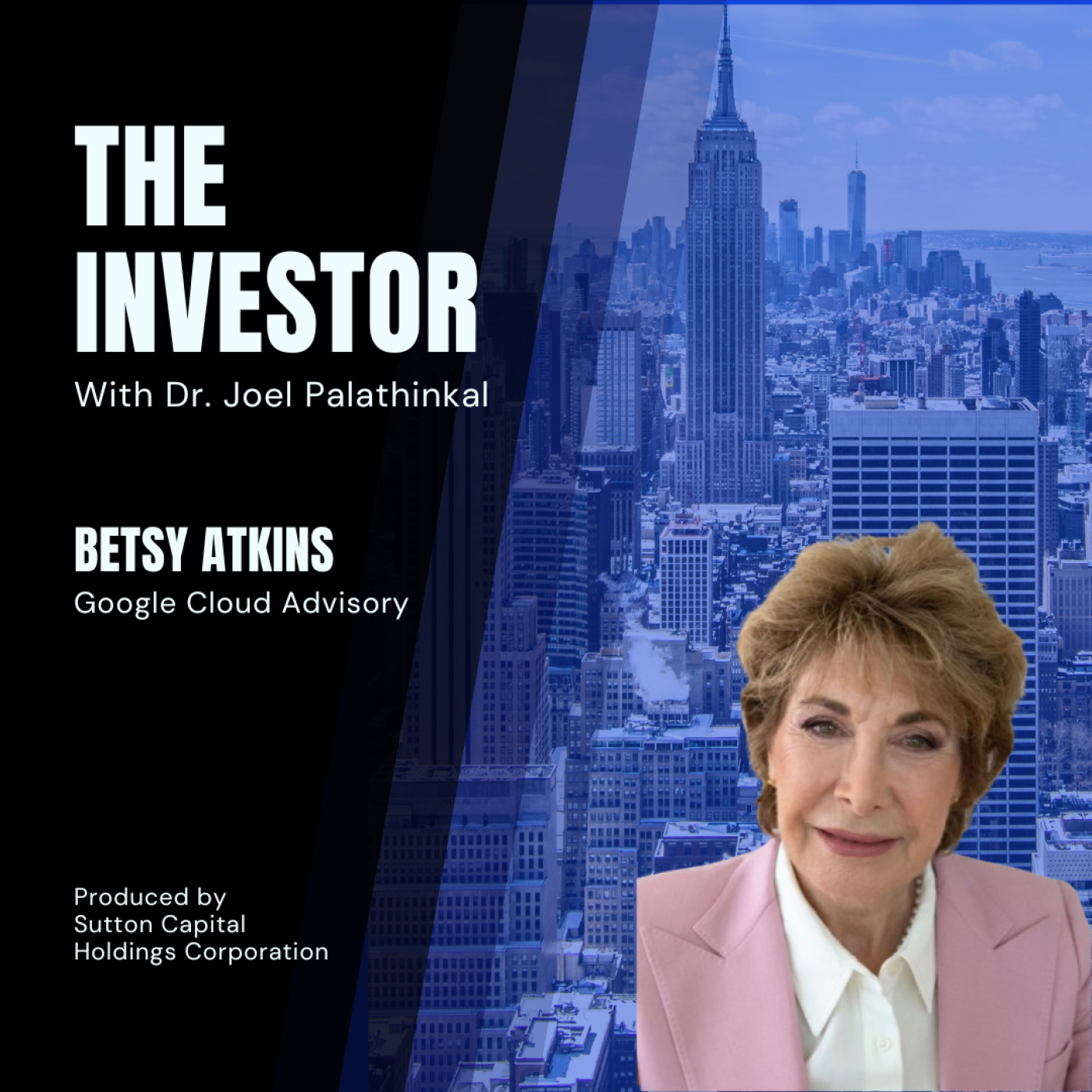
Loading summary
Transcript137 lines
- [00:03]
A
Welcome to the Investor, a podcast where I, Joel Palo Thinkle, your host, dives deep into the minds of the world's most influential institutional investors. In each episode we sit down with an investor to hear about their journeys and how global markets are driving capital allocation. So join us on this journey as we explore these insights. All right, I am super excited to have this guest on my podcast. This is the Investor podcast. We have several institutional investors in the private equity space, venture capital space leaders in Wall street, and you know, today I have Betsy, Betsy Atkins. She's currently the chairman of the Google Cloud Advisory Board and a board member at Gopuff and Wynn Resorts. She's also a three time CEO and serial entrepreneur who has served on 50 plus venture backed boards and 40 plus private equity backed boards over a 30 year career. She's also seen firsthand how board composition influences valuation, investor confidence, founder control and long term outcomes. What we do here at Sutton Capital is we are one of the most active communities of private equity investors, venture capital investors. Many people are successful entrepreneurs are looking out to build their own investment fund or continue supporting founders from an operating partner capacity or a board level capacity. So it's very relevant to have Betsy here. So, Betsy, again, thank you for your time. You have such a celebrated career and background and I really respect all the great things you're doing. So thank you for coming on today.
- [01:46]
B
I'm delighted to be with you. And I actually have served on, I think the second most public boards in the country. 37 public boards.
- [01:55]
A
Oh, wow, that is amazing. And I was excited to see Gopuff because I'm a user, I'm a, I'm a customer of Gopuff, I live in New York. So I'd say it's amazing. I mean, within one or two taps, you know, you get what you need. So, you know, excited to go through all of the, you know, the things that you've been working on. But you know, before we go deeper into the tactical things, I always want to know who Betsy is. You know, we always want to know a couple levels deeper who, you know, this person became and what was going on in your mind when you were thinking about your career. So maybe you can start with just kind of your early childhood, you know, where'd you grow up, what did your parents do, what did you think you wanted to become when you were in middle school and high school? And how did that evolve over time? Kind of your career aspirations? And as all of us have experienced, right. We go through so many pivots in life. With, you know, opportunities. Right. Sometimes they're challenges, but they also turn into opportunities which, you know, maybe open up a new chapter in our life, but want to learn a little more about kind of that those formative years in terms of figuring out what the path was and what it became.
- [03:05]
B
I grew up outside of Boston. I had the world's best parents, which not everybody is blessed to have. Such a great start. Sure. Went to, you know, standard University of Massachusetts and then a scholarship at Trinity College in Oxford and University of Copenhagen. And out of college I got my first job at GE and I was a terrible fit. I was a really bad subordinate and they fired me. And it made it clear to me I was destined to be an entrepreneur. And from there I started companies in my 20s, took them public and had a chance in between my first startup that got acquired on the IPO roadshow to go into an amazing defense contractor nobody ever heard of. But you all know everything they ever did. I bet two thirds of the audience doesn't know what the ARPANET is. But the arpanet, Advanced Research Projects Agency is today's Internet. And creation of the arpanet war game simulation software, natural language speech recognition, massively neural networks encryption. So it was a great place with about 2500 MIT PhDs and I was the only product commercial person. And then I ran a big division as a general manager at Unisys, then out to Silicon Valley to be a CEO of a supercomputer company that I sold and co founded Ascend that went from 0 to 5.4 billion in revenue in eight years. We took it public and then I had little bit of early stage angel investing and went back, was a CEO of a enterprise software company in energy management that I sold to SAP and I've been doing board work, private venture backed, PE backed and public board work throughout it all.
- [05:25]
A
That's amazing. Well, there's a lot to unpack there, Betsy. But you know, one of the first questions I have is what do you think made you in your mind not a good subordinate? What, what do you think it was? Is it just kind of the, just the processes? I mean I. Look, I worked at big companies as well and what I noticed is a lot of times if you want to get things, if you want to get things done, there's like 10 levels of approval. But you know what else was kind of the self realization trigger that made you realize, hey, this is not, this is not kind of maybe the environment that I'm going to thrive in,
- [06:06]
B
you know, in any business if you think like an owner, then you want to get things done.
- [06:12]
A
Sure.
- [06:13]
B
And you want to accomplish things, solve problems, satisfy your customer. And at ge it was not that way. Right. It was very process oriented. Stay in your lane. And it was clear to me that you couldn't have the impact, you couldn't really accomplish things, and you're wasting all kinds of silly time doing unimportant things. So that just wasn't gonna be a fit for me. So I went into the semiconductor industry. It looked like it was booming at the time.
- [06:48]
A
Sure. I wanna hear your reaction to. There was some analysis that I saw previously on the difference between Costco and Sam's Club. Right. They're essentially the same business model. They have the same membership model, the competitive pricing. The difference is the CEO, I think, makes 900,000 a year versus the salary of the CEO of Sam's Club. But their employees, they feel they have the feeling of ownership and they take care of their employees.
- [07:18]
B
Yes.
- [07:18]
A
And they've invested a lot more in the people. And I think Sam's Club, exact same business model is, I think they're around 25 million a year where Costco is like 900 million a year. Right. So you see this firsthand, helping these boards kind of really think about scaling. And you've taken companies to a billion dollars. But what's your reaction to that in terms of just kind of investing in the people and investing in just kind of that culture to give people, you know, agency and equity and, you know, maybe it's not specific equity and shares, but just equity and ownership in projects and what they're working on.
- [07:57]
B
You know, many great thinkers in Silicon Valley have said, you know, cultural trump strategy. And it's true. If you having started companies and seen why do startup companies do well? How can they get so much done with so few people? Well, they feel like owners, they're part of it, they build it, they buy into the vision, they're there for the mission. And if you can create that, that's the best company culture. Like at Wynn Resorts and casinos where I'm on the board. Why are we the top performing casino? Well, we have a higher number of people. Well, okay, that's better serviced. But why do we have average tenure four times that of our competitors? It's the culture. They feel ownership. We invest in them, we train them, we give them a better environment, whether it's the food we feed them, the uniforms we give them, the care we take of them, from their psychological to their emotional to their intellectual growth. You keep people and people care when they know you care about them and they put out more. And that's what the customer sees in every organization. Look at Zappos, right? They're all companies that overperform have somehow created the magic elixir to make their team feel like owners.
- [09:28]
A
Sure, that's really helpful. What were some of the things that you learned when you joined the semiconductor industry? And then, you know, kind of going deeper, you know, what were the biggest things that you learned from taking a company from where you entered to becoming a billion dollar company?
- [09:47]
B
You know, I think what you learn most is, in my opinion, great companies stay close to the market and the customers and companies that start to, you know, go slow in their growth and become legacy, it's because they're not close to the customer anymore. They have too many spans, too many layers, too much, you know, internal bureaucracy which can't say yes and only says no. The blockers, the process owners, we don't need process owners. We need people who are, you know, going to respond to what the customer in the market wants. And when you get too much in between, the signal gets distorted. The best companies have CEOs that are really in touch with their customers and the market, and spending time with them, I think is a big takeaway.
- [10:40]
A
Sure, that's really helpful. What do you think it takes to scale and what are some of the graduations? What are the milestones? Right, so let's say when you come in, the company's at 30 million, right. What would be kind of the next level of milestones when it comes to revenue? And, you know, what are the different levers that you need to pull? You know, there's probably a point where you, you need to have managers of managers, right? So talk me through kind of the transformation of a company graduating to a new level of institutional scale and kind of what are the, you know, people. I'll make the three things easy people, processes and technology that you have to have.
- [11:23]
B
You know, I think there are predictable stall points that we've all seen as patterns. Right. The hardest thing is you start the company, oh my gosh, get your first 0 to 5 million. It's like a dead lift. It's so hard. And then you break through 10, 20, you hit 30, it slows down often 50 is a stall point. People have difficulty breaking through, break through 100 and then know kind of 250 and then is, it's hard to get over the 5, 600, then break a billion. And I think that it's not just the layers of, you know, when you get managers of managers, I think it's the defining of clear functions that, that really well run companies and well led companies have clarity of the swim lane of what you're going to do so that you don't have mushy, fuzzy, duplicative things. Because that's when you devolve into politics. And the energy goes internal to my fiefdom and my stuff versus you over here and you over there instead of everybody out here. And I think that's what you have to watch for now with technology. With LLM and Agentic, I think we're going to see a compression of the number of layers, which is a good thing. And I think we're going to be the last generation of managers who are only managing humans. You're going to have, you know, you're going to manage your agentic capital and you're going to manage your human capital and you're going to have managers of agents. You're going to have, you know, agentic managers that might have, you know, 100 other agents in the call center.
- [13:18]
A
Sure.
- [13:20]
B
So I think that's all going to shift a lot, but I do think continuously kind of pruning out business processes that don't serve you anymore and organizational artifacts, you know, these, you know, I'm a captive to the process and I manage the process. Do we need this process anymore? Why is this process here? You know, companies don't go back and prune that out deliberately till they really slow down and become a legacy. And then you got to bring in Alvarez and Marcel and Alex to do a big restructuring.
- [14:01]
A
That's really helpful. What do companies normally do when they're trying to get to the next level? Do they bring in, you know, so when would the board members and probably some of these operating partners come in? Is there a certain revenue milestone when it's like, hey, should we, we bring in a bunch of advisors? Should we bring in a bunch of McKinsey consultants? Do you see those people come in once they hit about 100 million or is it, you know, sometimes a little bit earlier?
- [14:30]
B
So I actually don't see early stage companies bringing in, you know, the McKinsey consultant of what is my strategy, what should I do? I think you see bringing in Consultants sub 100 million like Simon. Sure. Help me with pricing and packaging specialist consultant for a particular thing.
- [14:52]
A
Sure.
- [14:54]
B
I think that your board starts to shift. Like when you start a company, you're going to have your venture investor board members and maybe one or maybe two independents. And as the Company gets further along and closer to an ipo, that's when you see the board mix shift to be IPO ready, bringing in, you know, somebody who can be the audit chair and the compensation chair and maybe the governance chair. Because in the perfect world, the US Exchanges would ideally like you to have three independents leading your three major committees.
- [15:35]
A
Sure.
- [15:36]
B
But there's always a divergence. Right. Between. I think that when you have only venture board early on and nobody represent common, it. It's tough for the founders because there will inevitably be the small percentage of times where preferred and common have a divergent interest. And without somebody to, you know, sort of speak up for the common, it can be hard for management.
- [16:02]
A
Yeah. So who would that person be that speaks on behalf of the common shareholders? Would it be just kind of another serial entrepreneur that kind of has a voice that influences some of those decisions?
- [16:17]
B
It could very well be another serial entrepreneur, an operator. But you got to be sure that the person has the courage to be willing to, in a diplomatic way without being disagreeable. Take the other side of the discussion where, you know, preferred might be advocating to do something that is in the interest of preferred, but not at all in the interest of common. And if you're beholden and you don't have, you know, that you, you care about your next gig from this venture capital firm, you know, you may not have the courage or you may make the trade off. Hey, it's in my interest not to fight the fight. So I think if you're actually going to be a fiduciary, you got to have courage. And I think character always, character always trumps credentials in the boardroom because people hire for credentials, they hire for the resume, and then the reality doesn't match.
- [17:20]
A
Sure, that's really helpful. So what are some of the things that you think are important from a character standpoint to be a strong board member?
- [17:30]
B
Well, I think the most important thing on character is courage, grit, tenacity. These are the qualitative things. Why does the company win and the other company folds? Right. They pivot. They have courage. They use their relationship capital as an asset of the board and management. They're creative enough in how they think about things. They lean into change. They're not so risk adverse. And, you know, stuff goes wrong always. Private boards, a lot of stuff goes wrong. Public boards, the number of crises, the frequency of something going wrong. If you look in the last 20 years, you know, maybe in the year 20, you know, 2000 to 2010, maybe there was like, you know, one thing that Went wrong every three years. CEO, CEO succession issue, giant cyber attack. Somebody you know does something incorrect and you have to restate your financials, you know, a catastrophe. Now frequency is much, much higher. And not a lot of people lean into when stuff goes wrong. They worry about, oh, will this blow back on my reputation? You know, you got to be a firefighter. You're not here for the donuts and the bagels. You're here to go into the burning building. Not, oh my gosh, this is bad. Let me leave.
- [18:57]
A
Sure. Well, I always love myself a good origin story. So can you walk me through kind of your origin story of building your first company and you know, what was going on in your mind when you decided to build it?
- [19:10]
B
Ah, okay. My first company was Interlan and it was an ethernet controller company. So it was local area networking boards and systems. And I was lucky enough to be working at a company that did data acquisition, analog to data conversion and you know what we would call today? IIoT industrial Internet sensor fusion and insights. So anyhow, the guy running engineering and I was running all go to market and services and operations. We looked at each other, we said, hey, the CEO here, he's cooking the books. I don't think this guy's ever going to take this thing public. You know, like, you know, we could be here for a long time while Fred here is lining his pockets and the VCs haven't figured this out. And since we figured it out, I don't really want to be complicit here and not say anything. So let's you and I go start the company.
- [20:13]
A
So I wrote the whatever, if you're allowed to, I guess. Are you allowed to share? What made you think that the books are being cooked? Did you see some of the money not coming in or something like that? Or again, whatever you're allowed to say.
- [20:30]
B
You know, this is where you got to trust your intuition.
- [20:34]
A
Yeah. You just felt that something was off.
- [20:36]
B
You know, if it smells bad and it looks bad.
- [20:40]
A
Sure.
- [20:40]
B
And things aren't right. Things aren't right. Yeah, you know, like don't, don't ignore your stomach and nose alarm.
- [20:47]
A
Yeah.
- [20:48]
B
It when if all of us look back when we said, gosh, that didn't look right, how often was, oh no, it was all perfect. I was nervous. There was nothing here. There was almost always something there.
- [21:02]
A
Sure. So you guys decided to just make a little bit of a clean exit and build something similar with your own twist and expertise on it.
- [21:14]
B
Well, that was in the data acquisition and a to D analog to digital digital to analog sensor function. This was local area networking. So it was no way competitive. The only lesson that we lifted and learned was it was a controller board, you know, a bus compatible computer board that went into, you know, someone else's computer.
- [21:39]
A
Sure.
- [21:40]
B
And did the functionality.
- [21:43]
A
Got it. And then tell me about your first customer. I guess what was the experience when you. Because of your first business. Right. So it's always that magical experience when you get your first customer. I guess what was going on in through your head where you're like, wow, you know, I, I think we're on to something.
- [21:57]
B
You know, I'd never start a company without having talked to like 20 prospective customers.
- [22:04]
A
Sure.
- [22:05]
B
Because when you start a company in a vacuum with a brilliant technologist and you haven't done a market check, you're never going to guess. Right. Even when you talk to 20 customers, the 21st through the 30th, who actually are the buyers? Not your pre launch of the company. Know, market information gathering. It's always different. But so the first customer to me was probably already customer number 23 or 24.
- [22:39]
A
Sure.
- [22:39]
B
And when you co innovated and spoke to those early prospects or suspects or maybe they were rumors, but you got them to talk to you and say what they thought would be useful and would give, give them some value and that they would actually buy it, you can then go back to all of them. So it isn't just a out of nowhere cold call.
- [23:02]
A
Sure. I feel like some of the skills that you built and superpowers that you developed of like go to market probably help too to essentially kind of almost pre sell the solution. And I think with sales too, it's really about solving problems, kind of figuring out where people's pain points are and then, you know, delivering a solution around that pain point. Sometimes you might have to be consultative in the beginning before you build like a resellable product that you can sell as hotcakes. But in the beginning, do you feel like sometimes you have to solution it a little bit for your customers?
- [23:34]
B
I think you always have to. But actually the trick is to standardize.
- [23:39]
A
Sure.
- [23:39]
B
Because if you haven't got rigor and if you don't have, you know, sort of clarity, you'll end up making everything a little customized and you can't make any money that way. So you have to decide are you a product or a services? You know, I think that you can look at Palantir and they've done a marvelous job of taking whatever is 30% of their revenue, 37 as services and position themselves as a product company.
- [24:07]
A
Yeah. They sell their services as a product as well. Right. So everything is a product company.
- [24:13]
B
Exactly. But in general, you know, it's really very easy in a slippery slope in an early stage company to customize too much and get stuck in the loop of proof of value, proof of concept, and then it's really hard to move it into a purchase order.
- [24:31]
A
Sure, that's really helpful. What mindset do people have to think about when they're trying to get from an eight figure business owner to a nine figure business owner? Because I feel like a lot of it is the mindset too of kind of really thinking through the processes. Right. Sometimes your, your biggest enemy could be yourself and it could be in your head. And, and I've heard a few founders kind of talk through that.
- [25:01]
B
You know, I think the, the first company that I founded, I, I stumbled on that I, I didn't want to forward hire strong enough people. I didn't want to forward hire stronger people than me. So. And I think that that's a very common, you know, founder, first startup issue of let go of control and go get best in class and people you're going to learn from, learn how to give them the power.
- [25:34]
A
Sure. I would say even, you know, founder led sales is a big thing in the beginning and, and it may take time to eventually have other people handle sales as well. So what would you advise founders that are looking to kind of get to the next level and scale? What have you learned from a sales perspective and sales enablement and training perspective in terms of replicating yourself as a founder to build a team around you to sell the same thing in the same way.
- [26:06]
B
You know, I think that early stage company sales is very different than established brand. Right. So you have to profile people differently.
- [26:21]
A
Sure.
- [26:22]
B
If you're doing, you know, a new concept that's an evangelical kind of a cell where you're painting a vision of a future state. That's a different caliber of person who can do that conceptual sale and who can close. Everybody can open 1% out of 100 can close.
- [26:47]
A
Sure.
- [26:48]
B
So I think you have to open over index towards Hunter Closers Net new logo closers. That's a different person, right?
- [26:56]
A
Yeah.
- [26:57]
B
In an early stage company. And you can bring in the account management farmers to cross sell, upsell, expand after you land it later.
- [27:08]
A
Sure.
- [27:09]
B
So I think it's stage of company.
- [27:11]
A
Yeah. I got a good one for you. So you know, I saw Travis Kalanick recently talk about Uber and how is, you know, a new level of hard mode, you know, moving from consumer to B2B and it just, it's just a whole new beast. Right. Getting from consumer. You're just driving downloads and driving GMV.
- [27:31]
B
Yes.
- [27:31]
A
And then there's new KPIs. Right. If you're now trying to get into B2B and have fleet management for Uber, it's a different type of customer and it's a longer sales cycle. Right. You don't even know if you're doing well probably until three to six months down in the sales, you know, follow through process. So you know what, what have you learned, you know, with many of the boards that you've served on in terms of switching from either consumer to B2B or you know, maybe they're B2B and they're trying to, you know, build a consumer app.
- [28:04]
B
So I think you're hitting on something really important. There is a world of difference even when you're all in B2B between the SMB, go to market motion and the enterprise. It's completely different sales cycle, average sale price and everything about it being product led, demand gen, very, very different. You know, if you're at the bottom of the pyramid doing SMB, it's you know, mostly demand gen. I heard a great thing that if you are direct to consumer, spend more money in marketing than sales. It's so obvious. And if you're B2B spend a lot more in sales than in marketing.
- [28:47]
A
Sure.
- [28:47]
B
And I, I think that the shift from B2B to the consumer is a very different plan on where you spend your money and how you micro target and all of the different channels for the consumer. Everybody understands the words but they don't understand the organization and the correct profile of people who can execute against it because they're not at all a great fit in the same go to market team.
- [29:33]
A
Yeah, absolutely. In terms of whatever you're allowed to share, it'd be interesting to learn any insights you have on just kind of your role at the glue that the Google cloud advisory function that you have, you know, in terms of, you know, what you learned in terms of that position in terms of the cloud strategy. I know there's a whole push now with like with openclaw coming out now in terms of just, you know, integrating in with AI and all of that still needs infrastructure and redundancies in the cloud. So you know, anything you learned from Google or just in general in terms of best practices for the cloud and where that's heading with AI would be really great to hear for the Audience,
- [30:18]
B
I'd be delighted to share that. And I think the other topic that's interesting is the role of advisors and how you structure them, how you fit them, where they're a good fit. So if I'm talking from the perspective of a public company director, public company directors don't have in general good tech background and they also don't in general have necessarily very good entrepreneurial background or innovative backgrounds. Right. Public company directors come from other large cap public companies with, you know, wonderful resumes of having been a general manager, a division president, a CEO of a company, a billion and up. So they've got a great resume or they were a functional leader, a cfo, a cmo, chief product officer, a head of manufacturing. So they aren't going to have good grasp of the cloud except what they know as a consumer. And understanding tech and how essential it is to making your company competitive and current and responsive is pretty much not there in most boardrooms. Boardrooms have heard, oh my gosh, I need to be doing something about AI. And now they, everybody had the GPT moment a while ago and they say, okay, I use it as my lookup engine now instead of Google. But they, they've heard the term agents but they're not really sure. Sure. So I, I think the, the big thing for corporate boards and anyone selling tech to corporate boards is to remind everybody about the difference between, you know, vendor lock in, you know, and, and systems that are not open source because that pertains directly to a multi cloud, hybrid, heterogeneous environment. You know, we see it in the models and using multiple frontier models, you know, they have personalities, they're different. The anthropic kerfuffle highlighted, you know, that there's anthropic has their constitution with its own personality. And so the need for agentic governance is really important. And when you talk about, see, I don't think boards understand the basic difference between a rules based deterministic payroll system or HR system and an LLM probabilistic system. And if you're going to have, you know, clawed agents that are wild in your environment that you put them out there and the agents can self modify. Oh my God. What does that mean?
- [33:37]
A
Sure.
- [33:38]
B
So I don't think people truly get the difference. So I think some of the foundational education of a board has to give them, hey, the basics, right? Remember SAP is closed versus you know, an open system. Remember one cloud you didn't want to be locked in or dependent. So multi cloud, you know, multi frontier model, you know, These, these are the things that de risk and make you resilient. And then, you know, when you think about, you know, agentic and probabilistic versus deterministic and what that means, I think those are the levels that boards need to kind of get it and start to understand it. And they, they don't. Coming from the tech industry, I'm familiar with it and they, they definitely, if you're lucky enough to have an unbelievable CEO like Schneider Electric, where I was a board member for almost a decade, you know, everybody else deconglomeratized. GE broke up, Siemens broke up, Honeywell broke up. Only Schneider. Schneider survived and grew as a conglomerate because he leaned into tech. He was super change adaptive. He made sure everybody started using software early. He understood that hardware cultures are, you know, don't do well with software cultures. Different release cycle, you know, so we had to keep the software in a separate subsidiary for a while, you know, so if you're gifted with a great CPU CEO like that, or win, where we have an unbelievably tech savvy CEO, you know, they're change adaptive and they're tech forward leaning and innovative, but oftentimes that's not the case and they're open
- [35:24]
A
to pilots and testing new things out or maybe a limited environment to, to see the roi, I would say probably as well. Right?
- [35:32]
B
Yeah, they lean in early and they lean in early. Early is key. Right. The 3% of companies that, that are the most forward leaning on tech have always outperformed the, outperformed their peers.
- [35:47]
A
Yeah. It'd also be good probably to have people that are cheerleading the innovation arm of the, of the business so that those people have those relationships with those vendors so they can already do those experiments and tests, you know, within a closed and closed data set of like enterprise data that's secure, you know, to kind of see how it would react, I'm assuming. Right?
- [36:10]
B
Yeah. You need that on a board.
- [36:12]
A
Yeah.
- [36:12]
B
Like at Volvo Car Co. They asked me, gee, would I be interested to join the board? And I said sure. No, thank you. I'm, I'm, I'm your wrong person. Right. I'm a capitalist and you're a socialist. I'm Silicon Valley and I have a higher clock rate. And you're going to be, you know, making sure everybody is aligned for, you know, 24 months before you make the first decision. This won't be good. And they said no, no, no, we really want to do autonomous drive and we want to do electrification and over the top software updates and all of These things we want to go direct to consumers. So you could actually order a Volvo online, which you can now. So depends from the top. And they wanted technology entrepreneurial cheerleader advocates on the board. They were refreshing the board to bring that mindset in. So, you know, one of your, your little prep questions was, you know, what can outside. How can outsiders decode if the board is going to be an asset or not?
- [37:25]
A
Sure.
- [37:26]
B
And, you know, that's part of what I would look for if I was going to invest in a company.
- [37:31]
A
Yeah, that's a good, that's a good segue. I think from a career standpoint. There's a lot of people that, you know, especially in our community, that are exited entrepreneurs. They come into a big liquidity event and then they're trying to figure out what the next step is. And a lot of times I feel like a board position could be a good, good next step to kind of add value to companies that may not be too far away from where they were. Right. I mean, they had an exit whether it was a share purchase or a cash purchase of their, of their company or maybe a hybrid. Right. And kind of navigating that experience because they may be a couple years away from an IPO or some liquidity event. So I think it's, you know, oftentimes these roles are probably not advertising advertised on LinkedIn. It's through kind of a warm network or a community. So I think you mentioned earlier something to talk about is really, you know, from a advisor standpoint, you know, how should they structure that? And then obviously at the board level, you know, maybe some, some KPIs, right. Of like, you know, what, what success looks like. So we'd love to hear maybe the board's level, the board level's perspective, and then also someone that's thinking about joining, you know, whether it's Volvo or Google or some other big company, you know, how do you pick the right team for you to be a board of as well? What should you look for and how do you structure it? I'm assuming it's probably an hourly rate or some type of compensation, plus hopefully some equity as well, or both.
- [39:05]
B
So how you look for board? I actually wrote a book on it called Be Board Ready and it's all the channels to get onto a board. You know, it's obviously the search firms.
- [39:21]
A
Sure.
- [39:21]
B
Venture capital, it's private equity, it's bankers, it's attorney. So I wrote a whole book because I got asked a lot and I was mentoring all these people and it was kind of like having the same conversation so many times a week, I said, oh my gosh, write this stuff down. But at any rate, I look for, and would recommend anyone to look for a board that fits with what you can add value on.
- [39:51]
A
Sure.
- [39:52]
B
Right. So if you're an entrepreneur and the biggest thing you ever built was $100 million company, you're probably not going to add value on Disney or on Coke.
- [40:01]
A
Sure.
- [40:02]
B
Probably not. Likewise, if you were an executive at Pepsi, you probably shouldn't go join a scrappy entrepreneurial board sub, you know, a billion. Because you never, you, you've been a, a large cap executive your entire career. No idea of the cycle time, the urgency, the lack of processes, you know, the, all the stuff that makes, you know, smaller stage companies so exciting. So I think you have to map your stage of the life cycle that you've worked with. Right. So if you worked with only small mid cap, whatever, you're a great fit there or smaller and maybe a little bit bigger. I would also look, what I look for is chemistry with the CEO. It's all about if you believe in them and their vision and you know, you connect with their energy and you can be valuable, you know that you can contribute, you can make an impact, you can mentor them, you can help them, your relationship capital can be, you know, an accelerant for the company, something. Because if you think you're going to a board to go learn, nobody wants you go to college. Boards are not for, you know, ojt. And if you think you're going to a board because it's my next step, I'm an important person, I should be entitled, you know, I don't want you either, you know, how are you going to, how is your learning going to contribute in a complementary way to what we have around the table?
- [41:44]
A
Sure.
- [41:45]
B
And I do think we all have to rethink the, this notion of diversity, which used to be, oh, I want gender diversity, I want ethnic diversity. Now you want thought diversity. What you really want is different cohort. So, you know, whether it's Gen Z or Millennials, which we brought on to the wind board because we had a lot of baby boomer customers, we need to see the future cohort.
- [42:12]
A
Yeah. I mean, because the future cohort is eventually going to be baby boomers and you want to grow with them as well. Well, right, right.
- [42:18]
B
And half, half of the revenue of most companies comes outside the U.S. how about an international director from one of your biggest geos? How about, you know, the voice of the customer, like remember who was that imbev Budweiser. Yeah, the McVany kerfuffle on the Budweiser can. Like the Ford 150, dude is your customer. You know, let's not lose sight of this here.
- [42:50]
A
Yeah, absolutely.
- [42:52]
B
You know, so, you know, I, I think you've got to have a reason that you're different and complementary to who's around the table.
- [43:03]
A
Sure.
- [43:04]
B
Why do they want you and why do you want to be there? And if it's just because. Oh, I think it'll be interesting. You know, you're a fiduciary. You got to add value.
- [43:14]
A
Sure. What's the formula for a good board structure and cadence and meeting?
- [43:25]
B
So a good board meeting is where all of your, where all of your colleagues have done their work and they've read the stuff material that management gave and, and that management does not recite it. Again, we read it. Let's have a conversation. And where you've established trust and credibility the board has with the CEO and leadership team that they're there to be an asset and are leaning in to be a thought partner. So that you're actually going to talk about the trade offs on. Should we go this way or that way on a particular decision, you know, should we enter this market or that market? Should we build this internally or should we acquire it? You know, you know, whatever the question is, you know, you should be in a great board meeting. You're talking about those things.
- [44:25]
A
Sure.
- [44:27]
B
And that requires trust to be transparent. So you can't have a bunch of board members that are fault find.
- [44:34]
A
Sure.
- [44:35]
B
And all board members should take the Hippocratic oath, do no harm to the patient.
- [44:41]
A
Sure. That's a good, that's a good pivot to one of our questions. Right. One of the prep questions we had. But essentially, you know, what are some of the big early stage, I mean, early stage board mistakes that can hurt fundraising. Right. So I mean, and I would say even more established companies, what could hurt, I'm assuming it's just not having the right people at the table. But what are some other things that could kind of cause kerfuffles? As you mentioned,
- [45:15]
B
stuff that hurts is when you load a board with too many friends of founder.
- [45:26]
A
Okay.
- [45:27]
B
Now the founder should always have the a veto and not be able to put someone on the board they don't like. I just, you know, I don't like Betsy. I, I don't like brown eyes and she's not my cup of java. So you gotta have chemistry and you got to be able to be trusting and so but if you're, if you've loaded the board with only people who are kind of cheerleaders and sycophants that can be harmful and investors kind of smell that out so you're less likely to great, get great investors. And you do want people that are going to bring you ideas and some experience and scar tissue and pattern recognition and you know, who are there, who are your lifeboat picks that you would put in the lifeboat, who would pick up the paddle and row with you. Because it's just never going to go perfectly. It isn't. And so, you know, you want people who are, you know, in it to win it with you.
- [46:41]
A
The whole concept of super voting, you know, from, from the Uber days. Right. I mean a lot of that was eliminated in 2017, but just, you know, are there other things to maintain control, decision making? Obviously the whole thing with Travis was, was really, you know, just a crazy roller coaster for many of the investors. And I'm not sure if we work also had the concept of super voting as well. But, you know, it moved to I think a one share, one vote vote structure. So any best practices on decision making, voting making, sure that, you know, the stake, the right stakeholders have a voice at the table to, to serve the best interests of the companies and fiduciaries.
- [47:28]
B
So there is still super voting shares out there and they still go into bylaws.
- [47:35]
A
Sure.
- [47:35]
B
And there is still board control with which founders put in and often should because you do see things happen. I mean, I personally think it was a really bad board decision to remove. Travis was an extraordinary founder. He created the category, built the category. I often think these boardroom assassinations, you know, are very Machiavellian. And if you really dive in and I've seen three where, you know, board members wanted the gig, two of them and tried to assassinate the CEO. The third one, I recognized it early enough to say we would be conflicted if any of us were to take the CEO's role. So before we start this investigation, let's all hold hands and agree none of us will take the seat. So there is that. And I do think that the sort of general public company, institutional investor group accepts that boards will continue to go public with super voting and board control and it'll sunset around the 7 to 12 year time frame. And you know, you do have exceptions, right. Snap, where you know, the CEO really underperformed and they had the protections. It was hard to get them out. But I don't think that's as big a deal that investors accept it now for an exceptional founder there there are going to be some of these protections in place and investors are still going to buy databricks if it's in place when it goes public and same thing at and roll when it goes public.
- [49:26]
A
Well Betsy, I mean there's a lot more things that I want to cover and I know we have limited time so I'm going to rapid fire a couple more questions that I think would be helpful for you know selfishly myself in the audience but would love to learn a couple things that you you know gathered from your term at at Gopuff and also at Wynn. You know some learnings and, and maybe sprinkle in some learnings from some of the other notable board seats that you've held. Yeah. If you want to run through some of those that'd be really helpful.
- [50:00]
B
I think the best thing is to have a small board. Small board far more functional.
- [50:05]
A
Sure.
- [50:06]
B
I think founders and CEOs should always put in an auto sunset clause. So that means your chairman of the board, if it's different than the CEO or if it's the CEO is chair then for your lead director that annually that role sunsets and the nominating committee renominates because there is no way to get that person out. There is no mechanism corporate governance and you're, you're stuck with somebody.
- [50:41]
A
So everybody on the board should have an auto sunset and then the board
- [50:45]
B
kind of the most boards stand annually anyhow. Yeah, but the committee leadership doesn't typically rotate. For audit committee governance.
- [50:57]
A
Sure.
- [50:58]
B
But for lead director and chair in my opinion it is critical that you auto sunset that role and then nominating just re nominates or if there is an issue, you then have a mechanism to rotate the person.
- [51:12]
A
Sure.
- [51:15]
B
I think the biggest takeaway I would say to anyone who's looking at a board to bring on a board member is to see how current they are, how engaged because you have these glorious resumes and they're ready for their next phase and they're going to go play golf and oh, I'll be on two boards and I'll have something to talk about on the same seventh hole. Forget it. Are you fully engaged? Are you meeting with VCs and private equity and mentoring CEOs and talking to startups and going to conventions. If you're not 100% engaged with this velocity of change, you should not be in a boardroom. So people who retire and think they're going to do this part time, I think that is really not good because your playbook get stale so fast. So that would be my other way.
- [52:06]
A
A lot of these things are probably. I shared your book as well. I think it's an amazing read for anybody, you know that's on our platform. Definitely. Check out Betsy's book. Are there any other KPIs? You know, qualitatively and quantitatively, as you're kind of looking to bring somebody onto the board?
- [52:26]
B
I think the. The most important thing is that they be different.
- [52:32]
A
Okay.
- [52:33]
B
No, it's some crazy. 56% of board members went to the Ivy League. Really? How different are they?
- [52:43]
A
Sure.
- [52:44]
B
I mean, come on now. Like, do you have anybody who, you know, if. If 75% of the country are frontline workers and you're a consumer company, do you have anybody who actually looks like your customer? Hello. There's things. It's so common sense, but you want diversity of thought because everyone sees the same opportunity and misses the same risk. And I also think the other big thing is change. Adaptive. Look for people who lean into change. Look for people who are not all about risk. Historically, boards were oversight of risk. Now they're future proofing. So there's just a giant change that you need in the boardroom of. We're not just doing risk oversight. That's like brushing your corporate teeth.
- [53:35]
A
Sure.
- [53:36]
B
How about how do you stay relevant when the life expectancy of a company is shrinking, just like the CEO tenure is shrinking?
- [53:45]
A
Sure. Well, that's really helpful. Well, Betsy, I always wrap up every podcast with just one piece of advice. It could be a piece of advice from a mentor, a family member. It could be life advice. So anything you want to leave us to kind of take back with us, you know, reflecting on your career, reflecting on this episode.
- [54:06]
B
Always, always go for your dreams and always work harder. You don't have to be the smartest. You just have to be the hardest working and. And the most determined.
- [54:18]
A
Amazing. Well, Betsy, thank you so much for your time and everybody else tuning in. So have a great day.
- [54:24]
B
Great to be with you.
- [54:25]
A
All right, take care.