Loading summary
Transcript39 lines
- [00:03]
A
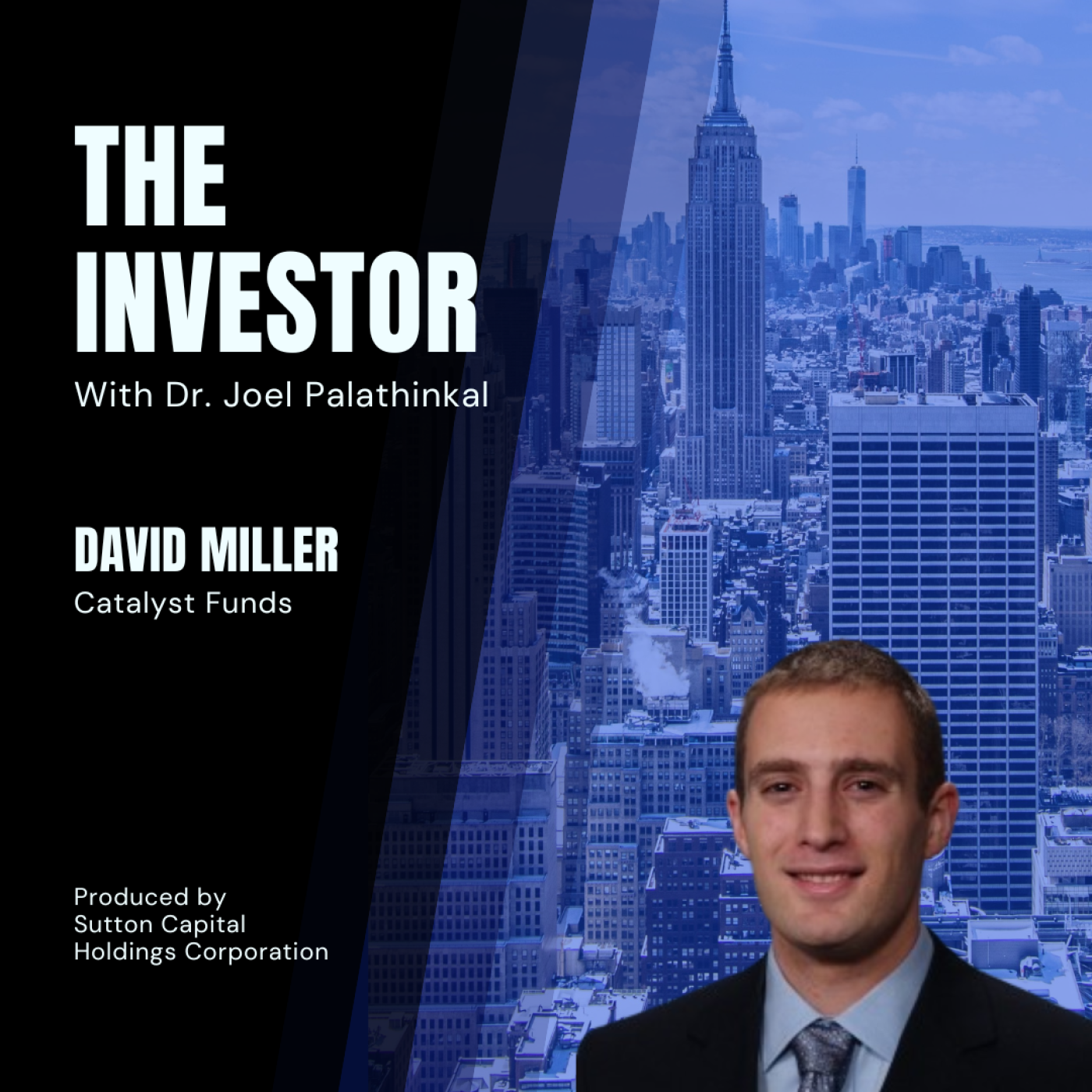
Welcome to the Investor, a podcast where I, Joel Palo Thinkle, your host, dives deep into the minds of the world's most influential institutional investors. In each episode, we sit down with an investor to hear about their journeys and how global markets are driving capital allocation. So join us on this journey as we explore these insights. All right, really excited for our podcast that we're having today on the Investor podcast. Just as a quick disclaimer, this episode is for information and educational purposes only. So it's not a solicitation to buy or sell any security or a public solicitation. We're just going to learn about asset management and learn a little more about the market. So really excited to introduce you guys to my guest, David Miller. He's a CIO of Catalyst Funds. They're about a $13 billion asset management firm. And then he's also the PM of Catalyst Insider Buying Fund and the Strategy Shares gold Enhanced Yield ETF, which is a five star Morningstar rated ETF up 40% year to date, that combines gold futures exposure with income from corporate bonds and treasury collateral. Some of his top holdings are Robinhood Markets, Groupon, Oddity Tech, Techstride, Fortinet, Meta, LPL, StoneX, and Comfort System. So, really excited to kind of learn a little more about what he's building, but just taking a step back. David, again, thank you for coming on the show. We'd love to learn a little more about your early education, where you studied, what you thought you would do, and then how that took a turn in terms of your career or maybe you did exactly what you thought you would do. But, you know, who are the influences that drove that, that career progression? And you know, just early on, what were some of the things that were going on and through your mind? And then we'd love to kind of just hear your journey of kind of now, you know, just heading towards the, the path of becoming a cio.
- [02:10]
B
Sure. Well, I guess I started very early and there was very little change from what I wanted to do when I was a kid. I mean, you know, as a little kid, I didn't know what to do. A stock even was, you know, I wanted to be a fireman when I was in kindergarten. But by the time second grade had come around, I was interested in what a stock was and I asked my mom and she kind of knew. So she told me what she basically knew, but bought me a book on it. And ever since then, I was hooked. I was just had this passion for stocks, investing, compounding, math, all that type of stuff. So we had this exercise in third grade when I was a kid where you had to write down what you were going to do when you grew up and where are you going to go to school. And I probably took it a little too literally, or maybe I thought you couldn't change anything because I wrote down that I was going to go to the University of Michigan and I was going to study business and then I was going to do an MBA at the Wharton School, University of Pennsylvania, and then I was going to work in stocks. And while maybe I didn't realize that once you commit to something you can change it when you're eight, I did end up going to Wharton School, University of Pennsylvania, although I did it for undergrad. And then I did go to University of Michigan, study business and finance, although I did that for grad school. And then I have been working in stocks my whole career. So I guess it's one of those scenarios where you decide young. That's definitely what was the case for me.
- [03:36]
A
Did you have anybody that kind of, you know, you said you initially didn't know what stocks were, but do you have any early influences that kind of help to educate you on that early on and help you kind of come up with some of those ideas for a career path?
- [03:51]
B
Yeah, certainly so. I mean, when I was 10 years old, after, you know, reading about stocks and learning about business, my grandmother had this first cousin, his name's George Weiss, and he was running one of the original pretty good sized hedge funds, a little bit over a billion in aum. And he'd had a wonderful track record. And when we were up visiting him in Connecticut back in 1990, he picked us up in his limo one day, took us to his office, showed me, introduced me to people in his office and had me a place. My first trade, it was in a stock as a bank company ticker back then was wec. And after that I was just totally hooked. He was alum of University of Pennsylvania Wharton School. And I was pretty enchanted with the concept of what he did for a living and was very interested to see if I could do the same for my career. Even though I kind of had an inkling that was what I wanted to do when I was 8. That really firmed it up.
- [05:03]
A
That's really helpful. Yeah. We had one of the founder of the Motley fool on, I think it's David Gardner. And he, you know, he was saying that he is, his father would take him to the grocery store and I think they own shares in the grocery store. Right. So understanding the Whole concept of like owning equity in a business and looking at how the company operates. Right. I mean, do they seem like they're operating their business in a successful fashion? Because you have holdings in that. In that company. So I think taking equity and, and actually allocating capital and understanding the health of these businesses that you're investing in, especially at an early age, helps to kind of bring things to perspective as well. So what were some of the things?
- [05:44]
B
Absolutely. And I got exposed to the same thing. And instead of birthday presents When I was 10, I asked for some Disney stock that actually did well. But I think my relatives who gave it to me never changed it out of their name. It's worth a lot more now when they did it. And I guess I also wanted some Toys R Us back then that didn't turn out quite as well, but didn't know too much about how to analyze an income statement or balance sheet back when I was 10. Nor would I have known back then that the toy business was going to convert to really an Amazon denominated thing, given Amazon didn't even exist back then.
- [06:22]
A
Yeah. What were some of the biggest things that you learned attending Wharton, maybe your peers that you studied with and networked with in terms of kind of building the skills of an asset manager?
- [06:38]
B
I think the biggest thing going to Wharton was just this incredible level of exposure to people that I couldn't even necessarily even dream of getting access to today. So, for example, 2001, there was this event and there was this guy who'd recently sold this company called Zip2. And they invited everybody to hear from him about this company that he was starting called X.com at the time. And he was telling us how he was going to be the future of finance and dominate finance in the world of finance. And, you know, ultimately, well, X.com ended up becoming PayPal and that guy nobody heard of at the time. So we were in a room of, you know, five people hearing this guy drawing all this stuff on a board and telling us stories about, you know, how he bought this McLaren and crashed it. Not too often you get to have dinner with Elon Musk 20 years ago, before he became, you know, Elon Musk that everyone knows him to be today, or certainly didn't have just a few people in the room. But we had Jeff Bezos come and speak to our group. We also had the opportunity to have Warren Buffett come and speak and tell us about what he did and George Soros to. To have that type of direct access, I guess not even just an Undergrad or, you know, Buffett come to speak to us. But then, you know, in grad school as well, you know, there was this event where MBA students could come out to Omaha and hear directly from him and ask questions and, you know, have dinner in his Gorod's favorite steakhouse and, you know, ask him about how he'd select stocks. If you were to start over from the beginning, you know, just kind of some incredible access like that, or, you know, Donald Trump was speaking to us and giving us a story about the casino business when I was an undergrad at Penn and you know, Ivanka was living directly beneath my dorm and then Don Jr. Was in the fraternity down the street. So just the access of the people that you come in touch with, I think was the biggest thing.
- [08:47]
A
No, that's helpful. And you know, we have, in our audience, we have people that come from all walks of life, especially in the finance industry. We have people that are focusing on private credit. We have people that are looking at, you know, only private markets. We have people that do crossover strategies. Right. They look at like, you know, how the, how the private markets converges to public markets and how they complement each other. I would say when it comes to strictly public investing, and it's someone that's becoming of age and kind of developing those skills, I would say maybe a first year analyst, what are some of the statements and maybe technical skills and also soft skills that they should start to reassess. When I mean statements kind of the actual reports that they should look at. We've got the 10k, we've got the earnings reports, we also have the earnings calls. But what's the toolkit to, you know, kind of be that first year analyst?
- [09:54]
B
Sure. So, I mean, when you think about the first year analyst skills, I think that was something I wasn't necessarily the best at. I was very good historically at strategy. Figuring out what levers to pull that make the most impact in a business. Yeah, figuring out what gives a business its real key competitive advantage, what enables it to do far better than its peer group is what it is that that special advantage is. That's very difficult for other people to replicate. But when I first started out of Wharton, I was. Well, first off, I tried to start business when I was at Penn and fortunately that was going very well. And it was the early days of the Internet and Internet marketing and it was just really easy to make money back then. It was hard to screw it up because the keywords on places like Google AdWords were so incredibly inexpensive. Any email that you sent to anybody would go through. There's no such thing as like spam filters if you're building out a newsletter. So it's kind of like building a business on easy mode in that respect. But I never really thought I wanted to be in the marketing business per se. But it was such a great opportunity back then. That was what I did and I, I graduated and always knew I wanted to do finance. So I worked that UBS and their equity derivatives group coming out of school and it was fascinating. They had an initial great training program. They teach you everything from soup to nuts and how to think about finance, how to, you know, price an equity derivative for corporate clients and things of that nature. But the problem was I was a little bit hooked on entrepreneurship by that same point in time because I was already making, you know, more than 10 times as much from the marketing as I was getting paid by ubs. So I was a little too tempted to, you know, kind of burn the candlesticks on both sides and try to do both at the same time.
- [11:49]
A
Yeah.
- [11:50]
B
And problem was when you're an early stage analyst, you gotta be working at least 12, 13 hour days. And then I get home and then I have Internet marketing work to do and I take another four or five hours is like, okay, there's not really time for sleeping here. Or I can quit what I really want to do and just do this marketing stuff that I'm not as excited about. Or I can stick with just the finance and take a 90% plus pay cut. Trying to do both made it clear that that wasn't really possible because I wasn't able to do that analyst work in the way that the guys that I was competing against could because they had a full night of sleep and were just doing that as opposed to trying to run a business on the side.
- [12:30]
A
Yeah. And I guess when you were, when you were a marketing anal, a marketing, it sounds like, were you running like a marketing agency where you're helping people run their ads and do stuff on double click and stuff like that?
- [12:42]
B
Yeah. So I was doing early stage when Facebook first got launched. I mean, this was after ubs. I was buying like most of the inventory on Facebook when it was incredibly inexpensive. We'd have keywords on Google. When Google AdWords first launched, that would be $5 a click. And they were still worth $5 a click back then, but they cost 5 or 10 cents a click because nobody was doing online advertising through Google AdWords when it first launched. And it was just so incredibly uncompetitive. That it was pretty easy to make money. You know, if you market a Chase credit card, you pay 5 cents for the click. If somebody got approved, you get paid a $20 bounty. You didn't need a great conversion rate to make those numbers make sense. If you're paying for the ads and you're getting paid a performance conversation commission whenever the sale came through. So that was kind of what I was doing with the digital marketing.
- [13:32]
A
And you were still. It was still a niche skill because, I mean, it was kind of a new emerging industry. So for you to kind of have that skill and be able to market that, that's kind of something that that is not. You know, I'm assuming it wasn't as widespread at that time when you were kind of starting to do that.
- [13:49]
B
No, I really had some very unique early exposure to that because I had this idea, they could say, conceptually, I had the idea for bitcoin before bitcoin existed. I just didn't execute it properly. And I actually started this business in 2000 called bitcoins.com. so it wasn't bitcoin, but it was bid coins. And the idea was you'd sign up and you get this digital virtual currency. You'd sign up for offers on the Internet. You could pay your friends with these coins, you could play blackjack with them, and then you could use them in this auction that you could then redeem them for prizes with this virtual currency. Now, there is nothing crypto about it, but the idea was if you created your own virtual currency, that it could have some neat features. And that really kind of took off in the beginning. And that's where I really learned Internet marketing in the early days and would have been nice if it also got me to think about buying bitcoin when it first came out. But at least I had bitcoins.
- [14:50]
A
And then you decided to kind of just put all your energy into the finance career and put the marketing on the side to kind of be laser focused.
- [14:58]
B
Yeah, I was kind of almost falling asleep at work a little bit. So it wasn't 100% my decision. I did resign, but it was getting to the point where I was going to have to either choose one or the other. And I wasn't ready to give up that substantial income that I had from the digital marketing then. So I ended up leaving ubs, doing the digital marketing full time, but also trying to pair it with finance by launching an investment newsletter that was actually called Investment Catalyst that I started back in 2002 and found that the picks that we had for the newsletter and the process we were using was getting some great results. But the dilemma was it wasn't so easy selling investment newsletters as an end product. So I was figuring that it would actually make more sense to run an asset management company. And so in 2005, I reached out to my current business partner, our CEO of Catalyst Funds, Jerry Slaji, when he was head of business development at a firm called Integrity Mutual Funds, and pitched him on my idea for launching a mutual fund. And while he was kind of intrigued with the idea and my distribution ideas for it as well, his firm wasn't so intrigued with launching a new mutual fund with someone who had zero experience managing mutual fund and was 25 years old and had worked for UBS for a little bit, which fortunately turned out pretty good because when they said no, they said they were cool with him starting his own business on the side. So we started Catalyst Funds together back in July of 2006.
- [16:39]
A
That's amazing. What was going on through your thought process when you decided to start this firm? And the reason why I ask is I think it's really important to understand that building a firm, whether it's a fund or a mutual fund or an asset management business, it is a business. So it's the business of capital. So there's so many other facets outside of investing that you have to do, right. You're. You're building a brand, you're building trust, you're probably talking to people that you may not need to talk to three years from now, but you want to plant those seeds and connect with those people. There is reporting, there's stakeholder management, right. There's working with difficult personalities. So there's so many other facets outside of just investing when it comes to an investing business. And I think sometimes it helps to do something with a fresh set of eyes as a complete beginner just jumping into the fire versus someone who's been doing this for 25 years and they're kind of stuck in their ways. Right. And I think if you're kind of doing this from an innovative standpoint, you know, obviously you have a founder background. Right. Kind of building a business and also thinking how, you know, advertising works and thinking about like, algos and stuff. So what's your reaction to that? You know, just kind of coming at this from a fresh set of eyes and then what was going on in your mind when you guys start, you know, thought about starting to build this business?
- [18:09]
B
Yeah. So I've read this book called the Little Book that beats the market by this guy named Joel Greenblatt. And he has this firm called Gotham Capital. And he later launched some mutual funds based on that idea. But he had one of the best performing hedge funds of all time. He'd done about 40% annualized on a decade plus basis. And after reading his book that showed if you just focused on those companies that had the highest free cash flow yield combined with the highest return on invested capital that on the back test he ran, you had some tremendous results. And this book at the time, you know, in the mid early 2000s was a best selling book, but there was no actual fund based on that book at the time. So my original idea was actually to take his concept that he articulated in the book and there are all these people searching on Google for this term magic formula investing, that if I could take those people who'd read that book and were searching for magic formula investing and I could launch a fund based on his concept. And it was the only way you could do that without having to deliberately execute every single one of those trades and rebalance all by yourself. It seemed like it would be a pretty neat idea, and frankly it probably would have been. But the dilemma was when we first launched, I was a little too naive. I had business a little bit on easy mode when I was doing the marketing business. Competition was very low, the margins were wonderful. Nobody was really doing it at the time, so it was pretty easy to make money. So when I pitched Jerry on this idea, I thought it wouldn't actually be that terribly difficult. But when you launch your first mutual fund and you launch it with half a million bucks of your own money and you don't even get a ticker symbol, when you have half a million dollars of your own money and you have no track record, and then you're going out and trying to do marketing to sell a fund that has no track record and no ticker symbol, but it just has a Q sip to financial advisors or directly to retail investors, they're like, oh, show me your track record. Oh, well you know, we don't have a track record. Oh, what's your ticker symbol? Oh, we don't have a ticker symbol. Oh, well, but this is our Q sip if you want to invest, but it's not actually on your platform and they're not going to add us to your platform because we don't have a ticker symbol or enough AUM that you realize you get some catch 22 issues in the very beginning. So I guess ultimately it was to my Benefit that I didn't fully understand the difficulty of what I was getting into. And I fortunately still had some significant income from the marketing business that I was able to ride out that initial phase, which was pretty difficult. And then 2008 came along and was staring at something that seemed pretty difficult because I was looking at 2008, what was going on in that environment. It looked like these banks were about to collapse. But earlier in 2008, even though Bear Stearns had already collapsed into JP Morgan the year prior, people were valuing equities like everything was going really well in the beginning of the year, but it looked like the world was falling apart. And I had this prospectus that said I had to be at least 80% invested. But I was scared to death that the market was going to crash in a big way because I wasn't trying to predict anything. It was just people were concerned about whether Morgan Stanley or Citigroup or AIG were potentially going to go bankrupt after Bear Stearns had to get saved. And I was thinking, why would I want to pay these valuations for companies when it looks like the financial systems and potential imminent collapse, even though market prices hadn't yet recognized that. So I was talking to Jerry and thinking, what should we do here? I'm very bearish, but we have this prospectus that says we have to be along. So what we figured was, okay, well, we can comply with this prospectus if we're in equities and preferred stocks for equities. And we entered in some preferred stocks where they had very little bankruptcy potential. And that really enabled us to be the best performing fund in our category in 2008, which was great because we're down the least. And then I was reading about some of these trades that Bill Ackman was getting into in late 08, early 09 with like GGP general growth properties. And it seemed like a phenomenal deal and was able to get into that because we're mostly cash, either the minimum amount of cash that we could hold to still be in compliance, or in preferred stocks. So started getting in some GGP and that turned out to be a home run. And then early 2009 there was this situation where this fund called the Reserve fund, which is a money market fund, broke the buck. And when it broke the buck, this is a situation where money market holders expect that their nav for their money market is going to stay the same like you would with a cd. So this was incredibly unusual that a money market fund broke the buck. But the management had to sell their other funds because they were dealing with such a crisis at the time that this was about April of 2009. And we took over their mid cap fund that the reserve fund had. Didn't everything do with their money market fund was just the same company. But that immediately brought us $11 million in assets, immediately got us a ticker symbol. And it also immediately made us long one month after the absolute bottom of the market, after missing the majority of the downturn. So not only did we end up being down the least in 08, but we ended up being up the most in our category in 09, about 66%. And then we really had a story we could tell. We were put on with all the platforms that that fund was on. We had a fund that was down the least category in the crisis and then up the most the year after. And then we were kind of off races.
- [23:51]
A
That's really interesting. Yeah. And I think, you know, when you talk about that, what are some thoughts around risk mitigation? So how can people kind of obviously think about their downside and manage that at the same time of thinking about their strategy and maintaining that, you know, equilibrium?
- [24:12]
B
So when you think about that, frankly, at that point in time, I think I was thinking about things the same way most equity investors do, is which stock do I want to own? Which one should I pick? Do I think we're potentially going to have a downturn or do I think things are going to be bullish? But what I hadn't fully recognized, but I did learn in school, but I don't think many people really teach you the full concept in school is this concept behind the Markowitz model. And what the Markowitz model really tells you is there's this one free lunch in investing, and it's called diversification. But I think when most people think about diversification, they don't really get what it actually means. And it certainly doesn't mean owning 500 stocks. Not that 500 stocks isn't a lot of stocks to own, but when you own 500 stocks, you have 500 bets on one outcome that stocks are going to go up. You don't have any diversification as to something that can actually do well and make you money when stocks go the other way and go down. But if you could, if you could combine two strategies, one strategy that made you money during bull markets and made money over the long term, and you could pair that with another strategy that also made money over the long term, but tended to do its best during bear markets, if you could combine Two strategies like that, you could get a much better total return because you could add the returns of the two strategies together. But they should also naturally hedge one another out because the strategies that are more offensive in nature should hedge out the ones that are more defensive in nature. So you get two strategies that hedge one another out. Although I think most people think of a hedge as being something that costs you money, if you can combine two strategies that both make money, it's actually a hedge that makes you money over the long run, but decreases your overall risk. And the way that I really learned this properly wasn't learning the theory. But we got into this other business at Catalyst, realizing that from this perspective of it's a lot easier to recognize someone who is Michael Jordan or LeBron than it is to become Michael Jordan or LeBron yourself. So we were constantly looking at other managers and we got into this sub advisory business where when we found a manager who is truly exceptional, we would partner with them. We would work to bring on salespeople to help distribute their fund and they would run the money. And we had partnered with this group called Milburn Ridgefield. And Milburn is a Managed Futures CTA expert. They've been doing it since the early 1970s, over 50 years. And they had this fund which was just their partner's capital, where normally it would just be managed futures. But in this one, you only had to put down about 10, 15% of your money as margin to get exposure to managed futures portfolio. So what most people would do is they take that other 85% and put it into treasury bills to get some meal. What they figured was why bother with treasury bills? This is our own partner money fund. Why don't we put it into equities? Those should do better than just having treasury bills. And the beauty of what they had built was that equities pretty much consistently do well during bull markets for obvious reasons, because they're equities. They wouldn't call a bull market if it wasn't going up. And they obviously do bad leader in bear markets. But managed futures have the opposite profile churn. When you have really high volatility in a serious bear market, that's usually when you get the biggest trends in the market and trend following. Managed future strategies are positioned in the direction of a market trend. So if you have a year like 2008 where volatility is exceptionally high, you're going to be short equities in that environment, because that's the direction of the trend. You're going to be long Treasury Bills while interest rates are decreasing. So like a year like a 2008 when equities did terribly, or 2022 when equities and bonds both did terribly, is your worst case scenario for an equity fund, but it's your best case scenario for a managed futures fund. And they had this remarkable track record where they had both beaten the S&P 500 since 97. But they were up in 2001, 0208 and 2022, all of the worst calendar years for equities. And they never had a double digit negative year in their strategy. So I was like, wow, that sounds a little too good to be true. That seems like a unicorn. But then I really realized it wasn't that they predicted what was going to happen with equities, they didn't predict what was going to happen with managed futures. They figured out how to blend risks in a way that gets you a much better total return, a better risk adjusted return by balancing your risk with, I guess what I'd really consider to be common sense. You know, you never see a football coach or basketball coach who'd ever tell their team, just play offense, you guys suck at defense. If you just play offense, you'll score far more points. Because it'd be fairly obvious what would happen if you just get totally routed if you didn't play any defense while our team was playing offense. But most investors think, oh well, I should invest in equities. They have the best return. Sure, that that may be true, but you should really pair them with the defensive strategy so your risk balance rather than just tilting 100% one way or the other.
- [29:31]
A
Yeah, no, that makes sense. I mean, kind of having, I mean maybe not a barbell strategy, but just kind of, you know, managing your downside with a, with a relevant strategy that's kind of opposing to the strategy that's getting you. Hopefully alpha is kind of what you're saying, right?
- [29:53]
B
Combine things like a millennium where you have many different traders who are all properly uncorrelated to one another. A Citadel where you have large teams of traders that are all uncorrelated to one another, or better yet, where some of them are negatively correlated to one another, but they're all expected to make money. That's really the holy grail of investing where you can get three, four times the risk adjusted returns of what you could from a typical equity or bond fund if it's done properly. So I think that's really the key is you have to figure out how to build out real diversification, not just A whole bunch of different holdings.
- [30:30]
A
So this is kind of a flip question to what the analyst should do. This is now kind of evolving in your career. Now you've been an analyst, now you're a PM and you're building a team. Right. So how maybe as an emerging manager can you start thinking about building leadership and then kind of having structures in place? And if we think about like the millenniums and the citadels, they may have different styles and a lot of those people are under NDA, so they're not really allowed to share how they do it. But in your mind, if you're at a ment, kind of an emerging manager that's kind of now building culture and building a team, what are some things that you would advise somebody on in terms of kind of getting, getting that team based approach within the firm and then, you know, how do you kind of still, I mean, no pun intended, but catalyze the group? Right. In terms of just leadership and then just rallying people around that. Around a strategy.
- [31:37]
B
Yeah, it's a great question. And I mean frankly, if you ask Izzy Englander or you upset Ken Griffin, I think they could give you a wonderful answer as to how to do that best.
- [31:48]
A
Yeah.
- [31:48]
B
And obviously they turn themselves into multi billionaires doing that. We've taken a different angle because frankly we didn't figure out how to do that directly. What we figured out how to do, which was a bit different, is how to recognize that we could find an individual manager that had a great strategy and a great track record and a replicable for generating alpha, figure out how to partner with them. And a lot of these managers that were very good at generating alpha, they didn't really know how to do sales and marketing. They didn't know how to distribute their funds because they like to focus on running money, not how to raise money or how to do compliance or how to do fund admin or how to do marketing or all those types of things. So what we found is if we could focus on finding a great manager that really was justifiable and that somebody should want to invest in them because they have a much better process, much better returns, consistent alpha generation, that that process could get you to a place where you could build out great products. And then what we found was sometimes scarcity is the bit of a mother of invention, that if we wanted to figure out how to distribute, because we didn't really want to go out and try to figure out how to raise money for our firm, that there was a way that you could do that where if you had a great product and you were willing to pay salespeople on commission, you didn't have to raise a lot of money. You could say, hey, whatever money you raise for this fund that already has this phenomenal track record going back to 07, we'll pay you a 0.5% commission on. And there's no risk to it really, if you give somebody a territory and you don't have a salesperson out in that territory, and if they do a good job, you've got to pay them a lot of commission, but you're making a lot of money because they raised a lot of money and if they fail, they kind of fire themselves. So that was, I think, really what we figured out was that if you could find a great manager that had a much better process that was really truly top decile, and then pair them with a team of wholesalers that could distribute their strategy across the country with the different wholesaler in every major region, then you could really build a pretty great business without having to figure out how to assemble a whole team of individual managers, combine them all, do the covariance analysis between all their strategies and which ones would be better in some environments versus which one to others, and how to split the incentive fees between all of them, but rather just take individual strategies and go out and distribute those through a team of commission driven sales reps. So clearly there is some enormous upside. And you know, Ken Griffin's made himself $50 billion figuring out all those other steps, which are certainly worth doing if you can figure it out. But you can still build a pretty solid business focused on individual managers without figuring all that out.
- [34:45]
A
No, that's great. And you know we can't have any podcast without talking about AI. Right, David. So, you know, tell me a little bit about where you think the innovation is heading. Obviously AI has been involved in back testing and algos and statistical learning for decades. Right. But where do you think now we could possibly augment and then maybe down the line replace PMs and traders, if not only, if not already doing it? I would say people always ask me this when it comes to private markets. And look, if you're sitting in a boardroom and somebody's asking you about a specific deal or like asking you about your fund, Right. You're not going to, in that boardroom, build that relationship and answer those questions by immediately trying to answer the question, look it up on ChatGPT and then turn your laptop around and show them the ChatGPT screen. Right. So asset management is still very much in person, it's sometimes thinking quickly on your feet and that's not there yet, you know, so to wire $50 million, you know, someone needs to still know who they're wiring the $50 million to and you know, kind of get to know that person and feel like they can trust that person and, and also like that person. Right. So I don't think we're at that point now where you can, you know, can, you know, completely talk to a robot. And you know, my, I share this, I joke around about this with a lot of other people. I mean if you're doing hearts or if you got to get heart surgery, you still want to talk to a doctor, right? You're not ready to sit in a capsule and have a robot do the heart surgery for you. So some of those high stakes things, you know, and the intuitiveness of it, I would say that the PM has especially strategically still is going to be a manual function. But where do you think those things are slowly evolving where it could be, you know, evolving from semi automated to, to fully automated?
- [36:42]
B
Yeah, it's a great question. I mean frankly I'm not directly involved with the LLM development, so where it's going in the future I think is a fairly open ended question. I don't even think necessarily people that are doing it know given that the way a lot of the way these models work, the people who've developed them don't know how they work. But I guess what I've been able to figure out from it is there's already a lot there that if you're willing to use an LLM as your external brain, you can figure out how to do things a lot better. Currently you just have to force yourself into prompting the LLM to get you to that solution by asking the right questions. Meaning like if I want to think about what's the best stock to buy? If I go directly and ask ChatGPT what's the best stock to buy, it's not going to give me an answer that necessarily makes the most sense if I start there. But let's say I start, try to start from pattern matching and say hey chatgpt, tell me what the characteristics of the biggest winners in the stock market have been over the past couple decades. What were the characteristics that be consistent across those companies that have been hundred plus baggers, like a monster, Energy, like an Apple, like a MasterCard, like an Nvidia. And then you know, I've tried figuring out how to ask Chat GPT those questions. Then it'll tell Me. Oh, okay. Well, the commonalities between those companies is they've had outstanding return on equity, they have high moats, they have high free cash flow yields, they have recurring revenue growth, they have very replicable revenue and earnings growth. You see margin expansion, you see EPS expansion, you see operating leverage, you say, okay, thanks ChatGPT. Now tell me a list of 20 companies that demonstrate all these characteristics that you said were most representative of the biggest winners. But tell me what some of those are of smaller cap companies today and then it'll give you a list and then you say, okay, hey chatgpt, let's go down this list. Tell me all about this company and why it's a good investment and the amount of work that you can do in a fairly short period of time if you force the LLMs to do the real work for you. But you don't make your question too open ended can be incredibly productive.
- [39:08]
A
I think what you're saying too is, you know, there still needs to be a conductor like an orchestrator that kind of gives direction. I don't think we're there yet to actually have someone be an agent that could give that kind of level of direction. But I think there's some tasks that could be tedious and time consuming that you might be able to delegate to maybe an analyst that maybe some stuff ChatGPT could handle. Writing an analyst report from consuming some type of research that that might be something that could augment what's currently there.
- [39:51]
B
To some extent might already be there, but they're trying to save money on compute. So meaning like if you just ask CHAT GPT a simple question and it'll give you a simple answer and it'll try to answer it as quickly as possible with as little computers necessary so they're not coming up with a bigger bill. But if you force CHAT GPT and you have some first questions, you say in front of your question like hey chatgpt, my child's life depends on this. I need the right answer. Please do very thorough work and give me the answer to this question. Check as many resources as you possibly can and then double check your work. You'll get a dramatically better quality answer from ChatGPT than what it will if you initially prompt it and then after it gives you the answer say hey Chuck, GPT, can you check this answer that you gave me to make sure everything and it's correct so there's things you can do to force it to do more work than it would want to do initially. If you kind of construct your Prompts correctly.
- [40:48]
A
Yeah, no, that's helpful. And, you know, kind of one of my final questions as we kind of slowly wrap up is just maybe a piece of advice that you'd like to share from maybe a family member or someone that you looked up to maybe in the beginning of your career or later in your career. Just any kind of piece of wisdom that you'd like to share with us. Couple nuggets.
- [41:14]
B
Yeah. So I guess an interesting piece of wisdom was when I actually went to Omaha and asked Warren Buffett a question. You know, anybody can look and see the companies that he owns today and say, okay, yeah, that seems fairly obvious about Coke, but I can't go back in time 50 years. That makes sense about some of your intuitions around the insurance industry. But if you buy a company that has a $500 billion market cap or you buy Coca Cola or a company like that, you're not going to get amazing returns. So what I asked Buffett when I was in Omaha was, okay, so you said previously that if you were able to start with a million dollars, instead of having to deal with hundreds of billions of dollars, you could make 50% annualized returns. How would you actually do that today? If you were to go back and start with just a million dollars, what would be your process for how you would generate those 50% plus returns? And what he told me was he pulled out this Moody's guidebook, had thousands of names in it. And he showed me, he found these companies, like Korean companies that at the time were trading at five times earnings that I never would have come across on my own, but that we're also growing at a nice clip. So if you can, you know, buy a company that's growing 20% a year and you're paying five times earnings, it's a lot easier to see how you can make a 50% return than if you're trying to pick, you know, what should I do about Nvidia or an Apple? So I think a lot of the work is if you really want to make money investing, you got to be willing to dig through that haystack to try to find that needle. And because that. That's where the really special thing comes from and where you can find, I guess, what he calls those fat pitches in investing.
- [43:02]
A
Yeah, that's really helpful. Well, David, I really appreciate all of your time. I think it was really valuable to kind of learn a little more about your background, how to refine our skills as an asset manager and. And learn a little more about your universe. So appreciate you know, you. You sharing all of your wisdom and. And congrats on all the success.
- [43:23]
B
Oh, thank you. Appreciate you having me.
- [43:25]
A
Absolutely. Take care. Have a great one. And to everybody else, have a good day.
- [43:29]
B
Thanks.
- [43:30]
A
All right.