Loading summary
Transcript26 lines
- [00:03]
A
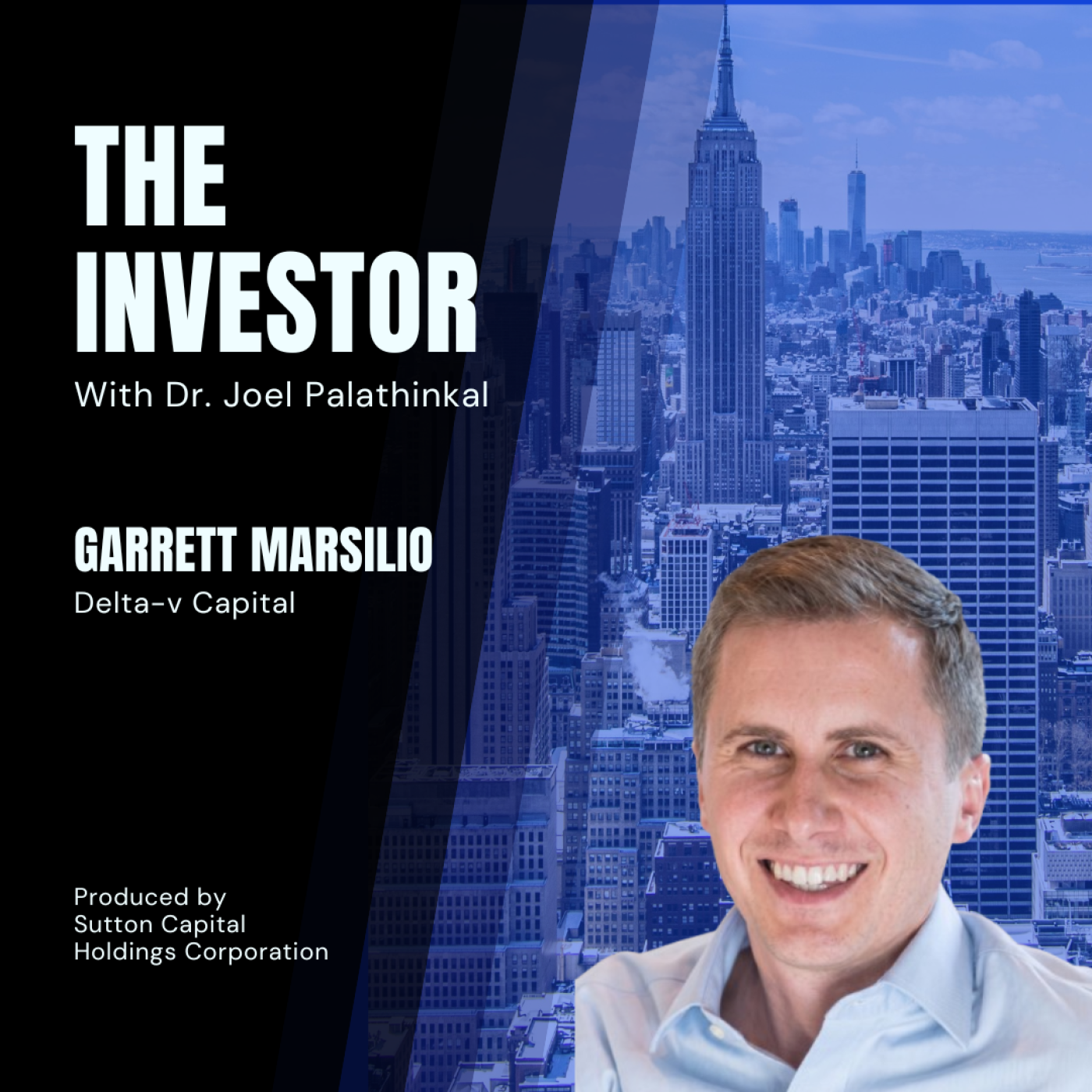
Welcome to the Investor, a podcast where I, Joel Palo Thinkle, your host, dives deep into the minds of the world's most influential institutional investors. In each episode, we sit down with an investor to hear about their journeys and how global markets are driving capital allocation. So join us on this journey as we explore these insights. All right, really excited for my guest today, we've got Garrett Marcillo, who's a partner at Delta V Capital. He has the privilege of collaborating with a growth network of investors and operators who align with his core values and investment philosophy. His role centers on partnering with ambitious cloud services and vertical software companies. And he's actively supporting strategic growth initiatives and acquisitions designed to build enduring value. A guiding principle for him is the economic concept of additionality, or simply the property, the property of an action resulting, in effect of what would have occurred anyways without the action. So that the best, the most fun partnerships, you know, over his career have yielded terrific outcomes which would have unlikely occurred otherwise. So it's really just kind of compounding on what's already there and building on the momentum of what's already there and really just making 2 plus 2 hopefully equal 10. Right. So just really quick background on his career. You know, he was an investor at Common Fund Capital, graduated summa cum laude at the Wharton School of Business at the University of Pennsylvania with distinction as both a Joseph Wharton Scholar and a Benjamin Franklin scholar. So super impressive. Would love to kind of double click on those credentials just to kind of learn a little more. And he serves on the board of directors for several Delta V portfolio companies and also volunteers as a chair of the board for a Colorado based social services nonprofit. So, Garrett, welcome to the show and I'm excited to have you here and learn a lot from you today.
- [02:01]
B
Thank you, Joe. That's a very great introduction to me. I really appreciate it.
- [02:05]
A
Yeah, no, no, no problem at all. My pleasure. But look, would love to kind of dive a little deeper to maybe one or two dimensions in granularity. You know, obviously you got the great credentials. You know, most of the people that get into private equity, you know, come from all walks of life. You come from, obviously, a great institutional background as well. Tell me what was going on in your mind in high school? You know, what did you think you wanted to do? What were some of the influences that kind of drove you to want to pursue private equity? Because obviously there isn't a specific degree. Right. When you graduate from high school and you're thinking about college, they don't have a specific degree seeking program that's like, hey, this is venture capital. This is private equity. This is banking. So a lot of times it comes from, you know, finance or accounting or even something else like engineering. But tell me a little more about kind of, you know, the early days.
- [03:04]
B
Yeah, great question, Joel. And I'm chuckling here because I don't think I've ever heard myself described as institutional before, but I guess maybe I am now institutional. But that's certainly not my background and not my upbringing. And I grew up in Cleveland, Ohio, and I was fortunate enough to get a scholarship to go to a small Catholic high school just outside of Cleveland in a city called Lakewood, right outside there. And my parents were not business people. And so my exposure to business was negligible, if any at all, when I was in high school. And what I remember at a young age is often having many different types of businesses to make money. And so as an example, I had a paper route. I also had a lemonade stand. And I remember we built a massive lemonade stand, and we took it to the local park and tried to sell much more than just the lemonade you could sell out in front of your street. I recognized that there was an opportunity to go to the concerts in the park and make money that way. And so my upbringing was a lot of those types of entrepreneurial experiences. Mowing lawns, et cetera. And then in high school, I was fortunate enough to have a few friends where we saw the opportunity in the Internet. And back in the day, when I was exposed to the Internet, the Internet meant making websites, and for us, it was making websites for small businesses. And so we would approach local mom and pop businesses in the community and make small businesses for them. And that was my first, I'd say, real foray into business. And I like that. I really enjoy the opportunity to hustle and to make money in that way and to provide value for others by having specialized knowledge and then taking that specialized knowledge and making it valuable. And so I was fortunate where I applied to the University of Pennsylvania, the Wharton School of Business, and, geez, I didn't know anybody who had ever went there. I think I found out about it, really, just reading online and just seeing the different notable alumni that had come out of that school. And I thought, well, if I want to go to business and do something related to business, let's see if I can get into what I believed at the time and I still believe is one of the best business schools in the world. And so applied. And I still remember the name of the admission officer who accepted me. Her name is Blair Godfrey, and she's a wonderful woman for letting me in, and she was very kind. And the reason that she let me into that school is she did a reception at the local Hyatt in Cleveland, Ohio, and I attended that. And she came up to me at the end, or I came up to her at the end, and she said to me, you know, you're the only student who is here without their parents. And that really speaks to, you know, your drive and your personality. And I'm forever grateful for her for admitting me to that school because it clearly changed the trajectory of my life, I'd say, and got me into a career that I love and I'm passionate about, which is helping entrepreneurs build big businesses.
- [06:01]
A
That's amazing. I think it's a huge feat to kind of get into an elite university because I think changing your environment can drastically just change your life, Right? And it's those people that you remember in your life. And, you know, most importantly, obviously, you remembered her name. But I think what. Most importantly, what I'm gathering is, you remembered how that person made you feel. And I think that's so important too, you know, as we grow in our careers to touch other people's lives and create impact, you know. And then I think what would be really great to touch upon very briefly is maybe just some advice you have through the recruiting process. A lot of the people in our community are looking for that next step in their career. A lot of people are looking to, you know, break into private equity, as they say. So what are some things that, you know, could help candidates stand out when they're applying, especially when you go to such an elitist university? There's so much talent. There's so many people that might already have private equity experience or some banking or finance experience. So with. With all the people applying in such a coveted role, what are some of the things that you think you did to possibly stand out and essentially outperform in the interviews to land these awesome roles?
- [07:16]
B
So I think it's persistence, persistence. Persistence is really the answer that I have, you know. You know, I came from a world where I had zero connections to the world of finance. I had zero friends, zero family that knew anybody at Goldman, that knew anybody at Citibank, any bank, anywhere, had really no connections whatsoever. And I remember when I was in and, you know, going through recruiting process, and I haven't been through a recruiting process, and now a decade, because I've grown up in the firm that I'm at, so it's been a while, but my memory of that is quite literally putting together a spreadsheet and going one by one of all the different recruiters that are out there, what's the story that I'm going to tell them? Going out and identifying all the firms that I wanted to work with and work for. And what I was looking for out of my career is an opportunity to join a relatively small and a relatively young firm that I felt had potential to grow into something larger. And I wanted to be a part of a journey that started small and then got larger. And that was quite important to me and how I was focused on my search. I did not want to be at a big company. I did not want to be at a family type of business that would stay small forever. I wanted to be with a team that I felt could grow and aspire to do great things together with. And so that was the focus of where I spent time on. And what that means is trying to find individuals who have had prior successes and have built interesting businesses, have had great careers, and are now looking to do their next thing. And so that was what I optimized for when I was evaluating the types of opportunities to go work for. And then ultimately it came down to finding people that you like to work with and like to be with and are inspired by. And, and, and that's, that's how I, I, I conducted my search.
- [09:02]
A
Yeah, I feel like some of that targeted search comes in. I may be kind of assuming here, but I'm assuming some of that stems from your entrepreneurial spirit. You know, kind kind of joining a team that is somewhat entrepreneurial there. You know, you see the potential in them. They want to grow, and you want to be part of that rocket ship. So that's what I'm assuming. But would love to kind of hear maybe a lesson or two from the lemonade stand or some of those first businesses that you, that you started and what you really learned about life and about just building a business.
- [09:37]
B
Wow. So I, I've learned to optimize for having fun. And when you have fun, I feel like. Well, not. I feel like I know that my most successful experiences have been when I'm having fun. And so one of the most fun times that I've had early, early on in my entrepreneurial journey was I started a newspaper on my local street. And I just really enjoyed doing that and had a lot of fun doing that, having a street newspaper. And then as I've matured and gotten older and gotten to work more in the quote, Unquote, bigger leagues within private equity. I have always been, I've always gravitated towards individuals that I feel like I will enjoy working with and alongside and helping them. And they're helping me build my career just as I'm helping them. And just don't be afraid to trust your gut. Sure. At the end of the day, where I have gotten in trouble in business and in life is when you start to try to over explain things. And so as a real tactical example, you can look at a company that's not growing and you can convince yourself that there's some pro forma growth rate. There might be what's called an ideal customer profile analysis, an ICP analysis, where you might decide, hey, if I look at a subset of the customers, they're actually doing pretty good, but overall the business is not doing good. So I'm going to convince myself to invest because. Because I've overanalyzed the situation. And I found by and large, when I feel like I'm overanalyzing and digging too deep and trying to go against my gut in those cases, those have been some of the bigger mistakes that I've made in my career.
- [11:17]
A
I think that dovetails into another question I have, which is just kind of your process for sourcing and screening and maybe taking them to ic. I think the gut is a huge piece of that. And then I think to add to that, I'm assuming there's probably just very rigorous quantitative things that you look at. The qualitative stuff I think is definitely the concept of just backing people, which kind of maybe ties to your gut. But there's probably some quantitative non negotiables or check marks that are on the qualitative side too. So we'd love to maybe have you maybe just talk through at a high level how you find, you know, winning companies, winning teams, and how you kind of try to foresee potential outsized returns. And some of that goes out to, you know, obviously the financials and the return analysis. But maybe there's a framework or kind of something that's worked for you to kind of make it simple so that you're not over explaining.
- [12:14]
B
Yeah, I think it's a great question and it is. The answer has changed quite dramatically over the past few years and specifically because of AI and how we use AI and engage with AI in order to find better companies, get in front of better companies, and then help our businesses in ways that we were not able to before. And so to bring that to life. Every private equity firm has a database it might be in Salesforce, it might be in HubSpot, it might be in DealCloud. And typically these databases that the private equity firm has been around for some time and has had a team of associates out sourcing and partners outsourcing, they may have tens of thousands of companies in that database. And that's certainly the case for our CRM instance. And then the challenge becomes, well, how do you process all those companies? There's just no way for any one person or even a team of people to, to go through an efficient way and process and prioritize which companies to reach out to. And in the past, I think much of venture capital, much of private equity, has been a fairly serendipitous or almost ad hoc type of process. It's a lot of it's based on relationships, a lot of it's based on you happen to be in the right conversation at the right time. And now with the world of AI, I think it's making the markets much more efficient. And that is to the benefit of really entrepreneurs. And to bring that to life, what we do is 50% of our investments that we've made out of our most recent fund has been sourced by our agentic outreach programs. And so we have an algorithm that we're constantly refining that takes in various signals, LinkedIn employee growth, the backgrounds of the founders, the sector that the company is in, the types of investors that have been in the company prior to us getting involved. And it scores those companies and it helps us decide which companies are those that we should reach out to in priority. And then when we do so, we then set them up on an agenta cadence. So it's not me following up every couple weeks and quite literally is an agent that is in my inbox and in my LinkedIn that is sending personalized messages to the entrepreneur and explaining to them why we are the best fit for them. And so our ability to get the right message out to the right people at scale has increased probably tenfold because of AI over the past two years. And that has quite literally led to we made eight investments out of our most recent fund so far. And half of those investments, four of the eight have been a direct result of the efforts that I've just described to you. And so I think the market is getting way bigger, way more efficient for folks like me. And it's just such a very interesting time to be doing what I'm doing today.
- [15:08]
A
Yeah, I think what I'm hearing is I think there's going to be a convergence where a Lot of the sourcing, if you're saying 50%, a lot of the sourcing will be handled agentically. But I feel like still the screening and the people aspect of it and really just determining if this is the team that you want to back. I think you still want to have a human being make that high stakes decision. So, but correct me if I'm wrong.
- [15:31]
B
Yeah, I, I think at the end of the day, so our, our decisions on investing are made by an investment committee. That, which, which I sit on a lot of my partners and, and, but you know, we're, we've gotten approval for a deal later today and last night I spent several hours in Claude using skills that I've developed in Claude to help me really create both the bull case and the bear case foreign investment. It's not my deal, it's one of my partners. And I have an incredibly more informed point of view coming into my committee meeting than I ever could have had before without AI. And so we are using AI across all of our processes to augment and refine our judgment. But at the end of the day, is it a human decision? Yes. I do wonder, Joe, how long that's going to last. And as we prove this out, we are currently building systems right now that say yes or no on investments. We're going to have the ability to back test those decisions. And at some point in the foreseeable future, I think we're going to be relying more and more on those types of systems. I think another great example is so much of private equity and venture capital is it's really an apprenticeship business. And, and what I mean by that is I think many people that are successful in this industry find a couple mentors who have been successful in the private capital game, attach themselves to those individuals and learn from them over typically a long period of time. Those mentors at some point retire and they move on. And now you have the ability to capture their thinking through custom trained LLM systems where you can pull in all the writing of your mentor, all the decisions they've made, and then ask them and even past their death in 20, 30 years, what would so and so think. And so one of the ways that we're ensuring that we take advantage of this is trying to increasingly document all the decisions that we make so we have those records that will continue to accrue value to us as a firm going forward.
- [17:35]
A
Yeah, I think that's interesting too because I feel like it could be a copilot as you're currently diligence, maybe you're diligencing a quantum computing deal. Right. And let's say unfortunately your partner passes 10 years from now and that's someone that you look up to. Your partner's conscience could still kind of give you feedback and say, hey, remember this last quantum computing deal that blew up? Now the technology has caught up. So I think this is a green light at this point. But hey, I want to remind you of that deal that we did back in 2026 that had these concerns and, and these, these edge cases and, and this is why we pass. But you know, that co pilot of that conscience I feel like is something that could exist, which I think is interesting. What are, what are maybe the five top skills that maybe a principal or an associate should develop using Claude, I guess. What are some of the new superpowers that they should sharpen up on or that are new skills to acquire?
- [18:34]
B
Yeah, I think it's first draft of everything needs to be done through AI. And so, so you know, that includes, you know, first draft letter of intents. You know, we, we, we, we certainly have a library of samples and, and we, we, we upload them and say hey, here are the key principles that we're looking for in this, in this offer letter and then go, go draft it. And is it, is it perfect the first time? Absolutely not. But are you able to do things ten times faster? Yes. And so I, I would strongly encourage people to think, okay, first draft is always AI. How do I use AI to, to do. And then really try to avoid monotonous labor like that is why I think this field is becoming so much more interesting is because early on in a career of a private equity or a banker, so much of the work that you're doing five years ago was you're spreading comps, you are doing monotonous work around PowerPoint to make sure the presentation looks right, et cetera. You're turning NDAs. And so much of that workflow is, is now automated or nearly automated through the use of LLMs. And that's enabling associates to up level and work in areas that they weren't really able to before. And now they're spending more time sourcing. Now they're spending more time in thesis development within our portfolio. They're spending a meaningful amount of time supporting the CEOs and entrepreneurs that we work with and how they can build their businesses. And so more time allocated to those tasks and less time allocated to the more monotonous tasks.
- [20:05]
A
Yeah, I think if you could double down on just quality time with the founder, that now yields four or five new intros. Those are things that you can never really manually replace with AI because it's a human connection. I think if you could double down on your AGM and have an amazing experiential experience with just your portfolio companies with the LPs and then the decks and the reports and the performance reporting, that normally would take you probably 10 hours because you got to really go back and update the slides. And to your point, the formatting, there's a software called Gamma where you can literally just type in a prompt and it'll just build out the entire deck. I think Claude has the same thing now as well. To just generate a deck based on a prompt. Yeah, I mean I remember those days just kind of spending hours just trying to make sure the fonts were right. And that was half of my time beyond just the content. And the content could just kind of be generated now using image generation and a lot of the libraries that are out there. So. Totally agree.
- [21:16]
B
It even enables meet up level my time too. It's not just time. And so as a real example, when I was going through diligence as a partner early on in the wave of AI two years ago, I was spending a good amount of time understanding the financials, a good amount of time digging into retention metrics, a good amount of time with things that are now just so highly automated that I don't need to spend as much time there. And I'm able to allocate my time to much more strategic things that are valuable to the company. As specific example, now whenever I join a board of a company, I'm often doing a great deal amount of work talking to corporate development departments of potential buyers of the company that I'm joining. So my most recent investment, I made 20 calls to corporate development departments and then I can take that work and bring it back to the board and help advise the company on the most important strategic initiatives using real data from real conversations from real buyers. And so these are things that I candidly just didn't have time for. As you know, the intensity of getting a deal done is very high. But. But now that you're able to automate much of the workflow that enables you to think more strategically and spend more your time in ways that are more directly valuable to the businesses that you're working with.
- [22:35]
A
Yeah, I totally agree. I talked to a manager recently that is now on their third fund and you know, they've been investing heavily into communities of other established managers because part of it too is not just getting to your destination, but it's refining the craft, the skill of being a better investor. And a lot of times when you surround yourself with other investors that are equipping themselves with the more modern tools, it keeps you sharp and, you know, kind of at the edge of everything. I mean, when you think about becoming like a, you know, a medical doctor, they every five years have to kind of get recertified, right? And kind of get. Get up to date on the best, best practices. So I think it's the same that carries over with being an investor and continuing to be a better and better investor and streamlining your time. What do you think is important when you're thinking about hiring talent? What are some of the maybe soft skills and hard skills now in the age of AI that are super important and just in terms of character as well?
- [23:40]
B
So we, the principle that we use at our firm to hire individuals is we ask ourselves, does this individual bring the bar up or keep the bar the same across the firm? And we believe that we're growing and winning if we're adding people that are even more capable than the people that are currently in the organization. And so if I'm adding an associate to my team as an example, one, the bar super high because so much of the work can be done by AI today. And our associates today are super men and women based on using AI. And then two, I asked myself, could this person be a partner at a private equity firm one day? And that is the bar. I think three, four, five years ago, it was a completely different game. And candidly, many private equity firms. There's an individual I used to work for a decade ago, and I won't share his name, but he used to refer to associates as the work team. And I think that was the mentality is you would bring people in and you'd have them work for a small period of time, and then they would go on to business school, they would go on to some other career. They would not stay and grow within the firm. And today, people that are just part of the work team, you don't need that anymore. You have AI for that. So today you're looking for people that have really such strong upside potential that you look at yourself, said, this person needs to join the organization. I don't even know if there's a role for them in the organization, but they need to join the organization. We're going to make room for them because they are quite likely to continue to grow within the firm and maybe even be a partner one day. And that's how we approach hiring, particularly on the investment team and then on the non investment team. I'd say that the principle holds the same, which is we are looking for people that have a tremendous amount of ambition, a tremendous capacity, and just desire to make an impact in the world and to do something really interesting and extraordinary. And at the end of the day, that's what we screen more for than really anything else in our interviews.
- [25:52]
A
What are some of the common attributes that you've seen across the board of people that meet that DNA?
- [26:00]
B
It's a great question. They tend to have a chip on their shoulder, sure. Candidly, they tend to have a desire to prove either themselves or somebody in their life that they can be successful. And that type of mentality I have seen is often true for many of the best executives that I work with, the best entrepreneurs that I work with, where they're just relentless because of the chip on the. And it doesn't mean you have to have that, but that's the pattern recognition that I have. Portfolio.
- [26:31]
A
Yeah. At the end of the day, you got to look at the data and let the data kind of tell you what works and what doesn't. And then the other piece is just your instincts. I know we're at time, so I want to just ask you real quick for maybe one piece of advice. Could be life advice, it could be professional advice. Could be a piece of advice from a family member or a past boss. Whatever you got for us, Garrett, we'll take it with us.
- [26:52]
B
So my advice is never underestimate the power of serendipity. And what I mean by that. Things happen. Sometimes you can't explain them for reasons you can't explain. And so because of that advice, I'll give the second piece of advice, which is you just can't give up. You have to keep pursuing your dreams, just continue to push and things happen, bad things happen, good things happen. But if you don't give up, man, you're more than likely not going to find yourself having some fantastic successes in this life. And I just encourage people to, to keep at it. I came from a very humble background. I had nobody in my world that was knew what the word private equity meant. And so the fact that I'm now a private equity partner at a fund managing $1.6 billion is remarkable for me, given my background. And geez, it's possible for anybody out there that wants to do it.
- [27:41]
A
Well, Garrett, thank you so much for being so generous with your time. And I really appreciate it personally. And I know that everyone in our audience audience has learned a lot. So thanks for your time and all the great things that you guys do for founders and the community and your and your lps that you're supporting. So appreciate.
- [27:57]
B
Thank you, Joel. I really appreciate it.
- [27:59]
A
Absolutely. Have a good one.
- [28:00]
B
Bye.