Loading summary
Transcript56 lines
- [00:03]
A
Welcome to the Investor, a podcast where I, Joel Palathinkel, your host, dives deep into the minds of the world's most influential institutional investors. In each episode, we sit down with an investor to hear about their journeys and how global markets are driving capital allocation. So join us on this journey as we explore these insights.
- [00:26]
B
It.
- [00:53]
A
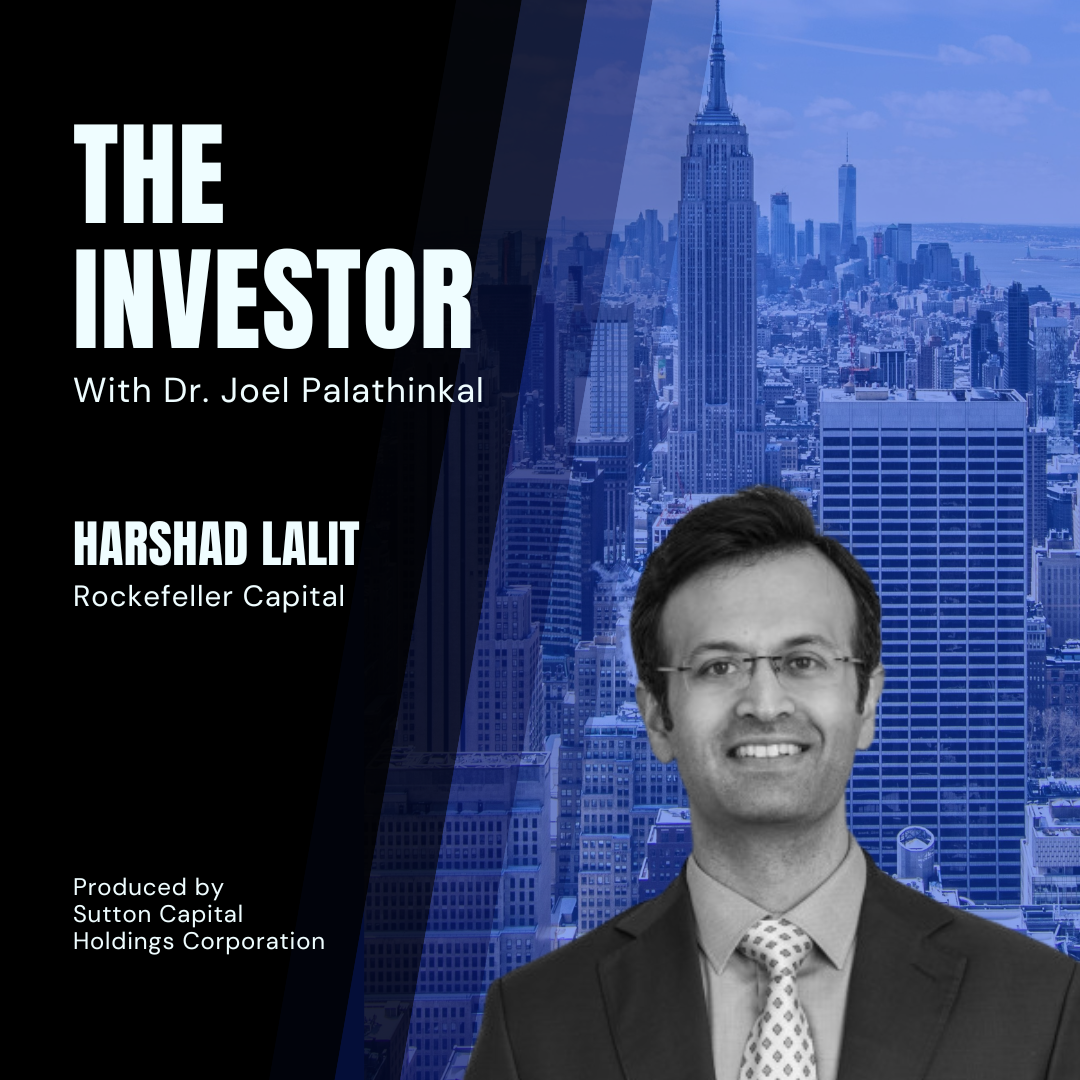
Okay, looks like we're live. So, Harshad, thank you for joining. So we're here today with Harshad Lullat with Rockefeller Capital, and I'm really excited to have you on the show. I think a few things that we have a shared interest in is impact and esg, but then obviously other things, entrepreneurship and interesting things with you and I is we have technical backgrounds and we've transitioned into finance. So that's really great to have that commonality. But thanks for joining on the show. Really honored to have you here to mentor us and excited to learn from you.
- [01:31]
B
Yeah, absolutely. Thanks for having me. And it's a pleasure to be here.
- [01:37]
A
Yeah, absolutely. Well, hey, you know, we've got a great group of people here, you know, on the show with us, so they'll, you know, have some good questions, hopefully at the end, and, you know, excited to learn more about you. I think where we can start. Start where I usually start is learning about people's careers and, you know, how they navigated through their career. Because we all have a weird path of how we ended to where we are now. So I think you have a really interesting one. So love to know. Let's just start in the beginning. You know, where'd you grow up? What did your parents do? And then, you know, where'd you go to school? And how'd you kind of navigate into the role that you arrived at now?
- [02:15]
B
Yeah, absolutely. So, yeah, just going back to the beginnings. I am from India. I grew up in the capital, New Delhi, and my parents, my father is a lawyer in the Supreme Court of India. My mother was a practicing lawyer, and then she became a housewife. So, like, growing up, my father is actually the third generation of lawyers in the family. So we are all like my grandfather, my great grandfather, again, all lawyers.
- [02:47]
A
Yes. Do they want you to be a lawyer as well?
- [02:49]
B
Exactly. Yeah. So it wasn't like the stereotypical engineer or doctor in the house. They wanted me to be a lawyer, but, yeah, I had no interest in law. Absolutely. And then I chose, like, after. During high school in India, you have to choose either science or commerce or arts. These are the three options that you have. And I chose science because I liked the whole field, and engineering and that's sort of how I transitioned into engineering post my high school. So for my undergrad I did an undergrad in mechanical engineering. And then just through my undergrad I was like really interested in aircraft and space and all of these things, which are like childhood fantasies for many kids growing up these days. And so just that childhood fantasy and like watching movies like Top Gun, you know, just, just made me transition into aerospace engineering, which I did in my masters. So for my grad school I came to the US and I landed in Los Angeles to do my grad school in aerospace engineering at usc. And then I spent like two years there and decided that I want to specialize in some kind of a very specific subject in aerospace engineering. And so I chose to do a PhD and I went to Purdue University, which is in Indiana, for my PhD and I specialized in a topic called combustion physics. It has nothing to do with finance. No correlation whatsoever, but just that while I was studying and during my third and fourth year of my PhD, I was introduced to all of these advanced technologies like machine learning and AI and how these could be used in a financial setup. And what are the applications of these very high quality mathematical approaches that we use in a bank or in a hedge fund or in an asset manager, for example. Things were changing very rapidly. Investors were not only looking at discretionary styles of investing, the traditional fundamental approaches of investing, but they were also using lots and lots of data, alternative data and statistics and mathematical approaches to get portfolio construction and invest systematically in the market. So just, just like it sort of was a natural transition, my interest in the field just grew naturally over the years. I also took up the CFA exams to sort of learn more about what's going on in the financial world. And so, so yeah, I would just say like it was just, it wasn't a forced transition, but sort of a natural process that my interest grew in the subject and I sort of like tilted completely engineering role to now being in Rockefeller Capital, where I look at systematic approaches to investing with an impact based approach as well.
- [06:20]
A
Yeah, and I have seen a pattern. You know, I don't know if you've started to see this too, but I have seen a pattern of PhDs that have a physics background get into private equity and finance, and I'm not sure if that's happening more often. It's a lucrative industry to get into normally versus your options of staying in academia or being a professor or you know, even going to an aviation company. I feel like it's an attractive opportunity, but I feel like some of the things that you would have to be successful at as a, as a physics major is I'm really doing a lot of modeling, I think.
- [06:58]
B
Right. Yeah, yeah. So I just feel like, you know, traditionally when you look at like 20 years ago, most of the people who transitioned from a physics background into finance were mostly doing like option pricing. So that was probably the only application of, you know, technical matters, technical expert into finance, like option pricing and how do you solve for derivatives and all of that. But nowadays, like with the advent of more and more data and these technologies, like machine learning, AI, you have these, you know, the same, you can have different applications in finance like credit risk modeling or fraud modeling or you know, in asset management. How do you create systematic portfolios? How do you create new optimizers to optimize for portfolios? Asset allocation can be done systematically. So there are these different applications and. Which is why you see a lot of people shifting from pure engineering fields into these different applications in the financial world. Yeah.
- [08:05]
A
And I would say more and more these financial firms are, they have to eventually kind of be almost like a tech company or at least hire engineers as much as they would hire kind of a financial person as well.
- [08:18]
B
Absolutely. It's, I guess there is a tremendous shift from being just pure discretionary to now being like quantum mental in nature where you're not only looking at DCF models but also applying a quantitative approach to your investing philosophy. So that's where people like us come into the picture.
- [08:40]
A
And there was a little bit of, there were some small changes to the strategy I think at Rockefeller too, where you guys wanted to have more of a quant strategy. And that was a little bit of a shift in advancement from the traditional asset management that you saw as well.
- [08:55]
B
Right, right, right. So yeah, I mean, just going back to the history of the company. So we started off being just a very small family office and this is like a hundred year old family office which managed the money of the Rockefellers. Rockefellers. As you know, John D. Rockefeller was probably one of the richest people on earth. In today's money. He was probably worth around $350 billion or something. And even his like fourth, fifth generation are millionaires even now. So we started managing money for the Rockefellers. And the Rockefellers sort of initially were very philanthropic in nature. They sort of were the pioneers of this philanthropic approach. Giving back to society, giving the wealth to society. But then this transition sort of came in about three years ago when a hedge fund infused capital in our company. And that's when we sort of changed our name from just Rockefeller and Company to Rockefeller Capital Management. And that's when we started, you know, reaching out to more and more institutional investors and generating more capital and launching more and more strategies. So that was sort of the inflection point of the company where we had originally very fundamental and discretionary approaches to investing. And about a year, year and a half ago, we launched, not launched, but we are still in the process of launching it. But we thought of why not applying a quantity quantitative approach to investing. So those are going to be two streams of investing that we are going to have now in the company.
- [10:49]
A
That's really interesting. And any advice for people that are transitioning maybe from tech to finance, what are some tips that you maybe have for those people? Because I mean, how did you kind of sell yourself as, hey, I'm this PhD person that studied combustion and I think you worked in the aviation industry for some time as well.
- [11:10]
B
Right, right, right.
- [11:12]
A
So any advice? Because I look, I did the same thing, right? So I have my own advice. But I'd love to hear someone else that kind of went through similar path. Like how, how did you pivot?
- [11:22]
B
Yeah, so when I pivoted sort of, I realized that there are these different kind of roles that people in tech or who have a quantitative background can switch to in the financial world. So for example, you can have these kind of software engineering, extremely programmatic kind of roles in the high speed trading world where the trading is done on a very, very low latency and the objective is to code as fast as you can and have algorithms that trade as fast as possible to have minimum alpha decay as possible. Then there is a different kind of role where you are sort of assisting a discretionary or fundamental portfolio manager by applying quantitative insights. And that's probably sort of in a traditional asset management or a hedge fund kind of role where you are a quant researcher, but you are assisting the fundamental portfolio manager, providing him with additional alternative data insights and quantum approaches to investing. And then there is a final third kind of a role where you are launching your own systematic strategies. So instead of having a DCF model governed buy and sell decisions, you have a portfolio of stocks and you have an algorithm that you either invent on your own or you use an existing one. And that algorithm basically makes the buy and sell decisions for you. And that algorithm could be like very high speed in nature. You could have a high speed trading using that algorithm or it could also be a passive kind of an approach of investing. So those I think are three different kinds of roles where people from a tech background could switch to these days.
- [13:24]
A
And then when you do the, you know, when you're in the interview, what are some, maybe some. Those are I think some good quantitative and applied ways to kind of sell yourself and then any other soft skills, you know, as you're kind of selling yourself to kind of break into a financial industry.
- [13:43]
B
Yeah. So I guess what I noticed and what my experience was that many of these hedge funds and asset managers which are looking for quantitative people are looking for some kind of data experience. So you have to have experience in managing large chunks of data. So maybe like if you have your own, you know, you have your own personal projects that you have done in the past and you have made sort of like a template, a website of all your projects that you have done that could be really useful to the hiring manager who is ultimately going to hire these kind of people. And so yeah, that's maybe just sort of like on GitHub, if you have any code repositories, then you can showcase that as well to the hiring managers. So things like these, you know, they just add a couple of extra brownie points to your whole profile.
- [14:45]
A
That's a good point. And then also I think what you're, what you're getting at too is tailoring it to like what that firm needs as well. So if that firm is specifically looking for esg, you could probably submit like an ESG model or some ESG quant strategy. I don't know if you know Neil Dutta, he's at the Forbes family office. So he's at a multi family office. But then he also started a company like a fintech app. And what I thought was really interesting is the fintech app people can come up with trading strategies and then the trading strategies, they can submit it directly to companies who are hiring. So that made me really think like that's really the future of the resume. Right. Instead of sending somebody a resume, kind of what you're getting at sending GitHub, you can actually share like this cool analytics or like it's kind of like a dashboard that you can send with your font with your portfolio strategy.
- [15:41]
B
Exactly.
- [15:41]
A
So I feel like that would be more relevant than looking at like an over embellished resume. Right. So the data, I feel like more and more the data is really the data. You can't really lie with the data. Right. It's the hard information and quantitative numbers that really show if you know what you're doing or not.
- [15:59]
B
Right? Absolutely. Yeah, yeah, there are these. Yeah, I See what you're saying, like there are these other apps and software called, for example, Quantopian is one where you can basically launch your own strategies. And the strategies, if, if hedge funds and these asset managers like it, then they can license the strategies from you. And so you have access to all of the financial data there. So you can sort of play around with different approaches there. And so these are kind of like unconventional ways of putting yourself out there and showcasing your talent to these hiring managers.
- [16:41]
A
Yeah, because the other parallel I see is, you know, in other industries, right, if you're, if you're a UX designer, you usually have like a portfolio of designs that you've done. And even as an engineer usually have a coding test. So it just seems natural to do some type of quant strategy test that you can show that's like backtested. So I think that's an interesting possible parallel to like the future of hiring and employment.
- [17:06]
B
Right, interesting.
- [17:08]
A
And let's talk real quick about your PhD. So I think I know the process because I went through the painful process like yourself, but maybe you can educate people real quick on the steps to complete your PhD, because maybe that might not be something that everybody knows. Because I know in my experience there's a, there's a proposal exam. Wow, it's been a while. There's a, there's a proposal exam and then there's a, there's one more presentation before the defense as well. Right? I think no, there's a qualifier exam, there's a proposal exam, and then there's a defense exam. And my experience, so it's kind of like launching a startup in my experience, because you have to come up with an idea that nobody's ever thought of before. So you have to almost kind of think outside of the box. And that's the same thing when you're launching a startup, right? You want to build something that 10 other people are not already doing. So it needs to be some type of new scientific finding and you need to prove that you can show something that's meaningful with data.
- [18:14]
B
Right.
- [18:14]
A
And then I think in my experience, and I'll let you fill in, fill in the dots of your experience, but I think, you know, the proposal exam, you have to present your first three chapters, I think, and then, but you. Before that, you also have to be qualified. Sometimes you have to take a test to get accepted into the PhD program. And then the final thing, which is like really the big stressful thing, is like defending your PhD, and that's kind of my experience. But I'd love to hear kind of your journey to just coming up with a PhD idea and then actually defending and completing it.
- [18:50]
B
Yeah, so there are like PhD. I would just like put a disclaimer that it's not for everyone and it's absolutely right like how you put it, it's probably like setting up your own startup. When you join a PhD program, the first year itself, you have to give a qualifying exam. You know, so the qualifying exam is that you know the science and you know the subject matter. And only if you pass the qualifying exam will the university allow you to proceed further into your research. So the first step is basically, which is quite a horrid step, it's, it's passing that qualifying exam. And in my case I only had like 2, 2 chances pass the exam and if you don't pass it within the two chances that you get, then you're out of the school. So, so once that is done, then it's, it's all about like reading papers and coming up with new ideas, how you can differentiate yourself from the crowd, how you can come up with an idea which is, which has not been implemented before, or even if it has been implemented before, can you add an extra layer to it. So it's probably putting a lot of hours into the idea, coming up with some new idea that you can differentiate yourself from the crowd. And much like a startup, you don't have help, you only have yourself, basically you don't have external help coming into you. So that phase is probably reading a lot of papers. And then once you finalize the idea, then you have to sort of think about how you want to implement the idea. And the only way you can justify that the idea is even viable is by presenting at conferences or publishing more papers. And the whole idea is that if you publish papers, then the community accepts that the idea is viable for any industrial use or any further academic use. So one of the challenges of doing a PhD is how you publish papers and how you speak at conferences to sort of market your thought process. And then finally when you do all of this, then towards the fourth or fifth year of your PhD, you first have to give a qualifier. You have to probably give a pre defense kind of an exam where you are convincing a group of people that this is the work you have done. You have come up with a unique approach. You have published papers and spoke spoken at conferences and people like your approach. So please let me go ahead and with my PhD. So when you present in front of a group of people, then they sort of test you on these different kind of approaches that you have invented yourself. And then finally, you know, once that is done, then you have to go through the final defense process. So it's, it's kind of like your idea is your own baby, much like creating your own startup and you have to look after it and let it grow into some kind of, into a product which can be later sold into the academic world or in the industrial world.
- [22:42]
A
Yeah, sometimes too. And this is an interesting take. Sometimes if you build an interesting technology, the university can commercialize it and they can sell it into industry. But there's pros and cons with that because there's always some strings attached with sometimes a university wanting to own the ip. But I don't know if you have any insight into that with like the tech transfer office at Purdue with some of your peers that were doing that or if you were building a tech. Any, any thoughts on that and how that relates to kind of maybe getting that funded as a venture backed startup? Do you think there's friction if you try to incubate something in the university versus just go out on your own after your PhD and start a company privately?
- [23:25]
B
Yeah, I mean so, so much like creating your own startup, I think one of the other processes that you have to go through is even if you have the idea, you have to get funds from outside to sponsor yourself through those five years of PhD. So you have to write proposals to all of these academic sponsors or like industry sponsors. So in my case, for example, I was working on jet engines, so you know, many of my colleagues were writing proposals to doe, the Department of Energy for example, or companies like General Electric which sponsor this kind of research. And it's also really useful for them because if the sponsored research comes up with a unique product, then they can license that product and use it for their own technologies. So it's a two way street. And yeah, it's exactly like, I agree how you put it, like it's probably constructing your own startup. You have to think of something new but also get funds to sponsor that idea.
- [24:45]
A
Yeah, absolutely. Well, hey, thanks for that, that insight, all of that was great. Just the deeper look into just the PhD and how to get through it. I know we're at halfway right now and I know that you had some really great slides that are educational. So I'm happy to. Maybe we can take some time out to go through those and then we'll leave a few minutes at the end for some questions if that's, if that works for you. On timing okay, so I'll make you the co host, so you should be able to share now. Let me know if you can.
- [25:30]
B
Okay, let me know if you see the screen.
- [25:33]
A
Yeah, we got it.
- [25:35]
B
Okay. Yeah. So basically in this presentation, I just wanted to go through the whole idea of impact investing, how the whole field has transitioned from 50 years ago to where it is right now, and kind of show what I am doing in my work at Rockefeller Capital. So basically, I am a quantitative equity analyst at Rockefeller Capital. And my company has a very unique approach to investing. We don't just look at financial metrics to come up with DCF models, but we also look at ESG metrics. Esg, I mean, environment, social and governance metrics. And we use those metrics to understand what are the risks the underlying company has when we invest. So we have a separate ESG team. And when we pitch a stock, the stock goes through the ESG review process to understand if there are any underlying risks that the company has, and if there are any environment, social governance risks, then the ESG team has the right to sort of veto the stock pitch in that sense. So that's kind of the traditional way of investing, the fundamental approach of investing. But we are also trying to understand how these ESG metrics could be used in a systematic sense for systematic portfolio construction approaches. So that's kind of a gist of the work that we do at Rockefeller Capital. But I just wanted to go through the trends and the highlights of this industry over the past 50 years. So, yeah, so I would be missing out on the whole subject if I don't speak about this legend in economic sciences. His name is Milton Friedman and he was a stalwart in economics. He won the 1976 Nobel Prize in economics. And what he spoke was very contrary to how we understand ESG right now. So what he said was that the only social responsibility that company should have is maximizing profits. And so long as it is not engaged in any fraud or any fraudulent activities, then the sole purpose of the organization is maximizing profits. So this is completely contrary to how we think about ESG today. And which is why I wanted to highlight this. Many of his theories, he believed in monetary policy, and many of his theories are still applicable. Many of the Fed governors use his theories. Especially during the financial crisis, his theories became very applicable. So I just thought that he would be a very significant figure to highlight in this presentation. And then in a parallel universe, there was this guy again, an American economist by the name of Howard Bowen. And he spoke of. He first he was the first one to coin this whole concept of corporate social responsibility. So in his article which was titled Social Responsibilities of Businesses, he spoke of how companies should also address the cost benefit analysis of social and environmental practices that they are engaging in. And this was again very contrary, although in the same time period as Milton Friedman, but pretty contrary to what Friedman's approach was. And so his ideas ultimately led to this entire notion of triple bottom line, which we now know was coined by this British management consultant called John Elkington. So triple bottom line was again derived from this corporate social responsibility fundamental. And it said that instead of having just profit on the bottom line of a balance sheet, maybe we should have the cost benefit analysis of the social and the environmental impact that the company has. And this notion of corporate social responsibility and triple bottom line got really popularized simply because people thought that companies exist only because of consumers, so there is an obligation that the companies should have towards the society. But still, even though we had these two different parallel approaches of pure capitalism that Milton Friedman gave us and corporate social responsibility that Howard Bowen coined, there was this whole notion that investors thought, what does corporate social responsibility achieve? If we integrate corporate social responsibility and capitalism, ultimately we want returns, we want some kind of return on investment, on the cash that we put in. So how can these two strategies be beneficial to the investors? So there was skepticism about 20 years ago on this whole strategy of integrating capitalism and social responsible investing. But with the advent of more and more data and accounting standards, for example, have changed with the advent of SASB and so data. And these couple of changes that are happening in the industry led to some very interesting findings. And I would like to highlight these three papers which I came across recently. So, for example, Linz et al. He spoke of how companies which were doing good for the society and had a good social impact score did very well during the financial crisis, as opposed to companies which did not have a good social metric during the great financial crisis. Then secondly, again, this paper by Khan et al. It was a very seminal piece because they were the ones who showed that they highlighted issues into these two categories, material and immaterial issues. And they spoke of material issues being those which have financial impact on the firm. And they were the ones who postulated that companies who focus on these material issues, which are basically environment, social and governance issues, have a good financial return for their investors. Then again, this last paper by Sherwood and Julia, they sort of studied the emerging market equities and they sort of came to the conclusion that the risk adjusted return of companies were Higher. Like the Sharpe ratio of these companies were higher, which engaged in integrating ESG strategies into their investment philosophy. So these three couple of papers, and there are so many others too, but I just wanted to highlight these couple. So the gist of these three papers is that it's not just the financial metrics that matter, but also how the company looks at environment, social and governance issues that ultimately decides the company's trajectory. Investors therefore should look at these ESG metrics to understand if there are any underlying risks that the company has. Because if a company has some kind of glaring risk, either in the environmental, social or governance space, then ultimately their return on investment would be compromised. Just wanted to highlight that capitalism plus social responsible investing does lead to higher returns for the investors. This is postulated by looking at this graph. The blue line on this chart is basically the MSCI ACWI Index and it's short for All Country World Index. And the yellow line is the MSCI ESG Leaders Index. So how it's constructed is that from the 2,700 securities that the All Country World Index has, MSCI just screens out companies which have a good ESG score to construct a new index which is the ESG Leaders Index. And you can see in this graph that the yellow line is almost always above the blue line for all the 10 years since inception. The yellow line has probably returned 79% to investors over the last 10 years cumulatively, whereas the blue line has returned 67. What this shows is that ESG is real like ESG. If you invest in ESG companies which have a good ESG profile, you will end up with higher returns and it is beneficial to investors. So yeah, so again, I just wanted to highlight this one more slide which again shows this is from msci. And yet again the blue line is the MSCI Acqui Index which is the All Country World Index. It is completely ESG neutral index. Whereas the yellow, pink, these orange and blue lines, they are different MSCI indices with a tilt towards ESG companies. So these indices focus in different ways on investing in companies which have a better ESG profile and than the constituents of the underlying parent index, which is the All Country World index. And you can see that this is just the first three months of 2020 when Covid was just hitting the world. And you can see that the ESG indices performed way better than the parent index which was the All Country World Index. So this just goes to show that ESG investing in ESG or having an impact based investing approach is universal and it can lead to lesser drawdowns during Black Swan events such as we saw in the first couple of months in 2020. And it could lead to, you know, sustainable long term performance, just like we saw in the previous, in the previous graph. And so yeah, so with that I just wanted to highlight a couple of trends that we have seen in the ESG and the impact investing space. So for example, this chart which I sourced from Morningstar, it just goes to show how the quarterly sustainable fund inflows have risen dramatically over the last year. So these are sustainable funds quarterly flows into like ESG ETFs. And because I work in the public equity space, most of my charts are bias towards the public equity space. But these trends are also one can observe in the private equity and the venture capital space. More and more people are looking at ESG risks, how to quantify those ESG risks. And which is why you see a lot of money getting poured in into the sustainable funds, because people have realized that even during Black Swan and very extreme drawdowns, ESG companies perform much, much better than companies which do not have an ESG profile. So this is a very interesting graph that I got from one of Bain Capital's report. And it just goes to show even in the private equity space, how things are changing. So I think the team from Bain Capital, they were just looking at Asia Pacific. So this graph is mostly representative of Asia Pacific. But it just goes to show that although on the right you have the traditional deals which only look at the financial metrics, and on the left you have the distribution of deals which have an environmental and social impact, what you can see is that on the right distribution, the tail, the left tail is very thick. Most of the deals with 1-2x or 2-3x return are very significant. Whereas on the left, if you see that deals which have an environment or social impact, the width of the distribution now has broadened up. So the deals which secured 3-4x returns have grown in size compared to traditional deals which only looked at financial metrics of a company. So again, this goes to show that the trends that we observe in the ESG space are not only limited to public equities, like I showed in the previous three graphs, but also in the private equity and the venture capital space, just like you see here. Finally, I just wanted to give a couple of takeaways and instead of like having point wise takeaways, I just wanted to show this one graph which I thought was really intuitive. And it goes to show how we at Rockefeller Capital think of ESG and Impact investing. So on the left you have the idea generation process of a traditional investor which only looks at DCF models to value companies. So the way they look at valuing companies is just looking at the financial information. They don't have any impact measurement of ESG metrics, so they don't look at how the company is focusing on the environment, social or the governance aspect of things. And on the extreme right, you have the impact investor or an investor who not only looks at financial information from the balance sheet, but also looks at non traditional information, how the company looks at environment, social and governance in the organization. To look at those kind of metrics, they track some kind of ESG KPIs and they have these kind of alternative data sets which helps them quantify the risks that the company might entail in these three buckets. And then cohesively, by looking at both financial as well as the ESG information, they can better value the companies. So just the final takeaway that if a company, if venture capital or if a SoftBank, for example, would have looked at ESG, for example, while valuing a company like WeWork, then it would not have to draw down all of those investments that it made. WeWork was devalued from let's say 47 billion to less than 8 billion in a span of six months. So had a company like SoftBank looked at the governance and the governance risks that the company, like WeWork was going through, then it would not have put an extreme valuation of $47 billion on We Work. So the takeaway here is that this, this kind of investing is applicable to both public as well as private equities because both are highly correlated with each other. So with that, you know, I'll just end my talk here and feel free to have any questions.
- [44:03]
A
Thanks, Arshad. Anybody from the audience have any? This was amazing. Thanks for sharing all this. It's always great to learn more about ESG and how you can be quantitative with integration with it. So thanks again for educating us on this. So anybody from the audience have any questions in general or just about the slides that we reviewed?
- [44:27]
C
Yeah, thank you very much, Ashad. I'm based in the UK and really appreciate the insights you shared with regards to your background and how that all fits in with esg. I'm just curious about the use of algorithm, well, the use of algorithmic sequences. I'm tongue twister at the moment.
- [44:57]
A
Tongue twister?
- [44:57]
B
Yeah.
- [44:58]
C
To pick public securities versus picking private securities. I know you've mentioned how ESG works for both public and Private. But assuming you're going to have an overlay that uses quantitative strategies for private investments, is that possible? Is that currently being done? How would you see it evolving?
- [45:28]
B
Yeah. So private equities has a challenge that things are not showcased like financial returns of the company cannot be seen by outside investors. So that is quite a challenge because the whole idea is you integrate ESG as well as financials into one complete data set to understand and value the the company, to calculate the whack of the company. But I have seen many studies which have tried to replicate private equity performance using traditional public equities. The research just goes to show that you can replicate a private equity performance using traditional asset classes for which you have data available. But yeah, I mean, the whole challenge is algorithmic approaches to private equity is still not common. It's mostly in the space of public equities that we have managed to use systematic approaches to value companies. But yeah, I don't know if I've answered your question, but it's still not common in the private equity space.
- [46:57]
C
Oh, you've answered my question because I certainly was taking stock of what you said and because my interest lies around impact and I've got some background in just playing around with quants and creating automated FX trades. So yeah, I was just really exploring it. Is that a potential gap at the moment? Sounds like it is. So, yeah, thank you very much.
- [47:28]
B
Yep.
- [47:31]
A
Cool. Good question. Anybody else have any final questions?
- [47:34]
D
Hello?
- [47:35]
B
Yeah, this is Nishtha. I'm from New Delhi. I recently came across an article from Economic Times that says that India is about to start a social stock exchange that would list companies in a manner similar to Bombay Stock Exchange and nse, but only the companies with a social cause or for social impact investing would be listed. So what's your viewpoint on that? Yeah, I mean, I wouldn't find it surprising if it does come up with a social stock exchange because things are moving pretty rapidly. So I don't know if you've heard this, but just in January of this year, one of the largest asset managers, BlackRock, it announced that it would double the ETFs that it has for sustainable funds. And for every traditional ETF that it has, it would clone the ETF with an ESG tilt as well. So this is coming from one of the world's largest asset managers, which manages more than a trillion dollars of assets. And if BlackRock is committed to having an ESG tilt towards its investing philosophy, then it's high time others do it as well. So, I mean, things are Moving pretty fast. If you just look at the previous chart I showed the amount of funds that are coming into sustainable strategies are just like growing exponentially. And I guess Covid has also been a tipping point and inflection point for people to realize that investing in sustainable strategies is the way to go ahead. So yeah, I wouldn't be surprised.
- [49:37]
A
Great, that was helpful.
- [49:40]
D
Hi there Jewel, this is Smitha. Yeah, Harshad, this is Smitha from Salt Lake City. I was going to draw a comparison. I'm from the medical background and I work for a payer insurance company, Humana. I was going to say for the past year and a half we've started. Well, most insurance companies, or rather all of them have started looking into the social determinants of health which are looking at the health of the people and what impacts them from their socio environmental spaces. And I think it's some sort of a corporate social responsible giving back to the community. Is that something that you're looking at or you know, sort of factoring in, you know, from the healthcare industry? Obviously Covid's brought that into the surface now more urgently than ever. But I think that's the compare, that's what would be equivalent in the field that I'm coming from.
- [50:58]
B
Right, exactly. So yeah, when we look at fundamental strategies that we have, the ESG team that we have, they look at social metrics like the one you mentioned. And so many of the social metrics could be for a traditional tech company, for example, could be human capital management or how much is the percentage of men versus women on the board or in general in the company. So these are like different metrics and if you have the data for it, and if you can compile data for it, then you can understand how the company is working internally. And if, if any of these metrics show you that there is a red flag, then you can sort of adjust the rate of return that you expect from the company, so to speak. So that can impact the WAC that you finally compute to make a buy or sell decision for the company. So yeah, thank you. Great.
- [52:14]
A
Any final questions for Harshad? All right, well thanks Harshad. What I did too was I'll start doing this. I actually posted a link to some more upcoming events. We have a lot of other great speakers and these also get live streamed to YouTube so you can see the recording. So Forbes family office was with us I think two days ago. That was a really great chat and we'll have just continuously other speakers coming in so feel free to check those out. We also have a private equity and venture capital training program as well. So check that out. And thanks for joining. And Harshad, thank you so much for educating us on this insightful and timely topic.
- [53:04]
B
Absolutely. Thanks for having me. It was a great pleasure speaking here. Thank you. And hoping for many more to come. Yeah.
- [53:12]
A
Hope to see you soon in New York when things calm down and be safe.
- [53:17]
B
Sure. All right.
- [53:18]
A
Take care. Bye, guys.
- [53:19]
B
See you later. Sam.