← The Investor With Joel Palathinkal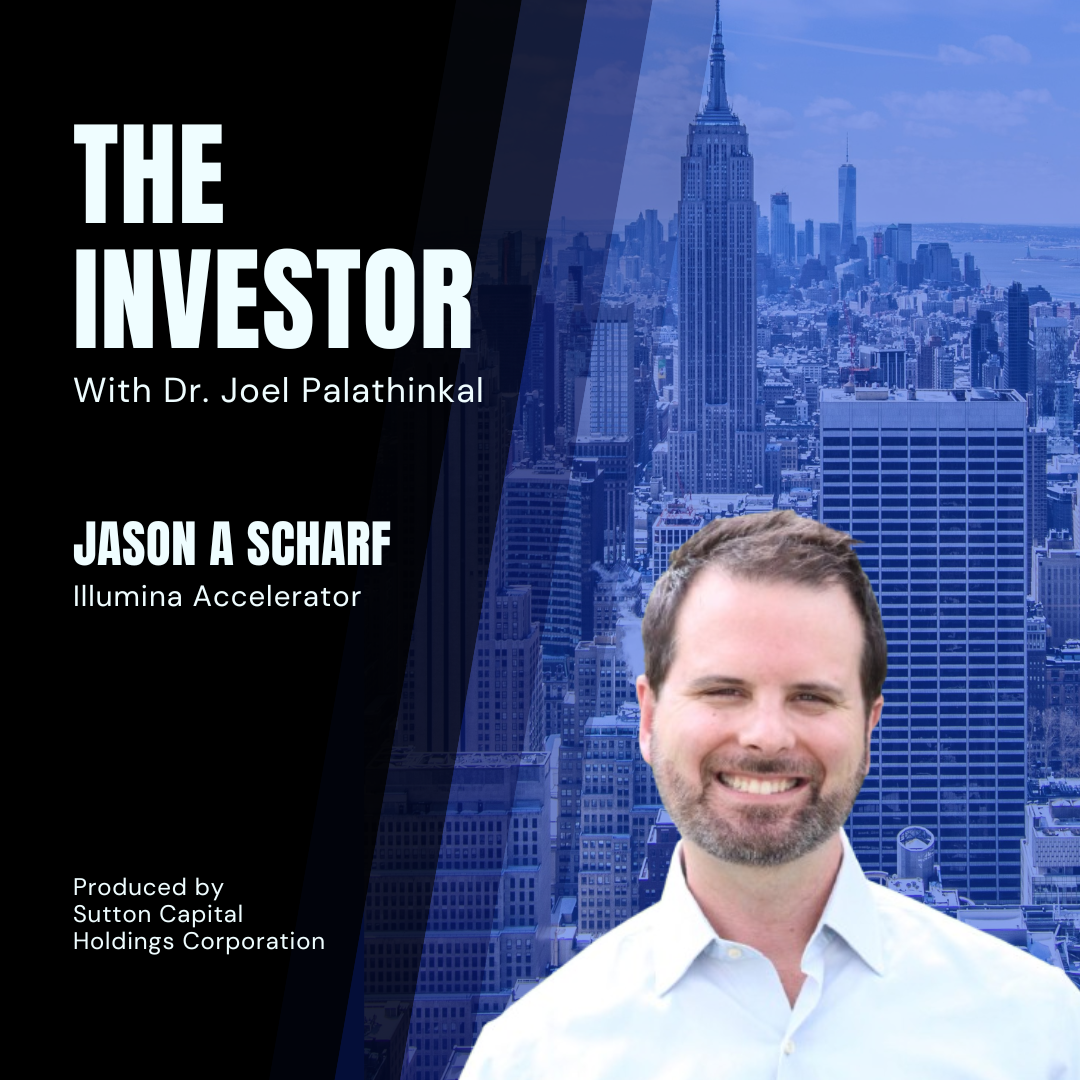
Loading summary
Transcript94 lines
- [00:03]
A
Welcome to the Investor, a podcast where I, Joel Palo Thinkle, your host, dives deep into the minds of the world's most influential institutional investors. In each episode, we sit down with an investor to hear about their journeys and how global markets are driving capital allocation. So join us on this journey as we explore these insights. So it looks like we're live. We are here with Jason Scharf and really excited to spend more time with you, Jason. I know we've spoken a few times on the phone, so just really excited to kind of go a little deeper on your career. I think some exciting topics that we can talk about obviously is angel groups, seed investing and then just the healthcare genomics space as a whole. Some top level trends and then specifically Illumina's accelerator and then I think the different flavors of accelerators too. I think that'd be helpful to break down. So welcome to our program. Thanks for, thanks for popping in and yeah, would love to maybe kick off learning a little more about your background. Where'd you grow up, how did you start your early career? And then what are some of the transitions you made in your career as you went along?
- [01:14]
B
Sure, absolutely. Joel, thanks for having me on. I'm excited to be here. Yeah, I just want to start where I grew up. So I was born and raised in Southern California. Both my parents were from la. So then they decided to they wanted to raise children outside of la. So sure. Was born in a city called Thousand Oaks. Actually if you've ever heard of Amgen, big biotech company, kind of in the shadow of Amgen, spent a number of years there and then moved just south of Los Angeles to Orange county when I was in junior high and high school. Growing up, always had wanted to be a scientist, kind of wanting to I had this image in my head of what that actually meant. Then actually went a little bit farther south in California, went to UC San Diego with the intention of getting molecular biology degree, go get a PhD and be a scientist for a living. Had a great opportunity to work in a lab and had that moment of realization that actual lab work and I don't quite mesh and it wasn't good. Not only just from an interest perspective, but as I always kind of joke since then I wasn't very good at the hands on side of the of wet lab work. So I married a PhD instead.
- [02:24]
A
Sure.
- [02:25]
B
So then during that time then got some exposure to the business side of science and that's kind of when that light bulb went on and said hey, this is great. Let me actually helping Companies and really actually commercializing and making science happen in the real world. From there, you know, graduated, worked for a contract research organization company called Covance, now part of LabCorp. Really getting into the healthcare economics. So how are drugs paid for? How do we think about reimbursement? What's the actual value of drugs? And diagnostics went out in the being dealt with physicians and the like. So that was a lot of fun. Learned a lot there. Went back to business school again staying in San Diego, I really hit my goal at the time for a long time was always being part of the San Diego life science ecosystem. So went to the Rady School of Management at UC San Diego. Went back kind of a double Triton there, great opportunity. Learned a lot. It was actually a startup school itself. I was only the second full time class, so learned a lot about how an organization kind of grows from just being an idea to something much more substantial. Then graduated in 2008. So I have a very special place in my heart for everybody who's graduating right now and kind of in this environment because as that was kind of peak uncertainty due to the financial crisis, one of the big things that happened to me in that moment is, you know, I was going around talking to different companies, trying to figure out what I wanted to do. Talk to the vice president of business development for a small pharmaceutical company. His exact words to me were like, look, I don't have a job for you, but I have work. And of course my thought was well, I need to eat. So I think we have something there. And from there, actually my consulting firm was born. So I spent the next five years as an independent consultant working for Pre revenue to $100 million revenue companies usually with the Chief Business Officer VP Biz Dev, where they're in a position to they have more work than they need, but not quite the capital to hire on staff. So that was a lot of fun, kind of really helping those companies grow. And then I usually would also come in and more the market intelligence types of roles for Amgen Eizai, you know, some of the larger pharma companies as well. Did that for about five years. Had an opportunity to come back to San Diego to work for a company called Curefusion in the medical medication management software and medical device business in hospital. So infusion pumps, dispensing cabinets, things of that nature again in market intelligence and strategy was there for about a year and then Beck and Dickinson, a giant med tech company came and bought us. Had a lot of fun working in there for about six years. Doing strategic planning, ran the business case excellence team and then ran the market intelligence team as well. Learned a lot from that perspective, but was kind of getting the itch to do something different. So this was back in 2018 and had always Illumina was a, you know, on the rise. It's now, I can't believe it's a 20 year old company, but basically we had created the genomic space. So if you think about back in the early 90s, the 2000s, when the Human Genome Project was completed, it cost $3.2 billion to do one genome. Today on our technology, it costs about $1,000. So really about pushing that cost down. So that was something that really attracted me to Illumina as well. So I came over at the end of 2018 to be working the commercial strategy organization. And then something else which we can touch on in a little bit is Illumina also has an accelerator program that was very interesting in wanting to help work with startups. So while I was doing that transition and you know, I'd also. One of the reasons I went to school, back to the beginning, I always talked about wanting to be a biotech life science, early stage CEO and something I recommend for lots of people. I think it was a great opportunity for me was I went and actually got an executive coach and she pushed me to say, great, so if we look out ahead, what does that company look like? So like any good strategy professional, I put together a PowerPoint deck. And as we're going through this, there was a kind of a funny moment in there. We're like, yeah, there's not a product anywhere in here. And that's kind of the second big realization that I had in my life where there was an investment thesis and I've always enjoyed working with startups, but maybe that the actual entrepreneur CEO role wasn't the right one for me. And it's actually catalyzing innovation and working on the investing side. So while I made that transition to Illumina at the exact same time, I kind of started dipping my toe into the angel investing world as well.
- [07:07]
A
Sure, that's interesting. Maybe you can unpack the genome a little bit for the audience. Just kind of learn a little more about what the genome is and how can we bring that cost down continuously over the years and what are some of the main applications and just in general in industry, are we pretty late in it now? Is it pretty saturated or is there still a lot of opportunity to kind of continuously build new tech around it? Or is there like another next generation that we should also be thinking ahead of.
- [07:41]
B
Sure, sure. So if you go back to high school biology, our DNA is made up of A's, C's, T's and G's. And really what our technology at Illumina, at its core is the sequencing technology that actually can then go and read out that sequence for everybody down to, if we're looking for a specific gene, all the way to whole genome sequencing, getting all 3.2 billion base pairs understood by somebody. Yeah, I think we are really at the, I'd say the end of that maybe first wave of understanding was like, okay, so we've, we've kind of picked off, you had a lot of large consumer companies to the 23andMe and ancestries of the world.
- [08:23]
A
Yeah.
- [08:24]
B
So I think that's been a big thing. One of the biggest places that we've really been able to make differences is an oncology. If you think about cancer, cancer really is a disease of the genome. It's uncontrolled cell growth of various types of cells. And if you think about, we've for so long talked about cancer by the region that comes from, so breast cancer, brain cancer, colon cancer. But if you break down it, it really is based on the molecular signature of that cancer. So I think a great example, as we've gone through in blood cancers, if you go back 30, 40 years, we had two types. You had lymphoma and leukemia. But if you look at today, we've really been able to subdivide that into 50 to 100 plus types of cancers. And when you have that subdivision, it makes understanding more what's the cancer, what drug is actually going to be able to work against it? How should we be treating it past chemo? And so I think that's really what is opening up with the genome. And you can see that across all sorts of cancers of various diseases. If you think about in today's environment with COVID one of the first things that we were able to do to really start thinking about how to fight Covid is they actually went and sequenced the genome of the virus. And this was done in rapid, short order, I think maybe back in February. So we're really just starting to scratch the surface on the things that we're able to do.
- [09:54]
A
Okay, that's great. And now maybe we can talk a little more about Illumina and I guess some of the things that, that you guys are focusing on there.
- [10:02]
B
Yeah, so I mean, so Illumina said is we're the one of the largest genomics player in the world. Most of these companies and these labs, they're all running on our sequencer. So we're kind of the backbone of that technology.
- [10:15]
A
Sure.
- [10:17]
B
You know, our main focus today is in oncology, reproductive health and genetic disease testing. We also just recently announced a diagnostic for Covid as well. So we're definitely stepping into that space. And so really a lot of what it is is not only the areas that we're going deep, but then how do we further catalyze and grow the market to be able to do all sorts of the new use cases and new things that can be done with sequencing? And that's really where the accelerator comes into play as well.
- [10:44]
A
Sure. And then with the accelerator, what are some of the things that you guys are focusing on? Are you guys looking at more early stage companies and how big is your class and kind of what's the cadence? I think you said there's a deadline coming up for applications. Right. So where do you guys source some of these companies? Are they usually on the university side?
- [11:04]
B
Yeah. So sources is all side. You have kind of pre people coming out of universities to early stage startups. Obviously this is kind of the seed stage, pre Series A. We have been around for about six years and then have a whole. It's about four to six companies per class. We tend to be looking at therapeutics, diagnostics, software tools, and then synthetic biology as well. Synthetic biology just kind of said is it's the new kind of way to be able to take engineering principles and bring them to biology. So you think about the DNA as a code as well, what you can do with that. So a great example is DNA storage. So being able to actually use DNA as your new hard drive, which is really interesting from a cold storage perspective, that's great.
- [11:54]
A
And then I guess where do some of these companies come from? Where are kind of the best ways to source them? And how do you guys kind of promote your platform to the community?
- [12:06]
B
Yeah, so we have webinars all the time. There was just recently a webinar on something called Genome Web, which is a key a genomics publication. About a month ago, talking with our previous cohort and Amanda Cash and our vice president, head of the accelerator as well. A lot of pull in, you know, obviously from the network of VCs that we work with. Talking at podcasts like yours, Joel. Sure. So I think it's a whole range. We have two different locations. We have one in San Francisco and one in the UK as well. And so the UK one just started its new cohort we announced about two weeks ago the latest cohort of six companies. So really exciting time. Really what we help them with, we bring in, we obviously give them some capital, we give them access to sequencing, we give them the coaching and then obviously the network of VCs and other investors that we brought on so that we can go and build up these companies beyond there. Right now I think we have about a 93% post investment rate.
- [13:05]
A
Oh, that's great. And I guess what are some of the characteristics of the founders that you found were really, really exciting to invest in? I guess. Is it. Do they come from like a research background or more of a tech background or.
- [13:19]
B
It's really been a combination. Right. Like you have obviously when you have the more drug development and diagnostic that tends to be a little more tech deeper in this when you have some of these kind of interesting use cases. I think if I remember correctly, we have a traumatic brain injury one and that actually comes. It's an ex veteran. So something very near and dear to their heart of understanding what's going to be causing this. So really does depend. Right. And I think what we're looking for is people to be creating new opportunities and new use cases and entirely new markets for this. So sometimes you need to be looking in new places to finding people who are looking for these type of opportunities.
- [14:00]
A
Sure. It's exciting. And I guess what are some of the things that you guys do to support them? Is it, you know, obviously there's funding probably, but then you know, do you help them kind of connect with some pharmaceutical companies and more late stage investors to kind of get through the class.
- [14:15]
B
Or what are some of you guys? We definitely have a VC network that we tap into quite strongly that we kind of come and bring in, introduce them to. We have coaching from Illumina headquarters as well, like understanding how they should be thinking about this. One of the key things obviously is they're trying to build out their killer experiments on the sequencer. And since this is new cases and new things that they could be doing, it's really helping them think through that as well.
- [14:40]
A
Yeah, no, that's really helpful. Yeah. And I think, you know, and then what are some of the big milestones for some of these companies? So is it to get to a certain mass level of data points or tests to get out to mass market and is it also, you know, really just securing some pharma customers to actually adopt their sequencing technologies besides taking the.
- [15:03]
B
Answer of it depends. You know, I think that's one of the big things Right. In life science versus a lot more of the tech is since generally speaking you have less product market fit issues in life science because like, hey, I make a great new oncology drug that works. I don't really need to worry about product market fit per se. It works. It doesn't. You have much more of. It's the technical risk. So I think when you think about building out those milestones for any sort of life science companies, it really becomes what's the level of data that I need to to de risk the project moving forward, Whether that's in vitro, whether that's animal data, whether that's not necessarily for the lumen accelerators, but starting it into human data, I think that ends up being the key cases to be thinking about when looking at milestones is really what's the experiment I can do to de risk us getting to the next stage?
- [15:55]
A
Sure. Yeah, it's really helpful. And what are some of the issues that some of the founders have? I guess when they're trying to get traction, if there isn't product market fit, what is usually the reason for that? Is it. Is there just not really a true application or demand for what they're building or is it also. It depends. It kind of case by case basis.
- [16:16]
B
I mean, as I think and I'll talk about like life science more in general. Right. If you think about the continuum of life science companies and my particular area that I'm interested in is kind of the. That convergence of big data and big biology.
- [16:29]
A
Yeah.
- [16:29]
B
When you have more of the healthcare, it, the digitization, digital transformation, that tends to look more like technology. Right. So can I really change something? Can I change the rules? Am I turning an Excel sheet into something and be able to manage say clinical trials?
- [16:45]
A
Sure.
- [16:46]
B
So that, that is I think much more the classic product market fit issues that you might be looking about is If I've got 13 problems that are occurring from my customer and I'm solving one, it may not be enough to do that. When you get into the digital health side, which is more of how do I apply AI apps, big data, those kind of technological solutions into this space that becomes, it's kind of that middle ground. Right. Like let's how do I prove out? So you're seeing a lot more of AI and drug development research. And that's an interesting case where I think we are in that transition stage as people are proving out that they have the right models and the right techniques to be doing that. But if you're to go out 15 years, you're not going to hear about AI driven pharmaceutical companies. You're going to hear about a pharmaceutical company. It's going to be kind of, you know, baseline technology that you use. So being able to prove out that this stuff works is always the key differentiator In, I'd say, 90% of life science technology.
- [17:45]
A
Sure, yeah, that makes sense. Yeah, I think that's really, you know, I think it could be difficult too. And I think, you know, you tell me the trend with life sciences, it's, you know, in my opinion, it's usually perceived as capital intensive and it also is a longer tail. So I guess what are some of the challenges when it gets, when it comes to fundraising? You know, how much earlier should they just make sure that they have their next round of capital? And then is your seed Focus Fund also focused on life sciences? Is your seed, your angel group? More generalist.
- [18:21]
B
Right, so I'll take the first question first. So there's, I think, a perception as we think about life science. The classic drug development company, I think is the one that people come to mind, which is, you're right, extremely capital intensive. And then you have the much longer tail. Now what's interesting from that perspective though is while you have the very long tail in terms of when you get actual revenue, the various liquidity events, IPO, M&A happen much, much earlier in the cycle.
- [18:50]
A
Got it.
- [18:51]
B
So, you know, the big, obviously the biggest expense and to kind of think about, I don't know how your audience is steeped in life science research, but you have, you know, the, the in vitro in the cell work that you're being done preclinical. You then do it in animal work. Once you have enough data from that perspective, you file something called an IND with the FDA that then allows you to do human trials. Phase one of human trials is the safety trial. So in most cases, oncology is one of the exceptions. You'll have actually healthy volunteers go in and you basically figure out your safety. Like how far up can we go in dosage before they start having side effects that we don't want? Then go to phase two. And you said, I've, okay, I've narrowed down three, three different dosing regimens. I'm going to test those out against each other to figure out which one is the best trade off of efficacy versus safety. You pick your one and then you have your massive phase three, which obviously your most expensive, where it says, okay, I picked my dose, I'm going to go out, I'm going to get statistically significant data and Then that's what you go and put the fda. So and each of those things are increasing in cost. But a lot of times what happens for these drug development companies is, is they don't necessarily need to go to phase three because usually a pharma company will come in much earlier than that, especially if it's very promising. Phase two tends to be the sweet spot. They'll come in and say, okay, you've shown it kind of works. We'll take it that next stage and then commercialize it. If that doesn't happen, then they tend to go the IPO route to actually raise the necessary capital to then go do this. So you as an early stage investor don't necessarily have to wait all the way to revenue to see an ROI on your money.
- [20:31]
A
Sure. And I guess so. Yeah. Can you unpack that a little bit? So as the early stage investor, when you say roi, are you talking about a liquidity event or are you just saying that they just get a quick ipo?
- [20:45]
B
Yeah, the liquidity event. So you'll actually.
- [20:49]
A
The life cycle of getting to IPO is quicker than a typical venture fund. You're saying it's like. Well, with Life Sciences, how many years do you think it'll normally take in comparison to kind of like the five to seven years that a typical.
- [21:03]
B
It actually is, I think roughly the same. Bruce Booth at Life Science vc. I don't have all the data in front of me, but he's a great blog and kind of looks out at the rois and the lengths and it tends to actually be pretty typical of the same kind of period. It's just that it's a, it's not revenue that's actually driving the liquidity event as you'd have with tech.
- [21:23]
A
Oh, that's interesting. So it's more kind of the support that it provides a specific workflow in the hospital or pharma company or research institution versus the revenue as a kid. Because normally with venture you're looking at the revenue multiples pretty much, right? Yeah.
- [21:39]
B
So this tends to be much more. So you're looking at revenue multiples and then you de risk it back or based on where you are in the lifecycle. So as an example, if you've hit phase three, it's pretty much a coin flip of whether it be approved by the FDA or not. And so that kind of, you bring that back and, and then as you keep going back, you kind of bring those, those risk adjusted values in and for the pharma company, so what they're doing and Again, we're talking about the drug development, the classic drug development company. They're going about and trying to look at those. They're buying the asset. It's the interesting asset that will go and they'll say, okay, great, we'll take it those last steps and then bring it back down. So an example Car T, which is the newest immuno oncology type drug, actually take your T cells, they adjust them, put them back in and they actually then go and attack the cancer. So it's a really hot space. And the Kite Pharma was the first company that actually got one approved prior to approval. They got bought by, I think it was Novartis, I think for $12 billion.
- [22:46]
A
Sure. Got it. Oh, wow. So that's pretty interesting.
- [22:50]
B
So you have multi billion dollar acquisitions prior to actually getting drug on market.
- [22:56]
A
Got it, yeah. And I think you hit on a good point. I mean, I think it's really, you know, the ability to get that product market fit much faster than just a typical tech company, you know, where they're still figuring it out, they're iterating on their growth strategies. They're still figuring out, you know, who their target customer is. I think that's always an interesting insight.
- [23:16]
B
Yeah, I mean, to your point, it's basically you have product market fit day one, roughly. But your, your question of will it work? Is really everything that you're doing since then?
- [23:25]
A
Yeah, sure. And then can you, when you say will it work? I guess there's probably, you know, the accelerators and the wet labs to kind of, to do that testing. Right. To kind of test out a new use case or a new type of genomics solution. Pretty much, yeah.
- [23:39]
B
So I mean 90% of the funding that is being raised at any of these events is really going straight into the experiments themselves.
- [23:47]
A
Sure.
- [23:49]
B
In the drug development, as you start moving into different types of companies, you know, you might have some more interesting stuff happening where you can be selling stuff early if you're trying to sell, say to someone who's working on clinical trials. So a supportive type of technology. Great example is a company called Visi Cell Medical that I'm invested in, which has a nanoparticle that goes into these cell therapies. And then under an MRI they can actually track where the cells are going. So say, hey, if we're working on pancreatic cancer drug, are the cells actually going to the pancreas? So there's a great use case there while it's being done in the clinical trials? Because if it's not Going where it's supposed to be. And I can see that I don't necessarily need to wait for other endpoints if the drug is working or not to go back and try to adjust it.
- [24:37]
A
Sure. And what are your thoughts on just kind of the next generation? What do you think about the microbiome? Do you think that's an interesting opportunity to go deeper on or do you think it's still early and how does that kind of jump off or tie to genomics? Yes.
- [24:54]
B
So it's funny. The answer is yes, it's early and yes it's interesting. Right. If you think about, you know, genomics is really just the reading of our DNA. But you think about, you have the DNA then gets transcribed in RNA into the protein, then those proteins go out. We have this entire other, you know, microbiome living in everywhere around us. I think it's like a hundred X, I think is the numbers I've heard in terms of how many other cells are living on us. And all of that is interacting. And so really that's where you get about kind of like the multi omic space. So you have the micro, microbiome proteomics and understanding how all of that is working together is really, I think as we get to start being the next stage of this. Right. Because all of these things don't happen in a vacuum. And how does not only what our biology tell us, us historically what's happening today. And then of course our behavior and different actions then, you know, that's where they say the wearables and Fitbits and all the glucose monitors the world, all of that starting to come together and that's when you start thinking about that biology is really just turning into a gigantic data science project.
- [26:07]
A
Sure. Yeah. It's really interesting. Yeah. I guess along with the microbiome, what are some other. Because I've been doing some research in that space. But along with the microbiome what are some other indicators of kind of your body and your genetic makeup? Is there another kind of generation that we should also be thinking about? And I guess what, what is it going to take for the microbiome to, to be taken more seriously? Is it just the level of accuracy or there are other factors?
- [26:38]
B
I think it's a being this. The problem that I've seen with a lot of some of the consumer genomics, I use that term really broadly is there is. So you know, I saw a company, I don't remember the name of it off the top of my head that was talking about we can, you know, look at what your wine preference is based on your genome. Yeah, I 100% agree that that is possible. But we're in this stage where I think that it's, we're getting to, it's the low hanging fruit, the single, you know, the single mutation disease. We have that figured out and now it's, as you said, getting into that big data science project. And so really what it is is I'm concerned when people are out there making broad claims about what genomics can do. And we're kind of still in, I said we kind of had that, that first wave and now we're getting into that second wave. We're really starting to see how all of that interacts together. And so when you get to the microbiome, there's a lot of really interesting stuff. And what's going to be required is that proof points, you know, seeing, seeing the tests being done, seeing the, the real deep research of how, what we're going to be able to do. Another actually really exciting place is the cancer liquid biopsy. We have a bunch of companies out there right now, Grail Foundation Medicine, a few others that are really looking at creating what's called a liquid biopsy for cancer where you actually can do a blood test to find out what is going on. And in the ideal state, can you actually find cancer at stage zero or stage one? And this becomes a really interesting screening technology that saves lots and lots of lives.
- [28:19]
A
Oh wow, that's really interesting. And how could people, you know, and what are some best practices with co investing? I guess, you know, just building, building the ecosystem. And I'm sorry if I missed this. The, the angel group, are they also just focused on life sciences or are they more generalist as well?
- [28:36]
B
Right. So I'm a part of two different angel groups and I would say that both of them are generalist. Ish. So the first one, which is actually the one that got me involved in angel investing, is called the San Diego Angel Conference.
- [28:48]
A
Oh cool.
- [28:49]
B
It's structured as an event fund. And what it is is that we kind of, we have. So we started it last year, we had 100 companies come in and then it was, it was whittled down from 100 to 25. Came in for a three minute pitch, 12 that came in for a 10 minute pitch and then you got it down to the final six, do a month due diligence on them and then pick a quote unquote winner. And then what's happened now across our two funds, we've invested a million dollars across six companies ranging from $100,000 to $300,000.
- [29:22]
A
Sure.
- [29:24]
B
The other side of the equation is we're actually about activating new angels. So it's opportunities to come in. We have a very low threshold in terms of the unit cost. Yeah, you can have people kind of coming in. That's again, how, you know, how I came in and said, hey, it's a low unit cost. If I lose all my money, my wife will be okay with, you know, just kind of treating it as an education expense. So that group, while not only new, really spans the gamut in terms of their backgrounds. You have real estate, you have financial services, you have life science, you have clean tech, you have software. So it's an interesting mix of people and really gets you some really great discussions. And this was not intended, but was kind of funny is. So last year we invested in a clean tech, a life science and an ag tech. And then this year we invested in a clean tech, a life science and an ag tech.
- [30:18]
A
Oh, wow.
- [30:19]
B
The parallelism was not intended. You know, we've had some interesting, you know, some great software companies as well. Yeah, so, so that's agnostic. It's, it's really interesting. And that dynamic. So that's been a lot of fun.
- [30:32]
A
We just, we just looked at this clean tech company. It was pretty interesting. So what they do is they take, they take waste and then they can turn that into ink. However, it is a little more expensive than the current solution. But there are people that have demand for impact. So it's kind of interesting still kind of looking at it, because the, you know, there isn't the cost savings. Right. You get the impact, but you don't get the cost savings. And love to hear your thoughts on this, but oftentimes, you know, when it's clean, you know, I think cleantech is different, but I think with impact. Right. A lot of times you're battling with the financial return versus the impact. But, you know, and that's kind of interesting. So what are some of the trends that you're seeing with clean tech since you guys have done some deals and also with agtech as well?
- [31:15]
B
Yeah. So I'll say a little bit about these areas because one of the fact that we have this diverse group is that you lean on the people who have the expertise. And obviously I was being leaned on for the life science. So the two clean tech companies, one was really about purifying water waste. So think of breweries, think of large food manufacturers. So that one actually is really built around an roi Which I think makes them definitely interesting. But because the company's required to do this type of waste purification due to regulations. And so this company came in and was actually able to do that at a better cost and actually even generate some energy as a byproduct as well. So that makes the ROI very attractive. The other company was helping to work on the efficiency of water plants. So you have some of the, you know, you have various pieces of the filters breaking down. They had a better system to get understanding of what's going on with the filters. So in this case, both of them, while having an impact, have a strong financial ROI behind them.
- [32:26]
A
Sure, yeah, that's important. And I think. And how often do you guys meet? So tell me, and then what was the other fun? So the San Diego Angels, that's kind of a. That's kind of a conference.
- [32:36]
B
Yes, the San Diego Angel Conference. It's the timing structured. So we are just now opening up to the entrepreneurs. We actually do an entrepreneurial track that's in the fall really about teaching them. This is actually out of University of San Diego. We're working with their accelerator called the Brink. And so that really is. They work on their pitches, they work on presenting, they understand about some of the basics of fundraising and then going in. So they learn a lot. There's some portion of that group then applies. Obviously we're open to outside as well. And it's a mix of who actually goes in. They apply at the end of December and then in early January we kick off and kind of go through the end of March. Yeah, and so that was. The timing this year was obviously really crazy because we. It's a large in person conference. Yeah, it was the end of March, so the whole world went crazy and we all shut down. So in a matter of 10 days we had to pivot to a digital conference as well. But that actually created some really interesting opportunities. We went from being a local regional conference with some Southern California to we actually became worldwide. We went from 300 attendees to 700. We had people from the UK, people from India, Canada, Mexico, across the United States. So it was an interesting pivot. And then one of the things that we do as well is, is we raise the money from the active angels who are going through the entire time and then we open it up. Who people do not have any decision rights, but if they're interested in the companies, the fund is still open. So we actually raised $100,000 at the conference days after.
- [34:13]
A
So that's great. And how do you guys. What vehicle do you guys use? You guys just use like an spv pretty much. To have everybody directly invest.
- [34:19]
B
Yeah, yeah. So it's a single time, you know, one time fund into this. And then we invested in three companies this year actually at the conference. Last year we invested one at the conference and actually ended up having to build out two additional SPVs because I think there wasn't the. We didn't realize until afterwards, like, hey, who's interested in a couple other ones? And everybody raised their hand. So just from his own perspective, we're trying to do that as one now.
- [34:47]
A
And how did you guys collect the money at the conference? I at least say, because I still think it's archaic, like how you. I still have to like go to my, you know, call my bank and do like a bank wire. So can people do this with PayPal now or like with a credit card?
- [35:00]
B
No, it's still, it's still that because obviously there's the legal documents that have to happen and you know, so it's, it's checks and wires. So. No, that hasn't been. Yeah, people could make that better.
- [35:12]
A
I was trying to just create like a custom payment link for like a specific thing to put on my website and I had to go through all these different workflows and just do a bunch of research on how to do that. So I'm like, man, it's, it's 2020 and it's still. Payments are still kind of. And I think part of it is just the security behind it too. You know, you want to, you know, obviously have KYC and you know, the frauds that happened in the last, specifically last couple of years. So I think it's good to kind of still have those processes in place. But still it's like Venmo is so easy to use. Right. I wish there was like some way to kind of just auto set up your bank account. It's kind of like the venmo for Angel SPVs or something like that. Because like Venmo, you just literally log in through your bank and then you can send people money pretty much.
- [35:59]
B
But there is a lot I know you've got to. Sure. And you've got. Some of these companies I think are trying to solve this, but I think one of the big shifts and obviously when we think about just consumer tech or more enterprise tech that is starting to take the consumer tech mindset of like okay, UI and UX matter a lot more and how do we make things easy for the, for the users, not just is it going to Tick my boxes for the buyers.
- [36:25]
A
Yeah, no, it's interesting. And I guess, you know, what are you the most excited about? You know, because I know your day job really is focusing on the accelerator and you know, kind of your day to day jobs at Illumina. Are there any other kind of just random sectors that you're interested in, whether it be quantum or space or, you know, something else? Is there something that you just really, really excited about, like outside of your wheelhouse?
- [36:50]
B
Yeah, if we break outside of my investment area because obviously that's, I mean, even if I explain my. I mean, I think, I think neurotech is a big thing. So you think about like neuralink and all the brain control interfaces. Facebook just bought a company called control Labs for $400 million, I think was the number. And that was being able to, you know, link up the brain directly to the computer. So yeah, I think that space is really interesting and where that we can be going and I'll even put those in the broader life space as well. I think a lot of the areas in the longevity space as well, I think we are really learning a lot of things about really what is aging. And once you start breaking that down into specific processes, there are things that you can do about that. Beyond that and growing up obviously being a giant sci fi nerd, which I think a lot of the people who are invested in this, in these types of things were. I mean, obviously the space race, asteroid mining, all that kind of stuff is just, you know, it's exciting. Right? Like we, you know, we grew up post the moon landing. It didn't have that kind of air and had that kind of slow down. And I think it's with, you know, SpaceX and Blue Origins, we're seeing all of that kind of grow up a lot faster, a lot more interesting and really some, I mean, obviously we just had the SpaceX launch to the ISS with the US astronauts on board, so that was really exciting. Quantum, I think is interesting. I think if you go beyond two sentences, you get outside of my depth. Yeah, but just understanding what does that mean about, you know, cryptography and national security implications of that. Quantum is also being just as we think about. When you think about AI and quantum together in pharmaceuticals, there's a lot of really interesting opportunities because the idea of building a drug from scratch and being able to put that into somebody has been, I think a dream for a long time. But the computing power to do that just didn't exist. Like you could not accurately understand how a protein folded with current technology. And now with Quantum and AI growing, that's suddenly on the table now. So that's really interesting as well.
- [39:06]
A
Yeah, that's really helpful. And I guess, you know, one thing too that I think would be good to cover because we mentioned this earlier as a potential speaking point. You know, you're at more of a corporate accelerator. What's the biggest difference that you see with the corporate, you know, and how they look at accelerators and what their expectations are versus, you know, some of the other accelerators that you've kind of collaborated with?
- [39:26]
B
Yeah, so the corporate accelerators, I think there's really two models. Right. And so the one model, which is. I'll get to Illuminas in a second, is a Johnson and Johnson JLabs, a very kind of famous model where they're really about building out the various products. A lot of different drugs coming through. But the goal of that model, really, in the ideal state is they have something that then the mothership comes in and says, hey, this is great, we'd love to bring that in house. So that's one model. And I'd say probably 80% of corporate accelerators look like that. You're really.
- [40:01]
A
So when they do it in house, house, would they hire like a venture studio or like a dev team to kind of come in as a contractor to help build it in house?
- [40:10]
B
No, in this case, it really is the. I haven't necessarily seen the venture studio model in the corporate. Not saying it doesn't exist, but. No, this is really about. You're putting a lot of these bets out on these interesting companies and with the hope that some of them get far enough along, are directly aligned with the mission of, say, J and J. And then you want to go. And then. And then that's your liquidity event. Right. There is actually JJ comes and brings them.
- [40:34]
A
So that's.
- [40:34]
B
That's one.
- [40:35]
A
So when they bring them, do they just acquire them or do they. Okay, got it. So it's just kind of, hey, we like your tech. It's harder for us to build it. So we're just gonna buy. We're just gonna buy your team and your tech and. And try to integrate it in. I guess there's probably some type of integration process that happens to weave it into what the existing. The existing infrastructure that they have, right?
- [40:55]
B
Yeah, and lifestyle, big life science companies, Pfizer, JJ and the like. That's part of the model. They have huge R and D budgets and they're building out things. But the expectation is there's a lot of external Innovation. And since that is built in, this is not a rare event. They're buying these startups all of the time. And that gets back to one of the reasons why we talked about from the beginning that you have a much earlier liquidity event than revenue because you have buyers out there who this is part of their plan is I got to go out and find new technology.
- [41:25]
A
Sure.
- [41:26]
B
So that's one model and it's. And so they said, if we're trying to do this, how can we actually help and make these companies better? And you know, another sourcing model.
- [41:33]
A
Yeah.
- [41:34]
B
The other method is Illumina. Also another San Diego company, Qualcomm, has an accelerator. It's the same method which is we have an underlying technology and we clearly, because we don't have infinite money, can go out and build every single use case. So here, by the accelerator, bringing in all these interesting companies who are finding new and interesting ways to use sequencing or say in the case of Qualcomm using 3G, 4G now 5G chips and saying, hey, we have this great technology. How else would you use it? What would you do with it? And in the best case scenario, these aren't companies that we would be acquiring. These are companies are creating entirely new market segments for the use of sequencing. So they're creating, hey, here's a new use case. And of course everybody kind of runs in and says, yes, that's a great thing. We should be doing that as well. And it really is catalyzing the new, you know, the next wave of whether it be microbiome or whatever it may be or something that we're not even thinking about.
- [42:27]
A
Yeah, yeah. I mean, I think some of the things you're talking about is maybe like multi omics solutions.
- [42:32]
B
Right.
- [42:32]
A
Really, really developing those and kind of having a true, you know, application. I think there are some applications, but then I think really getting that to a wider scale and possibly even it sounds like even just reducing the cost. Right. That's going to help you get at scale much faster.
- [42:48]
B
Exactly. So that we think about some of the software companies that are going to the accelerator, that's more as how do we get better workflows, get better, bring down the cost, increase the speed to the therapeutics and diagnostic companies as much more of, oh, here's a new way that we can use sequencing to make these kinds of, you know, drug xyz. And you say, oh, that's a great new target we should be looking at. Of course, that catalyzes a lot of other companies as well.
- [43:11]
A
Yeah.
- [43:11]
B
So the financial return, because obviously we take a small equity stake in this, that's obviously an upside. But the better case here is that they go off and create new giant companies. The next 23andMe, the next Ancestry, the next foundation.
- [43:26]
A
Yeah, that's really helpful. Well, this was amazing. Thanks for really going through this. I think it was obviously great to build my relationship with you more closely and collaborate. We'll continue to keep in touch and stay in the loop. And again, I know your time is really precious, so thanks for taking time out to educate us on your career, your background, and just kind of what's happening in the future. One thing that I always ask at the end, which I think is interesting to hear from every speaker, is just one piece of life advice. Anything that maybe you live by or that you got from a mentor that you can pass on.
- [44:06]
B
I think one of the things that I've learned, especially graduating business school during a recession and actually at the same time now, life isn't a straight line, you know, learning to pivot, being resilient, kind of making do with what you can. And I think the moment now, and I think this is a big one, not just for individuals but for businesses, is the people who are bold and lean in now are the ones who are going to come out stronger. It's the people who say, like, I'm just going to sit back and wait for something to happen and wait for this to be all over. They're going to be behind when we're in the new normal. So I think that be bold and lean in now.
- [44:40]
A
Yeah, that's really helpful. Well, hey, thank you so much, Jason. This was great. Really appreciate your time and do reach out to me offline. If I can help you with anything, I'm forever gracious for you supporting our platform.
- [44:53]
B
Fantastic. Thanks a lot, Joel.
- [44:54]
A
All right, take care.
- [44:55]
B
Bye. Sat.