← The Investor With Joel Palathinkal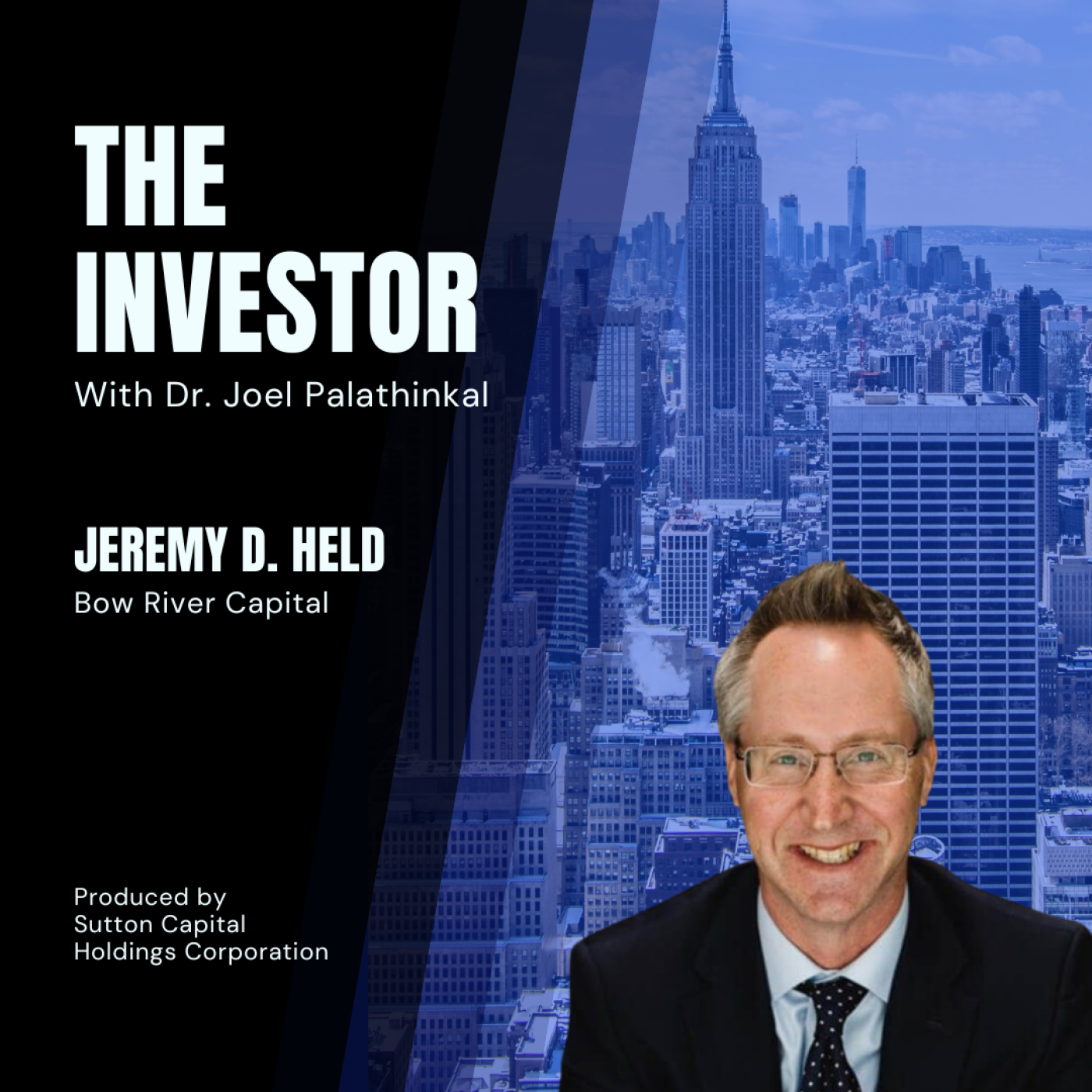
Loading summary
Transcript31 lines
- [00:03]
A
Welcome to the Investor, a podcast where I, Joel Palo Thinkle, your host, dives deep into the minds of the world's most influential institutional investors. In each episode, we sit down with an investor to hear about their journeys and how global markets are driving capital allocation. So join us on this journey as we explore these insights. All right, so excited for another episode of the Investor podcast. Excited for my guest today. Jeremy D. Held, CFA as a Managing Director at Bow River Capital and leads the firm's registered asset management business, including oversight of research, product development, investment management of the firm's evergreen private equity strategies. He joined Bow river capital in 2019, bringing with him over two decades of experience experience at Alps Advisors where he served as Director of Research and Chief Investment Officer, Alps. When he worked there, he played a central role in launching the firm's asset management business in 2007. He eventually oversaw 44 registered investment companies and more than 20 billion in assets under management. At Bow River, Held serves as President and Chairman of Investment Committee for the EV erx, helping guide the fund strategy and investment decisions. I'll just give a quick overview on Bow River. Bow River Capital is a private alternative asset manager based in Denver, Colorado focused on investing in the lower and middle market in five asset classes. Defense technology, private credit, private equity, real estate and software. Growth equity. So really excited about going deeper, Jeremy, just because the platform that we built, we have so many private equity managers and everyone has different definitions of private equity, right? Whether you're thinking about middle market, what you think about buyout, or just growth equity. So excited to go through all of that. But I always like to start with the human being, you know, who is Jeremy? Jeremy, tell me a little bit about, you know, what you started out thinking you were going to do. You know, possibly back to like middle school or, or elementary school. You know, I've got an eight year old myself and we have these discussions in terms of like what you want to do when you grow up. So you know, a lot of times that gets influenced by your upbringing, you know, maybe what your parents did. So, you know, talk to me about that, talk to me about kind of like your, your early education and maybe your early influences and how you got into the asset management space because there's no clear path in general, right. So you always get there through a mentor or through some type of pathway.
- [02:40]
B
There's absolutely no clear path. I'm a, a native of Colorado. I'm sort of a walking billboard for the city of Denver and state of Colorado. And yeah, went to college at CU Boulder My son is at CU Boulder right now. I do some mentoring up there for students. And exactly what you said earlier, there is no clear path. And I think everybody's looking for a shortcut. And what you want to do at age 20 might not be what you want to do at age 30, 40 or 50. And so after there's no shortcut, you have to just keep exploring and always be curious. And look, when I, when I was a kid, I had some great teachers, I had some great coaches in the sports that I played. And so I always thought I was going to be a teacher. I also thought if I wasn't going to be a teacher, I might be a doctor. But what I really wanted to do was be a professional football player. Sure. At 5, 8, 150 pounds. I think I realized at some point that wasn't going to happen. My high school football coach used to always tell me, he'd say, held, you're small, but you're also slow. And he was, he was accurate there. So I had to, I had to pivot. And you know what I found so intriguing about the investment industry? Look, when I graduated from, from CU Boulder, I had a degree in international business. I didn't, I didn't know that I was going to get into this field. I ended up spending time in Spain and in Costa Rica. But what I found so interesting about the investment industry, what drew me to it was you're really just a student of the world. You have to learn about every sort of industry and see if you can find opportunity there. And so I found it so intriguing and I've built, you know, a 30 year career in investment management, but it doesn't feel like work because you're learning about the world every day.
- [04:28]
A
Yeah, I totally agree. So tell me about some of your early influences and kind of what, what was the catalyst for, you know, maybe your first jobs out of college and you know how that kind of navigated to where you are.
- [04:40]
B
Yes. So I got a job out of college. I mentioned that I, I spent some time in college. I lived in Spain for eight months and then I moved to Costa Rica for a year after college and, and surfed and taught English. And I'm not sure if that's exactly the recipe for, for getting a career in asset management, but it was, it was a good way to sort of learn about what I wanted to do and what I didn't. Yeah, my first job was at an asset management firm and I was in customer service, speaking Spanish because, I mean, in Costa Rica I thought I might be there six months. I ended up being there for 23 years and ended up launching the firm's asset management business and grew it to $20 billion. And I think the advice that I give young people all the time is, is be curious and be a problem solver. You know, we launched our asset management business, you know, in the early 2000s when exchange traded funds were just coming on the scene. And, and we saw this as a transformative way to change the way people accessed investments. And we thought that, that ETFs could be a great way to get access to asset classes that investors didn't have before. So we launched some of the first commodity ETFs in the market. We launched some of the first energy ETFs in the market. We launched some of the first alternative ETFs in the market. And I think that whenever we were trying to solve a problem for investors, we were successful. And I think that was the biggest lesson that I learned from that experience.
- [06:04]
A
That's amazing. Tell me about some of the trends that you're seeing in private equity now. I just got done reading, I mean, essentially audio, listening to the, the, you know, the book by David Rubenstein, it's How to Invest. And I really enjoyed the chapter where he interviewed Thoma Bravo. You know, so the founder of Thoma Bravo, I mean, they kind of got into software, private equity really before it was a thing. And, you know, he, I think the founder started out in investment banking and, you know, really got, you know, at that point, you know, it's really kind of the, the picks and shovels kind of businesses that, or health care services businesses that were really ripe for, you know, buyout and private equity. And then, you know, obviously now we know about Vista Equity Partners and kind of the strategies that are prominent now. And, you know, many of these venture firms are now building kind of their own holding companies and buyout type of strategies. But tell me a little bit about, you know, because you've been in the game, you know, since 2007, especially essentially, when the market, you know, was taking a, taking a beating. The biggest beating of all time. Right. And, you know, tell me how, how things have changed. You know, back then, based on the bio, you know, there was about 20 billion in assets. How do you think those assets are being reallocated today? You know, in today's modern era? And there's so many different types of structures, you know, we saw industry ventures, we're seeing venture funds getting bought out by large banks. Right. So I guess, how do you think that the assets will be kind of allocated now versus kind of the evolution of the last couple years.
- [07:45]
B
Years. Yeah. I think it's such an exciting time to be an investor. It's such an exciting time to be an entrepreneur. Look, I've been in the asset management business now for almost 30 years and the biggest single change that I've seen over that 30 year time period is how A relevant and how B investable private markets have become. If you think about, you know, everybody knows the, the major technology stocks that sort of dominate the headlines and dominate the public markets from Facebook to Apple to Amazon and Google and Nvidia and Tesla.
- [08:15]
A
Yeah.
- [08:16]
B
But 90% of companies in the US with more than 100 million in revenue or 500 employees are private. And historically that was not an investable market. And now private companies have become much more investable. First of all, there's a lot more private companies. There are half as many public companies as there were 30 years ago. Companies are staying private forever. Think about OpenAI and think about Stripe and think about SpaceX and these companies that 10, 20, 30 years ago they would have been public much earlier in their life cycle. These companies are staying private in some cases forever. And yeah, used to be that there was no way to invest in those companies and now there's been a lot of advances in terms of structures that allow regular investors to get access to private companies. And so I think that that's really exciting A for the investors. But B, if you were a business owner 10, 20, 30 years ago and didn't have a natural successor to buy your company, often those businesses died. And now you've got a whole ecosystem of private equity firms from Vista, Tatoma, Bravo to Blackstone to Bow river that can be partners in helping to grow those businesses. So I think it's great for entrepreneurs, I think it's great for investors because now the landscape of investing is, isn't just public equity, it's equity. And that's public companies and that's private companies and that's Nvidia and that's Tomo Brock put them together and it's pretty exciting.
- [09:45]
A
So I see private equity as, you know, in my mind and I would love to see how you guys look at private equity, considering you guys have an evergreen strategy. You know, I look at it mainly as just, you know, everything is private, right. And then there's early stage, there's growth equity, there's, you know, kind of a combo between growth equity and late stage. And then there's so many different permutations when you get towards a late stage, there's kind of a cross between venture debt and mezzanine debt and equity combined, cobbled all together. And then the final stage is essentially buyout. Right. So those are kind of the buckets that I've seen, but I'm wondering if there's any permutations that you guys have also kind of seen to evolve on top of the main three traditional buckets of private markets until you're essentially public.
- [10:32]
B
Yeah, no, you bring up a great point. I mean, I think people think about private equity as this homogenous group of companies and you've got all the public companies and then everything else is private. And I would argue that the differences among some of the distinctions you made about private companies are actually much greater than distinctions people think about in public companies. In public companies, people think about large cap and small cap and foreign and domestic and growth and value. But they're all public companies, which means they've all reached some level, level of maturity in their life cycle, in their revenue, in their, in their profit. The private markets vastly different. You have pre seed venture companies up to large cap buyout companies and those are vastly different. And so it really matters. The thing that matters most, I think investing in private equity is specialized expertise. Someone that's an early stage venture investor should not be investing in late stage buyout. Somebody that's a growth equity investor should not be investing in industrial services in the mid cap buyout space. And so I think the most important thing to find and what we look for in our evergreen business and what we look for in entrepreneurs is that specialized dedicated expertise. And I think when you think about building a private market portfolio, you should think about the same things you think about when building a public market portfolio. You would never invest in just one stock. You would invest in multiple stocks and multiple sectors and multiple geographies. And the same thing should be true when building on a private markets portfolio. You should have ventures should be part of it, Growth equity should be part of it. Small mid and large cap buyouts should be part of it, but with dedicated experts along the way in each field.
- [12:14]
A
So we've had several allocators on our podcast and you know, we've been lucky to get so much wisdom. And you know what I've heard and would love to hear your take on it. You know, there's the open endowment model, right? So that's essentially kind of when you think about universities, there's an open ended endowment, there is an evergreen model. So there's some, some of the allocators that I've spoken to, they, they've shared that there's kind of a little bit of a clearer delineation. Sometimes they could be, you know, used interchangeably. And then, you know, there's some of these larger family offices. They come from like a massive real estate portfolio and they want to just get access to venture. So they're just investing in these emerging managers that to your point, are super concentrated. You know, ideally just focusing on high conviction and just kind of one strategy. Maybe the person worked in the defense industry or they worked at the air. The guy, you know, was in the air force for 10 years and that's all they do. They do defense tech because they're, they're the people that have that, that knowledge and network. So can you unpack, you know, whatever you're allowed to in terms of how the Evergreen model works when it comes to portfolio construction? You know, I guess are you kind of just recycling some of those proceeds and then they just kind of go into, you know, they just kind of go in continuously into different, different assets. Kind of like an endowment model or is it a little different?
- [13:41]
B
It is, it's precisely like now model, but it's an endowment model. For someone that may not have the scale, the access is the resources of a Yale or a Harvard that might be running a 10, 20, 30, $50 billion endowment. You can now do that at the $50,000 level. And I think what's so critical about Evergreen funds? Evergreen funds are relatively new. If you think about the ecosystem of private market investments, most of them work like a Thoma Bravo. You're doing a 10 year partnership and you're asking people to commit capital for a 10 year period. And you're going to invest over the first five years and you're going to harvest and sell those companies over the next five years. And Evergreen strategies, such as the one we like, we have at Bow river and others, are really a good complement to that because they do a couple of things. First of all, they get capital and investment dollars in the ground right away.
- [14:36]
A
Yeah.
- [14:37]
B
You mentioned the endowment model. I sit on the, the foundation and investment committee board for my alma mater at CU Boulder. And you know, when we want to make allocations to private markets, it sometimes takes years to reach our target allocation. Because you first have to commit to a private equity manager.
- [14:54]
A
Yeah.
- [14:55]
B
To go out and find companies to invest and then you ultimately invest there. And with Evergreen Strategies, the capital is invested day one, right away in a diversified strategy. And so I think having investment dollars in the ground right away in a diversified fashion is really important. And as the name suggests, it's evergreen. So rather than when we have companies that are sold sending those proceeds back to our investors, we reinvest those dollars into new companies. And what we try and do is put together for a $50,000 investor the same level of diversification by sector, by strategy, by vintage year, by private equity manager, by geography that you would get if you were running a 50 billion dollar endowment. But now you're doing it at the $50,000 level.
- [15:42]
A
Yeah, and I would say too, it's, it's much more work to underwrite one manager versus investing in a fund to fund, you know, depending on the scale that you're allocating at. Right. So there's a point where it just doesn't make sense. Another thing I've been hearing is there's not enough resources. So you know, the private equity program at a large university might only be like three people. So they may just not have the actual like little physical bandwidth to diligence that many managers. So it's more work to, and more risk to invest in a manager they didn't know versus just kind of re upping, you know, when the time comes to a proven, proven strategy that's been doing this for, you know, maybe close to a decade now. So wanted to, you know, hear your thoughts on that in terms of just asset allocation to, to managers on the private equity side. What, what are your, you know, kind of just insights or reactions to that?
- [16:37]
B
Yeah, no, you're 100 right. And I think one of the, one of the biggest challenges to, to investing in private markets historically has not just been access and information, it's been diversification. You know, most private equity strategies themselves have a minimum that might be 1 million or 2 million or $5 million per strategy. And so to truly build a diversified portfolio has been, has been hard. And the dispersion and outcomes in private markets is so much wider than what you get if you were to invest in, if you invest in a, in a mutual fund or an exchange traded fund or you, you have a separate account with a public equities manager, the dispersion between the top quartile and the bottom quartile is typically only a few percentage points a year. When you look at the top performing private equity managers and the bottom performing private equity managers, it can be 10, 15, 20, in some cases 30 percentage points per year. And so you really have to have the resources and the ability and the relationships frankly and the information to be able to underwrite those managers to manage some of that risk. I think one of the biggest risks in private markets is not just the access and the ability to have information, but just the concentration that a lot of investors make. Again, I go back to that analysis of stocks. No investor in their right mind would put an entire portfolio into one public company. Yet when it comes to private markets, very frequently we see that investors are investing with one manager or in one strategy. In this market, probably more than any other, you really have to build diversification.
- [18:06]
A
Sure. And when you guys think about private equity strategies, what are some of the sectors that you like? I, I, it sounds like, you know, you guys were looking at a lot of the defense industries and some of the other software industries as well. Are there kind of some subsets or some sectors that you're excited about? I mean, you know, everyone, you know, we can't have this podcast without talking about AI. Right? So, so, you know, what, what are some of the trends that you're seeing with, with just kind of the managers and, you know, their, their investment strategies?
- [18:38]
B
Yeah, no, I think, I think you hit on it. Look, we're pretty diversified in our evergreen business, and we're pretty neurally focused in the rest of the Bow river business. But you hit on something we really like, which is software, defense technology, cybersecurity, and what we call infrastructure and industrial services. And if you think about each of those different verticals, they have some macroeconomic tailwinds to them. And I think, look, we've been invested in the defense business for quite some time, but it's not in sort of the large defense industry companies that you'd be thinking about. It's more about data and technology that helps facilitate the defense industry. And that applies to our software businesses as well. And when you think about AI and software, the question is, is it a disruptor or is it a tailwind? And I say this to college students all the time. You know, AI isn't going to take your job if you know how to use AI is changing so frequently that what's happening, we're doing this at Bow river, and I think a lot of other companies are doing it is we're actually hiring young talent in college, fresh out of college, to help teach us how to use AI. And if you think about what software and SaaS was, you know, software as a service was just a tool to help companies become more efficient. And that's what AI is. And I think now what used to be just technology became software became now AI. It's all about efficiency and I think that anything that you can invest in that helps companies become more efficient, whether it's software for the defense industry, software for other end markets, or also if it's industrial services, what we're doing is we're helping business owners become more efficient. And I think private equity in general, if it's done right, is about business building. And that might look different for an industrial company than it looks for a defense or a software or cyber security company, but that's really what we're focused on.
- [20:34]
A
No, and you make a good point. I mean, we've got 0.72, that has 0.72 Academy, and it's really powerful. I mean, these Gen Z's can do things in a fraction of the time that we know about. I mean, there was this presentation software that I found recently and you literally type in a prompt and it'll put together the entire deck, format it and that. I, I feel like when you're doing a deck, you're putting together, you know, even like a pitch deck, right, for your firm, it probably takes an hour to just format the font. It's not even the content. So, you know, but, but you know, I saw some Gen z person on LinkedIn post that they were using that software. I was like, let me try this out. And, and it saved me probably like three hours of just formatting time, trying to format the, the regular deck that I've been using. But you know, there's a whole concept of like reverse mentorship. Right. So you, you know, a lot of us are getting mentored by people that are 10 years younger than us and they're saving us, you know, at some point, maybe 10 years of time. So it's essentially time travel. But my question to you is how do we attract that talent and then how do we lead and motivate them? You know, and I think, you know, the, the things that these, you know, larger institutions are putting together, you know, an academy, you know, JP Morgan has kind of like this mentorship program. So, you know, some of these kind of summer accelerated, you know, immersive internship programs. So what are some ways to kind of, I guess, number one, attract top talent to come into your firm and you know, help your firm outperform. But then how do you retain that talent? And then, you know, a couple things I want to touch on is just building culture and improving leadership because those people are going to eventually become leaders too. Right? So giving a, a partner track for them too.
- [22:18]
B
Yeah, look, I mean, I think, you know, the, the, the best way to attract Talent is to have a growing company. You know, in my former company, we were bootstrapped. We were then private equity backed. We were then owned by a public company. We're then owned by another public company. And people always ask me, you know, what's, what's the best form of ownership? Is it best private? Is it private equity backed? Is it public? And I said, if you have a growing culture, we're always trying to learn and evolve. That's the most fun. It's much better to be at a fast growing public company than a stagnant private company. It's better to be a fast growing private company than stagnant, stagnant public company. So I think having a growth mindset is critical. But then when you think about attracting talent, particularly young talent, and we have a very young team at Bow river, and they are, they are so, so qualified and, and so hard working, I, I really push back against the, the narrative that this next generation, you know, doesn't work as hard as, as us. They're just, they're more efficient than we are. And I think, sure, technology is a great equalizer. And I think that the best way to motivate talent, young talent, is to bring them in and exactly like you said, have them teach us. And I think that's a great way to make them feel like their voice is heard. And, and that's what really builds culture. I mean, my whole team is a generation younger than I am, and they're teaching me stuff every day. And so I think to truly build the right culture, you have to have a growth mindset, but you have to have everyone with a seat at the table and you have to give them a voice. And that sounds great in practice, but you actually have to do sounds great in theory. You have to do it in practice. But one thing I would say, because people talk about culture all the time, in my experience, you know, doing this for 30 years, you can't manufacture culture overnight. You have to have all the right ingredients, but there's no substitute for just time spent in the seat. A lot of discussions about remote work, and remote work has also been a huge efficiency saver for companies. But our team, you know, we work in a little, you know, bullpen out here, and all eight of us are in, you know, close proximity, and we're there together, working in person with each other every day. And I think there's no substitute for time spent. Time spent together leads to trust, trust leads to culture. And so I think you can have all the right ingredients, but if you don't actually have time spent together working as a team. I think it's really hard to build that trust in that culture.
- [24:51]
A
Yeah, I totally agree. Well, I know we got about six minutes left, so I got a couple rapid fire questions for you. One question is, look, there's, there's a really thing, there's a really interesting thing that came across my desk a couple weeks ago. Pretty big fitness company that really, really scaled out the park and they took in some private equity capital. One of their top salespeople ended up becoming the CEO. And you know, the CEO ended up, you know, he wrote a whole post about this. He ended up leaving after he essentially took on some more private equity capital. And what he realized is just he's a really good CEO to kind of take this company from zero to hundreds of millions of dollars. But he may not be the best private equity backed CEO. And we see this also in the public markets too, right? I mean we all saw Travis Kalanick take Uber to where it needed to be. And now we've got Dara, who's the grown up, right, that worked at Expedia take over. So sometimes there's leaders that serve a purpose for a limited period of time and then when the company needs to graduate to another growth period or maybe just a more mature place where it needs to be, especially when you're dealing with stakeholders that are, you know, private equity investors, you know, there, there's kind of some transformation that needs to happen and maybe that person needs to find a soft land. So just wanted to hear your reaction to that. And, and you know, I'm sure you've seen a lot of that happen, you know, with a lot of the deals that you guys are involved in.
- [26:25]
B
No, I 100% agree. Look, there's nothing like the founder mentality. And I think it takes a special kind of person, a special kind of entrepreneur to truly start a business from 0day $1 0 and grow that. But that founder has to do a little bit of everything. They have to be a certain type of mentality from a risk taker perspective, they have to always be thinking about a million different things. And look, the founder doesn't know if the business is going to be successful. And then ultimately when it reaches a level of success, you know, you can take the founder out of that role, but it's really hard to take the founder out of that, that mindset. And so sometimes bringing in a different perspective on, okay, you've, you've achieved these certain milestones, you've grown the company from Point A to point B. If we want to grow from point B to point C, we're going to have to execute a bunch of different metrics and a bunch of different KPIs. And I think sometimes it's hard. There's a very emotional relationship that founders have with their companies, and you sometimes need to bring in an unemotional third party or partner that can help grow it from point A to point B. And you guys hear the term all the time, serial entrepreneurs. And there are people that are uniquely qualified to take companies from one stage to the other. And that's really all what private equity is. And again, like I mentioned it earlier, private equity, when done right at its highest and best use, is about building businesses. And there's different stages of businesses. And I think private equity can be a really good partner for founders. And that sometimes allows them to go and found another company or start another company or help another company. And I think that's been really beneficial for the industry.
- [28:09]
A
That's amazing. Another question I have is, you know, when it comes to talent, what do you think is the DNA of a good private equity investor, especially when you're kind of looking to hire somebody? What are maybe some of the hard skills and soft skills that help become, help someone become a talented investor, especially in the private markets, you know, private equity space.
- [28:32]
B
Yep. I think there's no substitute for, for specialization. If you think about it. I think the easy money in private equity was made 20 years ago where you could be a, a generalist and you could come with a nice checkbook and buy a company from a business owner and put on a little bit of debt and take the cash flow and pay down the debt and earn your way to a nice return and a nice return for the investors. Now there's a lot of competition. There's more than 5,000 private equity firms. A lot of business owners and founders have a lot of options when it comes to private equity. And so you have to be able to demonstrate to that management team, to that leadership team, that you know as much about their business as they do and almost adopt that founder mentality and say, look, we're going to help you grow from point A to point B. It's not about financial engineering. We know a lot about your business because, you know, this is a way, it's great for entrepreneurs and business owners. They have choice. And so I think you have to have a demonstrated, repeatable playbook that you know a lot about that industry and that you're a good listener. And I think that's you know, a good listener and a good leader because you're, you're not just investing in those companies, you're helping to operate those businesses and grow them. And if you think about that from the, the, the seat of the business itself, I think you're going to be in much better, better stead.
- [29:51]
A
Great. Well, we got one minute left. I guess one piece of advice that you want to leave us with, it could be from a mentor, you know, a family member, you know, whatever wisdom you want to leave for us for the holidays.
- [30:04]
B
Yeah, no, it's great. My dad's a psychologist. He's 81 years old. He's 55 years in private practice. I did not go into the psychology field, but maybe you could say that investing has its own level of psychology. But he always has told me this thing, and I think about this piece of advice not only in work, but in life. And he says, shared joy is twice the joy and shared grief is half the grief. And when you think about it, you know, building a business with your team is that much more gratifying. Right. And so having that joy that you can share with someone is really twice the joy. And look, there's ups and downs in every business. There's ups and downs in life, but if you can share it with people, it really minimizes that. So I think about that all the time. That shared joy is twice the joy and shared grief is half the grief. And I thank my dad for that.
- [30:54]
A
Well, thank you so much and appreciate all that you do, Jeremy. Thanks for all the wisdom and being generous with your time, and have a great holiday, everybody.
- [31:02]
B
Yep, same to you. Thanks, Joel.
- [31:03]
A
All right, take care. Bye.