← The Investor With Joel Palathinkal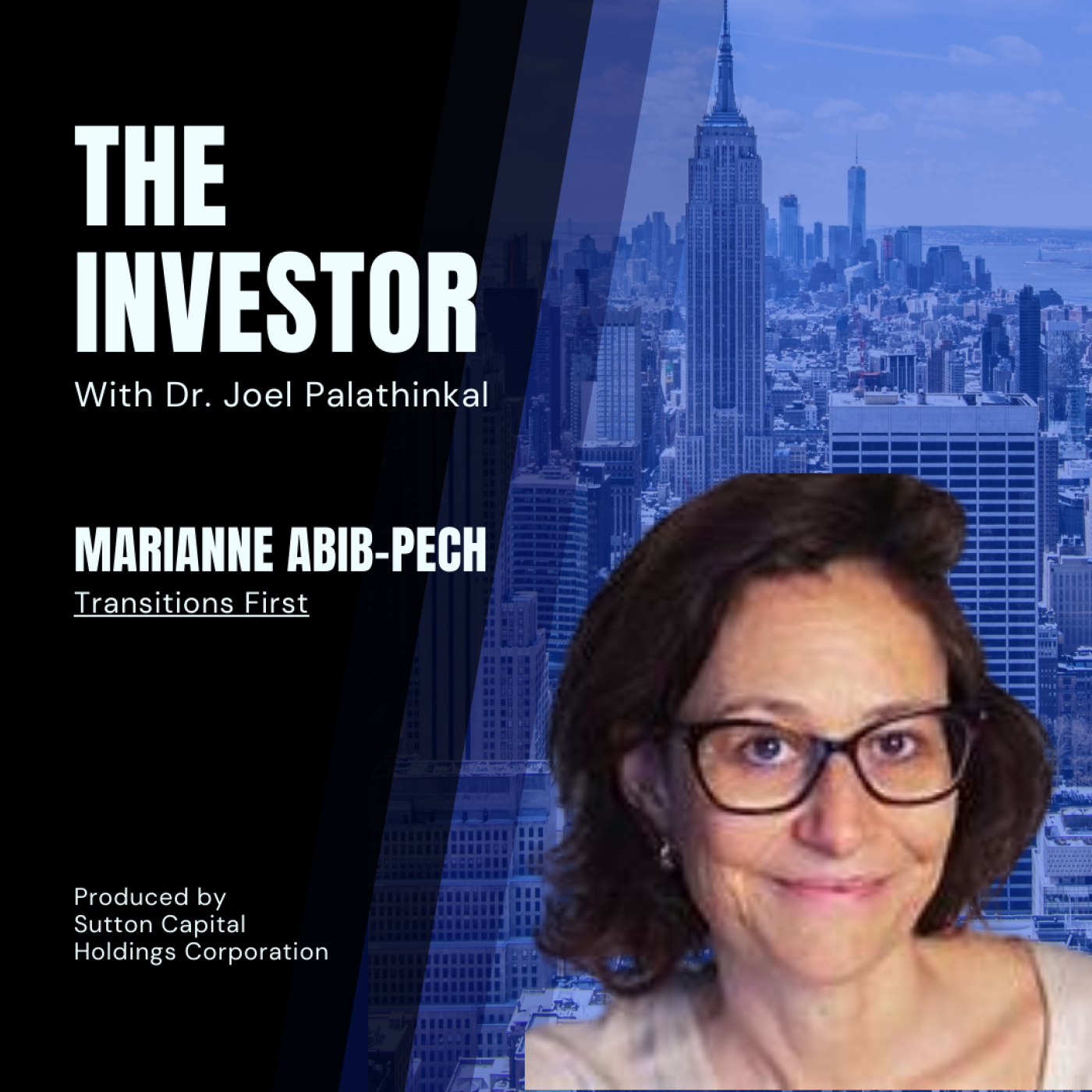
Loading summary
Transcript74 lines
- [00:03]
A
Welcome to the Investor, a podcast where I, Joel Palo Thinkle, your host, dives deep into the minds of the world's most influential institutional investors. In each episode, we sit down with an investor to hear about their journeys and how global markets are driving capital allocation. So join us on this journey as we explore these insights. All right, I am super excited today. I've got a new guest on my podcast. We've been just having some amazing guests, but an amazing guest that I have today is Marianne Habib Peck. She's a managing partner at Transitions First. Transitions first is an early stage deep tech venture fund accelerating industrial transitions. They back industrial technology companies with scalable technology, redefining how they produce in the 21st century. So excited to go a little deeper on that, but to go a bit further on her bio, she's a multicultural C suite finance leader turned entrepreneur investor and author of the Financial Times Guide to Leadership. After a fast paced global career, leading Shell Aviation's 20 billion business as a global CFO and pioneering mergers and acquisitions in frontier markets, now she heads up a deep tech venture fund focused on reshaping industrial supply chains through capital innovation. Marianne combines finance leadership, geopolitical insight, and strategic courage to challenge traditional venture models and reimagine how capital can drive industrial transformation. She spends time in San Francisco, in Paris, and also other parts of Europe. So, Marianne, welcome to the show. And I think there's just so many things to unpack. So excited to go through all of it.
- [01:52]
B
Thank you, Joe. It was like a really impressive introduction. I'm even impressed.
- [01:56]
A
Oh, well, thank you. I mean, all I did was just read, read your bio. So you, you, you made it really easy for me. I'm just kind of reading the script here, but I hope that I covered everything and did you justice. But, you know, it's always better to hear in your own words, you know, because the, the bio sounds really polished, right? You know, it sounds very, you know, perfect as a easy sequence. Hey, we worked at, I easily worked at shell. I managed $20 billion. Now I'm running a venture fund. So, you know, when we go through all these journeys and, you know, we work behind the scenes, it's very complex and there's so many different pivots in our life and stories that back those pivots that we don't hear about. Right. We just hear kind of the profile. So the purpose of this podcast is to also just learn a little more about who, who, who Marianne is, you know. So tell me a little more about your early childhood. You know, in terms of what you thought you would become and you know, aspirations that you had, maybe family members, mentors, people, maybe older cousins that were kind of pursuing their career. How did that shape you in terms of your ambitions to get into deep tech and you know, obviously work in the energy industry for some time. We'd love to have you unpack all that and then talk about what you studied in college and, and how we got into some of those early careers. And then if it's okay, I'd like to also interrupt and maybe ask further questions as well.
- [03:24]
B
Yeah. Okay. So early childhood. So I'm a French national. I was born and raised in a very small village in the south of France. I think it was like 1500 inhabitants. And all my family history is a medical profession. My dad, my mom is a nurse, all my uncles or, you know, dentist, doctors. What is interesting is like the second generation, most of us are in business.
- [03:50]
A
Sure.
- [03:50]
B
So I think, you know, when you grew up in a very medical oriented family, what happens is you develop empathy, you develop a taste for impact, but also it is a very entrepreneurial spirit because, you know, a doctor is a doctor, he needs to find clients and everything. So I think empathy, impact and entrepreneurial spirit was very much ingrained in my childhood. One person was very instrumental in me becoming what I am today. You stated there's so many layers. I am a truly multi dimensional person. Some people would say you're a renaissance person, but it's so cliche. I don't use that anymore. I like multi dimensional. And this person was my history teacher when I was 12 and 13 because he was covering two classes and you know, I was always staying a bit later at the end of the classes with him and we will talk about art, philosophy, everything, geopolitics and all that. And it shaped my thinking, it gave me what. One thing that is very ingrained on the top of impact is empathy, which is curiosity. And I think curiosity and impact have, were what drove my, I don't want to say my career because I think, you know, it's life really.
- [05:21]
A
Sure.
- [05:21]
B
A journey, a people person is a life journey. Right. So it drove my life then. You know, obviously I went through university, I, I didn't know what I wanted to do when I grew up, but I always thought, you know, do math because if you're numerate, you can do anything.
- [05:41]
A
So did your parents want you to become a doctor? Like did they want you to be in healthcare in the beginning?
- [05:48]
B
They kind of floated the idea at one point, but it never kind of Stuck with me. And they were like, with it. But also my grandmother was, was also saying, so my parents were like, okay, Marianne, go into mathematics, you gotta be numeric, you gotta be numerical. But I also love writing. When I was a kid, I was very creative. I was doing dresses for my dolls, taking polarized writing. I started writing at a very early age and my grandmother always said, oh, Mary. And her natural gift is actually words, not numbers. So she kind of tried to push me towards more a creative writing career, but I was very stuck on, no, I want numbers, I want structure.
- [06:39]
A
You know, I'll say too, you know, Michael Moritz, who's one of the top venture capitalists at Sequoia, he was a journalist, right? So I think there's something to private equity and venture capital. Half of it is being able to write things thoughtfully. You know, we, with Sutton Capital, we mentor a lot of people that are looking to get into private equity, venture capital and banking. And a big piece of it is, you know, having an investment memo. But, you know, I remember when I was doing this, I mean, I feel like a dinosaur because I'm just like, I remember the days when I had to use Google to like write a memo, right? And I actually had to write it myself. There wasn't something. But now it's like you type in a couple prompts and like there's a memo that can be written out for you. Obviously you still need to orchestrate it, but I think the writing part of it is still an important piece. And even if you get ChatGPT to write something or clawed for you, you still need to have conviction because there's a lot at stake, right? If you're about to write a two million dollar check, you know, you don't want to just depend on Chat GPT to tell you that it's a good investment. You still have to have that conviction around that. But, you know, the time that it takes to put together a spreadsheet or the time that it takes to put together a deck, you know, there's tools that can kind of format some of those things for you a little quicker. But still, the creativity of like, what you should kind of shape in the thesis is still kind of a very human task, I would say. But I would love your thoughts on that.
- [08:08]
B
So you're touching on a lot of different points. First of all, words and writing started with reading. And there is this amazing writer called Marianne Wolf that wrote this book called Reader Do Not Give Up On Us Yet. And she's a neuroscientist and she demonstrates how reading and writing develop your cognitive ability. Because our brain is not naturally geared to write and read. So it's by learning and doing this and that creates like the reading and the writing give you, even in the day of artificial intelligence, I think the discipline to train your brain to do that is going to give you a massive competitive advantage in strategic thinking when it comes to being a writer. For me, yeah, I wrote two books on leadership, but I also write, you know, I wrote a column, I did the Journalist funny enough funny you saying. I started journalists in school as well at some point. But then life happened and I didn't finish it. But it gave me three things. First of all, writing is very close to venture in a way because you got to be creative, you got to see beyond, you got to observe first. If you want to write, you got to live, you got to observe. Then you got to structure what you've observed in something that makes sense. And you have to push above and beyond what you just see, trying to get deeper in what does it mean, how I can articulate it better and everything. And more importantly, what. When you are interacting with people, it gives you lenses because you pay attention to words. And if you know how to decipher words, it gives you so much insight on a founder's psyche. You know, this morning I was like texting with one of our, with our founders and he says something like he said something, he said, there are too many cooks in the kitchen. It just wrote down and I, and I interpreted, he's under stress. Something has happened that probably could put our investment at risk or not. So I picked up the phone because for me those words meant something that signal the risk.
- [10:27]
A
So when I, when I say and everybody digests those words differently. Like I'm a visual, very visual person. So when you tell me that I actually, I like picture 3 VCs in the kitchen trying to cook something. So I think the words also, which I think is really beautiful in grain, a visual depending on your learning style. Right. Some people learn in systems, I just picture it. But everybody's different. So the words kind of impact different people differently. So I think what you're saying too is sometimes you might need to choose your words differently depending on the person that you're delivering it to as well.
- [11:02]
B
You mentioned artificial intelligence and how, you know it fast tracked how we produce things when it comes to venture and you know, writing and how you differentiate prompts are great, but the best prompts are based on your own ability to articulate your thinking. So it's about how do I articulate what I've observed, what I've, what my intuition is telling me, how do I articulate the depth of what I need to take a decision? And then obviously how do I challenge and rechallenge the outcome to really get deeper and allow a much more thoughtful decision making process? So I use, you know, artificial intelligence for me is not about, is less about creating documents, is more a tool that I can use to challenge my own thinking, discover my blind spot when it comes to investing, but also articulate better strategy by challenging with different lenses.
- [12:13]
A
Sure, that makes sense. No, and I think it's super important to really articulate and to kind of still guide the prompt. I think we're currently in the era where we, the human is still very much the orchestrator and you know, the robots, you know, we had somebody come on yesterday that depicted it as essentially a fleet of agents. Right. So you have agents that are doing something in the insurance space. There's a, an agent that does the claims, there's an agent that does a consumer, the consumer journey. But it's still very much kind of guided by a human to kind of orchestrate this whole process. I think there'll be a next level where maybe there's a prompt writer, you know, that that kind of comes up with the prompts and orchestrates. Right. I don't think we're there yet. But what are your reactions to that in terms of like the stage that we're in right now in AI and where it could, where it could go.
- [13:09]
B
So you know, as you mentioned, I wrote the Financial Time Guide to Leadership. But what you might not know is I wrote two editions one years ago and one was just published and launched two weeks ago. And in it I talked about the accelerator of leadership. And one of them is artificial intelligence. And for me, artificial intelligence can be used in two things. First is accelerate your business. It's productivity, productivity, productivity. But second is, as I was saying, enhance our thinking. I don't think artificial intelligence is yet replacing the way human think because artificial intelligence does not absorb and integrate information in the five senses and three dimensions that we do. I mean if you think about it, intelligence is created every day. You create intelligence every day by me talking to you. Today is going to, you know, create thoughts, ideas, aha moment that I'm always going to have in my head. And it's not codified anywhere. And until unless we start to have neuralinks and the ability to capture live the amount of intelligence we create as human being, every Day I think human being have a long way to go to think, create and eventually invest and find under area of value and pocket of value.
- [14:44]
A
No, I totally agree. And you know, switching gears, I'd love to kind of hear a little more about your journey. So you kind of were trying to figure out what you wanted to specialize in. It seems like, you know, you had some family that was influencing you on medicine and using language. And then also obviously part of your family was in the business space as well. So what, you know, walk me through kind of what was going on in your mind through college and then what that and what that ended up being when it came to your maybe your first job out of college.
- [15:21]
B
So for, for me, it was what I wanted to do in my life very early. It was like I wanted to have an impact. I was like, was, I think my first venture. I was 12 years old or 13 years old. We were selling pastry at the, during, you know, like at, in high school. And I came up with the idea of, well, you know, some people can buy a fresh pastry, but there are a lot of people that want to have a pastry, but it's too expensive for them. So why don't we restore cycle the pastry from the morning recess at a discount on the afternoon recess, you know, so yeah, impact equality was, was big. Come from my, you know, medical, my family background. Then when I started, I really didn't know what I wanted to do for a long time. So I just went on the be good at math because you can do everything. Then, you know, get into a business school because you're good at math, you're good at French, you're good at English, but you're not excellent at math to go to an engineering school. And in fairness, I love people, I'm very curious. So an engineering school might not have been the best fit. So I went to a business school. When I went to a business school, I had the choice. I studied in France and in the UK and then I had a choice of like, okay, what do you want to specialize on? Is. And I thought, okay, what is a universal language? Finance is a universal language. So stick to finance because it's going to give you a very practical tool to actually communicate and drive value. So from finance was like, what do you want to do? I was not that much interested in investment banking at the time and you know, in my 50s. So back then, the golden path for, well, the horizon of ambition, as somebody said to me once, was actually the corporate world. So I went into corporate world and I thought, how do I like, how do I leverage my finance background Audit, because it gives you a really deep understanding of how things works. Then from audit, I moved to General Electric because, well, at that time it was the most admired company in the world. And what Jack Welch was doing with the company, that is the innovation, the pace, the momentum was appealing to me. And then I went up into the CFO role. So in fairness, for a very long time I didn't choose what I wanted to do and you know, my career, the first part of my career audit, g CFO were very structured, very disciplined, but very traditional. What I didn't realize is while I was doing that, I was learning a key skill for my job today, which is really pretty much capital allocation. Because you know, when you're a CFO role, what do you do? You are constantly looking at risk, reward, you are constantly looking at strategy, you're constantly looking at how do you take decision with data which is sometime incomplete, sometimes more complete, but always have consequences and they are very real. You build process, you build narrative. So that was really the first foundation of my career and with hindsight, because it's always a wonderful thing, the first building block of my transition or my conversions to venture. Then I stepped out when I was 38. I was the CFO of Shell Aviation 20 billion channel company before being 35. So it was really, really quick. And I thought, okay, I had my dream job, I want to do something else. What matters to me is decision making. How do I become an ultimate decision maker, right? It was like, well, become an entrepreneur. So I stepped out of the corporate world, started my entrepreneurship life and founded an M and a boutique deploying foreign direct investment in frontiers market. But I'm going to let you in a little secret. Not any Iran was very topical. Very topical, sure. So 2014 started doing business in Iran and that gave me something. It changed my perception to risk completely because everything was about uncertainty, volatility, navigating political risk, currency risk. And I also realized the power of human relationship. So that also kind of like in a way was another building block for coming finally into my calling, which is really venture and deep tech and industrial deep tech investing. But before that I wanted to, when I decided to branch out, create my own venture, I thought there's the myth of the entrepreneurship, but what is the reality? So it's the CFO structure, discipline, data. So I started investing and I started literally hanging out with entrepreneurs saying, well, I'm cutting a check but I want to help, I want to shadow, I want to be with you. And that was fascinating because then I realized that it's all about the human leadership. It's all about the founders, how they see reality, how they force reality, how they pivot, how they federate people around their ideas. At the same time I was writing my first book on leadership. So this gave me curiosity but also a way to codify and I mean if I look at what I do today, it was actually made me realize that when you are in venture, you actually not only underwriting the a business, more importantly you're underwriting a person. So underwriting the person requires some lenses on founder psychology, drivers and everything. And writing the leadership, the book on leadership gave me that.
- [21:31]
A
Sure.
- [21:31]
B
And then eventually, you know, all the pieces starting to converge. Cfo, structured discipline, entrepreneurs, risk, uncertainty, volatility, investors, writer leadership lenses and all that. And what was the best way to put all this? To have impact and become an architect of something. Venture was a natural part. Now obviously I didn't start in venture, it was not a plan, but it was not entirely accidental either. I think all the experience in my life led me to here today.
- [22:12]
A
Sure. So I would say as a CFO you do have some of the building blocks of being a capital allocator as well. Right. Because there's corporate investing. Most big companies have a corporate venture arm. GE definitely does. Nvidia, Salesforce. Every Fortune 500 company, they need to innovate or die. Right. I mean their competitors are going to take up market share so they want to obviously be involved in M and A transactions plus also just do corporate innovation. So they can kind of be on the, on the edge of innovation. So you're looking at obviously the only issue with corporate VC is there's like 10 levels of leadership before they can get approval to write a check into a startup. Right. Versus when you're an angel investor, you're spending time with them directly. You obviously sometimes get emotional because you get passionate about what they're building and sometimes that's something that you have to separate. But as you're mentoring these founders, supporting them, also writing checks behind the mentorship, you can move the capital much faster. And I think that's the biggest issue with a lot of people that are writing angel checks. You know their check is quite small and even syndicates your. It's a never ending cycle where you might have a deal but then you don't have the investors, you might have the investor and then you lost the allocation. So you know the fund structure, closed ended fund structure is always helpful because you Know once you have the capital you can go ahead and deploy and take your time in deploying and make sure it's the right investments that align with the thesis and portfolio construction. So what are some of the things that you learned as a cfo? You know you talked about audits, fund managers do audits as well. But what are some of the traits? And we've, we've had, you know, within our platform we've had attorneys and also CFOs later go out people that actually, actually worked at fund admins, go out and be part of a management team to start a fund. So I think I've got a few thoughts that I can riff with you. But what do you think some of those characteristics are from being kind of in the accounting CFO discipline to carrying that over to being an institutional investor.
- [24:36]
B
First of all, I'd like to make a comment. GE finance is business finance. So most of my corporate career like I did three years in audit, five years in ge, five years as a cf. So is very important because are taken because it makes sense from a finance perspective. So you're not an accountant, you're not. And it's not about ticking the boxes, it's about using capital and finance as a strategic tool when it comes to fund management. For me the fund I think founded with my co founder which is in San Francisco is about industrial. It's not just tech, it's industrial deep tech which if you think about it have most of them have the characteristic of corporate. It's long term capital, it requires infrastructure, it requires capex. So it's very close to running a corporate. The fact that I can't come from a corporate environment and being a CFO allows me to do three different things when I look at an investment. First it's about assessing very quickly if this particular product is going to be palatable in the realm of the industry that I know I was in. Fast moving consumer goods, oil and gas, financial services as well. I also did, you know I also had a brief time in mining and commodity. So all the industrial companies that we're looking at are producing things that are going to be a replacement or going to be an addition or going to help the supply chain. So understanding okay, what do I know and who do I know stand still in those company that can allow me to do a match. Palatable, not palatable. So you have the megatrends, you have the tailwind megatrends, but also you have the reality industrial. Their first customer are going to be corporate. Second, it gives you when I look at a venture, even if we are early stage, what is always going through our mind is like what is the potential exit? But when we say potential exit I think M and A exit. And you know one could argue well you don't find unicorn with M and A but from a fund management perspective if you can do three or four or five really great greatly executed mid cap M and A transaction you get the performance of, of the Fed.
- [27:28]
A
Yeah. And so you prefer the M and A versus the ipo essentially.
- [27:32]
B
Yeah, one could argue, you know it's a fantasy because you do not control ipo, you do not control M and a fair point however the mid cap M and A market, half a 500 million to 1 billion. If you look at statistics over the last 25 years, it's always been resilient. So the likelihood, if you can first of all really help the startup find the product market fit and help them feel a need in those big corporate, you will definitely get at one point an M and A product offering productivity element or even geographical expansion. And the last thing is like because I come from a corporate environment and a CFO background, I believe in cash flow from operations, I don't believe in venture $. We want to back help drive cash generating business as quickly as possible. It's all about commercial, it's all about product market fit. And you know when we start the discussion with our founders, one of the first question I ask who's your first investor? And if people say the venture capital people, I'm like not quite a fit. The first investor is your client.
- [28:59]
A
Yeah, absolutely. I mean I think it's super relevant as well with deep tech companies. Right. I've invested in a handful of them myself. And the biggest issue with deep tech is obviously they're moonshot opportunities but the, you know, on top of that it's very capital intensive. So if you're great at fundraising, that definitely helps. It's super important. You have to be able to, you know, be able to fundraise because some of these projects, you know, and, and I would love to, you know, go a little deeper in the sectors that you're interested in. Yeah. But like most of these projects, you know, we've invested in the space industry. You definitely the ones that win are the ones that have had massive capital raises to support building the infrastructure, building the technology, but also having a big enough of a technical moat that it's hard to compete with. Right. If you're rebuilding the space station, you know, it's very difficult for your competitors. The one or two competitors. If you're doing it differently to, to compete because you have a huge tech mode now, you need a lot of capital to do that. But if you can, deep tech companies, especially now in the quantum space and the AI space that can bootstrap by selling a service, some of them have started as a consultancy, right? And then they find their first customers to fund the prototype and it's a paid pilot. I've also seen on the other end several pilots and then it never turns into a real enterprise customer. So I think there's the balance of that where you don't want to be a company that just does hundreds of paid pilots and then, and then you don't really show recurring revenue or subscription annual revenue, you know, for your services as well. So, so I don't know, like what's your reaction to what I just said?
- [30:55]
B
A lot. First of all, you know, CapEx intensive is, it's an interesting concept because, right. I come from Uber capex intensive industry. I mean oil and gas, you can, cannot be more capitalistic with that, you know. And I work mining for a while. You have to spend only half a bit, well, 500 million. So half a billion only for pre feasibility study, only to go and take pictures from this, from space, from the soils and everything. So the, the CapEx intensive things, it's something I am used to, right? I and I understand the capex intensive but what, what we look at is asset, right? And I think, you know, deep tech in our case we are an industrial deep tech, so it's supply chain, right? We also look at, okay, how can we help them find an elegant, simple and innovative solution to capex, right? And I mean you'll be surprised because you have a lot of. You can also decide that, okay, we spend a lot of time looking at what is the core IP of those industrial deep tech and asking the founders or working with the founders on separating what the core IP requires from a manufacturing standpoint and stay in house, what is not core to their mode, core to the technology and then can be outsourced and externalized. And a lot of the company we have invested in have this dual model. They have a first part of the IP which is done in house and then it's CMO and things like that. So it doesn't have to be all capital intensive, it can be smart. That's the first thing, the second thing you say about space. I was one of the very first woman investor in space in Europe. New space like back in 20s, 2016, 2017 at the end of the day, right, There is a need. I mean space is the last continent. And if you factor sustainability and if you factor, you know, the, the amount of productivity you would do building something in space. I've looked at, I've looked at a startup in Israel that was wanting to do mining in space and then you know, for critical material to ensure the grass. Critical material act and everything. A lot of things are happening there and I mean, and it is, you know, industrial and deep tech have the, and space have the same issue. They don't, they don't, they are not perceived venture worthy because there is one thing that they need that the venture capital world doesn't give is time. It's time. If you look at an industrial project, for an industrial project to work, you list at minima. And when they're good and they are adequately financed and they have the right pilot, 15 to 17 years.
- [34:01]
A
Yeah, yeah. I mean there was a, there was an aerospace company that I was looking at and they said that the commercialization was going to take 14 years. That's essentially two, two entire fund cycles. So like one fund wouldn't even be able to, it would outlast the life of an actual fun, you know, it's,
- [34:21]
B
you know, I mean I, I challenge that thinking because industrial deep tech is not a difficult, not sexy asset class is the way the financing word work is not fit for industrial.
- [34:39]
A
Yeah. And I would say too, you know, there are creative ways to support those longer time horizons. That's why we have continuation funds. And then also some of these funds that are getting to the end of fund one, you know, they can use secondaries. Right. So some of the exits, I would say in space, you know, I actually don't know when there could be or would be an M and A opportunity. But there are SPAC opportunities. You know, if you're hitting a certain revenue, you know, opportunity there, you know, you could, that company could be identified as a SPAC target. So like Virgin Galactic was one of them. And then I think when you think about, you know, secondaries, you could get a, you know, you could wait and get a decent amount multiple and get out of that position with a secondary. And then I think the only thing that I would think about with M and A is is it a cash offer? Is it a stock only offer? Is it cash and stock? So, so what would be your thoughts around that in terms of some of the other exit opportunities and maybe some new vehicles that you're thinking about? Because people started talking about SPACs like five years ago. In my opinion. Well, that's when I heard about it. So have you heard of other vehicles to give liquidity in the future?
- [35:58]
B
So again, you're touching on a very excellent point. People are getting creative but also always in a. I'm going to use that term and it's not a. For writer. I'm going to have a difficult moment because it's not a precise term.
- [36:15]
A
Sure.
- [36:16]
B
But you know, people are looking at everything the private market or VC way. Right. You talked about. Well, we need an exit. Why? What about, you know, going back to traditional finance, going back to 18th century merchant banking, going back to all the transgenerational capital companies that have been 100 years old and you find them everywhere. Cog industry in the us cms, GM in Europe, like Tetra and everything industrial company. If you remove the pressure of the exit.
- [36:57]
A
Yeah.
- [36:57]
B
Then it's a different game. So you know, you can compound wealth, you can compound return by moving away from. I need to have an exit. But backing solid customer relevant, corporate relevant cash rich dividend distributing business. You give them time and then the exit will eventually happen or it doesn't matter.
- [37:27]
A
Well, I think at the end of the day you've got LPs that have invested and venture is illiquid. So if it's like a closed ended fund, you want to give them, you know, obviously some distributions to recycle. But you make a good point. You could deliver some of that outcome with just investing in great companies that are giving some cash distributions that you can distribute back. So that's an interesting model. And then there's also models that are evergreen. Right. That are not closed ended. And you know, I mentioned this on a podcast yesterday. I mean, you know, if you think about Tribe Capital, if you think about a 16Z, a lot of these companies are now moving to becoming an RIA or a holding company because they want to capture exactly what you're capturing. Right. The company is now worth a trillion dollars and they're generating, you know, much more revenue than they were when you came in. So just selling a secondary would be great. But then to your point, you know that, you know that value creation and capturing that and having long term investors that are okay with that longer tail now you're getting into essentially almost like an, an open ended endowment model or a long term evergreen fund, essentially. Right? Yeah.
- [38:43]
B
So it's, it's about, you know, like you have the choice. Hot exit or compound research. Exit works for the bits, it doesn't work for the atoms or yet we haven't Found a way to make it work for the atoms. And if you superimpose LP sentiment about the entire industry, private market, the lack of transparency, the questioning of why the fees, the lack of you know, like liquidity. Well I think there is an argument to be made. It's a good time to innovate in how you finance industry industrial.
- [39:29]
A
Yeah, no, I totally agree. What are some pieces of advice that you would have for people. I know we got about 10 minutes left. What are some pieces of advice you'd have for people that are looking to start their own investment fund?
- [39:44]
B
Don't. I'm just kidding. Yeah, no, do it because you know, the more, the more people get into the supporting, backing, financing, any type of company. Obviously for me what matters is what I call societal society preserving companies. So industrial speak to my mind because extractive energy, recycling, it is part of what we do. I mean I love, I love an open AI, I love a delivery, I love that. But if you go back to we are human beings and the mass load pyramids of needs, you still need food, you still need shelter, you still need to go from place A to place B. So sure, do not shy away, do get into the investing wagon and do not shy away of industrial of like real assets. I would tell them which worked for us because we were an emerging fund cross border industrial Capex. Capex tagged. Capex Heavy tagged raising money in 2023 and 2024. It was brutal. But you know what? It only takes one. And it doesn't matter if your first fund is small. What matters is that you exist and you start building and you start making the noise we need to make. Be aware that fundraising is brutal. It is brutal. And at the end of the day 95% of your fund is going to come from people you already know. So. So be aware of conference frenzy. Better have deeper conversation with five people trying to be on the conference circuit.
- [41:35]
A
Yeah, that's a big piece of feedback. So we run a fund accelerator. So we've graduated several fund managers that have all different backgrounds, right. I mean private equity, hedge funds, venture funds and many of them have different focus areas. But the biggest piece of feedback I've heard is they go to these events, they go to these conferences and it's very surface level conference conversations. So what advice would you have for number one for people to build that top of funnel when conferences or conference frenzies and then how can people build deeper connections? And I feel like some of this stems from your leadership, you know, expertise and experience and the books that You've written, but you know, just relationship building 101. How do you build deeper conversations?
- [42:24]
B
First of all, I go to a lot of conferences, but I have, and it's very interesting and I'm a writer, so I observe how people operate. Right. And you have the person who spent five minutes with everybody in the room. It's very transactional conversation. And give a business call.
- [42:41]
A
Right.
- [42:43]
B
I don't do that. I actually have maybe five conversations in a whole conference. But they are 20 to 30 minutes trying to, you know, engage. Obviously if the person in front of me is the person who is going to spend five minutes in transactional, it doesn't work.
- [43:00]
A
Right, sure.
- [43:01]
B
But all about like listening. It's all about trying to have depth instead of volume. And always follow up. I mean it's follow up, follow up, follow up, follow up. And sometimes serendipity is true strikes. So, you know, I met one of our investor at a conference in Dubai. I don't know why I was at this conference. He doesn't know why he was at this conference. But we were sitting next to each other and I mean, I don't know if you will see me, but at least you will hear me. But you, Joel, who have seen me, I'm very, you know, a passionate. I'm a French person.
- [43:41]
A
Woman.
- [43:41]
B
Right.
- [43:41]
A
Yeah.
- [43:42]
B
So. And I, you know, I, I mumble and everything. And the speaker on the stage was not doing a great job. So I was kind of bit annoyed and we kind of like connected on that, on like this, you know, this particular speaker could have been better.
- [43:58]
A
Yeah.
- [43:59]
B
And started talking about, you know, what he was doing, what I was doing. And then it led to having another form follow up call. And then we start having a conversation and we share. We went have a coffee together, another coffee. And that in six months turned into an investment. So the deeper human relationship, it's what you need to work for. So it's about finding, letting the universe speak a little bit. Sounds a little bit like mystic. But don't try to be a, you know, a decent human being. Be curious of the person.
- [44:37]
A
Sure.
- [44:37]
B
What person wants to do, not what this person can give you.
- [44:42]
A
Yeah. I had an LP that just gave some piece of advice and he was, he's, I think he's based in Luxembourg or Germany. I think he's based in Germany, but he's from Portugal. So we went to Portugal and he just pinged, you know, someone that he did not invest in. He was just like, look, I'm, I'm in Portugal, you know, happy to catch up and grab coffee if you want. And that manager was just like, look, you know what? I'm not in market right now, so I'm good. And, you know, you always want to have those relationships. And, you know, the best time to fundraise is when you're not fundraising because there's no pressure and you're cultivating that relationship as a human being versus, you know, trying to guard your time, to just focus on the transaction. So I think some of the transacting happens when you're not transacting. Yeah.
- [45:33]
B
I think you made two excellent points. One is availability. You know, like, I mean, even today we're not fundraising, we close the fund, we're deploying, we are going to think about the next phase, but working on something very unique. But I still have one day in my week where I just meet people. Yeah, I meet people to have a conversation, to get insight, and I always try to end the conversation. How can I help? What can I bring you? You know, kind of like, not because it's a devious plan, but because I genuinely believe that collaboration trumps competition anytime the second.
- [46:16]
A
I totally agree.
- [46:23]
B
Be present the amount of conversation you have with people when you know they're not there with you because they are checking your phone or what have you. And I think we are still going back to the artificial intelligence element, going back to my lenses as a writer. We still still human beings that need human interaction, but unfiltered, real, genuine, present human interaction.
- [46:55]
A
Sure.
- [46:56]
B
It may. It's already a differentiator.
- [46:59]
A
Yeah. And I think there's cues that you get. I mean, this is really interesting too, but there's cues that you can see visually and verbally and within the context that you don't see on zoom. So, like, when you go to lunch with somebody, you're going to see how they treat the waiter. You're going to see how they. How quickly they. How quickly they order. Right. If they take like 10 minutes and they can't just decide between which salad they want. Right. That shows their decisiveness. And sometimes you just don't see those cues or signals when you do a zoom meeting, because the people on zoom are polished. Right. And they. They're rehearsed, but just kind of how you react to things. Sometimes you don't see that unless you're networking with them. And obviously you'll see a little more extra cues when people have a few cocktails. Right. So I guess my final question is, what are some things that you've noticed with different profiles of LPs whether it's a business family, whether it's an institution, a fund to fund and just different nuances with different regions. Maybe it's all the same. But are there different things you need to think about when you talk to LPs in Paris versus New York versus San Francisco and just maybe the different Personas and profiles in terms of just the capital raising environment.
- [48:26]
B
We're pretty lucky and unlucky at the same time. Because I think if you look at the investor universe, we have most of them. We have a semi institutional, we have a fund of fund, we have ultra high net worth and then private individual and we have Asian LP, US LPs, European. So it's pretty unique. Sure. And I think the fundraising happen most with the personal relationship that each of us, we are two gps. I think you know my co gp, it's a gentleman called Ali Chen who used to be in Bluebird Venture, I think.
- [49:09]
A
Oh yeah, yeah, I do. Yeah.
- [49:12]
B
We co founded Transitions first.
- [49:15]
A
Okay.
- [49:16]
B
So Alec was like really working on the, on the European. On the Asian lp. Yeah, obviously working on the European lp and we share the US LP and it goes to three things. Right. Understand the culture, understand their driver, but the real driver and invest time.
- [49:40]
A
Sure.
- [49:41]
B
What we, what, what we like about our LP pool is. And we have a board meeting, an LP called an LP meeting tomorrow morning.
- [49:52]
A
Yeah.
- [49:53]
B
When we get this bunch of people together, we get immediate insights at the global level.
- [50:01]
A
Sure.
- [50:02]
B
You know, so you get what's going on in Asia right now, what's going on in the US right now, what's going on in Europe right now, obviously how the capital flow are working, what are the hot, you know, hot like trends that you're seeing in which sector? Is it advanced material, Is it more biomanufacturing? What are investors are thinking? Are they more. I mean what is their latest thinking on liquidity or lack. There is. How do they perceive the asset class? So we get. It's a little bit like General Electric. You know the electric had what they call Boca once a year where all the business were getting together. And you literally had the global economy at a micro scale in one place. So you have services. It was amazing to experience the amount of information and insight you are getting. And we have the same thing. So it's very important to, I think, you know, we don't say that enough from a fund perspective. But at the end of the day an emerging fund is just like a startup. Your cap table matters and if your cap table can have deep pocket, which is one thing but more important importantly, if your cap table so your LPs can open doors, help you accelerate your portfolio and give you insight, you are differentiating and you are standing a better chance to create performance in returns.
- [51:30]
A
Yeah. That's amazing. Well Marianne, this was a really stimulating and interesting discussion. So thank you for taking time out of your busy schedule to educate the community community and share your amazing story. So thank you so much. And hopefully we catch up with you and also your co founder in person someday.
- [51:51]
B
Yes, that would be fantastic. Thank you so much for having me.
- [51:54]
A
Yeah, likewise. It was a lot of fun. And take care everybody else. Have a great day. All right. Take care.
- [52:08]
B
Sam.