Loading summary
Transcript92 lines
- [00:03]
A
Welcome to the Investor, a podcast where I, Joel Palo Thinkle, your host, dives deep into the minds of the world's most influential institutional investors. In each episode, we sit down with an investor to hear about their journeys and how global markets are driving capital allocation. So join us on this journey as we explore these insights. Hate to lose some of the great material if it's not getting out there. Great. Okay, great. Yeah. I think we are live now.
- [00:54]
B
Can you.
- [00:54]
A
Can you still hear me? Okay, sure. I think I just lost your audio for a second. Can you try speaking again?
- [01:02]
B
Yep. Can you hear me?
- [01:03]
A
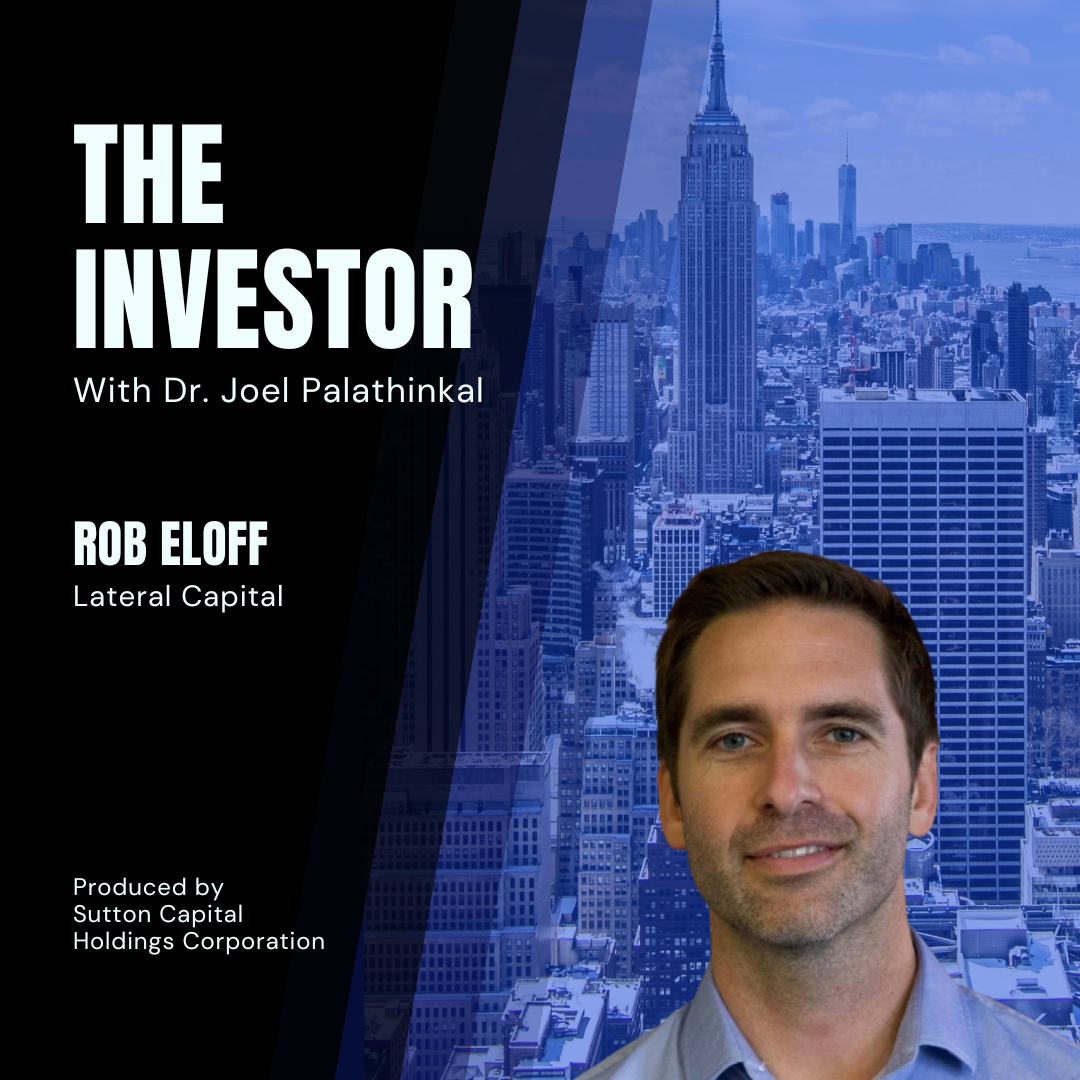
Yep. Yeah, you're great. Yeah. Awesome. Great. So, hey, Rob, thanks for taking time out. I know you're super busy. Wanted to just really quickly introduce you real quick. So Rob Elof from Lateral Capital is here. Super excited to have him on our show, the Future One show, where we interview family offices, VCs, two to three times a week, talking about investment trends. And super huge treat today because we're going to learn about your story of your career and how you got into venture capital. But you also got possibly some educational stuff for us, too, right, to talk about what you guys are looking at.
- [01:39]
B
Thanks, Joel. Thanks for having me. And it's a great initiative that you're running here. Yeah, I'm excited to explore that.
- [01:46]
A
That's great.
- [01:47]
B
Yeah.
- [01:47]
A
You. Yeah. So I'll kick it off. So maybe we can tee this up by maybe just telling us a little bit about your background, you know, where you started your career, you know, where did you grow. Where did you grow up initially? And, you know, where your family is from, I guess. Did you grow up in. Are you originally from Africa? Is that where you grew up with your family?
- [02:08]
B
So far from where I'm calling in now, in California? Yeah, I grew up in South Africa, Joel, and started my career there as well. And it was at a really unique moment in history, in South Africa's history. You know, I grew up with the advent of the new South Africa with, you know, our first democratically elected government and saw a lot of change. And, you know, I went to college there, studied economics and philosophy, and I found myself needing to be a breadwinner pretty early on. And at that time, trading desks and Wall street were where that happened. And so I found myself trading the South African stock market and venturing into other asset classes over the next decade, investing in emerging countries with investment banks that range from Russia to Brazil to Turkey, and then eventually exclusively focused on Africa again with the realization that, you know, and we can get into this More. But that Africa really is a once in a generation opportunity now with all the sort of repatriation of amazing human capital talent that I'd seen in colleagues that were choosing to go back to Africa and build companies rather than take another job in the Bay Area or on Wall street or in London. And yeah, so, you know, the first seven, eight years of my career was investing in emerging countries with a big question mark along the way, which was there was this term that everyone was throwing around called convergence, basically meaning catch up. And that seemed like a strange term for me. These countries were growing really, really fast. Was convergence important? How was the right way to invest in really fast growing emerging countries? And then sort of going down a level. What was the right way to invest in the really fast growing but fragmented opportunity set that is Africa? Especially in the private markets. I ended up advising on a number of private equity transactions in the financial services space in Africa. And what I saw was a huge market where private equity typically was focused on companies doing a minimum of $10 million of revenue a year. And 99% of the private sector in this really fast growing space was doing revenue of less than $5 million. And so you had a situation where over 80% of the capital allocated to that space was chasing less than 1% of the opportunities that. And so that seemed like a good problem to focus on and to try and solve with some first principles thinking.
- [04:59]
A
Sure. And then. So that was still kind of in your banking career, Right? But it was more on the technology transaction side, but still kind of doing more banking type transactions though, right?
- [05:10]
B
Yeah, yeah. You know, it was at that point in time I was advising on the acquisition of a number of banks. And I firmly believe that you need to be empirical about these types of things. And the best way to do that is to invest your own capital.
- [05:25]
A
Sure.
- [05:25]
B
I was very actively angel investing just in Africa in companies that were technology driven or technology enabled. I found myself living in New York. My wife had put up for a long time with the adventures of various emerging places that I called home. And I joined a venture fund in New York as a venture partner focused on fintech. And the idea there was, could we sort of replicate that success in emerging countries? Quickly realized that a slightly different model might be required. And I was fortunate enough to meet my co founding partner, Stephen, who had walked a similar path with a little bit more of initially a private equity, real estate, private equity focus in the US and then deep experience managing capital in South America, where he set up the first sovereign wealth fund for the country of Guyana. What brought us together was if the typical approach of, I guess what we call blind pool investing today is a little bit challenged in these markets. What else is available and how do you adapt the typical venture model from the west coast of backing a large number of companies with a high fail rate to a market where profitability is as important as growth? And so we put our angel portfolios together. We found the same group of family offices co investing with us. And we were fortunate enough to find one family office that was really serious about this and wanted to build a strategy to invest in the opportunity that is technology in Africa in the long term. And that lateral capital was born.
- [07:11]
A
And I think we had a couple great discussions on just the future of venture as a whole. And we talked about just venture funds not always having to raise capital for 18 months. There's now interesting models that also can be incentivized for family offices to just directly invest through an spv. And you could probably be flexible on the management fee and the carry. So it's still attractive and it's just easier because I think one thing we were talking about is you could just have separate bank accounts for each company and literally just start an SPV as an entity for each company. And that way literally it is a fund. But you don't have to burn 18 months on the road trying to do your first close and your second close. Maybe you can talk a little bit about that and your perspectives, because I feel like we share some of those same perspectives.
- [07:59]
B
Yeah, I think the most important thing here is the why. And so if you go back to the alignment that's necessary between our two customers, call it, which is family offices or LPs, generally we also have institutional fund investors, but the alignment between that pool of capital and the uses of that capital. And I think we live in a world that's becoming increasingly disintermediated and that's important. And friction costs are going one way. Additionally, as a backdrop, family offices as a percentage of asset ownership has never been higher and that's also sort of increasing. So it's important to be able to, I think, offer a rigorous fund like efficient structure with a rigorous investment process that's professional, but the transparency of what the opportunity is and really give people choice. And so all credit to my partner Stephen. What he realized pretty early on was if you go back to venture in the 60s and 70s or even before that, the notion of sort of taking risk, it was a syndicated structure and it was more focused on the individual deal and Then to kind of, I think he gave me permission to go into the weeds a little bit on structures. There's some really cool things happening in the space. Everything from Angel List had the evolution of the Maiden Lane funds where they were putting capital back in the hands of founders to go and back other founders. Structurally in the US this is not that challenging to do. The renewable energy space has been doing this for a long time. And yes. So at a very simple level, to have a management company on top of a series of SPVs that contain the individual investments allows you to give your family office investors the choice. And so our major investors do have co investment rights and opt out rights on a deal by deal basis. But they still want one K1 and they still want the efficiency of a fund where an investment team has done the really, really hard work of mining through, in our case, nearly $3 billion of African venture opportunities and picked 12 companies. Today that's very difficult to do from far away. And after investing or flying and flying out into this really large, diverse, fast growing, exciting market is tough.
- [10:30]
A
And how do you balance the level of involvement as far as just looking at the deals? Do you just kind of give them a report or do you actually kind of like give them the deal even before you invest and say hey, we're looking at this deal? Because I think the level of participation that actually means a lot to the family office too because they feel like they're, they're part of the journey with you. But then again, you know, you don't want, you don't want it to kind of disrupt your rhythm of like finding the deals and you know, making it another gap. So I feel like there's a balancing act with keeping them involved but then not distracting you from doing your thing.
- [11:05]
B
Sure. You know, I think it's important to double underline the fact that family offices are partners to us. Yeah, many of our family office investors have built businesses very successfully. Sure, there's a lot we don't know and we really appreciate that engagement. Building a payments business in Africa is different to building a payments business in any other market. But some of the same critical success factors prevail. So you know, we think it's really valuable to draw on that expertise and get smarter together.
- [11:36]
A
But yes.
- [11:38]
B
It'S very hands on work doing what we do. And I think one of the reasons why is as I mentioned, due to historically very shallow capital markets in sub Saharan Africa, entrepreneurship is often not a choice. Many of the founder community come from families that have always been entrepreneurial. So There's a strong culture of entrepreneurship in Africa, but there's also a focus on profitability by necessity because the market isn't awash with capital. And so the upshot of that is it can be heavily diluted as a founder in our markets to raise capital in the traditional venture sense. Right, where you're trying to raise another round roughly every 18 months at roughly twice the valuation of the last round. Well, if you're in one market and you're growing for profitability and your top line, pretty soon you're going to find that you're a minority investor in your own company. And so that led us to the opportunity of we should be able to invest across the balance sheet with debt and equity. Right. Sizing the capital for what a founder needs at that point in time. And that's great for family offices too, because there's a tremendous non equity investment opportunity in our markets as well. And so we do both, we do investments across stages, presenting the output of that work. To your original question, to our investors that trust us to make those good investments, and for our major investors, that means yes, absolutely. They can say no thank you, or they can say we want to be bigger than our pro rata and that.
- [13:15]
A
Works well, that's great. Can we take a step back to maybe go back to the time when you're an angel investor in Africa and maybe just walk me through that experience and just kind of, you know, maybe some major differences that you noticed. You know, I think you already touched on some of that, right? There's a necessity to get to profitability. But what are some other things that you kind of experienced as an angel in Africa and just some differences that you see now in the US Just kind of working with those founders and also the ecosystems back then and how they've evolved.
- [13:45]
B
Sure, sure. So, you know, I think I touched on one of the key catalysts for us, which was just, you know, this notion that there is incredible human capital globally, but there's this massive focus now from a lot of that diaspora and talent and also locally in our markets on building, and that changes things. With that singular focus, you can now have company formation with a combination of local and international returning African talent or even international founders. So that's sort of a very key ingredient here. Aside from that though, the focus and our focus is on investing in what we call foundational technology. And this is really focused on sort of essential products and services because there are big audacious problems to solve in these markets at sort of the local venture ecosystem level. And I'm sure a lot of people on this call will be familiar with the opportunity to provide better payments, infrastructure, strong suites of products around financial services, generally power, health care, education. These are not cyclical sort of sectors that are at the whim of the consumer. And so in angel investing, I realized pretty quickly that everyone knows that Africa is a tremendously big place and it's a terrible idea to try and generalize. But at the local level, at a city level, in certain cities, venture was really starting to mature. And those for us were cities like Nairobi in Kenya, Lagos in Nigeria, Abidjan and Ivory Coast, Cairo and Egypt. They've all got their own unique sort of ingredients, but the needs are similar and they are those things that I described. You know, so broadly speaking, we put them in the buckets of financial services, human capital verticals being healthcare and education, and then let me just call it the ability to do hardware and software, whether that's for power or real estate, et cetera. That's what got me really excited as an angel. In short, you're investing in things that are not just a trend or a fad, they're essential and in need of innovation.
- [16:14]
A
Sure, yeah, it's really helpful. And I think before we started we talked about financial services. So I'd love to touch on that a little bit too because I think there's, we've been looking at some opportunities to just take the wealth in Africa and just give exposure. I think sometimes there's also governmental or environmental effects that we take for granted as Americans. Right. So in america you put $10,000 in the bank, you know that it's still probably going to be there, but I feel in some countries the government might have some impacts. I'm from India, so I've experienced that with some of my family with the banking system. But maybe you can touch on some of the larger regulatory impacts and just how that ties into fintech and the innovation that you're seeing now with that, with some of the companies you're looking at.
- [17:03]
B
Sure, it's a really important point because it really is this double edged sword. And what I mean by that is the opportunity is not just to disrupt for the sake of being disruptive. There's a huge opportunity to enable legacy infrastructure, so to speak, but then also to leapfrog. So there are situations in which it makes sense to go from A to C and skip B. We can talk about that in India as well, where that certainly has happened. But there's also the opportunity to make what exists work better and let Me just give you a real example rather than speak hypothetically. Probably a lot of people on this call followed the IPO of Encino here in the US a couple of weeks ago, which did really well. And the crazy thing is we think we found the Encino of Africa two years ago. It's a Lagos, Nigeria based company with roughly 150 engineers that have built effectively a digital operating system for the biggest banks and microfinance banks in a very large market. And so here's a company that has helped banks reach the consumer in a more cost effective way with products that cut costs by 80% plus by also understanding what exists, what the regulatory environment is, what licenses they need, how to work proactively with the central bank. I think there's a lot more of that to be done and then that kind of ripples out to analogous sectors. We made an investment this year in a company that we think is building basically the workday for Africa. And so if you have a SaaS product for the private sector workforce that's not only automating payroll but managing human capital and then layering fintech products on top of that, and that company's customers are using that product rather than SAP or Oracle or Sage, which are in this country, then that's pretty exciting too. So I want to check that I answered your question. I can definitely go deeper on regulation, deal with it and sort of the risk too. But I just wanted to frame the opportunity as leapfrogging and enabling legacy.
- [19:26]
A
Yeah. As far as leapfrogging, India experienced this too. But I think from my understanding, correct me if I'm wrong, the whole banking modality, I think there was a bit of a leapfrog to go directly into mobile for payments. Is that correct?
- [19:42]
B
Yes, but I want to be careful here because.
- [19:45]
A
Yes.
- [19:45]
B
Has the biggest and fastest growing mobile money markets in the world.
- [19:49]
A
Yeah.
- [19:50]
B
And traditionally that has been Kenya. And Kenya is the leader in mobile money. And so much in the fintech space has been built on those rails. One of the scale challenges has been that, you know, the big mobile money markets in Africa are Kenya, Ghana, Ivory coast, not Nigeria. Not mobile money hasn't worked in those two very large markets yet. So it's important to also understand maybe the term rails is really overused, but how products and services can be built for that set of rails. But then also banks. And it's very particular to the individual market that you're working in.
- [20:32]
A
Sure. And I guess to work with the banks you need to really probably be hands on with the bank and Actually just make sure that you're integrating properly and using their regulatory frameworks to kind of build on top of that or at least have some APIs to work directly with the banks and then also go through their compliance process too, I'm assuming, right?
- [20:51]
B
Yeah. You know, even I think some of the most exciting fintech companies in the US they manage, they do an incredible job of building technology at the right price point, but they also deeply understand the problem from a bank's perspective. Right. So if you're building mortgage origination tech, you need to have a pretty good handle on what like a credit origination officer at a bank's job is and what their decision process looks like. Sometimes I think we've kind of forgotten about that a little bit and we're looking for shiny new toys to deploy because the technology is beautiful, but it's got to actually solve the problem. And so yes, deep engagement at a bank or a telco at the level of the chief risk officer at the level of that's really important. And if you do that right, then you're building for a bigger audience.
- [21:43]
A
What's the right role to help to support that effort? Is it like a solutions architect that is more consultative, that maybe a startup would have to hire to kind of just really go into the bank and say, hey, let's map out your as is and your to be state? Or is there kind of a different kind of role that you think would be helpful to help to solve those problems and kind of work with the bank closer?
- [22:05]
B
Yeah, you know, part of that work is our job, the way we see it and talk about sort of how that happens in our team. What we see a lot on the founder side and on this, on the startup side is a role that is very common, is hiring, I guess what most people call a sales engineer. And what that means is, you know, you're proficient and you know enough to be dangerous. But it's really also about customer service. On our as we built this team across a very large market, we tried to add complementary skill sets and you know, Summer Cub, who runs on Nairobi office, comes from a background of being deeply familiar with investing in East Africa over many years, but also from a credit perspective and from a fund to funds perspective for best practice. Whereas Ochua, who runs our Lagos presence, comes from a background of deep industry experience, having worked at the biggest telecommunications company in Nigeria and you know, with a degree and background in telecoms, mobile telecoms engineering. So you need to have that diversity of skill sets to be successful. And I'd say the same thing is important at the team level, at the founder level.
- [23:19]
A
Sure. I have a more of a casual question on just the concept of going back home. So, you know, again, you know, I mentioned I'm from India, so a lot of people from India that have worked in the US have just gone back home. I think some of the factors are just being back home in the motherland and also just being home with their relatives. I think that just makes them more happy in general. So curious if that's a similar reason why a lot of the people that, you know, super smart people, they came to America for the opportunity as an immigrant, but they're like, you know what, I can do the same thing at home and I can be with my family and just kind of where I feel comfortable. But are there other factors or reasons why people are going home or is it kind of the similar thing of just kind of just being back with your family?
- [24:07]
B
Yeah, in a way, I think for many African founders, going home is actually a luxury because so many of our, you know, African founders, families have broken their backs to give them the opportunity to be successful in the US or in the uk and so the choice to go home is not often popular with families. You know, I speak to people every day whose parents and siblings are saying, don't come home, don't come home. Future is right where you are. But I think what it is is Africa has this tried and tested ability to surprise to the upside and be resilient. And for a lot of founders now, they kind of know people that were part of China's value creation story in the early 2000s, and they know a lot of people that had the chance to be part of that and weren't. And I think they could say something similar for India. And their narrative is, I'm not going to let that happen to me because I have asymmetric information. I know what is needed in a really large market and I have skill sets and I've seen things succeed and fail in a mature market. So I can't sleep at night letting this opportunity cost dwell on me. And certainly I can relate to that. But home is relative for me. Home is everywhere from, you know, Johannesburg to Moscow to, you know, Sao Paulo to Lusaka and Accra in sort of various succession stages with project. At the end of the day, home is where you are not wanting for spending your time differently. And so you can do that remotely or you can do it on the ground.
- [25:55]
A
Yeah, that's a great expression. Yeah. And you talk about being a Breadwinner, too. I mean, I think, you know, I think there's a parallel, too. I mean, a lot of people didn't leave by choice. You know, they left because, you know, they had to have to support their family. So a lot of times people had to have to leave their spouse to kind of move to another country to kind of make something of themselves and even oftentimes send money back home to kind of like help their family out, especially if they're like an older sibling. So, you know, saw some parallels with that. When you talk about being a breadwinner.
- [26:26]
B
Yeah. You know, I want to be super clear. I've been so fortunate and, you know, benefited from a great education and that really supported me. So I'm not going to pretend that, you know, I walked that really difficult path. So let's call it breadwinner. But I think the overarching theme for me is if something is a good idea in Lagos and in New York and New York and Lagos agree that it's a good idea, then really successful things happen. If New York thinks it's a good idea or only Lagos thinks it's a good idea, then there are usually blind spots. And so I think what we're trying to do in this biggest digital migration of our species in the last four months is take out some of that friction and let people build knowing the intricacies of a local market and what's worked in other markets as well.
- [27:15]
A
Sure. Yeah. Well, that was helpful insight. We're about halfway through, so do you think this would be a good time to possibly maybe pull up some of your slides, maybe go through some of these interesting trends that you have?
- [27:27]
B
If you wouldn't mind giving me permission to screen share, I'll certainly do that.
- [27:32]
A
Absolutely.
- [27:33]
B
Okay.
- [27:33]
A
Yep. Yep. I think you got control now.
- [27:35]
B
Yeah. Thanks a lot. How does that look?
- [27:39]
A
Looks great.
- [27:41]
B
Okay. Yeah. Just a couple of points. You know, I get mixed responses to this slide because a lot of people say, obviously, you know, Africa is huge. And a lot of other people say, wow, I didn't realize it was that big. But I think the point here is the population of sub Saharan Africa surpassed a billion people and will double, you know, by 2050, one in three or one in four human beings on the planet will be African. And that's a really important point. It's a very young population with, you know, the average age being actually under 30, well under 30. And it's growing extremely fast and changing very fast. And so the catalysts have been some of the things that we've talked about meaning the rapid adoption of smartphones. We haven't talked about a lot, but that's a big component. We talked a little bit about mobile money. I think there's been a lot of sort of AWS effect as well where starting a business is cheaper than ever before. We've talked a lot about talent coming home and. And one other thing that's changed is real capital is showing up in meaningful size. So that sort of to quantify that, when we got started angel investing, the total amount of venture funding to Africa was about $250 million a year. That number surpassed $2 billion last year, but probably is down somewhat this year with COVID and we can touch on that. Importantly, investors that matter are investing in Africa. And especially on the corporate venture capital side, there is a lot of data supporting strategic investors buying growth that we think is a huge catalyst. Like I mentioned, we have a healthy combination of being in the right places in Africa and in the US.
- [29:40]
A
But.
- [29:41]
B
I wanted to sort of touch a little bit on this portfolio as well, which is an interesting way to think as a family office. To have a combination of champions in regional markets and then companies that have the ability to be pan emerging markets or Pan African and create value is I think really important too. And I think this is a slide that I really wanted to dwell on which is what does this mean and what is the opportunity? I use the term foundational technology. It encompasses a lot, but we really feel like this is able to stand the test of time. And building in these verticals in such a big market with the right strategy is something that you can do for multiple decades, not just, you know, one deployment period of a fund.
- [30:35]
A
Sure.
- [30:36]
B
I'm going to pause there before I sort of get into the next couple of slides in case there are questions or anything you want to go deeper on so we can allocate our time.
- [30:44]
A
Well, yeah. Anybody in the audience have any questions? If not, I have one. So what's a good example of B2B2C? Is it? You know, one thing that comes to my mind it's a company that we're looking at is the healthcare because there's a, you know, you're integrating in with the IT infrastructure, but then there's also a consumer facing app. And then I think another one I've seen is like insurance tech. Right. So there's the financial advisors enterprise experience, but then the client also has a experience too. But I was curious if you can share a couple good examples of B2B2B2C.
- [31:28]
B
Yes. Maybe let me talk about sort of a very relevant current example. One of the most interesting, I think, discussions at the moment in our space. There's a fast and furious hunt on for who could build something that might look like played.
- [31:46]
A
Oh, interesting. Oh wow. Okay.
- [31:48]
B
And so the idea is, you know, can someone build a very neat and tidy API integration between banks, fintechs and ultimately the consumer as well? And I think what we've realized is it's not going to look quite like played or maybe it'll look very different to Plaid. But we've seen a couple of really exciting founders that have figured out how to be a partner to the banks and fintechs and have revenue models that are compatible with the banks. In other words, something that looks like a subscription based revenue model, up to a certain number of API calls and then a per API call pricing model above that. And I think to answer your question, the point here is that works for B2B customers that, you know, if the to C part really takes off, the revenue model makes sense for the fintechs as well.
- [32:46]
A
Sure.
- [32:47]
B
And they might be repricing. That wouldn't work going straight B2C because you know, we're still in a place where to orientate everyone. You know, household disposable income in Nigeria is under $2,000 a year. Right. And so huge market, but there aren't a lot of people willing to pay a large sum of money per API to, you know, check in on their Robinhood account. Right now that'll change. But maybe that's a good example of B2B2C. And then the other place where you see this a lot is in healthcare as well. Yeah, really interesting companies that have done sort of an enterprise software piece that then integrates customer data at the end and makes that data portable so that if you're the end customer, you've got like one sort of single identifier that's compatible with various different businesses. So two examples for you.
- [33:38]
A
Yeah, it's really helpful. And then the legacy infrastructure, I think we talked about that with the fintech and really just, you know, spending time as like a sales engineer. So I think that was a good example you touched on. And then right before you move on, I guess the regional prosperity. Can you kind of maybe go one step deeper on that?
- [33:58]
B
Absolutely. I think that it's really important to focus on what it will take to create prosperity in these venture ecosystems over the long term. And so that happens when you decrease cost a lot. So if you can cut the price of a fintech product by 50 to 80% or a healthcare product. The prosperity comes from not having to reach into your wallet for things that are everyday essential goods. Let me give you a slightly more surprising example. We made an investment a couple of years ago in a company that is trying to fix the problem. Cooking fuel in Africa and sitting in New York or anywhere in the world. That might not sound like the sexiest problem, but this is a $20 billion per annum market and in a lot of households that means using charcoal to cook food three times a day or two times a day. And it can be the third highest spend category in a consumer wallet after food and airtime to use a cell phone. Right. And it shouldn't be. Right. So there's prosperity if you get rid of that problem in the region. And it also addresses deforestation and various other impact objectives that we have. But that's a problem that is not solved by. I don't mean to, you know, be insensitive, but like a dog walking app is not going to solve that.
- [35:29]
A
Yeah, absolutely.
- [35:30]
B
So I think that's what we mean.
- [35:33]
A
Are there also initiatives to kind of just help enable increased income as well? So I think there is the educational system, but then are there opportunities for people to kind of find ways to kind of increase their income or have side income, take on additional opportunities to generate new lines of. New lines of income? Is that something that you're seeing kind of like with maybe freelancing or just doing other things or just even enabling higher education so that they can now get the higher paying banking jobs? Is that something that also kind of falls under that same category?
- [36:13]
B
You know, Joel, there's so many solutions needed to the space. Employment is the biggest challenge that sub Saharan Africa faces.
- [36:22]
A
Sure.
- [36:24]
B
Unemployment rates vary from 10% to 40%. And in a lot of countries the informal sector is 90% or 80 to 90% of GDP. So the gig economy is very interesting for Africa and I think it's quite different to how it's played out in India. We have an investment in a company called Link that you can see on the screen that is trying to build a combination of LinkedIn and TaskRabbit for the informal sector.
- [36:54]
A
Oh, interesting. Yeah.
- [36:56]
B
And so in Nairobi and Kenya, which is their main market, there is a huge demand by middle class consumers or products and services that have a high search cost and low trust. That might be a plumber, that might be childcare, that might be personal care and a platform that can create trust by vetting and providing upskilling for these semi skilled professionals to the point that Covid aside, they can be in a household delivering those products and services is really, really powerful. And we've seen that with Lync. And I think a little bit of out of the box thinking on what gig economy in Africa can mean is a big part of solving the unemployment challenge.
- [37:39]
A
Sure, that's great. Yeah, that's really helpful. And I guess just so we can understand too, the geographic region of Africa. It sounds like, you know, and I'm still learning this too, but it sounds like the most developed areas in Africa are they. Is it Nigeria and South Africa? Is that the two biggest cities or.
- [37:59]
B
I'm not gonna let myself get dragged into that debate because I'm gonna get a lot of shade from a lot of my friends in Nigeria as a South African by talking about it that way. I think the way that. No, no, no. I think the. Is, you know, what are the places that venture capital is happening successfully in Africa? And I think the sort of the top five in my mind are definitely Lagos, Nigeria, Nairobi, Kenya, Cairo in Egypt and the Cape Town or Johannesburg in South Africa. Those destinations account for 80% over 80% of total funding.
- [38:38]
A
Okay, got it. Okay, that's helpful.
- [38:41]
B
Evolving, exciting. You know, other areas are cities in francophone Africa, including Abidjan in Ivory coast and Dakar in Senegal, as well as Addis Ababa and Ethiopia. Those are kind of, I don't exclude anyway, because there's exciting.
- [38:57]
A
Absolutely.
- [38:58]
B
But that's kind of where the attention is right now, I'd say from the industry.
- [39:01]
A
That's really helpful just to understand the landscape and I think breaking it down as far as the venture activity, that's a helpful way to look at that. So appreciate you bringing that down.
- [39:12]
B
Sure, sure. Yeah. I guess just to throw two more sort of aspects into the conversation that we can or don't have to go deeper on is, you know, I touched on this idea of venture. Traditional venture might be challenged in Africa because there's a real need for other kinds of financing as well. And there's quite a lot of sort of creative solutions to this emerging. Even here in the US non dilutive financing structures such as revenue based lending has grown a lot and there's a huge opportunity to do this in our markets where simply put, you can avoid the dilution of another round and finance a fast growing business with off balance sheet structures. And we've done that and are really excited about continuing to grow that it's important to look at a business and understand what its capital needs are rather than try and offer Something off the shelf, just a safe note, or any other sort of venture structure that we're familiar with, where we are. And then I think good things happen. So I thought I'd flag that. And then I think the other question we get asked a lot is, is the market big enough? Can you deploy a $50 million fund, which is what, you know, we're trying to close out into this market, or is that just is the market not there yet? And for any of, you know, the audience that have that question, you know, this is real data, because for us, it's really important to measure this and how it grows every year. And the answer is, yes, the market is big enough. Now, we've seen about $2.7 billion of African venture deals as a team, and it's really important where that comes from to that point. Three quarters of the deals that we look at, we pride ourselves in that, coming from the founders in our portfolio or our team in Africa or our venture partner network. But the way I think about this is if I need to deploy a minimum of two and a half million dollars a year so far, and probably more like $10 million a year going forward, there is a coverage ratio of enough deals that's very healthy to be able to do that. And yes, the market is ready. Now.
- [41:37]
A
Can I ask two quick questions that I think would be possibly helpful for the audience? So two things I think is some of the people in the audience are emerging fund managers. Just maybe some tips on developing really good proprietary deal flow and then any best practices on just portfolio construction as far as just kind of how much we should allocate to early stage versus growth versus senior debt or very late stage. Maybe one or two nuggets of advice on those two things would be probably good for the audience.
- [42:12]
B
Yeah, I definitely don't want to pretend that we have the holy grail answer on that, but my responses would be, in terms of building a pipeline, I think it's really important to put some capital to work that is in sectors that you want to get smarter on and really sort of revisit that thesis very rigorously over the initial year or two. So for us, that meant doing something in fintech, doing something in clean energy, doing something in healthcare, and figuring out where we're right or wrong, and then building pipeline around that to get smarter. But networks are really important of venture partners, scouts, other founders. I think the way to do that well is give more than you take. So even if you don't end up investing a lot of what you're Seeing be very conscious of at least parting with, you know, these are the three things that would make me invest in this company or I think the solution is here. If you're just take, take, take looking for more and more deals, I think that's going to be a pretty short experience. I think regarding deployment, you know, all fund managers are absolutely convinced that they are different and will return 5x3x whatever the number is. And the reality of it is venture math is such that over 50% of Series C stage deals don't make it, let alone over 90% of seed stage deals. So the power law math of venture is not in your favor if you assume that you're easily going to arrive at a 5x and deploying capital with that power law venture in mind. This is nothing new. This is the same adventure anyway. But roughly speaking we look to and we've broken this rule many times, but we look to deploy maybe a third of our total size in a first investment and then really follow on aggressively after that. And we've earmarked 50% of our available capital for pure growth investments, meaning predominantly debt impedance as well. There are various ways of doing it, but it's point is be aware of that high fail rate and try and triple down and winners as early on as you can and cut your losses. But that's not super helpful.
- [44:46]
A
Thank you.
- [44:47]
B
Yeah, maybe, you know, just keeping an eye on the clock. Impact important to us as well. It's important how you measure it. It's got to matter to founders. If impact's important to you, it's got to be important to the person who you're backing. And so we've worked pretty hard to try and build a set of KPIs with founders that both measure the prosperity of the company, but also the impact that they want to deliver in a very real way. And I think the good news is it's getting easier and easier to do that. And then I'll tie off just on a quick recap. We've seen the validation of the market growing. We've seen really high quality capital come into Africa and we've seen that sort of first principles thinking outside of traditional venture private equity structures is possible. And we're excited to partner with anyone that wants to be part of that journey, be that as an investor or a founder.
- [45:52]
A
That was great. Yeah. Really, really helpful information and really appreciated it. We'll take us. You know what? I think I lost the screen for a second.
- [46:02]
B
Oh, sorry. I just ended off that presentation. But I'm happy To go back to any slide that you want to revisit.
- [46:11]
A
Oh, no, no, you're good. I was just worried that zoom froze, but no, it's fine. Yeah, that was great. No, I appreciate it. So we got around 10 minutes left. What I usually do is I leave the end for a couple questions from the audience. But what I always ask the speaker at the end is if you just have any life advice, maybe from a mentor or just kind of in your career journey that you think you'd like to share for the audience, that would be great. If you have anything. Just a.
- [46:38]
B
Generally, for me, it has been essential to find a partner and then a team to do this. I think it's impossible. Not impossible, but it's very difficult to build anything on your own. And that requires trust. But alongside the trust, it requires, I think, an acute focus of what our biases and blind spots are as human beings. Right. And we go from low to high conviction multiple times in many things. We do, I think, kind of being aware of your biases and being open minded and kind of sense checking yourself regularly saying, is that still really true or can I revisit that thesis? And then trusting your partners when you get out of your own way is super important. If you can find that, I think the journey is a lot easier.
- [47:28]
A
Yeah, no, that's really helpful advice and very insightful. So we got a few minutes, so I'm just going to check and see if anybody from the audience has Question. Mike, you want to share your question?
- [47:41]
B
Yeah.
- [47:41]
A
So my question has to do with what's the, like, minimum investment you've made today? Sure.
- [47:49]
B
Thanks, Mike. You know, our target is to start at an investment size of $250,000 and grow that up to around a million dollars in equity per company. But we have gone smaller than that, and the smallest investment we've made is half that size, $125,000. So that's kind of the lower end in angel rounds, I'm happy to tell you. I still absolutely see angels putting 10 and 15 and $20,000 to work at a time, but for us, it's a target of $250,000.
- [48:21]
A
I got a question too. So is there a minimum. If you guys are leading a round ever, is there a minimum percentage that you guys try to aim for as well?
- [48:28]
B
Yeah, you know, we've led and followed dominantly. We've led. And the answer is there isn't a rule. We tend to be a significant minority investor. And I think our average across the portfolio is a little 5% okay, that's fair.
- [48:49]
A
Yeah, that's helpful. Great. Hey, well, Sagit. Simon, you guys have any questions? All right, I guess that was all the questions we had, and we're a couple minutes early, so. Hey, Rob, I really appreciate you taking the time out. I know you're super busy, so this was really great. It was really educational for me to understand just the investing ecosystem we have looked at. There's one company that we looked at, so we'll definitely take that offline with you and get some feedback. We're excited about just that ecosystem and just kind of the emergence of the technology and the venture activities. So it was really great learning from you and hope to collaborate with you soon.
- [49:31]
B
Thanks so much. Thanks, everyone, for your time. And, yeah, as I said, we're really excited about the space and looking forward to working with anyone that wants to be part of the journey. And thanks for the work you do, Joel. This is great.
- [49:42]
A
Yeah, absolutely. Have a good one. Take care. All right. Bye, guys. See you. Thank you.
- [49:53]
B
Sam.