Loading summary
Transcript161 lines
- [00:03]
A
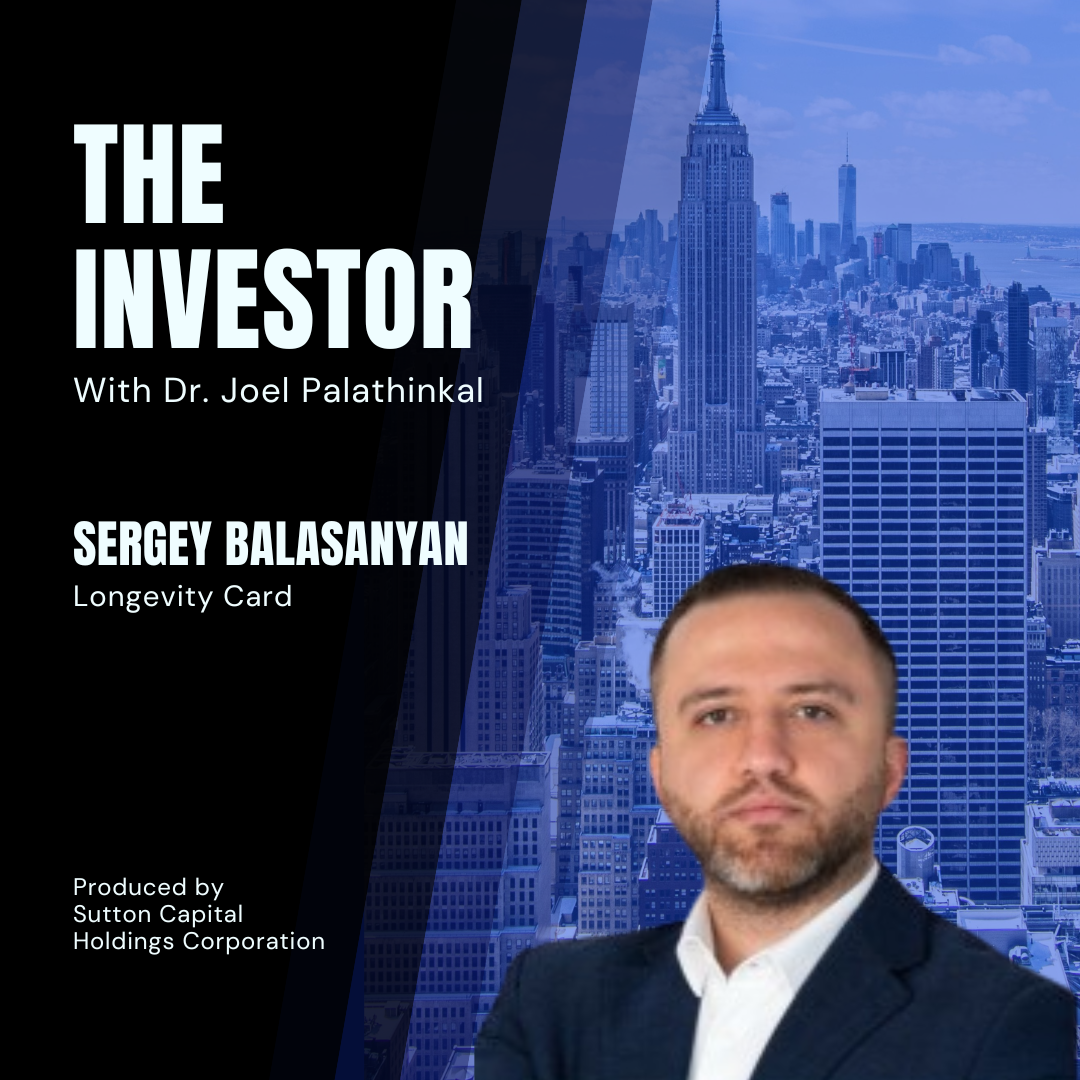
Welcome to the Investor, a podcast where I, Joel Palo Thinkle, your host, dives deep into the minds of the world's most influential institutional investors. In each episode we sit down with an investor to hear about their journeys and how global markets are driving capital allocation. So join us on this journey as we explore these insights. Okay, looks like we are live. So Sergey Balasanyan, did I get that right?
- [00:35]
B
Yes, exactly.
- [00:36]
A
Great. So Sergey, welcome. Bonnie, welcome. As usual you're pretty much my co host so no need for introductions here. Everyone knows who Bonnie is but wanted to introduce Sergey. He has a strong fintech background, investment banking, was formerly at the head of the fintech division at Deep Knowledge Ventures and now is heading up a new spin out project as the CEO of the Longevity Card. So excited to learn about this project. You know more about your story, your background, but maybe we can take a step back and learn about you. Where did you grow up? I know you're in London now. So what did your parents do? Where did you grow up? What did you study? We want to hear all of it.
- [01:21]
B
So first of all Joel, Bonnie, it's an absolute pleasure meeting you and thank you for having me. Very honored. So about myself I was born originally in Armenia and then we moved to Eastern Europe where I started my first career steps where I received my got my education in business administration but probably the all the passion of my life is of course the fintech because I've had like more than 50 plus courses on the FinTech including Oxford, FinTech etc. So it's my passion and regarding my parents my father is an architect.
- [02:14]
A
So.
- [02:15]
B
All my childhood we were traveling a lot different countries across, across Europe, across post Soviet like space and caucuses. So my mother is a doctor so yeah this like a short introduction about my parents, about where I was born and regard in my career. It was a very diverse diversified so I started first as a project manager I had two businesses in my life with E commerce and I was also opening co working spaces in Austria so accelerators. That's why I have a big background and then switched of course to private banking. I started from private banking then I wanted to try myself to find myself into investment banking and then I, I fell in love with fintech so that's how I got to fintech and when I had a chance to join Deep Knowledge Group previously it was starting from Deep Knowledge Ventures. So I met Dmitry Kaminsky and general partner of Deep Knowledge Group and understood that traditional banking is dead and the future, the health is the longevity industry. So for Many years in Deep Knowledge group we were working not only on investment funds but also on analytics. We made more than 40,000 plus pages of analytics in longevity industry, in M Health, in health tech, in AI, in deep tech. And one year ago I came up with an idea to Dmitry that I want to make fintech project. So and he told me why, why we don't like combine and make a marriage of health and wealth. So that's how the idea of the longevity bank project, but it's a name of project, it's not legal entity, it's a long term project. So the first step will be longevity card. So this why this how the longevity card was born. For one year we were developing the concept like making market intelligence on longevity fintech industry. I will show it in my slides later. So currently we are progressing very good. We're expecting the launch of the first product which if we compare will be a Challenger bank, but plus health tech integration and plus longevity marketplace in the end of September 2020. So we will have both consumer and business accounts and we will have presence in the UK and Europe.
- [05:56]
A
So Sergey, so you, you said a pretty bold statement, you know, a few minutes ago. So you said the traditional banking is dead. And I guess what was Dimitri's thought process around that? I guess is it because people are living longer or it's just the current infrastructure has some issues? I guess what are some of the. Can you give us some context on that thesis?
- [06:21]
B
Sure. One of the brightest I can say example is the Corona crisis. It showed us the, the huge gap between the traditional banks and their senior clients, for example. And this one of the examples that the senior generation is not mobile friendly in most part and traditional banks and even modern challenger banks, they can't even give the adjusted technologies for them adjusted like the high level of security for vulnerable people. So we can't give it. And that's why I can't state the traditional banking is dead. And yeah, because the line share line shareholders like of the world wealth, 60 plus people in retirement. And that's why I think, and I am sure that until the traditional banks and challenger banks will make their steps towards the longevity towards the 60 plus generation, they will be non profitable.
- [07:47]
A
So some of the parts that you're referring to is really the user experience and just the service. Is that kind of a huge issue that you're seeing for the seniors? They're not millennials. They may not know how to make a deposit or pull money out. They want to just be able to still have a human element Is that kind of what would be the solution?
- [08:11]
B
Yes, it's the first thing. But for example there are several telecom companies in few eastern European countries which are providing their 60 plus clients with a brochure on how to use mobile phone. Mobile Internet, sure, that's what I'm talking about that they are making the technical education for example. It took a long time, a lot of time to make senior people to use WhatsApp.
- [08:49]
A
Yeah.
- [08:50]
B
For example and it was with help of their grandchildren, children, they were explaining a lot. So that's why the same should be done with banking.
- [09:02]
A
Yeah, I was talking to Kate about this. We actually, this is funny, we were talking about just the user experience and one trend that I saw because I worked in Fintech as an operator for some time and specifically wealth management and same issue, seniors don't know how to use a mobile app for managing their finances but they're experts when it comes to Facebook. They know how to scroll up and down and like and tag people. They're probably more active on Facebook than their kids. But I think the usability, the user experience, super intuitive. So I think there could be some optimizations, you know, in that, in that area to make it easier. But what beyond just the usability, are there changes to just the way that we service them or just even on the tech side are there changes that we should make to help the wealth, the decumulating people, the people that are trying to now pull out the money tax efficiently?
- [10:01]
C
You know I want to add one thing, security issues which would be a bigger concern than. Yes, Facebook is a security issue as well, especially with finances and fintech. I would think that security issues would be addressed.
- [10:13]
B
Yes, that's exactly what I wanted to talk about that the first step, of course user experience is very important but the first step and the main step is the integration of HTAC to prevent like senior generation from financial exploitation. That's the main thing what should be done at first. So it should be a very high security, taking into account age related specifics of customers and that's what we are working on and actually I can tell you that we were first targeting the 60 plus generation but for our big surprise we received a huge amount of interest from 35 plus people. So we were making a big survey throughout more than 20,000 people. That's why we a little bit corrected our strategy and we will start with the health tech proposition and in 10 months from now we will launch the the H tech with preventing of financial exploitation with user journey. So yes, it will be our like the most biggest product.
- [11:42]
A
And on the health side, what are some pieces of data that would be helpful to integrate in with the fintech solution?
- [11:49]
B
Yeah, sure. So the main idea of our Klela product which will be in the end of September is the integration of mHealth technologies. So we will track fitness activity, not health activity because health is very sensitive data. And yes, we will work only with fitness data of clients. So our app will track the for example steps or your nutrition, your input in nutrition, or how many hours have you slept today, your pulse, etc. So based on these on achieving goals, you will be rewarded with longevity points which will be redeemable as an additional discount on longevity Marketplace. So our aim is to stimulate people to be healthy. We don't charge our customers, so we want just to stimulate them. And of course integration of AI which will make personalized tips based on the user, based on their behavior. Sure.
- [13:12]
A
And what can they redeem with the, the longevity points?
- [13:18]
B
Where you mean.
- [13:20]
A
No. Well, what can they redeem? Is it only healthy food? So no pizza? No.
- [13:26]
B
No. Our marketplace will have like gene providers.
- [13:32]
A
Yeah, sure.
- [13:35]
B
Blood testing, for example, companies related with pregnancy, diabetes. So everything which can improve your health, they will get exclusive offers and deals from these companies.
- [13:52]
A
Sure.
- [13:53]
B
As much they earn points as more attractive offers they will get.
- [14:00]
A
Yeah, no, that's great. So that's one big piece. Just promoting the healthy behaviors and just incentivizing them. What are some other trends that you're seeing that are important to just the wealthy aging people? Even if not wealthy, just aging people to just manage their finances. One trend I have, and I was mentioning this earlier, is decumulation. Have you guys started talking about that? Because when you're older you want to think about drawing the money the you've been saving without taking, you know, taking too much of a hit on taxes. So I was just curious if that was something you guys were thinking about or if any other startups are looking into that. I haven't seen too many. So I was just curious if you've seen, you know, with your fintech background, you or Bonnie have seen anything in that space.
- [14:53]
B
So it's, you know, I've seen several startups but I can't say that there are so much advanced. We're thinking about this and of course it's a great thing to implement, but it will take time.
- [15:18]
A
Yeah.
- [15:20]
B
Much efforts to do this. But actually not only the health being, but the wealth being, wealth planning. Of course it hundred percent should be. And if you go through our website, you will See that not only health tech will be integrated also wealth tech, data science. And one more trend which is not related to health but which is for me is very important for now and very actual is contextual banking. So it's like very tailored personalized banking based on behavior, based on like on location, on preferences, on everything. So people now want to get like people want to get tailored products. Sure. They want, you know the main thing that bank should be your friend. It should, it should be your advisor, it should be your helper, it should be your like one stop shop for your life. That's why we're trying to achieve this in health. That their bank will be their friend and their health coach. And yeah sure.
- [16:46]
C
You're talking about also at some point putting together almost an investment syndicate so that ordinary people can invest in tech or whatever as well. Is that. Did I, did I catch that or. No.
- [17:03]
B
No, sorry, I didn't understood about the investment syndicate.
- [17:08]
C
Oh that you know, people are investing and living longer and looking for alternative uses of their funds which to generate income or money or long term.
- [17:20]
B
You mean the integration of Investec solution? Yeah.
- [17:25]
C
Just ask.
- [17:26]
B
Yeah, but I can tell you that we can integrate Investec but not for the first two years until we get the like we want. We aim to make a full banking license in the UK and of course once we get it we will integrate many very interesting products. But for now we can consider them in our marketplace.
- [18:00]
C
Okay, just wondered if that was on the drawing board or part of the.
- [18:04]
B
I will also show you in presentation. But for now like we're a little bit limited with the ability. So we will start with the like with the products which do not provide us interest, for example or we will not give loans.
- [18:29]
A
Sure. What about life insurance? So you know, with people living longer, do you think we need to structure, you know, fundamental changes in how we're issuing these policies?
- [18:40]
B
I can tell you that life insurance is one of the main part of our proposition because we will. I can't disclose the name but we are partnering with. With a big insurance company. Sure. And for our clients we will provide not only first we will provide travel insurance. So then we will expand.
- [19:11]
A
Okay.
- [19:12]
B
So sorry, I can disclose.
- [19:14]
A
Can't talk about too much.
- [19:15]
B
Yeah, but yeah, the main idea that of course we are partnering and we will announce this partnership in a couple of months. So you will be the first to know about it.
- [19:30]
A
Thank you. Yeah, yeah, I think that's super interesting. I think beyond just extending the length of the policy, I wonder if there's other things that we need to consider. Right. What type of injuries happen more often in your 60s to 70s? You know, maybe, maybe you need to add that type of additional coverage relatively to the age.
- [19:55]
C
So not even just injuries, but health issues like diabetes or.
- [19:59]
B
Yeah, sure. I can tell you more that after the coronavirus, this situation has started, we've got a significant interest from insurance companies. So and they really are now into longevity and they're reaching us out. So yeah, insurance is very important.
- [20:27]
A
I think the more data you have, you'll be able to accurately predict potential outcomes too, just based on statistical analysis. So there is a, you know, this is a little different of an application, but there was a company that could measure your heart rate and then just compare your heart rate to a large data set of typical heart rates and within a decent amount of accuracy. So we didn't invest because the accuracy wasn't high enough. But I think if you can get to a point where you see somebody's heart rate and you just know statistically if this heart rate is in this range, the likelihood of having heart disease is this percentage, I think that's really powerful. So I think you can look at different trends like that, but you need to have all the data which Google and Apple have. But partnering with someone like that, you can tell if someone is going to get diabetes based on their current eating habits. And some of the factors that they're doing today use those as signals to possibly predict the future. So I think that's kind of interesting as well. Well, I guess have you guys looked at any of that? Just kind of using prediction algorithms, looking at today's data to kind of model out what could possibly be concerned of in the future. And then you can use that data to kind of write an insurance policy, I'm thinking.
- [21:50]
B
Right, sure. Data science. I even can't imagine modern company now without implementation or applying of data science.
- [22:03]
A
Yeah.
- [22:05]
B
Because it's like if someone open built a company without AI now. So yeah, sure, we should leave in the 2021.
- [22:18]
A
Yeah, that's great. I'm trying to think what else we could talk about. So the, so the longevity card, when are you guys launching? You guys are launching in the, in the fall.
- [22:34]
B
Yeah, in the end of September.
- [22:36]
A
Got it. So you have some insurance, possibly some insurance integrations. You'll have this marketplace, what are some of the other features? So you'll, and then you can kind of measure eating habits. So I know that, you know, you know, Weight Watchers did have something like that. My only issue with Weight Watchers was that you have to manually put in your. You know, this is a fundamental issue I had. So you have to manually put in what you eat. And sometimes I forget, like, what I ate for breakfast. I mean, especially now during the pandemic. I don't know, you guys, correct me if I'm wrong, but I feel like the days are just kind of running together. So I don't really know if we're living. I don't really remember if what I ate, you know, if I ate Chick Fil a today or on, you know, two days ago, just because of the days running together. So I think is that. Do you think that'll be a challenge just having people have the accountability to put in the meals manually, or do you think it's a certain Persona that'll just be super proactive about it?
- [23:38]
B
I can give you just a hint that it will be taking a photo.
- [23:45]
A
Okay. So you got to take a photo of it. And it'll probably just remind you to take the photo, I guess. Right?
- [23:51]
B
You're just taking a photo.
- [23:53]
A
Thanks to AI image recognition.
- [23:57]
B
Yeah.
- [23:59]
A
Okay.
- [24:00]
C
We don't know the ingredients and the different ingredients effects on their health. And I say this from experience because my husband was diagnosed with type 2 diabetes. MS, A1C step level was way off the charts. And when I saw that the best medication available, the side effect was Liverpool liver cancer. And I have a biochem background, so I started researching. And instead of changing his eating habits, because I know absolutely nothing about calories or dieting, I weigh 93 pounds. So I just changed the ingredients and I got him off the metformin in three months, and his A1C went to dead normal. So, you know, even though you have these foods and blah, blah, blah, it's also the ingredients which are a huge issue. Doctors only study nutrition. Three months, three weeks in medical school. Three weeks. Yes.
- [24:43]
A
Yeah. There's a company called Clarify. They have these APIs you can hook up into, and then they can recognize all the images. So there is some technology out there, but I guess the accuracy would be something to watch. I guess you would just have somebody take a photo of the type of food, and then it'll just detect the ingredients to the level of accuracy it has. And then from there, do you get a score? Is that how you get kind of graded and assigned points? Or do you just get credit for uploading the.
- [25:19]
B
Dia for uploading also, for example, if you upload Big Mac, you will not be no points. So, yeah, that's the idea. So our system will analyze not only that you took the photo, but what did you eat?
- [25:48]
A
Yeah. So how are, you know, how are some of the other competitors? Because there are some, I thought there were some competitors that do give you some points. But I guess the differentiation is kind of the integration. The other larger integrations with the health tech and also the insurance technology as well.
- [26:11]
B
I can tell you that, for example, I can't name that they are competitors because we are not competing with anyone. We were collaborating with everyone. So they are called, let me remember, vitality points. So they are awarding their customers with perks in insurance, if I'm right. Yeah. So they're achieving some goals with not food, but with steps and jogging, etc. So yeah, okay. There are such solutions. We are not the first, we are not the last. Yeah, oh sure.
- [27:04]
A
No, it's really interesting and I guess what are some things that you just see in the future that we should, you know, be, be mindful of as you know, we care for seniors and then as senior seniors just continuing to just kind of look at their finances. Any other just high level trends that we should just be aware of.
- [27:30]
B
I think that the only one thing should done that the big companies, big tech companies, they all should first of all think not only about Millennials, but also for senior generation. Because seniors, they are very happy with all this technology but they should be rightly packed. You know, the package of the product should be right for them.
- [28:00]
A
Yeah.
- [28:03]
B
For me it's, it's really like a mystery why, why people are ignoring why this like, you know, I can tell that it might be called ageism, but it's really, I don't have any idea why they're doing this.
- [28:23]
A
I mean, and maybe it's not even the tech. Maybe the solution is just have a little more human interaction for the aging generation. So, you know, when I worked in fintech there were special clients. Those clients, obviously they were by pattern older in age plus they were wealthier. So they were in a different tier where they got the white glove service. But I wonder just in general, maybe just tech isn't always a solution. Maybe we just need to have a different capability for that age group to just have more human customer service to accommodate that if the tech isn't enough. But I don't know, do you think we also need to have a little more human customer service to augment this or should we just focus on tech because tech is going to be the most scalable.
- [29:15]
B
You know, of course we should have customer service, human presence. But it's a little bit now tricky for example, if there will be one more pandemic and we can't put at risk elderly. So that's why we need more. Think about video support, for example, you. To show them that we care, that we show the physical presence.
- [29:48]
A
Yeah.
- [29:48]
B
Because even if we take the FaceTime. Yeah. No one used it from senior generation, but now everyone use it. Sure. And they're happy because it's partially replaced the, like, the physical warmth of their grandchildren, children.
- [30:08]
A
So, yeah, I mean, I think there's definitely improvements that could be made. We did like a family Zoom meeting, and I did like a pre training session with one of my elder aunts, and we were struggling. I mean, she had trouble. I mean, and if you think about it, Zoom is not the easiest to use either. If you're not that tech savvy, it's kind of. There's like eight screens you got to go through, and you have to type in the path. You know, sometimes you have to type in the code and the password. So we were definitely struggling, but we finally got her in. But, you know, it. You know, she looked like this. You know, you just saw her mouth half the time. So. So, yeah, I mean, I think just that's just video sharing, you know, Imagine managing your finances, and if it's that complicated, you know, definitely opportunities to change. What do you guys think about Zoom? Do you. Do you think it's easy, you know, especially for family members or.
- [31:03]
C
We've done a few family gatherings on Zoom, and Lou even participated. Lou is 95 years old, and, you know, he was a little confused at first, but he's getting better and better, and we do them every couple of weeks, and he's right there now.
- [31:16]
A
That's great. They do have, like, I think they do have a link that's like a one touch. But, yeah, it would be cool if you could just pop open the app and just press one button and you're in. But it's still. And I mean, they're balancing the ease of use with security as well, Right? People are zoom bombing, right? Yeah, people are zoom bombing. And Kettle Space was warning me about that. I think when we did our session, they're like, hey, Joel, you have the waiting room, Right. So I think. I think they got, you know, I think there were some issues in the past with other people. Yeah, but what happens when people Zoom bomb? Just some random person comes in and they share their screen.
- [31:52]
C
Yeah, they change the screen. They'll take over for a while. It's ridiculous.
- [31:56]
A
Yeah.
- [31:57]
C
But, you know, sometimes it's porn. We didn't experience porn but you know.
- [32:02]
A
Yeah, that's no good. Cool. Well, hey, we got 20 minutes. So Sergey, did you want to show us your slides, kind of walk us through some of the stuff you're working on?
- [32:11]
B
Yes.
- [32:14]
A
I made you a co host. So there we go. Nice.
- [32:16]
B
So one moment.
- [32:22]
A
So is this global or is this only in the uk?
- [32:25]
B
So it will be in the UK and eu.
- [32:28]
A
Okay.
- [32:29]
B
So our motto as you can see, healthy the new wealth. So I would love to start my presentation with words of Dmitry KAMINSKY that the 1 billion retired people globally are multi trillion dollar opportunity for business. So the longevity industry, probably the most complex and you know, and the biggest industry because if we even look at world longevity economy size we can see that in 2019 it was 17 trillion, now it's about 19 trillion and we're expecting the growth up to 23 trillion to 2026. So Ivan was co author or like a guest author in the Longevity Industry 1.0 book. And here you can find like every aspect of this industry including the longevity fintech. And so let's move to the like main problem of longevity finance for now, longevity banking. Today we can see a significant race of challenger banks redefining the banking industry by connecting with a new generation of mobile first consumers. But none of them, as I mentioned before, offers financial products to meet the needs of the 60 plus generation. So as we can see like on the challenger bank landscape we can see even one company which is working with the elderly and of course at the share of the population about 60 is increasing globally, traditional banks are lagging behind in finding solutions as we discussed before. So and if we Compare the like 1 billion of retired people we can see that they can form easily their own seventh continent which will be probably the wealthiest and the happiest continent in the world. So then now which is very interesting that traditional banks like ubs, hsbc, Credit Issues, Barclays, they are making their first steps in HTEC and longevity. For example, HSBC has partnered with Alzheimer's Society to create dementia friendly products. While Barclays is actually developing software for seniors. Like it's about the user journey and UBS went so far they create even the this century, I think it was called the centenarian club among their clients who are expecting to live up to 100 years but unfortunately it was like 12 times but not ongoing process. So hopefully they will develop this. And here you can see the landscape of financial institutions who are somehow related to longevity. As you can see a huge amount of pension funds, reinsurance and insurance companies as we discussed before. So this also was one of the steps created by Aging Analytics Agency for us when we are doing the longevity fintech industry research. So it's like a flat mind map. And of course what we were talking about is traditional banks with hundreds of years of history and nearly unbreakable guaranteed trust behind their brands and their long standing reputations were willing to onboard data science, AI and advanced IT solutions and technologies to meet the needs of untapped silver ocean. They stand in almost unconquerable position to challenge and gain the multi trillion market opportunity that their younger less experienced competitors fail to capture. So we're talking about the difference between the challenger banks and banks if they will do their steps and of course the yes, sorry, we can go to our health tech part and I think we can also highlight that beyond payments in 202021 we'll see the emergence of fintech applications that help consumers afford higher deductible health care plans and to be able to receive financial benefits from improved health care. And here you can see our initial proposition. As you can see the travel insurance business account always support as audio as the video support and the other are like a standard pack of challenger banks. And so if we go next here is like extended overview of what we will be doing. As you can see we're always aiming to make a longevity ecosystem to help B2B to increase the value of being in our B2B longevity ecosystem. So robo advisors integration of mhealth insurance personal tips and here you can see the longevity marketplace so offers so it will be health and beauty fitness, telemedicine, nutrition and vitamins, health diagnostic services, yoga and cetera. So and the second part is the rewards the special financial products for seniors the Htech which will be launched in 10 months from now. And yeah so I can provide you with this presentation for future if someone will need it.
- [39:10]
A
Yeah that'd be great.
- [39:12]
B
Here you can see the health stack integration so in more detailed view like healthspan and fitness gimmick communication, AI assistance compatible with wearables, daily activity analysis and so on. So the success of wearable technology to track and enhance personal wellness through performance will provide fintech organizations the ability to build reward systems that benefit healthcare firms and financial services service organizations. Similar to how automobile tracking can lower insurance cost, health tracking can do the same for insurance firms and even traditional financial institutions. This integration of technology, attention to personal wellness and financial services will soon emerge in the coming years. So that's what you were asking about and we were Talking about, right? Yep. And here you can see for example on mobile how will look like the Longevity Marketplace. So it will include deals of the day categories. So it will be very easy to navigate, it will be more visual, you don't need to read, you don't need to put on your glasses. So it will be all understandable. So Longevity Marketplace will be a one stop shop for a whole range of available longevity products and services. And if we move to htech, which we were discussing probably we already discussed this before so I just wanted to show you the world htech economy size and you can see the components which include htech. So like elderly care, fintech, social and communication caregiving, cognitive care. So it will give you the best idea of the industry size and how much profit and every. And the impact.
- [41:37]
A
Hey Sergey, we don't actually see your slides changing. We're stuck on the first slide.
- [41:41]
B
Really?
- [41:43]
C
Yeah, but I'm listening to this and I guess.
- [41:46]
A
Yeah, I didn't know if, I don't know if you just kind of kept this here as a background. So yeah, we don't see the slides changing.
- [41:55]
C
Do you see that? There are 32 slides there but you're still on the first slide.
- [41:58]
A
What slide are you on?
- [42:01]
B
I'm already on the 20th slide probably. Okay, so let me check. But I don't know what was the problem. Wait, there we go.
- [42:15]
A
Yep. So what you can do is you can give me the slide deck. If you want to flip back really quick and show some couple images, that's great. And then what I'll do is I'll share this out to the community. I'll create a link for the this and give the deck out to the community.
- [42:29]
B
Yeah, you can share it, but now you can see the htec economy size.
- [42:37]
A
Oh, that's cool. So it's around a trillion. So trillion dollars. Is that the size of the assets of the individuals in that group?
- [42:47]
B
Yeah, about 3 trillion.
- [42:49]
A
Got it. So it's a big market size.
- [42:51]
B
Sure, sure.
- [42:53]
C
Or the personal wealth of Jeff Bezos. Either one.
- [42:56]
A
Yeah, exactly.
- [42:58]
B
So also we will create a focus group of 70 plus people who will test who will improve our htech proposition and we will really make an ideal product for the senior generation because the best product is created by people of the same age. So also we are having the entrepreneur in residence program because we want to always improve technologies and we are very happy to invite and to have on board new progressive entrepreneurs. So to conclude, I just want to tell that health is the new wealth and it's quite clear that this global crisis will have long lasting consequences. People and financial institutions will get a new understanding of their priorities. Whereas health and longevity may get greater attention and start to be considered as the actual, tangible and most precious asset and the marriage of health and wealth. In the next few years we will see the rise of integrative fintech and health tech platforms that will use AI and data science to redesign financial and wellness marketplaces where previously segmented and separated solutions and services will be integrated into a synergetic blend of health insuretech, preventive medicine, longevity htech and financial well being. So that's. Yes, that's a few words and slides about us, if you don't mind. I just wanted to share with you how will Longevity Marketplace look like?
- [44:57]
A
Yeah, that's great.
- [44:59]
B
So it will be very intuitive at that.
- [45:02]
A
Can they purchase in fiat currency as well or is it only with the longevity points? Like if I wanted to buy yoga classes, do I have to use longevity points or can I just use British pounds?
- [45:14]
B
I can disclose it for now.
- [45:16]
A
Oh, you can, okay. All right. Yeah.
- [45:18]
B
But you can see how it will look like. And also here you can see the health tech part, how it will look like. So you can see it's very friendly, it's very warm. Because the first thing which we are thinking about is the user journey. User experience.
- [45:37]
A
Yeah.
- [45:38]
B
So it's the start standard pack which will include.
- [45:45]
A
Oh wow. So the card. Okay, so can we go back to the card? So the card, can you use that? So do you get real money as well? I thought it was only just the marketplace. So does this equate to like a certain dollar amount? Like where I could use it as a visa or are you not allowed to talk about that?
- [46:03]
B
Or I can tell the issuer who will be. Yeah, but of course it's a debit card. Yeah, it's your bank.
- [46:13]
A
Sure.
- [46:15]
B
It's your banking app. You can top up it in our partner network by transfers from your bank, etc. Of course. And it will have a business account, not only the consumer account.
- [46:33]
A
Yeah.
- [46:34]
B
So yeah. And one more thing that just to show that this landscape of longevity, financial institutions which are focused and which are like oriented on longevity. And this was the picture of seventh continent which I was talking about. We like all people of 60 plus believe in a single continent in it will be like this. It will be the worst continent in the world. So it's just a little bit futuristic, but it shows very good.
- [47:10]
A
It's a synthetic island on the one of the continent.
- [47:16]
B
Yeah. And of course, yeah, We, I was talking about this book which was the longevity industry and I'm guest author also. And here is the world economy, longevity, economy size, just. Those are the main things which I want.
- [47:38]
A
Sure, yeah, that data is really helpful. I'd really appreciate the presentation to share with the community. I think this is helpful information. So thanks for, thanks for taking time out to walk us through that. I'm trying to think if I. There was another question I had that I'm trying to recall now, but I guess the. I guess. Have you ever piloted or just thought about just giving people money, like instead of just the credits for purchasing things, do you think that would just motivate people to. And if there was some type of backer that would back. Just, you know, inserting fiat money into the, into the card that really, really incentivizes people to get some type of monetary incentive to just be healthy. And you have to make sure they're not gaming the system and scamming the app somehow. But I feel like that would motivate me. It's like, oh, wow, I actually get paid to stay healthy. And that payment would also be the savings that an underwriter would have to pay. Right. So I would look at it as almost like a credit that normally if you were in and out of the hospital, these insurers, they have to pay all this money because you're exercising the premium that you pay every month. You actually have to pay the deductible and then the insurance pays the rest of it. But if you could save the money from being healthy, it would probably be cheaper for the insurance company to give you a small amount. And I wonder, I don't know if you did any user testing or got some feedback on just giving them money versus credits to the gym.
- [49:19]
B
No, I understand what you're talking about. It's a bit now undoable to give money.
- [49:27]
A
Like. Like, you mean regulatory.
- [49:30]
B
Yeah. So. But why, for example, if we. If you are receiving instead of 10% with the help of longevity points, the 25% in gym, it also saves you money.
- [49:47]
A
Yeah, no, that's true. That's a good point. But sometimes, I don't know, I feel like for me, or maybe, you know, maybe I don't get the money right. Maybe I don't need to use the money to spend, but maybe the money goes into an investment vehicle. It's like, hey, you did, you know, you were super healthy today. You ate, you know, you ate salad, you went to the gym. So here's 50 bucks. You can't touch it, but we're going to put it into this life insurance policy that bears interest. So I think if you could use it as an asset to insert back into the same product, then maybe it could be an option. But I know there's a lot of regulatory concerns, and then you need the capital to back that as well, which could be cost prohibitive to have that capital in the bag. But I was just curious if any people, when you were doing your user testing, kind of gave feedback like that or not. And I wonder how people would behave if they got money versus coupon, like, you know, money versus marketplace points.
- [50:53]
C
And I was also wondering if that would be applicable to insurance companies, which would reduce your premiums, which. That would be a strong incentive as well. So money's not taking hands, but it would be an incentive.
- [51:03]
A
Yeah, yeah. Or you get some savings on the premium that you would have paid. So you're essentially keeping money back in your pocket.
- [51:09]
B
So I can tell you so that. Let's wait September.
- [51:13]
A
Yeah. We don't want to get you in trouble, tricking you.
- [51:17]
B
And you will see, like, all the benefits.
- [51:20]
A
Yeah, yeah. I'm really interested to see the. How you guys are doing the insurance play. And do you guys have plans to go global as well? Globe, you know, go to the US or you're just focusing now in the next couple years in Europe.
- [51:34]
B
I can tell you that we have huge ambitions. Of course we want to become not only a digital bank, but also a retail bank.
- [51:45]
A
Sure.
- [51:47]
B
So. But of course, something big starts from these small steps.
- [51:51]
A
Yeah, I guess to have a bank. I know there's really strict guidelines to have a bank chart. I know Robinhood tried to be a bank. I think they got rejected and a couple other big entities did. So I guess to essentially be a bank in the uk, do you need the whole bank charter and is there kind of some really huge hurdles in the UK to do that?
- [52:17]
B
Everything is doable.
- [52:19]
A
Sure.
- [52:20]
B
Because, you know, when you are doing the right thing, when you are creating an impact, we're helping people. I don't see any problems. Yes, it will take time. It will take a lot of legal.
- [52:34]
C
Procedures and negotiating, regulatory issues.
- [52:38]
A
Yeah.
- [52:39]
B
But everything is doable.
- [52:42]
A
Yeah, I agree.
- [52:43]
B
You just need to do step by step, and there is no possible in our life.
- [52:51]
A
Yeah, I agree, and I think that's a good point. You know, having a positive attitude and also being, you know, persistent because you're gonna, like you said, you're gonna deal with all these hurt, you're gonna deal with all these hurdles, setbacks, but just continuing to push on through. And, you know, I think the positive attitude helps as well. And especially when you're creating impact, that that also helps. Helps influence some of those decisions.
- [53:17]
B
So.
- [53:17]
A
Super helpful.
- [53:20]
B
So it was really amazing talk, as I wrote to you today. Before that, I was afraid that we. As. I can't even speak for one hour because I don't know about what to speak. Thank you. This is great.
- [53:38]
A
Yeah, thank you. This is. Hey, this is a safe bubble here. You know, we didn't. You know, we wanted to make sure you felt comfortable. And it's the best when it's. It's the best when it's just an organic, fun conversation.
- [53:50]
C
So a lot faster than you'd think.
- [53:53]
A
I know.
- [53:54]
C
It really does.
- [53:55]
A
Yeah. When you're having fun, it flies by.
- [53:57]
C
Yes.
- [53:58]
A
So cool. Well, hey, Sergey, thanks for your time. This was really great. I will circle back on your materials. We can share that out. And this will be live soon too, so I'll give you the link to this. And Bonnie.
- [54:12]
C
Yes.
- [54:12]
A
Always good seeing you. And we'll catch up next week. Got a couple other episodes next week as well.
- [54:17]
C
Always fun to participate. Thank you, sir.
- [54:19]
B
Yeah, thank you very much. Keep safe. Take care.
- [54:22]
A
Yeah, you too. Thanks, guys. Appreciate it.
- [54:26]
B
Bye.
- [54:37]
A
It.