Loading summary
Transcript75 lines
- [00:03]
A
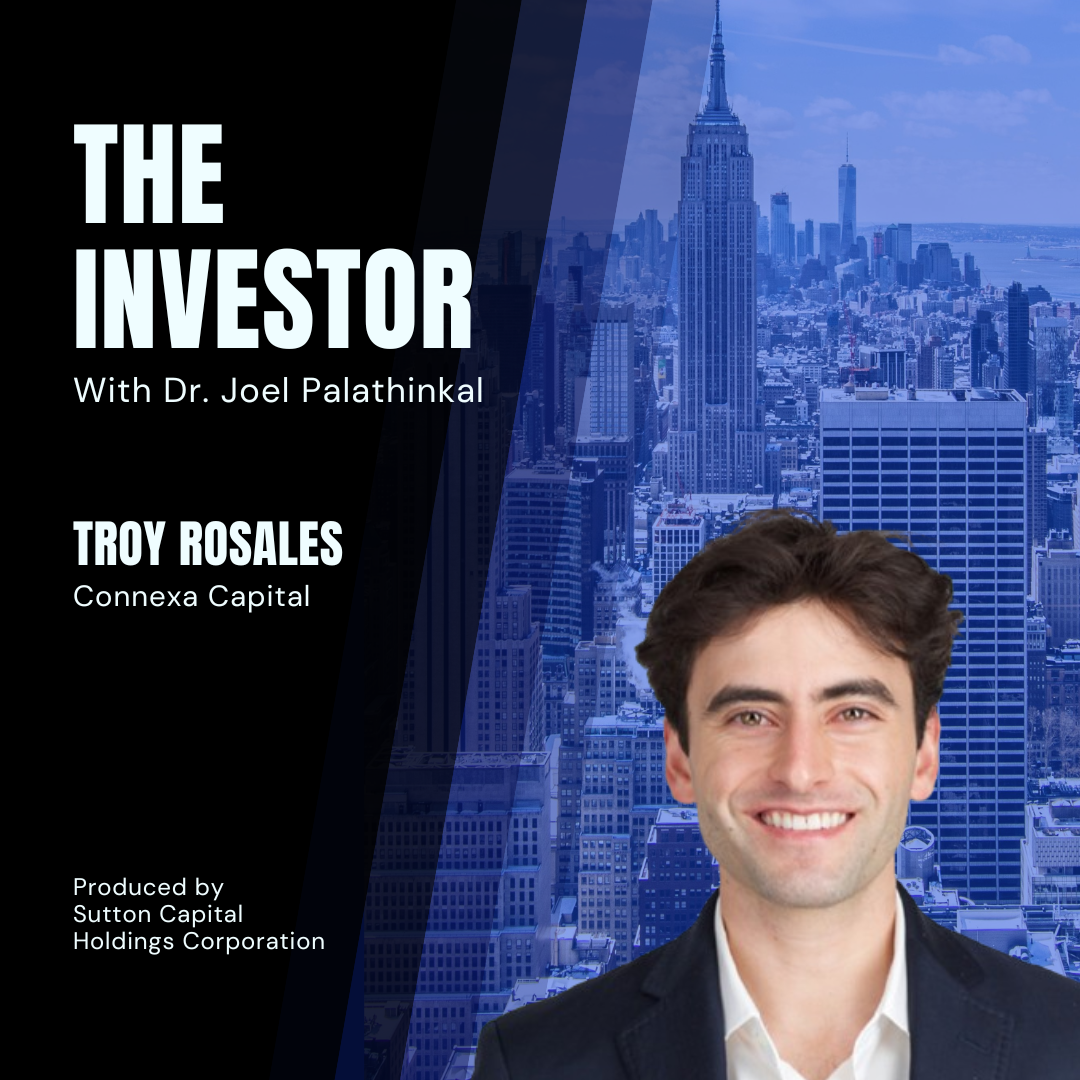
Welcome to the Investor, a podcast where I, Joel Palathinkel, your host, dives deep into the minds of the world's most influential institutional investors. In each episode, we sit down with an investor to hear about their journeys and how global markets are driving capital allocation. So join us on this journey as we explore these insights. Awesome. So it looks like we're live here with good friend of mine. So I'm here with Troy Rosales. He is a friend, he's at Conexa Capital, who I, you know, I've also been familiar with Conexa through Jonathan. You know, Conexa went through our fund accelerator years ago and just connected with Troy recently. He's also in New York, just like me. So excited to have him on the pod, just to give a quick overview. And then we'll have Troy just go deeper on his journey into private equity banking and venture. But Troy is at Conexa Capital primarily focused on sourcing and evaluating investment opportunities, as well as providing operational support to the portfolio companies. Right. So there's essentially the execution side where you're kind of doing the deals, taking them to ic, but then a lot of things that people don't see behind the scenes is the portfolio support. So that's going to be an exciting topic to, to talk about and unravel. But on top of that, you know, before joining Conexa, Troy was a private equity associate at Platinum Equity. Prior to Platinum Equity, Troy worked in investment banking at Houlihan Locky in business in the business services group, and at Presidio Technology partners, covering automotive S.A.S. verticals. Troy graduated from Cornell University with a Bachelor of Science in Applied Economics and management. So super exciting background and just a lot of really hot topics to talk about. You know, it being September in the venture ecosystem, you know, there's a lot of insights that we're, we're seeing. So excited to kind of go through all of those things. But before we go through all of that, Troy, hopefully I did a good job with just a high level overview on your background. Maybe you can start with just your initial origin story, like tell me, you know, about your early career. Maybe think about what you wanted to do when you were in high school and how that evolved when you were in college and maybe some of your influences, maybe it's your family, maybe it's big brothers, big sisters, mentors. But walk me through kind of your journey in the beginning and how you got to where you are now. And then I may interject with some questions and comments and reactions, of course.
- [02:48]
B
Thanks for having me, Joel. Happy to get Started in terms of the origin story here. So I come from a pretty untraditional background, despite all the merits in school credentials. But when I was in high school, a lot of my family came from just traditional blue collar work. It was my dad who graduated from UC Berkeley as a transfer student when he was 30 years old. And we moved to Bay Area from LA when I was 8 and my dad got introduced to some of the high finance work. So investment banking, consulting, private equity, this was all novel to him and new to me as well. And when I was in high school, trying to decide and deduce what I want to do career wise, you know, you go career fairs and you hear about software engineering, that wasn't something that was lying to me. But you know, vapidly, I always want to earn as much as I could. Right. And my dad was whispering, we were saying, hey, there's these guys called investment bankers that, you know, make a lot of money, they work a lot of hours, but could be something that you might be interested in. I was like, okay, that sounds good. In high school, while my GPA was pretty strong, I knew that if you want to go to, you know, a strong investment bank, there are these Target school, so pick your flavor of Ivy League or Stanford, UC Berkeley. Right. And I decided that if I really want to do investment banking, I'm gonna have to try to go to the best schools to better my odds. So I only applied to schools that have like a sub 10% acceptance rate and I got accepted to none. So I'm graduating senior year of high school, no college lined up. Right. I'm thinking in my head like there's only one other know chamber in the bullet that I can do to get into these schools is that I go get my associates degree at community college and then hopefully lateral and transfer into a better academic institution. So that's essentially what I did. So I graduated 2016 from high school with the goal of transferring to a top university to be able to be more eligible for these entry level roles. Right. It seems like, it seems like a premeditated move, but it essentially was. I was, I was very motivated to get a good job and knew that if I went to, you know, any sort of in California CSU school, it that those opportunities are afforded to you, but they're a lot more difficult versus the opportunities that were afforded to me when I ultimately transferred to Cornell. So I did my two years in community college, did very well, frankly. It's, it was pretty easy, I would say, as long as you're Motivated. And I had two jobs. I worked at cbs, I worked at a laundromat and also as a lifeguard instructor. So kind of had the extracurricular stats with student vice president of finance. Just kind of all the pedigrees that you need to make yourself a transferable candidate. So once it came time to transfer, I was thinking in my head, okay, what is like the easiest, best school to get into from junior transfer perspective? I typed that on Google and Cornell University was the first one that came up. I was like, all right, you know, shoot, why not just give it a shot, right? I got in, I was like, wow, this is awesome. Had no idea where it's at. I thought it was in New York City. Had no idea where this place called upstate New York. So two years after I graduated high school, I was at Cornell as a junior. Knew no one there. Still had a, you know, itch in my brain of like, you know, why am I doing this? I'm here to ultimately get a job. And while, you know, I wasn't fortunate to have like the same four year university experience of like being in freshman dorms and software sophomore and making friends, you know, for me it was all work oriented and all catered to like getting a job. And that was the reason why I was there. And it was a little difficult coming in fresh as a junior, right? You have no gpa. You essentially have this, this, you know, no name, random community college GPA that doesn't account for any job applications. And so it was a little difficult at first. So I was kind of really just putting my head to the grindstone looking for internship work and was fortunate to land one with Barclays in their operations role. It's not something that was going to convert to full time, but it was a good name to pat on the resume. And come 2021 trying to graduate. Of course COVID 19 happens and that puts the whole like world on freeze high hiring freezes.
- [07:28]
A
Sure.
- [07:29]
B
I got in cahoots with my first employer, Prestigio Technology Partners. Let me know if you can still see me.
- [07:36]
A
I think I can.
- [07:37]
B
Okay. Awesome.
- [07:38]
A
Yeah.
- [07:38]
B
Presidio Technology partner. Shout out to them. Katie and Bill. They're solid team and are really strong in the automobile software space. I just cold shot sent a resume over to them and they wanted to get me started shortly after graduating and it was on a internship subject to full time hiring depending if it went well. So six months I really was grinding there. It was only four person team when I was there and I believe now they're at 12 or 15 folks. So they're going pretty well and definitely making strides in this space. But when I was there I was great to finally be in investment banking role. Despite it not being a brand name or in a particular sector that I thought was, you know, worthwhile. Not saying the automotive software wasn't something I wanted to do long term career wise. But you know, when you're a younger, younger lad like it's nice to have exposure to a wide array of different types of industries. And during 2020, 2021 is during ZIRP, the COVID boom, bust hiring of investment banking. And that was when the lateral market was very hot for young investment banking talent. As there was a Goldman Sachs report that came out or from some investment bankers working there saying that the hours were too tough, yada yada yada. They're like all right, well we're just going to over hire. And I was fortunate to join on that hype train of over hiring across all these different banks and decide to join Houlihan Loki and their business Services Group in 2021. I believe. So I did year Presidio. I started in Holland 2021 and that was a great experience. My entire class was all laterals that came from other random no name banks. It was a really great group with strong transaction experience. I worked across a pharmaceuticals deal. I was working on the TNL team, the environmental services team. There's so many different industries that goes into business services. I'm very grateful for that experience there. Of course the job is a little difficult, but there was really able to hone in and refine more on a, I'd say enterprise level. The processes with investment banking, whether those excel, PowerPoint and just general networking too. When you're working at a smaller bank, it's a little difficult sometimes to grasp the scale of these large organizations that have research teams and built in power BI tools and PowerPoint for that matter to make your job a lot more easier. And that all comes with scale. After two years there, I was reaching the point of where I need to matriculate into my associate role. I was thinking, I think it might be nice to, you know, maybe pivot over to the buy side and get a feel for that. I think investment banking could always be there if I wanted to get back to it. But I think but in terms of long term, career wise, you know, private equity does open up doors for you. And what got the tap on the shoulder from Platinum Equity after recruiting for I'd say six months or so, it was a pretty Pretty tough market when I was recruiting in 2023 and was super hyped. Platinum Equity is a great shop. Large cap sponsor based in Beverly Hills. I believe they just raised a $13 billion fund. They're doing everything right and they work on great transactions mostly, you know, have a strong skill set for corporate cars and more hairy deals that other sponsors don't want to play in. But that's where a lot of value creation. And so I joined a five person team. So kind of a pod structure. And I was covering large cap industrials, chemicals and business services verticals. And it was a little different from what I was doing back at Presidio. Different what I was doing with Houlihan. This is a whole different ballpark in terms of the scales of these businesses, the different type of diligence that you have to go through to ultimately acquire, own and advise these portfolio companies. And that was a really valuable experience when I was there. We closed three transactions. My deal team there was Cook and Boardman, which is a steel, metal, hollow doors distributor, mostly in the northeast, Southeast, Southwest US lbm. Pretty large transaction. They're the second largest building products distributor in the United States. From anything from doors, roofing, siding, trusses. That was a really fun transaction. And then the last one before I sunsetted was Rise Bakery. And they essentially operate as a supplier of bakery products to food service and in store bakeries. So think Walmart pies and Costco muffins. That was a really fun one. But working on three platform transactions and 12 months I was there was a little too much of a burnout for me. You know, when I was there, we went to Lois on eight different deals, close three of them. And for those that might not be aware, these are like fully baked bids where you're, you know, throwing yourself in the fire every single month for 12 months. And I'm thinking in my head during my last days there, you know, looking at, you know, more of the seniors that are there, my other counterparts, is like, hey, do I, do I really want to do this, like for the rest of my life? It doesn't get better if you're a vp, right?
- [12:56]
A
Sure.
- [12:57]
B
Four or five years from now, can I really be doing this for four or five years and lose all my hair and lose friends and relationships? I decided just to cut bait because I figured the juice was not worth the squeeze there. And so I quit and decided to move out of LA and get the hell out of Dodge. I finally, for once, you know, in four or five years was like, hey, I finally have Some like free time. What do I want to do? One of those cliche let's go find ourselves. So I traveled to Hawaii, I went to Arizona, I visited family I never see. I have a full set of great grandparents that I don't hang out with. There's like five of them. So I really got to spend time with family friends, start working out again. Sure. And get, you know, try to get back to the road to two plates on the bench and move back to New York. When I was in New York, I got in cahoots with Jonathan and Taha. ConnectSA Capital via LinkedIn Easy Apply don't listen to the haters. LinkedIn Easy Apply is a way that a lot of people get jobs these days.
- [14:04]
A
Yeah. Because the formatting is already. You just have to upload the PDF Right. And then it pushes it through you guys.
- [14:10]
B
You literally have your PDF so saved on your LinkedIn profile and all you have to do is just click on the button and that's. Yep. So one shot on the easy apply for Conexa found strong connection with their team from the get go. I think what really when I was recruiting I was looking at a lot of co investment secondaries roles so a little derivatives of the ultimate investment space and private equity. But at least for venture I was like, hey, this is a really like fluffy asset class. Right. Like a lot of the skill sets I have are, you know, made to do I say quote unquote, real work. Like real with financial modeling, PowerPoint creation and after having some deep in depth conversations with the executive partners there, the management, not management team. Well, Jonathan and the other partner we have there, seeing the real work that they do almost at the same level of private equity rigor with with their analyses. It really resonated with me. It's like hey, you know, there are people within this asset class that are doing real work and have a lot more conviction on deals based off unit economics versus more thematic investing which is inherently bad. But it was a style of investing with an early stage that resonated with me and I appreciate at Presidio that these are, you know, sub 10 million EBITDA businesses that are in the software verticals that are doing something, you know, pretty unique sometimes. Even though it's an onmo software, it was really cool to see businesses that are on a growth inflection versus more antiquated chemical co manufacturing, industrial businesses that was working on that platinum. So you know, everyone has their different type of flavor of things they like. I think for me that resonated with me And I joined Conexa in January of 2025. So it's been almost 10 months now and it's been really great, you know, really finding strides to the team. Have gone to work on a wide array of different deals there, both from, you know, early stage to more growth equity S type deals. And really find the dynamics of venture to be a lot more aligned with what I'm doing long term career wise versus what I was doing both in investment banking and private equity. So. So yeah, that's kind of like the long weighted answer where I was and how I got here.
- [16:32]
A
Sure. No, I mean, that's really helpful. I mean, one thing that I realized is like, you know, when I think back to myself when I was like 15, 16 years old, I feel like I'm still the same exact person. Like my conscience, like everything else is about the same. I just have compounded more knowledge. So maybe I know more like I knew nothing about what private equity and venture was. Right. And I think like some of the life skills and values that I picked up when I was even in my teens, some of those still carry over. Right. So, you know, kind of funny questions for you, like those smaller jobs that you took, you were a lifeguard, right? You. I forgot the other two jobs that you took, I think you worked at cvs. What are some of the life skills and professional skills that you developed in those roles? You know, just kind of that you. That may still be part of you, a part of your DNA. And I guess the other question is, do you feel like you're still the same person, like your conscience as you were when you were, you know, in high school and maybe early college?
- [17:32]
B
Yeah. I don't think I'm as much of a knucklehead as I was when I was 15 or 16 per se. But intrinsically, like a lot of like the core values and are you a driven individual or not? Sometimes you have that dog in you and sometimes you don't. If you don't, you can grow it.
- [17:49]
A
Sure.
- [17:50]
B
Sometimes rubs off from family members or just when your back is against the wall. Right. So I agree with you. I think for me, always having a goal, sticking to it is something that I've always lived by. It's kind of a North star. Right. You don't always need to get to the point B, but at least that you're aiming for it. Right. Because sometimes you don't know what you don't know. But as long as you're working hard and you stay motivated. I've never seen an individual that's failed try and pursue their goals. If anything, everything just becomes a learning lesson. And my first jobs, I. There's one that I forgot to add to, and that one was a lot, a lot more formative in terms of just thought pattern behavior is. I was working with this local artist when I was working at the lifeguarding. The life. Not the lifeguard instructor. I was swim instructor at the local pool in Albany, California. This lady was working at the front desk, came up to me and she said, hey, I need someone to help move boxes at my house. She was an elderly lady. There's an elderly swim class going on. So I see her every day. She's like, I'll pay someone 20 bucks an hour. I'm like, shoot, I'm only making like 12. I. I'll. I'll leave right now and go help you. And she's like, sounds good. And so I walk over to her beautiful house, and she's a very nice painter that works on a lot of abstract art. Her name's Stephanie Weber. You should check it out. And started developing a nice relationship with her. And that parlayed into working with her husband, where he was doing a lot of data analysis work. And so I got to dip my toes a little bit in Excel because never really worked in Excel at all. He was an older individual as well, so had the patience to realize that I can do like a sum formula. And that was all great and novel to him, but really what I was taking away from it is that you kind of just take risks and come in with the best mentality and not really, you know, looking to get anything crazy out of it. But if you are in the right spot, the right time, opportunities can be afforded to you, but you have to make yourself available. Second, when I was working with them too, is that just being on time, diligent. It's very cliche in terms of like showing up five minutes early, but again, coming in the right headspace, coming in on time, trying to do the best work you can is always something that I found to be best. Like, if you're working at cvs, don't be on your phone. If you're at the cash register, don't want to be doing that. If you're a lifeguard, neither. Or the cops get called on you.
- [20:22]
A
Sure.
- [20:24]
B
But yeah, I would say a lot of the things that a lot of the ambitions that I had as a young man still am, thank God, at the ripe age of 27. Do stick. Do stick with you for the long term, but it's it's like a muscle. Right. If you start the gym, start waking up late, you know, stop taking care of yourself, like you can become unmotivated. Right. And if you are a motivated individual, like that stuff feels like depression to you sometimes where you're not on the same grind set that you were before. So it's always good to, you know, keep some semblance of habitual behavior with maintaining that type of mindset.
- [21:04]
A
So you said your father was kind of within the circles of, you know, the private equity and venture ecosystem. So it's interesting too when you mentioned your transfer strategy. There's. There was somebody that came on, I think a few months ago, they did the same thing. They like went to community college and then I think they went to like UC Berkeley. But you know, it was more of a hack to save money on tuition. Right. But I didn't know there was kind of a, you know, is it, is it just as difficult if you're trying to transfer to an Ivy League school versus just kind of the general freshman application or is there a little bit of like a window of opportunity from just using the transfer method?
- [21:50]
B
Yeah, for the Ivy Leagues, it's such a black hole in terms of is it easier or not. I will say this. There's definitely a way smaller pool of folks that are trying to transfer junior mostly because not that many people know about that.
- [22:05]
A
Yeah, well, now everybody knows about it, so.
- [22:07]
B
Yeah, exactly. But they a lot of these Ivy League programs, and I was fortunate to get a part of it too, is that they are looking from folks from untraditional backgrounds and untraditional background is also like coming from a community college. Right. There's a lot of people that transfer as a sophomore from, you know, Syracuse University or Ithaca College and can usually skate their way by. But for, you know, some of these more like brand name Ivy Leagues, like throw Cornell to the side, but like Columbia. I had a buddy that transferred to Columbia as well from my community colleges and I there was a Brown kid that like, if you are able to have, you know, at least like a 3, 9 or 4.0 GPA. The fun fact about community, you know, a little more goaded from the, from the grading perspective is that a minuses are in at cornell or at UC Berkeley, those are considered a 3.7, but in community college that's a 4.0. So as long as you're getting 90% above, you'll have a 4.0 GPA and no one wants to do extracurriculars there. Like I just signed up to do student body as vice president. And it's just like I now oversee like a budget of 100k for the school's student body and folks would come to me to ask if they want to do stuff for the Muslim Student association or whatever club. And I was like, okay, well that's literally my job. And I just walked in and signed up for it. So there are so many opportunities afford to you, but you do have to have a little more grit to be able to find it because no one is teaching you anything in terms of job preparation. What classes to take is very diy. It's like building your at home computer, right? You can buy one from the store and spend like 3,000 GPU and everything. But if you want to take the time and learn and go on YouTube to learn how to build a computer and you know, get all the components right, you can make the same specs for half the cost. I, I kind of find that kind of similarity. It just, it's a little more. Yeah, I give some to get some of it. But everyone that's there for the most part is either a lot older. They're doing it just to do a transfer acceptance guarantee to local state school. Not that many kids are at that school at the age of 18 to 20 looking to transfer to an Ivy League institution or work investment banking or consulting. It's just not a thing. If you start as a freshman year at nyu, you're inundated with knowing what the hell BCG is and Goldman Sachs. You, you take any pluck, any kid from my community college, they're not going to know anything about investment banking or consulting or what you know, Target school even means. It's just a very not, it's a very unknown thing to them because it's just not. It's not taught for better or worse. But if that's the kind of environment you want to be in, you got to have to work to get there.
- [25:16]
A
No, I totally agree. And I think proximity makes a huge difference and who you surround yourself with. I mean, I knew nothing about venture when I was early in my career. I mean, when I was a child I just, I had an uncle that was a successful engineer and his company got acquired and I just figured, hey, maybe I'll be an engineer too, you know, and most of the people in my ethnic community were either two told to be a doctor or a lawyer or an engineer, right? But what's funny is God forbid don't be a plumber or don't do H Vac and now people that are doing plumbing and H vac are multimillionaires, right? So it's interesting how actual trade businesses that are essentially essential are super lucrative. And obviously now in high demand, there's more demand that there is supply. So that's kind of something that I've been seeing that's pretty interesting. But one thing that I'm also interested in is what were some of your first observations and how did your perspective change when you just set foot at Cornell and you started kind of, you know, seeing the energy what other students were talking about? You know, what were some of the first things that kind of made you open your eyes a little bit in terms of like, you know, high finance and asset management?
- [26:33]
B
Yeah, definitely. From like a cultural perspective, first day, is that, at least in the business program that I was in, is that everything was oriented to getting a job from the school. Being able to market that on their website saying, hey, we have 99 placement out post graduation. That kind of culture was rampant throughout the undergraduates. You know, gossip between a lot of like the job nerds is like, hey, where's Troy? Working full time? Or like, hey, you know, where's Joel? Getting a summer internship? Like that kind of stuff is, is hot gossip and really gets you going in terms of like being someone that has a lot of respect because you got the summer internship at Lazard and.
- [27:22]
A
It stimulates a little bit of a competitive spirit, correct? Right?
- [27:26]
B
Yes. It's a little bit of a dog eat dog world in terms of like, you know, we both know that, like we submitted at the job fair, you know, a role for like E wise transaction services. Right? But only one of us gets it. I'm gonna be a little sour about that, right? But it's, it's just a job at the end of the day or summer internship. But that kind of culture was a little bit of a culture shock to me. And it was funny to see the difference in terms of care about, you know, academics to the same level that you do at community college. Because a community college, right, it's your, it's the last shot, right? You have to get good grades because you can't start from scratch again. You can't start back in high school and get a better GPA to restart. Like, this is the last dance, so to speak, right? But once you're in the club, right, whether it's Cornell, UC Berkeley, you know, whatever school, Texas A and M, like, you don't gotta worry about that anymore, right? You just gotta get by, get your 3, 7 and call it a day and get a job. So it was interesting to see how more easy the academics were as well, relative to just the sole focus on jobs. But that was something that I was ultimately doing it for, so I thought it was great. It was just a little more funny hanging out with all my Berkeley City College kids that, you know, didn't give a flying F about to. All these kids, that's all they want to talk about is, you know, where are folks working? How can I join the investment banking club? And it was hard joining as a junior to these clubs because there is some I won't call ageism, but classism in terms of like juniors don't typically join these clubs. You join as a freshman. So I was rejected from pretty much like every single club that I wanted to do that was business oriented, whether it's the investment banking club, consulting club, venture club, which seems odd, but it's kind of just a thing there because it is good resume patterns and they have like a little network. And again, it's difficult to transfer as a junior. But I would say that was also something that I thought was a little odd. But, you know, you gotta respect the game sometimes.
- [29:45]
A
Yeah, no, that's helpful. And walk me through the interview process. You know, let's start with banking, then private equity and then venture. And I love two frames like, you know, your perspective as the interviewer and you know, obviously now I can imagine you've been involved in several of the recruiting processes to hire talent. So like what? You know, so I'd love to hear both perspectives. And maybe we start with banking and then kind of think about private equity. Obviously much more technical skills that are required for, for banking and then even pe and then, you know, much more analytical, instinctual, people driven decision making. You could probably do some return analysis on the venture side, but we'd love to kind of, you know, have you unpack it because you've, you've got, you know, your own perspectives.
- [30:39]
B
Yeah, certainly. So starting with, starting with banking, from my experience at least for like a summer analyst program or I'll just do full time. But for full time, when I was joining Presidio, it was a lot more conversational, behavioral in nature than anything else. No case study. When I was lateraling to Houlihan, there was a model test, so you had to do a, that two hour DCF or LBO analysis. I think I got to pick either or I think I chose the lbo. That's pretty standard for most of these interviews also for any lateraling or for Any lateraling, it's literally a one to two week process. If they are opening up for hire for laterals, that means the group is sweaty and they need bodies quickly and whoever can do the process in two weeks and you're not weird, the job is frankly yours. But to a lot of other kids, at least for investment banking it's very straightforward where there are sometimes, you know, general technicals that they can ask you in terms of, you know, verbally of like, hey, walk me through the drivers of an LBO or walk me through, you know, what is whack, right? I sometimes I've never really gotten those. Fortunately in my interview processes they've always been in deal oriented work because I was a lateral. Because ultimately if you work any investment banking job, for the most part you're not really doing that many LBOs or DCFs like sometimes you are, but it's really only for pitch materials. If you're in a good group like you are doing deals and doing deals is basically just being a sell side analyst, making sims management presentations, operating malls and acting as an intermediary between management and the buy side teams are looking to acquire the business that you were advising. That's kind of like high level. So again, a lot of my interviews were all catered towards actual deal experience. Then talking about more theoretical types of analyses that, you know, a lot of folks are kind of sold in the MNI 400 guides of like, hey, you need to walk through some of Hart's analysis. It's very far and in between you, you could get asked it and you do have to be covered for all these things. But I was fortunate where I didn't have to. On the flip side, when I was interviewing kids for investment banking, it was the same, I just gave what I got. So essentially it was only interviewing and asking about related deal work. If they did a summer analyst role or if they did a full time job, asking them what their role in the deal was, their thoughts on the transaction, would they invest in it, in themselves? In investment banking and private equity, when you're recruiting, typically you're coming from either investment banking or consulting roles and you do have transaction experience. And so you do have to be pretty well versed on the roles in terms of what you did, why they were looking to sell, who is the ultimate acquirer if it was a closed deal and what was their rationale, right? Are you working on an education technology deal in a space where there's insulation from, you know, AI or is there like a, you know, large growth tailwinds for this particular end market. Just having a strong sense of like putting yourself in the buyer's shoes to be able just to talk at the deal at a very high level. So that was something that I did when I was recruiting too, even for private equity and investment. Kind of having a cheat sheet of like, what's the company? Where are their like general high level financial metrics, deal rationale, key risks and deal merits for the deal. And I would ask the same questions to folks as well and also just try to get a sense if I'm working, you know, call it on average 70 plus hours a week with some of these knuckleheads, like, I want to know who they are and make sure that there's strong chemistry as well. Because it's, it's a very, it can become a very toxic culture if you join the wrong team and they don't like you. Because you can only know someone so much over zoom versus and to meet them in person and get to know them.
- [34:50]
A
Let's talk about that. So I, I'd love to know how you can see if the vibe works out. You know, one thing that I heard recently that was really interesting was if you're about to hire somebody or go to business, go into business with them, just get coffee with them and see how they order. And if they just can't decide what they want and they go back and forth, that just shows maybe their decision making, like just basic decision making skills versus like look, you go in, you know, you want a coffee with skim milk. Right. And if you're starting to argue with the barista or you're, you know, indecisive, you know, that may be, you know, something to think about and then just kind of how you interact with, you know, service staff at a, at a restaurant. Right. So how are you treating the waiter? Those are just cues that you can't really pick up on a zoom call. Right. But we'd love to hear any other. And then obviously you could just take someone out drinking.
- [35:49]
B
Yeah.
- [35:50]
A
See if they see how much they open up. But any other just cues that have worked for you in terms of like that test. Right. The they call, I guess they call it the airport test. Right. Is this someone that you'd want to be stuck in an airport with and be okay with if you're stuck with them, you know, for three hours? Right?
- [36:07]
B
Yeah, 100%. One fund that did that well, when I was interviewing with them was AEA's small cap team. I believe they would host these little like blue Bottle coffee chats where you just chitchat with an associate that's on their PE team for, you know, 15, 30 minutes. And it's not. It's, you know, it's not an interview. They're not asking about deal work. You're literally just spitballing with them. Right.
- [36:34]
A
And it's not in the office, so it's kind of a different environment, you know.
- [36:39]
B
So, yeah, because truth of the matter is, like, being able to do LBOs, investment banking work is very commoditized. Right. At the end of the day, like, you can be very good at all the LBO, Excel work and PowerPoint stuff, but you have to be a pretty chill person to. For people to like you. Right. Sometimes you can work at a bot shop where they're all bots and you're a bot, and that works perfectly. But if you want to work at a firm that has strong culture, you know, know you're gonna have to add on to it to some degree.
- [37:06]
A
Sure.
- [37:07]
B
So, yeah, a lot of, like, the work, like, there's so many kids, investment banking that are trying to go private equity, and they can all do the job. Right. It's just having strong chemistry with the team. I think it's important. When I was. I. I did the reverse when I was joining Connex as well. Given it's only three folks, including myself, it's like, hey, all right. I'm gonna be stuck with this other, you know, investor associate. I need to make sure that I do my own due diligence if I can, like, have dinner with them and have a good time. Fortunately, my co worker is great. I have nothing negative say, but we had a great dinner. I was like, hey, like, this is really nice. Like, it's outside of, like, the work environment. You know, the knives are. Knives are down, guns are down. Like, we're kind of just like, having a good time, just chatting like buddies. And that's important to me because, yeah, you can talk about work with someone all day. Right. But it's better when they. You get along more. Right. You have a good boss that likes you, you like him, you have a nice coworker, you like him, you know? Yeah, yeah, yada. I can also. I can also talk about the PE recruitment process as well, if helpful. But I definitely agree that the airport, you know, litmus test is definitely worthwhile once you reach the end stages. And it goes both ways as well.
- [38:23]
A
And I think if you really enjoy what you're doing. Right. I mean, that the. The enjoyment of working with the people That, I mean, it's, it's almost probably, I would say, 60% of your life, right. Even if you have a family and you have kids, I mean, 60% of your life is your, your, your work life, you know, so if you're really unhappy there, it's mostly because of the people. I would say that then it really feels like work. But if you really enjoy what you do, you really love the people that you work with and, you know, then there's no problem talking about work all the time and, you know, checking your email every once in a while, even if it's off hours, because, because you really enjoy what you're doing and it doesn't feel like work. Right? Like, I mean, I think Jensen Huang said this. He's like, look, when I wake up, I, I do work and I work till I go to bed. And when I'm, you know, when I'm not working, I'm thinking about work. And, you know, it's, it's really what I enjoy doing, you know, it's part of you. So I think if it's, if it's really kind of your passion and kind of your, your zone of genius, I don't think it really is work. I mean, there is work in general, right? There's, you know, execution that needs to happen, but as long as you enjoy it, you know, hopefully you're having fun while you're doing that.
- [39:33]
B
Yeah, I agree. Especially when there's significant wealth creation tied up in your work as well. Right? Like, think about, like investment banking MD it's kind of, you know, eat what you kill, right? So, you know, are you gonna earn $100 million in fees and collect 20% off of that, or are you not going to make anything this year? That's what keeps going a little bit, right?
- [39:54]
A
Yeah.
- [39:54]
B
Or if you're Nvidia CEO, you know, obviously significant wealth creation tied up in his rsu. So, you know, better make sure that the earnings report come out nicely. Same thing with private equity. At Private Equity Seniors, right. You have carrying the funds. And if you know that this deal is going to be a moon rocket, this is great. And you want to just keep going for that next high. Right. Make sure you minimize the zeros. As a junior, it's a little more difficult to, you know, find yourself in that position, right. Where you have, call it skin in the game or ownership, because you might not have that same economic incentive. Sure, you might collect like the 300, 400, you know, associate total comp. Right. But that's not like the Beta MBA salaries that these guys are getting that are, you know, maybe four, four layer, you know, four notches higher than you in terms of the totem pole. So it's a, it's a little different sometimes. I definitely agree with you.
- [40:56]
A
Yeah.
- [40:57]
B
But yeah, so invest. So for private equity, it's all pretty canned, I would say and templated. You know any. Whether it's middle market, lower middle market, large cap, if you're not doing. I've never done on cycle recruiting. I always thought it was a little too hectic and didn't really care to do that. But I always did off cycle. I felt like there were a lot more diamonds in the rough in terms of firms that were doing things. And I would say it's usually, you know, call it like a month and a half process where the first call is like either with a VP or principal and you just walk through deal experience. Right. You might get over the next interview like a paper lbo. Sometimes they do live case studies over zoom where it's almost consulting in nature where you're giving recommendations and kind of double clicking into analyses. But always you will be given either a 2 hour or a 48 hour or a day LBO case study. Right. Where you're given either a blank Excel pre template Excel sheet or a sim and you're asked to make an LBO based off of certain transaction assumptions.
- [42:07]
A
Yep.
- [42:07]
B
And send it back within the desired time frame from there. Then you have to present it typically to walk through your assumptions if you pass. Right. If you have a busted LBO model that like is roughed out or you know your, your balance sheet's not balancing, usually you'll get axed at that point. But given all the resources at people's disposal now, like it's pretty cut and dry whether you can do it or not. Of course expected at this point. You don't have to be a LBO master when you join as an associate equity firm. But just having the baseline understanding of how things work is helpful.
- [42:47]
A
And when I learned, I always just started with some base template. I mean we'll love your inputs and just how people can pick it up. But I always learned by just starting with a template and really understanding how that model worked. I would debug it almost. I would click on the cell and understand that formula. And then the best way for me to learn was to actually add something to it. Add an additional piece of sensitivity analysis or add some additional projection or even like a graph. And then over time like I was always intimidated by it when I started, but then once I built more confidence, I, I started to like really nerd out on it. I'm like, oh, wow, you know, what if I do this projection and then I add some seasonality to it? Right. So. So is that something that has helped you and you know, you've mentored people on or what do you think is kind of a good way to kind of just kind of debug the model and maybe kind of understand its components? Yes.
- [43:50]
B
Building from scratch is the best way to understand any financial model, whether it's a simple operating model or albio or dcf. In my like freelance tutoring time, I walk through building these files from scratch.
- [44:06]
A
Yeah.
- [44:07]
B
Just make up assumptions on the fly.
- [44:09]
A
Yeah.
- [44:10]
B
When I was getting started, right. When I was investment banking and just like trying to understand a little bit more right. In my free time was YouTube. There would be guys that just have a blank excel sheet on YouTube. They just build out the whole thing and you can literally pause it and be like, what did they put? Oh, okay. And you unpause it and you start typing away and you build it alongside the, the guy on YouTube. I found YouTube to be very powerful. So source now there's like a plethora of different online programs where you could pay to, you know, of course like half live instructors go through things and also just have like pre templates that you can mess around with too. World's a great place now. It's very, I would say a lot more commoditized now in terms of the tribal knowledge of how to build these things. Right.
- [45:01]
A
Yeah.
- [45:02]
B
Resources available. Yeah. That was kind of like how I got a lot better and just like just pure reps, Right?
- [45:09]
A
Yeah.
- [45:10]
B
You won and like a year can go by and you haven't done it and you won't know how to do, you know, the debt pay down schedule anymore. So yeah, it's all reps, like with anything.
- [45:22]
A
Yeah. And it was interesting. I looked at, you know, like three titans across all asset classes. Right. I mean everyone looks up to like Steven Schwarzman, right. Steven Schwarzman's like 52 billion in net worth a trillion, you know, in assets. And then we've got like Vinod Khosla who's I think like worth 11 billion. Forgot what, you know, how much he was managing. But you know, just PE has, you know, grown to be the biggest opportunity and you know, it just goes downstream. Right. When you get to middle market PE or when you get to growth equity and then you're essentially getting into buyout, there's the you know, just based on what I'm looking at, there's the most massive upside. And then I, I really enjoyed. There was a podcast with the founder of Thoma Bravo. Right. They, he was one of the earlier people that I think he started in banking and then he got into software, private equity. You know, you think about like Vista Equity partners as well. Right. So what are some of the higher level trends? Because as you know, now that you're in venture, we could talk about venture. But you know, with venture, how do you guys think about partnering with, you know, these entities downstream, especially when they're managing massive, massive amounts of capital. They could be a capital partner downstream to support, you know, the early stage investments that you made. Right. So we'd love to hear some of your reactions to some of those comments and then that might be just a good segue to talk about venture and you know, breaking into venture.
- [46:48]
B
Yeah, I would say just like my comments on the PE landscape is that it is become a lot more of a mature industry at this point. Definitely during 2020, 2021 you saw so many emerging managers. Right. And funds being raised at you know, Google's amount. Some have stayed and some have closed up shop. Right. With the rise of interest rates, the lack of deal flow and just the relative pricing and bankruptcies have, you know, really crippled a lot of OG sponsors that used to be in the market. Definitely something that I saw when I was in private equity, especially when you move higher up in the layer cake is that if you're working at like a Platinum or a Tom of Bravo or Vista Equity, where you're working on deals, call it above a billion enterprise value is that you're ultimately acquiring a business from another sponsor. It's just a game of hot potato. Right. And the hot potato game ends when the company gets too big and you just dump it onto retail investors. Not bad play. Right. But that's kind of like the only plays that you can do sometimes. For the deals that I was doing at Platinum, a lot of the value creation comes from the lower middle market and mill market sponsors that do strategic add on M A and then expand and sell it to a larger sponsor that can ultimately acquire it. For, for our underwriting process at Conexa we do typically underwrite for strategic M A for either sponsor backed or just standalone companies. Call it, you know, Google Nvidia, you know, name your flavor of software company that's related to the end market of our portfolio company. That's kind of what we play for just a lot of private equity sponsors Are, you know, very serial strategic add on acquirers. And that's something that we do play play for because that's where a lot of the value is created. Private equity these days. Not just like the, you know, the debt pay down arbitrage, but more of the arbitrage and Ebitda multiples where you have some dinky H Vac platform you bought for AX and AX Ebitda and then you acquire all these smaller mom and pop shops for three times and it just gets blended up to eight times now because that's what the platform trades for. That's something that we, we definitely see play for in terms of our exit underwriting.
- [49:17]
A
And you know one thing I looked at when, when I was looking at your guys's website, you know, you guys look at, you know, for venture. It's also interesting to hear a venture fund looking at strong economic fundamentals. Right. And I, as we mentioned before, I know, you know, through our Sutton Capital private equity venture training program, you know, we've had, you know, we're fortunate to have one of our, you know, alumni, you know, join the conexa team. And you know, one of the things I'm seeing here is, you know, Connexa likes strong economic fundamentals. You don't always hear those words. You might hear it in the, a little more with some of the New York based funds but I definitely don't ever hear that as much with you know, the SF based focused funds. Right. And looking at your background, your pedigree and obviously the you know, some of the backgrounds of some of our alumni, it's interesting to see that you've got a team that's kind of coming in with some of that quantitative background. So we'll love to hear you know, kind of your thoughts on that in terms of kind of like how you guys like maybe some advice in general on. And I think the advice is going to be different for New York. You know, college graduates that are trying to join a fund in know obviously in Manhattan versus sf. Right. I mean I think there's still a lot more quantitative metrics that New York based investors look for. They look at the financials versus like just the vibe. So you know, just advice, you know, if you're joining maybe a New York based fund, how would you think through sourcing, screening, what are some of the financial metrics, especially in the early stage that you look for? And, and how can people maybe build like an investment thesis when they're kind of approaching that. Yeah.
- [51:02]
B
You know, to have strong unit economics, that kind of Goes in hand in hand with the relative scale of the business. Right. If you have no revenue, no products, there's no unit economics to report. Right. So the businesses that we look at kind of have like a minimum threshold of like a million run rate, so 12 times last month's revenue or just you know, annual revenue for that matter. So we're usually like striking in businesses that have like 1 to 3 million ARR. You can dissect that now by looking at revenue by customer and revenue by customer tells you two things mostly right? Logo retention and net dollar retention as well. So logo retention, you know, that kind of plays into, you know, product market fit. Are your customers staying right for, you know, greater than whatever benchmark that you're looking at for the business? Is it transaction based, is a subscription based? That do does play a role in terms of how healthy this logo retention should look. And also the dollar expansion our customer is retaining and also spending more on your platform over time, which is super important because that would play into another metric we look at is ltb. At cac. Are you acquiring businesses or sorry, are you acquiring logos or customers or individuals at a healthy, healthy cac. The customer acquisition cost, yeah, ltv, CAC is underwater. Ultimately like this is just not going to bode well for your business. You're essentially just going to be running in profitably forever. So you need to have strong CAC payback, you need to have good retention. We also are very adamant and keen on looking at businesses while they're at a growth inflection point that's a little more fluffy in the asset class compared to like PE or even sometimes growth equity too is that, you know, who's on the cap table sometimes matters in terms of, you know, raising subsequent rounds and hypey vcs like hypey businesses that are growing at a very fast clip. Right. Or that are in a hot space. And it's important to kind of get in early a little bit with businesses that already have sound unit economics that are now going to be well capitalized beyond belief by funds that don't do the same level of diligence as us. And they're more just looking at the big picture where they like management, they like the space they're in. Product seems cool we're in right. And, and they'll upsize the check 10 times the amount that we're going in. Ultimately we operate as a co investor so fortunately I don't really do that much. You know, traditional LinkedIn, cold outreach to folks. We have a strong LP network sorry, co investor and LP network, I would say for that matter too, where we get proprietary deal flow from other funds that are either have a portfolio company that's looking to raise, have a company that is looking for a lead, or has, you know, XYZ amount still left in the round and we'll do our own due diligence to assess the company, you know, outside of the vacuum of like who's around at the table for it and call heads or tails of whether we want to do the deal or not. That's something I really appreciate about my work and venture as a more junior associate. Thank you. I would say other folks that are hosting dinners with founders and you know, engineers and it's just like, it's not, not, you know, classically real work, so to speak. It's all just like networking. But that's the game they play. Right. And so I got, I gotta respect the hustle, but that's not something I want to do and that's not something that Conexa does.
- [54:52]
A
Yeah, no, I totally agree. I think, you know, one frame of mindset, maybe it's the, the Gen Z mindset. You know, they, you know, it's interesting. I saw this really interesting stat. So there was, there was some statistics around some of the, you know, the Twitter VCs, right. Like the, the Gen Z VCS that went out and raised their first fund. And you know, there was some data around like a lot of those managers not being able to raise again like after, after their first fund. So sometimes those disciplined skill sets, if those are less of a focus than building the Tick Tock page and you know, kind of doing these dinners and you're not actually, you know, finding the deals that are actually gonna, if you're not actually sourcing, picking and winning effectively, where you're going to potentially look at every deal that's going to return the fund that might put you at a larger macro risk to, you know, have potential to raise your next fund, I would say.
- [55:47]
B
Right.
- [55:48]
A
I don't know what you're thoughts are around that.
- [55:50]
B
Yeah, we're, we're definitely not playing the power law where we're hoping that, you know, 5% of our portfolio makes up, you know, whatever percentage of returns of the funds. Every single deal that we underwrite too is like at a healthy exit. Like a healthy exit like Net moik. Right?
- [56:09]
A
Yeah.
- [56:09]
B
Of like, you know, call it like two to three to four times. Right. Versus the Ubers and you know, unicorns of the world where you know, some, some seed, seed investors are just looking for a 50x for every deal. And you can play that game and you can be very successful at it. Right. But I feel in terms of where our focus is is that if we are just try to minimize as many zeros as possible and hope that most are at the two to three times Moik that is a very successful venture.
- [56:42]
A
Capital firm and there's just based on historical statistical data it is just not realistic to have 50 baggers in all of your portfolio. There was some data the emerging manager ecosystem. You're going to get a 5x cash on cash mostly from the emerging managers. Because when you look at the magnitude of the funds like the mega funds, you're not going to get that type of return because just proportionally when you look at the size and like you know how that size relates to the returns, just that that ratio is going to be easier to achieve with a smaller fund. You know. So I think that's kind of what you're saying too.
- [57:24]
B
Yeah. If we're, if we're a first time fund. Right. And we want to have longevity in this world, this fund, one has to be, has to go well. Right. And two, if we're you know working alongside another GP who has like a $500 million venture fund. Right. If they get a 2.5 like miss. Right. And 2.5 million check goes to zero and it's like all right, whatever rounding it. Right. But if we're doing our 500k or 1 million dollar check for a fund one that's real money to us. Right?
- [57:55]
A
Absolutely.
- [57:56]
B
And it's really just making sure the portfolio survives and that the level of due diligence that we do relative to peers is leagues ahead.
- [58:06]
A
Yeah.
- [58:07]
B
Or talk down on any other firm. But that's just ultimately the way we operate. Hope to scale that in the future with either larger funds or just more diversified checks.
- [58:17]
A
Yeah. And you know I know we're at time so last thing that I always ask everybody is just one piece of advice. Could be from a relative, it could be from a mentor for and it could be about just life as a whole or just kind of your investing career.
- [58:33]
B
Yeah. Just be risk on. That's kind of one thing I've always learned either on yourself work that you're doing. Right. Taking a chance. Any, any person that does well for themselves. Right. More often than not they took risk in their life and made something of it. You always have to be lucky. But if you're lucky and you take risks very well. Not something that I live by.
- [59:00]
A
Yeah. No, I totally agree. I mean, I think there's, there's the, there's a utility of kind of taking that risk and, you know, thoughtfully doing it. But obviously, like, if you don't do it, you're. It's a bigger risk to, to not get to the places where you want to be. And, and I totally agree with that. So thanks for that. Thanks for reinforcing that. Awesome. Well, hey, Troy, have a great. Yeah. Have a great weekend. I was gonna say thanks. We keep talking over each other, but, but, you know, thank you so much for all that you do. Give Jonathan a special thank you for me and appreciate all that you guys do for the founder community and, and for just the community as a whole.
- [59:42]
B
Awesome. Thanks, Joel. Nice try.
- [59:44]
A
Yep. Absolutely. Take care. Bye.