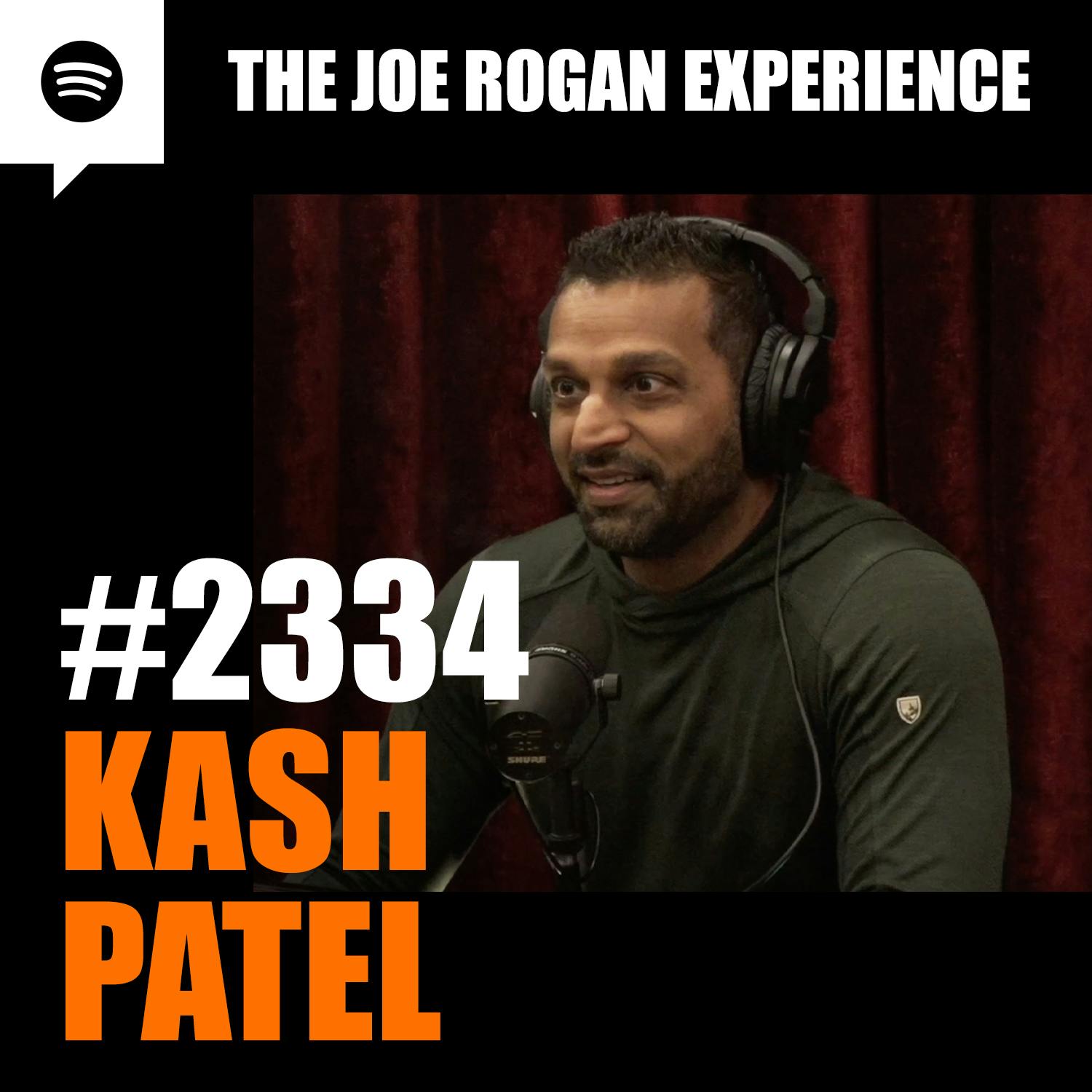
Loading summary
Transcript464 lines
- [00:02]
Joe Rogan
Joe Rogan podcast. Check it out.
- [00:04]
Kash Patel
The Joe Rogan Experience.
- [00:06]
Joe Rogan
Train by day, Joe Rogan podcast by night.
- [00:09]
Kash Patel
All day.
- [00:13]
Joe Rogan
All right, what's going on, man?
- [00:15]
Kash Patel
How you doing, Joe?
- [00:16]
Joe Rogan
Very good to see you, sir.
- [00:17]
Kash Patel
Thanks for having me in Austin.
- [00:18]
Joe Rogan
What is it like to be the head of the FBI? How weird is that?
- [00:21]
Kash Patel
It's completely effing wild. I mean, I don't even know how to describe it.
- [00:27]
Joe Rogan
What was it? What did you think it was going to be like? And what was different once you got in there?
- [00:35]
Kash Patel
I thought that we were going to be able to come in with the movement that President Trump came in with the administration to fix this, fix the errors that the leadership of the FBI previously made. Not like the 37,000 change people. And we are, we're doing a ton of work. I didn't know we would be able to do it this quickly is my surprise. And that what that showed me was the people at the Bureau, literally people who've been there, 30 year agents, they're coming up to me like, dude, we wanted to do that 15 years ago. Really, we wanted to do that 10 years ago. And then my question was like, you guys are the pros. Like, I'm just. My job as the director, I'm not chasing down bad guys. I don't know how to do that. Is to give them what you need and get the hell out of the way. And they were like, dude, all they did was get in the way.
- [01:25]
Joe Rogan
What kind of stuff specifically did you start doing that they wanted to do 15 years ago?
- [01:32]
Kash Patel
Simple. The one that I've taken the biggest heat for. You know, when I said, hey, there are. These are the statistics from the usg, so you can take them or leave them, right? I don't know where else to go because nobody else does these, right? In the last calendar year, not this one year before last, 100,000 people were dying of drug overdoses a year. That's one every seven minutes. A child or kid was being raped every six and a half minutes in this country. And there were two homicides an hour in this country. And we have a 38,000 person workforce. And I said, okay, where are the agents? Where are intel analysts? Where is Everybody? We got 55 field offices, we got 300, what we call RAs, resident agencies, so satellite offices, the field offices in major cities. And they said, well, we've got 11,000 FBI employees in what we call the NCR, the National Capital Region. So if you take D.C. and you do a 50 mile, 60 mile radius around it, 11,000, almost a third of the workforce worked there. They said, what the hell are they doing there? They said, well, they mandated if you want a promotion, if you want to move up, you got to come back here and prioritize stuff here. So I said, look, we're moving agents and intel analysts to the field. And that's what I did. 1500 people are going to the field because a third of the crime doesn't happen in Washington D.C. in the 65 miles around it. And everybody was like, we've been wanting to do this forever. I mean, just think about it. One agent out in Indian country, one agent out in Texas, Arkansas, Washington state, prevents a homicide, conducts a major drug bust, stops a ton of fentanyl or meth from coming into our country. One agent can do that. And the agents that I talk to now from around the country are just stoked.
- [03:10]
Joe Rogan
That's awesome. That's great news. That really is great news. Because the fentanyl thing scares the shit out of me. It really does.
- [03:17]
Kash Patel
Well, it's one of the things I want to hammer down on, but whenever you want to get into that.
- [03:21]
Joe Rogan
Yeah, please. Yeah, it's so terrifying because, you know, we've shown it on the podcast. The amount that'll kill you.
- [03:28]
Kash Patel
Yeah.
- [03:28]
Joe Rogan
It's so small, it's like the tip of a pencil.
- [03:31]
Kash Patel
Yeah. It's like point something, something milligrams. It's. It's nothing. I'll give you. I put this to Big program. I love doing this long form stuff and this is the only long form interview I'm going to do, I hope you know. Oh, thank you. I do one interview. I do one interview. A one. And it's usually like a five minute TV thing just to keep abreast. And we do a lot of stuff on social media. But I've been looking forward to this for a long time. Even when I was on the campaign, I was just, this is like the best way to get information out. So fentanyl, right. Everybody's like, how do you attack fentanyl? How do you stop this stuff? Okay, yes, let's go after the gangs. Excuse me, the narco terrorists down in Mexico, 100%. You gotta go after the cartels, the drug trafficking organizations. You gotta shore off the southern border. And the president has done an amazing job at bulletproof. Both of those things made it a priority. So we have decreased the amount of fentanyl being moved around, let's say. Right. But not necessarily coming into the United States. So where's the root of the problem? The ccp. So the Fentanyl precursors, the stuff you need to make fentanyl, comes from mainland China. That's it. Now, I'm sure like 1% of it comes from somewhere else in the world, but that's where it comes. They've got hundreds of companies standing up in mainland China shipping this stuff out into the world. Now, their cover is that fentanyl has, and it does have a legitimate, lawful purpose in terms of an anesthetic or medical use for anesthesiology related stuff. Okay. So there's like a minimal use for it. And what the CCP has done is they've come out and said, this is like the biggest, like, talk about the devil pulling the wool over the world's eyes. They're like, we don't make fentanyl. They're right, they don't. They just give you all the ingredients for it and ship it to Mexico. And then what they did was to trick the world. They came out and said, hey, we're gonna not sell precursor X. They're like, so now we're out of the fentanyl trade entirely. The problem is there's 14 other precursors you can use to make fentanyl, and they're still shipping all of those. So what we did when I got to the bureau is we st up this massive enterprise to go after fentanyl precursor companies in mainland China. And they're probably not going to like that. And what they're doing now to get cute is they're shipping that stuff not straight to here, they're going to places like India, and I'm also doing operations in India. And they're having the Mexican cartels now make this fentanyl down in Mexico still. But, you know, instead of going right up the southern border and into America, you know what they're doing? They're flying it into Vancouver. They're taking the precursors up to Canada, manufacturing it up there and doing their global distribution routes from up there. Because we were being so effective down south. Yeah, it's a huge lift. But part of it is Americans just don't understand the depth and depravity of fentanyl. But what's worse is fentanyl. You don't hear fentanyl deaths in China, you don't hear fentanyl deaths in India. You don't really hear fentanyl deaths in England, Australia, New Zealand. Our five eyes partners in Canada, the Chinese, in my opinion, the CCP have used it as a directed approach because we are their adversary and they don't like us. And we don't like what they're doing when it comes to fentanyl and their long term game is this. How do I, in my opinion, kneecap the United States of America, our largest adversary? Well, why don't we go and take out generations of, of young men and women who might grow up to serve in the United States military or become a cop, or become a teacher. And that's what they're doing. When you wipe out tens of thousands of Americans a year, it's a long term plan for them.
- [07:16]
Joe Rogan
Oh, that is such a dark, dark thing.
- [07:20]
Kash Patel
It is. But we got, we got, we're on it.
- [07:25]
Joe Rogan
What else could be done? Like with the Chinese companies? I mean, has there ever been any negotiation with Xi Jinping with the United States or the like where you could lighten up tariffs or do something and make some sort of a deal? Or is it just so profitable for them that they're going to do it no matter what if they can?
- [07:45]
Kash Patel
Here's the thing, they're not making a ton of money off of it, right?
- [07:48]
Joe Rogan
So it's. This episode is brought to you by Squarespace.
- [07:52]
Kash Patel
Have you ever been shopping online and the website just gave you the ick? Let me tell you, that wouldn't happen if they used Squarespace. Squarespace Design intelligence empowers anyone to build beautiful, more personalized websites tailored to your unique needs. And with Squarespace Payments, it's super easy to manage payments with just a few clicks. Plus, with Squarespace's integrated and optimized SEO.
- [08:20]
Joe Rogan
Tools, there's all the help you need to get people to your site.
- [08:24]
Kash Patel
Head to squarespace.com emma for a free trial and use code EMMA to save 10% on your first purchase.
- [08:31]
Joe Rogan
Your team's best shooter is headed to the line. They're down one, he's shooting two. He's gotta be sweating bullets, right? Know who's not sweating you? That's because DraftKings is hooking up new customers with a no sweat bet. Up to $100 when you deposit $5 or more. Just deposit $5 or more. Place any bet and if it doesn't hit, they'll give you a bonus bet back in the amount of your initial bet. $100. Download the DraftKings sportsbook app. New customers use promo code Rogan to get a no sweat bet. That's promo code rogan only on DraftKings sportsbook. The crown is yours. Gambling problem. Visit opgr.org Lottery games should not be played for investment purposes. Must be 21 and over and in Oregon to place wagers. Eligibility Restrictions apply. One per new customer issued as one bonus bet based on amount of initial losing bet. Bonus bets expire in 168 hours. Deposit, wagering and eligibility restrictions apply. Terms at SP sportsbooked@draftkings.com promos really, just.
- [09:30]
Kash Patel
For that purpose, you could sell fentanyl precursors. Unless you jacked up the price to exorbitant amounts of money, they're not making a ton of money. And so it's an all of government approach. So I'm working with guys like the Secretary of Treasury to do sanctions on some of these companies. Right? Then I'm working with our five Eyes partners. And our five Eyes are the five English speaking countries in the world. Canada, America, England, New Zealand and Australia. Right? We share intelligence, we share classified intelligence on this stuff. So I'm asking them, I said, hey, it's not just affecting us. It will affect you and your population. The CCP just hasn't directed it at you yet. And they know that. And I said, guys, I need your help. I'm looking at intelligence reporting that shows fentanyl precursors are now in your country. The fentanyl itself isn't being deployed into your country, but it's there being manufactured. And so I'm asking for their help to shut down those factories and production facilities. And I'm asking the Mexican government's help to come and say, hey, your drug trafficking organizations are now exporting the manufacturing of fentanyl and getting creative in the ways in which they obtain fentanyl precursors. So they'll say, oh, we didn't get it from China, we got it from India, we got it from wherever. And it's too cute by half. It's not like there's been a reduction in the amount of fentanyl precursors that mainland China produces. What there has been a reduction in is President Trump's administration's aggressive approach to just crush the fentanyl trafficking. And unfortunately, our adversaries adapt. We're so good down south on the border here, and we're so good in Mexico that they're moving it elsewhere.
- [11:09]
Joe Rogan
Jesus.
- [11:11]
Kash Patel
We're gonna get them. I promise you. I promise the President and the American people. We will not have kids dying of fentanyl overdoses in our streets. Just give me a little bit more time. We have a massive operation going on around the world on this.
- [11:24]
Joe Rogan
Well, that's great news. It's great to hear. So the fentanyl, a lot of it is. It's not just fentanyl overdoses, right? It's opiate overdoses overall, how much is a lot of it? Because people get hooked on pills and, like, and then they want more. And then they could buy black market pills. And those are the ones that have fentanyl in it, or is it molly and things like that that have been laced with fentanyl.
- [11:52]
Kash Patel
So great question. Nobody asks these questions. It's probably why your show's number one. They are so demonic in their ways. They're like, we'll make fentanyl and people can go use fentanyl and get killed on fentanyl. Then what they do is they manufacture as part of this lift. They being the drug trafficking organizations, once they get the precursors from the ccp, they take their pill presses and they make fake oxycodone. So, like, literally, I'm just giving you an example. Make tens of thousands of pills of fake oxycodone and we bust them for it. And in that fake pill is fentanyl. It's laced with fentanyl that kills people. Then the drug trafficking organizations, to make it appealing for the youth, shape this illicit narcotic in the form of, like, candy and gummy bears. So you hear about kids in New York who just happen to have, like, a trace amount touching it somewhere, also dying from it. So they have absolutely no rules or boundaries whatsoever when it comes to how they deploy fentanyl to get into our population. It could be through another drug. It could be through a synthetic, it could be through a fake drug, or it could be like, hey, and we've seized it. Thousands of pounds of material that looks like candy.
- [13:05]
Joe Rogan
Are they doing it specifically to try to get people to overdose on candy, or are they selling this candy as a drug?
- [13:12]
Kash Patel
They're selling it as a drug.
- [13:13]
Joe Rogan
Okay. And they're just saying it looks like candy.
- [13:16]
Kash Patel
It just looks appealing to kids, right? Like, so inner city youth, they're like, hey, put a pill down on the table. Put a gummy bear down on the table. You know, a younger person to be like, oh, that's cool. Let me try that. I mean, I can tell you stories from now until the entire show about high school kids on the verge of graduating, and they went out and took a pill that they thought was, you know, an upper, but it happened to be laced with fentanyl. They died. Their parents are calling, they're destroyed. And people are like, well, we gotta go after the drug traffickers. I'm like, we do. And we are. But what My job is to educate the American public on the root cause of the fentanyl. That is destroying our society. And it's the fentanyl precursors that I've asked. I literally just got off the phone with the Indian government. I said, I need your help. This stuff's coming into your country, and then they're moving it from your country. Because India is not consuming fentanyl. They're not. No one's dying over there from fentanyl. But I need you and your help. So my FBI is over there working with the heads of their government, law enforcement authorities to say, we're gonna find these companies that buy it, and we're gonna shut them down, we're gonna sanction them, we're gonna arrest them where we can. We're gonna indict them in America if we can. We're gonna indict them in India if we can start indicting them in places like Canada and the UK and England and Australia. This is a global problem. And the reason it's gotten so bad is because nobody did anything for four years. You know, people are like, how do they stand this up? Well, if you give the ccp, who has an endless amount of money to deploy in human capital, that's what happens. It metastasizes.
- [14:49]
Joe Rogan
Why didn't anybody do anything for four years? Have you been able to figure that out?
- [14:55]
Kash Patel
Look, to me, I'm a national security guy, and anything that kills 100,000 people a year is a national security crisis. Right? It's what we call a Tier 1 threat. And the last administration did not classify the drug trafficking enterprise as a prime threat against the American people. And so what happens is you reorient the system of intelligence collection operations. I mean, I'm not making this up. They said climate change is our biggest priority. DEI is our biggest priority. I mean, you guys have heard this and you've had guests on that say it, but these are the ramifications. In real life, I only have X amount of people that can target something. Right? Same with the CIA, same with the dod. But if the United States government and Uncle Sam and your commander in chief said, hey, I need your X amount of people looking here, I can't clone the that army to look back at fentanyl. Plus, we have to follow the chain of command.
- [15:48]
Joe Rogan
It's so crazy that they would say climate change and DEI were the priorities for the FBI.
- [15:55]
Kash Patel
Well, for the government.
- [15:56]
Joe Rogan
For the government in total.
- [15:57]
Kash Patel
So I'll give you a better example. So I was, in the end of the last Trump administration, I was chief of staff of the Department of Defense, one of the greatest jobs at the time, I thought the greatest job I'd ever have. And when we left, we said, hey, you know, Iran's a huge threat. We got to never let up on the counterterrorism mission. We still have hostages out there we got to find and bring home. And the narcotics mission is a big priority. We handed off our playbook and we said, look, this is not a political issue. This is protecting the American people and our allies. So we hope you guys continue this effort. So the DoD has this thing called ConOps concept of operations. The Department of Defense has 3 million employees, and a CONOP is how you move the machine of the Department of Defense. Defense, hey, we have a threat in Indo pacom. How many carrier groups are we sending down there? We got a threat with government X. What are we doing operationally, kinetically? What are we doing? Intelligence collection. That's a con up. The first concept of operation that the Biden administration launched at the Department of Defense was on climate change. You can't make this shit up.
- [16:59]
Joe Rogan
What do you think that's all about? Like, as an outsider, as someone, like, looking at it going, I just don't understand, like, where's the profit in this? Like, what. What is. What's the motive? Like, what would incentivize all these people to get on board with it without someone logically stepping in and saying, hey, this is not our top priority?
- [17:19]
Kash Patel
I think at its. So that was something I tried to answer when I was out of government for the last four years before I took this job. And the answer laid in the first Trump term. We were doing things so effectively on national security that hadn't been done before in such speed and volume that the media hated us for it because the other party had tried to do it and failed.
- [17:49]
Joe Rogan
What thing specifically?
- [17:51]
Kash Patel
So when it comes to, okay, hostages, I could talk about that forever, too. Used to be counterterrorim was a big portfolio. I ran it for the White House, the National Security Council in the first Trump administration. We brought home. People don't know this. President Trump in his first term brought home and rescued over 50 hostages and detainees from around the world. That's more than every president before him combined. Wow. Did you hear about the successes of reuniting families with lost loved ones from Africa and the Middle East? Or these operations that the president was courageous enough to greenlight to go into place places like Afghanistan and do these hostage rescue Ops and use Seal Team 6 and Delta or take out guys like Baghdadi and Soleimani. President Trump's directive was simple. We are going to protect the homeland. We are not going to endanger the lives of our armed forces and our intelligence community, but their job is to protect the homeland. And he said, go. And we went. And I think there was such a resounding success that the media had such a hatred for President Trump and his administration. They just said, one, we're not gonna give you the credit. Two, we're gonna put out a ton of disinformation, which we can get into. And three, when they came time to transition governments from Trump to Biden, they just said, we're not gonna do. And this is my opinion, we're not gonna do any of the stuff that worked, because then we'll have to attribute it to Trump's policies. So we're gonna go off on our end. And I keep asking people to prove me wrong. Like, tell me something you did in that administration that carried out the apolitical national security mission to a T. Right? I mean, you had the Secretary of Defense in the Biden administration go down, go to a hospital, MIA literally awol, and didn't tell the commander in chief, and broke the national command authority. There is a reason, and I was the guy responsible in that nuclear football for a part of my time at the White House, that. That thing. And there is an unbroken chain of command between the President of the United States, the Secretary of Defense, and the national command authority at all times, because shit happens. And what if it had happened in that one or two weeks the guy was in the hospital and maybe something did and we don't even know. Right. But no one, including the President, didn't know the Secretary of Defense was in the hospital. I can't tell you how big of a cataclysmic failure for the national security mission that is. And what I tell people when they're like, it's all right. It's not that big of a deal. What if Hecseth took a week out and said, I'm going to the hospital. I'm not telling anyone. What do you think the media would do to that guy and Trump if that were to happen now?
- [20:26]
Joe Rogan
Yeah. It would be catastrophic.
- [20:28]
Kash Patel
Yeah.
- [20:28]
Joe Rogan
Yeah. So this person went to the hospital for what? What was the.
- [20:34]
Kash Patel
I keep losing my flame.
- [20:36]
Joe Rogan
Isn't the letter over there?
- [20:37]
Kash Patel
I got it.
- [20:38]
Joe Rogan
Yeah, you got it. What was. What were they in the hospital for?
- [20:43]
Kash Patel
So Secretary Austin was in the hospital for medical issues. And I'm not saying you shouldn't have.
- [20:47]
Joe Rogan
Right. But there should be someone else that's.
- [20:49]
Kash Patel
There's a plan in place. The deputy secretary of defense comes in. You know, every time a senior goes out, there is a continuity of government plan in place. Oh, you're out for a weekend treatment, no problem.
- [20:59]
Joe Rogan
But they just hit all this.
- [21:01]
Kash Patel
They hid it.
- [21:02]
Joe Rogan
That's insane.
- [21:03]
Kash Patel
And we broke it. We discovered it and we broke it. And it wasn't the only time he did it. It was the second time, or the guy would end up doing it another time.
- [21:12]
Joe Rogan
Why would they do that? Just to hide the fact that they're sick?
- [21:15]
Kash Patel
Well, that I think is up for debate. Like, people are old and they get sick. Like, no big deal, everybody needs treatment. Everybody's gotta go to Walter Reed or whatever.
- [21:23]
Joe Rogan
Do you think that he thought it would hurt him politically if he looked weak?
- [21:28]
Kash Patel
I'm not. Yeah. I don't know.
- [21:29]
Joe Rogan
Speculation.
- [21:30]
Kash Patel
Yeah, I don't know if I can answer that. And the secretary at the time, Secretary Lloyd Austin, was like a 45 year military man. It's not like this was new to him.
- [21:38]
Joe Rogan
Right.
- [21:38]
Kash Patel
He'd been doing it his whole life. Next man up, you know, so he.
- [21:41]
Joe Rogan
Had made a decision to try to.
- [21:42]
Kash Patel
Keep it private intentionally. And he would come out later to say, well, oh, I just wanted to keep it private. And I said, hey, man, your life, when you're the Secretary of defense, Director of the FBI, Director of the CIA, it ain't about being private. That's gone. You signed up to serve the mission. And when you do that knowingly, you have literally violated the national command authority. Wow.
- [22:07]
Joe Rogan
So you were saying there's a bunch of misinformation that was put out or disinformation. Like, what was that?
- [22:14]
Kash Patel
Oh, pick your. So my thing is all roads lead to Russiagate. Right? That's where it all started. I was coming out of my tour at JSOC as a civilian, and DOJ and I would end up going to Congress to run this thing called Russiagate, which at the time, no one knew anything. It was just a whatever. And then it became what it became. And I would be the guy, the lead investigator on the Hill who said, hey, man, look, they lied in the FISA application. Let me give you Russiagate in 90 seconds, okay? Could you imagine a time in the United States of America in the 21st century where a political party would go overseas and acquire fake foreign intelligence from a foreign intelligence officer funded by donations to that political party in the United States of America, Then take that material, package it, walk it to the FBI, literally, and say, hey, we need you to surveil the opponent of our political party who happens to be running for The President of the United States then convince the FBI to go into a secret federal FISA court that I used to use to manhunt terrorists and say, hey, I need you to wiretap essentially all the comms in and around Trump camp because of the material we gave you, and then have that FBI lie to the federal court and the judge in that warrant application, which is a felony, and intentionally remove information of innocence from that application just to get it above the threshold so the judge would sign it. That's Russiagate. That's what they did. And you remember the years and years of reporting surrounding Russiagate. The FBI would never lie. They would never do that. The leadership there is above reproach. James Comey, Andy McCabe, Peter Strzok, the list goes on. We caught him red handed. We caught him. You've seen the text message, you've seen the documentation, you've seen the reports. But when I did that, when I exposed that initially as a staffer on the Hill, Adam Schiff comes out and has his cronies leaked to the world that I am acting as a genocidal dictator. There was actually an article that called me genocidal. Hang on, it gets better. Yeah, no, it gets better.
- [24:25]
Joe Rogan
How do you get to be a dictator?
- [24:26]
Kash Patel
I don't know genocidal one, let alone. Right. Like, you know, it's a twofer.
- [24:30]
Joe Rogan
That's. These words don't even mean anything anymore.
- [24:33]
Kash Patel
No, he literally, there's an article out there that they called me Torquemada. The guy from the Spanish Inquisition.
- [24:39]
Joe Rogan
Jesus Christ.
- [24:40]
Kash Patel
And I was a staffer. So the rule was you can ding elected representatives all you want in the media. You don't touch staffers. They didn't care because they knew what I had on earth was the biggest political criminal scheme ever perpetrated by portions of the FBI leadership and other people in the intelligence community in coordination with the media. In coordination.
- [25:01]
Joe Rogan
And who could have investigated it.
- [25:03]
Kash Patel
But hang on, that's the kicker. So what people don't know about Russiagate that weren't paying attention was that warrant that initially kicked off the FISA surveillance on the Trump campaign writ large was substantiated by FBI leaks to the media. Two of the articles cited in that warrant from I think Mother Jones and Yahoo News, were leaks of information from the same leadership at the FBI. Peter Strzok, Andy McCabe, James Comey and company. And then they in the application be like, hey, it's not just us saying that Trump's a Russian asset, right? Look at this article, Mr. Judge, on the federal FISA court, and they included it in that application. So this was a coordinated conspiracy to take down your political opponent by weaponizing government. And now I say that now in 2025, what? I said that in 2017, whatever it was, people were like, you're out of your effing mind. And I was like, look, man, I'm just showing you the facts. I'm not making this up. I'm showing you the application, I'm showing you the documentation. And that's when they came after me. And it hasn't stopped ever since. But the damage they did, they, the media and the people that wanted to take out Trump. And I didn't care what you thought about. And remember, back then, I hadn't met Trump, never spoken to him, didn't know him. I took that job at Congress on one condition. I said, whatever we find, we're putting out. I'd been in for 16 years at that point. Democrats, Republicans. I was a national security guy, intel guy. That's what I wanted to do. Chase terrorists, chase bad guys, bring hostages home and help protect the homeland. And I said, I didn't know if Trump did this. I didn't know if he was colluding with whoever. I didn't know it would turn out like this, that they would actually manufacture and make it up. But half of America to this day still believes the narrative that the CNNs of the world pushed for five years. And if you look on their shows now, Russiagate keeps coming back because we keep exposing the documents that showed how bad these guys were. And most Americans like, no, no, they're already convinced. So in order to fix that disease temple, it is just that much harder of a lift for me to go back into the FBI. We're going to get it done. But it takes so much more communication and so much more energy to get after the American people and say you were lied to. Because that's the hardest thing I think people can ever admit to themselves. You were lied to. I went out for years and created a life cycle out of this lie of Russiagate. I went on tv, I made money, I wrote books, I sold political advertisements based on it. I educated my children based on it because I thought it was the truth. And some of them have come back and said, yeah, we got it wrong, but most haven't. And that's the disinformation seed, in my opinion, that started it off. And then you could talk about things like January 6th or, you know, pick your poison rescuing hostage or what have you. The media just never got on Board. They kneecapped Trump from the beginning by participating in the Russiagate collusion conspiracy with the FBI.
- [28:13]
Joe Rogan
It's so crazy that someone could do something like that and a whole enormous group of people could do something like that with no repercussions. And to be able to operate and, you know, say they're the trusted source in news and you were a part of something that was one of the biggest scandals in political history, but just because of. Because it's targeted towards Trump, people look the other way. Like, if that was targeted towards Obama, could you imagine how psychotic the response would be? People would be up in arms and furious. But the same people that would be up in arms and furious if somebody tried to do that for Obama are completely silent if it's happening to Trump.
- [28:52]
Kash Patel
Yeah. Just think about it. What if me, as the FBI director in the Trump administration, right, during a presidential cycle, went out there and said, hey, Republican National Committee, do you guys have dirt on whoever's running for the Democratic nomination to be President of the United States? If you don't, can you go overseas and pay a foreign national who used to be an Ms. 6 guy, get me some bogus intel? Then I, as the FBI director, will authorize a warrant, a leak to the media while I'm doing it, take their articles, put it in that warrant, and then go surveil the opponent so he doesn't get elected. I would be in prison, which I should be, for doing anything like that. And that's what people want accountability for. And that's what you asked me at the beginning of the show. You know what's the hardest part? I'm like, hey, I'm the guy that is exposing and giving you the accountability from 2017 onwards. But I wasn't the guy in charge of putting people in prison and arresting them for this conduct. And so the other education campaign I have to go on is there's this thing called the statute of limitations. I can't prosecute people for their crimes in the past that the statute of limitations has run. And I'll give you a great example that goes right back to Russiagate. So one of the big systems I've created, maybe because of my time in Russiagate, is I'm committed to congressional oversight. I'm committed to giving Congress the documents they need to do their work and give them to the American people unredacted, no classification bs. You want it, you get it. So we just think about this. Me as the director of the FBI, the former Russiagate guy, when I first got to the Bureau found a room that Comey and others hid from the world in the Hoover Building, full of documents and computer hard drives that no one had ever seen or heard of. Locked the key and hit access and just said, no one's ever gonna find this place. What? Yeah, so my guys are going through that right now.
- [30:54]
Joe Rogan
What's in there?
- [30:55]
Kash Patel
A lot of stuff. I mean, that's the thing. People are like, well, okay, go arrest him. And I'm like, okay, well, how about you let me run a methodical investigation while I give over information? One of the things we gave over before this, the room deal, was I don't know if you remember who Nellie Orr is. It doesn't really matter. Nellie Orr's husband, Bruce Ohr, was like the number four at the Department of Justice, and he was the one who introduced the world of Christopher Steele, the guy that started Russiagate. Well, the entire time her husband was doing that at doj, she, Nellie Orr was working on an outside contract to dig up dirt on Donald Trump. So she goes to the Hill and testifies as a result of our investigation, right under oath. She said, I never worked. And I'm paraphrasing. I never worked with my husband on any of that. I would never do that. What did Grassley put out just yesterday, two days ago, the Nelly Orr documentation that the FBI hid to the world that we gave them. Where Nelie Orr is caught red handed providing information to her husband, Thumb drives related to Trump, Russia collusion, directly proving that Nelly or lied to Congress, felony camp prosecutor, statute of limitations is gone. That's just one example. Wow.
- [32:08]
Joe Rogan
What a dirty business.
- [32:11]
Kash Patel
Yeah, I hate it.
- [32:12]
Joe Rogan
Politics is just. It is just the dirtiest. And in this age of transparency, because of, you know, the Internet and social media and independent news, like everybody knows about it now. Like if this, if CNN and, you know, and all these left wing news sources, msnbc, and it was only Fox on the right. And that was all we had. And we had no Internet. All this would be completely secret. No one would have known the Russiagate collusion, that. That all that stuff would be. People would really think it's a true story. It would probably take decades before someone wrote a book where people started to really take it seriously and really realize that there was something fucked up about it.
- [32:53]
Kash Patel
Yeah, I'm not allowed to plug my book, so I won't. But I did write, you can plug your book.
- [32:58]
Joe Rogan
Why can't you plug your book?
- [32:58]
Kash Patel
I think there's some rules on it.
- [32:59]
Joe Rogan
About I can plug your book. What's your book Give it to me.
- [33:02]
Kash Patel
Here you go. This one's for you anyway. Government Gangsters.
- [33:04]
Joe Rogan
Government Gangsters by Kash Patel. Go buy it plugged. You didn't plug it. I did.
- [33:10]
Kash Patel
I love it.
- [33:12]
Joe Rogan
Did you do the audio?
- [33:13]
Kash Patel
Yeah.
- [33:14]
Joe Rogan
You've read it?
- [33:15]
Kash Patel
Oh, I. I got somebody to do it. My voice is not for radio or tv.
- [33:19]
Joe Rogan
Come on, man. You got a great voice.
- [33:20]
Kash Patel
I appreciate that. It's. It's taken time and a lot of cigars to get to here.
- [33:24]
Joe Rogan
It would be good for you to read it. They should let you read it.
- [33:26]
Kash Patel
Well, I mean, what's in. But the reason I wrote it is, one, I never thought I was going back into government service. And two, part of the job to completing the mission was exposing what people didn't ever think could happen in the United States of America. And it was not just disinformation, misinformation, but your government and leaders in government weaponizing it for political purposes. Not just FBI and doj, but others in the ic. And what it shows you is the back end of that, too. The rewards. Right. The guys that wrapping it back up or reversing it back up. The guys that were in charge of Russiagate at the FBI. Andy McCabe. Right. Remember what this guy did? Andy McCabe agreed to set in motion a plan with the Deputy Attorney General, Rod Rosenstein at the time to have him wear a wire into the Oval Office to record President Trump. Those documents we found, we released them. Put that aside. While Andy McKay was in charge of the Trump Russiagate collusion investigation, his wife was running for political office in the state of Virginia. Do you know who's funding her campaign for political office? 200, $600,000. Hillary Clinton World, who happened to be running against Donald Trump. Do you know what Andy McCabe did? He leaked information about the Clinton investigation to the media unlawfully as the deputy director of the FBI, got caught by us, then lied about it to federal authorities. And that's the reason Andy McKay was dismissed. Do you know what the Biden administration did? They allowed him to retire out of the FBI with full benefits. Wow. He got rewarded. Do you know what he does now? He's on cnn. You know who's also on cnn? Peter Strzok, the head of the counterintelligence unit that had that affair with Lisa Page, who basically put out those text messages. Who was running that investigation with Andy McCabe and said, Trump people smell in Walmart and we're never gonna let him win. I have an insurance policy. That guy's on cnn. So they get Rewarded for putting on this disinformation campaign for this illegal activity, because the media will never correct, or some portions of the media will never correct the record. Remember, these guys got Pulitzers. New York Times, same thing. These guys got the biggest award in journalism. They were proven wrong. Not by me, by the own evidence created by. You know how I caught these guys? Because these guys were so arrogant, they would write everything down. And I found the documents.
- [36:01]
Joe Rogan
Why would they write everything down?
- [36:03]
Kash Patel
They're so arrogant, they think no one's going to catch us. I'm going to write everything down. We're going to put it in a lockbox, we're going to put it in a vault, and no one's going to find it. Well, you know what? I found the vault, and now I'm going to work.
- [36:15]
Joe Rogan
Wow. Now, is there a statute of limitations on those crimes?
- [36:19]
Kash Patel
So generally the statute of limitations on crimes for process crimes that we call them is five years. But if you can time to an overarching conspiracy, there is no statute of limitations. So if there was more egregious conduct that no one knew about before that we are just finding and we are investigating, then we'll have to relook at it. The one thing we will do is put out all that information to the American public once we actually get through it, and we'll give it to Congress. And if we can work with our partners at DOJ to come up with a prosecution, that'll be their decision. We'll do it.
- [36:52]
Joe Rogan
The disturbing thing about all this to me is how people on the left are willing to look the other way, because this is just a dangerous precedent. If the federal government is doing this and they're doing this to someone who you consider an enemy, what's to stop this from doing that against your candidate? Like, this is unprecedented behavior that's tolerated and coordinated with the media. Like, that's dangerous for the country. But people are so ideologically captured, they're so locked into their party, and by any means necessary, we gotta get Trump out. And they push that narrative so hard that they're willing to do a very un American thing.
- [37:37]
Kash Patel
Yeah. And my goal, now that I'm back in government, is to make sure this doesn't happen again ever. That's the goal.
- [37:46]
Joe Rogan
How can you do that? How can you make sure it doesn't happen again ever?
- [37:48]
Kash Patel
Exposing it all. And I know there are people. And look, people keep calling me and saying, when are you gonna arrest everybody? When are you gonna go out there and arrest everybody that did everything to Donald Trump, I was like, first of all, you guys were barking at people who were in the seat before me to do that. And they didn't. They failed. The difference between me and that guy is one, I'm the guy that exposed it. Two, I didn't tell you this. I was the guy they targeted. So while I was doing the Russiagate investigation, do you know what Trump's own doj, Rod Rosenstein, the Deputy Attorney General of the Department of Justice, Christopher Wray, then Director of the FBI, did to me and a dozen other staffers who were working Russiagate? They subpoenaed all of our information while I was running the Russiagate investigation. We wouldn't find out for five years. You wanna know why? Because these guys were so vindictive. They went to the federal court, not only got a search warrant, they got a judge to say to all the telecom companies, Google, Facebook, everybody else, your banking companies, everybody, do not tell them for five years that we authorize this subpoena. So I just found that out last year.
- [38:54]
Joe Rogan
Wow.
- [38:55]
Kash Patel
This is how hard this is. What I'm trying to show. It's not a Republican or Democratic thing. Right. It's an all hands on approach to protect the leadership that was so corrupt. To protect themselves and their actions and their friends. My mission is to educate the world that this happened. And as director of the FBI, have a responsibility. I'm not just gonna bring a case because somebody hurt me. They did. And they continue to do it. Shit, my house just got swatted yesterday.
- [39:23]
Joe Rogan
What?
- [39:24]
Kash Patel
Yeah.
- [39:25]
Joe Rogan
But you got swatted?
- [39:26]
Kash Patel
Oh, yeah.
- [39:27]
Joe Rogan
The head of the FBI gets swatted.
- [39:31]
Kash Patel
Yeah, yeah. These people play. It's. It's the ultimate height of hypocrisy. They have two sets of rules, one against you and one for them. And what I want to do is lay out that entire body of work for the American people with Congress. And I'm doing it with guys like Grassley and Jordan and Kennedy and rand Paul on COVID 19. And we could talk about the origins. We actually have some pretty cool developments on that front. And let the American people know that my mission has always been to put out the truth, whatever the consequences are, whoever it's against. Like I did when I signed up for Russiagate. If Donald Trump was a Russian asset and I proved it, I was telling the world that that's what matters. And if we can hold people accountable in terms of indictments, then we'll work with our partners at doj. But what I'm asking people is don't trust me? I don't Care about that. Look at what I have done and what we have done. That's the guy that's now in charge of the FBI. His leadership team is in place. We've got great partners at doj. We're the ones working on all this stuff. And look, let's just get to it, because I know it's on people's minds. Epstein, right? The reason people are pissed off about that is the same thing, right? 20 years ago, or whenever it was, 2006, 7, 8, Epstein gets his sweetheart plea deal, right? After committing the most horrific crimes on planet Earth, right? I wasn't in power there. I wasn't in place there. I, you know, nothing to do with it. But people were rightfully pissed. I mean, this guy was committing the most grotesque acts you can against children. And the media spins up about it. Many in the media protected him. Why? Because of his relationships, who he knew, who his bankers were, who his colleagues were, who was on the island and stuff like that. Some pretty powerful human beings. And so when you peel back the layer and then you. And then what happened? The Trump administration, the last go round, decided, no, no, we're not going to let that go. We're going to investigate him, right? They charge him, they indict him, and he's awaiting trial. And I've said it. Dan Bongino said it. We've reviewed all the information, and the American public is going to get as much as we can release. He killed himself. Do you think. Let's play out the logical conclusion of this. Do you think that myself, Bongino and others would participate in hiding information about Epstein's grotesque activities? Or do you think we would also participate in not prosecuting people? We had evidence to prosecute people on. The problem is there's been, like, 15 years of people coming in and creating fictions about this that doesn't exist. Where's the videotape of a nipsey island of X, Y and Z committing these frauds? Why haven't you given it to us? Do you really think I wouldn't give that to you if it existed? I'm working my ass off along with the leadership at the Bureau and DOJ to get you what we're allowed to give you. And you're gonna get the video of the cell, and you're gonna see for yourself. And we will never be able to convince everyone.
- [42:42]
Joe Rogan
Okay, let's get into that. So what did you think before you got into office? Did you think that Epstein was murdered?
- [42:50]
Kash Patel
No.
- [42:50]
Joe Rogan
No suspicion at all of it.
- [42:52]
Kash Patel
But I have A different background. Right, right. So I was a public defender back in the day. I used to spend a lot of time in jails and a lot of time in segregated housing units. Shoes, as we call them. Right. And so. And I've known people that have committed suicide in these cells. And I know how you get in, how you get out, who works the system. And so the way, based on public information at the time that he ended up the pictures and him hanging himself, I was like, yeah, that guy killed himself. It's. There's just no way that you could have run an op and had people go into that cell and not have any video of it and not have any people come out and say, hey, yeah, I saw that guy. He shouldn't have been there. The guard or this guy. There's just no access points into places like this in the detention center he was in, which I've been in.
- [43:42]
Joe Rogan
So correct me if I'm wrong, but what I was told, what I'd read was that the guards were not paying attention or were sleeping well. Right.
- [43:51]
Kash Patel
Yeah. And in short order, you'll see it.
- [43:54]
Joe Rogan
Is that correct?
- [43:55]
Kash Patel
Well, it's hard to surmise that from a video. Right. Where they. Like, you know. And look, do guards doze off on the night shift? Yeah, but no one can get in to the cell. And if they had gotten into the cell, you would see it.
- [44:07]
Joe Rogan
But we were told that the cameras were down.
- [44:10]
Kash Patel
Well, I don't know who said that.
- [44:12]
Joe Rogan
But that was in the news.
- [44:14]
Kash Patel
We're giving you all the footage we have.
- [44:17]
Joe Rogan
So why wasn't that released, like, immediate? Why did this speculation escalate?
- [44:25]
Kash Patel
I think you'd have to ask whoever the Attorney General back then was.
- [44:29]
Joe Rogan
Bill Barr, did you ever see. Do you remember that HBO autopsy show, Dr. Michael Baden? He's a famous forensic.
- [44:37]
Kash Patel
I don't think.
- [44:37]
Joe Rogan
I'm a scientist. So he's a pathologist, and he reviewed the case, and it was his determination that it was a homicide because of the way his neck was broken. And what he said was it was indicative of a ligature strangulation. And it was because of the positioning on the neck where the marks were, that it wasn't indicative of someone hanging by their weight, which had been higher on the chin. And there's a specific break of the bones and the vertebrae that's consistent with someone who is just strangled to death.
- [45:08]
Kash Patel
I haven't seen it. I'll definitely take a look at it because that's part of my job.
- [45:13]
Joe Rogan
You haven't seen that?
- [45:14]
Kash Patel
The report on that? No. I haven't looked at that.
- [45:16]
Joe Rogan
Did you see any. Was there any other autopsy done other than the official one?
- [45:24]
Kash Patel
Not to my knowledge, but if there was, you'll get it. And that's what we're doing.
- [45:27]
Joe Rogan
See if you find that Dr. Michael Baden thing. Do you remember that show, the HBO show?
- [45:32]
Kash Patel
No.
- [45:32]
Joe Rogan
Pretty cool show. So this guy, Dr. Michael Batten, he had a long career of catching murderers, you know, exhuming bodies, finding trace amounts of poisons, different kinds of things. And it was a crazy show. Like all these wild ways.
- [45:45]
Kash Patel
Well, I love watching shows and I spent a lot of time on planes.
- [45:47]
Joe Rogan
Yeah, it was an old show. It was a show like from the early 2000s I believe. But this guy was very well respected forensic scientist who would analyze these bodies and it was his determination that he was murdered.
- [46:03]
Kash Patel
Yeah, and my job going back to the core of what I've been doing since I studied Russiagate, was to get and is to get everybody the information.
- [46:12]
Joe Rogan
When did you get here? Epstein's autopsy points to homicide Pathologists Hired by brother claims New York City medical examiner strongly disputed the claim that the evidence from the autopsy suggested strangulation. So let's go to the by the way, this is the New York Times and they never lie. The private pathologist, Dr. Michael Baden said the morning TV show Fox and Friends Mr. Epstein experience a number of injuries, among them a broken bone in his neck that are extremely unusual in suicidal hangings and could occur much more commonly in homicidal strangling, strangulation. I think the evidence points to homicide rather than suicide, said Dr. Batten, who observed the autopsy done by city officials. Dr. Batten, a former New York City medical examination and a Fox News contributor, said, I have not seen in 50 years where that occurred in suicidal hanging case findings by Dr. Baden were strongly disputed by the city's Chief Medical Examiner, Dr. Barbara Sampson, who previously ruled that Mr. Epstein's death on August 10th in the metropolitan Correctional center was a suicide. I stand firmly behind our determination of the cause and manner of death in this case, Dr. Sampson said in the interview on Wednesday. She added, in general, fractures of the hyoid bone and cartilage can be seen in suicides and homicides. The hyoid bone is near the Adam's apple. Dr. Sampson also dismissed Dr. Batten's contention that the circumstances around Mr. Epstein's death suggested other people may have been involved. She said her office had done a complete investigation, taken into consideration information gathered by law enforcement in the making in making the determination.
- [47:45]
Kash Patel
So this is a perfect example of going back to my public defender and prosecutor days. This is what we call a war of experts. You can always find someone.
- [47:55]
Joe Rogan
Right.
- [47:55]
Kash Patel
To come in and say the opposite.
- [47:57]
Joe Rogan
Right.
- [47:57]
Kash Patel
And I used to do it all the time. I mean, I represented some of the worst humans that you can possibly imagine on earth. Literally the guys that were trafficking children from Mexico into America. And you could put up a professional expert to say, and this is what's going to go on forever. And my job is not the forever. My job is to get you absolutely everything that we can give you. And that's what we're going to do.
- [48:21]
Joe Rogan
When did you become aware of this video that showed that no one had gone in and out of the cell.
- [48:27]
Kash Patel
Recently?
- [48:28]
Joe Rogan
So why was it recent, though? I mean, if this death was. How long ago Was this death? Two years?
- [48:34]
Kash Patel
Couple?
- [48:34]
Joe Rogan
20? 19. Oh, really? Why? Time flies. So six years?
- [48:41]
Kash Patel
Well, again, that's part of what I'm going to try to answer for you.
- [48:43]
Joe Rogan
Jeffrey Epstein, JLCC TV erased by technical errors. Whoopsies. Yeah, but you see how anybody on the outs. I mean, this is like a perfect storm.
- [48:55]
Kash Patel
Yeah.
- [48:55]
Joe Rogan
For something. Can you pull that article up so we read what it says? Jamie, US prosecutor said the jail mistakenly saved footage from the wrong cell. Sorry, Epstein. A convicted sex offender first tried to kill himself in July last year and hanged himself in jail.
- [49:10]
Kash Patel
Hang on, hang on. Yep, Reread that line.
- [49:13]
Joe Rogan
That he first tried to kill himself in July of last year. Yeah.
- [49:16]
Kash Patel
How much of the American public do you think knows that?
- [49:18]
Joe Rogan
I didn't know that until right now.
- [49:19]
Kash Patel
There you go.
- [49:20]
Joe Rogan
Maybe I heard it and forgot. Did you ever hear it, Jamie? That's why he's on suicide watch, I think. Oh, okay. So guy himself in jail in August, while serving trial on federal sex trafficking charge, he pleaded not guilty to abusing dozens of girls, some as young as 14. Soon after Epstein's death in August, two of the CCT CCTV cameras outside his cell malfunction and were being examined by the FBI. Found semi conscious in his prison cell with injuries on his neck on 25th of July. After this incident, he's placed on suicide watch.
- [49:51]
Kash Patel
I'm not saying every single camera in the place was working. I'm saying we've got footage and you're getting it. And then you can make up your own mind and the theories can continue. But my job.
- [50:03]
Joe Rogan
So you became aware of this footage.
- [50:05]
Kash Patel
Recently, the ones that we're looking at? Yeah.
- [50:08]
Joe Rogan
Right.
- [50:08]
Kash Patel
Yeah.
- [50:08]
Joe Rogan
And so. But this is like an article from quite a while ago that was saying that the Footage was mistakenly erased.
- [50:14]
Kash Patel
Look, I mean, goes back to the same. Ask the people that were in power then. I mean, I get it that you want to hold me to account for their actions. And no, I'm not saying not you.
- [50:23]
Joe Rogan
I'm not saying that.
- [50:24]
Kash Patel
Not you. Just the public in general. And that's okay.
- [50:27]
Joe Rogan
What's confusing to everybody today? First of all, it's very confusing because AI can kind of make anything, you know, which has got to be a bizarre position for you to be in when you're looking at videos. I mean, I've watched Viking videos. Looked real as fuck. You know, they just make Viking towns. I mean, it's really quite incredible what they're doing now. And it accelerates every month. I mean, I talked to Elon about it and he said we're blown away. Literally every week, every week there's some new breakthrough. We're like, wow, we didn't expect that.
- [50:55]
Kash Patel
Well, we all know Americans are still recovering from years of surging prices. Now some in Congress want to make cuts to Medicaid, a program that provides critical health care to 72 million struggling Americans, including veterans, people with disabilities, kids, and your friends and neighbors. 40% of American births are covered by Medicaid. And Medicaid covers health care costs for a third of children with cancer. Working families rely on this program. It has 77% support. Nearly 9 in 10Americans oppose Medicaid cuts. Did you know that 12 million Medicaid families live in rural communities? Many of these people voted for President Trump, but they didn't vote for this. If Congress cuts Medicaid, a lot of rural hospitals could close and a lot of rural families will be hurt. No matter how you look at it, cutting Medicaid just doesn't make sense. Tell Congress not to cut Medicaid. Our health and our communities depend on it. Paid for by the Coalition to Strengthen America's Healthcare. This episode is brought to you by.
- [51:55]
Joe Rogan
Degree original Cool Rush deodorant.
- [51:57]
Kash Patel
You gotta love when a brand can own its mistakes. So last year, people got really mad when Degree changed their Cool Rush formula. Well, guess what?
- [52:05]
Joe Rogan
Degree listened, admitted they messed up and.
- [52:07]
Kash Patel
Are bringing the original Cool Rush scent back.
- [52:09]
Joe Rogan
Grab some from Walmart, Target or other stores now for under four, four dollars.
- [52:13]
Kash Patel
And remember why? It's the number one men's anti purseman for the last decade. The original Degree Cool Rush is back. And it smells like victory for all of us. I can tell you after having looked at it, this ain't going to be AI.
- [52:27]
Joe Rogan
You don't think so?
- [52:28]
Kash Patel
You're going to. It's. It's just not great. You know, it's like if it were AI, like someone wanted to come in and make it, they'd make it better.
- [52:35]
Joe Rogan
But why would you make it better when people could, you know, you could have ambiguous footage that is, you know, totally generated by AI? I mean, AI can generate blurry images, AI can generate night vision. AI can generate essentially anything that's already existed. Like really shitty 1984 VHS tapes. They can do that.
- [52:55]
Kash Patel
They can, but I'm telling you, I'm giving you the tape from the tape. You know, there's just like. I'm giving you the documents from the vault, just like I'm giving you information to Congress on Covid origins or what have you. What we find is what you're getting.
- [53:10]
Joe Rogan
Okay, so now it's saying 2019, missing jail video from the first Jeffrey Epstein suicide for the first attempt, has been found. So maybe. Let's put it into perspective. Jails are not the most efficient, best run places. It's not like Fort Knox.
- [53:29]
Kash Patel
Yeah, no, it's not.
- [53:31]
Joe Rogan
It's.
- [53:32]
Kash Patel
Yeah, you know, we're working with what we got, right? So. And listen, this guy's not the only guy to kill himself in prison. It happens. I don't know how often, Right. All the time.
- [53:42]
Joe Rogan
Even if he killed himself in prison. So if he was murdered in prison. Crazy, right. You could see why very powerful people wouldn't.
- [53:50]
Kash Patel
If he was murdered in segregated housing, in isolation after being on suicide watch in a place in a detention center that I physically been in myself, it would be fiction. It's just in my experience, that is not doable.
- [54:07]
Joe Rogan
It's not doable even for the most powerful and wealthiest people in the world.
- [54:10]
Kash Patel
Yeah.
- [54:12]
Joe Rogan
Wouldn't you think, though, that, like, if. If someone was in a position where a guy could release information that could potentially damage the most wealthy people on earth, you would have a concerted effort that's unprecedented.
- [54:26]
Kash Patel
Sure.
- [54:27]
Joe Rogan
You'd have the resources that we couldn't even possibly comprehend, all pointing towards eliminating this one person, that it could be done.
- [54:36]
Kash Patel
But I mean, so many people have been implicated. Right. Already. And some of that information, what they did to Prince Andrew and everybody else is already out there. And so that's the conspiracy stuff that me, Bongino and the folks have to say, look, we will give you everything we can and then we will have done our job. Also, if I had a shred me Cash Patel had a shred of evidence. The Russiagate guy, the Jan6 guy, the COVID Origins guy. Had a shred of evidence that this guy was murdered, I would be the first guy to bring this case hard and fast. And I would do, even doing press conferences every week on it. The first guy. That's what I'm asking people to play out to their logical conclusion. I'm not comey. I'm not McCabe. I'm not the guy that was in the seat before. I have a wildly different background. I've been putting out the truth my entire career. Why would I risk all of it on this guy?
- [55:32]
Joe Rogan
I believe Cast the letter. I believe you. I just think that the problem is we've been fuming on this conspiracy for so long. And we love conspiracies, don't we, as a country? There's so much.
- [55:46]
Kash Patel
I mean, you know, they make JFK.
- [55:47]
Joe Rogan
Tapes come on, like, release the documents. We all love them. We love them. We love UFO ones. We love everything. We love the craziest conspiracies. They're exciting. We don't want to hear that he tried to kill himself in July and then succeeded in August. And look, I could imagine why the guy wanted to kill himself. He was going to jail for the rest of his fucking life. And in jail, sex offenders for children are not treated well.
- [56:11]
Kash Patel
And also, by the way, most Americans have it. Nor should they. Have you ever spent one minute in segregated housing? No, it's the worst. The absolute worst. Like, you and your background, you could probably handle it, right? Like, you know, just in all reality, most Americans, you put them in there for five seconds, they're going to slam their head against the wall, literally. They're going to lose their mind.
- [56:33]
Joe Rogan
Yeah.
- [56:34]
Kash Patel
Immediately.
- [56:34]
Joe Rogan
Yeah.
- [56:35]
Kash Patel
It's that bad.
- [56:36]
Joe Rogan
I'm sure. I could only imagine. And I could only imagine this guy knowing that it's over. And what do you want to do? Do you want to.
- [56:43]
Kash Patel
Yeah.
- [56:44]
Joe Rogan
And who knows who the fuck he's working for? Let's just put that aside now. If you're working for. Let's just. We don't have to name names. We don't have to speculate if he's working for some agency, some group, some foreign group, and they decide to target his family because he. Look, he's going to jail for the rest of his life anyway. They decide to target his family if he testifies against them. I could see where I. If I thought that it was like, I'm gonna be in jail for the rest of my life, or I tell and my family winds up being killed or destroyed or who knows? Maybe you'd say, look, the honorable Thing is to end it in prison.
- [57:26]
Kash Patel
Honorable, Cowardly thing.
- [57:28]
Joe Rogan
Cowardly. Whatever it is.
- [57:29]
Kash Patel
Like you just decide at some point that guy was going back into gen pop. And the one thing I'll tell you about prison systems is the, the people they eat are child predators.
- [57:38]
Joe Rogan
Yes.
- [57:39]
Kash Patel
And he was gonna get eaten.
- [57:40]
Joe Rogan
Well known. Yeah. And they probably wouldn't have protected him. Yeah. So the narrative has always been that there's video. Now what is the chain of custody. Is there evidence that there is video? Is there evidence that it was moved around, stored, protected from people looking at it?
- [58:02]
Kash Patel
Like you're going to get all that information. Like that's literally what we're putting together. And we're going to give you every single thing we have and can. And that's the whole point. We can't fill gaps by making stuff up. And we're not going to do that.
- [58:17]
Joe Rogan
And you have to be methodical and.
- [58:18]
Kash Patel
We have to be. That's the other thing. Right. We're reviewing not just the video. We're reviewing, you know, everything as meticulously as we can because that's what we owe the American people. That's our job. And I don't want to rush to the sticks or the podium and just say, hey, look what we found.
- [58:36]
Joe Rogan
Right.
- [58:37]
Kash Patel
And then be like, oh, sorry, I forgot the four seconds. You know, if we miss four seconds and be like, oh, well, it's in the four seconds you missed.
- [58:44]
Joe Rogan
Right.
- [58:44]
Kash Patel
So I'm.
- [58:46]
Joe Rogan
How much can you talk about what you've seen?
- [58:48]
Kash Patel
Not yet. Just what I've told you.
- [58:51]
Joe Rogan
Can you say you've seen anything?
- [58:54]
Kash Patel
No, that's the point. That there's nothing in there like in the video. You guys would be bored, you talking.
- [59:00]
Joe Rogan
About the video of the murder or the. The suicide. But what about the video of. From the island?
- [59:06]
Kash Patel
Oh, that's. Sorry. So you're talking about two different. Yes, so sorry. So, yeah. So again, we're gonna give you everything we can. And people have to remember we're not going to re. Victimize women. We're not going to put that shit back out there. It's not happening. Because then he wins. Not doing it. You want to hate me for it? Fine. Again, logical play out. If there was a video of some guy or gal committing felonies on an island and I'm in charge, don't you.
- [59:37]
Joe Rogan
Think you'd see it if you have access to it?
- [59:41]
Kash Patel
If I have it. Period. If I have it. If I have it. So where else would it be?
- [59:49]
Joe Rogan
Right. If you have it.
- [59:50]
Kash Patel
Right.
- [59:50]
Joe Rogan
But you can't Say that you have it.
- [59:53]
Kash Patel
No, we're giving you everything we have so far. Everything we have so far is.
- [59:58]
Joe Rogan
Have you guys gone over all the video that's available?
- [60:01]
Kash Patel
Yeah, that's what I'm telling you. That's what takes so much damn time. Right. And.
- [60:05]
Joe Rogan
And is there video from the island?
- [60:09]
Kash Patel
Not of what you want. The. The people out there have filled the void with can't wait to see X, Y or Z.
- [60:17]
Joe Rogan
Right. Speculation.
- [60:18]
Kash Patel
And I'm like, here's the other thing I've been asking for. Right. Openly. If you have information on this, call us, tell us. The best resource we have is the American people in the world.
- [60:29]
Joe Rogan
Right.
- [60:30]
Kash Patel
Get me the tail numbers, get me the flight, you know, get me new information, and I will run that down.
- [60:35]
Joe Rogan
So this narrative might not be accurate that there's video of these guys doing this.
- [60:40]
Kash Patel
Exactly.
- [60:41]
Joe Rogan
Is it possible that the video was taken and destroyed?
- [60:46]
Kash Patel
Well, you're talking about, what, decades worth of stuff, right? Remember, we have what we have pursuant to lawful search warrants and authorities from the case that was done however many years ago was done. That's what we have. If other people have other stuff and they want to give it to us, bring it.
- [61:05]
Joe Rogan
Have you guys reviewed everything that you have?
- [61:07]
Kash Patel
Almost like we're. That's. I mean, yes, we have, and now we're figuring out how to put it out.
- [61:15]
Joe Rogan
Now, I understand that you would never re. Victimize these women and show this footage, but is there footage.
- [61:25]
Kash Patel
Outside of. The only thing I can say right now is if there was ever. If there was footage of anyone doing anything else, we would have opened a case.
- [61:37]
Joe Rogan
Is it possible that there was footage that you just will never have access to because they've already gotten rid of it?
- [61:42]
Kash Patel
I mean, anything's possible, right?
- [61:43]
Joe Rogan
Well, there was a long time, right, between the time when it was clear that Kamala lost the election and that Trump won.
- [61:50]
Kash Patel
Yeah, I mean, I gotta hear.
- [61:51]
Joe Rogan
Before he got into office.
- [61:52]
Kash Patel
I gotta hear 100 days ago, literally, Right?
- [61:54]
Joe Rogan
Exactly. It's just kinda crazy, you know?
- [61:56]
Kash Patel
So I'm doing what I can, and that's this type of stuff. Like, you know, and I'm happy to talk about it and bring it up, but what I'm trying to achieve at the Bureau is not only are we doing what's of public interest, what's of great public interest, our biggest job. Our biggest job is to defend the homeland and stop kids from dying. Well, that's my biggest job, and that's what I'm focused on. And I think we can do all of Those things, and we're doing them really well. And I think if you give us just like another hundred days, it's not a lot of time. Literally, I just hit my 100 day mark. Like two days.
- [62:33]
Joe Rogan
Right.
- [62:34]
Kash Patel
You're gonna see a ton of stuff. You're already seeing it. We just hit. We just rolled out the Catholic memo. The truth about that. What is that the last administration, the FBI wrote a memo targeting Catholics. Remember the Richmond Catholic memo?
- [62:50]
Joe Rogan
I don't remember that.
- [62:51]
Kash Patel
Okay, so basically they. There was a write up from the FBI relying on the Southern Poverty Law center, which is like the modern day Fusion gps, and basically said Catholics should be targeted as domestic terrorists. Yeah. So then Chris Wray, the former FBI Director, went to Capitol Hill and testified about it. And the Congress was like, wait a second, is this real? Is it predicated on actual facts? And how wide is it? Is it one office? Is it. All these people across the country are Catholics being targeted as domestic terrorists. And what ended up happening was Wray said, oh, it was just one office, one memo. Nothing to see here. Well, what we just roll out again to Congress this week to Chuck Grassley, who put it out, was that in fact it was multiple offices, multiple memos that were weaponizing law enforcement to target a religious group during an election cycle. And we proved it, and now everybody has read it.
- [63:54]
Joe Rogan
Why. Why were they targeting the Catholics?
- [63:56]
Kash Patel
I don't know. You'd have to ask the people that got here before I did, did you.
- [64:00]
Joe Rogan
Have any suspicion of what kind of motivation they would have to. To do that?
- [64:05]
Kash Patel
I think when you use. It goes back to Russiagate. If you're willing to use Mickey Mouse journalism, if you're willing to use the Fusion GPS and Christopher Steele's of the world, like the leadership at the FBI then did, then it has a chance to replicate itself. And that's what happened. I don't know if you know anything about the Southern Poverty Law center, but they literally are the ones that sent information to the FBI. And the FBI said, oh, we'll write a memo. And so that's the type of work that I think gives credibility back to the Bureau. Us exposing it, us giving Congress the truth, Congress coming back in and saying, hey, you actually didn't give us the Heisman. You gave us the documents. We gave them to the American people. And if there are criminal referrals to come out of that, then let's do that. I mean, we just had a great breakthrough this week on Fauci. So Senator Rand Paul, Senator Kennedy, and I hate naming names Because I always forget. People are doing a great job with us on Covid Origins, and we've got multiple investigations open on that. But they had always been looking for Fauci's original phone and. Or not original, but phones and devices he used while he was Fauci back in Trump 1 during COVID and nobody had found it till two days ago.
- [65:20]
Joe Rogan
Really?
- [65:21]
Kash Patel
Yeah. Now, look, your audience and everybody listening to it shouldn't jump to the conclusion, everything's in there. We'll look at it, we'll pull it, we'll rip it as we say, and maybe it's deleted, maybe it's not. But at least we found it. And at least now we can tell the American people we've been looking because it is of public importance to figure out, did that guy lie? Did he intentionally mislead the world and cause countless deaths? We owe those answers to the American people. And the best evidence ever is always the people's evidence who created it. And so now we're gonna go and exploit those hard drives. But I think a victory for the American people that we broke with Congress is that we did find it. We're not done. We're still looking, and we're on the case. So whether it's Richmond Catholic Memo, whether it's Fauci, Covid Origins, whatever becomes of Russiagate, Crossfire Hurricane, whatever becomes of great public importance, that's a big part of what we do at the FBI, too.
- [66:15]
Joe Rogan
The Crossfire Hurricane 1 is bananas.
- [66:17]
Kash Patel
Well, that's all Russia Gate. Yeah. It's completely nuts. I mean, you can. We can do three days on that. I mean, I'm. That's like, I spent.
- [66:24]
Joe Rogan
It's bananas. I mean, it's. I mean, there's so many things in the past that you get. Like the Operation Fast and Furious.
- [66:34]
Kash Patel
Yeah. The guns.
- [66:35]
Joe Rogan
Insane. Which led to the death of American lives.
- [66:38]
Kash Patel
A federal agent.
- [66:39]
Joe Rogan
Yeah.
- [66:39]
Kash Patel
Yeah. You know, and there's just things that, like, I see that you would think I would have more uproar, even as much time I've been doing this that don't. And things that wouldn't have that in my mind would be like, no one's going to pay attention. And people are like, oh, my God. And so that's part of the learning curve for me too, you know, like, trying to figure out what the balance is, you know, should I be given this so much attention, so much resources. But then when I have to call a parent because their kid's dead from fentanyl, or when I have to call a cop's Family and I call every single line of duty death that we have in this country. I call everyone's chief and I call their families. And I'm glad that the numbers are going down in terms of how many have been killed this year versus last.
- [67:19]
Joe Rogan
Year, how much of the numbers gone.
- [67:21]
Kash Patel
Down by over 15% so far. But I want to be at zero. You know, that's where my focus needs to be.
- [67:30]
Joe Rogan
15% in 100 days, still pretty good.
- [67:33]
Kash Patel
Give or take a couple of points. And that's where my focus, that's where the FBI's focus needs to be. These guys are on the line. We're doing all these raids across the country. In Homeland Security Task Force, we just hit a 10,000 mark. We just arrested over 10,000 people in the 100 change days that we've been doing this with DHS, huge right on illegals and whatnot. We also just like, this is great. This piece of information actually made me happy. We are on track to have the lowest homicide rate ever. Murder rate, excuse me. Murder rate ever.
- [68:13]
Joe Rogan
In the country.
- [68:14]
Kash Patel
Yeah.
- [68:14]
Joe Rogan
Really?
- [68:15]
Kash Patel
We're already, and look, we got six more months to go, so we're not done yet for the year, but we're already down 20% from last year. And we broke it this week that right now, the murder rate, if we, the FBI and our government partners achieve the mission, we'll give the American people the lowest murder rate in decades.
- [68:33]
Joe Rogan
That's incredible.
- [68:33]
Kash Patel
And that's what I'm focused on.
- [68:35]
Joe Rogan
So what, what steps have been made to do that? Like what, how did that become real?
- [68:43]
Kash Patel
So I think, and I, and I've worked with cops and law enforcement a lot in the, the past. And you have to. They're awesome. All they wanted to do was do the work once President Trump got elected, before I even got the nomination. Right. And excuse me, when I was traveling country with him before, before that, they were like, take the handcuffs off of us. Let us go do our jobs. And that's where I came up with, let good cops be cops. I said, if I'm going to get this job, that's what I'm going to do. I'm going to let you, the agents, the police officers, the sheriffs, go out there and do the work you so badly want to do. And I'm going to give you the resources you need to do it. And I'm going to take away the politicization and weaponization, saying, oh, we can't target this group or this thing or this area. And that's it. That's what We've done. Everywhere I go, I speak to cops across this country constantly. And it's a humbling message that I receive back every time I talk to them. They're like, and it's not me. It's the president's administration and our entire government that's doing it. They're like, thank you for letting us do the work. We want to chase child predators. We want to bust up ms.13. I mean, look at the victories we've had for the American people. In the first two months, the FBI arrested three. Not one, not two, but three of the world's most top 10 wanted fugitives. Three. One of them happened to be the guy that was the Abbey Gate bomber.
- [70:08]
Joe Rogan
What was the Abbey Gate bomber?
- [70:10]
Kash Patel
The terrorist that blew up 13 US soldiers in the Afghan withdrawal. I did it with my interagency partners. In a week. In a week, we found that guy, went to Pakistan, brought him back here. Now there's others responsible for it, and we're chasing them down, too. But the question the American people should be asking is why didn't the prior administration, putting aside the disastrous withdrawal from Afghanistan, a plan that they completely politicized? We handed off them a proper way to do it and methodical way to do it, and they just said, f you. We're doing it this way. And you saw the videos, and you saw people plunging from our aircrafts, and you saw Abby Gate and 13Americans dead. Why didn't anyone go get justice for those families? Well, that's the priority that the President said. We're gonna go find him, and we let good cops be cops. We let federal agents be agents. We let our intel community focus intelligence collection on terrorists, and we went and got that guy.
- [71:10]
Joe Rogan
It's so hard to believe that it's really that simple, that it's just they weren't given the resources and they weren't given the support to let cops be cops and that they could have done this all along.
- [71:19]
Kash Patel
I don't know if that's the only answer. I'm just telling you what I'm doing, and I think we're seeing some results.
- [71:24]
Joe Rogan
I appreciate that. But as a person, again, who loves conspiracies, you know, you look at that and you're like, what would be the benefit of not letting co cops? Why would you want more crime? Why would you want more murders? Why would you not want to arrest bad guys? This episode is brought to you by Zip Recruiter. Summer is here at last. That means it's time to go enjoy that vacation you've been planning. For months. But before you hop on a plane or hit the beach, make sure everything is taken care of at your job. Nobody wants to work on vacation. If you're hiring, there's a fast and easy way to stay on top of things. Zip Intro It's Zip Recruiter's newest feature that helps you find and meet qualified candidates in a matter of days. And more importantly, you could try it for free@ziprecruiter.com Rogan with Zip Intro when you post your job, it'll immediately find and schedule interviews with top talent. You could be talking with people the very next day. All you have to do is pick a time and to really speed things up, you can schedule back to back video calls. Make the most of your summer in Enjoy the benefits of Speed hiring with Zip Intro only from ZipRecruiter rated the number one hiring site based on G2. Try Zip Intro for free at ZipRecruiter.com Rogan again that ZipRecruiter.com RogAn Zip Intro post jobs today. Talk to qualified candidates tomorrow. This episode is brought to you by Traeger. It's time to get fired up for grilling season and there's no better time to join the Traeger hood than during their summer savings event. Save up to $300 on select grill models now through July 7th. These grills come packed with tons of different innovative features, but each one delivers that incredible wood fired flavor and set it and forget it convenience that will have you firing up flavor all summer long. And if you've wanted to try out the flat rock griddle that's included in the sale too, head over to traeger.com to start saving. And don't forget to use the code Rogan at checkout for free shipping.
- [73:31]
Kash Patel
Well, you have to look at the landscape of the last, I don't know, 4, 8, 12 years. Call it right. It was an intentional decision and this isn't politics. It was just an intentional decision to say we're going to let all these people into our country and let them stay. The result of that is, you know, this is another part of the list that we're doing at the Bureau. We call them KSTs, known or suspected terrorists. They get pinged at the border, the northern border and the southern border. And then the last administration said you guys can come in. And then one of the most terrifying things I heard was my predecessor, Christopher Wray went to Congress a year or two ago and said, well, the last year's annual statistics for known KSTs was a few dozen. And we don't know where they are in America. What do you mean you don't know where they are? How is that not a national security crisis? And so what we're doing while we're doing these raids and chasing down illegals is trying to target those with terrorist affiliations. Those who are terrorists. Those are in our homeland because the last administration let them be here. And that's. You can say I'm being political, I don't really care. But that's me being the FBI director and saying, americans come first and we're protecting our own and we're chasing them down. And DHS is doing a great job, and so is our intelligence community, and so are the local police departments who are now working with us and not living in sanctuary cities and allowing police stations to be burnt to the ground. Working with us and not having law enforcement attacked constantly for just doing the job of protecting the American people. I think that's a tectonic shift in the mentality of what this administration has brought in. Now people are still vilifying us for doing that. How dare you separate families? They'll say, And I'm like, how dare you separate a mom from a kid on a fentanyl overdose? How dare you separate an American soldier's mom or dad from the guy that got blown up at Abbey Gate. I have different priorities. I have a different view of it. And so that's the ethos I'm bringing to the Bureau.
- [75:46]
Joe Rogan
I appreciate everything you guys are doing. I just. I'm baffled to try to come up with any kind of an explanation why anybody would let known or suspected terrorists into the country and just let them loose. I mean, when, when you. I mean, I know you can't speculate, but when you take office and you realize all this is going on, like, what. What is going through your mind? Like, how are you processing this? Like, is this pure incompetence? Is this malice? Is this a foolhardy adherence to ideology and just completely ignore the danger that they're putting the American people in by doing this?
- [76:25]
Kash Patel
It's. I think it. No, it's intentional. The intentional decision was when you're going to let in, what is it, 9 million people. A lot of them are going to be criminals. A lot of them are going to be tda. You saw what they did in Colorado. A lot of them are going to be Ms. 13. A lot of them are going to be narco traffickers, which, when you allow narco traffickers in the country, you're automatically bringing sex Traits trafficking, human trafficking, and drug trafficking automatically. And the drug traffickers have partnered with the terrorist organizations and our adversaries. We haven't even talked about Russia and the CCP and how they've combined forces over the last however many years to infiltrate America not just with people, but our cyber capabilities and our infrastructure. And so when I come into a job like this, patience is one of the hardest things you have to manage because you can't fix everything overnight. You have to build up the workforce, you have to get them the resources, you have to fix the infrastructure that's broken. I mean, I'll just give you a quick example. The building that the FBI calls headquarters, the Hoover building, is like 70 years old. I literally have netting, mesh netting holding up the side of the building because pieces of concrete fall off of it. So it doesn't hit people in the head. I'm not kidding. I'm dead serious. So I said, how about we give the workforce a safe place to work? So we're moving out of there. And people think it's a political decision. Oh, Cash Patel's taking the FBI out of the historic Hoover Building. Yeah. Cuz I don't want people to die. And I think they deserve a better workplace than something that's 70 years old that has pipes exploding literally every single week. Every week. And also, we're gonna save the taxpayer money. We're gonna get out of a building that would cost billions to fix, and we're gonna move into a location that's already built instead of a 15 year government boondoggle an hour outside of D.C. and we're gonna stay in D.C. we're gonna stay near our partners in government, and we're gonna put out the workforce and spread them out across the country like I talked to you about earlier, and put more agents on the streets and put more agents in Indian country and put more agents in your communities and intel analysts to figure out where the crime is. But that all of that takes time. I can't do it overnight.
- [78:36]
Joe Rogan
But why do you say Indian country?
- [78:39]
Kash Patel
Tribal lands.
- [78:39]
Joe Rogan
Well, what about tribal lands is problematic.
- [78:41]
Kash Patel
Oh, man. So this you're. Thank you so much for bringing this up. It's one of my biggest priorities. So the tribal. And I just met with almost all of the chiefs and the leaders of the tribal communities in America. The crimes they have committed on what we call Indian country is just as horrific, if not worse, than the rest of America. Look up the story about Emily pike, whose family is still waiting for her arms. This child was murdered on a reservation and they found a piece of her body and not the murderer and not the rest of her body. They are plagued by drugs, and they have never been a priority in terms of law enforcement working together. And now, remember, you're talking about two different sets of legal structures, right? They have their own and we have our own. But what I've asked of them and what they've asked of me is pay more attention, give us more resources. And what I've asked to them is said, hey, all the leaders said, let my guys on. Let my guys come to you, and let's work together on solving some of these horrific, horrific crimes. The trafficking, the murders, and the violent crime on Indian reservations is skyrocketing. And I'm not going to treat people who live in the United States of America differently because they have a different way of life. We're gonna help them. And we put out Operation Not Forgotten where we deployed this month and this summer. I can't remember how many agents and intel analysts, specifically to remote tribal locations to solve crimes that have not been solved for years, specifically the most violent. And we're going to double down on that. And as Bongino likes to say, this summer we are unleashing a massive operation across the country, as Dan calls it. It's a bad day to be a bad guy this summer because the FBI is putting out all these extra agents and personnel into the field, and we're going to come find you. If you think you can nest in our communities and find safe haven, you're going to prison.
- [80:44]
Joe Rogan
That's great to hear. So when. What is the. When you guys sit around, you think about the motivation to let all these people into the country? I mean, again, you're kind of speculating, but why do you think they allowed it? Why do you think they allowed the border to be wide open like that?
- [81:03]
Kash Patel
You know, in my job now, that's like one of those political decisions. And so I try to stay out of that.
- [81:09]
Joe Rogan
How was that political, to leave the border? Like, how is a national security issue political?
- [81:14]
Kash Patel
So that's just it. From my perspective, it's a national security decision, and they failed on the national security mission. But I think where the decision from that administration to do that was a political one, that's what I'm trying to sort of separate. I've always viewed it singularly protecting the border, preventing drugs from coming in, preventing terrorists from coming in, preventing people from.
- [81:38]
Joe Rogan
What political decision could be made that makes any sense at all to not do that?
- [81:42]
Kash Patel
I don't think there is one but unfortunately they did it anyway.
- [81:46]
Joe Rogan
Do you think it was just that Biden was just not there and everyone else that was really running things was completely incompetent, was focused on other things, was focused on maybe the optics of border protection. That it, you know, that somehow or another there was some negative connotation to.
- [82:06]
Kash Patel
It politically, I don't, I think it's, I always say this. I think it's dismissive to say those people were incompetent, they're super smart, they're not dumb. And whether or not Biden was running things or whatever conversation for other people to have, but there's lots of people around them who are very smart, who were in government for a long time and they, this is what I mean. They politicized the national security and law enforcement apparatus of this country by making those decisions. The why, you'd have to ask them, ask them why they did that and why they thought that was okay. And why people think it's okay for James Comey to go down a beach and put up 8,647. You know, that's another political act that hurts our national security from smart people who are doing it intentionally. And maybe because they want press, maybe because they're selling a book, maybe because it's. They want notoriety. I don't know the answer to that. But for me it's all national security related. And these people keep doing it over and over again. The good thing is now there's a bulwark against it because we're in and the President just is not having any of it.
- [83:13]
Joe Rogan
What was the case very recently where you guys caught a scientist bringing in pathogens? Yeah.
- [83:21]
Kash Patel
So I'm a New Yorker and I brought this for a reason.
- [83:24]
Joe Rogan
This means spore.
- [83:25]
Kash Patel
Yeah.
- [83:25]
Joe Rogan
Fucking New York Post is the best. They're the best. They have the best headlines ever.
- [83:30]
Kash Patel
Yeah.
- [83:31]
Joe Rogan
So it's so funny.
- [83:32]
Kash Patel
It's based. So the case is still go. It's obviously ongoing since we just made the arrest. So I'm a little limited in what I can say, but backing up the truck a little bit. Agro terrorism is a thing. Right? The CCP isn't just coming at us with fentanyl and coming at us in our cyber infrastructure and our capabilities in space and underwater. They are literally exporting people to the United States of America, having them end up being senior researchers like this individual at the University of Michigan. And the bureau picked up on this and said, wait a second, why are you bringing you. And her husband is also indicted, but he's in Mainland China. So he's not here. But we retraced what he did. And what's public now is that he also tried to come to this country to do the same thing. So they were making the connections on that, but what they did was literally bring in a mushroom that technically alone exists in the US but in an altered state causes billions of dollars of damage to wheat, to corn, to maize, and to agricultural industry, and also could wipe out your livestock and causes reproductive damage to human beings. And so this is the lethality in terms of the mindset of people that want to do harm to our country. In this case, I didn't know. This is one of those things where I knew it would garner a lot of attention, but, like, this thing went massive. It's everywhere. And I'm glad it's everywhere, because for me, it highlights the multiple levels of operation that our adversaries are looking to do harm on us. Thank God we caught this one. But what about the ones we've got to still catch that are still out there? They're not gonna stop because this lady's in jail now and being prosecuted by us.
- [85:25]
Joe Rogan
This is just the one you caught.
- [85:26]
Kash Patel
This is the one we caught.
- [85:27]
Joe Rogan
So this is proof that this is actually an ongoing thing.
- [85:31]
Kash Patel
It's been an ongoing thing. Just like, why are we allowing our adversaries to buy land around our military?
- [85:37]
Joe Rogan
I'm just gonna ask you that.
- [85:38]
Kash Patel
It's insane. To me. It's lunacy. Having been the former chief of staff at DOD and having gone to a lot of our bases, I was just like, why is that Chinese CCP establishment right there? Why are the Russians right across the street?
- [85:53]
Joe Rogan
Why did they provide towers for cell phones?
- [85:56]
Kash Patel
Cell phones. And that's a trickier issue because that's not like a federal sol. That's a state by state issue. And a lot of states have taken action. I think the Dakotas are leading the charge up there by outlawing it and banning it and saying, no, you can't do this. You can't buy this.
- [86:11]
Joe Rogan
Because a lot of these things have third party input. Right, Right.
- [86:14]
Kash Patel
And a lot of these things, unfortunately, are just about money.
- [86:19]
Joe Rogan
Right. They sell it to you cheaper, but then they're spying on everybody.
- [86:22]
Kash Patel
Then they're spying everybody. Here's the thing, like what I ask people in. Because what I get hit with is, why shouldn't foreigners be able to buy land in America? I'm like, are you able to buy land in downtown Moscow? Can you guys buy a farm in China?
- [86:36]
Joe Rogan
No.
- [86:37]
Kash Patel
No. So what's with the Disparate treatment. I get that we're the United States of America and we want to give everybody a chance. And you gave this kid a chance. But that's different than literally inviting our adversaries into our country and saying, well, as long as you build X or dump enough money into your state, we can look the other way.
- [86:59]
Joe Rogan
So what can be done about the land that our adversaries own outside of military bases?
- [87:05]
Kash Patel
Again, it's a state. It's like every state has to take steps legislatively in my opinion, to either kick them off, stop the contracts, prevent them from coming in, things like that. What we can do at the federal level are things that you've seen the State Department under Marco Rubio do. Revoking visas in certain places in certain sectors of the economy. And I think rightfully so, because if you stop the personnel from coming in, kick them out, then who cares who owns it? It's basically a dead site.
- [87:39]
Joe Rogan
That's the vulnerability that we have for being such a free society.
- [87:42]
Kash Patel
It is.
- [87:43]
Joe Rogan
We allow foreign nationals to come in and go to universities and start and do research and become the head of these different departments. And they're constantly reporting back to the CCP or coordinating with them. Yeah, or Russia.
- [87:59]
Kash Patel
Yeah. And they're not gonna stop. That's the thing with these guys. It's just because you take one out unless you take a whole of government approach, unless you get buy in from the American public. And again, this is one of those things that you would think is a national security issue, right? Yeah, but they'll politicize it, they'll weaponize it. The Post will write about it one way and it probably won't even make the headlines in a number of other outlets. Cuz they don't want to talk about that.
- [88:24]
Joe Rogan
Has the New York Times written about this channel?
- [88:25]
Kash Patel
I have no idea.
- [88:27]
Joe Rogan
I mean it seems like something that everybody should want to know about. If foreign government, an adversary government, is trying to poison our food supply and human beings and affect the reproductive system, that seems like that's a bipartisan issue.
- [88:42]
Kash Patel
Yeah. And that's the thing about your show that I agreed that I wanted to do it is because getting out to a population that has stopped listening to mainstream news and reaching out to them and challenging them with information and how we're doing things and saying, look, this is our priorities, this is what I'm doing is so hugely important because the audience, the influence of that manpower on the electorate is huge, is huge. And if we can reach through on certain some of these issues, then we're going to win collectively. Like, I can only arrest so many bad guys. And we will. But if we arrest them and people don't know who we're arresting and why we're arresting them and what the threat is, then it almost becomes irrelevant. We're still going to do it. We're not going to stop. But if we can get more and more people talking about these things and saying, look, the national security of our country is of what's of most importance to me. Not who wins the next election, but also we need to work with our communities to say who's in our communities. How many registered sex offenders are there near our schools? Are they violating federal laws? Why aren't we on these priorities? And we need help. We need American buy in to really accomplish the mission.
- [90:01]
Joe Rogan
I wonder what heavy lifting has to be done to separate national security issues from political issues. And for everybody just to just say, listen, all the other stuff that the Democrats disagree with or the Republicans disagree with, put that aside. We should all be concerned with stopping fentanyl, stopping gang members and cartel members and terrorists from coming into the country. How that becomes political to me is just fucking bananas. It really is crazy because it's just like if one side supports it, the other side has to be against it. And it's.
- [90:34]
Kash Patel
And you get you raised. The reason it's so politicized and the reason it's so sort of in many sectors of government is because of the answer to that question. The leaks from inside of government and then the spin on that information by the media is what's causing the most harm, in my opinion, to the American public.
- [91:00]
Joe Rogan
What kind of leaks?
- [91:02]
Kash Patel
Whether it's classified information or just leaks about fake news, like people saying oh so and so hate each other at the White House. Did you hear about this meeting they had? That never occurred. And I was like, I was in that meeting. What are you talking about?
- [91:16]
Joe Rogan
What have you heard? Like that. What kind of like fake rumors.
- [91:19]
Kash Patel
Oh, so I'll give you an example from, from actually FBI, then the New York Times. So.
- [91:27]
Joe Rogan
Which never lies.
- [91:28]
Kash Patel
No, no, of course not. Now we're relying on them to solve everything. So we have these. We have a regular drumbeat at the FBI where everybody has a. We have a morning meeting with the heads of our divisions. Counterintel, counter espionage, CT, everything criminal, cyber, so we can move the machine. And I was like. And I did them for a week. And I was like, why do we do these every morning? And the whole place looked at me. These are career agents and intel folks like 10, 20, 30 years in the seat, they go, boss, we hate those. They make us come offline of our work and focus on briefing you rather than staying on mission and we can come brief you on our own. So I chopped it to two days a week and I cut the time in like, less than half. New York Times puts out the story, Cash Patel upends. And I'm paraphrasing the ethos at the FBI. How dare he cut down the morning briefing cycle? And this is a perfect example of these people are coming to me saying this is what they wanted to do for years, and I'm working with them to say, that's a good idea. Why don't we do that? But the Times comes in and kicks us in the face with this leak that's not even true. Because they go out and say, anonymous source, this retired person, that. It's just one example. It might sound small to you, but now a reader is going to read that, a new kid who's like, oh, I, maybe I'm going to join the FBI and they're going to look at it and say, this place is a circus. I don't want to go work there. What do you mean they disrupted the morning meeting? That guy should be getting briefed six hours a day. And I'm like, no, I want my agents on mission. I don't need them briefing me. I can call them, I can talk to them later. And so it's just stuff like that. Since we were talking about fake news.
- [93:13]
Joe Rogan
This is going to come up because.
- [93:14]
Kash Patel
It'S been going on since we've been recording here.
- [93:18]
Joe Rogan
Elon and Trump seem to be in a bit of a spat. Joe, you want to check the tweet that Elon just put out a little bit ago? Time to drop the really big bomb. Donald Trump is in the Epstein files. That's the real reason they have not been made public. Have a nice day. Jesus Christ.
- [93:32]
Kash Patel
I'm not participating in any of that conversation between Elon.
- [93:36]
Joe Rogan
Have a nice day. DJD so much digits. Phone away. They're going back and forth about different things.
- [93:41]
Kash Patel
And.
- [93:41]
Joe Rogan
Yeah, well, he said he was disappointed in Elon Musk. Jesus Christ. That's a crazy thing to say. How does he know? Does he know that Donald Trump is in the Epstein files? Does he have access to the Epstein files?
- [93:53]
Kash Patel
I don't know how he would, but I'm just staying out of the Trump Elon thing. That's way outside my lane.
- [93:58]
Joe Rogan
What the fuck are they doing?
- [93:59]
Kash Patel
I know my lane and that ain't it.
- [94:01]
Joe Rogan
I just don't. I mean, I understand he owns Twitter. I think it's bad for your mental health. I think posting things public all day and arguing with people all day is bad for you.
- [94:12]
Kash Patel
Well, you raise a great point. Sorry to cut you off.
- [94:14]
Joe Rogan
Good.
- [94:15]
Kash Patel
Half of what we have to respond to is the click army on social media, right?
- [94:21]
Joe Rogan
And 50% of that plus is bots.
- [94:24]
Kash Patel
50% of that plus is bots. But let's take the other 50% of that. It's just constantly pushing out information to sell T shirts or subscriptions or whatever. Listen to my show. And then people are like, hey, FBI, why aren't you looking at this thing in Oklahoma? And I'm like, because it's fake. I don't have time for that. And so to your point on, like, social media does have a great use in terms of me. And so the reason Dan and I don't do a lot of media is because we're the FBI. Like, let our work speak for itself. Right? But we have to find the right balance of going to do media and posting on social media, the things we're doing and keeping keeping people updated. And so that's the delicate balance we're trying. But what I'm learning is no matter what you do, it doesn't matter. It's going to just completely not make everyone happy. And there's no solve for that in terms of how the FBI operates. But at the same time, the FBI won't be thwarted by it. We're going to keep going. Like, do you know, I mean, I've already told you, I've been called a genocidal dictator, which is ironic since I'm the son of a man who fled a genocidal dictatorship in East Africa and his parents lawfully immigrated to this country and had me and now their kids, the FBI director, first generation Indian kid, kind of pretty freaking cool story.
- [95:48]
Joe Rogan
That is a cool story.
- [95:50]
Kash Patel
But I'm like, that's what me and Dan say all the time. You can call us whatever you want.
- [95:54]
Joe Rogan
But genocidal dictator like that. Now those words don't mean anything anymore if you're calling you that.
- [95:59]
Kash Patel
Well, that's what I mean.
- [96:00]
Joe Rogan
You're not a dictator and you're not genocidal. So what are you doing tagging both of those together?
- [96:05]
Kash Patel
What is the proof and what does the media doing printing it?
- [96:09]
Joe Rogan
That's insane. That's an insane thing. But I think they were given a mandate to be the attack dogs, you.
- [96:17]
Kash Patel
Know, I think they were.
- [96:18]
Joe Rogan
And I think during the last administration. They reinforced that, I think. I mean, just look what happened with the Hunter Biden laptop story, where 51 former intelligence agents testified that this thank.
- [96:30]
Kash Patel
You for bringing that up.
- [96:31]
Joe Rogan
That Tell me this episode is brought to you by shipstation. Managing an E commerce business is challenging enough. Without the added chaos of shipping and order fulfillment, it can feel like trying to herd cats on roller skates. That's where ShipStation comes in. With its simple dashboard. ShipStation lets you handle all your shipping needs in one place, automating tasks, securing the best shipping rates, and even printing labels with a single click. Whether you're shipping a few packages a day or thousands, it grows alongside your business. Plus, it integrates seamlessly with all the services and selling channels you already use, so you can keep your existing workflow intact while making it even more efficient. Ready to bring calm to the chaos? Go to shipstation.com and use the code JRE to sign up for your free trial. This episode is brought to you by Rocket Money. With prices going up on just about everything lately, being smart with your money isn't just a good idea. It's essential. But managing subscriptions, tracking spending, and cutting costs can feel overwhelming. Lucky for you, Rocket Money takes the guesswork out of it, so you can easily make smart decisions. Rocket Money is a personal finance app that helps find and cancel your unwanted subscriptions, monitors your spending, and helps lower your bills so you can grow your savings. You got to know how useful it is to see all of your subscriptions in one place and know exactly where your money is going every month. And for the subscriptions that you don't want anymore, Rocket Money can help you cancel them. Rocket Money has over 5 million users and has saved a total of $500 million in canceled subscriptions, saving members up to $740 a year when they use all the app's premium features. Cancel your unwanted subscriptions and reach your financial goals faster with Rocket Money. Download the Rocket Money app and enter my show. Name the Joe Rogan experience in the survey so they know I sent you. Don't wait. Download the Rocket Money app today and tell them you heard about them from my show about how crazy that is.
- [98:47]
Kash Patel
So you want to talk about the ultimate weaponization and total disinformation combining forces, right? A week before the election, when Biden and Trump were running against each other. Maybe a week or two weeks before that, right? A guy who used to be in the intelligence community community says, oh, we got to bring the Hunter Biden laptop thing into play. Knowing it was bogus and they come out and they basically say the FBI, even though knew that Hunter Biden's laptop was a righteous piece of investigatory material and were examining it and at the time knew that they were going to work up criminal leads on it, sat silent. Put that over here. Here. The intelligence community comes in and says, we gotta get this information out. Because the guy who would end up becoming Biden's Secretary of State was advising him and saying, hey, we gotta squash this Hunter Biden laptop thing. Let's do the Russiagate play. Let's do the crossfire hurricane play. So they go to the CIA and they go to then director Gina Haspel, who by the way, there's no coincidence in his government. Gina Haspel was chief of station London when Russiagate was launched in London. We can come back to that. So now she's director of CIA and we're on the eve of an election and there's this thing called a pre publication process. So like when I had to put my book out as a government server, server, whatever you call has to go in and everybody's got to read it and they got to chop it and whatever takes forever, even if it's a two page document. The 51 intel letter was written by these same people, some of who participated in Russiagate. And the person that has to authorize that is directed to CIA before it goes public. Do you know how long she took to authorize the release of the letter? Knowing the information in the letter was false, Knowing that a laptop with Hunter Biden's information on it was true and accurate and being investigated by the Federal Bureau of Investigation for criminal purposes. Eight hours. Eight hours. They released that barrage of disinformation for eight hours. And what do we do? We spent the last four years proving up and we've got more information coming on that too. Proving up how those former secretaries of defense, CIA, nsa, deputy directors of the intelligence community all came together to politicize intelligence once again because they got caught on Russia again, don't care. And they wanted President Biden to win so badly, they were willing to lie to the American people and they did it again.
- [101:20]
Joe Rogan
That is so insane. It's so hard to believe because it's so corrupt and coordinated. The fact that 51 people would be will be willing to do that and.
- [101:29]
Kash Patel
They'Ve doubled down on it. They keep doubling down on it.
- [101:33]
Joe Rogan
How are they doubling down? In what way?
- [101:35]
Kash Patel
They've been asked in the years since. They've been like, hey, actually, do you remember the time where Hunter Biden got charged in two separate felony federal indictments in two different districts. And, like, now we stand by our. Like, the people that signed the letter said we stand by it. Guys like Clapper and Brennan and all these guys. Panetta. No, no.
- [101:54]
Joe Rogan
So they stand by the idea that.
- [101:55]
Kash Patel
That laptop was Russian disinformation, and they know it's not. And these guys who rose the highest ranks in government service won't come off that perch because the media will allow them to be propped up.
- [102:08]
Joe Rogan
Up. Wow.
- [102:09]
Kash Patel
And it's the same look, totally switching gears, but a similar disinformation tale January 6th. Right. I was chief of staff at DOD on January 6th. Days before January 6th, I was in the Oval Office with the President, the Secretary of Defense, Chairman of the Joint Chiefs of Staff, on a foreign matter. And on that day, he goes, hey, you know, how's it looking for January 6th? Do you guys have everything you need? And he goes, I'm going to authorize up to 10 to 20,000 National Guardsmen and women if you guys need them anywhere in the country. The reason that's important is because we can't uniformly deploy military in the United States. That's what the National Guard's for. But in order to do that, the President has to, one, authorize it, and two, the mayor or governor. So it's D.C. so it's the mayor and the Capitol Police and the speaker of the House are in charge. Have to request the deployment of troops. We went to them days before January 6th. We went to Bowser, we went to Pelosi. They said no in writing. We were excoriated for it. Your guys are lying. You didn't offer this up. If you had been there, this would have never happened. Well, actually, President Trump preemptively authorized 10 to 20,000 National Guard. And what happened? I spent the next three years and hundreds of thousands of dollars in legal fees testifying before Congress, proving up just what I had said was the truth. Then the documents came. We finally got them out, because I know what we had written. And it showed Bowser in writing, declining National Guard. It showed Pelosi in writing saying no to the Capitol Police. Don't get the National Guard.
- [103:41]
Joe Rogan
So they wanted it to be chaos.
- [103:43]
Kash Patel
Well, I'll leave to you on that, but what I'm telling you is they knew. They knew what was true. They knew what was false. And I'm not asking you to give an opinion on the events of January 6th, but had 10,000 of my guys been there, do you think it would have gone differently?
- [104:01]
Joe Rogan
Yeah, 100%.
- [104:01]
Kash Patel
They stopped it. And they spent years lying, and now we're still lying about that authorization, even though we've put it to bed. Like Russiagate, like Hunter Biden's laptop. 51 intel letter. They keep doing it over and over again.
- [104:15]
Joe Rogan
What about agent provocateurs that were involved in January 6th?
- [104:20]
Kash Patel
So what we just released to Congress was, I think we're still digging through it, is there was a couple of dozen sources that were involved with January 6th. And so we're getting Congress those files, and the American people are going to learn the extent of that. We're doubling down on our investigation on the pipe bomber because we think it's of great public importance that someone almost blew up the headquarters for the RNC and dnc. And, oh, by the way, the vice President of the United States happened to be in the vicinity of that pipe bomb.
- [104:48]
Joe Rogan
How did that pipe bomb not detonate? Was it faulty, or did they never activate it?
- [104:52]
Kash Patel
Yeah, it's the latter. But we keep going back to events like January 6th, and I keep trying to say, hey, again, don't trust me. We put out the truth About Russiagate about 51 intel letter, about Hunter Biden's laptop, about the National Guard on January 6. These are the guys that are now in charge about these sensitive issues like the pipe bomber and all this information you to want. So we're giving you. We're the ones that are reopening these investigations and doubling down on them. Covid origins. We think that there was definite foul play, but my opinion is irrelevant. It only matters what I can show to the American people and prove. And that's what we're working on. That's why I don't run out there and say, look, we're gonna get this guy. We're 100% gonna get him. We're working our butts off to get him. We're also working our butts off to identify who brought cocaine into the White House. Because when you bring a felony narcotic into the most secure compound in the world, I think the world has a right to know.
- [105:46]
Joe Rogan
Yeah. Is there footage of that?
- [105:47]
Kash Patel
So we're on.
- [105:48]
Joe Rogan
He's like, a known guy who likes coke who happened to be at the White House at the same time.
- [105:54]
Kash Patel
Well, again, like, also, I don't want to jump to conclusions because, you know, I've done this for a long enough time where even the most obvious suspect, you're like, well, shit, it wasn't him. It was her.
- [106:02]
Joe Rogan
Right.
- [106:03]
Kash Patel
You know, and so let's do it methodically. We are. It's of great public. If someone brought a dime bag of cocaine or however you package it, I don't know, or pills of fentanyl into the White House now.
- [106:17]
Joe Rogan
Yeah.
- [106:18]
Kash Patel
In a Trump administration, what do you think the media would say?
- [106:20]
Joe Rogan
What a wild motherfucker doing coke in the White House. You know, wild. You have to be, I mean, to be doing lines in the bathroom of the White House.
- [106:28]
Kash Patel
I was like dancing the line when I was using the bathroom that I wasn't supposed to use because I wanted to go to the east wing and they had a nicer setup up and I was like hiding my badge. That's as far as I took it.
- [106:39]
Joe Rogan
That is. It's just such a crazy thing to do. Like you have to be completely off the rails where you can't be on coke for just a few hours while you're hanging out at the White House. You're like, no, no, no, I need a little bump. I need a little bump in the White House.
- [106:51]
Kash Patel
It's crazy, man.
- [106:52]
Joe Rogan
And I would think that like everybody would get urine tested immediately upon finding that bag.
- [106:58]
Kash Patel
Well, you, you could have done a lot of things then, but they, of.
- [107:02]
Joe Rogan
Course they didn't want it. I mean, there wasn't even a suspect, right?
- [107:05]
Kash Patel
No, for them they were just like, ah, whatever, we're done. Wild, Wild, right?
- [107:11]
Joe Rogan
Yeah.
- [107:11]
Kash Patel
And you know, so it's just. Yeah, I mean, you have to. My other mission is to control the things I can control.
- [107:22]
Joe Rogan
Was the bathroom, the men's room or the women's room or was it like an all gender bathroom or anybody but it can go into.
- [107:27]
Kash Patel
You know, I'm not sure. I gotta, I gotta go back.
- [107:29]
Joe Rogan
Good point.
- [107:29]
Kash Patel
I gotta go back and look. I actually gotta go back and look. But I think when we do these things and we answer these questions for the American people, we're restoring the trust in the FBI. That's what I can control. That's sorely needed. Because when I go around the country, this is not me saying it or the leadership saying it. The FBI's credibility took a hit because of these actions by these few people in charge. And we're building it back. We've done a lot in a hundred days to get it back. And I think if you wait for the rest of this year, you're going to see some massive, massive actions taken over the summer. And our priorities and I changed our sort of our website and our pillars, you know, uphold the Constitution, defend the homeland, crush violent crime and rigorous constitutional congressional oversight so that we restore trust. That's what we want to do now.
- [108:21]
Joe Rogan
A lot of people got pardons. Like, more pardons, I think, than anyone ever. Right?
- [108:26]
Kash Patel
Yeah.
- [108:27]
Joe Rogan
Never does the pardon cover. Like, if you find that Fauci lied to Congress, like, when Rand Paul was talking to him about gain of function research, clearly he was being deceptive. If someone is that, are they pardoned for that as well? Because it was like this crazy blanket pardon from 2014 forward, which I didn't even know you could do, so.
- [108:50]
Kash Patel
So I'm the investigator. So that would be a decision for the Department of Justice. They'll have to make that. I don't know the answer to that. We'll work it up and we'll say this is what we found. And then legal minds will have to come in and chop on. Does this pardon apply or not?
- [109:05]
Joe Rogan
Is that the same sort of thing apply to the 51 intelligence agents that lied about the laptop?
- [109:10]
Kash Patel
I think the same scenario applies to anyone who got the pardon. I can't remember exactly who off the top of my head got it, if there was some of them or none of them or what happens. But that's never happened before in the history of the country. So there's literally no, like, legal precedent, as we say, to figure out how that goes. But what I can do, irrespective of the pardon and how it applies, is produce the information in the documents.
- [109:33]
Joe Rogan
Jeez, what a crazy place to come into.
- [109:37]
Kash Patel
You know, it's a Gong Show.
- [109:41]
Joe Rogan
Is it surprising how dysfunctional it is to you?
- [109:45]
Kash Patel
Well, I think I would change that a little bit. I think I'm thrilled at how functional most of the FBI is. I'm shocked at the levels of depravity and even me that few in leadership would do to alter that and then go out to the public and lie about it. You got James Comey running around, and he can yell at me all he wants, and Andy McCabe can, too. This is another perfect example. Right? These two guys used to run the Bureau. And we had a guy in Denver without a shirt off running around throwing 16 Molotov cocktails on human beings shouting, free Palestine. I got that information because I'm the director of the FBI and I put out a statement because the American people need to know we are investigating this matter as an act of terrorism. Cnn, New York Times come in and crush us. These guys don't know what they're doing. How dare they label it as such. The investigation is still ongoing. And I said, yes, I'm investigating the matter in which a man who was from overseas in Egypt threw Molotov cocktails at American citizens at a peaceful rally and screamed free Palestine. That's what you want your FBI doing. What you don't want your FBI doing is having New Orleans and Super bowl and having another known terrorist come in there and run people over and kill them. And then have the FBI go to the podium and say, this is not an act of terrorism. That is the politicization of the FBI. That's what we've changed. And I think the American people are seeing it, and I think our results are speaking to it.
- [111:20]
Joe Rogan
But that doesn't even make sense that the New York Times would criticize that and criticize the description of it as an act of terrorism when it by definition, is an act of terrorism. But the action itself, you're throwing Molotov cocktails on human beings that are at a political, peaceful rally. That's terrorism, isn't it? I mean, what is terrorism if that's not terrorism?
- [111:42]
Kash Patel
And what I can say, remember the charging is for the Department of Justice partners, what I can say is what I'm investigating it as. And that's what I'm investigating it as. Because the facts to that point in time quickly relayed to me by our people in the field. The pros said, hey, this is what we got. This is what happened. Everyone's talking about it. Let's report out to the American people what we can responsibly. And that was a responsible way of doing it. But that's what I'm saying. These people that used to run the FBI are coming in there, and they would have made the same decisions. It's just the fact that we're making them. And they got fired because they got caught conspiring against the United States of America and weaponizing the FBI. And CNN's giving them a platform. They keep crippling this country by putting out these stupid statements or not stupid, these intentionally false statements to attack us. And again, you can hit me and Bonjean all you want. We don't care. We're winning. I believe we're winning this fight. We're winning it because the American people are like, hey, that was an act of terrorism. I hope you get the bad guys. And I don't know if you just saw, but we also remember the fertility clinic that was bombed. Bombed in Southern California. We just busted the co conspirator in Poland and brought him back last night. And now he's getting charged because publicly, what we can say is he procured something like 45 pounds of ammonium nitrate. So what we're doing is Investigating acts of terrorism as acts of terrorism. And we're utilizing our authorities overseas under that to give the American people justice. The guy didn't act alone. What about the shooter, the savage shooter in Washington, D.C. who comes in and murders two people for the Israeli embassy in cold blood? Like just literally, what is it, 21, I don't know how many shots, right. Yelling something free Gaza, whatever. We investigated that as an act of terrorism because that's what it is. That's what the American people deserve to hear. I'm not saying they don't have a presumption of innocence sentence. I'm not saying that they're going to be convicted at trial. But I'm telling you as the director of the FBI, what I'm doing as the number one cop in this country and who's in charge of investigations, that's my call to make, and I'll make it every time.
- [113:58]
Joe Rogan
I just don't understand how the media, particularly the thing in Colorado, how they could print that this is not an act of terrorism and not diminish all of whatever credibility they have left. I just don't understand why they would even be willing to do that. That.
- [114:15]
Kash Patel
I think it all goes back to the same derangement syndrome that people have.
- [114:21]
Joe Rogan
Yeah.
- [114:22]
Kash Patel
Their hatred for certain individuals and people who dare to work in those administrations is so great that they don't care about the truth. They care about the platform. And they'll go on and they'll be given a platform on TV or in print media or on other shows, and there's still a significant portion of the American populace that is willing to give them their ear. That's what I'm trying to change. We're never going to get everybody, but if we can get 10% of them, I think it's a home run. We get 20, we're totally winning all day long. But it's gonna take time.
- [115:06]
Joe Rogan
Yeah, I mean, I know that people are super. Everybody wants Ozempic today. Right. They just want it, you know, they wanted a quick fix. And when you're dealing with four years of whatever the hell was going on and 9 million people being released into this country and all. All the stuff that comes with just would stand to reason. It would take a long time to unravel all that or to fix all the problems that were created.
- [115:30]
Kash Patel
That is. Man, I hope you clip that and play that over and over again. That's what I've been trying to explain to people. I'm like, we're gonna fix as much as we can, but you guys want answers yesterday for problems that have been metastasizing for decades.
- [115:45]
Joe Rogan
Also, you want to have all the information in place when you finally do go public with everything where you can't miss things, not cross a T, dot an I and someone can get off that.
- [115:57]
Kash Patel
And we also two pronged that is just as equally as important as the following. We want to fix the institution so it doesn't happen again. That's the bigger win. Catching the bad guys is the everyday job. We're going to do it. Calling out the people who corrupted the place in the past is hugely important, but leaving the American people an FBI, a dod, a CIA, a functionality national security apparatus is the ultimate, is my ultimate goal.
- [116:27]
Joe Rogan
So the apparatus that was in place before, that was so riddled with corruption. What do you think happened between Trump's, between when he was in for the first term and the four years? Like, how did it get so bad.
- [116:44]
Kash Patel
When he left?
- [116:45]
Joe Rogan
Yeah, when he left in the last four years, I mean, I'm assuming there was always corruption, but how did it get so bad in this past four years?
- [116:54]
Kash Patel
Because of the priorities. They completely shifted the priorities.
- [117:00]
Joe Rogan
But how does that encourage corruption amongst the top officials?
- [117:04]
Kash Patel
Because the priorities themselves were corrupt. Focusing on DEI and climate change is a political potshot to weaponize the Department of Defense and the intelligence community and the law enforcement community. To say, we're gonna promote you based on your background and beliefs rather than your ability to get through the pipeline. You know, another thing we're doing is we're changing the pft, the physical fitness test at the Federal Bureau of Investigation for new agents and for current agents, because it's wholly insufficient. I'm not asking you to be a special forces operator, but I am asking you to be able to take down a dude running away from you in 100 yard sprint, maybe twice your size, and detain him and safeguard the American public. And so when you don't focus on those things for years, years, and you focus on promoting people based on, I'm not here because the color of my skin, but when you do that, this is what happens. And then when the media celebrates these victories, people are like, oh yeah, I'm going to subscribe to that because I hate the other side so much, I'm just going to go along. I honestly don't believe what most of the people are putting out there in the media, that they actually believe it. I think they go home at night and they're like, yep, we know this is wrong, but we've made our bed and we are going to sleep in it every single night and we are not going to retract.
- [118:27]
Joe Rogan
That is such an insane decision. It's such an insane decision. And again, it diminishes the credibility of an already damaged organization. I mean people now people know about Russiagate. They know about the Hunter Biden laptop story. They know about the Steele dossier, they know about all this shit that happened. Like their faith in media over, especially after the pandemic, their faith in media has been deteriorated so badly that I can't imagine they wouldn't just for self preservation reasons shift course.
- [118:59]
Kash Patel
But they have been, the problem is they have been able to persevere in their space and they're not looking to persevere anything past that. I mean, look at the. From a monetary standpoint, most of the media has been losing money for years, right? But they keep reporting it. They don't care. Most of these editors in chiefs at these big wig operations get blown out the door in a year or two. New people come in and buy it. They keep losing money. Most of these shows on mainstream media, the TV shows at night, their hosts get fired every other minute because their ratings suck. But the institutions themselves don't care to change. They don't go out and bring in a Joe Rogan. That would probably be what it takes in my opinion, to fix something like that.
- [119:45]
Joe Rogan
Do you imagine?
- [119:47]
Kash Patel
I think you should do it.
- [119:48]
Joe Rogan
Get the fuck out of here. They would torture me. It would be horrible. Every news story, I mean, you see that they're willing to lie in the news. You see they're willing to push narratives that just are not true through. It's just so hard to imagine how you can sustain the American people's trust. And if you don't sustain the American people's trust, then you're going to keep losing money. I just, I can't imagine. I know, I know CNN made somewhat of a concerted effort to try to be objective for a while. They brought on Scott Jennings. They've changed a bunch of things in that regard, but it's still like some of the panel talks they have. You're just like, what fucking planet are you guys even living on?
- [120:29]
Kash Patel
Right? And the problems we're facing. He does a good job of highlighting. He's like, hey man, these pro Hamas positions didn't happen overnight. They happened because we let in all these people from all over the world and they came in and they started attending our universities and they started getting together and they started seeing in the media that that was a quote unquote Popular thing to do. And then that ethos spread. And now look what we have. We have chaos on college campus. We've got lone wolf attackers, we've got terrorists, we've got openings for our narco traffickers. We haven't even touched upon what our adversaries are doing to our cyber infrastructure. I mean, Salt Typhoon is a massive telecommunications breach engineered by the ccp. It's public, it's not classified. And they literally got into our United States of America's telecommunications provider broken. And we are playing catch up. These are the priorities we're focused on. We have solutions for them. They take time. They're not sexy. No one wants to talk about upgrading the nuclear arsenal or the triad. It's not the sexy thing to talk about, but that's what we need to do. No one wants to talk about hardening our infrastructure and fixing our grid switch system. Across the country, you take out one electrical grid infrastructure plant and you take out a large chunk of this country. But when you don't prioritize those things for years, in these last however many years, then our adversaries get hip to it and they say, hey, there's a vulnerability, let's double down. And what our adversaries are doing, we haven't even talked about the war and Hamas and all that stuff. We don't have to, but they're teaming up. They're saying, look, we really don't like each other, but we don't like America more, so why don't we partner up? Why don't we use you, the drug trafficking organizations in Mexico for human smuggling, not just drugs. Why don't we use you, Russia, Iran, the CCP get together, we'll sell ammunitions to you because you can't get them from anywhere else in the world. You don't have access to banks. The biggest threat we have from a counterterrorism standpoint is Iran. And that's why the President's trying to achieve a peaceful resolution with them and end this war that Hamas started in October in Israel and Gaza. And nothing would be a better solution than a peaceful one to that. Because we talked about hostages before. And what did they just report out? Two more American Israeli citizens bodies were uncovered yesterday or the day before. The cost of these wars, people, people don't see and feel right away. And unless you give them in your face 247 coverage of it, their focus is going to be on what CNN's talking about and how they're talking about it.
- [123:21]
Joe Rogan
Yeah.
- [123:22]
Kash Patel
And that's part of the shift. And that's, like, one of the large reasons I was like, we have to come on this show. We have to at least swing at it. I don't know how many people. Maybe no one will watch it. Maybe some people watch it.
- [123:34]
Joe Rogan
Oh, a lot of people are going to watch this.
- [123:37]
Kash Patel
That's, you know, that's not the point for me. Like, it's. We just have to try to reach different audiences. We have to, have to, have to, have to try.
- [123:48]
Joe Rogan
Yeah. Well, I don't think people have heard it from your perspective before like this, especially over long form. I know you have a heart out at 3:00. Yeah, sorry, it's 3:00 clock now, so thank you. Thanks for being here. Really appreciate it. And I appreciate you illuminating a lot of these things that I think. I think very confusing to a lot of people. And I think you've answered a lot of questions as to, like, how long time takes and what the process is like, but I appreciate everything you're doing. Means a lot to me.
- [124:12]
Kash Patel
I can't believe that was. Two hours flew by. That's awesome. Hopefully I can come back, but look.
- [124:18]
Joe Rogan
Absolutely. Please do.
- [124:19]
Kash Patel
Just a parting message, if I may. I appreciate the show and what you've done, and I love seeing you at UFC fights. I'll see you at one soon. But we. I just want to say this for the folks at the FBI, and I probably should have answered when you first asked me. The thing I'm most proud of is most all of them, they're crushing it. They're crushing it, and they've been wanting to do it for so long that this part. This job's easy. My job's easy. What they're doing is hard. Me moving people around the country, taking them from their families, uprooting them, and everybody's like, that's the mission. That's what we're here to do. And I don't want people to take away. Oh, okay. He's bought and sold by everybody that corrupted the place. If you look at the show and you look at it in its entirety and don't take clips from it, you'll see what we're about and putting the mission first.
- [125:14]
Joe Rogan
Thank you very much.
- [125:14]
Kash Patel
Thanks, brother.
- [125:15]
Joe Rogan
Appreciate you.
- [125:15]
Kash Patel
Yeah.
- [125:16]
Joe Rogan
All right. Bye, everybody.
- [125:16]
Kash Patel
Take care. It.